7
The business’
finance function
the finance function financialinforMation supporting objectives
the accountant's role reporting functions and control processes
1 How the finance function supports the pursuit of business objectives
By providing information for management: performance measurement
decision making control.
By providing information for shareholders and other external parties:
published financial accounts.
By ensuring there is finance available for the business’ activities (treasury management):
short-term liquidity and cash flow long-term financing and solvency.
2 Finance function
The finance function has both an internal and an external function within the business.
The four main functions are shown below. 2.1 The finance function
Recording financial transactions (internal) Books of prime entry.
Ledgers. Asset control.
Treasury management (internal/external)
Cash, working capital and foreign exchange management. Managing financial risks.
Raising short-, medium- and long-term finance. Financial reporting (external reporting)
Financial statements. Tax.
Regulatory information.
Management accounts (internal reporting) Costing records. Budgets. • – – – • – • – – • • • • • • • • • • • • •
Performance evaluation (e.g. KPIs). 2.2 Managing the finance function
The finance function is like any other department or element of the business. Funds are invested into the finance function and it is expected to positively contribute to the economic well-being of the business.
2.2.1 Managing the function effectively
The finance function, like any other investment in the business, is expected to generate a ‘return’ in excess of the cost of funding it. Attention needs to be paid to planning (its human resources, IS needs, targets, objectives) and control (assessing how effective the function has been at meeting its goals).
Requires good management and leadership. •
• •
•
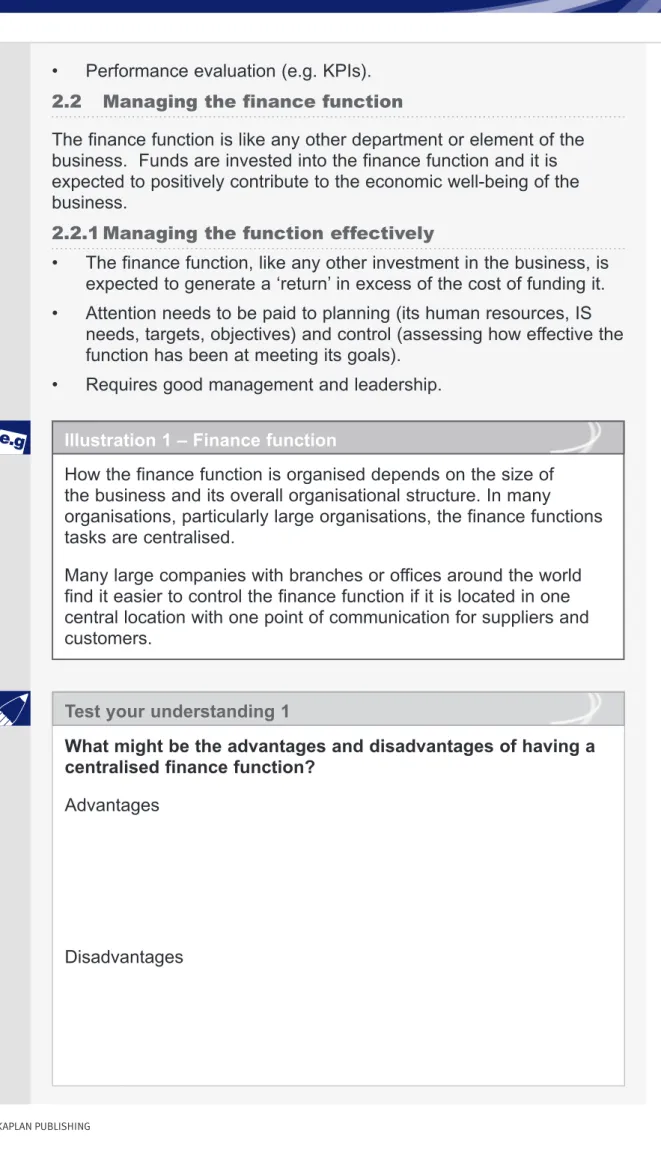
How the finance function is organised depends on the size of the business and its overall organisational structure. In many
organisations, particularly large organisations, the finance functions tasks are centralised.
Many large companies with branches or offices around the world find it easier to control the finance function if it is located in one central location with one point of communication for suppliers and customers.
Illustration 1 – Finance function
What might be the advantages and disadvantages of having a centralised finance function?
Advantages
Disadvantages
2.2.2 Quality of the information produced
Much of the ‘output’ of the finance function = information (e.g. management accounts, budgets).
Key issue = benefit derived from info produced > cost in deriving it
g think of chapter 6 points.
2.2.3 Quality of the decisions made
Similarly, the finance function will make decisions affecting the profitability of the business (e.g. negotiating loans from bankers). These decisions need to be assessed for ‘quality’ as would any other decision in the business. (e.g. favourable terms gained on loan).
2.2.4 Financial control processes
The finance function faces particular risks which could result in serious pecuniary and other losses. Effective control over the function is critical.
3 The accountant's role
3.1 Financial accountants
Financial accountants maintain the bookkeeping system of nominal ledger, purchase ledger, sales ledger, etc, and prepare financial statements as required by the law and accounting standards. • • • • • control Processes control environment culture. Management philosophy. authority. segregation of duties. business ethics, etc. • • • • • control activities specific controls – manual/ physical (e.g. cash in locked safe) and programmed (e.g. checks that mgt a/cs = fin a/cs). • risk assessment processes identify/ respond to risks (e.g. how the business copes with growth/ technology Δ. • Is control over infrastructure, operations, data, staff, etc. • Monitoring of controls checking controls working as prescribed. •
3.2 Management accountants
Cost accounting provides a detailed analysis of the costs of products and services, activities and responsibility centres of an organisation. Management accounting systems use the cost accounts and other information sources to provide a financial reporting system for management. Management accountants are providers of financial information.
3.3 The roles of the management accountant and financial accountant. Management accountant Financial accountant Information mainly produced for
Internal use, e.g. managers and employees.
External use, e.g.
shareholders, suppliers, lenders, banks, government. Purpose of information To aid planning,
controlling and decision making.
To record the financial performance in a period and the financial position at the end of that period. Legal
requirements
None. Limited companies
must produce financial accounts.
Formats Management decide on the information they require and the most useful way of
presenting it.
Format and content of financial accounts intending to give a true and fair view should follow accounting
standards and company law.
Nature of information
Financial and non-financial.
Mostly financial. Time period Historical and
forward-looking.
Mainly a historical record.
3.4 Non-financial information
Information provided by cost accounting systems is financial in nature.
Financial information is important for management, because many objectives of an organisation are financial in nature, such as making profits and avoiding insolvency. Managers also need information of a non-financial nature.
• •
Suppose that you are a manager in a general hospital. Give examples of the cost information that you might want to know about and have reported to you.
Solution
Test your understanding 2
The management accounting systems in many organisations are able to obtain non-financial as well as financial information for reporting to management.
At a strategic level, management need to know about
developments in their markets and in the economic situation. They also need to know about any new technology that emerges, and about the activities of competitors.
At a tactical level, they might want to know about issues such as product or service quality, speed of handling customer complaints, customer satisfaction levels, employee skills levels and employee morale.
At an operational level, they may want to know about the number of rejects per machine, the lead time for delivering materials and the number of labour and machine hours available.
Chapter summary the FInance FunctIon supporting objectives: provide information ensure finance. • • rePortIng FunctIons and control Processes the accountant's role financial accountants Management accountants. • •
Test your understanding answers
Advantages
Better cash management. Easier external reporting. Disadvantages
Providing local managers with information may prove problematic.
Global organisations may have difficulties dealing with exchange rates and different time zones.
• •
• •
Test your understanding 1
Here are some suggestions.
1 The cost of each department (e.g. the ear, nose and throat department, accident and emergency, the X-ray unit, and so on).
2 The cost of carrying out different types of surgical operation. 3 The average cost of each type or course of treatment.
4 The daily cost of looking after a patient in hospital (the cost of a patient/day).