doi:10.1016/j.sepro.2011.08.022
Systems Engineering Procedia 1 (2011) 130–136
2011 International Conference on Risk and Engineering Management (REM)
A fuzzy-stochastic Constraint Programming Model for Hazmat
Road Transportation Considering Terrorism Attacking
Hongmei Jia
a,b*, Lin Zhang
a,b, Xiuling Lou
a,b, Huiyun Cao
a,b aCollege of Civil and Architectural Engineering,Hebei United University,Tangshan 063009, China
b
Abstract
Earthquake Engineering Research Center of Hebei Province, Tangshan 063009, China
A lot of research has been achieved on Hazmat transportation routing problems in order to minimize risk-related costs which is consequence of a natural accident. As the terrorist threat is growing, Hazmat shipment has became a new target of terrorist attacks, it is therefore necessary to consider the terrorist threat into the Hazmat routing model. In this work, we consider the following hazmat transportation scheduling problem in traffic engineering: a hazmat shipment has to be shipped over a road transportation network in order to transport a given amount of hazardous materials from a specific origin point to a specific destination point every day. We design a route to minimize the risks from the natural accident and the uncertainty of a terrorist threat, and develop a fuzzy-stochastic constraint programming method to deal with multiple uncertainties presented in terms of fuzzy sets, interval values and random variables which representing the probabilities and fatality rates of the terrorist attacking. Finally, it illustrates the methodology on a case study.
Keywords: hazmat transportation; transpoatation routing; terrorism attack; trsffic engineering; heuristic algorithm
1.INSTRODUCTION
Hazardous materials (hazmat) are integral to industrialized societies, and in almost all instances originate at a location other than their destination. Approximately 4 billions of hazardous materials (hazmat) tons move daily through the world, and more than 2 billion tons of hazmat (of which 65% are carried by truck and rail) are being transported yearly in China. Routing is a critical factor to consider in hazmat logistics. Although the number of fatalities per year due to hazmat-related traffic accidents is almost negligible as compared to the annual number of deaths in ordinary traffic accidents, hazmat risks are considered unacceptable, the public is very sensitive to the dangers of hazmat transportation activity. After the September 11 attacks, the terrorist threat is growing around the world, Hazmat shipment has became a new target of terrorist attacks, it is therefore necessary to develop a Hazmat routing model with consideration of the terrorist threat, which provide guidance to state and local governments regarding which highway facilities might be restricted (for which materials and under which conditions) is a challenging but important activity. The indispensability of hazmat to modern society implies that such accidents
* Jianqiang Han. Tel.: 86-315-2592180; fax: 0315-2592182.
E-mail address: [email protected]
© 2011 Published by Elsevier B.V.
Selection and/or peer-review under responsibility of the Organising Committee of The International Conference of Risk and Engineering Management.
Open access underCC BY-NC-ND license.
2211-3819 © 2011 Published by Elsevier B.V.
Selection and/or peer-review under responsibility of the Organising Committee of The International Conference of Risk and Engineering Management.
cannot be avoided, and hence researchers have focused on developing risk assessment and mitigation strategies. 2. LITERATURE REVIEW
Highway transportation of hazmat has received a lot of attention over the past two decades, wherein most of the work focused on risk assessment and route selection (Erkut, Tjandra, & Verter, 2007).
In literatures, the risk imposed by the transportation of hazardous materials is expressed by the product of the probability of an accident timing the measure of its consequences. Therefore, the risk minimization in hazardous materials transportation can be accomplished both by minimizing the hazardous materials accident probability and the reduction of the accidents impacts. The consideration of risk as a criterion for selecting hazardous materials routes contributes substantially to the reduction of accident probability and the severity of the accidents impacts. The consideration of risk as a criterion for selecting hazardous materials routes contributes substantially to the reduction of accident probability and the severity of the accidents impacts.
One of the main issues of hazmat shipments is hazmat routing problem. There are a lot of works be done in this area. Chin and Paul lay out a bicriterion problem that minimizes the distance traveled and the population at risk within a fixed band width along the path. Gopalan etc. focus on development and analysis of a model to generate an equitable set of routes for hazardous material transportation. Lindner-Dutton etc. follow-up on the observation that risk equity between these zones is achieved only after all the shipments are done. Kalelkar and Brooks use decision analysis in optimizing choices regarding material transportation. Kara and Verter pose the hazmat network design problem as a bilevel problem for determining paths with minimum total risk and minimum total costs. Bianco and Garamia proposed bilevel model for determining paths with minimum total risk while guaranteeing equitable risk spreading. Dadkar et al. (2008) and Nielsen et al. (2005) developed K shortest path algorithms for stochastic and dynamic networks. Dadkar et al. (2008) focused on problem instances where the distribution of each link attribute is continuous whereas Nielsen et al. (2005) focused on problem instances where the distribution of the link attributes is discrete with integer values.
There is substantial interest in research related to transportation and terrorism. To date much of that research has focused on identifying what parts of the transportation system are vulnerable to terrorism and initial ideas of what should be done about those vulnerabilities. For example, see Szyliowicz and Viotti (1997), Chatterjee et al. (2001), Frederickson and LaPorte (2002), and Haimes and Longstaff (2002). Dadkar (2010)develops a game-theoretic model of the interactions among government agencies, shippers/carriers and terrorists as a framework for the analysis.
In this paper, we study a fuzzy-stochastic constraint programming for hazmat transportation network design. The problem we consider is the following: a hazmat shipment has to be shipped over a road transportation network in order to transport a given amount of hazardous materials from a specific origin point to a specific destination. We design a route to minimize the risks from the natural accident and the uncertainty of a terrorist threat, and develop a fuzzy-stochastic constraint programming method to deal with multiple uncertainties presented in terms of fuzzy sets, interval values and random variables which representing the probabilities and fatality rates of the terrorist attacking. Finally, it illustrates the methodology on a case study. To the best of our knowledge, this is the first work that pays particular attention to a fuzzy stochastic model for hazmat transportation with considering the risks from the terrorism threat.
3.LINK ATTRIBUTED RISKS
In the most researches, link risks are calculated by natural accident rates timing the number of suffered people from a specified level of harm in a given population from the realization of specified hazards. As the terrorist threat is growing in resent years, Hazmat shipment has became a new target of terrorist attacks, it is therefore necessary to consider terrorism risk into the Hazmat routing model. In this section, we discuss how to define and calculate link attributed terrorism risk.
Terrorism risk can be defined as the anticipated consequences over some period of time to a distinct set of targets, consequential of a definite set of threats. Therefore threats, vulnerabilities, and consequences play a considerable part in the overall terrorism risk. Terrorism Risk can be measured as the expected consequence of an existing threat, for a given target, attack mode, and damage type. Since terrorism risk is the product of threat,
vulnerability and consequence (Terrorism Risk= Threat X Vulnerability X Consequence).
Terrorism Risk= Probability (attack occurs) X Probability (attack results in damage | attack occurs) X Expectation (damage | attack occurs and results in damage).
So, terrorism risk indicates the expected consequences of attacks considering the possibility of the occurrence and success of the terrorist attacks. In terms of probability, a terrorism risk from an attack of a certain type is the unconditional expected value of damages of a certain type. Formulating terrorism risk helps in providing an approach for comparing and aggregating terrorism risk, and also provides a clear mapping between risk and approaches to managing or mitigating terrorism risk.
Usually attack mode is uncertainties and the damages from a certain terrorism type are random, for example, the demographic distribution in cities varies during time of day, therefore usually terrorism risk is a random fuzzy variables. Here LetN
^
n1,n2,n3,...,nn`
,^
`
n ij n ij ij ij ij n n n n C /P , /P , /P3,..., /P 3 2 2 11 be a set of terrorism attack types and the set
of fuzzy terrorism attacks of link i,j ,
n
k/
P
ijkmeans the possibility of terrorism attackn
kof link i,j is k ijP
.As we know, the terrorism risk of link i,j , i,j A is a fuzzy random variable, that means the total terrorism
risk of any rout on the network is a fuzzy random variable. 4. THE FUZZY –STOCHASTIC CONSTRAINT MODEL
Most Hazmat transportation models which has primarily a hard or crisp structure have been developed, which means the transportation solutions made by the carriers have to be satisfied with the hard constraints limited by the governments, these solutions are considered as unfeasible. As we talked in the last section, the terrorism risk is a fuzzy random variable, so there is impossible to find the best solutions when we consider terrorism attacks into Hazmat transportation strategies, we just care about how to get the reasonable solutions with an aspiration level.
In this section, we develop a new hazmat transportation model to describe the hazmat transportation routing problem as a fuzzy-stochastic constraint programming formulation, which means we deal with multiple uncertainties presented in terms of fuzzy sets, interval values and random variables which representing the terrorism type and the damages of the terrorist attacking.
The hazmat transportation network problem is described as a fuzzy-stochastic constraint programming formulation, is a graph theoretical problem defined on a directed graph G V,AwhereV is the set of vertices,
andAis the set of arcs of the graph. A vertex corresponds to a road intersection, and an arc corresponds to a road
segment on the network. A riskrij is associated with each arc that represents the natural risk of shipment travelling
from nodeito nodej, i,j A. A risk ij
k is associated with each arc that represents the terrorism risk of shipment
travelling from nodeito nodej which is a fuzzy random variable as we talked in the third section, i,j A.
Letxij 1, if arci,jis used in the optimal network, 0 otherwise.
Letyij t 1, if arci,j is available for transportation of hazmat at timet, 0 otherwise.
As we talked in section 3, the terrorism risks are fuzzy random variables since attack mode is uncertainties and the damages are random. We define these problems with fuzzy random variables are double uncertainty problems. To solve these double uncertainty problems, the follow two definitions are proposed.
Definition 1: let
4ˈp4,Pos
be a possibility space of fuzzy variables, and A is an element of set p4 , then
^ `
A
Pos
^ `
A
Nec
^ `
A
Cr
2
1
is defined as the creditability measure of A, and
Nec
^ `
A
1
Pos
^ `
A
e isthe necessity measure of A.
Definition 2: let
[
^
[
1,
[
2,...,
[
nˈ
`
be a set of fuzzy random vectors of the possibility space of fuzzy variables :ˈA,Pr, andf :Rn oRmbe the creditability function, then:^
f [ t f`
a^
ECr^
Z:^
f^
[ Z`
t f`
tE`
tD`
Ch sup Pr
is the average opportunity measure
D
of fuzzy random event f [ t f .In this paper, we develop the fuzzy-stochastic constraint programming model formulation according to definition 2, which is:
¦
¦
¦
A j i ij F ij ij ij ij A j i ij ijc xr xk x , , , min(1)
s.t.
^
k k`
a i j A Ch ij d ij tE, , (2)
° ¯ ° ® z¦
¦
D i D S i S i x x A j i j ji A j i j ij , 1 , , 0 , 1 , : , :(3)
ij ijy
x
d
(4)
^ `
i j A xij 0,1ˈ , (5)
^ `
i j A yij 0,1ˈ , (6)The objective (1) is to minimize the total risks and costs on the network used by the carriers. Constraints (2) are fuzzy random constraints of terrorism attack. Constraints (3) ensure the flow from its origin to destination. Constraints (4) ensure that only edges selected by the government can be used by the carriers. Constraints (5) and (6) are binary requirements on the variables.
We assume link risks are time-dependent whereas travel time is constant since travel speed is not significantly affected by congestion.
The fuzzy stochastic model is similar to the common network flow model, besides considering the terrorism attack risk which are fuzzy random, the risk equity of whole road network is concerned too. So the target of the proposed fuzzy stochastic model is to search the route with the lowest costs and risks on
D
which is satisfiedE
. 5. HEURISTIC SOLUTION OF THE TIME-DEPENDENT MODELThe classical heuristics can not be implemented since the model including fuzzy random variables. Considering usually we choose a set of routes as the candidates in Hazmat road transportation, we adopt genetic algorithm which characterized by parallel and global search. The algorithm follows.
5.1. population initialization and chromosome coding
We adopt natural number coding to construct the genes. Set 0 as depot, 1,2,…,L as road nodes. We generate the random numbers which between
> @
1
,
n
for the initial population. The more details can be searched in the related literatures.5.2. fitness function and calculation
According to the fuzzy stochastic model in section 4, the fitness function is following:
IJ
K
K
Here we simulate the fitness on the computer, here the probabilities of the terrorism attack on link i,j is:
^
n`
ij n ij ij ij ij n n n n C /P , /P , 3/P3,..., /P 2 2 1 1Here we simulate the accidents of the terrorism attack on the computer with Ntimes. The steps are following
STEP1 set i 0
STEP2 here we assume the number of the links attacked possibly is m, we generate terrorism attack accidents on the possibility space of fuzzy variables on link i,j (the probability must be greater than 0), calculate the probabilities
P
1i,P
2i,…,P
mi , andP
iP
1i
P
2i
...
P
mi ;STEP 3 according to the fatality rates of link i,j , calculate
k
iji of^
d i`
tE ij i ij k kPr by simulating on the computer, to STEP 3.1;
^
e e`
ij k p k p k p
k 1, 1 , 2, 2 ,..., ,
Set the simulation times are
N
s and j 0;STEP 3.2 if
j
!
N
s, to STEP 3.3; otherwise, generate the random number between 0-1 to the links attacked possiblym
, and find the correspond fatality rate;STEP 3.3 sort
^
iji iji ijNi`
sk
k
k
1,
2,...,
, and set the>
ExNs@
1as i ijk
, to STEP 4; STEP 4 setn
n
1
, ifn
d
N
F, to STEP 1, otherwise, define^
`
^
`
¸ ¹ · ¨ © § t d d d d ij j ij j ij N j ij j ij j ij N j ij k k k k k L F F P P max 1 max 2 1 1 1Calculate the maximal
k
ijwhich is satisfiedL
k
ijt
P
by dichotomy, which is the fitness of the gene. 5.3. tactics selectionHere we implement the best individual saved tactic and roulette wheel selection. The operator is: array N individual of each population according to the fitness. The first is the best individual, according to the best individual saved tactic, copy it directly to the next population. Other N-1 individuals of the next population are generated by roulette wheel selection according to their fitness of the previous population.
5.4. crossover operation
We adopt OX crossover. The crossover operator is happened on the probability
P
C. Choose The place of the crossover is random.5.5. mutation operation
The mutation operator is happened on the probability
P
m. The swap times J is generated randomly in case the mutation operator is happened.6. EXPERIMENTAL ANALYSES
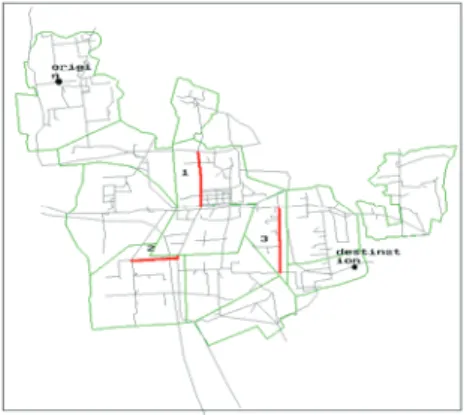
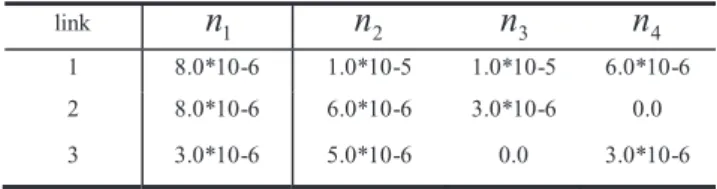
In this section, we will show the computational results achieved by the proposed fuzzy stochastics model and the proposed heuristic algorithm. We implement the heuristic algorithms and solve the network flow problems by VC++. We perform all testing on the road networks, which is shown in Fig.1. The road network is composed of 21 effective vertices and 46 arcs, the red links mean the road which could probably attacked by terrorists. The hazmat shipments shipped from the origin point to the destination point. To shorten computing time, we classify roads to four categories and the traffic and accident rates are same of every category. There are 3 potential attacking points spreading on the network which are located in the 3 links. The probabilities of evolving terrorism attack are shown in table 1, and fatality rates are shown in table 2.
Table 1 the probabilities of evolving terrorism attack
link
n
1n
2n
3n
41 8.0*10-6 1.0*10-5 1.0*10-5 6.0*10-6
2 8.0*10-6 6.0*10-6 3.0*10-6 0.0
3 3.0*10-6 5.0*10-6 0.0 3.0*10-6
Table 2 the fatality rates of evolving terrorism attack
mode Fatality rate(rates, probabilities)
1
n
(0.1, 0.6),(0.1, 0.2),(0.2, 0.1),(0.6, 0.1) 2n
(0.2, 0.1),(0.2, 0.1),(0.1, 0.2),(0.1, 0.6) 3n
(0.5, 0.2),(0.6, 0.3),(0.7, 0.3),(0.8, 0.2) 4n
(0.7, 0.1),(0.8, 0.1),(0.9, 0.2),(1.0, 0.6)And in this case,
D
0.8
,E
0.2
. And for comparing the solutions calculated by different policies, we design three routing polices: the first one represents the routings which would be chosen by minimizing natural risks in absence of any terrorism attacking risk-related routing policy; the second one aims to minimize the terrorism risks; the third one is the one we proposed in this paper. Table 3 summarizes the implications of these policies.Table 3 the implication of different polices
Policy 1 Policy 2 Policy 3
Natural risks 7.634*104 8.973*104 7.650*104
Terrorism risks 1.423*104 1.271*104 1.271*104
Total risks 9.057*104 10.244*104 8.921*104
The total population exposure of policy 1 from nature is the most minimum around the three policies while the maximum population exposure from terrorism attack is the most maximum since terrorism attack isn’t considered in policy 1. terrorism attack risk is same considered in policy 2 and policy 3 , but the population exposure of policy 2 from nature is higher than policy 3. So we can conclude the terrorism attack risks could be reduced significantly.
7.CONCLUSION
In this paper, we analyzed how terrorism attack affects hazmat transportation routing selection and proposed a new fuzzy stochastic model for hazmat transportation scheduling problem represents the distinction between the risks as the consequence of a natural accident and terrorism attack. We develop a fuzzy-stochastic constraint programming method to deal with multiple uncertainties presented in terms of fuzzy sets, interval values and random variables which representing the probabilities and fatality rates of the terrorist attacking. Finally, we experimented the proposed fuzzy stochastic model and heuristic algorithm on the scenarios of a road network.
Acknowledgements
This research was conducted at Hebei United University. We acknowledge the financial support of the Natural Sciences Foundation of Hebei United University: Study on the routing strategy models based on TRANSCAD for regional hazmat transportation.
References
1. Abkovitz, M., Eiger, M., Srinivasan, S., Estimating the release rates and costs of transporting hazardous waste. Transportation Research Record, Vol.977, pp.22-30. (1984).
2. Akgün, V., Erkut, E., Batta, R., On finding dissimilar paths. European Journal of Operations Research, Vol.121, pp.232-246. (2000). 3. B. Fabiano, F. Curro`, A.P. Reverberi, R. Pastorino, Dangerous good transportation by road: from risk analysis to emergency planning, Journal of Loss Prevention in the Process Industries, Vol.18, pp.403-413. (2005).
4. Carotenuto, P., Giordani, S., Ricciardelli, S., Finding minimum and equitable risk routes for hazmat shipments. Computers and Operations Research, Vol.34, pp.1304-1327. (2007).
5. Chang-Xing REN, Zong-zhi WU, On route-choice analysis of hazardous materials transportation, JOURNAL OF SAFETY AND ENVIRONMENT, Vol.6, pp. , (2006).
6. DellÿOlmo, P., Gentili, M., Scozzari, A., On finding dissimilar Pareto-optimal paths. European Journal of Operations Research, Vol.162,
pp.70-82. (2005).
7. Erkut, E., Alp, O., Designing a road network for hazardous materials shipments. Computers and Operations Research, Vol.34, pp.1389-1405. (2007).
8. Erkut, E., Gzara, F., Solving the hazmat transport network design problem. Computers and Operations Research, Vol.35, pp.2234-2247. (2008).
9.Guang-Min WANG, Zhong-Ping WAN, Xian-Jia WANG, Bibliography on bilevel programming, Advances in Mathematics. Vol.36,pp.153-129, (2007).
10. Gopalan, R., Kolluri, K.S., Batta, R., Karwan, M.H., Modeling equity of risk in the transportation of hazardous materials, Operations Research, Vol.38, pp.961-973. (1990).
11. Guo-Zhen TAN, Wen Gao, Shortest ath algorithm in Time-Dependent Networs. Chinese J. computers, Vol. 25, pp.165-172, (2002). 12. Hong-Mei, JIA, The Study of Road HazMat Transportation Strategies, [D], Jilin University, Master thesis, (2006).
13. J. K. Vrijling, W. van Hengel and R. J. Houben, A framework for risk evaluation, Journal of Hazardous Materials, Vol.43, Issue 3, pp.245-261. (1995).
14. Kara, B.Y., Verter, V., Designing a road network for hazardous materials transportation. Transportation Science, Vol.38, pp.188-196. (2004).
15. K.G.Zografos, K.N.Androutsopoulos, A heuristic algorithm for solving hazardous materials distribution problems ˈEuropean Journal of
Operational Research, Vol.2, pp. 507-519,(2004).
16. Lindner-Dutton, L., Batta, R., Karwan, M., Equitable sequencing of a given set of hazardous materials shipments, Transportation Science, Vol. 25, pp.124-137. (1991).
17. List, G. F., P. B. Mirchandani, An integrated network/planar multiobjective model for routing and siting for hazardousmaterials and wastes, Transportation Sci. Vol.25(2), pp.146-156. (1991).
18. List, G. F., P. B. Mirchandani, M. A. Turnquist, K. G. Zografos. Modeling and analysis of hazardous materials transportation: Risk analysis, routing/scheduling and facility location. TransportationSci. Vol. 25(2) pp.100-114. (1991).
19. Lucio Bianco, Massimiliano Caramia, Stefano Giordani , A bilevel flow model for hazmat transportation network design, Vol.17, pp.175-196. (2009).
20. Marianov V., ReVelle C., Linear nonappoximated models for optimal routing in hazardous environments, Journal of the Operational Research Society, Vol.49, pp.157-164. (1998).
21. P. Leonelli, S. Bonvicini , G. Spadoni, Hazardous materials transportation: a risk-analysis-based routing methodology, Journal of Hazardous Materials, Vol.71,pp. 283-300,( 2000).
22. William C. Frank, Jean-Claude Thill, Rajan Batta, Spatial decision support system for hazardous material truck routing, Transportation Research Part C, Vol.8, pp.337-359. (2000).