Effect on Superficial Variability of Examples on Learning Applied Probability
Tiantian Jin
Submitted in partial fulfillment of the requirements for the degree of
Doctor of Philosophy under the Executive Committee of the Graduate School of Arts and Sciences
COLUMBIA UNIVERSITY 2018
© 2018 Tiantian Jin All rights reserved
ABSTRACT
Effect of Superficial Variability of Examples on Learning Applied Probability Tiantian Jin
Learning through examples is a central and widely used instructional device for teaching mathematically-based subjects such as statistical probability. However, the applications of the superficial variability of examples remain controversial. This dissertation investigates how the superficial variability of multiple examples influences students’ learning and transfer of probability problem-solving. Moreover, the author discovers whether content difficulty affects the influence of examples’ superficial variability. Three conditions were developed and compared: consistent-surface condition (CS), varied-surface-within-rule condition (VSWR), and varied-surface-between-rule condition (VSBR). For the purpose of exploration and methodology improvement for the dissertation study, two pilot studies were conducted. However, conflicting results were shown in those two studies. In the first pilot study, students in CS condition performed the worst. In the second pilot study, students in VSBR condition performed the worst. These conflicting results encouraged the author even more to conduct the dissertation study with a larger sample size and improved methodology. In this dissertation study, the author found that students’ performance on the posttests in VSBR was significantly worse than in the other two conditions, which was consistent with the second pilot study, and that their performance in CS and VSWR condition was not different. Contrary to expectation, the strength of the pattern of the effect of the superficial variability of examples did not vary between the easy and difficult types of problems. Moreover, the pattern was the same when the difficulty variable was not
included. These results suggested that examples’ superficial consistency between different problem types promotes more effective learning than superficial variation between different problem types. The consistency can be one single cover story used multiple times for each type of problem or the same battery of varied cover stories used repeatedly for different types of problem. Moreover, the pattern of the influence of superficial variability of examples is robust among types of the problem at varying difficulty levels.
i
Tables of Contents
List of Tables ... ii
List of Figures ... iii
Acknowledgements ...v
1. Introduction (Research Goal and Scholarly Significance of Dissertation) ...1
2. Literature Review...3
2.1.Schema Construction ...2
2.2.Analogical Transfer ...4
2.3.Learning through examples ...7
2.3.1. Multiple Examples……….7
2.3.2. Varied Examples………....8
2.3.3. The Role of Prior Knowledge………..…13
2.4.Conceptual Framework of This Dissertation Project ...14
3. Pilot Studies ...20
3.1.Pilot One ...20
3.1.1. Methodology………...25
3.1.2. Results and Discussion……….27
3.1.3. Conclusions……….…34
3.1.4. Limitations and Improvements of the Experiment Design………...……34
3.2.Pilot Two ...35
3.2.1. Methodology……….36
3.2.2. Results and Discussion.……….38
3.2.3. Conclusions……….………44
3.2.4. Limitations and Improvements of the Experiment Design……….…45
4. Dissertation Study Overview ...47
5. Research Questions and Hypotheses for the Dissertation Study ...48
6. Methodology ...50
6.1.Participants ...50
6.2.Design and Manipulation ...50
6.3.Procedure ...51
6.4.Materials and Measures ...53
7. Results ...56
8. Discussion ...71
9. Limitations and Future Research Direction ...75
References ...77
Appendix A. Personal Information Survey ...86
Appendix B. Comprehension Questions in the Pretest ...87
Appendix C. Application Questions in the Pretest ...88
Appendix D. Questions in the Transfer Test ...90
Appendix E. Feedback Survey ...92
Appendix F. Sample Worked Problem ...93
Appendix G. Screen Shots for the Instructional Slides ...94
ii List of Tables
Table 1 Comparison of Design and Definition in Ross (1989b) and Quilici & Mayer (1996)
...13
Table 2 Three Conditions...21
Table 3 Differences in Design for Two Pilot Studies ...38
Table 4 Comparisons of the Results in Two Pilot Studies ...45
Table 7.1 Accuracies of the four tests of all conditions and each separate condition...56
Table 7.2.1 Values of cond_new ...60
Table 7.2.2 Helmert Contrast Results (K Matrix) of the Two Posttests ...60
Table 7.3 Helmert Contrast Results (K Matrix) for the Transfer Test ...62
Table 7.4.1 Difficulty Ratings of the Easy and Difficult Rules ...64
Table 7.4.2 Performance on Two Difficulty Levels of Rules in the Tests ...65
Table 7.4.3 Within-Subject Factors in the Three Way Mixed ANCOVA Test (BWW)...67
Table 7.4.4 Tests of Within-Subjects Effects ...67
Table 7.4.5 Helmert Contrast Results (K Matrix) for the Posttests with Difficulty as a Within-Subject Factor ...68
Table 7.4.6 Helmert Contrast Results (K Matrix) for the Transfer Test with Difficulty as a Within-Subject Factor ...70
iii List of Figures
Figure 1. Analogical Transfer & Schema Construction...16
Figure 2. The Learning Process Through Examples ...22
Figure 3. Different Processes of Schema Construction in Three Conditions ...23
Figure 4. Participants' Performance Accuracy in Pretest and Posttest...28
Figure 5. Performance Accuracy in Pretest and Posttest of Three Groups ...28
Figure 6. Equivalent Prior Knowledge Across Groups ...29
Figure 7. Accuracy Improvements Across Groups ...30
Figure 8. Accuracy Improvements for Permutation Questions across Groups ...31
Figure 9. Comparisons of Helpfulness for Instructions of Each Rule ...32
Figure 10. Overall Performance Accuracy of Each rule ...34
Figure 11. The Task Flow in Two Pilot Studies ...37
Figure 12. Participants' Performance Accuracy in Pretest and Posttest in Pilot 2 ...39
Figure 13. Performance Accuracy in Pretest and Posttest of Three Groups in Pilot 2 ...39
Figure 14. Inequivalent Prior Knowledge across Groups in Pilot 2 ...40
Figure 15. The Performance Improvement in Three Groups in Pilot 2 ...41
Figure 16. The Performance Improvement of the Difficult Rule in Three Groups in Pilot 2...43
Figure 17. The Performance in the Transfer Test Across Three Groups in Pilot 2 ...44
Figure 18. The Performance in the Delayed Transfer Test Across Three Groups in Pilot 2...44
Figure 6.3. Task Flow in the Dissertation Study…….………….……….……52 Figure 7.1.1. Mean of Accuracies of the Pretest, Posttest, Transfer Test and Delayed
iv
Posttest in Each Condition (Clustered by Condition) ...58 Figure 7.1.2. Mean of Accuracies of the Pretest, Posttest, Transfer Test and Delayed Posttest in Each Condition (Clustered by the Type of Tests) ...58 Figure 7.2.1. Profile Plots of Students’ Performance in Two Posttests in Three Conditions ...61 Figure 7.3. Profile Plots of Students’ Performance in the Transfer Test ...63 Figure 7.4.1. Perceived Difficulty of the Easy and Difficult Rules ...65 Figure 7.4.2. Performance on the Easy and Difficult Rules in Four Separate and Overall Tests ...66 Figure 7.4.3. Profile Plots of Students’ Performance in Two Posttests at Two Difficulty Levels in Three Conditions ...68 Figure 7.4.4. Profile Plots of Students’ Performance in the Transfer Test at Two Difficulty Levels in Three Conditions ...70
v
Acknowledgement
After an intensive period, today is the day to reflect on the people who have supported and helped me so much throughout all difficulty and stress.
I would first like to express the deepest appreciation to my advisor Professor John Black, who has provided me with generous support and advice in designing and
conducting this study. I am also grateful to Professor James Corter, who always directed me to the right path, and Professor Ryan Baker, who never failed to be supportive and encouraging. I also want to thank Professor Fran Blumberg for her continued support and care, and Professor Mitchell Rabinowitz for his valuable suggestions.
A special thank you to Kim Moy. I am so lucky to have met you. You have no idea how much your help has meant, not only for this dissertation but also for my career and life. Other many thanks go to Juan Wu. Thank you for taking care of Meatball and me with the warmest heart all the time.
Nobody has been more important to me in the pursuit of this project than the members of my family. I would like to thank my parents, who sacrificed all they had and more, so that I could pursue whatever I want. Finally, to my partner, best friend, and love of my life, Hao Qu: thank you for your love, support and understanding. Thank you for making me a better me. I believe that the future will be brighter and happier, with you.
1
1 Introduction
Research Goal and Scholarly Significance of this Dissertation Project In the past, research on learning and cognition has shown that superficial variability of examples affects learning and transfer (Ross 1989b; Quilici & Mayer, 1996). However, the mechanism by which and the extent to which superficial variability of multiple examples exerts influence remain controversial. Without a clear
understanding of the influence, it is difficult for instructors to find a more effective way to teach students. The purpose of this dissertation project is to study the effects of superficial variability of instructional examples on learning performance and transfer. Moreover, the author explores whether the strength of its effects is different for concepts and problem types at different difficulty levels. In this dissertation study, the learning domain is statistical probability, chosen because the author had observed that statistical probability was challenging for most college students. The information can be used to help refine instructional design for probability and to help students acquire a more effective learning outcome. Furthermore, the learning process and strategy of most mathematically-based curricula are very similar. If the instructional method has a positive effect on the learning of statistical probability, it is reasonable to suggest that the same approach may be useful in the learning of other mathematically-based subjects.
2
2 Literature Review 2.1 Schema Construction
Learning is a constant process of acquiring new knowledge, combining it with existing knowledge, and rebuilding the internal deep structures of all related knowledge points. The internal mental structures are referred to as "schemas" (Piaget, Elkind, & Tenzer, 1968). The appropriateness of schemas affects whether individuals are able to understand concepts successfully and solve related problems (Mayer, 1992). Word problems are a common question type for mathematics-related knowledge, including statistics. As individuals look at word problems, beyond linguistic and semantic
knowledge, they also need knowledge of the problem type. To clarify, the problem type is not about the format of a problem, but rather the essential concepts involved in that problem. Therefore, concept and problem type have very similar definitions in this study. The knowledge of the problem type is schematic knowledge, which helps to distinguish relevant from irrelevant information (Mayer, 1991). As demonstrated in various studies, schematic knowledge is a fundamental component of mathematical problem-solving expertise (Chi, Feltovich, & Glaser, 1981; Cummins, 1992; Hinsley, Hayes, & Simon, 1977; Mayer, 1981, 1982; Riley, Greeno, & Heller, 1983; Schoenfeld & Herrmann, 1982; Silver, 1981). Research on expertise has suggested that experts are more likely to sort problems on the basis of deep structural features and less likely to sort on the basis of superficial features when compared to novices (Chi, Feltovich, & Glaser, 1981; Rabinowitz & Hogan, 2001; Silver, 1981). Superficial features depend on attributes of objects in the problem and are derived from aspects of cover stories, whereas deep structural features depend on relations among objects and determine aspects of the
3
required solution procedure (Vosniadou & Ortony, 1989). For instance, in this
dissertation study, superficial features of permutations problem include story characters (drawing cards from a deck of poker cards, picking marbles from a jar of colorful marbles, etc.). The deep structural features of permutations problem include whether the
order of things (a card of King and a card of A, and a blue marble and a red marble) is considered. If the order is not considered, the problem may be a combinations problem instead of a permutations problem. Obviously, successful problem solving is closely related to structure-based problem schemas, rather than surface-based ones. For that reason, learning and instructional materials, such as examples and practices, should promote students' ability to recognize structural features rather than focus on surface features.
When individuals learn with examples, schemas play the role as abstractions from specific problem instances that can be used to make inferences about instances of the concepts they represent (Anderson, 2010). In other words, schemas are at the heart of successful problem representation, which is a major factor in solving a word problem. Hence, appropriate problem schemas can affect whether subjects are able to solve a word problem. For example, Riley, Greeno, and Heller (1983) have suggested that failure to solve word problems might be caused by a lack of appropriate schemas, rather than poor arithmetic or logical skills. Moreover, Hinsley, Hayes, and Simon (1977) have illustrated that wrong schemas can result in many difficulties in solving word problems.
Previous studies have shown that schema acquisition plays a critical role in reaching transfer of problem-solving skills (Pass & Van Merrienboer, 1994). Cognitive schemas are conceptualized as cognitive structures that enable problem solvers to
4
recognize problems as belonging to particular categories, requiring particular operations to reach a solution (Pass & Van Merrienboer, 1994). Similarly, Gick and Holyoak (1983) have defined a schema as the generalized description of two or more problems and their solutions. Additionally, their results indicated that when problem solvers generated a more effective schema, transfer was enhanced. Subsequently, Cooper and Sweller (1987) have examined the effect of schema acquisition on problem-solving transfer as well. According to their empirical results, schema acquisition precedes rule automation, and has a strong impact on problems similar to initial acquisition problems, which promotes problem-solving transfer.
Since schema construction is a critical component of successful learning and problem solving, it is necessary to probe how the process of schema construction can be promoted. According to research on learning from examples, experience with example problems has promoted the construction of problem schemas (Bransford, 1979; Reed & Bolstad, 1991; Sweller & Cooper, 1985; Ward & Sweller, 1990; Zhu & Simon, 1987). Moreover, Ranzijn (1991) and Shapiro and Schmidt (1982) have demonstrated that schema acquisition benefits from wide variability of practice along the task dimensions, and in turn transfer of acquired skills can be facilitated because varied practice increases the chances that similar features can be identified and that relevant features can be distinguished from irrelevant ones.
2.2 Analogical Transfer
Learning is never only for being able to solve any specific example question, but rather for being able to transfer the knowledge or skill acquired from the solved problems to new ones. Thinking by analogy is one critical strategy during this process. For
5
example, when a person is confronted with a new statistics word problem (which is the target problem), he/she can solve it by drawing an analogy to a similar problem (which is the source problem) that this person has successfully solved in the past, sometimes using a method abstracted from the source problem. This process is defined as analogical transfer (Gentner, 1989; Holyoak, 1985; Mayer, 1992; Ross, 1987; Vosniadou & Ortony, 1989). Based on the analogical transfer hypothesis, there are three essential components of successful analogical transfer from a known problem (the source problem) to a new one (the target problem): recognition, in which a problem solver identifies a potential source problem from which to reason; abstraction, in which a problem solver abstracts a general structure, principle or procedure from the source; and mapping, in which a problem solver applies that knowledge and solution to the target (Mayer, 1992).
Knowing a solution for an analogous problem (the source) is not necessarily useful, unless students realize that this problem is analogous to the one they are working on (the target). In other words, recognition is the necessary prerequisite to successful analogical reasoning. This process depends on whether the problem solver can recognize the similarity between the new problem that he/she is working on and related problems that he/she has solved. In order to recognize similarities between problems, two
techniques are available: one is to focus on superficial similarity, and the other is to focus on structural similarity of problems (Vosniadou & Ortony, 1989). As mentioned before, the structural feature is the one that affects the solution procedure, thus for the purpose of solving new problems, successful recognition relies more on identifying structural
6
According to Mayer (1992), the second step is to abstract the general
characteristics from the analogs (source questions) for use in solving other problems. Those general characteristics are formed by finding the commonalities in the structure of the analogs, which forms a schema (Gick & Holyoak, 1983). In other words, the process of abstraction corresponds to structure-based schema construction. Therefore, based on the definition of abstract process and schema construction, it is reasonable to argue that the abstraction process does not happen, at least not completely, after recognition. For instance, students are abstracting the characteristics and building schemas while learning how to solve the source problem that will become the analogous problems when they meet a new question. Holyoak (1985) has also claimed the feature of disorder in the process of analogical transfer. Holyoak (1985) said the following:
These steps need not be carried out in a strictly serial order, and they may interact in many ways. For example, during the selection of an appropriate source, a partial mapping with the target is typically required. Moreover, since mapping can be conducted in a hierarchical manner, the process might iterate at different levels of abstraction. (Holyoak)
The third step, mapping, involves finding an appropriate connection between the solutions for source and target problems (Mayer, 1992). In order to probe how to help individuals use the solution procedure from the source problem to solve the new one, Holyoak and Koh (1987) have conducted research to discover the role of structural and superficial similarity in analogical transfer. In their study, subjects were asked to read and summarize one of four versions of the light bulb story, and then to solve a series of problems (e.g., the tumor problem) in which they were asked to list as many solutions as
7
possible. Finally, those subjects were given a hint suggesting that the light bulb problem could be used to solve the tumor problem, and they were again asked to list possible solutions to the tumor problem. The results indicated that transfer by analogy from the solution procedure of the source problem to the target problem was better if subjects had read a structurally similar version of the source problem story, but superficial similarity did not affect transfer.
Successful schema construction and analogical transfer are both necessary components for the learning and the transfer of mathematics (Chi et al., 1981; R. E. Mayer, 1992; Polya, 1945; Silver, 1981) and statistics (Quilici & Mayer, 1996; Ross, 1987, 1989a). Moreover, these two components are not independent of each other. Schemas can mediate analogical transfer (Holyoak & Thagard, 1989). Based on previous research about each component, it is apparent that structural similarity among problems influences both schema construction and analogical transfer. Identifying the most effective approach for implementing these findings in instruction in order to improve students' learning becomes a very practical and meaningful problem. In the next section, the author discusses related studies focusing on this problem.
2.3 Learning through examples
Learning through examples has been considered an important instructional device, particularly for teaching students in fields such as mathematics (Anderson, 1993;
Catrambone, 1994; Chi et al., 1989; Cooper & Sweller, 1987; S. K. Reed, Dempster, & Ettinger, 1985). Research on the use of examples in instructional design has focused on three major issues: the multiplicity of instruction examples, the variability of examples
8
present during instruction and the role of learners' prior knowledge in learning from various examples (Atkinson, Derry, Renkl, & Wortham, 2000; Guo & Pang, 2011)
2.3.1 Multiple examples
With respect to the quantity of examples, most researchers have agreed that multiple examples are necessary when students are learning complex concepts during instruction (Cooper & Sweller, 1987; Quilici & Mayer, 1996; Spiro, Feltovich, & Coulson, 1992; Sweller & Cooper, 1985). For example, Gick and Holyoak (1983) found that students receiving two examples of a concept exhibited more evidence of structural schema construction than did students who received only one example. Furthermore, Reed and Bolstad (1991) provided empirical evidence through the experiment. Their results concluded that students who were taught with two examples outperformed those who were shown only one example, which indicates that multiple examples can facilitate learning better than a single example.
2.3.2 Varied examples
Because the change of structural features affects a concept and a corresponding solution, how superficial features should be manipulated during instruction to facilitate recognition of structural features attracts researchers’ attention. Consequently,
researchers have conducted many studies on the effect of variability of superficial features. However, in what way and to what extent varying multiple examples exerts influence on learning and transfer are still controversial questions. In other words, how similar or different should multiple examples be in terms of superficial and structural features (Guo, Pang, Yang, & Ding, 2012; Renkl, Stark, Gruber, & Mandl, 1998; Rittle-Johnson & Star, 2009)? Should examples be designed with cover stories that are similar
9
for the same concept or problem type? Alternatively, should examples rely on a varied cover story within a concept or a problem type?
One view has suggested that superficial similarity among examples should be used during instruction of both a concept and procedure (Gick & Holyoak, 1980; Namy & Gentner, 2002; Renkl et al., 1998; Ross, 1989a). Within a new domain, it is highly possible that novices will be overwhelmed by the great number of concepts and types of problems (e.g., basic probability rules include four concepts including additions,
multiplications, permutations, and combinations1) and the complicated solutions for each. The common solution is to segregate by concepts. In other words, recognizing the
problem type is an important skill in the process of learning. Ross (1989b) has suggested one possible means to design a lesson would be to mix up the concepts but use superficial similarity to ensure that learners use appropriate methods. For example, in a lesson on probability, all problems about additions, multiplications, permutations and combinations could be presented with examples about poker cards. Ross (1989b) has presumed that this would force learners to concentrate first on the methods, but in a less segregated
environment. In addition, he has demonstrated that superficial similarity helps to deal with the difficulty in determining the relevant distinctions between types and deciding how to categorize problems as a function of these distinctions. This difficulty is often aggravated aggravated by focusing learners' attention on the individual types rather than on their commonalities and differences. Still, take probability as an example.
1 The addition, multiplication, permutation and combination rules are fundamental in probability.
These rules provide us ways to calculate the probability of a certain event happening. Addition rules include two variations depending on whether events are mutually exclusive. Multiplication rules also include two variations depending on whether events are independent. The number of permutations of n objects taken r at a time is denoted by nPr. The number of combinations of n objects taken r at a
10
Permutations and combinations are two concepts that are similar but have an important distinction (whether the order of arrangement is important). Having examples in each with similar cover stories might help learners to notice the similarities and distinctions. Ross (1989b) went on to say, "as learners become more capable and confident, they could be weaned away from their reliance on superficial similarities until they are able to categorize the problems by structural aspects only" (p. 464). Moreover, it is often harder to discover the underlying common structure when varied superficial features are
presented (Gick & Holyoak, 1980, 1983; Ross & Kennedy, 1990).
Other researchers have also suggested not using examples with varied superficial features (Gentner & Namy, 1999; Namy & Clepper, 2010; Namy & Gentner, 2002). They agreed with Ross but contended that superficial similarity among examples helps learners to notice and align the structural features, and to construct the schema and improve structure mapping, which are important for both learning and transfer. Besides, Renkl, Stark, Gruber, and Mandl (1998) have also supported this suggestion and demonstrated that examples with similar superficial features do not overwhelm the students and can help them to focus on the structural features. Moreover, based on the theory that increased cognitive load may exert negative imapct on schema acquisition (Sweller & Cooper, 1985), it would make sense that wide variability of examples, which requires more cognitive demand, would impede the learning progress (Paas & Van Merriënboer, 1994).
On the contrary, another group of researchers have held the opposite opinion; they have suggested that examples with varied superficial features should be used during instruction, because varied superficial features expedite capturing structural features of
11
different types of problems and concepts, and help induce a schema (Merrill & Tennyson, 1978; Paas & Van Merriënboer, 1994; Quilici & Mayer, 1996; Ranzijn, 1991; S. Reed, 1989). Though Paas and Van Merriënboer (1994) raised the concern that variability of superficial features (the value and problem format in their particular study) during instruction increases cognitive load, they still suggested that variability should be included as long as the extraneous cognitive load is reduced. Extraneous cognitive load pertains to the processes not directly relevant for learning (Sweller & Cooper, 1985). In Paas and Van Merriënboer's study (1994), worked examples were proven to save cognitive demand and exert the positive effects of the variability of superficial features during geometry instruction. The results showed that students who studied worked examples with high variability in superficial features outperformed students who were in the condition of low variability.
Quilici and Mayer (1996) have investigated this approach as well by manipulating the similarity/variability of cover stories of examples for teaching statistical concepts. They designed two distinct sets of examples. One set emphasized superficial features by using very similar/unvaried cover stories for each example of a given concept; the other set emphasized structural features by using different/varied cover stories for each
example of a given concept. For example, suppose students are learning probability rules. Three different cover stories (e.g., poker cards, marbles, and dice) are used during
instruction for learning an addition rule, and the same three cover stories are adopted for a multiplication rule. In this condition, students are expected to realize that the relevant commonalities of concepts are not superficial features but rather the structural features. This process can facilitate the structure-based schemas of statistical concepts and future
12
tasks, such as sorting problems into corresponding categories. Their results were consistent with their prediction: students who were given structure-emphasizing examples were more likely to sort problems based on structural features and were less likely to sort based on superficial features compared to students who received surface-emphasizing examples.
It seems that two groups of researchers, Ross (1989b) and Quilici and Mayer (1996) had two opposite opinions; however if we look at the experimental designs from another angle, we realize that this is not true. Quilici's structure-emphasized examples were varied within each concept, but were similar between concepts (Table 1). The surface-emphasized examples were varied between concepts, but similar within each concept. The similar-surface-design mentioned by Ross (1989b) was the instructional design composed of similar cover stories within and between concepts. Though he did not directly clarify whether the varied-surface-design was with examples that varied between or within concepts, it can be inferred through the example (p. 463) given in his book (Ross, 1989b) that the variability exists between concepts. Therefore, precisely speaking, the results from Quilici and Mayer do not completely contradict Ross's opinion. On the contrary, the results reached similar conclusions that examples with varied cover stories between concepts facilitate learning in a lesser way than the other two types of
instructional designs. However, the impact on instruction of the other two types – cover stories varied only within concepts, and cover stories that were consistent within and between concepts – still needs to be explored.
13
Table 1
Comparison of Design and Definition in Ross (1989b) and Quilici & Mayer (1996) Superficial Variability
by Quilici and Mayer (Structure-Emphasized)
Superficial Similarity by Quilici and Mayer (Surface-Emphasized) Superficial Similarity by Ross Superficial Variability by Ross Addition Rule
example 1 Cards Spinner Dice
example 2 Cards Cards Dice
example 3 Cards Marbles Dice
example 4 Cards Dice Dice
Multiplication Rule
example 5 Cards Spinner Cards
example 6 Cards Cards Cards
example 7 Cards Marbles Cards
example 8 Cards Dice Cards
Permutation Rule
example 9 Cards Spinner Spinner
example 10 Cards Cards Spinner
example 11 Cards Marbles Spinner
Combination Rule
example 12 Cards Spinner Marbles
example 13 Cards Cards Marbles
example 14 Cards Marbles Marbles
2.3.3 The role of prior knowledge
Although most researchers have believed that students’ prior knowledge in related fields impacts the effect of example variability, there has been no definitive conclusion about its influence on students' learning and transfer (Guo et al., 2012; Rittle-Johnson & Star, 2009). Some researchers (Quilici & Mayer, 1996) have argued that
lower-performing students can benefit more from structural-emphasizing examples than higher-performing students, because lower-higher-performing students have more difficulty in
categorizing test problems, and examples with emphasized structural features help to reduce this kind of difficulty. Some researchers have found that learners with higher levels of prior knowledge benefit more from high-variability examples, but learners with lower levels of prior knowledge benefit more from low-variability examples (Große &
14
Renkl, 2006, 2007; Rittle-Johnson & Star, 2009). Moreover, some researchers have claimed that students with lower levels of prior knowledge would benefit more from less complex contrasting examples than from highly varied examples (Holmqvist,
Gustavsson, & Wernberg, 2007; Schwartz & Bransford, 1998). Unlike other previous researchers, some researchers have not detected an interaction effect between students' prior knowledge and the variability of examples (Renkl et al., 1998). In a nutshell, it is still debatable how learners' varying levels of prior knowledge affect the usage of
example variability. However, it raises an important concern for the author, that learners' prior knowledge should be controlled when conducting related experiments.
2.4 Conceptual framework of this dissertation project
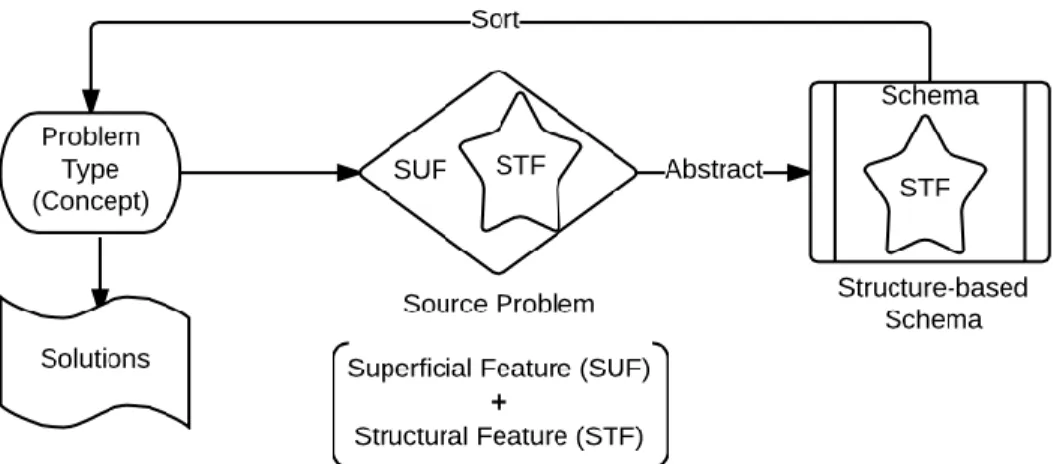
Previous studies have concluded that schema construction and analogical transfer are two indispensable components of mastering knowledge that mutually promote each other (Donovan, Bransford, & Pellegrino, 1999). In order to foster these two components and successfully solve new problems, recognizing and abstracting structural features of both source and target problems, and mapping a solution procedure based on structural similarity of both, are necessary (Figure 1). Figure 1a illustrates how these two
components and steps interact in the process of learning and solving problems. In order to successfully map the correct solution to a target problem, individuals need to precisely recognize the most appropriate source problem that is relevant to the target problem. Each type of problems can be presented in various versions with different superficial features but the same structural features (Figure 1b). By abstracting the shared structural features, structure-based schema is constructed. With a high-quality structure-based schema, individuals have a deep understanding of the structure of certain types of
15
problems, which ensures the precision of the recognition and in turn prompts the analogical transfer.
Learning by worked examples is a critical and effective technique for teaching mathematics and mathematically-based curriculum (Sweller & Cooper, 1985). But in what way and to what extent the variability of multiple examples should be utilized for instruction is still controversial. Some researchers have suggested that superficial similarity among examples should be used during instruction (Gick & Holyoak, 1980; Namy & Gentner, 2002; Renkl et al., 1998; Ross, 1989a), since controlling superficial similarity can be helpful for students to notice and align the structural features, as well as reduce cognitive load (Paas & Van Merriënboer, 1994). On the contrary, other
researchers have believed that examples with varied superficial features can expedite identifying structural features of different types of problems and induce schemas (Merrill & Tennyson, 1978; Paas & Van Merriënboer, 1994; Quilici & Mayer, 1996; Ranzijn, 1991; Reed, 1989).
16 (a)
(b)
17
Although each aspect is supported by multiple studies, they are not entirely parallel. For example, the studies adopted different measures. Some studies examined the influence of the variability of superficial features on sorting problem types (Namy & Gentner, 2002; Quilici & Mayer, 1996; Rabinowitz & Hogan, 2001; Ranzijn, 1991) and some focused on retrieval (Holyoak & Koh, 1987) or access (Ross, 1987). Measuring the influence on successfully solving a problem is imperative, but it was employed in a limited way. This type of influence is what the author measures in her research. In addition, researchers have conducted studies in different domains; most researchers have focused on mathematical or mathematically-based subjects (Paas & Van Merriënboer, 1994; Reed, 1989; Renkl, Stark, Gruber, & Mandl, 1998), while some chose
non-mathematically-based subjects (Holyoak & Koh, 1987; Ranzijn, 1991). Of studies about mathematically-based curriculum, few of them have concentrated on statistics (Quilici & Mayer, 1996; Ross, 1987, 1989a), in which the author is interested.
Furthermore, in carefully comparing studies of Quilici and Mayer (1996) and Ross (1987), the author notices that the definition of the variability of examples'
superficial features is not exactly same. As Ross described, superficial similarity meant the cover story was unvaried within and between concepts (Table 1). The superficial variability was between concepts rather than within. However, in Quilici and Mayer's study (1996), superficial variability was addressed in the structural-emphasizing
techniques where each concept was exemplified by a battery of cover stories that differed from one another and the same battery of cover stories was used across concepts. And the superficial similarity was within concepts, which corresponded to the superficial
18
design. Ross (1989b) compared unvaried cover stories among all examples of mixture concepts with varied cover stories between different concepts. Quilici and Mayer (1996) compared the condition under which cover stories did not vary between concepts but varied within concepts with the condition under which cover stories varied between concepts, but did not vary within a concept. In other words, these two groups of researchers used two different conditions to compare the same condition (Table 1).
Therefore, it is not warranted to claim that these two studies fully contradicted each other. In fact, the instructional suggestion by Ross (1989b) does not have direct empirical evidence and was based on his previous studies (1987, 1989a) in which he manipulated the superficial similarity of test problems (target problems) instead of instructional examples (source problems), to investigate how similarity between a new and an earlier problem affects the access and use of the earlier problem. Hence, in the dissertation study, the author fills in the gaps in the literature by: 1) verifying Ross’s suggestion on instruction and 2) comparing three instructional methods that are discussed above,
including the two (learning with examples with cover stories not varied between concepts but varied within concepts, and examples with cover stories not varied among all mixture concepts) that were not compared in previous studies, and exploring which one better improves students’ learning of probability.
Previous research has probed the effect of students’ prior knowledge (Große & Renkl, 2007; Holmqvist, Gustavsson, & Wernberg, 2007; Quilici & Mayer, 1996; Renkl, Stark, Gruber, & Mandl, 1998), but there was no certain conclusion of the role it played (Guo et al., 2012; Rittle-Johnson & Star, 2009). However, the influence of the difficulty of learning content on the effect of examples’ variability has been overlooked. Previous
19
studies show that students who were given difficult source problems had better analogical transfer (Didierjean & Nogry, 2004; Gick & McGarry, 1992). Moreover, Didierjean and Nogry (2004) have proven that difficulty induces students to build a more abstract representation of the solution. Therefore, it is natural to reason that for easy content involving no abstract concepts or complex procedure, students may gain the same benefit from well-structured and not well-structured instruction; however, for difficult content, students may benefit more from well-structured instruction. In the dissertation study, the author explores the role that content difficulty plays in the influence of examples’ superficial variability and hypothesizes that the pattern of influence is stronger for difficult content than for easy content.
The author believes that although the research focuses on the learning of probability, the findings can be applied to the general design of instruction for various domains, particularly for mathematically-based ones. Better-structured instructional design and learning strategy can bring about more effective and efficient learning.
20
3 Pilot Studies (Design and Preliminary Findings) 3.1 Pilot one
In the first pilot study, the author explored three major questions:
1) whether learning through multiple examples with a similar cover story among all mixtures of problem types improves students’ performance in probability more than learning through multiple examples with varied cover stories between problem types; 2) whether learning through examples with cover stories not varied between concepts, but varied within problem types improves students’ performance in probability more than learning through multiple examples with a similar cover story among all mixtures of problem types; 3) whether the superficial variability of examples exerts different patterns of effect on problem types at varying difficulty levels. The dependent variable of this experiment was the learning performance of probability rules. The independent variables were the variability of cover stories for examples and the difficulty level of learning content.
In order to probe the above research questions, the author developed three conditions (Table 2). In the first condition (named as the consistent-surface condition, CS), four probability theories—addition, multiplication, permutation, and combination rules—were taught through multiple examples with similar poker-cards-related cover stories. In the second condition, superficial variability existed within rules, so this condition was named varied-surface-within-rule condition (VSWR). In this condition, cover stories for each example of a given rule only varied within that rule. On the contrary, in the third condition—varied-surface-between-rules (VSBR) condition, cover
21
stories for each example of a given rule were not changed. However, cover stories varied for different rules.
Table 2
Three Conditions
Condition 1 (CS) Condition 2 (VSWR) Condition 3 (VSBR) Consistent Surface
Features
Varied Surface Features Within Rules
Varied Surface Features Between
Rules
Addition Rule
Example 1 Cards Spinner Dice
Example 2 Cards Cards Dice
Example 3 Cards Marbles Dice
Example 4 Cards Dice Dice
Multiplication Rule
Example 5 Cards Spinner Cards
Example 6 Cards Cards Cards
Example 7 Cards Marbles Cards
Example 8 Cards Dice Cards
Permutation Rule
Example 9 Cards Spinner Spinner
Example 10 Cards Cards Spinner
Example 11 Cards Marbles Spinner
Combination Rule
Example 12 Cards Spinner Marbles
Example 13 Cards Cards Marbles
Example 14 Cards Marbles Marbles
Since each of the addition and multiplication rules has two formulas according to different types of events (e.g., addition rule includes mutually exclusive and not mutually exclusive events; multiplication rule includes dependent and independent events), each of these two rules was taught through four examples, two examples for each type of event. The four rules had varying difficulty levels: additions and multiplications were
considered more fundamental than permutations and combinations, as the understanding of the later two rules had to be based on the understanding of the former two rules; permutations was considered easier and more foundational than combination, so
22
permutations was always taught before combination in class. Because of this, the difficulty level of learning content was naturally manipulated.
As discussed before, structure-based schema construction plays an essential role in learning and solving new problems. While learning through examples, each type of problem is taught with source problems, which are composed of both superficial features exhibited by a diamond frame and structural features exhibited by a star frame in Figure 2. To better understand a given type of problem, individuals need to abstract the
structural features from the source problem so that they can construct appropriate
structure-based schemas. Subsequently, appropriate structure-based schemas will be used to sort more problems in correct categories. In that way, they can access and remember proper solutions corresponding to different problem types. In this particular study, the author intervened in the process of structure-based schema construction by manipulating the superficial similarity—the cover stories of examples.
23 Figur e 3 . Dif fe re nt P roc esses of S che ma Const ruc ti on in Thr ee Gr oups
24
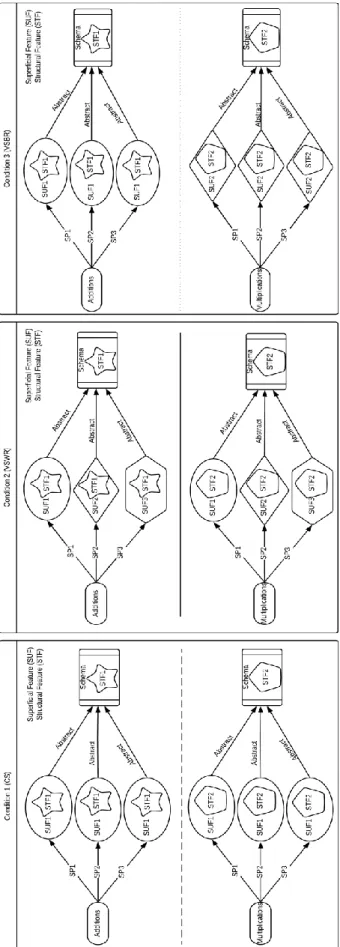
For illustration purposes, Figure 3 only sketches the instructional design of the addition rule and multiplication rule. In the VSWR condition, each type of problem was exemplified by the same battery of different cover stories. It was expected that,
individuals are able to realize that the superficial features, like the cover stories, do not matter and what they need to focus on to solve this type of problem is the structure of the problem. Another way of saying this is that the deep structural features of the problems are less likely confounded with the problems' surface features. Moreover, the varied cover stories provide individuals more chances to practice "ignoring" the cover story altogether. Once individuals understand the structural features and constructed schemas based on those features, the boundary between different types of problems would become clear and corresponding schemas would become appropriate. Therefore, when these individuals encountered problems, they can differentiate them more skillfully and find the correct solutions more precisely.
In the CS condition, four rules were taught with multiple examples that were embedded into the same cover story. Based on Ross's theory (1989b), by providing the same cover stories, students could conserve attention for determining relevant
distinctions between problem types and for focusing on the structural features. The structural features in this condition are also not likely be confounded with the problems' surface features. However, participants in this condition do not get a chance to practice how to distinguish structural features from superficial features. As a result, their schemas and understanding of each type of problem are not as thorough as in VSWR condition. When coming across new problems, they could not recognize the corresponding problem types and solutions as quickly and precisely as in VSWR condition.
25
By the same token, in the VSBR condition, the same cover story used four times within each rule hinders the participants from determining structural features. Moreover, it was possible that the students were misled to associate the cover story with certain types of problems by being given various cover stories for different rules. In other words, the structural features of problems were more easily confused with superficial features.
Based on previous research and theories, the author has developed four hypotheses.
Hypothesis 1: Students in the CS condition, learning through examples with similar cover stories among different probability rules, outperform students in the VSBR condition, learning through examples with cover stories varied between rules.
Hypothesis 2: Students in the VSWR condition, learning through examples with cover stories varied within rules, outperform students in the CS condition, learning through examples with similar cover stories.
Hypothesis 3: The pattern of influence of superficial variability of examples is stronger for difficult probability rules than easy ones.
Hypothesis 4: Students in the VSWR condition, learning through examples with cover stories varied within rules, have a better transfer rate than students in the other two groups.
The first three hypotheses were tested in the first pilot study and the fourth hypothesis was tested in the second pilot study.
26
Participants. 39 graduate students (13 for each group), including eight males and 31 females, were recruited from Teachers College, Columbia University and randomly assigned to three groups/conditions.
Procedure. All participants sequentially completed the personal information survey, pretest, instructional intervention, posttest, and feedback of the instruction and learning, requiring approximately one hour in total. Except for the instruction section, materials for the other sections were the same across conditions. During the instruction, participants read worked examples to learn the probability rules.
Material. The personal information survey contained questions used to collect participants’ gender, major, and familiarity with probability theory and with the contexts of cover stories presented in this study. Before exposure to instructional worked
examples (the intervention), the author tested participants’ ability to solve probabilistic problems. The pretest aimed to examine participants’ ability to solve probabilistic
problems. The test was composed of seven multiple-choice questions with multiple cover stories. Take this question for the addition rule as an example: Peter is randomly picking a card from a standard deck of 52 playing cards. What is the probability of his choosing
a queen or a heart? The answer options included , (the correct answer), , and
. Questions on permutation and combination had two correct answers. One was in the
form of a formula ( ) and the other one was in the form of a fraction ( ).
In the instructional phase, worked examples were presented on PowerPoint slides (Appendix G) with well-designed animations and images corresponding to the cover
15 52 16 52 17 52 18 52 1 52P3 1 52´ 1 51´ 1 50
27
story of each example. According to Paas and Van Merriënboer (1994), using worked examples can balance the cognitive load caused by problem variability, thus, they provide more possibility to add variability and, in turn, to enhance schema acquisition. The
learning process was entirely self-paced. By tapping the right- and left-arrow-button on the keyboard, participants could view the next or previous solution steps. In order to improve engagement, researchers suggested participants take notes during their study. After the instructional phase, participants were required to finish a posttest to see which condition improved their ability to solve problems.
The posttest was identical to the pretest, containing seven questions as well. However, the order of answer options for a given question changed. The last section consisted of several Likert-scale questions to examine clarity, helpfulness, and effectiveness of the instruction through participants’ self-report.
3.1.2 Results and Discussion
Does participants’ performance improve? The basic idea of this study was to see the score difference between pretest and posttest to discover whether and how much participants’ performance on probabilistic questions could be improved by intervention. The paired-samples t-test was conducted to test the effects of instruction on participants’ ability to solve probabilistic problems. The results suggested that students’ performance after learning significantly increased, t (38) = 6.401, p < 0.001, which means the
instruction effectively improved participants’ performance on such problems (Figure 4 & 5).
28
Figure4. Participants' Performance Accuracy in Pretest and Posttest
Figure5. Performance Accuracy in Pretest and Posttest of Three Groups
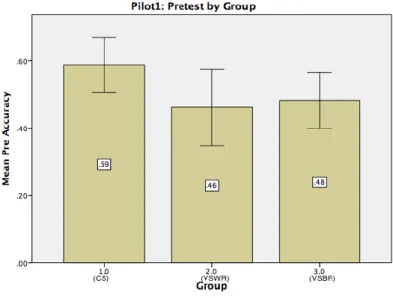
Are the groups equivalent in prior ability? An analysis of variance (ANOVA) conducted on the pretest scores of each participant indicated that the three groups did not differ significantly on prior knowledge of probability (Mean of accuracy = .59, .46, and .48 for similar cover stories (CS condition), varied cover stories within rules (VSWR
29
condition), and varied cover stories between rules (VSBR condition) respectively, F (2. 36) = 2.062, p = .142 (Figure 6).
Figure 6. Equivalent Prior Knowledge Across Groups
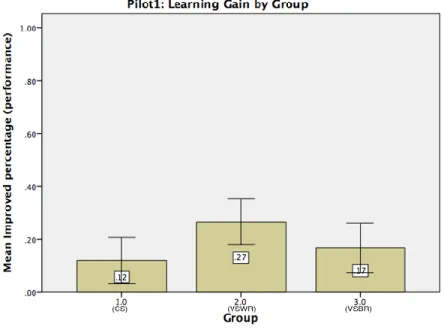
Does participants’ improvement differ by condition? The accuracy improvement was obtained by deducting the pretest accuracy from the posttest accuracy. Results from one-way ANOVA illustrated that the difference in accuracy improvement between groups was marginally significant, F (2, 36) = 3.092, p = .058 (Figure 7). Considering that small sample size might limit significance value and the effect size was large ( ), the author still did a post-hoc comparison. The finding showed that the accuracy improvement in the VSWR condition (M = .27, SD = 15.5) was significantly higher (F (1, 36) = 6.088, p = .018) than improvement in CS condition (M = .12, SD = 17.3), which was consistent with the second hypothesis that VSWR condition would outperform CS condition. However, there was no significant difference between VSWR and VSBR conditions, which was not consistent with the findings from the work of Quilici and Mayer (1996). In addition, the researcher did not find the difference between
30
the CS condition and the VSBR condition, which was not consistent with the author’s expectations based on Ross’s suggestion (1989b) (Hypothesis 1).
Figure 7. Accuracy Improvements Across Groups
The results confirmed Hypothesis 2. However, the results did not exhibit the expected disadvantage of the VSBR condition compared to the others. The author's interpretation of such results was likely due to the small sample size, which was not sufficient enough to show a significant difference. Moreover, the author noticed that the questions for multiplication in the test were a bit of confusing, which might also have affected the general results.
Does the pattern differ by content difficulty? Since the researcher expected that varying difficulty levels naturally exist among the four probability rules, she examined the group difference in performance in each rule. The significant difference in accuracy improvement was only found in permutations (Figure 8), F (2, 36) = 4.486, p = .018.
31
SD = 21.7, p = .007) and between rules (the VSBR condition) (M = .29, SD = 26.7, p = .032) was significantly higher than in similar cover stories (the CS condition) (M = .08, SD = 23.7). However, there was no significant difference between the VSWR condition and the VSBR condition. In other words, the intervention was only evident in the permutation rule that was considered a relatively difficult concept. The resulting pattern involving the VSWR condition and the CS condition fully coincided with the one in the general comparison. Moreover, the difference tendency between the VSBR condition and the CS condition became significant here. In order to draw the conclusion that the
findings were consistent with the third hypothesis that the difficulty level of content would affect the strength of the influence from superficial variability, more analyses were conducted.
Figure 8. Accuracy Improvements for Permutation Questions across Groups
It is possible that a difference in the quality of instruction caused VSWR and VSBR to perform better than CS on permutation. For example, instructions for
32
permutations in VSWR and VSBR were better than instructions for the other rules in these two groups. Or instructions for permutations in CS was worse than instructions for the other rules in CS. To test this possibility, the author analyzed participants’ feedback. As mentioned before, participants rated the helpfulness of instruction for each rule in the last experimental section. A Kruskal-Wallis H test was used to examine whether there was a difference in helpfulness of instruction for rules. The results did not display significant differences across rules in CS ( , p = .592) and VSWR ( , p = .075), which means participants in these two groups considered instruction for each rule equally helpful. In VSBR condition, significant difference in helpfulness across rules was found ( , p < .001) (Figure 9): ratings for additions (Mdn = 5) and multiplications (Mdn = 5) were both significantly higher than permutations (Mdn = 4) and combinations (Mdn = 4). Accordingly, instruction for permutation in the VSBR condition was not viewed as more helpful than other rules either. Therefore, the findings disproved the likelihood of better instruction for
permutations in VSWR and VSBR condition and worse instruction for permutations in CS condition.
Figure 9. Comparisons of Helpfulness for Instructions of Each Rule c2 (3)=1.908 c2 (3)=6.918 c2 (3)=23.636
33
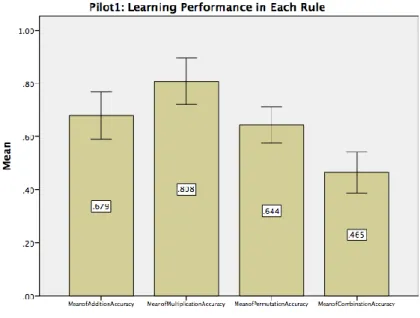
Next, the author compared the performance accuracy of the four rules across groups (Figure 10). This accuracy was no longer learning gain (pretest minus posttest), but the average performance accuracy of pretest and posttest. Significant differences across rules were found (Welch's F (3, 83.949) = 11.862, p < .001): performance accuracy of combinations (M = .465, SD = 24.1) was lower than that of additions (M
= .679, SD = 28.1), multiplications (M = .808, SD = 27.2), and permutations (M = .644,
SD = 21.2), while the performance of permutations was lower than that of
multiplications. It is reasonable to believe that the performance accuracy was related to the difficulty of the concepts. Naturally, when difficulty increases, accuracy drops. Therefore, the varied performance on corresponding rules supported the assumption that varying difficulty level existed among the four rules. Accordingly, the combination rule was the most difficult among the four rules. As the addition rule and multiplication rule were conceptually similar to each other and no significant difference in accuracy was found between them, these two rules were considered easy concepts among the four rules. Also given that conceptually the permutation rule substantially resembled the combination rule, but was distinct from addition and multiplication, and its accuracy was significantly higher than the combination rule, the permutation rule s identified as a moderately difficult concept among the four rules.
In a nutshell, the third hypothesis that the influential pattern of superficial variability was stronger for difficult concepts than for easier ones was confirmed. Moreover, the effectiveness of the intervention was best with the moderately difficult concept (e.g., permutations).
34
Figure 10. Overall Performance Accuracy of Each rule
3.1.3 Conclusions
Based on all of the above statistical evidence, the hypotheses were partially confirmed. Learning through examples with consistent cover stories among different probability rules and learning through examples with cover stories varied within rules exerts influence at disparate levels. The latter approach is found to better facilitate learning. However, Ross’s suggestion (1989b) was not validated in this study, as there was no difference between learning through examples with similar cover stories and with cover stories varied between rules. Moreover, the difference between examples with cover stories varied within and cover stories varied between rules was not found as significant as in Quilici and Mayer’s results (1996). Such patterns also proved stronger for permutations, which was moderately difficult to learn.
3.1.4 Limitations and Improvements of the Experiment Design
Although part of the results was not consistent with what was expected, the author could not assert that the hypotheses based on previous studies had been proven wrong, as
35
the first pilot study had limitations, which might affect the significance level of results. First of all, the sample size was small; thus, some trends might not be detected at a statistically significant level. Therefore, in the second pilot study, the author recruited a larger number of participants to increase the sample size. Moreover, some experimental materials needed to be refined. For example, the wording of one multiplication question was determined to be confusing to participants; therefore, in the second pilot study the author refined that question. In order to guarantee the clarity of all refined materials, the author asked both experts and peer students to approve them before conducting additional experiments. Thirdly, although it is reasonable to believe that varying difficulty levels naturally exist among four rules, there was no direct examination of participants' opinion around that. Thus, in the next study, a relevant survey was added. Last but not least, in the first pilot study, the author did not test the influence from superficial variability on transfer, which is also important and might be affected by superficial variability.
Therefore, the group difference in learning transfer was an additional research question in the next study.
3.2 Pilot two
There were three major purposes for the second pilot study. First of all, the author aimed to verify the findings in the first pilot study. Secondly, in the first pilot study, the author did not directly test the difficulty level of four rules. Though varying difficulty level exists among the four rules conceptually and practically – addition and
multiplication rules are fundamental for permutation and combination rules, and the combination rule is more advanced than the permutation rule – there was no evidence that students considered the difficulty level among the four rules in the same way. Therefore,
36
in the second study, the author aimed to directly test students' understanding of the difficulty level among the four rules. Thirdly, the author aimed to examine the difference in transfer that might be caused by the superficial variability of learning examples.
Based on previous research and theories that have been discussed in the previous sections, the author kept the same four hypotheses raised in the first study.
3.2.1 Methodology
Participants. 45 graduate students (13 for each condition) were recruited from Teachers College, Columbia University and Fordham University. They were randomly assigned to three conditions.
Procedure. Unlike in the first pilot study, there were two sessions separated by one week in the second pilot study. In the first session, the whole procedure was nearly the same as in the first pilot study. In the instruction, participants still read the worked examples to learn the probability rules. But the task sequence changed for the feedback of the instruction and learning. In the first pilot study, the self-reported feedback was asked to complete after the posttest. However, considering possible bias caused by delay, the author asked participants to provide feedback on the instruction and learning for each rule right after they finished the corresponding section (Figure 11). In addition, to directly testing students’ understanding of the difficulty level of the four rules, the author added one more 5-point Likert scale in the feedback survey. All participants were asked to rate how difficult the rule that they learned was, with that scale. While they were learning with examples, participants could take notes. However, they could not keep the notes when they worked on exams, including the posttest, transfer test, and delayed transfer test. After finishing the posttest, participants were required to complete a transfer test.
37
The whole session took about 90 minutes. One week after they finished the first session, participants needed to come back for the second session for a delayed transfer test, which required no more than 30 minutes to complete.
Figure 11. The Task Flow in Two Pilot Studies
Materials. In the second pilot study, the same pretest, posttest, and instructional materials as in the first pilot study were used. The author refined the confusing
multiplication questions and added one conceptual question for each rule in both pretest and posttest (e.g., please select the correct statement(s) about the Addition Rule). The transfer test was also composed of multiple-choice questions. The cover stories for questions in the transfer test were never used in the pretest, posttest, or instruction.
38
Moreover, unlike in previous tests or instruction, some questions in the transfer test were decimal instead of fractional (Table 3). The materials for the delayed transfer test were identical to the ones used in the transfer test.
Table 3
Differences in Design for Two Pilot Studies
Pilot 1 Pilot 2
Participants TC only (39) TC(34) & Fordham (11) Feedback After posttest During learning Difficulty of
Concept (self-report) ✔
Learning Content Same Same
Instructional Method Same Same
Pretest
✔ (N=7)
✔
• Refined the wording of Multiplication question • Added 4 more conceptual
questions (N=8+4)
Posttest ✔
✔
• Refined the wording of Multiplication question • Added 4 more conceptual
questions (N=8+4)
Transfer Test ✔
Delayed Transfer ✔
3.2.2 Results and Discussion
Does participants’ performance improve?Similarly, the paired-samples t-test was used to check whether there were performance differences between the pretest and
posttest. The result indicated that students’ performance was significantly improved in
the posttest rather than in the pretest, t (44) = 10.439, p < 0.001, which means the
39
Figure 12. Participants' Performance Accuracy in Pretest and Posttest in Pilot 2
40
Are the groups equivalent in prior ability? An analysis of variance (ANOVA) conducted on the pretest scores of each participant indicated that the prior knowledge of probability (Mean of accuracy = .59, .44, and .65 for similar cover stories (the CS condition), varied cover stories within rules (the VSWR condition), and varied cover stories between rules (the VSBR condition) respectively was significantly inequivalent, F
(2, 42) = 24.448, p < 0.001 (Figure 14). Therefore, the unadjusted performance
difference between the posttest and pretest could not be used to indicate the effect of the instructional method in three groups. In other words, the same approach as in the first pilot study—comparing learning gains of each group, was not appropriate in this pilot study.
Figure 14. Inequivalent Prior Knowledge across Groups in Pilot 2
Does participants’ improvement differ by condition? In order to control the
undesired effect from nonequivalent prior knowledge, the one-way analysis of covariance (ANCOVA) was employed (accuracies of the pretest was the covariate).
41
To test the first hypothesis, the author compared the posttest accuracies of the CS and VSBR conditions while controlling both groups’ pretest accuracies. After adjustment for pretest, there was a marginally significant difference in posttest between the CS and VSBR condition, F (1, 27) =3.491, p = .073, partial η2 = .114. This finding supported the first hypothesis that students learning through examples with similar cover stories among different probability rules, outperform students learning through examples with cover stories varied between rules, which was consistent with Ross’s suggestion (1989b). However, the expected difference in posttest between CS and VSWR condition was not found, F (1, 27) =.117, p = .735, partial η2 = .004. That means the second hypothesis was not confirmed, which was not consistent with the finding in the first pilot. The small sample size in both studies was the most likely reason for such erratic findings.