Individualised learning approach (the three ‘p’s) for a small to medium
enterprise through work based learning
Dr Shayne Baker, University of Southern Queensland
Professor Malcolm Cathcart, Leeds Trinity University
Dr Neil Peach, Brisbane
Abstract
An ongoing challenge for education and training providers is to ensure learners can achieve maximum learning and recognition for their vocational education pathways. The strategy and case to be presented could best be described as the 3 ‘p’s approach to the provision of vocational education and training, that is:
I. How we support people in their education and training II. What processes we use to provide education and training? III. The place where the learning opportunities are provided.
The aim of this paper is to share an educational and training strategy that has been successfully implemented in an Australian enterprise. The strategy provided education and training for the members of the enterprise in a multidisciplinary manner from a certificate through to a degree outcome, entirely through work-based learning (WBL) pedagogy.
The research was conducted with six candidates (employees of the enterprise) through their educational journey applying a range of WBL activities including projects and initiatives to improve processes and performances in the workplace. Each candidate's program involved designing the learning component following an initial phase of review of their previous learning’s and qualifications with a learning advisor. This process was deemed as 'the learning review'. The other component of this phase was to develop a learning plan to encapsulate an area of study or disciplinary process that would be relevant to the individual candidate. This process was deemed as 'the learning journey plan'.
The second phase was for each candidate to prepare and undertake a problem based/research led learning activity through one or more workplace project/s with the support of the employer.
The final phase involved a structured review and development of a final project report to outline the outcomes and learning’s achieved through the work based projects.
The research undertaken included post-program interviews with the six candidates and the General Manager and provided an example of a relatable model for all workplaces as well as education and training provider.
Introduction
This case study research emerges as a contemporary action and enquiry to highlight an integrated pathway for delivering vocational education and higher education in Australia. Why is this integrated pathway needed?
enterprise’s strategic capability believing this strategy to be in line with best practice. This narrow training view of a firm's learning involves key employees within a firm identifying skill gaps between where the firm needs to be and the current competencies of their staff. The gap is then bridged by traditional training methods that extend staff competencies to meet the firm’s requirements. These traditional training approaches separate learning from the work context and have been identified by many researchers over the years as an inefficient practice.
This study was undertaken using a case study approach based on semi-structured interviews to gain an understanding on how WBL strategies used a range of integrated learning strategies within the workplace to develop the firm's strategic capability as well as a range of formal qualifications (certificates to degrees) for its people. The candidates interviewed were from various organisational levels within the enterprise.
The research was focussed on a small to medium enterprise (SME) located in Brisbane with which the authors have worked to deliver a long-standing program of vocational/higher education work based learning. Prior to expanding the WBL approach for a higher education outcome, members of the workforce had completed a range of vocational education and training programs from certificate III through to diploma level outcomes. The SME owners were keen to develop strategic competitive advantage via their human resource skills. Therefore, they embraced the concept of developing competitive advantage by ensuring that their people were highly trained and competent not only at an operational level but also at a strategic level. As one of the owners indicated the SME would like all their people to hold an MBA (or equivalent).
The pedagogical approach was achieved through consultation with individual staff members to evaluate their existing qualifications against their respective position descriptions to identify potential areas of learning and to validate their interest in pursuing a WBL approach to learning and development.
Learning and mentoring using both external and internal facilitators was used as a basis to negotiate work-based projects that could be mapped against units of competency and importantly support from senior management contributed to the overall development and direction of the organisation.
This approach was subsequently expanded into higher education and represented a unique WBL approach for the acquisition of vocational and undergraduate level outcomes in Australia. Data collected during this study is analysed using the following areas of interest
• the impact of WBL on all those involved
• the extent to which the workplace under study was conducive or otherwise to learning
• the success or otherwise of the work based approach to learning from a return on investment perspective.
From the analysis, some preliminary conclusions were drawn regarding each of these areas as well as an overarching assessment of the relate ability of this case study to other SMEs in Australia.
Work based learning – the literature
Management within organisations are always looking for a strategy that will improve productivity, increase revenue, and improve the bottom line. Learning based on and within the workplace is rapidly emerging as an important strategy that will deliver those improvements, build a firm’s strategic capability and gain a competitive advantage for businesses endeavouring to increase their competitive advantage. Work based and work related learning can appear to be an attractive proposition, but can be limited if there is a lack of organisational support. The development and practice of support for this form of organisational (work based) learning transforms the organisation into a learning organisation.
Prahalad and Hamel (1990) suggested that core competencies are the collective learning in the organisation that has brought recent attention to the relationship between strategic capability and organisational learning. An organisation’s core competencies are its unique capabilities that allow it to build a competitive advantage and is a direct consequence of organisational learning (Prahalad & Hamel 1990). The focus of this relationship is for the organisation to gain a competitive advantage by using its learning and mental capacity to continuously develop competencies such as diverse production skills and the integration of technologies.
Increased competition, both locally and globally, together with the speed of change, have highlighted the importance of learning to organisations as a key attribute to survival, growth and success (Vera & Crossan 2004). Managers view work based learning as a powerful tool to increase the performance of their organisation (Teare & Pantin 2002). Currently it is not organised into a specific field of management as the area remains too broad, inadequately defined and does not fit neatly into existing models of good management practice (Easterby-Smith & Lyles 2003; Sorensen & Stuart 2000).
The capacity to learn is a key attribute of individuals, which involves developing, and changing over time (Ellstrom 2003). Much of this development is informal and experienced randomly, a feature of Kolb’s experiential sequence model of learning by doing, looking, thinking, growing and acting (Klob 1984). Vera & Crossan (2004) suggests that learning, as distinct from training, is about continuous change and focuses on values, attitudes and innovation. Vera & Crossan (2004) further argues that organisations may need to change processes, rules and procedures to ensure survival and that this requires collective learning.
Learning has, in many organisations, been a part of the natural workings of a workplace (Morgan 2004). Workers in their normal work environment share stories, offer advice, adapt to new or different ideas, pick up on how to use new tools, and follow the lead from respected fellow workers (Rusch 2005). This type of learning within the workplace, generally social in nature and responsive to change can be categorised as ‘work based learning’. Work based learning has the attributes of action and review, which results in a change of an organisation’s actions (Rowe & Boyle 2005).
Competitive advantage can be developed using the WBL process to allow all individuals in the enterprise to develop and use their learning and learnt competencies for the organisation to prosper now and in the future (Evans, Guile & Harris 2011). WBL is broad, multi-faceted and emerges from a wide range of managerial capabilities such as knowledge management, leadership, organisational culture, total quality management, innovation, effective communications and an efficient physical environment (Fuller & Unwin 2011). Effective
enterprise learning requires the learning process to encompass organisational culture, leadership, organisational processes and technology with a view to balancing the required skills and knowledge needed for the present, and those skills and knowledge required for the future within the organisation (Sorensen & Stuart 2000). Garnett (2012) suggests that all organisations learn, but it is the efficiency and effectiveness supported by the organisation’s processes that often distinguishes it from its competitors.
Work based learning is an academically sound and organisationally feasible way of creating an efficient and effective learning environment and providing a rewarding outcome for both the individuals involved and the organisation. For workers, the outcome is a vocational education or higher education award (that aligns with the Australian Qualifications Framework) and for the organisation, the project or activity is achieved in a manner that enables the learning to be shared and understood within the organisation.
The use of workplaces for formal recognition of student learning is acknowledged by Baker (2013) in that there is ‘increasing recognition that people learn in different situations, through a range of experiences and at their own pace. Terms such as recognition of prior learning (RPL), on-the-job and off-the-job learning and flexible learning have become key characteristics of vocational education and training and have influenced its delivery’.
Work based learning in Australia has traditionally been focussed on vocational education: a good example is the application of work based apprenticeship training that is well established in many jurisdictions in Australia. However, it has emerged that the workplace is the site for much more than just vocational education development. Engestrom (2011) states that what is much less clear are what needs to be learnt, at what level and how the required learning takes place. The key issue here is about the transition of learning into the required level of action (Fuller & Unwin 2011). WBL can appear to be an attractive proposition, but can be limited in scope and pace if unsupported (Garnett 2012). It is the task of the partnership between the learning provider, the SME and the individual to integrate individual learning into the organisation's learning (Garnett 2012).
The purpose or objective of the business is not just to achieve individual learning or development (Fuller & Unwin, 2011). A business’s objective will generally be directed towards the production of goods and services. However, the increasingly societal nature of work processes noted by Engestrom (2004) relates to the organisational need for what Fuller & Unwin (2011) describe as High Performance Working (HPW). They suggest HPW is associated with the need to develop ‘much greater employee involvement, the development of higher levels of skill and knowledge creation, and their capacity to innovate’. There is evidence therefore that the broad interest in workplace learning is being driven not only by new forms of work organisation (such as HPW), but also by a clear recognition that the workplace is a potential place for all levels (and types) of learning. Further, because of technological developments, as well as marketisation, there is an economic need for countries and regions to increase workforce skills.
The pedagogy of a WBL award is built upon and around the learning agreement, established through a process of resolution between the university, the student and the student’s employer (Garnett, 2000). Learning objectives are established for each student and these reflect a consensus of the parties. The common ground of this consensus means that the resulting curriculum is not borne out of a specific disciplinary perspective, nor of a predefined vocational or professional prescription (Portwood 2000; Portwood and Costley 2000). Hence WBL sits in
a unique and direct relationship between the workplace (and its needs) and the student’s personal and professional aspirations. Unlike conventional vocational or disciplinary courses/programs, it is not separate to or outside the labour market. It is embedded in it. Consequently, it is considered that the risks associated with conventional programs (in that they sit outside the labour market), are much reduced through a WBL approach.
Work base learning case study research
Our specific case study (of a company we will refer to as SME Pty Ltd) will present an example of the relevance and successful implementation of WBL in Australia.
Case study research is an ideal approach when a holistic, in-depth investigation is required (Gable 1994). Yin (1994) argues that case study research undertaken correctly can give a rich, insightful analysis and can make a worthwhile contribution to theory development. This study aims to gain an in-depth understanding of the use of WBL strategies by rigorously exploring and analysing the real-life experiences of participants within the context of SME workplace.
Yin (1994) further argues that case study research is an empirical inquiry that investigates contemporary phenomenon within a real-life context and where boundaries between phenomenon and context are not evident. This type of research can be used to explore, describe, illustrate and explain different phenomena and have been increasingly used in business. This study involves research issues of an exploratory nature using the ‘how’ questions and fits within a contemporary real-life context and, in consequence, justifies using the exploratory case study approach. It is important to identify the broad advantages and weaknesses of such an approach so that it is clear the most appropriate method has been selected.
Advantages of using case study research have been identified by several authors apart from Yin. Creswell (2005) suggests that most authors agree that case study research gives a holistic approach to researching the research problem within a given context using a variety of rigorous evidence. Case studies having interaction and a flexible design that will result in a more in-depth understanding of the business research problem and allow the business community confidence in commissioning more research. For the business community has a large variety of applications across all disciplines within a business context.
The major advantages of using case study research over other research methods for this study would be as follows: it would provide a much greater understanding of SME's learning and competitive strategies in a constantly changing competitive environment; it would be more cost effective than other research approaches; the understanding and knowledge gained would be current; and less time needed to plan, evaluate and implement (Creswell 2005).
During the students’ enrolment, the authors have worked with the students, the business, the Recognised Training Organisation (RTO) and the university to achieve beneficial outcomes for all parties. In so doing, all learned about the ramifications of the implementation of WBL in Australia.
The emphasis of this case study is its relevance to other businesses in Australia, which may seek to better, understand the development pathways afforded by WBL as a viable development option for its staff and to also contribute to the body of knowledge regarding the delivery of WBL by RTOs and universities.
Context and approach
Company
SME Pty Ltd has been in operation for 12 years and employs approximately 70 staff. Approximately 30 staff are in one location that is a combined office warehouse facility. The other 40 staff are a distributed network of sales representatives across Australia. The company sells hair treatment products to hairdressers. The core products are predominantly manufactured in Brisbane under contract to another company. The company competes with both multinationals and other local suppliers. Sales have grown by some 100% over five years to over $20 million per annum. The company is expanding into both Asia-Pacific and European markets.
Staff/Students
For several years, the company has invested in the training and development of its staff. This is reflected in the fact that the six students all had prior training and development experience gained whilst working with SME Pty Ltd. prior to achieving their bachelor’s degrees through WBL. The six individuals involved worked in the ‘head office’ operations of the business, which comprises a total of some 15 people not engaged in sales and warehousing operations. This part of the business comprised ‘office’ staff working in general management, marketing, human resources, finance, logistics, communications and information technology. Participants in the program were identified through of an informal process that involved the General Manager (GM) progressively selecting those staff who exhibited two key characteristics - (a) they were involved in core functions of the business that were undergoing important changes and development and (b) they had demonstrated an interest in further professional development and a capacity for such development.
Program
Both the Managing Director (MD) and the GM were made aware of the scope of the program participating in a WBL program through information provided by one of the authors who had been involved with the development and delivery of WBL to post graduate students at the University of Southern Queensland. Through this involvement, he became aware of
undergraduate programs being offered through WBL at Middlesex University in the United Kingdom. After some consideration of the academic and commercial structure of the available programs, the company resolved that the six students would enrol in Middlesex University’s Bachelor of Arts (Honours) Professional Practice degree program.
The specific program used at SME was designed around the core elements of WBL with an initial phase designed to review previous learning and qualifications and to develop a learning plan that encapsulated an area of study or disciplinary focus. This initial phase introduced students to reflective practice and assisted them to identify and to formulate the description of their accumulated knowledge. This was also the basis for a submission to enable the recognition of prior learning to achieve the qualification level of diploma. The second phase involved preparing for and undertaking problem-based/research-led learning through one or more workplace projects. The third phase involved a structured review and preparation of a final report to cover the outcomes and learning arising from the work based projects. The program was modulated like most under graduate degrees to allow student, employer and university to effectively manage time line, expectations and payments.
Research
Each of the authors had been directly involved with the company and its staff during the whole process - from early considerations of the most appropriate program, through enrolment, engagement, assessment and finalisation of academic awards. The case study forms part of an ongoing research project by the authors to further develop WBL as a way of delivering higher education services in Australia. It explored the impact of WBL on one SME in Brisbane, Australia and to our knowledge this was the first time a WBL approach had been employed to deliver bachelor level awards in an Australian workplace. Our primary objective was to engage in the full life cycle of this project and in so doing as practitioner researchers, to focus primarily on the ‘reliability’ for other Australian enterprises. We continue to endeavour to ensure that valuable information is shared into ‘how’ and ‘why’ this approach may prove beneficial to others.
Approach
Having been directly involved with the project as practitioner researchers, the authors regularly interacted with the students, the owners and, on occasions, with the customers and suppliers of the company. The authors learned and developed a greater appreciation of the approach to undergraduate WBL having previously only worked with postgraduate students in WBL programs. Fortunately, each author had experience with development and training inside organisations and two had formal qualifications and experience in vocational training in workplaces. This was useful because it provided a degree of confidence and familiarity with the setting in which much of the learning and teaching took place. Previous working relationship with both the MD and GM were useful when there was uncertainty about how to manage changes in focus or priority that can occur because of change in workplaces over an extended period.
Our experience and background provided us with the scope to support the continued relevance of the program within the workplace. Dick (2002) alludes to the constant battle faced by practitioner/action researchers in the tension between relevance and rigour. We acknowledge that organisations generally focus on research relevance because knowledge for a commercial business must have a performative value and therefore deliver an outcome that contributes to their survival. We were also conscious that our capacity to contribute to practice additionally would require an appropriate element of rigour in our research. To better support and position our work (and learning), we decided to undertake a semi-structured interview with each of the six students and the MD representing the ownership of the business (Yin 1994).
We developed an open survey instrument to guide discussion and framed this instrument to enable us to
• assess the overall impact of WBL and compare our results with previous research undertaken in the United Kingdom by the Higher Education Academy (HEA) (Part one of the interview instrument)
• assess the extent to which SME Pty Ltd was an expansive or restrictive workplace towards High Performance Working (HPW) (Part two of the interview instrument)
• consider the degree to which the individuals and the company thought the program had been effective and efficient as a company training program. (Part Three of the interview instrument).
Part one of the instrument focussed on the overall operation of WBL and provided an added opportunity for some comparative analysis with the previous WBL study.
Part two of the instrument was designed to determine how ‘restrictive’ or ‘expansive’ the business was with the questions based directly on the assessment framework developed by Fuller and Unwin (2011). This issue was paramount because it is accepted that what a student can achieve through WBL is to some extent, invariably limited by their working ‘environment’, and in as much WBL is only appropriate for students who are operating in work settings that support workplace learning (i.e. ‘expansive’ using Fuller and Unwin’s characterisation).
For Part three of the instrument, it was determined to use the checklist developed by Sutton (2006) and supported by Garnett (2012) to guide a reflective assessment of the project success as a training and development exercise for the company. The use of the checklist (Sutton 2006) was used on a pilot group and reviewed by Professor Garnett.
Findings and discussion
The analysis of the responses was undertaken referencing three research areas, (1) Impacts of WBL (2) Extent of high performance working and (3) Value of learning program.
Impacts of work based learning
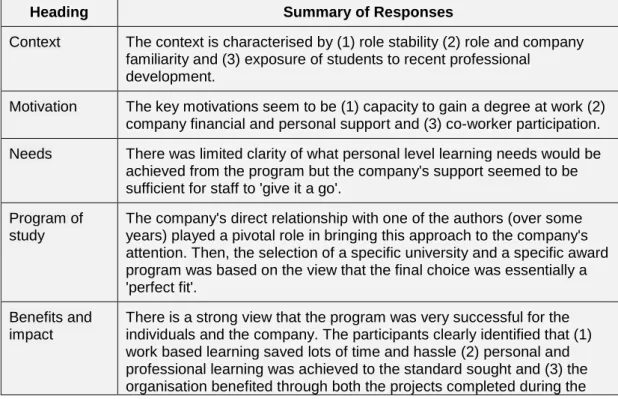
Twenty-seven questions (six headings) provided the starting point for this assessment. The authors reviewed all responses to each question and analysed and categorised each question. A further summary was completed to identify the key issue or issues arising from the questions under each heading. The full set of questions and each layer of summarisation are set out in Table 1 below. (Table 1 sets out the six headings and the assessment agreed to for each of these headings).
Table 1 Summary of Responses for Part One of the Interview Instrument
Heading Summary of Responses
Context The context is characterised by (1) role stability (2) role and company familiarity and (3) exposure of students to recent professional
development.
Motivation The key motivations seem to be (1) capacity to gain a degree at work (2) company financial and personal support and (3) co-worker participation. Needs There was limited clarity of what personal level learning needs would be
achieved from the program but the company's support seemed to be sufficient for staff to 'give it a go'.
Program of study
The company's direct relationship with one of the authors (over some years) played a pivotal role in bringing this approach to the company's attention. Then, the selection of a specific university and a specific award program was based on the view that the final choice was essentially a 'perfect fit'.
Benefits and impact
There is a strong view that the program was very successful for the individuals and the company. The participants clearly identified that (1) work based learning saved lots of time and hassle (2) personal and professional learning was achieved to the standard sought and (3) the organisation benefited through both the projects completed during the
program and the ongoing increased confidence and capability of all staff involved.
Value from money
The business owner and the students regarded the whole approach as good value for money. The program would benefit from better
'explanation' early in the implementation.
Feedback from the owners suggested the quality of the work projects undertaken during the degree program had a positive contribution to the operational development and success of the business. The SME management stated that there had been and continues to be a higher level of communication and engagement between the program graduates with the business more generally. In relation to the program there was widespread recognition that in the absence of a general awareness about WBL, there needed to be a greater orientation about what was involved in the program prior to students starting the program. The key suggestions for further development were given that would enhance the likelihood of others adopting such an approach were: the need for a 'student guide to WBL' be published with sample case study material; and an easy to understand explanations of how the program delivers learning outcomes compared to class room delivery and assessment by examination.
Comparing the broad-based impact study undertaken for the HEA in the UK (Nixon & The KSA Partnership, 2008) with our much smaller survey which involved only one cohort from one workplace, our analysis indicates a high degree of consistency with some variations. Specifically, in regard to ‘motivation’, the SME Pty Ltd students expressed their interest in the program in far more altruistic terms based on (1) company financial and personal support (2) capacity to gain a degree at work and (3) co-worker participation, compared to the HEA sample which appeared to express motivation predominantly in relation to learning and education terms (validation and formalisation of experience and development of greater understanding, knowledge and expertise in a particular field). The HEA study noted that employees tended to be the driving force behind the willingness to support the program. This is only feasible when employees/students are fully aware of the available opportunities for studying through WBL. In the Australian context, given the lack of education policy interest in WBL (Baker 2013) at the undergraduate level, the early adoption of WBL is most likely to be stimulated by the employer. It would take much wider university engagement in WBL for individual student workers to be the primary drivers of WBL approaches in Australian higher education.
The impact of the HEA study notes that ‘the most commonly mentioned benefit was increased confidence, both in their job and outside of work’ (Nixon & The KSA Partnership, 2008). This is consistent with the impact we observed with all graduates at SME Pty Ltd. Similar comparisons were observed for the owners of SME Pty Ltd and this appears to be consistent with the experience of UK employers. Each study indicated an improvement in current business operations and an ongoing increase in the levels of employee self-sufficiency and innovation. There was commonality in both studies in relation to both employees and employers identifying the WBL approach as being value for money.
Extent of high performance working
As noted earlier, high performance working is associated with the need to develop ‘much greater employee involvement, the development of higher levels of skill and knowledge creation, and their capacity to innovate’ (Fuller and Unwin, 2011:49). Based on Fuller and Unwin’s characterisation of workplaces along a ‘restrictive’ ‘expansive’ continuum, seven questions were developed to assist in gauging the staff and owner’s assessment of the work
environment.
The responses from Part two of the survey instrument supported a view of the workplace as being supportive of high performance working using Fuller and Unwin’s terminology, the work environment is ‘expansive’.
Our research through this project fully endorses the general notion that the workplace is an expansive one and this is supported by the academic success of each of the work based projects and the success of each student worker. This is further supported by the information gained from Parts one and three of the interview instrument.
Value of learning program
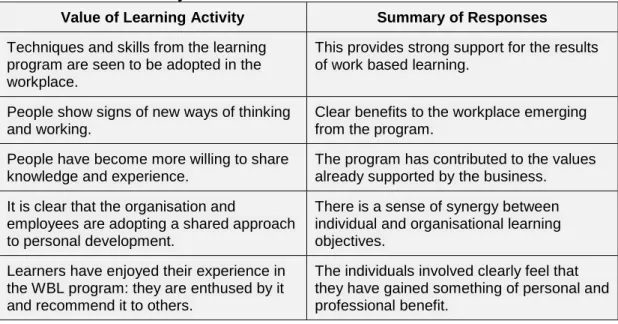
For WBL to be successful it appears that not only will it be necessary for student (employees) to see it as being valuable but organisations also will need to be convinced about its value to the corporation. Part Three of the interview instrument was designed along the lines of work undertaken by Sutton (2006) to test the value of training and development activities undertaken and/or supported by business organisations. Sutton’s work suggests that there are five items present when corporate training is deemed a good return on investment. Our assessment was developed in response to the view that (a) most often corporations do not formally evaluate the return on investment of training initiatives and (b) it is the presence of these five items that prompts business decision makers to continue or otherwise with certain training programs. The responses of both students and the business representatives were positive regarding the return on investment for WBL.
Table 2 Summary of Assessment for Part Three of the Interview Instrument
Value of Learning Activity Summary of Responses
Techniques and skills from the learning program are seen to be adopted in the workplace.
This provides strong support for the results of work based learning.
People show signs of new ways of thinking and working.
Clear benefits to the workplace emerging from the program.
People have become more willing to share knowledge and experience.
The program has contributed to the values already supported by the business.
It is clear that the organisation and
employees are adopting a shared approach to personal development.
There is a sense of synergy between individual and organisational learning objectives.
Learners have enjoyed their experience in the WBL program: they are enthused by it and recommend it to others.
The individuals involved clearly feel that they have gained something of personal and professional benefit.
Conclusion
As noted earlier, the pivotal point in WBL as a contemporary vocational education/higher education pathway is the ‘learning agreement’ which is negotiated through a consensus building process between three key stakeholders - the individual, the company and the learning institution. The circumstances surrounding this project with the company (located in Brisbane, Australia) and the UK University were such that this tripartite relationship was founded on a pre-existing relationship between the researchers and the company. This was a contributing factor in considering the reliability of this case study, as it was apparent that the early adoption of WBL by the company was significantly impacted by a relationship of trust that allowed the company to move into ‘new waters’ without fully understanding the concept of WBL as an approach. Our findings and conclusions are presented using the three parties to the learning agreement in the sub-headings the individual, the company and the university.
Individual
The student workers had a relatively high level of work stability and were clearly attracted to the practical benefits of a work based degree program. This combined with strong company support and the ongoing kudos and energy associated with being part of a cohort, strongly underpinned the results arising from their enrolment into a WBL bachelor’s degree (with honours). That all students successfully graduated was a very positive result, though it is acknowledged that such a perfect level of progression would be an exception.
However, if students have backgrounds that support recognition of prior learning claims and companies can offer sound projects that build student capacity for a high degree of self-directed learning that builds on their vocational experience, then it is reasonable to expect much greater levels of progression than those encountered by conventional classroom style learning programs. This is simply because the time frame is compacted and much of the work for the qualification is occurring during working hours. As such we believe there is evidence from this study that would suggest that WBL would be highly effective in developing and growing the number of vocational and bachelor degree qualified workers in Australia into the future. Company
Having people doing jobs that are consistent with those staff member’s interests and aspirations, regardless of whether they are not is important even if they are not studying for qualifications. This provides the opportunity for the staff member to ‘get their teeth’ into a project or small number of related projects and to have time to build knowledge and expertise in their field.
The student also must be given sufficient responsibility and accountability to lead, or at least play an important role in a project that is going to make a difference to the company’s operations. Trivial projects with limited scope and/or limited autonomy will not satisfy the learning outcome standards. WBL qualifications are the same standard as other types of qualifications and therefore workplaces must embrace the ‘expansive’ end of the continuum in relation to high performance working. Our study indicates that ‘expansive’ working environments can use WBL as a viable training and development pathway for their employees. It also shows that WBL can deliver tangible and immediate benefits for business through high quality completed projects undertaken by student/employees while developing more committed and engaged employees who are able to make an ongoing contribution to the business.
University
Having student/employees supervised by an academic who has a strong background in vocational settings appears to be critical to building rapport between the workplace, its workers and the institution. As well our findings suggest that ‘inside’ support is also very important. In this case, the GM participated in the program and could ‘lead by example’ but more importantly, was fully cognisant of the nature of the approach and the obligations it placed on student /employees.
In addition, it was noted that the academic supervisors involved had a pre-existing knowledge of the company which made the ‘start up’ phase easier, under conditions where the company and its employees were uncertain about the nature and approach of WBL. Institutional delivery of WBL depends on the institution being able to have supervisors and mentors who are at ease in contemporary workplaces, who are able to operate as ‘account managers’ and academic supervisor, and who are able to develop strong working relationships with both management and staff in partner organisations.
This study highlights that the capacity to assess and recognise prior learning (be it from formal studies or work) is a very important ingredient to fully engage and motivate potential student workers who have accumulated extensive background and experience from work, at work and through work. Our research indicates that this not only validates the whole thrust of WBL but also enables experienced personnel to achieve a higher qualification as part of their vocation.
This case study has highlighted some features of WBL that are pertinent and relatable to many workplaces in Australia. It purports that WBL can be a highly effective way of increasing the number of bachelor level degree qualified workers operating in Australian workplaces. However, it does also conclude that WBL has limits and is unlikely to be suitable for all workplaces.
The findings suggest that the provision of good quality information about how WBL works and how it is different to conventional academic offerings will need to be provided to and understood by business and that most likely that business seeking to obtain better quality staff and to build their own organisations capability will be the ones attracted to WBL.
Consequently, it will be organisations more so than individual students or universities that will forge growth and development of WBL in Australia for higher qualifications.
References
Baker, S. D. (2013). Making the implicit explicit: Facilitating growth in others to realise effective organisational change. (D. Prof thesis). Institute of Work Based Learning, Middlesex University, Middlesex.
Cathcart, M. (2008). Organisational learning strategies for developing strategic capability within Australian franchised business unit (DBA thesis). University of Southern Queensland, Toowoomba, Australia. Retrieved April 20, 2019, from https://eprints.usq.edu.au/6185/
Creswell, J.W. (2005). Educational research: Planning, conducting, and evaluating quantitative and qualitative Research. 2nd Edn. Pearson Education , New Jersey.
Dick, B. (2002). Postgraduate programs using action research. The Learning Organization, 9:4, 159-170. https://doiorg.ezproxy.usq.edu.au/10.1108/09696470210428886
Easterby-Smith, M. & Lyles, M.A. (2003). The Blackwell Handbook of Organizational Learning and Knowledge Management. Blackwell, Malden, Mass.
Ellstrom, P. (2003). Developmental learning: A Condition for Organizational Learning. In B. Nyhan, M. Kelleher, P. Cressey, & R. Poell, (Eds.), Facing up to the learning organization challenge, 24-32. Cedefop, Luxembourg.
Engestrom, Y. (2011). Activity Theory and Learning at Work. In M. Malloch, L. Cairns, K. Evans, & B. N. O’Connor (Eds.), The Sage handbook of workplace learning, 86–104. SAGE, Los Angeles.
Evans, K. Guile, D. & Harris, J. (2011). Rethinking work-Based learning: For education professionals and professionals who educate. In M. Malloch, L. Cairns, K. Evans, & B. N. O’Connor (Eds.), The Sage handbook of workplace learning, 149–161. Los Angeles: SAGE.
Fuller, A. & Unwin, L. (2011). Workplace learning and the organisation. In M. Malloch, L. Cairns, K. Evans, & B. N. O’Connor (Eds.), The Sage handbook of workplace learning, 46– 59. SAGE, Los Angeles.
Gable, G.G. (1994). Integrating case study and survey research methods: An example in information systems. European Journal of Information Systems, 3:2, 112-126.
Garnett, J. (2000). Organisational culture and the role of learning agreements. In D. Portwood & C. Costley (Eds.), Work based learning and the university: New perspectives and practices, SEDA Paper 109, 58–66. Staff and Educational Development Association, Birmingham.
Garnett, J. (2012). Authentic work-integrated learning. In L. Hunt & D. Chalmers (Eds.), University teaching in focus: A learning-centred approach, 164–179. ACER Press, Melbourne. Klob, D.A. (1984). Experiential learning. Prentice-Hall, Englewood Cliffs NJ.
Morgan, R. E. (2004). Market-based organizational learning - theoretical reflections and conceptual insights. Journal of Marketing Management, 20, 67-103.
Nixon, I. & The KSA Partnership. (2008). Work-based learning: Impact Study. York: The Higher Education Academy. Retrieved April 28, 2019, from http://www.heacademy.ac.uk Portwood, D. (2000). An intellectual case for work based learning as a subject. In D. Portwood & C. Costley (Eds.), Work based learning and the university: New perspectives and practices, SEDA Paper 109, 17–22. Staff and Educational Development Association, Birmingham.
Portwood, D. & Costley, C. (Eds.). (2000). Work based learning and the university: New perspectives and practices, SEDA Paper 109. Staff and Educational Development Association, Birmingham.
Prahalad C. & Hamel G. (1990). The core competence of the organisation. Harvard Business Review, 68, May-June, 78-91.
Rowe, P.A. & Boyle, M.V. (2005). Constraints to organizational learning during major change at a mental services facility. Journal of Change Management, 5:1, 109-117.
Rusch, E.A. (2005). Institutional barriers to organizational learning in school systems: The power of silence. Educational Administrative Quarterly, 41:1, 83-120.
Sorensen, J.B. & Stuart, T.E. (2000). Aging, obsolescence and organizational innovation. Administrative Science Quarterly, 45:2, 81.
Sutton, B. (2006). Adopting a holistic approach to the valuation of learning programs deployed in corporate environments. (DProf). Middlesex, London. Retrieved April 17, 2019 from http://eprints.mdx.ac.uk/2667/
Teare, R. & Pantin, D. (2002). Cascading organizational learning, Journal of Contemporary Hospitality Management, 14:7, 340-353.
Vera, D. & Crossan, M. (2004). Strategic leadership and organizational learning, Academy of Management Review, 29:2, 222-240.