Assessing Enterprise Resource Planning
(ERP) Systems Customization in SMEs
Sherzad Ramadhan, PhD Candidate
Hassan Koutaini, PhD Candidate
Ma'moun W. Aridah, PhD Candidate
Fareeba Ahmed, Msc Candidate
Bucharest Academy of Economics Studies (ASE), Romania
Doi:10.19044/esj.2019.v15n19p172 URL:http://dx.doi.org/10.19044/esj.2019.v15n19p172
Abstract
Enterprise Resources Planning (ERP) are information systems designed to manage all the processes of an organization so that they allow and facilitate decision-making from a global perspective of the organization as a whole, and not only from a departmental point of view. Therefore, this type of systems become a key factor in organizations. However, not all ERP is suitable for all organizations, and it is very important that each organization implement the ERP system that best suits their processes and characteristics, otherwise referred to as customization. For this, establishing and following a customization process is fundamental. There are different studies that try to identify and propose the most appropriate steps to follow for the correct customization of ERP systems, but most focus only on one part of the process, and are based on cases of multinationals or large companies which lack the unique ownership types, business processes, and stage of organizational growth characteristic of SMEs. For this reason, they are not applicable to small and medium-sized enterprises (SMEs). Therefore, this article assesses the customization of ERP Systems with the focus on proposing a methodology for the customization of a customized ERP system (MCERP) suitable for an SME that can serve as a guide for these types of companies in the customization of an ERP system.
Keywords: ERP system customization, Enterprise Resources Planning (ERP), Information Management System, Hierarchical Analysis Process (HAP)
Introduction
As indicated by Romero and Vernadat (2016), ERP systems can be considered as the consequence of the evolution and sophistication of inventory
ERPs emerge, which are systems capable of managing in an integrated way the information and knowledge of all the processes of a company, from the most primary such as, for example, those related to accounting, purchasing, sales, production to other secondary (although equally important) such as those related to human resources management, cost management, quality etc. ERP systems are, therefore, a communication platform between all areas of the company, which can achieve, through their exploitation, greater efficiency. But they are also systems able to connect with each other and transfer information in an automatic way, with the consequent saving of costs, time, errors, and with the availability of online information at any time (Romero & Vernadat, 2016). In this way, ERPs can not only improve the internal functioning of an organization but, well implemented and exploited, can improve the company's relationship with its environment, including increasing the efficiency and response capacity of an organization’s supply chain (Romero et al., 2016).
Obviously, not all ERPs are the same, they do not have the same characteristics in terms of modules, options, functionalities, costs, implementation complexity, usability etc. There are many ERP systems in the market and are focused on different types of organizations, such as large companies, multinationals, companies in specific sectors (these systems are known as "vertical" or "sectoral"), a geographical area etc. Therefore, since in many organizations, ERP systems are the information engine that allows the execution of business processes (Cunha, et al., 2016), the customization of the ERP software suitable for a Concrete organization, with its particular characteristics, is an extremely critical decision for the said organization. However, many organizations, especially SMEs, lack in most cases adequate knowledge to make this customization. To facilitate this decision-making and, above all, to be able to make the decision in a more appropriate way, a methodology is needed that proposes step by step the activities to be carried out. Therefore, the main objective of this article is to assess the customization process with the aim of designing a methodology that can serve as a guide for the customization of ERP systems in SMEs.
To this end, an analysis of the scientific literature has been made regarding the customization of information systems and more specifically ERP systems, and subsequently the information has been contrasted to the theoretical study in the business environment, interviewing ERP system implementation consultants as well as companies that have implemented these systems and recognized experts in the sector.
Literature Review:
Customization of ERP Systems
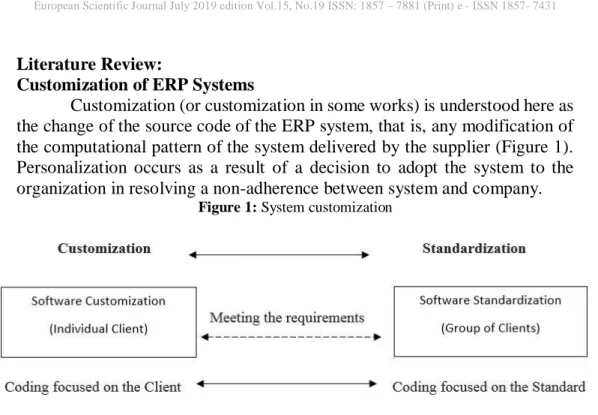
Customization (or customization in some works) is understood here as the change of the source code of the ERP system, that is, any modification of the computational pattern of the system delivered by the supplier (Figure 1). Personalization occurs as a result of a decision to adopt the system to the organization in resolving a non-adherence between system and company.
Figure 1: System customization
Source: Adapted from Bellini, Becker and Borenstein (2004).
Possibilities for Customization
There are basically three ways to customize an ERP system: customizations, interfaces, or bolt-ons. The customizations are the modifications in the ERP system so that it can adapt to a certain organizational situation impossible to be reproduced through existing parameters. Customization is a small project in itself, and, like any project, requires planning, resource allocation and follow-up (Fitzgerald & Stol, 2017).
Interfaces are programs that allow communication between different systems, regardless of whether they have the same technology (Fitzgerald et al., 2017). For Sykes (2015), the need to build interfaces is conditioned to the modules acquired. If the organization needs a feature not included in the system, there is a need to maintain some legacy system or specific software for the exchange of information between systems. It should be mentioned that, although ERP systems have a wide range of functionalities, they do not yet meet all organizational needs.
Finally, bolt-ons solutions are specific systems that can be integrated with ERP systems without specific developments and that have functionalities that seek to complement what already exists in the ERP solution. Of the customizations, this is the least problematic, since the suppliers of bolt-ons are, in general, partners of the suppliers of ERP; so, the solutions tend to be synchronized with the version updates of the ERP system in question.
Customization Attention Points
Customizing an ERP system, however, should be avoided whenever possible, due to the resulting serious implications. Among them, the first to be highlighted is the modification of the original product; a specific version that needs to be rebuilt with each new release released by the vendor (Fitzgerald et al., 2017). Changes made must be made by the software vendor, as he or she knows the product and may possibly make changes without incurring damages to the customer; however, if the development is done by the organization the supplier will not be responsible for problems arising from these changes. The development of customizations, in addition, means additional costs and unforeseen costs, besides usually having negative impact on the schedule (Fitzgerald et al., 2017).
Methodology of the Investigation
In order to propose the methodology presented below, different works on the customization of ERP systems and the steps to be followed have been previously reviewed, such as, for example, the Systematic Help for an ERP Acquisition (SHERPA) methodology. (Haddara, 2018) or the works of Ranjan et al. (2016), Wei, et al., (2005), Bradford (2015) or López and Ishizaka (2017). These articles also include references to other previous works that deal with the methodology of customization of ERP systems, with which you can have a global idea of the proposals made in recent years. However, in all these studies emphasis is placed on one or the other part of the customization model, in some of the activities or phases, but there is no proposed methodology that includes all the necessary activities with a minimum level of detail so that it can carry out the whole process. For example, the SHERPA methodology, despite being a specific and very detailed methodology, does not comment on the project team and the profiles that must participate in it, as well as having functional criteria that could be updated to the current situation.
In the case of Bradford (2015), his proposal begins directly by the analysis of requirements, without taking into account previous steps. In the case of Wei et al (2005), it focuses a lot on the comparative valuation among alternatives, although it does not indicate anything of activities such as product demonstrations, visits or negotiation, among others. Rivera and Ranjan et al. (2016) make a review of the literature very interesting, propose in their work a series of activities to be done to select an ERP based on the different phases identified in various works. But his work focuses more on the literature review, and a methodology is presented in which little detail is entered into each activity, going directly from the constitution of the work team to the analysis of requirements and criteria to be evaluated. Nor does it propose a method for the evaluation and comparison of the different alternatives. Therefore, it does not become an operational proposal for an SME.
In the research presented in this article, all the information of these revised proposals was collected, as well as the works cited, and it was contrasted with the experience of experts and ERP user companies, who had evidently had to previously customize the system. The panel of experts was composed of two profiles. On the one hand, academic specialists in the area of information systems, and on the other hand, professionals, consultants, and managers of implanting companies and manufacturers of ERP systems. With this, a panel of 10 experts was composed and the Delphi method was used, one of the methods that is best suited to address scientific fields in continuous evolution, such as the one investigated here, mainly to detect key factors in the management of Information Systems, and predict their future evolution (Mozuni & Jonas, 2018).
Based on the research proposals cited, and the contributions and experience of the experts and companies using ERP systems with which this research has been counted, a series of activities are proposed that must be carried out sequentially as the methodology for the customization of an ERP system. In this case, it is not being done from the point of view of a large company, or from a strategic level, as is often the case in the studies reviewed, but rather from a point of view of the needs of an SME, and at the operational level.
Findings:
In the first place, it is worth mentioning that, before starting to apply the ERP customization methodology, the company or organization that wants to implement it, the following question should be asked: is the organization really prepared to implement an ERP? Implementing an ERP system is not much like installing new software, nor like another IT department project. Keep in mind that it involves a strategic and organizational change that will affect the entire company and you will need a project that involves the entire organization, which must be willing to change, driven by the highest management. If this is not the case, the project should be discarded directly and perhaps opt for another alternative, such as personalized development (internal or external), the integration of specific software packages by areas, the maintenance of existing systems etc.
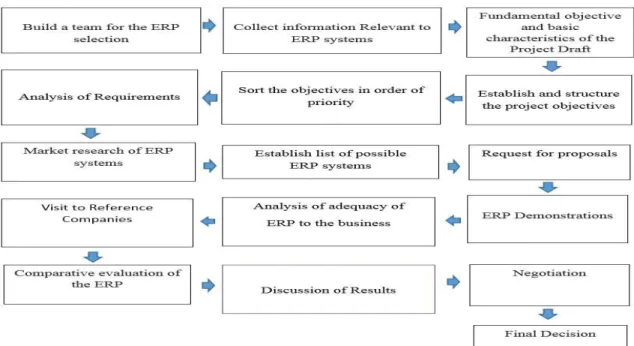
If the answer to this question is affirmative, and the company is prepared to assume a change of these characteristics, the first thing to do is select the ERP that best suits its situation and particular characteristics, for which it is proposed to follow the methodology composed by the activities presented in Figure 2 and described below in the following sections:
Figure 2. Proposed methodology
Source: Authors
Constitute Work Team for the Customization of ERP
Once the decision to implement an ERP has been made, the first step should be to form a project team. It is important to note at this moment that the team referred to here is not the "implantation" team of the ERP. The implementation team will be formed later, at the start of the implementation phase, once the customization is made. At this point, it is about establishing the team of the "ERP customization project", which obviously should have members in common with the implementation, but it does not have to be the same. The ERP customization project team should be led by senior management and should include representatives from all departments at the highest level, as well as functional experts from the different processes. Obviously, a technical point of view is also necessary, but it must not be forgotten that the implementation of an ERP system implies in itself a reengineering of processes (Bradford, 2015) and, therefore, it should be taken into account from this point of view, and not from a merely technological aspect.
Sometimes, it is interesting to include within the team the figure of an external advisor. But you have to be very careful with this, given that these external consultants and companies that are dedicated to this type of work (there are companies and organizations that advise on the ERP customization projects) are usually aligned with some system, product or a particular
implanting company, even being many times the own consultant company. However, this figure can be very interesting as a component of the team, given that the members of the project team of the organization in which the ERP is selected do not have why experts in this type of systems are (and generally they are not) and a professional vision
Specialized, as is that of an external advisor, can be very valuable. But in its proper measure. The adviser must not make the decision in any case, it is simply a source of information and knowledge, an external and expert opinion that can be taken into account. On the other hand, it should be noted that top management cannot delegate its leadership role of the project. It is important to emphasize again that it is a strategic decision, not a technical one, and as such it must be undertaken. This is one of the main problems when selecting an ERP for an SME. Usually, being a technological system, the customization of the ERP is usually left to the technicians. But that should not be the case, because many points of view are necessary for a decision like this, and the technique is just another vision to take into account, and generally, not the most important one.
Collect the Relevant Information of ERP Systems
At this stage, the customization project team must gather relevant information about ERP systems in general, and the situation of the sector and the market.
Possibly the team is not an expert in this type of systems. But if a project of this magnitude is going to be approached, they must begin to become it, forming themselves in the basic concepts (and the not so basic) of the ERP systems. For this, you can get a lot of information about ERP systems, projects, benefits, disadvantages, risks to be taken into account and through specialized books, professional journals, congresses, exhibitions, yearbooks, internet and other sources.
The project team should be organized to know everything necessary before starting the process of selecting an ERP, since, once implemented, this will be the tool that manages all the information of a company, and will become a critical factor for the success and future development. Therefore, all the time that is used for the formation of the project team, and that makes it able to select the most appropriate ERP, will be well spent.
In this section, it is also very interesting the help of a possible external advisor, an expert in the field, who can provide information and training, provided it is non-partisan or interesting. And not only in terms of ERP systems only, but also in the different areas that may be necessary for the implementation and use of this type of systems, and the possibilities they offer at the time of customization. For example, in the possibilities of the different
cloud modalities that can be used, the free software options that exist, the different types of implementation etc.
Identify the Strategic Objective and the Basic Characteristics of the Project
Sometimes, the fundamental reason for the implementation of an ERP project is not defined or is not adequately known by the team. However, this is a primordial point that, if it is not clearly and duly transmitted at the time of making the customization, can lead to totally erroneous customization, based on criteria not suited to that fundamental reason. Therefore, in the proposed methodology a specific point is specifically dedicated to this activity, due to the importance it has.
Therefore, the purpose of this step of the methodology is to establish the strategic objective, the real reason for the decision to implement an ERP. In a large company, in general, when you reach this step, this is already more than defined, from the decision to approach a project like this, and then it is concreted and transmitted to the customization and implementation plan, as seen in many published research works. But in an SME, this is not so clear, and many times you do not really know why you want to implement an ERP, what is the final task of that road to travel.
Different companies can adopt an ERP system for completely different reasons, including, among others, from technical and commercial reasons to impositions by partners or dominant members in a supply chain. The initial fundamental reason for adopting a ERP system influences the definition of the problem, the definition of the objectives, the methods for achieving these objectives and the rest subsequent activities.
It is not the same to implement an ERP because of the need to be able to face a legislative change in an accounting issue that the existing system cannot cover, that by the need to establish a new working model in logistics management, or by obsolescence technique of current systems. Obviously, the project approach is very different in each of these cases, and it may be that the ERP to select it is also different.
In this step, you can use techniques to identify and define problems, such as the 5 W (or the 5 why) which despite being very simple, can clarify this issue to a large extent (Michlowicz & Mindur, 2018). At this point, it might be crucial to reflect again, based on the result obtained, if the company really needs an ERP to achieve that "fundamental objective". In addition, once all the information gathered so far, both internal and external, is known, it is a good time to rethink the question "is the organization really ready to implement an ERP?"
If this is the case, the entire project team must assimilate this strategic objective, and all the activities of the customization project (and subsequently
the implementation) must be established on the basis of it, without losing sight of it as a point of reference that must be reached. Once this strategic objective has been defined and assumed as such by the entire project team, and after processing and assimilating the information obtained in the previous phase, it is possible to identify some basic characteristics to find the most appropriate solutions to the limitations of the organization and its resources. At this time reference is made to very global characteristics, as if it is important that the ERP works in SaaS mode, or in its own installation in the same company, or if access to the source code is necessary or desirable. These are issues that, depending on the project and its strategic objective, can be taken as customization criteria in subsequent steps of the methodology, but which, on occasion, based on the strategic objective of the project, such as the elimination of the IT department, could be perfectly they can be a fundamental point to take into account before even thinking about the detailed objectives of the project, which are identified and structured in the next phase.
Establish and Structure the Objectives of the Project
Once the reasons for the implementation of the ERP are known and based on the strategic objective, the project team must identify and define the objectives that are expected to be achieved through the use of the ERP. These objectives can be diverse and of variable magnitude and importance. In addition, they are surely related to some extent between them. Therefore, it is interesting to establish a structure that can relate to them.
Many times they get lost of sight when entering the detail of the particular objectives, for example, when establishing the objectives to be fulfilled by the system at a functional level in an area or concrete department of the company. Therefore, all objectives must be aligned to achieve the scope of the strategic objectives and will be structured systematically based on them. It is important that the established objectives have the characteristics proposed by Croxatto and Greub (2017) who uses the word SMART as a mnemonic rule of the following characteristics that an objective must fulfill:
S: Specific
M: Measurable
A: Attainable
R: Realistic
T: Time-Related
Classify the Objectives Based on Priority
After creating the objectives structure, the project team must prioritize them, determining which are totally necessary to achieve the strategic objective, and which are desirable, but with a lower priority. It must be
achieve all objectives due to budgetary problems or temporary deadlines. But the minimum objectives must be met to achieve the strategic objective of the project, and therefore, there will be some more important than others. Based on this prioritization, it is possible that relevant attributes can already be identified to evaluate ERP systems.
Perform the Analysis of Requirements
The requirements analysis is a fundamental step in this type of projects, which will allow knowing the needs that the organization has to carry out its processes, and that should be covered by the ERP. Therefore, it is at this moment when the detailed requirements that the ERP system must meet are established, taking into account the established objectives as a starting point.
For this, detailed knowledge of the processes that take place in the company is essential. Many times, this is the most complex step of the customization, especially in the case of SMEs, since, in general, these have no documented processes, and it is complex to do the requirements analysis. In fact, on many occasions, the processes are not even identified. Therefore, in the first place, it will be necessary to identify the processes, define them and model them, if this is not already done.
Sometimes, due to its size and the possible complexity that it may bring, this step supposes a "subproject" of the main project, focused on Process Management. In many cases, this step is not given enough importance, and it is about analyzing the specific needs that the ERP system must have, based on the "ways of doing" of the company, but without taking into account that they cannot be the correct ones or the most suitable ones. Therefore, it is important to question the suitability of the company's processes and act accordingly.
Once the processes are perfectly identified, defined and modeled, you can make a requirements analysis, using standard type analysis tools, such as the use cases proposed by the UML language (Unified Modeling Language) or the structure of the IEEE / ANSI 830-1998 standard. In general, the requirements will be functional, although these may result in other non-functional requirements, of a rather technical nature.
Market Research of ERP Systems
Based on the requirements established in the previous phase, the project team should look for ERP systems that can be implemented in the company. In general, in addition to taking into account the requirements, a filter should be established based on certain basic parameters (maximum affordable cost, platform, covered modules etc.) and that is appropriate to the organization and the type of project that is being considered.
The project team must obtain the minimum information sufficient about each ERP that can consider, applying the required requirements. This
information can be obtained through different channels, such as initially through the internet and the official pages of ERP systems, consulting companies, universities, forums, industry and business associations, contact with other similar companies that have had a similar experience, or direct contact with the ERP manufacturer or distributor.
It may be the case that an ERP system is distributed and implemented by two (or more) consulting firms. This happens especially in the most well-known and implanted ERP systems. In this case, in addition to information on the ERP system itself, you should also look for information on the "Partners", the consulting companies that are responsible for the implementation. Must take into account that the success of an ERP implementation project depends more on the Partner than on the ERP itself.
Establish List of Possible ERP Systems
Once the information of the different ERP systems that may be susceptible to be selected is known, an initial list with a reduced number of candidates must be established. It should be a small number, recommended between 5 and 8, according to Bradford (2015) and the SHERPA methodology.
Subsequently, the information on the ERPs selected in the first instance should be expanded, and a second filter based on this should be established to reduce the list. Here, the project team needs much more information about the ERPs obtained in the previous phase. This information must be obtained through direct interviews with suppliers and partners, obtaining as many system data sheets, catalogs, articles etc. as possible. All this information is contrasted with the requirements and objectives established to reduce the list of possible candidates.
Finally, the project team must select 2 or 3 (maximum 4) candidate ERP solutions.
Request for Proposals
In this phase, project proposals for the implementation of the ERPs that have been included in the list resulting from the previous phase must be requested. This request for proposals must ensure that it is reflected in writing the scope, the areas that are covered, the deadlines, control milestones etc. of the project, as well as the costs, are broken down to the highest level of detail, with the payment terms also included.
In the proposals, the costs must include the entire implementation project, complete, including both software and hardware, consultant or programmer hours, software licenses and possible updates. In the section of the software, it is necessary to take into account that sometimes, in addition to
functioning, such as database management systems or development tools. And of course, it should also include future maintenance, both in support or development services and in license updates.
In addition, possible developments must be closed to the maximum to solve the possible "GAPs" that may exist between the ERP processes and the company's requirements. No company fits 100 % with an ERP, and many times, if not always, it is necessary to make developments or modifications in the system, even if they are minimal. The developments that may be necessary to cover the identified requirements must be perfectly defined and budgeted.
It is also more than recommended that the proposal requested from suppliers include information from the project team that will participate in the implementation if their proposal is selected. This information should include the structure and composition of the team that will participate, its curriculum and experience in ERP implementations in companies with similar characteristics, and guarantees to ensure that this project team will be stable and really take over the project throughout its duration. In many cases, the ERP implanting companies present project teams composed of people, consultants, who subsequently do not carry out the implementation for different reasons (for example, that the consultants have been assigned to another project, or that have left the consulting company). You must be assured that the person can change, but the profile that will be responsible for the implementation should be similar.
Demonstrations of the ERP
At this point, the suppliers of the ERP that have been selected in the previous phase must show their products, their ERP, so that its validity is clear to carry out the processes of the company. This demonstration should be done in a session for each ERP in which they are present: the customization project team, senior management, mid-level management (directors or department heads) and a selected group of future end users. The objective here is to obtain much deeper knowledge about each solution, specifically about its functionality and adaptability to the organization.
It is essential that the company, for the demonstration, has identified its main processes and the particular characteristics of each of them, in order to observe how the ERP system is going to show can manage such processes. It is also very interesting to provide a set of data to the company that is going to do the demonstration, so that this is done with data as real as possible, and that the demonstration attendees get an idea of how the ERP could work in an environment as similar as possible to yours. If necessary, you can demonstrate an ERP in several sessions. For example, by functional area, so that department managers and end users can go through shifts only to the session in which they see how their needs will be met. Of course, the information
extracted from each of the demonstrations must be collected, both in the technical aspect of the ERP and the response of the consulting team.
Analysis of Adequacy of ERP to Business
Once all the demonstrations have been carried out, the project team gathers all the information and opinions, to check the adequacy of each ERP to the list of requirements. If there are doubts about the adequacy of the system to the company and vice versa, you must resolve them, either by contacting the ERP Company, or the consultant who will implement it, or internally, depending on the origin of the possible doubt. But it must be clear the adequacy of each ERP to the processes and requirements of the company. It is interesting in this case to use comparative tables to gather the adequacy of the ERP to the requirements. In addition, these tables can be used to make comparisons between different systems.
Visits to Reference Companies
In this step, the intent is to observe and assess how the targeted ERP works in a real environment. To do this, visits are made to companies in which each of the ERP have been implemented and are functioning. Obviously, it is interesting that the company you visit has requirements as similar as possible to those established, and have some characteristics (size, sector, geographical area etc.) as similar as possible. If it is possible, it is also highly advisable to visit without the company of the consulting company, so that the interlocutors of the reference you visit can express their opinions in a completely free manner. Although that is really difficult in the vast majority of cases.
Comparative Evaluation of the ERP (HAP Method and Basic Criteria)
At this point, you already have all the information about the different ERP systems and the consulting companies that implement them. Now it is necessary to compare the options, to make a decision. This decision is based on multiple criteria, which are not always equal or with the same importance for each organization. It depends on the established objectives, the associated requirements and how each of them is covered in each ERP. Therefore, the decision is very complex and differs in each case, which makes a tool or method that helps the decision making very useful, taking into account that it must be able to consider different criteria and priorities among them.
In the scientific literature, there are many studies on the application of different methods for the customization of software packages. Specifically, Jadhav and Sonar (2009) conducted a study on the evaluation and customization of software packages that includes a systematic review of methodologies for selecting packages and software evaluation techniques.
This study concludes that the application of the method of the "hierarchical analysis process" (HAP) to the evaluation of software packages has been applied successfully in many research studies.
In fact, the HAP method has been applied on different occasions to the customization of an ERP system, but from the point of view of large companies and multinationals, and based on customization criteria appropriate to these. Possibly this is because the ERP, in the past, have been aimed at large companies. However, currently the ERP manufacturers seek to expand their customer market, approaching and adapting to the market of SMEs (Ngai, Law & Wat, 2008), and it is in this type of companies where the methodology presented in this context is framed. work, MCERP.
It should be noted that the HAP method was presented by Thomas Saaty (1990) and has been widely used as a multicriteria decision-making tool in such diverse areas as Society, Science, Education, Economics, Transportation, Location and Resource Allocation, Marketing, Production, Environmental applications, urban planning, public sector, health, system evaluation, group decision, international conflict resolution, new technologies, thinking and ethics, among others as can be seen in Vaidya and Kurnar (2006). The potential of the method is due to the fact that it adapts to different situations, its calculation is simple, and can be used both individually and in groups. In the case of the proposed methodology, MCERP, this is essential, since it is mainly focused on SMEs, and the capacity for adaptation and simplicity are essential for its use. In essence, it can be affirmed that the HAP method is a method of selecting alternatives (strategies, investments etc.) based on a series of variables or criteria, which are often in conflict. To do this, it weighs both the criteria and the different alternatives, using a series of paired comparison matrices and the Fundamental Scale for pairwise comparisons. In this way, the HAP method allows a systematic comparison of alternatives and is applicable to practically all areas of decision making (Ossadnik, Schinke & Kaspar, 2016).
The central principle of HAP is to divide the decision problem into a hierarchy of sub-problems, structuring the decision, which makes it suitable to handle complex decisions (Vaidya et al., 2006). In this way, the decision problem is first decomposed into a series of sub-problems or hierarchical decision criteria, each of which can be analyzed independently in relation to each alternative. Obviously, in this way, the complex multi-criteria decision is broken down into decisions based on a criterion, being easier to understand and analyze.
In the methodology presented in this paper, the use of the HAP is proposed as a tool to compare the alternatives and decide, according to the established criteria, the most appropriate option. Therefore, criteria that will be applied in the HAP method must be established, as well as their
relationships and relative weights. This, obviously, is extracted from the objectives and their structure and priority, as well as from the previously established requirements. Of course, these criteria not only come into play characteristics of the ERP, the software itself but also have to consider criteria in relation to the software manufacturer and the partner or implementing company, many times more important in the success of the project than the ERP in itself.
Presented below is a classification of criteria extracted from the works of Wei, et al., (2005) Tsai, et al., (2012) and Cruz-Cunha, et al., (2016) who in turn study literature existing about it These criteria were agreed with the group of experts, and they were also presented to a group of 15 managers / CEOs of companies that had recently selected and implemented an ERP system.
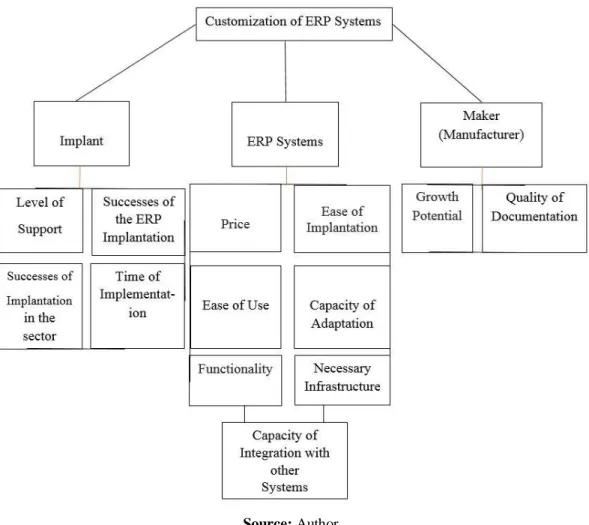
After that, as a result, the MCERP methodology establishes a series of basic criteria that SMEs can take into account in the customization of the ERP system. It is worth mentioning that, in this proposal, the criteria are structured into 3 categories, whether they are related to the ERP System, to the manufacturer of the same, or to the partner or implanting company. The classification in 3 categories that are presented in the MCERP methodology and that can be seen below in figure 3 is not observed in any of the reviewed published works.
Figure 3. Hierarchy of basic criteria
Source: Author
These proposed criteria can be adapted according to the needs of each of the companies that apply the methodology, which should also establish the relative weights of the importance of each of them, depending on the requirements of each specific case. The MRP methodology establishes a series of basic criteria that SMEs can take into account in the customization of the ERP system.
Discussion of the Results
At this moment, there is already an evaluation result of each ERP, the result of all the information collected on each system, and its comparison with the specific requirements of the company, to achieve its objectives. This result must be analyzed by the project team and by the management. It may be that there is some error of appreciation, or in the establishment of criteria or requirements. Even if there is still some unresolved doubt, or that has not been
sufficiently documented. This is the time to review all these issues, before moving on to the next negotiation phase with the selected provider.
Negotiation
Finally, you already have a decision on the most appropriate ERP. Once the ERP has been selected (or the combination of the ERP and the consulting firm, if applicable), the project team negotiates the contract with the selected ERP provider. Here you should review the entire future implementation project again, including planning, phases, resources, costs, etc. Finally, the top management gives its final approval, of course with the approval of the project team, and the contract is signed with the ERP provider. In this negotiation phase, it is possible that, based on it, some parameters of the ones taken into account in the customization process may change. It is common for some providers, if they have not been selected, to "reformulate" their project proposals, especially in the economic area, or in terms of time and dedication of resources. If this is the case, going back to the "ERP Benchmarking" phase and modifying the values needed to obtain the decision based on the new situation is needed. These negotiations can be extended, and can even modify the decision if the values of the customization criteria are really modified. It must be borne in mind that, in general, the time spent by ERP providers to provide information, resolve doubts, carry out demonstrations and visits to reference companies is quite a lot, and it is often profitable to modify the costs or deadlines execution, to finally obtain the signature of the contract, and not lose the client against the competition.
Final Decision and Signing of the Contract
Finally, the decision of the ERP that is going to be implemented is taken, and the contract is signed. With this, you can start the implementation project, depending on the established planning.
Conclusion and Recommendations: Conclusion
In this work, an assessment of the customization of ERP Systems has led to the development of a proposal presented with the MCERP methodology, which can be used in an SME for the customization of an ERP system suited to their needs. The proposed methodology is based on different existing proposals regarding methodologies for the customization of ERP systems. The information of these proposals has been contrasted with a team of experts in the field, made up of specialist academics, consultants and companies that use (and therefore have selected) ERP systems.
Recommendations:
The proposed methodology, in some way, groups and chooses the most detailed level in each phase to develop it and take it to a more operational level in an SME. In this way, it is a methodology consisting of 16 phases, very specific and delimited to each other which make it very simple to follow, guiding the company that must make the customization from the first stage until the end of the process. In addition, some tools are proposed that can support some of these phases, such as the application of the HAP method, or the use of cases.
Finally, as a future line of work, this methodology should be applied in the customization of ERP systems in SMEs in order to check their validity and extract possible improvements.
References:
1. Ann Sykes, T. (2015). Support structures and their impacts on employee outcomes: A longitudinal field study of an enterprise system implementation. MIS quarterly, 39(2).
2. Bellini, C. G. P., Becker, J. L., & Borenstein, D. (2004). Towards a
Better Understanding of Stakeholders' Roles in Software
Customization. Int. J. Comput. Syst. Signal, 5(1), 16-31.
3. Bradford, M. (2015). Modern ERP: select, implement, and use today's advanced business systems. Lulu.com.
4. Croxatto, A., & Greub, G. (2017). Project management: importance
for diagnostic laboratories. Clinical Microbiology and
Infection, 23(7), 434-440.
5. Cruz-Cunha, M. M., Silva, J. P., Gonçalves, J. J., Fernandes, J. A., & Avila, P. S. (2016). ERP Selection using an AHP-based Decision
Support System. Information Resources Management Journal
(IRMJ), 29(4), 65-81.
6. Fitzgerald, B., & Stol, K. J. (2017). Continuous software engineering: A roadmap and agenda. Journal of Systems and Software, 123, 176-189.
7. Haddara, M. (2018). ERP systems selection in multinational
enterprises: a practical guide. International Journal of Information Systems and Project Management, 6(1), 43-57.
8. Jadhav, A. S., & Sonar, R. M. (2009). Evaluating and selecting
software packages: A review. Information and software
technology, 51(3), 555-563.
9. López, C., & Ishizaka, A. (2017). GAHPSort: A new group multi-criteria decision method for sorting a large number of the cloud-based ERP solutions. Computers in Industry, 92, 12-25.
10.Michlowicz, E., & Mindur, L. (2018). Logistics Engineering in Logistic Processes Designing. Logistics and Transport, 37.
11.Mozuni, M., & Jonas, W. (2018). An Introduction to the Morphological Delphi Method for Design: A Tool for Future-Oriented Design Research. She Ji: The Journal of Design, Economics, and Innovation, 3(4), 303-318.
12.Ngai, E. W., Law, C. C., & Wat, F. K. (2008). Examining the critical
success factors in the adoption of enterprise resource
planning. Computers in industry, 59(6), 548-564.
13.Ossadnik, W., Schinke, S., & Kaspar, R. H. (2016). Group aggregation techniques for analytic hierarchy process and analytic network
process: a comparative analysis. Group Decision and
Negotiation, 25(2), 421-457.
14.Paluch, S., Antons, D., Brettel, M., Hopp, C., Salge, T. O., Piller, F., & Wentzel, D. (2019). Stage-gate and agile development in the digital age: Promises, perils, and boundary conditions. Journal of Business Research.
15.Ranjan, S., Jha, V. K., & Pal, P. (2016). A strategic and sustainable multi-criteria decision making framework for ERP selection in OEM. International Journal of Applied Engineering Research, 11(3), 1916-1926.
16.Romero, D., & Vernadat, F. (2016). Enterprise information systems state of the art: Past, present and future trends. Computers in Industry, 79, 3-13.
17.Tsai, W. H., Lee, P. L., Shen, Y. S., & Lin, H. L. (2012). A comprehensive study of the relationship between enterprise resource planning selection criteria and enterprise resource planning system success. Information & management, 49(1), 36-46.
18.Vaidya, O. S., & Kumar, S. (2006). Analytic hierarchy process: An
overview of applications. European Journal of operational
research, 169(1), 1-29.
19.Wei, C. C., Chien, C. F., & Wang, M. J. J. (2005). An AHP-based approach to ERP system selection. International journal of production economics, 96(1), 47-62.