Tel +44 (0) 20 7612 6000 Fax +44 (0) 20 7612 6097 Email [email protected] www.ioe.ac.uk
Development Education Research Centre
Douglas Bourn and Olga Cara
Research Paper No.10
School linking – where next?
Partnership models between
schools in Europe and Africa
Published by the Development Education Research Centre in partnership with Link Community Development
Development Education Research Centre Institute of Education
London International Development Centre 36 Gordon Square
London WC1H 0PD www.ioe.ac.uk/derc Tel: 020 3073 8309
Link Community Development 19b Compton Terrace, London N1 2UN www.linkschools.org www.lcdinternational.org Tel: 020 72269331 First Published 2013
© Development Education Research Centre and Link Community Development
ISBN: 978.0.9574546.2.0.
Cover photo: School children in Masindi, Uganda by Madeline Bain.
Partnership models between schools
in Europe and Africa
Contents
Acknowledgements 2 Preface 3 Executive Summary 5 1 Introduction 7 2 Methodology 9 3 Context 114 Models of School Linking 13
5 Link Community Development and School Linking 20
6 Partners in Development Project 22
6.1 Aims and Challenges for the Project 22
6.2 Targets and Goals 25
6.3 Evidence from the Mid-Term Evaluation 27
6.4 Impact in UK and Ireland 29
6.5 Impact in Ghana, Malawi, Uganda and South Africa 31
7 Analysis of School and Teacher Engagement with Partners in Development 35
7.1 Schools’ involvement 35
7.2 Teachers’ views 39
7.3 Case Study: Six Scottish Schools 52
7.4 Case Study: English Primary School 56
7.5 Observations on this Data 57
8 Impact of the Project on Link’s Work 58
9 References 63 Appendix A 67 Appendix B 68 Appendix C 70 Appendix D 72 Appendix E 75
Acknowledgements
This final evaluation has been based on data gathered from staff at Link
Community Development. They have been very open and honest with both the information they have supplied and their responses to queries.
We would particularly like to thank the following for supplying information and being available for interview: Madeline Bain, Steve Blunden, Andy Houlihan, Beth Kreling, Richard Phillips, Kennedy Quaigrain, Louise Stuart, and Alex Wright; and Angela Cook and Alison Leonard for their comments on earlier drafts of this report.
Preface
School linking today faces a very different operating environment from that encountered by the Link Schools Programme when it first launched back in 1998. Stark shifts in UK policy towards development education are forcing those involved in facilitating school partnerships to ask fundamental questions about the purpose of school linking, who benefits, and the economic sustainability of existing linking models.
These changes have directly affected Link’s operation of the Link Schools Programme and the European Union (EU) Partners in Development grant that we received to support our linking work. When our EU funding began in 2010, UK education and overseas aid policy was firmly behind development education. Global citizenship was referenced in the curriculum, increasing school demand for international links and DFID funding required development projects to “include an element of building support for development in the UK”1. Over the three year lifetime of our EU grant, there has been a complete policy reversal following the election of a Coalition government in the UK. The concept of global citizenship is no longer referred to in the curriculum in England, although it still has some status in Wales and Scotland. DFID now stipulates that: “Absolutely no Global Poverty Action Fund (GPAF) funding can be used for awareness-raising activities in the UK”2. As a result of this increasingly challenging environment and the end of our current EU grant, Link has decided, with regret, to end its school linking programme after fifteen years of operation. At this turning point for us as an organisation, we wanted to reflect on what we have learnt from working in the sector, to celebrate our achievements, and to encourage wider debate on the challenges we have faced and their implications for the sector as a whole.
The Link Schools Programme was different from other linking models in that it deliberately set out to address the imbalance in existing linking programmes between northern and southern benefit. It worked exclusively with rural, African, government-run schools that were already part of Link’s broader school improvement projects. It established a supported linking model that benefited all African schools in a district, both linked and not linked, and openly encouraged closely monitored and targeted fundraising to support development projects in African partner schools. As a result of this emphasis on southern benefit, the programme embodied, more than most linking programmes, the tensions that have existed across the linking sector between northern biased grant priorities and southern beneficiary needs. As this report outlines, the programme has achieved notable success both in contributing to improved school performance in African schools and in building development knowledge in European schools, but overall
it has struggled to meet the breadth of outcomes its dual-beneficiary structure demanded.
Over the course of fifteen years of coordinating school links and teacher
placements - and of juggling these competing priorities - we have learnt some key lessons:
• a consistent policy environment at both ends of the partnership is crucial to building effective and sustainable programmes;
• linking should have a clear purpose – not just linking for linking’s sake – and that purpose should be defined by schools and communities on both sides of the partnership;
• linking can help meet school improvement and development education agendas, but success requires significant capacity and balanced funding. Economically sustainable, fully-supported linking models without external donor funding are just not viable in the current climate;
• structured overseas placements north-south or south-north can have real impact. In order to explore these lessons further and to set them in a broader context, this final evaluation report for our EU Partners in Development programme, conducted by the Institute of Education, focuses not just on the evaluation of a single project, but also on comparing linking models and challenges across the sector. As we now bid farewell and offer heartfelt thanks to all of the schools and staff that have worked with us over the last fifteen years, we hope that this report does justice to all that they have achieved and provides a critical lens through which to plan for the future.
Executive Summary
Linking between schools in the UK and schools in sub-Saharan Africa has been a feature of the educational landscape for more than twenty years, but became a government priority between 2000 and 2010. Whilst the interest in Ireland was less, both countries resourced linking programmes primarily as a means of raising awareness of development issues.
Non-governmental organisations (NGOs) also became involved in school linking during the first decade of the twenty first century with Plan UK and Link Community Development (Link) being the leading organisations in this field. However due to funding constraints and change in UK government policy post 2010, both of these NGOs ended their linking programmes in 2011 and 2012 respectively.
Link’s involvement in school linking came from a development perspective; links were primarily seen as a mechanism for improving schools in sub-Saharan Africa. Development education only became a main feature of their linking programme with their European Union funded project, Partners in Development (PiD), which ran from 2010 to 2012. This project was funded from a development awareness budget line, but the NGO’s proposal included development goals within the project. This became a major source of tension that was unresolved throughout the life of the project.
This report is an evaluation of the Partners in Development project that was based on linking schools in England, Scotland, Wales and Ireland, with schools in Ghana, Malawi, Uganda and South Africa. The evidence gathered was based on a combination of quantitative based questionnaires, interviews with key staff within Link and in-depth data gathered from a number of schools in Scotland.
The main findings of the evaluation are as follows:
i) The Link Schools Programme (LSP) was clearly valued but its impact was different in the UK and Ireland from that in South Africa, Ghana, Malawi and Uganda. For the schools in Africa the impact of the programme was clearly much more on skills gained and access to resources and infrastructure support; whereas in the UK and Ireland impact was more noticeable in terms of knowledge gained.
ii) The breadth of schools involved, particularly in the UK, suggests that the programme reached different schools from those which have been involved in other linking programmes.
driven approach. This meant that some of the more imaginative and creative areas that emerged during the life of the project were not able to be fully explored. iv) Link staff became too heavily involved in administration and support,
particularly administering the exchange of letters between schools, and did not focus enough on professional development support in Europe. However there was evidence of well supported professional development programmes in partner countries in Africa.
v) As a consequence, many of the issues that often emerge in linking activities, such as perceptions of the lives of the partner school’s pupils, the dangers of reproducing colonial relationships and sharing examples of mutual learning, were not fully addressed. The themed resource packs were welcomed but were not necessarily the priority need in terms of areas of study for partner schools in the Global South.
vi) The website was popular and the Solar Connect component that provided internet access to some of the schools in Africa was highly valued. The direct exchange of letters and material, although costly in terms of time and support, was regarded as very important, particularly in terms of raising standards in English language.
vii) Supported links developed by the Link model clearly have value. They can locate partnerships within specific communities by maximising existing contacts. They can provide opportunities for professional development support and act as conduits for access to broader educational support and resources. But seeking funding to pay for this from partner schools in the UK and Ireland is a challenge; the amounts they are prepared to give are never going to be sufficient to ensure such programmes can be self-funding.
The project had considerable impact and value to schools in both Europe and Africa. The benefits were however quite specific and distinct to particular schools, and in many cases were not easily categorised within development education objectives.
An overall recommendation for funders of school linking programmes in future is that links need to be supported on their own terms, which by the nature of the bi-lateral relationship at the heart of school linking, will always be both educational and developmental. Programmes should make reference to mutual learning but at the same time include an understanding that agendas and needs will be different in the Global North from those in the Global South.
‘Do you ride an Elephant to school?’
1
Introduction
This research report has been produced by a research team at the Institute of Education based at the Development Education Research Centre (DERC), in partnership with Link Community Development (Link). It is the third and final report in a series produced by the Research Centre on the work of Link and its European Union (EU) funded Partners in Development (PiD) project.
The two earlier reports were: a mid-term evaluation of PiD (Bourn and Cara, 2012); and research that looked specifically at the impact of partnerships on rural schools in a district in Uganda (Bourn and Bain, 2012).
This research report builds on the evidence published in those reports and is the final evaluation report of the PiD project. This report particularly aims to reflect on: i) the impact of Link’s PiD programme on schools and pupils;
ii) its role and value in relation to models of school linking;
iii) the merits of international partnerships for NGOs where the primary focus of the organisation is based on development goals and objectives.
This report does not aim to reflect on some of the broader debates and questions regarding international school partnerships, such as neo-colonial and power relationships, changing priorities and the agendas of funders, nor what is meant by inter-cultural understanding and contribution of personal experience to learning. Some of these issues are covered in Alison Leonard’s (2012) research report on the Aston-Makunduchi partnership; and have also been addressed in the work of Andreotti (2011), Martin (2007) and Disney (2008). To date, Link’s activity in school linking has not featured significantly in any other research.
In commissioning the Research Centre to undertake this research and final evaluation of the PiD project, Link was primarily interested in the value of the school partnerships model they had developed, particularly in relation to similar programmes; the impact of having a project framed by the EU funding criteria; and the interrelationship between development education aims and practices and the NGO’s broader development programmes.
In 2012, in reviewing the PiD project and earlier programmes on school linking, Link made the decision to close its engagement in this area of activity. It is continuing to raise awareness of development issues in schools via a new campaign named “Passport to Education” which aims to promote global citizenship skills whilst fundraising for sustainable school improvement work
in sub-Saharan Africa. For both financial and strategic policy reasons, the organisation has decided to focus more on its core business of building capacity and improving performance in schools in specific countries in sub-Saharan Africa. This report is thus in part a reflection on the lessons of the organisation’s overall engagement in development education.
2
Methodology
For this final evaluation of PiD, a methodology was agreed with Link that not only aimed to address the impact of the objectives agreed with the funder, the EU, but also to consider the most appropriate models for school linking and the role that NGOs can play when their main focus is on development goals and objectives. This study has therefore aimed to address three key questions:
i) What has been the impact of the Partners in Development project in terms of increasing awareness and understanding of development issues in schools in UK and Ireland?
ii) To what extent has the project improved the quality and performance of schools in Ghana, Uganda, Malawi and South Africa?
iii) What does the evaluation of the PiD project tell us about the most effective models of school linking?
To gather evidence for this final evaluation, a mixed methods approach has been taken so as to ensure a combination of quantitative data related to usage and impact of the materials produced from the project, alongside qualitative evidence based on interviews and reflections from key personnel in Link in both Europe and Africa. Questionnaires were sent to all schools in Europe and samples of schools in African countries engaged in the project. Whilst there were some variations from country to country in terms of the quantity of the data gathered, we feel we have gathered sufficient evidence to enable us to provide an in-depth evaluation of the PiD project.
The main elements of the research conducted for this evaluation have been: • analysis of existing documentation and research in international school
partnerships;
• interviews with key players involved in the PiD programme;
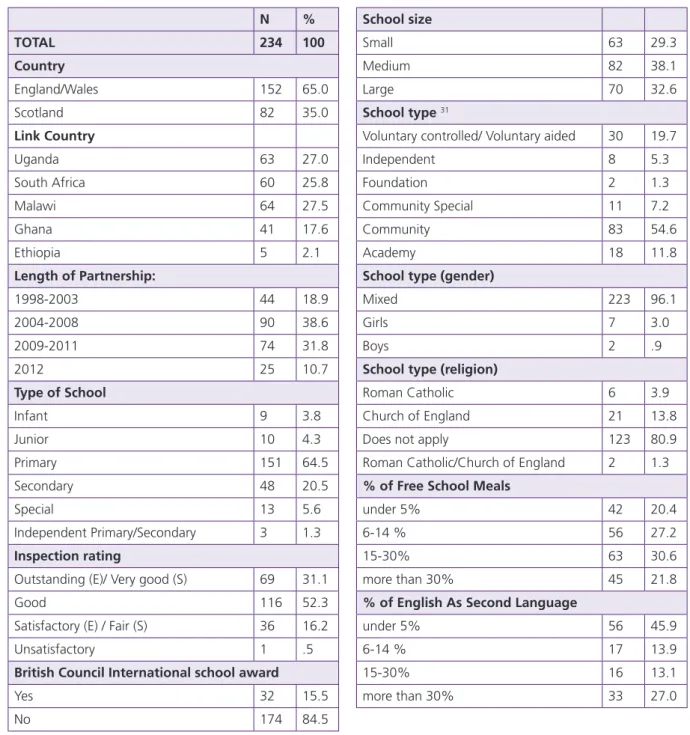
• analysis of data from questionnaires (130) and focus groups (9) from schools in England, Scotland and Ireland;
• incorporation of data from a study conducted in Scotland of 6 schools’
engagement with the programme, including evidence from teachers and pupils; • surveys of impact of the programme from schools in Uganda, Malawi and Ghana;
• evidence from evaluations of use of themed resource packs;
• analysis of comments made by speakers and participants at the IOE/Link Conference on school linking held in November 2012;
• Link staff reflections.
A feature of the evidence gathered in Scotland was the combination of interviews, focus groups and a pupil-centred exercise. The Heads, Hearts and Hands (HHH) activity required small groups of children to sketch a human body outline on to paper, and write what they know (head), feel (heart) and do (hands) regarding their school partnership. This research method was chosen as it was used
successfully in some of the earlier research and evaluation material for this project (Bourn and Bain, 2012; Bourn and Cara, 2012). Focus groups were conducted with teaching staff in each school. Interviews were carried out with the link coordinator in each school. There were six schools in the sample, four primary and two secondary, with varying lengths of relationships.
There were some limitations to the approach taken. For example, it was not possible for the research team to undertake any direct qualitative research with the end-users of the project, teachers and schools. Also there was more evidence gathered in Scotland and England, for example, than in Ireland. It was also not possible to have in-depth interviews with Link staff in all countries involved in the project in sub-Saharan Africa. Evidence from most of these staff was based on written material submitted, based on an agreed number of question areas.
3
Context
International partnerships between schools in the UK and schools elsewhere in the world have been part of the landscape of the British education system for many years. The drivers for this have been:
• teachers’ own enthusiasm for encouraging broader world views amongst their pupils, to learn and experience different cultures;
• policy makers’ belief in school partnerships as a way of breaking down
international barriers and healing rifts between countries; as part of European, Commonwealth or UK-US programmes; and as a means of increasing support for the allocation of taxpayers’ money to the DFID budget;
• development education and development awareness grants for school
partnerships as a means of meeting global citizenship and development awareness goals;
• belief in the value of global connectedness as a mechanism for broadening the experiences and outlook of pupils.
Cook, in her review of the EU funded Comenius school partnership programme, found that it was an ‘effective vehicle to support the delivery of two major
education initiatives’: ‘Developing a workforce with the necessary skills to live and
work in a global economy’; and ‘Providing professional development for teachers’.
These, she suggested, were key drivers for international school partnerships in all four UK nations, including ‘raising awareness of global issues, promoting tolerance of and an appreciation of different beliefs, cultures and backgrounds and improving relationships between different communities (Cook, 2012:i). In the UK, partnerships with schools in the Global South become a major feature of school life from 2000 onwards, as a result of a drive from DFID and the then Department for Education and Skills to encourage all schools to have a link by 2010. As a result, a major programme of funding through the British Council and other NGOs and educational bodies led to a significant expansion of international school links in the first decade of the twenty-first century (Disney, 2008; Leonard, 2012). Elsewhere in Europe, notably Ireland, there was the emergence of a similar initiative of encouraging school links, with funding from Irish Aid (see Toland, 2010).
These initiatives were part of broader goals set by the UK government, the Irish government and the devolved administrations in Scotland and Wales to give greater prominence to global and development themes within education. Whilst there may have been variations in the use of terminology and the specific focus and countries
for partnerships, the overall themes tended to be linked to development awareness. Supporting a partnership with a school in the Global South through mutual learning and real life experience was seen as a practical and valuable way of building
understanding of international development and of global issues.
The European Commission in its grant-making programme for civil society organisations in development awareness, whilst not directly mentioning linking, clearly saw direct engagement with partners in the Global South as an important element of its funding criteria.
Similarly, DFID included a development awareness line in its mainstream
development funding as part of the Civil Society Challenge Fund (CSCF). Whilst project activity was usually focused on poverty alleviation in the Global South, the grant conditions stipulated that “It is a requirement that all CSCF projects include an element of building support for development in the UK”. For UK NGOs focused on project activity in the Global South, this created an immediate incentive to spread their focus to encompass development education activity in the UK as well, in order to qualify for development funding.
Any linking programme must have dual beneficiaries, either directly or indirectly. Funding streams which favour one or other beneficiary create explicit or implicit tensions in project delivery and reporting. Most funding opportunities for school linking, whilst coming from a development focus, saw constituencies in the Global North as the main beneficiaries, with a consequent impact on the management and emphasis of linking programmes. The importance of this tension does not appear to have been recognised in programmes supported by either the EU or DFID prior to 2010.
Following UK elections in 2010, the Coalition government in the UK, through DFID, decided to end its grant programme to NGOs on development awareness, and not to support development organisations including any form of development education activity within their broad strategic partnership agreements. The
government did however agree to continue to support international partnerships, but only through one programme, the British Council Connecting Classrooms programme, which brought together the former DFID funded Global Schools Partnership programme and an earlier version of Connecting Classrooms. This new programme has a much stronger focus on professional development for teachers around the world, with international partnerships being only one element 3. The consequence of these decisions was that for a number of organisations, school linking alongside broader development education became a lower priority, or in some cases resulted in organisations withdrawing from engagement in this area of practice altogether (Bourn and Kybird, 2012).
4
Models of School Linking
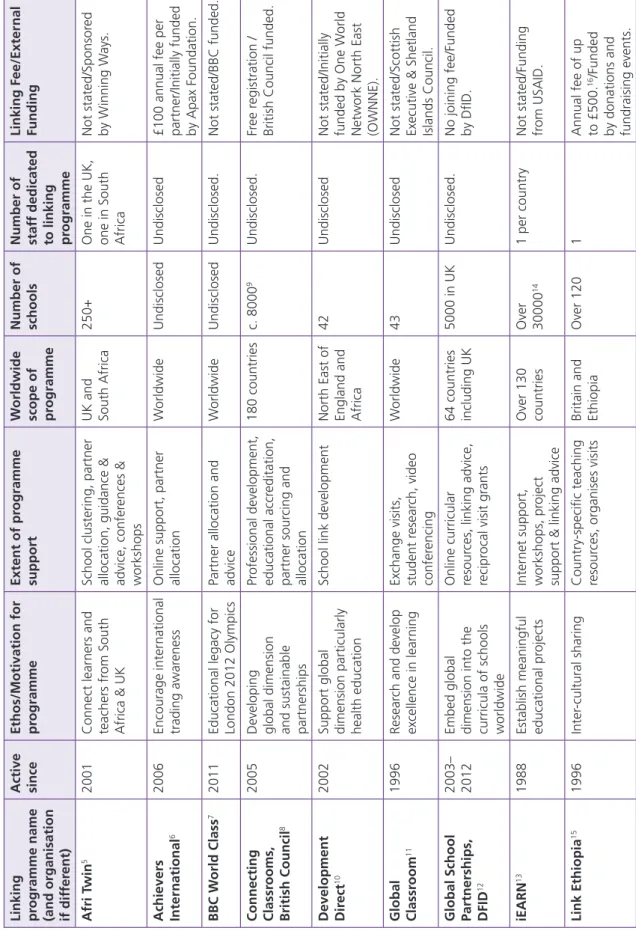
Before we review the model of school linking, it is necessary to summarise the range of linking programmes other than those developed by Link which have evolved over the past decade in the UK and that have a global theme. The sixteen programmes outlined below have a focus on partnerships between the UK and the Global South. There are other programmes such as the wide range of European programmes, links between schools and teachers in the UK and North America, Anglo-Japanese partnerships and a large number of small scale, community based initiatives that may well involve schools. Those identified here in Table 4-1, are chosen according to those which feature most prominently in linking programme catalogues.4 The sample was analysed according to the following criteria:
1. Year the programme was established (and terminated, where relevant) 2. The organisation’s ethos and motivation for providing the programme 3. The extent of support provided to schools by the programme
4. The scope of the countries involved in the programme 5. The number of schools involved in the programme
6. The number of organisation staff dedicated specifically to the programme 7. The funding for the programme
The following observations can be made about these programmes:
i) nearly three quarters of the programmes in the sample started in the 1996-2007 period;
ii) the majority of the programmes involve joining specific communities, or children-centred development, or had development education themes within the aims of their activities;
iii) the majority of the programme support is based on linking advice, professional development, teaching resources, partner allocation, arranging visits and online resources;
iv) almost half the programmes have a worldwide scope, whereas the remainder focus on specific areas of the world, or particular communities in those areas;
Linking programme name (and organisation if dif
fer
ent)
Active since Ethos/Motivation for programme
Extent of pr ogramme support W orldwide scope of programme Number of schools Number of staf f dedicated to linking programme Linking Fee/Exter nal Funding Afri T win 5 2001 Connect lear ners and teachers fr om South Africa & UK
School clustering, partner allocation, guidance & advice, confer
ences &
workshops
UK and South Africa
250+
One in the UK, one in South Africa
Not stated/Sponsor ed by W inning W ays. Achievers Inter national 6 2006 Encourage inter national trading awar eness
Online support, partner allocation
W
orldwide
Undisclosed
Undisclosed
£100 annual fee per partner/Initially funded by Apax Foundation.
BBC W
orld Class
7
2011
Educational legacy for London 2012 Olympics Partner allocation and advice
W
orldwide
Undisclosed
Undisclosed.
Not stated/BBC funded.
Connecting Classr
ooms,
British Council
8
2005
Developing global dimension and sustainable partnerships
Pr ofessional development, educational accr editation, partner sour cing and allocation 180 countries c. 8000 9 Undisclosed. Fr ee r egistration /
British Council funded.
Development Dir
ect
10
2002
Support global dimension particularly health education
School link development
North East of England and Africa
42
Undisclosed
Not stated/Initially funded by One W
orld
Network North East (OWNNE).
Global Classr oom 11 1996 Resear ch and develop excellence in lear ning
Exchange visits, student r
esear ch, video confer encing W orldwide 43 Undisclosed
Not stated/Scottish Executive & Shetland Islands Council.
Global School Partnerships, DFID
12
2003– 2012
Embed global dimension into the curricula of schools worldwide Online curricular resour
ces, linking advice,
recipr
ocal visit grants
64 countries including UK
5000 in UK
Undisclosed.
No joining fee/Funded by DfID.
iEARN
13
1988
Establish meaningful educational pr
ojects
Inter
net support,
workshops, pr
oject
support & linking advice
Over 130 countries Over 30000
14
1 per country
Not stated/Funding from USAID.
Link Ethiopia
15
1996
Inter
-cultural sharing
Country-specific teaching resour
ces, organises visits
Britain and Ethiopia
Over 120
1
Annual fee of up to £500.
16/Funded
by donations and fundraising events.
Linking programme name (and organisation if dif
fer
ent)
Active since Ethos/Motivation for programme
Extent of pr ogramme support W orldwide scope of programme Number of schools Number of staf f dedicated to linking programme Linking Fee/Exter nal Funding
My School, My Voice, Child Reach Inter
national
17
2004
Encourage mutual understanding between childr
en worldwide
Assembly pr
esentations,
teacher support, workshops
UK, T anzania and Souther n Asia Undisclosed Undisclosed
Not stated, but presentations fr
ee. Funded by Eaga T rust. OWL (One W orld Link) 18 1981
Encourage justice, equality
, human
understanding and mutual support Teaching materials, coor
dinates visits, lessons
and assemblies
Bo District, Sierra Leone and W
arwick,
UK
32 schools (both countries) Undisclosed number of ex- teachers fr
om
W
arwick
Not stated. Funders undisclosed.
Partner Ghana, Sabr
e T rust 19 Not stated A brighter futur e for schoolchildr en in Ghana Teaching r esour ces,
training, advice, facilitates exchange visits UK and Souther n Ghana 28 20 Undisclosed
Annual fee charged to UK school,
Plan UK 21 2007– 2011 Child-centr ed development
Monthly contact with teachers,
22 pr
ofessional
development support
UK, China and Africa
Over 320
1
Not stated/ Funded by Eur
opean
Commission
23
Take It Global, TIG
24
1999
Engaging youth, developing sustainable and peaceful world Heavily focused on e-resour
ces
136 countries
3351
Undisclosed
Not stated/Funded by American and Canadian donors.
York Fanteakwa Community Link
25
2000
Lear
ning and support
between Y
ork and
Fanteakwa
Telephone, e-mail, face-to-face advice on linking and fundraising, workshops UK and Ghana
16 (Y
ork
and Fanteakwa)
Undisclosed
Not stated/Funded mainly by private donations.
5 Afri T
win (2010). All the r
emaining sour
ces for each organisation ar
e stated in this first column, unless
otherwise stated. 6 Achievers Inter
national (2012)
7 BBC (2011) 8 Pr
eviously Global Gateway
, British Council (2012a)
9 4000 partnerships, so ar
ound 8000 assumed, British Council (2012b)
10 Development Dir
ect (2007)
11 Global Classr
oom (2012)
12 Now merged with Connecting Classr
ooms, DfID (2012)
13 iEARN (2012) 14 Including youth organisations 15 Link Ethiopia (2012) 16 Stuart (2009: 12) 17 Child Reach Inter
national (2011), Pr
eviously Global Development Links
18 OWL (2012) 19 Sabr e T rust (2012a) 20 Sabr e T rust (2012b) 21 Bour n & Cara (2012: 39) 22 Bour n & Hunt (2011: 35) 23 ibid.: 36 24 TIG (2012), pr
eviously Gemini & Rafiki
v) the majority of programmes operate with around 120 schools or more.
vi) 80% of the organisations receive external funding to operate their programmes. At least four programmes openly state that a linking fee 26 is not charged.
What this evidence shows above all is that it seems to be very difficult to have any form of ongoing self-funded programme of support to schools in both the North and the South; also that most programmes, despite good intentions, tend to have a Northern driven agenda. Finally there is an underlying assumption that mutual learning and co-operation is not only desirable but feasible. Yet few programmes address the fact that power relations can and do play an important role in what and how pupils learn, in terms of who sets the framework and content of any educational programme, and who influences the pedagogy.
Within these types of linking and the many other more informal partnerships that may exist between schools in the UK and elsewhere in the world, are a range of approaches from links that have grown out of personal contacts by teachers or wider community/local authority initiatives and joint curriculum projects, movements of teachers and pupils, as well as the more traditional areas of exchange of letters and direct fundraising and infrastructure support from the North to the South.
The contribution of school linking to development education themes in terms of raising understanding of global issues, giving a voice to the peoples of the Global South, challenging stereotypes and showing similarities and differences in how children and young people live has been discussed and debated in a number of publications in recent years (See Andreotti, 2006; Disney 2005, Leonard, 2012; Martin, 2012).
A development education lens for reviewing a school partnership could cover the following questions:
• To what extent does the link go beyond fundraising, fasting and having fun (Bryan et al 2012)?
• To what extent does the partnership encourage critical self-reflection, learning ‘through other eyes’, challenging stereotypes and moving from a charitable mentality to one concerned with social justice?
• To what extent is there a respect for difference as well as similarity, for valuing a range of perspectives?
• To what extent does the link encourage learning that addresses global perspectives and the value of mutual learning?27
What the review of literature and evidence from a range of reports show is that any analysis of school linking should look at it through a number of lenses regardless of the funding priorities. These lenses could be summarised as follows: • inter-cultural understanding;
• cosmopolitanism in terms of a common sense of humanity and belief in being part of a global community;
• improving school performance and broader educational goals;
• development education goals such as building understanding of development issues and recognising the interdependent nature of the world in which we live. In terms of identifying general conclusions that could be relevant to the evaluation of Link’s programme, the following points can be stated:
i) School linking can be an important motivator for teachers in the North and the South. Direct experience and contact can help to increase confidence, broaden horizons and above all give a ‘sense of worth and value’ to their work. The consequence of this could be seen in improved quality of teaching and learning in the UK and the Global South.
ii) Pupils’ perceptions of the lives of children from their partner school may well be challenged. For example, one pupil from a school in England wrote to a pupil in Ghana, ‘do you ride an elephant to school?’
iii) The emotional attachment by teachers and pupils in the Global North to help and support partner schools through fundraising, assisting with infrastructure development or giving resources cannot be ignored (Leonard, 2012).
iv) School links can raise many challenges for teachers and pupils in both the North and the South in terms of questioning their own assumptions. Professional development programmes can play a key role in helping to reflect on how to deal with these challenges (Alcock, 2010).
v) Support organisations in the Global South as well as the Global North can play an important role in dealing with the dangers of imbalance and power relations that inevitably emerge in linking (Bourn and Kybird, 2012).
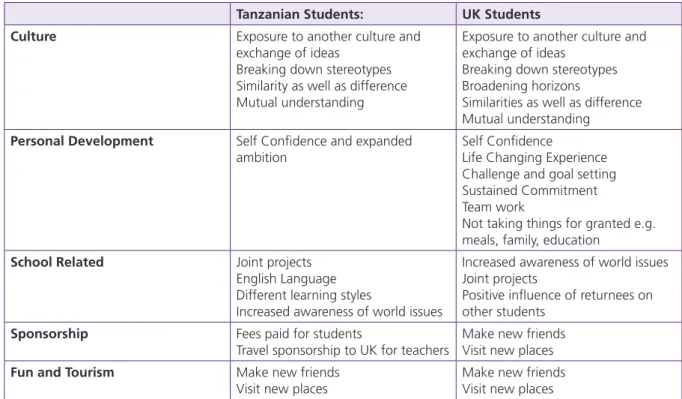
A useful summary of the range of benefits schools and pupils gain from
partnerships can be seen in the research by McNicoll (2011:50) that is summarised in Table 4-2.
Table 4.2 Benefits from partnerships
Tanzanian Students: UK Students Culture Exposure to another culture and
exchange of ideas
Breaking down stereotypes Similarity as well as difference Mutual understanding
Exposure to another culture and exchange of ideas
Breaking down stereotypes Broadening horizons
Similarities as well as difference Mutual understanding
Personal Development Self Confidence and expanded ambition
Self Confidence
Life Changing Experience Challenge and goal setting Sustained Commitment Team work
Not taking things for granted e.g. meals, family, education
School Related Joint projects English Language Different learning styles
Increased awareness of world issues
Increased awareness of world issues Joint projects
Positive influence of returnees on other students
Sponsorship Fees paid for students
Travel sponsorship to UK for teachers
Make new friends Visit new places
Fun and Tourism Make new friends Visit new places
Make new friends Visit new places
What this research and other studies (Leonard 2012; Disney 2006) show is the range of influences, many of which go beyond what either the sponsoring organisation or the funder envisaged. Moreover, many of these benefits are very difficult to measure. In some cases, the benefits and outcomes might not be seen as appropriate for a programme funded by an international development programme. Therefore in reviewing the activities of one programme from Link, it is appropriate and necessary to assess not only its impact in terms of the objectives identified with the funder, but also the unintended and wider outcomes. In the case of school linking, it is suggested that this means going beyond development education lenses and objectives and looking at development goals, inter-cultural themes, personal transformations, school improvement and improvements in the quality of learning.
A useful comparison with Link’s programme has been Plan UK’s school linking work. Both organisations have now closed their linking programmes, in part due to the same challenge: self-funding by schools was neither realistic nor sustainable. Plan UK’s school linking programme existed between 2007 and 2011 and consisted of over 300 schools in the UK, with partner schools in China, Kenya, Malawi, Senegal and Sierra Leone.
Plan’s vision for their school partnership programme was that every child in the UK and in Plan programmes (around the world) who had their lives touched by a link would gain an understanding of global issues and develop skills to act on issues which affect children locally and globally. What was distinctive about Plan’s programme was the focus on child-centred development. The aim of the programme was that:
‘Children understand and act on their rights and responsibilities as global citizens leading to improved governance and effectiveness of schools and other institutions that are responsible for realising the rights of children’
(Plan UK p. 7).
The challenges Plan had were related to the number of schools in the UK that were prepared to become engaged in the linking programme, and the ongoing tensions that International NGOs have regarding the relationship between development education and educational development goals.
The evaluation of Plan’s school linking programme showed that in many countries the programme increased communication skills, broadened horizons and
developed cross-cultural understanding. There was some evidence amongst UK pupils of increased empathy and concern with social justice. There was also some evidence in a small number of UK schools that having a link influenced changes to the curriculum and approaches to teaching. Outside the UK, the other main benefits appeared to have been infrastructure support including buildings and computers (Wood, 2010). But it was the use of School Councils and opportunities for pupils themselves to debate issues that appeared to have the biggest impact. This gave pupils the opportunity to engage in decision-making processes and to develop the skills to engage in governance issues rather than more traditional development education (Bourn and Kybird, 2012).
The evidence suggests that whilst many organisations have been involved with school linking in some form, the impact has been difficult to measure, particularly if the programme has been judged against specific funding objectives. The objectives of the organisation may well be different from that of the school or the teacher in terms of their motivation for engagement in an international partnership. Above all, the relationship between development goals and
development education practices was rarely explored. A consequence of this has been that issues of power relations, and questions regarding whose agenda the partnership was working on, were not explored.
5
Link Community Development and School Linking
Link was formed in 1989, with South Africa as the main focus of its development work. This focus grew in the 1990s to include working in partnership with governments on educational development in Ghana, Uganda, Malawi and Ethiopia. Its focus has always been to support the delivery of quality education in rural districts:‘Rather than creating islands of excellence, we use a “whole district approach”. Through innovative engagement and support to the district education authorities, we work with every school in a district in order to demonstrate that improved outcomes can be delivered by existing systems and structures and with existing resources. We aim for depth of impact within our core districts to demonstrate
good practice that can be taken to scale’27.
Link developed a well-respected school partnership programme in the late 1990s, resulting in over 300 links between schools in the UK and Ireland and schools in Ghana, Malawi, South Africa and Uganda. Alongside this it developed 350 alumni of the Global Teachers Programme, who undertook placements in African schools between 2000 and 2008. In the first decade of this century, Link was recognised, alongside Plan UK, as the leading development NGO involved in school linking in the UK. One of the first programmes on school linking was a result of securing a Millennium Award which enabled teachers from the UK to have a placement for up to five weeks in a rural school in one of the African countries with which Link operated. Another important early initiative was the promotion of links between schools in Scotland with Malawi. This started in 2005 and had school improvement in both countries as one of its main goals.
The organisation’s engagement in linking was a natural and evolutionary process that built on its initial project work in South Africa supporting the development of schools. As the work expanded into other countries in sub-Saharan Africa, Link recognised the value of promoting partnerships between schools in the UK and schools in countries where they already had some strength and depth of engagement. The partnerships were seen in terms of providing a source of support to African schools, particularly in areas such as school improvement. Raising funds for these partner schools or skills transfer from reciprocal visits and sharing of teaching practice were seen as the main features of these programmes. The focus on development education benefits only came later, as a secondary and complementary goal, largely driven by Northern demand and donor emphasis. In 2009, Link applied for EU funding to develop its links in a new project, Partners
in Development (PiD). The basis on which partnerships developed, between the
UK and Ireland with partner schools in countries where Link already operated, is important in assessing the impact of the PiD project. Development education themes based around mutual learning and understanding, broadening pupils’ visions about the world and promoting a sense of empathy between pupils around the world were not high on Link’s agenda. This meant that for many of the schools that became involved in PiD there was already a well-established tradition as to how the schools and teachers saw the nature of their relationships.
6
Partners in Development Project
6.1 Aims and Challenges for the Project
This three-year project began in January 2010 and ended in December 2012 (see Bourn and Bain, 2012; Bourn and Cara, 2012). The project proposal set out to build on and expand Link’s existing school linking programme, which had been running since the late 1990s. It aimed to demonstrate that partnerships between schools in Europe and schools in Africa could considerably enhance both development education and education quality in African schools through a focus on themed learning activities related to development, complemented by direct actions to support African school improvement, including a 40 school solar technology pilot. The project proposal openly acknowledged its dual focus, stating that the project aimed to address:
dissatisfaction with existing school linking models expressed by southern partners, who argue that linking often promotes northern development education without also adequately supporting southern school improvement. The needs of African partner schools are central to Partners in Development’s design, especially the right of children to quality education.
Nevertheless, as the project was funded by the EU’s Development Education and Awareness Raising budget line, the project’s overall objective remained to improve the relevance and effectiveness of development education and therefore raise public awareness of development issues in the UK and Ireland through school linking. The specific objectives of the Partners in Development (PiD) project were to develop and implement a new and sustainable model of school partnerships that would bring effective and relevant development education and enhanced benefits to a target of 700 European schools and 700 African partner schools. The project focused on three areas:
1) developing a clustered linking model with associated support documents; 2) applying ICT and solar power technology to improve communication, reduce the
carbon footprint of linking, and further learning in sustainable development; 3) producing thematic learning resources to engage students and teachers with MDG
agendas and to promote direct action in support of development.
The project partners were the seven Link organisations across England, Wales, Scotland, Ireland, Northern Ireland, Malawi, South Africa, Ghana and Uganda.
The rationale for the project was that direct communication between schools and direct action taken to support development issues identified in the classroom – all facilitated by Link staff – would provide a key mechanism for bringing learning about development issues to life. It built on previous work by the organisation, notably its Global Teacher programme that was based on short study visits by UK and Irish teachers to supported schools in Africa, and broader NGO work on school improvement in the Global South.
Major challenges to Link in delivering this programme were the criteria and framework set by the funder, the EU. The focus of this funding line was to promote awareness and understanding of global and development issues in Europe. The project aimed to address these objectives and priorities directly, in the following ways:
• Through the development and implementation of an enhanced model for school partnerships, PiD will – ‘Raise public awareness of development issues and promote education for development in the EU’
• Through direct communication, teaching about the needs and priorities of partner school communities and promoting direct action by learners and teachers, PiD will
– ‘mobilise greater public support for actions against poverty and fairer relations
between developed and developing countries’
• Through themed learning experiences that are directly related to the MDGs and firmly rooted in the reality of the African partner schools, PiD will – ‘change attitudes to the issues and difficulties the developing countries and their peoples are facing’.
Throughout the project, Link made it clear that alongside the development education goals were broader development goals related to the needs of schools in Africa. The funding proposal for example stated:
‘PiD will also strive to improve the quality of education for an estimated 800,000 pupils in 750 linked African schools in Ghana, Malawi, South Africa and Uganda’
Southern impact is therefore included in the project impact assessment, but it was accepted that the overall objective remained increased awareness and understanding in Europe.
It is evident from the research carried out for this report that the tensions and relationships between these goals and objectives were never fully resolved, particularly in terms of the extent to which the focus was on mutual learning or using partnerships for differing needs and priorities. The tensions had been recognised in the proposal for the funding:
‘It is Link’s experience that in many partnerships between EU and African schools, the ‘northern’ development education agenda can come into competition with the ‘southern’ school improvement agenda. The obvious economic inequality between EU and African schools leads to the risk that the EU partner will impose its own agenda onto the partnership.’ This concern was well articulated by Naledi Pandor, the South African Minister for Education who challenged the audience at the ‘Partnerships in the Commonwealth’ conference in 2006 with the following words:
‘Unfortunately most funding agencies and policy makers in the North are still mainly concerned about the advantage for children in the North. The important lessons of our experience are that partnerships should not be an end in itself. They should be a means to an end. And that end should be overall school improvement’.
The PiD project aimed to respond directly to this challenge by aiming to ensure that the development education components included reference to supporting the development of the African partner school.
What this meant in practice became challenging both in terms of the areas to address and the scope of activities. The benefits in the Global North and the Global South are very different and therefore have to be measured differently. This became a challenge for Link, with its limited resources and the inevitable need to meet the priorities of the funder, for whom the Northern beneficiaries took priority.
The project had always assumed a connection with Link’s broader educational programme in sub-Saharan Africa and particularly its school improvement projects. For example, the project proposal stated:
‘Through PiD, while learning about development issues, UK and Ireland partner schools will also be invited to directly support efforts to improve their partner school. Through supporting school improvement, (UK and Ireland) pupils and teachers will realise the impact that individual and community action can have in development, therefore mobilising greater public support for action against poverty’.
It was also assumed that ‘through joint curriculum activities, PiD would build real friendships and bring the voices of African learners into European classrooms. A criticism of development education practice (see Bourn, 2012) is that all too often the issues discussed are not based on real world examples and fail to show the complexities and dilemmas that may well exist. One of the issues Link wanted to address was to promote mutual understanding of the everyday issues schools were facing.
Slow speed of communication and irregularity of correspondence were recognised as important constraints to school partnerships. In order to address the differences between schools in UK and Ireland and those in rural areas of Africa, solar
powered internet connections were aimed to be established, in 10 schools in each of the 4 participating African countries.
It was anticipated that 100 of the school partnerships in PiD would be in Scotland, 100 in Ireland (including Northern Ireland), and 500 in England and Wales, linked with 700 in Africa. The project also aimed to improve education for an estimated 800,000 pupils in the 700 linked African schools in Ghana, Malawi, South Africa and Uganda.
To achieve these goals and targets, the following areas were seen to be crucial: i) Developing networks of clusters of schools in UK and Ireland that will be linked to
similar networks of partner schools in Africa.
ii) Production of themed curriculum materials that are appropriate for skills in UK and Ireland and partner Africa schools.
iii) UK and Ireland schools through their involvement in the project will engage in further action to support their partner school based on responding to needs and priorities identified at a local level.
iv) A web-based portal will be developed, to share up-to-date school profiles, progress reports, feedback, information about school improvement projects and learning materials.
v) Provision of solar power and ICT equipment to 9 schools and the district office in selected target districts in Sub-Saharan Africa, accompanied with provision of training for head teachers and district officials.
It was also assumed that with expanded membership, the subscription service for the UK and Ireland schools would enable the programme to become sustainable after the end of the three-year funding.
6.2 Targets and Goals
As will be shown in detail later in this report, these targets and goals became a straightjacket for the project. The key learning outcomes which emerged were subsumed or marginalised in the pursuit of meeting what became unrealistic, quantifiable targets; and the tension between development education and
educational development aims stretched activities across too broad a spectrum for the staffing available.
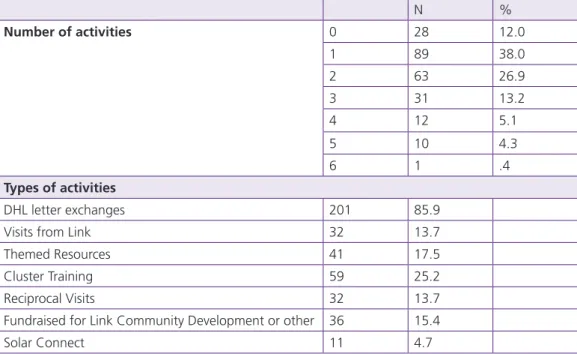
The emphasis on targets, particularly that of engaging 700 schools in Europe, meant that too much attention was spent on trying to engage schools and too little on learning and building understanding of development. Related to this was the structural problem of communication between UK and Irish schools with rural schools in Uganda, Ghana, Malawi and South Africa. The primary method of communication remained the physical sending and exchange of letters, sent via Link offices to the schools, and organised through DHL. This proved to be a very costly and labour intensive part of the project. Whilst there are examples in this report of the impact of these communications, it is clearly not a sustainable form of dialogue between schools, without external funding.
At a technical and quantitative target level, the Solar Connect component of the project achieved what it set out to do. The target of 40 installations was exceeded across the four African countries. Each installation included a solar panel, a
netbook, a printer and ICT training for three teachers per school.
Evaluations show that whilst the installations took longer than expected and ICT skill levels proved a major challenge, schools and District Education Offices actively benefited from the pilot. The main benefits were in terms of school improvement, with African schools accessing teaching materials online, communicating with their District Education Office by email (rather than teachers having to leave the classroom for long periods to visit the office in person) and use of the installation as a hub resource for local schools in the area. Whilst some partnership benefits were noted with schools sharing resources by email or via the programme portal, the equipment was never intended to be high enough in its specification to enable skype or other high bandwidth activities; and poor ICT skills meant communication online with partner schools was limited. This created some tensions with UK and Irish schools, who sought partnership benefits rather than development benefits from the installations.
The emphasis in the programme on awareness-raising in the North alongside the differing needs of the African schools meant that with limited resources, the focus became more on ticking boxes to satisfy the funder. The consequence was that, rather than being a programme based on mutual learning, it became determined by the goals and needs of Northern funders and schools. The clearest examples here are the themed resource materials, which are discussed in more depth later. Despite the attempts of the authors of these materials to make them relevant to the African partner schools, comments from teachers and officers in Africa suggested that the themes identified were not seen as most important to their teaching and learning. This does not mean that teachers did not find the materials valuable. Teachers, wherever they are located, will always be resourceful and make use of materials, adapting them to their own needs and gaining new ideas. But on reflection it may have been more appropriate to produce more flexible materials that could have been more easily adapted to different environments.
Link has always seen its priorities as an NGO in terms of impact in Africa. Senior staff within the organisation had envisaged that the project could have benefits at both the Northern and Southern end. Whilst, as this and the earlier research reports show, there is some evidence of this, there was an inevitable and
unresolved tension throughout the life of the project between development and development awareness goals and objectives.
The professional development support programme was welcomed and supported by many teachers in the partner countries in Africa. Examples of this were
headteacher training in Ghana, pedagogical training in Uganda, literacy and numeracy teacher training in Uganda and gender and health education in Ghana. The delivery and development of the project was also not helped by a number of changes to the staff team involved in PiD. For example the staff who wrote the proposal had left before the project began. The staff who started off the project, perhaps inevitably, focused on meeting recruitment and development education priorities, but left mid-way through. Finally, the group of staff responsible for the final eighteen months of the project re-focused activity on the original proposal goal of meeting dual needs, and ensuring northern and southern benefit and synergies with Link’s development work in the South.
6.3 Evidence from the Mid-Term Evaluation
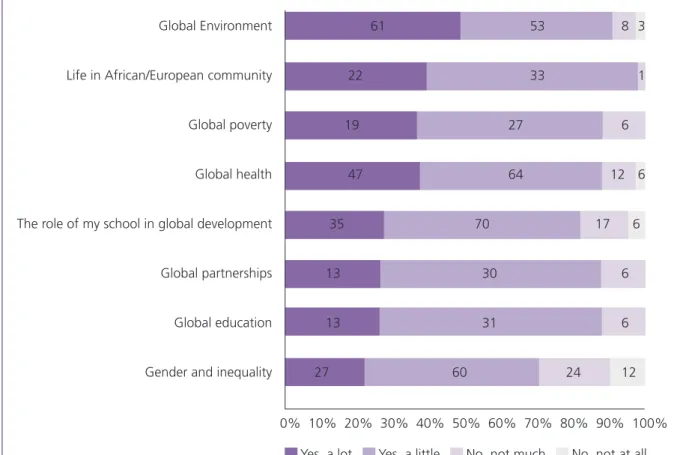
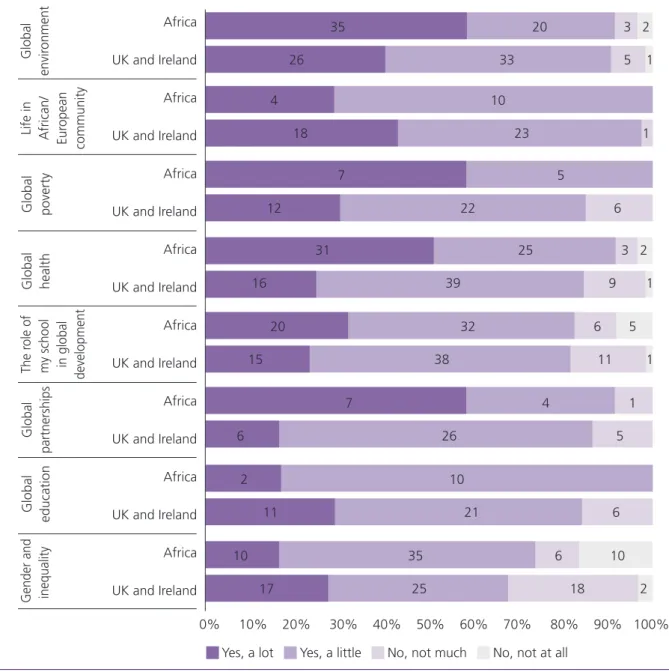
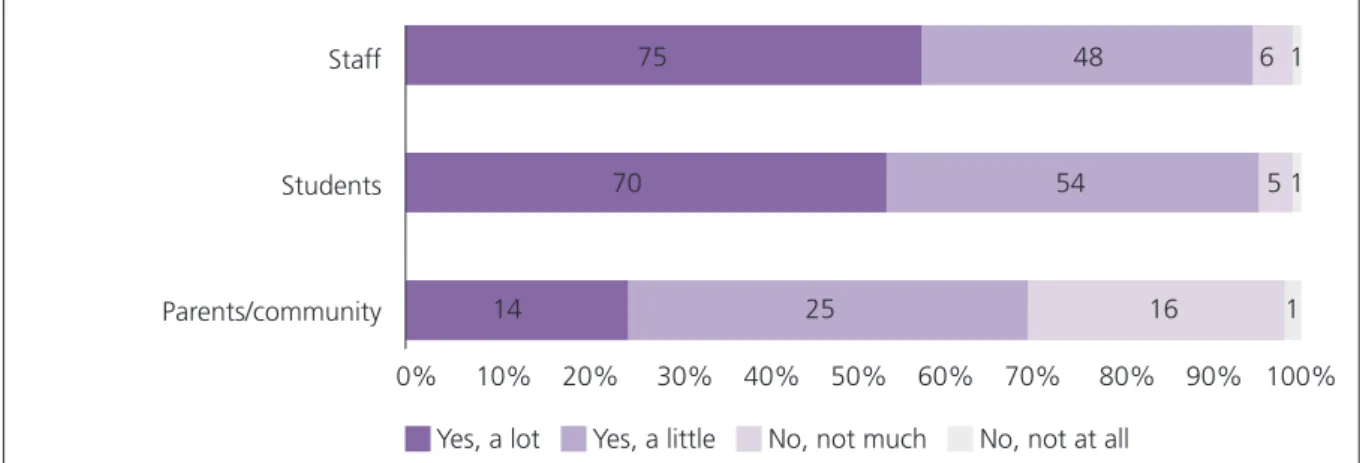
A number of these themes have already been identified in the two earlier research reports produced in this series. The mid-term evaluation noted some very positive features about the impact of the project (Bourn and Cara, 2012). There was evidence that pupils in the UK and Ireland increased their knowledge and understanding about development and global issues and that having a partnership with a school in Africa made this learning real. Pupils learnt about the lives of pupils from their partner schools. A theme that emerged from pupils in both European and African schools was the recognition of the importance of topics such as environment, health and social justice. However, there was some evidence from pupils in the European schools of paternalistic notions towards their counterparts in Africa. For the schools in Africa, there was much more evidence of impact, particularly in terms of skills development and also in terms of learning in environment and health. In both regions, there was noticeable evidence of increased learning, skills and confidence in teaching global and development themes as a result of engagement in the project. Direct contact with fellow teachers was particularly valued. There were several examples of the positive impact of the partnership in revitalising the overall life of the school. There was also evidence of the value of the curriculum resources, which enabled teachers to consider and introduce styles of learning that were more participatory.
A key issue to emerge in the mid-term evaluation was that Link, unlike other organisations engaged in partnership programmes, placed a particular emphasis on the contribution of school links to development goals in the Global South. However the report noted that what this meant in practice did not appear to have been fully explored or debated within the NGO.
The Link Schools Programme (LSP) worked exclusively with rural schools, most of which would not have been capable of sustaining a link without NGO support. The aim was to engage schools who would not usually have had the opportunity to get involved. Link’s ethos was that the programme should support all schools in a district, and that whilst they selected schools that were capable of sustaining a link, the aim of the programme was to ensure that both link schools and non-link schools would benefit from activities. An example of this was Solar Connect, where individual schools were installed with solar and IT equipment so that they could act as hub schools for other schools in the area (which may or may not be part of the project). Similarly, when schools raised money for direct action projects in their partner school, a percentage of the money raised went to Link’s wider work in the school’s district.
This area of support to schools in the Global South was the main focus of the other mid-project research report on schools in Uganda (Bourn and Bain, 2011). The research focused on schools in rural areas within the Masindi district of Uganda and compared the impact of links in five programme schools with five schools that had not had links. The main themes to emerge from this research were:
• linked schools had, compared with non-linked schools, a strong sense of self esteem;
• the link, through formal and informal professional development, had improved the quality of teaching and learning, and overall leadership, in the linked schools; • children, particularly girls, had more enthusiasm and motivation to attend school
as a result of their school having a link;
• local communities with linked schools had a sense of pride and enthusiasm in their school.
By having a link, the school also benefited from opportunities for the teachers and pupils to improve their English language skills. The teachers and pupils tended to have a broader vision, to look beyond their own community and to recognise they are part of a wider world.
However, despite Link’s efforts to avert this, the direct action support to the linked schools tended to create a two-tier structure in the district, with significant
differences in terms of resources, quality of teaching and motivation of teachers and pupils. For Southern schools, the priority for any link will always be the extent to which it can help with improving access to education, increasing resources and support, and as a consequence improving the quality of education. NGOs facilitating linking programmes will always face an uphill battle: a) with Southern schools whose first priority is basic teaching and learning needs; and b) Northern schools whose focus on building personal relationships makes it hard to broaden their fundraising priorities beyond an exclusive focus on their partner school. Despite mixed success, Link continued to feel that openly addressing fundraising and resource imbalances when building a partnership would always be better than ignoring them and allowing activities to continue without support or adequate guidance.
6.4 Impact in UK and Ireland
The detailed evidence outlined in the next section demonstrates the continued value and impact of the project for both schools in the UK and Ireland and partner schools in Africa. However this evidence, reflected upon in the final section, needs to be seen in the context of the priorities of an NGO, the needs of schools in rural districts in Africa, and how best to develop learning and understanding about development issues in schools in the UK and Ireland.
In most countries in the North, Partners in Development (PiD) built on contacts and particularly the motivations of individual teachers who had been involved with the organisation’s Global Teacher programme. A starting point therefore is to look at the impact of the project and the targets set in the individual countries involved. Link’s programme in Scotland was reasonably successful. In part this was due to the number of schools involved: 63 schools were engaged in some form with the project, 13 of whom had very good engagement. They also had a full time officer dedicated to supporting them. Another reason for the success of the programme in Scotland was that the majority of the links were with schools in Malawi, a priority country for the Scottish government in terms of development and promotion of international partnerships. Having links with just one country logistically makes management and support to links much easier to manage. PiD’s cluster training programme and accompanying resource materials had some impact in terms of moving teachers towards a deeper understanding of development education. The school curriculum in Scotland also created spaces for learning about some of the themes promoted by the project.
In Ireland, the situation was rather different. International school partnerships as an area of development education practice did not have a strong history and tradition, apart from missionary connections with schools and communities in
sub-Saharan Africa. As a consequence it was a more contentious issue within development education than in Scotland. Recent support for school linking from the Irish government, through Irish Aid, was focused on secondary schools; and primarily with Uganda, a priority country for the Irish government. Two-thirds of school links in Ireland were with Uganda, in part due to the Global Teacher connections, but also because Uganda was a priority country for Irish Aid. Link’s priorities have always been with primary schools and this gave it a potentially new and distinctive feature, distinct from the Irish government funded programme. The support in Ireland from schools came from personal contacts, the majority being teachers who had some experience of the Global Teacher programme. Uganda also became the most popular country to develop links with, probably influenced by the history of partnership between the two countries.
Ireland also had an officer to support the schools, and as a consequence 20 professional development sessions were held with teachers in Ireland. Whilst teachers and schools welcomed and used the themed resource materials, they tended to be used as an ‘add-on’ rather than as an integral component of the curriculum. Sustaining the school partnerships in Ireland became increasingly difficult because of the changing economic situation in Ireland. Schools found it difficult to identify funds to support the project and their partner school. But Link staff in Ireland noted that the project was successful in that it did raise awareness and understanding of development issues, and schools had ‘real life’ stories and contacts with schools and children in Africa. This ‘sense of connectedness between the schools’, recognising similarities as well as differences and being able to have communication with each other, was seen as one of the legacies of the project for schools in Ireland.
The situation in England and to a lesser extent Wales obviously changed dramatically during the lifetime of the project, from school linking and
development education being popular with the Labour government in 2009 to a much more lukewarm relationship under the Coalition government. This had consequences in terms of motivation and engagement from schools. England and Wales, whilst having the largest programme, also faced the most difficult challenges as a result of high school to staff ratios. The original target was 500 schools, and it became apparent within a year or so of the project starting that this was not going to be reached. In the end, the project worked with 155 schools which, compared with other NGO programmes, was a respectable number.
However despite having an officer to support the programme, in reality Link could only respond to some of the demand for support and did not have the resources to be proactive in terms of identifying professional development needs in European schools (because of complementary project activity more effective support was provided in the African schools). This had consequences for the quality of Link schools’ activities, and, there was still a tendency in many schools to
see the relationship in terms of fundraising and helping the ‘African school’ rather than a process of mutual learning.
The schools that had the most effective educational programme were those with individual teachers who were passionate about the area. Whilst regional training sessions were held, demand for sessions was limited and only 8% of schools who signed up to the programme attended a training session. One of the reasons for this was the pressures on teachers in terms of time and space to engage in an area of professional development that was increasingly being perceived as not central to school objectives.
Within the network of schools involved, 70% were primary schools; and the London area was the region with the strongest representation.
6.5 Impact in Ghana, South Africa, Uganda and Malawi
In terms of the impact of the programme on the Southern partners, there were similarities across the countries, but also some specific features related to the strength of Link’s history of engagement in school linking in particular countries.
Ghana
Ghana is a country with a wealth of schools that have links with schools in the UK. But Link’s contribution was different from many other support or funding organisations. In Ghana, the NGO works with 350 rural primary schools with the aim of building the capacity of these schools and improving their performance. The schools are supported by District Education Officers and it was through these Officers that most of the communication and support to schools for the project was undertaken. Working within existing government structures is central to Link’s approach to development interventions, in all the countries with which it works. For most schools involved in the programme in Ghana, the major impact was the access to increased resources and direct contact with schools in the UK and Ireland, which helped to broaden both teachers’ and pupils’ horizons. The schools felt valued and gained a greater sense of self esteem.
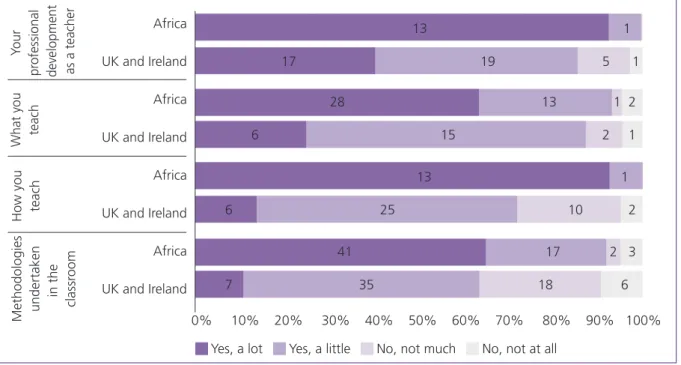
Whilst the direct links and exchanges between teachers were few, there was considerable exchange of correspondence in letters, as outlined in the next section. The resource materials were seen as useful, but did not cover the priority learning areas that school teachers were looking for - they were more interested in having support in areas such as school management and leadership training. But the approaches and methodologies outlined in the resource materials were valued and did have an impact. For example the Link staff team in Ghana noted the impact on teaching practice, with more evidence of the use of participatory methodologies and group based activities.