Original Article
Evidential Analytic Hierarchy Process Dependence
Assessment Methodology in Human Reliability
Analysis
Luyuan Chen
a, Xinyi Zhou
a, Fuyuan Xiao
a, Yong Deng
a,b,c,*, and
Sankaran Mahadevan
baSchool of Computer and Information Science, Southwest University, No. 2, Tiansheng Road, Beibei District, Chongqing 400715, China
bSchool of Engineering, Vanderbilt University, 2301 Vanderbilt Place, Nashville, TN 37235, USA
cInstitute of Integrated Automation, School of Electronic and Information Engineering, Xi'an Jiaotong University, No. 28, Xianning West Road, Xian, Shaanxi 710049, China
a r t i c l e i n f o
Article history:Received 20 November 2015 Received in revised form 29 July 2016
Accepted 21 October 2016 Available online xxx Keywords:
Analytic Hierarchy Process DempstereShafer Evidence
Theory
Dependence Assessment Human Reliability Analysis Nuclear Power Plant
a b s t r a c t
In human reliability analysis, dependence assessment is an important issue in risky large complex systems, such as operation of a nuclear power plant. Many existing methods depend on an expert's judgment, which contributes to the subjectivity and restrictions of results. Recently, a computational method, based on the DempstereShafer evidence theory
and analytic hierarchy process, has been proposed to handle the dependence in human reliability analysis. The model can deal with uncertainty in an analyst's judgment and reduce the subjectivity in the evaluation process. However, the computation is heavy and complicated to some degree. The most important issue is that the existing method is in a positiveaspect, which may cause an underestimation of the risk. In this study, a new evidential analytic hierarchy process dependence assessment methodology, based on the improvement of existing methods, has been proposed, which is expected to be easier and more effective.
Copyright©2016, Published by Elsevier Korea LLC on behalf of Korean Nuclear Society. This is an open access article under the CC BY-NC-ND license (http://creativecommons.org/ licenses/by-nc-nd/4.0/).
1.
Introduction
With the continuous development of science and technol-ogy, human error is an important factor to be considered seriously in human reliability analysis (HRA) in the design and risk assessment of large complex systems, such as nu-clear power plant operations, air traffic control, and
grounding of oil tankers[1e3], especially when humans are a crucial ingredient of these systems. HRA is a systematic framework to assess human contribution to a system risk. An important activity within HRA is the assessment of dependence among human failure events (HFEs) in order to avoid an underestimation of the risk [4]; this refers to the evaluation of the influence of failure of operators to perform
*Corresponding author.
E-mail addresses:[email protected],[email protected],[email protected](Y. Deng).
Available online at
ScienceDirect
Nuclear Engineering and Technology
journa l home page:www.elsevier.com /locate/ne thttp://dx.doi.org/10.1016/j.net.2016.10.003
1738-5733/Copyright©2016, Published by Elsevier Korea LLC on behalf of Korean Nuclear Society. This is an open access article under the CC BY-NC-ND license (http://creativecommons.org/licenses/by-nc-nd/4.0/).
one task on the basis of the performance of subsequent tasks
[5]. The result of dependence assessment is a conditional human error probability (CHEP), given the failure of the preceding task[6].
Several methods have been developed for dependence assessment between HFEs [7e10]. Three main research di-rections are the technique for human error rate prediction (THERP)[5,11,12], decision trees[13], and fuzzy expert system (FES)[14]. Many research works have been developed on the basis of the existing methods. THERP introduces five levels of dependence corresponding to different values of the CHEP and suggests some of the factors that may influence the dependence level between two proceeding tasks. However, limited guidance on how these factors actually determine the dependence level is exited and thus considerable amount of experts'judgments are required, which results in the lack of traceability and repeatability. In the method of decision trees, the analyst is not required to draw conclu-sions on the dependence level but only has to give judg-ments on input factors; for example, trees can reduce the subjectivity and increase the repeatability of the assessment, but they simplify the relationships between the factors and dependence level. There is more as decision trees is not flexible since the analyst's judgments are confined on a narrow set of extreme situations[14]. To improve the flexi-bility of the representation of an analyst's judgment, an FES method has been developed. In FES, the input judgments are represented in the form of fuzzy numbers; a set of rules for capturing the relationships between different values of the input factor and output variables are then implemented through the fuzzy logic procedure. However, correspondence rules in the FES method are directly suggested by the expert, and thus they are subjective and can be inconsistent in some cases. Further, information can be either added or lost within the fuzzification and defuzzification procedures in the FES-based method.
Recently, Su et al [15] have proposed a computational model to handle dependence level in HRA based on the DempstereShafer evidence theory (DSET) and analytic
hier-archy process (AHP). AHP is used to determine related weights, and DSET is an efficient model to reason with un-certain information from different sources[16]. This method has a good representation of uncertainty in an analyst's judgment and reduction of the subjectivity in capturing relationship between the judgments of input factors and output dependence levels [15]. However, there are some shortcomings of this method. One is that the computation is relatively complex, and the other is that the weighted average combination rule will cause a positive result since its main aim is to obtain good convergence, which does not coincide with the aim of HRA. It is much more important to get the exact estimation of the CHEP than to get better convergence in HRA.
To address these issues, in this article, we present an easier but efficient evidential methodology to manage dependence assessment in HRA to improve Su et al's[15]method. Four steps are addressed: first, the expert independent analysis process is managed; second, basic probability assignments (BPAs) constructed based on an analyst's judgments are ob-tained; third, fusion of BPAs using a discounted combination
of DSET can be calculated; and finally, we can obtain the CHEP and its confidence as the final results. An application of the proposed method to a nuclear power plant is also presented in this article.
The organization of the rest of this research paper is as follows. Section2starts with a brief presentation of necessary related concepts. The proposed evidential AHP dependence assessment methodology in HRA is presented in Section 3. Section4examines an application of a nuclear power plant to illustrate our proposed method. A discussion is presented in Section5. Section6is the conclusion of this paper.
2.
Preliminaries
In this section, some preliminaries are briefly introduced. 2.1. Brief introduction of THERP
THERP is the precursor for most of the subsequent depen-dence models. The two most important concepts of THERP can be represented as two parts. First, THERP suggests five dependence levels of two tasks, as shown in Table 1. ZD is considered as no dependence between two tasks, and CD means that they have complete dependence. There's more as the guidelines for assigning the level of dependence between two subsequent tasks based on relative factors are provided in THERP. For more detailed information, refer to the work of Podofillini et al[14].
Second, a modification formula of THERP for five depen-dence levels [see Eq.(1)] was proposed to calculate the CHEP, which expresses the contribution of the failure of one task to the failure probabilities of subsequent tasks. Considering there are two tasks A and B and they are the corresponding failure works. IfPAandPBare the basic probabilities of failure of tasks A and B, respectively, the CHEP ofB,whenAis given, is calculated as follows[5]:
PXDðBjAÞ ¼
1þKPB
Kþ1 (1)
whereK¼0, 1, 6, 19,∞, corresponding to dependence levels XD¼CD, HD, MD, LD, and ZD, respectively.
2.2. DempstereShafer evidence theory
Uncertain and incomplete information existed everywhere
[17e19]. To address this issue, many mathematical tools were presented. One typical theory includes fuzzy sets with effi-cient modeling of vague and linguistic variables[20e22]and fuzzy logic [23,24]. In the DSET, there is a fixed set of N mutually exclusive and exhaustive elements, called the frame of discernment, which is symbolized byQ¼{H1,H2,H3,…,Hn}.
Table 1eFive dependence levels proposed by THERP [14].
Zero dependence ZD
Low dependence LD
Moderate dependence MD
High dependence HD
P(q) is denoted as the power set composed of 2Nelements ofQ; each element of 2Nrepresents a proposition.
Definition 1. A BPA is a function fromP(q) to [0, 1], which is defined by:
m:PðqÞ/½0;1;A/mðAÞ (2) and which satisfies the following conditions:
X A2PðqÞ
mðAÞ ¼1; mð∅Þ ¼0 (3)
The massm(A) represents how strongly the evidence sup-portsA, whilem(q) is expressed as the uncertainty of evidence. Ifm(q)¼1, we cannot obtain any useful information from the evidence.
Definition 2. For a propositionA4Q, the belief function Bel: 2Q/[0, 1] is defined as follows:
BelðAÞ ¼X
B4A
mðBÞ (4)
The plausibility function Pl: 2Q / [0, 1] is defined as follows:
PlðAÞ ¼1BelA¼ X
B∩As∅
mðBÞ (5)
whereA¼QA. The quantity Bel(A) can be interpreted as a measure of one's belief that the hypothesisA is true. The plausibility function Pl(A) can be viewed as the total amount of belief that can potentially be placed inA.
Definition 3. Assume that there are two bodies of evidencem1 andm2;m1andm2can be combined with Dempster's orthog-onal rule[25]as follows:
m14m2¼mðAÞ ¼ P BㄇC¼Am1ðBÞm2ðCÞ 1K (6) Where K¼ X BㄇC¼∅ m1ðBÞm2ðCÞ (7)
Dempster's rule can well manage the uncertainty of various types of information.K(conflict coefficient) is a com-bination of mass functions assigned to the null subset, which represents contradictory evidence[26]. To normalize them, divide other mass functions by 1eK.
Example 1Suppose that the frame of discernment isQ¼{a, b,c}. Two BPAsm1andm2are given as follows:
m1:m1ðaÞ ¼0:6; m1ða;bÞ ¼0:2; m1ðQÞ ¼0:2 m2:m2ðbÞ ¼0:4; m2ða;bÞ ¼0:4; m2ðQÞ ¼0:2
Thus, the combination results are the following:
mðaÞ ¼0:474; mðbÞ ¼0:211;m1ða;bÞ ¼0:263; mðQÞ ¼0:053 Definition 4. Given a BPAm(A) andabeing a discounting co-efficient that represents the degree of confidence one has in
relative information source, the discounted BPAm0(A)[28]is defined as follows:
m0ðAÞ ¼amðAÞ; AsQ
m0ðQÞ ¼amðQÞ þ1a (8)
The vacuous BPA is denoted as mQin the above equation.
The discounting operation is applied to model a situation where a sourceSprovides a source BPAm, and the reliability of Sis measured bya. Owing to its efficiency to model and fuse uncertain information, evidence theory is widely used in many applications such as decision making[29e31], uncertain modeling[32,33], risk and reliability analysis[34e36], target recognition[37,38], and fault diagnosis[39]. However, it should be pointed out that there are some open issues. Some typical issues are the conflicting evidence management [40,41], dependent evidence combination[42], uncertainty measure
[27], as well as determination of BPA[43]. These issues should be paid careful attention to in real applications.
2.3. Pignistic probability functionBetPm
Definition 5. Let m be a BPA on Q. Its associated pignistic probability function BetPm[44]is defined as follows:
BetPmðuÞ ¼ X A8q;u2A 1 jAj mðAÞ 1mð∅Þ;mð∅Þs1 (9) wherejAjis the cardinality of subsetAanduis the subset proposition inA. The main aim of BetPmis to translate a BPA into probability in order to make a decision.
2.4. Analytic hierarchy process
AHP, introduced by Thomas Saaty[45]in 1980, is an effective tool for dealing with complex decision making by determining the weights of different criteria in a multicriteria decision-making problem [46,47]. Since a complex system is very complicated with hierarchy or network structure[48e50], AHP is widely used to model real systems. The weight evaluation process quantifies the subjective experiment of experts and can check the consistency of decision-makers’evaluations. Generally, the AHP method includes three steps to obtain decision-making ranking.
Definition 6. Assume thatnpieces of decision elements are presented as (F1, F2, F3, … , FN); the comparison judgment matrix between the two decision elements is Mn*n ¼ [mij], which satisfies the following condition:
mij¼ 1 mji
(10) The value ofmijindicates that the judgment concerning the importance of the decision elementFiis overFj.
Definition 7. When many pairwise comparisons are per-formed, some inconsistencies may typically arise. Generally, an effective technique based on the computation of a suitable
consistency index (CI)[44]is proposed, which is defined as follows:
CI¼ lmax
n1 (11)
Accordingly, the consistency ratio (CR) can be calculated as follows:
CR¼CI
RI (12)
where RI is the random index. The values of RI are related to the dimension of matrix, which are listed inTable 2.
Definition 8. The eigenvector of ann*npairwise comparison
judgment matrix Mn*n can be denoted as
u¼ ðu1; u2; u3; …; unÞT; which is calculated by using:
Mu¼lmaxu (13)
where lmax is the largest eigenvalue of matrix Mn*n. The eigenvector corresponding to the largest eigenvalue can be viewed as the final criterion for ranking goals. It should be noted that, due to the complexity in uncertain decision mak-ing[51e53], AHP is extended as a fuzzy AHP to address mul-ticriteria decision-making problem issues[54e56].
3.
Proposed method
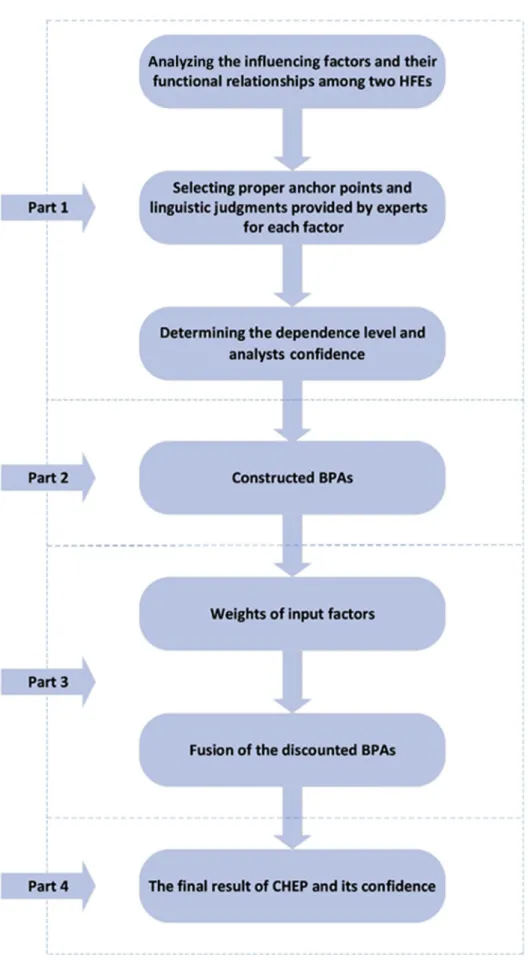
In this paper, a more flexible but efficient evidential method-ology to manage dependence assessment in HRA is put for-ward to improve Su et al's[15]method, based on the DSET and AHP. A flowchart of the method is shown inFig. 1.
The proposed method is divided into four parts.
Part 1: The expert independent analysis process:The first step is to determine the input factors related to dependence of two HFEs (1), and then select the proper anchor points and lin-guistic judgments corresponding to five dependence levels (2); analysts give their judgments on the dependence level among two HFEs as well as their confidence (3).
Part 2: The constructed BPAs:According to the above infor-mation, the constructed BPAs can be transformed with judg-ments and relative belief of analysts (4).
Part 3: Fused BPAs for analysts and factors:The weight of input factors can be calculated by AHP (5), and then the weight of factors can be regarded as the coefficient for discounted BPAs. In this part, we can obtain the fused BPA for analysts (6) and the fused BPA for factors (7), based on previous results, as the final fused BPAs. The method used in this whole process is called the discounted Dempster's orthogonal rule.
Part 4: CHEP and its confidence:The result of the CHEP and its confidence can finally be raised (8) with the management of BetPm.
The steps of the method are detailed as follows:
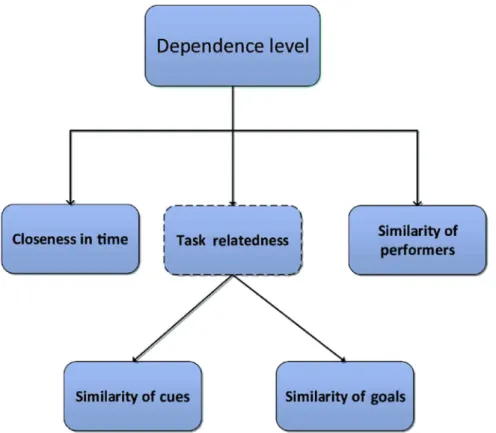
Step 1:The factors that possibly have an influence on the dependence and their functional relationships among the two HFEs are analyzed. The five main factors that are listed in the THERP model are the following: “spatial relatedness,” “time relationship,” “function relatedness,” “stress,”and “ similar-ities among the personnel performing the task.”In addition, the functional relationship of factors is provided by domain experts. It is an important step since the remaining proced-ures are totally based on it.Fig. 2represents an example of functional relationships among the input factors of a nuclear power plant working model.
Step 2: Anchor points and linguistic judgments are sug-gested by domain experts in advance as the guidance for HRA analysts' judgments of input factors [14]. Hence, after the determination of input factors, corresponding anchor points and linguistic judgments are presented and applied as prior knowledge. Detailed information can be found in the works of Cepin [4] and Zio et al [6]. Something that should be mentioned is that five dependence levels have substituted with linguistic labels in[6]. The dependence level of an input factor indicates the dependence level between two tasks with respect to this factor. For example, a set of anchor points and linguistic judgments for the input factor“Closeness in time”
are presented in Table 3; the dependence level “ZD”means that the dependence level between two tasks is zero with respect to the factor“closeness in time.”Under the guidance of anchor points and linguistic judgments to provide the reference on the scale, different analysts' judgments on dependence level are relatively consistent, which makes them easier and less subjective.
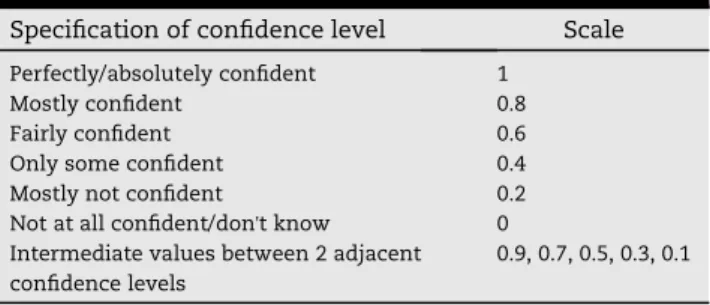
Step 3:Analysts determine the dependence level between the two HFEs with regard to each factor and give relative confidence in a judgment: with the standard of anchor points and linguistic judgments obtained in Step 2, the analysts can provide judgments on input factors. However, complete belief cannot be guaranteed from analysts on a specific dependence level. In particular, there may be ambiguity and uncertainty in their judgments. In this study, a more flexible method based on the analysts'judgments of uncertainty is presented. We use a scale of (0, 1) to show the confidence of their judgments on the sets of possible dependence levels. There's more as a ratio is represented by the analyst to indicate the relative probabilities of different sets. The numerical scale used for assigning values to the confidence levels is shown inTable 4. Number 1 expresses perfect confidence in an analyst's judg-ments, while Number 0 expresses no confidence in his/her judgments.
Examples of the analysts'judgments on dependence level are shown inTable 5. Case 1 represents that an analyst has complete confidence in his/her judgments that the depen-dence level lies in high dependepen-dence; Case 2 represents that the analyst has complete confidence in his/her judgments that the dependence level is between middle dependence and high dependence, but cannot estimate which one is more likely; in
Table 2eValues of RI.
Dimension 2 3 4 5 6 7 8 9 10
Fig. 1eFlowchart of our proposed method. BPA, basic probability assignment; CHEP, conditional human error probability; HFE, human failure event.
Case 3, the analyst think that HD is three times more likely than MD with a belief of 0.8; Cases 4 and 5 represents the same meaning that the analyst has no idea about the dependence level.
Step 4:BPAs constructed based on analysts'judgments: The judgments of analysts for input factors are converted into BPAs; the proposed method is argued within five dependence levels, so that the discernment frame is denoted asQ¼{ZD, LD,MD,HD,CD}. According toDefinition 3, the power set ofQ except the empty set consists of 25e1¼31 elements,
repre-sented as D1, D2, D3,…, D31. The general expression of an-alysts'judgments can be viewed as follows.
The possibility ratios of the sets D1: D2: D3:…: D31¼r1: r2: r3:$$$:r31, and the confidence of a judgment isa.
A constructed BPA is generated using the following formula: mðDiÞ ¼a ri P31 j¼1rj ; mðqÞ ¼1 a (14)
where Di is the element of the power setQ excluding the empty set,riandrjare the possibility ratios of the judgments on dependence assessment,ais the confidence of the analyst in the judgments, and m(q) indicates the vacuous BPA that shows no confidence (seeDefinition 1).
Example 2BPAs of the judgment on Case 3 inTable 5can be calculated as follows: mðfHDgÞ ¼a ri P31 j¼1rj ¼0:8 3 3þ1¼0:6; mðfMDgÞ ¼aP31ri j¼1rj ¼0:8 1 3þ1¼0:2; mðfqgÞ ¼10:8¼0:2
The results of the BPAs constructed based on judgments in
Table 5are listed inTable 6.
Fig. 2eExample of functional relationships among the input factors of a working model with a nuclear power plant.
Table 3eAnchor points for input factor“closeness in time”(Adapted from Refers. [6,15]).
“Timen anchor points Linguistic judgment Dependence level
24 hr The 2 tasks are very widely separated in time ZD
8 hr The 2 tasks are widely separated in time ZD
1 hr Time difference between tasks is less than wide LD 30 min Closeness in time is not relevant in the dependence assessment MD 20 min The tasks are in a short time window, but not close enough HD
Step 5:Calculating the weight of input factors by AHP: In this study, AHP is used to get weights according toDefinitions 7e9. The weights of input factors are related to the degree to which the factor influences the dependence level among human tasks. A factor will account for a larger weight when it has a larger influence on the dependence level, while a smaller weight will be assigned to it when the factor has a subtle influence.
Step 6:In this procedure, fused BPAs can be obtained from different analysts' discounted information sources for each input factor. The discounted coefficient of BPAs is the weight of the related factors.
Compared with Su et al's[15]method, the weighted average combination[57,58]is suggested to get fused BPAs where the weights of the analysts are derived from the distance of source evidence. More specifically, if there areMBPAs, the weighted average belief is combined by Dempster's orthogonal rule Me1 times. However, we can see that Su et al[15]adapt a
positive attitude to manage dependence assessment. The reason can be illustrated as follows: the weighted average combination rule tends to the rapid movement toward cer-tainty, which means that it may ignore the disagreement be-tween multiple sources and lead to a loss of information. It is a good method in the decision-making field but may be inap-propriate for risk assessment. In this article, we discussed about the CHEP. According to Eq.(1), each dependence level should be considered to calculate the CHEP. In order to avoid
underestimation of the risk, we use the discounted Dempster's orthogonal rule, which can give overall consideration to ex-pert's judgments on dependence assessment.
Step 7: After the fused BPA for each analyst related to a specific factor is obtained, Dempster's orthogonal rule is used to fuse BPAs of each factor. The confidence of the final resultaf can be directly calculated as follows:
af¼1mðqÞ (15)
wherem(Q) is considered the uncertain information. Step 8:Calculating the result of CHEPPðBjAÞ: After the BetPm is applied to manage the final BPAs, the CHEPP(BjA) is calcu-lated as follows:
PðBjAÞ ¼X XD
BetPmðXDÞ PXDðBjAÞ (16) wherePXD(BjA) is the modification formula (seeDefinition 2) for dependence level “XD”(i.e., ZD, LD, MD, HD, and CD) to compute the CHEP in THERP.
4.
Application of nuclear power plant
operation
In this section, we will discuss the performance of a working model for postinitiator HFEs of a nuclear power plant to show the whole procedure of our proposed method.
4.1. Expert independent analysis process
The identified factors in the working model of a nuclear power plant are shown inFig. 2 [14]. We can easily find that three factors directly influence the dependence level of two HFEs,
“closeness in time,” “task relatedness,” and “similarity of performers,”as well as two subfactors“similarity of cues”and
“similarity of goals”that are related to”task relatedness.”
For each input factor, anchor points and linguistic judg-ments corresponding to five dependence levels are given by experts in advance. Analysts give their judgments on depen-dence level and the relevant belief. The anchor points and linguistic judgments for the input factor“closeness in time”
are shown in Table 3, and those for the other three input factors “similarity of cues,” “similarity of goals,”and “ simi-larity of performers”are, respectively, shown inTables 7e9.
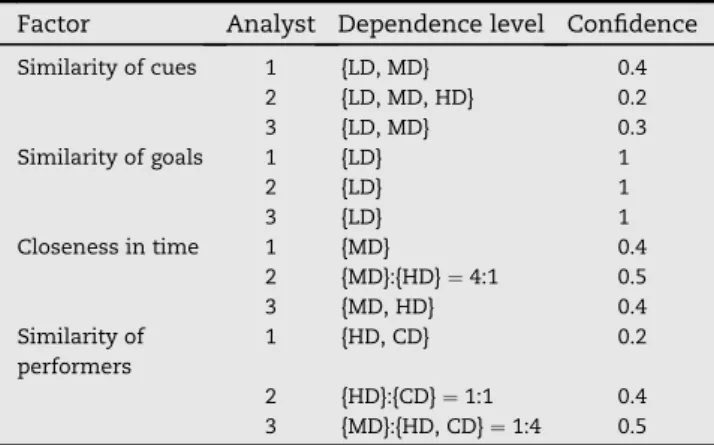
With the standard of anchor points and linguistic de-scriptions provided in Tables 3 and 7e9, analysts can give their judgments on the dependence level and confidence of each factor. Assume that there are three analysts: Analyst 1, Analyst 2, and Analyst 3. The judgments of each analyst, with regard to four factors, are shown inTable 10.
For example, Analyst 1 has a confidence of 0.4 that the dependence level is within LD and MD with respect to the factor “similarity of cues”. However, he or she has no idea which one is more likely. Besides, Analyst 1 has complete confidence that the dependence level corresponding to“ simi-larity of goals”is LD. For the factor“closeness in time,”Analyst 1 has only a belief of 0.4 on the dependence level of MD. For the factor “similarity of performers,”Analyst 1 has small confi-dence of 0.2 that the depenconfi-dence level is between HD and MD.
Table 4eScale of the confidence level.
Specification of confidence level Scale Perfectly/absolutely confident 1
Mostly confident 0.8
Fairly confident 0.6
Only some confident 0.4 Mostly not confident 0.2 Not at all confident/don't know 0 Intermediate values between 2 adjacent confidence levels
0.9, 0.7, 0.5, 0.3, 0.1
Table 5eExamples of analysts'judgments for a fixed
factor.
Case Dependence level Confidence
1 {HD} 1
2 {HD, MD} 1
3 {HD}:{MD}¼3:1 0.8
4 {MD} 0
5 {ZD, LD, MD, HD, CD} 1
Table 6eBPAs constructed based on analysts'judgments
in Table 5. Case BPA 1 m({HD})¼1 2 m({HD, MD})¼1 3 m({HD})¼0.6,m({MD})¼0.2, m({q})¼0.2 4 m({q})¼1 5 m({q})¼1
4.2. Construction of BPA
With the judgments of four input factors by analysts, we can construct BPAs using Eq. (12). Actually, analysts can be regarded as the information sources in DSET, while the judg-ments of the dependence level on two HFEs can be considered as the criteria of belief functions. The results of BPAs are shown inTable 11.
4.3. Weights of input factors
The weights of four input factors are calculated with AHP. However, understand that for the hierarchical level that con-sists of two factors, “similarity of cues” and “similarity of goals,” we use the discounted average weight of a relevant higher factors,“similarity of performers,”as their coefficient. Assume that the judgment concerning the relative impor-tance of the factor“similarity of cues”over the factor“ simi-larity of goals”is the following:
mCG¼ 1 mGC
¼2
The eigenvector related tolmaxis expressed as the weight of three input factors:
uTime¼0:1220; uTask¼0:6483; uPerformers¼0:2297 4.4. Fusion of Dempster's combination rule
The BPAs constructed based on the judgments of Analysts 1e3
should be utilized to obtain a comprehensive evaluation. First,
for each input factor, the related weight is used as the coeffi-cient of BPAs, and then DSET is used to combine and obtain a single BPA. The combined BPAs for three direct affected fac-tors are inTable 12.
We can combine BPAs from three factors using Dempster's combination rule; the final result can be shown as follows:
mf ({LD}) ¼ 0.4333, mf({MD}) ¼ 0.0628,mf({HD}) ¼ 0.0289, mf({CD})¼0.0155,mf({LD, MD})¼0.1128,mf({MD, HD})¼0.0149, mf({HD, CD}) ¼ 0.0416, mf ({LD, MD, HD}) ¼ 0.0251, and mf(Q)¼0.2649.
Therefore, the confidence of the final result ofaJ¼1mf (q)¼0.7351.
4.5. Output result of CHEP
With the abovementioned final results of fused BPAs, the associated pignistic probability function (BetPm) can be calculated using Eq.(7). For example, BetPm(LD) is computed as follows:
BetPm(LD)¼mf({LD})þ1/2mf({LD, MD})þ1/3mf({LD, MD, HD})þ1/5mf(Q)¼0.4333þ1/2*0.1128þ1/3*0.0251þ1/5* 0.2649¼0.5003.
Similarly, the results of dependence levels LD, MD, HD, and CD are shown as follows:
BetPmðLDÞ ¼0:5003; BetPmðMDÞ ¼0:1880 BetPmðHDÞ ¼0:1185;BetPmðCDÞ ¼0:0893
Table 7eAnchor points for input factor“similarity of cues”(Adapted from Refers. [6,15]).
“Cues”anchor points Linguistic judgments Dependence levels
Different sets of indicators for different parameters No similarity of cues is present between tasks ZD Different sets of indicators for the same parameters An intermediate level of cue similarity exists, although
not fully medium
LDeMD Single indicator for the same parameter Level of cue similarity is more than medium MDeHD Different sets of indicators for the same physical
quantity
Slightly more than high level of similarity of cues is present between tasks
HDeCD Same sets of indicators for the same sets of
parameters
The tasks present complete similarity of cues CD
Table 8eAnchor points for input factor“similarity of goals”(Adapted from Refers. [6,15]).
“Goals”anchor points Linguistic judgments Dependence levels
Different functions by different systems No similarity of goals is present between tasks ZD Different functions by the same system A low level of goal similarity exists LD Same function by different systems Level of goal similarity is high HD Same function by the same system Complete level of similarity of cues is present between tasks CD
Table 9eAnchor points for input factor“similarity of performers”(Adapted from Refers. [6,15]).
“Performers”anchor points Linguistic judgments Dependence levels
TSC (Technical Support Center) vs control shift room No similarity of performers is present between tasks ZD Different teams A low level of performer similarity exists LD Different individuals with same qualification Level of performer similarity is medium MD Same team High level of performer similarity is present between tasks HD Same person Tasks are accomplished by the same individual CD
Considering that the basic human error probability of the subsequent taskTBisP(B)¼0.01, the CHEPPðBjAÞis calculated using Eq.(1)as follows:
PðBjAÞ ¼P XD BetPmðXDÞ PXDðBjAÞ ¼BetPmðLDÞ*PLDðBjAÞ þBetPmðMDÞ*PMDðBjAÞ þBetPmðHDÞ*PHDðBjAÞ þBetPmðCDÞ*PCDðBjAÞ ¼0:50031þ190:01 20 þ0:1880 1þ60:01 7 þ0:11851þ10:01 2 þ 0:0893 1¼0:207
As a result, the CHEPPðBjAÞis given taskAon the nuclear power plant an 0.207, and the confidence of the result is 0.735.
5.
Discussion
In a previous study[15], a method of dependence assessment in HRA using evidence theory and AHP was proposed, and the
CHEPPðBjAÞof taskTA's failure was 0.109 and the confidence of the result was 0.996. In our proposed method, the CHEPPðBjAÞ
is 0.207 and the confidence is 0.735. Comparing these two re-sults, it can be found that the CHEP is higher and the confi-dence is lower in our study than the results obtained in the previous study[15]. This can be explained by the fact that the weighted average combination rule has been substituted the discounted Dempster's orthogonal rule in data fusion, which makes the proposed method more simple but also more effective. The weighted average combination rule strongly implies the agreement between multiple sources but cannot give overall consideration on an expert's judgment due to the rapid movement toward certainty, which will cause apositive result. It is noteworthy that an exact estimation of the CHEP is the subject of HRA rather than obtaining better convergence. Our method effectively decreases the cost of computing by half approximately. Although it cannot be proved that the CHEP in our method is more accurate or reliable due to the lack of real-world data, the method and logical reasoning may be possible ways to draw some conclusions on model validity. In our proposed method, two advantages are addressed: first, the flexibility is improved since the method can model the uncertainty of the analysts' judgments on dependence levels, including their preferred similarity levels and even indications of their confidence in judging a specific factor. Compared with the decision tree method, five linguistic labels rather than two for each other, are provided in our proposed method. Compared with the FES method, further processing of a judgment is straightforward, and it avoids loss of addi-tional information [15]. Second, the subjectivity, which is reduced for the proposed model, is based on a computational model, which means that experts do not need to determine the relationships between the judgments of input factors and output dependence levels directly. The output results can be derived from the model.
Table 10eAnalysts'judgments on input factors. Factor Analyst Dependence level Confidence Similarity of cues 1 {LD, MD} 0.4 2 {LD, MD, HD} 0.2 3 {LD, MD} 0.3 Similarity of goals 1 {LD} 1 2 {LD} 1 3 {LD} 1 Closeness in time 1 {MD} 0.4 2 {MD}:{HD}¼4:1 0.5 3 {MD, HD} 0.4 Similarity of performers 1 {HD, CD} 0.2 2 {HD}:{CD}¼1:1 0.4 3 {MD}:{HD, CD}¼1:4 0.5
Table 11eConstruction of BPAs based on input factors.
Factor Analyst BPA
Similarity of cues 1 mC1ðfLD;MDgÞ ¼0:4;mC1ðqÞ ¼0:6 2 mC2ðfLD;MD;HDgÞ ¼0:2;mC2ðqÞ ¼0:8 3 mC3ðfLD;MDgÞ ¼0:3;mC3ðqÞ ¼0:7 Similarity of goals 1 mG1ðfLDgÞ ¼1 2 mG2ðfLDgÞ ¼1 3 mG3ðfLDgÞ ¼1 Closeness in time 1 mT1ðfMDgÞ ¼0:4;mT1ðqÞ ¼0:6 2 mT2ðfMDgÞ ¼0:4;mT2ðfHDgÞ ¼0:1;mT2ðqÞ ¼0:5 3 mT3ðfMD;HDÞ ¼0:4;mT3ðqÞ ¼0:6 Similarity of performers 1 mP1ðfHD;CDgÞ ¼0:2;mP1ðqÞ ¼0:8 2 mP2ðfHDgÞ ¼0:2;mP1ðfCDgÞ ¼0:2;mP1ðqÞ ¼0:6 3 mP3ðfMDgÞ ¼0:1;mP3ðfHD;CDgÞ ¼0:4; mP3ðqÞ ¼0:5
Table 12eDiscounted combined BPAs of analysts.
Task relatedness mG(LD)¼0.4784,mG(MD)¼0.0599, mG(LD, MD)¼0.1245,mG(HD)¼0.0044 mG(MD, HD)¼0.0164,mG(LD, MD, HD)¼0.0277,mG(Q)¼0.2925 Closeness in time mT(MD)¼0.4420,mT(HD)¼0.0488,mT(MD, HD)¼0.1320, mT(Q)¼0.3772 Similarity of performers mP(MD)¼0.0200,mP(HD)¼0.0450,mP(CD)¼0.0450, mP(HD, CD)¼0.1207,mP(Q)¼0.7693
Besides, the proposed method has a good advantage of improving the repeatability of dependence assessment, which comes from the fact that our method is based on an explicitly structured computable model. The model is the variability and subjectivity of the elicitation of input factors and is controlled by framing the input judgments through anchor situations that an analyst can easily relate to. Anchor points and linguistic lan-guages can systematically and transparently represent as-sumptions and rules underlying the assessment, and they make the expert knowledge and rules accessible to an HRA analyst.
6.
Conclusion
HRA is a systematic framework used to assess the human contribution to a system risk. An important activity within HRA is the assessment of dependence among HFEs. In this study, we propose an evidential AHP dependence assessment methodology to manage dependence levels based on Demp-ster's orthogonal rule and AHP. In our proposed method, after the BPAs have been constructed based on an analyst's judg-ments and confidence, a fused BPA can be obtained using discounted Dempster's combination rule and then converted into the CHEP. An application of our proposed method to a nuclear power plant is illustrated here.
Our proposed method is an easy and effective method to improve the flexibility and reduce the subjectivity in depen-dence assessment among human tasks in HRA. Importantly, our method takes a conservative attitude, which is possibly more reliable in real life. It is much more important to get the exact estimation of the CHEP than to get better convergence in HRA, so a criterion can be derived from the conservative result as the relatively max error probability. As for the application of our proposed method to a nuclear power plant, we believe that a conservative human error probability has an important realistic reference value in it.
Conflicts of interest
The authors declare that there is no conflict of interests regarding the publication of this article.
Acknowledgments
The authors greatly appreciate the reviewers'suggestions and the editor's encouragement. The work is partially supported by National High Technology Research and Development Program of China (863 Program; Grant No. 2013AA013801), National Natural Science Foundation of China (Grant Nos. 61174022, 61573290, and 61503237), and China State Key Lab-oratory of Virtual Reality Technology and Systems, Beihang University (Grant No. BUAA-VR-14KF-02).
r e f e r e n c e s
[1] E. Zio, Risk-informed regulation: handling uncertainty for a rational management of safety, Nucl. Eng. Technol. 40 (2008) 327e348.
[2] E. Pate-Cornell, On black swans and perfect storms: risk analysis and management when statistics are not enough, Risk Anal. 32 (2012) 1823e1833.
[3] M.R. Martins, M.C. Maturana, Human error contribution in collision and grounding of oil tankers, Risk Anal. 30 (2010) 674e698.
[4] M. Cepin, DEPEND-HRAda method for consideration of
dependency inhuman reliability analysis, Reliab. Eng. Syst. Saf. 93 (2008) 1452e1460.
[5] R.L. Brune, M. Weinstein, M. Fitzwater, Peer-review Study of the Draft Handbook for Human-reliability Analysis with Emphasis on Nuclear-power-plant Applications, NUREG/CR-1278, Technical Report, Human Performance Technologies, Inc., Thousand Oaks (CA), 1983.
[6] E. Zio, P. Baraldi, M. Librizzi, L. Podofillini, V.N. Dang, A fuzzy set-based approach for modeling dependence among human errors, Fuzzy Sets Syst. 160 (2009) 1947e1964.
[7] B. Reer, Review of advances in human reliability analysis of errors of commission, part 1: EOC identification, Reliab. Eng. Syst. Saf. 93 (2008) 1091e1104.
[8] M. Marseguerra, E. Zio, M. Librizzi, Human reliability analysis by fuzzy cream, Risk Anal. 27 (2007) 137e154.
[9] L. Podofillini, J. Park, V.N. Dang, Measuring the influence of task complexity on human error probability: an empirical evaluation, Nucl. Eng. Technol. 45 (2013) 151e164.
[10] W.D. Jung, A.M. Whaley, B.P. Hallbert, Human errors during the simulations of an SGTR scenario: application of the HERA system, Nucl. Eng. Technol. 41 (2009) 1361e1374.
[11] A. Swain, THERP-technique for human error rate prediction, Proceedings of the Symposium on Quantification of Human Performance, Albuquerque, 1964.
[12] B. Kirwan, The validation of three human reliability quantification techniquesdTHERP, HEART and JHEDI: Part
1dtechnique descriptions and validation issues, Appl. Ergon.
27 (1996) 359e373.
[13] J. Grobbelaar, J. Julius, F. Rahn, et al., Analysis of dependent human failure events using the EPRI HRA calculator, in: Proceedings of the ANS Topical Meeting on Probabilistic Safety Assessment (PSA'05), 2005, pp. 11e15.
[14] L. Podofillini, V. Dang, E. Zio, P. Baraldi, M. Librizzi, Using expert models in human reliability analysisda dependence
assessment method based on fuzzy logic, Risk Anal. 30 (2010) 1277e1297.
[15] X. Su, S. Mahadevan, P. Xu, Y. Deng, Dependence assessment in human reliability analysis using evidence theory and AHP, Risk Anal. 35 (2015) 1296e1316.
[16] C.K. Lo, N. Pedroni, E. Zio, Treating uncertainties in a nuclear seismic probabilistic risk assessment by means of the DempstereShafer theory of evidence, Nucl. Eng. Technol. 46
(2014) 11e26.
[17] X. Ning, J. Yuan, X. Yue, Uncertainty-based optimization algorithms in designing fractionated spacecraft, Sci. Rep. 6 (2016) 22979.
[18] W. Du, Y. Gao, C. Liu, Z. Zheng, Z. Wang, Adequate is better: particle swarm optimization with limited-information, Appl. Math. Comput. 268 (2015) 832e838.
[19] W. Jiang, B. Wei, J. Zhan, C. Xie, D. Zhou, A visibility graph power averaging aggregation operator: a methodology based on network analysis, Comput. Ind. Eng. 101 (2016) 260e268.
[20] L. Wu, Y.M. Zhuang, W. Li, A new default intensity model with fuzziness and hesitation, Int. J. Comput. Intell. Syst. 9 (2016) 340e350.
[21] W. Jiang, C. Xie, M. Zhuang, Y. Shou, Y. Tang, Sensor data fusion withZ-numbers and its application in fault diagnosis, Sensors 16 (2016) 1e22.
[22] X. Ning, J. Yuan, X. Yue, A. Ramirez-Serrano, Induced generalized choquet aggregating operators with linguistic information and their application to multiple attribute
decision making based on the intelligent computing, J. Intell. Fuzzy Syst. 27 (2014) 1077e1085.
[23] F. Sabahi, M.-R. Akbarzadeh-T, A qualified description of extended fuzzy logic, Inf. Sci. 244 (2013) 60e74.
[24] F. Sabahi, M.-R. Akbarzadeh-T, Introducing validity in fuzzy probability for judicial decision-making, Int. J. Approx. Reason 55 (2014) 1383e1403.
[25] T. Denoeux, Conjunctive and disjunctive combination of belief functions induced by nondistinct bodies of evidence, Artif. Intell. 172 (2008) 234e264.
[26] L.A. Zadeh, A simple view of the DempstereShafer theory of
evidence and its implication for the rule of combination, AI Mag 7 (1986) 85.
[27] Y. Deng, Deng entropy, Chaos Soliton. Fract. 91 (2016) 549e553. [28] E. Lefevre, O. Colot, P. Vannoorenberghe, Belief function
combination and conflict management, Inf. Fusion 3 (2002) 149e162.
[29] J. Ma, W. Liu, P. Miller, H. Zhou, An evidential fusion approach for gender profiling, Inf. Sci. 333 (2016) 10e20. [30] C. Fu, J.B. Yang, S.L. Yang, A group evidential reasoning approach based on expert reliability, Eur. J. Oper. Res. 246 (2015) 886e893.
[31] Y. Deng, S. Mahadevan, D. Zhou, Vulnerability assessment of physical protection systems: a bio-inspired approach, Int. J. Unconv. Comput. 11 (2015) 227e243.
[32] Y. Song, X. Wang, L. Lei, S. Yue, Uncertainty measure for interval-valued belief structures, Measurement 80 (2016) 241e250.
[33] Y. Yang, D. Han, A new distance-based total uncertainty measure in the theory of belief functions, Knowledge Based Syst. 94 (2016) 114e123.
[34] H.C. Liu, J.X. You, X.J. Fan, Q.L. Lin, Failure mode and effects analysis using D numbers and grey relational projection method, Expert Syst. Appl. 41 (2014) 4670e4679. [35] J. Guo, A risk assessment approach for failure mode and
effects analysis based on intuitionistic fuzzy sets and evidence theory, J. Intell. Fuzzy Syst. 30 (2016) 869e881. [36] W. Jiang, C. Xie, B. Wei, D. Zhou, A modified method for risk
evaluation in failure modes and effects analysis of aircraft turbine rotor blades, Adv. Mech. Eng. 8 (2016) 1e16. [37] Y. Li, J. Chen, F. Ye, D. Liu, The improvement of DS evidence
theory and its application in IR/MMW target recognition, J. Sensors 2016 (2016) 1903792.
[38] Z. Liu, Q. Pan, J. Dezert, G. Mercier, Credal c-means clustering method based on belief functions, Knowledge Based Syst. 74 (2015) 119e132.
[39] W. Jiang, B. Wei, C. Xie, D. Zhou, An evidential sensor fusion method in fault diagnosis, Adv. Mech. Eng. 8 (2016) 1e7. [40] Y. Deng, Generalized evidence theory, Appl. Intell. 43 (2015)
530e543.
[41] W. Jiang, B. Wei, X. Qin, J. Zhan, Y. Tang, Sensor data fusion based on a new conflict measure, Math. Probl. Eng. 2016 (2016) Article ID: 5769061.
[42] X. Su, S. Mahadevan, W. Han, Y. Deng, Combining dependent bodies of evidence, Appl. Intell. 44 (2016) 634e644.
[43] W. Jiang, J. Zhan, D. Zhou, X. Li, A method to determine generalized basic probability assignment in the open world, Math. Probl. Eng. 2016 (2016) Article ID: 3878634.
[44] W. Liu, Analyzing the degree of conflict among belief functions, Artif. Intell. 170 (2006) 909e924.
[45] T.L. Saaty. The Analytic Hierarchy Process: Planning, Priority Setting, Resources Allocation, University of Pittsburgh, Pittsburgh PA, 1980.
[46] X. Deng, Y. Hu, Y. Deng, S. Mahadevan, Supplier selection using AHP methodology extended by D numbers, Expert Syst. Appl. 41 (2014) 156e167.
[47] R.K. Goyal, S. Kaushal, A constrained non-linear
optimization model for fuzzy pairwise comparison matrices using teaching learning based optimization, Appl. Intell. 45 (2016) 652e661.
[48] X. Ning, T. Zhang, Y. Wu, P. Zhang, J. Zhang, S. Li, X. Yue, J. Yuan, Coordinated parameter identification technique for the inertial parameters of non-cooperative target, PLoS One 11 (2016) e0153604.
[49] D. Cheng, R.X. Hao, Y.Q. Feng, Embedding even cycles on folded hypercubes with conditional faulty edges, Inf. Process. Lett. 115 (2015) 945e949.
[50] W.B. Du, X.L. Zhou, O. Lordan, Z. Wang, C. Zhao, Y.B. Zhu, Analysis of the Chinese airline network as multi-layer networks, Transport. Res. E Log. Transport. Rev. 89 (2016) 108e116. [51] Z. Liu, Q. Pan, J. Dezert, A. Martin, Adaptive imputation of
missing values for incomplete pattern classification, Pattern Recogn. 52 (2016) 85e95.
[52] A. Mardani, A. Jusoh, E.K. Zavadskas, Fuzzy multiple criteria decision-making techniques and applicationsdtwo decades
review from 1994 to 2014, Expert Syst. Appl. 42 (2015) 4126e4148.
[53] W. Jiang, Y. Luo, X. Qin, J. Zhan, An improved method to rank generalized fuzzy numbers with different left heights and right heights, J. Intell. Fuzzy Syst. 28 (2015) 2343e2355. [54] G. Fan, D. Zhong, F. Yan, P. Yue, A hybrid fuzzy evaluation
method for curtain grouting efficiency assessment based on an AHP method extended by D numbers, Expert Syst. Appl. 44 (2016) 289e303.
[55] H.T. Nguyen, S.Z.M. Dawal, Y. Nukman, H. Aoyama, K. Case, An integrated approach of fuzzy linguistic preference based AHP and fuzzy COPRAS for machine tool evaluation, PLoS one 10 (2015) e0133599.
[56] Y. Deng, Fuzzy analytical hierarchy process based on canonical representation on fuzzy numbers, J. Comput. Anal. Appl. 22 (2017) 201e228.
[57] C.K. Murphy, Combining belief functions when evidence conflicts, Decis. Support Syst. 29 (2000) 1e9.
[58] D. Yong, S. WenKang, Z. ZhenFu, L. Qi, Combining belief functions based on distance of evidence, Decis. Support Syst. 38 (2004) 489e493.
![Table 8 e Anchor points for input factor “similarity of goals” (Adapted from Refers. [6,15]).](https://thumb-us.123doks.com/thumbv2/123dok_us/10966063.2984857/8.892.88.818.120.274/table-anchor-points-input-factor-similarity-adapted-refers.webp)