DEVELOPMENT OF AN ACCIDENT DATABASE FOR QUANTITATIVE SAFETY AND RISK ANALYSIS OF HIGHWAY BULK-PACKAGE
TRANSPORTATION OF HAZARDOUS MATERIALS
BY
LAURA ELIZABETH GHOSH
THESIS
Submitted in partial fulfillment of the requirements for the degree of Master of Science in Civil Engineering
in the Graduate College of the
University of Illinois at Urbana-Champaign, 2013
Urbana, Illinois
Advisers:
Professor Christopher P. L. Barkan
ii ABSTRACT
Highway bulk package design elements have a substantial effect on the probability and quantity of release if a vehicle transporting hazardous materials (a.k.a. hazmat, dangerous goods) is involved in an accident. However, the ability to statistically quantify bulk package performance is constrained due to insufficient reliable information about the number of accidents, nature and severity of damages, frequency and severity of releases, and design specifications of involved packages. This thesis identifies necessary elements of an accident reporting system to collect sufficient information to evaluate U.S. DOT-specified hazardous materials bulk package accident performance. Such a data collection program would enable private and public sector organizations to better inform their risk management efforts including choice of package design, hazardous material routing decisions, or general understanding of the risk associated with various business activities.
In the context of collision-caused accidental releases, current practices for conducting quantitative risk analyses are reviewed. These mainly consist of route-selection analyses that compare the expected risk on alternative routes. Many current practices use the most basic expression of risk: a product of the probability of a release event and the resulting consequences; however, there is a growing trend to expand the basic risk equation to account for differences in bulk package performance. The probability that a release will occur given that the bulk package has been involved in an accident, or conditional probability of release (CPR), is a potential metric to assess bulk package safety performance. Two methods are developed to incorporate CPR regression equations into the risk model: (1) a generalized risk model assuming independence of the CPR estimate for each roadway type, accident scenario and bulk package component, and (2) a route-specific risk model that accounts for route-specific information for each accident scenario – roadway type – bulk package component combination.
Information needed to assess CPR is identified by surveying potential database users, and reviewing cargo tank classifications and specifications, industry practices, existing data collection methodologies, risk analysis strategies, container performance studies, and cargo tank accident investigations. This study identifies data fields in the following categories:
iii
bulk package design information, basic commodity information, bulk container damage information, and basic accident information.
Several options for recording cargo tank performance in accidents are considered. An industry-sponsored extension of an existing program with voluntary participation was found to be the most desirable, but a government-sponsored mandatory program was identified as the most feasible. The U.S. DOT Pipeline and Hazardous Material Safety Administration (PHMSA) Hazardous Materials Information Reporting System (HMIRS) was determined to be the most appropriate existing program to extend because it collects about 70% of the desired information. This could be achieved by modifying the existing Form DOT F 5800.1 to collect additional data or by importing the necessary information from Form DOT F 5800.1 and requesting additional information separately. Technical implementation and security methods required for such a data collection program are explored in further detail.
Data from National Transportation Safety Board accident reports, PHMSA HMIRS reports, Federal Motor Carrier Safety Administration Motor Carrier Management Information System reports and news articles are used to populate a prototype database. Using these data, the time required to collect sufficient incident data to support reasonable statistical analyses was determined. Based on a calculated rate of 132 accidents and 34 releases per month and assuming an accident-reporting rate of 20%, the database is expected to have a sufficient number of records to test basic hypotheses within two years of program implementation. The information in the prototype database was analyzed. Damage was observed to most likely occur to the top front passenger-side tank shell (from rollover accidents) and to the piping and/or undercarriage below the tank (from collisions). Crushing damage to the tank shell, including dents, was shown to be the most prevalent type of damage; however, it is the least likely to result in a release of hazardous materials.
Barriers to implementing a successful accident database are identified and approaches to overcoming them suggested. These challenges are categorized as barriers associated with implementation, participation, obtaining data and database maintenance costs. Many of these concerns have already been addressed by the rail industry in their implementation of the Tank Car Accident Database (TCAD). Ultimately the success of an accident damage data collection system will require overcoming all of the potential institutional barriers.
iv
ACKNOWLEDGEMENTS
I would like to express my sincere gratitude to the many individuals who have provided inspiration, encouragement and support throughout this research process. Without the effort of numerous individuals, the completion of this research would not have been possible.
First, I thank my principal advisor, Dr. Christopher P.L. Barkan, for providing me with the opportunity to apply my interest in transportation systems safety by exploring the nuances of the risk involved with transporting hazardous materials. Throughout this process his encouragement to pursue excellence, think critically, and value scientific curiosity has been invaluable. His critical insights and commitment to the completion of this research are greatly appreciated. I express my sincerest gratitude to my second advisor, Dr. M. Rapik Saat, for his helpful guidance, good advice, and in-depth knowledge of the subject area of this research. I am particularly grateful for his patience in imparting this knowledge and helpful direction throughout the research process.
I owe sincere appreciation to Phillip J. Daum, the principal investigator of the HM-07 project, whose insight, collaboration, dedication, and industry contacts were tremendously beneficial in conducting this research. I greatly appreciate the efforts and insights of the HM-07 project panel: William R. Rhyne, Daniel Blower, Cheryl A. “Cherry” Burke, John F. Cannon, John L. Conley, Roger D. Sims, Todd Treichel, Charles H. Hochman, James Simmons, Douglas W. “Doug” Scheffler, and Ann Purdue. Their assistance in disseminating various surveys and information collection programs to their industry contacts, comments and review of my research was very helpful.
I wish to thank all my colleagues and students in the Railroad Engineering Program for their advice and companionship throughout my Master’s studies. In particular, I thank Xiang Liu and Samantha Chadwick for sharing their insights into the evaluation of transportation risk, Erik Kroeker for his assistantship with the development of the pilot study collection tool, and undergraduate assistants, Ahmad El Khatib, Pradyut Paul, and Kathryn M Born, for their assistance with several data collection efforts.
v
I am also thankful for the financial support of several organizations throughout my Master’s studies. Foremost, I am grateful to the Transportation Research Board Hazardous Materials Cooperative Research Program for initiating and funding the HM-07 project. I am also thankful for financial support for a portion of my graduate studies from the Association of American Railroads and the Railway Supply Institute through the Advanced Tank Car Collaborative Research Program. Finally, I am greatly appreciative of the additional support provided by an Eisenhower Graduate Fellowship and the George Krambles Transportation Scholarship Fund, both of which supported my conference attendance. These opportunities have greatly contributed to the quality of my graduate education.
On a more personal note, I would not have started much less completed this effort without the support of my husband, Alex Ghosh. His encouragement, faith and trust push me to achieve my goals and bring balance to my life. I am, and will ever be, grateful for your presence in my life. I also thank my parents, Michael and Elizabeth Vingerhoeds, for instilling in me a love of learning and for their constant, unconditional love, and my parents-in-law, Robin and Paula Ghosh, for their support and advice.
vi
TABLE OF CONTENTS
CHAPTER 1: INTRODUCTION ... 1
CHAPTER 2: AN OVERVIEW OF THE RISK OF TRANSPORTING HAZARDOUS MATERIALS ... 6
CHAPTER 3: INFORMATION NEEDED TO ASSESS BULK PACKAGE ACCIDENT PERFORMANCE ... 18
CHAPTER 4: DATA COLLECTION METHODOLOGIES ... 111
CHAPTER 5: BULK PACKAGE ACCIDENT DATA COLLECTION PROGRAM PILOT STUDY ... 165
CHAPTER 6: INSTITUTIONAL BARRIER IDENTIFICATION ... 208
CHAPTER 7: CONCLUSION ... 223
REFERENCES ... 227
APPENDIX A: SURVEY DEVELOPMENT AND QUESTIONS ... 233
APPENDIX B: LEVELS OF DATA REFINEMENT ... 316
APPENDIX C: DIFFERENCES BETWEEN HIGHWAY AND RAIL HAZARDOUS MATERIAL TRANSPORTATION AFFECTING DEVELOPMENT OF A BULK PACKAGE ACCIDENT PERFORMANCE DATABASE ... 318
vii
APPENDIX D: OPTION EVALUATION TOOL ... 326
APPENDIX E: PILOT STUDY DATA COLLECTION TOOL ... 328
1 CHAPTER 1 INTRODUCTION1
1.1Purpose
The purpose of this research was to consider the development and implementation of an accident-reporting database system to collect information on the nature and extent of damage to U.S. DOT-specified hazardous materials bulk packages damaged in accidents as well as the characteristics of the accidents. The database would enable better quantification of hazardous materials transportation risk, assessment of bulk package performance, identification of possible design improvements, estimation of their effectiveness, and evaluation of the effectiveness of current and proposed regulation.
1.2Motivation and Background
Chemicals and petroleum products play an essential role in many aspects of modern industrialized society. Large quantities of these products are transported from points of production to points of consumption via all modes, including highways, railways, waterways, pipelines, and, in small amounts, via air (American Chemistry Council 2010). Many of these products have the potential to harm people, property or the environment if they are released in transport. In recognition of the potential hazard, the U.S. Department of Transportation (DOT) has developed extensive regulations governing the safe transport of these materials. A total of 2.2 billion annual tons of hazardous materials were transported in the United States in 2007 (Duych et al. 2011). Much of the long distance transport of hazardous material is by rail, which account for 28.5% of ton-miles shipped, while highway transport accounts for only 19% of interstate ton-miles. However, highway transport is more
1 Parts of this chapter were developed to fulfill the requirements of the
Transportation Research Board (TRB)’s Hazardous Materials Cooperative Research Program (HMCRP) project HM-07 entitled “Accident Performance Data of Bulk Packages Used for Hazardous Materials Transportation.” This section appears as part of Chapter 1 in HM-07’s final deliverable which was published in 2013.
Philip J. Daum, P.E., Christopher P. L. Barkan, Ph.D., M. Rapik Saat, Ph.D., and Laura E. Ghosh, 2013. Feasibility Study for Highway Hazardous Materials Bulk Package Accident Performance Data Collection. Hazardous Materials Cooperative Research Program (HMCRP) Report 10, Transportation Research Board. Washington, DC.
2
commonly used for regional and local transportation and delivery. Although interstate trucks only account for 13% of intrastate ton-miles, they account for 45% of the total tons shipped, which is more than any other mode. Many of these local and regional shipments occur in more developed regions of the country where highways are more congested and adjacent areas are more densely populated. Compared to other modes, the consequences of a release from a truck’s bulk package may be greater because of the proximity of drivers and passengers in other vehicles sharing the roadway, pedestrians walking adjacent to roads, and individual homes and businesses located along the roadside.
Among the DOT regulations are detailed specifications for the type and design of bulk packages used to transport hazardous materials. These specifications apply to a range of different portable tanks, cargo tank trailers, and cargo tank motor vehicles. Tank specifications and designs are intended to be commensurate with the hazards posed by the various products, with more damage-resistant designs required for more hazardous products. These regulations and specifications result in a generally safe record of highway transport. Nevertheless, when accident-caused releases occur, questions may arise regarding the
adequacy of current package designs and how their safety might be improved. Furthermore, private and public sector organizations may be interested in quantifying the risk associated with highway shipment of hazardous materials so that they can better inform their risk management efforts including choice of package design, hazardous materials routing decisions, or general understanding of the risk associated with various business activities.
Package design elements have a substantial effect on the probability and quantity of release if a vehicle transporting hazardous materials is involved in an accident. This is implicit in the regulatory differences in package specifications required for different types of hazardous materials. Yet, in spite of the need to understand the relationship between hazardous materials bulk-package, safety-design features and their performance in accidents, the quantitative understanding of these relationships is quite limited. This is primarily due to insufficient reliable data regarding the number of hazardous materials bulk packages
involved in accidents, the design specifications of the packages involved in these accidents, the nature and severity of the damages the packages incurred, and the frequency and severity of releases. Although a variety of highway safety and accident data are collected by private companies, local, state and federal government agencies, and other organizations, these data do not provide a satisfactory basis for the type of analysis described above. The overarching
3
goal of this study was to address these data gaps by determining the types of data already being recorded, the types of data needed, and identifying possible new data and data collection systems that would be needed to satisfactorily address the various pertinent questions.
This study presents an approach to the development and implementation of an accident-reporting database system to collect information on the nature and extent of damage to U.S. DOT-specified hazardous materials bulk packages damaged in accidents as well as the characteristics of the accidents. The objectives of this study were to (1)
determine which data are needed to develop a satisfactory database, (2) develop
methodologies for systematic collection of the necessary safety design performance data, (3) identify methodologies to analyze cargo tank accident performance using these data, and (4) identify and evaluate the institutional barriers to development of such a database and approaches to overcoming them.
1.3Thesis Organization
This thesis is divided into seven chapters including an introduction, conclusion and six chapters within the body in which the following questions are addressed:
Chapter 2 - How does bulk package accident performance relate to the risk of transporting hazardous materials?
Chapter 3 - What information is needed to assess bulk package accident performance?
Chapter 4 - Which data collection methodologies are possible, preferred, and/or most feasible?
Chapter 5 – What technical aspects should be considered during implementation? What quality of data can be expected from the implementation of such a data collection system? How much time would be required to collect sufficient incident data to support reliable statistical analyses?
Chapter 6 – What institutional barriers need to be addressed to implement such a data collection system?
4
1.3.1 An Overview of the Risk of Transporting Hazardous Materials (Chapter 2)
The purpose of this chapter was to discuss how bulk package accident performance relates to the risk of transporting hazardous materials, explain the importance of developing estimates of the conditional probability of release (CPR), and illustrate how collected data might be used to estimate the CPR.
1.3.2 Information Needed to Assess Bulk Package Accident Performance (Chapter 3)
The purpose of this chapter was is to identify design parameters that may affect bulk package accident performance and evaluate variables needed to develop more accurate risk estimates. These include design information that is not currently collected, information that describes the accident environment (such as in which accident scenarios the bulk package has been involved), and information needed for database administrative purposes. An effort was made to qualitatively understand the influence of a particular variable on whether a bulk package survives the accident intact and the amount of effort required in collecting such information. The evaluation favored variables that, while marginally are not as accurate at explaining performance, may be more feasible to collect.
1.3.3 Data Collection Methodologies (Chapter 4)
The purpose of this chapter was to identify possible data collection methodologies, and select the methodology most likely to be successfully implemented. This depends largely on the willingness of participants to provide data, the ability of the sponsoring organization(s) to cover its costs and the ability of the resulting analyses to relate to other factors affecting risk. For example, developing CPR estimates for a rollover accident scenario may not be appropriate to use in a risk analysis that does not distinguish between different accident scenarios.
An additional purpose of this chapter was to present implementation strategies that will ensure data integrity and security. This is important if analysts wish to develop accurate explanatory or predictive models. Incomplete records must either be removed from the data used to develop the model or missing variables must be approximated. Incorrect records introduce unnecessary noise into the dataset and may be difficult for analysts to filter. In addition, ensuring data security is important should the sponsoring organization wish to either protect data from malicious individuals or the keep the information confidential.
5
1.3.4 Bulk Package Accident Data Collection Program Pilot Study (Chapter 5)
The purpose of this chapter was to describe a pilot study to explore the collection of accident damage data, evaluate the expected quality of data, demonstrate the types of
analyses facilitated by the database and estimate how long it would take to collect incident data sufficient to support reasonable statistical analyses. The information provided in this chapter can aid the sponsoring organization(s) in the planning and implementation of a successful data collection program as it tests the challenges of data collection and provides recommendations for improving reporting efficiency and data collection quality. In addition to the objective described above, the pilot study provided a preliminary
understanding of the performance of certain components under various accident scenarios.
1.3.5 Institutional Barriers (Chapter 6)
The purpose of this chapter was to identify industry concerns and institutional barriers to be addressed in order to implement a successful data collection program. The chapter also suggested some approaches to overcoming them. These barriers often result from established regulatory processes and procedures as well as concerns with costs, risks and benefits incurred by program participants.
Some regulatory processes and procedures may slow the implementation process or prevent data collection. Their early identification will allow implementation of such a program to proceed in a streamlined manner as multiple hurdles can be addressed at the same time. For example, an extension of DOT Form F 5800.1 would likely require a multi-year implementation process. During the same timeframe, a national program may be initiated to encourage police responders to take photos of bulk packages involved in accidents.
Concerns with costs, risks and benefits incurred by program participants must also be overcome in order to have a successful data collection program. Although there are differences between highway and rail hazardous materials transportation industries, a reasonable basis for evaluating these concerns can be extrapolated from the Railway Supply Institute (RSI) – Association of American Railroads (AAR) Tank Car Accident Database (TCAD). The rail industry sponsors of the database believe it has been successful and effective. Differences and parallels between the two industries with respect to such a database are discussed.
6 CHAPTER 2
AN OVERVIEW OF THE RISK OF TRANSPORTING HAZARDOUS MATERIALS
2.1 Basic Risk Equations used in Quantitative Risk Assessments and Route Analyses
Hazardous materials transportation may pose risk to individuals and ecosystems in the event of a release. The degree of this threat is typically evaluated using quantitative risk analyses, which combines the probability of a hazardous materials release (P) and the resulting consequence (C) (equation 2.1).
(2.1)
In the realm of hazardous materials transportation, there are multiple scenarios that can result in the release of hazardous materials including:
accident-caused releases such as those resulting from bulk packages being unable to withstand impacts of a crash or derailment
non-accident-caused releases such as during loading and unloading
accidental releases resulting from exposure to fire
intentional releases such as terrorist and other malicious activities
In this chapter we focus on developing risk estimates pertaining to accident-caused releases due to highway collisions. Models quantifying this risk have focused primarily on operations research approaches that quantify the risk of specific routes and determine the optimal route choice given various conditions and objective functions (Ak and Bozkaya 2008, Bubbico et al. 2004, Centrone et al. 2011, Chakrabarti and Parikh 2011, Chakrabarti and Parikh 2011[2], Dadkar et al. 2008, Erkut and Verter 1998, Erkut and Ingolfsson 2005, Erkut and Alp 2007, Guo and Verma 2010, Guo 2010, Harwood et al. 1993, Huang et al. 2005, Jin and Batta 1997, Kara et al. 2003, Noick et al. 1997, Wijeratne et al. 1993, Zheng 2010).
7
Equation 2.1 can be used to estimate the release risk at a particular location. When considering the risk of transporting hazardous material over a segment of roadway the probability of a release event is usually calculated in terms of occurrences per million miles and the number of miles traveled. Quantitative estimates of segment specific accident rate may be developed based on data for particular routes, or more general highway attributes that are applied to various portions of a route as appropriate. Exposure estimates can be determined based on the national commodity flow surveys, or, in a route-specific analysis, by the expected number of miles traveled by the bulk container(s).
As noted in Harwood et al. (1993), many route selection methodologies assume “that hazmat releases are equally likely in all accidents”. Therefore, the probability of an accident has been widely used in lieu of calculating the conditional probability of a release event given an accident. Although many accidents involving highway hazardous materials bulk packages do not actually result in a release, this practice continues even with more recent routing analyses (Bubbico et al. 2004, Dadkar et al. 2008, Erkut and Alp 2007, Guo and Verma 2010, Guo 2010, Jin and Batta 1997, Kara et al. 2003, Zheng 2010). This practice does not take into account the myriad of factors that can affect the probability of release including package design, roadway type and accident speed. It almost certainly overestimates risk in general and does not permit accurate estimates of location-specific risk. The accident rate is usually estimated using historical accident information such as that gathered by individual states or contained in Federal Motor Carrier Safety Administration (FMCSA) Motor Carrier
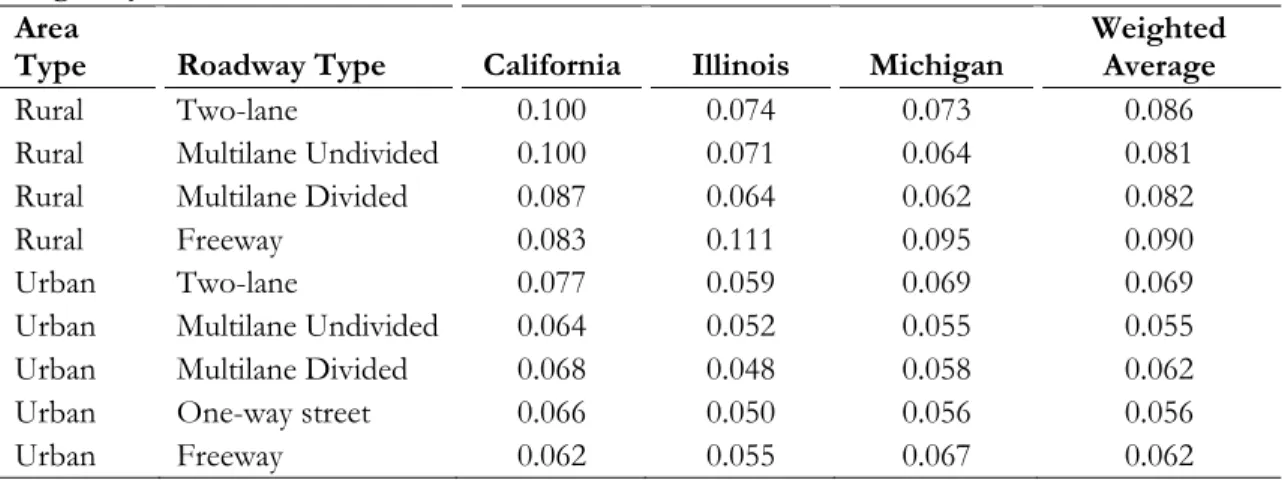
Management Information System (MCMIS). The most widely used probabilities of accidents are those developed by Harwood et al. (1993) (Table 2.1).
The consequences of a release are a function of the amount of material released, its physicochemical and toxicological properties, combined with the population density,
property and environmental conditions and characteristics at the release location. A simpler approach typically used in various risk analyses focuses on the number of people residing within the hazardous materials’ evacuation perimeter (Bubbico et al. 2004; Dadkar et al. 2006; Erkut and Alp 2007; Guo and Verma 2010; and Guo 2010). This is particularly evident in most operations research route selection analyses which tend to use “static estimates of accident probabilities and consequences” (Erkut and Alp 2007). Due to these generalizations, these models tend to select routes so as to minimize population exposure. Alternatively, some studies have attempted to quantify
8
Table 2.1 Harwood et al. (1993) Truck Accident Rates
Highway Class
Truck Accident Rate
(Accidents per Million Vehicle-Miles) Area
Type Roadway Type California Illinois Michigan Weighted Average
Rural Two-lane 0.66 1.21 0.83 0.85
Rural Multilane Undivided 2.10 0.82 3.67 1.73
Rural Multilane Divided 0.47 1.85 2.19 0.83
Rural Freeway 0.21 0.18 0.45 0.25
Urban Two-lane 1.63 4.29 4.22 3.34
Urban Multilane Undivided 5.03 6.58 4.00 5.37
Urban Multilane Divided 1.35 5.72 4.09 4.82
Urban One-way street 2.55 10.18 3.12 3.75
Urban Freeway 0.62 2.25 1.08 0.84
consequences based on average costs (Desai et al. 2010; Deng et al. 2010). These may include emergency response and remediation expenses, repair expenses, and costs associated with casualties resulting from the hazardous materials release.
2.1.1 Extending the Definition of Highway Transport Risk
Such methods of generating risk estimates may be sufficient for route selection models but they do not account for large potential sources of variance depending on the commodity and the container in which it is shipped (Brown et al. 2000). Attempts to more accurately estimate hazardous materials transportation risk have led to use of the probability of a release given that an accident has occurred, or conditional probability of release (CPR)( Ak and Bozkaya 2008, Centrone et al. 2011, Chakrabarti and Parikh 2011, Chakrabarti and Parikh 2011[2], Erkut and Verter 1998, Erkut and Ingolfsson 2005, Harwood et al. 1993, Huang et al. 2005, Noick et al. 1997, Wijeratne et al. 1993). These CPR estimates have been incorporated into quantitative risk assessment methodologies using Bayes’ Theorem such that the probability of a release is represented by the product of the probability of an accident ( ) and the probability of a release given that an accident has occurred ( ( ) ) (equation 2.2).
9
∑ [ ( ) ]
(2.2)
Where:
= the risk due to a release of hazardous materials along a particular
route.
i = the ith link in a route.
m = the total number of links in a route.
= an exposure estimate. It may represent the length, in number of miles, of link i. Alternatively, if assessing the annual risk, it may represent the product of the length of link i and the number of times the route traversed in a year.
= the probability of an accident.
( ) = on the ith link, the probability of a release given that an accident has
occurred, or CPR. Therefore, ( ) corresponds to the events on the ith
link in which the vehicle is involved in an accident but does not result in a release.
= the consequences of the release on the ith link.
CPR is a function of the damage incurred during an accident and the bulk package’s ability to withstand that damage. It is independent of the probability of an accident
occurring and the consequences of a release. Rudimentary CPR estimates, such as those provided by Harwood et al. (1993) (Table 2.2), compare the total number of releases (numerator) to the total number of accidents involving hazardous materials (denominator). Both variables can be computed using FMCSA’s MCMIS or state-specific datasets.
10
Table 2.2 Harwood et al. (1993) Probabilities of Release Given that an Accident Occurred as a Function of Highway Class
Highway Class Probability of a Hazardous Materials Release Given an Accident Area
Type Roadway Type California Illinois Michigan Weighted Average
Rural Two-lane 0.100 0.074 0.073 0.086
Rural Multilane Undivided 0.100 0.071 0.064 0.081
Rural Multilane Divided 0.087 0.064 0.062 0.082
Rural Freeway 0.083 0.111 0.095 0.090
Urban Two-lane 0.077 0.059 0.069 0.069
Urban Multilane Undivided 0.064 0.052 0.055 0.055
Urban Multilane Divided 0.068 0.048 0.058 0.062
Urban One-way street 0.066 0.050 0.056 0.056
Urban Freeway 0.062 0.055 0.067 0.062
2.2 Reduce CPR By Improving Bulk Package Performance
Risk-based research on highway transport of hazardous materials has been focusing on alternative route selection. As a result, research on factors affecting CPR have been limited to roadway classification, accident type and bulk package specification. Further risk-reduction could be accomplished by employing historical hazardous materials accident data to identify opportunities for improved bulk package design. This not only increases the ability of the bulk package to withstand damage incurred in an accident, but also may reduce the amount of material released. However, an extensive review of current data collection practices revealed that available bulk package information is generally insufficient to evaluate CPR (refer to Chapter 3). Furthermore, where data are collected, existing databases suffer from underreporting, which, as noted by Batelle Memorial Institute (2009) and Trépanier et al. (2009), may introduce considerable uncertainty into estimates of CPR. Care should be taken when using small subsets of datasets for estimation.
2.2.1 Bulk Package Performance Evaluations
Two variables in Equation 2.2 relate directly to bulk package performance: the CPR and the quantity released. Bulk package design affects CPR in that it determines the
package’s ability to withstand damage incurred in an accident. The amount released is a function of the size of the opening (related to the package’s ability to withstand damage), the
11
physical properties of the hazardous material, and the time elapsed before the opening can be plugged or the hazardous material can be off-loaded. Current highway data collection practices are generally insufficient to evaluate CPR so chapters 3 through 7 explore what information would be needed in the development of a highway bulk package accident database. A principal objective of developing such an accident damage database is to
provide a robust source of empirical accident information on bulk package performance in a wide range of accident scenarios. As data are accumulated over time, the statistical power of these regression equations will increase and increasingly sophisticated analyses can be
conducted. These include developing the CPRs for various components, in different accident scenarios.
In a similar manner the performance of railroad tank cars has been evaluated using information in the Railway Supply Institute (RSI) - Association of American Railroads (AAR) Tank Car Accident Database (TCAD). Since its formation in 1970, more than 45,000 records of damaged tank cars and more than 29,000 accidents have been recorded in the database. This extensive database enables robust statistical analyses of the performance of the principal tank car components, and development of quantitative answers to a variety of questions (CCPS 1995; Barkan and Pasternak 1999). The most basic questions include “What percentage of tank cars were involved in accidents and released some or all of their contents?”, “What is the safety performance of tank car transport of hazardous materials?”, “How do different tank car specifications perform in accidents?”, and “How has tank car safety performance improved over time?”. Meanwhile, more complex questions include “What is the likelihood and the expected quantity of release from a particular component?”, “How does the performance of a particular component differ with the incorporation of various design features?”, “What is the effectiveness of different design changes to improve safety?”, “How has tank car safety improved as a result of some change in design or
operation?”, and “What is the cost-effectiveness of various design changes?”. The RSI-AAR TCAD illustrates how such a data collection process enables:
Quantitative understanding of the relative performance of different bulk package designs in various accident circumstances.
12
The capability of assessing the risk of transporting various hazardous materials using a particular specification or a bulk package equipped with a particular feature.
A means to estimate the potential benefit from incorporation of a particular safety measure or by changing a particular design element.
Combined with financial information, identification of the most efficient risk reduction measures.
2.3 Logistic Regression Models
Previous experience involving analysis of railroad tank car safety performance using the RSI-AAR TCAD illustrates the use of statistical techniques to develop prediction models for CPR based on bulk package performance (Treichel et al. 2006). As part of the RSI-AAR Railroad Tank Car Safety Research and Test Project, several regression methods were
employed to develop the estimates of CPR:
Logistic regression in which a binary response variable such as release or no release is selected. Logistic regression makes an exponential transformation that allows probability estimate errors to conform to the required assumption of normality.
Ordinal logistic regression in which response variables are binned. For example, binned data regarding the percentage lost would be an appropriate response variable for ordinal logistic regression.
Multiple binary logistic regression in which there are several response variables representing, for example, release or no release of hazardous materials in several categories.
Wen and Simpson, in Multivariate Regression Analysis of Tank Car Lading Loss (Wen and Simpson, 2000), presented the following equations and some other details of the general logistic regression model:
13
( ) ( )
( )
( ) (2.3)
Where:
Yi= a binary dependent variable associated with the ith record where 0 represents a non-release event and 1 represents a release event,
Xi = a vector denoting the values of l independent variables for the ith record:
[ ] (2.4)
L = the logarithmic odds ratio, = Xi’β, and
β = the following vector denoting values of l coefficients of the logarithmic odds ratio, L: [ ] (2.5)
Unlike linear regression, an analytical solution does not exist for logistic regression. Instead, a maximum likelihood procedure, in which an iterative process is employed to converge at the best possible solution, is used to estimate the coefficients (Menard, 2001).
The incorporation of a linear equation within the logistic regression model is beneficial because it “allows consideration of a large number of independent variables and has [a] well established theoretical basis for further statistical inference” (Wen and Simpson, 2000), while the incorporation of a quadratic or higher-order equation allows for interactions between variables (occurs when there is a covariance between two or more variables in the equation). Since the estimation of the conditional probability of release for bulk packages
14
transported by highway is similar to the estimation of the conditional probability of release for tank cars, similar approaches for developing the response function may be used.
Accident scenarios that may initially be considered include, among others, accidents in which another vehicle is involved and incidents in which the vehicle and bulk package overturned. Roadway types that may be considered include those specified by Harwood et al. (1993):
Rural two-way
Rural multilane undivided
Rural multilane divided
Rural freeway
Urban two-way
Urban multilane undivided
Urban multilane divided
Urban one-way, and
Urban freeway.
Similarly, the bulk package components that may be considered include:
Valves.
Loading/unloading lines, piping or fittings.
Manway or dome covers.
Tank head.
Tank shell.
The above combination results in the need to calculate 135 separate regression equations representing the conditional probability of release from the jth component given
the kth accident scenario on the lth roadway type. The various combinations are illustrated in
15
16
Assuming roadway type, accident scenario and bulk package component are independent, a generalized conditional probability of release can be determined using equation 2.6: ∏ ∏ ∏ [ ] (2.6) Where:
= the probability of a release given that an accident has occurred, or CPR.
= the CPR from the l
th source due to the kth accident scenario on the jth
roadway type.
= the number of roadway types considered.
= the number of accident scenarios considered for each roadway type.
= the number of components considered for each accident scenario – roadway type combination.
Alternatively, should consequence information be available for each accident scenario – roadway type – bulk package component combination (Cjkl), the risk of
transporting hazardous materials along a particular route could be determined using equation 2.7: ∑ ∑ ∑ (2.7) Where:
= the additional risk of transporting hazardous materials should a
release occur.
= the route length of the jth roadway type.
= the probability of an accident occurring on the jth type of roadway.
17
= the probability of release as a result of an accident of the k
th type, given
that an accident has occurred on the jth type of roadway.
= the number of accident scenarios considered for the jth roadway type.
= the probability of a release from the l
th bulk package component, given
that an accident of the kth type has occurred on the jth type of roadway.
= the consequences of a release due to the k
th accident type on the jth type of
roadway from the lth bulk package component.
= the number of components considered for each accident-scenario, roadway-type combination.
In Treichel et al. (2006), separate regression models for each of the four major components (head, shell, top fittings, and bottom fittings) were developed by removing factors that had no significant effect on a particular component’s loss probability from that component’s model. Similarly, a regression analysis of highway accident data may show that, for example, the capacity of the bulk package does not have a significant effect on the probability of a release from loading/unloading lines. Not all the characteristics considered will have a significant effect on a particular component’s loss probability given a particular type of accident on a particular type of roadway. Therefore, regression model building techniques comparing every subset of the full model should be conducted.
Similar to the methodology used in Treichel et al. (2006), to determine the
coefficients for each significant factor, accident report selection criteria for the population to be analyzed should be constructed with the intention of eliminating the possibility of
undesirable heterogeneities. Without these inclusion criteria, biased conclusions may be drawn, particularly if loading characteristics differ (bulk package is empty) or damage is sustained to the bulk package after the initial impact (such as prolonged exposure to fire). Thus, the inclusion criteria for accident records are particularly important when accident data include accidents involving cargo tanks whether or not they carried hazardous materials; were loaded at the time they were damaged; sustained sufficient damage to result in a lading loss; or were exposed to a fire for a prolonged period of time.
18 CHAPTER 3
INFORMATION NEEDED TO ASSESS BULK PACKAGE ACCIDENT PERFORMANCE
3.1Introduction
This chapter consists of a review of the nature and quality of the bulk package performance data currently being collected1. This is achieved through a literature review, a
review of relevant definitions used in analyzing bulk package accident performance, an investigation of existing data collection strategies, and an extensive interview process. The literature review focuses on studies and reports in the following categories:
Cargo tank and portable tank classification and specifications – The packages for which accident data will be collected are identified, and design attributes, such as minimum head and shell thicknesses and type and location of valves and
manholes, are noted.
Cargo tank motor vehicle industry practices – Besides container design
specifications, industry practices may influence the performance of cargo tanks in an accident scenario. Factors affecting the service life of a cargo tank identified by Bowman et al. (2009) are summarized.
Container performance studies – Past studies are reviewed to determine how existing crash data have been used. For highway cargo tanks, a number of
analyses have been performed to evaluate the performance of front heads as well as container performance in rollover scenarios. Key factors required to perform similar statistical analyses of container performance are identified.
1 This chapter was developed to fulfill the requirements of the Transportation
Research Board (TRB)’s Hazardous Materials Cooperative Research Program (HMCRP) project HM-07 entitled “Accident Performance Data of Bulk Packages Used for Hazardous Materials Transportation.” This chapter appears as Chapter 2 in HM-07’s final deliverable which was accepted for publication.
Philip J. Daum, P.E., Christopher P. L. Barkan, Ph.D., M. Rapik Saat, Ph.D., and Laura E. Ghosh, Feasibility Study for Highway Hazardous Materials Bulk Package Accident Performance Data. Hazardous Materials Cooperative Research Program (HMCRP) Report, Transportation Research Board, 2013.
19
Cargo tank accident investigations – Accident investigations are reviewed to identify key factors for inclusion in a database enabling statistical analyses of container performance.
Data collected by existing programs were reviewed for applicability in evaluating cargo tank and portable tank performance in accidents. These existing programs include the Pipeline and Hazardous Materials Safety Administration (PHMSA)’s Hazardous Materials Incident Reporting System (HMIRS), the Federal Motor Carriers Safety Administration (FMCSA)’s Motor Carrier Management Information System (MCMIS), the University of Michigan Transportation Research Institute (UMTRI)’s Trucks Involved in Fatal Accidents (TIFA), and NHTSA’s National Automotive Sampling System (NASS) General Estimates System (GES). Additionally, the Railway Supply Institute (RSI) - Association of American Railroads (AAR) Tank Car Accident Database (TCAD) is an existing data collection process used for a comparable purpose in railroad bulk liquid transport.
Finally, an extensive interview process was undertaken. Several companies from each stakeholder group were visited and interviewed to determine what information is currently recorded regarding bulk package design and/or accident damage. Through these stakeholder interviews, it was ascertained that, due to the large differences in bulk package use and accident performance associated with different specification containers, a process to engage a larger number of stakeholders was required. Therefore, a set of stakeholder online surveys were developed and distributed, where possible, through their respective industry associations. The purpose of the surveys was to gain insight on what information different stakeholders believe would be most useful in an accident damage database. Additionally, the survey was intended to provide information on what constraints might exist among
stakeholders as well as various preferences they might have regarding the database. Questions were tailored to each survey group to collect information most appropriate to their interests and expertise.
Survey responses were used in conjunction with interviews, literature reviews, and existing database reviews, to identify and rank the most important types of data to be collected. These include bulk package design characteristics, the nature of damage they experience, the circumstances of accidents involving hazardous materials packages, whether
20
or not there was a release of product, and, if so, the quantity and other details about the release.
3.2Literature Review
As part of a review to identify and evaluate the quality of bulk package performance data currently being collected, extensive searches for relevant literature were conducted. The review focused on studies and reports in the following categories:
Bulk package classification and specifications.
Cargo tank motor vehicle assembly and repair.
Container performance studies.
Cargo tank accident investigations.
3.2.1 Bulk Package Classification and Specifications
One of the primary purposes of this project is to outline a database containing information concerning damage to highway bulk packages. An understanding of various cargo tank motor vehicles and intermodal containers currently in use was obtained through the following sources:
49 Code of Federal Regulations (CFR) Section 178 – Specifications for Packagings. This source provides the minimum design requirements for the lading retention system of certified cargo and portable tanks including authorized materials, minimum thicknesses, structural integrity requirements, and accident damage protection requirements.
Guidelines for Chemical Transportation Risk Analysis Appendix A: Standard Container Illustrations and Specifications (CCPS 1995). This source provides an overview of current motor carrier series cargo tanks including the types of materials typically carried in the tank, a description of the tank, and design features of the tank.
State of Ohio Hazmat and Weapon of Mass Destruction (WMD) Awareness for the First Responder: Instructor Guide Unit Three – The Ability to Recognize and Identify Hazardous Materials (Ohio Hazmat/Decon Technical Advisory Committee 2009). A series of PowerPoint slides for first responder hazardous
21
material training that provides detailed descriptions of cargo tank motor vehicles and intermodal tanks.
The following sections describe the packages for which accident data will be collected. Design attributes, such as minimum head and shell thicknesses, and type and location of valves and the manhole, are noted because the proposed database is anticipated to allow analyses of the performance of these features.
3.2.1.1MC 306/DOT 406 – Atmospheric Pressure Cargo Tank
With a maximum allowable working pressure between 2.65 psig and 4 psig (49 CFR 178.346), MC 306/DOT 406 cargo tanks typically transport between 2,000 and 9,500 gallons of flammable and combustible liquids or poisonous materials (CCPS 1995). Figure 3.1 illustrates an MC 306/DOT 406 cargo tank.
Source: 2012 Emergency Response Guidebook.
Figure 3.1 MC 306/DOT 406 Non-Pressure Liquid Tank.
MC 306/DOT 406 cargo tanks typically have a single shell oval cross-section and are equipped with a vapor collection system that is evident by the piping running along the top and wrapping around the end of the tank. The lading retention system may feature a multi-compartment design in which multi-compartments are separated by double bulkheads and a vented/drained airspace (CCPS 1995). The manhole is either recessed into the cargo tank or is equipped with rollover protection.
The tank is equipped with bottom stop-valves that are generally grouped together on the underside of the tank to assist with unloading. Piping connects the compartments to the bottom valves and is protected from breakage by accident protection devices or shear sections (CCPS 1995). Additionally, an emergency valve remote closure device is located more than 10 feet from the stop-valves. A rear bumper provides additional protection to pipes and valves in the event of a rear-end collision.
22
Minimum thicknesses for tank head/bulkhead/baffle and tank shell as specified in 49 CFR 178.346 are shown in Tables 3.1 and 3.2, respectively, based on the type of material and the cargo tank motor vehicle rated capacity, in gallons.
Table 3.1 Specified Minimum Head Thickness of MC 306/DOT 406 Cargo Tank (or Bulkhead and Baffle When Used as Tank Reinforcement)
Volume capacity in gallons per inch of length
Minimum Head Thickness (inches)
Mild Steel
High Strength Low Alloy Steel & Austenitic Stainless
Steel Aluminum
14 or less 0.100 0.100 0.160
Over 14 to 23 0.115 0.115 0.173
Over 23 0.129 0.129 0.187
Table 3.2 Specified Minimum Shell Thickness of MC 306/DOT 406 Cargo Tank
Cargo tank motor vehicle rated capacity (gallons)
Minimum Shell Thickness (inches)
Mild Steel
High Strength Low Alloy Steel & Austenitic Stainless
Steel Aluminum
More than 0 to at least 4,500 0.100 0.100 0.151
More than 4,500 to at least 8,000 0.115 0.100 0.160 More than 8,000 to at least 14,000 0.129 0.129 0.173
More than 14,000 0.143 0.143 0.187
3.2.1.2MC 307/DOT 407 – Low-Pressure Cargo Tank
With a maximum allowable working pressure between 25 psig (49 CFR 178.347) and 40 psig (CCPS 1995), MC 307/DOT 407 cargo tanks typically transport between 2,000 and 8,000 gallons of flammable liquids and mild corrosives with vapor pressures not more than 40 psi at 70oF. Figure 3.2 illustrates an MC 307/DOT 407 cargo tank.
MC 307/DOT 407 low-pressure cargo tanks are typically made of steel with a double-shell and may be lined. The lading retention system may have a multi-compartment design in which compartments are separated by double bulkheads and a vented/drained airspace (CCPS 1995). The manhole, able to withstand an internal fluid pressure of at least
23
40 psi, is either recessed into the cargo tank or is provided with rollover protection. Additionally, stiffening rings add additional structural strength to the tank.
The tank is equipped with bottom stop-valves that are generally grouped together on the underside of the tank to assist with unloading. Piping connects the compartments to the bottom valves and is protected from breakage by accident protection devices or shear sections (CCPS 1995). Additionally, an emergency valve remote closure device is located more than 10 feet from the stop-valves.
Source: 2012 Emergency Response Guidebook.
Figure 3.2 MC 307/DOT 407 Low-Pressure Chemical Tank
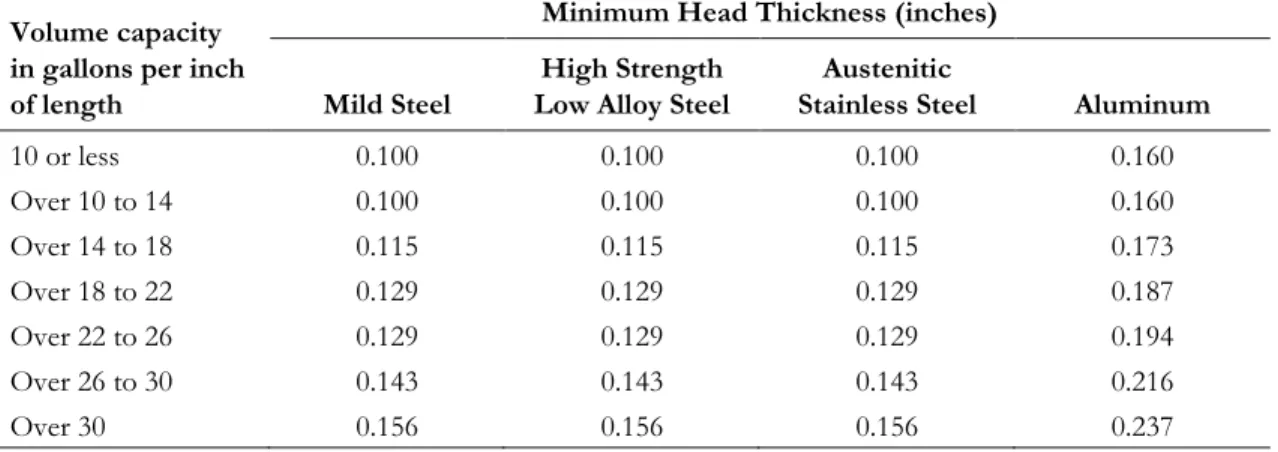
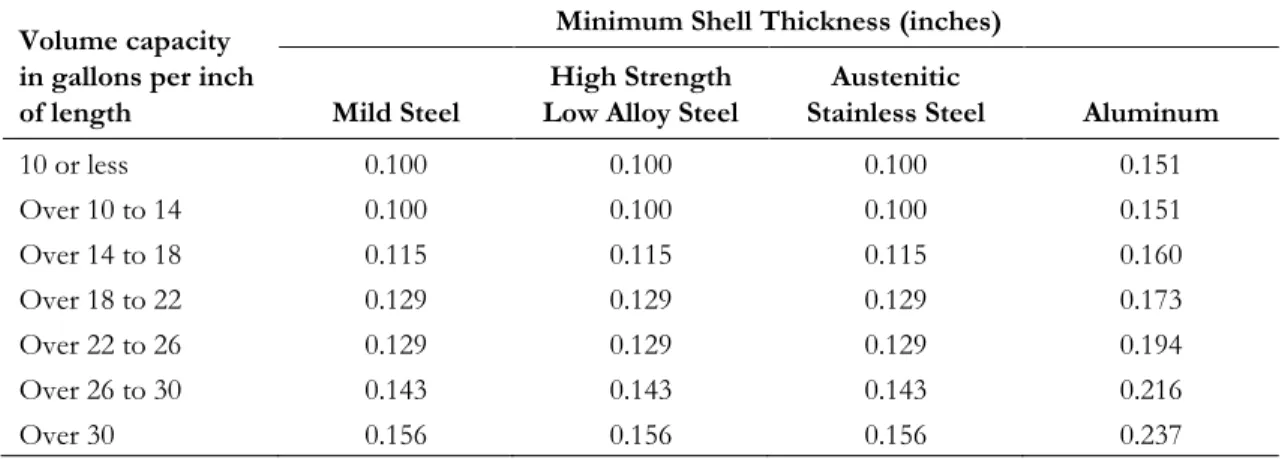
Minimum thicknesses for tank heads/bulkhead/baffles and tank shell as specified in 49 CFR 178.347 are shown in Tables 3.3 and 3.4, respectively, based on the type of material and the cargo tank motor vehicle rated capacity, in gallons.
Table 3.3 Specified Minimum Head Thickness of MC 307/DOT 407 Cargo Tank (or Bulkhead and Baffle When Used as Tank Reinforcement)
Volume capacity in gallons per inch of length
Minimum Head Thickness (inches) Mild Steel
High Strength Low Alloy Steel
Austenitic
Stainless Steel Aluminum
10 or less 0.100 0.100 0.100 0.160 Over 10 to 14 0.100 0.100 0.100 0.160 Over 14 to 18 0.115 0.115 0.115 0.173 Over 18 to 22 0.129 0.129 0.129 0.187 Over 22 to 26 0.129 0.129 0.129 0.194 Over 26 to 30 0.143 0.143 0.143 0.216 Over 30 0.156 0.156 0.156 0.237
24
Table 3.4 Specified Minimum Shell Thickness of MC 307/DOT 407 Cargo Tank Volume capacity
in gallons per inch of length
Minimum Shell Thickness (inches) Mild Steel
High Strength Low Alloy Steel
Austenitic
Stainless Steel Aluminum
10 or less 0.100 0.100 0.100 0.151 Over 10 to 14 0.100 0.100 0.100 0.151 Over 14 to 18 0.115 0.115 0.115 0.160 Over 18 to 22 0.129 0.129 0.129 0.173 Over 22 to 26 0.129 0.129 0.129 0.194 Over 26 to 30 0.143 0.143 0.143 0.216 Over 30 0.156 0.156 0.156 0.237
3.2.1.3MC 312/DOT 412 Corrosive Cargo Tank
MC 312/DOT 412 cargo tanks are characterized by a narrow cylindrical shape and are typically lined with a homogeneous corrosive resistant material to transport high-density liquids and corrosives such as acetyl chloride and hydrochloric acid (CCPS 1995). The cargo tanks have a multi-compartment design, are usually constructed of steel, stainless steel or aluminum, and equipped with rollover protection and splashguards that also provide rollover protection. Figure 3.3 illustrates an MC 312/DOT 412 cargo tank.
Source: 2012 Emergency Response Guidebook.
Figure 3.3 MC 312/DOT 412 Corrosive Cargo Tank.
The manhole is located at either the center or the rear of the tank. The loading area is typically covered with corrosive resistant material; and piping, hoses, and connections may be made of non-metallic materials to resist corrosion as well (49 CFR 178.348). These cargo tanks are typically equipped with the ability to be unloaded from the top using air pressure and are provided with valves both at the discharge point and inside the tank to prevent siphoning in the event of a valve failure (CCPS 1995). Discharge piping is shown in Figure 3.3 at the rear of the tank.
25
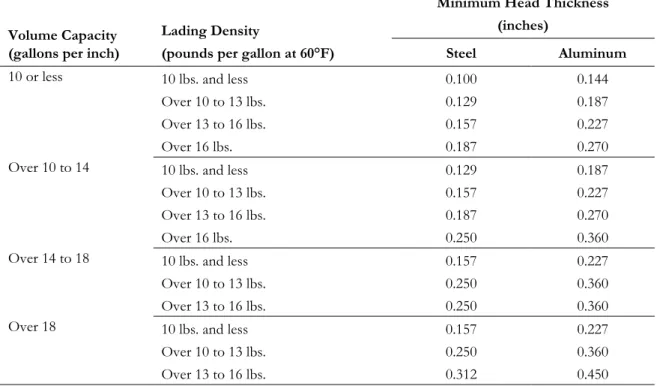
Minimum thicknesses for tank head/bulkhead/baffle and tank shell as specified in 49 CFR 178.347 are shown in Tables 3.5 and 3.6, respectively, based on the type of material, the cargo tank motor vehicle rated capacity, in gallons, and the lading density at 60°F.
Table 3.5 Specified Minimum Head Thickness of MC 312/DOT 412 Cargo Tank (or Bulkhead and Baffle When Used as Tank Reinforcement)
Volume Capacity (gallons per inch)
Lading Density
(pounds per gallon at 60°F)
Minimum Head Thickness (inches)
Steel Aluminum
10 or less 10 lbs. and less 0.100 0.144
Over 10 to 13 lbs. 0.129 0.187
Over 13 to 16 lbs. 0.157 0.227
Over 16 lbs. 0.187 0.270
Over 10 to 14 10 lbs. and less 0.129 0.187
Over 10 to 13 lbs. 0.157 0.227
Over 13 to 16 lbs. 0.187 0.270
Over 16 lbs. 0.250 0.360
Over 14 to 18 10 lbs. and less 0.157 0.227
Over 10 to 13 lbs. 0.250 0.360
Over 13 to 16 lbs. 0.250 0.360
Over 18 10 lbs. and less 0.157 0.227
Over 10 to 13 lbs. 0.250 0.360
Over 13 to 16 lbs. 0.312 0.450
3.2.1.4MC 331 High-Pressure Gas Cargo Tank
MC 331 cargo tanks are typically used to transport liquefied pressurized gases (49 CFR 178.337). With a maximum allowable working pressure between 100 and 500 psig, MC 331 cargo tanks are made of steel or aluminum using seamless or welded construction. Aluminum tanks are insulated and covered with a steel jacket while steel tanks only need to be insulated and covered with a steel jacket when carrying a flammable gas. Insulation must be non-combustible if used for tanks carrying nitrous oxide refrigerated liquid and must be corkboard, polyurethane foam, or ceramic fiber/fiberglass if used for tanks carrying chlorine. If the cargo tank is not insulated, it is painted white, aluminum, or a similar reflecting color on the upper two-thirds of the container. Structural members, the suspension sub-frame,
26
Table 3.6 Specified Minimum Shell Thickness of MC 312/DOT 412 Cargo Tank
Volume Capacity (gallons per inch)
Lading Density (pounds per gallon at 60°F)
Distances between heads (and bulkheads baffles and ring stiffeners when used as tank reinforcement)
Minimum Shell Thickness (inches)
Steel Aluminum 10 or less 10 lbs. and less 60 in. or less 0.100 0.144
Over 10 to 13 lbs. 60 in. or less 0.129 0.187 Over 13 to 16 lbs. 60 in. or less 0.157 0.227
Over 16 lbs. 60 in. or less 0.187 0.270
10 lbs. and less 54 in. or less 0.100 0.144 Over 54 in. to 60 in. 0.129 0.187 Over 10 to 13 lbs. 54 in. or less 0.129 0.187 Over 54 in. to 60 in. 0.157 0.227 Over 13 to 16 lbs. 54 in. or less 0.157 0.227 Over 54 in. to 60 in. 0.187 0.270
Over 16 lbs. 54 in. or less 0.187 0.270
Over 54 in. to 60 in. 0.250 0.360 Over 14 to 18 10 lbs. and less 36 in. or less 0.100 0.144 Over 36 in. to 54 in. 0.129 0.187 Over 54 in. to 60 in. 0.157 0.227 Over 10 to 13 lbs. 36 in. or less 0.129 0.187 Over 36 in. to 54 in. 0.157 0.227 Over 54 in. to 60 in. 0.250 0.360 Over 13 to 16 lbs. 36 in. or less 0.157 0.227 Over 36 in. to 54 in. 0.187 0.270 Over 54 in. to 60 in. 0.250 0.360
Over 18 10 lbs. and less 36 in. or less 0.129 0.187
Over 36 in. to 54 in. 0.157 0.157 Over 54 in. to 60 in. 0.187 0.270 Over 10 to 13 lbs. 36 in. or less 0.157 0.227 Over 36 in. to 54 in. 0.250 0.360 Over 54 in. to 60 in. 0.250 0.360 Over 13 to 16 lbs. 36 in. or less 0.187 0.270 Over 36 in. to 54 in. 0.250 0.360 Over 54 in. to 60 in. 0.312 0.450
accident protection structures, and external circumferential reinforcement devices are typically used for attachment of appurtenances and other accessories. Figure 3.4 illustrates an MC 331 cargo tank with vents located on top of the cargo tank and a manhole located on the rear head.
27 Source: 2012 Emergency Response Guidebook.
Figure 3.4 MC 331 High-Pressure Gas Cargo Tank
Non-chlorine cargo tank openings include gauging devices, thermometer wells, pressure relief valves, manhole openings, product inlet openings, product discharge openings, and other openings that have been closed with a plug, cap, or bolted flange. Backflow check valves or internal self-closing stop valves are located inside the cargo tank or inside a welded nozzle that is an integral part of the cargo tank. Additionally, non-chlorine cargo tanks have remote closure valves in at least two diagonally opposite locations (CCPS 1995). Chlorine cargo tanks only have one opening on the top of the tank, which is fitted with a nozzle, an internal excess flow valve and an external stop valve, and protected by either a manway cover or a dome cover plate (49 CFR 178.337).
The minimum thickness for MC 331 tanks is based on the structural requirements of the tank and 25 percent of the tensile strength of the material used. Sulfur dioxide and chlorine tanks are made of steel and designed to incorporate a corrosion allowance of the lesser of an additional 20 percent or an additional 0.100 inches. Chlorine tanks are required to be at least 0.625 inches, including the corrosion allowance. All other MC 331 steel tanks should exceed 0.187 inches and MC 331 aluminum tanks should exceed 0.270 inches (49 CFR 178.337).
3.2.1.5MC 338 Cryogenic Liquid Cargo Tank
MC 338 cargo tanks are designed to prevent heat transfer to the lading, and consist of an inner tank enclosed within an outer tank. This provides a thermos-bottle-type design where the interstitial space can be evacuated of air (vacuum). Additionally, an insulation material may be provided between the inner and outer tanks. Depending on the insulation provided, each tank is rated for a specific holding time before the tank pressure exceeds the set pressure of a pressure relief valve. The insulation must also meet certain fire rating
28
standards based upon the type of lading for which the tank was designed (49 CFR 178.338). Figure 3.5 illustrates an MC 338 cryogenic liquid cargo tank.
Source: 2012 Emergency Response Guidebook.
Figure 3.5 MC 338 Cryogenic Liquid Cargo Tank
The manhole, typically located on the top or rear of the tank must be provided with a means of entrance and exit through the jacket, or the jacket must be marked to indicate the manway location on the tank. Tanks designed for flammable ladings have a discharge
opening located at the bottom centerline of the tank and are equipped with a closure that is leak tight at the tank’s maximum allowable working pressure.
Accident damage protection for all valves, fittings, pressure relief devices and other accessories is typically provided through a collision-resistant housing located at the rear of the tank. Additionally, pressure relief devices are protected so that they are not obstructed in the event of a collision. MC 338 cargo tanks typically have a remote means of automatic closure located at the end of the cargo tank that is furthest from the loading/unloading connection area.
The tank is typically constructed of steel alloys suited for the low temperature environment to which the tank is subjected. The minimum thickness of the steel tank is 0.187 inches or 0.110 inches if the tank is vacuum insulated or double walled with a load-bearing jacket carrying a proportionate amount of structural loads. The minimum thickness for an aluminum tank is 0.270 inches.
29
Table 3.7 Specified Minimum Jacket Thickness of MC 338 Cargo Tank
Note: ‘--' indicates that gauge measurements are not applicable.
3.2.1.6Compressed Gas Tube Trailer
Tube trailers transport bulk non-liquefied compressed gases such as helium,
hydrogen, nitrogen, and oxygen at pressures ranging between 3,000 and 5,000 psi. A group of cylinders, meeting standards outlined in 49 CFR 178.35 are stacked and banded together in a modular or nested shape. Each cylinder is constructed using a material without seams, cracks or laminations, or other defects. Figure 3.6 illustrates an example configuration of cylinders in a tube trailer, and Table 3.8 displays some properties associated with cylinders used for tube trailers.
Source: 2012 Emergency Response Guidebook.
Figure 3.6 Compressed Gas Tube Trailer Type Metal
Jacket Evacuated Jacket Not Evacuated Gauge Inches Gauge Inches
Stainless steel 18 0.0428 22 0.0269
Low carbon mild steel 12 0.0946 14 0.0677
30
Table 3.8 Specified Seamless Cylinder Properties
Cylinder Type Max. Water Capacity (lbs.) Cylinder Dimensions (where max. water capacity is not provided)
Min. Service Pressure (psig) Max. Service Pressure
(psig) Material Type Max. Diameter (inches) Max. Length (feet) 3A 1000 N/S N/S 150 N/S Open-Hearth or Electric Steel 3AX 1000 N/S N/S 500 N/S Open-Hearth or Electric Steel
3AA 1000 N/S N/S 150 N/S Open-Hearth, Basic
Oxygen, or Electric Steel
3AAX 1000 N/S N/S 500 N/S Open-Hearth, Basic
Oxygen, or Electric Steel 3B 1000 N/S N/S 150 500 Open-Hearth or Electric Steel 3BN 125 N/S N/S 150 500 Nickel 3E N/S 2 2 N/S 1,800 Open-Hearth or Electric Steel 3HT 150 N/S N/S 900 N/S Open-Hearth or Electric Furnace Steel 3T 1000 N/S N/S 1800 N/S Open-Hearth, Basic Oxygen, or Electric Furnace Steel 3AL 1000 N/S N/S 150 N/S Aluminum
Note: N/S = Not Specified
3.2.1.7Non-Pressurized UN Portable Tank
Non-pressurized UN portable tanks are used to transport liquid and solid hazardous materials. These tanks are designed to withstand temperatures between -40oC and 50oC
(-40oF and 122oF) or greater than the maximum temperature of its lading. Tanks are generally
made out of steel; however, some shells may be constructed using aluminum. Additionally, tanks may be lined with a homogeneous corrosion-resistant material that is compatible with the lading. Minimum thicknesses are specified based on the type of material used as well as the tank diameter and are exclusive of corrosion allowance. Table 3.9 shows the required minimum thickness of a non-pressurized UN portable tank as specified in 49 CFR 178.275.
31
Table 3.9 Specified Minimum Thicknesses for Non-Pressurized UN Portable Tanks
Tank Diameter
Minimum Thickness [mm (in)]
Reference Steel Absolute Up to 1.8 meters 5 (0.197) 3 (0.100) 1.8 meters and above 6 (0.200) 3 (0.100)
All UN portable tanks (Figure 3.7) are constructed with supports that provide a secure base during transportation. Longitudinal bars may be used to provide additional lateral support. Reinforcement rings or bars fixed across the frame, an ISO frame, or an insulation jacket may be used to provide additional protection against overturning. A bumper or rear frame may also be equipped to protect against rear impacts (49 CFR 178.275).
Source: 2012 Emergency Response Guidebook.
Figure 3.7 Portable Tank
A pressure relief device is located within the vapor space on top of the shell, near the longitudinal and transverse center. Accident damage protection is provided to ensure the pressure relief device continues to function in the event of a collision. Stop valves, or another suitable means of closure, are located close to the shell at all openings except for openings leading to venting or pressure relief devices. If the tank is insulated, a spill
32
collection reservoir with suitable drains will surround top fittings. Bottom fittings, if provided, shall have either two or three independent shut-off valves located both close to the shell and at the end of the discharge pipe (49 CFR 178.275).
3.2.1.8Pressurized UN Portable Tank
Pressurized UN portable tanks are used to transport non-refrigerated liquefied gases. Tanks have a circular cross section, and are made of steel with a minimum thickness of four millimeters (0.2 inches). If insulated, the insulation either covers between the upper third and upper half of the shell surface or completely covers the shell and is separated from the shell by an air space. Like all UN portable tanks, the tank is constructed with supports that provide a secure base during transportation. Longitudinal bars may be used to provide additional lateral support. Reinforcement rings or bars fixed across the frame, an ISO frame, or an insulation jacket may be used to provide additional protection against overturning. A bumper or rear frame may also be provided to protect against rear impacts (49 CFR
178.276).
A pressure relief device is located within the vapor space on top of the shell, near the longitudinal and transverse center. Accident damage protection is provided to ensure the pressure relief device continues to function in the event of a collision. All other openings greater than 1.5 mm (0.100 inches) have at least three mutually independent shut-off devices in series. Types of shut-off devices can include stop-valves, excess flow valves, integral excess flow valves, external stop-valves, blank flanges, thread caps, and plugs (49 CFR 178.276).
3.2.1.9Cryogenic UN Portable Tank
Cryogenic UN portable tanks are used to transport refrigerated liquefied gases. The tank is constructed of steel and designed to hold at least 450 liters (118.9 gallons).
Consisting of an inner shell enclosed in a jacket, the tank is insulated by either an
intermediate layer of solid, thermally-insulating material or by vacuum (49 CFR 178.277). Like all UN portable tanks, the tank is constructed with supports that provide a secure base during transportation. Longitudinal bars may be used to provide additional lateral support. Reinforcement rings or bars fixed across the frame, an ISO frame, or an insulation jacket may be used to provide additional protection against overturning. A bumper or rear frame may also be provided to protect against rear impacts. All filling and