Does Going Mobile Always Make Learning Better?
Laurel Evelyn DysonCentre for Human Centred Technology Design University of Technology, Sydney
Australia
Abstract: In order to understand what mobile learning (mLearning) can contribute to the educational experience and learning outcomes of university students, an examination is made of three mLearning applications – lecture podcasting, interactive classroom systems, and student-generated mLearning. These are analyzed in the light of pedagogic theory and compared to the traditional, didactic lecture and to typical implementations of eLearning. The application of concepts such as student-centred learning, active experiential learning, situated learning, learning conversations and the affordances offered by mobile devices reveal that mLearning can be fundamentally different from the forms of learning that preceded it. However, it is also noted that not all mLearning leads to better educational outcomes and that more emphasis needs to be placed on learner engagement and student-centred learning as fundamental concepts of any mLearning adoption.
Introduction
There have been many claims made for mobile learning (mLearning) in the literature since mobile devices came to increasing notice in higher education through the opening decade of the Twenty-first Century. For example, the mantra of “anywhere, anytime” is often repeated as a justification for podcasting lectures, without full consideration being given to the nature of the learning that is being promoted (Nataatmadja & Dyson, 2008). Because the current generation of university students use mobile devices in their daily lives, there is often an assumption that they will benefit from the deployment of the technology in their learning, whatever form this takes (Pachler, Bachmair & Cook, 2010). Herrington, Herrington, Mantei, Olney and Ferry (2009, p. 1) note that mobile devices are under utilized in education and, where they are used, this occurs without “sound theoretical reasons” for their use.
The new ways of acquiring knowledge with mobile technologies and their implications for formal education certainly need to be better understood. Moreover, an understanding of what mobile technology can add to the university learning experience that is not currently provided by traditional teaching or by eLearning would be advantageous. One way of tackling this issue is through case studies, and there have been many reported in the literature to give credibility to the case for mLearning (e.g., Kukulska-Hulme & Traxler, 2005). Another approach, which is the one advocated in this paper, is to examine the pedagogical underpinnings of mLearning. This can take the form of applying widely accepted theories to mLearning – for example experiential learning or situated learning (Kolb, 1984; Lave & Wenger, 1991) – or the development of new pedagogic theory which would align more closely with the different forms of learning that mobile devices facilitate. The development of a theoretical understanding of how mobile technology can facilitate learning could benefit academics both in choosing whether to adopt mobile learning in the first place and also in designing mLearning activities which might lead to the achievement of improved learning experiences and outcomes for their students.
The aim of this paper is to analyse the alignment between existing mLearning practice and pedagogic theory. The authors seek to show how mLearning contrasts with two common educational approaches employed at university, and try to answer the question as to whether all forms of mLearning are equally valid.
The paper begins with a summary of the major pedagogical analyses of mLearning that have been undertaken to date, including the application of existing learning theory and the development of new theories of mLearning. It then briefly examines the traditional university lecture and eLearning in order to provide a comparison with mLearning. Three applications of mLearning are then presented: lecture podcasts, interactive classroom systems and student-generated mLearning. Our findings show that, while not all mLearning implementations lead to
improvements in educational practices, mLearning which places the student at the centre of active learning can lead to high levels of student engagement and excellent learning outcomes.
Mobile Learning Pedagogy
The development of a theoretical understanding of mLearning is still in its infancy although researchers and practitioners have begun to explore this area. Various approaches have been adopted, either building an understanding of mLearning from general educational theories, or deriving concepts from eLearning theory, or examining the special and distinctive characteristics of mobile devices and their uses.
One of the earliest attempts to understand the pedagogy of mLearning was undertaken by Naismith Lonsdale, Vavoula and Sharples (2004, p. 10) who classified mLearning according to three existing theories of learning (behaviourism, constructivism and situated learning) and three “areas of learning” (collaborative learning; informal and lifelong learning; and learning and teaching support). Constructivism and situated learning have been emphasized more recently by participants at an mLearning workshop in the UK, who stress that two of mLearning’s key characteristics are allowing students to construct their own understandings and enabling students to build knowledge in various contexts (Winters, 2006). Situated learning is also implied by the emphasis given by Sharples, Taylor and Vavoula (2005) to the mobility of the learner and to learning that occurs outside the classroom. Taking a different theoretical viewpoint, several authors have noted how mobile devices can be used for educational activities which support experiential learning (Dyson, Litchfield, Raban, & Tyler, 2009; Lai, Yang, Chen, Ho, & Chan, 2007). Several of these theorists have chosen student-centred pedagogies, or explicitly put forward the notion of learner centredness as fundamental to any mLearning approach (Dyson, Litchfield, Raban, & Tyler, 2009; Herrington & Herrington, 2007; Winters, 2006).
Sharples’ (2003) adopted another approach, looking to eLearning pedagogy for an understanding of mLearning. In particular, he applied the idea of “conversations” which had originally been developed by Pask (1976) and then adapted to eLearning by Laurillard (1993). The Conversational Framework focuses on constructing conversations between learners, between teacher and learner, within the heads of learners as they interrogate concepts, and conversations with the world. Sharples noted that mobile technologies facilitate conversations between learners through the creation of externalized, shared representations of student understandings, for example, in the form of photographs or video.
Moving to the distinctive characteristics of mobile devices, a useful concept is that of affordance. This term refers to the way in which the design of an object naturally invites a user to interact with it in a particular way (Gibson, quoted in Lai et al., 2007). Lai et al. (2007) note the affordances of mobile devices, such as PDAs, to make information available to learners wherever and whenever they require it, and to provide learners with multimedia “note-taking” functionalities, such as photography, audio and video recording. Pachler et al. (2010) draw attention to the affordance of smart phones for the learner to interact with multiple functions due to the convergence of many previously separate devices, e.g., phone, MP3 player, camera, gaming device. Herrington and Herrington (2007, p. 7) note the affordance of mobiles “as tools for complex and sustained tasks and problem solving” rather than for simple transmission. They list a number of possibilities offered by mobile devices to support authentic learning activities, including the use of the multimedia capabilities of mobile devices for developing digital narratives, the gathering and analysis of field data, concept mapping, and student-generated podcasts.
In recent years several researchers have attempted to develop complete theories of mLearning, including a “Theory of Learning for the Mobile Age” proposed by Sharples, Taylor and Vavoula (2007), which incorporates conversational models into Activity Theory. Their approach features a dialectical relationship between learning and technology. On one level – the semiotic layer – the learner’s progress towards the acquisition of knowledge is mediated by learning resources, social rules, conversation, division of labour, and the context of the learning community. On the other level – the technological layer – learning is seen as an engagement with technology in the form of mobile learning and communication tools which, in the case of new technology, result in the acquisition of new technical skills. A deficiency, highlighted by Sharples et al. (2007, p. 243) themselves, is that this theoretical approach does not give “sufficient importance to what it is that makes a learning activity valuable”.
Pachler et al. (2010) argue that approaches based on Activity Theory are too abstract and too complex to be easily implemented. Instead, they propose a “Socio-Cultural Ecology of mLearning” in which three interrelated components come into play: the learner’s capacity to learn, or make meaning; existing cultural practices from learners’ uses of mobile devices in their everyday lives; and learners’ socio-cultural and technological context. This position acknowledges mobile devices as cultural resources and recognizes that learning in informal contexts can be
assimilated into formal educational settings. Learning consists of the “transformative engagement with (aspects of) the world” (Pachler et al., 2010, p. 175).
Kearney, Schuck and Burden (2010) also explore socio-cultural perspectives in their Framework for Mobile Learning in the Third Space. Their framework emphasizes authenticity (contextualized, participatory learning), social interactivity (conversational, connected learning) and customization (personalized, autonomous learning based on learners’ devices). Where these three features intersect represents the ‘third space’, the nexus of formal and informal learning in which “levels of flexible, spontaneous, incidental learning are optimised” (Kearney et al., 2010, p. 114). This framework thus draws on constructivism, situated learning, collaborative and conversational learning, while following the emphasis on learner mobility and the assimilation of informal learning into the classroom introduced by Sharples et al. (2005) and taken up later by Pachler et al. (2010).
Like Sharples et al. (2007), Hoban (2010) adopts the notion of semiotics but, instead of using Activity Theory, bases his approach on Peirce’s fundamental work on semiotic systems in the 1930s. Hoban (2010) is concerned with educational activities which enhance deep learning and meaning making, in contrast to the surface learning approaches that some institutional educational practices encourage. His semiotic theory offers an interpretation of student-generated content using mobile devices, showing that students engage in deep learning as they are forced to reflect on the relationship between the digital artefact they are creating (the “representation”) and the concept or object they are attempting to represent (the “referent”) (Hoban & Nielsen, 2010). Furthermore, a semiotic chain is formed as students reflect on each phase of the construction from initial planning and background research to the finished digital product.
The Traditional Classroom
In seeking to define mLearning at the university level it is useful to contrast it with the traditional top-down lecture, where the teacher teaches and the students listen and take notes (Figure 1). This practice is dominant for reasons of economy of delivery in courses which attract large student numbers (Oliver, 2007). This approach is based on a transmission model of learning informed by behaviourism, in contrast to a more socially constructed and situated view of learning (Goodfellow & Lea, 2007). Academics, who (outside Education Faculties) rarely have formal teacher training, can too easily believe that teaching consists of the transmission of their knowledge to students (Martin & Webb, 2001).
THE WORLD Notes Textbook References T S Teaches Listen LECTURE THEATRE S S S S Provides Read UNIVERSITY
Figure 1: The Traditional Lecture [T – teacher; S – student]
In large lectures students are generally passive, with the lecturer most active. Learning within the artificial environment of the lecture theatre is decontextualized, with little engagement with the real world. The lecture fosters shallow learning. The design or “affordance” of the lecture theatre and its PowerPoint displays favours the dominance of the lecturer’s voice and acts against student contributions. It represents a very teacher-centred mode of education with few possibilities for student activity. Though lectures provide the opportunity for question-and-answer sessions, these are often teacher centric: the academic’s frame of reference dominates as the “right” question-and-answers
are given to students (Burns & Myhill, 2004). With so many students present there is inevitably little attention paid to individual learning needs (Oliver, 2007). Laurillard (1993, p. 3) remarks that “It is truly a miracle, and a tribute to human ingenuity, that any student ever learns anything worthwhile in such a system.
eLearning
From the mid-1990s the convergence of personal computers and the Internet into networked, multimedia information and communication systems supported the growth of online educational practices. These provided the potential for collaboration and learning conversations using communication technologies, such as discussion boards, chat rooms, group spaces, file sharing and email.
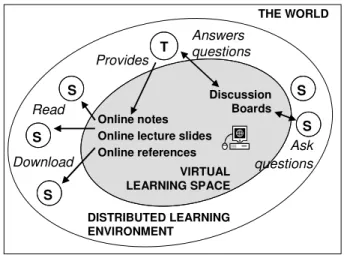
However, eLearning has not revolutionized pedagogic practices. For most lecturers, it involves the online provision of learning resources, to be downloaded by the student, and the answering of students’ questions, again a top-down approach to learning (Figure 2). Goodfellow and Lea (2007) observe that, with increasing student enrolments, eLearning focused on mass learning management. Because eLearning tools are good at delivering content more efficiently and to larger numbers of students, the transmission model of education was perpetuated (Martin & Webb, 2001). Like the lecture theatre, the online classroom is an artificial learning environment, separated from reality, with limited contextualization of knowledge usually offered. Kirkpatrick (2001) points out that the imposition of commercial learning management systems on academics introduced a lack of flexibility in educational approaches, and that conventional, teacher-centred attitudes acted against the exploration of the more interesting potentials of eLearning.
S Answers questions Ask questions Download Read Provides S S S VIRTUAL LEARNING SPACE Discussion Boards T Online notes Online references Online lecture slides
THE WORLD
DISTRIBUTED LEARNING ENVIRONMENT
S
Figure 2: Typical eLearning Implementation
Contributing to the entrenchment of traditional teaching practices was the lack of resources invested in adequate professional development for academics:
“Educators cannot be expected to complete their conventional full-time load (which is always an overload) and then develop innovative, provocative and appropriate web-based material. To construct evocative websites takes time as well as huge commitments of skill, design, expertise and knowledge.” (Brabazon, 2002, p. 68)
mLearning
As a “disruptive” new technology mobile devices have an interesting potential to support new learning and teaching practices. Here we examine three common implementations of mLearning in order to clarify the learning processes that are involved.
Lecture Podcasts
Many universities have gone down the route of wide-scale provision of podcasts to their students. This is probably the most common form of mLearning in use today (Nataatmadja & Dyson, 2008). There are three main ways in which podcasts can be deployed: as a substitute for lectures (either entirely or for students who miss a class), to provide supplementary learning materials or, the rarest use, for students to create podcasts themselves (McGarr, 2009). The main rationale behind podcasts, particularly of lectures and supplementary materials, is to remove the fixed boundaries of time and place and allow students convenient access to education.
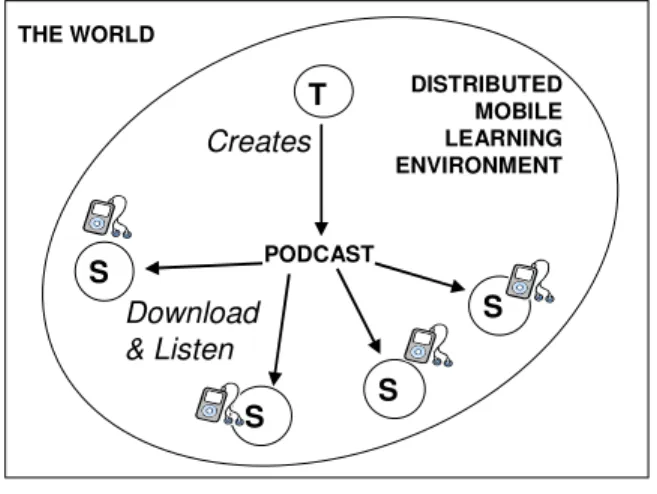
Setting to one side the arguments for supplementary and student-generated podcasts, it can be seen that podcasting lectures does not represent a real improvement in learning, even if it allows greater convenience for students. Conceptualizing lecture podcasts in diagrammatic form (Figure 3) arrives at a distributed learning model similar to eLearning without, however, the facility for students to ask questions. McGarr (2009) points out that both lecture podcasts, and much of supplementary podcasting, are reinforcing the worst aspects of the transmission model. This risks taking mobile learning into the realm of mass content delivery, like so much of eLearning before it. Download & Listen T S Creates PODCAST S S S THE WORLD DISTRIBUTED MOBILE LEARNING ENVIRONMENT
Figure 3: Lecture Podcast
Thus using mobile technology alone is insufficient to create a deep learning experience. Nor is learning which takes into account the mobility of the learner from formal classroom to informal contexts sufficient, despite the emphasis on these concepts in the mLearning theories of Sharples et al. (2005), Pachler et al. (2010) and Kearney et al. (2010). The affordance of iPods and other MP3 players, with their single set of earphones, is for individualized, private listening, not collaboration, so that providing students with podcasts leads to a one-way download rather than the creation of learning conversations and interactions. The learning, like that in traditional large lectures or with the provision of lecture slides online, is passive rather than the active, constructivist learning experience that will lead to deep learning. It remains a teacher-centred, not student-centred, educational approach. Interactive Classroom Systems
Interactive classroom systems entail the use of wireless technologies to engage students in lectures by inviting them to respond to questions or undertake other learning activities. The students are provided with immediate feedback, often in the form of bar graphs compiled by the system from the collated answers of the class. A variety of technologies have been developed for this purpose, including Personal Response Systems and clickers (or keypads), which students are normally issued with by their university; or systems which run off student-owned mobile phones and employ SMS or Internet communication (Draper & Brown, 2004; Scornavacca, 2009; Dyson, Litchfield, Lawrence, Raban, & Leijdekkers, 2009).
Draper and Brown (2004) were among the first to point out the type of learning that occurs when interactive classroom systems are put in place. For them, the use of these systems is “about having what individuals think and do affect what others consequently think and do” (Draper & Brown, 2004, p. 92). They postulate that the
interactivity provided by the system impacts not only on a student’s thinking and reflection, but also the teacher’s ability to adapt the material presented, which in turn lead to improvements in learning.
Dyson, Litchfield, Raban and Tyler (2009) went further by analyzing the learning interactions in terms of Kolb’s experiential learning theory. Kolb (1984) proposed a four-phase cycle of learning in which the learner undergoes a concrete experience, reflects on this experience, then abstracts concepts from their reflection and finally applies their new understanding to practice. By analyzing reflections recorded by a lecturer and students, Dyson Litchfield, Raban and Tyler (2009) demonstrated that both engage in experiential learning. This is facilitated by the mobile learning system and its ability to externalize a shared representation of the students’ group response to questions in class. The graph compiled from students’ responses opens a mutual window to understanding or, in Sharples’ (2003) terms, a basis for conversation. This conversation goes beyond a set of mere interactions and constitutes a series of transactions in that they represent exchanges of knowledge (Itin, 1999). Students enter into a transaction with their peers by contributing to the joint class response and then comparing their own answer with the combined response shown in the graph. The lecturer and students enter a complex series of interlocking transactions, beginning with the lecturer’s posting of the activity, the students’ response to this, and the learnings that begin with reflections on the displayed response. Through the lecturer’s learning, she or he is able to enhance the knowledge of the students by adding extra teaching material in the next lecture.
Figure 4 shows the interactive nature of this type of lecture. It contrasts with the traditional lecture (Figure 1). Enhanced by wireless technology, it is still a lecture in an artificial classroom setting, but there is a great deal more learning happening for both students and lecturer. Both reflect on the product which they have collaborated to produce – the graph of student responses to the lecturer’s question. These interactive systems recast an otherwise usually passive, teacher-centred instructional situation (where the lecturer talks and students listen) into a more active learning process. The mobile devices offer the affordance of communication which forms the basis of the interaction. LECTURE THEATRE T S Teaches, Interacts & Learns Listen, Interact & Learn S S S S THE WORLD UNIVERSITY
Figure 4: Interactive Classroom mLearning Student-Generated mLearning
An alternative to the lecturer producing content is for students to use mobile technology (camera phones, digital cameras, videocams, iPods, digital sound recorders) to make and share content with each other. There is a growing body of researchers who are interested in the power of this type of mLearning to engage learners and to lead to deeper learning (Hoban, 2010; Litchfield, et al., 2010; McLoughlin, Lee & Chan, 2006).
In one implementation, lecturers introduced a student-generated vodcast (video podcast) assignment into a large, core communications subject for first-year Information Technology (IT) and Business/IT university students (up to 356 students per semester) (Litchfield, et al., 2010). Following its first successful implementation in 2009, it has now become embedded in the subject. For the assignment, students work in teams of four to research an IT career, plan and video an interview with an IT professional, and edit the video to make a vodcast, which is shown as part of a class presentation about the career. The vodcasts are then made available to all students enrolled in the subject in both the current and subsequent semesters via the university’s learning management system.
The different dynamics of the student-generated vodcast, compared to both traditional classroom learning and eLearning, is depicted in Figure 5. Students are active learners, creating new knowledge, which is highly contextualized since the interviews take place in the workplace. The lecturer’s role is mainly to support, giving little help since students either know how to use the equipment already or like to work it out for themselves. Video fits within their experience of visual media and aligns with their own practice of recording videos on their mobile devices. The main assistance required is the provision of some video equipment, finding IT professionals to be interviewed and an optional 2-hour multimedia workshop. Frequently students use their own cameras and workplace contacts.
THE WORLD – MOBILE LEARNING SPACE
T Create, present & share Vodcasts S S S S Views CLASSROOM Supports Collaborate Interview S S S IT Professionals Record WORKPLACE
Figure 5: Student-Generated Vodcasts
The student-produced vodcasts combine several learning approaches – including mobile-supported fieldwork, experiential learning and peer learning – which have been identified in the literature as supporting deep learning and higher order thinking (Dyson, Litchfield, Lawrence et al., 2009; Litchfield et al., 2010; McLoughlin et al., 2006). Constructivist, situated and collaborative learning are all terms which can be validly applied to this activity. It is student centred, as the lecturer is largely absent. The affordance of mobile devices for multimedia recording creates the basis for learning conversations between students as they view each other’s vodcasts. The process of planning, researching, talking about, recording, editing and presenting the vodcasts allows the students to engage in deep learning consistent with Hoban and Nielsen’s (2010) semiotic chain.
The vodcast assignment’s learning objectives were to enhance students’ understandings of the various IT careers open to them and to improve their multimedia communication skills. Students’ perceptions of their learning outcomes, as evaluated using before and after surveys with Likert scales, indicated a high level of achievement. While only 29% of students on the beginning-of-semester survey agreed or strongly agreed that they were well-informed about IT career options, this grew to 70% of students with the end-of-semester survey. At the start of semester, 27% of students self-assessed that they had good or very good video recording skills, while at the end this had increased to 49%.
In addition, focus groups were conducted allowing students to express their opinions and then rank these. High motivation levels were demonstrated, with the first-ranked comment being “Unique assessment that was fun”. The second-ranked comment was that students appreciated “Developing presentation skills, teamwork and interviews”, all desirable professional graduate attributes. Ranked third was the comment “Opportunity to find out about different IT careers … real world perspective”, indicating that students appreciated being able to engage with a real life context.
This case study demonstrates how mLearning can reverse the didactic educational paradigm and create experiences which deeply engage students (Litchfield et al., 2010). Asking students to produce vodcasts challenges notions of literacy – traditionally conceived in the education system as reading and writing – to include digital, multimedia communication skills. This is a transformation long overdue (Davies, 2003).
Conclusion
Today, using mobile devices, students can be global producers, not just consumers, of multimedia content. University learning, mediated through and supported by mobile technologies, can be very different from both the traditional, didactic lecture and the typical use of eLearning for mass content delivery. Mobile devices create the possibility for active, student-centred learning in which students create their own knowledge, collaborate with peers and move into the world outside the university to learn in context. This occurs because of the mobility and affordances for interactivity and multimedia offered by mobile devices, which create the basis for shared learning conversations. In addition, mobile technology is an important aspect of our students’ lives and therefore of intrinsic interest to them. In the student-generated vodcast assignment, the students did not have to be taught to make or edit their videos, apart from being provided with an introductory workshop. Applications of mLearning such as this can be powerful triggers in helping students reflect and engage in deep learning.
The continuing use of the transmission model through lecture podcasting indicates that improving learner engagement cannot be taken for granted with mLearning practices. Significantly, student engagement is not sufficiently foregrounded in many of the current theories of mLearning. In fact, improving engagement needs to be at the heart of any useful mLearning theory. It is not sufficient to rely on students’ interest in mobile devices, even though this is a good beginning, forming as it does part of the lived reality of our students. MLearning must incorporate sound educational design principles and a theoretical underpinning which reinforces the need for learner engagement through active student-centred experiences.
It is hoped that this exploration of mLearning theory and practice will lead to the identification of principles and guidelines for a new pedagogy using mobile devices to actively engage our current generation of students. This work is important because of the rapid cultural, social and economic adoption of wireless technologies and multimedia mobile devices. The predominantly static text-media literacies of our established “industrial age” educational practices are being challenged by the rapidly emerging “information age” networked multimedia literacies of our students. Significant and under-theorized changes are happening in the ways humans think, know, learn, create, represent and communicate knowledge. A theory of active, student-centred mLearning can inform a new pedagogy to better address contemporary issues of learner engagement and educational relevance.
References
Brabazon, T. (2002). Digital hemlock: Internet education and the poisoning of teaching. Sydney: UNSW Press. Burns, C., & Myhill, D. (2004). Interactive or inactive? A consideration of the nature of interaction in whole class teaching. Cambridge Journal of Education, 34 (1), 35-49.
Davies, J.P. (2003). DOA: Education in the electronic age. Lanham, USA, & Oxford: Scarecrow Press.
Draper, S.W., & Brown, M.I. (2004). Increasing interactivity in lectures using an electronic voting system. Journal of Computer Assisted Learning, 20 (2), 81-94.
Dyson, L.E., Litchfield, A., Lawrence, E., Raban, R., & Leijdekkers, P. (2009). Advancing the mLearning research agenda for active, experiential learning: Four case studies. Australasian Journal of Educational Technology, 25 (2), 250-267.
Dyson, L.E., Litchfield, A., Raban, R., & Tyler. J. (2009). Interactive classroom mlearning and the experiential transactions between students and lecturer. Same places, different spaces: Proceedings Ascilite, Auckland, 233-242. Goodfellow, R., & Lea, M.R. (2007). Challenging e-learning in the university: A literacies perspective. Maidenhead, UK, & NY: McGraw-Hill.
Herrington, A, & Herrington, J. (2007). Authentic mobile learning in higher education. Australian Association for Research in Education (AARE) 2007Conference, Fremantle, 1-9.
Mobile learning in higher education. Wollongong: University of Wollongong.
Hoban, G. (2010). “Data dumping, after the test you forget it all”: Seeking deep approaches to science learning with slowmation (student-generated animations). Proceedings of the 16th UniServe Science Annual Conference, 2010,
Sept 29th – Oct 1st, Sydney, pp. 2-6.
Hoban, G., & Nielsen, W. (2010). The 5Rs: A new teaching approach to encourage slowmations of science concepts. Teaching Science, Sept.
Itin, C.M. (1999). Reasserting the philosophy of experiential education as a vehicle for change in the 21st Century.
Journal of Experiential Education, 22 (2), 91-98.
Kearney, M., Schuck, S., & Burden, K. (2010). Locating mobile learning in the third space. Proceedings of mLearn 2010,Malta, 108-115.
Kirkpatrick, D. (2001). Who owns the curriculum? In B. Brook & A. Gilding (Eds.), The ethics and equity of e-learning in higher education (pp. 41-47). Melbourne: Victoria University.
Kolb, D. (1984). Experiential learning: Experience as the source of learning & development. Englewood Cliffs: Prentice-Hall.
Kukulska-Hulme, A., & Traxler, J. (2005). Mobile learning: A Handbook for educators and trainers. London & New York: Routledge.
Lai, C.-H., Yang, J.-C., Chen, F.-C., Ho, C.-W., & Chan, T.-W. (2007). Affordances of mobile technology for experiential learning: The interplay of technology and pedagogical practices. Journal of Computer Assisted Learning, 23, 326-337.
Lave, J., & Wenger, E. (1991). Situated learning: Legitimate peripheral participation. Cambridge: Cambridge University Press.
Laurillard, D. (1993). Rethinking university teaching: A framework for the effective use of educational technology. London: Routledge.
Litchfield, A., Dyson, L.E., Wright, M., Pradhan, S., & Courtille, B. (2010). Student produced vodcasts as active meta-cognitive learning. ICALT, Tunisia, pp. 560-564.
McGarr, O. (2009). A review of podcasting in higher education: Its influence on the traditional lecture.
Australiasian Journal of Educational Technology, 25 (3), 309-321.
McLoughlin, C., Lee, M.J.W., & Chan, A. (2006). Fostering reflection and metacognition through student generated podcasts. ACEC, October 2-4, Cairns, 1-8.
Martin, E., & Webb, D. (2001). Is e-learning good learning? In B. Brook & A. Gilding (Eds.), The ethics and equity of e-learning in higher education (pp. 49-60). Melbourne: Victoria University.
Naismith, L., Lonsdale, P., Vavoula, G., & Sharples, M. (2004). literature review in mobile technologies and learning. Report 11. Bristol: Futurelab.
Nataatmadja, I., & Dyson. L.E. (2008). The role of podcasts in students’ learning. International Journal of Interactive Mobile Technologies, 2 (3), 17-21.
Oliver, R. (2007). Using mobile technologies to support learning in large on campus university classes. Proceedings ASCILITE Singapore 2007, 788-798.
Pask, A.G.S. (1976). Conversation theory: Applications in education and epistemology. Amsterdam & New York: Elsevier.
Scornavacca, E. (2009). A two-year analysis of students’ learning experience using interactive SMS in the classroom. International Conference on Mobile Business, Dalian, China, 110-114.
Sharples, M. (2003). Disruptive devices: Mobile technology for conversational learning. International Journal of Continuing Engineering Education and Lifelong Learning, 12 (5/6), 504-520.
Sharples, M., Taylor, J., & Vavoula, G. (2005). Towards a theory of mobile learning. Proceedings of the 4th World Conference on mLearning (mLearn 2005), Cape Town, South Africa, 1-8.
Sharples, M., Taylor, J., & Vavoula, G. (2007). A theory of learning for the mobile age. In R. Andrews & C. Haythornthwaite (Eds.), The SAGE handbook of e-learning research (pp. 221-247). London: SAGE.
Winters, N. (2006). What is mobile learning? In M. Sharples (Ed.), Big issues in mobile learning: Report of a workshop by the kaleidoscope network of excellence mobile learning initiative (pp. 7-11). Nottingham: LSRI, University of Nottingham.
Acknowledgements
The author acknowledges the contributions of Dr Ryszard Raban and Andrew Litchfield to a previous version of this paper.
![Figure 1: The Traditional Lecture [T – teacher; S – student]](https://thumb-us.123doks.com/thumbv2/123dok_us/11007961.2988201/3.918.319.652.652.901/figure-traditional-lecture-t-teacher-s-student.webp)