Social Media Usage Among Wine Tourism
DMOs
Filipa Jorge1,2(&) , Mário Sérgio Teixeira1,2 ,
Carlos Fonseca1,2 , Ricardo Jorge Correia2,4 ,
and Ramiro Gonçalves1,3
1 Universidade de Trás-Os-Montes e Alto Douro, UTAD, Vila Real, Portugal
2
Centro de Estudos Transdisciplinares para o Desenvolvimento, CETRAD, Vila Real, Portugal
3
Instituto de Engenharia de Sistemas e Computadores, Tecnologia e Ciência, INESC TEC, Porto, Portugal
4
Instituto Politécnico de Bragança, IPB, Bragança, Portugal
Abstract. Social media is an important tool for tourism destination promotion. The usage and the contents published on these platforms have an important role in visitors’ decision-making process. Information and communication tech-nologies are changing DMOs’markets and communication paradigm, since they allow the interaction between these organizations, visitors, and stakeholders. Therefore, social media are increasing their relevance on DMOs’ marketing strategies. This purpose of this study is to analyze comparatively social media platforms’usage by six wine tourism DMOs. The results were provided by the analysis of secondary data available on these platforms and DMOs posts on the four most popular social media platforms to tourism industry: Facebook, Instagram, Twitter, and YouTube. Results indicate that DMOs use their official accounts on these platforms on different ways. This study also reveals that Facebook is more interactive than other platforms, and YouTube achieves less engagement levels.
9.1
Introduction
Tourism sector is facing a technological revolution. The number of tourists booking online travels, accommodation, and other tourism products and services is increasing
and even for those who don’t buy online, at least they use Internet to search
infor-mation about destination [1, 2]. Social media platforms allow to share information
through the use of texts, images [3], but also short duration microfilms for tourism
destinations promotion [4]. These types of contents may be important to potential
visitors who are planning their travel, but also for visitors who already are in the
destination and these information may improve their tourism experience [3].
Destination Marketing Organizations (DMOs) have as mission the representation of
their destinations at the marketplace in order to attract more tourists [2]. According to
©Springer Nature Singapore Pte Ltd. 2020
Á. Rocha et al. (eds.),Marketing and Smart Technologies, Smart Innovation, Systems and Technologies 167,https://doi.org/10.1007/978-981-15-1564-4_9
[5], DMOs have several responsibilities concerning the development of the destination. The roles more mentioned for these organizations are the marketing strategies for-mulation, which includes promotion activities, and the communication between tour-ism stakeholders from the destination. To DMOs activities, social media platforms may
act as a powerful and low-cost way to overcome this challenge [6]. For [2], the use of
technologies by DMOS can be an opportunity and also another challenge.
Even though there is a growing interest in social media usage in tourism industry and the existence of empirical evidences that support the strategical importance of these platforms to achieve a better competitiveness of this industry, there are few exploratory researches that are focused on the social media platforms usage by DMOs as was
indicated by [6] and [7]. Although this research is also motivated by the future
investigation recommendation of [8], which is to analyze the social media use by
DMOs of emerging destinations.
This research has the purpose to analyze comparatively the usage of four social media platforms (Facebook, Instagram, Twitter, and YouTube) by six DMOs that promote small wine tourism destinations. The present study aims to contribute to
scientific discussion that are concerned about the use of different social media platforms
to tourism destinations’ promotion. Besides, it is also expected to yield some good
practices to destination marketers who are interested in social media marketing.
The present article is divided into five sections. In this section, the social media
thematic on tourism was introduced. In the following section, relevant literature toward this mentioned theme will be exposed. The third section will describe the methodology used to accomplish this study objective. In the fourth section, the results will be
presented. Lastly, in thefifth section, the principal conclusions and contributions of this
research, and the limitations and suggestions for future studies will be enunciated.
9.2
Literature Review
Social media marketing should be part of a more holistic strategy. According to [9],
social media marketing has as objectives: improving sales, increase brand awareness, improve brand image and brand awareness, reduce marketing costs, and promote user interactivity on social media platforms. Social media platforms also provide an opportunity for organizations to try to understand how their consumers view their actions and organization.
Tourism is a very competitive industry, and destinations compete to attract more visitors. Internet has changed the way that potential visitors access information, the way they plan and book tourism products, and allows them to share contents about the
destination [10]. Previous researches have revealed that digital channels have a
sig-nificant impact in tourism sector since tourists use them to have information about the
destinations [11]. For that reason, Internet presents itself as a growing promotional
channel for tourism industry because it is cheaper and more efficient than traditional
marketing tools [6].
Tourism industry is very intensive in information [12]. This explains that tourists’
decision-making process is highly influenced by the information expressed on social
plays a vital role in tourists’decision-making [12]. The use of social media platforms
by tourists is changing this sector and the way how tourists research andfind
infor-mation, because these platforms provide the collaborative production of information
about tourism destinations and organizations [15].
Social media can be extremely useful for tourism stakeholders, since they represent
an information source, which allow them to understand tourists’preferences and how
to respond [16].
Therefore, DMOs should engage with their tourists, which means that DMOs should encourage them to share images, videos, and other contents about the
desti-nation in order to influence other potential tourists [17].
Some studies indicate that DMOS are not using the total potential of social media, since most of DMOs are only using these platforms as promotional tool and not using them to mitigate potential customer services problems or as a co-creation place, which
will allow them to gain competitiveness [6,8,18].
9.3
Methodology
The previous research was focused on the social media use by national DMOs. Nev-ertheless, this research will be dedicated to emerging wine tourism destinations. In order to have similar destinations, it was selected from Forbes (2018) list of the ten most beautiful wine tourism destinations: Douro Valley (Portugal), Franschhoek (South Africa), Saint Emilion (France), Valle de Guadalupe (Mexico), Barossa Valley
(Aus-tralia), Piedmont (Italy), Napa Valley, (USA), Hawke’s Bay (New Zealand), Moselle
Valley (Germany), and La Rioja (Spain) [19].
From these ten wine tourism destinations, we selected six to use as sample. The information about the DMOs responsible for these six wine tourism destinations are
expressed in Table9.1. Almost all DMOs’ websites are focused on a wine tourism
destination, with exception of Douro Valley. This DMO is responsible for the pro-motion of this wine tourism destination but also for a more extensive region denom-inated Porto and North of Portugal. Besides, two of these six wine tourism destinations,
explicitly Douro and Saint Emilion are classified as world heritage by UNESCO [20].
Data collection was done in October 2018 on social media official pages of these
six DMOs in four social media platforms: Facebook, Instagram, YouTube, and Twitter. These social media platforms were chosen for two reasons: these social media were
considered important for tourism sector [12], [17], and all the selected DMOs have an
official page in these social media, which allows a better comparison. Having into
consideration that social media platforms have several publications by day, this research limits the period of observations to 3 months (July to September 2018).
9.4
Results
Results are presented in tables below and they are discussed in order to afford a comparative analysis.
This research follows the recommendation of [8] to describe the audience of each
Table 9.1. Destinations, DMOs, and social media platforms used as sample
Wine Tourism Destinations
DMOs Facebook page Instagram username Twitter username YouTube page Douro Valley Turismo do Porto e Norte de Portugal facebook. com/TurismoPortoNortePortugal @turismo_portoenorte @PortoeNortePT youtube. com/channel/UCdBiRW6kEaFKplpd4JXW5IA La Rioja La Rioja Turismo facebook.com/turismodelarioja @lariojaturismo @lariojaturismo youtube.com/user/Tierraconombredevino Saint Emilion Saint Emilion Tourisme facebook. com/saintemiliontourisme/ @mysaintemilion @saint_emilion youtube. com/channel/UCZrUIiNm4xg_g1tranZY1_w Napa Valley Visit Napa Valley facebook.com/VisitNapaValley @visitnapavalley @VisitNapaValley youtube.com/user/VisitNapaValley Franschhoek Franschhoek Wine Valley facebook. com/Franschhoekwinevalley @franschhoek_sa @Franschhoek_SA youtube. com/channel/UCcy6piUBEN8tpiYjmLreFng Barossa Valley Tourism Barossa facebook.com/BarossaWines/ @barossawines @BarossaWineAu youtube.com/user/barossadirt
platform audience can be measured by the number of followers on Twitter and Instagram, the number of likes on the Facebook page, and by the total number of views
on YouTube. This information is summarized in Table9.2.
Considering the total audience of the six DMOs, YouTube is the social media platform that has more audience, followed by Facebook, Instagram and, lastly, Twitter. However, it is important to have into consideration that one user may view a video several times, but users cannot follow or like a same page twice. As positive indicators related with the audience size: La Rioja DMO has the highest number of total views in YouTube, and more followers on Twitter; Douro Valley DMO has the most likes on
their Facebook official page; Napa Valley DMO has the highest number of followers on
Instagram. In the negative side, Saint Emilion is the DMO with less audience in Instagram, YouTube, and Twitter; in Facebook, Barossa Valley DMO has lesser audience.
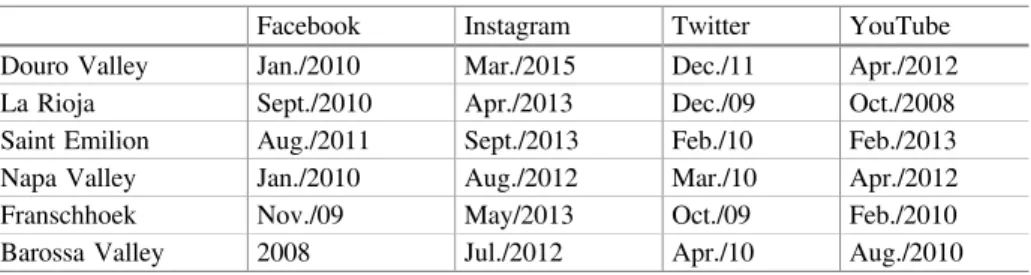
In Table9.3, the date on which each DMO has created its official account in the
four social media platforms is reported. This information is important to identify the early adopters for all the four platforms.
Table 9.2. Social media audience for each DMO Facebook page likes Instagram followers Twitter followers YouTube views Douro Valley 151,644 5,325 5,336 54,262 La Rioja 32,917 8,146 47,000 2,123,721 Saint Emilion 11,981 4,195 2,256 25,936 Napa Valley 147,274 76,500 28,700 1,791,685 Franschhoek 18,930 21,900 9,760 31,235 Barossa Valley 6,751 15,500 18,800 27,846 Total 369,497 131,566 111,852 4,054,685
Table 9.3. Membership dates of the DMOs for each social media platform Facebook Instagram Twitter YouTube Douro Valley Jan./2010 Mar./2015 Dec./11 Apr./2012 La Rioja Sept./2010 Apr./2013 Dec./09 Oct./2008 Saint Emilion Aug./2011 Sept./2013 Feb./10 Feb./2013 Napa Valley Jan./2010 Aug./2012 Mar./10 Apr./2012 Franschhoek Nov./09 May/2013 Oct./09 Feb./2010 Barossa Valley 2008 Jul./2012 Apr./10 Aug./2010
Barossa Valley DMO emerges as early adopter on Facebook and Instagram. La
Rioja DMO was thefirst to have an official account on YouTube. On Twitter,
Fran-schhoek DMO was the earliest to develop an account on this social media platform. Saint Emilion was the last DMO to join Facebook and YouTube and Douro
Val-ley DMO was the last to create an official account on Instagram and Twitter.
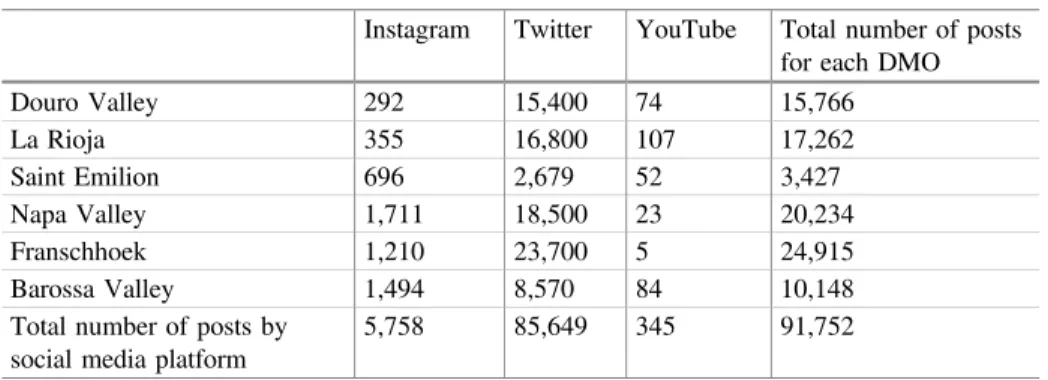
In the table below (Table9.4) are presented the total number of posts that each
DMO has published in Instagram and Twitter, and the total number of videos uploaded
in YouTube on their official account. In this table, no data concerning to Facebook are
expressed, since this social media platform does not make this information available to
the users who view the profiles, unlike with the other three social media platforms
(Instagram, YouTube, and Twitter).
Twitter is the social media platform where DMOs post more, followed by Insta-gram and, last of all, YouTube. One of the reasons for YouTube to appear as the social media with the least posts is because this platform is orientated toward uploading videos, and this type of content consumes more time and money than others types of contents used on the others platforms like Twitter or Instagram. Besides, different DMOs lead total posts for each social media platform. In Instagram, Napa Valley is the DMO with the highest number of posts. In Twitter, it is Franschhoek DMO who posts more. In YouTube, it is La Rioja DMO who uploads more videos.
In the following table (Table9.5), the data collected about DMOs’activity on the
four social media platforms is presented. As indicators of this activity, the number of posts made in the 3 months selected and the interactivity generated by these posts were used. The number of posts made during the 3 months was considered every post made or shared by the DMOs. Besides, a number of interactions from these posts, i.e., every likes, comments, shares, and views (in the case of videos) were considered. For social media platform, Twitter, the data was not collected for the number of interactions.
Similarly to the total number of posts, also in the period analyzed, YouTube was the social media platform less used to make publications. In fact, only La Rioja and Saint Emilion DMOs have published videos in this platform during these 3 months. Furthermore, during this period, La Rioja DMO was the one that made more posts on Facebook, YouTube, and Twitter. Napa Valley DMO was the one who posted more on
Table 9.4. Total number of posts for each DMO
Instagram Twitter YouTube Total number of posts for each DMO
Douro Valley 292 15,400 74 15,766 La Rioja 355 16,800 107 17,262 Saint Emilion 696 2,679 52 3,427 Napa Valley 1,711 18,500 23 20,234 Franschhoek 1,210 23,700 5 24,915 Barossa Valley 1,494 8,570 84 10,148
Total number of posts by social media platform
Table 9.5. Social media activity Facebook Instagram Twitter YouTube Posts in 3 months Interactions Posts in 3 months Interactions Posts in 3 months Posts in 3 months Interactions Douro Valley 12 15,827 0 0 8 0 0 La Rioja 291 294,309 28 17,479 >732 11 340,738 Saint Emilion 60 18,373 57 11,270 128 4 622 Napa Valley 146 8,076,312 119 106,168 363 0 0 Franschhoek 284 211,679 96 27,629 557 0 0 Barossa Valley 75 9,466 88 14,767 0 0 0
Instagram. It is important to note that although Napa Valley is not the one who makes the most posts, this DMO is the one who achieved more interactivity in Facebook and Instagram. This may indicate that this DMO strategy focuses more on the quality than the quantity of their posts and seems to have success because it has more user inter-action than other DMOs with more posts.
9.5
Final Considerations
Results indicate that wine tourism DMOs are using social media platforms to promote their destinations. With regard to Facebook data, there are several facts that justify to be
highlighted. Thefirst DMO to join this social network was Barossa Valley, but is the
one that has the least followers. Besides, Napa Valley DMO has less followers than Douro Valley DMO, but have converted more of these followers into interactions. This best result may be explained by the fact that the Napa Valley DMO performs a larger number of posts compared to Douro Valley DMO.
In Instagram, all DMOs have lower number of followers than in the previous social media platform, what can be explained by this social network be more recent. Napa Valley DMO has the highest number of followers, more posts in the periods analyzed, as well as more interactions. On opposing, Douro Valley DMO was the least active in Instagram, since it did not perform any post in the 3 months analyzed and published fewer posts when we look all posts.
In YouTube, thefirst DMO to create an official page on this social network was La
Rioja, and is also the one that has published more videos in total and in the period analyzed and who has more visualizations. In the opposite, Saint Emilion DMO is the last to join the YouTube. However, this last DMO and La Rioja DMO were the only ones that uploaded videos during the analyzed period. Although, Napa Valley DMO has far more views than most DMOs with more videos, which may indicate that despite publishing fewer videos, they are often viewed.
Concerning to Twitter, thefirst DMOs to create a page on this social media were
Franschhoek and La Rioja. The last DMO has the better performance, which means that has more publications in the total and in the analyzed period and has a higher number of followers. Further, during the analyzed period, Barossa Valley DMO did not post any publication, and, similarly, Douro Valley DMO only performed eight posts. This seems to indicate a disinvestment in this particular social media by these DMOs. On other hand, Saint Emilion DMO has a lower total number of posts and a lower number of followers than these two DMOs, but performed more posts in the analyzed period, which may indicate that they are investing more on this social media platform. This research contributes to the discussion about the social media usage by DMOs, with the innovation of being applied to wine tourism destinations. For these organi-zations, the results obtained leave some information to allow them to improve their effective communication using the most relevant social media platforms associated to tourism promotion.
The present research has several limitations that should be outpaced in future
research. Thefirst limitation is the sample used, since it should have a larger size, what
available on the social media platforms. Hence, future studies may use primary data,
such as interviews with DMOs’marketers may be interesting to have a better
under-standing of social media marketing strategies that can explain the data collected. Third, the present research only analyzes the social media platforms. Thus, it is proposed that future research analyzes other digital marketing tools, such as websites, that will allow
gaining a better understanding of DMOs’marketing strategies.
Acknowledgements. This research was funded by European Regional Development Fund (FEDER) through NORTE 2020, operation number NORTE-01–0145-FEDER-000014.
References
1. Castañeda, J.A., Frías, D.M., Rodríguez, M.A.: Antecedents of internet acceptance and use as an information source by tourists. Online Inf. Rev.33(3), 548–567 (2009)
2. Li, S.C.H., Robinson, P., Oriade, A.: Destination marketing: the use of technology since the millennium. J. Destin. Mark. Manag.6(2), 95–102 (2017)
3. Roque, V., Raposo, R.: Social media as a communication and marketing tool in tourism: an analysis of online activities from international key player DMO. Anatolia 27(1), 58–70 (2016)
4. Shao, J., Li, X., Morrison, A.M., Wu, B.: Social media micro-film marketing by Chinese destinations: the case of Shaoxing. Tour. Manag.54, 439–451 (2016)
5. Wang, Y.C.: Destination marketing and management: scope, definition and structures. In: Wang, Y., Pizam, A. (eds.) Destination Marketing and Management: Theories and Applications, pp. 1–20. CABI, Wallingford
6. Uşaklı, A., Koç, B., Sönmez, S.: How‘social’are destinations? Examining European DMO social media usage. J. Destin. Mark. Manag.6(2), 136–149 (2017)
7. Leung, D., Law, R., van Hoof, H., Buhalis, D.: Social media in tourism and hospitality: a literature review. J. Travel Tour. Mark.30(1–2), 3–22 (2013)
8. Uşaklı, A., Koç, B., Sönmez, S.: Social media usage among top European DMOs. In: Kozak, N., Kozak, M. (eds.) Tourist Destination Management. Tourism, Hospitality & Event Management, pp. 1–14. Springer, Cham (2019)
9. Felix, R., Rauschnabel, P.A., Hinsch, C.: Elements of strategic social media marketing: a holistic framework. J. Bus. Res.70, 118–126 (2017)
10. Mariani, M.M., Di Felice, M., Mura, M.: Facebook as a destination marketing tool: evidence from Italian regional destination management organizations. Tour. Manag. 54, 321–343 (2016)
11. Buhalis, D., Law, R.: Progress in information technology and tourism management: 20 years on and 10 years after the Internet-the state of eTourism research. Tour. Manag.29(4), 609– 623 (2008)
12. Hays, S., Page, S.J., Buhalis, D.: Social media as a destination marketing tool: its use by national tourism organisations. Curr. Issues Tour.16(3), 211–239 (2013)
13. Filieri, R., Alguezaui, S., McLeay, F.: Why do travelers trust TripAdvisor? Antecedents of trust towards consumer-generated media and its influence on recommendation adoption and word of mouth. Tour. Manag.51, 174–185 (2015)
14. Reza Jalilvand, M., Samiei, N.: The impact of electronic word of mouth on a tourism destination choice. Internet Res.22(5), 591–612 (2012)
15. Zeng, B., Gerritsen, R.: What do we know about social media in tourism? A review. Tour. Manag. Perspect.10, 27–36 (2014)
16. Dellarocas, C.: The digitization of word of mouth: promise and challenges of online feedback mechanisms. Manag. Sci.49(10), 1407–1424 (2003)
17. Molinillo, S., Liébana-Cabanillas, F., Anaya-Sánchez, R., Buhalis, D.: DMO online platforms: Image and intention to visit. Tour. Manag.65, 116–130 (2018)
18. Lalicic, L., Huertas, A., Moreno, A., Jabreel, M.: Emotional brand communication on Facebook and Twitter : are DMOs successful ? J. Destin. Mark. Manag. 1–11 (2019) 19. Forbes: 10 beautiful travel destinations for wine lovers.Forbes(2018)