Labour Force Data Analysis:
Guidelines with African Specificities
2012
This report was prepared by the Statistical Capacity Building Division of the Statistics Department, in the Office of the Chief Economist at the African Development Bank. The findings reflect the opinions of the authors and not necessarily those of the African Development Bank or its Board of Directors. Every effort has been made to include inputs by labour practitioners from a number of national statistical offices who participated in various labour statistics workshops and seminars.
Statistical Capacity Building Division Statistics Department
African Development Bank Temporary Relocation Agency BP 323, 1002 Tunis, Belvédère Tunis, Tunisia Tel.: (216) 71 10 36 54 Fax: (216) 71 10 37 43 E-mail: [email protected] Website: www.afdb.org
Copyright © 2012 African Development Bank
Design/layout by Phoenix Design Aid AS/Denmark. ISO 14001/ISO 900 Certified and approved CO2 Company.
Labour Force Data Analysis:
Table of contents
Preface IV
Acknowledgements V
List of figures VI
List of tables VII
Acronyms and abbreviations VIII
Part I: Measurement of the EAP 1
1. Introduction 2
2. The EAP 5
3. The current EAP (or labour force) 9
4. The employed population 11
5. The unemployed population 14
6. Population outside the labour force 16
7. Employment in the informal sector and informal employment 17
8. Working time measurement 20
9. Measures of underutilised labour 21
10. Measurement of long-term employment situation (usual activity) 25
Annex
III
Part II: Analysis of labour force data 35
11. Introduction 36
12. Descriptive analysis of survey variables 36
13. Analysis of supply and demand of labour 51
14. Size and composition of the population 52
15. Labour force participation of men and women 55
16. Employment-population ratio 60
17. Unemployment and its duration 63
18. Youth and school-to-work transition 67
19. Hours of work, underemployment and labour slack 71 20. Branch of economic activity and productivity 75
21. Occupational structure and segregation 78
22. SE and informal employment 81
23. Income from employment and earnings differential 83
24. Low pay and working poor 86
Part III: Quality assessment of labour force survey data 91
25. Coherence and comparability of survey estimates 92 26. Sampling errors and precision of estimates 97 27. Non-sampling errors and weights adjustment 102
preface
Labour statistics are an important element in the measurement of economic growth and development and yet the data required to provide evidence-based decision making are scanty or non-existent. Within the implementation framework of its Statistical Capacity Building Program II, the African Development Bank (AfDB) in consultation with its regional member countries identified the lack of expertise in data analysis of labour force surveys as a major drawback in the production of labour force statistics in many countries. As a result, the data collected are not properly or fully analysed, even sometimes not analysed at all. This is due to a variety of reasons related to decisions and activities both before actual data collection and sub-sequent to it. Amongst these are questions relating to questionnaire design, field work, preparation of the collected data for analysis and the analysis itself. In an effort to address these issues, the AfDB decided to commission this guidebook so that statisticians in Africa will have a practical guide when analysing statistics on the labour force and users of these statistics will benefit from an introduction to methods for their analysis. The guidebook is in three parts, introducing the relevant concepts and definitions for labour force statistics, analysis of labour force data and quality assessment of labour force surveys.
Part I deals with the concepts and definitions of the economically active population (EAP); the current
EAP (i.e. the labour force); employment and unemployment statistics; working time statistics; time-relat-ed underemployment and inadequate employment; labour under-utilisation; employment in the infor-mal sector and inforinfor-mal employment; and the usual EAP. It also introduces the various uses and sources of these statistics. In addition, it reflects developments that have taken place since the publication of the manual of the International Labour Organization (ILO) on the EAP in 1990.1Part II
presents methods for analysing data from labour force surveys, from descriptive analysis used in the production of a survey report to analysis of labour force structures and trends that are particularly useful in analytical studies. The former describes approaches to understanding and using tables, diagrams and related statistics to write survey reports. The latter sections introduce key indicators of the labour market and their uses. Areas covered include the supply and demand of labour; the size and composi-tion of the populacomposi-tion; labour force participacomposi-tion of men and women; the employment-populacomposi-tion ratio; unemployment and its duration; youth and school-to-work transition; hours of work; underemployment and labour slack; branches of economic activity and productivity; occupational structure and segregation; status in employment (SE) and informal employment; income from employment and earning differen-tials; and low pay and the working poor.Part III
discusses methods for assessing the quality of a labour force survey in terms of (a) the
coher-ence and comparability of the statistics produced from it both internally and externally in comparison with other sources; and (b) the identification and estimation of both sampling and non-sampling errors associated with the survey.This guidebook is directed at labour statistics practitioners in national statistics offices and policy analysts in development, economic and labour ministries, as well as those in central banks.
Mthuli Ncube
Chief Economist and Vice President
2 Hussmanns, R., Mehran, F., Verma, V. (1990): Surveys of economically active population, employment, unemployment and underemployment, ILO Geneva.
V
Acknowledgments
This book was prepared by a team headed by Oliver J.M. Chinganya (Head of the Statistical Capac-ity Building Division, Statistics Department). Other core members of the team included Besa Mu-wele (Senior Statistician, Statistical Capacity Building Division, Statistics Department), and Abim-bola Sylvester Young and Farhad Mehran (consultants), both of whom are former directors of the Bureau of Statistics of the International Labour Office.
The Guide Book was prepared under the close and direct supervision of Charles L. Lufumpa (Direc-tor, Statistics Department of the AfDB), under the overall guidance of Mthuli Ncube (Chief Econo-mist and Vice President of the AfDB).
The preparation process benefited from the inputs of various labour practitioners in a number of national statistical offices who participated in various workshops and seminars.
List of figures
Part I
Figure 1. Labour statistics: Bridge between economic and social statistics Figure 2. Labour force surveys: Advantages and limitations
Figure 3. Establishment surveys: Advantages and limitations Figure 4. Administrative records: Advantages and limitations Figure 5. Productive and non-productive activities
Figure 6. Labour force framework
Figure 7. International definition of employment Figure 8. Usually active measurement framework
Part II
Figure 1. Employment by industry
Figure 2. Histogram and density curve of an income distribution (artificial data) Figure 3. Conditional distributions of occupation given SE (US, 2006)
Figure 4. Scatter diagram of variables X and Y (artificial data) Figure 5. Supply and demand of labour
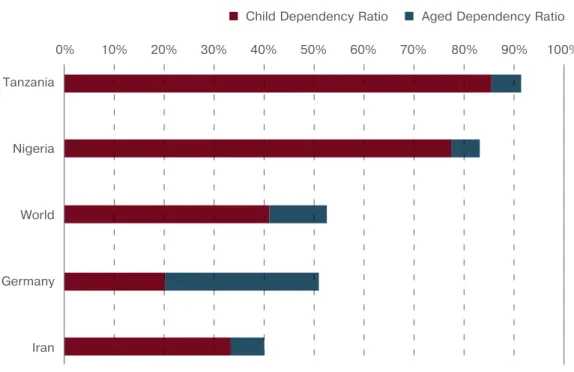
Figure 6. Tanzania age pyramid 2010 Figure 7. Population age pyramids, 2010 Figure 8. Dependency ratios (2010)
Figure 9. Labour force participation rate (World, 2010)
Figure 10. Labour force participation rate, Tanzania (Zanzibar), 2008 Figure 11. Labour force participation rate, USA March 2006
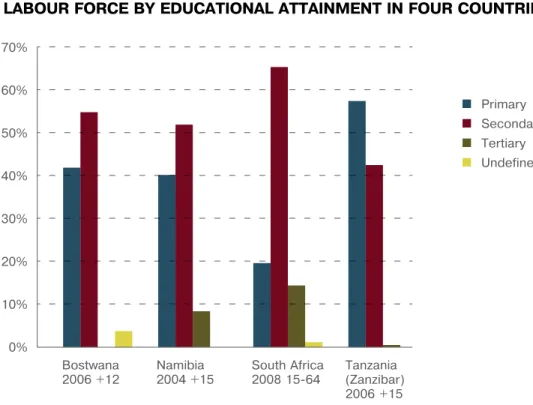
Figure 12. Labour force participation rate of men and women by educational attainment Figure 13. Labour force by educational attainment in four countries
Figure 14. Female labour force participation rate by marital status Figure 15. Unemployment rate by age group
Figure 16. Youth versus national unemployment rate
Figure 17. Percentage number of unemployed persons by duration of unemployment Figure 18. School leavers: academic year 2004-2005 (An illustration)
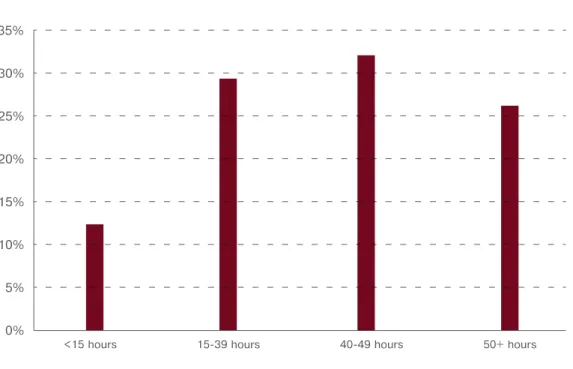
Figure 19. Youth school-to-work transition: An illustration with labour force survey data Figure 20. Relative number of employed persons by hours usually worked per week at all jobs Figure 21. Rate of time-related underemployment in seven countries
Figure 22. Correspondence of International Standard Classifications of All Economic Activities (ISIC Rev 3.1 and ISIC Rev 4)
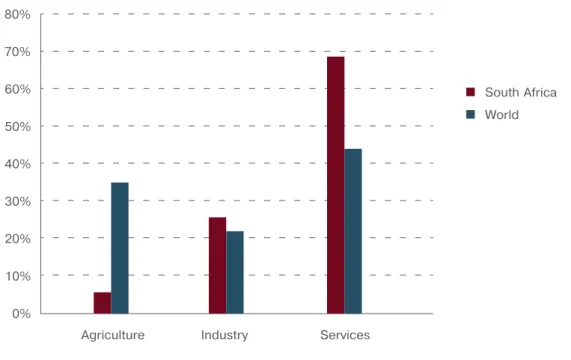
Figure 23. Employment by branch of economic activity, South Africa (2008) Figure 24. Labour productivity in selected branches of economic activity Figure 25. SE in main job in two countries
Figure 26. Average monthly earnings by level of educational attainment Figure 27. Average monthly earnings by age group
Figure 28. Definitions of working poor
Figure 29. Profile of working poor by age group (USA 2004)
Part III
Figure 1. Coherence of employment and output trends Figure 2. Sampling distribution of unemployment estimates
VII
List of tables
Part II
Table 1. Employment by industry (South Africa, First Quarter 2008)
Table 2. Age distribution by labour force status (South Africa, First Quarter 2008) Table 3. Summary statistics of age distribution by labour force status (South Africa,
First Quarter 2008) Table 4. Employment by industry
Table 5. Employed population by occupation and SE
Table 6. Conditional distributions of SE given occupation (US, 2006) Table 7. Conditional distributions of occupation given SE (US, 2006)
Table 8. Summary statistics for conditional distributions of income by industrial sector Table 9. Conditional distributions of occupation given SE and sex
Table 10. Conditional distributions of occupation given SE and year
Table 11. Summary statistics for conditional distributions of income by industry and sex Table 12. Calculation of the core employment-population ratio
Table 13. Age at employment and at retirement Table 14. Calculation of the unemployment rate
Table 15. Ratio of youth to national unemployment rate Table 16. School-to-work transition matrix
Table 17. Short and long hours of work
Table 18. Alternative rates of labour slack in seven countries
Table 19. Occupational segregation among young men and women in three countries Table 20. Education and occupation mismatch in terms of ISCO and ISCED
Table 21. Informal employment in three countries
Table 22. Average reported monthly earnings (USD 2007) in main job among men and women Table 23. Estimated parameters of the earnings function
Table 24. Low earnings in seven countries
Part III
Table 1. Reconciliation of employment data: Labour force survey and National Accounts Table 2. Reconciliation table: Number of employed persons in manufacturing establishments
with 50 or more workers
Table 3. Reconciliation table: Unemployed persons seeking work at public or related employ-ment offices
Table 4. Sampling errors of main labour force indicators: A numerical example Table 5. Relative standard error by size of estimate
Acronyms and abbreviations
AfDB African Development BankCV Coefficient of Variation
EAP Economically Active Population
ICSE International Standard Classification of Status in Employment ICLS International Conference of Labour Statisticians
ILO International Labour Organization
ILO WG Working Group on the Advancement of Employment and Unemployment Statistics of the ILO
ISCED International Standard Classification of Education ISCO International Standard Classification of Occupations
ISIC International Standard Industrial Classification of All Economic Activities KILM Key Indicators of the Labour Market
LFPR Labour Force Participation Rate PSU Primary Sampling Unit
SE Status in Employment SNA System of National Accounts UN United Nations
UNSD United Nations Statistics Division US United States of America
1
Part I
Measurement of the EAP
1. Introduction 2. The EAP
3. The current EAP (or labour force) 4. The employed population
5. The unemployed population
6. Population outside the labour force
7. Employment in the informal sector and informal employment
8. Working time measurement 9. Measures of underutilised labour
10. Measurement of long-term employment situation (usual activity)
Annex
Figure 1
LAbour stAtistics: bridgE bEtwEEn EconoMic And sociAL stAtistics
Production statistics – SNA (Labour productivity) Price statistics - CPI (Real wages) Population statistics Health statistics (Occupational injuries and diseases) Education statistics (School leavers) Economic statistics Labour statistics Social statistics
Labour, main factor of production in economic statistics
Labour, as workers, part of population and social statistics*
* Also: Household income statistics (Income from work main determinant of household income); Time-use statistics (Hours of work main element of time-use).
1. Introduction
1.1 usEs
Statistics on the EAP and its components, in-cluding indicators derived from them, have both economic and social uses (see Figure 1). They are used to describe and analyse the supply of labour (a) towards the formulation, implemen-tation and monitoring of macro-economic and micro-economic policies and programmes and (b) in human resource development planning. These statistics provide measures of the supply side of the labour market such as the size and characteristics of the EAP, of labour input into production, of the structure and conditions of employment, and of the extent of utilisation of available labour resources (volume and per-sons). They include statistics on:
a.
The EAP, including the size of its compo-nents (employment, unemployment and not economically active) and its socio-demographic characteristics, such as age, sex, geographical location, educational at-tainment, residency, and race (where ap-plicable);b.
The characteristics of the employed popu-lation as measured through their various jobs, including their occupation, industry, SE, institutional sector, working condi-tions (such as employment income, work-ing time, job security and safety, trainwork-ing, participation in decision making), as well as employment in the informal sector and informal employment;c.
The characteristics of the unemployed population including duration of unem-ployment, job search methods, access to social benefits, and the characteristics of previous jobs they may have had; andd.
The characteristics of those not economi-cally active, including their reasons for not being active and the extent of their labour market attachment, as well as characteris-tics of previous jobs they may have had. NB: the above terms are as defined in various resolutions and guidelines of the International Conference of Labour Statisticians (ICLS). The analysis of these statistics over time provides a basis for monitoring trends in the economy and the employment situation. For example, the unemployment rate is widely used3
Figure 2
LAbour forcE survEys: AdvAntAgEs And LiMitAtions AdvAntAgEs
›
Comprehensive coverage›
Independent measurement in line with international standards›
Joint data on employment, unemployment and economic inactivity›
Possibility of other data on labour slack, etc.LiMitAtions
›
Relatively costly, especially if conducted with high frequency›
Subject to sampling and response errors›
Requires statistical infrastructure›
Limited geographic and other disaggregations2 See United Nations & ILO (2009) for additional information on the uses of these statistics.
3 See Pember, R.J. & H. Djerma (2005): Development of labour statistics system, Bulletin of Labour Statistics, Vol. 1, ILO Geneva for full discussion of these merits.
in developed economies to assess the current performance of the economy. These statistics along with labour demand statistics (such as filled jobs, vacancies, labour costs, compensa-tion and training needs) and contextual statistics (such as economic growth, investment, popula-tion growth and skills training) are essential in the analysis of the labour market. Also, when used in conjunction with other relevant statis-tics, they are useful in understanding other eco-nomic phenomena and evaluating corresponding policies, such as the possible impact of a specific fiscal policy on employment.
Statistics on the EAP and its components play a key role in the design and evaluation of govern-ment socio-economic policies and programmes relating to welfare, migration, education and health, including income maintenance, poverty, social exclusion, job creation, vocational train-ing and so on. The analysis of statistics on em-ployment, income and other socio-economic variables provides information on the income-generating capacity of different economic activi-ties, the extent to which there is decent work, the adequacy of employment income for welfare objectives, the existence of group inequalities in access to employment opportunities and so on.2
1.2 sourcEs
The best source for these statistics is labour force surveys. Other household surveys and popula-tion censuses could also be used. Statistics on employment are available from establishment/ enterprise surveys and censuses as well as from administrative systems such as social security records, tax records, and public-sector payrolls. Unemployment statistics are obtainable from records of employment agencies on registered jobseekers and from those of social security/ benefits schemes on recipients of unemploy-ment benefits. These sources all have their rela-tive merits3 (see Figures 2, 3 and 4). They may be used together to obtain a comprehensive picture of the employment situation and to mutually improve the quality of their data. It should be noted that they could genuinely produce differ-ent estimates for the same phenomenon, for ex-ample, different estimates of employment from a labour force survey and from an establishment survey.
It is important to appreciate that statistics on the EAP and its components, on their own, cannot respond to questions on all the above issues. They can only do so in tandem with other relevant statistics. For example, in order to properly assess labour productivity, statistics are required on production as well as on labour
Figure 4
AdMinistrAtivE rEcords: AdvAntAgEs And LiMitAtions
Figure 3
EstAbLishMEnt survEys: AdvAntAgEs And LiMitAtions
input. Also, for analysis of the working poor, statistics are required on the employment and poverty situation of each person. Moreover, challenges relating to coverage, concepts, defi-nitions, classifications, units, and so on could have a bearing on the combination or use of statistics from different sources. Producers and users of these statistics should therefore be aware of the issues raised in this sub-section.
1.3 intErnAtionAL stAndArds
As always, the production of statistics on a phenomenon of interest requires clarity and uniqueness in its concepts and definitions. In the case of the EAP, international standards on its concepts and definitions have been
es-tablished through various resolutions and guidelines of the ICLS of the ILO. The main one is the Resolution concerning statistics of the economically active population, employ-ment, unemployment and underemployment
adopted by the 13th ICLS in 1982 (hereinafter referred to as the 13th ICLS Resolution). It has been amplified by the Guidelines on the impli-cations of employment promotion schemes on the measurement of employment and unemploy-ment adopted by the 14th ICLS (1987); Guidelines
concerning the treatment in employment and unemployment statistics of persons on extended
absences from work adopted by the 16th ICLS
(1998); and the Resolution concerning the meas-urement of underemployment and inadequate
employment situations adopted by the 16th ICLS
(1998). The 18th ICLS (2008) adopted a
Resolu-tion amending one of the key paragraphs of AdvAntAgEs
›
More accurateinformation based on establishment records
›
Detailed industry data(and occupation at 3-digit codes)
›
Varied types of wage data (wage rate, earnings, labour cost)›
Varied types of hours data(hours paid for, normal hours of work, overtime hours)
LiMitAtions
›
Coverage often limited to formal sectorestablishments certain size
›
Double-countingof multiple jobholders
›
Non-response relatively high›
Auxiliary information limitedto items available in establishment record
AdvAntAgEs
›
Lower cost›
Full count›
No reporting burden›
Timeliness›
Possibility of deep geographical and other disaggregationLiMitAtions
›
Dependence on current legislation›
Scope and coverage problems›
Instability over time›
False/inadequate reporting›
Limited auxiliary variablesConfidentiality-5
the 1982 Resolution to bring it in line with themost recent version of the System of National Accounts (SNA). Other supporting resolutions have been adopted in relation to classification of occupations (18th ICLS 2008), to classification of SE (15th ICLS 1993), to income from employ-ment (16th ICLS 1998) and working time (18th ICLS 2008). The 15th ICLS in 1993 adopted the
Resolution concerning statistics of employment
in the informal sector and the 16th ICLS in 1998
adopted the Guidelines concerning a statistical
definition of informal employment.
In response to a resolution adopted by the 18th ICLS in 2008 and recommendations from the re-view of labour statistics commissioned by the UN Statistics Commission, the ILO established the Working Group on the Advancement of Employment and Unemployment Statistics to consider proposals for revising the 13th ICLS
Resolution (the ILO WG). The ILO WG is well
advanced in its work and has reached some conclusions on the contents of the new resolu-tion which are also referenced in this part of the Guide Book.
1.4 PurPosE And MAin rEfErEncEs
This part of the Guide Book explores the basic concepts and definitions used in the production of statistics on the EAP and its components based on the above international standards, the ILO WG proposals and current best practices in countries. It draws from various published sources, including the following:
a.
Hussmanns, R. (2007): Measurement of employment, unemployment and underem-ployment – Current international standards and issues in their application, Bulletin of Labour Statistics, Vol. 1, pp. IX-XXXI, ILO Geneva.b.
Hussmanns, R., Mehran, F., Verma, V. (1990): Surveys of economically active pop-ulation, employment, unemployment andunderemployment, ILO Geneva.
c.
ILO (2000): Current InternationalRecom-mendations on Labour Statistics, ILO
Ge-neva.
d.
ILO Bureau of Statistics (2003): Interna-tional Training Compendium on Labour Sta-tistics, Module 1, Statistics on employment, unemployment, underemployment:eco-nomically active population, ILO Geneva.
e.
UN (2008): Principles and Recommenda-tions for Population and Housing Censuses,Revision 2, UN New York.
f.
UN & ILO (2009): Handbook on Measuring the Economically Active Population and Related Characteristics in Population Cen-suses, UN New York.All the resolutions and guidelines discussed below can be accessed at http://www.ilo.org/ global/statistics-and-databases/standards-and-guidelines/lang--en/index.htm. Some are also available in ILO (2000).2.
2. The EAP
The intention is to determine a definition of activity status that would allow the mutually exclusive and exhaustive categorisation of the population of interest into:
a.
Those ‘actively’ supplying labour;b.
Those not ‘actively’ supplying labour, but willing and looking to do so; andc.
Those not doing either of the above.2.1 dEfinition
The current approach is that the most impor-tant reason for determining the activity status of a person is economic. Therefore, statistics on the EAP should be produced in such a way that they are consistent with economic statistics, in particular the SNA. This then requires the
ac-and doing exercise that cannot be performed by a third party for an individual; and
iii.
activities not producing any outputs such as begging or stealing (unless the goods so ac-quired are resold).a.
Furthermore, the SNA production boundary, the basis on which all measurements relat-ing to production are made in the national accounts, includes only some of the activi-ties that are production in the above general terms. These are:b.
the production of all goods or services that are supplied to units other than their pro-ducers, or intended to be so supplied;c.
the production of all goods that are retained by their producers for their own final con-sumption or gross fixed capital formation;d.
the production for own final consumption of housing services by owner-occupiers of dwellings (involves no labour input and so is not of any relevance in the measurement of the EAP); ande.
the production for own final consumption of domestic or personal services produced by employing paid domestic staff.These are the activities that are defined as eco-nomic activities in the SNA and used in the above definition of the EAP (see Figure 5).
4 18th ICLS (2008): Report of the Conference, p. 66, ILO Geneva.
5 Commission of the European Communities, International Monetary Fund, Organization for Economic Cooperation and De-velopment, United Nations, World Bank (2008): System of National Accounts 2008, Brussels/Luxembourg, New York, Paris, Washington DC.
tivity concept of employment statistics to be the same as the activity concept of production statistics. Thus, the 13th ICLS Resolution, and its amendment in the 18th ICLS (2008), adopted the concept of economic activity as defined in the SNA as the basis for measuring the EAP. Ac-cording to the 18th ICLS Resolution:4
Hence, a person is considered to be economically active if, and only if, that person contributes or is available and seeking to contribute to the production of goods and services that fall within the SNA production boundary. In any household survey, it is therefore crucial to be able to unam-biguously identify which activities are economic in order to apply the above definition of EAP.
2.2 snA Production
boundAry5
The SNA 2008 defines production in general terms to be any activity performed under the control, management and responsibility of an institutional unit (financial corporation, non-financial corporation, government, non-profit institution serving households, and household) that uses labour and assets to transform inputs of goods and services into outputs of other goods and services. Excluded as a result are:
i.
activities that are not under any direct human intervention such as the unmanaged growth of fish stocks in international waters;ii.
basic human activities such as eating, sleepingThe economically active population comprises all persons of either sex who furnish the supply of labour for the production of goods or services within the production boundary, as defined by the latest version of the SNA, during a specified time-reference period. According to the SNA 2008, the relevant production of goods and services includes all production of goods, the production of market and non-market services, and the production for own final consumption of household services by employing paid domestic staff.
7
The production in bullet point (a) above issub-divided into market production and non-market production. The former is carried out by estab-lishments, most7 of whose output is intended for sale at economically significant prices and typi-cally includes corporations and unincorporated household enterprises. The latter, non-market production, is production by government units and non-profit institutions. Their output is ei-ther supplied free or at prices that are not eco-nomically significant. Activities relating to both these types of production typically involve some form of remuneration to those who participate in them, in the form of pay or profit. These activi-ties may also be done on the basis of exchange of labour or barter of goods.
The production in bullet point (b), referred to as ‘production for own final use’, typically but not exclusively consists of:
b1
production of agricultural/primary prod-ucts (e.g. milk, cereals, cotton, gathering of berries, forestry, wood-cutting, collec-tion of firewood, hunting, fishing, mining salt, cutting peat, supply of water);b2
processing of agricultural products (e.g. making butter, flour, wine, baskets, mats; preservation of meat, fish, fruits; curing of skins and making of leather; threshing of grain; etc.);b3
other kinds of processing such as weaving cloth; making furniture, footwear, utensils, pottery; dress-making and tailoring; andb4
construction, major renovation or exten-sion of own dwellings, farm buildings, etc.8 The activities relating to this type of produc-tion are to be included as economic activities6 Provided these are quantitatively important in relation to total supply in economy.
7 SNA 2008 considers enterprises for which only some (less than 50%) of their output is intended for sale at economically significant prices as producers for own final use. The ILO position, however, is also to include them as market producers.
Source: Adapted from ILO (2003), Figure 1b
Production in gEnErAL sEnsE: ActivitiEs LEAding to
non-Productive
Activities
Production of goods and services (intended to be) supplied to other units
Production for own final use Activities not under human intervention e.g. unman-aged growth of fish stocks in international waters; Basic human activities e.g. eating, sleeping Activities without out-puts e.g. beg-ging, stealing
All goods6 services
Goods or services sold at economically significant prices, bartered or used for payments in kind by market producers (most of their products) Goods or services pro-vided free, or at prices not economically significant, by non-market producers (govern-ment units or non-profit institutions) Producing agricultural or primary products; Processing agricultural products; Other kinds of process-ing; Construc-tion or major renovation of own dwellings Housing services produced by owner occupiers of dwellings (no labour input, however) Domestic or personal services produced by paid domes-tic staff Domestic or personal services pro-vided unpaid by household members e.g. cleaning, repairing, preparation of meals, care work, training children, transporting of household members
within snA Production boundary
beyond snA Production
boundary
Figure 5
provided the amount of the good produced is quantitatively important in relation to the total supply of that good in the country.9
Excluded from the SNA production boundary are the unpaid domestic and personal services produced by households for their own final con-sumption. These include services such as clean-ing, decoration and minor maintenance of the dwelling occupied by the household; cleaning, servicing and repair of household durables or other goods; preparation and serving of meals; care, training and instruction of children; care of sick, infirm or old people; and transportation of household members or their goods. Whilst acknowledging that these activities are produc-tive, in the above general terms, and have eco-nomic value, the SNA advances several reasons for excluding them from the definition of the SNA production boundary. Unlike correspond-ing goods produced in the same way, these ser-vices are consumed immediately on production and cannot be stored. This means there is no possibility to later decide to exchange them in the market. As they are also not produced for the market, no typical suitable market prices exist for use in valuing them. In addition, given the widespread performance of these activities by all old enough to do so and the definition of employment as engagement in production included within the SNA production boundary, the inclusion of these activities in this bound-ary would lead to virtually everyone being em-ployed and so make nonsense of employment statistics.
However, although they are not included in the SNA production boundary, these activities should still be measured given their impor-tance in gender analysis and in understanding the interaction between them and economic activities. For example, depending on the per-formance of the economy, households shift between out-sourcing care activities and do-ing them as unpaid domestic services. Their measurement is therefore necessary to better understand trends that may be observed in the
measurement of the EAP over time or for dif-ferent countries.
The 13th ICLS Resolution, including its amend-ment in the 18th ICLS, is in the process of being revised. One of the current proposals is to no longer consider the activities in (b) above as employment activities even though they are economic activities within the SNA production boundary. Persons engaged in these activities along with those relating to household services for own final consumption, who are excluded from the SNA production boundary, will be treated as unemployed if they are looking for work or as ‘persons not in the labour force’ oth-erwise. It should be noted that in those coun-tries where the activities in (b) are carried out by a significantly sizeable group of persons, this change could have a great impact on their em-ployment size and unemem-ployment rate.
2.3 AgE LiMits
The above definition of the EAP refers to the economic activity of ‘all persons’. In reality, there are persons such as babies, infants and some young persons who are not in a posi-tion to perform any economic activity. There is therefore no need to ascertain their eco-nomic activity status when measuring the EAP. Moreover, for some older children and young persons, compulsory schooling and/or national labour legislation may prevent them from being involved in economic activities in any signifi-cant numbers. Thus, the cost and time wasted in identifying the very few with such activi-ties may not be justifiable. The international guidelines therefore recommend that countries should specify a minimum age limit for the measurement of the EAP. Given the very dif-ferent cultural, economic, legal and educational practices amongst countries, no universally applicable value was set in the guidelines. In practice, the values chosen vary between 14, 15 and 16 years of age depending on the educa-tional system. Values such as 10 and even six
8 See Hussmanns et al (1990) for further examples.
9 The criterion adopted in the 13th ICLS Resolution is that the quantity should be an important contribution to the total con-sumption of the household.
9
years have also been used in some countries.10 The population above the chosen minimum age is referred to as the working age population.
Although not recommended by the interna-tional standards and not supported by the in-creasing tendency to abolish retirement age, some countries do apply a maximum age limit for defining the working age population.
2.4 rEfErEncE PEriods
Measurement of the EAP based on the above definition also requires a specification of the period when the economic activity was done. The 13th ICLS Resolution distinguishes two such periods: a short reference period such as one day or one week and a long reference period such as a year. The EAP measured using the short reference period is referred to as the cur-rently active population (or the labour force)
whilst that based on the long reference period is called the usually active population.
3. The current EAP
(or labour force)
3.1 dEfinition
According to the 13th ICLS Resolution:
The definitions of employment and unemploy-ment are treated later in Part I.
The measurement of the labour force thus re-quires the identification of persons who were employed and those who were unemployed,
10 See UN & ILO (2009), pp. 46–47 for further discussion on the choice of a minimum age.
the rest of the population then being outside the labour force. The method by which this identification is carried out is referred to as the labour force framework.
3.2 LAbour forcE frAMEwork
The framework classifies persons in the popula-tion into three groups – employed populapopula-tion, unemployed population and population outside the labour force – based on their activities dur-ing the short reference period. It uses a set of priority rules to ensure that these groups are mutually exclusive and exhaustive. The prior-ity rules are that, within the short reference period:
›
The economic activity status of employ-ment takes precedence over all other eco-nomic activity statuses; and›
For those who are not in employment, the activity status of unemployment takes precedence over the status of not being eco-nomically active.›
Thus, in classifying the population accord-ing to the labour force framework, the fol-lowing steps are applied sequentially:›
First, identify persons who were employed amongst all those in the population above the minimum working age.›
Next, from amongst the rest of the work-ing age population, identify those who were unemployed.›
Then the residual group in the population, including those below the minimum work-ing age, constitute those outside the labour force (i.e. not currently active).As a consequence, a person who was working and at the same time looking for other work is classified as employed whilst a student attend-ing college and at the same time lookattend-ing for work is classified as unemployed. A corollary of
The currently active population, or the
labour force, comprises all persons
above a specified minimum age who, during a specified brief period of one day or one week, fulfil the requirements for inclusion among the employed or the unemployed.
the priority rules is that employment always takes precedence over other activities regardless of the amount of time devoted to it during the reference period, even if only one hour. As a result, unem-ployment is the state of total lack of work amongst those looking for and available to work.
Another key element in using the labour force framework is that the classification is based on the actual activity of the person during the specified
short reference period. Thus, in general, persons are considered for inclusion in the labour force on the basis of whether they were engaged in eco-nomic activity or were looking for such an activity during the reference period. This is referred to as the activity principle. Some exceptions to the prin-ciple are allowed, however, such as the inclusion among the employed of persons who were tempo-rarily away from work or the inclusion among the unemployed of persons waiting to start a specific
PoPuLAtion AbovE sPEcifiEd AgE PoPuLAtion bELow sPEcifiEd AgE
Worked during short refer-ence period (1 week/day)
Had a job/enterprise from which temporarily absent
Did not work during short reference period (1 week/day)
Did not have a job/enterprise
Not available to work
Not looking for work
Not Future starter
Not currently ac-tive population Employed population
Population outside the labour force Unemployed population
Labour force
Available to work
Looking for work
Future starter
Figure 6
LAbour forcE frAMEwork
11
job they already have, at a date subsequent to thereference period and so not looking for a job during this period.
3.3 APPLicAtion of thE LAbour forcE frAMEwork
The labour force framework enables the measure-ment of the current situation in a country with respect to employment, unemployment and the employment characteristics of the population. The choice of one day or one week as the reference period has important consequences for the labour force status of individuals.11 Most countries use the labour force as their preferred measure of the EAP, basing it on a one-week reference period. It is par-ticularly suited to situations where the dominant type of employment is regular, full-time paid em-ployment.12
4. The employed
population
4.1 dEfinition
An employed person is, broadly speaking, a per-son in the working age population who, during the short reference period, performed some economic activity or who would have performed such an ac-tivity had they not been temporarily absent from work. The employed population can be described as all persons in the working age population who, during a specified short reference period of one week or one day, met any one of the following conditions:
a.
performed some work for wage, salary, profit or family gain, in cash or in kind;b.
were temporarily absent from a job in which they had already worked and to which they maintained a formal attachment; orc.
were temporarily absent from work in an enterprise they own (such as a business en-terprise, a farm or a service undertaking), for some specific reason.11 See Hussmanns et al (1990) and UN & ILO (2009) for a full discussion of these consequences. 12 Hussmanns (2007)
According to the 13th ICLS definition:
Thus, the international definition distinguishes between “paid employment (employees includ-ing apprentices and members of the armed forces) and “self-employment” (employers and own-account workers including members of producers’ cooperatives, contributing family workers and producers of goods for own final use), providing separate criteria for their meas-urement (See Figure 7).
4.2 oPErAtionAL issuEs
The concept of work in the definition is the same as the concept of economic activity in the SNA
... the employed comprise all persons above the age specified for measur-ing the economically active population who, during a specified short reference period of either one week or one day, were in the following categories:
Paid employment:
a.
at work: persons who, during thereference period, performed some work for wage or salary, in cash or in kind;
a.
with a job but not at work: personswho, having already worked in their present job, were temporarily not at work during the reference pe-riod and had a formal attachment to their job;
self-employment:
a.
at work: persons who, during thereference period, performed some work for profit or family gain, in cash or in kind;
a.
with an enterprise but not at work:persons with an enterprise (which may be a business enterprise, a farm or a service undertaking) who were temporarily not at work during the reference period for any spe-cific reason.
... For operational reasons, the notion of “some work” may be interpreted as work for at least one hour.
from a job or an enterprise. The 13th ICLS reso-lution identifies for inclusion as employed some specific groups of persons who were not at work during the reference period. These are persons who were temporarily absent from their work for reasons such as illness, injury, holiday, strike or lockout, educational or training leave, ma-ternity or parental leave, temporary reduction in economic activity, temporary disorganisation or suspension of work due to bad weather, me-chanical or electrical breakdown, shortage of raw materials or fuels, etc. or other temporary absences with or without leave.
Amongst the others who were not at work during the reference period, the international definition gives specific criteria for assessing absence from paid employment. These are based on the notion of “formal job attach-ment”, which is to be determined in the light of national circumstances according to one or more of the following: (i) the continued re-ceipt of wage or salary; (ii) an assurance of a return to work (with the same employer) following the end of the contingency or an agreement as to the date of return; and (iii) production boundary. Furthermore, the
defi-nition interprets the notion of “some work” as work for at least one hour during the reference period (the one-hour criterion). There are sev-eral inter-related reasons13 for the use of this cri-terion in the definition of employment, including:
a.
the priority rule of the labour force frame-work which gives precedence to any em-ployment activity, even if only for one hour, over other economic activity sta-tuses (hence unemployment is total lack of work);b.
the need to make the definition of employ-ment as broad as possible to cover all types of employment situations such as short-term, part-time, casual and temporary work; andc.
ensuring that at the macro-level total la-bour input corresponds to total production in the economy.Another operational issue arising out of the def-inition is the notion of “temporary absence”
Figure 7
intErnAtionAL dEfinition of EMPLoyMEnt
At least one hour during reference week Work = SNA production boundary (Production of goods, paid or unpaid, and paid production of services)
›
Employers›
Own-account workers›
Contributing family workers›
Members of producers’ cooperativesFormal job attachment
›
Continued receipt of wages & salaries›
Assurance of return to work›
Short duration of absence At work but not at workWith a jobIn self employment In paid employment
At work With enterprisebut not at work
EMPLoyED
13
the elapsed duration of absence from the job,which may be that duration for which work-ers can receive compensation benefits with-out obligations to accept other jobs. There are, however, borderline situations in the treatment of certain categories of persons ab-sent from work such as persons temporarily laid off, non-regular employees, seasonal em-ployees, women on maternity leave, ees on unpaid leave initiated by the employ-er, employees on other extended leave such as parental leave and educational or training leave. Guidelines on their treatment were endorsed by the 16th ICLS14 and discussed in ILO (2003) and Hussmanns (2007).
Due to the heterogeneity of working patterns amongst the self-employed, the international definition does not give specific guidelines for the treatment of persons temporarily absent from self-employment. In practice, however, the cri-terion used for inclusion as employed of persons temporarily absent from self-employment is the continued existence of their enterprise during their absence. The duration of absence, deter-mined according to national circumstances, can be used to ascertain that the absence is temporary. For certain categories of self-employed work-ers, it can be deduced that their enterprise does not continue to exist in their absence. This is the case for casual own-account workers, like itiner-ant shoe-shiners or street vendors, when they are absent from work. It also applies to most seasonal employers, own-account workers and members of producers’ cooperatives during the off-season. These otherwise self-employed persons should therefore not be classified as employed during the off-season. However, some enterprises do con-tinue to exist in the off-season and their owners continue to do some work in them even during the off-season (e.g. farms which are maintained even during the off-season although the bulk of their activities are seasonal). In this case, the self-employed person not at work during the off-sea-son could be classified as employed provided the duration of absence is within an acceptable limit. Contributing family workers, even though they participate in activities in a household enterprise,
are not considered as owning or operating the en-terprise. They cannot therefore be “with an enter-prise but not at work”. Thus, contributing family workers not at work during the reference period should not be included among the employed. Those in the above groups who are not included as employed should be classified as unemployed or not in the labour force according to their search activities and availability for work during the ref-erence period.
4.3 sPEciAL grouPs
The following groups of workers were given ex-plicit attention in the 13th ICLS Resolution for inclusion among the employed: contributing family workers at work; persons engaged in the production of goods for own final use within their household; paid apprentices; working stu-dents, volunteer workers, homemakers, etc.; and members of the armed forces.
Contributing family workers are persons who work for family gain in an unincorporated mar-ket enterprise operated by a related person liv-ing in the same household.15 Such persons are to be considered employed if at work in the same way as for other self-employed persons, irre-spective of the number of hours worked during the reference period. Countries that choose for special reasons to set a minimum time criterion higher than one hour for the inclusion of con-tributing family workers among the employed should identify and separately classify those who worked less than the prescribed time. Persons engaged in the production of goods for own final use by their household should be considered for inclusion as employed provided the production constitutes an important contri-bution to the total consumption of the house-hold. The intention in the proviso is to exclude from consideration production that does not re-ally have a significant impact on the subsistence of the household and which is done more as a leisure activity. This is similar to the macro-level exclusion of negligible production activities for
14 Guidelines concerning the treatment in employment and unemployment statistics of persons on extended absences from
work, 16th ICLS, 1998, http://www.ilo.org/public/english/bureau/stat/download/guidelines/exleave.pdf
15 See Resolution concerning the International Classification of Status in Employment (ICSE), ILO (2000) pp. 20-23 for the full definition of contributing family workers and paid apprentices.
ever, volunteers contributing to the produc-tion of services for own final consumpproduc-tion by other households are not to be considered as employed, since this production is outside the SNA production boundary.
In line with the priority rules of the labour force framework, students, homemakers, pensioners and those engaged mainly in non-economic activities during the reference period, but who were at the same time in paid employment or self-employment, should be considered as em-ployed on the same basis as other categories of employed persons (and be identified separately, if possible).
Finally, all members of the armed forces are to be included as employed, according to the 13th ICLS Resolution. The statistics should include both regular and temporary members of the armed forces as well as persons performing ci-vilian services as an alternative to compulsory military services.
5 The unemployed
population
5.1 dEfinition
According to the international standards adopt-ed by the 13th ICLS:
own final use from the national accounts. The implementation of the proviso in labour force surveys and population censuses is, however, problematic. Therefore, some countries use the volume of labour input into this production to assess its importance whilst others simply ig-nore it and include all of them as employed. As mentioned earlier, under the current proposals for revising the 13th ICLS Resolution, such per-sons will no longer be considered as employed. Apprentices and trainees who receive pay in cash or kind should be considered in employ-ment and treated in the same way as other persons in paid employment. The treatment of unpaid apprentices was not specified in the 13th ICLS Resolution, but it could be deduced on the basis of general principles. When at work they should be considered as employed if they ful-fil the conditions for inclusion as contributing family workers. Otherwise, their inclusion as employed should depend on their contribution to the production of goods and services of the enterprise.
According to Guidelines agreed in the 14th ICLS,16 participants in job training schemes are to be included as employed if the training takes place within the context of the enterprise and in connection with its production, irrespective of whether or not they were paid by the employer. If the training takes place outside the context of the enterprise or without connection to its production, the participants are considered as employed if they retain a formal job attachment to the enterprise in which they had formerly worked.17
Based on SNA 08 and the 18th ICLS, volunteers providing labour inputs for the production of goods should be included as employed, irre-spective of whether the goods are intended as market outputs, non-market outputs or out-puts for own final use. Volunteers contribut-ing to the production of market or non-market services are also considered as employed.
How-16 14th ICLS (1987): Guidelines on the implications of employment promotion schemes on the measurement of employment and
unemployment,
Current International Recommendations on Labour Statistics, ILO (2000), pp. 86–87. 17 See Hussmanns (2007) for a full discussion.
The unemployed population consists of those in the working age population who during the reference period were simultaneously:
1.
“without work”, i.e. not employed, where employment is as defined above;2.
“currently available to work”, i.e. were available for employment dur-ing the reference period; and15
5.2 thE “without work” critErion
The “without work” criterion follows from the priority rule of the labour force framework in which any employment takes precedence over other activity statuses. The criterion thus dis-tinguishes clearly between employment and non-employment, also ensuring that the two categories are mutually exclusive. Therefore, an unemployed person has to be totally without work, i.e. did not work at all during the refer-ence period (not even for one hour) and was not temporarily absent from work. The other two criteria serve to draw the distinction between the unemployed and those not economically active among the non-employed population.
5.3 thE “sEEking work” critErion
The second criterion requires that specific ac-tion should have been taken in the recent past to look for work, in keeping with the activity principle of the labour force framework. The 13th ICLS Resolution gives as examples of spe-cific formal steps to seek work: registration at an employment exchange; application to prospec-tive employers; checking at work sites, farms, factory gates, market or other assembly places; placing or answering newspaper advertise-ments; looking for land, buildings, machinery or equipment to establish one’s own enterprise; arranging for financial resources; applying for permits and licences, etc. It also suggests infor-mal methods such as seeking the assistance of friends or relatives. With respect to registration at employment centres, the 14th ICLS further specified that this is allowable only if it is done for the purpose of finding a job and not for ad-ministrative purposes relating to the receipt of certain social benefits. Advertisements would
3.
“seeking work”, i.e. had taken specif-ic steps in a specified recent period to look for employment.now extend to include those on the internet and other e-media, but simply looking at them without responding to them is not considered as actively seeking work. The duration of the recent past for seeking work was not speci-fied by the 13th ICLS Resolution but it is usu-ally assumed that it could extend beyond the basic survey reference period of one day or one week. The trend is in fact to use the last month or the past four weeks as the search period.
5.4 thE “AvAiLAbLE for work” critErion
According to the international standards, to be considered unemployed a person should be available to take up employment during the reference period if such an opportunity arose. In practice, some countries extend the period to take into account that some persons seek-ing work are not expected to take it up imme-diately it is offered. They may need to make arrangements to cope with previous commit-ments (for example, childcare), may be sick on the start day or are required to start work on a particular date, e.g. 1st of the month. For ex-ample, the availability period for countries in the European Union is the reference week plus the subsequent two weeks. The availability cri-terion serves to exclude from unemployment persons who may be seeking work to start at a much later date, like students looking for work to start at the end of the school year, and per-sons who cannot take up work due to family responsibilities, illness, community responsi-bilities, and so on.
5.5 futurE stArtErs
The current standards give guidelines on the treatment of persons who are not employed but are not looking for work because they have already made arrangements to take up a job or start an enterprise at a date subsequent to the reference period (future starters). Such per-sons, if currently available for work, should be classified as unemployed even though they
did not look for work. This is one instance where an exception is made from the require-ments that all three criteria should be applied simultaneously.
5.6 thE “rELAxEd dEfinition”
The current international standards recog-nise that in certain circumstances the “seeking work” criterion, as a means of identifying those searching for information on the labour market, may not be meaningful. They allow for the re-laxation of the use of the criterion in situations:
This is likely to be the case in rural areas of de-veloping countries where self-employment pre-vails and no institutions are properly developed to provide information on the availability of jobs. Moreover, most workers in these areas, as well as in agriculture, do not actively seek work at certain periods of the year since they already have a more or less complete knowledge of the employment opportunities that exist at various times of the year. Even in urban areas of these countries and in some industrialized countries, particular groups of workers may not actively seek work because they believe no work suit-able to their skills is availsuit-able in their areas. In these instances when the “seeking work” criterion is relaxed, the use of the “available for work” criterion becomes critical. Thus, the standards recommend that appropriate objec-tive tests should be applied when assessing availability to work in these circumstances. The measure of unemployment under the re-laxation provision is referred to as the relaxed definition of unemployment.
5.7 currEnt ProPosALs for rEvision
One of the proposals relating to the revision of the 13th ICLS resolution is to abandon the use of the relaxed definition of unemployment. In many countries, the production of multiple unemployment rates has caused confusion and loss of credibility in the statistics being pro-duced as well as misunderstandings in public debates. Moreover, with the proposal to pro-duce supplementary indicators of labour slack in the new resolution, the relaxation provision will no longer be necessary.
As mentioned earlier, another proposed revi-sion is the exclurevi-sion of persons producing out-put exclusively for own final use from the em-ployed population. Those amongst them who satisfy the above three unemployment criteria would now be included amongst the unem-ployed population. If their number is significant, this change could lead to a sizeable increase in the unemployed population and so create a break in the historical series of unemployment rates. Those who fail one or more of the three unemployment criteria would be placed in the population outside the labour force.
6 Population outside
the labour force
6.1 dEfinition
According to the international standards adopt-ed by the 13th ICLS:
“where the conventional means of seek-ing work are of limited relevance, where the labour market is largely unorgan-ized or of limited scope, where labour absorption is at the time inadequate, or where the labour force is largely self-employed.”
The population outside the labour force (or the population not currently active) comprises all persons in the population who, during the short reference period of one day or one week, were neither employed nor unemployed.
17
It should be noted that persons below themini-mum working age specified for measurement of the EAP are included in this population.
6.2 cLAssificAtions
The current international standards recom-mend that this population should be classified in terms of their reason for not being active during the specified short reference period, in order to assist governments in designing their human resources and development policies. The proposed groups consist of: (a) those attending educational institutions; (b) those perform-ing household duties; (c) those who are retired or too old and are living on pension or capi-tal income; and (d) those with other reasons. The 13th ICLS further proposed separating out those who were available for work but did not seek work during the reference period from the others in this population. The resolution also recommended the development of classifica-tions reflecting the relative strength of attach-ment to the labour market of persons in this population.
The ILO WG is considering the following pro-posals for such a classification to be included in the new resolution:
a.
Persons outside the labour force who looked for work (during the seeking work reference period) but were not available (during the availability reference period) to take up work;b.
Persons outside the labour force who wanted and were available to work (during the availability reference period) but did not seek work (during the seeking work reference period) because they were:i.
Discouraged jobseekers: past failure to find suitable jobs, real or perceived lack of suitable jobs, real or perceived so-cial barriers, real or perceived economic barriers, lack of infrastructure;ii.
Others: workers on lay-off without for-mal job attachment, workers in train-ing, others;c.
Persons outside the labour force who wanted to work, but were neither seeking nor available for work during the respec-tive periods for seeking and being available for work;d.
Persons outside the labour force who did not want to work.7 Employment in the
informal sector
and informal
employment
7.1 usEs
In many developing countries, especially coun-tries in Africa, the informal sector has long played a significant role in employment crea-tion, income generation and in the develop-ment debate. Increasingly, it is also becoming relevant in developed economies. Due to vari-ous factors, but especially in the wake of the global financial and economic crisis, employed persons are going into informal sector activities rather than into outright unemployment. Sta-tistics are required on:
a.
the number of persons employed in the in-formal sector, their socio-demographic and other characteristics as well as their condi-tions of work and employment;b.
the number and structural characteristics of the informal sector enterprises;c.
the production and incomes generated by these enterprises; andd.
other characteristics relating to the birth and death of these enterprises and their relationship with other production units.7.2 intErnAtionAL stAndArds (EMPLoyMEnt in thE
inforMAL sEctor)
Recognising the importance of the informal sector, the 15th ICLS adopted in 1993 the
Resolu-tion concerning statistics of employment in the
informal sector.18 According to the international
standards:
where,
Further, the Resolution specified that:
Thus, employment in the informal sector is deter-mined by the characteristics of the enterprise in which a person is employed. According to the above, the identification of the enterprise as an informal sector enterprise is based on its size or the registration of the enterprise or that of its employees, depending on the SE of the employed person. The Delhi Group on Informal Sector Statis-tics recommends that, for international reporting, a limit of ‘less than five’ should be used as the size cut-off.19
In practice some other additional criteria are used, such as the keeping of separate accounts for the enterprise and the type of workplace of the enterprise. The former comes from the con-ceptual definition of the informal sector and the latter from the fact that informal sector enter-prises tend to operate from or close to the en-trepreneur’s home, from a market stall, or from some temporary location.
Operationally, persons employed in the infor-mal sector can be identified as follows:
a.
An employee or contributing family work-er is employed in the informal sector if:i.
the number of persons working in the enterprise where that person works is less than some specified cut-off (e.g. five); andii.
either the enterprise is not formally registered (for purposes of tax, social security or some form of trade licence) or it operates in certain types of infor-mal places such as at or near the home, in the street or in some moveable loca-tion.b.
An employer, own-account worker or member of a producers’ cooperative is em-ployed in the informal sector if the enter-prise they own is not formally registered (for purposes of tax, social security or some form of trade licence) or does not have a bank account separate from the per-sonal account of the owner.... the informal sector is regarded as a group of ... household enterprises or, equivalently, unincorporated en-terprises owned by households ... and comprise (i) “informal own-account en-terprises” ... and (ii) ... “enterprises of informal employers” ...
18 Current International Recommendations on Labour Statistics, p. 32, ILO Geneva 2000.
19 See http://mospi.nic.in/report_3.htm
... informal own-account enterprises may comprise, depending on national circumstances, either all own-account enterprises or only those which are not registered under specific forms of na-tional legislation.
... enterprises of informal employers may be defined, depending on national circumstances, in terms of one or more of the following criteria:
i.
size of the unit below a specified level of employment;ii.
non-registration of the enterprise or its employees.The population employed in the infor-mal sector comprises all persons who, during a given reference period, were employed ... in at least one informal sector unit ... irrespective of their status in employment and whether it is their main or secondary job.