Distributed Control Plane for Software-defined Networks:
A Case Study Using Event-based Middleware
Sukanya Bhowmik†, Muhammad Adnan Tariq†, Boris Koldehofe∓, Andr´e Kutzleb† and Kurt Rothermel†
†University of Stuttgart,{first name.last name}@ipvs.uni-stuttgart.de ∓University of Darmstadt,{first name.last name}@kom.tu-darmstadt.de
ABSTRACT
Realizing a communication middleware in a software-defined network can leverage significant performance gains in terms of latency, throughput and bandwidth efficiency. For ex-ample, filtering operations in an event-based middleware can be performed highly efficiently in the TCAM memory of switches enabling line-rate forwarding of events. A key challenge in a software-defined network, however, is to en-sure high responsiveness of the control plane to dynami-cally changing communication interactions. In this paper, we propose a methodology for both vertical and horizontal scaling of the distributed control plane that is capable of im-proving the responsiveness by enabling concurrent network updates in the presence of high dynamics while ensuring consistent changes to the data plane of a communication middleware. In contrast to existing scaling approaches that aim for a general-purpose distributed control plane, our ap-proach uses knowledge of the application semantics that is already available in the design of the data plane of a commu-nication middleware, e.g. subscriptions and advertisements in an event-based middleware. By proposing a methodology for an application-aware control distribution, we show, in the context of PLEROMA, an event-based middleware, that application-awareness is significantly beneficial in avoiding the synchronization bottlenecks for ensuring consistency in the presence of concurrent network updates and thus greatly improves the responsiveness of the control plane.
Categories and Subject Descriptors
C.2.1 [Network Architecture and Design]: Distributed networks; C.2.4 [Distributed Systems]: Distributed ap-plications; D.2.11 [Software Architectures]: Data ab-straction
Keywords
Software-defined Networking, Publish/Subscribe, Content-based Routing, Middleware, Consistency
Permission to make digital or hard copies of all or part of this work for personal or classroom use is granted without fee provided that copies are not made or distributed for profit or commercial advantage and that copies bear this notice and the full cita-tion on the first page. Copyrights for components of this work owned by others than ACM must be honored. Abstracting with credit is permitted. To copy otherwise, or re-publish, to post on servers or to redistribute to lists, requires prior specific permission and/or a fee. Request permissions from [email protected].
DEBS’15,June 29 - July 3, 2015, OSLO, Norway. Copyright 2015 ACM 978-1-4503-3286-6/15/06 ... $15.00. http://dx.doi.org/10.1145/2675743.2771835.
1.
INTRODUCTION
The emergence of software-defined networking (SDN) has enabled network designers to go beyond the limitations of traditional network architectures and to allow software to flexibly configure the network. With the help of standards like OpenFlow [6], the lower-level network functionalities are abstracted and presented as network services. In doing so, SDN establishes a clear distinction between the control plane and the data (forwarding) plane by extracting all control logic from the forwarding devices and hosting it on a logi-cally centralized component, thecontroller. A controller has an integrated view of the entire network. It has the ability to collect and process information (e.g., network statistics, application-specific requests) from the data plane and carry out network updates accordingly by modifying the state of network devices (i.e., switches).
The SDN technology can especially be exploited by ex-isting middleware to enhance application performance on the data plane w.r.t. throughput, end-to-end latency and bandwidth efficiency. In particular, event-based systems can largely benefit from SDN. This is because the expressive fil-tering of events which was previously done at the application layer is now performed on the TCAM memory of switches (in the date plane) at line-rate [20]. Moreover, since the logically centralized controller has a global view of the un-derlying topology, it is possible to avoid dissemination of the same packet multiple times over the same physical link in contrast to an overlay network [14].
Preserving the aforementioned benefits of SDN in a highly dynamic environment is rather challenging. For example, applications such as financial trading, traffic monitoring, online gaming and electronic auctions are not only latency sensitive but also very dynamic in terms of number of ap-plication users and their interactions. As a consequence, the control plane has to engage in very frequent network topology updates and this is where the traditional design of SDN, consisting of a single controller instance, does not scale well. The bottleneck at a single controller instance results in increased response times to requests for network updates, rendering the middleware less responsive to dynamics.
Not surprisingly, research efforts [23, 15, 10, 8] propose a distributed implementation of the control plane, which es-sentially operates as a logically centralized controller. A distributed control plane hosts multiple controller instances capable of performing concurrent network updates, thus im-proving responsiveness and throughput of the control plane. While increasing the rate at which network reconfigurations can be realized, it has been well established in literature that
© ACM, 2015. This is the author's version of the work. It is posted here by permission of ACM for
your personal use. Not for redistribution. The definitive version was published in proceedings of 9th
International conference on Distributed Eventbased Systems, pp. 112, Oslo, Norway, June 29
-July 3, 2015.
a distributed control plane is subject to inconsistencies [17, 3]. Inconsistencies may arise due to unsynchronized global network state views at the distributed controller instances. Every controller instance maintains a datastructure repre-senting the view of the global network state. This implies that the network acts as a shared resource. Depending on the nature of the application, network updates are made by each controller instance based on the state of its local datastructure. Inconsistencies between the global network state maintained at each controller may lead to incorrect application-specific behavior. Performing updates based on a stale copy of the network view may result in routing loops and black holes on the data plane. Existing literature [17] shows the severity of degraded application performance in the absence of strong consistency.
To ensure strong consistency of network state, synchro-nization mechanisms must be employed among all controller instances such that all network updates are coordinated. Synchronization involves state distribution and, depending on the desired level of consistency, various classical ap-proaches available in the field of distributed systems may be used for the same [15, 3]. However, synchronization techniques always come with a cost that may compromise re-sponsiveness to data plane requests. For instance, according to literature [15], synchronization techniques using transac-tional persistent database backed by a replicated state ma-chine yields severe performance limitations for applications requiring frequent network updates.
The significant overhead in synchronization cost can be attributed to the attempt of designing a general-purpose dis-tributed control plane capable of supporting any SDN use-case. However, as SDN can help to shape application-aware data plane, it is worth exploring how application-aware con-trol distribution can help to reduce this overhead. In this paper, we illustrate the benefit of application-aware control distribution in the context of the very popular event-based middleware, i.e., publish/subscribe, to allow for increased responsiveness while ensuring strong consistency (in the con-text of control plane) even in the presence of failures. We design our system based on PLEROMA [20], an SDN-based middleware. It is worth mentioning that our concepts can apply to any application using event-based middleware.
In this paper, we propose to scale the control plane by in-troducing multiple controllers, which may reside on a single physical machine with a multi-core architecture (i.e., ver-tical scaling) or on separate physical machines in a physi-cally distributed setting (i.e., horizontal scaling), to improve the responsiveness and throughput of network updates han-dled by the PLEROMA middleware. We design two ap-proaches – shared everything and shared nothing – each reaping the benefits of vertical and horizontal scaling respec-tively. Moreover, we address limitations of SDN-compliant switches w.r.t. the rate at which flow updates are performed, again by exploiting application-awareness. Our evaluations show that application-aware control distribution allows to increase responsiveness significantly for both vertical and horizontal scaling while ensuring control plane consistency.
2.
PRELIMINARIES AND SYSTEM
ARCHI-TECTURE
In this section, we first give an overview of PLEROMA, an SDN-based middleware with a centralized controller
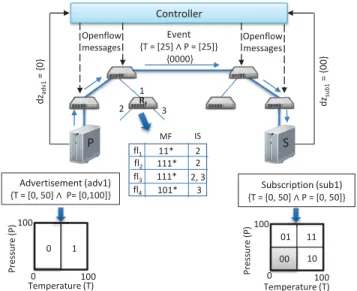
de-Controller P S {0000} Advertisement (adv1) {T = [0, 50] רP= [0,100]} 1 0 Temperature (T) 01 10 11 00 Temperature (T) 2 3 1 MF IS 11* 2 fl1 fl2 111* 2 fl3 111* 2, 3 Rf fl4 101* 3 Openflow messages Openflow messages Pr es su re ( P ) 0 100 100 0 100 100 Pr es su re ( P ) Subscription (sub1) {T = [0, 50] רP = [0, 50]} Event {T = [25] רP = [25]} dzsub1 = {00} dzadv 1 = {0}
Figure 1: SDN-based Pub/Sub Middleware
signed to support content-based publish/subscribe (in short pub/sub) [20]. We then present an architecture to scale such a middleware for improved control plane performance.
2.1
SDN-based Pub/Sub Middleware
A content-based pub/sub system consists of mainly two participants – publishers and subscribers – which are con-nected to switches in a software-defined network. Publish-ers specify the information they intend to publish by send-ing advertisements to the SDN controller. Likewise, sub-scribers specify information they are interested in receiving by sending subscriptions. Thecontroller collects all control requests ((un)advertisement/(un)subscription) from partic-ipants based on which it installs paths on the data plane between each publisher and all its interested subscribers (cf. Figure 1). In doing so, it configures the network’s data plane by proactively installing suitable flow table entries – representing content-based filters – on SDN-configurable switches by utilizing the widely accepted OpenFlow stan-dard [6]. The aforementioned paths between publishers and their interested subscribers enable line-rate forwarding of published events through header-based matching of packets at the TCAM memory of switches on the data plane (cf. Figure 1).
The PLEROMA middleware ensures high expressive-ness and low bandwidth usage by following the content-based subscription model where events are represented by attribute-value pairs. To ensure the aforementioned packet-header-based filtering of events at the data plane, we need an efficient mapping between content attributes and flow iden-tifiers (i.e., one or more header fields that uniquely identify flow entries in the flow tables of switches). There are two steps to this mapping process.
The first step yields a binary representation of content fol-lowing the principle of spatial indexing [14, 21]. The entire event-space (denoted by Ω) comprising of sayd attributes is modeled as a d-dimensional space where each dimension represents an attribute. Recursive binary decomposition of Ω generates regular subspaces that serve as enclosing ap-proximations for advertisements, subscriptions and events which are represented by binary strings called dzs. As a
consequence of spatial indexing,dzs have certain character-istic properties depending upon the subspaces they repre-sent. For instance, 1) adzwith smaller length, denoted as
|dz|, represents a bigger subspace in Ω, and 2) a subspace represented by dzi is covered (contained) by the subspace
represented bydzj, i.e.,dzjdzi, iffdzj is a prefix ofdzi.
For instance, in Figure 1, subspace dzadv1 = {0} mapped by the advertisement{T = [0,50]∧P = [0,100]}covers the subspace dzsub1 ={00}mapped by the subscription {T =
[0,50]∧ P = [0,50]}. As a result,dzadv1 ={0}has shorter
length and forms the prefix ofdzsub1={00}.
The second step involves the mapping of the generated binary strings (dzs) to flow identifiers. To this end, we use a range of IPv6 multicast addresses, reserved for pub/sub traf-fic, as the flow identifiers. So, a subscription/advertisement is represented by an IPv6 multicast address which is used by the flow entries in the flow tables of switches for event matching and forwarding. The covering relation between subspaces is accommodated in IP addresses with the help of Class-less Interdomain Routing (CIDR) style masking sup-ported by hardware switches where the ’don’t care’ symbol (*) is used to represent masking operations. For instance, a subscription withdz={001}is converted to an IPv6 multi-cast address ff0e:2000:*. In Figure 1, the flow table of switch
Rfshows the flow fields that are relevant for our middleware.
This constitutes the match field (MF), in our case an IPv6 multicast address representing adz, e.g., 11* inf l1, and the
instruction set (IS), which specifies the port through which an event should be forwarded on account of a match, e.g., 2 inf l1. An event is also represented as an IPv6 multicast ad-dress and forms part of the header of the event packet. This enables header-based matching and subsequent forwarding of the event packet as dictated by the outgoing port of the instruction set (IS) on account of a match.
An efficient approach to topology reconfiguration is cen-tral to pub/sub on SDN. For this purpose, a spanning tree (comprising switches) is maintained to account for an acyclic dissemination structure on which paths are embedded be-tween publishers and subscribers by installing appropriate flows (filters) on switches along these paths. A path is noth-ing but a sequence of switches (denoted asR) on which flows are deployed to ensure connectivity between the publisher and the subscriber. The flows to be deployed on a switch depend largely on the already existing pub/sub flows on that switch and as a result it is important for the controller to identify the state of each switch in the network.
In more detail, the network state is represented by network configuration that consists of (i) all switches constituting the network, (ii) all links connecting the switches in a spanning tree to account for an acyclic dissemination structure, and (iii) all pub/sub flows deployed on each switch. In general, the network configuration is maintained both at the data plane and the control plane of a software-defined network. The network configuration at the data plane (denoted as DP-config) is maintained implicitly as a result of pub/sub flows deployed in the TCAM memory of hardware switches. On the other hand, the control plane network configuration (denoted as CP-config) is maintained by the controller and serves as a reflection of DP-config. As mentioned before, installing paths between publishers and subscribers involves reading the existing flows of each switch (along the path), taking decisions on flow changes and writing these changes to the switch. Since the controller assumes CP-config to
be identical to DP-config, it uses CP-config to read existing flows and decide on flow changes. On taking a decision, the controller sends the new flow changes to the hardware switch, resulting in a change in DP-config. Meanwhile, the controller also performs these flow changes in the CP-config to ensure that it remains consistent with DP-config.
In order to understand the decision-making process to de-termine flow changes on a switch, it is important to note the containment relation between flows w.r.t. a single switch. A flowf licovers (or contains) another flowf lj, denoted by f lif lj, if the following two conditions hold: (i) thedz
as-sociated with the destination IP address in the match field off lj is covered by the dzoff li, and (ii) the out ports to
which a packet matchingf ljis forwarded are subset of those
specified in theIS off li. Likewise, a partial containment
relation () can be defined between flows of a switch (or flows to be installed on a switch). A flowf li partially
cov-ers (or contains) another flowf lj, denoted byf lif lj, ifdz
associated with the match field off li coversdzof f lj, but
not all the out ports used for forwarding packets matching
f ljare listed in theISoff li. For example, in Figure 1,f l1 f l2 and f l1 f l3, whereasf l4 is unrelated to all other
flows in the flow table ofRf. Based on these containment
relations, flows are either installed or modified or no actions are taken w.r.t a switch while establishing the routing path. Assume that a new flowf ln is to be installed on a switch,
then decisions are taken as follows : 1) If an existing flow
f le already coversf ln , then no further actions are taken.
This also includes the special case wheref lnis identical to f le. 2) If an existing flowf le is covered byf ln, thenf lnis
added andf le is deleted from the flow table as it is
redun-dant. 3) Iff lnis partially covered by an existing flowf le,
thenf ln should be added with higher priority and should
include the out ports in the IS of f le. A higher priority
ensures that if a packet has multiple matches in the flow table, it would be matched against and follow theISof the flow with highest priority. 4) Iff lnpartially covers the
ex-isting flowf le, then besides addingf lnto the flow table,f le
should be updated to include out ports used byf lnand to
hold higher priority thanf ln.
2.2
Distributed Control Plane
In general, the topology reconfiguration efforts are signif-icant in an SDN-based pub/sub middleware. In a scenario with frequent concurrent control requests from multiple par-ticipants, a design with a single SDN controller will result in very poor control plane responsiveness. Here, we define
re-sponse timeas the time from the issuance of a control request
by a participant till the completion of all topology reconfig-uration associated with this request by the control plane. For example, the response time to a subscription is the time elapsed from the issuance of the subscription until the sub-scriber starts receiving events. As a single controller pro-cesses each control request sequentially, the response time increases significantly in the face of high dynamics. This problem motivates us to introduce multiple controller in-stances in the control plane enabling concurrent processing of control requests.
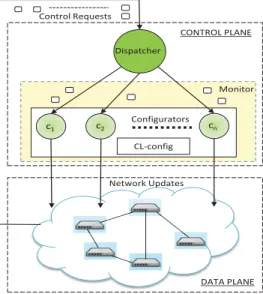
Figure 2 depicts a two-tiered architecture in the control plane; adispatchercollects control requests from publishers and subscribers in a software-defined network, and a set of components, known as configurators (denoted byC), pro-cesses these requests and carries out network updates
ac-Monitor Control Requests Configurators Network Updates Dispatcher c1 c2 cn DATA PLANE CONTROL PLANE CL-config
Figure 2: Distributed Control Plane
cordingly. SDN allows thedispatcherand theconfigurators, residing in the control plane, to acquire a global view of the entire network and configure it as needed. Thedispatcher
serves as the entry point to the control plane. It collects all data plane control requests and forwards them to the
configurators. Theconfigurators serve as the main workers
that are capable of modifying the state of every switch in the network. Each of them receive control requests forwarded by
thedispatcherand process them as described in Section 2.1,
resulting in concurrent updates to the CP-config and DP-config. The monitoris an additional component connected to theconfiguratorsand thedispatcher. It plays an impor-tant role in maintaining load statistics of eachconfigurator, which contributes to improved system performance. The relevance of themonitor, in context of our designed middle-ware, will be explained in details later in this paper.
In this paper, we scale the control plane both vertically as well as horizontally. Vertical or horizontal scaling is mainly achieved by scaling up or out the configurators. Here, ver-tical scaling means hosting multiple configuratorinstances on multiple cores of a single machine. In contrast, horizon-tal scaling involves hosting multiple configuratorinstances on cores of physically distributed machines. Irrespective of the scaling type, the introduction of multiple configurators
implies concurrent processing of requests for improved re-sponsiveness which in turn raises questions on control plane consistency.
In the subsequent sections, we first discuss control plane consistency in the context of pub/sub middleware and iden-tify conflicting actions that may induce inconsistencies (cf. Section 3). Afterwards, we present approaches for verti-cal and horizontal sverti-caling of the control plane that ensure consistency by enabling concurrency control for conflicting actions with low synchronization overhead (cf. Section 4).
3.
CONTROL PLANE CONSISTENCY IN
PUB/SUB
In general, two important problems have to be addressed to ensure control plane consistency in a SDN-based pub/sub middleware. These problems are i) maintaining consistent
Push new flow entry
fl3= Match: 00* Action: outport :1, 3
fl2= Match: 00* Action: outport :1, 2
Packet matches single entry
fl´2= Match: 00* Action: outport :1, 2, 3 fl1= Match: 00* Action: outport :1
Concurrent read
2
3
Push new flow entry c1 c2 1 2 3 00*Actio 1 2 CONTROL PLANE CP-config sub1 = (00, S1) sub2= (00, S2) S1 Rt S2Figure 3: Control Plane Inconsistency
network configuration (i.e., CP-config and DP-config) in the presence of concurrent updates by multiple configurators, and ii) keeping CP-config consistent with DP-config in the presence of failures. In this section, we strictly focus on the first problem and address the second problem in Section 5. For simplicity and without loss of generality, we discuss the first problem only with respect to CP-config, as consistent maintenance of CP-config in the face of concurrency (and absence of failures) implies consistent DP-config.
In more detail, theconfiguratorsexecute the same control logic and operate on the same CP-config concurrently. On receiving a request, a configuratorperforms operations on switches along the paths between publishers and subscribers in order to deploy flow updates. As mentioned in Section 2, at each switch, theconfiguratorperforms an action that con-sists of an ordered sequence of three operations. The three operations include reading flows from a switch, deciding on the changes to be made to the flows, and finally writing these changes back to the switch. The concurrent execution of such actions by two or moreconfigurators can result in their sequences being interleaved. This raises concurrency related issues resulting in false negatives (events not deliv-ered to a subscriber despite its interest in receiving them) or false positives (events delivered to a subscriber that is not interested in receiving them) at the subscriber end.
Figure 3, depicts an example of a simple case of false negatives at a subscriber due to the interleaving of se-quences of operations constituting two actions and belong-ing to two configurators. Let us suppose that two over-lapping subscription requestssub1={00}from subscriberS1
and sub2={00}from subscriber S2 are simultaneously
dis-patched toconfiguratorsc1,c2∈Crespectively. Both follow
the aforementioned request handling process and perform actions on relevant switches. We specifically focus on the terminal switchRt which already has a flow,f l1, to match
event packets for subspace{00}(cf. Figure 3). We consider a case where bothconfiguratorsperform concurrent read on this switch in CP-config. On reading the state, c1 and c2
independently decide on required flow updates and replace the existing flow (f l1) by adding two new flowsf l2 andf l3
respectively (cf. Figure 3). As a consequence, there now exists two flows with the exact same match field but with differentISat Rt. Since deploying flows on CP-config
im-plies deploying them on DP-config, now, if an event packet lying in subspace {00}arrives at Rt in the data plane, it
c1 c2 cn
Dispatcher
Read / Write
p1 p2 pk
Global Queue
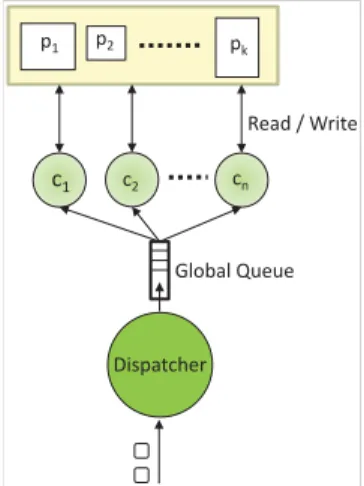
Figure 4: Shared Everything Approach
follows the instruction set of either f l2 or f l3, but never both as the matching of a packet at a switch is terminated as soon as the first match is found. In either case, one of the two subscribers is affected by false negatives compromising correctness of the system.
Clearly, false negatives at a subscriber in Figure 3 oc-curred because flowsf l2 and f l3 concurrently added by c1
andc2 are in aforementioned partial flow containment
rela-tion (i.e.,), which essentially results in updating the same flow inRt. In general, concurrent updates of the flows with
containment relations (i.e.,or) have an effect of one of the updates being overwritten by the other.
While understanding the above mentioned concurrency is-sues, we identify conflicting actions in a SDN-based pub/sub middleware.
Definition 1 Two actions are in conflict if (i) they belong
to different configurators (ii) both of them access the same
switch and (iii) both of them affect flows that are bound by
the flow relations, i.e., complete containment () and partial
containment ().
In order to ensure consistency, all conflicting actions must be serialized.
4.
SCALING APPROACHES
Having identified conflicting actions, we propose two ap-proaches – shared everything and shared nothing – that scale the control plane both vertically as well as horizontally while avoiding concurrent processing of conflicting actions.
4.1
Shared Everything Approach
The shared everything approach (SEA) works on the prin-ciple that all configurators share CP-config among them-selves. This implies that all of them read from as well as write to every switch in CP-config. Section 3 explained the undesirable consequences of such concurrent access of shared state which means that the SEA approach must employ cer-tain additional mechanisms for concurrency control. SEA uses a locking mechanism that allows a configuratorto ac-quire exclusive access on CP-config at various granularity levels. This means that no other configurator can access the locked part of CP-config unless the configurator hold-ing the lock relinquishes it. Locks can be held at different
levels of granularity in CP-config. In the absence of appli-cation knowledge, a plausible strategy is to assign locks at the granularity of switches. For example, with the advent of a subscription, aconfigurator can determine the paths be-tween the associated subscriber and all relevant publishers, acquire locks on all switches in these paths, read, decide on flow changes, deploy changes on the switches, and finally release the locks. Acquiring locks at switch level, however, would imply that no otherconfiguratorcan execute an action on a locked switch even if its action does not conflict with the current action being executed. So, with respect to our definition of conflicting actions (cf. Definition 1), locking at switch-level may not be ideal.
Here, we propose an application-aware method that uses knowledge of advertisements and subscriptions to control the granularity at which CP-config can be accessed concurrently. Since thedzs representing the subscriptions/advertisements (in control requests) are directly mapped to flows added to switches (cf. Section 2), two control requests where onedz
covers or is identical to the other (overlapping subspaces in Ω) yield flows related (and) to each other. This means that concurrent processing of overlapping control requests at a switch will result in conflicting actions and must be or-dered sequentially. Control requests with non-overlapping subspaces in Ω, however, can undergo concurrent process-ing without any issues. For example, concurrent processprocess-ing of two subscriptions{00}and {000}which results in state modification of at least one common switch will lead to in-correct system behavior as {00} {000}. However, two unrelated subscriptions, {00} and {11}, can be processed concurrently by twoconfiguratorswithout any issues as pro-cessing will not yield any related flows. This directly leads us to the idea of partitioning the event-space in a disjoint way such that flows corresponding to different partitions in Ω are maintained in separate CP-configs. This enables con-current processing of disjoint control requests that operate on different CP-configs. Locking would only be required at the level of a CP-config to ensure sequential processing of overlapping control requests.
So, we divide the event-space (Ω) into multiple disjoint, continuous partitions. A partition is nothing but a sub-space in Ω and may be represented in the same way, i.e., by adz. Disjoint event-space partitioning may yield equal or unequal partitions depending on the partitioning criteria. However, it is important to note that, in any case, the par-tition set, denoted byP, is non-overlapping and fully covers Ω. Mechanisms for content or event-space partitioning have been extensively researched in various fields of computer sci-ence [24, 25] and will not be discussed further in this paper. Henceforth, we assume thatP consists of kpartitions and
k >> nwherendenotes the total number ofconfigurators. The middleware maintains a set of independently con-figurable CP-configs (denoted byCP) having a one-to-one mapping with these partitions. This results in the creation ofkCP-configs where each configuration,cp∈CP, is repre-sented by thedzof the corresponding partition. Again, each switch in eachcpcontains only those flows that are associ-ated with the event-space partition that this configuration represents. This implies that the spanning tree maintained by CP-config is responsible for the dissemination of only a set of events that lies in its designated subspace. In the remaining part of this paper, a CP-config (cpi ∈ CP) is
We focus on a SEA approach where locking is carried out at the level of acp∈CP which essentially means locking a set of flows across all switches that correspond to a partition in Ω. This ensures concurrent access of unrelated flows on the same switch. Eachconfiguratormaintains a pointer to each CP-config/ partition. Figure 4 illustrates the same with
n configurators, c1,.., cn, operating on k partitions, p1,...,
pk. SEA ensures serial processing of requests within a single
partition while allowing concurrency otherwise.
Thedispatchercollects all control requests from the data
plane and adds them to a global queue accessible to all
configurators. But before adding them, it performs an
ad-ditional step to prepare the requests for further processing. Let us denote the dzrepresenting a control request by dzc
and that representing any partition pi by dzpi. When a
control request arrives at a dispatcher, it is processed by
the dispatcher in two ways depending on whether (i) dzpi
dzc or, (ii) dzc {dzpi,...,dzpj}. In the first case, the
dispatchersimply adds the request to the global queue as the
request is contained by one partition and affects a single CP-config. However, the second scenario portrays a case where the control request subspace spans more than a single par-tition. Under such circumstances, the dispatcher splits up the request into multipledzs depending upon the nature of the partitions and adds these partial requests to the queue. For example, if we consider a system with 4 partitions – 00, 01, 10, 11 – and a request with dz {001101}arrives at
thedispatcher, thedispatcherimmediately adds the request
to the global queue as {00} {001101}. However, if the request corresponds to {0}, thedispatcher first splits it up into two partial requests{00},{01}and then adds them to the queue as{0} {00, 01}. Consequently, two CP-configs are reconfigured for this single request. Processing of a con-trol request is considered complete only when all its partial requests have been processed.
As soon as a request is available in the global queue, an
idleconfiguratortries to dequeue it and process it. However,
before dequeuing the request, it would first need to acquire an exclusive lock on the CP-config to be reconfigured for this request. Since a request is already preprocessed by the
dispatcher, it will always correspond to a single CP-config,
requiring the configurator to acquire the lock on this con-figuration alone. If it is possible to acquire the lock, the
configuratordequeues the request from the global queue and
proceeds with reconfiguration of the locked CP-config. Re-configuration follows the usual mechanisms discussed in Sec-tion 2. Once all changes corresponding to this request are made, theconfiguratorreleases the lock on the configuration. On the contrary, if aconfiguratoris unable to acquire a lock on a CP-config for a particular request, it simply continues traversing the queue for a request belonging to a partition on which it can acquire a lock till it reaches the end of the queue. So, a configuratordoes not get blocked if requests affecting unlocked partitions are available in the queue for further processing. It should be noted that a configurator
ensures that, if it acquires a lock on a partition, it always processes the first request waiting in the queue for that par-tition. This ensures fairness of request processing at least within a partition. SEA enables theconfiguratorsto actively look for a request to process as soon as they are idle, result-ing in implicit load balancresult-ing among them. Also, multiple partitions wherek >> nallows for a possibility of a certain degree of concurrency despite ensuring strong consistency.
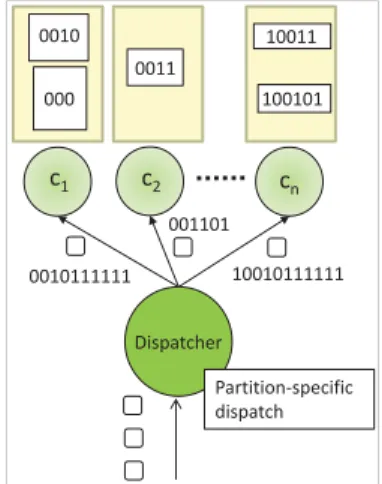
0010111111 001101 10010111111 c1 c2 cn Dispatcher Partition-specific dispatch 000 0011 0010 10011 100101
Figure 5: Shared Nothing Approach
The advantages of using such an approach for increased responsiveness in a vertically scaled control plane are signif-icant. This is because vertical scaling works with a shared memory architecture where sharing of multiple CP-configs does not cause much overhead. However, horizontal scaling implies repeated remote access of multiple CP-configs by everyconfigurator. This involves transfer of large amount of data over the control network resulting in severe perfor-mance limitations. Not surprisingly, SEA cannot match up to the requirements of a horizontally scaled control plane. To overcome these limitations and exploit the benefits of horizontal scaling, we propose the shared nothing approach which is the subject of discussion in the remaining part of this section.
4.2
Shared Nothing Approach
The shared nothing approach (SNA) also operates with multiple disjoint CP-configs or partitions. However, in this approach, each partition is assigned exclusively to exactly
oneconfigurator. To ensure consistency, each configurator
is restricted to performing reconfigurations on its assigned partitions only. So, two or moreconfiguratorsmay process different requests concurrently as they operate on completely different subspaces in Ω, i.e., they may modify the flows on the same switch concurrently without any inconsistencies as the flows affected in each case are completely unrelated. This ensures that no two configurators interfere with each other while performing parallel topology reconfigurations on the same network. As our design assumes k >> n, each
configuratormay be responsible for multiple partitions. It
is important to note that eachconfiguratorneeds to main-tain only those CP-configs that have been assigned to it. By employing such a mechanism, we avoid all kinds of coordi-nation overhead amongconfiguratorswhile ensuring control plane consistency in a distributed setting.
Figure 5 depicts a middleware where eachconfiguratorhas one or more partitions assigned to it and each partition is represented by its correspondingdz. Such a representation enables the direct mapping of advertisements/subscriptions (represented by one or moredzs) to partitions. For example, two partitions{000},{0010}have been assigned toc1 ∈C,
implying that c1 only maintains CP-configs for these two
4.2.1
Topology Reconfiguration
Thedispatcher plays a significant role in this approach.
It maintains a map of the configurators and their associ-ated partitions and performs partition-specific dispatch of control requests. Again, thedispatcherfirst prepares a con-trol request for further processing by splitting it into partial requests, if necessary, depending on the partitions (cf. Sec-tion 4.1). This guarantees the mapping of a request to a single partition enabling thedispatcher to directly forward a request to aconfiguratorresponsible for the corresponding partition. For example, as per Figure 5, if a request cor-responds to{00}, thedispatcher first splits it up into three requests{000},{0010},{0011}and then dispatches them to
c1 and c2 as {00} {000, 0010, 0011}. Consequently, all
three CP-configs are reconfigured for this single request.
Eachconfiguratormaintains a request queue for each
par-tition it is responsible for. Processing of control requests
at a configurator takes place sequentially. This, in turn,
ensures consistency within each partition. Once a request is dispatched, it gets enqueued to the relevant queue and waits for theconfiguratorto dequeue it for further process-ing. While choosing the next queue from which to dequeue a request, a configurator considers the order in which re-quests for all its assigned partitions arrived ensuring request processing fairness. After dequeuing a request, it proceeds with reconfiguration of a specific CP-config corresponding to the request dz. Topology reconfiguration follows the usual mechanisms discussed in Section 2.
The shared nothing approach enables concurrent process-ing of requests correspondprocess-ing to disjoint partitions at
multi-pleconfigurators, thus reaping the benefits of scaling.
How-ever, the true potential of this design can be realized if the workload can be balanced betweenconfigurators. There may be scenarios where the workload is much higher for certain partitions which burdens a few configurators while others remain idle. This degrades the responsiveness of the control plane to control requests. For this reason, adaptive load bal-ancing among configurators bears considerable significance and features as the subject of discussion in the remaining part of this subsection.
4.2.2
Adaptive Load Balancing
In the face of a dynamic incoming workload, an adaptive policy is central to the load balancing approach. We iden-tify load of aconfiguratorat a given time by request queue lengths of all partitions assigned to it. A request queue, spe-cific to a partition (say, pj), consists of all control requests
waiting to be processed by theconfiguratorfor an assigned partition. So, load at aconfiguratorcimay be defined as,
li = m
j=1
QLj (1)
where m is the number of partitions assigned tociandQLj
represents queue length atpj.
When an overload condition is detected at a heavily loaded
configurator, one or more of its assigned partitions is
mi-grated to a configuratorwith current minimum load. This implies that the task of processing all current and future re-quests for the migrated partitions now lies with the newly chosen configurator. An overload detection is carried out by the monitorcomponent. The monitorperiodically col-lects load information of every configuratorand hence can
easily identify an overload condition. With every periodic collection, themonitorcalculates the average queue length at eachconfigurator, denoted bylavg. If the ratio of the load
at aconfigurator, i.e.,li, tolavg is greater than a threshold
value, then the monitor detects an overload and proceeds with partition migration. More formally, an overload is de-tected if, li lavg > threshold (2) wherelavg = n s=1ls
n . However, in order to avoid partition
thrashing, the monitor initiates migration only if the over-load condition at aconfiguratoris monotonically increasing with time. Initially, the most heavily loaded partition at the overloadedconfiguratoris selected for migration and the ef-fects of migrating it to the minimally loadedconfiguratoris calculated. If this results in a potential overload condition at the minimally loadedconfigurator, the monitor proceeds to calculate the feasibility of migration of the next most heav-ily loaded partition until a balanced migration is achieved or all partitions considered for migration.
Migration of a partition, say pi, essentially means
trans-fer of state from one configurator to another. This state includes the CP-config,cpi, associated withpiand all
pend-ing requests related to it in the queue of the overloaded
configurator. Also, while this transfer is underway, all new
requests corresponding to pi that arrive at the dispatcher
need to be stalled to avoid unnecessary state transfer. Once migration is completed, thedispatcherforwards the pending requests and all corresponding ones associated withpito the
newly assignedconfigurator.
It should be noted that SNA is suitable for both verti-cal as well as horizontal sverti-caling. However, in the case of vertical scaling, it may perform worse than SEA in the pres-ence of fluctuating unevenly distributed workload. Subject to such workload, adaptive load balancing of SNA will al-ways be outperformed by the implicit optimal load balancing achieved in SEA. This is further confirmed by our evaluation results (cf. Section 7).
5.
CONTROL PLANE CONSISTENCY IN
PRESENCE OF FAILURES
As we have not considered failures previously, it has been sufficient to assume that CP-config is consistent with DP-config and therefore sufficient to only deal with in-consistencies arising due to concurrency between
multi-ple configurators. However, lost connections (between
configurators and switches) and switch failures may result
in inconsistencies between the two configs, irrespective of whether the control plane is centralized or distributed.
Let us first consider a case where the connection be-tween a configurator and a switch is lost. As a result, the updates that were pushed by a configurator on to a switch may not be reflected on the TCAM memory of the switch at all. If the configurator continues processing of requests assuming that the said changes are deployed on the switch, then this would imply inconsistencies between the two configs, resulting in incorrect system behavior. To avoid this, our middleware pushes out the flow modifi-cation requests, generated while processing a control re-quest, to the switch and waits until the switch acknowl-edges the successful completion of these updates within a
fl1 fl2
1) sub1: 00 Æsub2: 000
Add(Match : 00* Outport :2) 2) sub2: 000 Æsub1: 00
Add (Match : 000* Outport :2)
Add (Match : 00* Outport :2)
Delete(Match : 000* Outport :2)
1 2 S1 1 2 R2 R1 S2 3 1 2 sub1: 00 sub2: 000 fl1 fl2 1) sub1: 00 Æsub2: 000
Add(Match : 00* Outport :2)
Add(Match : 000* Outport :2, 3) 2) sub2: 000 Æsub1: 00
Add (Match : 000* Outport :3)
Add (Match : 00* Outport :2)
Modify (Match : 000* Outport :2, 3)
1 2 S1 1 2 R2 R1 S2 3 1 2 sub1: 00 sub2: 000
Figure 6: Reducing Flow Operations
given timeout. The flow monitoring functionality introduced by OpenFlow version 1.4 can be efficiently used to allow
a configurator to be notified by a switch about flow
op-erations (addition/modification/deletion) performed on its tables. Such switch notifications can serve as acknowledg-ments of completed flow table updates. On receiving an acknowledgement from the switch, the configurator writes these changes to the CP-config and considers the control request as fully processed. If an acknowledgement does not arrive at a configurator within the given timeout, the
configuratormarks all the unacknowledged flow changes as
undefined in CP-config. The processing of all subsequent requests that depend on undefined flows must be stalled.
Aconfiguratormust explicitly read the current status of the
switch with a missing acknowledgement using the OpenFlow standard and reflect the same in the CP-config.
Inconsistencies between CP-config and DP-config also arise due to switch failures. In case of a switch failure, the span-ning tree maintained by CP-config has to be modified ac-cordingly, which means that all paths need to be recalculated according to the new topology. The same has to be done in case of a switch recovery as this also involves a change in the network topology and must be reflected in CP-config to ensure consistency.
6.
REDUCING FLOW OPERATIONS
Increasing responsiveness of the control plane to control requests also increases the rate at which network updates are pushed on to the switches by multiple configurators. With today’s hardware switches supporting around 40-50 flow-table updates per second [11], it would be really beneficial if the total number of flow updates could be reduced. However, this would have to be achieved while ensuring correctness of the system, i.e. no false positives and false negatives.
We claim that the number of network updates can be re-duced by exploiting the knowledge of advertisements and subscriptions and their relations yet again. Using the rela-tions, processing of control requests can be ordered to op-timize the network update procedure. We explain the opti-mization process at a switch level w.r.t. subscriptions and
identify two relations that make a difference in the ordering of control requests. If two subscriptionssubiandsubj, where subi subj, independently produce two new flowsf li and f lj respectively, then the two relations between the flows
that ordering would benefit from are complete containment, i.e.,f lif lj, and partial containment, i.e.,f lif lj.
Referring to the two subscriptions in the above example and their relations, we first look at complete containment between flows. The following updates would be done on a switch depending on the order in which the two subscriptions are processed. 1) Ifsubi is processed beforesubj,subi first
produces one add flow (f li) operation on the switch. When subjis processed, it does not produce any other flow updates
on the switch asf li fully covers all events that need to be
forwarded in response tosubj. 2) Ifsubjis processed before subi, subj also produces one add flow (f lj) operation on
the switch. After this, whensubi is processed another flow
(f li) add operation has to be performed to cover forwarding
of all events matching subj and also those matching subi
but notsubj. Also, a delete operation has to be performed
on f lj as it is now redundant. Given the limitations of
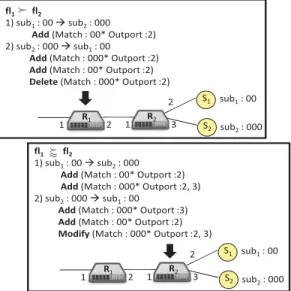
the flow table size on a switch, redundant flows cannot be afforded. This clearly indicates that the first ordering yields two operations less as compared to the second. Figure 6 illustrates the above discussion with an example where the ordering of two subscriptionssub1 ({00}) andsub2 ({000}) that would independently producef l1andf l2yield different
number of operations on switchR1 asf l1 f l2.
Let us now consider the second relation of partial con-tainment between the flows. Again, we look at the number of operations required on orderingsubiandsubjdifferently.
1) If subi is processed before subj, subi produces one add
flow (f li) operation. Whensubj is processed, a second flow
(f lj) add operation needs to be performed as this time the
flows are only partially related and a different out port needs to be added only forsubj. 2) However, ifsubj is processed
beforesubi,subj produces one add flow (f lj) operation on
the switch. Now, whensubi is processed, first a flow (f li)
gets added for this subscription. Also, since the events rele-vant tof ljare also relevant tof li(assubisubj), a modify
operation is performed onf ljto accommodate the out port
forsubi. Again, the first ordering yields lesser operations as
compared to the second. This is again illustrated in Figure 6 and this time the operations w.r.t. both orders are tracked on switchR2 where a partial containment relation between f l1 andf l2 (f l1f l2) occurs.
It is important to note that the reordering of subscriptions does not have an impact on the correctness of the system. This is because, no matter how processing of requests is ordered, the final set of flows deployed on the switches is always the same. In Figure 6, at the end of processingsub1
andsub2, both switches have the same flows irrespective of the order in which they were processed. However, ordering may have an effect on the response time to certain requests that get scheduled later (cf. Section 7).
Similarly, efficient ordering of advertisements, unad-vertisements, and unsubscriptions that have overlapping switches and are bound by the above relations reduce the number of network updates significantly. However, ordering of two control requests of different types should never be done. For example, the order of processing a subscription with an unsubscription must not be changed as this may re-sult in undesirable system behavior. Both our designed
ap-proaches benefit from relevant ordering of control requests of the same type in the waiting queues of theconfigurators.
7.
PERFORMANCE EVALUATIONS
This section is dedicated to an analysis of the design and implementation of our architecture and related approaches. A series of experiments are conducted to understand the ef-fects of the design of the control plane on performance met-rics such as (i) control plane throughput, (ii) average pro-cessing latency of control requests, and (iii) required number of flow operations on switches. We evaluate our approaches w.r.t. vertical and horizontal scaling of the control plane in order to understand the benefits of scaling up and scaling out.
7.1
Experimental Setup
We scale the control plane both vertically and horizontally on a test-bed consisting of a small local area network which includes a cluster of physical machines capable of hosting each component of the proposed architecture. Vertical scal-ing is realized by hostscal-ing multiple configuratorson a single physical machine with 4 cores, 3.4 GHz processor and 8 GB of RAM. On the other hand, horizontal scaling is achieved by hosting multipleconfigurators on multiple physical ma-chines where each machine in the cluster has 4 cores, 3.4 GHz processor, and 8 GB of RAM. Two separate machines host thedispatcherand themonitor.
The aforementioned setup deals with the control plane. In order to realize the data plane, our setup uses Mininet [16], a very prominent tool for emulating software-defined net-works. Mininet is an extremely flexible tool that allows to conduct experiments with different types of topology and application traffic. Since we use a very large fat-tree topology with 64 hosts (publishers and/or subscribers) and 102 OpenFlow-compliant switches for all our experiments, Mininet is an ideal choice. It is also important to note that since our evaluations focus on control plane performance, they are independent of a real or emulated data plane.
We use a content-based schema that consists of upto 10 attributes for our event-space (Ω), where the do-main of each attribute varies in the range [0,1024]. Experiments are performed using two different mod-els of data distribution for generating control requests ((un)advertisement/(un)subscription). The uniform model generates control requests uniformly over Ω, whereas, the interest popularity model chooses 8 hotspot regions around which control requests are generated using the widely used zipfian distribution. The rate at which control requests are sent by the participants (i.e., publishers and subscribers con-nected to a SDN network) to the dispatcher also follows two models of distribution, i.e., uniform and poisson. A uni-form rate implies that the occurrences of incoming requests at thedispatcherare distributed uniformly on an interval of time. However, poisson rate involves a fluctuating workload while maintaining an average rate of incoming requests at
thedispatcherwithin a given interval of time. So, there may
be bursts of incoming requests from time to time along with lull periods to ensure an average rate at thedispatcher.
7.2
Vertical Scaling
In this section, we evaluate throughput and average pro-cessing latency of a vertically scaled control plane following the shared everything (SEA) and shared nothing with load
balancing (SNA-LB) approaches. We partition the event-space into 64 disjoint partitions on which each approach op-erates. Additionally, in SNA-LB, we randomly assign par-titions to the configurators on system start-up. Also, 64 subscribers issue upto 200,000 subscriptions and unsubscrip-tions at various uniform and poisson rates to generate load at the control plane.
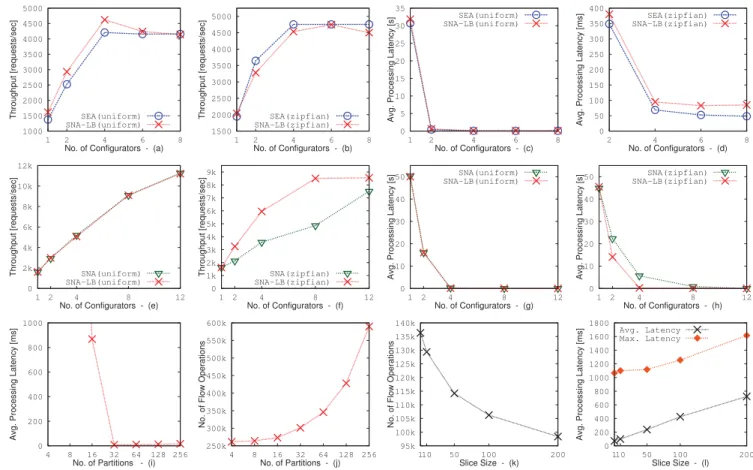
The first set of experiments measures the maximum rate at which the control plane can process control requests, i.e., throughput, with increasing number ofconfigurators. It is important to note that control requests may be further bro-ken down into partial requests to contain them in different partitions. A control request is considered to be processed only when all its partial requests have been processed. Fig-ure 7(a) and 7(b) show that, with increasing number of
configurators, the throughput of the control plane increases
significantly for both uniform and zipfian data till the control plane is scaled up by 4 configurators for both approaches. Not surprisingly, as theconfigurators are hosted by a ma-chine with a 4-core architecture, there is not much benefit if the control plane is scaled beyond 4. Figure 7(b) shows that, for control requests following zipfian distribution, the throughput of SEA is higher as compared to SNA-LB. This is because, for zipfian data, the workload is not evenly dis-tributed among the partitions. This means that in SNA-LB, some configurators may be more heavily loaded while others remain relatively idle. Even though SNA-LB tries to balance this load, it does so only after a threshold limit is crossed while SEA ensures that no configurator is ever idle unless there are no more requests to process. SEA im-plies optimal load balancing amongconfigurators. In case of uniform data, where all partitions are equally loaded, Fig-ure 7(a) shows that the performance of SEA is slightly worse than the other as once the benefits of load balancing are not visible, the additional synchronization overhead required in SEA renders it less effective as compared to SNA-LB.
In the context of our paper, responsiveness is directly re-lated to the overall time it takes for a control request to be processed by the control plane (i.e., processing latency). We define processing latency as the time elapsed from the is-suance of the request by a publisher/subscriber to the time when all partial requests for this request have been processed by the control plane. In this experiment, we plot the aver-age processing latency of control requests with increasing number ofconfiguratorsin a vertically scaled control plane. We show a comparison of both the approaches when sub-scription and unsubsub-scription requests are generated using both uniform and zipfian distributions and are sent by the subscribers to thedispatcher at a poisson rate of 2500 re-quests/sec. Figure 7(c) and Figure 7(d) show that, for both uniform and zipfian data and for both approaches, the aver-age processing latency reduces significantly with increasing number ofconfiguratorstill 4 configurators. Again, scaling beyond 4configuratorsmay not have any benefits due to the reason mentioned above. Figure 7(c) suggests that there is not much difference in performance between the approaches for uniform data as all partitions get similar amount of work-load. This implies that allconfiguratorsget similar amount of workload in SEA and SNA-LB. However, the difference in benefits between the approaches is visible for zipfian data and as a result we focus on comparing their performances by zooming the graph in Figure 7(d). In general, with dynam-ically changing incoming workload, SEA performs better as
1000 1500 2000 2500 3000 3500 4000 4500 5000 1 2 4 6 8 Throughput [requests/sec]
No. of Configurators - (a) SEA(uniform) SNA-LB(uniform) 1500 2000 2500 3000 3500 4000 4500 5000 1 2 4 6 8 Throughput [requests/sec] No. of Configurators - (b) SEA(zipfian) SNA-LB(zipfian) 0 5 10 15 20 25 30 35 1 2 4 6 8
Avg. Processing Latency [s]
No. of Configurators - (c) SEA(uniform) SNA-LB(uniform) 0 50 100 150 200 250 300 350 400 2 4 6 8
Avg. Processing Latency [ms]
No. of Configurators - (d) SEA(zipfian) SNA-LB(zipfian) 0 2k 4k 6k 8k 10k 12k 1 2 4 8 12 Throughput [requests/sec]
No. of Configurators - (e) SNA(uniform) SNA-LB(uniform) 0 1k 2k 3k 4k 5k 6k 7k 8k 9k 1 2 4 8 12 Throughput [requests/sec] No. of Configurators - (f) SNA(zipfian) SNA-LB(zipfian) 0 10 20 30 40 50 1 2 4 8 12
Avg. Processing Latency [s]
No. of Configurators - (g) SNA(uniform) SNA-LB(uniform) 0 10 20 30 40 50 1 2 4 8 12
Avg. Processing Latency [s]
No. of Configurators - (h) SNA(zipfian) SNA-LB(zipfian) 0 200 400 600 800 1000 4 8 16 32 64 128 256
Avg. Processing Latency [ms]
No. of Partitions - (i)
250k 300k 350k 400k 450k 500k 550k 600k 4 8 16 32 64 128 256
No. of Flow Operations
No. of Partitions - (j) 95k 100k 105k 110k 115k 120k 125k 130k 135k 140k 110 50 100 200
No. of Flow Operations
Slice Size - (k) 0 200 400 600 800 1000 1200 1400 1600 1800 110 50 100 200
Avg. Processing Latency [ms]
Slice Size - (l) Avg. Latency Max. Latency
Figure 7: Performance Evaluations
compared to SNA-LB as it ensures optimal load-balancing. As mentioned before, with uneven load corresponding to dif-ferent partitions, and a poisson rate of incoming request, the queues formed at differentconfiguratorsare of different lengths for SNA-LB. This implies much longer waiting times for some requests waiting at the end of long queues resulting in a higher average processing latency.
7.3
Horizontal Scaling
We also evaluate throughput, average processing latency, and required number of flow operations in a horizontally scaled control plane. We especially compare the perfor-mances of shared nothing without load balancing (SNA) and shared nothing with load balancing (SNA-LB) approaches in order to show the effects of load balancing on this approach. As SEA does not scale well in a physically distributed set-ting, our evaluations in this section do not include this ap-proach. As in the experiments for vertical scaling, we par-tition the event-space into 64 disjoint parpar-titions unless oth-erwise specified. Also, 64 subscribers issue upto 200,000 subscriptions and unsubscriptions at various uniform and poisson rates to generate load at the control plane.
Figure 7(e) and Figure 7(f) show the throughput of a hor-izontally scaled control plane for uniform and zipfian data respectively. In both SNA and SNA-LB, the throughput increases with increasing number of configurators for both distributions as a horizontally scaled setup does not suffer from the limitations of a vertically scaled one in terms of number of cores. Scaling out provides a lot of flexibility and
can be used effectively to increase control plane throughput as shown in the graphs. Not surprisingly, there is not much difference between the plots of SNA and SNA-LB for uni-form data. However, the benefits of load balancing are again visible for zipfian data where SNA-LB outperforms SNA.
We also conducted experiments which measure average processing latency of control requests with increasing num-ber ofconfiguratorswhen subscriptions and unsubscriptions are generated using both uniform and zipfian data and sent to thedispatcherat a poisson rate of 5000 requests/sec. Fig-ure 7(g) and FigFig-ure 7(h) show behavior similar to that ob-tained in vertical scaling where the average processing la-tency reduces significantly with scaling. The plots for uni-form distribution are similar for both SNA and SNA-LB, whereas SNA-LB performs better when zipfian data is used due to additional load balancing. This means that SNA-LB provides a possibility to migrate partitions to manage the maximum length of the waiting queues, whereas SNA has no such possibility, because of which the average processing latency for SNA-LB is lower than that of SNA.
It is also interesting to observe the average processing la-tency of a control request with increased partitioning of the event-space when SNA-LB is used. The more the number of partitions, more is the possibility of load balancing in SNA-LB, when dealing with requests following zipfian dis-tribution. If aconfiguratorhas a large partition with very high load, moving it to any otherconfiguratorwill not bal-ance the load. However, if the partitions are smaller, the possibility of the load being distributed among these
parti-tions is more, which increases the flexibility of balancing the load between multipleconfigurators. Figure 7(i) shows that for zipfian data, the average processing latency reduces sig-nificantly with increasing number of partitions upto a point. However, beyond this point further partitioning has no ben-efits as no further load balancing is possible for the consid-ered workload. In fact, the graph indicates that once these benefits are no longer applicable, further partitioning may increase the average latency to some extent. This is because increased partitioning has an effect on the number of par-tial requests that are constructed from control requests. If the partitioning is more fine granular, the probability of a control request spanning multiple partitions is more. This means that multiple CP-configs will be affected resulting in increased number of flow operations. Figure 7(j) plots the ef-fects of partitioning on total number of flow operations. The graph clearly shows that partitioning increases the number of flow operations significantly which can have an impact on the flow updates on the network.
7.4
Reducing Flow Operations
In order to reduce the number of flow operations on switches, we order control requests as discussed in the previ-ous section. However, continuprevi-ous sorting of a waiting queue
at aconfiguratornot only poses a significant overhead but
also results in starvation for some fine-grained subscription requests that get continuously pushed down in the sorted queue. As a result, we sort only slices of contiguous sub-scriptions at a time and not the complete waiting queue. This set of experiments plots the number of flow operations required to process a set of 5000 subscriptions with increas-ing slice size. Figure 7(k) clearly shows that with increasincreas-ing slice size, the number of flow operations reduces. However, Figure 7(l) shows that due to starvation of certain requests, the average latency is affected on increasing the slice size. We also plot the maximum processing latency for each slice size that contributes to increasing the average processing la-tency. So, there is always a trade-off between the slice size and fairness in request processing that directly affects the responsiveness to certain requests. It is important to note that a slice size of 1 implies an unsorted queue.
8.
RELATED WORK
Various approaches to the many aspects of content-based pub/sub have been presented in literature [5, 12, 19, 21, 4, 13, 7, 22]. However, built on top of overlay networks, these systems cannot take advantage of the properties of the un-derlying physical topology and lack in performance, in terms of throughput, end-to-end latency and bandwidth efficiency as compared to network layer implementations of communi-cation protocols. Realizing the potential of an implementa-tion on the network layer, middleware such as DDSFlex [9] and PLEROMA [20] build efficient pub/sub systems by us-ing the capabilities of SDN. We have already discussed the PLEROMA middleware at length in this paper and have identified the inherent scalability limitations of a single con-troller instance with respect to reconfiguration efforts in the face of high dynamics. PLEROMA also introduces the con-cept of multiple controllers responsible for separate admin-istrative domains in its design where each controller per-forms reconfiguration in its designated domain. However, within a domain, the middleware may suffer from the same aforementioned limitations. Also, in the presence of
inter-domain communication, the responsiveness of the control plane may suffer. Efficient maintenance and handling of dynamically changing subscriber interests has also been a subject of much research in overlay-based pub/sub middle-ware [4, 13, 7]. For instance, Jayaram et al. [13] propose mechanisms to efficiently handle subscriptions that change dynamically w.r.t. various parameters (such as location) by introducing the concept of parametric subscription. These methods, however, cannot be directly applied to the problem addressed in this paper.
In the recent past, the emerging cloud computing model prompted the realization of pub/sub as a cloud service. In this respect, the importance of a scalable and elastic pub/sub with high throughput has been impressed upon in literature. Li et al., present an attribute-based pub/sub service, Blue-Dove [18], that organizes multiple servers into an overlay and achieves high throughput filtering (or matching) of events by forwarding events to be matched to the least loaded servers. Likewise, Barazzutti et al. design a scalable pub/sub service, StreamHub [1], where a set of independent operators take advantage of multiple cores on multiple servers to perform pub/sub operations which include subscription partitioning and event filtering. Since StreamHub only supports scale out, Barazzutti et al., further propose e-StreamHub [2], an elastic pub/sub which is capable of scaling in and scaling out depending on the load observations of the system. It is important to note that all these systems target parallelism of event filtering and do not need to take care of concurrency control as the servers enabling concurrent filtering of events do not share any resources.
Scaling the control plane in SDN, however, involves con-current access to the network, acting as a shared resource, and has been subject to much research in recent times. Levin et al. [17] explore the trade-offs of state distribution in a dis-tributed control plane and motivate the importance of strong consistency in their work. They investigate the impact of eventual consistency on the performance of a load-balancer implemented using SDN and infer that the lack of strong consistency severely degrades application performance. To ensure strong consistency of network state between multiple controller instances, Onix [15] provides a transactional per-sistent database backed by a replicated state machine. How-ever, it claims that, for applications requiring frequent net-work updates, dissemination of state updates using this tech-nique yields severe performance limitations. As a result, to accommodate such applications, Onix also proposes a mech-anism for obtaining eventual consistency using a memory-only DHT which has its limitations w.r.t. consistency guar-antees. Similarly, Hyperflow [23] only provides guarantees of maintaining weak consistency by passively synchronizing the global network views of all controllers. On the other hand, Botelho et al. [3] show that by using a classical state machine replication technique the cost of coordination to guarantee strong consistency may become bearable for cer-tain SDN applications, but not in general. This paper, in contrast to the aforementioned literature, not only focuses on line-rate forwarding of events in the data plane but also on achieving high responsiveness while ensuring strong con-sistency on the control plane.
9.
CONCLUSION
In this paper, we have proposed an application-aware con-trol for software-defined networks that is capable of
enhanc-ing the responsiveness of the control plane by allowenhanc-ing con-current network updates while ensuring consistent changes to the data plane with low synchronization overhead even in the presence of network failures. In particular, we have designed two complimentary approaches in the context of event-based middleware that take into account interests of publishers and subscribers in order to reap the benefits of horizontal and vertical scaling of the control plane. More-over, we have proposed reordered (yet consistent) handling of control requests at the control plane to mitigate the limi-tations of current SDN switches w.r.t. number of supported flow updates per second. Our evaluations show that the application-aware control distribution drastically decreases the response time to control requests (upto 99% in compar-ison to a centralized controller) for both vertical and hori-zontal scaling while ensuring control plane consistency. Fur-thermore, reordered handling of control requests results in upto 28% less flow updates on the SDN switches.
10.
REFERENCES
[1] R. Barazzutti, P. Felber, C. Fetzer, E. Onica, J.-F. Pineau, M. Pasin, E. Rivi`ere, and S. Weigert. Streamhub: A massively parallel architecture for high-performance content-based publish/subscribe. In
Proc. of the 7th ACM Int. Conf. on Distributed
Event-based Systems, 2013.
[2] R. Barazzutti, T. Heinze, A. Martin, E. Onica, P. Felber, C. Fetzer, Z. Jerzak, M. Pasin, and E. Rivi`ere. Elastic scaling of a high-throughput content-based publish/subscribe engine. InProc. of 34th IEEE Int. Conf. on Distributed Computing
Systems, 2014.
[3] F. A. Botelho, F. M. V. Ramos, D. Kreutz, and A. N. Bessani. On the feasibility of a consistent and
fault-tolerant data store for SDNs. InSecond European
Wshop. on Software Defined Networks, EWSDN, 2013.
[4] F. Cao and J. P. Singh. Efficient event routing in content-based publish-subscribe service networks. In
Proc. of 23th IEEE INFOCOM, 2004.
[5] A. Carzaniga, D. S. Rosenblum, and A. L. Wolf. Design and evaluation of a wide-area event
notification service.ACM Transactions on Computer
Systems, 19(3):332–383, 2001.
[6] O. M. E. Committee.Software-defined Networking:
The New Norm for Networks. Open Networking
Foundation, 2012.
[7] G. Cugola, D. Frey, A. L. Murphy, and G. P. Picco. Minimizing the reconfiguration overhead in
content-based publish-subscribe. InProc. of ACM
Symp. on Applied Computing (SAC), 2004.
[8] A. Dixit, F. Hao, S. Mukherjee, T. Lakshman, and R. Kompella. Towards an elastic distributed SDN controller. InProc. of 2nd ACM SIGCOMM Wshop.
on Hot Topics in Software Defined Networking, 2013.
[9] A. Hakiri, P. Berthou, P. P. Patil, and A. Gokhale. Towards a publish/subscribe-based open policy framework for proactive overlay software defined netwo