QuantiFast
®Multiplex PCR
Handbook
QuantiFast Multiplex PCR Kit — with master
mix containing ROX™ passive reference dye
QuantiFast Multiplex PCR +R Kit — with
separate tube of ROX passive reference dye,
and master mix that does not contain ROX dye
For quantitative, multiplex, real-time PCR and
two-step RT-PCR with fast cycling using
sequence-specific probes
QIAGEN Sample and Assay Technologies
QIAGEN is the leading provider of innovative sample and assay technologies, enabling the isolation and detection of contents of any biological sample. Our advanced, high-quality products and services ensure success from sample to result.
QIAGEN sets standards in:
I Purification of DNA, RNA, and proteins
I Nucleic acid and protein assays
I microRNA research and RNAi
I Automation of sample and assay technologies
Our mission is to enable you to achieve outstanding success and breakthroughs. For more information, visit www.qiagen.com.
Contents
Kit Contents 4
Shipping and Storage 4
Product Use Limitations 5
Product Warranty and Satisfaction Guarantee 5
Technical Assistance 5
Safety Information 6
Quality Control 6
Product Description 7
Introduction 8
2x QuantiFast Multiplex PCR Master Mixes 8
Sequence-specific probes 11
cDNA synthesis for real-time two-step RT-PCR 11 Equipment and Reagents to Be Supplied by User 13
Important Notes 14
Selecting kits and protocols 14
Guidelines for effective multiplex assays 15 Suitable combinations of reporter dyes 16
Controls 30
Protocols
I 1: Duplex, Real-Time PCR Using TaqMan Probes on Most Applied Biosystems
Cyclers 31
I 2: Triplex and 4-plex, Real-Time PCR Using TaqMan Probes on Most Applied
Biosystems Cyclers 34
I 3: Duplex, Real-Time PCR Using TaqMan Probes on the Applied Biosystems
7500 and Other Cyclers 38
I 4: Triplex and 4-plex, Real-Time PCR Using TaqMan Probes on the Applied
Biosystems 7500 and Other Cyclers 42
Troubleshooting Guide 46
Appendix A: Assay Design and Handling Primers and Probes 50 Appendix B: Customized Pipetting Scheme for Separate Primer and Probe Solutions 53 Appendix C: Generating Color Compensation Files on LightCycler Systems 54
Kit Contents
QuantiFast Multiplex PCR Kit (80) (400) (2000)
Catalog no. 204652 204654 204656
Number of 25 µl reactions 80 400 2000
2x QuantiFast Multiplex PCR Master Mix* 1 ml 3 x 1.7 ml 25 ml
RNase-Free Water 2 ml 2 x 2 ml 20 ml
Handbook 1 1 1
* Contains HotStarTaq®Plus DNA Polymerase, QuantiFast Multiplex PCR Buffer, dNTP mix (dATP, dCTP,
dGTP, and dTTP), and ROX passive reference dye.
QuantiFast Multiplex PCR +R Kit (80) (400) (2000)
Catalog no. 204752 204754 204756
Number of 25 µl reactions 80 400 2000
2x QuantiFast Multiplex PCR Master Mix 1 ml 3 x 1.7 ml 25 ml (w/o ROX)†
50x ROX Dye Solution 45 µl 210 µl 1.05 ml
RNase-Free Water 2 ml 2 x 2 ml 20 ml
Handbook 1 1 1
† Contains HotStarTaq Plus DNA Polymerase, QuantiFast Multiplex PCR Buffer, and dNTP mix (dATP, dCTP,
dGTP, and dTTP).
Shipping and Storage
QuantiFast Multiplex PCR Kits are shipped on dry ice. The kits should be stored immediately upon receipt at –20°C in a constant-temperature freezer and protected from light. When the kits are stored under these conditions and handled correctly, performance is guaranteed until the expiration date (see the quality-control label inside the kit box or on the kit envelope). 2x QuantiFast Multiplex PCR Master Mixes can also be stored protected from light at 2–8°C for up to 1 month without showing any reduction in performance.
To maintain optimal performance of QuantiFast Multiplex PCR Kits for 2000 x 25 µl reactions, we recommend storing the 25 ml master mix as appropriately sized aliquots in sterile, polypropylene tubes.
If desired, 50x ROX Dye Solution can be added to 2x QuantiFast Multiplex PCR Master Mix (w/o ROX) for long-term storage. For details, see “Passive reference dye”, pages 9–10.
Product Use Limitations
QuantiFast Multiplex PCR Kits are intended for molecular biology applications. These products are not intended for the diagnosis, prevention, or treatment of a disease. All due care and attention should be exercised in the handling of the products. We recommend all users of QIAGEN®products to adhere to the NIH guidelines that have
been developed for recombinant DNA experiments, or to other applicable guidelines.
Product Warranty and Satisfaction Guarantee
QIAGEN guarantees the performance of all products in the manner described in our product literature. The purchaser must determine the suitability of the product for its particular use. Should any product fail to perform satisfactorily due to any reason other than misuse, QIAGEN will replace it free of charge or refund the purchase price. We reserve the right to change, alter, or modify any product to enhance its performance and design. If a QIAGEN product does not meet your expectations, simply call your local Technical Service Department or distributor. We will credit your account or exchange the product — as you wish. Separate conditions apply to QIAGEN scientific instruments, service products, and to products shipped on dry ice. Please inquire for more information.
A copy of QIAGEN terms and conditions can be obtained on request, and is also provided on the back of our invoices. If you have questions about product specifications or performance, please call QIAGEN Technical Services or your local distributor (see back cover or visit www.qiagen.com).
Technical Assistance
At QIAGEN, we pride ourselves on the quality and availability of our technical support. Our Technical Service Departments are staffed by experienced scientists with extensive practical and theoretical expertise in sample and assay technologies and the use of QIAGEN products. If you have any questions or experience any difficulties regarding QuantiFast Multiplex PCR Kits or QIAGEN products in general, please do not hesitate to contact us.
QIAGEN customers are a major source of information regarding advanced or specialized uses of our products. This information is helpful to other scientists as well as to the researchers at QIAGEN. We therefore encourage you to contact us if you have any suggestions about product performance or new applications and techniques. For technical assistance and more information, please see our Technical Support Center
Safety Information
When working with chemicals, always wear a suitable lab coat, disposable gloves, and protective goggles. For more information, please consult the appropriate material safety data sheets (MSDSs). These are available online in convenient and compact PDF format at www.qiagen.com/Support/MSDS.aspx where you can find, view, and print the MSDS for each QIAGEN kit and kit component.
24-hour emergency information
Emergency medical information in English, French, and German can be obtained 24 hours a day from:
Poison Information Center Mainz, Germany Tel: +49-6131-19240
Quality Control
Component Test
2x QuantiFast PCR sensitivity and reproducibility assay: Sensitivity and Multiplex PCR reproducibility in real-time PCR are tested in parallel Master Mixes* reactions containing variable amounts of DNA templates. HotStarTaq Plus Efficiency and reproducibility in PCR are tested. Functional DNA Polymerase† absence of exonucleases and endonucleases is tested.
QuantiFast Multiplex Conductivity and pH are tested. PCR Buffer†
RNase-free water Conductivity, pH, and RNase activities are tested. 50x ROX Dye Emission and excitation are tested.
Solution‡
* See quality-control label inside the kit box or on the kit envelope for lot-specific values.
† Included in 2x QuantiFast Multiplex PCR Master Mixes. ‡ Supplied with the QuantiFast Multiplex PCR +R Kit.
Product Description
Component Description
HotStarTaq Plus HotStarTaq Plus DNA Polymerase is a modified form of a DNA Polymerase*† recombinant 94 kDa DNA polymerase, originally isolated
from Thermus aquaticus. The enzyme is provided in an inactive state and has no enzymatic activity at ambient temperature. The enzyme is activated by a 5-minute, 95°C incubation step.
QuantiFast Multiplex Novel PCR buffer for fast and highly sensitive PCR Buffer*† quantification of DNA and cDNA targets in multiplex
format; includes Factor MP to facilitate multiplex PCR dNTP mix*† Contains dATP, dCTP, dGTP, and dTTP of ultrapure quality
ROX passive Optimized concentration of fluorescent dye for reference dye* normalization of fluorescent signals on all instruments
from Applied Biosystems except Applied Biosystems®
7500 Real-Time PCR Systems
50x ROX Dye Separate tube of passive reference dye for normalization Solution‡ of fluorescent signals on Applied Biosystems 7500
Real-Time PCR Systems and, optionally, on instruments from Agilent (formerly Stratagene); not required for instruments from Bio-Rad/MJ Research, Cepheid, Eppendorf, and Roche
RNase-free water Ultrapure quality, PCR-grade
* Included in 2x QuantiFast Multiplex PCR Master Mix.
† Included in 2x QuantiFast Multiplex PCR Master Mix (w/o ROX). ‡ Supplied with the QuantiFast Multiplex PCR +R Kit.
Introduction
QuantiFast Multiplex PCR Kits provide rapid real-time PCR quantification of DNA and cDNA targets in a multiplex format. Depending on the real-time cycler used, up to 4 targets can be quantified simultaneously in the same well or tube. The kits can be used in real-time PCR of genomic DNA targets, and also in real-time two-step RT-PCR of RNA targets following reverse transcription with, for example, the QuantiTect® Reverse
Transcription Kit (see ordering information, page 55). High specificity and sensitivity in multiplex PCR are achieved without any time-consuming optimization steps through the use of the hot-start enzyme HotStarTaq Plus DNA Polymerase together with a specialized PCR buffer. Short cycling steps without loss of PCR sensitivity and efficiency are enabled by Q-Bond®, a patent-pending additive in the PCR buffer.
The kits have been optimized for use with TaqMan® probes and are available in
2 formats:
I QuantiFast Multiplex PCR Kit: This kit is supplied with a master mix containing ROX passive reference dye, and is optimized for use with real-time cyclers that require a high concentration of ROX dye for fluorescence normalization (e.g., instruments from Applied Biosystems, but not Applied Biosystems 7500 Real-Time PCR Systems).
I QuantiFast Multiplex PCR +R Kit: This kit is supplied with a master mix that is free of ROX dye, and also includes a separate solution of ROX dye which the user can add to reactions, depending on the real-time cycler used. The kit is intended for use with cyclers that require a lower concentration of ROX dye for fluorescence normalization (e.g., Applied Biosystems 7500 Real-Time PCR Systems), for use with cyclers that allow optional use of ROX dye (e.g., instruments from Agilent), and for use with cyclers that do not require ROX dye. Running reactions without ROX dye increases multiplexing capacity and allows greater flexibility when choosing reporter dyes for probes.
For users of Rotor-Gene®cyclers, the Rotor-Gene Multiplex PCR Kit is recommended.
The kit is supplied with a dedicated protocol that allows even shorter cycling steps. For ordering information, see page 56.
2x QuantiFast Multiplex PCR Master Mixes
The components of 2x QuantiFast Multiplex PCR Master Mix include HotStarTaq Plus DNA Polymerase, QuantiFast Multiplex PCR Buffer, and ROX passive reference dye (see descriptions below). 2x QuantiFast Multiplex PCR Master Mix (w/o ROX) contains HotStarTaq Plus DNA Polymerase and QuantiFast Multiplex PCR Buffer, but no ROX passive reference dye. The optimized master mixes ensure that the PCR products in a multiplex reaction are amplified with the same efficiency and sensitivity as the PCR products in corresponding singleplex reactions.
HotStarTaq Plus DNA Polymerase
HotStarTaq Plus DNA Polymerase is a modified form of QIAGEN Taq DNA Polymerase. It is provided in an inactive state and has no enzymatic activity at ambient temperature. This prevents the formation of misprimed products and primer–dimers during reaction setup and the first denaturation step. Competition for reactants by PCR artifacts is therefore avoided, enabling high PCR specificity and accurate quantification. The enzyme is activated at the start of a reaction by a 5-minute, 95°C incubation step. The hot start enables reactions to be set up rapidly and conveniently at room temperature. In addition, the concentration of the polymerase in the master mix is optimized to allow short extension times in the combined annealing/extension step of each PCR cycle. QuantiFast Multiplex PCR Buffer
QuantiFast Multiplex PCR Buffer is specifically developed for fast-cycling, multiplex, real-time PCR using sequence-specific probes. A novel additive in the buffer, Q-Bond, allows short cycling times on standard cyclers and on fast cyclers with rapid ramping rates. Q-Bond increases the affinity of Taq DNA polymerases for short single-stranded DNA, reducing the time required for primer/probe annealing to a few seconds. This allows a combined annealing/extension step of only 30 seconds in duplex PCR. In addition, the unique composition of the buffer supports the melting behavior of DNA, enabling short denaturation and annealing/extension times.
QuantiFast Multiplex PCR Buffer is also based on the unique QIAGEN PCR buffer system. The buffer contains a balanced combination of KCl and (NH4)2SO4, which
promotes a high ratio of specific to nonspecific primer binding during the annealing step of each PCR cycle. This creates stringent primer annealing conditions, leading to increased PCR specificity. When using this buffer, primer annealing is only marginally influenced by the MgCl2 concentration, so optimization by titration of Mg2+ is not
required. The buffer also contains Factor MP, which facilitates multiplex PCR. This synthetic factor increases the local concentration of primers and probes at the DNA template and stabilizes specifically bound primers and probes, allowing efficient annealing and extension. The combination of these various components of QuantiFast Multiplex PCR Buffer prevents multiple amplification reactions from affecting each other. Passive reference dye
For certain real-time cyclers, the presence of ROX passive reference dye in real-time PCR compensates for non-PCR–related variations in fluorescence detection. However, when performing multiplex, real-time PCR with these instruments, the presence of ROX passive reference dye will limit their multiplexing capability.
The use of ROX dye is necessary for instruments from Applied Biosystems and is optional for instruments from Agilent. When performing multiplex, real-time PCR with ROX pas-sive reference dye on these instruments, we do not recommend using probes that have ROX or Texas Red®fluorophore as the reporter dye, since their performance in the
pres-ence of ROX dye is unpredictable. When performing reactions using probes labeled with ROX, Texas Red, or other equivalent fluorophore, use a real-time cycler that does not require ROX dye for fluorescence normalization.
The master mix supplied with the QuantiFast Multiplex PCR Kit contains ROX dye at a concentration that is optimal for instruments from Applied Biosystems (models 7000, 7300, 7700, 7900HT, StepOne™, and StepOnePlus™, but not Applied Biosystems
7500 Real-Time PCR Systems).
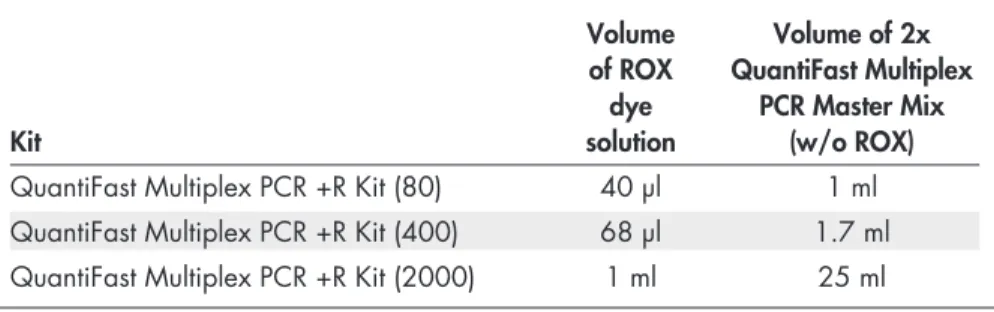
For Applied Biosystems 7500 Real-Time PCR Systems and instruments from Agilent, ROX dye is required at a lower concentration. This is provided by the QuantiFast Multiplex PCR +R Kit, which requires the user to add the supplied ROX dye solution to the master mix during reaction setup. If desired, ROX dye can be premixed with an entire tube of master mix in a 1:25 ratio (see Table 1). When stored protected from light, the premixed solution is stable at 2–8°C for up to 1 month or at –20°C until the expiration date. Remember to indicate on the tube that ROX dye has been added. Table 1. Addition of ROX dye to master mix for long-term storage*
Volume Volume of 2x of ROX QuantiFast Multiplex
dye PCR Master Mix
Kit solution (w/o ROX)
QuantiFast Multiplex PCR +R Kit (80) 40 µl 1 ml QuantiFast Multiplex PCR +R Kit (400) 68 µl 1.7 ml QuantiFast Multiplex PCR +R Kit (2000) 1 ml 25 ml
* Option for users of the Applied Biosystems 7500, Mx3000P®, Mx3005P®, and Mx4000®.
Instruments from all other suppliers, which do not require ROX dye for fluorescence normalization, should be used with the QuantiFast Multiplex PCR +R Kit, which provides master mix that does not contain ROX dye.
Sequence-specific probes
QuantiFast Multiplex PCR Kits can be used with all types of probe. This handbook contains optimized protocols for use with TaqMan probes, a major type of sequence-specific probe used in quantitative, real-time PCR (see below). For more details on sequence-specific probes, and their design and handling, see Appendix A, page 50. TaqMan probes
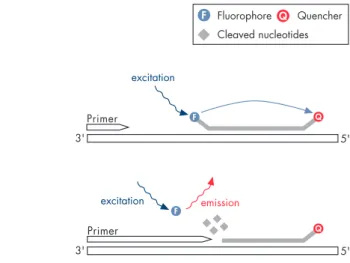
TaqMan probes are sequence-specific oligonucleotides with a fluorophore and a quencher moiety attached (Figure 1). The fluorophore is at the 5' end of the probe, and the quencher moiety is usually located at the 3' end or internally. During the extension phase of PCR, the probe is cleaved by the 5'→3' exonuclease activity of Taq DNA polymerase, separating the fluorophore and the quencher moiety. This results in detectable fluorescence that is proportional to the amount of accumulated PCR product.
Figure 1. Principle of TaqMan probes in quantitative, real-time PCR. Both the TaqMan probe and the PCR primers anneal to the target sequence during the PCR annealing step. The proximity of the quencher to the fluorophore strongly reduces the fluorescence emitted by the fluorophore. During the PCR extension step, Taq DNA polymerase extends the primer. When the enzyme reaches the TaqMan probe, its 5'→3' exonuclease activity cleaves the fluorophore from the probe. The fluorescent signal from the free fluorophore is measured. This signal is proportional to the amount of accumulated PCR product.
cDNA synthesis for real-time two-step RT-PCR
If quantifying cDNA targets with QuantiFast Multiplex PCR Kits, RNA must first be reverse transcribed into cDNA. A portion of the reverse-transcription reaction is then
B A A
For reverse transcription, we recommend using the QuantiTect Reverse Transcription Kit. The kit provides a fast and convenient procedure, requiring only 20 minutes to synthesize first-strand cDNA and eliminate genomic DNA contamination. An optimized mix of oligo-dT and random primers enables cDNA synthesis from all regions of RNA transcripts, even from 5' regions of very long mRNA transcripts. cDNA yields are high, allowing sensitive detection of even low-abundance transcripts in real-time two-step RT-PCR. An alternative to the QuantiTect Reverse Transcription Kit is the FastLane®Cell
cDNA Kit, which allows cDNA to be prepared directly from cultured cells without RNA purification. The FastLane Cell cDNA Kit is useful for experiments where archiving of purified RNA is not required. For ordering information for these 2 kits, see pages 55–56.
For very small RNA samples (as little as 1 ng), we recommend carrying out whole transcriptome amplification using the QuantiTect Whole Transcriptome Kit, which provides high yields of up to 40 µg cDNA for unlimited real-time PCR analysis. The kit contains all the necessary reagents for reverse transcription followed by cDNA ligation and amplification of all cDNA targets. The relative abundance of each transcript is preserved after whole transcriptome amplification, ensuring reliable gene expression analysis. For ordering information, see page 56.
Equipment and Reagents to Be Supplied by User
When working with chemicals, always wear a suitable lab coat, disposable gloves, and protective goggles. For more information, consult the appropriate material safety data sheets (MSDSs), available from the product supplier.
I Primers and probes from an established oligonucleotide manufacturer. Primers should be of standard quality, and probes should be HPLC purified. Lyophilized primers and probes should be dissolved in TE buffer to provide a stock solution of 100 µM; concentration should be checked by spectrophotometry (for details, see Appendix A, page 50). Primer and probe stock solutions should be stored in aliquots at –20°C. Probe stock solutions should be protected from exposure to light.
I Nuclease-free (RNase/DNase-free) consumables. Special care should be taken to avoid nuclease contamination of PCR reagents and consumables.
I Real-time PCR thermal cycler
I PCR tubes or plates (use thin-walled PCR tubes or plates recommended by the manufacturer of your real-time cycler)
I Optional: Trizma®base and EDTA for preparing TE buffer for storing primers and
probes (see Appendix A, page 50). Use RNase/DNase-free water and plastic consumables to prepare TE buffer.
I Optional: QIAgility®for rapid, high-precision automated PCR setup; for details,
visit www.qiagen.com/goto/QIAgility. Please note that the number of reactions will be 10–20% lower than indicated on the kit packaging to guarantee process safety and optimal performance.
Important Notes
Selecting kits and protocols
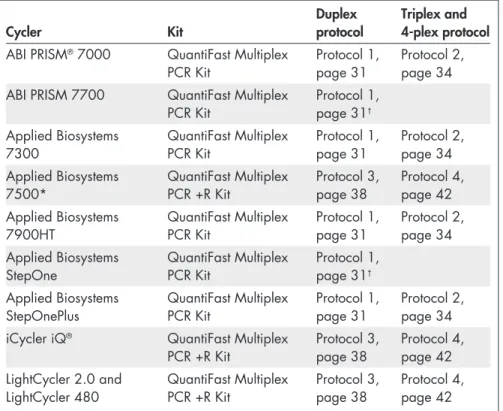
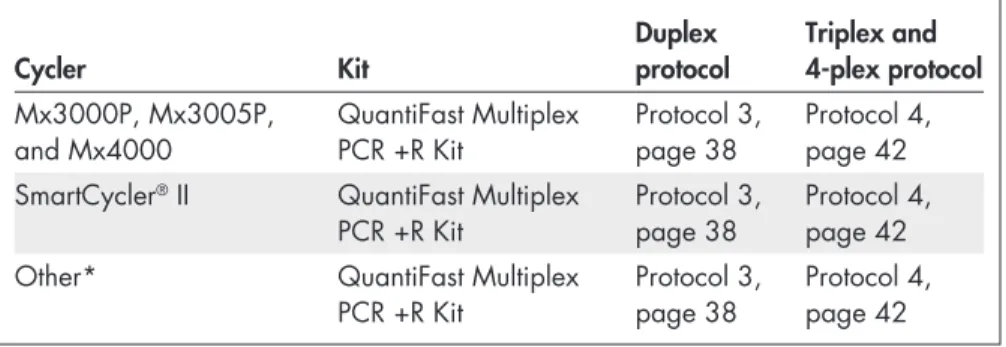
To select the correct QuantiFast Multiplex PCR Kit and protocol to use with your real-time cycler, refer to Table 2. In general, the following cyclers are not compatible with multiplex, real-time PCR: GeneAmp®5700, MyiQ™, and DNA Engine Opticon®(i.e.,
the single-color machine). The capabilities of the LightCycler®1.x for multiplex, real-time
PCR using QuantiFast Multiplex PCR Kits are very limited due to its detection optics. For users of Rotor-Gene cyclers, we recommend the Rotor-Gene Multiplex PCR Kit, which provides even shorter cycling steps (see page 56 for ordering information).
Table 2. Choosing the correct QuantiFast Multiplex PCR Kit and protocol for your real-time cycler
Duplex Triplex and
Cycler Kit protocol 4-plex protocol
ABI PRISM®7000 QuantiFast Multiplex Protocol 1, Protocol 2,
PCR Kit page 31 page 34 ABI PRISM 7700 QuantiFast Multiplex Protocol 1,
PCR Kit page 31†
Applied Biosystems QuantiFast Multiplex Protocol 1, Protocol 2,
7300 PCR Kit page 31 page 34
Applied Biosystems QuantiFast Multiplex Protocol 3, Protocol 4,
7500* PCR +R Kit page 38 page 42
Applied Biosystems QuantiFast Multiplex Protocol 1, Protocol 2,
7900HT PCR Kit page 31 page 34
Applied Biosystems QuantiFast Multiplex Protocol 1,
StepOne PCR Kit page 31†
Applied Biosystems QuantiFast Multiplex Protocol 1, Protocol 2,
StepOnePlus PCR Kit page 31 page 34
iCycler iQ® QuantiFast Multiplex Protocol 3, Protocol 4,
PCR +R Kit page 38 page 42 LightCycler 2.0 and QuantiFast Multiplex Protocol 3, Protocol 4, LightCycler 480 PCR +R Kit page 38 page 42
* Includes the Applied Biosystems 7500 Fast Real-Time PCR System.
† Only duplex assays are possible due to hardware limitations.
Table 2. Continued
Duplex Triplex and
Cycler Kit protocol 4-plex protocol
Mx3000P, Mx3005P, QuantiFast Multiplex Protocol 3, Protocol 4, and Mx4000 PCR +R Kit page 38 page 42 SmartCycler®II QuantiFast Multiplex Protocol 3, Protocol 4,
PCR +R Kit page 38 page 42 Other* QuantiFast Multiplex Protocol 3, Protocol 4,
PCR +R Kit page 38 page 42
* Refer to manufacturer’s instructions for multiplex capacity.
Guidelines for effective multiplex assays
QuantiFast Multiplex PCR Kits work with most existing probe systems that have been designed using standard design methods. However, for optimal performance of a probe system in quantitative, multiplex, real-time PCR, some considerations need to be made, including the choice of a compatible combination of reporter dyes (i.e., the fluorophores on the probes) and the quality of the primers and probes. Please read the following guidelines before starting.
I Check the functionality of each set of primers and probe in individual assays before combining the different sets in a multiplex assay.
I Choose compatible reporter dyes and quenchers. For details, see “Suitable combinations of reporter dyes”, page 16.
I PCR products should be as short as possible, ideally 60–150 bp. For details, see Appendix A, page 50.
I Always use the same algorithm or software to design the primers and probes. For optimal results, only combine assays that have been designed using the same parameters (e.g., similar melting points [Tm]). For details, see Appendix A,
page 50.
I Check the concentration and integrity of primers and probes before starting. For details, see Appendix A, page 50.
I Check the real-time cycler user manual for correct setup of the cycler for multiplex analysis(e.g., setting up detection of multiple dyes from the same well). Be sure to activate the detector for each reporter dye used.
I Some real-time cyclers require you to perform a calibration procedure for each reporter dye. Check whether the reporter dyes you selected for your multiplex assay are part of the standard set of dyes already calibrated on your instrument. If they are not, perform a calibration procedure for each dye before using them for the first time (for details, refer to the manufacturer’s instructions for your real-time cycler).
I Always start with the cycling conditions specified in the protocolyou are following.
I Optimal analysis settings (i.e., baseline settings and threshold values) for each reporter dye are a prerequisite for accurate quantification data. For details, check the literature from the manufacturer of your real-time cycler.
I Perform appropriate controls for evaluating the performance of your multiplex assays (e.g., amplifying each target individually and comparing the results with those for the multiplex assay).
Suitable combinations of reporter dyes
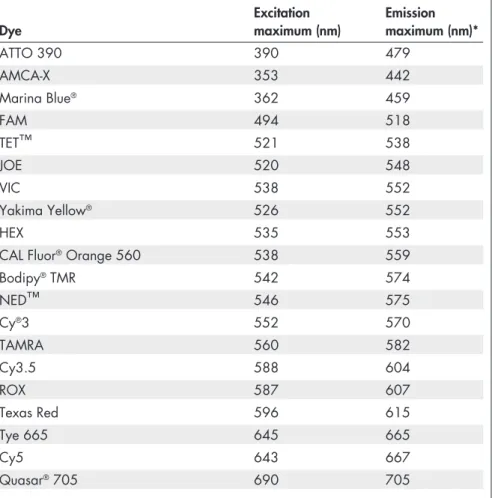
Multiplex, real-time PCR requires the simultaneous detection of different fluorescent reporter dyes (Table 3). For accurate detection, the fluorescence spectra of the dyes should be well separated or exhibit only minimal overlap. Please read the general recommendations and instrument-specific recommendations on the next few pages before starting.
Note: If there are no specific recommendations below for your real-time cycler, please refer to the user manual or other technical documentation for your instrument to find out which reporter dyes can be used in multiplex analysis.
General recommendations
I Before starting, choose suitable combinations of reporter dyes and quenchers that are compatible with multiplex analysis using the detection optics of your real-time cycler. Order the probes from an established oligonucleotide manufacturer.
I For optimal results, follow the recommended combinations of dyes shown in Tables 4–13 (pages 18–29).
I For duplex analysis, the use of nonfluorescent quenchers (e.g., Black Hole Quencher®[BHQ®] on TaqMan probes) is preferred over fluorescent quenchers
(e.g., TAMRA™ fluorescent dye). TAMRA quencher can be used in duplex analy-sis if the 2 reporter dyes are 6-FAM™ dye and HEX™, JOE™, or VIC®dye.
I For triplex and 4-plex analyses, we strongly recommend using nonfluorescent quenchers.Due to the detection optics of more recent real-time cyclers and the possible combinations of reporter dyes, triplex and 4-plex analyses may only be possible with nonfluorescent quenchers, especially with instruments from Applied Biosystems.
Table 3. Dyes commonly used in multiplex, real-time PCR
Excitation Emission
Dye maximum (nm) maximum (nm)*
ATTO 390 390 479 AMCA-X 353 442 Marina Blue® 362 459 FAM 494 518 TET™ 521 538 JOE 520 548 VIC 538 552 Yakima Yellow® 526 552 HEX 535 553
CAL Fluor®Orange 560 538 559
Bodipy®TMR 542 574 NED™ 546 575 Cy®3 552 570 TAMRA 560 582 Cy3.5 588 604 ROX 587 607 Texas Red 596 615 Tye 665 645 665 Cy5 643 667 Quasar®705 690 705
Recommendations for instruments from Applied Biosystems
Tables 4–9 on the next few pages give specific recommendations for the ABI PRISM 7000, ABI PRISM 7700, Applied Biosystems 7300, Applied Biosystems 7500, Applied Biosystems 7900HT, StepOne, and StepOnePlus.
Table 4. Suitable reporter dyes — ABI PRISM 7000 and Applied Biosystems 7300 Type of assay Filter A* Filter B* Filter C* Filter D†
Duplex 6-FAM HEX‡ ROX
JOE (passive
VIC reference)
Duplex 6-FAM Bodipy TMR‡ ROX
NED (passive reference) Triplex§ 6-FAM HEX‡ Bodipy TMR‡ ROX
JOE NED (passive
VIC reference)
* Use filter A, filter B, and filter C to detect the least abundant target, the second least abundant target, and the most abundant target, respectively.
† Filter D is for detecting ROX passive reference dye, a component of 2x QuantiFast Multiplex PCR Master
Mix.
‡ Before using HEX or Bodipy TMR dye, a pure dye calibration of the real-time cycler using this dye must be
performed. See the manufacturer’s manual for details. Supplementary protocols for pure dye calibration of major real-time cyclers are available from QIAGEN Technical Services.
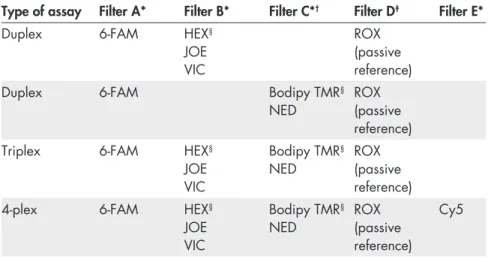
Table 5. Suitable reporter dyes — Applied Biosystems 7500
Type of assay Filter A* Filter B* Filter C*† Filter D‡ Filter E*
Duplex 6-FAM HEX§ ROX
JOE (passive
VIC reference)
Duplex 6-FAM Bodipy TMR§ ROX
NED (passive reference) Triplex 6-FAM HEX§ Bodipy TMR§ ROX
JOE NED (passive
VIC reference)
4-plex 6-FAM HEX§ Bodipy TMR§ ROX Cy5
JOE NED (passive
VIC reference)
* Use filter A, filter B, and filters C and E to detect the least abundant target, the second least abundant target, and the 2 most abundant targets, respectively.
† When using filter C in duplex, triplex, or 4-plex PCR, all probes in the reaction must be labeled with a
nonfluorescent quencher instead of a fluorescent quencher such as TAMRA dye.
‡ Filter D is for detecting ROX passive reference dye, which is supplied as a separate solution with the
QuantiFast Multiplex PCR +ROX Vial Kit. The dye can be added to reactions, or premixed with 2x QuantiFast Multiplex PCR Master Mix (w/o ROX).
§ Before using HEX or Bodipy TMR dye, a pure dye calibration of the real-time cycler using this dye must be
performed. See the manufacturer’s manual for details. Supplementary protocols for pure dye calibration of major real-time cyclers are available from QIAGEN Technical Services.
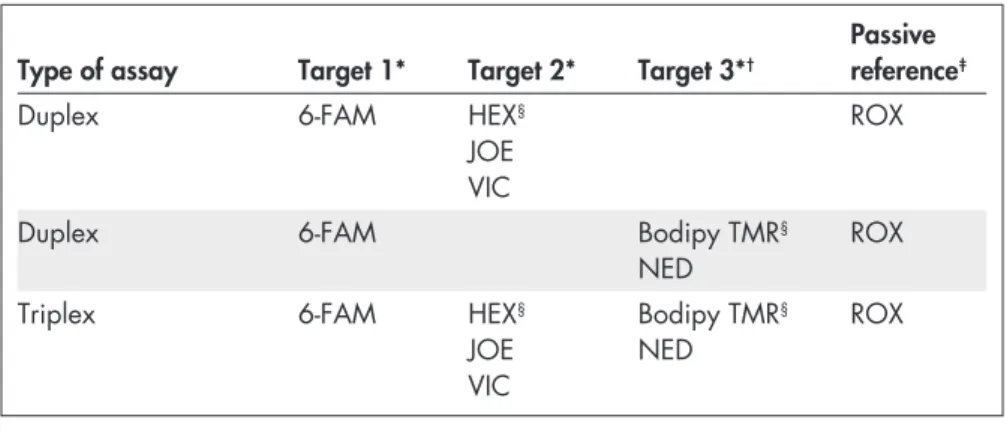
Table 6. Suitable reporter dyes — Applied Biosystems 7900HT
Passive Type of assay Target 1* Target 2* Target 3*† reference‡
Duplex 6-FAM HEX§ ROX
JOE VIC
Duplex 6-FAM Bodipy TMR§ ROX
NED
Triplex 6-FAM HEX§ Bodipy TMR§ ROX
JOE NED
VIC
* Target 1, target 2, and target 3 correspond to the least abundant target, the second least abundant target, and the most abundant target, respectively.
† When using a Bodipy TMR or NED labeled probe in duplex or triplex PCR, all probes in the reaction must
be labeled with a nonfluorescent quencher instead of a fluorescent quencher such as TAMRA dye.
‡ ROX fluorescent dye is used as passive reference and is a component of 2x QuantiFast Multiplex PCR
Master Mix.
§ Before using HEX or Bodipy TMR dye, a pure dye calibration of the real-time cycler using this dye must be
performed. See the manufacturer’s manual for details. Supplementary protocols for pure dye calibration of major real-time cyclers are available from QIAGEN Technical Services.
Table 7. Suitable reporter dyes — Applied Biosystems StepOne*
Passive Type of assay Filter 1† Filter 2† reference‡
Duplex 6-FAM HEX§ ROX
JOE VIC
* This real-time cycler is only designed for duplex analysis with the standard calibration.
† Use filter 1 to detect the least abundant target.
‡ ROX fluorescent dye is used as passive reference and is a component of 2x QuantiFast Multiplex PCR
Master Mix.
§ Before using HEX dye, a pure dye calibration of the real-time cycler using this dye must be performed. See
the manufacturer’s manual for details. Supplementary protocols for pure dye calibration of major real-time cyclers are available from QIAGEN Technical Services.
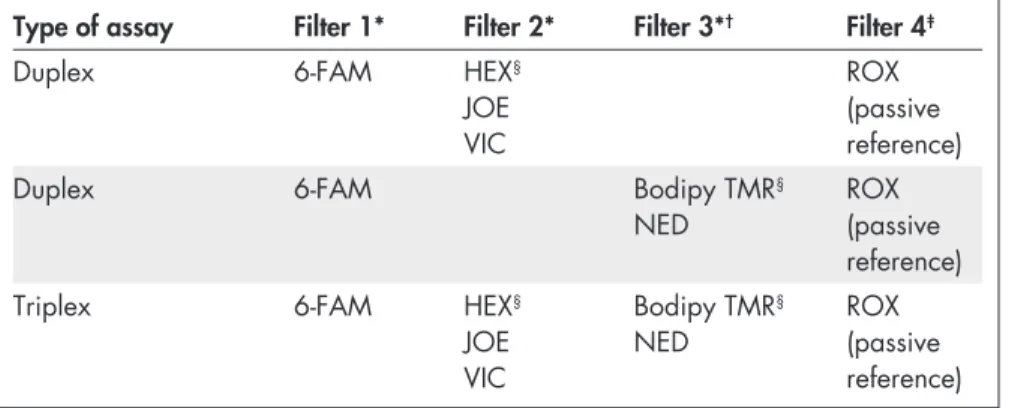
Table 8. Suitable reporter dyes — Applied Biosystems StepOnePlus
Type of assay Filter 1* Filter 2* Filter 3*† Filter 4‡
Duplex 6-FAM HEX§ ROX
JOE (passive
VIC reference)
Duplex 6-FAM Bodipy TMR§ ROX
NED (passive
reference) Triplex 6-FAM HEX§ Bodipy TMR§ ROX
JOE NED (passive
VIC reference)
* Use filter 1, filter 2, and filter 3 to detect the least abundant target, the second least abundant target, and the most abundant target, respectively.
† When using filter 3 in duplex or triplex PCR, all probes in the reaction must be labeled with a
nonfluorescent quencher instead of a fluorescent quencher such as TAMRA dye.
‡ Filter 4 is for detecting ROX passive reference dye, a component of 2x QuantiFast Multiplex PCR Master
Mix.
§ Before using HEX or Bodipy TMR dye, a pure dye calibration of the real-time cycler using this dye must be
performed. See the manufacturer’s manual for details. Supplementary protocols for pure dye calibration of major real-time cyclers are available from QIAGEN Technical Services.
Table 9. Suitable reporter dyes — ABI PRISM 7700*
Passive Type of assay Target 1† Target 2† reference‡
Duplex 6-FAM HEX§ ROX
JOE VIC
* This real-time cycler is only designed for duplex analysis with the standard calibration.
† Target 1 and target 2 correspond to the least abundant target and the second least abundant target,
respectively.
‡ ROX fluorescent dye is used as passive reference and is a component of 2x QuantiFast Multiplex PCR
Master Mix.
§ Before using HEX dye, a pure dye calibration of the real-time cycler using this dye must be performed. See
the manufacturer’s manual for details. Supplementary protocols for pure dye calibration of major real-time cyclers are available from QIAGEN Technical Services.
Recommendations for Mx3000P, Mx3005P, and Mx4000 systems
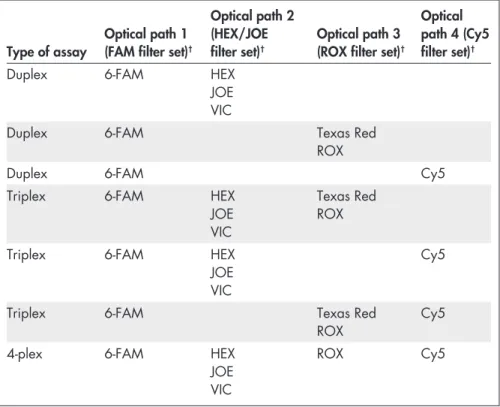
Mx3000P, Mx3005P, and Mx4000 systems allow the use of different combinations of excitation and emission filters. This provides flexibility when selecting reporter dyes for multiplex assays. However, care must be taken to select suitable combinations of reporter dyes and filters that exhibit minimal crosstalk. Suitable combinations of reporter dyes for multiplex assays using Mx3000P, Mx3005P, and Mx4000 systems are given in Table 10 (page 23).
I Before performing a multiplex assay on the Mx3000P, Mx3005P, or Mx4000 system:
I Check which reporter dyes can be detected with the sets of excitation and emission filters installed on your instrument.
View the installed filter sets on your instrument as follows. Make sure the computer is connected to the instrument, and start the instrument software. Click the “Options” menu and select “Optics Configuration” to open the “Optics Configuration” dialog box. Click the “Dye Assignment” tab: the 4 filter sets displayed correspond to the filter sets installed on your instrument. View the dyes assigned to the installed filter sets as follows. In the “Dye Assignment” tab, click “Additional Dye Information” to open the “Dye Information” dialog box. Select “Detected dyes” to display the filter sets installed on your instrument and the defined dyes that are compatible with them.
I Ensure that each reporter dye is detected by a different filter set in a distinct optical path.
I Refer to the Mx4000 Multiplex Quantitative PCR System Instruction Manual, the Mx3005P Real-Time PCR System Instruction Manual, or the Mx3000P Real-Time PCR System On-line Help Manual for additional information on the detection optics and correctly setting up the instrument for multiplex analysis.
I Different detection filter sets are available for Mx3000P, Mx3005P, and Mx4000 systems. Note that only some combinations of filter sets are compatible with multiplex analysis using commonly used reporter dyes. For details, see Table 10 (page 23).
Table 10. Suitable reporter dyes — Mx3000P, Mx3005P, and Mx4000* Optical path 2 Optical Optical path 1 (HEX/JOE Optical path 3 path 4 (Cy5 Type of assay (FAM filter set)† filter set)† (ROX filter set)† filter set)†
Duplex 6-FAM HEX
JOE VIC
Duplex 6-FAM Texas Red
ROX
Duplex 6-FAM Cy5
Triplex 6-FAM HEX Texas Red
JOE ROX
VIC
Triplex 6-FAM HEX Cy5
JOE VIC
Triplex 6-FAM Texas Red Cy5
ROX
4-plex 6-FAM HEX ROX Cy5
JOE VIC
* The Mx3005P has 5 detection channels. This table shows the recommended dyes for use with four of the channels.
† Use optical path 1, optical path 2, and optical paths 3 and 4 to detect the least abundant target, the
Recommendations for the iCycler iQ system
The iCycler iQ system is capable of using different combinations of excitation and emission filters. This provides flexibility when selecting reporter dyes for multiplex assays. However, care must be taken to select suitable combinations of reporter dyes and filters that exhibit minimal crosstalk. Suitable combinations of reporter dyes for multiplex assays using the iCycler iQ system are given in Table 11 (page 25).
I Before performing a multiplex assay on the iCycler iQ system:
I Check that a filter set for each selected reporter dye is installed on the instrument. Ensure that each reporter dye is detected by a different filter set.
I Calibrate each selected reporter dye on the instrument using a pure dye. The iCycler iQ Dye Calibrator Solution Kit (Bio-Rad, cat. no. 170-8792) may be used. Pure dye calibration data are used to separate the total fluorescence signal into the individual dyes. Pure dye calibration data are stored in the file RME.ini, which is stored at C:\Program Files\Bio-Rad\iCycler\Ini.
I Recalibrating the instrument (i.e., overwriting RME.ini) is required when changing the reaction volume, when switching from using caps to optical tape (or vice versa), or when adding new dyes for use in multiplex assays. If desired, the current RME.inifile can be archived before it is overwritten.
I The iCycler iQ system requires the collection of well factors before each run. If your sample plate does not contain the same dyes at the same concentrations in all wells, external well factors must be used. Collecting external well factors can be done using iCycler iQ External Well Factor Solution (Bio-Rad, cat. no. 170-8794).
I Refer to the iCycler iQ Real-Time PCR Detection System Instruction Manual for additional information on filter wheel setup, external well factors, selection and calibration of dyes, and correctly setting up the instrument for multiplex analysis.
Table 11. Suitable reporter dyes — iCycler iQ
Channel 1 Channel 2 Channel 3 Channel 4 (filter (filter (filter (filter Type of assay 490/530)*† 530/575)*† 575/620)*† 635/680)*†
Duplex 6-FAM HEX
JOE VIC
Duplex 6-FAM Texas Red
ROX
Duplex 6-FAM Cy5
Triplex 6-FAM HEX Texas Red
JOE ROX
VIC
Triplex 6-FAM HEX Cy5
JOE VIC
Triplex 6-FAM Texas Red Cy5
ROX
4-plex 6-FAM HEX Texas Red Cy5
JOE ROX
VIC
* The numbers indicate the excitation/emission wavelengths of the detection filter set.
† Use channel 1, channel 2, and channels 3 and 4 to detect the least abundant target, the second least
Recommendations for the LightCycler 2.0 system
The LightCycler 2.0 system has a LED light source that emits blue light of 470 nm and 6 band path detection filters. The available detection channels are 530 nm, 560 nm, 610 nm, 640 nm, 670 nm, and 705 nm. Suitable combinations of reporter dyes for multiplex assays using the LightCycler 2.0 system are given in Table 12 (page 27).
I The LightCycler 2.0 system always detects fluorescence in all of its detection channels. Therefore, there is no need to activate/deactivate the appropriate detection channels for each multiplex assay.
I Multiplex analysis on the LightCycler 2.0 system requires the generation of a color compensation file to separate the fluorescent signals and eliminate crosstalk between the individual detection channels. For details, see Appendix C, page 54.
I Although dyes detected in channels >600 nm are not optimally excited, using the dyes recommended in Table 12 will give a detectable fluorescent signal.
I The reporter dyes shown in Table 12 have been tested by QIAGEN and give reasonable fluorescent signals on the LightCycler 2.0 system. We do not recommend using other reporter dyes. Other dyes that can be potentially detected in channels >600 nm (i.e., detection channels 4, 5, and 6) may be poorly excited by the LightCycler 2.0 system, resulting in poor fluorescent signals.
I Although there are 6 detection channels, we recommend only using detection channels 1 (530 nm), 2 (560 nm), and 3 (610 nm) for duplex and triplex PCR. If performing 4-plex PCR, refer to Table 12 for possible combinations of dyes and their corresponding detection channels.
I Refer to theLightCycler 2.0 Instrument Operator’s Manual for additional information on the detection optics and correctly setting up the instrument.
Table 12. Suitable reporter dyes — LightCycler 2.0
Detection Detection Detection Detection Detection channel 1 channel 2 channel 3 channel 5 channel 6 Type of (530 nm (560 nm (610 nm (670 nm (705 nm assay filter)* filter)* filter)* filter)* filter)* Duplex 6-FAM HEX
JOE VIC
Duplex 6-FAM Texas Red
ROX Triplex 6-FAM HEX Texas Red
JOE ROX
VIC
4-plex 6-FAM HEX Texas Red Cy5
JOE ROX
VIC
4-plex 6-FAM HEX Texas Red Alexa
JOE ROX Fluor®660
VIC Pulsar®650†
* Detection channel 1, detection channel 2, and detection channels 3 and 5/6 should be used to detect the least abundant target, the second least abundant target, and the 2 most abundant targets, respectively.
† This dye exhibits a broad emission peak. The greatest signal can be detected using the 705 nm channel.
Recommendations for the LightCycler 480 system
The LightCycler 480 system uses a xenon lamp as its light source and has 5 excitation filters and 6 emission filters, allowing the setup of 5 detection channels suitable for multiplex analysis. Suitable combinations of reporter dyes for multiplex assays using the LightCycler 480 system are given in Table 13 (page 29).
I Check that each selected reporter dye is compatible with one of the detection channels installed on the instrument. Ensure that each reporter dye is detected by a different channel.
I Refer to the LightCycler 480 Operator’s Manual for additional information on activating and deactivating detection channels and correctly setting up the instrument for multiplex analysis.
I Make sure to select suitable combinations of reporter dyes and filters that exhibit minimal crosstalk. There are 2 options for avoiding crosstalk on the LightCycler 480 system:
I Dyes can be used that have widely separated emission spectra (e.g., FAM and Cy5). However, it is still recommended to determine the degree of crosstalk for these assays.
I Alternatively, the LightCycler 480 system can use a color compensation file that contains information to correct crosstalk between different detection channels. Check that each selected reporter dye is compatible with one of the detection channels installed on the instrument. Ensure that each reporter dye is detected by a different channel
Table 13. Suitable reporter dyes — LightCycler 480
Type of Channel 1 Channel 2 Channel 3 Channel 4 Channel 5 assay (450/500)*† (483/533)*† (523/568)*† (558/610)*† (615/670)*† Duplex Cyan 500 6-FAM
Duplex 6-FAM HEX‡
Duplex 6-FAM Texas Red
ROX
Duplex 6-FAM Cy5
Triplex Cyan 500 6-FAM HEX‡
Triplex Cyan 500 6-FAM Texas Red ROX
Triplex Cyan 500 6-FAM Cy5
Triplex 6-FAM HEX‡ Texas Red
ROX
Triplex 6-FAM HEX‡ Cy5
Triplex 6-FAM Texas Red Cy5
ROX 4-plex Cyan 500 6-FAM HEX‡ Texas Red
ROX
4-plex Cyan 500 6-FAM HEX‡ Cy5
4-plex Cyan 500 6-FAM Texas Red Cy5 ROX
4-plex 6-FAM HEX‡ Texas Red Cy5
ROX
* The numbers in parentheses indicate the wavelengths of the excitation and emission filters on the first-generation LightCycler 480. Newer versions of the LightCycler 480 have slightly different filters installed: please check the user manual supplied with your instrument. All reporter dye combinations shown have been successfully tested by QIAGEN on the first-generation LightCycler 480 only.
† Use channel 2, channel 3, and channels 1, 4 and 5 to detect the least abundant target, the second least
abundant target, and the most abundant targets, respectively.
Controls
No template control (NTC)
All quantification experiments should include an NTC, containing all the components of the reaction except for the template. This enables detection of contamination. No RT control
All RT-PCR experiments should include a negative control to test for contaminating DNA. However, detection of this contamination can be eliminated by using primers or probes that avoid amplification and detection of genomic DNA sequences. If it is not possible to use such primers or probes, DNA contamination can be detected by performing a control reaction in which no reverse transcription is possible. The control “no RT reaction” contains all components including template RNA, except for the reverse transcriptase. Reverse transcription therefore cannot take place. When an aliquot of this control is used as a template in PCR, the only template available would be contaminating DNA.
Alternatively, DNA in the sample can be removed by digestion with DNase before RT-PCR amplification.
Positive control
In some cases it may be necessary to include a positive control, containing a known concentration or copy number of template. Positive controls can be absolute standards or known positive samples.
Absolute standards include commercially available standards and in-lab standards, such as a plasmid containing cloned sequences. Absolute standards are used at a known copy number and provide quantitative information.
A positive sample is usually a substitute for an absolute standard and is used only to test for presence or absence of the target.
Duplex PCR
PCR Kit
Protocol 1: Duplex, Real-Time PCR Using TaqMan
Probes on Most Applied Biosystems Cyclers
This protocol is for use with the QuantiFast Multiplex PCR Kitand TaqMan probes on any real-time cycler from Applied Biosystems except Applied Biosystems 7500 Real-Time PCR Systems. For further information, see “Passive reference dye”, pages 9–10. Important points before starting
I Always start with the cycling conditionsand primer concentrationsspecified in this protocol.
I We strongly recommend testing the performance of primer–probe sets in individual assays before combining them in a multiplex assay.
I Read “Guidelines for effective multiplex assays”, page 15. Check whether your real-time cycler is compatible with the chosen combination of reporter dyes.
I If using an already established duplex real-time PCR assay, use the previously established primer and probe concentrations in combination with the cycling conditions specified in this protocol. It is not necessary to determine primer limiting concentrations again.
I Optimal analysis settings are a prerequisite for accurate quantification data.For data analysis, you should always readjust the analysis settings (i.e., baseline settings and threshold values) for analysis of every reporter dye channel in every run.
Things to do before starting
I For ease of use, we recommend preparing for each of your targets a 20x primer–probe mix containing target-specific primers and probe. A 20x primer–probe mix for duplex PCR consists of 10 µM forward primer, 10 µM reverse primer, and 4 µM probe in TE buffer. Alternatively, it may be preferable to prepare the reaction mix with separate primer and probe solutions. If you commonly set up reactions this way, see Appendix B (page 53).
Procedure
1. Thaw 2x QuantiFast Multiplex PCR Master Mix, primer and probe solutions, RNase-free water, and template DNA or cDNA. Mix the individual solutions, and place on ice.
Note: Due to the hot start, it is not necessary to keep samples on ice during reaction setup nor while programming the real-time cycler.
Table 14. Reaction setup
Component Volume* Final concentration 2x QuantiFast Multiplex PCR 12.5 µl 1x Master Mix
20x primer–probe mix 1† 1.25 µl 0.5 µM forward primer 1‡
0.5 µM reverse primer 1‡
0.2 µM probe 1§
20x primer–probe mix 2† 1.25 µl 0.5 µM forward primer 2‡
0.5 µM reverse primer 2‡
0.2 µM probe 2§
RNase-free water Variable –
Template DNA or cDNA Variable ≤100 ng/reaction (added at step 4)
Total reaction volume 25 µl* –
* If your real-time cycler requires a final reaction volume other than 25 µl, adjust the amount of master mix and all other reaction components accordingly. If using 384-well plates on the Applied Biosystems 7900HT, use a reaction volume of 10 µl.
† A 20x primer–probe mix for duplex PCR consists of 10 µM forward primer, 10 µM reverse primer, and
4 µM probe in TE buffer.
‡ A final primer concentration of 0.5 µM is optimal. Before adapting primer concentration, verify the
concentration of your primer solutions.
§ A final probe concentration of 0.2 µM gives satisfactory results in most cases. Depending on the synthesis
quality and purification method used, the optimal concentration may be between 0.1 µM and 0.4 µM.
3. Mix the reaction mix thoroughly, and dispense appropriate volumes into PCR tubes or the wells of a PCR plate.
4. Add template DNA or cDNA (
ⱕ
100 ng) to the individual PCR tubes or wells. Note: For two-step RT-PCR, the volume of cDNA (from the undiluted RT reaction) added as template should not exceed 10% of the final PCR volume.5. Program the real-time cycler according to Table 15 (page 33).
Note: Check the real-time cycler’s user manual for correct instrument setup for multiplex analysis (e.g., setting up detection of multiple dyes from the same well). Be sure to activate the detector for each reporter dye used. Depending on your instrument, it may also be necessary to perform a calibration procedure for each of the reporter dyes before they are used for the first time.
Duplex PCR
PCR Kit
Table 15. Cycling conditions
Step Time Temperature Additional comments Initial PCR activation step 5 min 95°C HotStarTaq Plus DNA
Polymerase is activated by this heating step
2-step cycling Important: Optimal
performance is only assured using these cycling conditions Denaturation 30 s 95°C
Annealing/extension 30 s 60°C Combined annealing/ extension step with
fluorescence data collection Number of cycles 40–45 The number of cycles
depends on the amount of template DNA or cDNA and the expression level of the target gene
6. Place the PCR tubes or plate in the real-time cycler, and start the cycling program. 7. Perform data analysis.
Before performing data analysis, select the analysis settings for each probe (i.e., baseline settings and threshold values). Optimal analysis settings are a prerequisite for accurate quantification data.
Triplex/4-plex PCR
PCR Kit
Protocol 2: Triplex and 4-plex, Real-Time PCR Using
TaqMan Probes on Most Applied Biosystems Cyclers
This protocol is for use with the QuantiFast Multiplex PCR Kitand TaqMan probes on any real-time cycler from Applied Biosystems except Applied Biosystems 7500 Real-Time PCR Systems. For further information, see “Passive reference dye”, pages 9–10. Important points before starting
I Always start with the cycling conditionsand primer concentrationsspecified in this protocol. Please note that the cycling conditions differ from those described in the protocol for duplex assays (page 31).
I We strongly recommend testing the performance of primer–probe sets in individual assays before combining them in a multiplex assay.
I Read “Guidelines for effective multiplex assays”, page 15. Check whether your real-time cycler is compatible with the chosen combination of reporter dyes.
I If using an already established multiplex real-time PCR assay, use the previously established primer and probe concentrations in combination with the cycling conditions specified in this protocol. It is not necessary to determine primer limiting concentrations again.
I Optimal analysis settings are a prerequisite for accurate quantification data.For data analysis, you should always readjust the analysis settings (i.e., baseline settings and threshold values) for analysis of every reporter dye channel in every run.
Things to do before starting
I For ease of use, we recommend preparing for each of your targets a 20x primer–probe mix containing target-specific primers and probe. A 20x primer–probe mix for triplex and 4-plex PCR consists of 10 µM forward primer, 10 µM reverse primer, and 4 µM probe in TE buffer. Alternatively, it may be preferable to prepare the reaction mix with separate primer and probe solutions. If you commonly set up reactions this way, see Appendix B (page 53).
Triplex/4-plex PCR
PCR Kit
Procedure
1. Thaw 2x QuantiFast Multiplex PCR Master Mix, primer and probe solutions, RNase-free water, and template DNA or cDNA. Mix the individual solutions, and place on ice.
2. Prepare a reaction mix according to Table 16 (page 36).
Note: We strongly recommend starting with the optimized Mg2+ concentration
provided by 2x QuantiFast Multiplex PCR Master Mix.
Note: Due to the hot start, it is not necessary to keep samples on ice during reaction setup nor while programming the real-time cycler.
3. Mix the reaction mix thoroughly, and dispense appropriate volumes into PCR tubes or the wells of a PCR plate.
4. Add template DNA or cDNA (
ⱕ
100 ng) to the individual PCR tubes or wells. Note: For two-step RT-PCR, the volume of cDNA (from the undiluted RT reaction) added as template should not exceed 10% of the final PCR volume.5. Program the real-time cycler according to Table 17 (page 37).
Note: Check the real-time cycler’s user manual for correct instrument setup for multiplex analysis (e.g., setting up detection of multiple dyes from the same well). Be sure to activate the detector for each reporter dye used. Depending on your instrument, it may also be necessary to perform a calibration procedure for each of the reporter dyes before they are used for the first time.
Table 16. Reaction setup
Component Volume* Final concentration
2x QuantiFast Multiplex PCR 12.5 µl 1x Master Mix
20x primer–probe mix 1† 1.25 µl 0.5 µM forward primer 1‡
0.5 µM reverse primer 1‡
0.2 µM probe 1§
20x primer–probe mix 2† 1.25 µl 0.5 µM forward primer 2‡
0.5 µM reverse primer 2‡
0.2 µM probe 2§
20x primer–probe mix 3† 1.25 µl 0.5 µM forward primer 3‡
0.5 µM reverse primer 3‡
0.2 µM probe 3§
Only for 4-plex PCR:
20x primer–probe mix 4† 1.25 µl 0.5 µM forward primer 4‡
0.5 µM reverse primer 4‡
0.2 µM probe 4§
RNase-free water Variable –
Template DNA or cDNA Variable ≤100 ng/reaction (added at step 4)
Total reaction volume 25 µl* –
* If your real-time cycler requires a final reaction volume other than 25 µl, adjust the amount of master mix and all other reaction components accordingly. If using 384-well plates on the Applied Biosystems 7900HT, use a reaction volume of 10 µl.
† A 20x primer–probe mix for triplex and 4-plex PCR consists of 10 µM forward primer, 10 µM reverse
primer, and 4 µM probe in TE buffer.
‡ A final primer concentration of 0.5 µM is optimal. Before adapting primer concentration, check the
concentration of your primer solutions.
§ A final probe concentration of 0.2 µM gives satisfactory results in most cases. Depending on the synthesis
quality and purification method used, the optimal concentration may be between 0.1 µM and 0.4 µM.
Triplex/4-plex PCR
Triplex/4-plex PCR
PCR Kit
Table 17. Cycling conditions
Step Time Temperature Additional comments Initial PCR activation step 5 min 95°C HotStarTaq Plus DNA
Polymerase is activated by this heating step
2-step cycling Important: Optimal
performance is only assured using these cycling
conditions* Denaturation 45 s 95°C
Annealing/extension 45 s 60°C Combined annealing/ extension step with
fluorescence data collection Number of cycles 40–45 The number of cycles
depends on the amount of template DNA or cDNA and the expression level of the target gene
* Depending on the assay, the times for the denaturation and annealing/extension steps may be reduced to 30 seconds each. For initial experiments, we always recommend to start with the cycling conditions specified in this table.
6. Place the PCR tubes or plate in the real-time cycler, and start the cycling program. 7. Perform data analysis.
Before performing data analysis, select the analysis settings for each probe (i.e., baseline settings and threshold values). Optimal analysis settings are a prerequisite for accurate quantification data.
Duplex PCR
PCR +R Kit
Protocol 3: Duplex, Real-Time PCR Using TaqMan
Probes on the Applied Biosystems 7500 and Other
Cyclers
This protocol is for use with the QuantiFast Multiplex PCR +R Kitand TaqMan probes on Applied Biosystems 7500 Real-Time PCR Systems and on real-time cyclers from Bio-Rad/MJ Research, Cepheid, Eppendorf, Roche, and Agilent. For further information, see “Passive reference dye”, pages 9–10.
Important points before starting
I Always start with the cycling conditionsand primer concentrationsspecified in this protocol.
I We strongly recommend testing the performance of primer–probe sets in individual assays before combining them in a multiplex assay.
I Read “Guidelines for effective multiplex assays”, page 15. Check whether your real-time cycler is compatible with the chosen combination of reporter dyes.
I If using an already established duplex real-time PCR assay, use the previously established primer and probe concentrations in combination with the cycling conditions specified in this protocol. It is not necessary to determine primer limiting concentrations again.
I Optimal analysis settings are a prerequisite for accurate quantification data.For data analysis, you should always readjust the analysis settings (i.e., baseline settings and threshold values) for analysis of every reporter dye channel in every run.
I If using the LightCycler 2.0 or LightCycler 480, be sure to create a color compensation file. For details, see Appendix C (page 54). If using reporter dyes with widely separated emission spectra on the LightCycler 480, a color compensation file may not be necessary.
Things to do before starting
I For ease of use, we recommend preparing for each of your targets a 20x primer–probe mix containing target-specific primers and probe. A 20x primer–probe mix for duplex PCR consists of 10 µM forward primer, 10 µM reverse primer, and 4 µM probe in TE buffer. Alternatively, it may be preferable to prepare the reaction mix with separate primer and probe solutions. If you commonly set up reactions this way, see Appendix B (page 53).
Duplex PCR
PCR +R Kit
Procedure
1. Thaw 2x QuantiFast Multiplex PCR Master Mix (w/o ROX), 50x ROX Dye Solution, primer and probe solutions, RNase-free water, and template DNA or cDNA. Mix the individual solutions, and place on ice.
2. Prepare a reaction mix according to Table 18 (page 40).
Note: We strongly recommend starting with the optimized Mg2+ concentration
provided by 2x QuantiFast Multiplex PCR Master Mix (w/o ROX).
Note: Due to the hot start, it is not necessary to keep samples on ice during reaction setup nor while programming the real-time cycler.
3. Mix the reaction mix thoroughly, and dispense appropriate volumes into PCR tubes, PCR capillaries, or the wells of a PCR plate.
4. Add template DNA or cDNA (
ⱕ
100 ng) to the individual PCR tubes, capillaries, or wells.Note: For two-step RT-PCR, the volume of cDNA (from the undiluted RT reaction) added as template should not exceed 10% of the final PCR volume.
5. Program the real-time cycler according to Table 19 (page 41).
Note: Check the real-time cycler’s user manual for correct instrument setup for multiplex analysis (e.g., setting up detection of multiple dyes from the same well). Be sure to activate the detector for each reporter dye used. Depending on your instrument, it may also be necessary to perform a calibration procedure for each of the reporter dyes before they are used for the first time.
Table 18. Reaction setup
Volume/reaction* 96-well Fast or
Component block capillary† Final concentration 2x QuantiFast Multiplex 12.5 µl 10 µl 1x PCR Master Mix (w/o
ROX)
50x ROX Dye Solution‡ 0.5 µl 0.4 µl 1x
20x primer–probe mix 1§ 1.25 µl 1 µl 0.5 µM forward primer 1¶
0.5 µM reverse primer 1¶
0.2 µM probe 1** 20x primer–probe mix 2§ 1.25 µl 1 µl 0.5 µM forward primer 2¶
0.5 µM reverse primer 2¶
0.2 µM probe 2** RNase-free water Variable Variable –
Template DNA or Variable Variable ≤100 ng/reaction cDNA
(added at step 4)
Total reaction volume 25 µl* 20 µl* –
* If your real-time cycler requires a final reaction volume other than 25 µl or 20 µl, adjust the amount of master mix and all other reaction components accordingly. If using 384-well plates on the LightCycler 480, use a reaction volume of 10 µl.
† Refers to the Applied Biosystems 7500 Fast Real-Time PCR System and capillary cyclers, such as the
LightCycler 2.0.
‡ For cyclers which do not require ROX dye, add RNase-free water instead.
§ A 20x primer–probe mix for duplex PCR consists of 10 µM forward primer, 10 µM reverse primer, and
4 µM probe in TE buffer.
¶ A final primer concentration of 0.5 µM is optimal. Before adapting primer concentration, check the
concentration of your primer solutions.
**A final probe concentration of 0.2 µM gives satisfactory results in most cases. Depending on the synthesis quality and purification method used, the optimal concentration may be between 0.1 µM and 0.4 µM.
Duplex PCR
PCR +R Kit
Duplex PCR
PCR +R Kit
Table 19. Cycling conditions
Step Time Temperature Additional comments Initial PCR activation step 5 min 95°C HotStarTaq Plus DNA
Polymerase is activated by this heating step
2-step cycling Important: Optimal
performance is only assured using these cycling conditions Denaturation 30 s 95°C
Annealing/extension 30 s 60°C Combined annealing/ extension step with
fluorescence data collection Number of cycles 40–45 The number of cycles
depends on the amount of template DNA or cDNA and the expression level of the target gene
6. Place the PCR tubes, capillaries, or plate in the real-time cycler, and start the cycling program.
7. Perform data analysis.
Before performing data analysis, select the analysis settings for each probe (i.e., baseline settings and threshold values). Optimal analysis settings are a prerequisite for accurate quantification data.
Triplex/4-plex PCR
PCR +R Kit
Protocol 4: Triplex and 4-plex, Real-Time PCR Using
TaqMan Probes on the Applied Biosystems 7500 and
Other Cyclers
This protocol is for use with the QuantiFast Multiplex PCR +R Kitand TaqMan probes on Applied Biosystems 7500 Real-Time PCR Systems and on real-time cyclers from Bio-Rad/MJ Research, Cepheid, Eppendorf, Roche, and Agilent. For further information, see “Passive reference dye”, pages 9–10.
Important points before starting
I Always start with the cycling conditionsand primer concentrationsspecified in this protocol. Please note that the cycling conditions differ from those described in the protocol for duplex assays (page 38).
I We strongly recommend testing the performance of primer–probe sets in individual assays before combining them in a multiplex assay.
I Read “Guidelines for effective multiplex assays”, page 15. Check whether your real-time cycler is compatible with the chosen combination of reporter dyes.
I If using an already established multiplex real-time PCR assay, use the previously established primer and probe concentrations in combination with the cycling conditions specified in this protocol. It is not necessary to determine primer limiting concentrations again.
I Optimal analysis settings are a prerequisite for accurate quantification data. For data analysis, you should always readjust the analysis settings (i.e., baseline settings and threshold values) for analysis of every reporter dye channel in every run.
I If using the LightCycler 2.0 or LightCycler 480, be sure to create a color compensation file. For details, see Appendix C (page 54). If using reporter dyes with widely separated emission spectra on the LightCycler 480, a color compensation file may not be necessary.
Things to do before starting
I For ease of use, we recommend preparing for each of your targets a 20x primer–probe mix containing target-specific primers and probe. A 20x primer–probe mix for triplex and 4-plex PCR consists of 10 µM forward primer, 10 µM reverse primer, and 4 µM probe in TE buffer. Alternatively, it may be preferable to prepare the reaction mix with separate primer and probe solutions. If you commonly set up reactions this way, see Appendix B (page 53).
Triplex/4-plex PCR
PCR +R Kit
Procedure
1. Thaw 2x QuantiFast Multiplex PCR Master Mix (w/o ROX), 50x ROX Dye Solution, primer and probe solutions, RNase-free water, and template DNA or cDNA. Mix the individual solutions, and place on ice.
2. Prepare a reaction mix according to Table 20 (page 44).
Note: We strongly recommend starting with the optimized Mg2+ concentration
provided by 2x QuantiFast Multiplex PCR Master Mix (w/o ROX).
Note: Due to the hot start, it is not necessary to keep samples on ice during reaction setup nor while programming the real-time cycler.
3. Mix the reaction mix thoroughly, and dispense appropriate volumes into PCR tubes, PCR capillaries, or the wells of a PCR plate.
4. Add template DNA or cDNA (
ⱕ
100 ng) to the individual PCR tubes, capillaries, or wells.Note: For two-step RT-PCR, the volume of cDNA (from the undiluted RT reaction) added as template should not exceed 10% of the final PCR volume.
5. Program the real-time cycler according to Table 21 (page 45).
Note: Check the real-time cycler’s user manual for correct instrument setup for multiplex analysis (e.g., setting up detection of multiple dyes from the same well). Be sure to activate the detector for each reporter dye used. Depending on your instrument, it may also be necessary to perform a calibration procedure for each of the reporter dyes before they are used for the first time.
Table 20. Reaction setup
Volume/reaction* 96-well Fast or
Component block capillary† Final concentration 2x QuantiFast Multiplex 12.5 µl 10 µl 1x PCR Master Mix (w/o
ROX)
50x ROX Dye Solution‡ 0.5 µl 0.4 µl