B a t E c h o l o c a t i o n R e s e a r c h
tools, techniques and analysis
E D I T O R S
R. Mark Brigham, Elisabeth K. V. Kalko, Gareth Jones,
Stuart Parsons, Herman J. G. A. Limpens
Austin, Texas
2002
ii Bat Echolocation Research: tools, techniques & analysis
Mention of products, corporations, or firms in this publication is for the reader’s information and reflects the views of the specific author. It does not constitute approval or endorsement by sponsors of the symposium or these proceedings.
E
DITED BYR. Mark Brigham, Elisabeth K. V. Kalko, Gareth Jones,
Stuart Parsons, Herman J. G. A. Limpens
S
YMPOSIUM SPONSORSHosted by Bat Conservation International
Funded by National Fish & Wildlife Foundation
C
ITATIONBrigham, R. M., et al., eds. 2004. Bat Echolocation
Research: tools, techniques and analysis. Bat
Conservation International. Austin, Texas
Bat Echolocation Research
tools, techniques and analysis
Information on obtaining copies of this report (depending on supply) may be obtained from: Bat Conservation International
PO Box 162603 Austin, TX 78737 [email protected] © 2004 Bat Conservation International
iii
C
ONTRIBUTINGA
UTHORSv
D
EDICATIONvi
I
NTRODUCTIONvii
R. Mark Brigham
B
ATD
ETECTORL
IMITATIONS ANDC
APABILITIESApplications for bat research
Bat Natural History and Echolocation
2
M. Brock Fenton
The Past and Future History of Bat Detectors
6
Donald R. Griffin
The Properties of Sound and Bat Detectors
9
Lars Pettersson
Foraging Habits of North American Bats
13
Thomas H. Kunz
A
COUSTICI
NVENTORIESUltrasound Detection: Basic Concepts
Choosing a Bat Detector: Theoretical and Practical Aspects
28
Herman J. G. A. Limpens and Gary F. McCracken
Are Acoustic Detectors a ‘Silver Bullet’ for Assessing Habitat Use by Bats?
38
William L. Gannon and Richard E. Sherwin
Field Identification: Using Bat Detectors to Identify Species
46
Herman J. G. A. Limpens
Acoustic Surveys And Non-Phyllostomid Neotropical Bats:
How Effective Are They?
58
Bruce W. Miller
Neotropical Leaf-Nosed Bats (
Phyllostomidae):
“Whispering” Bats as Candidates For Acoustic Surveys?
63
Elisabeth K. V. Kalko
U
LTRASOUNDS
PECIESI
DENTIFICATIONField and Laboratory Applications
Heterodyne and Time-Expansion Methods for Identification of Bats
in the Field and through Sound Analysis
72
Ingemar Ahlén
Designing Monitoring Programs Using Frequency-Division Bat Detectors:
Active Versus Passive Sampling
79
Eric R. Britzke
Bat Echolocation Research: tools, techniques & analysis
iv
Designing Bat Activity Surveys Using Time Expansion
and Direct Sampling of Ultrasound
83
Gareth Jones, Nancy Vaughan, Danilo Russo, Liat P. Wickramasinghe, and Stephen Harris
Frequency Division: A Technical Overview
89
Tony Messina
Time Expansion: Analysis Capabilities and Limitations and Field Design
91
Lars Pettersson
Zero-Crossings Analysis For Bat Identification: An Overview
95
Chris Corben
Bats in the Field and in a Flight Cage:
Recording and Analysis of Their Echolocation Calls and Behavior
107
Björn M. Siemers
Signal Processing Techniques for Species Identification
114
Stuart Parsons
Advanced Analysis Techniques for Identifying Bat Species
121
Joseph M. Szewczak
Wrap-Up: Using Bat Detectors for Species Identification
127
William E. Rainey
R
ESOURCES, R
ESEARCH,
ANDS
TUDYU
SINGB
ATD
ETECTORSFuture Directions
Bat Specific Signal Analysis Software – BATSOUND
130
Lars Pettersson
Reporting: Essential Information and Analysis
133
M. Brock Fenton
European Agency Perspectives: Expectations from Bat Detector Studies
140
Peter Boye
Geographic Variation in the Echolocation Calls of Bats:
A Complication for Identifying Species by Their Calls
144
Robert M. R. Barclay and R. Mark Brigham
Bat Call Libraries: Management and Potential Use
150
Dean A. Waters and William L. Gannon
Designing Bat Activity Surveys for Inventory and Monitoring Studies
at Local and Regional Scales
157
Allyson L. Walsh, Robert M. R. Barclay, and Gary F. McCracken
Conference Wrap-Up: Where do we go from here?
166
Gareth Jones
Bat Echolocation Research: tools, techniques & analysis
v
Ingemar Ahlén Department of Conservation Biology, SLU, Box 7002, SE-750 07 Uppsala, Sweden
Robert M. R. Barclay Department of Biological Sciences, University of Calgary, Calgary, AB, Canada T2N 1N4
Peter Boye Federal Agency for Nature Conservation, Konstantinstrasse 110, 53179 Bonn, Germany
R. Mark Brigham Department of Biology, University of Regina, Regina, SK, Canada S4S 0A2
Eric R. Britzke Department of Biology, Tennessee Technological University, Cookeville, TN 38505, United
States [email protected]
Chris Corben [email protected]
M. Brock Fenton Department of Biology, University of Western Ontario, London, ON, Canada N6A 5B7
William L. Gannon Department of Biology and Museum of Southwestern Biology, University of New Mexico,
Albuquerque, New Mexico 87131, United States [email protected]
Donald R. Griffin Deceased
Stephen Harris School of Biological Sciences, University of Bristol, Woodland Road, Bristol BS8 1UG, United Kingdom
Gareth Jones School of Biological Sciences, University of Bristol, Woodland Road, Bristol BS8 1UG,
United Kingdom [email protected]
Herman J.G.A. Limpens Society for Study and Conservation of Mammals Eco Consult and Project Management, Roghorst 99, 6708 KD Wageningen, Netherlands [email protected]
Elisabeth K. V. Kalko University of Ulm, Experimental Ecology, D – 89069 Ulm, Germany and Smithsonian Tropical Research Institute, Balboa, P. O. Box 2072, Panama [email protected]
Thomas H. Kunz Department of Biology, Boston University, Boston, MA 02215, United States
Gary F. McCracken Department of Ecology and Evolutionary Biology, University of Tennessee, Knoxville, TN
37996, United States [email protected]
Tony Messina Nevada Bat Technology, Box 33941, Las Vegas, NV 89133, United States
Bruce W. Miller The Wildlife Conservation Society, 2300 Southern Blvd., Bronx, New York 10460, United States
Stuart Parsons School of Biological Sciences, University of Auckland, Private Bag 92019, Auckland,
New Zealand [email protected]
Lars Pettersson Pettersson Elektronik AB, Tallbacksvägen 51, SE-756 45 Uppsala, Sweden
William E. Rainey Department of Integrative Biology, University of California, Berkeley, 3060 Valley Life Sciences Building #3140, Berkeley, California 94720, United States [email protected]
Danilo Russo Laboratorio di Ecologia Applicata, Dipartimento Ar.Bo.Pa.Ve., Facoltà di Agraria, Università degli Studi di Napoli Federico II, via Università, 100, I-80055 Portici (Napoli), Italy
Richard E. Sherwin Department of Biology and Museum of Southwestern Biology, University of New Mexico,
Albuquerque, New Mexico, 87131, United States [email protected]
Björn M. Siemers Animal Physiology, Zoological Institute, Tübingen University, Morgenstelle 28,72076
Tübingen, Germany [email protected]
Joseph M. Szewczak Department of Biological Sciences, Humboldt State University, 1 Harpst St., Arcata, California
95521, United States [email protected]
Nancy Vaughan School of Biological Sciences, University of Bristol, Woodland Road, Bristol BS8 1UG, United Kingdom
Allyson L. Walsh Lubee Bat Conservancy, 1309 N.W. 192nd Avenue, Gainesville, Florida 32609, United States
Dean A. Waters School of Biology, University of Leeds, Leeds LS2 9JT, United Kingdom
Liat P. Wickramasinghe School of Biological Sciences, University of Bristol, Woodland Road, Bristol BS8 1UG, United Kingdom
Bat Echolocation Research: tools, techniques & analysis
vi Bat Echolocation Research: tools, techniques & analysis
DEDICATION
D
ONALDR
EDFIELDG
RIFFINcoined the term “echolocation” to describe
how bats use echoes of sounds they produce to locate objects in
their path. This eye-opening discovery about animal behavior
spawned a new field of research that attracted colleagues from animal
behavior, neurobiology, signal theory, anatomy, and physiology.
Don died on November 7, 2003. He is survived by his work. He left the
world of biology a much richer place. To appreciate Don’s contribution,
read his 1958 classic,
Listening in the Dark. Do so after you think you have
dis-covered something new about bats and echolocation. Usually, you will find
that Don had visited your new discovery somewhat earlier.
I first met Don at the bat meetings in New Orleans in 1973, then spent
several months with him while on sabbatical leave in 1976. In 1980, we
worked together in the field in Australia. I especially remember his review of
a paper I had submitted about the evolution of echolocation. True to form,
he was critical, engaging, challenging, and supportive.
In November 2002, he presented a paper about feeding buzzes at the bat
meetings in Burlington, Vermont. Once again, Don took us to the magic
well of echolocation. It is his well, but he always shared it – and he will ever
be with those who go there.
M. B
ROCKF
ENTONDonald Redfield Griffin
vii
I
T IS MY PLEASURE TO INTRODUCE YOU TO THISVOLUME
, the outcome of the Bat Echolocation
Symposium and Tutorial held April 15-17, 2002, in
Austin, Texas. The symposium grew largely from
the vision of Lars Pettersson and Herman Limpens,
but it could not have occurred without direct
finan-cial support of the National Fish and Wildlife
Foundation and the organizational efforts of Bat
Conservation International, which hosted it.
The symposium brought together leading
authorities on bat echolocation and the detector
systems used to study these fascinating animals.
The focus was to evaluate the applications, capa
-bilities, and limitations of equipment designed to
detect and analyze bat-echolocation calls. This
vol-ume provides a formal record of the symposium. I
hope it will be of considerable use to participants
and other investigators already familiar with the use
of bat detectors. More importantly, however, I hope
these reports will stimulate and guide the
uninitiat-ed to consider the ways and means of learning
about the world of bats through their echolocation
calls. Bats harbor many secrets they have yet to give
up. This was strongly reaffirmed in my mind as I
lis-tened to the presentations and read the papers
con-tained in this volume. Hopefully, this collection of
papers will help improve the techniques used to
study bats through their echolocation calls so more
of their secrets will be revealed.
The volume contains 23 papers submitted by
authors who gave oral presentations at the
sympo-sium. All manuscripts were reviewed for merit,
clar-ity, and accuracy by at least one reviewer, with the
understanding that rejection was not possible. I
sin-cerely thank Gareth Jones, Elisabeth Kalko,
Herman Limpens, and Stuart Parsons for rapidly
and thoughtfully reviewing the manuscripts. Their
comments and suggestions substantively improved
what you will read on the following pages. I then
edited each manuscript for clarity and brevity.
I believe the resulting papers provide a good
overview of the diversity of work being done on bat
echolocation and the viewpoints of those involved
in that effort. Some of the papers are, strictly
speak-ing, less “scientific” and more “opinion” than others.
This should not detract from their usefulness or
from the goal of motivating people to consider
other ways and means of doing more and better
work. The volume concludes with brief overviews
by Bill Rainey and Gareth Jones, who nicely
sum-marize where we got to over the three days.
Donald Griffin, the codiscoverer of bat
echolo-cation – and the person who coined the term –
attended the symposium and contributed a paper to
this volume. Fully 65 years after he coauthored the
initial report describing bat echolocation by these
animals, Don was still working to unlock the
linger-ing secrets. This speaks to the dedication of the
man and the tenacity with which the animals are
holding out on us. We were deeply saddened to
learn of his passing in November 2003 and feel it
fitting that this volume should be dedicated to him.
I candidly confess that while I was thrilled to be
invited to the symposium, I was never sure that my
limited expertise merited the honor. For that reason,
I was more than willing to serve as editor for this
volume. My foremost goal was to make all the
man-uscripts as clear as possible so they would be as
use-ful as possible. Only the readers can judge if that
goal was met.
My second goal was to have the editorial process
proceed quickly so that the final product was
pro-duced in as timely a fashion as possible. I thank the
reviewers and the authors for putting up with my
constant flogging and Bob Locke at BCI for
under-taking the copyediting and production process. Brian
Keeley was the principal logistical coordinator of the
symposium. He deserves hearty thanks for seeing to
it that a most wonderful mob was brought together.
Julie Jenkins and Janet Tyburec of BCI also played
significant roles in helping to organize and facilitate
a great meeting. I am most grateful to Allyson Walsh,
who got the publication process off the ground. She
helped me immeasurably and I owe her a sincere debt
of gratitude.
But most of all, thank you, Don, for getting us
into the game.
R. M
ARKB
RIGHAM Bat Echolocation Research: tools, techniques & analysisS e c t i o n 1
B
AT
D
ETECTOR
L
IMITATIONS AND
C
APABILITIES
I
NTRODUCTIONToday our view of the natural history of bats is inex-tricably linked to echolocation. It was not always so and, for all of the magical appeal of echolocation (Griffin 1995), there was a time lag of about 30 years between the publication of the first papers about echolocation in 1939 and any groundswell of research activity there (Figure 1 in Grinnell 1980). Paralleling this lag was the time it took for textbook and review literature to document the diver-sity of echolocation behavior in bats. By the end of the 1970s, field studies of bats and their sounds became more prevalent in the literature and it took still more time for biologists to realize that there was more to bats than echolocation (and more to echolocation than bats).
Instrumentation was a bottleneck in the development of research on echolocation. Initially the lack of equip-ment for working with sounds beyond the range of human hearing (ultrasonic) hindered the development of this discipline. Only when such systems were readily available commercially and at prices within the reach of the “average” biologist, did research on the natural his-tory of bat echolocation begin in earnest. Today we are faced with an embarrassment of riches when it comes to bat detectors, and it can be hard to remember that this is a relatively new development. In 1980, when Gary Bell and I submitted a manuscript describing species-specific echolocation calls, one reviewer remarked that the infor-mation was interesting but of limited value because the necessary equipment was not readily available to others.
Today we know that not all bats echolocate. We also know that all echolocating bats do not use echolocation in the same way, or even use the same approach to echolocation. An undetermined number of species of
Rousettus use tongue clicks as echolocation signals, while
all other bats appear to use vocalizations produced by the vocal cords (Popper and Fay 1995). Some bats use high intensity (>110 dB sound pressure level [SPL] @10 cm) echolocation calls, mainly species hunting flying prey or prey moving on the water’s surface (e.g., Kalko 1995; Kalko et al. 1998). Other bats produce low inten-sity (60-80 dB SPL @ 10 cm) echolocation calls that appear to serve in general orientation while sounds from prey are used to detect, locate, and assess targets. But some bats using low intensity echolocation calls also produce feeding buzzes (e.g., Myotis bechsteinii and Myotis nattereri – H. Limpens, pers. comm.; Megaderma lyra –
Rat-cliffe, pers. comm.). Some flowers have ultrasonic nectar guides to steer bats towards nectar and pollen (von Hel-versen and von HelHel-versen 1999; von HelHel-versen et al. 2003). Will we find the same structures in fruits? It is possible that the erect, spike-like fruits of Piper species or
the U-shaped fruits of other plants could aid bats in localizing them (Thies et al. 1998). Echolocation is most obviously connected to the foraging behavior of bats, but it is also involved in communication and influences access to roosts.
Most species of echolocating bats separate pulse and echo in time and cannot tolerate overlap between the outgoing pulse and returning echo (Fenton et al. 1995; Kalko and Schnitzler 1993; Schnitzler and Kalko 2001). Typically, calls are relatively short, much shorter than the intervals between calls. Since these bats produce sig-nals about 10% of the time, they are “low duty cycle.” Other bats (rhinolophids, hipposiderids, and the mor-moopid Pteronotus parnellii) separate pulse and echo in
fre-quency (Fenton et al. 1995; Schnitzler and Kalko 2001). These species can tolerate overlap between pulse and echo, and they produce signals 40-80% of the time (at high duty cycle). Their calls are long relative to the
BAT NATURAL HISTORY AND ECHOLOCATION
M. BROCK FENTON Department of Biology, University of Western Ontario, London, ON, Canada N6A 5B7
Today our view of the natural history of bats is inextricably linked to echolocation even though not all bats echolocate and not all bats use echolocation in the same way. The availability of commercially produced, inexpen-sive bat detectors is one reason for the explosion in data linking echolocation with the biology of bats. Among microchiropteran bats there are two dichotomies in echolocation behavior: 1) species using high intensity versus low intensity calls; 2) species producing calls at low versus high duty cycle. Furthermore, microchiropterans use a wide range of frequencies in echolocation, from around 10 kHz to over 200 kHz. Echolocation by bats is not synony-mous with ultrasound. Limited range and information leakage are two important disadvantages of echolocation. It is becoming increasingly obvious that echolocation calls can simultaneously serve a communication role in bats. The implications for bats of these variations in echolocation behavior are reviewed.
Key words: bat detectors, behavior, communication, duty cycle, information leakage Correspondent: [email protected]
intervals between calls.
The echolocation calls of most species of bats are “ultrasonic,” by definition, beyond the upper limit of human hearing (arbitrarily 20 kHz). Bats use a range of frequencies in their echolocation sounds, from very high-pitched (Cloeotis percivali – calls dominated by
sounds >200 kHz), to relatively low-pitched (Euderma maculatum – calls dominated by sounds ~ 10 kHz), which
are not ultrasonic because they are readily audible to most people. But E. maculatum is not an exception; many
other species use echolocation calls that are readily audi-ble to humans. A sampling from the list includes Tadari-da teniotis (Russo and Jones 2002), Otomops mar tiensseni
(Fenton et al. 2002), Nyctinomus australis (Churchill
1998), Mops midas (Fenton et al. 1998), Eumops perotis, and Nyctinimops macrotis (Harvey et al. 1999). Bats producing
echolocation calls that are audible to people have now been reported from many locations, but too often biolo-gists speak of bats using “ultrasonic echolocation.” Ultra-sonic is not synonymous with echolocation, whether we observe the behavior in bats, birds, or toothed whales.
Shorter wavelengths mean that high-frequency echolocation calls have the potential to give an echolo-cating bat more detail about its target than lower-fre-quency calls (Griffin 1958; Simmons and Stein 1980). High-frequency calls have the disadvantage of being more subject to atmospheric attenuation than lower-fre-quency calls (Griffin 1971; Lawrence and Simmons 1982). Atmospheric attenuation and spreading loss com-bine to limit the movement of sound waves in air, reduc-ing the effective range of echolocation. The frequencies dominating the echolocation calls of most aerial-feeding bats (20 to 60 kHz) probably represent a compromise between attenuation (range) and detail about targets (Fenton et al. 1998).
T
WOD
ISADVANTAGES OFE
CHOLOCATION Range is the first significant disadvantage of echolo-cation. Kick (1982) demonstrated that using echoloca-tion, an Eptesicus fuscus first detects a 19 mm diametersphere at a distance of 5 m. This study provided the first real data about the short range of echolocation. Short effective range was predictable from what is known about the physics of the movement of sounds in air, and supported by field observations (e.g., Kalko and Schnit-zler 1989, Kalko 1995). Observations of the reaction times (distances) of echolocating bats in the field sug-gest operational ranges of 2-10 m. At a flight speed of 5 ms, ranges of 2 to 10 m correspond to 400 ms and 2000 ms between detection of and contact with a stationary target. Echolocation in air is a short-range operation, and comparable data from dolphins and porpoises (Au 1993), indicate that the same applies to echolocation in water.
Information leakage is the second big disadvantage. An echolocating Myotis lucifugus searching for prey
pro-duces 110 dB (SPL @ 10 cm) 4-ms-long signals at 50-ms
intervals, continuously broadcasting its position and course to listeners that can hear signals dominated by sound in the 40 to 80 kHz range. This information may be used by conspecifics (see below), or by potential prey as many insects have bat-detecting ears (Miller and Surlykke 2001). Many situations in electronic warfare repeatedly demonstrate the high potential cost of using active systems such as radar or sonar to assess one’s sur-roundings. The same costs, namely revealing presence, course, and identity, apply to echolocating bats.
B
ATS’ U
SE OFE
CHOLOCATIONWe know most about echolocation in aerial-feeding bats. Eptesicus fuscus and probably any species in the genera Eptesicus, Nyctalus, Lasiurus, Chalinolobus, or Pipistrellus, as well
as many other vespertilionids could be considered as “typ-ical” aerial feeders, along with emballonurids or molossids (reviewed by Schnitzler and Kalko 2001). Aerial feeders use echolocation to detect, track, and assess airborne tar-gets, typically flying insects. These are low duty cycle species, but high duty cycle species may also use echolo-cation to find flying prey (Fenton et al. 1995).
The same basics of signal design and pulse repetition rate apply to some bats, which take prey from surfaces. The best examples are Noctilio and Myotis species that use
echolocation to detect the ripples associated with prey (usually fish) swimming close to the surface of the water (e.g., Boonman et al. 1998; Kalko and Schnitzler 1989; Schnitzler et al. 1994; Siemers et al. 2001). The same applies to Megaderma lyra hunting frogs in water
(Marimuthu et al. 1995).
Many gleaning bats, animal-eating species taking prey from surfaces, use cues such as the sounds of move-ment or advertisemove-ment to detect, locate, and assess tar-gets. Gleaners typically use low intensity, short (< 2 ms long) broadband echolocation calls. A few gleaners,
Macrotus californicus (Bell 1985) or Cardioderma cor (Ryan
and Tuttle 1987) for example, appear to use vision when there is sufficient light. Desmodus rotundus also appears to
be able to use vision in some situations (Manske and Schmidt 1976). Some other species, notably Myotis emarginatus, switch between gleaning and aerial feeding,
adjusting their echolocation behavior accordingly (from low intensity while gleaning to higher intensity for aeri-al feeding (Krull et aeri-al. 1991; Schumm et aeri-al. 1991). Even in this situation, however,M. emarginatus does not
pro-duce echolocation calls as intense as those of other species (e.g., Pipistrellus pygmaeus – Limpens, pers.
comm.).
The role that echolocation plays in the natural histo-ry of plant-visiting bats, whether they eat fruit and leaves or nectar and pollen, has not been clear. In 1999, von Helversen and von Helversen showed how some flowers have ultrasonic nectar guides to assist New World nectar-feeding bats in locating nectar. Earlier, two other studies suggested a role for echolocation in finding fruit by Phyl-lostomus hastatus (Kalko and Condon 1998) and Carollia
species (Thies et al. 1998). Before these works were pub-lished, the short, low intensity, multi-harmonic echolo-cation calls of plant-visiting bats did not offer much promise in the detection or evaluation of food. The same absence of the lack of a clear role for echolocation applies to the blood-feeding vampire bats.
The signals that an individual uses for echolocation (to collect information about its surroundings) are also avail-able to others. Playback experiments have demonstrated how echolocation calls can serve a communication func-tion in a variety of species such as Myotis lucifugus (Barclay
1982), Euderma maculatum (Leonard and Fenton 1984), and Lasiurus borealis (Balcombe and Fenton 1988). There is
evi-dence that in Otomops martiensseni, calls originally
associat-ed with echolocation may actually serve more for com-munication (MBF unpublished observations).
A bat’s communication repertoire typically includes other signals. Acoustic signals dedicated to communica-tion are longer in duracommunica-tion than echolocacommunica-tion calls (and therefore of minimal value in echolocation because of pulse-echo overlap). Some are individual-specific and serve in food location and group maintenance (Bough-man and Wilkinson 1998), while others are interspersed with echolocation calls and associated with mating (Bar-low and Jones 1997). Bats appear to simultaneously use some vocalizations for echolocation and others for social purposes, placing interesting demands on their auditory systems because it necessitates simultaneous processing of different kinds of auditory information. In many species, communication also involves the use of olfactory signals (Bouchard 2001). People whose first language is English should make a special effort to keep abreast of data published in other languages, particular-ly in the area of echolocation and social behavior (e.g., Limpens et al. 2001).
T
HINGS FORW
HICHE
CHOLOCATIONP
ROBABLYD
OESN
OTW
ORKThe short effective range of echolocation appears to preclude using this mode of orientation in navigation and other long-distance (> 20 m) perceptions. For exam-ple, a Macrotus californicus would first see a tree-sized
object at over 1 km and a June beetle-sized insect at18 m, while an Eptesicus fuscus would only see the June
bee-tle at 1 m and the tree at about 300 m (Bell and Fenton 1986). Phyllostomus hastatus deprived of vision appear to
use some combination of spatial memory and echoloca-tion to orient themselves and find “home” (Williams et al. 1966). Eptesicus fuscus use the glow of sunset in
gener-al orientation (Buchler and Childs 1982). We do not know what cues bats that make long distance migrations use, but certainly vision offers more promise in these sit-uations than echolocation because of effective range. Verboom et al. (1999) have demonstrated how Myotis dasycneme used echolocation to collect data about their
general surroundings.
Low-intensity calls dominated by higher frequencies should translate into a very short effective range, proba-bly substantially less than the 5-m range for 19-mm diameter targets demonstrated for Eptesicus fuscus (Kick
1982). Mind you, I would also have said this about flow-er-visiting bats prior to the publication of reports by von Helversen and von Helversen (1999) and von Helversen et al. (2003) or fruit-eating bats before reports from Thies et al. (1998) and Kalko and Condon (1998).
E
CHOLOCATION ANDO
URV
IEW OFB
ATS Curiosity about echolocation and the appearance of affordable equipment for studying it have meant that research on bat sounds has dominated our perception of these animals. From the outset, however, Griffin (1958) and others (e.g., Suthers 1970) repeatedly reminded us that bats can see and, like other mammals must use a range of channels (visual, olfactory, acoustic, tactile) in communication (Altringham and Fenton 2003). Perhaps the most interesting frontier for bat biologists is the means by which bats integrate the information they col-lect through the various senses.Echolocation has changed our view about the diver-sity of bats. Differences in echolocation calls backed up by molecular data led Barrett et al. (1997) to ascertain that bats called Pipistrellus pipistrellus really were two
species. We can expect other such examples to emerge as we increase our databases documenting variation in echolocation calls (Obrist 1995).
R
ECOMMENDEDR
EADINGTo appreciate the entanglement of the way we see bats and echolocation, I strongly recommend that you read two classic books, Glover M. Allen’s BATS (1939)
and Donald R. Griffin’s Listening in the Dark (1958). The
first book will take you back to our view of bats, their biology and natural history, in the days before echolo-cation. The second will change your view of bats by making echolocation front and center. Then read André Brosset’s classic La Biologie des Chiroptères (1966) to see how
echolocation begins to intertwine with our view of the biology and natural history of bats.
A
CKNOWLEDGEMENTSI thank the organizers of the symposium for includ-ing me on the program as well as those who read and commented on earlier versions of this manuscript, including Rafa Avila-Flores, Enrico Bernard, Stefania Bis-cardi, Herman Limpens, Brian Keeley, Liz Reddy and Hannah ter Hofstede. My research on bats has been sup-ported by research grants from the Natural Sciences and Engineering Research Council of Canada.
ALLEN, G. M. 1939. Bats. Harvard University Press, Cam-bridge, Massachusetts.
ALTRINGHAM J. D., and M. B. FENTON. 2003. Sensory ecology and communication. Ecology of bats (T. H. Kunz and M. B. Fenton, eds.). University of Chicago Press, Chica-go, Illinois.
AU, W. L. 1993. The sonar of dolphins. Springer-Verlag, New York.
BALCOMBE, J. P., and M. B. FENTON. 1988. Eavesdropping by bats: the influence of echolocation call design and forag-ing strategy. Ethology 79:158-166.
BARCLAY, R. M. R. 1982. Interindividual use of echolocation calls: eavesdropping by bats. Behavioral Ecology and Socio-biology 10:271-275.
BARLOW, K. E., and G. JONES. 1997. Function of pipistrelle social calls: field data and a playback experiment. Animal Behaviour 53:991-999.
BARRATT, E. M., et al. 1997. DNA answers the call of pip-istrelle bat species. Nature 387:138-139.
BELL, G. P. 1985. The sensory basis of prey location by the Cal-ifornia leaf-nosed bat Macrotus californicus (Chiroptera:
Phyl-lostomidae). Behavioral Ecology and Sociobiology 16:343-347.
BELL, G. P., and M. B. FENTON. 1986. Visual acuity, sensitiv-ity and binocularsensitiv-ity in a gleaning insectivorous bat, Macro-tus californicus (Chiroptera: Phyllostomidae). Animal
Behaviour 34:409-414.
BOONMAN, A. M., M. BOONMAN, E. BRETSCHNEIDER, and W. A. VAN DE GRIND. 1998. Prey detection in trawl-ing insectivorous bats: duckweed affects hunttrawl-ing behavior in Daubenton’s bat, Myotis daubentoni. Behavioral Ecology and
Sociobiology 44:99-107.
BOUCHARD, S. 2001. Sex discrimination and roostmate recognition by olfactory cues in the bats Mops condylurus and Chaerophon pumilus. Journal of Zoology (London)
254:109-117.
BOUGHMAN, J. W., and G. S. WILKINSON. 1998. Greater spear-nosed bats discriminate group mates by vocalisations. Animal Behaviour 55:1717-1732.
BROSSET, A. 1966. La biologie des chiroptères. Masson et Cie, Paris, France.
BUCHLER, E. R., and S. B. CHILDS. 1982. Use of post-sunset glow as an orientation cue by the big brown bat (Eptesicus fus-cus). Journal of Mammalogy 63:243-247.
Churchill, S. 1998. Australian bats. Reed New Holland, Sydney, Australia.
FENTON, M.B., D. AUDET, M.K. OBRIST, and J. RYDELL. 1995. Signal strength, timing and self-deafening: the evolu-tion of echolocaevolu-tion in bats. Paleobiology 21:229-242. FENTON, M. B., C. V. PORTFORS, I. L. RAUTENBACH, and
J. M. WATERMAN. 1998. Compromises: sound frequencies used in echolocation by aerial feeding bats. Canadian Jour-nal of Zoology 76:1174-1182.
FENTON, M. B., et al. 2002. Researching little-known species: the African bat, Otomops martiensseni (Chiroptera:
Molossi-dae). Biodiversity and Conservation 11: 1583-1606. GRIFFIN, D. R. 1958. Listening in the dark. Yale University
Press, New Haven, Connecticut.
GRIFFIN, D. R. 1971. The importance of atmospheric attenua-tion for the echolocaattenua-tion of bats (Chiroptera). Animal Behaviour 19:55-61.
GRIFFIN, D. R. 1995. The magic well of bat echolocation. Le Rhinolophe 11:11-15.
GRINNELL, A. D. 1980. Dedication. Pp. xix-xxiv, in: Animal sonar systems (R.-G. Busnell and J. F. Fish, eds.). NATO Advanced Study Institutes, Academic Press, New York. HARVEY, M. J., J. S. ALTENBACH, and T. L. BEST. 1999. Bats
of the United States. Arkansas Game and Fish Commission, Little Rock, Arkansas.
KALKO, E. K. V. 1995. Insect pursuit, prey capture and echolo-cation in pipistrelle bats (Microchiroptera). Animal Behaviour 50:861-880.
KALKO, E. K. V., and M. CONDON. 1998. Echolocation, olfaction, and fruit display: how bats find fruit of flagelli-chorous curcubits. Functional Ecology 12:364-372. KALKO, E. K. V., and H.-U. SCHNITZLER. 1989. The
echolocation and hunting behavior of Daubenton’s bat,
Myotis daubentoni. Behavioral Ecology and Sociobiology
24:225-238.
KALKO, E. K. V., and H.-U. SCHNITZLER. 1993. Plasticity in echolocaton signals of European pipistrelle bats in search flight – implications for habitat use and prey detection. Behavioral Ecology and Sociobiology 33:415-428.
KALKO, E. K. V., H.-U. SCHNITZLER, I. KAIPF, and A. D. GRINNELL. 1998. Fishing and echolocation behavior of the lesser bulldog bat, Noctilio albiventris: preadaptations for
piscivory? Behavioral Ecology and Sociobiology 41:305-319.
KICK, S. 1982. Target detection by the echolocating bat,
Eptesicus fuscus. Journal of Comparative Physiology
145:432-435.
KRULL, D., A. SCHUMM, W. METZNER, and G. NEUWEILER. 1991. Foraging areas and foraging behavior in the notch-eared bat, Myotis emarginatus (Vespertilionidae).
Behavioral Ecology and Sociobiology 28:247-253.
LAWRENCE, B. D., and J. A. SIMMONS. 1982. Measurements of atmospheric attenuation at ultrasonic frequencies and the significance for echolocation by bats. Journal of the Acous-tical Society of America 71:585-590.
LEONARD, M. L., and M. B. FENTON. 1984. Echolocation calls of Euderma maculatum (Chiroptera: Vespertilionidae): use
in orientation and communication. Journal of Mammalogy 65:122-126.
LIMPENS, H. J. G. A., W. BONGERS, and W. HELMER. 2001. Territorium en strategie van de rosse vleermuis in de paarti-jd. Zoogdier 12:26-27.
MANKSE, U., and U. SCHMIDT. 1976. Visual acuity of the vampire bat, Desmodus rotundus, and its dependence upon
light intensity. Zeitschrift fur Tierpsychologie 42:215-221. MARIMUTHU, G., J. HABERSETZER, and D. LEIPPERT.
1995. Active acoustic gleaning from the water surface by the Indian false vampire bat, Megaderma lyra. Ethology 99:61-74.
MILLER, L. A., and A. SURLYKKE. 2001. How some insects detect and avoid being eaten by bats: tactics and counter-tactics of prey and predator. Bioscience 51:570-581. OBRIST, M. K. 1995. Flexible bat echolocation: the influence
of individual, habitat, and conspecifics on sonar signal design. Behavioral Ecology and Sociobiology 36:207-219. POPPER, A. N., and R. R. FAY (eds.). 1995. Hearing by bats.
Springer-Verlag, New York.
RUSSO, D., and G. JONES. 2002. Identification of twenty-two bat species (Mammalia: Chiroptera) from Italy by anal-ysis of time-expanded recordings of echolocation calls. Journal of Zoology (London) 258:91-103.
RYAN, M. J., and M. D. TUTTLE. 1987. The role of prey-gen-erated sounds, vision and echolocation in prey localization
by the African bat Cardioderma cor (Megadermatidae).
Jour-nal of Comparative Physiology A161:59-66.
SCHNITZLER, H.-U., and E. K. V. KALKO. 2001. Echoloca-tion by insect-eating bats. Bioscience 51:557-569.
SCHUMM, A., D. KRULL, and G. NEUWEILER. 1991. Echolocation in the notch-eared bat, Myotis emarginatus.
Behavioral Ecology and Sociobiology 28:255-261. SIEMERS, B. M., P. STILZ, and H.-U. SCHNITZLER. 2001.
The acoustic advantage of hunting at low heights above water: behavioral experiments on the European ‘trawling’ bats Myotis capaccini, M. dasycneme and M. daubentoni. The
Journal of Experimental Biology 204:3843-3854.
SIMMONS, J. A., and R. A. STEIN. 1980. Acoustic imaging in bat sonar: echolocation signals and the evolution of echolocation. Journal of Comparative Physiology A135:61-84.
SUTHERS, R. A. 1970. Vision, olfaction and taste. Pp. 265-309 in Biology of bats. Volume II (W. A. Wimsatt, ed.). Academic Press, New York.
THIES, W., E. K. V. KALKO, and H.-U. SCHNITZLER.
1998. The roles of echolocation and olfaction in two neotropical fruit-eating bats, Carollia perspicillata and C. cas-tanea, feeding on Piper. Behavioral Ecology and
Sociobiolo-gy 42:397-409.
VERBOOM, B., A. M. BOONMAN, M. BOONMAN, and H. J. G. A. LIMPENS. 1999. Acoustic perception of landscape elements by the pond bat (Myotis dasycneme). Journal of
Zoology (London) 248:59-66.
VON HELVERSEN, D., and O. VON HELVERSEN. 1999. Acoustic guide in bat-pollinated flower. Nature 398:759-760.
VON HELVERSEN, D., M. W. HOLDERIED, and O. VON HELVERESEN. 2003. Echoes of bat-pollinated, bell-shaped flowers: conspicuous for nectar-feeding bats? Jour-nal of Experimental Biology 206:1025-1034.
WILLIAMS, T. C., J. M. WILLIAMS, and D. R. GRIFFIN. 1966. The homing ability of the neotropical bat Phyllosto-mus hastatus. Science 155:1435-1436.
P
ASTH
ISTORYTo study the echolocation abilities of bats it is first necessary to detect their orientation sounds. The fact that bats make ultrasonic sounds was discovered by means of G. W. Pierce’s “sonic amplifier,” which was a heterodyne detector with an audio output constructed by modifying an AM radio receiver (Pierce and Griffin 1938). This apparatus had been developed to study the sounds of insects; its circuit is described by Noyes and Pierce (1937) and the microphones by Pierce (1948). The essential first element in any apparatus for detecting bat sounds is the microphone. Pierce used magnetostric-tion transducers and Rochelle salt crystals as
micro-phones; the latter were somewhat more sensitive, but neither was calibrated nor nearly as sensitive as micro-phones developed later. Pierce’s apparatus displayed the heterodyne output graphically, but its temporal resolu-tion was not adequate to measure the duraresolu-tion of the ultrasonic orientation sounds used by bats of the family Vespertilionidae. It could record pulse repetition rates and revealed that the interpulse interval dropped by about half when Myotis lucifugus avoided small wires
(Galambos and Griffin 1942). Furthermore it enabled us to demonstrate that emission and reception of orienta-tion sounds were necessary for obstacle avoidance (Grif-fin and Galambos 1941; Grif(Grif-fin 1958).
The next step was to use the Western Electric 640
THE PAST AND FUTURE HISTORY OF BAT DETECTORS
DONALD R. GRIFFIN Deceased Work done at Concord Field Station, Harvard University, Old Causeway Road, Bedford MA 01730, United States What we can learn about the echolocation abilities of bats has been limited by the sensitivity of microphones; and some of their high-frequency sounds cannot be detected under many conditions, even with the best instruments cur-rently available. For example, sensitive heterodyne bat detectors sometimes fail to detect feeding buzzes from Myotis lucifugus on early summer evenings when they are obviously catching insects. By mounting the bat detector on a long
pole and using infrared video showing the bat and the insect it captured, we found that buzzes were detectable only if the microphone was within one or two meters of the bat. Yet at other times buzzes could be detected from the same bats in the same location at distances of ten meters. Many neotropical bats emit much fainter sounds than M. lucifugus, and there is some evidence that shrews and laboratory rats use echolocation, although it has been difficult
to detect whatever sounds they may be emitting. There is an “apparatus threshold” which is ordinarily well above the auditory thresholds of bats and shrews, so that there is a sizeable intensity range where we cannot yet determine whether sounds are being used for echolocation or communication.
steel diaphragm condenser microphone, which was almost identical to the Bruel and Kjaer one-inch micro-phone, and to display waveforms on a cathode ray oscil-loscope. This apparatus was AC-operated, bulky, and considered far too delicate for use in the field. It showed, however, that the bats’ orientation sounds were FM chirps sweeping through about one octave (Griffin 1946). The sensitivity of these microphones is nearly constant up to about 12 kHz but then drops by about 12 dB per octave. Yet the internal noise level is low enough that components of bat sounds up to at least 120 kHz can be displayed on the oscilloscope. Filter circuits can correct for the declining sensitivity, but signal-to-noise levels necessarily drop as the microphone becomes less sensitive at higher frequencies.
When I first studied the orientation sounds of Eptesicus fuscus in the field in 1951, we needed a station wagon to
carry the necessary apparatus, which included a gasoline engine-driven AC generator, oscilloscope, modified movie camera (to record the oscilloscope displays), and a long, deep parabolic horn to increase microphone sensi-tivity. The displays were entirely different from anything seen in the laboratory, a mine tunnel, or nursery colonies in buildings. Since it was impossible to watch at the same time both the flying bat and the oscilloscope in the back of a station wagon, we needed an audible indicator of the bat sounds. The rough and ready solution was to connect the amplified signal from the microphone to the second detector stage of a portable AM radio. This was a very clumsy bat detector, but it worked so well that I used it for field work for several years because the other neces-sary apparatus was so bulky that it was not worth the trouble to build a smaller version. This system allowed me to discover that when pursuing insects (or tossed peb-bles), E. fuscus increased its pulse repetition rate by ten or
twenty fold. This was a most striking change from the rough doubling of repetition rate that Galambos and I (Galambos and Griffin 1942) had found when bats were dodging small obstacles.
As is now well known, the typical pattern is a rough-ly constant interpulse interval during the search phase, a gradual decline in this interval during the approach phase, ending with a burst of very short duration sounds with interpulse intervals of only a few milliseconds. With most bat detectors, this sounds like a buzz and is called a feeding, or terminal, buzz (Griffin 1958).
The next major advance was to take essentially the same apparatus to Panama in 1953 to make the first investigation of echolocation by Neotropical bats. A car or truck was still required to carry the apparatus to field sites, and an outboard motor-powered dugout canoe was needed to reach the best location on the upper Chagras River, where we observed Noctilio leporinus catching fish.
To reduce noise from the generator, it was left on shore behind trees, with the power cord forming a long umbilicus from a tree out to the canoe loaded with all the electronics and a high-speed camera to record the oscilloscope displays. The same crudely adapted AM
radio bat detector worked well for many Neotropical bats, but it was puzzling that the very abundant small fruit-eating bats such as Carollia perspicillata produced
faint clicks from the radio but no clear signals on the oscilloscope. However, these “whispering bats” collided with obstacles when their ears were plugged, showing that they were echolocating. Their orientation sounds were too faint to rise clearly above the background noise level of our apparatus.
We now know that different bats use widely varying types of orientation sounds, varying greatly in frequen-cy and intensity. Many of our ideas about bat echoloca-tion have been determined by the species with which we are familiar. If in the 1930s, Pierce, Galambos, and I had studied only Carollia, we would never have discovered
that bats emit ultrasonic orientation sounds. And if Spal-lanzani and Jurine had observed some of the Molossidae that emit orientation sounds in the frequency range audible to human ears, they would have discovered bat echolocation in the 1790s.
The landmark paper by Kühl et al. (1954) showed how to build plastic diaphragm microphones with roughly constant sensitivity to 100 kHz and beyond. Novick used these microphones to extend and improve the 1953 studies of Neotropical bats; and the plastic diaphragm microphones sufficed to detect orientation sounds from all bats he studied. But for some species, the emitted intensities were so low that orientation sounds could be detected only when the microphone was close to the bat (Griffin and Novick 1955). This experience taught us that what we can learn about sounds of bats and other animals is often limited by the internal noise level of microphones, which limits their sensitivity to low-level sounds. The Knowles microphones used in many modern bat detectors are basically similar.
In the late 1950s, the MIT Lincoln Laboratory devel-oped a true bat detector that was portable (only about 25 by 10 by 20 cm in size and weighing approximately a kilogram). It employed a plastic diaphragm microphone and was an envelope detector, producing as an audio sig-nal the envelope of the ultrasonic bat pulse (McCue 1961). Although long since superseded by modern bat detectors, this instrument was a great improvement over anything I had used previously. Somewhat later, leak detectors and simple bat detectors based on crystal microphones tuned to about 40 kHz proved useful for detecting those bats whose orientation sounds sweep through 40 kHz. Recently, Tony Messina and others have been developing relatively inexpensive bat detec-tors based on this type of microphone, which is now commercially available for only a few dollars. These detectors certainly make it possible to enter a bat’s acoustic world, but they cannot detect the full range of frequencies used by bats for echolocation.
Once ultrasonic waveforms have been converted by a microphone to electrical signals, these can be convert-ed to audible sounds by several methods that will be described by Lars Pettersson (this volume) and other
participants in this symposium. Since the orientation sounds of all bats have durations of only a fraction of a second, the output of most bat detectors sounds like a click. This suffices for detecting bats and for analyzing pulse repetition rate. But the full waveform, including harmonics, is probably used by the bats under some con-ditions and is therefore important for understanding their behavior. Photography of cathode ray oscilloscope displays provided only limited indication of harmonic content and was superseded when devices capable of tape-recording ultrasonic frequencies became available. These in turn are being replaced by digital recording. It is now possible, and highly desirable, to record and ana-lyze the full frequency spectrum of the sounds bats use for echolocation and communication.
Commercial development of increasingly small and versatile bat detectors has led recently to many types only a few of which I am familiar with. Other authors will bring the art and practice of bat detecting up to date. I would therefore like to turn to some general con-siderations about the potential future of apparatus capa-ble of helping us learn more about echolocation and communication of bats under natural conditions.
D
ESIRABLEA
DVANCESStudents of biology and behavior strive to learn all they can about the sounds that animals use for both echolocation and communication. As splendid as cur-rently available instruments are, there are still many situ-ations in which what we can learn is limited by the sen-sitivity of the microphones. For example, the fact that the orientation sounds of many neotropical bats are only barely detectable by bringing the microphone quite close to the animals obviously limits what we can learn about their natural behavior. There is suggestive but ambiguous evidence that shrews and possibly other terrestrial mam-mals may use a limited form of echolocation (Buchler 1976). If they emit any orientation sounds, these are dif-ficult to detect – perhaps because they are too faint to rise above the internal noise level of available micro-phones. At present it is not possible to detect broadband sounds close to the auditory thresholds of bats and other mammals. There is thus a sort of “blind area” in frequen-cy and intensity space where animals may emit and hear sounds that we cannot yet reliably detect.
One recent example of these limitations arose when listening to Myotis lucifugus with QMC Mini and
Petters-son D-100 heterodyne bat detectors in early summer. I was surprised that on some evenings, but not others, I heard very few buzzes, although I was using the same bat detector in the same places under what appeared to be identical conditions. These bats certainly must have been hungry in the early evening, and many were preg-nant or nursing females. Could they be catching insects without the familiar feeding buzzes, or was I failing to detect buzzes that were being emitted?
Once this question was raised, clearly some indepen-dent evidence of insect pursuit other than the feeding buzz was needed. Gregory Auger and I have therefore worked out procedures for obtaining video by near-infrared illumination showing insect captures by Myotis lucifugus with heterodyne bat detector output on the
same sound track. In some cases, an insect was clearly captured but no feeding buzz was detected. Further-more, there was often little or no approach phase in which the interpulse interval shortened progressively. We could not be sure whether the bat was not emitting approach-phase and buzz pulses or we were not detect-ing them. The simplest way to improve the signal-to-noise ratio was to mount a Pettersson D-100 bat detec-tor on a long pole, which we could sometimes hold fair-ly close to where the video showed that a bat caught an insect. In the summer of 2002, we used two video cam-corders, one aimed vertically and the other horizontally. The second camcorder was not sensitive enough to show the insects, but it did show whether the capture occurred at approximately the same distance from the first cam-corder as the bat detector. In all cases when the bat was within about 2 meters of the microphone and was head-ing roughly toward it, we did record a buzz. However, the intensity of approach phase and buzz was sometimes much lower than in other observations of the same bats with the same equipment.
To explore the lower range of emitted intensity of bat sounds we need microphones that can reliably detect sounds of lower intensities. This special problem of seem-ingly buzzless catches by M. lucifugus may not be the only
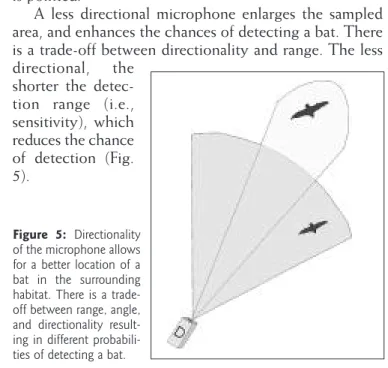
situation where we have been limited by microphone sen-sitivity. How might microphone sensitivity be improved? As plastic diaphragm microphones are made larger in area they are more sensitive, but also more directional, that is, sensitive only over an increasingly narrow beam perpen-dicular to the plane of the diaphragm. Could the plastic and the backplate be dome-shaped to avoid too narrow a beam of sensitivity? Are there other inherently superior types of transducers than the plastic diaphragm con-denser microphones of the basic design first developed by Kühl et al. (1954)? Laser vibrometry detects very small motions. It is possible that this could this be adapted to detect fainter movements resulting from impinging sound waves. At first thought, such an apparatus would seem delicate, expensive, and likely to be limited to laboratory use. But that was true for many years of the best available microphones, which made it possible to learn the basic aspects of bat echolocation.
Finally, it is beginning to be feasible to use differences in arrival time of a bat’s sounds at multiple microphones to determine its position in space (Holderied 2002). This opens up exciting new possibilities of analyzing flight paths and behavioral interactions between bats. It also may make it possible to study the directional pattern of sound emission by flying bats during natural behavior, including insect hunting. Emitted beam patterns seem to
vary somewhat during the octave of downward frequen-cy change in each of the brief orientation sounds, but it has been extremely difficult to measure this with flying bats. It is possible that bats might vary frequency-depen-dent beam patterns to adapt them to their current behav-ior. For example, a broad beam must be best for detection of insects, but once one is located might the bat shift to a narrower beam aimed at the target of interest? It is almost impossible to test such a hypothesis without some way to measure the bat’s position in three-dimensional space and the direction in which its head is pointed. As with many other aspects of echolocation behavior, I sus-pect that there are significant surprises waiting for enter-prising investigators to discover.
A
CKNOWLEDGEMENTSI wish to thank The Rockefeller and Harvard Univer-sities for financial and administrative support, Peter Auger and his students for assistance, and especially Gregory Auger for technical collaboration.
L
ITERATUREC
ITEDBUCHLER, E. R. 1976. The use of echolocation by the wander-ing shrew (Sorex vagrans). Animal Behaviour
24:858-873.
GALAMBOS, R., and D. R. GRIFFIN. 1942. Obstacle avoidance by flying bats: the cries of bats. Journal of Experimen-tal Zoology 89:475-490.
GRIFFIN, D. R. 1946. Supersonic cries of bats. Nature 138:46-48.
GRIFFIN, D. R. 1953. Bat sounds under natural conditions, with
evidence for the echolocation of insect prey. Journal of Experimental Zoology 123:435-466.
GRIFFIN, D. R. 1958. Listening in the dark: the acoustic
orien-tation of bats and men. Yale University Press, New Haven, Connecticut. (Reprinted 1986 by Cornell Uni-versity Press, Ithaca, New York).
GRIFFIN, D. R., and R. GALAMBOS. 1941. The sensory basis of
obstacle avoidance by flying bats. Journal of Experi-mental Zoology 86:481-506.
GRIFFIN, D. R., and A. NOVICK. 1955. Acoustic orientation of
neotropical bats. Journal of Experimental Zoology 130:251-300.
HOLDERIED, M. 2002. Akustische flugbahnverfolgung von
fle-dermäuse: artvergleich des verhaltens beim suchflug und richtcharakteristik der schallabstrahlung. Ph.D. dissertation, FriedrichAlexanderUniversität, Erlan -gen-Nürnberg, Germany.
KUHL, W., G. R. SCHODDER, and F. K. SCHRÖDER. 1954.
Con-denser transmitters and microphones with solid dielec-tric for airborne ultrasonics. Acustica 4:519-532. MCCUE, J. J. G. 1961. Ultrasonic instrumentation for research
on bats. 1961 I.R.E. International Convention Record, part 6:310-315.
Noyes, A., and G. W. Pierce. 1937. Apparatus for acoustic research in the supersonic frequency range. Journal of the Acoustical Society of America 9:205-211.
PIERCE, G. W. 1948. The Songs of insects. Harvard University
Press, Cambridge Massachusetts.
PIERCE, G. W., and D. R. GRIFFIN. 1938. Experimental
deter-mination of supersonic notes emitted by bats. Journal of Mammalogy 19:454-455.
THE PROPERTIES OF SOUND AND BAT DETECTORS
LARS PETTERSSON Pettersson Elektronik AB, Tallbacksvägen 51, SE-756 45 Uppsala, Sweden.
When an ultrasonic call is transmitted through the air, captured by the microphone of a bat detector and trans-formed into audible sound, there are several factors that influence the characteristics of the resulting sound. As sound waves travel through the air, reflections, atmospheric absorption and geometric spreading are some of the factors that alter it. The microphone of the bat detector can also affect the sound, e.g., by exhibiting a more or less non-ideal frequency response and directional sensitivity. The properties of the capacitance, electret, and piezoelectric microphone types are discussed. Bat detectors make use of different ultrasound conversion techniques, resulting in different types of sound. I describe the heterodyne, frequency division and time expansion bat detector principles and the advantages and drawbacks of each type.
Key words: bat detectors, frequency division, heterodyne, sound transmission, time expansion, ultrasound detectors, ultrasound microphones
I
NTRODUCTIONB
at detectors convert inaudible, ultrasonic signals into audible signals and thus are important tools for studying bats. There are several techniques that can be used to transform ultrasonic signals into audible signals. Here I describe the heterodyne, frequency division, and time expansion techniques.In order to register ultrasonic signals, bat detectors require microphones sensitive to such high frequencies. The most common microphone types, the capacitance, electret, and piezoelectric types, are described. As the ultrasonic sound wave propagates through the air, sever-al physicsever-al phenomena will affect it. I discuss the most important phenomena.
T
HEP
ROPAGATION OFS
OUND INA
IR Sound waves can be described as variations in pressure propagating away from the sound source with a certain velocity. When we want to capture and study the sound at some distance from the sound source, it is important to consider how the sound wave may be changed as it prop-agates through the transmission medium.There are a number of physical phenomena that may affect the sound wave (see Bradbury and Vehrencamp 1998, Gerhardt 1998, Hassall and Zaveri 1979). Exam-ples of such phenomena are geometric spreading, reflec-tion, absorpreflec-tion, refracreflec-tion, scattering, and Doppler shift.
Geometric spreading causes the sound intensity to decrease with the distance from the source. In the far field, the sound intensity is inversely proportional to the square of the distance from the source, i.e., it is decreased by 6 dB per doubling of distance. This is a simple consequence of the fact that from a point source, the sound energy spreads out equally in all directions. Hence, the spreading loss caused by geometric spread-ing can be easily calculated and is “harmless” in the sense that all frequencies are affected equally.
The simple geometric laws of reflection used in optics are valid also for acoustic waves, provided the reflecting surface is large and the surface roughness is small relative to the wavelength of the sound wave. An incident wave with a certain grazing angle will give rise to a reflected wave leaving the surface with the same angle. The direct and the reflected waves will interfere depending on the frequency, distance, and reflection coefficient. The interference in a certain situation may be constructive or destructive, which may result in the disappearance of certain frequencies.
For ultrasonic signals traveling near the ground, veg-etation and general surface roughness have large dimen-sions relative to the wavelength of the sound, so any reflections will be rather diffuse. Hence, such signals can propagate near the ground surface almost without being affected.
One exception to this is a calm water surface, which may give rise to well-defined reflections. Hence, bat calls recorded as the bat flies over a water surface some-times exhibit significant amplitude variations and “miss-ing frequencies.”
It is worth noting that reflections occur not only at the boundary between two different media, but anywhere that the acoustic impedance changes, e.g., at the interface of air masses with different temperature or humidity.
As sound waves propagate in a medium, a certain amount of energy is lost to the medium. Collisions between the molecules in the medium, resulting in dissi-pation of sound energy into heat, and the absorption of energy within the molecules of the medium are two important factors that contribute to “medium absorp-tion.” The medium absorption in air varies with the tem-perature and the humidity of the air, as well as the fre-quency of the sound. Temperature and humidity nor-mally change relatively slowly, while the signal frequen-cy may change rapidly. The frequenfrequen-cy dependence of absorption is thus of particular importance here.
At 10 kHz, the attenuation due to absorption in air is about 0.1 dB per meter, increasing to approximately 10 dB per meter at 200 kHz. Since the actual attenuation also depends on temperature and humidity, it is difficult to apply precise corrections to account for this effect. The attenuation of higher ultrasonic frequencies makes it difficult for bats to use high-frequency calls for echolocation over long distances.
If the sound source is moving relative to the receiver, Doppler shift will change the received frequency. As an example, if a bat flies towards the observer with a veloc-ity of 5 ms-1, emitting a call at a frequency of 50 kHz, the received frequency will be about 50.7 kHz.
Other factors that affect sound propagation include refraction (deflection of a sound wave caused by a change in the propagation velocity of the medium) and scattering (redirection of the sound wave as its passes an object).
U
LTRASOUNDM
ICROPHONESThere are many different types of microphones. However, for ultrasonic applications the most common are the capacitance, electret, and piezoelectric types.
A capacitance microphone consists of a metal back-plate and a thin metalized, plastic membrane. The mem-brane (or diaphragm) is stretched over the backplate to make the two parts form the two plates of a capacitor. As the sound waves make the membrane move, the capaci-tance changes, and these changes are converted into a proportional voltage.
A solid-dielectric capacitance microphone uses a slightly uneven (e.g., grooved) backplate, with the mem-brane stretched over the backplate and in direct contact with it. The grooves are required in order to allow the membrane to move with the sound waves. In an
air-dielectric capacitance microphone, the membrane is mounted at a certain short distance over the backplate.
The most common type of capacitance microphone in bat detectors is the solid-dielectric type, due to its high sensitivity and relative robustness. The frequency response of a capacitance microphone is usually quite flat, i.e., it is equally sensitive at different frequencies. For a well-designed microphone, the frequency response is typically flat within ±4 dB up to 150 kHz or higher.
A capacitance microphone requires a relatively high polarizing voltage, usually 100-200 volts. The polarizing voltage is applied over the microphone element, which, in the case of a solid-dielectric microphone, means a very thin barrier. At high polarizing voltages this means an increased risk of discharges, which of course gener-ates high-level noise from the microphone. Particularly in high humidity, the noise level of this microphone type may increase.
An electret microphone is similar in design to the capacitance type. The former does not require a polariz-ing voltage though, since the dielectric material can retain a permanent charge. Most electret microphones are intended for audio use, but they may still have a use-able response in the ultrasonic-frequency range. There are also a few types specifically designed to yield better high-frequency responses.
Both the capacitance and electret microphone types have built-in preamplifiers. This is required to convert the high impedance of the microphone element into a lower impedance. The sensitivity of the microphone ele-ment and the noise level of the preamplifier are the most important factors that determine the signal-to-noise ratio of the microphone and thus its capability of recording weak signals.
The piezoelectric microphone type is easy to use, rugged, cheap, and sensitive. However, it is a narrowband type of transducer, so it is sensitive only over a very lim-ited frequency range. Standard types have a 3 dB band-width of only a few kHz. There are broadband types with a 3 dB bandwidth of about 10 kHz, but this is achieved at the expense of lower sensitivity. The most common piezoelectric microphones use a 40 kHz center frequen-cy, but there are other types available, e.g., 25 kHz and 32.7 kHz. Combining two or more of these results in a wider useable frequency range. This is an alternative for less demanding instruments.
U
LTRASOUNDC
ONVERSION TECHNIQUES IN BAT DETECTORSBat detectors convert the ultrasonic calls of bats into audible signals, making it possible for humans to hear the sounds. An experienced observer is then often capa-ble of determining what the bat is doing and which species it is. There are a number of different methods to convert ultrasonic signals into audible sounds, the most common of which are heterodyning, frequency division,
and time expansion. Each method has advantages and disadvantages, so some bat detectors contain two (or even three) independent conversion systems.
H
ETERODYNINGHeterodyning is perhaps the most common conver-sion method. It is a narrowband technique, which means that only a narrow range of frequencies is made audible at a time. The width of the frequency range that is trans-formed is determined by a filter in the bat detector and is typically about 10 kHz. The tuning control is used to set the center frequency of the frequency range to trans-form, so setting this at 40 kHz will make frequencies between 35 and 45 kHz audible.
In a heterodyne detector, there is an oscillator, the frequency of which is adjusted with the tuning control. A mixer circuit is used to multiply the oscillator fre-quency, fo, with the ultrasonic signal frefre-quency, fs. This results in a signal consisting of two frequency compo-nents, fs-fo and fs+fo. The latter component is eliminat-ed by passing the signal through a lowpass filter. Provid-ed that fs is close enough to fo, the difference fs-fo will be audible. By way of example, if the tuning control is set to a frequency of 40 kHz and the frequency of the input signal is 42 kHz, the resulting frequency is 2 kHz, which is clearly audible.
The heterodyne technique results in sensitive bat detectors, i.e., it is possible to detect very weak signals. This is a simple consequence of the narrowband behav-ior. Since only a small part of the entire ultrasonic fre-quency range is made audible, only a correspondingly small fraction of the entire full-range noise will be made audible. Hence, the noise level will be low and the sensi-tivity high.
Bat calls transformed in a heterodyne detector sound different depending on the frequency to which the detector is tuned. At some settings, a “smacking” sound is obtained, while other settings result in a “ticking” sound. These tonal qualities can be used to determine the type of bat call (FM sweep, CF, etc). The approxi-mate frequency of a bat call can also be determined by varying the tuned frequency and listening to the result-ing sounds.
The narrow bandwidth of a heterodyne detector means that if the detector is tuned at a certain frequency and a bat call at another frequency is received, the bat call will pass undetected if its frequency is too far away from the tuned frequency to make it audible.
F
REQUENCY DIVISIONIn contrast to the heterodyning, frequency division is a broadband technique, i.e., the entire ultrasonic range is transformed at all times. The result of this transformation is a frequency being a fixed fraction (e.g., one tenth) of the original frequency. A frequency division detector is
less sensitive than a heterodyne detector, so weak calls may not be detected. This is due partly to the fact that all noise from the full frequency range is made audible, resulting in a poorer signal-to-noise ratio, but also because most frequency division detectors have a mini-mum threshold level, below which they do not produce any output signal. However, the transformed signal of a frequency-division detector contains more information than that of a heterodyne detector an