i
Integrated Framework for Mobile Low Power IoT
Devices
Yaarob Mahjoob Nafel Al-Nidawi
Submitted in accordance with the requirements for the degree of
Doctor of Philosophy
University of Leeds
School of Electronic and Electrical Engineering
Institute of Integrated Information Systems
ii
Declaration
The candidate confirms that the work submitted is his own, except where work which has formed part of jointly authored publications has been included. The contribution of the candidate and the other authors to this work has been explicitly indicated below. The candidate confirms that appropriate credit has been given within the thesis where reference has been made to the work of others. Most materials contained in the chapters of this thesis have been previously published in research articles written by the author of this work (Yaarob Al-Nidawi), who appears as lead (first) author in all of them.
The research has been supervised and guided by Dr. Andrew H. Kemp, and he appears as a co-author on these articles. All the materials included in this document is of the author's entire intellectual ownership.
A) Details of the publications which have been used (e.g. titles, journals, dates, names of authors):
In chapter 2:
“Mobility of Low Power IoT Devices: The State of The Art”, IEEE Internet of Things Journal, Under Review. Co-authors: Andrew H. Kemp.
In chapter 3:
1- “Mobility of Low Power IoT Devices: The State of The Art”, IEEE Internet of Things Journal, Under Review. Co-authors: Andrew H. Kemp.
2- "Impact of Mobility on The IoT MAC Infrastructure: IEEE 802.15.4e TSCH and LLDN Platform," in Proceedings of IEEE 2nd World Forum on Internet of Things (WF-IoT), pp.478-483, Milan, 14-16 Dec. 2015. Co-authors: Harith Yahya, Andrew H. Kemp.
In chapter 4:
"Mesh-Under Cluster-Based Routing Protocol for IEEE 802.15.4 Sensor Network," in Proceedings of 20th European Wireless Conference; pp.1-7, Barcelona, 14-16 May 2014. Co-authors: Naveed Salman, Andrew H. Kemp.
iii
In chapter 5:
“Mobility Aware Framework for Timeslotted Channel Hopping IEEE 802.15.4e Sensor Networks," in IEEE Sensors Journal, vol.15, no.12, pp.7112-7125, Dec. 2015. Co-authors: Andrew H. Kemp.
In chapter 6:
"Tackling Mobility in Low Latency Deterministic Multihop IEEE 802.15.4e Sensor Network," in IEEE Sensors Journal, vol.16, no.5, pp.1412-1427, March, 2016. Co-authors: Harith Yahya, Andrew H. Kemp.
B) Details of the work contained within these publications which is directly attributable to Yaarob Al-Nidawi:
With the exceptions detailed in section C, the published work is entirely attributable to Yaarob Al-Nidawi: the literature review necessary to construct and originate the ideas behind the published manuscripts, the novel ideas presented in the papers, the implementation of scheduling, clustering, TSCH, LLDN and security protocols used in the Contiki OS for analysis and all the work necessary in the editing process of the manuscripts.
C) Details of the contributions of other authors to the work:
Dr Andrew H. Kemp is the co-author for all the publications listed above. These publications have been written under his supervision, benefiting from excellent technical advice and editorial, patient guidance and valuable feedback.
Naveed Salman contributed with recommendations about how to efficiently structure a conference paper and how to emphasize the originality of the work and to make it more accessible to the reader.
Harith Yahya performed proofreading to the final drafts of the papers to ensure the solidity of the papers.
iv This copy has been supplied on the understanding that it is copyright material and that no quotation from the thesis may be published without proper acknowledgement.
The right of Yaarob Al-Nidawi to be identified as Author of this work has been asserted by him in accordance with the Copyright, Designs and Patents Act 1988. ©2016 The University of Leeds and Yaarob Al-Nidawi
v
Acknowledgement
Firstly, I would like to express my sincere appreciation and thanks to my supervisor Dr Andrew H. Kemp for his guidance, patience, motivation, continues support and immense knowledge. Your guidance helped me in all the time of research and writing of this thesis. I would like to thank you for encouraging my research and for allowing me to grow as a researcher. I could not have imagined having a better mentor and supervisor like you dear Dr Kemp.
A special thanks to my caring father and loving mother. Words cannot express how grateful I am to you. Your pray for me was what sustained me this far. It was really difficult for me to be away from you all these years but you were always beating inside my heart. Whatever I am now is because of you. Thank you from the heart. I am thankful to my wife for her love, patience and support that have always been my strength. You were always be here with me. Also I am thankful for my son, you brought the joy to my life and I have found my smile with you in all difficult times throughout this PhD. Also I would like to express my deepest gratitude for my sisters for their love and pray. Thank you all for being part of my life.
I also thank the Iraqi Ministry of Higher Education and Scientific Research and the Iraqi Cultural Attaché-London for their valuable support. Without their precious help it would not be possible to conduct this research.
Thank you Lord for always being there for me. I will keep on trusting You for my future.
For all my friends in the group of Wireless Sensor Network and friends in the school, thank you all for your valuable support and I was really lucky to work with wonderful friends like you.
vi
Abstract
Ubiquitous object networking has sparked the concept of the Internet of Things (IoT) which defines a new era in the world of networking. The IoT principle can be addressed as one of the important strategic technologies that will positively influence the humans’ life. All the gadgets, appliances and sensors around the world will be connected together to form a smart environment, where all the entities that connected to the Internet can seamlessly share data and resources. The IoT vision allows the embedded devices, e.g. sensor nodes, to be IP-enabled nodes and interconnect with the Internet. The demand for such technique is to make these embedded nodes act as IP-based devices that communicate directly with other IP networks without unnecessary overhead and to feasibly utilize the existing infrastructure built for the Internet. In addition, controlling and monitoring these nodes is maintainable through exploiting the existed tools that already have been developed for the Internet. Exchanging the sensory measurements through the Internet with several end points in the world facilitates achieving the concept of smart environment.
Realization of IoT concept needs to be addressed by standardization efforts that will shape the infrastructure of the networks. This has been achieved through the IEEE 802.15.4, 6LoWPAN and IPv6 standards.
The bright side of this new technology is faced by several implications since the IoT introduces a new class of security issues, such as each node within the network is considered as a point of vulnerability where an attacker can utilize to add malicious code via accessing the nodes through the Internet or by compromising a node. On the other hand, several IoT applications comprise mobile nodes that is in turn brings new challenges to the research community due to the effect of the node mobility on the network management and performance. Another defect that degrades the network performance is the initialization stage after the node deployment step by which the nodes will be organized into the network. The recent IEEE 802.15.4 has several structural drawbacks that need to be optimized in order to efficiently fulfil the requirements of low power mobile IoT devices.
vii This thesis addresses the aforementioned three issues, network initialization, node mobility and security management. In addition, the related literature is examined to define the set of current issues and to define the set of objectives based upon this. The first contribution is defining a new strategy to initialize the nodes into the network based on the IEEE 802.15.4 standard. A novel mesh-under cluster-based approach is proposed and implemented that efficiently initializes the nodes into clusters and achieves three objectives: low initialization cost, shortest path to the sink node, low operational cost (data forwarding). The second contribution is investigating the mobility issue within the IoT media access control (MAC) infrastructure and determining the related problems and requirements. Based on this, a novel mobility scheme is presented that facilitates node movement inside the network under the IEEE 802.15.4e time slotted channel hopping (TSCH) mode. The proposed model mitigates the problem of frequency channel hopping and slotframe issue in the TSCH mode. The next contribution in this thesis is determining the mobility impact on low latency deterministic (LLDN) network. One of the significant issues of mobility is increasing the latency and degrading packet delivery ratio (PDR). Accordingly, a novel mobility protocol is presented to tackle the mobility issue in LLDN mode and to improve network performance and lessen impact of node movement. The final contribution in this thesis is devising a new key bootstrapping scheme that fits both IEEE 8021.5.4 and 6LoWPAN neighbour discovery architectures. The proposed scheme permits a group of nodes to establish the required link keys without excessive communication/computational overhead. Additionally, the scheme supports the mobile node association process by ensuring secure access control to the network and validates mobile node authenticity in order to eliminate any malicious node association. The purposed key management scheme facilitates the replacement of outdated master network keys and release the required master key in a secure manner. Finally, a modified IEEE 802.15.4 link-layer security structure is presented. The modified architecture minimizes both energy consumption and latency incurred through providing authentication/confidentiality services via the IEEE 802.15.4.
viii
Table of Contents
Acknowledgement ... v
Abstract ... vi
Table of Contents ... viii
List of Figures ... xii
List of Tables ... xvii
List of IEEE 802.15.4 Attributes ... xviii
List of Abbreviations ... xx
List of Symbols ... xxii
Chapter 1. Introduction ... 1 1.1 IoT Paradigm ... 2 1.2 Problem Statement ... 3 1.3 Research Contribution ... 5 1.4 Thesis outline ... 8 1.5 List of Publications ... 11 Chapter 2. Background ... 13 2.1 Mobility Overview ... 13
2.1.1 Mobility Terminology and Attributes ... 14
2.1.2 Patterns of Mobility ... 15
2.1.3 Mobility Handling Process ... 17
2.1.4 Layer Based Classification ... 17
2.1.5 Mobility Management Initiation Process ... 17
2.2 MAC Scheduling and Listening Techniques ... 18
ix
2.3.1 Security Requirements and Challenges ... 21
2.3.2 Security Design principles ... 21
2.3.3 Key Management Approaches ... 22
2.3.4 Block Cipher Operations Modes ... 23
2.4 Summary ... 24
Chapter 3. Mobility of Low Power IoT Devices: State of The Art and Issues 3.1 Mobility of Constrained IoT Devices ... 25
3.1.1 Related Work ... 25
3.1.2 Mobility Under IEEE 802.15.4 ... 27
3.1.3 MMPs for 6LoWPAN-Based Networks ... 28
3.1.4 IoT Purpose-Based MMP ... 32
3.1.5 Application Layer-Based MMP ... 36
3.1.6 Secured-Based MMPs ... 37
3.1.7 Research Questions and Suggestions ... 38
3.2 Mobility Impact on the IoT MAC Infrastructure ... 41
3.2.1 LLDN and TSCH Description ... 41
3.2.2 Mobility-Related Issues of Both TSCH and LLDN Modes ... 48
3.2.3 Simulation Results and Analyses ... 50
3.3 Summary ... 55
Chapter 4. Network Initialization Phase: Mesh-under Cluster-based Approach 4.1 Mesh-Under Routing Philosophy ... 56
4.2 Related Work ... 58
4.3 MUCBR Design Principles ... 59
x
4.5 Low Latency Data Forwarding Scheme ... 67
4.6 Latency Overhead of Sampling and Scheduling Listening Techniques ... 69
4.7 Hosting Security ... 70
4.8 Results and Analysis ... 72
4.8.1 Simulation Parameters ... 72
4.8.2 Performance Analysis ... 73
4.9 Summary ... 84
Chapter 5. Mobility Aware Scheme for IEEE 802.15.4e Timeslotted Channel Hopping Mode ... 85
5.1 Mobility Issue in TSCH mode ... 85
5.2 Related work ... 86
5.3 Evaluation of the Mobility Impact on the TSCH Network ... 89
5.4 MTSCH Protocol for Mobile IoT Constrained Devices ... 97
5.5 Implementation and Analysis ... 102
5.6 Summary ... 114
Chapter 6. Mobility under IEEE 802.15.4e Low Latency Deterministic IoT Network... 116
6.1 Mobility Issues Under IEEE 802.15.4e LLDN Mode... 116
6.2 Related Work ... 117
6.3 Mobility Overhead Over IEEE 802.15.4e LLDN ... 119
6.4 Proposed Enhanced and Mobile-Aware LLDN Scheme ... 131
6.5 Results and Analyses ... 140
6.6 Summary ... 152
Chapter 7. Secure Key Bootstrapping Scheme for Mobile IoT Devices .. 153
xi 7.2 Energy Efficient Key Bootstrapping Scheme for Mobile Low
Power Devices ... 156
7.2.1 Methodology: ... 157
7.3 Confidentiality and Authentication Services for IEEE 802.15.4 ... 166
7.4 Results and Analyses: ... 168
7.5 Security Analysis: ... 175
7.6 Summary: ... 176
Chapter 8. Conclusion and Future Work ... 177
8.1 Conclusion ... 177
8.2 Future Work ... 179
xii
List of Figures
Fig. 1.1: 6LoWPAN-based network ... 2
Fig. 1.2: Communication layers stack ... 3
Fig. 1.3: Research contributions ... 7
Fig. 2.1: Possible mobility classifications ... 15
Fig. 2.2: Macro versus micro mobility [3] ... 16
Fig. 2.3: Asynchronous and synchronous listening techniques ... 20
Fig. 2.4: Diffie-Hellman key exchange protocol ... 23
Fig. 2.5: CBC and CTR block cipher operation modes [2] ... 24
Fig. 3.1: Standardized macro MMPs ... 26
Fig. 3.2: Possible elements that have an impact on or impacted by mobility ... 39
Fig. 3.3: TSCH slotframe architecture ... 42
Fig. 3.4: FastA association scheme [1] ... 43
Fig. 3.5: Information element (IE) structure ... 44
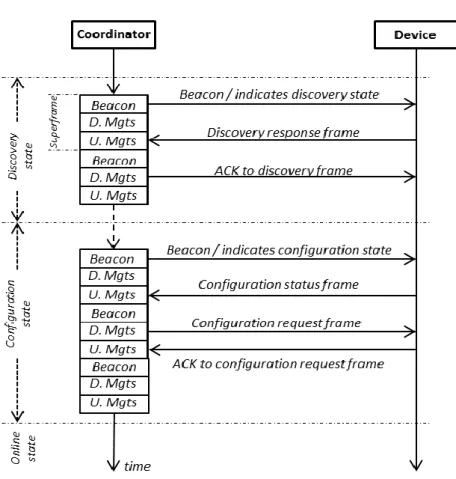
Fig. 3.6: LLDN transmission states ... 46
Fig. 3.7: Superframe structure in LLDN mode [1] ... 47
Fig. 3.8: Association procedure in LLDN mode ... 48
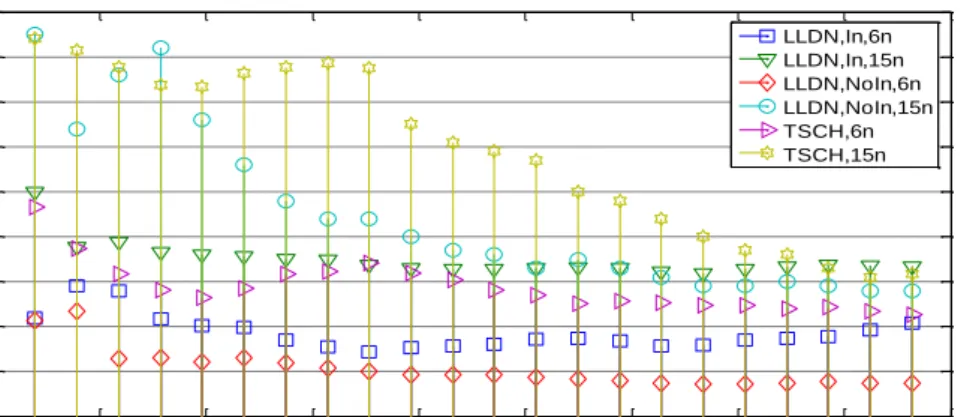
Fig. 3.9: RDC comparison between LLDN and TSCH, slotframe/superframe size =0.5s, transmission range=50m, no. of coordinators=9 ... 51
Fig. 3.10: RDC comparison between LLDN and TSCH, slotframe/superframe size =2s, transmission range=50m, no. of coordinators=9 ... 51
xiii
Fig. 3.11: RDC comparison between LLDN and TSCH,
slotframe/superframe size =0.5s, transmission range=100m, no. of
coordinators=4 ... 52
Fig. 3.12: RDC comparison between LLDN and TSCH, slotframe/superframe size =2s, transmission range=100m, no. of coordinators=4 ... 52
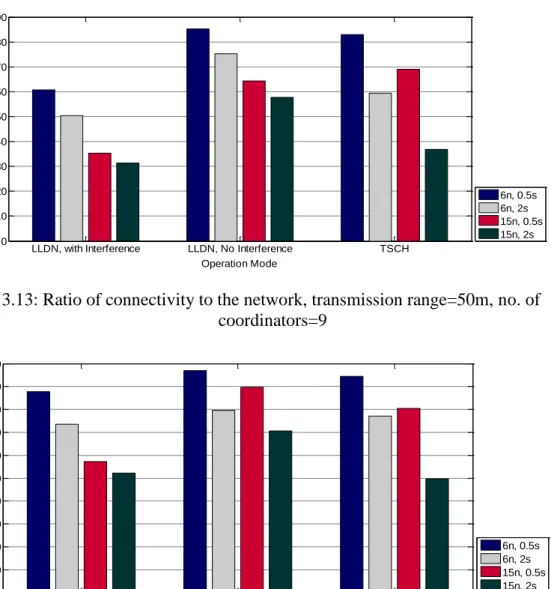
Fig. 3.13: Ratio of connectivity to the network, transmission range=50m, no. of coordinators=9 ... 54
Fig. 3.14: Ratio of connectivity to the network, transmission range=100m, no. of coordinators=4 ... 54
Fig. 4.1: Mesh-under versus route-over ... 57
Fig. 4.2: MUCBR cluster network ... 58
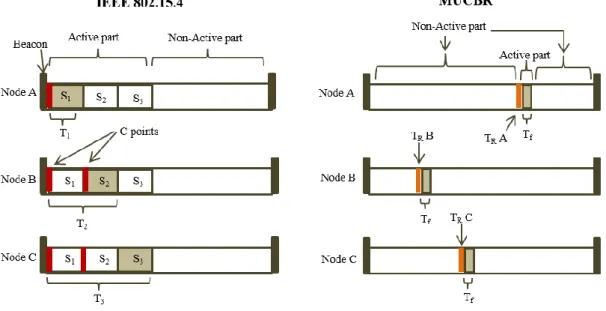
Fig. 4.3: Patterns of slot/time reference allocation in IEEE 802.15.4 and MUCBR ... 60
Fig. 4.4: MUCBR clustering phases timing ... 62
Fig. 4.5: MUCBR clustering process (message sequence chart) ... 63
Fig. 4.6: MUCBR clustering process (node-based activity) ... 66
Fig. 4.7: MUCBR ranking-based scheduled data forwarding ... 68
Fig. 4.8: Lists of acquired keys of neighbour CHs ... 71
Fig. 4.9: CH/Parent energy consumption ... 74
Fig. 4.10: Non-CH/leaf energy consumption ... 74
Fig. 4.11: RDC-initialization phase (CH/Parent) ... 75
Fig. 4.12: RDC-initialization phase (Non-CH/leaf) ... 75
Fig. 4.13: RDC-steady phase (CH/Parent) ... 76
Fig. 4.14: RDC-steady phase (Non-CH/leaf) ... 76
Fig. 4.15: Probability of collision-free (IEEE 802.15.4) ... 77
xiv
Fig. 4.17: Cost in terms of initialization latency ... 79
Fig. 4.18: Impact of check interval rate on RIME ... 80
Fig. 4.19: Impact of check interval rate on RPL ... 80
Fig. 4.20: RIME, RPL and MUCBR latency impact ... 81
Fig. 4.21: Latency overhead for one-hop network ... 82
Fig. 4.22: Latency overhead for two-hop network ... 82
Fig. 4.23: Latency overhead for three-hop network ... 83
Fig. 4.24: Latency overhead for four-hop network ... 83
Fig. 5.1: TSCH CSMA-CA backoff process... 90
Fig. 5.2: Possible trajectories of a mobile node in a POS ... 91
Fig. 5.3: Markov chain model for a mobile node in TSCH network ... 93
Fig. 5.4: MTSCH mechanism to accommodate mobile nodes ... 99
Fig. 5.5: Handling association flowchart for FFD and RFD ... 101
Fig. 5.6: RDC of static TSCH network ... 103
Fig. 5.7: RDC for non-CH nodes with range=50m, mn=6 ... 104
Fig. 5.8: RDC for non-CH nodes with range=50m ... 105
Fig. 5.9: Energy consumption of CH nodes ... 107
Fig. 5.10: Energy consumption of non-CH nodes, mn=6 ... 109
Fig. 5.11: Percentage of time associated to the network ... 111
Fig. 5.12: Average RDC of non-CH nodes ... 112
Fig. 5.13: Probability of blocking a mobile node, sfD =0.5, mn= 6, αnAc1=1 ... 113
Fig. 5.14: Probability of joining an FFD, sfD =0.5, mn= 6, φ =0.9, θ=1 ... 114
Fig. 6.1: LLDN-based mobile node lifecycle ... 119
Fig. 6.2: Markov chain for mobile node transitions in LLDN ... 124
Fig. 6.3: 2-hops mobile node association in MA-LLDN ... 132
xv
Fig. 6.5: Proposed MA-LLDN backoff scheme ... 139
Fig. 6.6: PDR (case of the impact of transfer from the online state) ... 141
Fig. 6.7: PDR (dissociation), 𝔼[s]=6m/s, 𝔼[d]=9m, 𝔼[P]=6s, nSC & nSD=50 SC=2.976ms, SD=2.528ms, ... 143
Fig. 6.8: Comparison between the PDR of both LLDN and MA-LLDN ... 144
Fig. 6.9: Comparison between LLDN and MA-LLDN dissociation time ... 145
Fig. 6.10: Total dissociation time of LLDN, SC=2.976ms, SD=2.528ms, nSC & nSD =50. ... 146
Fig. 6.11: Data latency caused by dissociating from the network in LLDN SC=2.976ms, SD=2.528ms, nSC & nSD =50. ... 147
Fig. 6.12: Impact of (SC & SD/SO) ratio on PDRtransfer, SC=2.976ms, SD=2.528ms, slots=20 ... 148
Fig. 6.13: LLDN nodes throughput ... 149
Fig. 6.14: Throughput of LLDN mode, MSDU=102B, SC=2.976ms, SD=2.528ms, slots=10 ... 150
Fig. 6.15: Dissociation function, SC=2.976ms, SD=2.528ms, nSC & nSD =50. ... 150
Fig. 6.16: LLDN connectivity ratio, nSC & nSD=50 SC=2.976ms, SD=2.528ms, number of coordinators: 4 (range 100m) & 9 (range 50m). ... 151
Fig. 7.1: MAK generation procedure ... 158
Fig. 7.2: Pseudocode of establishing shared link keys (EESKB) ... 160
Fig. 7.3: Message sequence chart of the proposed EESKB establishment process ... 161
Fig. 7.4: Shared keys lists (EESKB) ... 162
Fig. 7.5: Pseudocode of mobile node association procedure (EESKB) ... 164
Fig. 7.6: EESKB mobile node association message sequence chart ... 165
xvi
Fig. 7.8: AES-CCM mode diagram ... 167
Fig. 7.9: Modified IEEE 802.15.4 MAuC generation process ... 168
Fig. 7.10: EESKB energy cost of both initialization and association phases ... 169
Fig. 7.11: Comparison of the computation cost (overhead of microcontroller) ... 170
Fig. 7.12: Comparison of the communication cost (overhead of transceiver) ... 170
Fig. 7.13: Total security-related energy cost ... 171
Fig. 7.14: Energy consumption, range:50m, superframe:0.5s ... 172
Fig. 7.15: Energy consumption, range: 50m, superframe: 2s ... 172
Fig. 7.16: Energy consumption, range: 100m, superframe: 2s ... 173
Fig. 7.17: Energy consumption, range: 100m, superframe: 0.5s ... 173
Fig. 7.18: Energy consumption utilization of the modified IEEE 802.15.4 operation modes ... 174
Fig. 7.19: Impact of the default and modified IEEE 802.15.4 structures on latency ... 175
xvii
List of Tables
Table 3.1: IEEE 802.15.4-based MMPs ... 29
Table 3.2: 6LoWPAN-based MMPs ... 30
Table 3.3: Challenges and approaches for TSCH and LLDN modes ... 49
Table 3.4: Simulation parameters ... 50
Table 4.1: Appended frames indexes ... 61
Table 4.2: MUCBR simulation parameters ... 73
xviii
List of IEEE 802.15.4 Attributes
Attribute Description
aBaseSuperFrameDuration Time constant and corresponds to 15.36ms
aMaxLostBeacons The maximum value of missed beacons to announce
the node is orphan
aMaxPHYPacketSize The maximum PSDU size
aTurnaroundTime Required time for a device to change from transmit to
receive state and vice versa
aUnitBackoffPeroid Number of symbols to backoff in CSMA
LIFS Long interframe space
macMinLIFSPeriod Defined value of LIFS in the standard
macMinSIFSPeriod Defined value of SIFS in the standard
macMaxFrameRetries Maximum number of retries after transmission failure
macLLDNmgmTS Indicate the existence of management timeslots
(Boolean value)
macLLDNnumBid-irectionalTS Number of bidirectional timeslots
macLLDNnumUp-linkTS Number of uplink timeslots
macLLDNnumRet-ransmitTS Number of retransmission timeslots
macLLDNdiscove-ryModeTimeout Time threshold to change form discovery to configuration state
xix
macMaxCSMABa-ckoffs Maximum number of backoffs the CSMA can
attempt
macSuperframeOrder Active slot superframe duration
macTsMaxAck ACK transmission time
macTsRxOffset Beginning of the timeslot
macTsTxAckDelay End of frame to start ACK
macAckWaitDuration Required waiting time for an Acknowledgment
message
xx
List of Abbreviations
ACK Acknowledgement
ASN Absolute slot number
BI Beacon interval
BO Beacon order
CBC Cipher block chaining
CCA Clear channel assessment
CH Cluster head
CIP Cipher
CTR Counter
CN Correspondent node
CSL Coordinated sampled listening
DEP Decipher
DSME Deterministic and synchronous multi-channel extension
EB Enhanced beacon
FFD Full-function device
FCS Frame check sequence
GTS Guaranteed time slot
IE Information element
IoT Internet of things
KA Key of node A
LLDN Low latency deterministic network
LoWPAN Low power wireless personal area network
MAC Media access control
xxi
MAuC Message authentication code
MN Mobile node
MMP Mobility management protocol
MWSN Mobile wireless sensor network
PAN Personal area network
POS Personal operating space
RDC Radio duty cycle
RFD Reduced-function device
SD Superframe duration
SO Superframe order
TSCH Timeslotted channel hopping
xxii
List of Symbols
Chapters three and six
Symbol Description
nSF Number of slotframes
nTS Number of timeslots in each slotframe
ebP EB announcement duration
T Timeslot duration
TS Timeslot index
nSO Number of online superframes
nSD Number of discovery superframes
nSC Number of configuration superframes
Chapter four
Symbol Description
TRA Time reference for node A
Tf Required time to transmit a frame
Cp Collision point
R_received Received rank
R_current Current rank
W_recived Received weight
W_current Current weight
TP Time period interval (resembles beacon interval)
Dpos Density of sensor nodes within a POS
xxiii
LP length of payload
h number of hops
FR mean forwarding rate
RR mean rate of the received frames
U Utilization of a relay node
BF number of buffered frames
Chapter five
Symbol Description
𝐹𝑐ℎ number of frequency channels
Ts settle time
Peb(sf) probability of receiving at least one EB
𝑃(𝑡𝑠𝑛 ) probability of receiving an EB in a given slot index
𝑃𝑒𝑏(𝑠𝑓𝑖) probability of receiving an EB on a slotframe
σ probability of leaving a POS
DRSSI distance of the mobile node from a FFD
RdBm maximum transmission range of a FFD
β Probability of gaining a free SHARED TX link
sh number of shared links
Em expected number of mobile nodes entering a POS
An number of existed nodes
LD number of dedicated links
φ probability of receiving an acknowledgement
η probability of a FFD accepts an association request
ε number of available time slots
𝐸𝑚
̅̅̅̅ Number of mobile nodes that migrated out the POS
xxiv
θ channel error rate
mn number of contending mobile nodes
sf given slotframe
WLM time window (listening to mobile nodes requests)
WACK time window (sending ACK messages)
Lt time between listening to an ACK to sending association
T single timeslot duration
ts given timeslot index (position in slotframe)
sfD slotframe duration
TLM random time to listen for mobile nodes
TACK random time to send an ACK message
tp time required to receive a response after requesting
w maximum waiting time to join a network
Chapter six
Symbol Description
ASTreq Requesting association
AST Associated to the network
Adi ith adjacent POS
BP Beacon period
BE Backoff exponent
CW Contention window length
Dis Indicating dissociated
Dm Density metric
D Distance
D_Mgts Downlink management timeslot
xxv
h Hop index
i-Mgts Image of a management timeslot
K Possible number of movements inside a POS
Lh latency in a given hop
LD Expected latency during discovery state
LC Expected latency during configuration state
LCA Expected latency during acknowledging configuration state
LosD number of lost data frames
Mm Mobility metric
Mgts Management timeslots
Nm number of mobile nodes seek to associate the coordinator
Ncrt Set of existed nodes in a POS
NA Set of active nodes
Na(i) Number of nodes get associated at a given time ti
Nw Number of nodes waiting to associate
nPh Number of mobile nodes attached to a given proxy
Oc Preferred number of online superframes
PA Interval time between two beacons
Pth Maximum number of online superframes
R Transmission range
Reqs Maximum configuration request size
RS Symbol rate
Rt Total running time
S Superframe in general (any superframe type)
SD discovery superframe interval
SC configuration superframe interval
xxvi
SCB Scanning for beacon phase
SBmgts Size of a single slot in Mgts
TS Timeslot index
TSZ Timeslot size (excluding interframing space)
Tack Turnaround time
TMgts Time counter after what the proxy node accepts association request
ts Settle time in a POS
U_Mgts Uplink management timeslot
Vx(t) velocity of node x at time t
xD number of mobile nodes successfully transmitted discovery response
frame
γD Probability of the first CCA returns free (during discovery state)
α Probability of receiving a beacon
β probability of a received beacon determines discovery state
δD Probability of the second CCA returns free (during discovery state)
θt Probability to complete association within ts
Chapter seven
Symbol Description
MAK-X Master key with index X
SHA2-256(X) Applying hash function to input X
Ran_A Random number generated by node A
CIPMAK-0 (X) Ciphering an input block X with key (MAK-0)
DEPMAK-0 (X) Deciphering an input block X with key (MAK-0)
MAuC Obtaining message authentication code of input block X
TS Required time to exchange shared keys within a single POS
xxvii
Introduction
1
Chapter 1.
Introduction
The evolution of the IoT concept is determined by multiple standardization tools that have shaped the infrastructure of the IoT paradigm. Regarding limited memory and low power devices as required for wireless sensor network (WSN), three basic components have formed the communication stack which will smoothly integrate these limited power devices with the Internet. These three elements are the IPv6 protocol, the 6LoWPAN adaptation layer and the IEEE 802.15.4 standard. The IEEE 802.15.4 [4] standard defines the dominant physical and MAC layers of the IoT infrastructure. In addition, multiple industrial technologies that reside under the IoT umbrella have incorporated the IEEE 802.15.4 as the default physical and MAC components, e.g. WirelessHART, ISA 100.11a and WIA-PA. Hence, several contributions are made to optimize the performance of this standard and achieve a more coherent system. As a result, the first MAC amendment IEEE 802.15.4e [1] has been introduced that presents two important modes of operation, low-latency deterministic network (LLDN) and timeslotted channel hopping (TSCH). The LLDN is designed to support applications that emphasize high cyclic determinism and low latency reading aggregation. In the meantime, TSCH aims to provide network robustness and minimizes the impact of collision while increases network throughput and extends the effective range of communication.
The emergence of such IoT networks led them to be utilized into further, different sorts of application that each has different requirements with various challenges. Applications like health (wearable sensors) [5], cargos containers [6], automotive industry and airport logistics all share the aspect of also including mobile nodes. Therefore, the current standards and technologies must consider the overhead of node movement and its impact on the functionality of the network.
Introduction
2
1.1
IoT Paradigm
Realizing the IoT concept is basically depended on three important standards, which are the IEEE 802.15.4, the 6LoWPAN and the IPv6 [7] protocol. The core of the IoT is the 6LoWPAN adaptation layer [8], [9] which allows IPv6 packets to be transferred through IEEE 802.15.4 standard, so it will facilitate the interoperability of the mobile IP-based wireless sensor networks (MWSNs) with the Internet. Fig. 1.1 shows the basic layout of the IoT paradigm. The 6LoWPAN layer provides two services for the sensor nodes, which are: Fragmentation / defragmentation, compression / decompression in order to transmit the IPv6 packets over IEEE 802.15.4 frames.
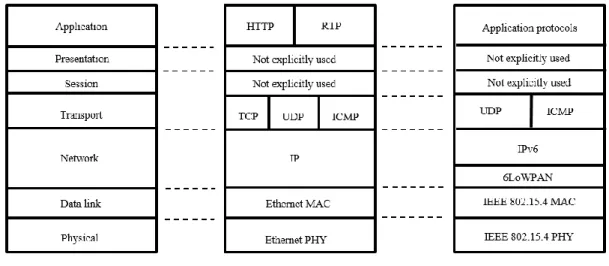
The 6LoWPAN layer works basically by tagging the IPv6 packets with special header types to define the fragmentation process or to support multi-hop mesh networking [8]. Fig. 1.2 shows the 6LoWPAN layer stack compared to the TCP/IP and the OSI model. Such a standard led to the IP-based Wireless Sensor Network, that a sensor network can communicate and exchange information with the Internet cloud.
Introduction
3 The second important component that forms the IoT is the IEEE 802.15.4 standard which is targeted for low-rate wireless personal area networks (LR-WPANs) with devices that are low-power, low-data-rate and short-range radio frequency (RF) transmissions in a wireless personal area network (WPAN) [4], such as the wireless sensor networks.
Basically, this standard defines two types of network topology, star and peer-to-peer. In addition, the standard defines two types of devices, reduced-function device (RFD) and full-function device (FFD). The 802.15.4 MAC protocol exploits two communication modes, beacon-enabled and non-beacon (beacon-less) mode. While in the beacon-enabled mode the PAN coordinator transmits a periodic beacon to synchronize the communications between the devices and the coordinator, with the non-beacon enabled mode beacons are not broadcast and the devices contend with each other to transmit to the coordinator using the unslotted CSMA/CA [10].
1.2
Problem Statement
The IoT is becoming a reality with the existence of several standardized protocols that construct the IoT paradigm. Unfortunately, till now there are several issues that need to be addressed and are affecting the solidity of the current IoT standards.
Introduction
4 The first issue is related to the IEEE 802.15.4 MAC structure by which there is no valid mechanism to organize the nodes in the network during the network initialization phase. In addition, the current approaches do not manage to provide an efficient multihop network topology that can relay the traffic from nodes to the sink in an energy efficient manner (during network steady state). Recent approaches rely mainly on the standardized routing protocol (RPL) which incorporate excessive overhead since the routing process is handled through the network layer. In addition, current IoT operating systems, i.e. Contiki OS [11] and TinyOS [12], are considering asynchronous media access mechanism and not the synchronous due to high energy overhead associated with the latest scheme.
The second issue is the node mobility which associated with different kinds of IoT applications. Unfortunately, recent approaches are relying on standardized protocols such as MIPv6 [13] and NEMO [14] that are not applicable for constrained devices as they require high number of exchanged messages in order to accommodate a node movement. Moreover, for IEEE 802.15.4, the only mode which the mobility has been addressed for is the beacon enabled mode while the two recent important modes (TSCH and LLDN) haven’t been considered. The infrastructure of TSCH considers a frequency channel hopping strategy which complicates the mechanism of handling node movement and in turn maximizes node dissociation time. In the meantime, the LLDN mode has been designed to meet the criticality and time limitations in low latency applications. With the existence of mobile nodes in the network, the LLDN fails to meet the time constraints that have been set by the standard and this issue affects its applicability in real-time and time-sensitive applications.
The third problem is the key distributing process. Until now, there is no defined standardized key management scheme while the majority of the proposed key management protocols are adapting asymmetric key technique which is impractical for low power constrained devices. In addition, the current link-layer security structure which is adapted by the IEEE 802.15.4 to provide authentication and confidentiality services, has a high energy overhead and maximizes the latency via including a bulky cipher mode of operation. Moreover, all the approaches of handling mobility and providing key management are standalone techniques by
Introduction
5 which these mechanisms are separated. Integrating the key bootstrapping phase with the node joining process (utilizing the same exchanged messages) can dramatically reduce the impact of energy consumption to half.
1.3
Research Contribution
The contributions of this thesis are as follows:
- Presenting a mesh-under cluster based routing (MUCBR) protocol that initializes the IEEE 802.15.4-based nodes in clusters and determines the shortest route to the sink via a chain of connected cluster heads (CH). The proposed MUCBR presents a novel initialization mechanism that mitigates the high network setup cost issue which associated with all scheduling schemes. MUCBR manages to disprove the assumption that network scheduling comes always with a high cost and thus, avoiding its adaption in the recent IoT operating systems. The clustered architecture of the proposed MUCBR produces a chain of cluster heads that eliminates the need of bridge nodes to connect two clusters and facilitates the proposed key bootstrapping/management scheme in this thesis (chapter 7).
- Investigating recent literature regarding mobility management techniques to identify the possible challenges that affect the IoT paradigm. In addition, study the impact of node mobility for both IEEE 802.15.4e TSCH and LLDN modes through implementing these modes within the Contiki OS.
- Proposing a mobility aware protocol (MTSCH) that mitigates the issue of frequency channel hopping in TSCH mode. The MTSCH presents a novel scheme to facilitate a mobile node association and reduces the dissociation time. The MTSCH introduces solid approaches to mitigate the TSCH problems of undefined beaconing, undefined slot allocation technique and undefined mechanism to organize shared slots. A passive beacon mechanism is proposed which utilizes the acknowledgement (ACK) messages, sent by FFD devices, to announce the existence of FFDs. These passive beacons will be transmitted based on a randomized fashion on a fixed channel. Thereby, each FFD selects a random time reference, picked up from a predefined time
Introduction
6 window in order to mitigate the probability of collision with other ACK messages. Both TSCH and MTSCH have been implemented within Contiki OS to investigate the node mobility overhead for the two models. MTSCH shows improved node connectivity and a reduction of nodes’ radio duty cycle (RDC) which in turn led to minimized energy consumption.
- Proposing a mobility management approach MA-LLDN that considers the defect of LLDN mode with the presence of mobile nodes. MA-LLDN manages to minimize encountered latency caused by multiple and long dissociations periods. Related technical problems such as: (i) transmission phases issue, (ii) association restriction to only discovery and configuration phases, (iii) low packet delivery ratio as changing transmission phase to accommodate new mobile nodes, (iv) low scalability as relying on a star topology network. The impact of mobility on the LLDN mode has been considered via presenting a Markov chain model which addresses the possible states a mobile node might encounter through the association process. The proposed MA-LLDN supports a multihop topology to extend the coverage of the coordinator while omitting the need for deploying further coordinators in the network. In turn, this minimizes the deployment cost and the probability of beacon collision between adjacent coordinators. The proposed approach has low latency since it delivers the readings within the same superframe. The relay nodes also act as a proxy to the coordinator where they can passively indicate the existence of the coordinator with low overhead and less association delay.
- Presenting a novel energy efficient key bootstrapping scheme (EESKB) that efficiently establishes required link-keys in clustered/non-clustered network. EESKB preserves required level of security while minimizing the energy overhead of the key management process and avoids the dependency on a public key methodology. Proposed EESKB facilitates new mobile node association process and ensures low computation/communication overhead. Moreover, the current IEEE 802.15.4 cipher modes of operation have been modified to provide authentication/confidentiality services with low energy cost. The modified link layer security preserves the same security level and
Introduction
7 minimizes latency associated with the processes of ciphering and authenticating traffic.
Fig. 1.3 depicts the major contributions of this thesis and the main outcomes of each one with regards to the IoT context.
Introduction
8
1.4
Thesis outline
Following the introduction chapter that highlights the paradigm of the IoT, the next chapters are organized as follows:
Chapter 2 presents an overview on the world of IoT and explains briefly different mobility terminologies. In addition, a brief snapshot on the principle of RDC is demonstrated while defining the recent sampling/scheduling techniques used in the context of low power devices. Finally, this chapter discusses the basics of security tools and structures utilized in the field of constrained IoT devices.
Part of this chapter is presented in “Mobility of Low Power Devices: The State of The Art”, IEEE Internet of Things Journal, Under Review (Revised version submitted).
Chapter 3 investigates the literature to define the current approaches and their related issues while identifying the current drawbacks that need to be addressed. An overview is presented regarding the possible approaches under each IoT communication stack layer to handle mobility. Accordingly, both IEEE 802.15.4e TSCH and LLDN modes are analysed and implemented within the Contiki OS to study the performance of these two modes with the presence of node mobility in the network. The chapter summarizes the issues in each mode and define the possible solutions for each problem individually. Simulation results are presented and consider the energy cost of handling mobility besides the total connectivity ratio to the network (as it is related to the amount dissociations caused by node movement). A comparison between LLDN and TSCH is presented to describe the drawbacks and advantages of each mode with regards to different network parameters.
The first part of this chapter has been presented in "Impact of mobility on the IoT MAC infrastructure: IEEE 802.15.4e TSCH and LLDN platform," in the proceeding of IEEE 2nd World Forum on Internet of Things (WF-IoT), pp.478-483, Milan, 14-16 Dec. 2015.
Introduction
9 The second part is presented in “Mobility of Low Power Devices: The State of The Art”, IEEE Internet of Things Journal, Under Review (Revised version submitted).
Chapter 4 introduces a proposed mesh-under cluster-based routing (MUCBR) protocol that provides a network initialization approach for IEEE 802.15.4 standard. Firstly, the related work under this topic is examined and secondly the principles of mesh-under and route-over are explained. The next section of this chapter introduces the possible attributes and assumptions of the proposed MUCBR protocol and is followed by a full description of this model. Finally, the analysis section discusses related results and compares the proposed MUCBR with RIME and RPL protocols. This chapter has been presented in "Mesh-Under Cluster-Based Routing Protocol for IEEE 802.15.4 Sensor Network," in Proceedings of 20th European Wireless Conference; Barcelona, 14-16 May 2014.
Chapter 5 presents a proposed novel mobility management approach that efficiently handles node mobility under the IEEE 802.15.4e TSCH mode. The chapter introduces related literature in this area followed by examining the impact of mobility on TSCH mode. A Markov chain model is presented to analyse the parameters that influence node association process. Accordingly, a novel mobility-aware MTSCH model is proposed that tackles the overhead of node movement within a TSCH network. A detailed discussion is then provided to examine the proposed MTSCH protocol and the mechanism by which to tackle the issue of frequency channel hopping. This section also examines the mechanism that will organize the enhanced beacon broadcast process and demonstrates the proposed principle of passive beaconing. The MTSCH section is followed by the implementation and analysis section which highlights the performance of both default TSCH and MTSCH. The analysis is focused on the RDC behaviour and its related energy consumption and ended by determining the connectivity ratio of each model. Finally, this chapter has been summarized to simplify the main outcomes of this chapter.
Introduction
10 This chapter has been published in "Mobility Aware Framework for Timeslotted Channel Hopping IEEE 802.15.4e Sensor Networks," in IEEE Sensors Journal, vol.15, no.12, pp.7112-7125, Dec. 2015.
Chapter 6 introduces a study of the overhead of node mobility under IEEE 802.15.4e LLDN mode and proposes a mobility management protocol for LLDN mode. This chapter starts by examining the related work to this topic and then followed by presenting a Markov chain model which depicts the possible states a mobile node may encounter while operating under this mode. Next in this chapter, a novel mobility-aware MA-LLDN protocol is demonstrated and the proposed methodology to tackle the increased latency is presented. In addition, the proposed backoff mechanism and the technique to maximize the coordinator coverage for mitigating the issues of LLDN-star based topology are explained. Additionally, both default LLDN and proposed MA-LLDN schemes were evaluated and the most crucial metrics have been examined, i.e. energy consumption, PDR and latency. The chapter at the end has been summarized to conclude the possible outcomes.
This chapter has been published in "Tackling Mobility in Low Latency Deterministic Multihop IEEE 802.15.4e Sensor Network," in IEEE Sensors Journal, vol. 16, no. 5, pp. 1412-1427, March, 2016.
Chapter 7 deals with the security issue and specifically the key management problem for the IoT backbone. A related work section is introduced to examine the current approaches within this field. The next section addresses the proposed key bootstrapping scheme (EESKB) that manages the key initialization procedure during network deployment phase. Additionally, the methodology section shows how the proposed EESKB model can handle node mobility and ensures only authorized mobile node association. This section is followed by presenting the modified authentication/confidentiality scheme for IEEE 802.15.4 link-layer security. The modified scheme is demonstrated to address how the overhead of these two services can be minimized through adopting the hashing technique. Later in this chapter, the impact of the EESKB is compared with other related methodologies focusing on the
Introduction
11 energy consumption factor. Moreover, the achievement of the modified IEEE 802.15.4 link-layer security has been considered and followed by the security analysis section which explains the security strength metric in this work. Finally, a summary is presented to brief out the whole chapter and its contribution.
This chapter will be presented in “Energy Efficient Key Bootstrapping Scheme for Constrained Mobile IoT Devices”, To Be Submitted to the IEEE Internet of Things Journal.
Chapter 8 concludes the outcome of the research contributions in this thesis and how the proposed schemes managed to enhance the current IoT paradigm. In addition, a set of future directions have been discussed to provide a group of research trends that can efficiently present a solid IoT framework for mobile low power devices.
1.5
List of Publications
The following publications have emanated from the work of this research: Journal Papers:
1- Al-Nidawi, Y.; Kemp, A.H., "Mobility Aware Framework for Timeslotted Channel Hopping IEEE 802.15.4e Sensor Networks," in IEEE Sensors Journal, , vol.15, no.12, pp.7112-7125, Dec. 2015.
2- Al-Nidawi, H. Yahya and A. H. Kemp, "Tackling Mobility in Low Latency Deterministic Multihop IEEE 802.15.4e Sensor Network," in IEEE Sensors Journal, vol. 16, no. 5, pp. 1412-1427, March, 2016.
3- Al-Nidawi, Y.; Kemp, A.H., “Mobility of Low Power Devices: The State of The Art”, IEEE Internet of Things Journal, Under Review (Revised version submitted).
Introduction
12 4- Al-Nidawi, Y.; Kemp, A.H., “Energy Efficient Key Bootstrapping Scheme
for Constrained Mobile IoT Devices”, To Be Submitted to the IEEE Internet of Things Journal.
Conference Papers:
5- Al-Nidawi, Yaarob; Yahya, Harith; Kemp, Andrew H., "Impact of mobility on the IoT MAC infrastructure: IEEE 802.15.4e TSCH and LLDN platform," in Proceedings of IEEE 2nd World Forum on Internet of Things (WF-IoT), pp.478-483, Milan, 14-16 Dec. 2015.
6- Al-Nidawi, Yaarob; Naveed Salman, ; Kemp, Andrew H., "Mesh-Under Cluster-Based Routing Protocol for IEEE 802.15.4 Sensor Network," in Proceedings of20th European Wireless Conference;, pp.1-7, Barcelona, 14-16 May 2014.
Co-Authored Publications:
7- H. Yahya, Y. Al-Nidawi and A. H. Kemp, "A dynamic cluster head election protocol for mobile wireless sensor networks," in Proceedings of International Symposium on Wireless Communication Systems (ISWCS), Brussels, 2015, pp. 356-360.
8- H. A. A. Al-Kashoash, Y. Al-Nidawi, and A. H. Kemp, “Congestion Analysis for Low Power and Lossy Networks,” Accepted in Proceedings of Wireless Telecommunications Symposium (WTS), 2016.
9- H. A. A. Al-Kashoash, Y. Al-Nidawi, and A. H. Kemp, “Congestion-Aware RPL for 6LoWPAN Networks,” in Accepted in Proceedings of Wireless Telecommunications Symposium (WTS), 2016.
Background
13
Chapter 2.
Background
Node mobility is an emerging, unresolved challenge for IoT infrastructure. Under the IoT umbrella, realization of fully connected heterogeneous networks that composed of different technologies and standardized elements will be determined by how these elements tackle node mobility. The IoT infrastructure must be enabled with efficient mobility management protocols (MMPs) that handle node mobility and guarantee reliable handover and low dissociation time.
Three crucial aspects must be tackled while handling node mobility; these are the association process, routing and security. With each node movement, there must be a mechanism that ensures a smooth handoff process and minimizes the dissociation time. This association process would typically be divided into two steps within the IoT paradigm. The first step is a fast link-based handoff facility that guarantees the node is connected to its closest homogenous network attachment point. The second step is a network-based association by which the node will be assigned an IPv6 address making it globally identifiable. The routing process on the other hand is required to provide a reliable and shortest path to the sink or a correspondent destination point. The security aspect is considered as pivotal since it must ensure secure access control and eliminate malicious node association.
2.1
Mobility Overview
The impact of node mobility is an important factor influencing network functionality and sustainability. The mobility of nodes introduces several overheads that are caused by a continuous change in the network topology. The phenomena of the IoT has opened the gate to a new era of communication by which different kinds of devices, technologies and standardizations elements are diffused into a single coherent system. Wearable devices, RFIDs and sensors will form the fabric of information feeding into the IoT. These devises share that they are low-power,
Background
14 memory and computationally constrained devices. Meanwhile, due to the diversity of applications within the IoT, the majority of these constrained nodes are likely to be mobile (or at least have a dynamic propagation environment) in order to perform their intended tasks. Accordingly, regardless of the network heterogeneity, these devices have to be self-configurable and service-cooperative in order to tackle the issue of mobility. Based on this point, a solid mobility management protocol has to fulfil this objective by seamlessly handling node mobility while ensuring low dissociation time and a high packet delivery ratio.
Before tackling mobility, the appropriate approach to handle node movement has to be defined which is fundamentally based on several parameters. Hence, the best MMP can be identified through defining both the IoT communication stack layer (to manage mobility) and the pattern of mobility.
The recent trend is to present a standardized framework for the IoT and this is exemplified in the current work of IEEE P2413 “Standard for an Architectural framework for the Internet of Things”. Alternatively, there is a de facto communication stack that can be dedicated for constrained devices and is composed from three basic standardized protocols, IEEE 802.15.4, 6LoWPAN and IPv6[15]. The IEEE 802.15.4 forms the physical and the MAC layers inside the network stack. In addition, not to forget the application layer which can be realized by such protocols as CoAP [16] and MQTT [17]. Hence, based on this classification, the MMPs can be categorized into different layers based on which one handles the mobility.
2.1.1 Mobility Terminology and Attributes
In this section, the basic attributes and specifications of mobility inside the IoT are explored. It’s mandatory to highlight the different aspects and terminologies used in the mobility context prior to discussing the recent approaches and their challenges in the IoT.
Mobility can be classified into several classes based on the aspect by which it has been categorized. The classification can be made based on device type, mobility model, node speed, movement pattern, movement detection scheme and the layer
Background
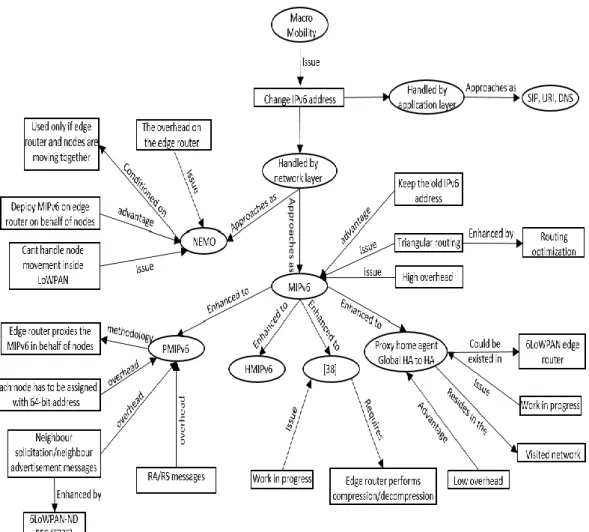
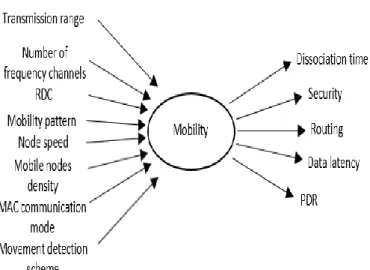
15 which handles the task of controlling mobility. For more details on available models, [18] presents a comprehensive evaluation on different mobility models used for ad hoc networks. For example, Fig. 2.1 demonstrates possible classes by which mobility can be addressed.
2.1.2 Patterns of Mobility
The mobility can be classified into two types, micro and macro mobility [3, 19]. Micro mobility refers to node movement inside a single network domain while macro mobility is a movement between different domains. In order to allow a mobile node (MN) to join a network, there will be required two basic steps to finalize the association and this is based on the mobility type. The first step is the ‘link association’ and the second is the ‘network association’. Any node must first performs the link association process by which to associate with the closest node in its perimeter and then consider the network association to obtain the IPv6 address. Link mobility (which is sometimes referred to as access mobility [20]) is determined by the wireless technology and must guarantee uninterrupted communication while the node changes its point of attachment. Meanwhile, other different terminologies can define the link association as handover while the network association can be
Background
16 called roaming. The macro mobility requires both the process of handover and roaming while micro mobility needs only the handover step [3]. Fig. 2.2 shows an example on the difference between macro and micro mobility.
Link association is based on different steps as channel scanning, association, short address allocation, authentication and any other mode-related services (presuming the IEEE 802.15.4 is the link layer). The steps are all determined by the modes of operation in the IEEE 802.15.4e (beacon-enabled, TSCH, LLDN or DSME) or the radio duty cycling used while operating on the beaconless mode (i.e. sampled listening technique).
Moreover, the mobility of nodes can be derived into two classes, node and group mobility. The node mobility refers to the movement of an individual node inside the network while the group mobility is the movement of multiple nodes together. There is another mobility class which is called ‘network mobility’ which corresponds to the movement of an edge router that connects a network to the Internet [3].
The final attribute for mobility is determined by the role of a node in the network. This can be either sink mobility or node mobility. Several approaches rely on moving the sink node to expedite the process of data aggregation and to reduce the
Background
17 overhead of data forwarding for the regular nodes in the network. In some cases, both nodes and sinks are mobile and this depends on the application type.
2.1.3 Mobility Handling Process
The principle by which the mobility is handled can be categorized into two sectors. The first one is the node-based MMPs that an MN is responsible for determining how to re-initialize a connection after a dissociation occurs. The second one is network-based MMP where the network is responsible for handling the process of associating an MN to the network. The network-based approach has less overhead over the MN as compared to the node-based scheme.
Although there is some literature indicating that with network-based mobility the nodes need no additional installation to handle mobility and there is no additional overhead, but there is still the problem of link association by which the nodes are still moving between different coordinators within the same network (domain). Thus, the only advantage of network-based MMP is when the node is communicating other terminals on other different domains.
2.1.4 Layer Based Classification
One of the important factors in the MMP design is defining which layer within the communion stack will manage mobility. Under the IoT umbrella, ideally there will be four layers that can manage mobility; MAC, 6LoWPAN, network and application. It’s advisable to think of the type of mobility prior to selecting the layer that will handle it. As an example, since the mesh-under techniques are appropriate for handling micro mobility [3], then either MAC-based or 6LoWPAN-based MMPs are suitable to manage micro mobility. Conversely, the macro mobility can be tackled through either network-based or application-based MMPs.
2.1.5 Mobility Management Initiation Process
One of the important concepts for tackling node mobility is the node movement detection scheme. Movement detection sparks the process of considering a new
Background
18 association and the required steps to realize a fast handover. Based on this, the MMPs are utilizing two approaches which are either ‘reactive’ or ‘proactive’ schemes. For reactive scenarios, an MN initiates the process of association once it detects that it has lost a connection with the network. Regarding proactive approaches, the MN or the network coordinators are always monitoring the MN movement to predict the time that an MN will lose connection and the next possible attachment point based on the MN movement trajectory. The reactive technique has less energy overhead but increases the latency of the handover process. On the other hand, the proactive technique has higher energy overhead due to the process of monitoring both link quality and node movement direction, in turn it has less handover latency as compared to reactive protocols.
2.2
MAC Scheduling and Listening Techniques
The radio duty cycle (RDC) of constrained nodes can be considered as a crucial factor that determines the low power IoT network lifetime and its service availability. Two listening techniques are utilized to reduce the RDC of the nodes, sample and schedule listening technique. Alternative definitions to these two techniques are, synchronous (scheduled) and asynchronous (sampling) [21].
Other definitions as in [22] go further and classify the synchronous listening technique to two types depending on the strategy by which the nodes are synchronized, Instantaneous synchronization (the nodes swap control messages to achieve synchronization) and pre-defined synchronization (the network has predefined time division multiple access TDMA structure).
Regarding the first and the most common type of listening techniques, sampling, this technique has been utilized by the most well-known constrained nodes operating systems, Contiki OS through the ContikiMAC [23] RDC technique and the TinyOS OS through the LPL [24] RDC technique. The sampling technique is basically depends on a mechanism by which the sender has to continuously transmits the packet until the receiver turns on its radio and receives the packet [25].
Background
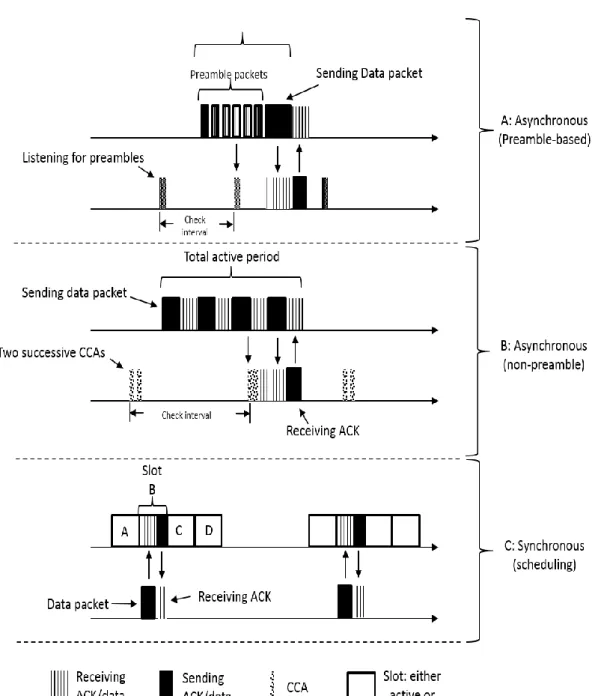
19 On the other hand, schedule listening technique is based on a tight synchronization between adjacent nodes to synchronize the transmission and permit the receiver node to switch on the radio only on a pre-defined time slots to reduce the RDC. According to [21], unlike the sampling technique, the initialization process cost of the schedule listening approach is too high and adds complexity to the network. This overhead caused by the control messages required to synchronize the nodes. Thus, the nodes within the asynchronous techniques have gained an improved energy consumption over synchronous approaches since they do not rely on the control messages [26]. Later, the contribution of chapter four will indicate that the synchronous approach can have low energy consumption as compared to asynchronous listening technique and disproves this assumption. Fig. 2.3 demonstrates the basic structure of each listening technique. With the asynchronous (sampling) scheme, there are two methodologies. The first one is based on transmitting preamble bytes and once the receiver detects these transmissions it will open its radio to receive the actual frame (which is transmitted directly after a specific amount of preamble bytes and determined by the network settings). The second methodology is consisting on sending the actual frame multiple times to ensure that the number of transmissions cover the check interval period. The check interval period is the interval between two successive radio scanning processes that a receiver performs to detect if there is any activity on the media. Maximizing the check interval period will increase data latency and decreasing this interval will maximize the energy consumption.
Besides the ContikiMAC and LPL, other asynchronous listening techniques exist like B-MAC [27], WiseMAC [28] and X-MAC [29]. Moreover, there are two common synchronous (Instantaneous synchronization) listening techniques, which are T-MAC [30] and S-MAC [31]. In addition, two synchronous (pre-defined synchronization) techniques exist: LMAC [32] and DMAC [33]. [22] presents FLAMA [34] as TRAMA technique and consider it as pre-defined synchronization while [34] introduces the FLAMA listening technique and not TRAMA. The TRAMA actually is presented in [35] and FLAMA is the successor of TRAMA. In addition, Corbllini et al. [22] define both of TRAMA and FLAMA as pre-defined synchronization techniques, while they must be considered as Instantaneous
Background
20 synchronization techniques due to the dependency on exchanged control messages during the network initialization to achieve synchronization.
Background
21
2.3
Security Concept Under the IoT Context
The security aspect is a wide field that composes several terminologies and different design methodologies. This section highlights the main principles and modelling techniques that are concerned with the trend of this research.
2.3.1 Security Requirements and Challenges
In order to provide authentic and reliable services and to ensure the availability of the IoT nodes, there are multiple crucial security requirements that need to be addressed prior network deployment. These requirements vary from network to network based on the type of application and the required level for security. In general, the common required security services are confidentiality, authentication, integrity and non-repudiation [36]. In the meantime, there are specific obstacles that withstand the adaptation of powerful security techniques and prevent the dependency on standardized security protocols. The main challenge here is the nature of these low power devices in term of computation and communication constrains that complicates the inheritance of any existed solid security technique. Accordingly, there must be a tradeoff between the desired security level and the overhead of achieving such security demands.
2.3.2 Security Design principles
This section presents a brief definition of the related cipher algorithms and key management approaches.
2.3.2.1 Block and Stream Ciphers
The cipher algorithms are classified into two sets, the block cipher techniques by which the cipher algorithm handles a block of data (i.e. 64,128, 256-bit) at a time. On the other side, stream ciphers process either one bit or a byte at a time. The common block cipher algorithms are AES, RC5, Skipjack and DES while the stream ciphers are like RC4, Salsa20 and its variant ChaCha.
Background
22
2.3.2.2 Symmetric and Asymmetric Cipher Techniques
The cipher algorithms are categorized according the type of key used in encryption and decryption processes. The symmetric algorithms use the same key for encrypting and decrypting (ciphering and deciphering) while the asymmetric techniques use different keys for each process. The asymmetric techniques also called public key cipher algorithms since the key used for encryption is always public while the key used for decryption must be secret and private. Example on the asymmetric techniques are RSA, ElGamal and ECDSA while for the symmetric there are AES, DES and RC5.
2.3.2.3 Ciphering Versus Hashing Techniques
Another sort of algorithms used in the context of security are called the hash functions. These algorithms have the property of being one-way functions by which from the output of these functions there will be no way to obtain the input data. Unlike the hash algorithms, the cipher techniques (as AES, DES, RC4) take the plain text and encrypt it to generate the ciphered text and this resultant output can be fed into a deciphering algorithm