Game Theoretic Infrastructure Sharing in
Multi-Operator Cellular Networks
Alexandra Bousia,
Student Member, IEEE,
Elli Kartsakli,
Member, IEEE,
Angelos Antonopoulos,
Member, IEEE,
Luis Alonso,
Senior Member, IEEE,
and Christos Verikoukis,
Senior Member, IEEE
Abstract—The introduction of 4th Generation (4G) wireless technologies has fueled the rapid development of cellular net-works, significantly increasing the energy consumption and the expenditures of the Mobile Network Operators (MNOs). In addition, the network underutilization during low traffic periods (e.g., night zone) has motivated a new business model, namely infrastructure sharing, that allows the MNOs to have their traffic served by other MNOs in the same geographic area, thus being able to switch off part of their network. In this paper, we propose a novel infrastructure sharing algorithm for multi-operator environments, which enables the deactivation of underutilized Base Stations (BSs) during low traffic periods. Motivated by the conflicting interests of the MNOs and the necessity for effective solutions, we introduce a game theoretic framework that enables the MNOs to individually estimate the switching off probabilities that reduce their expected financial cost. Our approach reaches a Dominant Strategy Equilibrium (DSE), which is the strategy that minimizes the cost of each player. Finally, we provide extensive analytical and experimental results to estimate the potential energy and cost savings that can be achieved in multi-operator environments, incentivizing the MNOs to apply the proposed scheme.
Index Terms—Infrastructure sharing, Switching off, Base sta-tion sleep, Game theory, Energy efficiency
I. INTRODUCTION
The rapid expansion of mobile services, along with the emerging demand for multimedia applications, driven by the widespread use of laptops, tablets and smart devices, has led to an impressive growth of the data traffic volume during the last few years. According to recent market predictions [1], global mobile data traffic is expected to increase nearly 11-fold in the next five years, reaching 15.9 exabytes per month by 2018. Hence, Mobile Network Operators (MNOs1) seek to extend their infrastructure by installing more Base Stations (BSs), in an effort to increase the capacity of their network and meet these pressing traffic demands.
The additional infrastructure not only implies a rise in the Capital Expenditures (CapEx), but also has a direct impact Copyright (c) 2015 IEEE. Personal use of this material is permitted. However, permission to use this material for any other purposes must be obtained from the IEEE by sending a request to [email protected].
A. Bousia, E. Kartsakli and L. Alonso are with the Department of Signal Theory and Communications (TSC) of the Technical University of Catalonia (UPC), Barcelona, Spain, e-mail: {alexandra.bousia, ellik, luisg}@tsc.upc.edu.
A. Antonopoulos is with the Department of Signal Theory and Communica-tions (TSC) of the Technical University of Catalonia (UPC), Barcelona, Spain and with Telecommunications Technological Center of Catalonia (CTTC), Barcelona, Spain, e-mail: [email protected].
C. Verikoukis are with Telecommunications Technological Center of Cat-alonia (CTTC), Barcelona, Spain, e-mail:{aantonopoulos, cveri}@cttc.es.
1Hereafter, the terms “MNO” and “operator” will be used interchangeably.
on the network energy consumption, thus resulting in higher Operational Expenditures (OpEx) [2]. In particular, the use of information and communication technology across a wide range of applications accounts for 5.7%of the world’s elec-tricity consumption and1.8%of global carbon emissions [3], something that translates into electricity bills in the order of
$10 billion for the MNOs worldwide [4]. Hence, there is a strong motivation to investigate solutions to bring down the energy consumption and the cost of cellular networks, thus yielding both environmental and financial gains. Given that cellular networks are dimensioned according to peak-hour traffic demands, an effective approach towards this direction is to temporarily switch off part of the BS infrastructure that remains underutilized when the network traffic is low.
The coexistence of multiple MNOs in the same geographical area [5], due to legal regulations that obligate them to install their antennas on the same buildings, has motivated a new business model, known as infrastructure sharing [6], [7]. This new paradigm embraces a set of strategies that enable the MNOs to use their resources jointly to reach their common goal, which is to guarantee user service while achieving energy and cost reduction. Infrastructure sharing is classified into three categories [8]: i) passive sharing of sites, masts and building premises,ii) active sharing of the active network com-ponents such as antennas, switches and backhaul equipment, and iii) roaming-based sharing, where the MNOs share the cell coverage for a pre-negotiated time period.
In this paper, motivated by the aforementioned issues, we propose a roaming-based infrastructure sharing scheme, applicable in multi-operator environments during low traffic periods. Taking into account the rationality of the MNOs and their conflicting interests, we introduce a game theo-retic framework that enables the MNOs to make individual switching off decisions for their own BSs, thus bypassing potential complicated service level agreements among them. Besides the expected energy efficiency benefits, the proposed scheme allows the MNOs to significantly reduce their financial costs independently of the strategies of the coexisting MNOs, providing them with the incentives to participate in the game. Our contribution is summarized as follows:
1) As a part of an integrated roaming-based infrastructure sharing scheme for multi-operator environments, we in-troduce a game theoretic switching off algorithm that aims at minimizing the individual MNO cost in a dis-tributed manner. We define a realistic cost function that explicitly considers actual roaming and operational costs for the MNOs. We show that, in the proposed game, a
Dominant Strategy Equilibrium (DSE) can be reached, defined as the strategy yielding the minimum cost for each MNO, regardless of the other MNOs’ actions. 2) To address the heterogeneous nature of voice and data
traffic in current and future cellular networks, we design an analytical model, based on a two-dimensional Markov chain, that theoretically estimates the throughput, the energy efficiency and the cost expenses both for the individual MNOs and the whole network.
3) We validate the theoretical analysis and assess the ef-fectiveness of the proposed infrastructure sharing scheme with the aid of extensive simulation experiments. We in-troduce a new performance metric, namely cost efficiency, that connects the network performance with the financial benefits of the MNOs. The results indicate the potential total energy efficiency gains in the network and highlight the individual cost and energy gains for the MNOs. The remainder of the paper is organized as follows. Sec-tion II briefly reviews the related work. The system model, the network configuration and the notation used throughout the paper are described in Section III. In Section IV, we introduce the infrastructure sharing scheme, along with the game formulation of the switching off decision. In Section V, we present the analytical models for the energy efficiency, the network throughput and the cost metrics. The validation of the model and an extensive performance assessment are provided in Section VI. Finally, Section VII concludes this paper.
II. RELATEDWORK
Since the BS is one of the most power hungry network com-ponents, several research works have focused on reducing the number of BSs through optimal [9], [10] or heterogeneous de-ployment strategies [11], [12]. Recently, in an effort to achieve more drastic energy saving gains, the research community has shifted towards the investigation of BS switching off schemes [13]-[17]. The core idea is to increase resource utilization during periods of low traffic (e.g., night) by switching off part of the BS infrastructure, while the remaining active BSs extend their coverage to serve the whole network area.
These traditional switching off schemes can be taken one step further by considering the emerging business model of in-frastructure sharing among multiple MNOs offering service to the same geographical area. In particular, significant research attention has been placed on roaming-based infrastructure sharing solutions that consider joint BS switching off among multiple MNOs [18]-[22]. In [18], a non-cooperative game for switching off BSs in a two MNOs network is presented. In their pioneer work, Marsan and Meo [19] proposed four cooperative strategies to switch off BSs in networks with two MNOs, according to the following criteria: i) equal switching off time periods, ii) equal roaming costs, iii) equal energy gains, iv) maximum energy savings. In all cases, the traffic of the switched off BS is roamed to the collocated BS of the active MNO. In [20], the authors extend the algorithm that maximizes the energy savings (proposed in [19]) for multi-operator environments with various traffic types and Quality of Service (QoS) requirements (i.e., throughput, lost calls). In the same context, Oh et al. [21] studied the potential energy
savings that can be achieved by opportunistically switching off part of the network during low traffic in real-world scenarios. In our former work [22], we introduced a game theoretic switching off strategy in networks with two MNOs, providing analytical expressions for the throughput and energy efficiency calculation, assuming only one type of traffic (i.e., voice).
Nonetheless, despite their novel insights in the infrastructure sharing concept, the aforementioned works study only partic-ular aspects of the problem (e.g., switching off time, roaming cost, energy savings). However, to provide feasible and effi-cient solutions, it is necessary to take into consideration all the important parameters (i.e., roaming and operational cost, energy consumption, QoS in terms of lost calls). In addition, the consideration of only voice traffic in some works (e.g., [19], [20]) is not realistic, since data traffic forms a significant part of the total traffic load in current cellular networks. Last but not least, the assumption of only two MNOs in the network is a limiting factor for the contribution of the above works, as the most common scenarios in European countries involve three to four MNOs [5]. In the following sections, we propose a distributed BS switching off solution that enables the efficient infrastructure sharing in multi-operator networks, taking into account realistic cost and traffic patterns.
III. SYSTEMMODEL
A. System Model and Operation
Our system model, depicted in Fig. 1(a), considers clusters of multi-operator cells. Each cluster is formed by one central cell surrounded byM peripheral cells, while each cell includes N BSs of different MNOs. Therefore, the termBSn,mis used
to denote the BS of the nth operator in themth macro cell, withn∈[1, N]andm∈[0, M]. Part of the BS infrastructure in the M surrounding cells may be switched off during low traffic conditions, motivating the MNOs to share the resources of the remaining active BSs in the same cell. In contrast, the central cell BSs always remain active and increase their transmission power to form an umbrella cell, in the extreme case where all the BSs of a peripheral cell are switched off.
Regarding the traffic model, we adopt a realistic pattern [23]-[24] for the aggregate voice and data traffic per operator in a given cell during the night zone. As depicted in the leftmost part of Fig. 1(b), the maximum traffic per hour is expressed as a percentage of the total BS capacity BW that is considered same for all cells. We focus on the time zone between 01.00 and 09.00 am2, when the total traffic per BS is relatively low (i.e., less than20% of the cell’s capacity).
For the sake of generality, we assume that the traffic of different operators follows the same pattern but may vary in volume. Hence, we define the percentage of each MNO’s traffic loadρn ∈[0,1]with respect to the maximum traffic for
the respective hour. In the example depicted in the rightmost part of Fig. 1(b), the traffic of three MNOs is considered. The first MNO has the maximum traffic volume (i.e., ρ1 = 1),
whereas the second and the third MNO have 70% and 30%
(i.e., ρ2 = 0.7 and ρ3 = 0.3) of the maximum traffic,
2Our algorithm can be adapted to different traffic conditions and the selection of the night zone may vary according to the actual traffic variations.
BSN,M BS1,M . BSN,0 BS1,0 BSN,m . BS1,m Cell M
(a) Cluster of one central andM periph-eral macro cells, covered byN operators
01.00 04.00 07.00 0 5 10 15 20 Night zone
Traffic Profile, Load (%)
Data Voice 01.000 04.00 07.00 5 10 15 20 Night zone
Traffic Profile of operator n, Load *
ρn (%) ρ 1=1.0 ρ 2=0.7 ρ 3=0.3
(b) Voice and data traffic during the night zone Fig. 1. Scenario and traffic model
respectively. Finally, the voice and data connections are served at a Constant Bit Rate (CBR) of RV andRD, respectively3.
B. Notation
Before proceeding to the algorithm description, let us define the next sets:
• M = {1, . . . , M}, with |M| = M, is the set of peripheral cells forming a cluster around a central cell.
• N = {1, . . . , N}, with |N | = N, is the set of N
operators covering the cluster area.
• MON ⊆ M, with |MON| = MON, is the subset of
peripheral cells with at least one active BS.
• MOF F ⊆ M, with|MOF F|=MOF F, is the subset of
peripheral cells with all BSs switched off.
• NON(m)⊆ N, with N (m) ON =N (m)
ON, is the subset of MNOs
that maintain their BSs active in cellm.
• NOF F(m) ⊆ N, with N (m) OF F = N (m) OF F, is the subset of
MNOs that switch off their BSs in cell m.
• Nroam(n,m)⊆ N (m) OF F, with N (n,m) roam =N (n,m)
roam, is the subset
of operators that select operator n in order to roam the traffic of their switched off BS in cell m.
IV. INFRASTRUCTURESHARING WITHGAMETHEORETIC SWITCHINGOFFDECISION
In this section, we introduce the infrastructure sharing framework for multi-operator environments, consisting of two 3We consider that no rate adaptation takes place within the cell and all users of a given service class are allocated the same amount of resources, calculated for cell edge users. Although this is the worst case scenario, our approach is suitable for our high-level study, while the optimized resource allocation (i.e., spectral efficiency) is not so critical during the night zone.
parts: i) an infrastructure sharing algorithm and ii) a game theoretic switching off decision strategy. The infrastructure sharing algorithm that defines the rules for the collaboration among the MNOs, given that part of the BS infrastructure is switched off during the night zone is presented in Sec-tion IV-A. Then, in SecSec-tion IV-B, we formulate the BS switching off decision as a game theoretic strategy that enables each operator to determine the best course of action in each cell, in order to reduce its own cost and energy consumption.
A. Infrastructure Sharing Scheme
Let us recall that the considered system model (Sec-tion III-A) includes N MNOs that provide coverage to a cluster of one central and M peripheral cells. For the low-traffic night zone, a subset of each operator’s BSs in the periph-eral cells is switched off. Once this BS subset is determined (through the game theoretic algorithm described in the next section), the proposed infrastructure sharing scheme is applied to determine how the traffic will be served by the remaining active infrastructure, taking into account the corresponding operation and roaming costs.
The proposed infrastructure sharing scheme is applied in the network after the execution of the independent switching off decisions. According to the outcome of the decision process, there are three possible outcomes in a peripheral cellm:
1) If all the BSs remain active (i.e.,NON(m)=N), no infras-tructure sharing takes place. Hence, each BS consumes energy for operation and service of its own traffic. 2) If a subset NON(m) ⊂ N of the BSs remains active, then
they undertake the service of the traffic of the switched off BSs in the same cell (i.e.,NOF F(m) ). In particular, the traffic of each switched off BS is roamed to an active BS of the same cell, selected randomly with equal probability ps
from the subsetNON(m). The MNOs of the deactivated BSs should pay the corresponding roaming cost to the active operators. However, the increased energy consumption (due to the higher traffic) of the active BSs implies a higher cost that should also be considered.
3) If no BSs remain active, (i.e.,NON(m)=∅), the BSs of the central cell (BSn,0) increase their transmission power to
cover the area of the peripheral cell. In this case, there is no collaboration between operators, since the traffic of each switched off BS is served by the central BS of the same operator. Hence, no roaming costs are involved, while the operators take into account the extra cost for the increased power consumption in the central cell. Having defined the general network operation, each MNO is able to make an individual switching off decision without the need of exchanging information and, subsequently, to execute the infrastructure sharing algorithm (Algorithm 1), illustrated in Fig. 2. Given the aforementioned three possible outcomes for the peripheral cellm, four different cases can be observed from the point of view of thenth operator (i.e., M N On):
• Case 1 - Operator n is ON and NON(m) = N − 1
operators are ON: The total cost for the M N On is
Cn,m = Cconst+C (n,m)
tr , where Cconst represents the
fixed operational cost for the BS andCtr(n,m)corresponds
No Yes
No
No
Yes Yes
Switching off decision application
Is the BS switched OFF? Any of the BSs in the same
cell roams its traffic?
Any BS in the same cell is ON?
Serve own traffic Serve own and the roamed
traffic - Roaming income
Send traffic to the central cell Roam traffic to one of the BSs randomly in
the same cell - Pay roaming cost
Fig. 2. Flowchart of the infrastructure sharing algorithm
• Case 2 - Operator n is ON and NOF F(m) >0 operators are OFF: In this case,M N Onmay have to pay a higher
cost due to the increased served traffic (i.e., its own traffic along with the roamed traffic of other BSs), while receiving the corresponding roaming income from each operatorM N Oi∈ N
(n,m)
roam. More specifically:
– The total operation cost can be expressed as Cn,m0 =
Cconst+C (n,m) tr + P i∈Nroam(n,m)C (i,m) tr
– The received roaming income by M N On can be
expressed as Croam0(n,m) = Pi∈N(n,m) roam C
(i,m) roam, where
Croam(i,m)is the roaming cost paid byM N Oiand can be
considered as a portion of the total operational cost, i.e.,Croam(n,m)=α· Cconst+C (n,m) tr , with α∈[0,1]. Consequently, in this case, the total cost for operator M N On can be written as:
Cn,m = Cconst + C (n,m) tr + P i∈Nroam(n,m)C (i,m) tr − α· Cconst·Pi∈N(n,m) roam C (i,m) tr .
• Case 3 - Operator n is OFF and NON(m) > 0 operators are ON: In this case, operator nshould pay the roaming cost to one operator from the active setNON(m) randomly selected with equal probability ps= 1/N
(m)
ON. Hence, in
this case, Cn,m=C (m,m) roam .
• Case 4 - Operator n is OFF and NOF F(m) = N −1
operators are OFF: In this case, the cost paid by the M N On corresponds to the extra energy consumption for
the power increase of the central BS (BSn,0), in order to
cover the area of a switched off BS in a peripheral cell. Hence,Cn,m=C
(n,0) inc .
B. Game Theoretic Switching Off Strategy
The proposed infrastructure sharing scheme defines the rules of agreement among the MNOs, taking as an input the subset of switched off BSs in the peripheral cells. Hence, the individual switching off decisions constitute the core of the proposed scheme and its main contribution. By considering the conflicting interests and the interaction among the MNOs, as well as the different available courses of action, we propose a game theoretic BS switching off strategy. We model the switching off decision process as a static non-cooperative game with complete information [25], played by theNMNOs in each of the M peripheral cells. Non-cooperative game theory provides multi-fold advantages, enabling us:
• to model the aforementioned conflicting situations be-tween the MNOs with high accuracy;
Algorithm 1 Infrastructure sharing algorithm of BSn,m in
peripheral cell m
Require: Switching off decision of all MNOs in cellm
1: for each m∈ M do
2: for eachn∈ N do
3: if
(n∈ NON(m)) & (NOF F(m) =∅)then .Case 1 4: Cn,m=Cconst+C
(n,m) tr
5: else if(n∈ NON(m)) & (NOF F(m) 6=∅)then . Case 2
6: Cn,m=Cconst+C (n,m) tr
7: for each(r∈ Nroam(n,m))do
8: BSn,m roam ←−−−BSr,m 9: Cn,m=Cn,m+C (n,m) tr −C (n,m) roam 10: end for
11: else if(n∈ NOF F(m) ) & (NON(m)6=∅)then . Case 3
12: Select operator r ∈ NON(m) with probability ps= 1/N (m) ON 13: BSn,m roam −−−→BSr,m 14: Cn,m=C (n,m) roam
15: else if(n∈ NOF F(m) ) & (NON(m)=∅)then . Case 4 16: BSn,m roam −−−→BSn,0 17: Cn,m=C (n,0) inc 18: end if 19: end for 20: end for
• to minimize the exchange of information among the
different MNOs. This is very important, since, in compet-itive environments, the MNOs may not be willing to dis-close extensive network information to their competitors. Furthermore, minimizing interactions can reduce the risk of misbehavior, since selfish operators could choose to modify their statistics to increase their personal benefits;
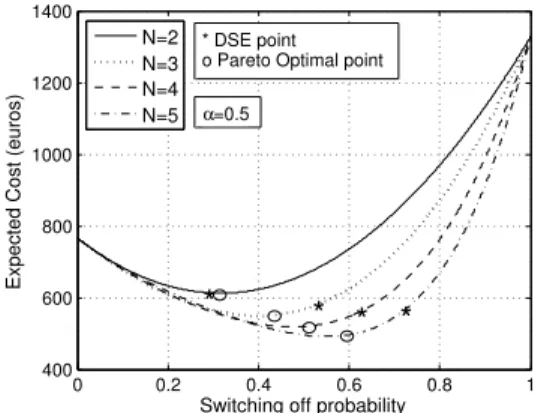
• to reach distributed close-to-optimal solutions for realistic scenarios. In the proposed game, a DSE can be achieved, which can be easily calculated with limited required information. The DSE represents the solution where each player’s assigned strategy minimizes its cost, regardless of the other players’ strategy and, in our formulation, it is very close to the Pareto optimal solution.
The remaining of this section is divided into three parts. First, the game formulation and the cost matrix are given,
followed by the individual cost minimization analysis in the second part. Finally, the DSE of the game is discussed, along with some numerical results on the switching off probabilities.
1) Game Formulation:
Definition 1.The non-cooperative gameΓcan be represented in strategic form by the triplet: Γ = (N,Sn,m, Cn,m), with
n∈ N, m∈ M, where:
• N ={1, . . . , N}is the finite set of players corresponding to the N operators.
• Sn,m={ON,OFF}is the set of the two possible actions
for eachM N On with respect to theBSn,m, i.e.,BSn,m
can be active (state ON) or switched off (state OFF).
• Cn,m:S →R+ is the cost function for player n in the peripheral cellm, whereS=S1,m× · · · × Sn,m× · · · × SN,m represents the Cartesian product.
The cost function of the game Cn,m has been selected to
match the cost paid by each operator in every peripheral cell, as described in Section IV-A. However, exploiting the fact that the small traffic load variations during night have a negligible impact on the operational cost of the BS, it can be assumed that all operators have approximately the same cost for serving the traffic in a given cell m, i.e.,Ctr(n,m) ≈Ctr(m). Similarly, the roaming cost, which is expressed as a function of the operational cost, is also simplified toCroam(n,m)≈C
(m) roam.
This realistic simplification has two direct implications on the game formulation. First, the operators can accurately calculate their cost function by using average traffic statistics for a given cell. As a result, there is no need for information exchange among MNOs (to obtain the actual traffic values) prior to the application of the game, thus facilitating its im-plementation and eliminating any concerns about truthfulness. Second, by simplifying the cost functions, the MNOs obtain the same payoffs for a given action and, as a result, the outcome of the game is independent of the identity of the players. Hence, by definition, the proposed game is symmetric, allowing its formulation as an N-player game with 2 macro-players: i) player A is a givenM N Oi, withi∈ N ii) player
B is the setN \{i}, formed by the remainingN−1operators, excluding M N Oi. The matrix representation of the game is
given in Table I, showing the costs of player A with respect to the different contingencies of player B.
The costs in Table I correspond to the different cases of the infrastructure sharing algorithm described in Section IV-A, after applying the simplification mentioned above. The formulation of our problem in a strategic form reveals one pure strategy, corresponding to the case where the MNOs switch off in all peripheral cells, thus minimizing the number of active BSs. However, this strategy would require major transmission power increase of the central BSs and could lead to lost sessions, since the central cells may not have sufficient capacity to support all the traffic of the cluster. This limitation of the pure strategy, along with the motivation of the MNOs to achieve energy efficiency without sacrificing ubiquitous service in the network, have motivated us to study the problem in the mixed strategies domain, in order to provide feasible and applicable solutions for distributed systems. Therefore, we proceed to a mixed strategy approach, where the MNOs
randomize over the possible actions with a certain probability distribution. In the next section, we calculate the strategy that minimizes the cost of each player, and, then, by exploiting the symmetry of the game, we prove that a DSE is achieved.
2) Individual Cost Minimization Analysis:
The aim of the game is to calculate the set of the switching off probabilities that minimizes the expected cost of M N Oi, ∀i∈N, given by: E[Ci,m] =E[C ON,ON i,m ] +E[C OF F,OF F i,m ]
+E[Ci,mOF F,ON] +E[Ci,mON,OF F]. (1) To that end, we define assi,m the probability of player A
(i.e., M N Oi) switching off the BSi,m. Furthermore, due to
the symmetry of the game, the remainingN−1operators are grouped together into player B, having a common switching off probabilitysj,m. Subsequently, the expected costs of player
A in each state of the game are estimated as follows: 1) Case 1 (ON,ON): The expected cost for MNOiis:
E[Ci,mON,ON] = (1−si,m)·(1−sj,m) N−1 ·Cconst+C (m) tr . (2) 2) Case 2 (ON,OFF): Each of theNOF F(m) switched off BSs randomly selects one of theNON(m)active BSs of the same cellmwith equal probabilityps= 1/N
(m)
ON. The random
decision does not affect the outcome of our approach, since the roaming cost is indifferent to the BS selection. Hence, the number of switched off BSs that will select operatorito serve their traffic (Nroam(i,m)) will determine its
actual cost. To calculate the expected cost, all the possible roaming combinations that involve the ith operator must be considered, leading to Eq. (3) (top of the next page). 3) Case 3 (OFF,ON): In this case, the traffic of the switched
offBSi,m is roamed to one active BS, with a cost: E[Ci,mOF F,ON] =si,m·
1−(1−sj,m) N−1
·Croam(m) . (4) 4) Case 4 (OFF,OFF): The BSs of all operators are switched off and the traffic is served by the corresponding BSs of the central cell, which increase their transmission power to cover the peripheral cell, with an expected cost:
E[Ci,mOF F,OF F] =si,m·sNj,m−1·C (i,0)
inc . (5)
Substituting Eq. (2)-(5) to Eq. (1), we derive Eq. (6) at the top of the next page.
Let us recall that the goal of each MNO is to estimate its individual switching off probability that minimizes its cost. To that end, the strategy that minimizes the cost of theith MNO, si,m, given the strategy sj,m is calculated by the roots of the
partial derivative of the cost function with respect tosi,m:
∂E[Ci,m] ∂si,m = 0⇒sNj,m−1·Cinc(i,0)+1−(1−sj,m) N−1 ·Croam(m) − N X NON(m)=1 N−1 NON(m)−1 ·(1−sj,m)N (m) ON−1·sN−N (m) ON j,m · Cconst+C (m) tr + Ctr(m)−Croam(m) ·N−N (m) ON NON(m) = 0. (7)
TABLE I
COST MATRIX OF THE PROPOSED GAME
Player B:N−1operators inN \ {i} ON OFF Player A: Operatori ON Cconst+Ctr(m) Cconst+Ctr(m)+ Ctr(m)−Croam(m) ·Nroam(i,m) OFF Croam(m) C (i,0) inc E[Ci,mON,OF F] = N−1 X NON(m)=1 (1−si,m)· N−1 NON(m)−1 ·(1−sj,m)N (m) ON−1·sN−N (m) ON j,m · N−N (m) ON X Nroam(i,m)=0 N−N(m) ON Nroam(i,m) ·pNroam(i,m) s ·(1−ps)(N−N (m) ON−N (i,m) roam)· Cconst+C (m) tr +
Ctr(m)−Croam(m) ·Nroam(i,m)
= N−1 X NON(m)=1 (1−si,m)· N−1 NON(m)−1 ·(1−sj,m)N (m) ON−1·sN−N (m) ON j,m · Cconst+C (m) tr + Ctr(m)−Croam(m) ·N−N (m) ON NON(m) . (3) E[Ci,m] =si,m·sNj,m−1·C (i,0) inc +si,m· 1−(1−sj,m) N−1 ·Croam(m) + N X NON(m)=1 (1−si,m)· N−1 NON(m)−1 ·(1−sj,m) NON(m)−1 ·sN−N (m) ON j,m · Cconst+C (m) tr + Ctr(m)−Croam(m) ·N−N (m) ON NON(m) . (6)
Having provided the analysis for the individual cost min-imization strategy, in the following section, we exploit the symmetry of the game to prove that the estimated value for the sj,m corresponds to the DSE.
3) DSE Characterization and Numerical Results:
According to [26, Definition 3.4]:
Definition 2. A strategy profiles∗={s∗1. . . s∗n} ∈ S is the DSE if each elements∗i ofs∗is dominant strategy of playeri. Proposition 1.The equilibrium of the gameΓis a DSE and is calculated by Eq. (8) at the top of the next page.
The proof of the Proposition 1 is given in Appendix A.
Proposition 2. The DSE of the gameΓ is unique.
The proof of Proposition 2 is given in Appendix B. Unlike other widely-employed game theoretic concepts (e.g., Nash Equilibrium) that may require a number of it-erations before converging to an acceptable solution [27]-[29], DSE can be always achieved in one shot. This is very important in our case where multiple iterations cannot be implemented, given that the continuous interchangeable switching on and off of the macro BSs is not considered as a viable option by the mobile operators [26], [30]. However, our practical and realistic game formulation enables the MNOs to reach the DSE by estimating one-shot switching off probabil-ities, which is particularly important in our problem. Hence, instead of applying an iterative algorithm that follows the best response dynamics to converge to an equilibrium, we show that one MNO can estimate the switching off strategies by knowing only the total number of operators (N) in the network.
Having derived the theoretical expression for the mixed strategies DSE, we study the impact of the number of MNOs and the roaming cost parameterαon the switching off prob-abilities through some numerical results, presented in Table II. The cost values are calculated based on the average traffic volume, given the Fig. 1(b). We consider values from N = 2
up to N = 6operators, while we assume five different values
forα(α= 0.1,α= 0.3,α= 0.5,α= 0.7 andα= 0.9) with respect to the definition of roaming cost in Section IV-A.
TABLE II
DSE SWITCHINGOFFPROBABILITIES
N a= 0.1 a= 0.3 a= 0.5 a= 0.7 a= 0.9 2 0.459 0.377 0.296 0.215 0.133 3 0.679 0.629 0.568 0.486 0.357 4 0.799 0.749 0.675 0.584 0.466 5 0.854 0.826 0.795 0.758 0.713 6 0.880 0.861 0.843 0.819 0.798
Two main conclusions can be derived from Table II. First, the DSE switching off probabilities increase with the number of MNOs in each cell. In particular, the coexistence of many operators in one cell motivates a given MNO to switch off its BS, as it implies a higher probability of having its traffic roamed to a different MNO. Regarding the second basic observation, as expected, the switching off probability decreases for higher roaming cost, which is a prohibitive factor for the BS deactivation. However, it is worth noting that the DSE probability is severely reduced for higher roaming in networks with few MNOs, due to the risk of switching off all BSs in the cell. On the other hand, in a network with many MNOs, where the aforementioned risk is not so evident, the switching off probability for highais still significant. Finally, in Appendix C, we compare the DSE to the global optimal solution to provide further insights for our game formulation.
V. ANALYTICALMODEL
In this section, we provide analytical models for the calcu-lation of the network throughput, energy efficiency and cost.
As mentioned in Section III-A, the network traffic consists of voice and data, with CBRs RV andRD, respectively. We
assume that for each BSn,m, voice calls and data sessions
are Poisson generated processes with ratesλ(Vn,m) andλ(Dn,m) and have exponential service times, denoted by1/µ(Vn,m)and
1/µ(Dn,m), respectively. Hence, we model the operation of BSn,m as a multi-server M1, M2/G1, G2/N/N1, N2 queue,
s ·Cinc + 1−(1−s ) ·Croam − N X NON(m)=1 N−1 NON(m)−1 ! ·(1−s∗)N (m) ON−1·s∗N−N (m) ON · Cconst+Ctr(m)+ Ctr(m)−C (m) roam ·N−N (m) ON NON(m) = 0 (8)
resulting in a two-dimensional Markov chain, illustrated in Fig. 3. Each state of the system(ν, d)is characterized by the number of active voice and data sessions, denoted by ν and d, respectively. The state space of this Markov model, along with the bandwidth restrictions, is:
A={(ν, d)|0≤ν ≤NV,
0≤d≤ND, ν·RV +d·RD≤BW}, (9)
given that BW is the total bandwidth of the BS, NV =
BW/RV andND=BW/RDrepresent the maximum number
of simultaneous voice calls and data sessions, respectively.
v,d
v,d+1 v-1,d
Fig. 3. Two-dimensional Markov state transition diagram for the voice and data traffic served in a BS (Note that for convenience, MNO and cell identification notations have been dropped.)
By analyzing the state transition diagram (Fig. 3), we obtain the system of linear equations for steady state probabilities, p(ν,d). The balance equation that represents the valid
transi-tions is given by Eq. (10) at the top of the next page. The steady state probabilities are calculated given the con-dition that the sum of the state probabilities is equal to 1, i.e., NV P ν=0 bBW−RDν·RVc P d=0
p(ν,d) = 1. Employing the steady state
probabilities, we calculate some key performance metrics for the individual BSs and the whole network.
A. Operator-wide performance metrics
In this section, we analyze the performance of a BSn,m
with total bandwidth of BW, belonging to operator n in a given cellm. We focus on the night zone, with durationtnight,
when voice and data sessions have an average generation rate of λ(Vn,m) andλ(Dn,m), respectively.
1) Definition 3.Cell Throughput: The expected throughput E[Tn,m]for theBSn,mis defined as the average number (over
all possible states) of served sessions in the system multiplied by the transmission rate of each session (i.e.,RV andRD for
voice and data, respectively) and calculated as:
E[Tn,m] = NV X ν=0 bBW−ν·RV RD c X d=0 (ν·RV +d·RD)·p(ν,d), (13) where p(ν,d) are the steady state probabilities for the given traffic load rates λ(Vn,m)and λ(Dn,m).
A very important and relevant metric in our work is the normalized throughput, defined as the ratio of the served connections to the total existing connections in the network. This metric is often employed to represent the Grade of Service (GoS) in telecommunication systems, showing the level of user satisfaction in the system. Achieving a normalized throughput of 100% signifies that all users are served, which is a key requirement for MNOs.
2) Definition 4.Cell Energy Efficiency: The expected en-ergy efficiencyE[η(n,m)]for BSn,mis defined as the ratio of
the average transmitted bitsE[Bn,m]over the average energy
consumption E[En,m]:
E[η(n,m)] = E[Bn,m]
E[En,m]
, (14)
whereE[Bn,m]can be calculated by multiplying the average
throughput (Eq. (13)) with the duration of the night zone (tnight), i.e., E[Bn,m] =E[Tn,m]·tnight.
To calculate the average energy consumption, we consider the power consumed by the BS for operation and transmission, consisting of three components: i) the constant powerPconst,
consumed by an active BS for operations such as cooling, antenna feeding, etc, ii) the idle power Pidle, which is the
power consumed when the BS remains idle, i.e., when it has no ongoing traffic sessions4, andiii) the transmission power for serving the ongoing traffic sessions corresponding to each state p(ν,d), considering that Ptx denotes the transmission power
for serving a single voice or data session. Hence, the average energy consumption during the night zonetnight is given by:
E[En,m] = Pconst+Pidle·p(0,0)+ NV X ν=0 bBWRD−ν·RVc X d=0 (ν+d)·Ptx·p(ν,d) ·tnight. (15)
3) Cost: We provide analytical expressions for the different terms (i.e.,Cconst,C
(n,m) tr ,C
(n,0) inc ,C
(n,m)
roam) that compose Eq.
(6), which provides the expected cost for an MNO. First,Cconst,C
(n,m) tr andC
(n,0)
inc refer to the costs related to
the operation of an active BS and the service of the existing traffic. These costs depend directly on the energy consumed for the different functions of the BSs. Therefore, provided that c1 is the electricity charge per energy unit, in[e/kW h], the
operational costs of a BS can be expressed as a function of the average energy consumption [31]. Thus, we have:
Cconst=c1·Pconst·tnight, (16)
Ctr(n,m)=c1· Pidle·p(0,0)+ NV X ν=0 bBW−ν·RV RD c X d=0 (ν+d)·Ptx·p(ν,d) ·tnight, (17)
4The fraction of time that the BS remains idle is expressed by the probabilityp(0,0)in the Markov chain (Fig. 3).
p(ν,d)· λ(Vn,m)·ϕν+1,d+λ (n,m) D ·ϕν,d+1·ϑν,d+1+ν·µ (n,m) V ·ϕν−1,d+d·µ (n,m) D ·ϕν,d−1 =λ(Vn,m)·p(ν−1,d)·ϕν−1,d +λ(Dn,m)·p(ν,d−1)·ϕν,d−1·ϑν,d+ (ν+ 1)·µ (n,m) V ·p(ν+1,d)·ϕν+1,d+ (d+ 1)·µ (n,m) D ·p(ν,d+1)·ϕν,d+1, (10)
whereϕν,d,ϑν,d denote the characteristic functions:
ϕν,d= ( 1, (ν, d)∈ A, 0, otherwise. (11) ϑν,d= ( 1, ν·RV +d·RD≤BW, 0, otherwise. (12) Cinc(n,0)=c1· Pidle0 ·p(0,0)+ NV X ν=0 bBWRD−ν·RVc X d=0 (ν+d)·Ptx0 ·p(ν,d) ·tnight, (18)
wherePidle0 andPtx0 denote the power consumed when the BS
remains idle and the transmission power for serving a single voice or data session, when the central BS increases its power. With regard to the roaming cost,Croam(n,m)corresponds to the
amount paid when an operator roams its traffic to the BSs of another operator. In Section IV-A, the definition of the roaming cost with respect to Cconst andC
(n,m)
tr was given. Now, this
definition is extended by considering the operational electricity charges. Based on the energy consumption of a BS,E[En,m],
the roaming cost is given by:
Croam(n,m)=α·c1·E[En,m]. (19)
4) Cost efficiency: Having defined theoretical expressions for the network performance and cost, we introduce a novel metric, named cost efficiency, that connects the performance with the total cost for each operator.
Definition 5. Cell Cost Efficiency, measured in[M bits/e], is defined as the ratio of the average transmitted bits over the operator’s total expenses. Accordingly, the cost efficiency of an operator nin a peripheral cell mis expresses as:
E[ηcn,m] = E[Bn,m]
E[Cn,m]
. (20)
B. Network-wide performance metrics
In continuation, we calculate the respective metrics for the network of N operators in a cluster of one central and M peripheral cells. Based on the game theoretic analysis (Section IV-B), each operatornmay choose to switch off the BS of a peripheral cellmwith a switching off probabilitys∗. As explained before, depending on the case, the traffic of each switched off BS is served either by the central BS of the same operator, or by a different operator of the same cell.
To calculate the global performance metrics of the network, we calculate the average traffic load that is served by each BS after the application of the infrastructure sharing algorithm. We define asλ
0(n,m)
T , T ={V, D}the new average traffic load of
the BSn,m for voice and data traffic, which is equal to the
traffic λ(Tn,m) of the nth MNO plus any additional roamed traffic. We distinguish the following two cases:
• For each BSn,0 of the central cell:
λ 0(n,0) T =λ (n,0) T + X i∈MOF F λ(Tn,i). (21)
• For eachBSn,mof the peripheral cells (m∈[1, M]) that
remains active and roams the traffic ofNroam(n,m)MNOs:
λ0T(n,m)=λ(Tn,m)+ X i∈Nroam(n,m)
λ(Ti,m). (22)
Using these values for the traffic load, the steady state prob-abilitiesp0(ν,d) for each BS are recalculated and employed for the estimation of the key network metrics, explained below.
1) Definition 6. Total Network Throughput: The total throughput of the cluster, E[T], is the sum of the average throughputs of the active BSs in the M peripheral cells and the central cell (which always remains active):
E[T] = M X MOF F=0 M MOF F ·s∗N·MOF F ·1−s∗N (M−MOF F) · N−1 X NOF F(m) =0 N NOF F(m) ·s∗N (m) OF F ·(1−s∗)N−N (m) OF F (23) · X m∈MON X n∈NON(m) ETn,m0 + X n∈N ·E Tn,0 0 ,
whereE[Tn,m0 ]is the average throughput of an activeBSn,m
in cellm, calculated by Eq.(13)using the corresponding traf-fic load (Eq.(22)). Similarly,E[Tn,00]is the average throughput of the central BSs, with average traffic load given by Eq.(21). 2) Definition 7.Total Network Energy Efficiency: The total energy efficiencyE[η]in the cell cluster is calculated as the
total number of transmitted bits E[B] divided by the total energy consumptionE[E]: E[η] = M X MOF F=0 M MOF F ·s∗N·MOF F ·1−s∗N (M−MOF F) ·E[B] E[E]. (24)
Similarly to Eq. (23),E[B] is calculated as:
E[B] = N−1 X NOF F(m) =0 N NOF F(m) ·s∗N (m) OF F ·(1−s∗)N−N (m) OF F · X m∈MON X n∈NON(m) E Bn,m0 +X n∈N ·E Bn,0 0 , (25)
where E[Bn,m0 ] andE[B0n,0] the average transmitted bits for
the BSs of the peripheral and the central cells, respectively, calculated for the corresponding traffic (Eq. (22) and (21)).
Accordingly, the total energy consumption is derived as: E[E] = N−1 X NOF F(m) =0 N NOF F(m) ·s∗N (m) OF F ·(1−s∗)N−N (m) OF F· X m∈MON X n∈NON(m) EEn,m0 +X n∈N ·EEn,0 0 . (26)
3) Definition 8. Total Network Cost: The total cost of the network,E[C], is the sum of the average cost of all operators for the operation of their active BSs and for the service of the existing traffic load, estimated as:
E[C] =E[E]·c1, (27)
where E[E] is calculated by Eq.(26) for the average traffic served over a year. Apparently, the total network cost is not affected by the roaming cost, which only specifies the amount of money that is going to be exchanged among the operators.
VI. PERFORMANCEANALYSIS
We have developed a custom-made C++ simulator for the network operation to validate the analytical expressions and assess the performance of the proposed infrastructure sharing scheme. In this section, we present the simulation setup along with the analytical and experimental results.
A. Simulation scenario
The simulation scenario considers a 7-cell cluster with one central and M = 6peripheral cells. Each cell is served byN BSs of different MNOs, as described in Section III-A and up toN = 6 MNOs are considered in our experiments.
To assess the performance of our scheme, we compare the proposed Game Theoretic Infrastructure Sharing strategy (re-ferred as GTIS hereafter) with three state-of-the-art approaches [19], [20]: i) aRoaming-to-One scheme (R-to-1), where the MNO with the highest traffic serves the total traffic in the network, while the rest MNOs switch off their BSs during the entire night zone, ii) a Roaming-to-All approach, namely Energy-balanced (E-bal), where the MNOs switch off their BSs for different portions of time to balance their energy saving, andiii) a to-All approach, namely Roaming-balanced (R-bal), where the MNOs switch off their BSs for different portions of time to balance their roaming costs. In the Roaming-to-All strategies, the MNOs roam their traffic to all the active networks with a probability proportional to their network size. Moreover, we consider a baseline approach (No Switch Off), where all BSs are active. The simulation parameters are summarized in Table III.
B. Model Validation
In this section, we validate via extensive simulations the analytical models for the network throughput, energy effi-ciency and network cost for different traffic profiles, roaming cost values and number of MNOs in each cell. In this set of experiments, we assume that all operators have the same traffic volume, i.e., ρn=ρ.
Figs. 4(a) and 4(b) present the total network throughput performance for different traffic profiles and number of MNOs,
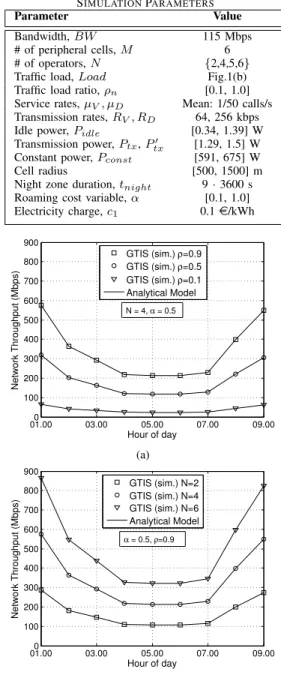
TABLE III SIMULATIONPARAMETERS Parameter Value Bandwidth,BW 115 Mbps # of peripheral cells,M 6 # of operators,N {2,4,5,6}
Traffic load,Load Fig.1(b) Traffic load ratio,ρn [0.1, 1.0] Service rates,µV, µD Mean: 1/50 calls/s
Transmission rates,RV, RD 64, 256 kbps Idle power,Pidle [0.34, 1.39] W
Transmission power,Ptx,Ptx0 [1.29, 1.5] W
Constant power,Pconst [591, 675] W Cell radius [500, 1500] m Night zone duration,tnight 9·3600 s Roaming cost variable,α [0.1, 1.0] Electricity charge,c1 0.1e/kWh 01.000 03.00 05.00 07.00 09.00 100 200 300 400 500 600 700 800 900 Hour of day Network Throughput (Mbps) GTIS (sim.) ρ=0.9 GTIS (sim.) ρ=0.5 GTIS (sim.) ρ=0.1 Analytical Model N = 4, α= 0.5 (a) 01.000 03.00 05.00 07.00 09.00 100 200 300 400 500 600 700 800 900 Hour of day Network Throughput (Mbps) GTIS (sim.) N=2 GTIS (sim.) N=4 GTIS (sim.) N=6 Analytical Model α= 0.5, ρ=0.9 (b)
Fig. 4. Total network throughput validation for different (a) traffic profiles, (b) number of MNOs
respectively. As we can see, the experimental results perfectly match the analysis, thus validating the proposed theoretical expressions. In both figures, we observe that the throughput presents similar behavior with the traffic load model (Section III-A). As expected, the network throughput also increases with the traffic load of each operator (ρ), as well as with the number of MNOs in each cell (N). It is worth mentioning that the roaming cost does not affect the throughput performance in the case ofN = 4MNOs, since there are no lost calls in the network. For higher number of operators, there are missed calls and this impact will be also studied in Section VI-D.
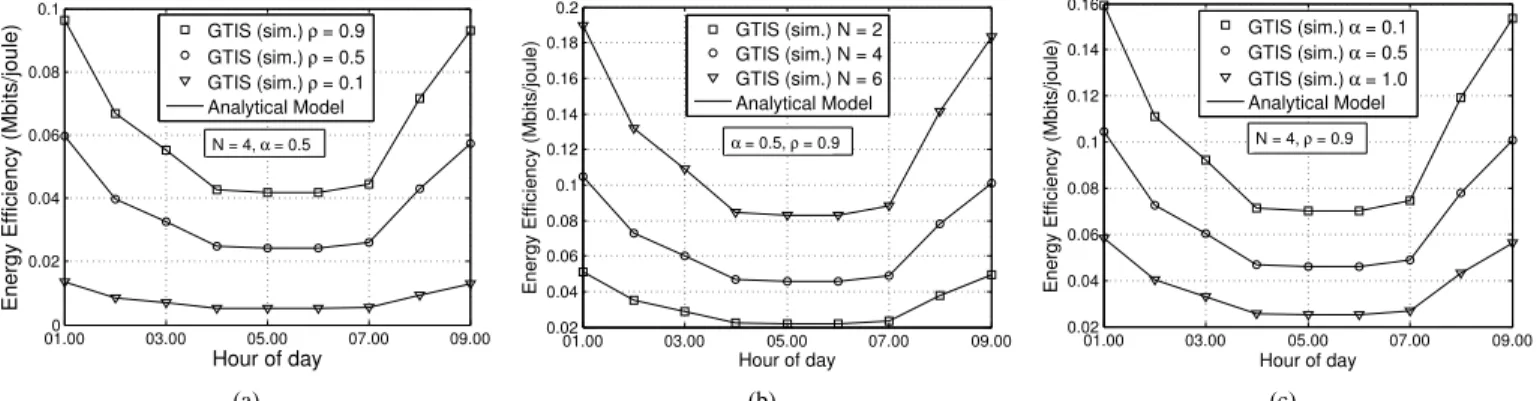
Figure 5 illustrates the total network energy efficiency achieved by the proposed infrastructure sharing policy for different traffic profiles (Fig. 5(a)), number of operators (Fig. 5(b)) and roaming cost values (Fig. 5(c)), which affect the switching off probabilities and, consequently, the total energy
01.000 03.00 05.00 07.00 09.00 0.02 0.04 0.06 0.08 0.1 Hour of day
Energy Efficiency (Mbits/joule)
GTIS (sim.) ρ= 0.9 GTIS (sim.) ρ= 0.5 GTIS (sim.) ρ= 0.1 Analytical Model N = 4, α= 0.5 (a) 01.00 03.00 05.00 07.00 09.00 0.02 0.04 0.06 0.08 0.1 0.12 0.14 0.16 0.18 0.2 Hour of day
Energy Efficiency (Mbits/joule)
GTIS (sim.) N = 2 GTIS (sim.) N = 4 GTIS (sim.) N = 6 Analytical Model α= 0.5, ρ= 0.9 (b) 01.00 03.00 05.00 07.00 09.00 0.02 0.04 0.06 0.08 0.1 0.12 0.14 0.16 Hour of day
Energy Efficiency (Mbits/joule)
GTIS (sim.) α= 0.1 GTIS (sim.) α= 0.5 GTIS (sim.) α= 1.0 Analytical Model N = 4, ρ= 0.9 (c) Fig. 5. Total network energy efficiency validation for different (a) traffic profiles, (b) number of MNOs, and (c) roaming cost efficiency. First, the analytical expressions given in Section
V are again validated, while we observe a very similar behavior with the throughput case. More specifically, we observe that the network energy efficiency increases as the network becomes more loaded (i.e., for heavier traffic loads or higher number of operators). Hence, the proposed algorithm provides an effective energy efficient solution that encourages the operators to share their infrastructure in order to reduce the energy consumption. Furthermore, energy efficiency increases as the roaming cost drops, since lower roaming costs lead to increased switching off probabilities, as seen in Table II, thus reducing the energy consumption of the network.
0 0.02 0.04 0.06 0.08 0.1 0.12 0.14
Energy Efficiency (Mbits/joule)
ρ=0.1 ρ=0.5 ρ=0.9 N=2 N=4 N=6 α= 0.5 287% 79% 282% 80% 278% 81% (a) 0 0.02 0.04 0.06 0.08 0.1 0.12 0.14 0.16
Energy Efficiency (Mbits/joule)
α=0.1 α=0.5 α=1.0 N=2 N=4 N=6 ρ= 0.9 237% 36% 278% 81% 317% 174% (b)
Fig. 6. Average network energy efficiency validation for different number of operators and different (a) traffic profiles, (b) roaming costs
In order to gain more insight on the network performance, we have plotted the average network energy efficiency during the night zone versus different traffic volumes (Fig. 6(a)) and roaming cost values (Fig. 6(b)). In Fig. 6(a), we observe that although the absolute value of the network energy efficiency increases with the number of operators, the relative difference ratio is independent of the traffic load. More specifically, in all
cases, a network ofN = 6operators is approximately80%and
280%more energy efficient compared to networks of N = 4
andN = 2operators, respectively. This interesting fact can be explained by taking into account that the outcome of the game theoretic algorithm (i.e., switching off probabilities) is not affected by the traffic load variations. Referring to Table III, we observe that the difference between the constant power and the transmission power is significant. Thus, small variations on the traffic do not affect the probabilities calculation. On the other hand, as shown in Section IV-B3, the switching off prob-abilities strongly depend on the roaming cost, thus affecting the network energy efficiency (Fig. 6(b)). As also shown in Fig. 5(c), the energy efficiency is reduced as the roaming cost increases, while this impact is stronger for smaller number (N) of operators. However, the relative difference of the energy efficiency gain with respect toN increases for higher roaming costs. For instance, for low traffic loads (α= 0.1), a network of N = 6 operators achieves 36% higher energy efficiency than a network of N = 4 operators, while this difference is considerably increased to 174% in case of α = 1.0. This occurs because, even though the switching off probabilities are low for high roaming costs, the presence of more operators leads to a higher probability of sharing the infrastructure.
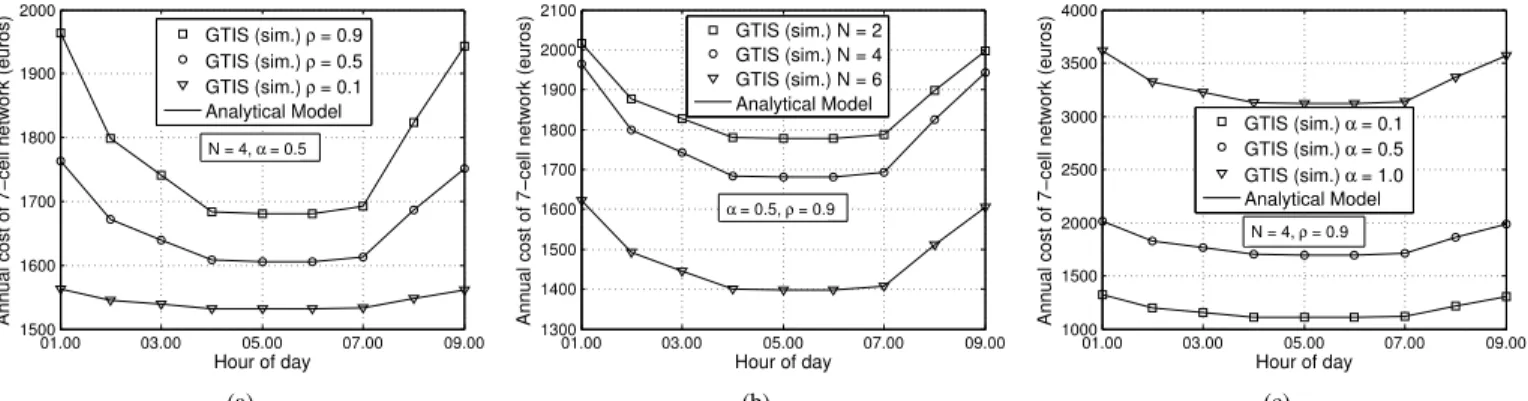
Figure 7 illustrates the total network annual cost for different traffic profiles (Fig. 7(a)), number of operators (Fig. 7(b)) and roaming cost (Fig. 7(c)). The analytical expressions given in Section V are again validated, while the results follow a very similar behavior with the throughput and energy efficiency only in the case of varying traffic profiles. On the other hand, the annual cost decreases with higher number of MNOs and decreasing roaming cost values. Given the switching off probabilities, depicted in Table II, in networks with high number of MNOs, the switching off probability increases, leading to smaller number of active BSs, which contribute to the total network cost according to Eq. (27). On the other hand, with increasing roaming cost, the MNOs are unwilling to switch off their BSs, resulting in higher aggregate cost.
C. Roaming Cost Analysis
The analysis and the experiments have revealed the crit-icality of the roaming cost parameter in roaming-based in-frastructure sharing schemes. Therefore, the selection of an appropriate range of α for the performance evaluation of our proposal becomes of paramount importance. To that end, Fig. 8 presents the total network energy efficiency achieved
01.00 03.00 05.00 07.00 09.00 1500 1600 1700 1800 1900 2000 Hour of day Annual cost of 7 −
cell network (euros)
GTIS (sim.) ρ= 0.9 GTIS (sim.) ρ= 0.5 GTIS (sim.) ρ= 0.1 Analytical Model N = 4, α= 0.5 (a) 01.00 03.00 05.00 07.00 09.00 1300 1400 1500 1600 1700 1800 1900 2000 2100 Hour of day Annual cost of 7 −
cell network (euros)
GTIS (sim.) N = 2 GTIS (sim.) N = 4 GTIS (sim.) N = 6 Analytical Model α= 0.5, ρ= 0.9 (b) 01.00 03.00 05.00 07.00 09.00 1000 1500 2000 2500 3000 3500 4000 Hour of day Annual cost of 7 −
cell network (euros)
GTIS (sim.) α= 0.1 GTIS (sim.) α= 0.5 GTIS (sim.) α= 1.0 Analytical Model N = 4, ρ= 0.9 (c) Fig. 7. Total network annual cost validation for different (a) traffic profiles, (b) number of operators, and (c) roaming cost
0 0.2 0.4 0.6 0.8 1 0 0.01 0.02 0.03 0.04 0.05 0.06 0.07 Roaming cost, α
Energy Efficiency (Mbits/joule)
GTIS R−to−1
E−bal
R−bal
ρ=0.1 Selected range for α
Fig. 8. Total network energy efficiency versus roaming cost to select the appropriateα
by the proposal compared to four schemes for the whole range of roaming cost values. We compare GTIS with the baseline scenario (i.e., No Switch Off) and three state-of-the-art approaches (i.e., R-to-1, E-bal and R-bal), which do not depend on the roaming cost. As we already mentioned, by employing the R-to-1, the MNO with heavier traffic load concentrates the traffic of the whole network, giving the opportunity to the rest of the MNOs to switch off their BSs. In E-bal and R-bal, the MNOs switch off their BSs for different portions of time in order to achieve equal energy gains and roaming costs, respectively. As a result, the switching off time of each MNO depends on their traffic load but is independent of the specific value of the roaming cost. In Fig. 8, we observe that GTIS outperforms R-bal independently ofα, while there is an interesting trade off with regard to the R-to-1 and E-bal schemes. Our proposed solution achieves higher energy efficiency for low values of α(i.e.,α <0.5 comparing to R-to-1 andα <0.78comparing to E-bal). However, performance drops as the roaming cost increases and, for high α, R-to-1 and E-bal achieve higher energy efficiency compared to GTIS (i.e., α > 0.5, α > 0.78, respectively). When employing GTIS, the MNOs do not have a strong incentive to switch off their BSs for high roaming values. Since energy efficiency is one of the key goals of the proposed scheme, we focus on the values of α that ensure enhanced energy efficiency performance with respect to the state-of-the-art schemes (i.e., α ∈[0,0.5]). Consequently, we have selected two indicative values of αwithin this range (i.e.,α= 0.1 andα= 0.5) for the performance assessment of our proposed solution.
D. Performance evaluation
This section includes the performance results with regard to various metrics, either telecommunication - oriented (network throughput and energy efficiency) or cost - oriented (annual cost and cost efficiency). In order to generalize the assessment of our proposal, we consider different traffic volumes for the network operators. In particular, we assume thatM N O1 has
the maximum possible traffic load (i.e.,ρ1= 1), while the rest
MNOs have a common traffic volumeρ, which is a portion of the maximum load (i.e.,ρ2=...=ρN =ρ∈[0,1]).
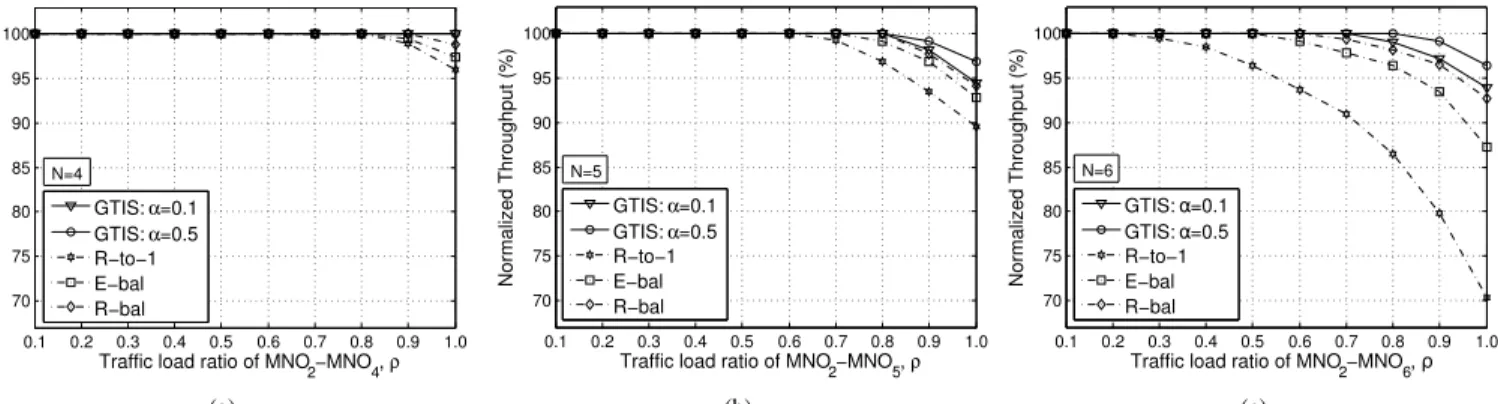
1) Telecommunication Metrics: Despite the importance of estimating the absolute values of throughput in the system, the deactivation of BSs potentially implies loss of connections. To that end, we consider the normalized throughput, which is an important GoS indicator that represents the percentage of served connections in the system. Fig. 9 presents the normal-ized throughput of the three infrastructure sharing schemes for different number of MNOs. In Fig. 9(a) (N = 4), we can see that all schemes guarantee the user service for variable traffic load conditions (i.e.,ρ <0.8). However, as the traffic volume grows, the R-bal, E-bal and R-to-1 approaches experience small losses (around 2% 3% and 5%, respectively), which still can be prohibitive for wireless cellular networks, while the proposed GTIS approach is able to guarantee the service of all the connections in the network. Hence, our scheme can guarantee the service of all connections for the case of N = 4 operators, which is highlighted as the most typical scenario in recent studies [5]. For higher number of operators, our proposal still outperforms the other three solutions and it guarantees the proper service in the network for traffic volume values up to ρ = 0.8 (case N = 5) and ρ = 0.7 (case N = 6). The degraded performance of the R-to-1 scheme is explained by the high number of deactivated BSs and the traffic service by one MNO only, whereas our approach proposes a distributed traffic roaming among the coexisting MNOs. In addition, we observe that GTIS achieves different performance with respect to the varying values of roaming cost, thus justifying once again the importance of this variable. For relatively small values ofα(i.e., α= 0.1), there are less active BSs and as a result the number of lost calls increases. However, compared to the state-of-the-art schemes, the GTIS supports higher traffic without losing any calls. For instance, in the case ofN = 6MNOs andα= 0.5, the GTIS provides full traffic service, while R-bal supports up toρ= 0.6, E-bal up toρ= 0.5 and R-to-1 only up toρ= 0.2.
0.1 0.2 0.3 0.4 0.5 0.6 0.7 0.8 0.9 1.0 70 75 80 85 90 95 100
Traffic load ratio of MNO 2−MNO4, ρ Normalized Throughput (%) GTIS:α=0.1 GTIS: α=0.5 R−to−1 E−bal R−bal N=4 (a) 0.1 0.2 0.3 0.4 0.5 0.6 0.7 0.8 0.9 1.0 70 75 80 85 90 95 100
Traffic load ratio of MNO 2−MNO5, ρ Normalized Throughput (%) GTIS: α=0.1 GTIS: α=0.5 R−to−1 E−bal R−bal N=5 (b) 0.1 0.2 0.3 0.4 0.5 0.6 0.7 0.8 0.9 1.0 70 75 80 85 90 95 100
Traffic load ratio of MNO 2−MNO6, ρ Normalized Throughput (%) GTIS: α=0.1 GTIS: α=0.5 R−to−1 E−bal R−bal N=6 (c) Fig. 9. Normalized throughput for (a) N=4, (b) N=5 and (c) N=6
0.1 0.2 0.3 0.4 0.5 0.6 0.7 0.8 0.9 1.0 0
0.05 0.1
Traffic load ratio of MNO2−MNO4, ρ
Energy Efficiency (Mbits/joule)
GTIS:α=0.1 GTIS:α=0.5 R−to−1 E−bal R−bal No Switch Off 677% 409% 395% 381% 20% N=4
Fig. 10. Total network energy efficiency for different traffic profiles and variable roaming costs and comparison to the state-of-the-art schemes
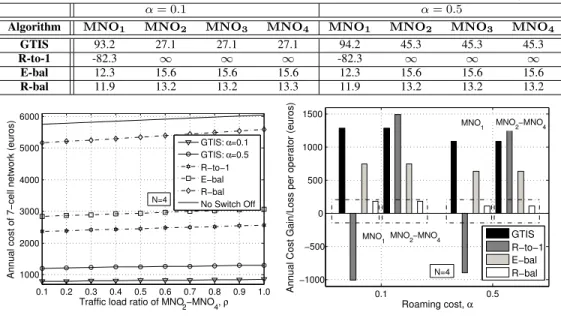
Fig. 10 presents the total network energy efficiency versus ρ for two different values of α and N = 4 operators. We observe that all schemes have the same behavior, since the energy efficiency increases with the traffic load. An important remark is that, for low roaming cost (α = 0.1), GTIS significantly outperforms the baseline scenario (where no BS is switched off), as well as the three state-of-the art algorithms. However, for higher values of α, the energy efficiency gain of GTIS compared to the R-to-1 scheme gradually decreases and, eventually, the two schemes achieve similar performance for α= 0.5. Even though the total network energy efficiency performance is the same, it is interesting to study the individual energy efficiency gains of the different MNOs. To that end, the individual gains for the specific (but representative) case of ρ= 0.1andN= 4are quantified in Table IV, where interest-ing conclusions can be extracted. In particular, independently of α, the R-to-1 scheme is beneficial only for the group of operators that switch off their BSs, while the operator with the active BSs faces important energy efficiency degradation. More specifically, the active operator is subject to higher energy consumption to serve the traffic of the whole network, while the rest operators theoretically achieve infinite energy efficiency, as they have their traffic served at zero energy cost. The proposed GTIS eliminates this unfairness, by guaranteeing energy efficiency gains to all operators, providing them with extra incentives to switch off their BSs by participating in the game. Comparing to the E-bal and R-bal that allow all MNOs to switch off their BSs for different time periods, the respective energy efficiency gains of the GTIS approach are clearly higher due to the lower number of active BSs.
2) Cost Metrics: The total network annual cost and the individual annual gains for the MNOs, having as a benchmark the No Switch Off scheme, are presented in Figs. 11(a) and 11(b), respectively. We observe that the total annual cost is not significantly affected by the traffic variations, since the fixed cost for the network operation is much higher than the cost due to the energy consumption in the network radio part. The corresponding values are also shown in Table III. In addition, for low roaming cost values (α = 0.1), GTIS achieves a considerable reduction (around 86%) of the annual network cost, mainly due to the deactivation of many underutilized BSs. Regarding the individual revenue of each operator, plotted in Fig. 11(b), we may observe that, similar to the energy efficiency gains, the R-to-1 scheme provides financial gains only to particular MNOs, and more particularly for the MNOs that switch off their networks, whereas M N O1 has higher
expenses with respect to the No Switch Off scheme. On the other hand, for GTIS, all operators are able to have higher economic benefits compared to the E-bal and R-bal schemes, independently of the particular roaming cost value. Further-more, asαincreases, the GTIS achieves higher financial gains for the operators due to the increased roaming cost values.
Finally, Fig. 12 depicts the cost efficiency of the operators, which is a metric that provides an indication for the relation between the served traffic and the financial cost. In Fig. 12(a), we illustrate the individual cost efficiency with respect to different values of roaming cost. The traffic load in the network (ρ) has a great impact on the cost efficiency, which, on the other hand, is not significantly affected by the roaming cost (α) values. The cost efficiency increases with the lower roaming cost due to the reduced energy consumption. In addition, Fig. 12(b) presents the cost efficiency gains of the infrastructure sharing schemes, having as benchmark the No Switch Off scheme. The plot in Fig. 12(b) verifies our results so far, as it highlights the great difference in the R-to-1 approach between the active operator and the rest operators in the system. The proposal of switching off the whole network of the MNO with the lower traffic (R-to-1) results to great cost efficiency for M N O2−M N O4, who do not consume any energy and
are encumbered only with the compensation of the roaming cost to the active operator. Contrariwise, M N O1 serves the
whole traffic of the network and consumes significant energy, leading to an increased cost that is not compensated by the received roaming. GTIS overcomes this issue by providing cost efficiency gains to all operators, outperforming, at the
TABLE IV
OPERATORENERGYEFFICIENCYGAIN/LOSS WITHRESPECT TO THENOSWITCHOFFSCHEME FORρ= 0.1
α= 0.1 α= 0.5
Algorithm MNO1 MNO2 MNO3 MNO4 MNO1 MNO2 MNO3 MNO4
GTIS 93.2 27.1 27.1 27.1 94.2 45.3 45.3 45.3 R-to-1 -82.3 ∞ ∞ ∞ -82.3 ∞ ∞ ∞ E-bal 12.3 15.6 15.6 15.6 12.3 15.6 15.6 15.6 R-bal 11.9 13.2 13.2 13.3 11.9 13.2 13.2 13.2 0.1 0.2 0.3 0.4 0.5 0.6 0.7 0.8 0.9 1.0 1000 2000 3000 4000 5000 6000
Traffic load ratio of MNO 2−MNO4, ρ
Annual cost of 7
−
cell network (euros)
GTIS: α=0.1 GTIS: α=0.5 R−to−1 E−bal R−bal No Switch Off N=4 (a) 0.1 0.5 −1000 −500 0 500 1000 1500 Roaming cost, α
Annual Cost Gain/Loss per operator (euros)
GTIS R−to−1 E−bal R−bal N=4 MNO 1MNO2−MNO4 MNO 1 MNO2−MNO4 (b)
Fig. 11. (a) Total annual cost for different traffic profiles and variable roaming costs and (b) Revenue for each MNO under variable values of roaming cost
0.1 0.2 0.3 0.4 0.5 0.6 0.7 0.8 0.9 1.0 0 2000 4000 6000 8000 10000 12000
Traffic load ratio of MNO 2−MNO4, ρ
Cost Efficiency (Mbits/euro)
GTIS, α=0.1: MNO1 GTIS, α=0.1: MNO2−MNO4 GTIS, α=0.5: MNO1 GTIS, α=0.5: MNO2−MNO4 N=4 (a) 0.1 0.2 0.3 0.4 0.5 0.6 0.7 0.8 0.9 1.0 0 100 200 300 400 500 600 700 800 900
Traffic load ratio of MNO2−MNO4, ρ
Cost Efficiency Gain/Loss (%)
GTIS R−to−1 E−bal R−bal MNO1 MNO2−MNO4 N=4, α= 0.1 (b)
Fig. 12. (a) Cost efficiency under different traffic profiles (b) Cost efficiency gain/loss versus No Switch Off
same time, the E-bal and R-bal schemes.
E. Discussion
Based on the analysis in Section VI-D, we have shown that the proposed GTIS outperforms the state-of-the-art approaches in terms of throughput, energy efficiency and annual network cost. In addition, it achieves balanced energy efficiency, cost gains and cost efficiency results for all the MNOs. Further-more, through an extensive assessment, we have identified the
significance of the roaming cost parameter, α. In particular, higher values of α achieve higher throughput. On the other hand, better performance results are attained in terms of energy efficiency, aggregate network cost, individual cost gains and cost efficiency, when lower values of α are chosen. Hence, the MNOs should choose the suitable value of αdepending on their priorities. For example, if energy efficiency is not priority, each MNO could achieve better individual throughput performance by setting higherα. On the other hand, lowerα leads to great energy efficiency gains for the network, whereas the individual performance of each operator is enhanced in terms of energy and cost gains.
VII. CONCLUSION
In this paper, motivated by the low BSs utilization during the night and the coexistence of multiple operators in the same area, we proposed a novel infrastructure sharing algorithm that encourages MNOs to share their resources and switch off redundant BSs. By employing game theoretic tools and realistic cost functions, we introduced a switching off scheme that allows the MNOs to reduce their expenditures in multi-operator cellular environments. The proposed scheme has been evaluated in terms of throughput, energy and cost efficiency for various traffic conditions and roaming cost values. The results have shown that our proposal can significantly improve the network energy efficiency, guaranteeing at the same time the network throughput in realistic scenarios of up to four MNOs. Regarding the financial costs/gains, the proposed scheme pro-vides higher cost efficiency and fairness compared to the state-of-the-art algorithms, motivating the operators to adopt game theoretic strategies for their decisions. In our future work, we plan to elaborate on cooperative game theoretic schemes in order to investigate the potential trade offs.
VIII. ACKNOWLEDGMENTS
This work has been partially funded by AGAUR (2014 SGR 1551) and the Research Projects CellFive (TEC2014-60130-P) and 5Gwireless (641985).