OpenEC/B
:
A Case Study in Electronic Commerce and Open Source
Software Development
Walt Scacchi
Institute for Software Research and
Graduate School of Management University of California, Irvine
Irvine, CA 92697-3425 USA [email protected]
July 2002
© Walt Scacchi, 2002
This report can be found on the Web at:
http://www.ics.uci.edu/~wscacchi/Papers/EC/OpenEC-July2002.pdf
Acknowledgements: The research described in this report is supported by grants from the NSF Industry/University Research Cooperative CRITO Consortium, National Science Foundation #IIS-0083075, and from the Defense Acquisition University by contract N487650-27803. No endorsement implied.
Executive Summary
This study investigates how to understand and transform an organizational system for internal or external operations using Open Source E-Commerce or E-Business
capabilities. This entails a case study within one firm that has undertaken an organizational initiative to develop, deploy, use, and support open source software systems for Enterprise Resource Planning (ERP), E-Commerce (EC) or E-Business (EB) services. The objective is to identify and characterize the organizational resources and development capabilities that lie at the center of the initiative. By learning what these resource are, and how the are arrayed into product development capabilities, can give executive decision-makers knowledge needing to determine whether or not to undertake a pilot study or product development effort that exploits the potential of open source EC and EB resources.
The study provides a survey of large, mid-size, small, and start-up companies that are making strategic investments in open source software systems for ERP, EC, and EB products or service offerings. Large companies include IBM, SUN, Hewlett-Packard, Apple, SAP, and AOL within the IT industry, and also Dresdner Kleinwort Wasserstein (DKW) and Barclays Global Investors (BGI)in the international banking industry. Mid-size companies include Red Hat, VA Software, Progress Software, and CollabNet. Many of these mid-size companies provides open source software development products and services to the large companies listed here. A number of small and start-up companies are described, including those like ActiveState, JBoss, Jabber and Compiere which have become global market leaders in their respective market niches within the past year by relying on the development and deployment of open source software products and services. The global success of these companies suggests careful study and consideration of strategic investment activities are timely matters to pursue. This motivates the case study that follows.
The case study examines GNUenterprise.org, an international virtual enterprise focused on the development and deployment of free open source software system framework for ERP and EB. The framework supports the development and integration of information system components for customer relationship management, corporate financial systems, and other business-to-business system modules. The study uses a Web-based approach to provide the data that empirically grounds this resource-based view of an organizational system. These data and the accompanying analysis help to what’s involved in developing and deploying open source EC or EB capabilities, how it works; and the conditions that shape success or failure. The description, analysis, discussion, and implications of this case study are the result of this investigation.
Overall, this study reveals that their appears to be a variety of compelling business reasons for companies large and small to consider making strategic investments in free open source software development products, service, and processes that support EC, EB, and ERP applications.
Table of Contents
Executive Summary ... 2
Introduction ... 5
Research Questions ... 6
Background Concepts... 6
What is Electronic Commerce? ... 6
What is Free, Open Source Software Development?... 8
Open Source Software Development Practices ... 9
Open Source Software Products... 11
Open Source Processes ... 11
Open Source Support Environments ... 12
Why is OSSD interesting? ... 13
What kinds of enterprises are interested in OSSD?... 14
Large companies... 15
Small and Midsize companies ... 19
Small, entry-level companies... 19
Other enterprises and agencies interested in OSSD... 21
What kind of enterprises could/should be interested in OSSD? ... 21
Case Study: GNUenterprise.org and the development of free open source ERP software... 23
Computing infrastructure resources... 30
Community communication resources ... 31
Scenarios of usage resources ... 31
How-to guides, To-do lists, FAQs, and other itemized list resources ... 31
Traditional system documentation resources... 38
External publication resources... 38
Open Web site and software resources ... 38
Software extension and customization resources ... 42
Free software license resources ... 44
GNUenterprise.org software development capabilities ... 47
The GNUenterprise.org software development process... 47
The GNUenterprise.org community development process ... 49
The GNUenterprise.org community as a capability enabling Open EC/B ... 51
Analyzing the GNUenterprise.org Case ... 52
Economic conditions supporting free open source software development... 53
Resources and Capabilities for Open EC/B ... 54
Personal software development tools and networking support ... 54
Beliefs supporting Free OSSD ... 55
Discretionary time and effort of developers... 56
Trust and social accountability mechanisms... 57
Free open source software development informalisms ... 58
Free OSSD capability enabling free, open ERP and EB systems ... 59
Revisiting the Research Questions ... 59
Implications and Enterprise Process (Re)Design Heuristics ... 61
Conclusions ... 63
List of Figures
Figure 1. A screenshot of a customer interface to an opaque, closed source E-Commerce process for purchasing goods from an electronic catalog at Amazon.com... 7 Figure 2. An architectural overview of an example open software, network, and hardware
system, where each component (rectangle) and connector (oval) is available in an open source form... 10 Figure 3. A screenshot of the Java Community Process definition, sponsored by SUN
Microsystems Inc. ... 17 Figure 4. An internal corporate portal for open source software behind the firewall (called "corporate source") at Hewlett-Packard... 18 Figure 5. Display of background information on the GNUenterprise.org and its GNUe
software ... 24 Figure 6. A view of the history of the development of GNUe software... 25 Figure 7. A public message from a GNUe project participant indicating her basis of
financial support as a professional consultant and developer of Free software ... 26 Figure 8. A partial display of international companies providing resources and sponsoring the development of the GNUe software... 27 Figure 9. Overview of the GNUe software system architecture and modules... 28 Figure 10. A view of a public email thread transcript communicating project information
and evaluative statements between project participants... 32 Figure 11. A public transcript that records Internet-based chat in a real-time online
project meeting... 33 Figure 12. A snapshot of a community digest summarizes communications and activities
across the GNUe project, with embedded Web links to source documents... 34 Figure 13. A display view of a news item of interest to GNUenterprise.org participants 35 Figure 14. The GNUe Enterprise Designer, an interactive development environment
(IDE) displaying a usage scenario for developers of GNUe-based applications ... 36 Figure 15. A screen display of links to an itemized list of "Frequently Asked Questions"
... 37 Figure 16. A view of a list of online user documentation found at GNUenterprise.org... 39 Figure 17. A display of a view into a source code Web directory associated with a GNUe
software distribution version... 40 Figure 18. A display of the Web site for acquiring and discussing a free, open source
software content management system that supports the GNUenterprise.org Web site ... 41 Figure 19. Display showing a view of the SourceForge entry for GNUenterprise.org .... 43 Figure 20. A software bug report and status information maintained in DCL that is
associated with a GNUe software component... 45 Figure 21. The community property and copyright license that covers all GNUe software
Introduction
Many companies face a problem in determining how to best adopt and deploy emerging capabilities for E-Commerce and E-Business services. For example, interest in Web-based capabilities for the procurement of materials, repairs, and operations products, or for the acquisition of contracted services (e.g., consulting, facilities maintenance, and logistics) remains high, but most companies have not found substantial returns on their investment in these areas. When faced with the emergence of opportunities associated with wireless/mobile commerce, peer-to-peer (p2p) collaboration services, open source software, or the redesign of internal business operations to support E-Business, decision-makers face much uncertainty about how best to proceed, if at all. Simply acquiring and installing a Web-based p2p system for an internal or external business operations does not yield significant results. Transforming and realigning business processes,
organizational strategies, and end-user work practices is required, but where and how does this occur? Overall, there is a basic and recurring lack of knowledge for how to determine and align the most effective choices for information system technologies, business strategies, and organizational transformation.
In a recent case study, [Scacchi 2001] reports how a federal government agency achieved a reduction in procurement cycle times of 20X and an annual operational savings of $10M-15M. These results came from the transformation and realignment of information systems, business processes, corporate strategy, and work practices in the agency within a 1-2 year timeframe to support the agency's E-Commerce and E-Business initiatives. The results also came from a research approach where the research team and agency
participants jointly developed and refined an open source computational models of the new business processes, resource dependencies, and work practices that together embodied the new organizational system that was sought [Noll and Scacchi 2001, Scacchi 2001].
The objective is to conduct a case study that examines how a firm can understand and transform its organizational systems to support an E-Commerce or E-Business initiative using free open source software resources or capabilities. Such a system may focus, for example, on back office activities associated with corporate financial operations, or on front office activities associated with customer relationship management. Alternatively, the focus may be directed as an organizational system where wireless, mobile, or p2p capabilities are sought.
The study employs a resource-based view of the organizational system involved in developing or adoption an open source EC/EB capability. The results of this arise from an analysis of the case study that uses Web-based snapshots of organizational information resources as data. This case study examines the GNUenterprise.org project. This study serves as a point of departure to explicate the concept of Open EC/B introduced in this report. Open EC/B results from combining open source software development with EC and EB.
Research Questions
This section introduces the research questions that are examined through an examination of the concepts, processes, and practices that give rise to open source software
development (OSSD) projects and to EC/EB applications. To narrow our focus of the broad subject of EC/EB, the study examines the development of ERP systems for deployment and use within an enterprise. This background helps to set the stage for the study of GNUenterprise.org case, which focuses on the OSSD of an ERP system, and related EC/EB system modules.
Four research questions may explain how open source software development and EC/EB approaches might be brought together, and to what ends.
• How are OSSD processes similar to and different from those for EC or EB?
• What is involved in designing EC or EB processes or organizational systems to take advantage of OSSD processes, practices, and infrastructure?
• What kinds of challenges can make the transition from EC/EB to Open EC/B problematic, and how might these problems be mitigated?
• What kinds of resources or business capabilities are needed to help make Open EC/B efforts more likely to succeed?
In order to begin to understand and develop answers to these questions, the next section presents a background for what E-Commerce is, and what OSSD is. It also provides a brief survey of companies currently making strategic investments in OSSD that support business initiatives in EC or EB.
Background Concepts
In order to address the questions in the preceding section, we first provide some
background descriptions of the concepts that underlie that study and analysis presented in this report. These focus on EC and Free OSSD.
What is Electronic Commerce?
Electronic Commerce is generally focussed on information systems, resources, and other IT related capabilities for buying and selling of products or services using the Internet or World-Wide Web (henceforth, "Web") as the medium or venue for this commerce. Electronic Business generally follows a similar form and purpose, but with the emphasis on internal business processes within a single unit, multi-unit, or multi-site enterprise. Both EC and EB are active areas of commercial development and deployment by many large software system vendors and systems integration consultancies.
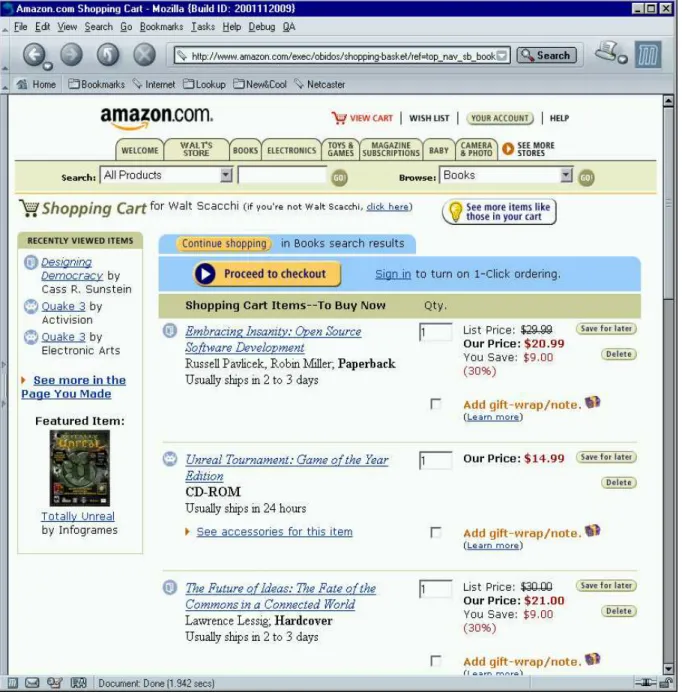
A common example can be found in the business-to-consumer form of EC typically experienced at Amazon.com. Figure 1 presents a view of an online shopping experience where a user has browsed Amazon's online product catalog, selected the items displayed, and is ready to proceed forward in completing an online order placement (purchase) transaction. The EB process for purchase ordering is opaque (and it's "1-Click" patented), but perhaps implicit to the customer in this EC transaction, thanks to automatically generated email messages about an order's status and fulfillment progress.
Figure 1. A screenshot of a customer interface to an opaque, closed source E-Commerce process for purchasing goods from an electronic catalog at Amazon.com.
It is likely that the EC and EB processes underlying this transaction and the other EB processes related to it (e.g., order fulfillment, inventory control, and distribution logistics) are coded within software programs. The business process logic in these programs is accessible only to Amazon programmers, rather than to its customers or internal operations users. In other words, Amazon's EC and EB processes exist only in closed, inaccessible form.
Some approaches to EC and EB seek to be very comprehensive in their attempt to develop, deploy, and/or integrate information systems for corporate financial operations (e.g., general ledger, accounts payable and receivable, etc.), sales and support (contact management, customer relationship management), and supply chain management (inventory control, demand forecasting, supplier relationship management, etc.).
Enterprise Resource Planning (ERP) systems were developed and deployed in the 1990's as the IT approach to prototyping and ultimately realizing comprehensive EB processes or internal operations [Curran and Ladd 2000, Keller and Teufel 1998, Skok and Legge 2002]. These efforts emphasize selection, customization, and deployment of EC or EB system modules for business operations relevant to an enterprise's incremental and iterative transition to EC/EB [Keller and Teufel 1998].
To succeed in an EC/EB initiative, an enterprise must provide and support a networked computing infrastructure and resources to customize and deploy the system modules. It must do so in a manner that is compatible with overall business objectives, labor and market conditions that ensure the sustained viability and longevity of the deployed EC/EB system. Unfortunately, the overall costs of acquiring and deploying a
comprehensive ERP system that enables both EB and EC processes, often runs well into millions of dollars (sometimes as high as one hundred million dollars) and years to deploy. These kind of ERP solutions are limited to the largest national or international enterprises. Subsequently, such a situation puts the capability for ERP as a basis for EB and EC well beyond the means and timeframes that are available to the large numbers of small or midsize enterprises. Therefore, the opportunity exists to understand what
alternatives, if any, might be available for developing and deploying ERP systems that enable EB or EC initiatives for enterprises of different sizes. Such an alternative may be found within the emerging OSSD movement.
What is Free, Open Source Software Development?
OSSD represents a relatively new approach to the development of complex software systems [Feller and Fitzgerald 2002]. OSSD generally relies on a global community of software developers and users who seek faster, better, and cheaper alternatives to closed proprietary systems. In the past year or so, EC and EB systems have begun to be
developed using OSSD techniques.
In most OSSD situations, the resulting software system and its associated Web-based documents or development artifacts are globally accessible at little or no direct cost. Furthermore, a defining requirement of OSS is how their intellectual property rights are assigned and protected. The terms and conditions of the copyright or license associated with OSS typically assert the following kinds of property rights or "freedoms" to anyone
who seeks to employ or use the software [cf. DiBona, Ockman, and Stone 1999, Pavlicek 2000, Williams 2002]:
• Freedom to run the program for any purpose;
• Freedom to study how the program works and adapt it to their needs;
• Freedom to redistribute copies of the software at will;
• Freedom to improve the OSS program and to distribute the altered version;
• Required distribution of the originating license that specifies the freedoms and rights concerning the preceding properties.
These rights or freedoms do not prohibit charging fees to access or acquire OSS, though typically there are no direct cost for the OSS itself. Instead there may be costs associated with acquiring the media (e.g., CDROM, books) through which the OSS is distributed. Similarly, the rights or freedoms do not restrict who may provide support, system
integration, or consulting services for the OSS. This is in contrast to the strictly controlled provision of support or services offered for closed source, proprietary software systems. These rights and freedoms stand in marked contrast to those offered with the selection, customization, and deployment of commercial ERP and other systems for EB or EC. In the following sections, we look more closely at the practices, products, processes, and support environments that help make OSSD an interesting alternative for EC/EB. This is help us better understand how OSSD and EC/EB might come together to create
alternatives that embrace the rights and freedoms of OSS with the potentially strategic information system capabilities and resources that enable an ERP system.
Open Source Software Development Practices
Open source is not the same concept as "open systems". Open source is a broader, more encompassing technique for exposing access to the underlying functionality, operation, or interoperation of a software system. Open systems traditionally refer to a technology scheme that provides customers, external developers, or end-users to access the internal functions of a complex system via "public interfaces." These interfaces take the form of accessible connectors or plug sockets. The structure of these interfaces denote the points of contact through which pre-specified types of program data, control signals, and error messages flow in or out. Otherwise, the modules or components to which the connectors are affixed are opaque, closed black boxes.
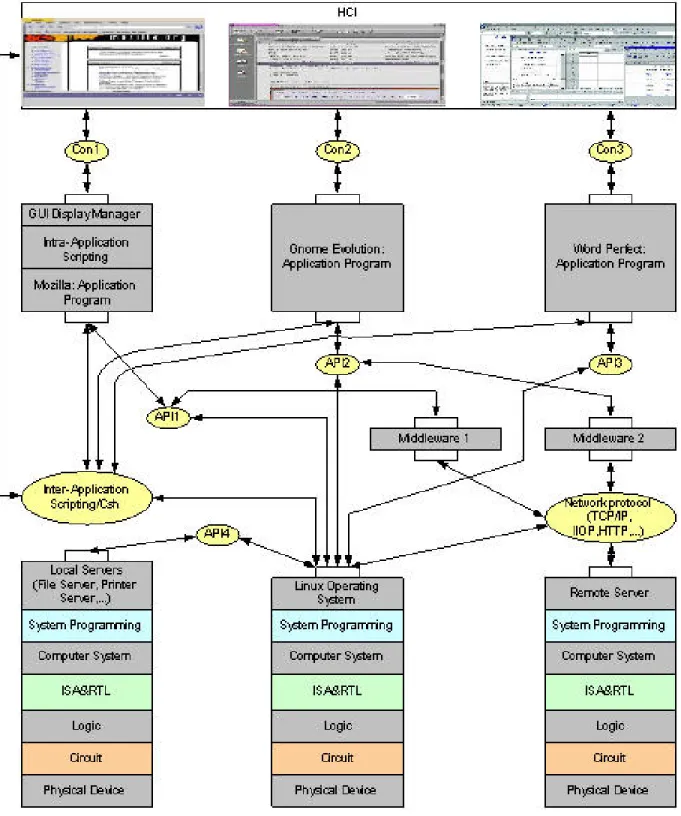
In open source software (OSS), the source code, as well as its surrounding documents and artifacts, all serve as the public interface to the system. Access to system functionality is not limited to functions calls through "application programming interfaces" (APIs). Access to functionality, as well as the ability to enhance, restructure, tune, debug, or re-host system functionality is realized through access to open source code, documents, and artifacts. An open system may consist of hardware, software, and network system
components. Subsequently, the potential exists for making all of the components functionality accessible, transparent, and open through public interfaces that consist of the components "source code", documents, and artifacts. Figure 2 provides a view of an open system composed out of open source hardware, software, and network components.
Figure 2. An architectural overview of an example open software, network, and hardware system, where each component (rectangle) and connector (oval) is available in
With this in mind, we now turn to examine the products, processes, and support environments for OSS.
Open Source Software Products
OSS program code is the typical focus of most OSSD activities. These computer programs are written in a programming language like C, C++, Perl, Python, and others. Documents that specify or describe how these programs function or interoperate are also products of open source software development. These documents may include
specification or design diagrams, end-user manuals, program installation scripts, threaded email discussion forums, Web-based source code repositories, and other Web site
contents. OSSD projects rely on a diversity of software informalisms [Scacchi 2002b] as information resources, documents, artifacts, or products that can be browsed, cross-linked, and updated on demand. These informalisms are socially lightweight information structures for managing, communicating, and coordinating globally dispersed knowledge about who did what, why, and how. These informalisms are easy to learn and use as semi-structured representations that capture software requirements, system design, and design rationale. As OSS developers are themselves end-users of their systems, then software system requirements and design take less time to articulate and negotiate, compared to software engineering projects that must elicit requirements and validate system design with end-users who are generally not software system specialists. Thus, a lesson learned from these observations is that practitioners of OSSD should be both users and developers of open source practices, and these practitioners should be provided with the ability to easily create, modify, share, and discuss informal descriptions of OSSD products, practices and outcomes.
OSS concepts can apply to any product that can be produced with or through the use of computing systems that can be networked together. As seen next, these products can also include the source code to the processes for technical work or business operations, if these processes can be specified in a form that can be compiled or interpreted for automated or interactive execution in a networked computing environment. Open Source Processes
OSS programs emerge as the result of technical activities that are arranged and ordered in a manner that can be described as a process—an OSSD process. This process may be ad hoc, difficult to describe and repeat, or it could be more structured and follow a pre-articulated scheme or formal process. In any case, it is reasonable to describe how the OSS products are developed, used, and evolved as processes. Furthermore, these
processes may be descriptive, proscriptive, or prescriptive. Descriptive processes describe
what previously occurred, by whom, when, where, etc. Proscriptive processes describe
what could be done at certain points or in response to some event or condition. Prescriptive processes describe how software development activities should be done
when supported by some means or mechanism that checks for compliance with the process prescription. In any of these forms, processes can be codified into computational models that can be analyzed, simulated, and iteratively refined by process users in many
different ways [Noll and Scacchi 2001, Scacchi 2000, 2002a, Scacchi and Mi 1997, Scacchi and Noll 1997].
OSSD projects can enact "Internet time" development practices, much like Microsoft, Netscape, and others [Cusumano 1999, MacCormack 2001] follow when market
conditions demand rapid response to substantial competitive threats. Internet time efforts emphasize minimizing time to market and delivery of incremental improvements in functionality, instead of complete well-engineered functionality that gives rise to much less frequent product releases. Internet time development depends on collecting feedback from end-users as a way to determine which incremental functionality, and which
perceived errors in available functionality matters most.
OSSD projects are iteratively developed, incrementally released, reviewed and refined by OSS developers working as peers in an ongoing agile manner [cf. Cockburn 2001]. These methods ensure acceptable levels of quality, coherence, and security of system-wide software via continuous distributed peer review, testing and profiling. OSSD efforts are hosted within decentralized communities of peers [Kogut and Metieu 2001, Scacchi 2001, 2002, Sharman 2002] that are interconnected via Web sites and OSS repositories. Community oriented OSSD gives rise to new kinds of requirements for community building, community software, and community information sharing systems (Web site and interlinked communication channels for email, forums, and chat). In contrast, most system engineering projects associated with major software development efforts are targeted for a centralized corporate setting, where access and visibility may be restricted to local participants. OSSD standards [Freericks 2001] are apparently easier to access and follow due to their Web-based deployment, and a long history of community oriented participation in developing implementation-oriented standards in an open source manner. These compare favorably to the institutionally oriented processes used to develop
software engineering standards that are much more cumbersome and often less effective at ensuring system quality [Scacchi 2002].
Open Source Support Environments
OSS emerges from the efforts of developers who are distributed across space and time. They do not work in a single or central workplace, and often there is no formal
management hierarchy in place to schedule, plan, and coordinate who does what, with what resources, etc. Instead open source developers contribute their effort to projects that they find interesting, significant, or otherwise professionally compelling. OSS developers generally have regular paid jobs, though they may or may not be paid to work on an open source project. Thus, traditional organizational models for how to motivate employees or how to organize and manage technical staff may not apply. Nonetheless, open source development projects thrive, as it now appears that tens of thousands of OSSD projects are underway.1
1 For example, the Web portal site, www.sourceforge.net, identifies more than 40,000 registered open
source development projects and more than 400,000 open source developers. 15% of these projects are identified by their developers as "stable" systems suitable for production application, or "mature" systems being sustained and incrementally evolved to improve their usability, system performance, and to expand the diversity of platforms on which they operate.
OSSD projects are "organized" as a loosely knit community of interested developers and end-users who work and interact online via Web-based computing environments [Scacchi 2002b]. These environments provide access to a global information infrastructure that includes routine support for Email and electronic bulletin board, and Web sites for posting or sharing open source artifacts. They also provide public access to centrally administered multi-version source code directories, software extension schemes and mechanisms (e.g., multi-application scripting languages, like Perl and Python, to enable interoperating systems), and more [Scacchi 2002]. Developing trust, "geek fame", and being recognized by peers for technical contributions [Pavlicek 2000] are part of the "glue" that binds open source developers together with their global information infrastructure to create the productive units or virtual organizations [Noll and Scacchi 1999] that populate the world of OSSD. These virtual organizations are thus part of what must be reproduced and enacted in the world of open government and open acquisition. OSSD tools are inexpensive/free and comparatively easy to use and learn. They are both given and received as public goods or gifts to the community [Bergquist 2001]. The most widely used OSS tools support concurrent version control and repository management [Fogel 1999], Web servers and browsers, communication applications (threaded email discussion forums, instant messaging), bug/issue reporting and resolution tracking, and various code development tools (text editors, integrated development environments, etc.). Access to and availability of OSS tools is generally not a problem or barrier to
participation in an OSSD project.
Faster and better OSSD conditions in tend to drive down the cost of developing software in terms of schedule and budget resources. Most OSSD projects are voluntarily staffed by people who want to work on the project, who will potentially commit their own time and effort, and who find personal and professional benefit from the OSSD development efforts [Scacchi 2002b]. Minimal management or governance forms [Sharman, et al.,
2002] are used to direct OSSD efforts, compared to the more rigid hierarchically managed, planned, staffed, controlled, and budgeted project activities typical for traditional development efforts associated with corporate initiatives for EC or EB . Why is OSSD interesting?
Interest in OSSD arises from its combination with tools, techniques, and concepts that support EC and EB. Traditionally, the development and deployment of EC/EB IT solutions is considered a costly undertaking that may take years to realize a return on investment. OSSD begins to erode the legacy of cost and time to deploy in EC/EB application in a number of ways.
First, OSSD appears to offer lower cost of development, customization, and ownership. Development costs are driven down through access and use of free/low cost tools, development tools and Web-based deployment environments. These can include core EC/EB application modules for enterprise financials, sales, and supply chain
management. Customization and ownership costs may decline due to non-exclusive access to the source code that constitutes the EC/EB application modules. Traditionally,
source code for these modules is only available from proprietary vendors that offer monopolistic product support contracts to their customers.
Second, OSSD may offer higher quality products and outcomes due to competitive forces. Consultants and system integrators cannot rely on exclusive monopolistic service contracts to sustain their business relationship with their customers, nor can they maintain exclusive access to the source code of the EC/EB application modules. Further, these application modules are subject to an open, public peer review of incremental
contributions, as well as discover and discussion of problems or bugs in currently deployed modules. This means customers can benefit from open community-oriented problem diagnosis and resolution.
Third, OSSD offers faster turnaround in the resolution of problematic features, gaps, or security holes found in OS software, compared to the slow and periodic nature of problem resolution releases that proprietary vendors traditionally offer. This is particularly true of widely deployed OSS systems that are continuously evolved in Internet time, such as those that constitute the predominant software infrastructure of the Web, and thus Web-based EC and EB.
Last, OSSD has been subject to a recent influx of empirical research studies that substantiate, challenge, or extend the "faster, better, and cheaper" characteristics of a small but growing number of OSSD projects [Scacchi 2002c]. OSSD is emerging as a hot research topic, and major OSSD projects associated with the ongoing development and expansion of the Internet and World-Wide Web information infrastructure, have begun to appear. Studies have been reported on the Apache Web server [Mockus, Fielding,
Herbsleb, 2000, 2002], the Mozilla Web browser [Reis and Fortes, 2002], the GNU/Linux operating system kernel the [Schach et al., 2002], the GNOME User Interface [Koch and Schneider 2001; German 2002], the FreeBSD operating system [Jorgensen, 2001], and the deployment of OSSD tools and techniques "behind the corporate firewall" within Hewlett-Packard corporation [Dinkelacker, Garg, Miller, Nelson, 2002].
Therefore, this is a most opportune time to undertake study of how OSSD may be applied to support the development of EC/EB applications. Following this, the next section examines what enterprises are interested in making strategic investments in OSSD.
What kinds of enterprises are interested in OSSD?
Companies of all sizes within the IT industry in general, and software industry in particular have begun to make strategic investments in OSSD projects. Who are these companies? Why are these enterprises interested in OSSD, and why have they made strategic investments? How do they manifest their interest in OSSD? What other kinds of organizations are interested in OSSD as a strategic investment? These are the kinds of questions examined in this section.
Large companies
There is a small but growing number of large companies2 in the IT industry that are investing in OSSD in a publicly visible manner. Perhaps we should not be surprised to find that most of the major IT hardware system vendors, including IBM, SUN, HP (and now HP-Compaq), Apple, and major Internet Service Provides like AOL, have made investments in OSSD efforts that support new products or service offerings.
IBM, SUN, and HP among others have invested in supporting the porting of the open source GNU/Linux operating system to a variety of their hardware product lines, from mainframe computers at IBM to hand-held pocket PCs at HP-Compaq. Other IT software companies like Oracle and SAP have also invested in re-hosting their premier enterprise-class products on GNU/Linux operating systems. Popular EC Web sites like Amazon and Yahoo host their portal, EC, and EB applications on open source systems, primarily as an operational IT cost-reduction technique.
Apple Computer in 2001 released its latest operating system, OS X, for its Macintosh computers. It is based on an open source operating system kernel (called Darwin) which is similar to the FreeBSD operating system [Jorgensen 2001].
SAP joined the open source world in 2000 by relicensing its main database management system product, SAP DB, using the GNU Public License, and the establishment of a community Web site for it at www.sapdb.org. Though the SAP DB was previously
marketed as the host DBMS for the SAP R/3 ERP system, SAP was largely unsuccessful against competitors like Oracle and Microsoft, who already had a DBMS installed in SAP ERP customer sites. Nonetheless, SAP DB does appear to be a full-featured, enterprise-scale DBMS product that is offered as an open source software product. However, it should be noted that when SAP DB is used in conjunction with SAP R/3 ERP software, SAP requires a contracted product support license for SAP DB. Not surprisingly, few OSS developers seem to embrace or develop their open software systems that require a DBMS by using SAP DB. Similarly, it seems unlikely that a large enterprise customer for an SAP R/3 ERP system is likely to be motivated to adopt an open source DBMS, while at the same time adopt a closed source ERP system that runs on it, since most SAP R/3 deployments represent multi-million dollar installation and support contracts from a single provider [Keller and Tuefel 1998]. Thus, the strategy that SAP seems to be
pursuing with SAP DB is to offer a lower acquisition cost to its SAP R/3 customers in an attempt to dissuade them from purchasing higher cost DBMS products from Oracle, Microsoft, or other enterprise DBMS vendors (e.g., IBM). It also appears that such an open source product pricing strategy for SAP DB, and its close affiliation with SAP R/3 prevents or mitigates the chance for a switch to a competitive ERP system occurring in a customers EB operations.
AOL, which previously acquired Netscape Corporation, has invested in supporting the ongoing development of a free, open source Web browser called Mozilla (cf.
www.mozilla.org). Mozilla was recently released for public consumption, featured in an
article in Time magazine, and is the frequently mentioned in rumors spread over the Internet as the basis for the next AOL (8.0) Web browser.
These investments may be seen as a strategic move that might prevent, mitigate, or diffuse Microsoft's growing penetration and dominance of the computer operating system market. However, these large companies have made other investments that are not
necessarily aimed at Microsoft. For example, IBM has established its developerWorks
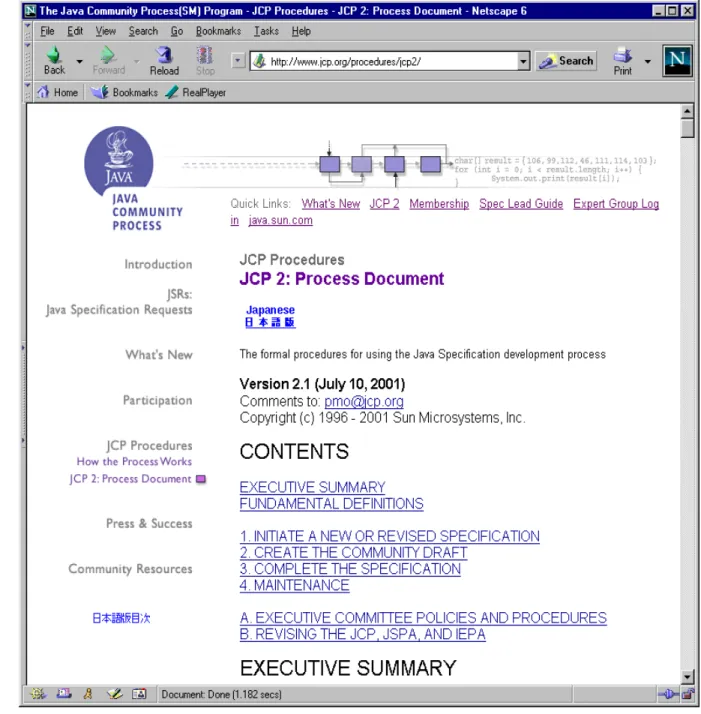
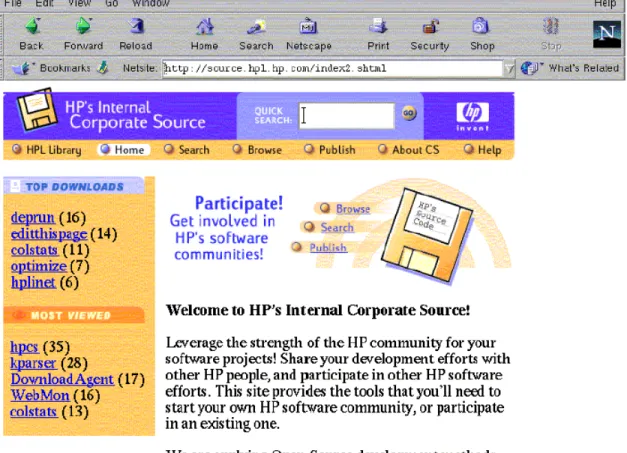
Web site for new OSSD products, and its high revenue, highly profitable Global Services division offers consulting services for the deployment and integration of OSS products with legacy enterprise applications. SUN has established its position in supporting OSSD based on its Java technology product line. This is most visible in SUN's Java Community Process, shown in Figure 2. HP-Compaq has invested in, demonstrated ongoing success and expanding commitment in a hybrid approach to OSSD they call, "progressive open source" [Dinkelacker, Garg, Miller, Nelson 2002]. Progressive open source is a technique for deploying a collaborative software development environment that can support
external software product or internal application development behind HP's corporate firewall, but across a global corporate environment. A view from behind the corporate firewall of HP's in-house OSSD effort is displayed in Figure 3.
Other large companies not in the IT industry are also investing in OSSD to support their EC/EB initiatives. Examples are found in the international business banking industry. Dresdner Kleinwort Wasserstein (DKW) developed and made free, the openadaptorTM
software technology, which is an open source middleware mechanism for expediting the connection of disparate EB systems found in the investment banking industry. DKW has established a sub-unit called openadaptor.org to handle ongoing development,
community building, licensing issues, and partnership alliances associated with openadaptor. Elsewhere, Barclays Global Investors (BGI) sought to maximize the benefits of global collaboration through the use of a Web-based software development framework from CollabNet called SourceCastTM. With development groups based in numerous locations including London, San Francisco, Sydney, Tokyo, and Toronto, BGI sought to achieve an end-to-end, integrated and consistent approach across its entire global software development practice. BGI selected SourceCast as the basis for its collaborative software development infrastructure for more than 150 internal system development projects ranging from high-end equity trading systems and global XML development to Web-based client order systems.3
Overall, it does not appear that the experience or efforts of DKW or BGI are unique to the international banking industry. Instead, it is probably coincidental that two banking institutions would embrace and publicize their efforts in OSSD. Nonetheless, it seems likely that other large non-IT industry companies might soon begin to invest in OSSD in support of their EC/EB initiatives. We suspect this may be particularly true for those companies that are involved either in the integration of complex multi-vendor enterprise applications like DKW, or those that entail providing a common collaborative
development environment that can be readily deployed across globally distributed business units, much like BGI.
Figure 3. A screenshot of the Java Community Process definition, sponsored by SUN Microsystems Inc. (Source: http://www.jcp.org/procedures/jcp2/ April 2002).
Figure 4. An internal corporate portal for open source software behind the firewall (called "corporate source") at Hewlett-Packard (Source: Dinkelacker, Garg, et. al. 2002).
Small and Midsize companies
Red Hat, VA Software (formerly VA Linux), and Collab.Net are probably the most visible of companies whose products or service offerings are primarily based on OSSD efforts. Early leaders in the OSSD movement in the late 1990's founded these companies. These companies for the most part have survived the economic downturn that has
affected most IT companies in the past few years, as well as surviving rapid rise and fall in their public valuations, as part of the dot-com industry shakeout. In sustaining business operations, these companies have been able to migrate away from unprofitable business operations (e.g., VA Linux's exit from the Linux workstation business) and more towards revenue generating operations associated with support and consulting services (including custom systems integration engagements). But these are not the only small to midsize businesses to sustain and grow value through OSSD based product or service offerings. For example, Progress Software, the world's leading vendor of embedded database management systems, and #2 vendor of E-Business integration software behind SAP, is another company that has made strategic investments in OSSD. Progress recently acquired NuSphere Inc., which is the world's leading provider of the MySQL relational database management system. MySQL is now included with most GNU/Linux operating system distributions, so that there are on the order of 1M copies of MySQL already distributed. Thus, there are small and midsize companies with sustained operations and revenue generation focused on the development/support of OSS products and services. Small, entry-level companies
In general, there are two kinds of small, entry-level companies that are interested in OSSD. First, there are entry-level start-up firms and established small companies that seek to acquire, use, or otherwise develop OSS as the basis for the products or services they intend to offer for generating revenue. ActiveState and Zope would be examples of sustained but growing small companies of this kind. Second, there are entrepreneurial system intergrators and consultancies that seek to sell/market their support services through offering free or low-cost open source software based solutions. Companies of the second kind are often those of the first kind as well, though there are examples of many small companies of each distinct kind. To simplify matters, here we choose to examine a small sample of those companies that act as both kinds.
Compiere, based in Europe, has become the world's largest provider of ERP systems, with more than 250K copies of its open source software already distributed (i.e.,
downloaded from its Web site) around the world. Traditional leaders in the ERP market like SAP, Oracle, Baan, JD Edwards, and PeopleSoft together claim no more than 20-25K copies installed of their costly, closed source ERP software systems. Compiere is not a direct competitor to the large ERP software vendors, unless or until those companies undertake product pricing and sales initiatives that are targeted to the small businesses that Compiere hopes to entice with its offerings. Compiere is a competitor to the
GNUenterprise.org project examined in this study. However, Compiere relies on the use of proprietary, closed source relational database management system (from Oracle). So
for many who acquire a copy of the Compiere ERP software, it mainly serves as a demonstration or evaluation system who usefulness is determined by the proprietary license from Oracle for their DBMS product (which is available at no cost for a limited period). Whether Compiere could readily rehost its open source ERP software onto the open source SAP DB and thereby realize a more complete open source ERP software environment is unclear. However, such a move would potentially put SAP in a difficult competitive position, since Compiere might then be able to have some affect on the shape of the ongoing development of enterprise-scale ERP software systems due to its
comparative mindshare advantage in the OSSD community and the hundreds of
thousands of copies already distributed. Thus, Compiere may offer an open source ERP system, but not a free or open source DBMS that can support it.
JBoss is the world's leading provider of Java-based application servers and server frameworks, with several hundreds of thousands of copies having been distributed. This compares to the estimated total of 10-30K copies of proprietary closed source software products of this kind offered by IBM (WebSphere), BEA Systems (WebLogic) and others. The JBoss business model is centered around service offerings for consulting, custom systems integration, and training. It recently began to train and certify
independent JBoss consultants from within the JBoss.org community, in order to help meet its rapidly growing customer service base. JBoss software is free and open source, and is usable in full once properly installed.
Jabber was perhaps the first company to offer open source software for instant messaging (IM) systems. Jabber appears to compete with IM products from AOL, Microsoft, Yahoo, and others. However, Jabbber's business strategy is to seek compatibility and
interoperation with existing proprietary IM products. Jabber's IM software surrounds and dissolves the differences and incompatibilities4 that exist among the competing closed source IM products through an alternative system architecture for IM that enables interoperation between and among proprietary closed-source IM systems. Thus users of Jabber software can send and receive instant messages or chat with proprietary IM clients, whereas proprietary IM clients can only send and receive messages from IM clients of the same one vendor. Jabber IM software is open source, and is usable in full once properly installed.
Ximian is the main firm backing the development of the GNOME graphic user interface (GUI) for the GNU/Linux system. GNOME is now bundled with nearly all GNU/Linux system distributions, thus realizing many millions of copies going into distribution. While these number of copies is minute compared to the existing global deployment of
Microsoft's Windows interface, SUN has licensed GNOME to use henceforth as its standard GUI for distribution with its Solaris (SUN Unix) operating system. Ximian is also developing a C# compiler and .Net Web services that seek to replicate the
functionality of those products being developed at Microsoft. GNOME software is free and open source, and is usable in full once properly installed.
Overall, each of these small entrepreneurial companies seeks to offer high performance OSS products at little or no direct cost, as a strategy for developing price competitive, sustained system integration and support services. For these companies, their OSS products might be seen as "loss leaders" that attract customers who are the target of service offerings. Distribution of thousands to millions of copies of different OSS applications and tools seems to insure an ongoing regional (or industry-specific), national, international, and global market demand for associated service offerings. Innovative entrepreneurial opportunities for entry-level companies may emerge to offer logically centralized support services, while customers may be physically distributed and organizationally decentralized. However, OSS companies in general do not hold a
monopolistic, vendor lock-in position as sole provider of ongoing support services. Thus they must compete based on the convenience, speed, quality, and cost of their service offerings.
Other enterprises and agencies interested in OSSD
Two other kinds of enterprises that are increasing being associated with the emergence and deployment of OSSD projects are non-profit enterprises and government agencies. Non-profit foundations have been established to assume legal ownership (and defense) of the property rights of a small number of free or OS projects or community organizations. The Free Software Foundation was the first of these, associated with thousands of OSSD projects that employ the GNU Public License (GPL) and its variants (e.g., the
Lesser/Library GPL), in order to insure that the software developed by these projects remains free and open in line with the terms and conditions stipulated in their licenses.5 The GNU/Linux operating system, which an estimated 10M copies in distribution, is the most visible of these projects that relies on the GPL to define, insure, and protect its community property rights, and thus to prevent them from being co-opted in corporate or individual private property. The Apache Software Foundation has a similar purpose for the Apache Web server, which operates a majority of Web servers on the Web.
National governments, particularly those in Europe and South America, have begun to put forward or debate public policies that encourage or mandate the adoption of OSS for use in national government agencies. The reasons for embracing such public policy are interesting and significant, but beyond the scope of this report, though they are beginning to be addressed in other reports [Nunez 2002, Scacchi 2002a] and proposed legislation [Cortiana 2002]. Nonetheless, it seems likely the OSSD will increasingly be viewed as a subject amenable for public policy within developed or developing countries.
What kind of enterprises could/should be interested in OSSD?
Based on the kinds of companies identified above, there is no a priori reason to expect that many other enterprises in different industries will not become increasingly interest in adopting OSSD projects for internal EB or external EC processes. Among those we expect to be early adopters of OSSD for EB or EC would likely include semiconductor, hardware component, or subsystem vendors like Intel, Conexant, Motorola, Texas Instruments, Nokia, Ericsson, Siemens and Broadcom. Intel and Ericsson have already
5 The GPL is constituted within U.S. copyright law frameworks. The European FSF also provides the GPL
invested in GNU/Linux projects, and thus represent the first in the semiconductor industry to begin to invest in this area.
Consumer electronics and appliance companies like Sony or General Electric are also likely adopters of OSSD projects. In particular, Sony's Computer Entertainment Group, makers of the Sony PlayStation 2 (PS/2) computer game console (with approximately 50M units sold) has recently released software development tools that enable OSSD projects that can run on and use the PS/2 console, via its embedded GNU/Linux operating system variant. This move by Sony may subsequently enable OSSD projects that seek to create OSS games for EC or EB, or that create an EC infrastructure that supports
emerging global game community economies, like that for the virtual world of Norrath, which recently was identified as the 77th. largest GDP economy in the world [Castronova 2001]. Norrath's economy6 is almost entirely electronic, relying on the global EC
infrastructure for sales, auctioning, sourcing, payment, and reputation services provided by eBay. Norrath is a virtual world hosted within the Everquest computer game world operated by Sony and its subsidiaries.
Moving farther away, we also eventually expect to see other high tech firms in the network systems, automotive, aerospace, and biotech industries to be among those that will adopt OSSD projects that enable or support internal EB processes or external EC processes. Clearly this is speculation, but it seems possible that companies in these industries will seek OSS solutions when they incorporate software systems that are part of, but not the entire, a product or service offering. Thus, aerospace companies like Boeing, and automotive companies like Ford, will seek OSS-based system component solutions that will be embedded in the airplanes or cars they sell.7
Overall, perhaps one of the most surprising findings from the preceding survey of
companies investing in OSS products and services, is the number of companies that have attained market leadership or significant contender positions. Clearly, these attainments are realized in terms of number of units (software systems) shipped/distributed, rather than on revenue generated. But this is still a significant accomplishment, given the ability of these firms to do so in direct competition to some of the largest and well-funded companies in the IT industry.
As such, we now turn to examine a case study of a global organization that seeks to combine the OSSD approach to develop and deploy EC/EB systems that are based on open source ERP system modules.
6 EBay based EC for Norrath enables trade in game resources among game players (Norrath residents) that
must otherwise be acquired through many hours of game play.
7 Every airplane or automobile is a potential host for a mobile Web server and browser embedded with the
individual vehicle, for vehicles networked within a fleet, or for vehicles serving/accessing content from the global Web.
Case Study:
GNUenterprise.org
and the development of free
open source ERP software
GNUenterprise.org is an international virtual organization for software development [Crowston and Scozzi 2002, Noll and Scacchi 1999] based in the U.S. and Europe that is developing a free, open source Enterprise Resource Planning (ERP) systems and related E-Business capabilities. This organization is centered about the GNUenterprise.org Web portal and global Internet infrastructure that enables remote access and collaboration (see Figure 5). Developing the GNUe software occurs through the portal, which serves as a global information sharing workplace and collaborative software development
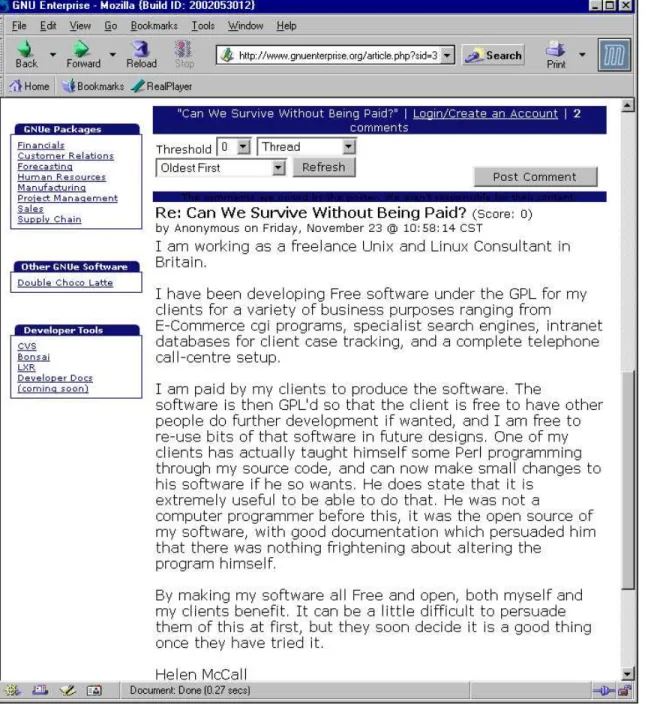
environment. It's paid participants are sponsored by one or more of twelve companies spread across the U.S. and Europe. These companies provide salaried personnel, computing resources, and infrastructure that support this organization. However, many project participants support their participation through other means (cf. Figure 7). A partial view of these companies appears in Figure 8. In addition, there are also dozens of unpaid volunteers who make occasional contributions to the development, review, deployment, and ongoing support of this organization, and its software products and services. Finally, there are untold numbers of "free riders" who will simply download, browse, use, evaluate, deploy, or modify the GNUe software with little/no effort to contribute back to the GNUenterprise.org community [cf. Olson 1971].
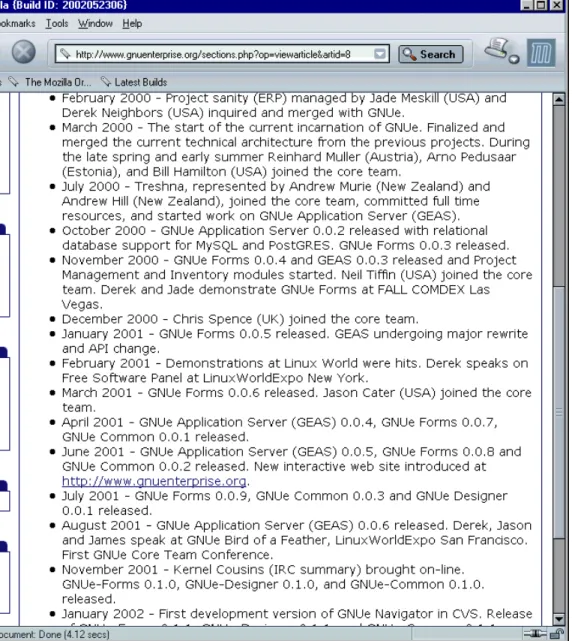
GNUEnterprise.org is community-oriented project, as are OSSD efforts [Scacchi 2001, Sharman et al., 2002]. The project started in earnest in 2000 as the result of the merger of two smaller projects both seeking to develop a free software solution for EB applications. More information an the history of the GNUenterprise.org project can be found on their Web site, as suggested in Figure 6. The target audience for the GNUe software modules are envisioned as primarily small businesses that are underserved by the industry leaders in ERP software, perhaps due to the high cost or high prices that can be commanded for commercial ERP system installations. Many of these target companies might also be in smaller countries that lack a major IT industry presence.
GNUenterprise.org is a free software project affiliated with the Free Software Foundation and the European FSF. The ERP and EB software modules and overall system
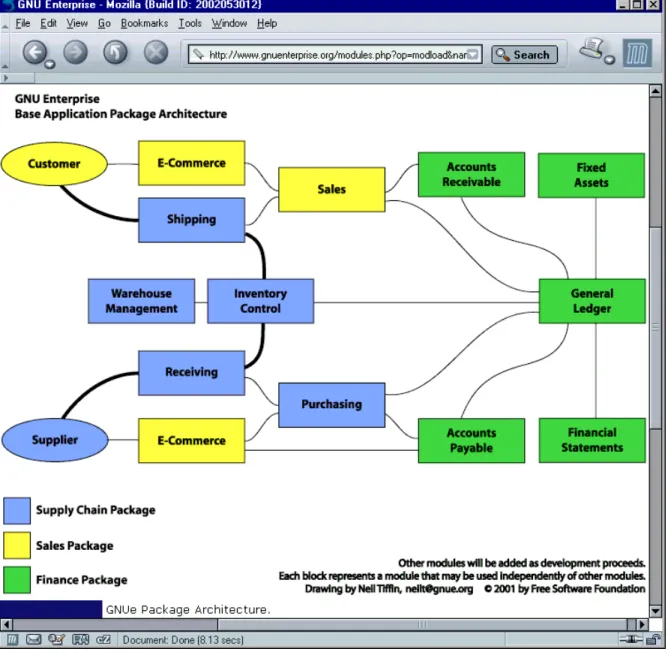
architecture (see Figure 9) are called the GNUe software. All the GNUe software is protected using the GNU Public License (GPL) [DiBona, Ockman, and Stone 1999, Pavlicek 2000, Williams 2002]. This stands in contrast to the ERP software from Compiere, which depends on the use of a commercial Oracle DBMS. Thus,
GNUenterprise.org is better characterized as a free open source project, rather than simply an open source development project [Fitzgerald and Feller 2002].
GNUenterprise.org is not in business as a commercial enterprise that seeks to build products and/or offer services. It is not a dot-com business, but is a "dot-org" community venture. GNUenterprise.org is more of a pre-competitive alliance of companies and individuals that want to participate in the development, use, or evolution of free ERP and EB software modules. As such, it has no direct competitors in the traditional business sense of market share, sales and distribution channels, and revenue streams.
Figure 5. Display of background information on the GNUenterprise.org and its GNUe software (Source: http://www.gnuenterprise.org/sections.php?op=viewarticle&artid=24, June 2002)
Figure 6. A view of the history of the development of GNUe software (Source: http://www.gnuenterprise.org/sections.php?op=viewarticle&artid=8, June 2002)
Figure 7. A public message from a GNUe project participant indicating her basis of financial support as a professional consultant and developer of Free software. (Source:
Figure 8. A partial display of international companies providing resources and
sponsoring the development of the GNUe software. (Source: http://www.gnuenterprise.org/sections.php?op=viewarticle&artid=6, June 2002)
Figure 9. Overview of the GNUe software system architecture and modules (Source:
GNUenterprise.org does not represent a direct competitive threat to companies like SAP, Oracle, PeopleSoft, or JD Edwards. This will be true until these companies seek to offer low-cost, entry-level ERP or EB service applications for small business customers. However, it does compete for attention, participation, and mindshare from potential OSS developers/users with companies like Compiere and others that seek to develop and deploy OSS for ERP applications and EB service offerings. In addition, since the development of the GNUe software is open for global public review and corporate assessment, it is possible that the efforts and outcomes of GNUenterprise.org might influence other companies developing ERP or EB software. For example, other non-free, closed source ERP software vendors may perceive competitive pressure of new system features, lower cost software products, better quality, more rapid maintenance, or modular system architectures [CW360, 2002] arising from the globally visible OSSD efforts of GNUenterprise.org.
The GNUenterprise.org virtual organization is informal. There is no lead organization or prime contractor that has brought together the alliance as a network. It is more of an emergent organizational form where participants have in a sense discovered each other, and have brought together their individual competencies and contributions in a way whereby they can be integrated or made to interoperate [Crowston and Scozzi 2002]. In GNUenterprise.org, no company has administrative authority or resource control to determine: (a) what work will be done; (b) what the schedule will be; (c) who will be assigned to perform specified tasks; (d) whether available resources for the project are adequate, viable, or extraneous; nor (e) who will be fired or reassigned for inadequate job performance. As such, there is comparatively little administrative overhead to sustain ongoing going software development and community portal support activities. Instead, there is a group of core developers, secondary contributors, and casual volunteers who review and comment on what has been done. The participants come from different small companies or act as individuals that collectively act to move the GNUe software and the GNUenterprise.org community forward. Thus, the participants self-organize in a manner more like a meritocracy [Fielding 1999], rather than a well-orchestrated community for Web-based commerce or entertainment [Kim 2000].
Certain kinds of software development decisions are made by "logically centralized but physically distributed" core developers [cf. Noll and Scacchi 1999]. These core
developers have earned the trust, have been recognized as technical authorities, and have achieved some degree of "geek fame", in the eyes other project participants [cf. Fielding 1999, Pavlicek 2000]. Like other project participants and OSS developers, the
GNUenterprise core developers are expected to uphold and reiterate the freedom of expression, sharing, and learning that free, open source GNUe software represents or offers. So as core developers of GNUe software, they must reflect on how their software development decisions reflect, embody, or otherwise reproduce belief in free, open source software. On the other hand, decisions to contribute gifts of skill, time, effort, and other production resources that give rise to software, online communications, and
technical peer reviews, are externalized or decentralized across a virtual organization [Bergquist and Ljundberg 2001, Crowston and Scozzi 2002]. These decentralized costs
reduce the apparent direct cost and administrative overhead of OSSD by externalization and global distribution, while sustaining something of a centralized decision-making authority. Thus, individual, corporate, and collective self-interest are motivated, sustained and renewed in a manner accountable to the culture and community that is
GNUenterprise.org [cf. Monge et al., 1998].
As such, these conditions make this study unique in comparison to previous case studies of EC or EB initiatives, which generally assume the presence of a centralized
administrative authority and locus of resource control common in most large firms. Nonetheless, we still need a better understanding of what resources are brought to bear on the development and deployment of EB and ERP software by GNUenterprise.org.
Subsequently, what follows is a description of key resources being employed throughout GNUenterprise.org to develop and support the evolution of the GNUe software modules. Computing infrastructure resources
Developers contributing to the ongoing evolution of the GNUe software in general provide their own personal computing resources. This is especially true for unpaid volunteer contributors, but also true of salaried participants who are paid to work on the GNUe software, particularly for their work at home. There is no standard or common personal computer configuration that is defined as the development platform, other than those that can run either Microsoft Windows or GNU/Linux operating systems, and that they can access the Internet or Web as needed. Thus, all GNUenterprise.org community members must provide their own way into the project, via personal resource subsidies. Beyond this, individual participants and contributors in the project are also expected to provide their own personal software development tools. These tools are generally expected to include those for source code development (e.g., code text editors, compiler collections, debugging tools, document formatters, local file repositories) and
communications (Email clients, Web browsers). In addition, software contributors routinely use the shared project coordination tools such as the CVS software version repository manager [Fogel 1999], Internet Relay Chat (IRC) for instant messaging and message logging8, and emerging GNUe software modules. However, within the GNUenterprise.org community, there is a strong, often reiterated belief that project contributors should only use software tools that are also free, open source software or that support non-proprietary data exchange formats, rather than proprietary, closed source products or data formats.
There are shared computing resources that help support and embody the GNUenterprise.org effort. These include the Web servers that host the content, communications, and related software development artifacts associated with
GNUenterprise.org community. The hardware side of the Web servers and their Internet service connection and fees are provided by companies that sponsors the
GNUenterprise.org project. The project's Web servers include use of the Apache Web
8 Message logging provides a persistent record of IRC message streams, which then serve as a medium for
capturing and documenting what is being discussed on a daily basis within the project. The
server and the PhP-Nuke content management system, which together provide Web portal capabilities while also serving as the community's information infrastructure [Deltor 2000].
Community communication resources
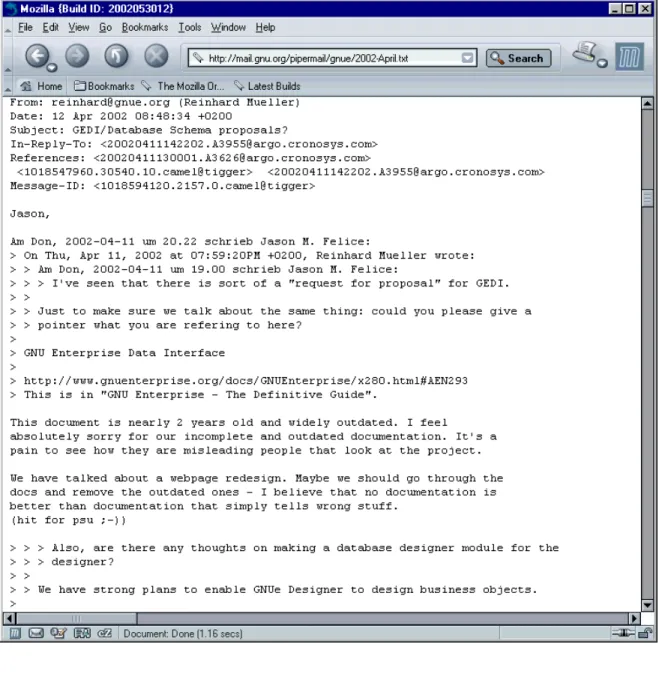
The GNUenterprise.org communication infrastructure serves as the “place” where GNUe software development work is performed, and where GNUe's software requirements are articulated, refined, stored, or discarded [Scacchi 2002b]. These communication systems, appear in the form of: (a) messages placed in a Web-based Threaded email discussion forums (Figure 10); (b) email list servers; (c) persistent, publicly available chat/IM records (Figure 11); (d) online community digests (Figure 12); and community news (Figure 13). Messages written and read through these systems, together with references or links to other messages or software webs, then provide some sense of context for how to understand messages, or where and how to act on them. Messaging also serves to enable informal communication about the availability of community participants with respect to different messaging forms, and their ability to coordinate and schedule their presence in online (virtual) project meetings [cf. Nardi, Whittaker and Bradner 2000].
Scenarios of usage resources
GNUe software developers generally do not meet face-to-face to create, employ, read, and revise shared mental constructions of how a given system is suppose to function. Since shared understanding must occur at a distance in space or time, then community participants create artifacts like screenshots, guided tours, or navigational click-through sequences (e.g., “Back” and “Next” Web page links). These scenarios of usage are augmented with supplementary narrative descriptions in attempting to convey their intent or understanding of how the system operates, or how it appears to a user when used. This seems to occur when GNUenterprise.org participants find it simpler or easier to explain what is suppose to happen or be observable at the user interface with pictures (or related hypermedia) than with just words. A later example in Figure 14 provides an example usage scenario that is intended for GNUe software application developers.
How-to guides, To-do lists, FAQs, and other itemized list resources
Online documents that capture and condense “how to” perform some behavior, operation, or function with the GNUe system, serve as a semi-structured narrative that assert or imply end-user requirements [Scacchi 2002b]. Formal HowTo descriptions include explicit declarations of their purpose as a HowTo, and thus may be identified as a system tutorial. Community participants may seek these formal HowTo’s when they are
unfamiliar with how to add a system module or class structure, or contribute other resources or efforts to the open software project. In contrast, informal HowTo’s may appear as a selection, composition, or recomposition of any of the proceeding resources. These informal HowTo guides may be labeled as a “FAQ”, such as that shown in Figure 15. A FAQ is a list of frequently asked questions about how a system operates, how to use it, where to find it’s development status, who developed what, known bugs and workarounds, etc. However, most FAQs do not indicate how frequently any of the questions may have been asked, or if effort has been made to measure or track FAQ usage/reference.
Figure 10. A view of a public email thread transcript communicating project information
and evaluative statements between project participants (Source: http://mail.gnu.org/pipermail/gnue/2002-April.txt April 2002)
Figure 11. A public transcript that records Internet-based chat in a real-time online project meeting
Figure 12. A snapshot of a community digest summarizes communications and activities across the GNUe project, with embedded Web links to source documents
Figure 13. A display view of a news item of interest to GNUenterprise.org participants (Source: http://www.gnuenterprise.org/article.php?sid=25, July 2001)
Figure 14. The GNUe Enterprise Designer, an interactive development environment (IDE) displaying a usage scenario for developers of GNUe-based applications
Figure 15. A screen display of links to an itemized list of "Frequently Asked Questions" (Source: http://www.gnu.org/projects/gnue/faq.html April 2002)