econ
stor
Der Open-Access-Publikationsserver der ZBW – Leibniz-Informationszentrum Wirtschaft
The Open Access Publication Server of the ZBW – Leibniz Information Centre for Economics
Nutzungsbedingungen:
Die ZBW räumt Ihnen als Nutzerin/Nutzer das unentgeltliche, räumlich unbeschränkte und zeitlich auf die Dauer des Schutzrechts beschränkte einfache Recht ein, das ausgewählte Werk im Rahmen der unter
→ http://www.econstor.eu/dspace/Nutzungsbedingungen nachzulesenden vollständigen Nutzungsbedingungen zu vervielfältigen, mit denen die Nutzerin/der Nutzer sich durch die erste Nutzung einverstanden erklärt.
Terms of use:
The ZBW grants you, the user, the non-exclusive right to use the selected work free of charge, territorially unrestricted and within the time limit of the term of the property rights according to the terms specified at
→ http://www.econstor.eu/dspace/Nutzungsbedingungen By the first use of the selected work the user agrees and declares to comply with these terms of use.
zbw
Leibniz-Informationszentrum Wirtschaft Leibniz Information Centre for EconomicsDorenbosch, Luc; de Reuver, Renee; Sanders, Karin
Article
Getting the HR message across: The lnkage
between line-HR consensus and 'commitment
strength' among hospital employees
Management Revue
Provided in Cooperation with: Rainer Hampp Verlag
Suggested Citation: Dorenbosch, Luc; de Reuver, Renee; Sanders, Karin (2006) : Getting the HR message across: The lnkage between line-HR consensus and 'commitment strength' among hospital employees, Management Revue, ISSN 1861-9916, Hampp, Mering, Vol. 17, Iss. 3, pp. 274-291
This Version is available at: http://hdl.handle.net/10419/78982
management revue, 17(3): 274-291
ISSN (print) 0935-9915, ISSN (internet) 1861-9916, © Rainer Hampp Verlag, www.Hampp-Verlag.de
Getting the HR Message Across: The Linkage between Line –
HR Consensus and “Commitment Strength” among Hospital
Employees
**Related to the theoretical work of Bowen and Ostroff (2004; also Ostroff/Bowen 2000), this article focuses on the features of an HRM system that help or constrain or-ganizations to get their HR message across. At a department-level of analysis, we fo-cus on the consensus between line managers and decentralized HR professionals on the human resource practices in place and on the either strategic or operational role of the HR function in the process of the management of employees. Stating that an or-ganization’s HR policies are transmitted by decentralized line and HR managers, it is proposed that the more line and HR executives agree on the status of their relation-ship and the HR practices in place, the less employees vary in their affective attitudes of commitment to the organization. Central to this article is the “strength” of affective organizational commitment among unit-members in a sample of 671 employees from 66 hospital departments drawn from four Dutch hospitals. Multi-level analyses indi-cate that consensus between HR professionals and line managers on HR practices (ca-reer opportunities, appraisal criteria) and on HR’s role is positively related to the commitment strength within a department. It is concluded that the collectivity of employee commitment to the organization is partly a function of department-level HR process indicators. Research limitations and implications for HR practitioners are dis-cussed.
Key words: Line Manager-HR Professional Consensus, HR Practices,
HR Roles, Employee Commitment, Climate Strenght, Hospital Departments
___________________________________________________________________
* For correspondence contact: Luc Dorenbosch.
Luc Dorenbosch, Renee de Reuver, both: Department of Human Resource Studies, Fac-ulty of Social and Behavioural Sciences, University of Tilburg, P.O. Box 90153, 5000 LE Tilburg, The Netherlands, e-mail: [email protected].
Karin Sanders, Work & Organisational Psychology, Faculty Behavioural Sciences, Univer-sity Twente, P.O. Box 217, 7500 AA Enschede, The Netherlands,
e-mail: [email protected]. ** Article received: April 27, 2006
Introduction
Puzzling questions regarding the dynamics between HRM and organizational per-formance outcomes have generated various conceptual models on the HR– organiza-tional performance link (Guest 1997; Becker et al. 1997; Wright/Snell 1998; Os-troff/Bowen 2000; Wright/Nishii 2004). The overall assumption these conceptual models contain is that a combination of HR practices, influences employee skills, atti-tudes and behaviour and in turn affects the overall business performance (Delery
1998). The last decade, particular research interest in high commitment models of HRM
depicted that a bundle of HR practices focusing on employee commitment to the or-ganization ultimately would contribute to oror-ganizational effectiveness, through the added value of dedicated employees working harder, smarter and sharing the objec-tives of the organization (Arthur 1992; Guest 2002; Edwards/Wright 2001).
Hence, this basic assumption underlying high commitment models of HRM has received much research attention and the scholars that empirically tested the direct re-lationship between commitment-oriented HR practices and affective organizational commitment (for example Benkhoff 1997; Agarwala 2003; Godard 2001; Guest 1999; Whitener 2001; Ramsey et al. 2000) reveal an overall positive relation between ‘best’ HR practices (e.g., career opportunities, selective hiring, performance appraisals, par-ticipation in decision-making) and affective organizational commitment. In all of the studies, affective organizational commitment defined as the degree of an employee’s emotional attachment to, identification with, and involvement in the organization (Al-len/Meyer 1990) is treated as a necessary individual employee attribute that is ex-pected to be crucial to the organization’s success.
However, as much of the strategic HR research views the individual employee’s commitment to the organization as a key resource to develop, recent theoretical devel-opments focus more explicitly on the value of creating “strong” organizational climates (Bowen/Ostroff 2004; Neal/West/Patterson 2005; Ferris et al. 1998) or internal social structures (Davis/Evans 2005) as one of HRM’s key resource for organizational effec-tiveness. A main difference is that the high commitment models suggest a direct rela-tionship between individual employee reactions such as an employee’s commitment to the organization in exchange for certain HRM investments (Whitener 2001) whereas or-ganizational climate models suggest that HR practices influences a process of organiza-tional sense-making (Weick 1995) by which “group members collectively understand and share their experiences of organizational events” (Parker et al. 2003: 391).
Therefore, the shared values and beliefs among employees are important proper-ties of a social collective with a shared mental model in which individuals have similar perceptions of the work environment, compatible performance expectations and atti-tudes/beliefs that are used to coordinate behaviour (Davis/Evans 2005).
Recently, Bowen and Ostroff (2004) applied collective constructs like organiza-tional climate and shared mental models to new theoretical stances towards the rela-tionship between HRM interventions and organizational effectiveness. They theorize that HRM systems affect business performance through eliciting a ‘strong situation’ (Mischel 1977) in which employees share the same ideas, beliefs attitudes, and objec-tives that reinforces each other’s work effectiveness (Ostroff/Bowen 2000;
Guzzo/Noonan 1994; Davis/Evans 2005). In this view, the effectiveness of an organization or lower-level department is enhanced through the efficiency as a function of employees sharing similar goal perceptions and attitudes that stimulates the likelihood of effective interaction and reduces interpersonal conflict and stress (Bliese/Halverson 1998).
Within this theoretical framework, the focal construct of this paper is the shared commitment towards the organization among employees of the same department. We expect that the member’s similar degree of identification and dedication to the organi-zation and organiorgani-zational goals is an important antecedent of department and conse-quently organizational efficiency. However, little research so far, has empirically inves-tigated the features of an HRM system that affects the shared attitudes of employees.
Consequently, the goal of this study was to make an empirical contribution to a part of the conceptual model of Ostroff and Bowen (2000; Bowen/Ostroff 2004) in which we frame the HR process at a department-level of analysis. Related to the
or-ganizational climate literature, we use the term ‘commitment strength’ to refer to degree of
shared affective organizational commitment within a department: the less department members differ in their affective commitment to the organization, the stronger the commitment strength.
Related to the work of Bowen and Ostroff (2004: 204), we define the HRM sys-tem itself not so much in terms of content (e.g., a specific set of HRM practices) but rather in terms of the HRM process (the features of an HRM system that support to get the HR message across to employees that allow them to understand the desired and appropriate responses and form a collective sense of what is expected). Among other features, Bowen and Ostroff (2004) describe two features of the HRM system that are considered important in clearly transmitting the HR message to employees. More specifically, we focus on the aspects of HRM that relate to the relationship be-tween line mangers and HR professionals, as these can be considered to be the front-line transmitters of organizational HR policies (Purcell et al., 2005). These features are
the agreement on the HR message among HR principals (line managers and HR professionals)
and the legitimacy of the HR message
Taken together, this research examines whether these two features of an HRM
system affect the degree of shared organizational commitment (commitment strength)
among employees within a department. Figure 1 shows the conceptual framework un-derlying this study.
Figure 1:
Theoretical background
Bowen and Ostroff (2004; Ostroff/Bowen 2000) provide a detailed theoretical framework for linkages between HRM systems, attitudes and organizational perform-ance. Based on the attribution theory (Kelley 1967; 1973), Bowen and Ostroff (2004) propose that when the HRM system is perceived as high in distinctiveness, consis-tency and consensus, it will create a strong organizational climate. Related to the
cli-mate literature, they define a strong organizational clicli-mate as a shared perception of
what the organization communicates through its practices, policies, procedures, rou-tines, and rewards (e.g., James/Jones 1974; Schneider 1990). The outcome is a work-force with for instance shared attitudes (e.g. affective organizational commitment) and/or collective behavioural patterns (e.g. organizational citizenship behaviour, safe working practice or customer friendliness).
In the following, we elaborate on the theoretical features of the HRM process that supports the shaping of shared employee perceptions, attitudes and behaviours in the workplace.
Framing the HRM process
In applying Ostroff and Bowen’s theoretical principles to an organizational setting, it is of importance to frame the HRM process through which HRM systems affect col-lective employee attitudes. To do so, we framed the HRM process by three compo-nents (HR practices, HR roles and level of analysis) that served as the guiding logic underlying our research.
HR practices: HRM systems are often described as a bundle of HRM practices such as selective hiring practices, pay for performance practices, training and devel-opment programs, broad job descriptions and the like. Research on HRM systems as-sume an underlying logic of the content of a high use of these practices that result in either high-commitment or high-performance HRM systems or – when used mini-mally – a more restrictive, Tayloristic variant referring to control-oriented HRM systems (Arthur 1992). An overview by Boselie, Dietz and Boon (2005) of ten years of empirical HRM studies reveal the dominance of the content approach to HRM that focuses on the presence of HR practices in relation to organizational effectiveness. In the process of HRM, HR practices contain the message the organizations wishes to send out to its employees as they serve as communication mechanisms signalling em-ployees what to expect from the organization and what is expected from them (Whit-ener 2001).
HR roles: A less explored component of the HRM process is the functional role of HR professionals in the execution of the HRM process. The discussion on the admin-istrative/operational role versus the tactical/strategic role of HR professionals in or-ganization is, however, prominent (Ulrich 1997; Pasmore 1999).
Functional roles of HR professionals are central to Ulrich’s (1997) widely-known framework in which he distinguishes four roles for HR: two operational HR roles (administrative expert and employee champion) and two strategic HR roles (strategic partner and change agent). In short, these four HR roles refer to the activities of HR with regard to the implementation and guidance of HR procedures (administrative
ex-pert), the direct concern for employee citizenship, motivation and well-being within the organization (employee champion), the direct advisor to line-management in the support of making long term strategic decisions (strategic partner), and the facilitation of change processes within the organization (change agent).
The significance of these functional HR roles relates to the tendency of organiza-tions to decentralize HRM responsibilities to front-line managers and HR profession-als in order to respond effectively to (business) unit challenges (Ulrich 1997). The consequence for the HRM process is that the functional relationship and clarity on the role of the HR professional and the (front) line manager is key to the actual transmis-sion of the HR message to employees. Research by Truss (2001) indicated that line managers play a ‘buffering’ role as it comes to the communication of organizational HR policies and principles. Purcell et al. (2005: 19) argues that this phenomenon ‘is often responsible for the difference between espoused HR policies and their enact-ment, and thus the experience of HRM processes as perceived by employees’. In sum, HR practices contain the message and HR roles that determine who (line manager or HR professional) takes responsibility for the transmission of the HR message. There-fore, HR roles are considered to be a key component of the HRM process through which employee attitudes and behaviour are affected.
Level of analysis: Both HR practices and HR roles are of importance in the process of transmitting the HR message, which – because of the intermediating role of decen-tralized HR professionals and (first) line managers – can differ within an organization and between organizational units or work groups. In the process of translating organ-izational goals into HR policies and practices, much of the impact of HRM on em-ployee attitudes and behaviour relies on line manager action and support (Purcell et al. 2005). Both in carrying out certain HR practices and the division of tasks and respon-sibilities translated into HR roles, the process of HRM is considered to be a (depart-ment/team/business-unit/work-unit) level activity (Wright et al. 2003). Of course this also depends on the type of organizational structure and size. Wright et al. (2003) state that, given the potential for huge variations in HR practices across (business) units and sites, the potential for gaining accurate, valid and useful measures of HR practices was quite low at a corporate or organizational level of analysis. With regard to employee attitudes towards the organization, it can be argued that employees perceive actions of line management as actions of the organization itself (Eisenberger/Huntington/ Hutchinson/Sowa 1986).
Hence, organizational HR goals like employee commitment towards the organiza-tion are affected by unit-level HRM processes. This because the makers of daily HR decisions which personify the organization in employee eyes are situated within lower
level work units – in our research labelled as (hospital) departments.
Features of the HRM system and commitment strength
The framing of the HRM process in terms of HR practices, HR roles at a department level of analysis serves as the guiding logic underlying hypotheses on the effect of the HRM system on ‘commitment strength’ in hospital departments.
Consensus on the HR message: One of the theoretical features of an HRM system as described by Bowen and Ostroff (2004; Ostroff/Bowen 2000) that intensifies the
communication of the HR message is the agreement or consensus among principal HR de-cision makers on the HR message. This refers to a situation in which employees view message senders strongly agreeing among each other on the message being sent out through HR practices (see also Guzzo/Noonan 1994). The smaller the gap between HR professionals’ and line managers’ perception of the implementation and execution of HR practices, the less ambiguous the message.
For example, when the HR department communicates that there is a range of possibilities for employees to train and develop themselves while line managers are not aware of these possibilities, they probably will not discuss them with employees on a regular basis. Employees on the other hand, will perceive that these opportunities
are out there while being out of reach.
Therefore, consensus among principal decision makers on what the means and goals of HRM are prevents employees from experiencing a mixed understanding of the HR message of the organization and the appropriate attitudes and behaviours the organization expects from them.
Similarly, Bowen and Ostroff (2004: 212) state that: ‘[…] disagreement among decision makers is likely to produce poor consistency in delivering practices; thus, dif-ferent employees will experience difdif-ferent event-consequence relationships. Overall, then, agreement among top decision makers can help foster greater consensus among employees, since it allows for more visible, relevant, and consistent messages to be conveyed to employees.
In addition, research on the communication of the psychological contract learns that a lack of clear management communication is “likely to lead to incongruence be-tween employer and employee perceptions of obligations – one of the causes of con-tract breach” (Guest/Conway 2002: 25). In a situation in which employer and em-ployees lack a clear perception of the employment relationship and the reciprocal promises and obligations implied in that relationship, employee feelings of trust, fair-ness and identification with the organization could be negatively affected (e.g. Benk-hoff 1997; Smidts/Pruyn/Van Riel 2001; Guest/Conway 2002).
Smidts et al. (2001) examined the impact of the adequacy of information about an employee’s personal role and organizational matters on the employee’s identification with the organization. Their results show that a positive communication climate, exist-ing of the employee’s experience of openness and trust in the information, perceived participation in decision-making and the feeling of being taken seriously by manage-ment, positively links to the degree that employees report organizational identification. The extent to which there is consensus between principal HR decision makers on HR practices being deployed is likely to be key to the clarity and adequacy of the HR mes-sage which gives rise to a positive communication climate that affects a shared sense of organizational commitment within a department. Hence, the first hypothesis reads:
Hypothesis 1: The consensus on the HR message ( = HR – Line consensus on the
con-tent of HR practices) is positively related to the commitment strength within a department.
Legitimacy of the HR message: The second feature of the HRM system that relates to the centrality of line managers and HR professionals in getting the HR message across is
what Bowen and Ostroff (2004) term legitimacy of authority. Specifically, this aspect
re-fers to the importance of “communicator credibility” in the process of getting the HR message across. As principal HR decision-makers are often jointly involved in carrying out HR practices, it is crucial to the effect of these practices that employees perceive an “authority situation” in which the division of HR tasks and responsibilities is clear to employees.
Although, Ostroff & Bowen (2004) claim that the legitimacy or credibility of the HR message is enhanced when the ‘HRM function is perceived as a status, high-credibility function and activity’ (p: 209), it is often claimed that HRM responsibilities should be carried out by first-line management to adequately respond to team-specific challenges and problems (Ulrich, 1997). Conversely, Bowen, and Ostroff’s example of HRM gaining legitimacy through investments in the HRM function, or perhaps by
placing the director of HRM in a high-level managerial position, does not guarantee
that line-managers will not by-pass higher-level HR management policies.
In practice, the shift from HR responsibilities from the HR professional to the first-line manager (with the HR professional in the role of business partner) has be-come central to the much of the thinking on the design of an effective HR function (e.g Ulrich 1997). From this perspective, it is more likely that the legitimacy of the HR message will increase with a clear division of HR responsibilities towards either the first-line manager or the decentralized HR professional. Therefore, it is expected that employees who perceive a situation in which it is not clear who is in charge of HR matters have a less collective understanding of whose HR message should be consid-ered as credible and legitimate. For HRM to have a clear source of communication, the agreement on the role of the HR professional in his/her functional relationship with line management is considered to create more legitimacy of authority, which supports organizations in getting the HR message across.
Research shows that consensus on HR’s role in the HRM process is, however, not common practice. In a Dutch sample, Biemans (1999) showed that the perception of line managers and HR professionals on their strategic activities and status are sel-dom alike. HR professionals tend to overrate, whereas line managers tend to underrate the strategic role of HR within the organization. Similar results were found in studies by Sanders and Van der Ven (2004) in another Dutch sample, by Wright et al. (1998) in an US sample, by Mitsuhashi et al. (2000) in a Chinese sample and by Boselie/Paauwe (2005) in a European sample. Hence, unclarity in the mutual under-standing between HR and line managers of their role in the HRM process is expected to blur the communication of the HR message. In turn, employees perceive less le-gitimacy of authority, which endangers the shared perception, and reactions of em-ployees to the message that the organization puts out. Stated positively, the second hypothesis reads:
Hypothesis 2: The legitimacy of the HR message ( = HR – Line consensus on HR’s
functional role) is positively related to the commitment strength within a department.
Methods
Sample and design
With a two-step stratified sampling approach (fixed sample of departments drawn from four large Dutch hospitals, with a random sample of employees within depart-ments) we used data from 671 employees (66% response), 66 line managers ( 97 % re-sponse) and 32 HR professionals (100 % rere-sponse). Departments were classified within four areas: clinical (cardiology, intensive care, internal medicine, child depart-ment, orthopaedics, and surgery), out-patients (surgery, cardiology, neurology, and kidney dialysis), support staff (kitchen, door and gatekeepers, financial administration, and warehouse), and medical support staff (laboratories, physiotherapy, dietetics, and pharmacy). The final dataset included 66 departments with an average of 10 employ-ees per department. The subjects were 509 female (76%) and 162 male employemploy-ees, 30 female (46%) and 36 male line managers, and 20 female (63%) and 12 male HR con-sultants. The mean age of the employees was 38.9 (SD=10.9).
All data were collected by means of questionnaires. To estimate the degree of commitment strength, employees were asked to fill out questions about their individ-ual affective commitment to the organization. Both line managers and decentralized HR professionals were asked to fill out identical questions about the HR practices for their department(s) within their range of responsibility. Because most HR profession-als connect with multiple departments within one hospital, they filled out the ques-tionnaire for each department they are responsible for. Also, both line managers and HR professionals were asked to fill out questions about their perception of the current role of the HR function, based on the role framework of Ulrich (1997).
Measures
Commitment strength was measured through the affective commitment scale by Allen and Meyer (1990). The affective commitment scale consists of five items with anchors 1
= totally disagree to 5 = totally agree (Cronbach ơ = .83). Sample items are: “This
or-ganization means a lot to me” and “I feel at home in this oror-ganization”. To measure the degree of commitment strength, for each of the 66 departments, we took the inversed standard deviation of organizational affective commitment scores of the individual em-ployees within that department. Therefore, the commitment strength can be interpreted as a measure of agreement; the more the employees report similar levels of organiza-tional affective commitment; the more commitment strength within a department. In their overview of measures to measure (dis)similarity in attitudes and behaviour (within-unit variance), Lindell and Brandt (2000) address the use of the standard deviation (SD) in contrast to the interrater reliability index (Rwg; James et al. 1993). On the basis of ar-guments made by Schmidt and Hunter (1989), and Lindell and Brandt (2000), the use of SD is justified if it is to assess relationships of shared attitudes with antecedents and out-comes. In addition, also Schneider et al. (2002) conceptualized shared employee percep-tions (of organizational climate) as the (inversed) standard deviation of employee per-ceptions of a service climate.
Consensus on the HR message: For this study we identified five commitment-oriented HR practices which are common to a majority of studies on HRM (Delery/Doty
1996; Tsui/Wang 2002; Boselie et al. 2005), including 1) career opportunities (e.g., “In
this organization employees have clear career paths”), 2) possibilities for training and
educa-tion (e.g., “In general employees have multiple possibilities for training and
educa-tion”), 3) appraisal criteria (e.g., “Employee appraisals are based on objective,
quantifi-able results”), 4) appraisal outcomes (e.g. “Employee appraisals are tied to contract
pro-longation and salary increase”), 5) clarity of job descriptions (e.g., “Job descriptions contain
all tasks that need to be performed by employees”). Line managers and HR profes-sionals were asked to what extent these practices were executed on the hospital’s de-partment-level using a 5-point scale (1=totally disagree, 5=totally agree). Each HR practices were measured with three items; the reliability of the five scales was
suffi-cient: Cronbach ơ varied between .66 (career opportunities) and .74 (appraisal
out-comes).
Originally, we also included HR scales for measuring the extent of participation in
decision-making and flexible pay arrangements. In the questionnaire for both line manage-ment and HR professionals we addressed identical items concerning these practices. However, reliability tests of the items of the proposed scales revealed that identical constructed HR scales for line managers and HR professionals had considerable
differ-ent reliabilities. Where HR professional data on the HR scales participation in
decision-making and flexible pay arrangements yielded moderate internal reliabilities (ơ >.67), the same scale construction of item scores in the line management data yielded low internal
reliabilities (ơ < .47). To maintain comparability of the measures of HR practices, we
ex-cluded the two HR practices from further analyses practices form further analyses. For the measurement of the extent to which both parties perceive a similar con-tent of HR practices, we calculated straightforward absolute deviance scores of the mean scores on the HR practices. Then we calculated the inversed deviance scores. Therefore, high scores on consensus refer to a high agreement on the HR message among line managers and HR professionals (scale means and standard deviations are depicted in Table 1).
Legitimacy of the HR message: To measure the legitimacy of the HR message, line managers and HR professionals in the different departments were asked about their
perception of the role of the HRM function. This was done by means of the strategic
partner (e.g., “HRM ensures that goals are achieved”), change agent (e.g., “HRM can
a-dapt to changes in the environment”), administrative expert (e.g., “HRM supervises the
implementation of administrative tasks”) and employee champion (e.g., “HRM takes care
of the personal needs of the employees”) roles of Ulrich (1997). The four scales using a 5-point scale (1=totally disagree, 5=totally agree) were constructed by Sanders and
Van der Ven (2004) and consist each of five items: Cronbach ơ varied between .82
(change agent) and .89 (employee champion).
Because of the high intercorrelations between the four roles we distinguish, based on a second order factor analysis, between two new scales: the operational HR role (administrative expert and employee champion) and the strategic HR role (strategic partner and change agent). The reliability of the scales, assessed by Cronbach's alpha, ranged from .87 (strategic HR role HR professionals) to .91 (strategic HR role line ma-nagement).
Here, in the same way as the consensus for the HR practices, we calculated for the two HR roles the inversed absolute deviance score between what line management and HR professionals perceive to be their operational/strategic HR role. Therefore, the smaller deviance between HR and line scores the higher the legitimacy of authority (scale means and standard deviations are depicted in Table 2).
Control variables: To control for organizational and department characteristics we chose to control for the hospital the examined departments belong to. Also we in-cluded both the average employee age (in years) and average employee educational level (1 = low; 6 = high) of each of the 66 departments.
Analytical procedure
The dataset consists of departments nested in hospitals, including scores from de-partment-level line mangers, HR professionals and aggregated scores from employees within the department. This means that the data can be conceptualized at two levels (department and hospital). Level 1 captures the information of the departments in each hospital, and level 2 captures the variability between hospitals. In such situations, it is appropriate to use a hierarchical 2-level modelling approach that simultaneously models effects at the within- and between hospital-level (Raudenbush/Bryk 2002). Because the hospital level is only included to control for differences between hospi-tals, there is no need to calculate ICC1 and ICC2. All independent variables are taken into account as variables at the lowest level; in this case: department level. In the multi-level analysis besides the consensus on HR practices between line managers and HR professionals the perceptions of the line managers and HR professionals on the HR practices and HR roles are taken into account.
Because the variance in the average employee age (in years) and average educational level is hardly related to commitment strength (respectively B = .007 and B = -.02), these variables are not taken into account in the analyses.
Results
Correlations
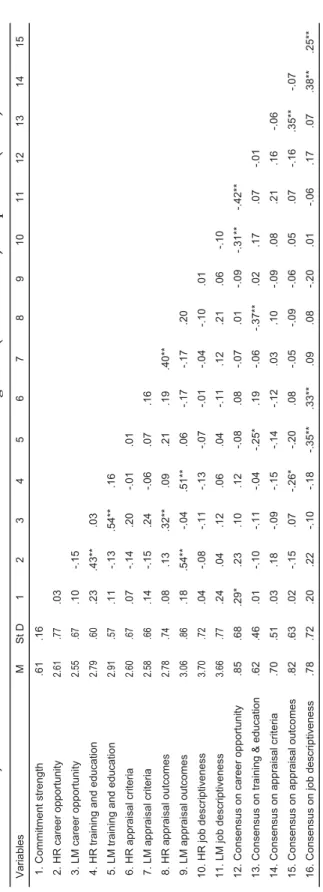
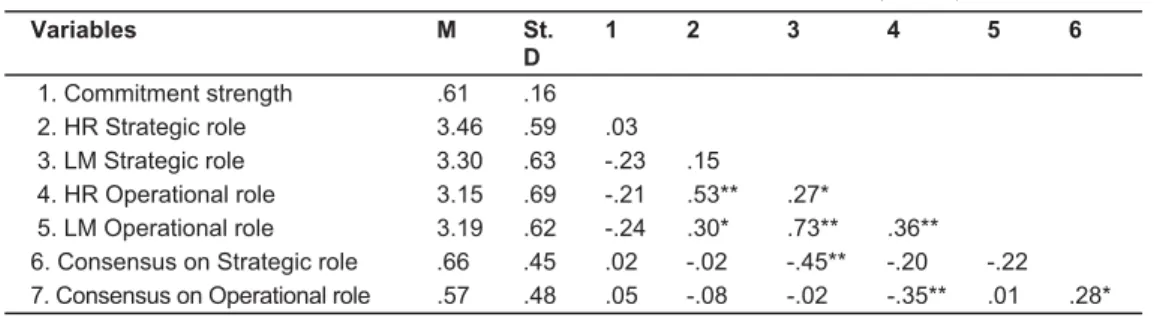
Correlations between study variables are reported in Table 1 and 2. In accordance with our theoretical framework, commitment strength is positively related to consen-sus on career opportunities (r = .29, p < .05). No other relationships with commit-ment strength were found neither with consensus between policy makers, nor with the perception of HR professionals or line managers on other HR practices and roles.
High correlations between different HR practices and HR roles for line managers and HR professionals are found. Both for line managers and HR professionals the per-ception of career opportunities and training and education is related (r = .54, p<.01; and r = .43, p<.01 respectively). On the contrary, we did not found the same relations be-tween the perceptions of the other HR practices. Also, the perceptions of the HR roles were related. Especially, high correlations were found between the strategic and the op-erational role for line managers (r = .53, p<.01) and HR professionals (r = .73, p<.01).
However, correlations between the consensus between HR professionals and line managers for the different HR practices and the HR roles are acceptable to take them into one analysis.
Table 1:
Means, standard deviations and correlations of
commitment strength and (consensus on) HR practices ( n=66)
* = p <.05 ; ** p < .01 / HR= rating by HR professionals, LM= rating by line managers Variables M St D 1 2 3 4 5 6 7 8 9 10 11 12 13 14 1. Commitment strength .61 .16 2. HR career opportunity 2. 61 .7 7 .03 3. LM career opportunity 2. 55 .6 7 .10 -.15
4. HR training and education
2. 79 .6 0 .23 .43** .03
5. LM training and education
2. 91 .5 7 .11 -.13 .54** .16 6. HR appraisal criteria 2. 60 .6 7 .07 -.14 .20 -.01 .01 7. LM appraisal criteria 2. 58 .6 6 .14 -.15 .24 -.06 .07 .16 8. HR appraisal outcomes 2. 78 .7 4 .08 .13 .32** .09 .21 .19 .40** 9. LM appraisal outcomes 3. 06 .8 6 .18 .54** -.04 .51** .06 -.17 -.17 .20 10. HR job descriptiv eness 3. 70 .7 2 .04 -.08 -.11 -.13 -.07 -.01 -.04 -.10 .01 11. LM job descriptiv eness 3. 66 .7 7 .24 .04 .12 .06 .04 -.11 .12 .21 .06 -.10
12. Consensus on career opportunity
.85 .68 .29* .23 .10 .12 -.08 .08 -.07 .01 -.09 -.31** -.42** 13. Consensus on tr
aining & education
.62 .46 .01 -.10 -.11 -. 04 -.25* .19 -.06 -.37** .02 .17 .07 -.01
14. Consensus on appraisal criteria
.70 .51 .03 .18 -.09 -. 15 -.14 -.12 .03 .10 -.09 .08 .21 .16 -.06
15. Consensus on appraisal outcomes
.82 .63 .02 -.15 .07 -.26* -.20 .08 -. 05 -.09 -.06 .05 .07 -.16 .35** -.07
16. Consensus on job descriptiv
eness .78 .72 .20 .22 -.10 -.18 -.35** .33** .09 .08 -.20 .01 -.06 .17 .07 .38**
Table 2: Means, standard deviations and correlations of HR roles ( n=66) Variables M St. D 1 2 3 4 5 6 1. Commitment strength .61 .16 2. HR Strategic role 3.46 .59 .03 3. LM Strategic role 3.30 .63 -.23 .15 4. HR Operational role 3.15 .69 -.21 .53** .27* 5. LM Operational role 3.19 .62 -.24 .30* .73** .36** 6. Consensus on Strategic role .66 .45 .02 -.02 -.45** -.20 -.22
7. Consensus on Operational role .57 .48 .05 -.08 -.02 -.35** .01 .28* * = p <.05 ; ** p < .01 / HR= rating by HR professionals, LM= rating by line managers
Consensus on the HR message and commitment strength
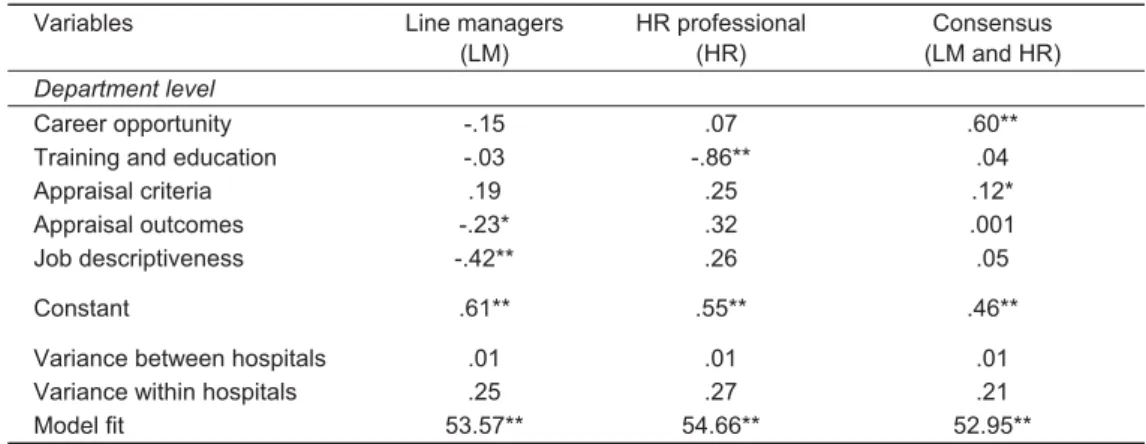
Hypothesis 1 predicted a positive relationship between consensus on HR practices among department HR principals and commitment strength. Table 3 presents the re-sults of multi-level analyses. For line managers we found a relationship between tying (developmental) rewards to appraisal outcomes and the clarity of job descriptiveness on one hand and commitment strength on the other hand, meaning the more line managers perceive these practices to be explicitly present, the less commitment strength within the departments. For HR professionals a negative relationship be-tween training and education and commitment strength is found: the more HR pro-fessionals perceive the training and education possibilities to be explicit, the less commitment strength within the departments.
Other than the separate actor-effects, related to the first hypothesis we found that more consensus between HR professionals and line managers on the explicitness of both career opportunity (B = .60, p<.01) and the appraisal criteria in place (B = .12, p<.05) leads to more commitment strength within the departments. For consensus on possibilities for training and education, appraisal outcomes, and comprehensiveness of job descriptions no significant effect was found. Noteworthy is the observation that for different HR practices, both single ratings of HR practices and ratings of consen-sus between line managers and HR professionals have differential effects on commit-ment strength. This means that we can only confirm H1 for consensus among line managers and HR professionals on the level of career opportunities and the appraisal criteria in place (Table 3).
Legitimacy of the HR message on commitment strength
In Table 4 the results for the HR roles are given. For both line managers and HR pro-fessionals no effects of the operational and strategic HR role on commitment strength were found (operational HR role B = -.03 and B = .02, ns. and strategic HR role: B = -.02, and B = .04, ns). In hypothesis 2 it was predicted that the more consensus HR professionals and line managers have on the shape of their professional role, the higher the department-level commitment. The results in Table 4 show that a positive effect was found for consensus on the operational HR role (B = .10, p<.05) and a positive effect was found for consensus on the strategic HR role (B = .42, p < .01). This means that we can confirm hypothesis 2.
Table 3: The effect of HR practices on department-level commitment strength (multi level analysis)
Variables Line managers (LM) HR professional (HR) Consensus (LM and HR) Department level Career opportunity -.15 .07 .60** Training and education -.03 -.86** .04 Appraisal criteria .19 .25 .12* Appraisal outcomes -.23* .32 .001 Job descriptiveness -.42** .26 .05
Constant .61** .55** .46** Variance between hospitals .01 .01 .01
Variance within hospitals .25 .27 .21 Model fit 53.57** 54.66** 52.95** * = p <.05 ; ** p < .01 / HR= rating by HR professionals, LM= rating by line managers
Table 4: The effect of HR roles on department-level commitment strength (multi level analysis)
Variables Line managers HR professional Consensus LM and HR Department level Operational HR role Strategic HR role -.03 -.02 .02 .04 .10* .42** Constant .72** .46** .57** Variance between hospitals .01 .01 .01
Variance within hospitals .19 .20 .19 Model fit 64.96** 61.12** 57.35** * = p <.05 ; ** p < .01 / HR= rating by HR professionals, LM= rating by line managers
Summary and discussion
The goal of this study was to make an empirical contribution to a part of the concep-tual model of Ostroff and Bowen (2000; Bowen/Ostroff 2004) in which the HR process is framed at a department level of analysis. Other than the writings on content models such as high commitment, high involvement or high performance HR sys-tems, we tried to empirically capture process-features of an HR system in which the consensus among principal HR actors (line managers and HR professionals) on HR message and the legitimacy of the message is regarded key to effectiveness of HRM (Bowen et al. 2004; Ostroff et al. 2000; Wright et al. 1998; Mitsuhashi et al. 2000; Boselie et al. 2005).
In line with other conceptual models that recently have surfaced (Wright/Nishii, 2004), the increasing interest in HR research including multiple actors (e.g., line man-agers, HR professionals, worker representatives, employees) involved in the process of
HRM at multiple levels (e.g., organizational, departmental, individual) levels is ad-dressed in this research.
In our study we tested the proposition that the more line managers and HR pro-fessionals (both involved in the execution of HRM at the department-level) agree on the content of HR practices and the professional role of HR function, the more de-partment members’ share a similar degree of affective commitment to the organiza-tion. Shared attitudes among department-members are regarded as a psychological de-partment-level construct that is an important though often neglected issue in explain-ing HR effectiveness. Related to the organizational climate strength literature (Lin-dell/Brandt 2000; Schneider et al. 2002) a strong organizational climate (as opposed to idiosyncratic employee climate perceptions) would evoke less variability in employee responses in the daily work situation. In the case of commitment strength, a depart-ment consisting of members whose affective attitudes are alike could cause less con-flict and stress among employees (Bliese/Halverson 1998) when, for example, the or-ganization requests flexibility of the department members in times of oror-ganizational or operational transformation or a short-term production increase. The actual perform-ance effects of a strong interpersonal work climate based on affective commitment are however beyond the scope of this article. Instead we examined the determinants of commitment strength within 66 hospital departments in four large Dutch teaching hospitals.
Our results partially support the idea that HR- Line consensus on the HR mes-sage and legitimacy of the mesmes-sage explain a proportion in the variability of the de-partment level commitment strength construct. We found that Line – HR consensus on career opportunity and on the performance based-criteria of job appraisals for
em-ployees are positively related to commitment strength. Furthermore, we found that
consensus on both the operational and the strategic HR role is positively related to commitment strength within a department. For consensus on possibilities for training and education, appraisal outcomes, and comprehensiveness of job descriptions, no significant effects were found.
A possible explanation for the significant and non-significant effects could be the nature of HR practice itself. The significant practices explicitly focus on the
opportu-nity and expectations towards the individual employment relationship with department
members. Career possibilities aim at the individual’s chances for internal promotion and the appraisal criteria aim at the communication of expectations to employees. Practices concerning training, job descriptions concern the operational aspects of the job and concern the department as a whole. Therefore, a lack of consensus on the lat-ter practices will not affect variability in employee attitudinal reactions as the whole group is affected by consensus or dissensus among line managers and HR profession-als (although it could affect the average levels of affective commitment in the depart-ment).
However, lack of consensus on career opportunity and appraisal criteria could
evoke mixed messages on the long-term promises made to an individual employee and
From the psychological contract literature (e.g. Rousseau 1995; Morris-son/Robinson 1997; Guest/Conway 2002) we already know that inadequacy of com-munication is likely to lead to incongruence between employer and individual em-ployee perceptions of expectations and obligations, and reduced levels of individual commitment. Taken a step further in our direction, our results indicate the importance of consensus on HR practices that relate to the individual’s employment relationship. Weaknesses in department level employee commitment are therefore more related to these practices, rather than the practices that relate to the functional maintenance (job design/ description, training) of the work process.
Limitations and recommendations
Although the research design and dataset were considered to match the research goal, there, naturally, are some limitations to our study.
First, our translation of Bowen & Ostroff’s (2004) theoretical features of a HRM system that supports a clear communication of the HR message into useful and valid empirical constructs is still very explorative. The danger that complex phenomena such as ‘consensus’ or ‘strength’ are difficult to operationalize is an issue that gets more and more attention by researchers. More validation of new constructs at multi-ple levels, but also among multimulti-ple actors is needed to facilitate empirical tests of complex theoretical frameworks that fit contemporary HR models (see Chan 1998).
Second, although we used the preferred multi-actor data to assess the consensus between policy makers, i.c. line- and HR managers, no measurement was used to measure the perception of the employees concerning the consensus between line and HR managers. This holds to the view that people’s behavior is not simply determined by ‘actual’ environmental factors but is mediated by their cognitive response to their environment (Fiske/Taylor 1984). Instead of using more actual measurements of con-sensus, both between policy makers, and among employees within a subunit, it is maybe more reliable to assess the perception of the employees concerning the differ-ent forms of consensus.
Third, our research does not take into account the actual level of affective com-mitment of employees in the departments. As we only focus on the similarity among levels of affective commitment within departments, it is not to conclude that consen-sus on the HR message and the legitimacy of the HR message actually leads to a
shared sense of high affective commitment. Statistically, both indicators can correlate
positively and negatively, which means that high commitment strength can indicate consistent low and high levels of affective commitment. Although it fits the process thinking on what determines the communication of HRM, it ignores whether the con-tent of HR message as such is beneficial to the affective organizational commitment of employees. Future research should address both HR content and HR process theo-ries in order to complete the picture on how HRM affects (collective) employee atti-tudes.
Finally, it should be noted that we used cross-sectional data rather than longitudi-nal data, which warns to be cautious with assumptions of causality.
Nevertheless, our research suggests that two features of a ‘strong’ HRM system as proposed by Ostroff and Bowen (2000) are distinctive constructs in relationship to
the strength of affective commitment within work-units. At a department level of analysis, multiple source data indeed show significant relationships between line and HR consensus on HR practices and the HR role and employee commitment strength.
A next step for academics would be to examine the effect of the strength of (in-terpersonal) climates on objective department-level performance and well-being out-comes. This would shed more light on one of the darker corners of the black box be-tween the HR function, HR practices and its subsequent outcomes.
HR professionals and line managers who deal with the execution of HRM proc-esses are advised to be aware of the importance of the mutual understanding of the HRM practices and their professional relationship and roles. The idea that HR policies are as effective as the line manager who behaves in accordance with them (Benkhoff 1997), also urges HR policymakers to carefully monitor the HR processes and actors lower down the organization’s hierarchy.
References
Agarwala, T. (2003): Innovative human resource practices and organizational commitment: an empirical investigation. In: International Journal of Human Resource Management, 14 (2): 175-197. Allen, N. J./Meyer, J. P. (1990): The measurement and antecedents of affective, continuance and
norma-tive commitment to the organization. In: Journal of Occupational Psychology, 63: 1-18.
Arthur, J. B. (1992): The link between business strategy and industrial relation systems in American steel minimills. In: Industrial and Labor Relations Review, 45: 488-506.
Becker, B. E./Huselid, M. A./Pickus, P. S./Spratt, M. F. (1997): HR as a source of shareholder value: Re-search and recommendations. In: Human Resource Management, 36 (1): 39-47.
Benkhoff, B. (1997): A Test of the HRM Model: Good for Employers and Employees. In: Human Re-source Management Journal, 7(4): 44-60.
Biemans, P. J. (1999): Professionalisering van de personeelsfunctie: een empirisch onderzoek bij twintig organisaties [The professionalization of the HR function: an empirical research in twenty organiza-tions]. Delft: Eburon.
Bliese, P./Halverson, R. R. (1998): Group Consensus and Psychological Well Being: A Large Field Study. In: Journal of Applied Social Psychology, 28: 535—580.
Boselie, P./Paauwe, J. (2005): Human resource function competencies in European companies. In: Per-sonnel Review, 34 (5): 550-566.
Boselie, P./Dietz, G./Boon, C. (2005): Commonalities and contradictions in research on human resource management and performance. In: Human Resource Management Journal, 15 (3): 67-94.
Bowen, D. E./Ostroff C. (2004): Understanding HRM-firm performance linkages: The role of “Strength” of the HRM system. In: Academy of Management Review, 29: 203-221.
Chan, D. (1998): Functional relations among constructs in the same content domain at different levels of analysis: a typology of composition models. In: Journal of Applied Psychology, 83(2): 234 – 246. Delery, J. E./Doty, D. H. (1996): Modes of theorizing in strategic human resource management: Tests of
universalistic, contingency, and configural performance predictions. In: Academy of Management Journal, 39: 619-654.
Delery, J. E. (1998): Issues of Fit in Strategic Human Resource Management: Implications for Research. IN: Human Resource Management Review, 8 (3): 289-309.
Edwards, P./Wright, M. (2001): High-involvement work systems and performance outcomes: the strength of variable, contingent and context-bound relationships. In: International Journal of Hu-man Resource Management, 12 (4): 568-585.
Eisenberger, R.,/Huntington, R./Hutchinson, S./Sowa, D. (1986): Perceived organizational support. In: Journal of Applied Psychology, 71: 500–7.
Evans, R. W./Davis, D. D. (2005): High-Performance Work Systems and Organizational Performance: The Mediating Role of Social Structure. In: Journal of Management, 31 (5): 758-775.
Ferris, G. R./Arthur, M. M/Berkson, H. M./Kaplan, D. M./Harrell-Cook, G./ Frink D. D. (1998): To-ward a social context theory of the human resource management-organization effectiveness rela-tionship. In: Human Resource Management Review, 8 (3): 235-264.
Fiske, S. T./Taylor, S. E. (1984): Social Cognition. New York: Random House.
Guest, D. E. (1997). Human resources management and performance: A review and research agenda In: International Journal of Human Resource Management, 8 (3): 263-276.
Guest, D. E. (2002): Human Resource Management, Corporate Performance and Employee Wellbeing: Building the Worker into HRM. In: Journal of Industrial Relations, 44 ( 3): 335-358.
Guest, D. E./Conway, N. (2002): Communicating the psychological contract: An employer perspective. In: Human Resource Management Journal, 12: 22-38.
Godard, J. (2001): High Performance and the Transformation of Work: the Implications of Alternative Work Practices for the Experience and Outcomes of Work. In: Industrial and Labor Relations Re-view, 54(4): 776-805.
Guzzo, R. A./Noonan, K. A. (1994): Human resources practices as communications and the psychologi-cal contract. In: Human Resource Management, 33: 447-462.
Huselid, M./Jackson, S./Schuler R. (1997): Technical and strategic human resource effectiveness as de-terminants of firm performance. In: Academy of Management Journal, 40: 171-188.
Hutchinson, S./Kinnie, N./Purcell, J. (2003): Bringing Policies to Life: Discretionary Behaviour and the Impact on Business Performance. In: WERC, University of Bath, Working Article Series.
James, L. R./Jones, A. P. (1974): Organizational climate: A review of theory and research. In: Psychologi-cal Bulletin, 81(12): 1096–1112.
James, L. R./Demaree, R. G./Wolf, G. (1993): An Assessment of within-group inter-rater agreement. In: Journal of Applied Psychology, 78(2): 306-309.
Kelley, H. H. (1967): Attribution Theory in Social Psychology. In: D. Levine (Ed.) Nebraska symposium on Motivation. Lincoln: University of Nebraska Press: 192-238.
Lindell, M. K./Brandt, C. J. (2000): Climate quality and climate consensus as mediators of the relation-ship between organizational antecedents and outcomes. In: Journal of Applied Psychology, 85: 331-348.
Mischel, W. (1977): The interaction of person and situation. In: D. Magnusson/N. S. Endler (eds.), Per-sonality at the crossroads: Current Issues in Interactional psychology. Hillsdale, NJ: Lawrence Erl-baum Associates: 333-352
Mitsuhashi, H./Park, H. J./Wright, P. M./Chua, R. S. (2000): Line and HR executives' perceptions of HR effectiveness in firms in the People's Republic of China. In: International Journal of Human Re-source Management, 11 (2): 197-216.
Morrison, E. W./Robinson, S. L. (1997): When employees feel betrayed: a model of how psychological contract violation develops. In: Academy of Management Review, 22 (1): 226-56.
Neal, A./West, M. A./Patterson, M. G. (2005): Do Organizational Climate and Competitive Strategy Moderate the Relationship Between Human Resource Management and Productivity? In: Journal of Management, 31 (4): 492-512.
Ostroff, C./Bowen, D. E. (2000): Moving HR to a higher level: Human resource practices and organiza-tional effectiveness. In: K.J. Klein/S.W. Kozlowski (Eds.), Multilevel theory, research, and methods in organizations. San Francisco: Jossey-Bass: 211-266.
Pasmore, W. (1999): A Hero for the Underdogs: A Review of Dave Ulrich’s Human Resource Champi-ons. In: Organization, 6(2): 361-369
Parker, C. P./Baltes, B. B/Young, S. A./Huff, J. W./Altmann, R. A./LaCost, H. A./ Roberts, J. E. (2003): Relationships between psychological climate perceptions and work outcomes: a meta-analytic review. In: Journal of Organizational Behavior, 24 (4): 389-416.
Purcell, J./Kinnie, N./Hutchinson, S./Rayton, B./Swart, J. (2005): Unlocking the HRM Black Box: Peo-ple management, HRM and the link with organizational effectiveness. University of Bath: Working Paper.
Ramsey, H./Scholaris, D./Harley, B. (2000): Employees and High-Performance Work Systems: Testing inside the Black Box. In: British Journal of Industrial Relations, 38 (4): 501-532.
Raudenbush, S. W. /Bryk, A. S. (2002): Hierarchical linear models: Applications and data analysis meth-ods (2nd ed). Newbury Park, CA: Sage.
Rousseau, D. M. (1995): Psychological contracts in organisations. Thousand Oaks, CA: Sage.
Sanders, K./Van der Ven, F. (2004): De rollen van Ulrich in de praktijk: verschillen tussen groepen ac-toren binnen een organisatie [The roles of Ulrich empirically tested: differences between groups within organizations]. In: Tijdschrift voor HRM, 6: 37-56.
Schneider, B. (1990): Organizational climate and culture. San Francisco, CA: Jossey-Bass.
Schneider, B./Salvaggio, A. N./Subirats, M. (2002): Climate strength: A new directions for climate re-search. In: Journal of Applied Psychology, 87: 220-229.
Smidts, A./Pruyn A. Th. H./Van Riel, C .B. M. (2001): The impact of employee communication and per-ceived external prestige on organizational identification. In: Academy of Management Journal, 49 (5): 1051-1062.
Truss, C. (2001): Complexities and controversies in linking HRM with organizational outcomes. In: Jour-nal of Management Studies, 38 (8): 1121-1149.
Tsui, A. S./Wang, D. (2002): Employment relationships from the employer’s perspective: Current re-search and future directions. In: International Review of Industrial and organizational psychology, 17: 77-114.
Ulrich, D. (1997): Human resource champions: The next agenda for adding values and delivery results. Boston: Harvard Business School Press.
Weick., K. E. (1995): Sensemaking in Organizations. Thousand Oaks: Sage Publications.
Whitener, E. M. (2001): Do “high commitment” human resource practices affect employee commitment? A cross-level analysis using hierarchical linear modeling. In: Journal of Management, 27: 515-535. Wright, P. M./Snell, S. A. (1998): Toward a unifying framework for exploring fit and flexibility in
strate-gic human resource management. In: The Academy of Management Review, 23(4): 756-772. Wright, P. M./McMahan, G./Snell, S. A./Gerhart, B. (1998): Comparing Line and HR Executives’
Per-ceptions of HR Effectiveness: Services, Roles, and Contributions. In: Human Resource Manage-ment Journal, 40: 111-124.
Wright, P. M./Gardner, T./Moynihan, L. (2003): The impact of human resource practices on business unit operating and financial performance. In: Human Resource Management Journal, 13: 21-36. Wright, P. M./Nishii, L. H. (2004): Strategic HRM and Organizational Behavior: Integrating Multiple
Levels of Analysis. Paper presented at the Conference “HRM: What’s Next”, Erasmus University Rotterdam, The Netherlands.
Wright, P. M./Haggerty, J. J. (2005): Missing Variables in Theories of Strategic Human Resource Man-agement: Time, Cause, and Individuals. In: Management Revue, 16 (2): 164-173.