Vibration damage levels for museum objects
David Thickett
Department of Conservation The British MuseumLondon WC1B 3DG, United Kingdom Fax: +44 (0)20 323 8636
E-mail: [email protected] Abstract
Adequate risk assessment for vibration is hampered by the lack of published damage levels for museum objects. The opportunity to study levels of vibration that cause damage to objects was presented by a major building project, The Great Court at the British Museum. The measured damaging vibration levels were between 0.2 and 0.6 g. The results of measured vibration caused by visitor circulation in the British Museum are assessed in terms of these measured damage levels. When assessing the likely impact of building work, vibration transmission through structures to areas remote from the building work must be considered. Examples of damage to individual objects and vibration transmission are discussed.
Keywords
vibration damage, building transmis-sion, walking
Introduction
Vibration is most commonly encountered in museums and historic houses as a consequence of visitor circulation. It can be particularly pronounced on poorly supported wooden floors, and such vibration is extremely expensive to reduce. This is the major source of vibration to which most objects in museums are exposed. Recently, the emphasis on access and cost has led to building work being undertaken in close proximity to objects on display or in storage. This can generate much higher and more damaging vibration levels than public circulation.
Vibration can lead to object damage through a number of mechanisms. Toppling is of serious concern during earthquakes, when the vibration can have a significant horizontal component, but toppling is less likely from flooring vibrations. The forces induced by the vibration can cause direct damage to weak or fragile objects, especially those with friable pigments or loose corrosion products. Where objects are constrained by mounts, then impact with, or abrasion against, the mount can be damaging. Finally, unrestrained objects can move or ‘walk’ on shelves under the influence of vibration. As well as the potential for impact with other objects, if an object were to ‘walk’ off a shelf this could be catastrophic both to the object itself and to objects below.
The potential risks to museum objects from vibration have been commented upon by several authors and are mentioned in most texts on preventive conserva-tion. Glass, mineral and anthropological collections are reported to be susceptible to vibration damage and anecdotal evidence has been published (Lins 1977, Scott 1989, Waller 1990). However, effective risk assessments for ambient vibrations caused by visitor circulation or for building work are hindered by a lack of published vibration damage levels for museum artefacts. The impact of vibration on paintings and some sculpture has been studied for transportation and some work has been published on the possibility of toppling during earthquakes (Agbabian et al. 1990, Mecklenburg and Tumosa 1991, Michalski 1991, Marcon et al. 1999, Sanders et al. 1999). Standards exist for vibration levels likely to cause damage to building fabrics and nuisance to humans occupying buildings (BSI 1992, BSI 1993, DIN 1997). However, there appears to be a singular lack of data for other types of objects or situations commonly encountered in museums and historic houses.
A major building project at the British Museum, The Great Court, instigated an extensive programme of vibration measurement. The development involved the demolition of redundant buildings and extensive foundation work in the central courtyard of the museum. A large number of galleries and storerooms abut the central courtyard on two levels and were expected to be affected.
Extensive enabling works were carried out prior to the building work and strenuous efforts were made to identify and move objects susceptible to the anticipated vibration, including more than 4000 stone sculptures. Prior to building work the ambient vibration levels caused by visitor circulation were measured to establish the normal background. Any instances of suspected damage arising from such levels were investigated. The museum’s commitment to uninterrupted access to the collections during the demolition phases of the building works regrettably led to a small number of objects being damaged by building vibration. While
extensive endeavours were made to move vulnerable objects, a number of unforeseen circumstances arose, particularly involving an unanticipated concrete foundation slab. Examination of these occurrences has allowed an estimate of damage levels for different types of object and situations.
Vibration measurement
Vibration monitoring had been previously commissioned by the museum from consultants for the display of a particularly sensitive group of objects and at the commissioning stage of a major storage project. This work identified the frequency range and likely amplitude expected from the various types of flooring in the museum. Most of the vibration measurements in the present work were performed with a Noreltek Wanderer WST-10/2 vibration logger. The logger records vibrations in the frequency range 3–400 Hz, with accelerations up to 1.6 g and with a sensitivity of 0.008 g. The unit does not record the frequency distribution of the vibration and is attenuated in one direction. Preliminary work identified the best way to deploy the logger and attach it reversibly to a vibrating surface (Thickett 1998). Some measurements were also carried out with a Lamerholm Fleming Shocklog RD298 logger, which records the vibration in three perpendicular directions.
Background vibration levels
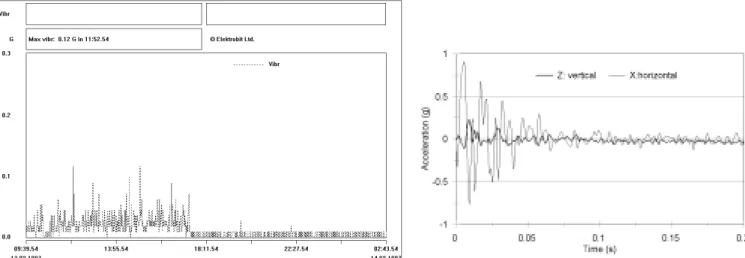
A survey of vibration levels around the museum’s galleries induced by day-to-day activities, such as visitor circulation, yielded average accelerations of between 0.006 g and 0.15 g and emphasized the extremely localized nature of some vibrations. A typical chart of the vibrations experienced in a wooden-floored, upper storey gallery is shown in Figure 1. The distinctive high acceleration spikes were observed in almost all of the measurements.
This was further investigated using the shocklog data-logger. Figure 2 shows two components of the vibration. As can be seen, the high acceleration peaks begin in the horizontal (x) direction and only afterwards are detected in the vertical direction. This is consistent with visitors banging against showcases.
Several instances of suspected vibration damage were investigated as part of the initial survey of background vibration levels. Vibration levels were measured as close as possible to the affected objects. Ongoing damage was assessed by placing paper around the base of objects to unambiguously determine further loss of material. Temperature and relative humidity monitoring were undertaken simul-taneously with the vibration monitoring to determine whether fluctuations in these parameters were contributing to the observed damage.
In only two instances were effects of ambient vibration observed on objects. The turquoise mosaic tesserae from Aztec artefacts were loosened from their resin and wood supports at vibration levels above approximately 0.05 g. They were subsequently moved to a specially designed, vibration-dampened showcase. The tails of two Benin ivory leopards worked themselves out of their retaining hole
under the influence of vibration levels of 0.1 g on a weak wooden floor, but no damage was caused to the leopards. Apart from the Aztec mosaic objects, no instances of actual physical damage could be attributed to ambient vibration, although damage from poor handling and fluctuating relative humidity was observed. Most of the instances investigated had been anecdotally ascribed to vibration, probably due to the very high sensitivity of human beings to vibration. It should also be borne in mind that although no actual instances of damage from background vibration were observed, vibration has been considered in gallery design for many years. Vulnerable objects may be excluded from display and, if displayed, are often placed in wall cases where the floor-borne vibrations are at a minimum. Instances of objects ‘walking’ on glass shelves were also investigated. In order for an object to walk the vibration must overcome the friction between the object base and the shelf. The friction forces depend on three factors: the weight of the object, the contact area between the object or its support and the shelf, and the shelf and object or object support materials. The influence of the material type is illustrated by the fact that bronze sculptures up to 0.485 kg mass were observed to walk under 0.1 g vibration when on Perspex bases, while an adjacent sculpture of 0.330 kg sitting directly on the glass shelf did not move under the same vibration. Walking was only observed on glass shelves and painted metal baseboards and generally only with small objects weighing less than 0.5 kg. All vibration measurements were taken as close as possible to the object on the shelf, as significant variations in vibration levels were measured across the length of shelves. Walking was observed at vibration levels as low as 0.02 g. Shelves supported from vertical metal rods (either hanging or fixed at both ends) were found to have lower vibration levels than baseboards or shelves fixed rigidly into case backboards.
Damage observed during building work
Twelve instances of damage caused by building vibration were investigated. Obviously, these measurements were only undertaken after the damage had been observed. Again the temperature and RH were also recorded and paper was used to visualize loss of material during the monitoring period. In some instances no further damage was observed during the monitoring and no hard conclusions could be drawn. It could have been that the vibration intensity had reduced by the time that the measurements were undertaken or that weaker elements of the object had been removed by the vibration before measurement. Nine of the incidences were directly monitored and in a further three, approximate vibration levels during damage could be reasonably extrapolated from immediately adjacent monitoring. The instances of damage observed and monitored are summarized in Table 1. Of
Table 1. Summary of damage
BM registration Type Material (conservation materials) Vibration Levels Damage type
number (measured at)
26265 figure of terracotta (plaster, consolidants 0.5g (baseboard) loss of paint, powdering and Aphrodite-Isis cellulose nitrate, Paraloid B72) loss of terracotta particles 26266 figure of Aphrodite-Isis terracotta (plaster, shellac, 0.5g (baseboard) loss of paint from blistered
consolidants; cellulose nitrate, paint layer Paraloid B72, polystyrene)
1239 polychrome statue of Nenkhefta limestone 0.2-0.3g loss of loosely bound pigment (base of sculpture)
1867,2-8. 1356 wall painting depicting death plaster (plaster, coatings 0.2-0.4g (top of case) opening of cracks,
of Icarus beeswax and polyvinyl acetate) new cracks, abrasion
186, 5-5. 1355 wall painting depicting Naiad plaster (plaster, foaming epoxy) 0.2-0.4g (on mount) opening of cracks, new cracks 1899,2-15.1 wall painting depicting Bacchus plaster (plaster, slate) 0.2-0.4g (top of case) loss of paint flakes, debonding
and Silanus and delamination of backing
1899,2-15.2 wall painting plaster (plaster) 0.2-0.6g (on baseboard) opening of cracks 1873,2-8.1 wall painting depicting Bacchus plaster (plaster) 0.2-0.4g* (estimated) opening of cracks 1883,5-5.5 wall painting depicting Cupid plaster (plaster) 0.2-0.4g* (estimated) opening of cracks
24792 coffin gesso on wood 0.2-0.44g# opening of cracks,
(on base board) severe loss of pigment
1 1 6 8 1 2 plaque terracotta 0.15-0.3g abrasion against mounting
(top of case) pins
1 2 3 6 9 1 back rest ivory (wax) 0.15-0.3g* cracking and abrasion of wax
(on base board) conservation material against glass shelf
the 12 instances of damage directly attributed to vibration, representative examples are discussed in detail below.
The majority of damage had occurred in areas of existing weakness within the objects. Damage to the Death of Icarus wall painting was manifested as an opening up and extension of existing cracks (see Figures 3 and 4). Several new cracks had also been initiated in the plaster. The vibration originated from work being undertaken at the base of the wall on which the wall painting was mounted and its magnitude was between 0.2 g and 0.4 g when loss was observed.
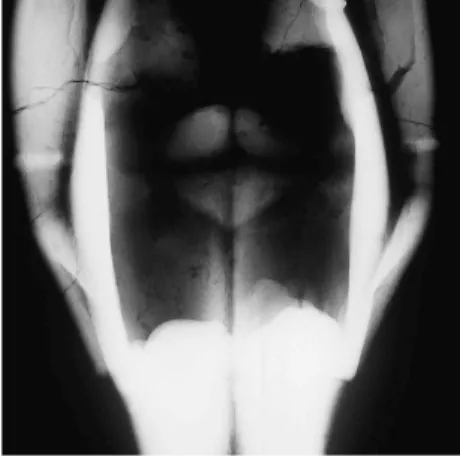
Damage on two terracotta anthropoid figures was concentrated in a band running around the thighs. Radiography showed that this corresponded to the edge of plaster fills inside the legs (see Figures 5 and 6). Initially, soluble salts introduced from the plaster were suspected as the cause of the weakening. However, analysis showed this assumption to be false and the weakening was ascribed to the action of water and the penetration and subsequent hydration of plaster through the unsealed terracotta break surface. The weakened paint layers and terracotta were damaged by vibration levels of 0.5 g, caused by the storage of metal I beams directly adjacent to the showcase containing the two figures.
The polychromy on a limestone statue of Nenkhefta was damaged at vibration levels of 0.2 g to 0.3 g. Small flakes of the poorly bound red pigment were lost and observed on paper placed around the base of the figure.
The damage on several of the objects had been aggravated by the mounting and display methods used. Abrasion at restraining points was observed, even when polyethylene-coated pins were used to restrain objects. In one instance the Naiad wall painting was displayed vertically and supported at its base by a lipped steel shelf. The shelf is considerably wider than the wall painting and Plastazote foam padding was placed between the wall painting and the backboard of the case. The wall painting is also loosely retained at its top edge by two Perspex pins. There was a gap of almost 2 cm between the wall painting and the backboard allowing free movement. A polyvinyl acetate lacquer had been applied to the surface of the painting and this exhibited a distinctive crackleture. Horizontal bands of cracks were interspersed with bands where the lacquer had not been disturbed. The vibration mode could be deduced from these bands corresponding to nodes (areas of maximum movement) and antinodes (areas of no movement) in the vibration. Abrasion was observed from the metal rim and new cracks also appeared at the interface between the original wall painting and the later plaster border. This damage had occurred at similar vibration levels to the Death of Icarus wall painting, which was exhibited in the same showcase.
An ivory backrest was damaged while displayed across two adjacent base panels in a showcase when subjected to vibration of 0.15 g to 0.3 g. The damage was mainly localized to the joint line between the two boards and fortunately occurred only to old wax-based conservation fills in the object.
Damage was observed at vibration levels between 0.2 g and 0.6 g. The observed damage levels are somewhat lower than the recommended levels for paintings and current building standards. This reflects the extreme vulnerability of some museum
Figure 3. Roman wall-painting depicting the death of Icarus
Figure 6. Radiograph showing coincidence of extent of plaster fill
Figure 4. Schematic of cracking in 1991 and after building work vibration
Figure 5. Loss of material from terracotta figure localized in band around top of thigh
objects. The lower bound of the measured damage levels is just above the background vibration levels from normal use of the building, discussed in the previous section.
Vibration transport through buildings
In order to assess the risk from vibration, some knowledge of the likely transport is required. This is especially important during localized building projects when trying to decide which objects in adjacent galleries require additional protection or removal. Trials of any practices likely to cause high vibration levels (demolition, drilling, or breaking out concrete) are invaluable in determining a suitable strategy. Vibration levels can be monitored at several adjacent locations and the results used to inform decisions involving even very complex structures. Such trials can also determine the likely noise impact of work on surrounding visitor or staff areas.
During the building work at the British Museum, most of the damage from vibration was caused by two activities: the breaking of an unanticipated thick concrete foundation adjacent to a sculpture gallery wall, which required a 30-tonne breaker, and the use of Kanga hammers on concrete roof beams. Objects, including vulnerable wall paintings, had been removed from the sculpture gallery wall in advance of the adjacent work, but the unanticipated strong vibrations were found to transmit significant distances through the arch-supported gallery floor structure. This damaged the friable pigment on the polychrome limestone statue of Nenkheftka in a case 1.5 m from the wall. Monitoring of the vibration indicated levels as high as 0.4 g over 5 m from the wall. The wooden floor of the gallery above did not transmit significant vibration into the gallery, except through a case butting out from the wall, 3 m into the gallery. One instance of damage, to a coffin, was some distance away from the major building activity, with vibration from drilling in a basement travelling up three stories in a wall via metal reinforcing girders.
Temporary storage of building materials also needs to be considered. The two terracotta figures of Aphrodite-Isis were damaged from shock generated by the repeated dropping of metal I beams beside their case.
Use of data
Vibration has been considered at the design stage for new and refurbished galleries within the British Museum for many years. Knowledge of individual object vulnerabilities and a qualitative understanding of the likely floor vibrations have allowed display of vulnerable objects in galleries without damage. Monitoring the ambient vibration levels has shown that, in some galleries with wooden flooring, they do indeed approach the damage thresholds determined during building work. The improved understanding of damage levels achieved in the early phases of the building project has enabled informed risk assessments to be made for new gallery projects and during building work. Monitoring in the display case containing the Aztec mosaic objects showed no increase in vibration levels during the majority of the demolition phase and supported continued display of these unique objects. When breaking out work for a new fire escape was scheduled adjacent to this gallery, a trial indicated that the vibration dampening case and mounting system would be overwhelmed by the vibration, with unacceptable levels experienced in the case. The objects were therefore removed to safe storage for the duration of this work. The Aztec mosaic skull was incorporated in the inaugural exhibition to celebrate the opening of The Great Court development. Monitoring indicated that the sprung marine ply floor of the exhibition gallery could generate excessive vibration levels for this object. The vibration frequency of the 1.5 m spans of ply was calculated at 110 Hz. Measurements undertaken on similar floors had identified a maximum vibration at 64 Hz to 128 Hz. For this object, a maximum acceleration of 0.05 g and isolation to a resonant frequency of below 5 Hz has been recommended. A vibration dampening mount was devised using 10 mm Sorbothane®
weighted with 25 kg stage weights. Calculations with the dampening calculator available from the manufacturers of Sorbothane, Lleyland Rubber Company, indicated this should reduce the vibration levels by 90% and reduce the resonant frequency of the mount and skull to 1 Hz. The system was unobtrusively positioned
in the display plinth of the showcase. Measurements at the base of the case and on the mount verified its efficacy, with readings of 0.14 g at the case base translating into 0.02 g on the mount, well below the recommended limit.
Conclusions
Measurements of vibration undergone by objects while damage is occurring has identified damage levels of 0.2 g to 0.6 g. Damage has been restricted to objects with pre-existing weaknesses and has largely centred on these defects. Vibration is rarely considered when mounts are designed and much of the damage was exacerbated by the mounting systems employed. A range of object types was affected, including wall paintings, terracottas, and polychrome surfaces; however, many material types were not exposed to the vibration. Materials such as archaeological glass were known to be sensitive and had been removed to safe areas well away from any vibration source. Vibration transmission through a building can be very difficult to predict and trials prior to commencement of building works are of immense benefit.
Ambient vibration levels from visitor circulation on wooden floors approach the damage levels identified and could pose a risk in some instances. Knowledge of the damage levels, combined with vibration-absorbing mounting systems and sympa-thetic design, can allow even particularly vulnerable material to be safely displayed.
Acknowledgements
The author would like to acknowledge the Science Group of the Victoria and Albert Museum for its kind loan of the Shocklog data logger; conservation colleagues Helen Taylor and David Singleton; Kim Overand of the Department of Greek and Roman Antiquities, for bringing instances of damage to his attention; and Susan Bradley for advice and encouragement.
References
Agbabian, M S, Ginell, W S, Masria, S F and Nigbor, R L, 1991, ‘Evaluation of earthquake damage mitigation methods for museum objects,’ in Studies in conservation, 36, 111–120. BS6472:1992, Guide to evaluation of human exposure to vibration in buildings (1-80 Hz), British
Standards Institute, London.
BS7385:Part 2:1993, Evaluation and measurement of vibration in buildings, Part 2 Guide to damage
levels for ground borne vibration, British Standards Institute, London.
DIN4150–3. 1997, Vibrations in buildings, Part 3 Effects on structures, Deutsches Institut fur Normung, Berlin.
Lins, A, 1977, ‘Ceramics and glass conservation: preventive measures’ in Museum News, 55, 5–9. Marcon P J, Harrington, M and Heinrichs, P, 1999, ‘Packing and transport of hollow plaster sculpture’ in J Bridgland (ed), Preprints of the twelfth triennial meeting of the International Council of Museums
Committee for Conservation, London, James and James Science Publishers Ltd, 77–82.
Mecklenburg, M F and Tumosa, C S, 1991, ‘An introduction into the mechanical behaviour of paintings under rapid loading conditions’ in M F Mecklenburg, Art in transit: studies in the
transport of paintings, Washington, DC, National Gallery of Art, 137–172.
Michalski, S, 1991, ‘Paintings - their response to temperature, relative humidity, shock and vibration’ in M F Mecklenburg, Art in transit: studies in the transport of paintings, Washington, DC, National Gallery of Art, 223–248.
Saunders, D, Slattery, M. and Mulder, I, 1999, ‘Building work, vibration, and the permanent collection,’ in Conservation News, 68, 10–13.
Scott, M, 1989, 1988 at the Australian Museum, AICCM bulletin, 15, 10–12.
Thickett, D, 1998, Vibration measurement using the Noreltek logger, Unpublished British Museum Internal Report 1998/1.
Waller, R, 1980, ‘The preservation of mineral specimens’ in Preprints of eighth annual meeting of
the American Institute for Conservation of Historic and Artistic Works, 116–128. Equipment
Wanderer Vibration Logger, Noreltek Ky, Jamytie 2, 96910 Rovaniemi, Finland, Tel.: +35 8 60 364 962, Fax: +35 8 60 364 961
Shocklog, Lamerholm Fleming Ltd, Caxton Way, Stevenage, Hertsfordshire, SG12 2DE, Tel: +44 0 1438 728844, Fax: +44 0 1438 742326, www.lamerholm.com
Sorbothane, Sorbothane Inc., 2144 State Route 59, Kent, Ohio, U.S.A., Tel.: +1 (800) 838 3906, Fax: +1 (330) 678 1303, www.sorbothane.com