Machines2021, 9, 22. https://doi.org/10.3390/machines9020022 www.mdpi.com/journal/machines Article
Precise Locating Control for a Polar Crane Based on Sliding
Mode Active Disturbance Rejection Control and Quadratic
Programming Algorithm
Xuyang Cao 1, Zhiwei Wang 1,* and Xingang Zhang 1,2
1 School of Mechanical Engineering, Dalian University of Technology, Dalian 116024, China; [email protected] (X.C.); [email protected] (X.Z.)
2 School of Science, Qingdao University of Technology, Qingdao 266033, China
* Correspondence: [email protected]
Abstract: A polar crane is a large-scale special lifting equipment operated in a nuclear power plant. To address the precise locating control problem of a polar crane with the center of gravity shifting, with cross-coupling, and with external disturbance, an effective control scheme is proposed in this paper. Firstly, a nonholonomic constraint dynamic model of the polar crane is established according to the Lagrange–Rouse equation. Then, an expansion state observer (ESO) of the active disturbance rejection control (ADRC) method is applied to estimate and compensate the cross-coupling disturb-ance in real-time. To improve the robustness and convergence speed of the control system, the nonsingular terminal sliding mode (NTSM) control method is incorporated with ADRC and the stability of the controller is proven by the Lyapunov function approach. Furthermore, to solve the problem of redundant actuation and to reduce trajectory deviation of the bridge truck, the contact forces of the horizontal guide device are introduced into the quadratic programming (QP) optimi-zation algorithm. Finally, the effectiveness and superiority of the proposed control scheme are il-lustrated by simulation results.
Keywords: polar crane; precise locating; active disturbance rejection control; nonsingular terminal sliding mode; quadratic programming algorithm
1. Introduction
A polar crane is a large-scale special lifting equipment operated at the top of a con-tainment vessel; it is mainly used for heavy equipment lifting and fuel replacing. Taking the lifting process of reactor pressure vessel upper heads as an example, the hook block needs to be slowly lowered and accurately aligned with the center of the reactor pressure vessel, which places a high demand for precision lifting on the polar crane.
Reliable manufacturing processes and reasonable structural design methods are the basis for precise lifting of a polar crane. Literature [1] took the physical structure of the rope-sheave system of the polar crane into account and proposed a systematic method for analyzing the dynamics of the system based on the virtual power principle. Literature [2] presented a quasi-static method to analyze the equilibrium path and trajectory deflections for the load of the polar crane, which is of great significance for improving the structural layout of the lifting system. Literature [3] proposed a static balanced approach to analyz-ing the straightness deviation of the hook block duranalyz-ing the liftanalyz-ing process. Literature [4] analyzed the influence of bridge deformation on the locating accuracy under different working conditions by the finite element method. Literature [5] presented an effective control method for the welding deformation of corbel by improving the welding process and welding sequence. Literature [6] analyzed the rigid-flexible coupling model of a polar
Citation: Cao, X.; Wang, Z.; Zhang, X. Precise Locating Control for a Polar Crane Based on Sliding Mode Active Disturbance Rejection Control and Quadratic
Programming Algorithm. Machines
2021, 9, 22. https://doi.org/10.3390/ machines9020022
Received: 08 January 2021 Accepted: 19 January 2021 Published: 20 January 2021 Publisher’s Note: MDPI stays neu-tral with regard to jurisdictional claims in published maps and insti-tutional affiliations.
Copyright: © 2021 by the authors. Licensee MDPI, Basel, Switzerland. This article is an open access article distributed under the terms and con-ditions of the Creative Commons At-tribution (CC BY) license (http://cre-ativecommons.org/licenses/by/4.0/).
crane based on the ANSYS and ADAMS co-simulation analysis method. The results ob-tained have important reference values in analyzing the influence of structural flexibility on locating accuracy.
Related studies did not consider the impact of the operation process on lifting accu-racy. In the field of traditional hoisting machinery, a series of control technologies is rela-tively mature and provides an important reference for the polar crane. In the aspect of swing suppression control, Literature [7] aimed for a double pendulum structure of over-head cranes and proposed a trajectory tracking and swing suppression control method based on sliding mode control theory. Literature [8] proposed a multivariable generalized predictive control method for an overhead crane based on the particle swarm optimiza-tion algorithm and achieved good control performance. Literature [9] designed a linear quadratic regulator based on Takagi–Sugeno fuzzy modeling and particle swarm optimi-zation algorithm for anti-swing and positioning control of the overhead crane. In terms of crane trajectory planning, aimed at the problem of payload residual swing caused by in-ertial force, Literature [10] designed the acceleration curve of the trolley based on the en-ergy control method. Literature [11] proposed an enen-ergy optimal model of the overhead crane according to energy consumption, operation time, and safety. To deal with the prob-lem of parameter uncertainty in the trajectory planning, Literature [12] proposed an un-certain estimation and optimization scheme which provides guidance for unun-certain anal-ysis and online controller design of overhead cranes. Literature [13] proposed a new con-trol system based on the state feedback concon-trol method to deliver high-performance tra-jectory tracking with minimum load swings in high-speed motions. In the field of the off-shore ship-mounted crane, Literature [14] designed a neural network-based adaptive con-troller to solve the payload swing caused by sea waves. Literature [15] proposed a novel event-triggered fuzzy robust fault-tolerant control approach to overcome actuator fault and external disturbance of offshore ship-mounted crane. Literature [16] designed an ob-server-based nonlinear feedback control to achieve simultaneous accurate jib/trolley po-sitioning and fast payload swing suppression against complex unknown external disturb-ances.
A polar crane is a nonlinear control system with multiple inputs, multiple outputs, and strong coupling. Moreover, due to the movement of the trolley, a polar crane is often in a state of center of gravity shift during rotation. As an effective nonlinear control method, active disturbance rejection control (ADRC) has the advantages of simple, feasi-ble, and strong robustness, and for the coupling system, the cross-coupling disturbance can be estimated and compensated by the ESO. Therefore, compared with the traditional decoupling control method, ADRC has significant advantages [17–19] and can be an im-portant method to solve the control problem of the polar crane.
As stated previously, most studies in the field of precise lifting of a polar crane have only focused on the lifting mechanism design and analysis, but the problem of location deviation during crane operation has been ignored. To address this problem, a novel lo-cating control scheme for the polar crane is proposed in this paper. The main contributions of this paper are summarized as follows:
(1) An nonsingular terminal sliding mode (NTSM)-ADRC-based decoupling method is first proposed to effectively address the cross-coupling disturbance for the polar crane system and to greatly improve the robustness and adaptability of the crane system.
(2) To properly address the problem of redundant actuation, a quadratic programming (QP) optimization model is designed, in which the contact force of the horizontal guide device is introduced to reduce the trajectory deviation of the bridge truck. (3) The proposed NTSM-ADRC-QP control scheme has good performance in locating
control under the conditions of center of gravity shift and external disturbance. The paper is organized as follows: The nonholonomic constraint dynamic model of the polar crane and model validation are introduced in Section 2. Section 3 illustrates the
overall structure of the NTSM-ADRC-based decoupling control method, the stability anal-ysis, and the quadratic programming algorithm for the polar crane. Numerical simula-tions and analyses are provided in Section 4 for the proposed control scheme. Finally, Section 5 concludes the main works of this paper.
2. Crane Description, Modeling, and Simulation
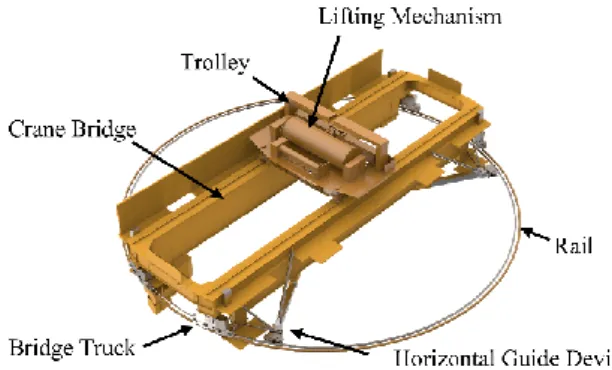
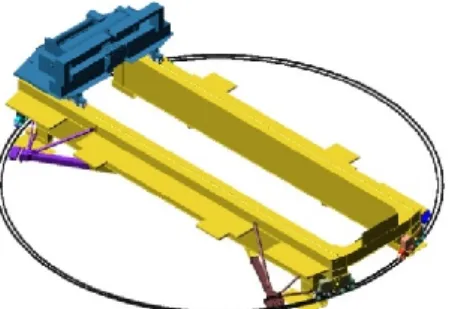
A polar crane is installed on the top of the containment vessel. As shown in Figure 1, the main structures include a crane bridge, a bridge truck, a trolley, a lifting mechanism, a horizontal guide device, and an electrical system.
Figure 1. Overview of the polar crane.
The bridge truck is used to drive the crane rotating on the rail, and the trolley is in-stalled on the crane bridge; thus, it can move on the crane bridge. Based on the cooperative movement between the trolley and the bridge truck, the lifting mechanism can cover all areas of the reactor building. In addition, horizontal guide devices are installed to ensure the crane operates safely.
2.1. Dynamic Model of the Polar Crane
In Figure 2, a graphical representation of the polar crane is shown. It could be seen that
X O Y
, ,
is a global coordinate frame attached to the center of the rail,
x P y
,
c,
is a local coordinate frame attached to the polar crane,P
c is the geometric center of the crane, andP
G is the center of mass of the crane.Under the condition of planer movement, the configuration of the polar crane can be described by seven generalized coordinates. Among them, three variables describe the position and orientation of the crane, and four variables describe the motion states of the driving wheels:
1 2 3 4
T c cx y
,
, ,
,
,
,
q
,where
x y
c,
c
are the coordinates of the geometric centerP
c in the global coordinate frame;
is the rotation angle of the polar crane; and
1,
2,
3, and
4 are the an-gular displacements of the driving wheels installed in the bridge truck.Moreover, the corresponding system parameters are illustrated in Table 1.
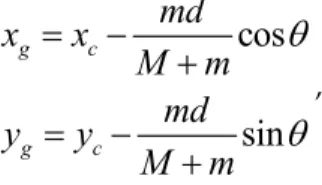
According to Figure 2, the relationship between the geometric center
P
c and the center of massP
G can be depicted as follows:cos
sin
g c g cmd
x
x
M
m
md
y
y
M
m
, (1)where
x
g,
y
g
are the coordinates of the center of massP
G in the global coordinate frame.(a)
(b)
Figure 2. Schematic of the polar crane system: (a) overview of the crane kinetic relationship and (b) local magnification of the crane geometric center.
Assuming a pure rolling condition for the driving wheels, the following constraint equations can be derived:
X Y y x d 1 2 1 L l 2 L v 4 4 v Corner B Corner A Corner C Corner D R 4 h F 4 n F 4 s F 4 1 1 v 1 2 v2 2 3 3 3 v c P G P X Y x y c P O xc c y
1 1 1 1 1 2 1 1 3 1 1 4
sin(
)
cos(
)
sin(
)
cos(
)
sin(
)
cos(
)
sin(
)
cos(
)
c c c c c c c cx
y
R
r
x
y
R
r
x
y
R
r
x
y
R
r
, (2)Table 1. Structure parameters of the polar crane.
Symbol Description Unit Symbol Description Unit 1
L
Length of the crane bridgem
m
Mass of the trolleykg
2
L
Width of the crane bridgem
r
Radius of the driving wheelm
l
Length of the outriggerm
1 Angle between wheel axle and x axisdeg
R
Radius of the railm
2 Angle between outrigger and x axisdeg
M
Mass of the crane bridgekg
d
Distance between the trolley andP
cm
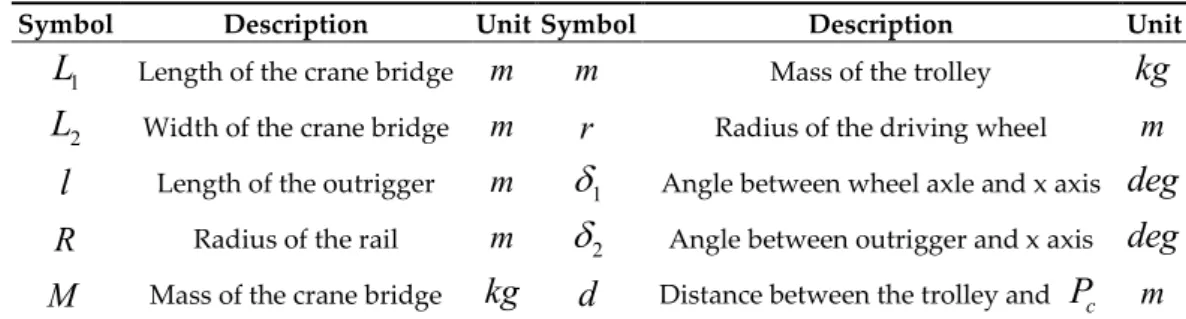
The matrix form of the constraints in Equation (2) can be rewritten as follows:
0
A q q
, (3) where
1 1 1 1 1 1 1 1sin
cos
0
0
0
sin
cos
0
0
0
sin
cos
0
0
0
sin
cos
0
0
0
R
r
R
r
R
r
R
r
A q
, (4)The Lagrange–Rouse equation is used to derive the dynamic equations of the polar crane, since the planer movement of the crane, the total kinetic energy
L
, can be written as follows:
4 2 2 2 2 11
1
1
2
g g2
d i2
iL
M
m
x
y
J
J
, (5)where
J
is the rotary inertia of the driving wheel andJ
d is the equivalent rotary in-ertia of the crane bridge and trolley around the center of massP
G. Note thatJ
d will change in response to the variation of the parameterd
.The Lagrange–Rouse equation of motion for the polar crane system is governed by the following [20]: 4 1
d
1, 2
7
dt
j j j k k kjL
L
F
B
j
q
q
,
, (6)where
q
j is the element ofq
,F
j is the generalized force,
k is the Lagrange multi-plier, andB
kj is the element ofA q
.Substituting the derivative of Equations (1) and (5) into Equation (6), the dynamic equations can be expressed by the generalized coordinates:
2 1 1 2 1 3 1 4 1 2 1 1 2 1 3 1 4 1 2 2 4 1+ sin cos sin sin sin sin
cos sin cos cos cos cos
sin cos c c c x c y c c d i i M m x md md F M m y md md F m d mdx mdy J M R M m J
1 1 1 2 2 2 3 3 3 4 4 4 u r J u r J u r J u r , (7) where c xF
, c yF
, andM
are the generalized forces corresponding to the generalized coordinatesx
c,y
c, and
, respectively, andu
1,u
2,u
3, andu
4 are the control tor-ques of the driving wheels.For the convenience of expression, the dynamic equations in Equation (7) can be re-written in a matrix form:
,
=
T
M q q + C q q q
F
A
q λ
, (8)where
M q
is the mass/inertia matrix of the crane system;C q q
,
denotes Coriolis and centripetal forces;F
is the vector of generalized forces;A q
is the matrix of sys-tem constraints, which was obtained earlier; and
is the vector of Lagrange multipliers. 2.2. Generalized Force Analysis of the Crane System2.2.1. Dynamic Analysis of the Bridge Truck
During crane operation, in addition to the control torques, the driving wheels of the bridge truck are also subject to lateral forces. Furthermore, the vertical load is the neces-sary condition for generation of the lateral force, and the vertical loads can be expressed as follows:
1 1 1 1 1 2 1 2 1 1 1 2 1 3 1 1 2 1cos sin sin cos
4 2 2 2
2 1
cos sin sin cos
4 2 2 2 1 cos sin 4 2 2 z c c c c z c c c c z c c L M m md mgd H F M m g M m x y H x y L L L L L M m md mgd H F M m g M m x y H x y L L L L L M m mgd H F M m g M m x y L L
1 2 1 4 1 1 1 2 2 sin cos 2 2 1cos sin sin cos
4 2 2 2 c c z c c c c md H x y L L L M m md mgd H F M m g M m x y H x y L L L L , (9)
where
H
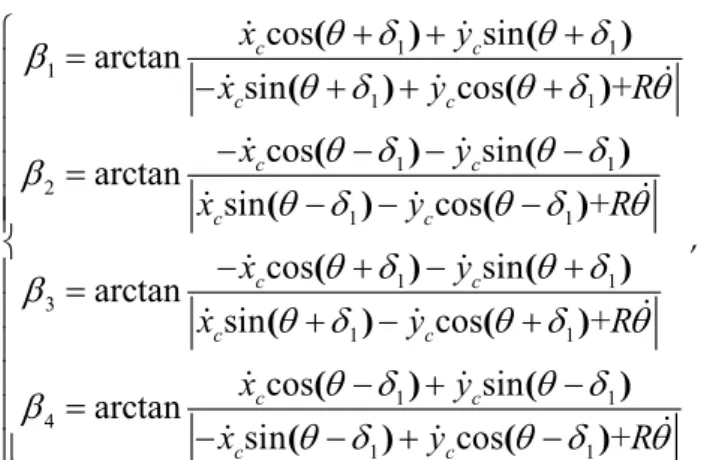
is the altitude distance between the center of mass of the crane and the rail plane.Besides that, the lateral force is also related to the side-slip angle of the driving wheel, and the side-slip angle of each wheel can be expressed as follows:
1 1 1 1 1 1 1 2 1 1 1 1 3 1 1 4
cos
sin
arctan
sin
cos
+
cos
sin
arctan
sin
cos
+
cos
sin
arctan
sin
cos
+
arcta
c c c c c c c c c c c cx
y
x
y
R
x
y
x
y
R
x
y
x
y
R
(
)
(
)
(
)
(
)
(
)
(
)
(
)
(
)
(
)
(
)
(
)
(
)
1 1 1 1cos
sin
n
sin
cos
+
c c c cx
y
x
y
R
(
)
(
)
(
)
(
)
, (10)Based on the empirical model, the lateral forces can be expressed as follows [21]:
(1
i i)(1
i zi),
1, 2, 3, 4
i
B C F
h i
F
A
e
e
i
, (11)where
A
i,B
i, andC
i are coefficients determined by wheel test data. Therefore, the lateral force can be written as a vector form:
1 20 0 0 0 0
Th h
,
, , , , ,
hF
, (12) where1 h1
cos
1 h2cos
1 h3cos
1 h4cos
1h
F
(
)
F
(
)
F
(
)
F
(
)
,2 h1
sin
1 h2sin
1 h3sin
1 h4sin
1h
F
(
)
F
(
)
F
(
)
F
(
)
,2.2.2. Dynamic Analysis of the Horizontal Guide Device
As shown in Figure 3, horizontal guide devices are installed at every corner of the crane bridge, which are mainly composed of a horizontal guide outrigger, an oblique rod, a horizontal rod, and horizontal guide wheels. Furthermore, the horizontal guide wheels are connected to the outrigger by disc springs.
Figure 3. Horizontal guide device.
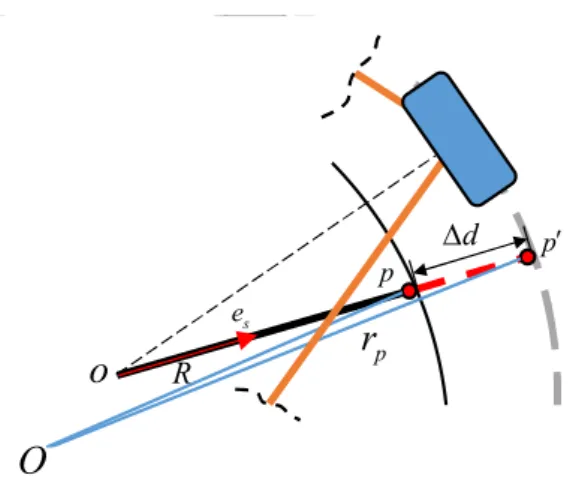
For ease of calculation, invasion between the horizontal guide wheel and the rail is allowed, so that the invasion distance can be used instead of the compression of the disc spring. Figure 4 shows the kinematic relationship of the horizontal guide device, where
p
is the contact point of the horizontal guide wheel and the rail,p
is the invasion point,e
s is the unit vector along the horizontal guide outrigger,
d
is the invasion dis-tance, andR
is the radius of the rail.Figure 4. Schematic of the horizontal guide device.
Referring to [22], the kinematic relationship can be expressed as follows:
d
R
p s
r
e
, (13)
From Equation (13), the invasion distance can be obtained as follows:
2
d=
b
b
c
, (14)where
b
r e
p
s andc
r
p
r
p
R
2.Therefore, the contact forces of the horizontal guide wheels can be written as follows:
,
1 2 3 4
i nf
i
, , ,
i i n sF
e
, (15) where i nf
is the magnitude of the contact force, which can be confirmed based on the relationship between invasion distance
d
and stiffness coefficient of the disc spring and wheree
si is the unit vector of each horizontal guide outrigger.From the above analysis, the contact forces can be written in a vector form:
1,
2, , , , ,
0 0 0 0 0
Tn n
nF
, (16) where
1
cos
2cos
2cos
2cos
2n
1 2 3 4
n n n n
F
F
F
F
,
2
sin
2sin
2sin
2sin
2n
1 2 3 4
n n n n
F
F
F
F
,Moreover, the frictional force between the horizontal guide wheel and the rail can be expressed as follows:
,
1 2 3 4
, , ,
i nf
i
i
i i p s pv
F
v
, (17)where
is the rolling friction coefficient between the horizontal guide wheel and the rail andi
p
v
is the tangential velocity of the horizontal guide wheel. Similarly, the frictional forces can be written in a vector form as follows:
1,
2,
3, , , ,
0 0 0 0
Ts s s
sF
, (18)o
R pr
p p d O
s ewhere
1
sin
2sin
2sin
2sin
2s
1 2 3 4
s s s s
F
F
F
F
,
2
cos
2cos
2cos
2cos
2s
1 2 3 4 s s s sF
F
F
F
, 4 3 1 is
l
i sF
,2.3. Simulation and Verification of the Crane System
To verify the crane system depicted by the aforementioned equations, the simulation results of the crane system in MATLAB are compared with the results obtained from the crane system modeled in ADAMS software.
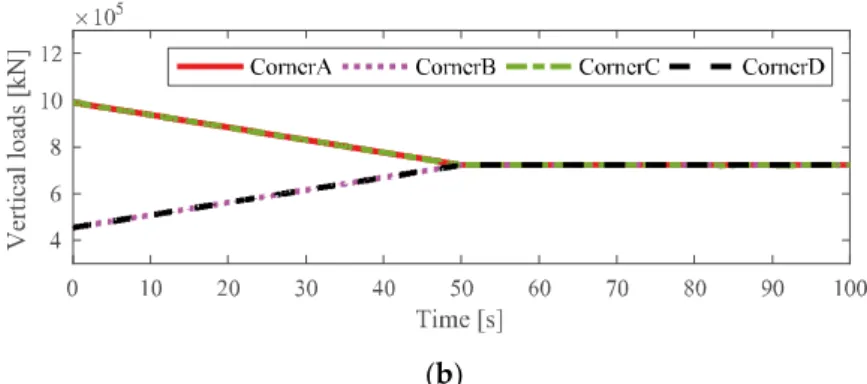
To this end, by using the modeled polar crane in ADAMS software, as shown in Figure 5, the crane system is simulated in a typical working condition, in which the movement states of the crane can be expressed as follows:
20 5 0 41 0
50
0 50
100
0 25 rad s
1 2 3 4
it
t
d
t
i
.
.
.
, , ,
, (19)where an equal angular velocity
0.25 rad / s
is applied to the driving wheels of the bridge truck and the trolley starts to move from the end of crane bridge (d
20.5 m
) at0.41 m / s
and then stops at the center of crane bridge (d
0 m
). The vertical loads of the driving wheels during crane operation are shown in Figure 6.Figure 5. The polar crane modeled in ADAMS.
(b)
Figure 6. Response comparison of the vertical loads of the driving wheels: (a) simulation via AD-AMS and (b) simulation via MATLAB.
As it can be seen in the illustrations, although the vertical loads of the driving wheels obtained by using the proposed model and ADAMS are almost the same, there are still some slight differences; the main reasons for this are the differences in the wheel–rail con-tact conditions and structure simplification of the proposed theoretical model.
3. Control Scheme Design and Stability Analysis
Considering the location deviation between the geometric center of the crane and the center of rail, a NTSM-ADRC-QP-based control scheme is designed for the polar crane in this section.
3.1. ADRC-Based Decoupling Method
According to the dynamic equations of polar crane, as shown in Equation (7), the dynamic equations without Lagrange multipliers can be derived as follows:
2 1 1 2 1 3 1 4 1 2 1 1 2 1 3 1 4 1 sin cos cos sin sin c x c y c J M m x md md F r J M m y md md F r mx d m sin( ) sin( ) sin( ) sin( )
cos( ) cos( ) cos( ) cos( )
x y B u B u 2 2 4 1 cos c d i i RJ m d y d J M M m r
B u , (20) where
1
1
1
1
1
sin
sin
sin
sin
r
xB
,
1
1
1
1
1
cos
cos
cos
cos
r
yB
,R
R
R
R
r
r
r
r
B
,
1 2 3 4
Tu
u
u
u
u
,Through a simple transformation, Equation (20) can be modified as follows:
1 1 2 3 4 1 1 2 1 2 3 4 2 2 3 1 2 3 4 3 3 c cx
f q q
w t
U
y
f
q q
w t
U
f
q q
w t
U
, ,
,
,
,
,
,
, ,
,
,
,
,
,
, ,
,
,
,
,
,
, (21)where
q
x y
c,
c,
;w
1,w
2, andw
3 are uncertainty disturbances;f
1,f
2 , and3
f
can be regard as total disturbance items including uncertainty disturbance and non-linear coupling disturbance; andU
1,U
2, andU
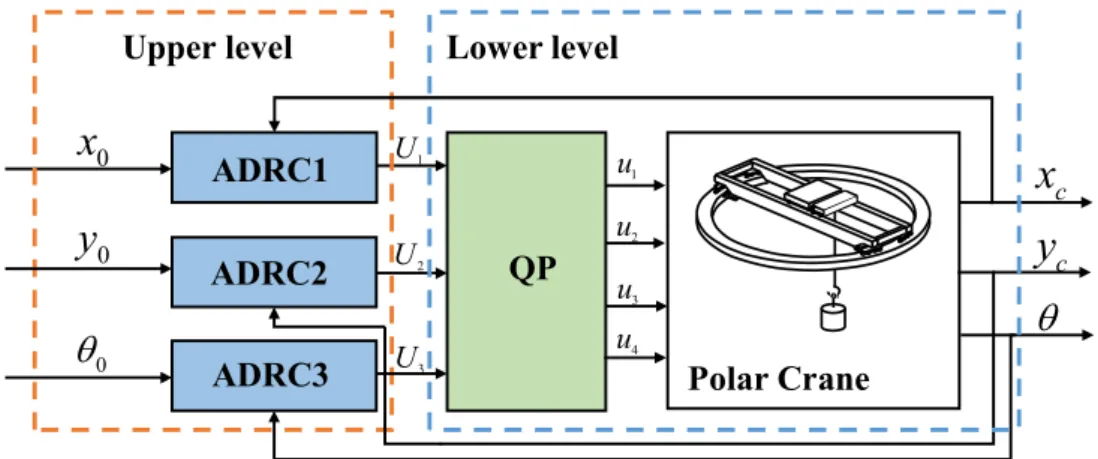
3 are virtual control items. Therefore, the crane dynamic system with single-input single-output relationships is formed.In this section, the decoupling control scheme of crane system is hierarchically de-signed according to the ADRC method. It is used for disturbance estimation and compen-sation in real time. The quadratic programming algorithm is used for active torques dis-tribution, and the decoupling control scheme is shown in Figure 7.
Figure 7. Schematic diagram of the decoupling control scheme, where
x
0,y
0, and
0 are the reference values of the generalized coordinatesx
c,y
c, and
.ADRC is composed of three parts: tracking differentiator (TD), ESO, and nonlinear state error feedback (NLSEF). For safety reasons in crane operation, the saturation of the virtual control items
U
i is taken into consideration in the design of ADRC; taking the generalized coordinatex
c as an example, the control structure is shown in Figure 8.Figure 8. Error-compensation-based anti-saturation scheme for active disturbance rejection control (ADRC). 3.1.1. ESO Design
Based on Equation (21), the state-space model of the generalized coordinate
x
c can be expressed as follows:ADRC1
ADRC2
ADRC3
0x
0y
0
QP
Polar Crane
Upper level
Lower level
c
x
cy
1 U 2 U 3 U 1 u 2 u 4 u 3 uTD
NTSM
ESO
Crane
0x
0x
0
x
1e
2e
1z
2z
3z
0U
U
1 1 Uk
cx
1ˆ
U
0ˆ
U
1 2 2 1 1 2 3 4 1 1 1 1=
0 cx
x
x
f q q
w t
U
x
x
U
sat U
, ,
,
,
,
,
,
ˆ
, (22)where the function
sat U
ˆ
0 is used to depict the saturation ofU
1 and the function
ˆ
0sat U
is defined as follows:
0 0 max 1 0 0 max 0 maxsign
U
U
U
U
sat U
U U
U
U
ˆ
ˆ
ˆ
ˆ
ˆ
, (23)where
U
max
0
is the maximum value of theU
1.Regarding
f
1 as a new state variable, Equation (22) can be expanded into the fol-lowing control system:
1 2 2 3 1 3 1 1=
0 cx
x
x
x
U
x
h
x
x
U
sat U
ˆ
, (24)Here, we define
h
f
1,h
as unknown but bounded. Referring to [23–25], the ESOcan be constructed as follows:
1 1 1 2 01 1 2 3 02 1 1 1 1 3 03 1 2 2 cz
x
z
z
z
z
fal
a
U
z
fal
a
ˆ
,
,
,
,
, (25)where
z
1 andz
2 are the estimates ofx
1 andx
2, respectively;z
3 is the estimate of the total disturbancef
1;
1 is the estimation error ofz
1; and
01,
02, and
03 are the gain coefficients. In addition,a
1,a
2,
1, and
2 are the tunable parameters of the functionfal
, ,
a
, and the functionfal
, ,
a
is defined as follows:
1sign
,
, ,
,
a afal
a
, (26)Due to the saturation, the actual input of the ESO can be expressed as follows:
1
1 U 0 0
U
ˆ
k
U
ˆ
U
ˆ
, (27)where
U
ˆ
0=
U
ˆ
0
U
1 is the saturation error and 1U
By properly selecting the value of the observer parameters, the outputs of the ESO can estimate well the state variables of the crane system.
3.1.2. Design of Nonsingular Terminal Sliding Mode Control
To improve the robustness and convergence speed of the control scheme, the NTSM is introduced into the ADRC method instead of the traditional nonlinear state error feed-back. According to Equation (22), the state-space model of the tracking error of the gener-alized coordinate
x
c can be expressed as follows:1 2 2 1 1 1 0 0 1 1 0
e
e
e
f
U
f
U
U
e
x
x
ˆ
ˆ
, (28)Referring to [26–28], the nonsingular terminal sliding surface can be constructed as follows:
1 2sign
2 x xs
e
e
e
, (29)where
x and
x are tunable parameters and satisfy
x
0
and1
x
2
. Accordingly, the control law can be expressed as follows:0 eq n
U
ˆ
u
u
, (30)where
u
eq is the equivalent control item andu
n is the nonlinear control item.The differential of
s
can be obtained as follows:
1 2 2 1 0 0 x x xs
e
e
f
U
ˆ
U
ˆ
, (31) Lets
0
. The equivalent control itemu
eq can be obtained as follows:
2 2 2 1 01
sign
x eq x xu
e
e
f
U
ˆ
, (32)Moreover, an exponential reaching law,
s
c
1tanh
s
c s
2 , is introduced to re-strain the chattering [29], and according to the described exponential reaching law, the nonlinear control term can be constructed as follows:
1tanh
2 nu
c
s
c s
, (33)where
c
1 andc
2 are control parameters and satisfyc
1
0
andc
2
0
.Substituting Equations (32) and (33) into Equation (30), the specific form of the con-trol law can be obtained:
2 0 2 2 1 0 1 21
sign
tanh
x x xU
e
e
f
U
c
s
c s
ˆ
ˆ
, (34)where the disturbance item
f
1 and saturation error
U
ˆ
0 can be estimated and com-pensated by the ESO. Note the reference valuex
0
x
0
0
; thus, the control law of the NTSM can be further constructed by using the estimatesz
1,z
2, andz
3 of the ESO:
2 0 2 2 1 2 0 3 01
sign
tanh
x x xU
z
z
c
s
c s
U
z
U
ˆ
, (35) 3.2. Stability AnalysisThe following Lyapunov function is considered:
2
1
2
V
s
, (36)
The differential of the above equation can be obtained as follows:
2 1 2 2 1 0 0 1 2 2 2 1 0 2 2 1 0 1 2 1 2 2 1 21
sign
tanh
tanh
x x x x x x x x x x x
V
ss
s e
e
f
U
U
s e
e
f
U
e
e
f
U
c
s
c s
e
c s
s
c s
ˆ
ˆ
ˆ
ˆ
, (37)When
s
0
, since
x
0
and1
r
2
2
, then 2 2 2 12
0
rr
x
andV
0
. Therefore, the NTSM control system is stable in the Lyapunov sense.3.3. Design of Quadratic Programming Algorithm
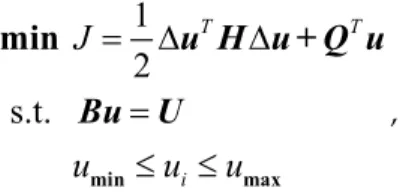
In this section, the quadratic programming algorithm is used to solve the redundant actuation of the polar crane. Due to the contact force of the horizontal guide device being related to the trajectory deviation of the driving wheel, we also take stability and smooth-ness of the control torques into consideration; thus, we construct the quadratic program as follows:
1
2
TJ
min
u H u + Qu
, (38)where
u = u
t
u
t T
denotes the differences between the current control tor-ques and the previous control tortor-ques,H
andQ
are the weight matrices, andH
is positively defined.According to Equation (20), the constraint relationships between control torque
u
i and virtual control itemU
i can be expressed as follows:1 2 3
U
U
U
x yB u
B u
B u
, (39)Therefore, the optimization problem of redundant actuation of the polar crane can be rewritten in a quadratic form:
1
2
s.t.
T T i
J
u
u
u
min maxmin
u H u + Q u
Bu
U
, (40)where
H
is set to a4 4
unit matrix and the other matrices are constructed as follows:3 1 2 4 4 4 4 4 1 1 1 1 i i i i T n n n n n n n n i i i i
f
f
f
f
f
f
f
f
Q
, T
x y
B
B
B
B
,
1 2 3
TU
U
U
U
,Finally, the control torques of the driving wheels can be obtained by solving this op-timization problem.
4. Simulation Results and Discussion
In order to verify the effectiveness of the NTSM-ADRC-QP control scheme proposed in this paper, MATLAB/Simulink software is used for the simulations. The detailed dy-namics parameters of the simulation model are shown in Table 2. Considering the struc-tural characteristics of the system, there are two typical working conditions of the polar crane implemented to verify the performance of the proposed control scheme and com-pared with the ADRC-QP method simultaneously.
Table 2. Parameters of the simulation model.
Symbol Value Symbol Value
1L
m
3 9 8.m kg
3 .3 1 1 0 5
2L
m
10r m
0 3 9 5.
l m
20 5.
1
1 4
R m
20 5.
2
3 0
M
kg
6 5 91 05 .d m
1717The parameters of the ESO in the control scheme are as follows:
01
50
,
02
100
,
03
30
where the parameters of the ESO in the ADRC-QP control scheme are set to be consistent with those in the NTSM-ADRC-QP control scheme and the parameters of the sliding mode surfaces in each channel are as follows:
0 003
x
.
,
x
1 56
.
0 002
y
.
,
y
1 68
.
0 1
.
,
1 1
.
In addition, considering the safety of the crane rotation, the virtual control item
U
3 is limited to
100 kN m
.4.1. Simulation Analysis of the Autonomous Operating of the Bridge Truck
In this section, in order to verify the locating performance of the proposed control scheme, we consider a typical working condition of the polar crane, in which the bridge truck rotates at a constant velocity.
The reference attitude of the polar crane can be expressed as follows:
0 0 0
0 0 0 25
T T
x
y
.
t
The initial attitude of the polar crane can be depicted as follows:
x
cy
c
T
0 0 0
TThe distance between the trolley and the geometric center
P
c is as follows:17
d
To verify the robustness of the system, here, we applied the following external dis-turbances of the driving wheels:
1 40.1 0
<10
=
=
2 0.1
10 10
<20
t
t
t
t
and
2 30.2 0
<10
=
=
4 0.2
10 10
<20
t
t
t
t
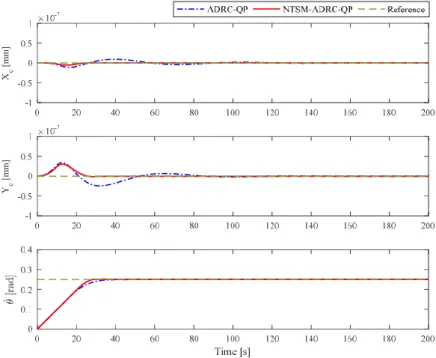
The locating performances of the polar crane in this working condition are illustrated in Figure 9, while the corresponding simulation results of the horizontal guide device and the driving wheel are shown in Figures 10–12.
The locating performances of the two controllers are given in Figure 9. From Figure 9, it can be seen that the two controllers proposed in this paper are both able to ensure the locating accuracy very well, but in contrast, the convergence speed and robustness of the NTSM-ADRC-QP are obviously superior to the ADRC-QP. Figure 9 shows the rotation velocity of the polar crane, and the results show that the proposed control scheme can achieve the stable uniform rotation and the accurate locating simultaneously.
Figure 10 shows the contact forces of the horizontal guide devices; we can see that, compared with ADRC-QP, the contact forces of NTSM-ADRC-QP are obviously de-creased. The main reason is that, as the location deviation decreases, the amount of com-pression between the horizontal guide wheel and the rail is accordingly decreased.
Figure 9. The comparison of locating performance of the two control schemes.
(a)
(b)
Figure 10. The comparison of the contact forces of the two control schemes: (a) contact forces via the ADRC-quadratic programming (QP) control scheme and (b) contact forces via the nonsingular terminal sliding mode (NTSM)-ADRC-QP control scheme.
Xc [ m m ] Yc [ m m ] 0 50 100 150 200 Time [s] 0 2 4 6 8 CornerA CornerB CornerC CornerD 0 50 100 150 200 Time [s] 0 2 4 6 8 CornerA CornerB CornerC CornerD
(a)
(b)
Figure 11. The moving trajectory of the driving wheel: (a) moving trajectories of the driving wheels via the ADRC-QP control scheme and (b) moving trajectories of the driving wheels via the NTSM-ADRC-QP control scheme.
For direct observation, the moving trajectories of driving wheels at each corner are shown in Figure 11; note that the trajectory deviation of the driving wheels are amplified in the same proportion. It can be seen that the moving trajectories of the driving wheels via the NTSM-ADRC-QP control scheme are almost the same as the rail route, which re-flects the remarkable control accuracy of the proposed NTSM-ADRC-QP control scheme directly.
Figure 12 shows the distributed control torques of the driving wheels at each corner. It can be seen that the location deviation of the crane is close to zero before maintaining the uniform rotation, which reflects the robustness and effectiveness of the proposed con-trol scheme. Furthermore, from the simulation results, note that the proposed quadratic program can effectively distribute the control torques and can thus improve the opera-tional stability and control efficiency of the crane system.
-20 0 20 40 60 X [m] -30 -20 -10 0 10 20 30 CornerA CornerB CornerC CornerD -20 0 20 40 60 X [m] -30 -20 -10 0 10 20 30 CornerA CornerB CornerC CornerD
(a)
(b)
Figure 12. The control torques of the driving wheels: (a) control torques of the driving wheels via the ADRC-QP control scheme and (b) control torques of the driving wheels via the NTSM-ADRC-QP control scheme.
4.2. Simulation Analysis of the Cooperative Operation
In this section, we focus on the effect of trolley movement on the crane locating per-formance, and the reference attitude and the initial attitude of the polar crane are set to be consistent with the above case; in this working condition, the distance between the trolley and the geometric center
P
c is as follows:
0.34 0
50
17 0.34
50 50
100
t
t
d
t
t
Note that the center of mass and the rotary inertia of the crane will change in response to the variation of the parameter
d
. The simulation results are shown in Figures 13–16.From Figure 13, it can be seen that the NTSM-ADRC-QP control scheme can still maintain fast convergence during crane operation, which reflects the better robustness of the designed control scheme. In addition, the simulation results further show that the movement of trolley has an important impact on crane location accuracy.
Figure 14 shows the contact forces of horizontal guide devices. We can see that the amplitude of the contact forces via the NTSM-ADRC-QP control scheme are decreased, which prove the robustness of the proposed control scheme on a side note.
Figure 15 shows the moving trajectories of the driving wheels at each corner. The simulation results are consistent with the results analyzed in Figures 13 and 14. From the results, we can see that, under the center of mass and the rotary inertia changing, the moving trajectories of the driving wheels via NTSM-ADRC-QP are more precise.
0 50 100 150 200 Time [s] -200 0 200 400 600 800 CornerA CornerB CornerC CornerD 0 50 100 150 200 Time [s] -50 0 50 100 150 200 250 CornerA CornerB CornerC CornerD
Figure 16 shows the distributed control torques of the driving wheels at each corner. In fact, based on the constraint relationships of the proposed quadratic programming al-gorithm, the variation in the location deviation will lead to variation in the control torques. Figure 16 manifests the adjustment process of the crane location deviation under the con-dition of uniform rotation.
Figure 13. The comparison of the locating performances of the two control schemes.
(a)
(b)
Figure 14. The comparison of the contact forces of the two control schemes: (a) contact forces in the ADRC-QP control scheme and (b) contact forces in the NTSM-ADRC-QP control scheme.
Xc [ m m ] Yc [ m m ] 0 50 100 150 Time [s] 0 100 200 300 400 500 CornerA CornerB CornerC CornerD 0 50 100 150 Time [s] 0 100 200 300 400 500 CornerA CornerB CornerC CornerD
(a)
(b)
Figure 15. The moving trajectory of the driving wheel: (a) moving trajectories of the driving wheels in the ADRC-QP control scheme and (b) moving trajectories of the driving wheels in the NTSM-ADRC-QP control scheme.
(a)
(b)
Figure 16. The control torques of the driving wheels: (a) control torques of the driving wheels via the ADRC-QP control scheme and (b) control torques of the driving wheels via the NTSM-ADRC-QP control scheme. -20 0 20 40 60 X [m] -30 -20 -10 0 10 20 30 CornerA CornerB CornerC CornerD -20 0 20 40 60 X [m] -30 -20 -10 0 10 20 30 CornerA CornerB CornerC CornerD 0 50 100 150 Time [s] -1000 -500 0 500 1000 CornerA CornerB CornerC CornerD 0 50 100 150 Time [s] -1000 -500 0 500 1000 CornerA CornerB CornerC CornerD
5. Conclusions
In this paper, a novel locating control scheme is presented to address the problem of precise location for a polar crane. Based on the Lagrange–Rouse equation, a nonholonomic constraint dynamic model of the polar crane is established, and the ADRC-based decou-pling control method is proposed to solve cross-coudecou-pling disturbance of the crane system. To improve the locating accuracy and robustness, the NTSM is incorporated with ADRC, and the stability of the control scheme is proved by the Lyapunov function approach. Ad-ditionally, a control torque distribution method based on the quadratic programming al-gorithm is designed to deal with the redundant actuation of the bridge truck. Considering the center of gravity shift during crane operation, two typical working conditions are sim-ulated to verify the effectiveness of the proposed control scheme. The simulation results show that the proposed control scheme can achieve effective dynamic control of precise locations on the basis of uniform rotation.
In future work, we will further consider factors such as creep characteristics of wheel–rail contact and response delay of the driving wheel to improve the performance and safety of the control scheme. Furthermore, we will add the scale model test to verify the effectiveness of the proposed control scheme.
Author Contributions: X.C., Z.W. and X.Z. formulated the numerical model; Z.W. and X.Z. coded the numerical model and performed the simulations; X.C., Z.W. and X.Z. analyzed the data and discussed the results; X.C. wrote the paper. All authors have read and agreed to the published version of the manuscript.
Funding: This research was funded by Science and Technology Major Project of Dalian City, China (grant number: 2018ZD13GX003).
Institutional Review Board Statement: Not applicable.
Informed Consent Statement: Not applicable.
Data Availability Statement: Not applicable.
Acknowledgments: The School of Mechanical Engineering at DLUT is gratefully acknowledged for providing funding and basic data.
Conflicts of Interest: The authors declare no conflict of interest.
References
1. Zhaohui, Q.; Huitao, S.; Jing, W. Dynamic analysis of the rope-sheave system of polar crane for nuclear power plant. Proc. Inst. Mech. Eng. Part C J. Mech. Eng. Sci.2018, 233, 269–286, doi:10.1177/0954406218757808.
2. Qi, Z.; Song, H.; Guo, S. Equilibrium path and load trajectory deflections for polar cranes in nuclear power plant. Adv. Mech. Eng.2017, 9, 1–14, doi:10.1177/1687814017742496.
3. Cao, X.; Song, Y.; Qi, Z.; Yang, S. Research on straightness accuracy about hook assembly of the third-generation nuclear ring crane. J. Dalian Univ. Technol.2013, 53, 51–57.
4. Qi, P.; Cao, X.; Lv, Y. The influence of the structural stiffness of the third-generation nuclear polar crane on precise positioning.
Hoisting Conveying Mach.2018, 17, 107–110, doi:10.3969/j.issn.1001-0785.2018.09.024.
5. Deng, D.; Zhang, Y.; Zhen, R. Study on manufacturing process of ring-lifting corbel for nuclear power station. Hot Work. Technol.
2018, 47, 239–242, 246, doi:10.14158/j.cnki.1001-3814.2018.09.064.
6. Lv, Y.; Cao, X.; Gao, S. Study on rigid-flexible coupling dynamics simulation for the third-generation nuclear polar crane. Hoist-ing ConveyHoist-ingMach.2018, 17, 123–127, doi:10.3969/j.issn.1001-0785.2018.10.032.
7. Ouyang, H.; Hu, J.; Zhang, G.; Mei, L.; Deng, X. Sliding-Mode-Based Trajectory Tracking and Load Sway Suppression Control for Double-Pendulum Overhead Cranes. IEEE Access2018, 7, 4371–4379, doi:10.1109/access.2018.2888563.
8. Smoczek, J.; Szpytko, J. Particle Swarm Optimization-Based Multivariable Generalized Predictive Control for an Overhead Crane. IEEE/ASME Trans. Mechatron.2017, 22, 258–268, doi:10.1109/tmech.2016.2598606.
9. Shao, X.; Zhang, J.; Zhang, X.-L. Takagi-Sugeno Fuzzy Modeling and PSO-Based Robust LQR Anti-Swing Control for Overhead Crane. Math. Probl. Eng.2019, 2019, 1–14, doi:10.1155/2019/4596782.
10. Liu, H.; Chen, W.; Li, Y. Trajectory planning for crane’s trolley to suppress residual swing of payload. J. South China Univ. Technol.2018, 46, 17–23, doi:10.3969/j.issn.1000-565X.2018.09.003.
11. Wu, Z.; Xia, X. Optimal motion planning for overhead cranes. IET Control. Theory Appl.2014, 8, 1833–1842, doi:10.1049/iet-cta.2014.0069.
12. Peng, H.; Shi, B.; Wang, X.; Li, C. Interval estimation and optimization for motion trajectory of overhead crane under uncertainty.
Nonlinear Dyn.2019, 96, 1693–1715, doi:10.1007/s11071-019-04879-w.
13. Khatamianfar, A.; Savkin, A.V. Real-Time Robust and Optimized Control of a 3D Overhead Crane System. Sensors2019, 19, 3429, doi:10.3390/s19153429.
14. Yang, T.; Sun, N.; Chen, H.; Fang, Y. Neural Network-Based Adaptive Antiswing Control of an Underactuated Ship-Mounted Crane With Roll Motions and Input Dead Zones. IEEE Trans. Neural Netw. Learn. Syst. 2020, 31, 901–914, doi:10.1109/tnnls.2019.2910580.
15. Guo, B.; Chen, Y. Fuzzy robust fault-tolerant control for offshore ship-mounted crane system. Inf. Sci.2020, 526, 119–132, doi:10.1016/j.ins.2020.03.068.
16. Fang, Y.; Fang, Y. Switching Logic-Based Nonlinear Feedback Control of Offshore Ship-Mounted Tower Cranes: A Disturbance Observer-Based Approach. IEEE Trans. Autom. Sci. Eng.2018, 16, 1125–1136, doi:10.1109/tase.2018.2872621.
17. Wu, Z.; Guo, B. Active disturbance rejection control to MIMO nonlinear systems with stochastic uncertainties: Approximate decoupling and output-feedback stabilisation. Int. J. Control.2018, 93, 1408–1427, doi:10.1080/00207179.2018.1508854.
18. Abdul-Adheem, W.R.; Ibraheem, I.K.; Azar, A.T.; Humaidi, A.J. Improved Active Disturbance Rejection-Based Decentralized Control for MIMO Nonlinear Systems: Comparison with the Decoupled Control Scheme. Appl. Sci. 2020, 10, 2515, doi:10.3390/app10072515.
19. Wang, Z.; Gong, Z.; Chen, Y.; Sun, M.; Xu, J. Practical control implementation of tri-tiltRotor flying wing unmanned aerial vehicles based upon active disturbance rejection control. Proc. Inst. Mech. Eng. Part G J. Aerosp. Eng. 2020, 234, 943–960, doi:10.1177/0954410019886963.
20. Jiang, L.; He, J. Control strategy and dynamic simulation of two-wheeled self-balancing vehicle. J. South China Univ. Technol.
2020,44, 9–15.
21. Dong, Y.; Deng, Z.; Fang, H. Dynamics and Control Study of Rover with Six Wheels Independently Driven. J. Syst. Simul.2009,
21, 1210–1213.
22. Zhang, X.; Qi, Z.; Wang, G.; Guo, S.; Qu, F. Numerical investigation of the seismic response of a polar crane based on linear complementarity formulation. Eng. Struct.2020, 211, 110462, doi:10.1016/j.engstruct.2020.110462.
23. Gu, X.; Xu, W. Moving sliding mode controller for overhead cranes suffering from matched and unmatched disturbances. Trans. Inst. Meas. Control.2020, 014233122092210, doi:10.1177/0142331220922109.
24. Coral-Enriquez, H.; Pulido-Guerrero, S.; Cortés-Romero, J. Robust Disturbance Rejection Based Control with Extended-state Resonant Observer for Sway Reduction in Uncertain Tower-cranes. Int. J. Autom. Comput. 2019, 16, 812–827.
25. Cai, T.; Zhang, H.; Gu, L.; Gao, Z. On active disturbance rejection control of the payload position for gantry cranes. In Proceed-ings of the American Control Conference, Washington, DC, USA, 17–19 June 2013; pp. 425–430.
26. Wu, X.; Xu, K.; Lei, M.; He, X. Disturbance-Compensation-Based Continuous Sliding Mode Control for Overhead Cranes with Disturbances. IEEE Trans. Autom. Sci. Eng.2020, 17, 2182–2189, doi:10.1109/tase.2020.3015870.
27. Hoang, Q.; Park, J.; Lee, S.; Ryu, J. Aggregated Hierarchical Sliding Mode Control for Vibration Suppression of an Excavator on an Elastic Foundation. Int. J. Precis. Eng. Manuf. 2020, 21, 2263–2275, doi:10.1109/TASE.2020.3015870.
28. Ngo, Q.H.; Nguyen, N.P.; Nguyen, C.N.; Tran, T.H.; Bui, V.H. Payload pendulation and position control systems for an offshore container crane with adaptive-gain sliding mode control. Asian J. Control.2020, 22, 2119–2128, doi:10.1002/asjc.2124.
29. Wu, Y.; Wang, L.; Zhang, J.; Li, F. Path Following Control of Autonomous Ground Vehicle Based on Nonsingular Terminal Sliding Mode and Active Disturbance Rejection Control. IEEE Trans. Veh. Technol. 2019, 68, 6379–6390, doi:10.1109/tvt.2019.2916982.