LDA-BASED DIMENSIONALITY REDUCTION AND DOMAIN
ADAPTATION WITH APPLICATION TO DNA SEQUENCE
CLASSIFICATION
by
SURBHI MUNGRE
B.E., Rajiv Gandhi Proudyogiki Vishwavidyalaya, India, 2006
A THESIS
submitted in partial fulfillment of the
requirements for the degree
MASTER OF SCIENCE
Department of Computing and Information Sciences
College of Engineering
KANSAS STATE UNIVERSITY
Manhattan, Kansas
2011
Approved by:
Major Professor Dr. Doina Caragea
Copyright
Surbhi Mungre
Abstract
Several computational biology and bioinformatics problems involve DNA sequence classi-fication using supervised machine learning algorithms. The performance of these algorithms is largely dependent on the availability of labeled data and the approach used to represent DNA sequences as feature vectors. For many organisms, the labeled DNA data is scarce, while the unlabeled data is easily available. However, for a small number of well-studied model organisms, large amounts of labeled data are available. This calls fordomain adapta-tionapproaches, which can transfer knowledge from asourcedomain, for which labeled data is available, to a target domain, for which large amounts of unlabeled data are available. Intuitively, one approach to domain adaptation can be obtained by extracting and repre-senting the features that the source domain and the target domain sequences share. Latent Dirichlet Allocation (LDA) is an unsupervised dimensionality reduction technique that has been successfully used to generate features for sequence data such as text. In this work, we explore the use of LDA for generating predictive DNA sequence features, that can be used in both supervised and domain adaptation frameworks. More precisely, we propose two dimensionality reduction approaches, LDA Words (LDAW) and LDA Distribution (LDAD) for DNA sequences. LDA is a probabilistic model, which is generative in nature, and is used to model collections of discrete data such as document collections. For our problem, a sequence is considered to be a “document” and k-mers obtained from a sequence are “doc-ument words”. We use LDA to model our sequence collection. Given the LDA model, each document can be represented as a distribution over topics (where a topic can be seen as a distribution over k-mers). In the LDAW method, we use the top k-mers in each topic as our features (i.e., k-mers with the highest probability); while in the LDAD method, we use the
topic distribution to represent a document as a feature vector. We study LDA-based dimen-sionality reduction approaches for both supervised DNA sequence classification, as well as domain adaptation approaches. We apply the proposed approaches on the splice site predi-cation problem, which is an important DNA sequence classifipredi-cation problem in the context of genome annotation. In the supervised learning framework, we study the effectiveness of LDAW and LDAD methods by comparing them with a traditional dimensionality reduction technique based on the information gain criterion. In the domain adaptation framework, we study the effect of increasing the evolutionary distances between the source and target organisms, and the effect of using different weights when combining labeled data from the source domain and with labeled data from the target domain. Experimental results show that LDA-based features can be successfully used to perform dimensionality reduction and domain adaptation for DNA sequence classification problems.
Table of Contents
List of Figures vii
List of Tables viii
Acknowledgements ix
Dedication x
1 Introduction 1
1.1 Motivation and Problem Statement . . . 1
1.2 Overview of the Proposed Approaches . . . 3
2 Background 5 2.1 Biology . . . 5 2.1.1 Gene Structure . . . 5 2.1.2 Splicing . . . 8 2.2 Machine Learning . . . 9 2.2.1 Logistic Regression . . . 10
2.2.2 Support Vector Machines . . . 11
2.3 Topic Modeling . . . 15
2.3.1 Generative Topic Models . . . 15
2.3.2 Latent Dirichlet Allocation . . . 16
3 Related Work 20 3.1 Dimensionality Reduction . . . 20
3.2 The mRNA Splicing Prediction Problem . . . 21
3.3 Transfer Learning Techniques for Biological Data . . . 22
3.4 Topic Modeling Applications . . . 23
4 Problem Definition and Approach 25 4.1 Splice Site Prediction Problem . . . 25
4.2 LDAW and LDAD Approaches to Feature Generation and Construction . . . 26
4.2.1 LDAW Approach . . . 28
4.2.2 LDAD Approach . . . 28
4.2.3 Using LDA Features for Classification . . . 31
4.3 Domain Adaptation Algorithms . . . 31
4.3.1 Target Only (DAt) and Source Only (DAs) Baselines . . . 32
5 Experimental Setup 34
5.1 Supervised Learning Framework . . . 35
5.1.1 Dataset Description . . . 35
5.1.2 Dataset Splits . . . 35
5.1.3 Experiments . . . 36
5.2 Domain Adaptation Framework . . . 37
5.2.1 Dataset Description . . . 37
5.2.2 Dataset Splits . . . 38
5.2.3 Experiments . . . 39
6 Results 41 6.1 Supervised Learning Framework Results . . . 41
6.1.1 Study of Effectiveness of LDA Topic Modeling Features . . . 41
6.1.2 Study of Support Vector Machine vs. Logistic Regression Classifiers . 46 6.1.3 Study of Different LDA Topic Modeling Settings . . . 50
6.1.4 The Effect of Increasing Labeled Data in Training Dataset . . . 56
6.2 Domain Adaptation Framework Results . . . 61
6.2.1 The Effect of Increasing Source and Target Species Evolutionary Dis-tance . . . 61
6.2.2 The Effect of Using Weighted Combination of Source and Target as Training Data . . . 63
7 Conclusion and Future Work 75 7.1 Conclusion . . . 75
7.2 Future Work . . . 77
Bibliography 85
List of Figures
2.1 Gene expression . . . 6
2.2 Gene structure . . . 7
2.3 Gene splicing . . . 9
2.4 Logistic curve . . . 10
2.5 Support Vector Machine 1 . . . 12
2.6 Support Vector Machine 2 . . . 13
2.7 Topic modeling . . . 16
2.8 Latent Dirichlet Allocation . . . 17
4.1 Positive and negative class examples . . . 26
4.2 All k-mers for a biological sequence . . . 27
4.3 Document collection to LDA model . . . 27
4.4 LDAW topics . . . 29
4.5 LDAD topics . . . 30
4.6 Domain adaptation algorithms . . . 33
5.1 Dataset splits in supervised learning framework . . . 36
5.2 Data description for domain adaptation framework . . . 39
5.3 Dataset splits in domain adaptation framework . . . 40
6.1 LDAW vs LDAD . . . 45
6.2 Comparision of LDAD VS MI based on number of features . . . 47
6.3 Performance comparision of LDAD VS MI . . . 48
6.4 Comparision of logistic regression classifier vs. SVM classifier . . . 51
6.5 Effect of increasing LDA topics for LDAW and LDAD method . . . 54
6.6 Effect of k-mer size for C. remanei . . . 56
6.7 Effect of k-mer size for D. melanogaster . . . 57
6.8 Effect of k-mer size for A. thaliana . . . 58
6.9 Effect of increasing evolutionary distance for DAs approach . . . 64
6.10 Effect of increasing evolutionary distance for DAs+t approach . . . 65
6.11 Effect of increasing evolutionary distance for DA2s+t approach . . . 66
6.12 Effect of increasing evolutionary distance for DAs+2t approach . . . 67
6.13 Effect of changing source and target train instance weight for C. remanei . . 72
6.14 Effect of changing source and target train instance weight for D. melanogaster 73 6.15 Effect of changing source and target train instance weight for A. thaliana . . 74
List of Tables
6.1 Table for LDAW DAt results . . . 42
6.2 Table for LDADDAt results . . . 43
6.3 Table for MI result . . . 49
6.4 Table for SVM classifier results . . . 52
6.5 Table for 6-mers features results . . . 59
6.6 Table for 8-mers features results . . . 60
6.7 Table for LDAW DAs result . . . 68
6.8 Table for LDAW DAs+t result . . . 69
6.9 Table for LDAW DAs+2t result . . . 70
Acknowledgments
I express my deepest appreciation to my advisor, Dr. Doina Caragea, for her support. Under her guidance, I have learned many things in the last two years. I specially acknowledge her patience to help me figure out the right project to work on, providing me flexibility to implement my new ideas and provide valuable inputs for this work. It has been a pleasure and an honor working with her.
I would also like to thank Dr. Gurdip Singh for his support and for graciously accepting to serve on my committee.
My special thanks to Dr. Torben Amtoft for his comments and valuable feedback that helped in refining the quality of this work.
I am also thankful to the staff in the department of Computing and Information Sciences at KSU for their good natured support and for providing me with the resources needed to materialize ideas into an accomplished thesis.
I would also like to thank all my friends for chipping in with useful suggestions and for always being there to help me during the entire course of this work and degree. Thank you for your well wishes and blessings.
The research described in this thesis was supported in part by a grant from the Na-tional Science Foundation (NSF 0711396) and Arthropod Genomics Center at Kansas State University.
Dedication
I dedicate this thesis to my father, Mr. Sandeep Mungre, and my mother, Mrs. Sampada Mungre, for their love and support at every stage of my life. It is because of their motivation and encouragement that I am able to complete my Masters.
My husband, Swarnim Kulkarni, has always had faith in me. This thesis would not be complete without dedicating it to him as an acknowledgment for words of encouragement and helping me to get through the difficult times.
Chapter 1
Introduction
In this chapter, we begin by providing the motivation for this work along with the problem statement. We then give a brief overview of the approaches proposed to solve these problems.
1.1
Motivation and Problem Statement
Today, we have a plethora of biological data available to us, due to the next generation sequencing technologies, which make it possible to sequence DNA at an ever-faster speed for lower cost. With the introduction of next generation sequencing, throughput per machine has increased 500,000-fold, while the number of reads per genome has increased by ∼ 100-fold [Monya, 2010]. Everything from storage to data processing to data analysis has to catch up with the speed of the new sequencing machines. Machine learning algorithms, which are extensively used to annotate DNA sequences, also have to keep the pace with the new sequencing machines. Some of the challenges with DNA sequences classification using machine learning algorithms are given by:
• Need for compact feature representation: DNA sequences contain certain ‘features’ (signals), which make it possible to apply learning algorithms on such data. Ex-tracting and representing DNA sequences as feature vectors, which can capture useful information, is a challenging problem. If we naively use a brute force approach to obtain features from sequence data, then, we might end up a with large number of
features. In such a situation, there will be many irrelevant features. This will have an adverse effect on the accuracy of the classifier learned from the data. Furthermore, due to the large number of features, the processing time and resources needed would also be large.
• Need for labeled data: There are some model organisms which are extensively studies and huge amounts of labeled data are available for such organisms. However, for many species there is not much labeled data available, even though huge amounts of unlabeled data is available for them. Given such scenarios, it has become essential to design techniques for learning how to transfer knowledge from one domain for which labeled data is available to a new domain for which not much labeled data is available. This problem is known as Domain Adaptation [Arnold et al.,2008], [DaumeIII,2007], or more generally, Transfer Learning [Arnold et al.,2008]. With domain adaptation we can use labeled data from one organism to make predictions about another organism.
Latent Dirichlet Allocation (LDA) is unsupervised dimensionality reduction technique that has been successfully used to generate features for sequence data such as text, but not for DNA sequences. In this work, we want to explore if we can use LDA to identify predictive features for DNA sequence classification in a supervised learning framework. Furthermore, we explore if we can use LDA to identify features shared by two domains, a source domain, for which labeled data is available, and a target domain, for which not much labeled data exists, but large amounts of unlabeled data are available. Thus, the problems address in this work are as follows:
• Study LDA-based dimensionality reduction approaches in the context of supervised DNA sequence classification.
• Study the usefulness of LDA features in the context of DNA sequence classification using domain adaptation approaches (where the goal is to transfer knowledge from a source domain to a target domain).
• Apply the proposed approaches to the problem of predicting splice sites in DNA se-quences.
1.2
Overview of the Proposed Approaches
As discussed in the above section, a major issue in building a classifier for biological sequence classification tasks is how to represent a sequence, as the accuracy of the classification largely depends on the adopted representation. A simple way to represent a biological sequence is to consider all k-mers for the sequence [Islamaj et al., 2006]. However, this technique will produce a large number of k-mers. We propose two approaches for feature extraction, (a) LDA words (LDAW) (b) LDA distribution (LDAD). Both approaches make use of Latent Dirichlet Allocation (LDA) for feature extraction. LDA, is a generative probabilistic model for collections of discrete data such as text corpora [Blei et al., 2003]. Given a set of sequences represented in form of k-mers, LDA models each sequence in this collection as a mixture of topics, where each topic is a mixture of k-mers. In LDAW we use the top k-mers in each topic (i.e., k-mers with the highest probability) as our features. On the other hand, in LDAD we use the topic distribution to represent a document as a feature vector. These approaches are explained in detail in Chapter 4.
We used supervised machine learning algorithms to study the LDAW and LDAD ap-proaches for feature generation in the first part of this work. For supervised algorithm we need enough labeled data to learn a model during training phase. If we do not have enough data then the performance degrades. Domain adaptation can be used even when we do not have enough labeled data to learn a model. It makes use of labeled data from a related domain called source domain to learn a model for a domain called target domain, which does not have enough labeled data. There are several assumptions about the source and target datasets that we make in this study. First, the source domain has a large number of labeled samples and the target domain has a small number of labeled samples but a lot of unlabeled samples. Nevertheless, we are studying the behavior for various data set sizes.
Second, both the source and the target domains are represented by the same set of features. Third, for our study we also assumed that both the source and the target domains have the same classes, which means that we are addressing a domain adaptation problem. The basic assumption in any domain adaptation method is that, the source and the target domains have different data distribution. If this was the case then there would not be any need of domain adaptation.
The rest of the thesis is organized as follows: Chapter 2 provides biological background and gives an overview of the machine learning algorithms used. This chapter also gives an overview of Latent Dirichlet Allocation, which is the foundation of our work. A discussion of the related work can be found in Chapter 3. Chapters 4 presents the two approaches for dimensionality reduction, along with the overview of domain adaptation algorithms. Chapters 5 and 6 describe the experimental setup and the results obtained for our experi-ments, respectively. Chapters 7presents several directions for future work and summarizes conclusions drawn from this work.
Chapter 2
Background
In this chapter, we provide some biological background and also explain machine learning techniques and topic modeling fundamentals, which form the basic building blocks of this work.
2.1
Biology
The mRNA splicing prediction problem, which is the main focus of this work, is a sub-problem of the gene prediction sub-problem. Before getting into the details of gene prediction, we need to understand gene structure. Thus, we begin our discussion by describing the gene structure.
2.1.1
Gene Structure
The modern working definition of a gene is “A locatable region of genomic sequence, corre-sponding to a unit of inheritance, which is associated with regulatory regions, transcribed regions and/or other functional sequence regions.” [Pearson,2006]. We restrict this discus-sion to eukaryote protein-coding genes, which are the type of genes we will be dealing with in this work.
Transcription, splicing and translation are the three main steps involved in protein syn-thesis (see Figure2.1). We will explain each of these steps in details and, in the process, we will also explain various regions in a gene.
Figure 2.1: Central dogma of molecular biology: transcription, splicing and translation. 1
1. Transcription: In simple terms,transcription is defined as the process of formation of RNA from DNA. There are three important phases of this process. Initiation is the first phase in which a mRNA polymerase binds to a sequence of DNA located immediately upstream of a gene, called promoter. Elongation is the next phase, in which there is a covalent addition of nucleotides to the 3’ end of the DNA. This produces a short stretch of DNA that is single-stranded. Termination is the last phase of this process, in which the transcription termination sequence is recognized, the RNA polymerase is released and a poly-A tail is appended. The final product of this step is primary mRNA [Marketa and Jeremy,2008].
2. Splicing: A gene contains coding regions known as exons, which are expressed (i.e. transcribed into mRNA), and intervening sequences, known as introns, which are not
1Figure source: http://en.wikipedia.org/wiki/File:Gene2-plain.svg, Date: 04/01/2011, License type:
expressed. Primary mRNA contains both exons and introns. Most introns start with the sequence GT, which is called donor site and end with the sequence AG, which is calledacceptor site. Introns are removed from primary mRNA to formmature mRNA. This process is called splicing [Marketa and Jeremy, 2008] (see Section 2.1.2for more details).
3. Translation: Translation is the final step in the information flow from gene to protein. During translation the mature mRNA is translated into protein. Three nucleotide of an RNA sequence code for one amino acid. The triplets are calledcodons. Translation has three important steps. Initiation is the first step, in which translation starts with a standard condon (AUG). This codon is called start codon. Elongation is the second step, amino acids get added to the elongating polypeptide chain in this step. Termination is the last step, in which translation stops at another standard sequence signal called stop codon, which is either UAA, UAG or UGA. Segments at both ends of the mRNA which are not translated are called 5’ UTR (UnTranslated Region) and
3’UTR, respectively [Marketa and Jeremy, 2008].
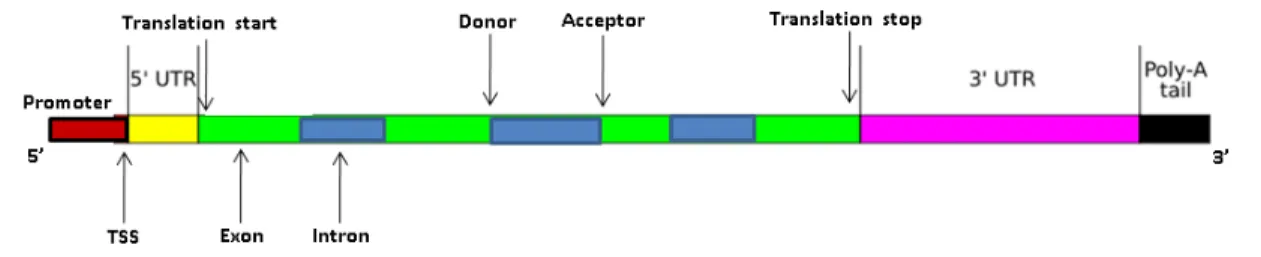
Figure 2.2: A simple gene structure showing the position of sequence signals relevant to gene finding.
A simple gene structure and the positions of sequence signals relevant to gene finding are shown in Figure 2.2. The promoter is a potentially long region upstream of the tran-scription start site (TSS). The region between TSS and translation start is referred to as 5’
untranslated region (5’ UTR). The figure also shows introns and exons, introns are bounded by the donor site on the 5’ end and by acceptor site on the 3’ end. Translation is terminated at translation stop, the region between translation stop and the cleavage site is called 3’ UTR. After transcription, the poly-A tail is appended to the mRNA. The poly-A tail plays important role in mRNA stability.
In this work, the main focus is on recognition of splice sites. This problem is discussed in details in Section 2.1.2.
2.1.2
Splicing
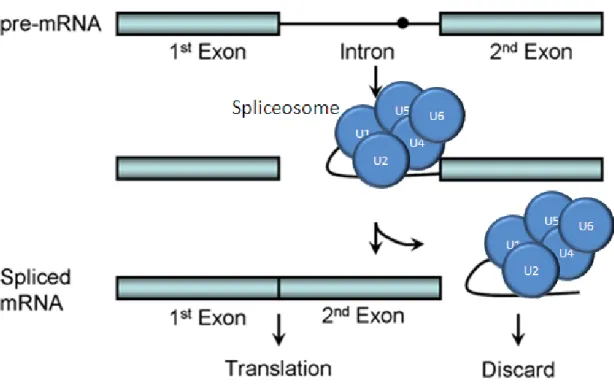
Splicing is an important step in gene expression, as it is responsible for gene regulation, and protein diversity in eukaryote. We have already mentioned above that, during splic-ing, introns are removed from primary mRNA to produce mature mRNA. This process is quite complex. It involves several other proteins and five snRNPs (small nuclear ri-bonucleoprotein): U1,U2, U5, U4, and U6, each of these contain a small RNA bound by proteins [Douglas,2003] (see Figure 2.3).
As soon as the primary mRNA is transcribed, it is bound by snRNPs. The snRNPs are responsible for splicing introns out of primary mRNA. They bind to sites of a primary mRNA at or near the intron-exon boundaries. These sites, called donor/acceptor sites, contain nucleotide sequences that are shared by most primary mRNAs. The donor/acceptor sites and snRNPs have complementary base pairing, so that snRNPs can bound to them [Nilsen,
1994].
The snRNPs attach not only to the consensus sequence but some of them attach to other sequences in the intron. These snRNPs group together into a large complex called a
spliceosome. The intron loops out with the formation of the spliceosome. The spliceosome cuts the primary mRNA at one intron-exon boundary leaving a free hydroxyl (-OH) group on the exon. It uses this hydroxyl group to attack the other end of the intron, and in the
2Figure source: http://en.wikipedia.org/wiki/File:Two-step Splicing Reaction.png, Date: 04/01/2011,
Figure 2.3: Formation of the spliceosome during RNA splicing.2
process removes the intron and joins the ends of two exons, producing amature mRNA[Scott and Gilbert,2006], [Collins and Guthrie, 1999].
Although introns are discarded, they do contain important sequences. snRNPs bind to the consensus sequences within the introns. The snRNPs use these sequences as markers to direct them to the correct splice sites. We make use of Machine Learning techniques to identify the splicing sites with the help of consensus sequence. We will discuss the Machine Learning techniques used in this work in the next section.
2.2
Machine Learning
Machine Learning is a branch of Artificial Intelligence which involves developing algorithms that can learn by repetition and experience just as humans learn [Mitchell, 1997]. It is widely used for classification tasks. A classification task in machine learning is defined as a
method for assigning a label (or category) to an instance, from a number of categories. A simple example would be assigning a label as spam or non-spam for an email. Supervised learning is a class of machine learning techniques which are very popular for classification tasks. The main idea of supervised learning algorithms is to use externally supplied labeled instances to learn a general hypothesis, which can make prediction about new instances. The general hypothesis which is generated by a classification algorithm is called a classifier, which is usually a mathematical function or a probabilistic model. The classifier maps the unlabeled instances to labels. We have used Logistic Regression classifier and Support Vector Machine classifier for our classification task. We will discuss each of these in detail in the next sub-sections.
2.2.1
Logistic Regression
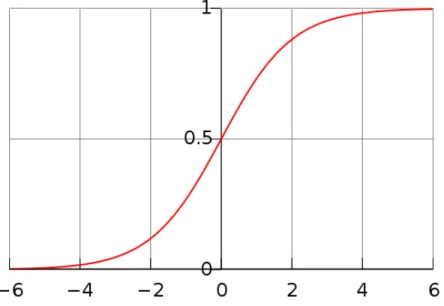
Logistic regression predicts the probability of occurrence of an event by fitting the data to a logistic curve [Kleinbaum et al., 1994].
Figure 2.4: The logistic function, with z on the horizontal axis and f(z) on the vertical axis. The variable z represents the exposure to some set of independent variables and f(z) represents the probability of a particular outcome3.
The logistic curve is shown in the Figure 2.4. The equation of this curve is given as:
f(z) = 1
1 +e−z (2.1)
wherezvariable represents the exposure to a set of independent variables andf(z) represents the probability of particular outcome.
An important property of this curve is that its input value z can range from a negative number until infinity, but its output f(z) can range only from 0 to 1. Furthermore, z is usually given as:
z =β0+β1x1+β2x2+β3x3+· · ·+βkxk, (2.2) For a classification task in machine learning x1, x2, ..., xk represent the features of train or test instances, i.e. they are the independent variables; β0, β1, ..., βk are called regression coefficients. The training instances are used to determine the values of these coefficients, who produce a logistic regression classifier. Once the value of these coefficients is known, unlabeled instances can easily be classified by using Equation (2.1). This equation tells us that what is the probability that a particular instance belongs to a given class.
2.2.2
Support Vector Machines
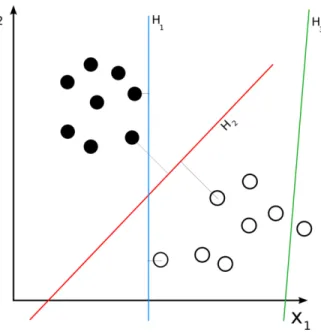
The Support Vector Machine (SVM) classifier works by finding a hyperplanes which sepa-rates points belonging to one class from the points belonging to another class. Figure 2.5
shows how points belonging to two classes can be separated by a hyperplane. However, there could be several hyperplanes separating these points. A good choice for classification is the maximum margin hyperplane (see Figure 2.6), which maximizes the distance from the nearest data points on each side [Cortes and Vapnik,1995].
3Figure source: http://en.wikipedia.org/wiki/File:Logistic-curve.svg, Date: 04/01/2011, License type:
This work has been released into the public domain by its author.
4Figure source: http://en.wikipedia.org/wiki/File:Svm separating hyperplanes.png, Date: 04/01/2011,
Figure 2.5: Example of hyperplanes in a 2-dimensional space and a data set consisting of two classes. H3 (green) does not separate the 2 classes. H1 (blue) does, with a small margin and H2 (red) separates the two class with the maximum margin.4
Formally, let us suppose that we have a set of training vectors belonging to two classes denoted by 1, -1. This set of data points will be denoted by:
D={(x1, y1), ....(xm, ym)|xi ∈Rn, yi ∈ {1,−1}} (2.3) A hyperplane in the Rn space can be represented as:
w·x−b = 0 (2.4)
In the above equation, w is a normal vector which is perpendicular to the hyperplane. The parameter kwkb determines the offset of the hyperplane from the origin along the normal vector kwk.
Parameters w and b are to be constrained, such that the margin between two classes is maximized, i.e. the parallel hyperplanes are as far as possible (see Figure 2.5). These hyperplanes can be described by the equations below:
w·x−b = 1 (2.5)
and
w·x−b =−1 (2.6)
Figure 2.6: Maximum-margin hyperplane and margins for an SVM trained with samples from two classes. Samples on the margin are called support vectors.5
The distance between these two hyperplanes is given by 2
kwk (see Figure 2.6). In order to maximize this distance, we need to minimize kwk2, with respect to w and b, subject to
several constraints specified below.
Any of the points representing instances (see Equation (2.3)) must not lie in between the hyperplanes represented by Equation (2.5) and Equation (2.6)). Therefore for the first class we have:
w·xi−b≥1 for xi of the class 1 (2.7)
5Figure source: http://en.wikipedia.org/wiki/File:Svm max sep hyperplane with margin.png, Date:
And for the second class we have:
w·xi−b≤ −1 for xi of the class -1 (2.8)
By simplifying Equations (2.7) and (2.8) we get:
yi(w·xi−b)≥1, for all 1≤i≤m (2.9)
The solution for the above optimization problem is found by considering the dual problem and using the technique of Lagrange multipliers. The solution is represented as:
w= n X
i=1
αiyixi (2.10)
where, αi’s are the non-negative Lagrange multipliers corresponding to the constraints in the primal problem.
Thus, given the training points we can determine the maximum-margin hyperplane in the training phase. Later, to classify an unlabeled instance we find its class by determining on which side of the separating hyperplane it is located. The SVM formulation above is for perfectly linearly separable data. If the data is almost linearly separable, a soft-margin SVM is used, which includes a term for error penalty in the optimization function [Cortes and Vapnik, 1995].
There are two important points to note here. First, we described SVM for two-class problems but it can be extended to multi-class classification problems, although some good properties of the binary classifier are lost, when extending SVM to the multi-class classi-fiers [Crammer et al.,2001] (we are only using binary SVM classifiers in this work). Second, the algorithm described above is for linear SVM classifier. However, it is possible to create a non-linear SVM classifier using the kernel trick6.
6The kernel trick is used to convert any linear classifier into a non-linear classifier, given that the original
linear classifier solely depends on dot products between two vectors. In the extension to the non-linear case, the dot product is replace by a the kernel function. [Cristianini and Shawe-Taylor,2000], [Aizerman et al.,
2.3
Topic Modeling
We make use of topic modeling for dimensionality reduction for DNA sequence classification task. The first part of this section will give a general overview of generative topic models. The second part of this section will discuss Latent Dirichlet Allocation in detail, as it is the topic modeling scheme which we have used in our work.
2.3.1
Generative Topic Models
Topic models provide an easy way to analyze unlabeled text of very large volume. Words that occur together frequently are clustered together in a topic. Topic modeling can help us to group words with similar meaning, as well as distinguish between the same words with different meaning.
Topic models are establish on the idea that documents are mixtures of topics, while topics are mixtures of words. These models give us a simple probabilistic procedure to generate documents. Topic model are, thus, seen as generative models for a collection of documents. If we want to generate a document on the basis of a topic model, then we first choose a distribution over topics. After that, we randomly select a topic according to the distribution and generate a word according to the distribution over words. This process is repeated to generate each word in the document and, therefore, a complete document is generated. By reversing this process we can infer the set of topics which generated a document corpus [Steyvers and Griffiths, 2007].
Probabilistic sampling rules, which describe how words in documents might be generated based on latent (random) variables, form the basis of generative models. In order to find a model that produced a document corpus, we need to find the best set of latent variables which can justify the observed data. This is done with the assumption that the model actually generated the data. The left side of Figure 2.7 shows how a document is generated given a topic model. In this example we have two topics, which generated three documents based on the known topic distributions. The right side of the Figure 2.7 shows how topic
Figure 2.7: Illustration of the generative process and the problem of statistical inference underlying topic models (this figure is adapted from [Steyvers and Griffiths, 2007]).
modeling can be viewed as a problem of statistical inference. Here, we are given three documents and we need to find the best model (i.e. topics or set of latent variables) that might have generated these documents. Note that the model shown in this figure also captures polysemy, by allowing a same word to appear in multiple topics. The word bank appears in both topics and the subscript in the figure helps to distinguish between bank from topic 1 and bank from topic 2. Another important thing to note here is that this model makes the bag of word assumption [Blei et al., 2003], i.e. this model does not take into consideration the order in which the words appear in documents.
2.3.2
Latent Dirichlet Allocation
Latent Dirichlet Allocation (LDA) is a generative probabilistic model which is used to model any collections of discrete data [Blei et al., 2003]. A text document corpus can be seen as a collection of discrete data, therefore LDA can be used to model a document corpus. LDA was first introduced by Blei et al. [2003]. They defined LDA as “A three-level hierarchical Bayesian model, in which each item of a collection is modeled as a finite mixture over an
underlying set of topics. Each topic is, in turn, modeled as an infinite mixture over an underlying set of topic probabilities”. To fit a document corpus to this definition, we can view a document as a collection of topics and each topic is viewed as a collection of words. The paper Blei et al. [2003] presented an efficient method from which given a collection of documents, it is possible to approximate the parameters of the model representing this corpus, i.e. we can estimate topic probabilities and word probabilities within a topic.
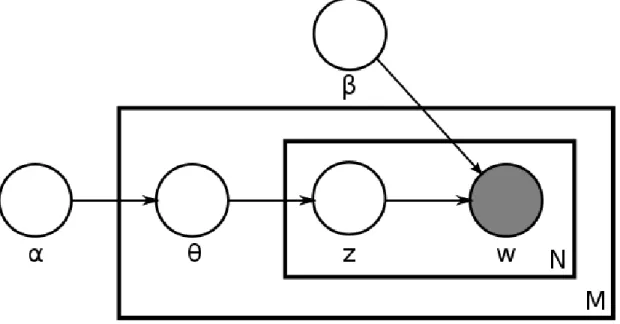
Figure 2.8: Graphical model representation of LDA. The boxes are “plate” representing replicates. The outer plate represents documents, while the inner plate represents the re-peated choice of topics and words within a document. 7
According to Blei et al. [2003], LDA assumes the following generative process for each document w in a corpus D.
1. ChooseN ∼ Poisson( ξ ).
2. Chooseθ ∼Dirichlet(α).
3. For each of theN words wn in document w:
7Figure source: http://en.wikipedia.org/wiki/File:Latent Dirichlet allocation.svg, Date: 04/01/2011,
(a) Choose a topic zn ∼ Multinomial(θ).
(b) Choose a word wn fromp(wn | zn, β), a multinomial probability conditioned on the topic zn.
Some of the assumptions that we make to obtain a generative probabilistic LDA model of a corpus are as follows. Firstly, we assume that the dimensionality k of the Dirichlet distribution hence the dimensionality of topic variable z is known and fixed. Second, we assume that the word probabilities are parameterized by akXV matrix whereβij =p(wj = 1|zi = 1), which is treated as a fixed quantity that is to be estimated.
A k-dimensional Dirichlet random variable θ which lies in the (k−1)-simplex has the following probability density on this simplex:
p(θ|α) = Γ(ε k i=1αi) Qk i=1Γ(αi) θα1−1 1 ...θ αk−1 k (2.11)
where α is a k-vector with components αi >0, and Γ is the Gamma function.
α and β are corpus level parameters, which are sampled only once during the process of corpus generation. θd is a document-level variable and it is sampled once per document (θd is the topic distribution for document d). N is independent of all the other data generating variables (θ and z). Therefore, it is an ancillary variable and we will generally ignore its randomness. For given values of αand β, we can find a joint distribution of a topic mixture θ, a set of N topics z, and a set of N words w as:
p(θ,z,w|α, β) = p(θ |α) N Y
n=1
p(zn|θ)p(wn|zn, β) (2.12)
In the above equation p(zn |θ) is θi for a uniqueisuch that zni = 1. If we integrate over θ and then sum over z, then we get:
p(w|α, β) = Z p(θ|α) N Y n=1 X zn p(zn|θ)p(wn |zn, β) ! dθ (2.13)
Finally, taking the product of the marginal probabilities of single documents, we obtain the probability of a corpus:
p(D|α, β) = M Y d=1 Z p(θd|α) Nd Y n=1 X zdn p(zdn |θd)p(wdn |zdn, β) ! dθd (2.14)
The probabilistic graphical model representation of LDA is shown in Figure 2.8. It is clear from the figure that LDA has three levels. Finally, the variables zdn and wdn are word-level variables, which are sampled once for each word in each document. This is how, under LDA, documents can be associated with multiple topics and each topic is associated with multiple words.
LDA can find a short description of a large collection of documents. As a result, LDA can be used for processing large collections, while preserving the essential statistical rela-tionships that are useful for document classification [Blei et al.,2003]. In our work, we used LDA to model our sequence collection (which is the equivalent of the document corpus). This enabled us to obtain a set of “topics” and set of “words” representing our sequence collection. The set of words obtained from modeling the sequence collection with LDA is much smaller than the actual number of words in the sequence collection. We only used the set of “important” words (words with high probability in a topic) obtained from LDA as features for representing each document in our sequence collection. This is how, LDA was used for dimensionality reduction.
Several techniques are proposed to estimate the parameters of LDA model, α and β, given a document corpus. Empirical Bayes approach [Blei et al., 2003] and Gibbs sam-pling [Steyvers and Griffiths,2007] are two popular approaches. In the implementation that we used, MALLET: A Machine Learning Toolkit [McCallum,2002], Gibbs sampling is used for inference.
Chapter 3
Related Work
This chapter reviews a number of works done in the past, which are related to the objectives of this thesis. Section 3.1 presents previous works on techniques employed for feature gen-eration and selection. Section 3.2 describes the techniques employed in the past for solving the RNA splicing problem. Section3.3presents previous work related to domain adaptation techniques for biological data. Finally, in Section 3.4 we discuss some of the applications of topic modeling.
3.1
Dimensionality Reduction
Dimensionality reduction techniques for text data have been studied extensively. Some of the previous works which presented dimensionality reduction techniques for text data are [Liu and Motoda, 1998], [Koller and Sahami, 1996], [Yu and Liu, 2003] and [Tasci and Gungor,
2009]. Liu and Motoda [1998] cover all the basic concepts related to feature generation and feature selection. Koller and Sahami [1996] examine an approach for dimensionality reduction based on information theory. Yu and Liu [2003] introduce a novel concept of predominant correlation, and present a fast filter method which can identify relevant features as well as redundancy among relevant features without pairwise correlation analysis.The work presented by Tasci and Gungor [2009] uses LDA for dimensionality reduction and selection of key features. Their work suggests that the performance of LDA dimensionality reduction technique was not better than that of the Information Gain technique (for details
of Information Gain technique refer to [McCallum and Nigam,1998]). However, they obtain a 75% reduction in corpus size without any loss in performance by using these features.
Lately, feature extraction for biological data has also gained attention from several re-searchers. Some of the feature extraction techniques used for the mRNA splicing site pre-diction problem are presented in [Yeo and Burge,2004], [Zhang et al.,2003a] and [Degroeve et al., 2002]. Yeo and Burge[2004] model sequence motifs based on the Maximum Entropy principle (MEP).Zhang et al. [2003a] use SVM algorithm to discover sequence information (motifs/features), which is further used for classification. Degroeve et al. [2002] present a wrapper-based feature subset selection algorithm. Although, LDA had been used to solve some biological problem (see Section 3.4), to the best of our knowledge, LDA has not been used for dimensionality reduction on biological sequences.
3.2
The mRNA Splicing Prediction Problem
In the past few decades the genome sequences of many organisms have become available. Due to the availability of labeled data, it has been possible to use supervised machine learning techniques to automate the splice site prediction process. A comprehensive overview of splicing site recognition can be found in [Sonnenburg, 2002] and a general overview along with a comparison of several gene and splice site prediction methods can be found in [Mathe et al., 2002] and [Zhang, 2002]. Among several supervised machine learning techniques that have been used for splicing site prediction, are methods based on Maximum Entropy Modeling [Yeo and Burge, 2004] and Support Vector Machines (SVM) [Zhang et al., 2003b]. SVMs along with related kernel methods are found to be very effective for solving gene prediction problems [Boser et al., 1992], [Scholkopf and Smola, 2002]. The main reason for the SVM popularity in computational biology is grounded ability to handle high-dimensional spaces and large data sets [Scholkopf et al.,2004], [Scholkopf et al.,2005]. Some other techniques used for solving the mRNA splicing site problem are based on genetic programming [Vukusic et al.,2007] and artificial neural networks combined with a rule based
system [Hebsgaard et al., 1996]. Some researches also used micro-arrays for mRNA splicing site prediction problem [Johnson et al., 2003], [Zheng et al., 2004].
3.3
Transfer Learning Techniques for Biological Data
All the methods mentioned in Section 3.2 are based on supervised machine learning. As a result, these methods require a large amount of labeled data (already annotated instances) to learn models, which can be then used to make predictions for the unknown instances in the rest of the genome. Semi-supervised learning may be useful in the situation when we have a small amount of labeled data and large amount of unlabeled data available. However, we may also have a large amount of labeled data from a related domain, which may have a different feature representation or data distribution. Transfer learning tries to find the similarity and relatedness of different domains with the goal of learning what can be transfered from a source domain to a target domain. In recent years, it has been used to solve bioinformatics problems. Protein name extraction [Arnold et al., 2007] and micro-array data classification [Widmer et al., 2010] are among the few bioinformatics problems for which researchers have used domain adaptation techniques.
Some very recent studies have also focused on domain adaptation techniques for the gene prediction problem [Schweikert et al.,2009;Widmer et al.,2010]. These techniques are based on the assumption that the cellular mechanisms that are responsible for transcription and translation of genes are conserved between organisms. Therefore, it should be possible to use the knowledge from an organism, which has a large number of labeled genes to make predication about an organism which has a very small number of labeled genes. In the work done by Schweikert et al. [2009], they consider different domain adapation methods and evaluate them on genomic sequence data from model organisms of varying evolution-ary distances. In this work, the source organism used was C. elegans. In 1963, Sydney Brenner introducedCaenorhabditis elegans (C. elegans) as a model organism. C. elegans is a free-living, non-parasitic soil nematode that can be safely used in the laboratory and is
common around the world. It is 1mm in length and can be cheaply housed and cultivated in large numbers (10,000 worms/petri dish) [Riddle et al., 1997]. All these properties made many researchers to work on this organism. Consequently, large amounts of labeled data are available for this organism, making it an ideal choice as a source organism. Convex combi-nation of source and target data, weighted combicombi-nation of source and target data, multitask learning, kernel mean matching are some of the domain adaptation algorithms considered by Schweikert et al. [2009],. The results in [Schweikert et al., 2009] showed that the use of domain adaption improves classification performance in cases where the organisms are not closely related.
One of the factors that contributed to the success of the approach in [Schweikert et al.,
2009] is the use of the weighted degree kernel, which works by counting matching sub-sequences between two sub-sequences. Due to the use of the weighted degree kernel [Fodor,
2002], they do not have to represent the data in a high dimensional space. We are also using the same dataset as used by Schweikert et al. [2009]. However, as an alternative approach to dimensionality reduction, we propose to use Latent Dirichlet Allocation (LDA) model to generate features for our experiments. In what follows, we review some of the previous work done based on LDA model.
3.4
Topic Modeling Applications
LDA is a generative probabilistic model for collections of discrete data such as text cor-pora. It was originally used for document modeling, text classification and collaborative filtering [Blei et al., 2003]. LDA has been used for many different applications after it was used by Blei et al. [2003] for document modeling. Among others, it has been used for various problems involving text data like tag recommendation [Krestel et al., 2009], word sense disambiguation [Boyd-Graber et al.,2007], named entity recognition [Guo et al.,2009], friendship link prediction problem [Parimi, 2010], etc. There have been some attempts in the past to use LDA for biological data. Items in a biomedical text corpus were modeled
using the Latent Dirichlet Allocation (LDA) model byBlei et al.[2006]. An adapted version of LDA, called Latent Process Decomposition (LPD), which can explicitly model expression levels, was proposed by Rogers et al. [2005]. This work used LPD for clustering expression micro-array data. Biologically-aware Latent Dirichlet Allocation (BaLDA), which extends LDP, was introduced and used by Perina et al. [2010] for classification of expression micro-array data. However, to the best of our knowledge, LDA has not been used for feature extraction for the RNA splicing site prediction problem or for any other prediction problem where DNA sequences are used.
Chapter 4
Problem Definition and Approach
We begin this chapter by describing the splice site prediction problem. Then, we present LDAW and LDAD approach considered in the first part of this work. Finally, we describe all the Domain Adaptation algorithms which we used for the second part of this work.
4.1
Splice Site Prediction Problem
We will be validating the performance of our approaches on the splice site prediction prob-lem. We have already described the gene structure and splicing in Section 2.1.1and Section
2.1.2, respectively. We discussed in these sections that there is a consensus sequence sur-rounding the acceptor site (GT) and the donor site (AG) to which the snRNPs bind during splicing. Due to presence of consensus it is possible to use machine learning algorithms to predict splice site. We will now discuss the details of this problem.
The donor site is identified by a GT sequence and acceptor site is identified by AG. However, this GT-AG rule does not always hold. Therefore, we can model this problem as a binary classification problem. The sequences with experimentally confirmed splice sites are our positive examples and the sequences confirmed as not real splice site are our negative examples. Given a DNA sequence surrounding a donor or acceptor site, our goal is to predict if it is a real splice site or not.
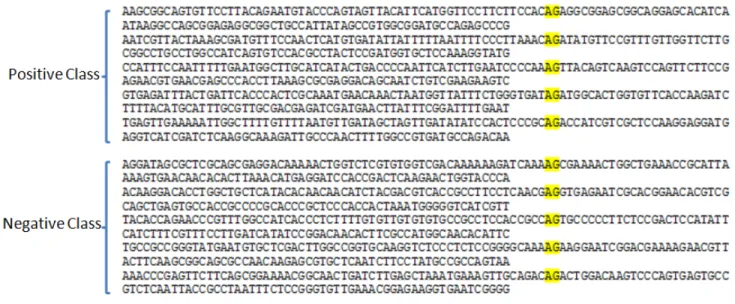
Figure 4.1 shows examples from our dataset of both positive and negative instances. Each instance has a possible acceptor site as it contain the AG sequence. However, only the
instances in the positive class are real acceptor sites. Although the instances in negative class have AG sequence, still they are not real acceptor sites. In our dataset, each instance is composed of 60pb before and 79 bp after the possible donor site (AG). The information surrounding the AG sequence is used to discriminate between the real acceptor site and decoy acceptor site.
Figure 4.1: Samples from positive and negative classes. The 3’ splice site or splice acceptor site (AG) is highlighted in yellow.
4.2
LDAW and LDAD Approaches to Feature
Gener-ation and Construction
We have already presented a brief overview of our approaches in Chapter 1. As discussed in Chapter 1, we need to represented biological sequences as feature vector before applying any classification algorithm on them. A simple way to do this would be to find all the k-mers and use each k-mer as a feature. However, this method will produce a large number of features, which would be difficult to work with when learning. Therefore, it is desirable to perform dimensionality reduction on the set of k-mers. We are using LDA to select the best features from the set of all k-mers representing the sequences.
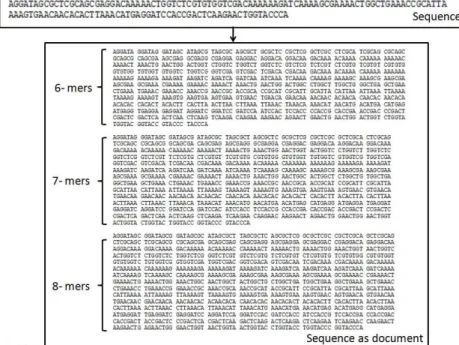
Figure 4.2: Illustration of the process of obtaining the set of k-mers from a biological sequence. The biological sequence is taken from the same dataset which we have used in our work.
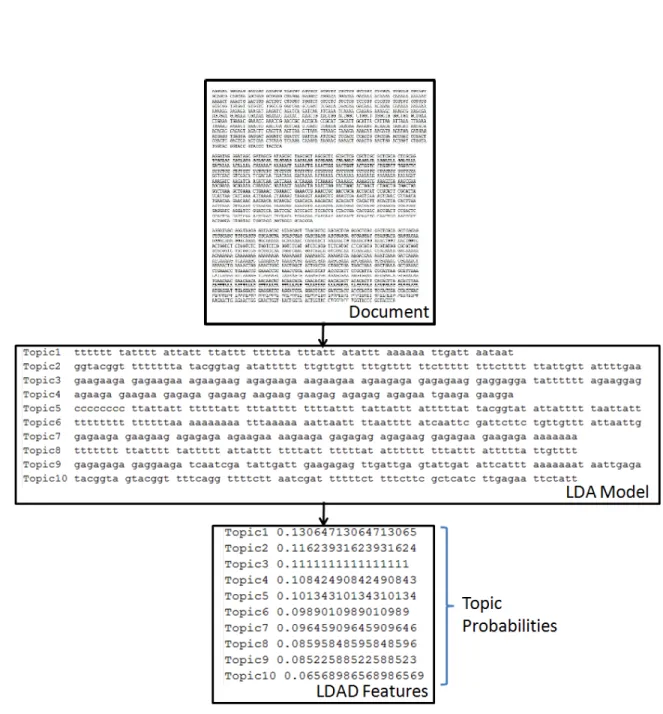
Figure 4.3: Illustration of the process of obtaining the LDA model from a document collec-tion. The LDA model has 10 topics with 10 words (k-mers) in each topic.
Our first step for feature generation was to find the set of all possible k-mers for a given biological sequence. The biological sequences in our dataset are of length 141bp and we represented each sequence using 6-mers, 7-mers and 8-mers. Figure 4.2 shows an example from our dataset depicting how a sequence can be represented as a collection of k-mers. Each set of k-mers corresponding to a sequence represents a “document” associated with the sequence. The next step in our approach is to find the LDA features by topic modeling this document collection. This step is shown in Figure 4.3. The order of the k-mers does not matter in a document as LDA makes the bag of words [Blei et al., 2003] assumption.
As mentioned earlier in Chapter1, we used two approaches for dimensionality reduction: (a) LDA words (LDAW) (b) LDA distribution (LDAD). We will now discuss each of these approaches in details.
4.2.1
LDAW Approach
In LDAW, we use all the k-mers (with high probability) obtained by modeling the document collection as our features. Figure 4.4 illustrates the process of representing a test or a training document using LDAW features. To represent a document, we simply count the number of occurrences of each word (k-mer) from each LDA topic. Thus, for an LDA model represented by 10 topics with 10 words (k-mers) in each topic, we will have 100 features (unless there is word overlap between topics). An important point to note is that, we can control the number of LDA features, by controlling the number of topics and the number of words shown in a topic used for modeling our document collection. For example, if we set the number of topics as 10 and number of words in each topic as 10, then after modeling the documents using LDA we will be left with only 100 LDAW features.
4.2.2
LDAD Approach
In LDAD we use the topic distribution for each topic as our features. Figure 4.5 illustrates how we can represent a training or a test document using LDAD features. A document is represented by the topic distribution of each topic obtained from LDA model. Therefore,
Figure 4.4: Illustration of the process of representing a document with LDAW features. A document is represented by the count of occurrences of each word (k-mer) in LDA model
the number of features is equal to the number of topics, which represent the LDA model of the document collection. For example, if the LDA model has 10 topics then the number of features would also be 10, as shown in the example in Figure 4.5.
The number of LDAD features only depends on the number of topics and not on the number of words. Figure 4.4 illustrates this approach.
Figure 4.5: Illustration of the process of representing a document with LDAD features. A document is represented by the topic distribution of each topic in the LDA model.
4.2.3
Using LDA Features for Classification
Once we obtain the features using either LDAW or LDAD, we represent both our training and test instances using these features. We then use a classifier to built a model from the training instance. We used logistic regression and Support Vector Machine (SVM) classifiers to learn models during training phase. Finally, the use the model learned during training phase to determine if a given instance belongs to positive class or negative class. An important point to note is that the sequence collection from which we obtained LDA model consisted of only the training instances and not the test instances.
4.3
Domain Adaptation Algorithms
In the second part of this work, we evaluate the effect of using LDA features in a domain adaptation framework. For this purpose we use different domain adaptation methods, sim-ilar to the methods used in Schweikert et al. [2009]. Before going into the details of these approaches let us first define the source domain and the target domain with respect to do-main adaptation. A classifier trained using a traditional supervised learning algorithm can make predictions only about the unlabeled instances from the domain to which the training instances belong. However, domain adaptation algorithms make use of data from a different but related domain called as source domain to help make predictions about another domain calledtarget domain. Basically, a source domain has some informative knowledge, which can be used to improve the classification accuracy of a target domain. Mostly, transfer learning is used when the number of labeled instances is very small in the target domain and we need to make use of labeled instances from the source domain to improve the performance of the classifier. Given this description of the source domain and the target domain, let us now describe each of the domain adaptation algorithms, and the baselines we have used.
4.3.1
Target Only (
DA
t) and Source Only (
DA
s) Baselines
As baseline algorithms, we used two methods named as target only (DAt) and source only (DAs) (see (A) and (B) of Figure 4.6). As the names suggest, in the target only method, we use labeled data from target domain only to train a classifier, and in the source only method we use labeled data from source domain only to train the classifier. An important point to note here is that the setting used for domain adaptation DAt is the same as the one corresponding to the supervised learning framework. In other words, all the results obtained for supervised learning are the same as those obtained for DAt.
4.3.2
Weighted Combination (
DA
xs+yt)
In the weighted combination approach the classifier is trained on the combination of source and target data (see (C), (D) and (E) of Figure 4.6). The weight of source data was kept double of target data in one set of experiments (DA2s+t). In the second set of experiments
the weight of target data was kept double of the weight of target data (DAs+2t). Finally, in
the third set of experiments the weight of target and source data was kept equal (DAs+t).
An important point to note is that the sequence collection from which we obtained the LDA model in the domain adaptation setting consisted of the training instances from both source and target training instances. Unlike, the supervised learning framework where we used training instances only from the target domain.
Figure 4.6: Illustration of Target Only (DAt), Source Only (DAs) and Weighted
Chapter 5
Experimental Setup
This Chapter describes the details of the experiments conducted to find the effectiveness of LDA as a dimensionality reduction tool for biological sequences in a supervised learning framework and domain adaptation framework.
In supervised learning framework, we conducted experiments with the aim to answer the following questions:
• How effective are the LDAW features for classification of DNA sequences?
• How effective are the LDAD features for classification of DNA sequences?
• How does the performance vary with the number of LDA topics used?
• How does the performance vary with the size of k-mers?
• How does the performance vary with the amount of labeled data in the target domain?
• What is the effect of using different classifiers?
In domain adaptation framework, we conducted experiments with the aim to answer the following questions:
• How effective are the domain adaptation approaches with increasing evolutionary dis-tances between species?
• What is the effect of using a weighted combination of source and target data as training data?
We will begin by explaining experimental setup for supervised learning framework and then we will discuss the experimental setup for domain adaptation framework.
5.1
Supervised Learning Framework
We begin this section by describing the dataset that we used and how we split the dataset for training and testing. We then discuss about the set of experiments which we performed.
5.1.1
Dataset Description
We consider the task of identifying acceptor and donor splice sites within a large set of potential splice sites on the basis of the sequence surrounding the potential site. We obtained the dataset for this problem from Schweikert et al.[2009]. This dataset has larger amounts of labeled samples and unlabeled samples forC. remanei, P. pacificus, D. melanogaster and
A. thaliana, which we used to study our approaches in supervised learning framework.
5.1.2
Dataset Splits
The dataset splits which we used for our experiments are shown in Figure5.1. In the training phase, we used the datasets of sizes 1,000, 2,500, 6,500, 16,000, 25,000, 40,000 and 100,000. These datasets were formed by randomly selecting samples from the labeled data for each organism. For all sample sets, the positive to negative ratio was 1/100. For cross-validation purpose, each target set was divided in three parts and all experiments were performed three times by considering two-third of the set for training. For our experiments, we balanced the training dataset such that we were left with equal number of positive and negative samples. If the training data is skewed towards a class, called majority class, then the classifier tends to predict always the majority class (even though they belong to minority class). To avoid this behavior we balance the training data by randomly removing samples from majority
class. A set of 60,000 samples was kept aside for each organism, which was used for testing purpose. Each of the three classifiers built in training phase were tested with one-third of the testing dataset of size 20,000. We averaged the results obtained from all three sets of experiments.
Figure 5.1: The train set is split in three parts. Two-third of the train set is used for training. Similarly, test set is split in three parts and each part is used in each of the three experiments.
5.1.3
Experiments
We performed experiments using both LDAW and LDAD approaches with all the four species,C. remanei, P. pacificus, D. melanogaster andA. thalianato study the effectiveness of these approaches for classification of DNA sequences. Below are some other details about the experiments which we performed in supervised learning framework:
• To evaluate the effectiveness of LDAW and LDAD approaches we compared their results with a traditional dimensionality reduction approach based on the information
gain criterion. This dimensionality reduction approach is called Mutual information (MI) method (for details refer to [McCallum and Nigam, 1998]). We use Weka’s
1 implementation for information gain (InfoGainAttributeEval along with Ranker’s
search algorithm) to rank a set of features in the decreasing order of their mutual information with the class variable [Hall et al., 2009]. We performed four sets of experiments by selecting top 100, 500, 1000 and 2000 features from this ordered list of features.
• To study the performance variation with the number of LDA topics, we used 10, 50, 100 and 200 topics. The number of words in each topic were kept constant as 10. Therefore, the number of LDAW features obtained were 100, 500, 1000 and 2000 and the number of LDAD features obtained were 10, 50, 100 and 200, respectively.
• To study the performance variation with the size of k-mers we performed experiments using only 6-mers and only 8-mers.
• To study the effect of using different classifiers, we performed experiments with both Logistic Regression classifier and Support Vector Machine classifier.
5.2
Domain Adaptation Framework
We begin this section by describing the dataset that we used and how we split the dataset for training and testing. We then discuss about the set of experiments which we performed.
5.2.1
Dataset Description
We consider the same task of identifying acceptor and donor splice sites on the basis of the sequence around the potential site, as we considered in supervised learning framework. We obtained the dataset for this problem from Schweikert et al. [2009]. This dataset is specifically designed to be used in a domain adaptation setting. C. elegans is a very well
studied model organism, which makes it appropriate as a source domain. The dataset has a large amount of splicing site labeled data for C. elegans. It also has larger labeled samples and unlabeled samples forC. remanei, P. pacificus, D. melanogaster andA. thaliana, which will be used as target domains. Although, domain adaptation is used when the target domain does not have enough labeled data, however, in our experiments we also studied the effect of increasing labeled data in target domain. C .remanei is the closest toC. elegans amongst all other organisms and they diverged around 100 million years ago [Stein et al., 2003]. More distantly related, P. pacificus diverged from C. elegans more than 200 million years ago [Pires-Dasilva and Sommer, 2004]. D. melanogaster diverged from C.elegans around 990 million years ago [Abel et al., 2003]. Lastly, A. thaliana is a plant and it separated from other organisms more than 1,600 million years ago (see Figure 5.2). As the target domain organisms have varying evolutionary distances from the source domain, therefore, this dataset will be suitable to study the effectiveness of the domain adaptation approach for increasing evolutionary distances among the species.
5.2.2
Dataset Splits
We used the same dataset splits as used bySchweikert et al.[2009]. In the training phase, we used the target datasets of sizes 1,000, 2,500, 6,500, 16,000, 25,000, 40,000 and 100,00 and a source dataset of size 25,000. These datasets were formed by randomly selecting samples from the labeled data for each organism. For all sample sets, the positive to negative ratio was always kept as 1/100. We balance the training data by randomly removing samples from majority class. A set of 60,000 samples was kept aside for each target organism, which was used for testing purpose. Each of the three classifiers built in training phase were tested with one-third of the testing dataset of size 20,000. We averaged the results obtained from all three sets of experiments. (see Figure 5.3).
Figure 5.2: Information transfer from source to target domains. As source organism, we used the well-annotated model organism C. elegans. As target domains, we used four organisms with varying evolutionary distances to C. elegans.
5.2.3
Experiments
We used only LDAW approach to study the effect of using different Domain Adaptation algorithms. We performed experiments for both the baselines (DAt and DAs) algorithms four target species. To study the variation of the performance with changing the weights of labeled data in source and target domain, we performed experiments for DAs+t, DA2s+t and DAs+2t. The weighted combination experiments were also performed for all the four target species. We used Logistic Regression classifier for all experiment performed in domain adaptation framework.
The results obtained from all the experiments discussed in this chapter are presented in Chapter 6 and conclusions derived from them are discussed in Chapter 7.
Figure 5.3: The target train set is split in three parts. Two-third of the labeled samples from target domain is combined with the labeled sampled from source domain and is used for training. Similarly, target test set is split in three parts and each part is used in each of the three experiments.
Chapter 6
Results
In this chapter, we discuss the results obtained by running the experiments described in Chapter 5. We begin by discussing the results obtained for the experiments performed in supervised learning framework in Section 6.1. We then discuss the results obtained for the experiments performed in domain adaptation framework in Section 6.2.
6.1
Supervised Learning Framework Results
The organization of this section is as follows: in Section 6.1.1 we report the results of the experiments performed to study the effectiveness of LDAW and LDAD approach as compared to MI features; in Section6.1.2we examine the results of using different classifiers; in Section 6.1.3 we discuss the effect of varying different parameters for LDAW method i.e. number of topics and size of k-mers, and in Section 6.1.4, we study the effect of increasing labeled data in training dataset.
6.1.1
Study of Effectiveness of LDA Topic Modeling Features
In this section, we investigate the effectiveness of using LDA topic modeling for dimensional-ity reduction. This section is further divided into two sub-sections. In the first sub-section, we compare LDAD and LDAW methods to see which one gives better performance. In the second sub-section, we compare LDAD results with MI results, which is a traditional dimensionality reduction method.LDAW vs. LDAD
We first compare the results obtained from LDAW and LDAD approaches. For this experi-ment, we only use the supervised learning framework (DAt) approach with logistic regression classifier. We perform experiments for different training data sizes and for different number of LDA topics. The results obtained with LDAW approach are shown in Table 6.1, while the LDAD approach results are shown in Table 6.2. These tables show that auROC values obtained from LDAW methods are greater than that of LDAD approach.
C. remanei 1000 2500 6500 16000 25000 40000 100000 10 0.615 0.574 0.549 0.635 0.682 0.699 0.718 50 0.586 0.56 0.613 0.536 0.546 0.544 0.621 100 0.591 0.592 0.585 0.638 0.528 0.559 0.568 200 0.634 0.62 0.658 0.606 0.563 0.56 0.645 P. pacificus 1000 2500 6500 16000 25000 40000 100000 10 0.486 0.494 0.501 0.489 0.491 0.492 0.488 50 0.49 0.49 0.507 0.49 0.487 0.491 0.487 100 0.493 0.592 0.585 0.638 0.492 0.506 0.487 200 0.473 0.5 0.477 0.515 0.501 0.502 0.501 D. melanogaster 1000 2500 6500 16000 25000 40000 100000 10 0.512 0.552 0.579 0.544 0.524 0.577 0.664 50 0.553 0.576 0.598 0.603 0.602 0.626 0.643 100 0.594 0.523 0.613 0.655 0.606 0.549 0.521 200 0.621 0.587 0.636 0.646 0.575 0.629 0.512 A. thaliana 1000 2500 6500 16000 25000 40000 100000 10 0.525 0.525 0.523 0.579 0.651 0.64 0.667 50 0.554 0.548 0.585 0.556 0.543 0.549 0.587 100 0.561 0.592 0.593 0.546 0.571 0.56 0.524 200 0.572 0.593 0.603 0.597 0.592 0.553 0.501
Table 6.1: auROC values obtained from LDAW method in supervised learning framework (DAt approach) with logistic regression classifier. The target data set sizes used are 1000,
2500, 6500, 16000, 25000, 40000 and 100000, respectively (column names). The number of topic used are 10, 50, 100 and 200, respectively (row names). The best value obtain for a given number of topics with increasing data set sizes is highlighted in each row.
C. remanei 1000 2500 6500 16000 25000 40000 100000 10 0.458 0.486 0.524 0.533 0.512 0.481 0.489 50 0.455 0.505 0.52 0.525 0.506 0.476 0.469 100 0.438 0.491 0.525 0.526 0.508 0.483 0.496 200 0.489 0.521 0.533 0.531 0.522 0.509 0.503 P. pacificus 1000 2500 6500 16000 25000 40000 100000 10 0.472 0.472 0.502 0.498 0.507 0.493 0.481 50 0.481 0.482 0.513 0.509 0.495 0.485 0.473 100 0.47 0.484 0.482 0.491 0.482 0.479 0.467 200 0.494 0.517 0.524 0.523 0.523 0.518 0.518 D. melanogaster 1000 2500 6500 16000 25000 40000 100000 10 0.453 0.487 0.523 0.551 0.502 0.473 0.462 50 0.497 0.518 0.515 0.521 0.533 0.48 0.46 100 0.514 0.527 0.53 0.526 0.503 0.492 0.459 200 0.499 0.506 0.503 0.511 0.537 0.516 0.511 A. thaliana 1000 2500 6500 16000 25000 40000 100000 10 0.495 0.506 0.505 0.516 0.514 0.509 0.492 50 0.454 0.499 0.51 0.514 0.517 0.484 0.484 100 0.476 0.482 0.506 0.51 0.531 0.487 0.493 200 0.43 0.498 0.52 0.528 0.528 0.505 0.509
Table 6.2: auROC values obtained from LDAD method in supervised learning framework (DAt approach) with logistic regression classifier. The target data set sizes used are 1000,
2500, 6500, 16000, 25000, 40000 and 100000, respectively (column names). The number of topic used are 10, 50, 100 and 200, respectively (row names). The best value obtain for a given number of topics with increasing data set sizes is highlighted.
Figure 6.1 shows a graph obtained by plotting auROC values against training data size for both LDAW (red) and LDAD (blue) approaches. It is clear from this graph that LDAW gives better performance as compared to LDAD for various training data sizes. Furthermore, even for the same number of LDA topics LDAW performs better that LDAD. An explanation for this behavior could be that for the same number for LDA topics the number of features for LDAW is ten times larger that the number of features for LDAD. For example, for 10 LDA topics the number of LDAW features is 100 as each topic has 10 words, whereas for
LDAD we just consider the topic distribution, therefore, there will be only 10 features. Note that we have shown results only for C. remanei, D. melanogaster and A. thaliana. The results obtained for P. pacificus were very poor. All the auROC values were less that 0.5 and there was no improvement with training data size for any of the methods.
LDAW vs. MI
The results from the above sub-section clearly show that LDAW is more effective than the LDAD approach. In this section, we present the results of the experiments which compare LDAW with a traditional dimensionality reduction method, specifically Mutual information (MI).
Summary of all the results obtained using the MI dimensionality reduction method is shown in Table6.3. We performed experiments using MI features for all four organisms and varied both training data set sizes and number of features. The classifier used for this study was logistic regression and the approach used was DAt.
As discussed in the previous section, the results for P. pacificus are very poor using LDAW method. These results do not follow the pattern observed for the other three organ-isms. Thus, all the observations made in this section are based on results obtained from C. remanei, D. melanogaster and A. thaliana.
First, to study the effect of number of features on performance of LDAW method and MI method, we plotted a graph against the number of features which gave best performance for a given training data set size. Figure 6.2 shows the graphs obtained by plotting the number of features which gave best performance fo

![Figure 2.7: Illustration of the generative process and the problem of statistical inference underlying topic models (this figure is adapted from [Steyvers and Griffiths, 2007]).](https://thumb-us.123doks.com/thumbv2/123dok_us/471732.2555717/26.918.122.815.107.413/figure-illustration-generative-statistical-inference-underlying-steyvers-griffiths.webp)