"What do works councils do for employees?"
Von der Fakultät für Wirtschaftswissenschaften der Rheinisch-Westfälischen Technischen Hochschule Aachen zur Erlangung des akademischen Grades eines Doktors der Wirtschafts- und Sozialwissenschaften genehmigte Dissertation
vorgelegt von
Diplom-Kaufmann Andreas Helmut Schmitt
Berichter: Univ.-Prof. Dr.rer.pol. Christian Grund Univ.-Prof. Dr.rer.pol. Christine Harbring
Tag der mündlichen Prüfung: 11.12.2012
Grund, C. and Schmitt, A. (2013) Works Councils, Wages, and Job Satisfaction, in Applied Economics 45 No. 3, 299-310.
I
Table of Contents
Table of Contents ... I Index of Tables ... IV Index of Figures ... VI Acknowledgement ... VII 1 Introduction ... 11.1 German works councils and the institutional background ... 1
1.2 General theories concerning works councils ... 4
1.3 The works council’s debate ... 6
1.4 Main topics of this dissertation ... 8
1.4.1 Works councils and working time arrangements ... 8
1.4.2 Works councils, wages and job satisfaction ... 9
1.4.3 Works councils, employment separations and severance payments ... 10
2 Works councils and working time arrangements ... 12
2.1 Introduction ... 12
2.2 Literature review and shortcomings ... 13
2.3 Institutional background, theoretical considerations and hypotheses ... 17
2.3.1 Institutional background ... 17
2.3.2 Theoretical considerations and hypotheses ... 19
2.4 Data, variables and statistical procedure ... 27
2.4.1 Data and variables ... 27
2.4.2 Statistical procedure ... 30
2.5 Empirical results ... 31
2.5.1 Works councils and overtime work ... 31
II
2.5.3 Works councils and different types of overtime work ... 40
2.5.4 Works councils and individual working time accounts ... 44
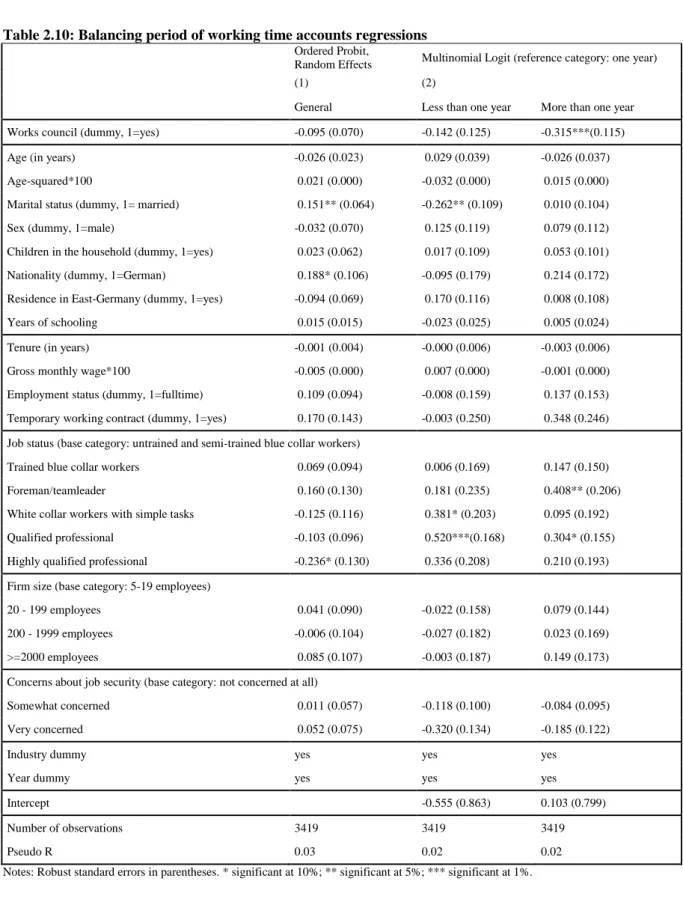
2.5.5 Works councils and the balancing period of working time accounts ... 48
2.6 Sample selection issues and unobserved heterogeneity ... 50
2.7 Implications and Limitations ... 53
2.8 Conclusion ... 57
3 Works councils, wages and job satisfaction ... 61
3.1 Introduction ... 61
3.2 Literature review and shortcomings ... 62
3.3 Theoretical considerations and hypotheses ... 64
3.4 Data, variables and statistical procedure ... 67
3.4.1 Data and variables ... 67
3.4.2 Statistical procedure ... 69
3.5 Empirical results ... 70
3.5.1 Works councils and wages ... 70
3.5.2 Works councils and job satisfaction ... 78
3.6 Discussion ... 85
3.7 Conclusion ... 87
4 Works councils, employment separations and severance payments ... 88
4.1 Introduction ... 88
4.2 Literature review and shortcomings ... 89
4.3 Institutional background, theoretical considerations and hypotheses ... 93
4.3.1 Institutional background ... 93
4.3.2 Theoretical considerations and hypotheses ... 96
III
4.4.1 Data and variables ... 100
4.4.2 Statistical procedure ... 103
4.5 Empirical results ... 104
4.5.1 Works councils, dismissals and voluntary quits ... 104
4.5.2 Works councils and severance payments for dismissed employees ... 111
4.6 Discussion and Implications ... 119
4.7 Conclusion ... 122
5 Conclusive remarks ... 124
5.1 Summary ... 124
5.2 Limitations and extensions ... 129
References ... 132
IV
Index of Tables
Table 2.1: Descriptive statistics ... 29
Table 2.2: Mean comparison - overtime work ... 32
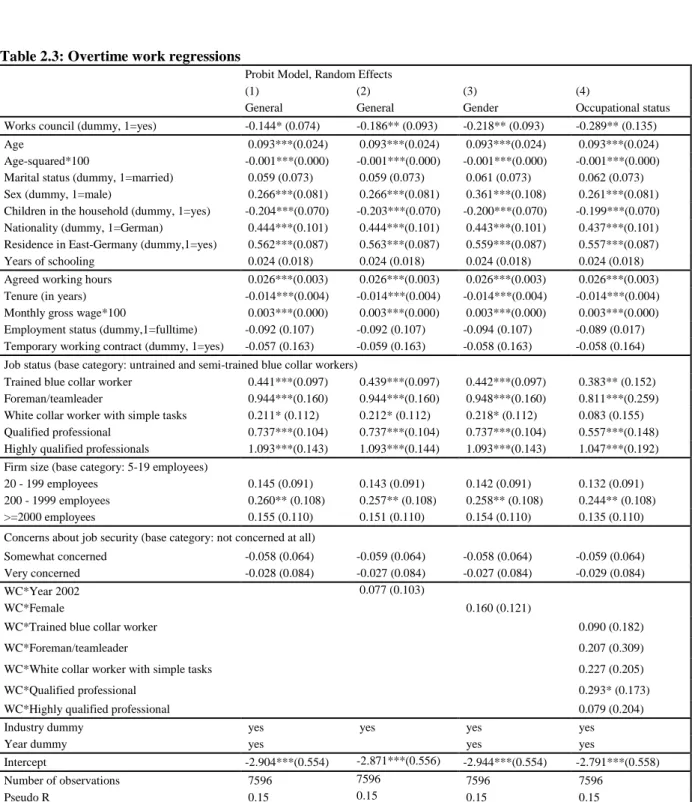
Table 2.3: Overtime work regressions ... 34
Table 2.4: Mean comparison - overtime hours ... 37
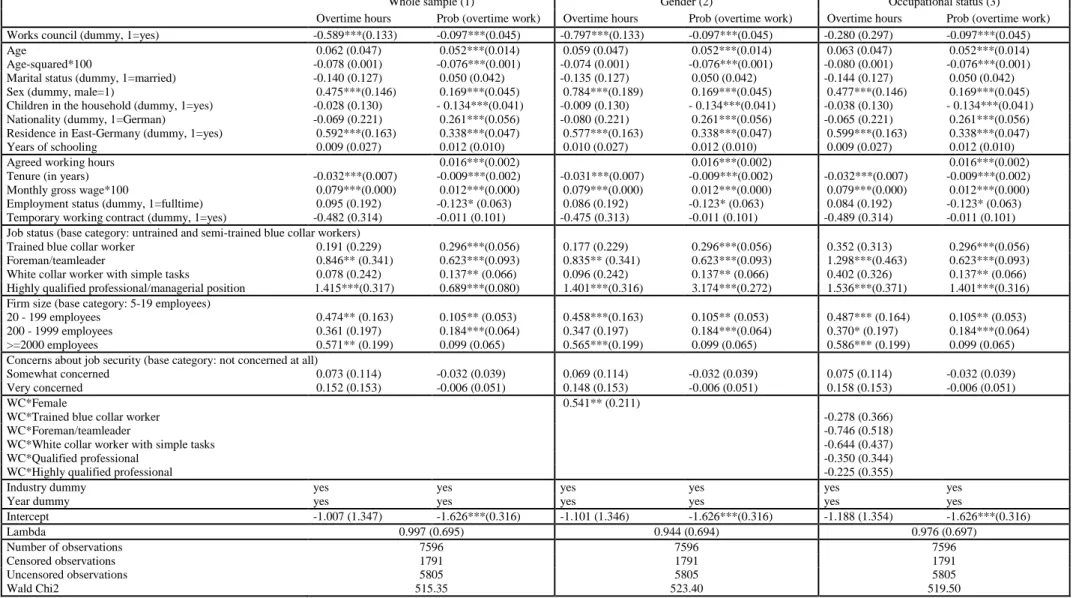
Table 2.5: Overtime hours regressions ... 39
Table 2.6: Mean comparison - compensation of overtime work ... 41
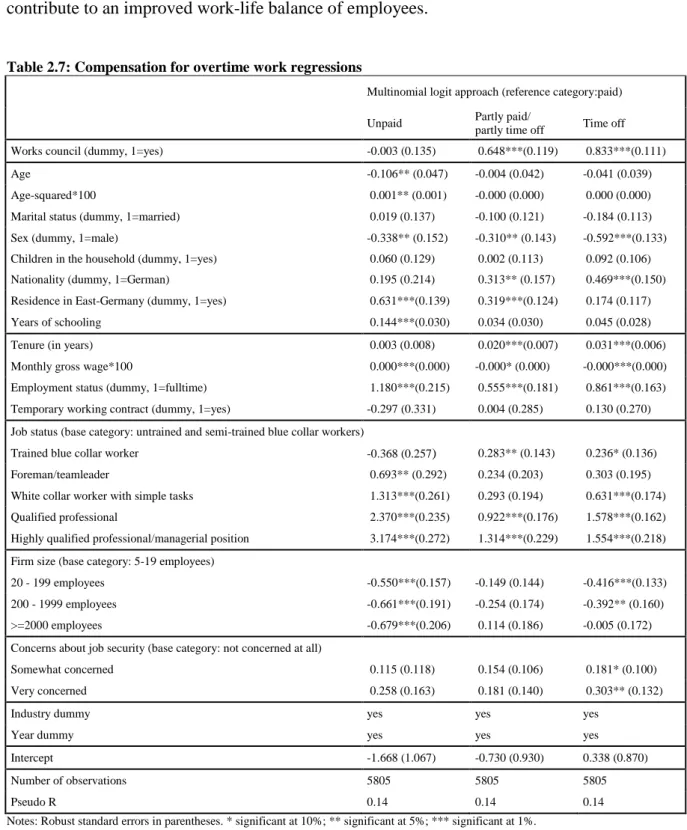
Table 2.7: Compensation for overtime work regressions ... 43
Table 2.8: Mean comparison – working time accounts ... 45
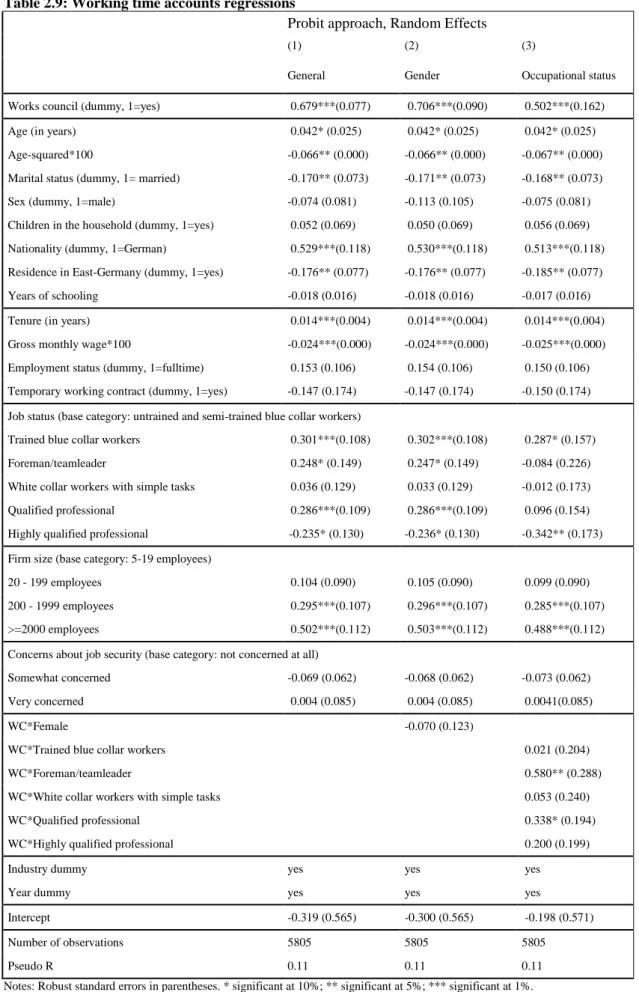
Table 2.9: Working time accounts regressions ... 47
Table 2.10: Balancing period of working time accounts regressions ... 49
Table 2.11: Difference-in-differences regressions ... 53
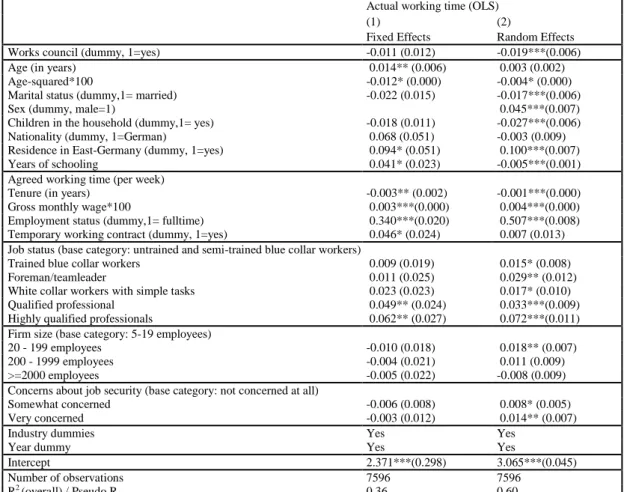
Table A: Actual working time regressions ... 60
Table 3.1: Descriptive statistics ... 68
Table 3.2: Mean comparison - wages ... 71
Table 3.3: Wage regressions ... 73
Table 3.4: Average wages and changes in wages from 2001 to 2006 ... 74
Table 3.5: Difference-in-differences regressions on wages ... 76
Table 3.6: Difference-in-differences regressions on wages for certain subgroups ... 77
Table 3.7: Mean comparison - job satisfaction ... 78
Table 3.8: Job satisfaction regressions ... 79
Table 3.9: Average job satisfaction and changes in job satisfaction from 2001 to 2006 ... 82
Table 3.10: Difference-in-differences regressions on job satisfaction ... 83 Table 3.11: Difference-in-differences regressions on job satisfaction for certain subgroups
V
Table 4.1: Descriptive statistics ... 102
Table 4.2: Mean comparison - separations ... 105
Table 4.3: Separations regressions ... 108
Table 4.4: Mean comparison - severance payments for dismissed emplyoees ... 112
VI
Index of Figures
Figure 4.1: Distribution of severance payments for dismissed employees ... 117 Figure 4.2: Distribution of severance pay factors for dismissed employees ... 118
VII
Acknowledgement
In writing this dissertation, I would like to say thanks and owe a large debt of gratitude to several individuals and institutions.
I clearly owe most of all gratitude to Prof. Dr. Christian Grund for choosing me as a research assistant and supporting me in writing this dissertation. Thank you very much for giving me enough free space but also for providing me with constructive criticism and important advices. Special thanks also go to Prof. Dr. Addison for inviting me to come to the Moore School of Business at the University of South Carolina and accommodating me with a first class research environment. I have further to thank Prof. Dr. Christine Harbring for agreeing to be the co-referee of this dissertation.
I also want to say thank you to Jan Höcker, Ralf Koßmann, Johannes Martin, Tanja Walter and Stefan Zimmermann for reading and commenting on every single chapter of this dissertation and accompanying me the last years as a research assistant. Further thank goes to Susanne Nassen for being such a pleasant office-mate. I could not imagine better colleagues. Not forgetting the student assistants Franziska Appold, Mark Fischer, Melanie Haltenhof, Peter Höschler, Susanne Imhof, Steffen Pyka, Jana Remer, Katharina Stelzer, Sebastian Stock, and Matthias Stumpf. Many thanks to all of you!
A few institutions have to be mentioned, too. Thanks to the University of Würzburg and the Mercator School of Management at the University of Duisburg-Essen for the research environment and the productive and stimulating time. Finally, my thanks go to the Deutsche Akademische Austausch Dienst for funding my research trip to the United States of America.
1
1
Introduction
The German system of codetermination has been regarded as exemplary and thus found attention in many other countries (Addison et al., 2004). Despite a continuing decline of unionism as one crucial pillar of the system of industrial relations in Germany on collective level, works councils have experienced a growing importance in recent years as they help to improve the quality of plant level working relations and economic performance (Frege, 2002). Codetermination on establishment level can in fact be interpreted as a central element of the industrial democratization and humanization (Jirjahn, 2009). Since works councils have direct contact with the employees, they seem to be better suited to represent employees’ interests towards the management in consideration of the specific circumstances within a firm. However, advantages and disadvantages for employees in conjunction with an existing works council are mostly neglected and hardly examined in economic studies. This is surprising since works councils originally reflect an institution that is committed to employees’ interests and only secondarily focuses on issues such as productivity, innovation or profitability. This dissertation aims to contribute to the employee perspective: What do works councils do for employees? The aim of this investigation is to highlight economic consequences of existing works councils on the basis of individual data. At first, the focus is laid on the relationship between works councils and the incidence of both overtime work and working time accounts. Then, the association between works councils, wages and job satisfaction is investigated. Finally, the relation between works councils and employment separations as well as severance payments is focused on. In the following chapter, the institution of German works councils including the institutional background and general theories will be described in more detail. Then, the efficiency discussion with respect to the presence of a works council will be addressed and subsequently the main topics of this dissertation will be motivated.
1.1 German works councils and the institutional background
German works councils are endowed with fairly extensive power. The rights of German works councils are laid down in the Works Constitution Act (WCA) which was introduced in
2
1952 and extended in 1972, 1989 and 2001.1 It is stated that works councils can be set up in all establishments with five or more permanent employees with voting rights and a tenure of at least six months, including three employees who are eligible. Works councils are mandatory, but not automatic. They have to be initiated by the employees so that they are not present in all eligible establishments. Three employees with voting rights or a union represented in the establishment are necessary to call for an initial works meeting in order to elect an electoral board. This electoral board will then be in charge for holding the election and ensuring the introduction of the elected body. The election has to be conducted according to the principles of proportional representation whereby employees with voting rights and the union represented in the establishment are entitled to submit lists of candidates for the works council elections. The works council is elected directly in secret ballots by the entire workforce with the exception of senior executives. In addition, with the amendment in the year 2001, the WCA also contains a simplified electoral procedure for small establishments. In a two-step procedure, the candidates are nominated by the election board and then in another works meeting one week later the works council is elected in a secret ballot of all employees presented. Regular elections for the works councils are held every four years. Expenses of works councils are borne by the employer comprising elections, facilities and release time. Finally, there are time and part-time works councilors. The number of full-time works councilors ranges from 1 member (for firms with 200 to 500 employees) up to 12 members (9,001 to 10,000 employees) and one additional member for each incremental 2,000 employees.
In contrast to German unions that bargain at the industry level, works councils act at the establishment level. However, there are close connections between these two institutions. In practice, the vast majority of works councilors are union members, although the share has declined over the years (Addison et al., 2007; Goerke and Pannenberg, 2007). Traditionally, works councils assist unions in recruiting their members at the workplace and are even called “pillars of union security” (Müller-Jentzsch, 1995).
The WCA provides works councils with considerable possibilities of participation that range from information rights, through rights of consultation and cooperation up to rights of
1 See Addison (2009) for a detailed overview of the history of codetermination at the workplace in Germany
3
codetermination. The rights of works councils rise to some extent with the size of the company, measured by the number of employees. Works councils have extensive codetermination rights on social issues including remuneration arrangements comprising the setting of job and bonus rates and other forms of performance related payments and the introduction of new technologies designed to monitor employees’ performance. Additional codetermination rights cover the commencement and termination of working hours, the regulation of overtime and reduced working hours as well as health and safety issues (§ 87 WCA).
Works councils have less strong consultation rights in areas that refer to any changes in work processes, the working environment and job content. The employer has to consult the works council in good time on the action envisaged and its effects on the employees. Taking particular account of its impact on the nature of their work and the resulting demands on the employees, suggestions and objections of the works council can be taken into account (§ 90 (2) WCA). Consultation rights also cover manpower planning where works councils may make recommendations to the employer with respect to the introduction and the implementation of particular measures (§ 92 (1) and (2) WCA). In establishments with more than 20 employees with voting rights, the employer has to consult the works council in advance of any new employment (§ 99 (1) WCA). Works councils have to be consulted before every individual dismissal. If an employer does not consult a works council, the dismissal is null and void (§ 102 (1) WCA).
The employer has to supply comprehensive information to the works council in good time to enable it to discharge general duties including to see that effect is given to Acts, ordinances, safety regulations, collective agreements and works agreements for the benefit of the employees (§ 80 (1) WCA). In addition, works councils are enabled to make recommendations to the employer for action benefiting the establishment and the staff (§ 80 (2) WCA). In establishments with more than 100 permanent employees a finance committee has to be set up which is appointed by the works council. The finance committee consists of not less than three and not more than seven members, at least one of whom has to be a works council member. The employer has to inform the finance committee in full and in good time of the financial matters of the establishment and supply the relevant documentation. This includes the economic and financial situation of the establishment, the production and marketing situation, production and investment programs as well as rationalization plans,
4
inter alia (§ 106 (3) WCA). The finance committee is responsible for reporting about all these matters to the works council.
With respect to all of the mentioned issues, the employer cannot act without the formal agreement of a works council. Hence, whenever the need arises to settle different opinions between the employer and the works council, a conciliation committee has to be set up. This conciliation committee has to be composed of assessors appointed in equal number by the employer and the works council and of an independent chairman accepted by both sides (§ 76 (1) and (2) WCA).
In addition, works councils also have ‘consent rights’ in matters of hiring and firing as well as job classification. According to § 95 (1) WCA, guidelines for the selection of employees for recruitment, transfer, regrading and dismissals require the approval of the works council. If no agreement is reached on the guidelines or their contents, the employer may apply to the conciliation committee for a decision that takes place of an agreement between the employer and the works council.
Finally, works councils can negotiate social compensation plans and working agreements. Proposed alterations such as the closure/transfer of the whole or important departments of the establishment or the introduction of entirely new working methods and production processes may entail substantial disadvantages for the employees. If no reconciliation of interests between the employer and the works council can be achieved, either side may submit the case to the conciliation committee (§ 111 WCA and §112 (2) WCA). The conciliation committee has to take into account the social interests of the employees concerned while making sure that the decision does not place an unreasonable financial burden on the establishment (§ 112 (5) WCA).
1.2 General theories concerning works councils
Analogously to the exit-voice model of unions developed by Freeman and Medoff (1984), works councils represent employees’ preferences and act as a collective voice institution at the firm level. Many contributions that improve working conditions are workplace public goods. Due to free-rider problems, the individual voice mechanism is not efficient in such circumstances. However, a works council acting as a collective voice institution can overcome the free-rider problem by aggregating employees’ preferences and communicating them to the employer. Hence, employees are provided with an instrument of expressing
5
discontent with regards to certain working conditions as an alternative to quits. To sum up, if the employer of a firm adjusts working conditions according to employees’ preferences, their motivation and job satisfaction will be increased and costly voluntary quits will be diminished. This also implies lower hiring and training costs and increasing investments in firm-specific human capital.
Addison (2009) interprets the last argumentation as the information aspect of collective voice. A further main issue of collective voice is governance which particularly refers to monitoring of incomplete contracts. Hence, works councils may also play an important role when labor market contracts are imperfect and a risk of breaching implicit contracts by an employer may exist. In labor markets, characterized by long-term relationships, contracts between an employer and employees are often incomplete due to information asymmetries, unforeseen contingencies or bounded rationality. Both parties will not be able to foresee all future developments and how the opposing party will react to each of them. If contracts are not legally enforceable by courts and a reputation mechanism does not sufficiently induce an employer to behave honestly, a mechanism has to be found to ensure that both parties are motivated to follow its terms (Addison 2009). Analogously to unions (see Malcomson, 1983), works councils may solve the employer’s commitment problem. As long as employees and employer cooperate in a trustful manner, employees will provide effort and a works council is not necessary. If circumstances change and employees fear opportunistic behavior of an employer, employees may establish a works council in order to protect their rents. In practice, works councils mostly act as safeguards against possible employer opportunism in case when employees invest in firm specific human capital. Menezes-Filho and Van Reenen (2003) argue that a worker representation in terms of a works council can prevent the hold-up problem by making the firm honor its commitment. This means that a worker representation provides employees with valuable information whether a firm is adhering to an implicit contract (Hogan, 2001). As a consequence, the risk of exploiting employees’ dependency upon the firm may be diminished. Summarizing, a works council endowed with extensive bargaining power will be a legal agency that disciplines an employer and the incentive to breach an implicit contract will be reduced.
Since works councils are specialized in worker representation and as they are supposed to make the adoption of long-term relations more efficient, employers will be prevented from engaging in opportunistic behavior. Works councils may additionally play an important role in fostering trust and cooperation between an employer and employees (Addison et al., 2001;
6
Frege, 2002; Jirjahn and Kraft, 2007). Communication between the employer and the employees of a firm may go into two directions: from the employer to the employees and vice versa. The issues of information screening and codetermination may particularly be relevant. First, works council may attenuate opportunistic behavior and foster trust between the employer and the employees via screening of information that is provided by the employer. This is of particular importance in the context of an employer’s report with respect to economic difficulties and a higher demand in working effort. Without a works council, employees do not exactly know whether the employer only feign a crisis or the firm is exposed to a real threat. The second issue refers to codetermination of works councils. Employees may not reveal information about potential performance-enhancing innovations to the employer if they fear that this information will be used to their disadvantage in terms of job losses or increasing workload. However, a works council’s right of codetermination how to use such information can impede that an employer takes advantage of employees’ information in terms of innovative proposals. Summarizing, employees will not increase effort or cooperate when an employer cannot credibly commit to take their interests into account. An existing worker representation may foster trust and cooperation between the employer and employees and thus, inter alia, employees’ job satisfaction will be increased and voluntary quits will be reduced. In this dissertation the subjects job satisfaction and voluntary quits will be focused on within a comprehensive empirical investigation for Germany.
1.3 The works council’s debate
An increase in employee’s job satisfaction implies that productivity may also rise. In this case, the existence of a works council would be beneficial to a firm as a whole and create additional rents. However, works councils are endowed with extensive participation rights that also strengthen its bargaining power. A growth in bargaining power entails an employer’s risk of an increased rent-seeking behavior of a works council. Freeman and Lazear (1995) examine this bargaining problem on a theoretical basis. The authors argue that the creation and the distribution of economic rents cannot be decoupled when a works council exists. Works councils may increase a firm’s productivity due to information exchange, consultation and participation, but they may also increase an employees’ share in total firm surplus. Hence, employers’ share of the surplus might shrink by such an extent that its overall profits would be lowered. Employees and employer would even not agree on the optimal power of works councils despite the consideration that a works council depicts the most efficient solution. In
7
addition, Freeman and Lazear (1995) emphasize that fixed costs may even impede the implementation of works councils at all. As works councils act as a rent-seeking institution that redistributes too large shares, employers will either try to abstain from implementing a works council or vest it with insufficient power. To quote Freeman and Lazear (1995): “If councils increase the rent going to workers more than they increase total rent, firms will oppose them. It is better to have a quarter slice of a 12-inch pie than an eighth slice of a 16-inch pie.” Since the social-welfare-maximizing power of works councils exceeds the level a management of a firm would voluntarily offer (Addison, 2009), such an efficiency-enhancing institution does not arise voluntarily, but has to be mandated.
Since employees would demand a larger amount of competence for their institution of representation than the management of a firm would voluntarily choose, certain limits have to be put on works councils. On a theoretical view, the possibilities of German works councils to influence rent-seeking activities are restricted according to the WCA. The WCA does not allow wage negotiations in order to limit distributional conflicts on the establishment level. Agreements on wages or working conditions are normally settled by collective agreements between unions and employer associations. In contrast to German unions that bargain at the industry level, works councils act at the establishment level and may not call a strike. Furthermore, works councils are required by the WCA to cooperate with the management in the spirit of mutual trust for the good of both the employees and the employer. However, they may use their extensive information, consultation and codetermination rights on many other issues to pursue rent-seeking activities. Unfortunately, one shortcoming of this dissertation is that the issues of productivity and profitability cannot be addressed due to a lack of data. However, the aspect of wages and the interrelation with an existing works council will be analyzed more closely in the empirical part. Pfeifer (2011) points out positive or at least non-negative effects of works councils on firms’ productivity, positive effects on employees’ wages and negative or non-significant effects on firms’ profitability for most of the existing studies. Summarizing, it is ultimately an empirical question whether the institution of a works council is efficient for both employer and employees. The next three chapters aim to shed some light on topics with respect to the employee level. Different categories of working time arrangements as overtime work and working time accounts, wages and job satisfaction as well as personnel separations and severance payments will particularly be analyzed.
8
1.4 Main topics of this dissertation
This dissertation consists of three essays. The relationship between works councils and different categories of working time arrangements such as overtime work and working time accounts is examined in the first paper. Next, the association between a works council and both wages and job satisfaction is discussed in the second paper. Finally, the third paper deals with the relationship of works councils and employment separations as well as the incidence of severance payments. In the following subsections, the single economic questions will be depicted in more detail.
1.4.1 Works councils and working time arrangements
In chapter 2, the relationship between works councils and different categories of working time arrangements will be examined. More precisely, it will be focused on the association between works councils and the incidence of overtime work as well as working time accounts.2 The investigation of this topic appears to be relevant in the context of an interaction between working hours, employment and the presence of a works council. Already in the early 80s of the last century, unions vehemently demanded to decrease working hours in order to reduce unemployment. It can be argued that a works council may have an impact on working hours and overtime work by using its codetermination right at this issue. This may also indirectly determine possible employment changes. Thereby, an increase in overtime work may limit additional employment. Although data of the German socio-economic Panel (GSOEP) does not contain any information about the exact firm size or its change over time, this issue will be discussed theoretically. In addition to estimations with regards to the incidence of overtime work and overtime hours, the association between a works council and different types of overtime work will be analyzed more closely. It will be differentiated between definite overtime work such as paid and unpaid overtime work as well as transitory overtime work such as compensation by time off. It can be assumed that work councils particularly foster compensation by time off. According to the reform of the WCA in 2001, works councils have to promote for a better reconciliation of employees’ work and life balance. In order to compensate overtime hours with leisure time, the existence of flexible working time accounts
2 It has to be noted at this point that a comprehensive discussion of the results and shortcomings of previous studies regarding the main topics will be provided directly in the single chapters.
9
is a crucial prerequisite. Works councils may have an influence on the existence of flexible working time accounts via opt-clauses included in collective agreements. Since collective agreements are not able to cover each firm case, so-called works councils agreements regulate particulars about the implementation of agreed working time arrangements within a workplace.
In addition to general analyses, a differentiation between certain subgroups of employees appears to be reasonable. In particular women may prefer shorter working hours and/or the existence of flexible working time accounts in order to reconcile work and private responsibilities. Moreover, a differentiation between blue and white collar workers with different job levels will be conducted. First, previous studies show that skilled employees do more overtime work than unskilled employees (Bell et al., 2000). Second, particularly qualified employees work unpaid overtime hours quite frequently due to the prospect of a future promotion (Pannenberg, 2005). Since works councils are supposed to contribute to an improvement of an employee’s work-life balance, it seems to be interesting whether works councils may also have an impact on the distribution of paid and unpaid overtime work of employees with different job levels. This may also affect the relevance of time off as a compensation for overtime hours worked and the incidence of working time accounts for certain groups of blue and white collar workers. Based on theoretical arguments, hypotheses with respect to the relationship of works councils and overtime work as well as the existence of individual working time accounts will be developed. Then, these considerations will be tested empirically by applying a probit approach in case of the incidence of overtime work as well as working time accounts and discussed in more detail. Moreover, a Heckman correction approach will be used in order to analyze the number of overtime hours and a multinomial logit approach will be used with respect to different overtime hours. Finally, taking causality issues into account, difference-in-differences estimations will be applied.
1.4.2 Works councils, wages and job satisfaction
Chapter 3 focuses on the association between works councils and both wages and job satisfaction. In general, the WCA does not allow wage negotiations for works council as mentioned above. However, works councils may use their extensive bargaining power in order to influence wages indirectly. Most of previous studies find a positive correlation between works councils and wages. Hence, works councils may induce a higher job classification or the payment of wages above collectively agreed levels. Furthermore, works
10
councils may not only pursue rent-seeking activities but also contribute to the creation of rents. The analysis of the relationship between works councils and job satisfaction is the first investigation of this topic on the basis of panel data. From a theoretical perspective, arguments hinting at a positive correlation between works councils and employees’ job satisfaction may predominate. Works councils acting as a collective voice institution communicate employee’s preferences with regards to working conditions to the employer. If the employer improves working conditions according to a works council’s proposals, employees’ job satisfaction will increase. In addition, an employee representation will reduce information asymmetry between employer and employee and thus foster trust and cooperation between both parties. At last, fairness considerations may also account for an increase in job satisfaction.
In order to use the panel character of the data, a difference-in-differences estimator will be applied as far as possible allowing the derivation of causal effects. In general, it has to be distinguished between employees who are enabled to establish a works council within a workplace and those who move from a firm without a worker representation to a firm with a works council. Therefore, in order to interpret empirical results correctly, it will be differentiated between stayer and mover. A distinction between certain subgroup of employees such as men and women and blue and white collar workers is supposed to improve the quality of this investigation. Analyzing subgroups of employees is of particular interest since numerous studies argue that works councils represent a workplace institution that particularly supports a specific clientele of employees. Hence, the subgroup of men may benefit from the existence of a works council since a predominantly number of works councilors are men. According to the similarity-attraction theory (Byrne, 1971), works councils may be in favor of employees with similar characteristics. In addition, it can be argued that an existing workplace representation advocates blue collar workers as they depict a more homogeneous group and thus it is less difficult for a works council to represent their interests towards the management of a firm.
1.4.3 Works councils, employment separations and severance payments
In chapter 4, the relationship between works councils and both personnel separations and severance payments will be investigated. Although there are numerous studies focusing on the association between works councils and personnel separations, most of them are not able to
11
distinguish between different types of separation due to a lack of precise data. In contrast, the GSOEP provides comprehensive information about dismissals induced by an employer and employees’ voluntary quits. These specific types of personnel separations are the central subject of this analysis. It can be argued that works councils are negatively associated with dismissals since existing consultation and consent rights at that issue enable works council to delay or even prevent them. The presence of works councils is also expected to correlate negatively with voluntary quits. As a collective voice institution, works councils are committed to employees’ interests within a workplace. As a consequence, an employee’s intention to leave a firm voluntarily will be diminished, to name only one reason. Furthermore, the relationship between works councils and separations for subgroups of employees is not sufficiently examined in previous studies. With the usage of interaction terms, correlations for men and women as well as employees with different job levels are investigated. Above mentioned arguments with respect to men and blue collar worker may also hold true for dismissals and voluntary quits. In a further step, the group of individually dismissed employees will be focused on more closely. The relationship between works councils and the incidence of severance payments for this subgroup of employees will also be examined. This is the first study analyzing this specific topic on the basis of multivariate data. In addition, the amount of severance payments and a so-called severance pay factor composed of the amount of the severance payment, the gross monthly wage and tenure of employees will be investigated. From a methodical perspective, a multinomial logit model will be used with regards to personnel separations and a Heckman correction model with respect to severance payments of dismissed employees.
12
2 Works councils and working time arrangements
2.1 Introduction
Overtime work interpreted as working hours that exceed contractually fixed working time is of particular importance for both employees and employers within an establishment for several reasons. Employees may have an intrinsic motivation to work overtime or they do overtime work in order to raise their own wages (Gold, 2004). Pannenberg (2005) argues that employees even exert more effort in terms of unpaid overtime work as a signal to an employer to be induced to better paid future positions. On the other hand, employers may be prompt to increase working time due to a seasonal short-time fluctuation in demand, an unanticipated order peak or an indivisibility of a working process. Jirjahn (2008) characterizes overtime work as an adjustment mechanism that responds to a firm’s short-term economic situation. With regards to the existing literature, transitory and definite overtime hours are usually distinguished. While transitory overtime hours will be compensated by leisure time, definite overtime hours imply that employees do either paid or unpaid overtime work. Recently, there is a trend going on that definite overtime hours will be more and more replaced by transitory overtime hours (Pannenberg, 2005). Employees are enabled to transfer these overtime hours to so-called working time accounts. Then, within a certain period of time, employees have to use worked overtime hours as time off.
An existing works council may also influence overtime work as well as the incidence of working time accounts. While unions and employer associations usually negotiate about working time on a collective level, the implementation of flexibility within a workplace has to be negotiated between an employer and a works council on establishment level (Hunt 1999). Works councils may use their extensive codetermination rights on working time regulations in order to have an impact on the number of hours worked as well as on overtime work. In addition, works councils derive its influence on the implementation of flexible working time accounts via opt-clauses included in collective agreements. Since collective agreements are rather general and not able to cover each individual firm case, so-called works councils agreements, agreements between a works council and a firm’s management, regulate particulars about the implementation of agreed working time arrangements within a firm (Carl and Maier, 2009). Works councils may also use its bargaining power in negotiations with a firm’s management in order to influence the decision whether working time accounts as an instrument of flexibility within a workplace will be implemented.
13
This paper aims to provide a contribution to the relationship of works councils and the presence of different working time arrangements namely overtime work and flexible working time accounts. Individual data from the German Socio-Economic Panel (GSOEP) is used. At first, the impact of works councils on the existence of overtime work is examined. In a following step, the association between works councils and the number of overtime hours as well as different types of compensation for overtime work will be analyzed. While definite overtime work encompasses both paid and unpaid overtime work, transitory overtime hours are usually compensated by time off. Transitory overtime hours can be transferred to so-called individual working time accounts and drawn within a certain period of time. Therefore, the relationship between works councils and the existence of flexible working time accounts as well as its balancing period is also focused on. Since certain groups of employees may particularly be affected by a works council, gender (men vs. women) and employees’ occupational status (blue collar vs. white collar workers) will additionally be distinguished.
2.2 Literature review and shortcomings
There are numerous studies within the existing literature focusing on determinants of an overtime work usage on the basis of German data (Gerlach and Hübler, 1987; Hübler, 1989; Kraft, 1989; Hübler and Meyer, 1997; Bauer and Zimmermann, 1999; Pannenberg and Wagner, 2001). However, the existence of a worker representation within a workplace as an additional determinant of overtime work is barely taken into account. In addition, hitherto existing empirical results concerning an association between German works councils and the incidence of overtime work are rather ambiguous. Jirjahn (2008) even concludes that there is no robust link between works council and the usage of overtime work in German literature. Turning to single investigations, Kölling (1997) uses IAB data and finds a positive relationship between a works council and both the existence of overtime work as well as the number of overtime hours. Based on the Hannover Panel and IAB data, Gold (2004) also provide empirical evidence in their pooled probit estimations that in firms with a works council the incidence of overtime work is more likely. Hence, works councils add authority to the issue of overtime work within an establishment. However, shortcomings of these studies cannot be neglected.
First, different opportunities to compensate employees for overtime work should be distinguished. For example, a restriction in transitory overtime hours is not expected to create additional permanent employment since it only involves a temporary redistribution of
14
working hours (Bauer and Zimmermann, 1999). Based on IAB data, Schank and Schnabel (2004) show a positive correlation between works councils and the incidence of paid overtime work in a pooled logit estimation. Applying an additional tobit approach, the number of paid overtime hours is higher in firms with a works council. But these differences cannot be confirmed in a fixed effects model. The authors argue that due to well-known problems of such a panel approach, e.g. central variables have to exhibit sufficient variation, the results of both estimations should rather be used and interpreted as complements. However, the authors do not take unpaid overtime work or transitory overtime work into account.
There is only one study focusing on this issue in more detail. Ellguth and Promberger (2004) analyze differences between firms with and without a works council concerning firms’ working time policies by using a matching approach. Thereby, firms with nearly the same characteristics are compared. Establishments only differ in the status of a works council’s presence. Empirical results of the cross-section estimations on the basis of IAB data show that employees’ actual working hours are shorter in firms with a works council. The authors interpret this result as an indication that works councils act as an institution which both controls and implements collective agreements within a workplace. Only firms with a works council in East-Germany show a larger adoption of paid or in leisure time compensated overtime work. In a further cross-sectional investigation, Ellguth and Promberger (2007) cannot confirm these positive correlations. Works councils rather foster the usage of overtime work that is compensated with leisure time in West German establishments. Summarizing, with regards to the relationship of works councils and different types of compensation for overtime work, further research on the basis of panel data seems to be necessary.
Second, these studies do not take into account that a correlation between a works council and overtime work may differ between certain subgroups of employees. While gender differences are not examined in the previous literature at all, there is only one study analyzing a works council’s impact on overtime work with respect to employees’ occupational status. Jirjahn (2008) examines the relationship between the interaction of a works council’s existence and a management’s view towards a blue collar workers’ involvement in decision making on the incidence of overtime work. The author uses data of the Hannover Panel within several probit and tobit estimations. With regards to the existence of overtime work as well as the number of overtime hours, no significant differences are observable. However, the interaction between a works council and a cooperative relationship between management and employees makes shift work more likely within a workplace. As a reason, it can be argued that shift work
15
entails problems for employees’ health and family life. In contrast, overtime work may be less troublesome and does not require an aligning of employees’ and management’s interests via works councils. However, Jirjahn (2008) fails to take employees’ different job levels into account. It can be argued that employees on certain hierarchy levels do more overtime work than others, e.g. higher skilled employees (Bell et al., 2000).
Third, with one exemption the issue of causality has not been considered. For instance, a positive correlation between a works council and overtime work may be driven by employees’ interests in establishing a works council in order to create or secure convenient employee-friendly working time regulations including overtime work. Focusing on the issue of causality, Kraft and Lang (2008) do not find an effect of a works council’s introduction on overtime hours on the basis of the GSOEP and IAB data. The number of overtime hours of affected employees was already lower before a works council was introduced. However, they neither distinguish between job mover and stayer nor control for the economic situation of a firm.
A related strand of literature pertains to working time accounts as an instrument of flexibility within a workplace. Ellguth and Promberger (2004) show that the incidence of working time accounts is more likely in firms with a works council. Working time accounts play an important role in compensating employees for overtime hours worked. Ludewig (2001) uses data of the IAB in several probit and tobit estimations. The author finds empirical evidence that in firms with a works council the existence of flexible working time accounts is more likely. Works councils contribute to a reduction of transaction costs in order to introduce and implement working time accounts. In addition, the period of time to draw collected overtime hours is longer in firms with a worker representation. Based on IAB data, Beblo and Wolf (2004) confirm that works councils support the existence of working time accounts which enable employees to balance collected hours even longer. The authors examine some more determinants of family-friendly workplaces including considerations of parents’ needs, supply of parental leaves, advisory and information services or child-care. The results of the ordered probit estimations show that in firms with a works council the incidence of these family-friendly practices is more likely and the number of these working practices is higher in such firms. Based on a representative survey of firms, Wotschack and Hildebrandt (2007) find empirical evidence that large firms with a works council have more frequently long-term working time accounts. These accounts will prevalently be used for early or progressive retirement options, in particular when the share of male employees is high within a
16
workplace. The authors argue that small firms in contrast are rather characterized by informal working-time arrangements and work culture with less long-term oriented policies. Finally, Heywood and Jirjahn (2009) show empirically on the basis of IAB data that a works council endorses a wide range of workplace practices, namely working time and job design in order to meet parents’ needs, childcare and helping with parental leave. The investigation of Heywood and Jirjahn (2009) is the only study explicitly arguing that the composition of a workplace should be taken into account since certain subgroups of employees desire such practices more than others. While women’s need for family-friendly practices is reasonable and thus more likely, a negative relationship can be expected for part-time employees. These considerations can empirically be confirmed in most parts hinting at a voice function of a works council. Additionally, works councils’ effects on family-friendly practices are examined when separating between covered and not covered establishments. Hübler and Jirjahn (2003) emphasize that it is less difficult for a works council to pursue employees’ interests when distributional conflicts are moderated by unions and employer associations on a collective level. Empirical results show that the influence of works councils is stronger in firms that are covered by collective bargaining agreements. To sum up, all of the presented studies with regards to the relationship of works councils and working time accounts refer to a one year data basis only. This does not allow taking the problem of unobserved heterogeneity or selectivity issues sufficiently into account. A deriving of casual effects is also not feasible. This paper builds on the existing literature and advances it in some respects. It provides a contribution to the relationship between works councils and different categories of working time arrangements namely overtime work and flexible working time accounts on an individual data basis. Individuals report about a works council’s existence in their firm in two years. Hence, this study is not restricted to cross-sectional estimations as most of the previous studies mentioned above. A further advantage of the GSOEP survey is the provision of extensive information encompassing individuals’ standard and actual working time as well as overtime work and overtime hours. Therefore, not only the incidence of overtime work but also the number of overtime hours can be analyzed within a comprehensive empirical framework. Moreover, available data facilitates a more precise differentiation between definite and transitory overtime work. Only Ellguth and Promberger (2004, 2007) clearly separate between different types of compensation for overtime work in former investigations. Unpaid overtime work, paid overtime work, compensation by time off or a combination of paid overtime work and time off will be distinguished. Of particular importance is transitory overtime work meaning that overtime work will temporarily be transferred to an individual’s
17
working time account and used by an employee within an agreed period of time. Information on the existence of flexible working time accounts as well as their balancing time is available in the survey and thus also focused on. Furthermore, it can be argued that certain groups of employees may be affected stronger by overtime work than others or may even have a larger need for working time accounts. Hence, different subgroups of employees with respect to gender and employees’ job status are analyzed. Finally, empirical results of numerous studies mentioned above may be misleading since they are not able to take selection issues or the problem of unobserved heterogeneity sufficiently into account. Applying additional difference-in-differences estimations within this investigation, these problems will be focused on. Thereby, subgroups of stayer and mover have to be distinguished. It has to be noted that a works council will either be established within a workplace on the initiative of employees who stay in an establishment during the observation period or employees who move to a firm with an already existing worker representation.
The remainder of this paper is structured as follows: Based on the institutional background and some theoretical considerations, hypotheses for the relationship between works councils and the incidence of both overtime work as well as flexible working time accounts will be derived in section 2.3. Then, data, variables and the statistical procedure (section 2.4) will be described before presenting and discussing the results in section 2.5. In section 2.6, selection issues and the problem of unobserved heterogeneity are focused on more precisely. Section 2.7 presents some implications and limitations. Section 2.8 concludes.
2.3 Institutional background, theoretical considerations and hypotheses
2.3.1 Institutional background
As already mentioned in chapter 1, works councils have extensive codetermination rights on what is called “social matters” including the principles of remuneration and the introduction of new payment methods, the deployment of technologies for monitoring the behavior and the performance of employees as well as health and accident prevention issues. In addition, works councils have an explicit co-determination right with respect to working time. This comprises the commencement and termination of daily working hours including breaks and the distribution of working hours among the days of the week. The management of a firm has to discuss all issues concerning any temporary reduction or extension of the hours normally worked in the establishment with a worker representation. A works council can reject both the
18
introduction as well as the extension of overtime work. They also have “consent rights” in matters of hiring and firing and consultation rights in areas such as manpower planning and changes in work processes, the working environment and job content. Issues in regards to manpower planning encompass the adaption and implementation of measures to promote equality between women and men. With the last reform of the WCA in 2001, it has been fixed that gender equality is facilitated by the requirement that the minority gender at the firm is represented at the works councils at least in proportion to its employment share. At least once within a calendar year, an employer has to report to the works council on the status of this adjustment. Both may support gender equality on firm level. In addition, the most recently enacted reform of the WCA entails the promotion of the reconciliation of family and work time by a works council. This last issue may prompt works council to initiate more family related personnel policies within a workplace.
According to the WCA, works councils are committed to enforce the implementation of laws, ordinances, safety regulations, collective agreements as well as works agreements within a workplace for the benefit of the employees. Collective agreements may contribute to an improvement in the statutory framework on working time. There are numerous collective agreements on working time which also affects the framework of the Working Time Act. The Working Time Act defines minimum conditions that have to be regarded as compulsive when fixing working time.3 Collective agreements cover the standard weekly working time, location and distribution of standard weekly working time, overtime and part-time work, partial retirement as well as night and shift work. As mentioned above, collective agreements include that particulars about the implementation of agreed working time arrangements should be regulated on a firm level via works agreements.
This short description of the institutional background illustrates that German works councils have considerable bargaining power which can also be applied to different categories of working time arrangements, in particular to overtime work and flexible working time accounts. In the following section, direct and indirect effects of works councils on these issues will be hypothesized more closely. At first, theoretical considerations with respect to works councils and overtime will be presented. Determining a relationship between works councils and overtime work, preferences of employees have to be taken into account. In addition, an
3
19
employer may also scrutinize thoroughly whether overtime hours or the number of employees should be increased depending on the economic situation of a firm or differences between short and long-term perspectives. While employers ponder between both opportunities in a good economic situation on a short term, they will rather attempt to increase employment on a long-term perspective. Kraft (1989) reports that an increase in short-term fluctuation rather affects overtime work than employment in Germany. In contrast, the target of long-term production increases has an influence on the number of employees but not on the extension of overtime work. Finally, a works council itself may also pursue own preferences with regards to overtime work of employees. In a second main step, the relationship between works councils and the incidence of flexible working time will be focused on. The demand in such an instrument of flexibility within a firm may be driven by both employer as well as employees. More profoundly, certain subgroups of employees may in particular be interested in such working time accounts. Therefore, next to a general argumentation also theoretical considerations for subgroups of employees will be presented.
2.3.2 Theoretical considerations and hypotheses
Works councils and overtime work
On the one hand, there may be arguments hinting at a positive correlation between a works council and the incidence of overtime work. First, works councils may use their specific consultation and consent rights at issues such as manpower planning as well as their extensive codetermination rights at the regulation of working time in order to delay or even prevent employment adjustments (Gold, 2004; Schank and Schnabel, 2004). Due to higher adjustment costs in firms with a works council, an employer will rather abstain from hiring of new employees. In addition, works councils can also make a downward adjustment process more expensive. Dismissal procedures may be more protracted in firms with a works council or a financial compensation in terms of a severance payment is more likely in such firms (Gensicke et al., 2008).4 Jirjahn (2010b) argues that higher downward adjustment costs may also have a negative effect on employment growth. Such costs do not only reduce an employer’s propensity to fire an employee but also the propensity to hire an employee.
4 It should be noted that the interrelation between works councils and severance payments for dismissed
20
Therefore, since an existing works council may adversely affect an employment adjustment in both directions, it is to be expected that overtime work acts as a substitute for employment and the probability of overtime work will be increased.
Second, employees’ preferences may also be a crucial factor that determines the question whether overtime work should be implemented within a workplace. As mentioned above, works councils represent the preferences of employees and act as a collective voice institution. If the employer of a firm follows the advices of a works council and improves working conditions in accordance, employees’ morale may be higher and thus both costly quits will cease and productivity may increase (Hirsch et al., 2010). According to Schank and Schnabel (2004), works councils attempt to maximize employees’ utility including job security, the amount of their wage as well as the number of working hours. If employees prefer a higher wage, a works council may try to implement overtime work as one instrument to achieve this target. In order to enforce overtime work against the management, works council’s bargaining power derived from its codetermination right on work time issues may be relevant. Heywood and Jirjahn (2009) argue that this bargaining power allows a works councils to gain a monopoly role.
On the other hand, employees may also have a preference for shorter working times in order to reduce efforts and workload within a workplace. Since works councils aim to secure its re-election, they may be eager for keeping agreed working time by the employer. Works councils may also use their bargaining power in order to inhibit overtime work. In addition, a works council itself may have an incentive to impede the implementation of overtime work. According to the WCA, works council have a codetermination right concerning the regulation of working time. By rejecting the implementation of overtime work due to its participation rights, a works council exerts or even increases its bargaining power towards a firm’s management (Gold 2004). If a works council, in contrast, agrees to the introduction of overtime work, a works council will lose an important means of power. Ellguth and Promberger (2007) argue that so-called package deals including an agreement from a works council concerning the introduction of overtime work in return to concessions of the management in other issues will then be obsolete. Carl and Maier (2009) also emphasize that works council agreements on flexible working time arrangements comprising overtime work may include a works council’s risk of losing strong bargaining power when signing the agreement.
21
Summarizing, with regards to an employee’s utility, it cannot be derived whether an employee prefers doing overtime work or not. The issue of a substitution between overtime hours and employment may in particular hold true for a short term. On a long term, an employer may be inclined to increase the number of employees in case of a good economic situation. Jirjahn (2010b) shows that a works council is positively associated with employment growth, but the author fails to take different time intervals or the economic situation of a firm into account. In addition, the assumption that works councils make a downward adjustment process more expensive should be called into question. Results of chapter 4 provide empirical evidence that works councils are negatively associated with severance payments for dismissed employees. Thus, a substitution of employment by overtime work may also be diminished due to this issue. As the argumentation with respect to a works council’s own interest to prevent or even strengthen bargaining power can be regarded as substantive, arguments for a negative association between the presence of a works council and the incidence of overtime work may outweigh positive arguments. Therefore, it can be stated:
Hypothesis 1: The incidence of overtime work will be decreased by a works council.
In addition, different types of overtime work have to be taken into account. Paid and unpaid overtime work, compensation by time off or a combination of time off and paid overtime work have to be distinguished. In comparison to paid overtime work, works councils may impede the introduction and usage of unpaid overtime work. Bell et al. (2000) interpret unpaid overtime work as an exploitation of employees by opportunistic employers. In firms with a worker representation its incidence is expected to be lower. Moreover, if overtime work cannot be avoided within a firm, the existence of a works council will foster time off or the combination of time off and paid overtime work as a further opportunity to compensate employees. Works councils have to promote the reconciliation of working time and leisure or family time according to the WCA.
Works councils and working time accounts
The relationship between works councils and individual working time accounts will also be analyzed. The number of overtime hours worked will be deposited in working time accounts when employees have to work more hours than stipulated by a contract due to short-term
22
deviations in product or service demand. In case of a positive short-term demand shock, an employer may prefer to transfer overtime hours to flexible working time accounts instead of compensating employees by a payment. A premium for overtime hours in Germany is usually about 25 percent in most industries (Schank and Schnabel, 2004). In contrast, the implementation of transitory overtime within a workplace does not create large expenses. Ludewig (2001) lists that only costs for implementation, documentation, and maintenance of such accounts may occur. But employees may also benefit from the existence of working time accounts. Wotschak and Hildebrandt (2009) state that flexible working time accounts enable employees to redistribute working hours. In case of a negative demand shock not the number of employees but the number of working hours has to be adjusted downwards (Hamm, 1999). An existing worker representation in terms of a works council may also influence the incidence of working time accounts. Works councils are a highly developed mechanism for employees’ participation that negotiates over a variety of workplace terms and conditions (Hübler and Jirjahn, 2003). Collective agreements often include so-called opt-clauses in order to confer influence at certain issues upon works councils at the establishment level. Hence, works councils may also have an impact on the introduction and implementation of flexible working time accounts. In the following section, theoretical considerations will be considered more closely.
On the one hand, works councils may attempt to prevent the implementation of flexible working accounts when such measures do not comply with employees’ interests. According to Ellguth and Promberger (2004), works councils may exert a traditional protection function against employer opportunism in case of flexible working accounts. In particular, conditions that require larger efforts or more flexibility should be avoided. Since employees might fear that their interest will not sufficiently be taken into account, a loss of motivation and cooperativeness as well as the incidence of voluntary quits could occur without a works council’s commitment (Seifert 1996). However, works councils who are interested in securing their re-election may use their consent rights according to WCA or their bargaining power due to their package deals in order to impede or restrict such accounts (Althammer 1990, Müller-Jentzsch 1995).
Works councils itself may also have an incentive to inhibit flexible working time accounts. Croucher and Brewster (1998) point out a negative effect of working time flexibility on the system of a worker representation. Works councils’ communication to employees is an essential issue in order to collect information concerning their preferences within a workplace.
23
However, works councils experience a larger difficulty of talking to employees since employees have different working times due to their flexible accounts. Hence, the risk will arise that a works council cannot take the interests of all employees into account. This may lead to an increased dissatisfaction and a loss of trust in the institution of a worker representation. Herrmann et al. (1999) stress that in case of flexible working times the aggregation of employees’ preferences is difficult because of employees’ various interests that have to be focused on. Finally, Bergmann et al. (1998) argue that the usage of flexible working time accounts makes it more difficult for a works council to monitor employees’ working hours. In particular, the range of various accounts as well as transferring working time from one account to another account may rather undermine works councils’ influence. On the other hand, there may be arguments speaking for a positive relationship between the presence of a works council and the incidence of working time accounts. According to Ellguth and Promberger (2004), a worker representation in terms of a works council will endorse the introduction of individual working accounts when large parts of the workforce expect higher scopes of autonomy. Working time accounts enable employees to redistribute working hours in order to balance work and leisure time. This may lead to an increase in job satisfaction from employees’ point of view.
An additional decisive characteristic of such working time accounts may lay in job guarantees (Carstensen 2000). As mentioned above, the number of working hours will be affected instead of the number of employees. Since negotiations with regards to flexible working time instruments between an employer and every single employee would create large costs, an existing works council is usually included in such employment agreements on establishment level. A works council serves as a central contact institution for a firm’s management and helps to reduce transaction costs (Addison and Gerlach, 1984). Tüselmann and Heise (2000) also emphasize that work time flexibility strengthens an employer’s commitment to co-determination. Since the introduction of such accounts may rather be complicated, a works council serving as a contact institution for an employer facilitates its implementation within a workplace.
At that point, it can be argued that it might be less difficult for an employer to implement working time accounts in the absence of works councils. In that case the introduction of such accounts would be conducted according to an employer’s preferences. However, the quality and sustainability of such accounts within a workplace has to be discussed. An existing works council acting as a collective voice institution aggregates employees’ interests and preferences
24
and communicates them to the employer. As a consequence, an employer will receive employees’ assessment about the value of flexible working accounts. This may lead to an improved selection of crucial flexibility instruments adjusted to employees’ preferences and a mitigation of failure at the implementation of such instruments. Heywood and Jirjhan (2009) emphasize that an information transfer may improve the structure of such practices, leads to a better interest match of both management and employees and makes the implementation as well as the longevity of working time accounts more likely. Ludewig (2001) states that employees’ expectations in regards to regulations of a working time account will also be considered more closely when a works council exists. This may lead to an increase in procedural fairness from employees’ view and thus cooperation between management and employees will be strengthened.
Furthermore, an existing works council can improve the distribution of information within a firm and reduce information asymmetries between employees and the management. A works council acting as a co-manager within a firm may support management’s decision in terms of an implementation of flexible working time accounts, if the advantages of such accounts predominate (Ellguth and Promberger 2004). If the management of a firm is successful in convincing a works council about the necessity of flexible working time accounts, a works council will also persuade employees about this undertaking. According to Freeman and Lazear (1995), a works council represents a credible workplace institution due to its legal status and its legitimation by elections. Therefore, an employer’s decisions can be followed more easily by the workforce. This may foster trust in such accounts and lead to a higher cooperation between management and employees.
Summarizing, these positive arguments concerning the relationship between a works council and the incidence of working time accounts may predominate the negative arguments. In particular, arguments with respect to a works council’s own interests hinting at a negative correlation are rather weak. A larger difficulty in communicating with employees or in monitoring employees’ working hours may only relate to a small number of employees and thus it may not be a decisive factor for inhibiting the incidence of working time accounts from a works council’s point of view. Therefore, it can be derived:
Hypothesis 2: The incidence of working time accounts will be higher when a works council exists
In addition, the question arises whether certain groups of employees are in particular affected by the presence of a works council. Therefore, theoretical considerations pertaining to both