A Capacity Theory of Comprehension:
Individual Differences in Working Memory
Marcel Adam Just and Patricia A. Carpenter
Carnegie Mellon University
A theory of the way working memory capacity constrains comprehension is proposed. The theory proposes that both processing and storage are mediated by activation and that the total amount of activation available in working memory varies among individuals. Individual differences in work-ing memory capacity for language can account for qualitative and quantitative differences among college-age adults in several aspects of language comprehension. One aspect is syntactic modular-ity: The larger capacity of some individuals permits interaction among syntactic and pragmatic information, so that their syntactic processes are not informationally encapsulated. Another aspect is syntactic ambiguity: The larger capacity of some individuals permits them to maintain multiple interpretations. The theory is instantiated as a production system model in which the amount of activation available to the model affects how it adapts to the transient computational and storage demands that occur in comprehension.
Working memory plays a central role in all forms of complex thinking, such as reasoning, problem solving, and language comprehension. However, its function in language comprehen-sion is especially evident because comprehencomprehen-sion entails pro-cessing a sequence of symbols that is produced and perceived over time. Working memory plays a critical role in storing the intermediate and final products of a reader's or listener's com-putations as she or he constructs and integrates ideas from the stream of successive words in a text or spoken discourse. In addition to its role in storage, working memory can also be viewed as the pool of operational resources that perform the symbolic computations and thereby generate the intermediate and final products. In this article, we examine how the human cognitive capacity accommodates or fails to accommodate the transient computational and storage demands that occur in lan-guage comprehension. We also explain the differences among individuals in their comprehension performance in terms of their working memory capacity. The major thesis is that cogni-tive capacity constrains comprehension, and it constrains com-prehension more for some people than for others.
This article begins with a general outline of a capacity theory of language comprehension. In the second section we use the capacity theory to account for several phenomena relating indi-vidual differences in language processing to working memory
This work was supported in part by National Institute of Mental Health Grant MH 29617 and Research Scientist Development Awards MH-00661 and MH-00662 as well as a grant from the Andrew W Mellon Foundation.
Sashank Varma played an important role in developing the capacity constrained interpreter and CC READER. We ace also grateful to Jay McClelland, Maryellen MacDonald, Chuck Clifton, Mike Masson, Marilyn Turner, and Jonathan King for their constructive comments on earlier drafts of the manuscript.
Correspondence concerning this article should be addressed to Marcel Adam Just, Department of Psychology, Carnegie Mellon Uni-versity, Pittsburgh, Pennsylvania 15213.
capacity In the third section we describe a computer simulation model that instantiates the capacity theory. In the final section we discuss the implications of capacity theory for other aspects of cognition besides language comprehension.
For the past 100 years, research on working memory (or short-term memory, as it used to be called) has focused on the storage of information for retrieval after a brief interval. A fa-miliar example to illustrate the purpose of short-term memory is the storage of a telephone number between the time that the number is looked up in a directory and the time it is dialed. Short-term memory was typically thought of as a storage de-vice, permitting a person to simply hold items until they were to be recalled. A related function attributed to short-term mem-ory is its role as a stepping stone on the path to long-term memory, while information is being memorized through re-hearsal or elaboration. Thus, working memory has long been implicated in both short-term and long-term storage.
A somewhat more modern view of working memory takes into account not just the storage of items for later retrieval, but also the storage of partial results in complex sequential compu-tations, such as language comprehension. The storage require-ments at the lexical level during comprehension are intuitively obvious. A listener or comprehender must be able to quickly retrieve some representation of earlier words and phrases in a sentence to relate them to later words and phrases. But storage demands also occur at several other levels of processing. The comprehender must also store the theme of the text, the repre-sentation of the situation to which it refers, the major proposi-tions from preceding sentences, and a running, multilevel repre-sentation of the sentence that is currently being read (Kintsch & vanDijk, 1978; vanDijk & Kintsch, 1983). Thus, language com-prehension is an excellent example of a task that demands ex-tensive storage of partial and final products in the service of complex information processing.
Most recent conceptions of working memory extend its func-tion beyond storage to encompass the actual computafunc-tions
themselves. The computations are symbolic manipulations that are at the heart of human thinking—such operations as compar-ison, retrieval, and logical and numerical operations. Of partic-ular relevance are the processes that perform language comphension. These processes, in combination with the storage re-sources, constitute working memory for language.
Construing working memory as an arena of computation was first advocated by Baddeley and Hitch (1974; Baddeley, 1986; Hitch & Baddeley, 1976), who constructed tasks that pit-ted the storage and processing aspects of comprehension against each other. They found that the ability to understand individual sentences rapidly and accurately decreased when lis-teners also had to encode several digits and later recall them. The trading relation between storage and processing suggested that the two functions were drawing on a common pool of resources. Thus, there are both conceptual and empirical rea-sons to express the dual roles of working memory within a single system.
It is important to point out the differences between our theory and Baddeley's (1986) conception of working memory. In our theory, working memory for language refers to a set of processes and resources that perform language comprehen-sion. In Baddeley's theory, working memory has two compo-nents. One component consists of modality-specific storage systems, including the articulately loop, a speech-based re-hearsal buffer of fixed duration. The second component is the
central executive. The central executive is the component that
Baddeley addressed least in his empirical research and speci-fied least in his theory; indeed, Baddeley termed the central executive "the area of residual ignorance" in his model (1986, p. 225). The working memory in our theory corresponds approxi-mately to the part of the central executive in Baddeley's theory that deals with language comprehension. The working memory in our theory does not include modality-specific buffers, such as the articulatory loop.
Overview of the Theory
A major purpose of this article is to present a theoretical integration of the storage and processing functions of working memory in language comprehension. We present a computa-tional theory in which both storage and processing are fueled by the same commodity: activation. In this framework, capac-ity can be expressed as the maximum amount of activation available in working memory to support either of the two func-tions.
In our theory, each representational element has an asso-ciated activation level. An element can represent a word, phrase, proposition, grammatical structure, thematic struc-ture, object in the external world, and so on. The use of the activation level construct here is similar to its widespread use in other cognitive models, both symbolic (e.g., Anderson, 1983) and connectionist (e.g., McClelland & Rumelhart, 1988). Dur-ing comprehension, information becomes activated by virtue of being encoded from written or spoken text, generated by a computation, or retrieved from long-term memory. As long as an element's activation level is above some minimum threshold value, that element is considered part of working memory, and consequently, it is available to be operated on by various
pro-cesses. However, if the total amount of activation that is avail-able to the system is less than the amount required to perform a comprehension task, then some of the activation that is main-taining old elements will be deallocated, producing a kind of forgetting by displacement. Thus, representations constructed early in a sentence may be forgotten by the time they are needed later on in the sentence, if enough computational activity has intervened. The activation is used not just for information maintenance—it is also the commodity that underlies compu-tation. The computations are performed within a production system architecture in which productions manipulate symbols by modifying their activation levels. The most common manip-ulation occurs when a production increases the activation level of one of its action elements. Elements are added or deleted by changing their activation level appropriately.
The computations that are involved in language comprehen-sion also can be expressed as manipulations of activation, as they typically are in connectionist models of comprehension (e.g., Cottrell, 1989; St. John & McClelland, 1990; Waltz & Pol-lack, 1985). In the current model, a production rule propagates activation from one element to another. The production has the source element as a condition, and the destination element as the action. The same production rule can fire repeatedly over successive cycles, reiteratively incrementing (or otherwise modi-fying) the target element's activation level, usually until it reaches some threshold. Consider an example in which the en-counter with a grammatical subject of a sentence generates an expectation that a verb will occur. A proposition representing a grammatical subject is a source of activation for the proposition that a verb will be encountered. Thus, the rule-based process-ing typical of a symbolic system works in concert with the graded activation typical of a connectionist system.
Many of the processes underlying comprehension are as-sumed to occur in parallel. Thus, at the same time that the comprehender develops the expectation of encountering a verb, she or he could also be calculating other syntactic, semantic, and pragmatic features of the sentence. The theory proposes that all enabled processes can execute simultaneously, and gen-erate partial products concurrently. However, if the number of processes (productions) is large or, more precisely, if the amount of activation they try to propagate would exceed the capacity, then the|r attempts at propagation are scaled back to a level that keeps the total activation within the maximum bound.
The trading relation between storage and processing occurs under an allocation-scheme that takes effect when the activa-tion maximum is about to be exceeded. Briefly, if the activaactiva-tion propagation on a given cycle of production firings would ex-ceed the activation maximum, then both the activation propa-gated and the activation used for maintenance are scaled back proportionally to their current use. This scheme is analogous to imposing an across-the-board percentage budget cut if the spending quota (the amount of activation) is about to be ex-ceeded. The scaling back of the activation propagated will in-crease the number of cycles required to bring an element to threshold, effectively slowing down the computation. The scheme implies that when the task demands are high (either because of storage or computational needs), then processing will slow down and some partial results may be forgotten. In sum, the time course and content of language processing within
this system depends on the capacity for storage and computa-tion. When the task demands exceed the available resources, both storage and computational functions are degraded. We call this theory capacity constrained comprehension.
Processing of Sentences in Context
Because a text can contain an indefinitely large number of sentences whose storage could eventually consume any finite capacity, there must be countervailing mechanisms that reduce the storage demands. Some of these mechanisms selectively retain representations of only the most recent and most central clauses in an activated form, while dampening the activation level of other propositions from earlier sentences (Glanzer, Fischer, & Dorfman, 1984; Kintsch & vanDijk, 1978; vanDijk & Kintsch, 1983). Moreover, analogous mechanisms may selec-tively retain only the most relevant aspects of world knowledge in an activated form, while dampening the activation level of other knowledge that might be initially activated by the reading of the text (Kintsch, 1988). Storage demands are also mini-mized through the immediacy of processing, the tendency to semantically interpret each new word or phrase as far as possi-ble when the word is first encountered, in contrast to a wait-and-see strategy that imposes additional storage demands (Car-penter & Just, 1983; Just & Car(Car-penter, 1980). Finally, some lower levels of the hierarchical representations of language may be deactivated after suitable, higher level structures have been formed. For example, the representation of the syntactic struc-ture of a sentence may be dispensable after a referential repre-sentation has been constructed. Consistent with this possibility are the empirical findings that indicate that relatively little of the lexical or syntactic information from earlier clauses re-mains accessible as a reader proceeds in a text (Huey, 1908; Jarvella, 1971; Sachs, 1967).
Processing a sequence of sentences with a finite working memory capacity is possible not only because the storage de-mands can be limited, but also because the context can provide some processing benefits. The stored context might facilitate the processing of the ensuing sentence by preactivating some concepts, relations, and schemas relevant to its comprehension (Sanford & Garrod, 1981; Sharkey & Mitchell, 1985). Thus, these mechanisms that facilitate processing and minimize the demands on storage may keep the overall demands on working memory manageable, even when an extended text is being pro-cessed.
In a later section of this article, we instantiate some parts of the theory in a computer simulation. The simulation is built using an architecture, called CAPS, that is a hybrid of a produc-tion system and an activaproduc-tion-based connecproduc-tionist system. The new simulation is a modification of a computational model of the processing of successive words of a text during reading called READER (Thibadeau, Just, & Carpenter, 1982). The modified model reflects the assumption that comprehension processes are capacity constrained. Hence, the name for the new model is CC READER (Capacity Constrained READER). It is a conventional production system in its use of productions, a working memory, and the recognize-act governance of the flow of control. It is connectionist in that the productions re-iteratively propagate activation from source elements to target
elements, and all the productions that are satisfied on a given cycle can fire in parallel.
The constraint on capacity is imposed by limiting the total amount of activation that the system has available for maintain-ing elements in workmaintain-ing memory and for propagatmaintain-ing activa-tion to other elements in the course of processing. Moreover, as we will describe below, the simulation's account of individual differences in working memory capacity for language is that subjects differ in the maximum amount of activation that they have available. Thus, the total amount of activation in the new CAPS system can express the conjoint constraint as well as any trade-offs that are made between storage and processing.
Individual Differences in Working Memory Capacity
A central thesis of this article is that the nature of a person's language comprehension depends on his or her working mem-ory capacity. We will describe a number of recently uncovered systematic individual differences in reading comprehension that are related to working memory capacity for language. We propose that individuals vary in the amount of activation they have available for meeting the computational and storage de-mands of language processing. This conceptualization predicts quantitative differences among individuals in the speed and accuracy with which they comprehend language. In addition, it is capable of accounting for some qualitative differences among readers that we have observed.
We have described capacity as though it were an energy source that some people have more of than other people have. According to an analogy proposed by Kahneman (1973) in ex-plaining his capacity theory of attention, a person with a larger memory capacity for language may be able to draw on a larger supply of resources, like a homeowner who can draw on more amperes of current than a neighbor, and can thus generate more units of cooling or heating. However, another account of indi-vidual differences is in terms of the efficiency of mental pro-cesses. To return to the electrical analogy, it may be that some homeowners have more efficient electrical appliances than others (appliances being the counterparts of mental processes), allowing them to do more with the current, such as produce more units. We can designate these as the total capacity
tion and the processing efficiency explanation. The two
explana-tions are mutually compatible and the experiments described here do not attempt to discriminate between them. Our theory is expressed in terms of the total capacity account because of the finding reported below that performance differences among college student readers of different working memory capacities are small and often negligible when the sion task is easy, but large and systematic when the comprehen-sion task is demanding. This result is easily explained by the total capacity hypothesis, because capacity limitations would affect performance only when the resource demands of the task exceed the available supply. The result is less easily explained in terms of individual differences in the efficiency of certain pro-cesses, because efficiency differences should manifest them-selves regardless of the total demand. We return to this issue in the final discussion.
Effects of Capacity Constraints
In this section, we present new data and summarize existing research supporting the hypothesis that comprehension is con-strained by working memory capacity. We address five capac-ity-related issues: (a) the influence of pragmatic cues on syntac-tic processes; (b) the time course of comprehending a complex syntactic embedding; (c) the maintenance of two representa-tions of a syntactic ambiguity; (d) the effect of an external mem-ory load on sentence comprehension processes; and (e) the abil-ity to track long-distance dependencies within and between sentences. The intention is to examine how individual differ-ences in working memory capacity constrain comprehension, producing both qualitative and quantitative performance dif-ferences. Before dealing with these five issues, we will describe the measurement of working memory capacity.
Assessing Working Memory Capacity
To assess individual differences in working memory capacity for language, we have used the Reading Span task (Daneman & Carpenter, 1980), which was devised to simultaneously draw on the processing and storage resources of working memory. The task requires subjects to read a set of unrelated sentences, such as: "When at last his eyes opened, there was no gleam of triumph, no shade of anger"; "The taxi turned up Michigan Avenue where they had a clear view of the lake." After reading these two sentences, the subject tries to recall the final word of each sentence, in this case, "anger" and "lake." The test deter-mines the maximum number of sentences per set for which the subject can recall all of the final words. The largest set size for which the subject successfully recalls all of the final words for at least three of five sets is defined as his or her reading span. If the subject is correct on only two of the five sets, she or he is as-signed a span that is intermediate between that size and the next lower one. Among college students, reading spans typi-cally vary from 2 to 5.5 for sentences of this type. In most of the studies described below, high span individuals have spans of four words or more, medium span individuals have spans of three or three and a half words, and low span individuals are those with spans of less than three words. The label of low span is relative to our sample; our low span subjects are in the top half of the distribution of verbal ability in standardized tests such as the Scholastic Aptitude Test (SAT).
The rationale behind the test is that the comprehension pro-cesses used in reading the sentences should consume less of the working memory resources of high span readers. These readers would thus have more capacity left to hold the final words of the sentences. This measure of individual differences builds on the research of Baddeley and Hitch (1974) and Hitch and Bad-deley (1976), which showed that language comprehension and simultaneous digit recall can draw on a shared resource. Thus, there can be a trading relation between the performance of the two tasks when they are done simultaneously, reflecting the constrained capacity.
The Reading Span task measure correlates highly with cer-tain aspects of reading comprehension, such as the verbal SAT, with these correlations lying between .5 and .6 in various exper-iments (Daneman & Carpenter, 1980; Masson & Miller, 1983).
The correlation between reading span and particular compre-hension skills is even higher. For example, the ability to answer a factual question about a passage correlates between .7 and .9 with reading span in various studies. For easy texts, low span subjects read only marginally slower than high span subjects, but on particularly difficult portions of a text, low span subjects tend to be substantially slower than high span subjects. In con-trast to the strong relation between reading span and various comprehension indices, passive short-term memory span per-formance (e.g., recalling a list of digits or unrelated words) is not significantly correlated with reading comprehension (Perfetti & Goldman, 1976).'
A listening version of the Reading Span task produces simi-lar results to the reading version (Daneman & Carpenter, 1980). In general, individual differences in reading and listening are highly correlated for educated adults, such as college students, who are the primary target population in these studies. Thus, the individual differences of interest here are due to language processes, and are not restricted to reading processes. Al-though others have suggested that the Reading Span task may measure a more general factor than just working memory for language (Turner & Engle, 1989), the evidence on this point is not yet conclusive (Baddeley, Logic, Nimmo-Smith, & Brere-ton, 1985). In the present article, the term working memory refers to working memory for language.
Modularity of Syntactic Processing
Capacity constraints have the potential of creating bound-aries between different types of processes when the total pro-cessing resources are insufficient to permit direct interaction between different processes. Interaction between processes, like other forms of computation, requires operational re-sources, such as storage of partial products and communication from one process to another. In the absence of resources suffi-cient to support interaction, two processes that have the requi-site interconnectivity may fail to interact; that is, they may fail to influence each other's ongoing computations. But the bound-aries created by capacity constraints are outcomes of resource limitations, and not of architectural barriers.
1 The lack of correlation between the standard digit span task and
reading comprehension indicates that the standard digit span task does not draw on the same resources as those used in most language comprehension tasks. The source of individual differences in standard span tasks is not clear (Lyon, 1977). One possibility is that such differ-ences primarily reflect individual differdiffer-ences in the phonological store and the articulatory loop, an internal auditory-articulatory re-hearsal process of fixed duration (Baddeley, 1986). The involvement of the articulatory loop in digit span performance has been implicated by cross-linguistic studies; in particular, the smaller digit span associated with the Welsh language has been attributed to the fact that Welsh vowels are longer and so Welsh digits take longer to subvocally rehearse than English digits (Ellis & Hennelley, 1980). Moreover, neuropsycho-logical data suggest that impairments in digit span are not necessarily correlated with impaired language comprehension; some patients with very severely impaired digit span have relatively preserved sentence comprehension (Shallice, 1988). These neuropsychological data also support a dissociation between the standard digit span task and the mechanisms that are used in normal sentence comprehension.
Capacity constraints thus provide an interesting new per-spective on the controversy concerning the modularity of lan-guage processing (Fodor, 1983; Garfield, 1989). A cognitive module is defined as a fast, domain-specific set of processes that is mandatory and informationally encapsulated. The inter-esting conjecture offered by Fodor is that the syntactic level of language processing is performed by a cognitive module. We propose that the postulated modularity of syntactic processing may be better explained as a capacity constraint that sometimes imposes informational encapsulation.
Informational encapsulation is the single most distinguish-ing property of a cognitive module. It refers to a module's activi-ties and outputs being uninfluenced by certain classes of infor-mation that may exist elsewhere in the system. One of Fodor's (1983) examples of encapsulation is that when you push your eyeball with your finger you see motion, even though another part of your cognitive system has the information that the mo-tion is not real. The informamo-tion about the finger movement is apparently not available to or not used by the processes that interpret input from the retina. These perceptual interpretation processes are in some sense encapsulated from the finger mo-tion informamo-tion. Fodor also considered the syntactic process-ing of language to constitute a module that is encapsulated from nonsyntactic information. Fodor said "as things stand I know of no convincing evidence that syntactic parsing is ever guided by the subject's appreciation of pragmatic context or of 'real world' background" (p. 78). The rationale that Fodor of-fered for encapsulation is that input systems have to operate rapidly (without allocating time to consider all possible relevant information) and veridically, somewhat like a reflex. Despite the centrality of encapsulation in the debate about syntactic modularity, Garfield (1989) wrote, "Nevertheless, it [encapsula-tion] is one of the most difficult of the central properties to detect experimentally.... As Fodor concedes, and as the de-bate in this volume documents, encapsulation is a vexing issue in psycholinguistics" (p. 4). The information from which syn-tactic processing is encapsulated is ultimately brought to bear at some time on the final interpretation of a word, phrase, or sentence. Fodor's conjecture is that the information does not affect syntactic processing itself, but instead affects some later integrative process.
The theory we propose reinterprets syntactic encapsulation as an issue of capacity rather than of architecture. According to our view, people with small working memories for language may not have the capacity to entertain (keep activated and prop-agate additional activation from) nonsyntactic information dur-ing the syntactic computations, or at least not to the degree that the nonsyntactic information can influence the syntactic pro-cessing. In this view, the syntactic processing of a person with a small working memory is encapsulated only by virtue of a ca-pacity constraint, not an architectural constraint. Individuals with a large working memory capacity may be more able to keep both syntactic and nonsyntactic information activated, and hence their syntactic processing would be more likely to be influenced by the nonsyntactic information. Thus, some peo-ple's syntactic processing might seem more modular than others. The degree of modularity would depend on working memory capacity for language, not on some structural separa-tion between modules. But any variasepara-tion in modularity across
subjects destroys the value of the concept of modularity. To replace it, we offer the concept of capacity for interaction, which can differ among individuals.
First, we briefly summarize the previous and new empirical findings, and then we report them in more detail. The empiri-cal support for our position comes from a study in which we examined individual differences in encapsulation of syntactic processing. The study used a task that had previously provided the strongest support for the modularity of syntax (Ferreira & Clifton, 1986). Ferreira and Clifton constructed a task in which the reader could avoid being led down a garden path only by making immediate use of nonsyntactic information. Their sur-prising result was that readers were led down the garden path, despite the presence of prior disambiguating information about the proper resolution of a syntactic ambiguity. That disambi-guating information was nonsyntactic, so its lack of influence on the syntactic processing was attributed to the encapsulation of the syntactic module. We repeated that experiment, separat-ing subjects of different readseparat-ing spans, and replicated Ferreira and Clifton's result in the case of the low span subjects. How-ever, just as our theory predicted, the high span subjects did take the nonsyntactic information into account in initially in-terpreting the syntactic ambiguity. In effect, the syntactic pro-cessing of the high span subjects was not modular, but interac-tive.
Ferreira and Clifton (1986) examined the reading time on sentences like Sentence 1, "The evidence examined by the law-yer shocked the jury"; and Sentence 2, "The defendant exam-ined by the lawyer shocked the jury." Because these sentences omit the complementizers and the verb ("who was" or "that was") of the relative clauses, the sentences are called reduced
relative clauses. The initial part of Sentence 2 "The defendant
examined" is temporarily ambiguous between the main verb interpretation (which could have continued as "The defendant examined the courtroom") and the eventually correct interpre-tation as a relative clause. The study varied whether or not a pragmatic cue, the animacy of the head noun, signalled the correct interpretation of the initial ambiguous portion of the sentences. In Sentence 1, the initial noun is inanimate and, consequently, an implausible agent of the following verb. If the pragmatic information concerning inanimacy influences the parsing decision, readers should be more likely to interpret the verb as a reduced relative verb than as a main verb. Moreover, they might expect that an agent will be specified later in the sentence. When an agentive phrase, such as "by the lawyer," occurs, it should be no surprise and it should present no particu-lar processing difficulty. In contrast, in Sentence 2, "the defen-dant" is a plausible agent of the verb "examined." Consequently, readers are likely to interpret the verb as a main verb, and begin their trip down the garden path. The subsequent agentive phrase is inconsistent with the main verb interpretation, so the encounter with the by phrase should present a processing diffi-culty. The garden path effect can be measured by comparing the reading time on "by the lawyer" in sentences like 1 and 2, to determine whether or not the inanimacy of the noun "evi-dence" alleviates any of the surprise on the encounter with the
by phrase.
The striking result that Ferreira and Clifton (1986) obtained was that readers still spent a long time on the by phrase when
the head noun of the sentence was inanimate. This result sug-gested that readers were led down the garden path. In fact, the first-pass reading times on the by phrase (as indicated in eye fixation data) were no shorter in the sentences containing an inanimate head noun than in sentences with an animate head noun. In other words, the inanimacy of a head noun like "evi-dence" appeared not to penetrate the syntactic analysis of the verb "examined." Ferreira and Clifton concluded that the lack of effect of inanimacy occurred becausejsyntactic analysis is a modular cognitive process that is informationally encapsu-lated. They reasoned that even if there were information avail-able to influence the syntactic analysis, that kind of informa-tion would not be used on the first pass of the syntactic process-ing because syntactic processprocess-ing, accordprocess-ing to theories like Fodor's (1983), is impermeable to other sources of information. Our experiment was similar to Ferreira and Clifton's (1986) in most respects, except that the data were separated for sub-jects of different reading spans—40 high span readers (spans of 4.0 or higher) and 40 low span readers (spans of 2.5 or lower). In addition, we improved some of the stimulus sentences so that the grammatical subject could not be interpreted as an instru-ment; this eliminated some of the sentences used by Ferreira and Clifton, such as "The car towed. . . . " Each of 20 sen-tences, interspersed with a variety of filler sensen-tences, was pre-sented in random order. In addition to sentences with reduced relative clauses, our experiment (like Ferreira and Clifton's) pre-sented sentences with unreduced relative clauses, such as the following, syntactically unambiguous sentences: Sentence 3, "The evidence that was examined by the lawyer shocked the jury"; and Sentence 4, "The defendant who was examined by the lawyer shocked the jury" Across four groups of subjects, each sentence occurred in each of the four forms.
While the subject read sentences on a graphics monitor, his or her eye fixations were recorded using an ISCAN Model RK-426 Pupil/Corneal Tracking System, and a VAXstation 3200 computed the point of regard every 16.7 ms. Each screen dis-play consisted of a neutral, introductory sentence, followed by the target sentence, followed by a true-false comprehension question that the reader answered by pressing one of two but-tons.
The primary analysis focused on the first-pass reading times on the by phrase and on the initial verb and the main verb of the target sentence. Subsequent analyses examined any reading beyond a first pass (typically regressions back to the by phrase). The analysis used only trials in which the subject fixated on the first verb for at least 150 ms, and then on the by phrase for at least 150ms.
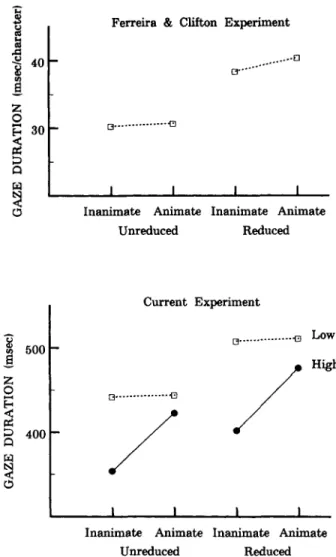
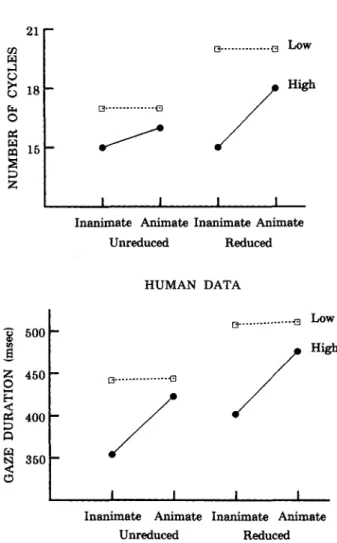
The main result was a difference between the high and low span subjects in their reaction to an inanimate noun. Inani-macy decreased the first-pass reading time on the by phrase for high span subjects, but not for the low span subjects. This result suggests that high span readers were sensitive to the pragmatic cue during the first-pass syntactic analysis. In the case of the reduced relative clauses, the presence of an inanimate noun reduced the first-pass reading time on the by phrase by 75 ms for the high span subjects, but did not reduce it for the low span subjects, as shown in the bottom right side of Figure 1. Similarly, in the case of the unreduced relative clauses, the presence of an inanimate noun reduced the first-pass reading time on the by
I
1
40 30 Q W OFerreira & Clifton Experiment
\ \ \ \
Inanimate Animate Inanimate Animate Unreduced Reduced 500 O H | 400 H
52
o
Current Experiment Low High IInanimate Animate Inanimate Animate Unreduced Reduced
Figure 1. First-pass reading times on by phrase for the untested
sub-jects of Ferreira and Clifton (1986) on the top and for high and low span subjects in the present study on the bottom. (The slope for the high span subjects between the inanimate and animate conditions indi-cates that their processing is faster if the grammatical subject of the sentence is inanimate; in contrast, the lack of difference between the inanimate and animate conditions indicates a negligible influence for Ferreira and Clifton's subjects and the low span subjects in the present experiment.)
phrase by 69 ms for the high span subjects, but did not reduce it for the low span subjects. This pattern produced a reliable inter-action of animacy and span group, F(\, 66) = 5.36, p < .025,
MSc = 15,487. The results for the low span group parallel those
of Ferreira and Clifton (1986); their data were reported as read-ing time per character and they are plotted in the top part of Figure 1.
Not surprisingly, the first-pass reading time on the by phrase was shorter (by 58 ms on average) for both span groups if the relative clause was not reduced, F(l, 66) = 14.13, p < .01, MSC =
16,334. There was no interaction between span group and re-duction. Taken together, these results suggest that the two groups of subjects make similar use of the explicit syntactic cue
(i.e., the expanded relative clause), whereas only the high span subjects make use of the pragmatic cue of inanimacy.
Averaged over all four conditions, the high span subjects had marginally shorter first-pass reading times on the by phrase (by 62 ms), F(l, 66) = 3.76, p< .06, MSe = 70,308.
This pattern of results is most easily explained in terms of a capacity difference between the two groups of subjects, such that only the high span subjects have the capacity to take the pragmatic information into account. The modularity explana-tion does not fit this pattern of results, unless one postulated that the syntactic processing of low span subjects is modular, and the syntactic processing of high span subjects is interactive. But modularity was construed as a hypothesis about a universal functional architecture, a construal that is violated by a finding of individual differences. In contrast, the capacity constrained comprehension model simply postulates that interaction re-quires capacity, so only those subjects with greater capacity have the resources to support interaction. The specific interaction in this case is the ability to represent, maintain, and use the inani-macy cue during the processing of the syntactic information.
The subsequent reading times on the by phrase after the first pass show the same general pattern of results as the first-pass reading, except that the critical interaction of animacy by span is no longer reliable, just as expected (as shown in Table 1). This result indicates that all subjects can ultimately take inanimacy into account, but only the high span subjects can take it into account during the first pass. The reading time on the by phrase after the first pass was shorter for both span groups if the rela-tive clause was not reduced, F(l, 66) = 7.95, p < .01, MS, = 7,798. There was no interaction between span group and reduc-tion. These times were marginally shorter for the high span subjects than for the low span subjects, F(l, 66) = 3.63, p < .07, MSC= 15,140.
For completeness, we also report the reading times on the two verbs that bounded the by phrase ("examined" and "shocked" in the sample sentence) in Table 1. The result that is important to our thesis is that there are no interactions between the two span groups and any other variable, for either the first or the second verb, nor is there a reliable main effect of span group in either case. In the case of the first verb, there is a main
Table 1
Reading Times (in Milliseconds) on Bypass, First Verb, and Second Verb
Unreduced Unreduced Reduced Reduced Group inanimate animate inanimate animate
Subsequent reading time on by phrase
Low span 55 56 87 100 High span 22 48 49 83
First-pass reading time on first verb
Low span 234 253 249 301 High span 212 232 265 284
First-pass reading time on second verb
Low span 287 268 308 295 High span 252 269 264 278
effect of both animacy and reduction, in that readers take less time on the first verb if the preceding context imposes more constraint (inanimacy or an unreduced structure) than if it im-poses less constraint (animacy or a reduced structure).
The general pattern of results can be viewed from another useful perspective—the effects of various cues to sentence structure. One cue to the complex relative clause structure is the complementizer and auxiliary verb ("that was") that occur in the unreduced relative clause. This is a reliable and valid cue used by both high and low span subjects; when this cue is pres-ent, the reading times on the first verb and on the by phrase are shorter than if it is absent. The inanimacy of the head noun is another cue, which indicates that the head noun will not be the agent of the verb, but will instead occupy some other thematic role in the main clause and in any subordinate clauses. Only the high span subjects use this cue in their first-pass reading; their reading time on the first verb and on the by phrase is shorter if the inanimacy cue is present and longer if it is absent. In the case of the high span subjects, the two cues make approxi-mately additive contributions to performance. The low span subjects show no effect of the inanimacy cue on the first-pass reading of the by phrase, indicating the insensitivity of their syntactic parsing process to this cue, as predicted by Ferreira and Clifton's (1986) instantiation of the syntactic modularity hypothesis. Completely unpredicted by the modularity hypoth-esis, but predicted by the capacity constrained comprehension model, is the high span subjects' use of this cue. Thus the syn-tactic encapsulation that some subjects exhibit is better ex-plained in terms of a capacity constraint. The results contradict the view that syntactic processing is informationally encapsu-lated by an architectural barrier.
Processing Complex Embeddings
Capacity constraints, as measured by working memory ca-pacity, should produce quantitative differences among individ-uals in the time course and accuracy of their processing. More-over, these quantitative differences should be most apparent when the sentence or task is particularly capacity demanding. Several recent studies have obtained the predicted quantitative differences, that is, high span readers were both faster and more accurate in their comprehension of difficult sentences (King & Just, 1991). These studies demonstrated that much of the quan-titative difference that results from working memory capacity can be localized to those portions of the sentence that are partic-ularly capacity demanding.
The classic example of a syntactic structure that makes large demands on working memory capacity is a sentence containing a center-embedded object-relative clause, such as Sentence 5, "The reporter that the senator attacked admitted the error." It is called an object-relative clause because the head noun is the object of the relative clause. Subjects who hear such a sentence and then try to paraphrase it make errors approximately 15% of the time (Larkin & Burns, 1977). There are two processing demands that in combination make such sentences difficult to understand, but the nature of the demands is not critical to our argument. Briefly, one source of difficulty is that the embedded clause interrupts the main clause, requiring that the in-terrupted clause representation either be retained m working
memory or be reactivated at the conclusion of the embedded clause. The second source of difficulty is that one of the syntac-tic constituents ("reporter," in the example above) is the subject of the main clause, but it is also the grammatical object of the embedded clause. Associating a single concept with two differ-ent roles simultaneously poses a difficulty in language compre-hension (Sever, 1970; Sheldon, 1974). In contrast, it is easier to comprehend a sentence containing a subject-relative clause, such as Sentence 6, "The reporter that attacked the senator admitted the error." Like Sentence 5, this example has an in-terruption of the main clause, but in this case, the head noun plays the same role in both clauses (Holmes & CfRegan, 1981). Thus, clause interruption together with the assignment of non-parallel roles to the same entity combine to make object-relative sentences particularly difficult to understand.
The processing demands imposed by object-relative sen-tences provide a way to examine how working memory con-strains the comprehension of normal (albeit difficult) sen-tences. The model predicts that each person's working memory capacity will determine how difficult each sentence type will be for him or her. All readers should find the object-relative sentences more difficult to comprehend than subject-relative sentences; more important for the thesis of this article, readers with lower capacity should have relatively more difficulty with object-relative sentences. King and Just (1991) measured the word-by-word reading times as subjects read sentences contain-ing either an object-relative or subject-relative clause and then answered a question to assess the accuracy of their interpreta-tion.
Reading time was assessed with the self-paced moving win-dow paradigm, in which the sentences are initially displayed with dashes replacing the alphabetic characters (Just, Car-penter, & Woolley, 1982). Each time the subject presses a small hand-held microswitch lever, the characters of the next word ahead of the current point of advance replace the correspond-ing dashes, and the previously displayed word is replaced by dashes. This method yields a reading time for each word of the text.
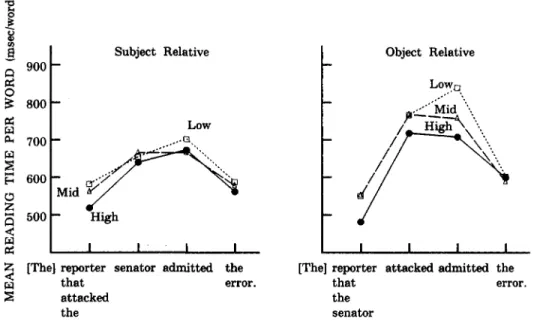
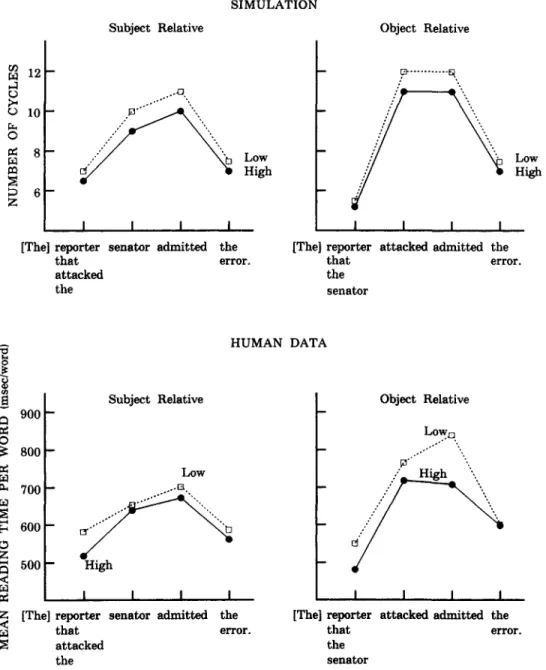
The results confirmed several important predictions of the theory, as shown in Figure 2. First, there were large individual differences in reading times, and these differences were pri-marily localized to the object-relative sentences which are shown on the right-hand panel of the figure. The fact that the intergroup differences were larger on the more demanding ob-ject-relative sentences suggests that working memory con-straints are manifested primarily when processing demands exceed capacity. Second, the word-by-word reading times local-ized the processing difficulty of object-relative clauses to the point at which the critical syntactic information becomes avail-able. All three groups of subjects showed a selective increase in reading time at the verb of the embedded relative clause ("at-tacked") and at the verb of the main clause ("admitted"). The increase was larger for subjects with smaller spans, so the three curves diverge in the right-hand panel of Figure 2 precisely at the location where the processing load is at its peak.
The subjects with lower spans not only took longer to read the more complex sentences, but their comprehension accuracy was also poorer than that of higher span subjects. The accuracy of the low span subjects in answering true-false comprehension
questions, such as "The senator admitted the error," was 64%, compared with 85% for the high span subjects (mid-span sub-jects' comprehension was 83%). The combination of reading time and comprehension-accuracy results shows that readers with lower reading spans have poorer comprehension, even though they may spend considerably more time processing in the syntactically critical area of the sentence. These results dem-onstrate systematic and localized individual differences in the comprehension of difficult syntactic structures, differences that are modulated by working memory capacity.
The near absence of differences among the groups for unde-manding sentences suggests that performance differences can-not be entirely attributed to the speed of some particular opera-tion, a hypothesis that underlay much of the interesting re-search on individual differences in cognition in the 1970s (e.g., Hunt, Lunneborg, & Lewis, 1975). For example, suppose that the individual differences in reading times were due only to differences in the speed of lexical access. Then there should be a substantial reading time difference between high span and low span subjects even on the syntactically simpler sentences, which in this particular experiment happen to contain exactly the same words as the more complex sentences. But the large reading time differences occurred only on the more complex object-relative sentences, showing that the speed of lexical ac-cess cannot be more than a minor component of the individual differences.
Age-Related Differences
Syntactic constructions that make large demands on the working memory capacity of college students are the very types of constructions that produce age-related performance decre-ments in elderly people. One reason that working memory is implicated in the age-related changes is that the performance decrements are not general, nor do they appear to be attributed to the loss of some specific linguistic computation. For exam-ple, older adults (65-79 years of age) show relatively greater deficits than do younger adults when they must make an infer-ence that requires integrating information across sentinfer-ences (Co-hen, 1979). Making the inference requires the storage of infor-mation from previous sentences concurrently with the process-ing of ensuprocess-ing sentences, placprocess-ing a large demand on workprocess-ing memory. The deficit is not general, because the older subjects have much less of a disadvantage when the comprehension test probes for verbatim information from the stimulus sentence.
Working memory was directly implicated in age-related changes in a task that required subjects to repeat sentences of various syntactic types (Kemper, 1986). Elderly adults (aged 70-89) were impaired (compared with young adults aged 30-49) at imitating sentences whose syntax made large demands on working memory. The elderly adults had particular difficulty in imitating sentences containing a long sentence-initial embed-ded clause, as in "The cookies that I baked yesterday for my grandchildren were delicious." They correctly imitated them only 6% of the time, as compared with 84% for the younger adults. The elderly adults also had some difficulty imitating a sentence containing a long sentence-final embedded clause (42% correct). By contrast, the elderly adults had no difficulty in imitating sentences with short embedded clauses. The
age-re-I
Q O WS
H O 25 S H 05 900 800 700 600 500 Subject Relative Low Mid High I I I Object Relative J_ I I I[The] reporter senator admitted the that error, attacked
the
[The] reporter attacked admitted the that error, the
senator
Figure 2. Reading time per word for successive areas of subject- and object-relative sentences, for high,
medium (Mid), and low span subjects. (The differences among the span groups are larger for the more difficult object-relative construction, which is the more complex sentence. The differences are particu-larly large at the verbs, which are points of processing difficulty that are expected to stress working memory capacity. The reading times for parenthesized words are not included in the plotted points.)
lated decline in the ability to imitate sentences is largest in cases in which the processing of the main syntactic constituent is interrupted by the processing of a long embedded constituent. This type of construction requires that the initial portion of the main constituent be retained in working memory while the embedded constituent is processed under the memory load, and then the stored portion must be made accessible again when its final portion is being processed. In addition to this age-related difference in imitation performance, Kemper found a corresponding age-related difference in spontaneous production (Kemper, 1988; Kynette & Kemper, 1986).
Thus, the decline in language performance in the elderly is focused on sentences whose syntax makes large demands on working memory. In general, the individual operations of lan-guage processing show little evidence of decline with age when the total processing load is small. However, at times of high demand, the total performance does decline, indicating an age-related decrease in the overall working memory capacity for language.
Syntactic Ambiguity: Single Versus Multiple Representations
Another facet of language that could generate demand for additional resources is syntactic ambiguity, particularly in the absence of a preceding context that selects among the possible interpretations. If comprehenders were to represent more than one interpretation of an ambiguity during the portion of a sen-tence that is ambiguous, this would clearly demand additional capacity. However, the existing data and the corresponding the-ories are in disagreement about the processing of syntactic
am-biguities. A comprehender encountering an ambiguity might select a single interpretation (Frazier, 1978; Just & Carpenter, 1987; Marcus, 1980), or she or he might retain two alternative interpretations until some later disambiguating information is provided (Gorrell, 1987; Kurtzman, 1985). These two schemes for dealing with syntactic ambiguity have been posed as oppos-ing (and mutually exclusive) alternatives. However, in a series of experiments, we found that both positions could be reconciled by postulating individual differences in the degree to which multiple representations are maintained for a syntactic ambigu-ity (MacDonald, Just, & Carpenter, in press).
In the model we advance, multiple representations are ini-tially constructed by all comprehenders on first encountering the syntactic ambiguity. Each of the multiple representations is assumed to have an activation level proportional to its fre-quency, its syntactic complexity, and its pragmatic plausibility. The important new postulate of our theory is that the working memory capacity of the comprehender influences the duration (i.e, intervening text) over which multiple syntactic representa-tions can be maintained. A low span reader does not have suffi-cient capacity to maintain the two interpretations, and soon abandons the less preferred interpretation, which results in a single-interpretation scheme. In contrast, a high span reader will be able to maintain two interpretations for some period.
The full set of results is too long to present here, because it includes reading times and comprehension rates on unam-biguous sentences and two resolutions of amunam-biguous sentences (MacDonakl, Just, & Carpenter, in press, for details). However, we can present the critical data that support the central claim, which makes an unintuitive prediction. In the survey of capac-ity effects presented above, a greater capaccapac-ity produces better
performance in all ways that have been measured; the high span readers did not have to trade anything measurable away to read difficult sentences faster and comprehend them better. However, maintaining the multiple interpretations of a syntac-tic ambiguity is so demanding that it produces a performance deficit, which is shown only by the high span readers.
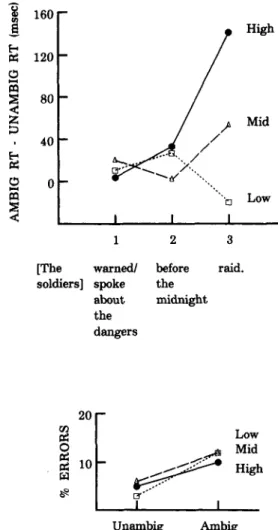
The critical data do not concern tricky garden path sen-tences, but on the contrary, they concern the most common syntactic structures in English, such as Sentence 7: "The experi-enced soldiers warned about the dangers before the midnight raid." This sentence is temporarily ambiguous, as can be demon-strated by considering an alternative resolution, such as Sen-tence 8: "The experienced soldiers warned about the dangers conducted the midnight raid." The syntactic ambiguity involves the interpretation of "warned" as either a main verb or as a past participle in a reduced relative construction. In Sentence 7 this ambiguity is resolved with the period at the end of the sentence. The surprising result is that only high span subjects show any effect of the ambiguity in Sentence 7, as evaluated by compari-son with the processing time on a control, unambiguous sen-tence that contains exactly the same words, except for the verb, such as Sentence 9: "The experienced soldiers spoke about the dangers before the midnight raid." Sentence 9 is unambiguous because the verb "spoke" can only be interpreted as a main verb and not as a past participle. For high span subjects, ambiguous sentences like Sentence 7 take longer than their unambiguous counterparts, particularly near or at the end of the sentence, where the ambiguity is resolved. In contrast, low span subjects show a small and generally unreliable effect of the ambiguity. Furthermore, in terms of absolute reading times, the high span subjects take longer than the low spans on reading ambiguous sentences, but not on unambiguous ones like Sentence 9. The reading time differences between the temporarily ambiguous main verb sentences and their unambiguous controls are shown in Figure 3. The sentences were presented in a self-paced, word-by-word, moving window paradigm. In the case of the main verb sentences, the three regions for which the reading time differences are plotted are indicated with brackets for the sam-ple sentence:
"The experienced soldiers
[warned about the dangers] [before the midnight] [raid.]" Region: 1 2 3 Precisely the same words (with the exception of the verbs) enter into each region for both the ambiguous and unambiguous con-ditions. Across a series of experiments, the high span readers showed a reliable ambiguity effect at and near the end of the sentence. These results strongly support the contention that high span subjects are maintaining two representations of the syntactic ambiguity, and they pay a concomitant price of slow-ing down their processslow-ing.
We have already commented on one remarkable facet of the results, namely that high span subjects pay a measurable price for maintaining two interpretations. The other remarkable facet is that sentences like Sentence 7, "The experienced sol-diers warned about the dangers before the midnight raid," are not garden path sentences. Even though the sentence is tempo-rarily ambiguous, it is ultimately given the more frequent
resolu-tf O 2 13 tf g S 160 120 80 40 0 High Mid 1 [The warned/ soldiers] spoke about the dangers before the midnight raid. 20 ERROR S »— * o — a'"' 1 Unambig Low ^0 Mid S^-"* High 1 Ambig
Figure 3. The differences between the ambiguous (AMBIG) and
un-ambiguous (UNAMBIG) sentences in the average reading time (RT) per word for the three regions of the sentences for the high, medium (Mid), and low span subjects. (The high span subjects take additional time on sentences with structurally ambiguous verbs, such as "warned," than those with unambiguous verbs, such as "spoke." This result is consistent with the hypothesis that high span subjects main-tain the ambiguity in working memory for a longer period than do medium or low span subjects. The error rates are indicated in the bottom panel.)
tion, that "warned" turns out to be the main verb of the sen-tence. The high span readers have not been led down a garden path. They represented an alternative, less likely path as they walked down the main path. The low span subjects also have not been led down the garden path. They represented just one alternative, and it turned out to be the correct one. They main-tained only one interpretation, and thus did not have to pay any significant costs due to the sentence's temporary ambiguity. However, even high span readers do not hold onto multiple interpretations indefinitely; the ambiguity effect for these sub-jects can also be eliminated if the ambiguous region is greatly lengthened.
Of course, the correct interpretation of the temporary ambi-guity could have turned out differently, as in Sentence 8: "The
experienced soldiers warned about the dangers conducted the midnight raid." In that case, there is a distinct advantage in having represented both alternatives. In this sentence, the correct interpretation is the less likely alternative, the reduced relative interpretation that corresponds to "The experienced soldiers who were warned about the dangers conducted the mid-night raid." The high span subjects are more likely than the lows to have the correct interpretation available, and this is reflected in their better comprehension of this sentence, as assessed by their accuracy in answering a comprehension question, like "Did someone tell the soldiers about dangers?" Of course, the high span subjects pay the cost of maintaining both interpreta-tions, as indicated by their greater reading time on this sen-tence than on a control sensen-tence. The low span subjects do not do the extra maintenance for any length of time and have no extra cost to pay as they read along; however, they are led down the garden path, and after encountering an unexpected verb, their resulting comprehension is often near chance level. We will present a more detailed processing account of the results in a later section that describes the capacity constrained simula-tion model.
The comprehension errors converge with this analysis, show-ing that the capacity constrained on-line processshow-ing is also a determinant of the ultimate comprehension of the sentence. The comprehension error rates are higher for ambiguous sen-tences, even if they are resolved with the main verb interpreta-tion. Of course, the error rates are higher for the less likely relative clause interpretation.
A further control study showed that the ambiguity effect per-sists even when relative clause sentences were not included, so that the effect could not be attributed to a strategy that devel-oped in the presence of this construction. Moreover, the ambi-guity effect cannot be attributed to differences between the verbs in the ambiguous and unambiguous conditions, rather than to the syntactic ambiguity. The ambiguity effect is essen-tially eliminated if the same verbs are used, but proper nouns replace the common nouns, as in Sentence 10: "Captain Thompson warned about the dangers before the midnight raid." The proper noun eliminates the reduced relative interpre-tation and, consequently, the ambiguity effect. However, in the same control experiment, the ambiguity effect was replicated for sentences like Sentence 7. Finally, the ambiguity effect oc-curs not only when the sentences are presented in isolation, but also when the sentences are embedded in short paragraph con-texts.
These findings demonstrate that individual differences in working memory capacity can produce different parsing out-comes for syntactically ambiguous sentences, which in turn can lead to differences in comprehension. The model unifies the previously disparate single and multiple representation models of parsing and points to the adaptability of the parsing mecha-nisms to the availability of memory resources.
Extrinsic Memory Load
The availability of working memory resources has often been experimentally manipulated through the introduction of an extrinsic memory load, such as a series of words or digits that are to be retained during comprehension. The extrinsic
load could consume resources simply by virtue of being main-tained in working memory or by virtue of rehearsal and recod-ing processes that compete for resources (Klapp, Marshburn, & Lester, 1983). As the extrinsic load increases, one or more facets of performance degrades such as the reading rate or the ability to recall the load items (Baddeley & Lewis, reported in Badde-ley, 1986; BaddeBadde-ley, Eldridge, Lewis, & Thomson, 1984).
The maintenance of an extrinsic load interferes with sentence comprehension, which suggests that they compete for the same resources. An extrinsic load condition was included in the syn-tactic complexity experiment described earlier (King & Just, 1991), involving sentences with subject-relative and object-rela-tive clauses, such as "The reporter that the senator attacked admitted the error." When the subjects were required to retain one or two unrelated words while reading the sentence, their ability to answer a subsequent comprehension question was less than in a condition in which there was no extrinsic load.
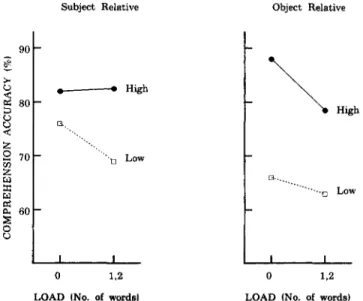
Figure 4 shows the comprehension accuracy of the high and low span subjects when there was no additional load, compared with a condition in which the subjects were maintaining either one or two words. A comparison of the overall performance for the two panels confirms that, as expected, accuracy is generally higher for the subject-relative sentences (left-hand panel) than for the linguistically more complex object-relative sentences (right-hand panel). The accuracy is particularly impaired for the low span readers, who have less capacity for the complex computations entailed in processing the object relatives. In-deed, King and Just (1991) found that half of the low span subjects had comprehension rates for the object-relative sen-tences that were indistinguishable from chance (66% in this study). Given the low level of comprehension in the absence of a load, the extrinsic load only slightly decreases comprehension
Subject Relative Object Relative
90
8
80a
2 70 W Cd OS 0. 60 O O -• High Low 1 High Low I 0 1,2 LOAD (No. of words)0 1,2 LOAD (No. of words)
Figure 4. Comprehension accuracy for subject-relative and
object-relative sentences in the absence or presence of an extrinsic memory load for high and low span reading groups. (Comprehension accuracy is lower for the low span subjects, for the more complex object-relative clause sentences, and when subjects are simultaneously retaining a load.)
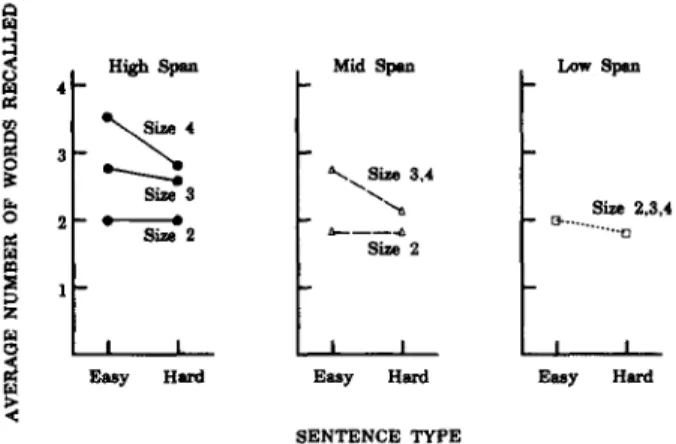
accuracy. The effect of the load is much more apparent for the high span subjects who, in the absence of a load, have sufficient capacity to comprehend the object-relative sentences with much greater accuracy than the low span subjects. In sum, comprehension accuracy decreases both when there is less ca-pacity because of a subject variable (as in the span contrast), because of additional linguistic complexity (as in the contrast between the two sentence types), or because of an additional extrinsic memory load (as in the contrast between a load of 0 words and 1 or 2 words). Such data are consistent with the hypothesis that some aspect of maintaining an extrinsic load competes for the resources used in the comprehension process. Not only does load maintenance interfere with comprehen-sion, but comprehension can reciprocally interfere with the maintenance of an extrinsic load. This effect was demonstrated in a modified version of the Reading Span task. The sentence-final words in this task constitute a concurrent load because the words from previous sentences must be maintained during comprehension of the current sentence. Thus, it is possible to manipulate the complexity of the sentences and examine its effect on recalling the sentence-final words. If the sentences in the set are linguistically more difficult, then the recall of the sentence-final words decreases (Carpenter & Just, 1989). The easy sentences (e.g., Sentence 11: "I thought the gift would be a nice surprise, but he thought it was very strange") primarily differed from the more difficult sentences (e.g., Sentence 12: "Citizens divulged that dispatching their first born was a trau-matic event to face") in the presence of more common and concrete words, as well as in syntactic complexity. The subjects, all college students, were given sets of two, three, or four sen-tences to read and then asked to recall the sentence-final words. The number of sentence-final words recalled was generally lower if the subjects had read a set of difficult sentences than if they had read easy sentences. This was particularly the case if the number of sentence-final words exceeded the reader's span, as assessed by the Reading Span task. For example, high span readers could retain and recall almost all of the words of a four-sentence set of easy sentences, but they could recall only three items if the set was composed of hard sentences. However, the difficulty of the sentences had little influence on their re-call for sets of three or fewer sentences. Similarly, medium span readers could recall almost all of the words of a three-sentence set if the sentences in the sets were easy, but they could recall only two items if the set was composed of hard sentences. The pattern of recall results, shown in Figure 5, demonstrates that the processing of difficult sentences interferes with the ability to retain and recall an extrinsic load, particularly if the subjects are operating close to their working memory capacity limit.
These overall effects do not indicate which comprehension processes may be more or less vulnerable to the effect of an extrinsic load. There is some evidence that low-level processes may be less vulnerable to the effect of an extrinsic load than more conceptual processes. The time attributed to word encod-ing is not affected by the presence or absence of a memory load (Carpenter & Just, 1989), nor is the speed of retrieving and judging whether an instance (eg., pine) is a member of a prespe-cified category (e.g, tree) (Baddeley, 1986). However, even as low-level a process as lexical access may be sensitive to working memory constraints. An attribute of gaze duration that is
re-Q U J B B 8
i
Mid Span Size 3,4 Size 2 I Low Span Size 2.3,4 Q-nEasy Hard Easy Hard SENTENCE TYPE
Easy Hard
Figure 5. The average number of load words that are recalled after a
subject reads a set of sentences that are either hard, because they con-tain difficult vocabulary, or easy. (Recall primarily decreases when the subject is at or near his or her capacity and the sentence is hard.)
lated to lexical access (an increase in gaze duration with de-creasing normative word frequency) showed sensitivity to ex-trinsic load, at least for individuals with larger working mem-ory capacities (Carpenter & Just, 1989). It is commonly assumed in the literature on automaticity that perceptual pro-cesses and highly practiced propro-cesses are less dependent on attention and may be less vulnerable to any kind of interference from a competing task (Cohen, Dunbar, & McClelland, 1990). If this assumption is applied to language processing, one might correspondingly predict that higher level comprehension pro-cesses would be much more disrupted by a competing task, such as maintaining an extrinsic load, than would lower level processes. However, as yet, there are inadequate data against which to examine this hypothesis. What the data do suggest is that comprehending a sentence and storing an extrinsic load draw on shared resources, so that performance declines when the two tasks conjointly exhaust the resources.
Distance Effects
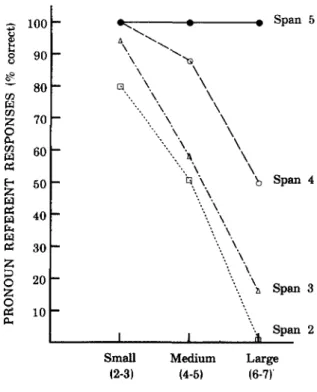
An intrinsic part of language comprehension is the ability to interrelate information that comes from different constituents, such as clauses or sentences. Consequently, there is a need to retain information over time and intervening computations. Working memory provides the resources to store information from preceding constituents while simultaneously providing the computational resources to process ensuing constituents. The greater the distance between the two constituents to be related, the larger the probability of error and the longer the duration of the integration processes (e.g, Chang, 1980; Jar-vella,1971).
Text distance effects. A text distance effect has been found
with a variety of constructions and relations. For example, sen-tences that contain pronouns take longer to read if other clauses or sentences intervene between the sentence and the earlier referent, presumably because of increased time to search for the referent (Clark & Sengul, 1979). Sentences that contain a term referring to a member (e.g., trombonist) of a category that