EFFECTIVENESS OF COMPUTER APPLICATIONS
IN MANAGEMENT OF BUILDING
CONSTRUCTION PROJECTS IN SRI LANKA
By
GEORGE PREMAN JEYAWEERASINGHAJVI
cGte3Q9 I M S Q © ° Q S ® A P R O J E C T R E P O R T S U B M I T T E D I N P A R T I A L F U L F I L L M E N T O F T H E R E Q U I R E M E N T S F O R T H E D E G R E E O F M A S T E R O F E N G I N E E R I N G I N C O N S T R U C T I O N M A N A G E M E N T M a y 1996
Supervised by (V ,
K]''*S
Eng. P.M. GUNASEKARA LA
No
D E P A R M E N T O F C I V I L E N G I N E E R I N G
U N I V E R S I T Y O F M O R A T U W A
M O R A T U W A , S R I L A N K A
6Q^6'[6 7 9 8 3
69'°Abstract
Today, construction activity is becoming increasingly complex due to rapid improvement in design and technology. Completing construction project without time and cost overrun is a great challenge. In the Sri Lankan conditions, the need for efficient management is more urgent than ever before. In fact, inefficient construction management has contributed to long drawn-out projects in the past with inflated costs and delayed utilisation. Professional construction project management input is a mandatory requirement for successful project completion, and one tool the project manager can effectively use to manage the project is a computer system. This study reports, research in to the application of computers in construction management by building contractors in Sri Lanka. The focus of this research was to gather industry experience in the use and application of construction management software and to asses the benefits realised by the industry. It is based on a survey of local and foreign building contractors and property developers. The local building firms were selected among ICTAD registered contractors and only Grade 1 and Grade 2 contractors were surveyed.
The industry experience in computer applications in construction management were studied under five major functional areas : Construction Planning and Control; Contract Administration; Stores Management; Estimation and Valuation; and Finance and Office administration. This was done through a questionnaire based interview. Contractors views on reasons for using computers, difficulties faced, benefits realised, future development and the level of user satisfaction were also considered. The results indicates the computer applications in construction management currently practised by contracting firms in Sri Lanka are not successful in generating information to control cost and time. The effectiveness of computer application in construction management was found to be largely contingent upon the commitment and involvement of the user as well as the quality of the computer system used and the professional advice received.
Acknowledgements
I wish to express my gratitude to my guide Eng. P.M.Gunasekara, for his valuable guidance and support in this project. I also wish to thank him sincerely for making available to me, his computer system for my use during the project, which has greatly enhanced the research.
It is my duty to remember with gratitude, the Course Director Prof. S.R.De S. Chandrakeerthy and his academic staff for their valuable contributions given to complete the Master Degree Program successfully.
My sincere appreciation is greatly extended to many members of the construction industry and profession who have shared with me their views on computer application in construction management.
I wish to sincerely express my gratitude to my parents, for their encouragement, support and inspiration given to me to pursue my higher studies.
Contents
Abstract i Acknowledgements ii Contents. Hi List of Abbreviations v List of Tables viChapter 1: Introduction 1
1.1 Background 1 1.2 Objectives 3 1.3 Methodology 4 1.4 Guide to report 5Chapter2: Literature Survey 6
2.1 Introduction 6 2.2 Construction management techniques 6
2.2.1 Planning techniques 7 2.2.2 Scheduling techniques 7 2.2.3 Control techniques 8
2.2.3.1 Progress control techniques 8 2.2.3.2 Cost control techniques 8 2.3 Construction management functions which need computer applications 10
2.4 Type of computer software and their applications 11
2.4.1 Project management software 11
2.4.1.1-Planning Tool 13 2.4.1.2 Scheduling Tool 14 : 2.4.1.3 Control Tool 14 2.4.2 Spread Sheet Software 16
2.4.4 Contract control software 2.4.5 Database management software 2.4.6 Computer aided estimating software 2.4.7 Accounting software
Chapter 3: Development of Study and Data Collection
3.1 Methodology 3.2 Limitation of study
3.3 Formulation of interview questionnaire 3.4 Pilot study
3.5 Identification of target group 3.6 Data collection
3.6.1 Information from literature survey
3.6.2 Interviews and discussions through questionnaire
Chapter 4 : Analysis
4.1 Introduction 4.2 Analysis 4.3 Discussion
Chapter 5: Conclusion, Recommendation and Further study
5.1 General 5.2 Conclusion 5.3 Recommendation 5.4 Further study References Appendix A Appendix B iv
List Of Abbreviations
ICTAD Institute for Construction Training And Development
DP Data Processing
PERT Program Evaluation Review Technique
MMI Man/Machine Interface
AI Artificial Intelligent
IKBS Intelligence Knowledge Based System
CPM Critical Path Method
LOB Line Of Balance
BCWS Budgeted Cost for Work Schedule
ACWP Actual Cost for Work Performed
BCWP Budgeted Cost for Work Performed
P3 Primavera Project Planner
WBS Work Breakdown Structure
PM Project Management
CM Construction Management
GUI Graphical User Interface
PC Personnel Computer
CAE Computer Aided Estimating
BOQ Bill Of Quantity
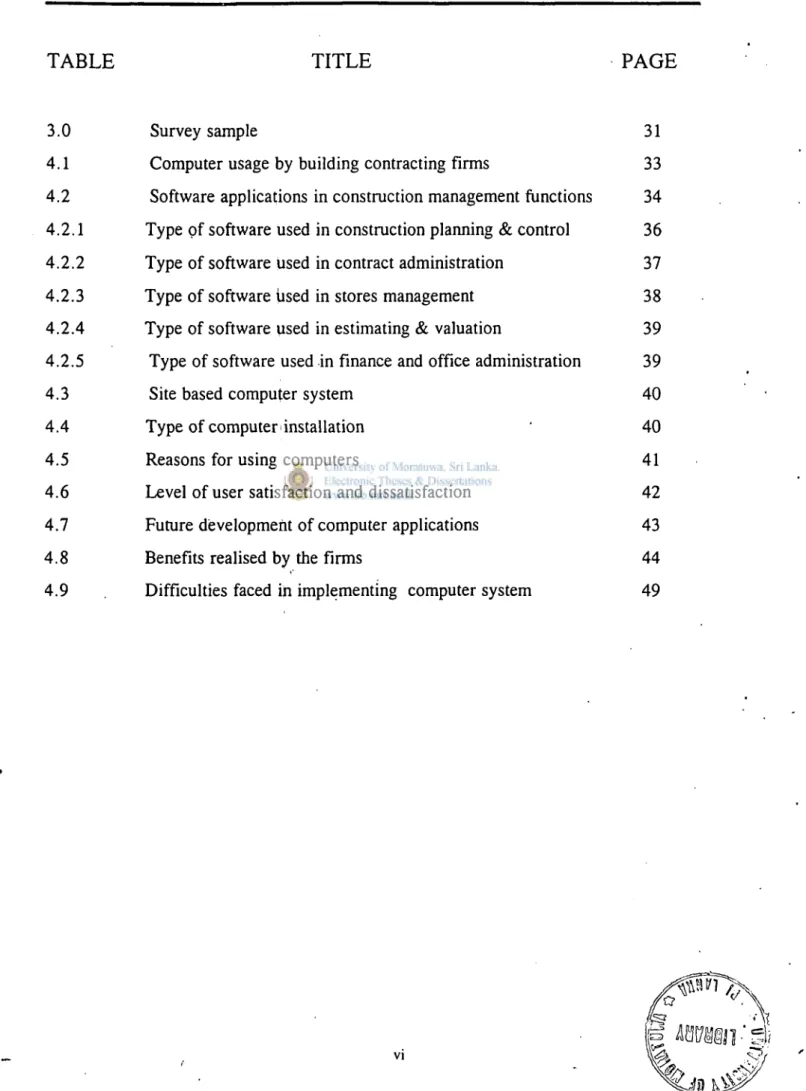
List Of Tables
TABLE TITLE PAGE
3.0 Survey sample 31 4.1 Computer usage by building contracting firms 33
4.2 Software applications in construction management functions 34 4.2.1 Type of software used in construction planning & control 36
4.2.2 Type of software used in contract administration 37 4.2.3 Type of software used in stores management 38 4.2.4 Type of software used in estimating & valuation 39 4.2.5 Type of software used in finance and office administration 39
4.3 Site based computer system 40 4.4 Type of computer installation 40 4.5 Reasons for using computers 41 4.6 Level of user satisfaction and dissatisfaction 42
4.7 Future development of computer applications 43
4.8 Benefits realised by the firms 44 4.9 Difficulties faced in implementing computer system 49