econ
stor
www.econstor.eu
Der Open-Access-Publikationsserver der ZBW – Leibniz-Informationszentrum Wirtschaft
The Open Access Publication Server of the ZBW – Leibniz Information Centre for Economics
Nutzungsbedingungen:
Die ZBW räumt Ihnen als Nutzerin/Nutzer das unentgeltliche, räumlich unbeschränkte und zeitlich auf die Dauer des Schutzrechts beschränkte einfache Recht ein, das ausgewählte Werk im Rahmen der unter
→ http://www.econstor.eu/dspace/Nutzungsbedingungen nachzulesenden vollständigen Nutzungsbedingungen zu vervielfältigen, mit denen die Nutzerin/der Nutzer sich durch die erste Nutzung einverstanden erklärt.
Terms of use:
The ZBW grants you, the user, the non-exclusive right to use the selected work free of charge, territorially unrestricted and within the time limit of the term of the property rights according to the terms specified at
→ http://www.econstor.eu/dspace/Nutzungsbedingungen By the first use of the selected work the user agrees and declares to comply with these terms of use.
zbw
Leibniz-Informationszentrum Wirtschaftvan Gorp, Annemijn; de Vries, Erik
Conference Paper
Preventing and managing disasters during public
events: The collaborative development of an ICT
ecosystem
25th European Regional Conference of the International Telecommunications Society (ITS), Brussels, Belgium, 22-25 June 2014
Provided in Cooperation with:
International Telecommunications Society (ITS)
Suggested Citation: van Gorp, Annemijn; de Vries, Erik (2014) : Preventing and managing disasters during public events: The collaborative development of an ICT ecosystem, 25th European Regional Conference of the International Telecommunications Society (ITS), Brussels, Belgium, 22-25 June 2014
This Version is available at: http://hdl.handle.net/10419/101391
Preventing and Managing Disasters during Public Events: The Collaborative Development of an ICT Ecosystem
Paper to be presented at ITS Europe, Brussels, June 2014 Annemijn van Gorp & Erik de Vries
The Hague University of Applied Sciences a.f.vangorp; [email protected]
Keywords
Public events, crisis management, event safety & security, technological innovation
Introduction
Ensuring people’s security during public events is an important, yet daunting task. Many people still remember the disaster of the 2010 Love Parade music festival held in Duisburg, which ended in the death of 21 visitors and 500+ injured due to an overcrowded ramp between tunnel underpasses and the festival area.
For any public event that attracts a large crowd of people to places that are usually less populated, it is important that visitors’ as well as emergency responders’ safety can be guaranteed. Issues like overcrowding, aggression, people in immediate need of medical attention, etc. ask for timely response of a variety of emergency responders like police, fire brigades, event organizers and ambulance. Event organizers, emergency responders and visitors must communicate to ensure timely and accurate information exchange on places where to go, pass on help requests, guidance to the right exit routes, etc. This is especially challenging for all those events that take place in (semi) open urban spaces that were initially not designed to handle large crowds of visitors, like the Amsterdam gay parade, Amsterdam SAIL, or the Life I Live festival in The Hague. Imagine for instance that during the Amsterdam SAIL event, a tall ships parade with over a million visitors, a person suffers direct heart failure on one of the ships. How could we prevent an ambulance arriving on one side of the river on an overcrowded quay while the water police is heading towards the other river bank to hand over the patient on a quiet private industry dock? During the last sail event this scenario became reality and an occasional experiment with modern information and communication technology (ICT) helped to coordinate emergency responders’ work and saved the person’s life.
Nowadays an increasing number of ICTs are available to support event security. Information on crowd whereabouts provided by telecom operators can help both visitors and emergency responders where to go and helps event organizers to count visitors and to get an idea where they come from. Eventually visitors could be guided to less crowded parts of the open urban space by offering price reduction on drinks, starting artist performances earlier than programmed or simply guiding them to video screens on which the performance that attracted the crowd could be better seen. Geographic information systems visualize geographic points where emergency response is needed, show safe and unsafe exit routes, or visualize toxic gas clouds and provide triggers to communicate electronically with emergence responders working in the geographic area into which the cloud develops. Integrated emergence response systems in event control rooms provide policy makers with an actual overview to support adequate decision-making. Multi agent software systems working on private or open networks support instantaneous information exchange between many systems of many organizations to gather in the first minutes of the golden (first) hour of disaster recovery to help people evacuate and to
support emergency responders to get into the area simultaneously. Dynamic traffic management systems could create green lanes to exit or enter the area of disaster.
Despite these technological developments to date many of these promising technologies are used only on an ad-hoc and mostly stand alone basis by different organizations, some of them being private, some being governmental organizations, during different events. While many innovative technologies already have been piloted, larger scale rollout has not yet taken place, partially due to lack of a viable business model and partially due to varying needs by the involved stakeholders as well as limited efforts to date to stimulate collaboration between stakeholders to coordinate their technology investments.
The objectives of this paper are twofold. First, we aim to provide an overview of the various innovative technologies that are currently being piloted to gain understanding of their added value during public events. Second, we aim to provide insight into how technologies can be used to enhance collaboration between safety and security stakeholders during public events. This will provide preliminary insights into some of the aspects that may affect the development and adoption of ICTs to support public safety during public events.
Inter-organizational ecosystems
Inter-organizational collaboration is needed to ensure event safety. Integrated information systems have been argued to support these inter-organizational processes by providing timely and accurate information. Arguably, many emergency responses have failed due to problems in the sharing and coordination of information; which is induced by lack of clarity about what information is needed by whom and when, and who is responsible for providing the information (Janssen et al, 2010).
Information sharing and management between organizations that have not previously done so creates many challenges. Different stakeholders with different organizational policies, restricted knowledge of others’ organizations, need to come together and develop shared governance processes in which approaches to innovation, cooperation, design and decision-making is shared among this variety of stakeholders (Pannemans, De Bruijn & De Vries, 2012). Various new organizational types have been described in the literature where a variety of actors comes together. Alliances in general refer to collaboration between competing organizations, where value creation depends on the pooling of various resources, that organizations access and acquire through different kinds of partnerships (Ritala, 2012). Meta-organization is a term coined to describe organizations that comprise multiple autonomous organizations. The meta-organization solves the basic problem of organizing without relying on formal authority (Gulati et al., 2012). In one type of meta-organization, the managed ecosystem, the majority of members contribute to the systems input, while a smaller number collaboratively bear responsibility and (more informally) control the output (Gulati et al, 2012). Indeed, the development of a model where multiple stakeholders invest in technologies for public safety, resembles an ecosystem; a loose network of various types of organizations that affect, and are affected by, the creation and delivery of the ecosystem’s offerings (Guegen & Ischkia, 2011). The development of an ecosystem of ICTs to support public safety during events in open urban space could thus itself be seen as a ‘system innovation’: Different organizations with different economic models, ranging from private ICT industry to private event organizers, public governmental agencies, municipalities and emergence response organizations need to invest in an ICT ecosystem. Further, many of the decision makers cannot completely oversee the new
system and its implications, economic viability is not proven yet, and cooperation challenges are partially unknown (Panneman, de Vries & de Bruijn, 2012).
Indeed, inter-organizational networks responding to large-scale safety and security incidents typically are seen to be best coordinated by networked organizations (Treurniet et al., 2014): Mixed-sector networks where the various organizations have different strategic orientations (Treurniet et al., 2014).
To date, extant literature has discussed the coordination among emergency responders (police, ambulance, fire department). Particularly often discussed, is the coordination between emergency responders. They operate in a hierarchical manner, in order to establish control, specify tasks, allocate responsibilities and reporting procedures. However, this primarily suits routine circumstances (Janssen et al., 2010). In order to respond to crises, but also in order to collaborate with other organizations and for collaborative adopt new ICTs, this may lead to barriers.
Further, even though a large number of new technologies have recently been developed, ,many of these technologies have not yet been integrated into the daily routines of emergency responders (Janssen et al., 2010). According to Janssen et al. (2010), this might hinder effective use during actual emergencies.
Next, we investigate what the ecosystem of public event safety technologies entails. Who are the involved stakeholders, and how can they collaboratively develop and adopt an ecosystem of ICTs to support their endeavors to increase public safety?
Method
This study has taken a case study approach. Case studies are most suited to studies which deal with contemporary events, over which the researcher has little or no control and in which the borders between the phenomenon of interest and its context are not clear (Yin, 1994) or to study phenomena not supported by a strong theoretical base (Benbasat, Goldstein & Mead, 1987). Our case study constitutes an exploratory analysis of the use of new ICTs to enhance public safety during the Life I Live festival of 2014 in The Hague, the Netherlands. Case study research is an accepted strategy for exploration (Benbasat, Goldstein & Mead, 1987; Lee, 1989; Yin, 1994). Life I Live is an annual festival in the city center of The Hague, spread out over multiple streets and squares, which attracted over 175.000 visitors during the 2014 edition. During the 2014 event a variety of technologies was piloted in the control room. This provides a good base to investigate how technologies have been used, and how they affected the operation and safety management of the festival, including coordination among the different emergency responders.
We used multiple data sources for data collection: interviews, documents and direct observation.The use of these data sources is not too time consuming, allows for triangulation to guarantee validity and the data sources complement each other in their strengths and weaknesses. The complementary use of these data sources is common in case research (de Vries, 2005). The interviews took approximately one hour, were thematically structured, open-ended and transcribed. The advantage of applying these qualitative approaches is the flexible and responsive interaction which is possible between interviewer and respondents which allows meanings to be probed, topics to be covered from a variety of angles and questions made clear to respondents (Sykes, 1990). This paper constitutes a work in progress. At the time of writing four people have been interviewed who work at technology providers that can help ensure the
safety of events. They have been asked questions about their perceptions of how the technology worked during the event, where they might improve their technologies, how they perceived emergency responders’ interest in the various technologies deployed in the control room, and finally how they see their business model evolve in the future. Document analysis has been used to gain more insight into the various technologies employed.
Case Study: Life I Live in The Hague Background
About thirty of the largest Dutch municipalities, collaborating in the so-called Dutch ‘Digital City Agenda’, work together to innovate cities through the use of ICTs. Every municipality has adopted a certain theme to improve on, like education, safety, care, etc. The City of The Hague took leadership in safety and security with a special interest in event security. The Hague is a city that hosts many large scale public events in open urban space every year. These public events range from well-organized music festivals to international meetings and (sometimes unexpected) political demonstrations. Under the umbrella of the Digital City Agenda and together with innovation agency Studio Veiligheid (‘Studio Safety’), TNO, the Dutch agency for applied research and The Hague University of Applied Research, the Hague municipality started a platform for event safety and security called Future Events. Future Events aims to support the development of viable solutions that will make public events safer. To this end, multiple workshops have been organized that brought together stakeholders with an interest in public event safety, and a start has been made with piloting technology solutions. This case study will report primarily on key issues related to public event safety identified during workshops and the piloting of innovative technologies during the so-called “Life I Live” festival in The Hague in April 2014.
During workshops, the following issues were identified that event organizers have to be prepared for to keep the public safe: General safety (crowd safety, small accidents), security (public disorder, activism, terrorism), health (basic life support/first aid, advanced life support, including drugs and hygiene) and crisis management (scenarios).1
To ensure the safety of the public many stakeholders are involved. While the police bears responsibility for calamities, the event organizer bears significant responsibilities as well; in particular the event organizer is responsible for prevention and small ‘incidents’. When incidents grow bigger, the Police takes over responsibility. In the end, according to Dutch law, the City is responsible for security and safety of its citizen and visitors.2
Due to their responsibility, event organizers are looking for ways to efficiently monitor their events. The event organizer of Life I Live is interested in deploying new technologies that enable better monitoring and information sharing between all stakeholders involved in public safety. Nowadays, safety & security account for approximately 1/5 of the overall event budget (Prooost, 2013). However their budget to invest is rather small. Due to the percentage of safety and security costs in the overall budget, opportunities to invest are limited. However, their might be a way out. And that is to use technologies that are used for safety, also to generate extra business. For the Life I Live event, it is estimated that the public generally spends approximately 35 euros during the event (Prooost, 2013). Only getting the public to spend just
1 Notes Workshop Evenementveiligheid (‘Event safety’), April 23, 2013 2 Notes Workshop Evenementveiligheid (‘Event safety’), April 23, 2013
one euro per person would generate enough income to cover many of the investments needed to lower safety and security costs and improve safety at the same time. Thus, the event organizer is responsible for investing in technology and other measures to ensure the safety of the public at events, while, according to e.g. the Life I Live event organizer, it does not have the necessary means to do so; i.e. to develop a fully equipped control room etc. (Prooost, 2013). On top of this, two trends are taking place in the safety and security management of public events. First, due to recent incidents there is an increased need for enhancing security and safety measures. In addition, a shift in responsibility for safety and security is transitioning from the public to the private sector (LiL eval) (i.e. from typical first responders (policy) to private security companies). Both trends lead to increased costs in safety and security of public events (Prooost, 2013).
However, there are many festival spin-offs: e.g. public transport, hotels, cleaning companies, taxi companies, etc. do make money on festivals without having to invest. Therefore, events can also be seen as engines for local economic growth (Prooost, 2013).
Acknowledging these problems for the event organizer as well as the benefits that events bring to local economies, the City of The Hague and other stakeholders are collaboratively working together aiming to develop a catalogue of technologies that can be used on a flexible basis, according to the specific needs during a particular event3. The foreseen business model might rely on Cities to manage the catalogue4. Stakeholders are trying to develop a co-investment model. Event organizers and emergency responders as well as other stakeholders involved in event safety can then use the available technologies5. The need to involve multiple stakeholders is acknowledged during workshops; in other words event organizers, police, municipality and fire fighters should be part of one team6. At the same time however it is acknowledged that to
date these different stakeholders “do not always” coordinate their efforts.
The Need for Information and Communication Technology
In order to ensure public safety and for the event coordinator to have appropriate situational awareness during Life I Live, the following information was needed during the 2013 festival: the number of people in the festival streets, squares and walking routes in between the various festival/stage hotspots, reports from the ground on the festival mood at the various hotspots and walking routes, number of people in trains and streetcars in the area, traffic situation near the festival area, updates if performances run late, weather reports, incidents, and group formation and sedition (Prooost, 2013).
In turn, output from the event coordinator to the public and supporting organizations (including safety & security) for crowd control has been communicated through the following channels in 2013: signaling by service teams and security, standby teams in different sectors of the festival, displays with public messages on cars and banners, fencing on strategic locations, notifications per location, Twitter, information displayed on stages, notifications through the National Railway service (NS), informing national press agency (ANP), informing the regional TV station and road blocking (LiL eval 2013).
3 Notes Workshop Evenementveiligheid (‘Event safety’), April 23, 2013 4 Notes Workshop Evenementveiligheid (‘Event safety’), April 23, 2013 5 Notes Workshop Evenementveiligheid (‘Event safety’), April 23, 2013 6 Notes Workshop Evenementveiligheid (‘Event safety’), April 23, 2013
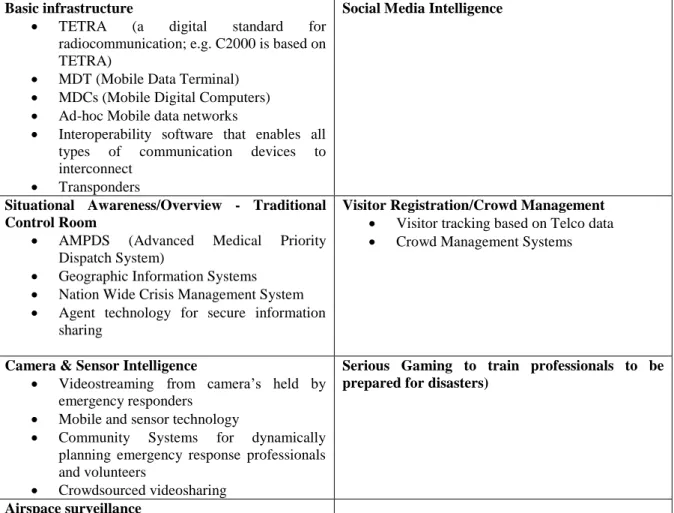
This shows that the use of digital technology by the event organizer was still limited in 2013. An initial list of available technologies was developed by Studio Veiligheid based on over five years of working in the safety and security area with innovative technologies. We have categorized them into basic infrastructure, situational awareness/overview, camera and sensor intelligence, visitor registration and crowd management, social media intelligence, serious gaming, and airspace surveillance technologies, although functionalities of the technologies often overlap. See table 1 for examples of each type of technologies.7
Basic infrastructure
TETRA (a digital standard for radiocommunication; e.g. C2000 is based on TETRA)
MDT (Mobile Data Terminal)
MDCs (Mobile Digital Computers)
Ad-hoc Mobile data networks
Interoperability software that enables all types of communication devices to interconnect
Transponders
Social Media Intelligence
Situational Awareness/Overview - Traditional Control Room
AMPDS (Advanced Medical Priority Dispatch System)
Geographic Information Systems
Nation Wide Crisis Management System
Agent technology for secure information sharing
Visitor Registration/Crowd Management
Visitor tracking based on Telco data
Crowd Management Systems
Camera & Sensor Intelligence
Videostreaming from camera’s held by emergency responders
Mobile and sensor technology
Community Systems for dynamically planning emergency response professionals and volunteers
Crowdsourced videosharing
Serious Gaming to train professionals to be prepared for disasters)
Airspace surveillance
Table 1: Types of Public Event Safety Technologies
Technology Pilots Life I Live
During the 2014 event a number of innovative technologies were piloted which are described in this section.
Situational Awareness by Geographic Information Systems
One of the technology companies provides advanced Geographic Information Systems to police control rooms, mapping both static and dynamic objects. Static objects included locations of obstacles, calamity routes, police stations, fence supply, and camera positions. Dynamic objects included e.g. festival locations, visualization of crowdedness on walking routes, road closures, cars with message displays, emergency responders’ and security vehicles.8 The map uses different colors to indicate the different levels of bustle (i.e. crowd sizes). Depending on the color, the organizer would know what action to take (e.g. place fences,
7 Examples are taken from the list of technologies developed by Future Events.
close roads, evacuate areas).9 During Life I Live the event organizer used the tool in the control room. The tool was felt to provide valuable realtime oversight.
Situational Awareness
Another company provides a 3D geographic tool that tracks and traces private security guards and police officers. Input can be shared with the control rooms of both the police and event organizer. In addition, they monitored and analyzed social media during the festival by social media intelligence tools10. This tool was deployed in the control room.
The technology was found to be very useful to gain an overview of the locations of security teams, as well as sending security teams towards incidents.11
Dynamic trafficking and meeting
Technologies based on social media are finding their way to event management as well. An example is a social media type app that has been piloted during Life I Live. Prior to the event visitors could download the app, which helped them plan their agenda and route to and through the festival. The app provides various types of information; e.g. on performances (time, location, etc.), bars, public transport, parking spaces, available hotel rooms, etc.12 The social media component evolves around automatic check in at various places so that users can see if their friends are around, as well as group chats enabling communication among friends. Visitors using the app could also be notified by the festival organization with information ranging from notifications of overcrowded places, festival info such as free tickets for an after party, free hotel rooms, etc.
An app like this makes it possible not only to gain insight into real-time data tracking the walking routes from its visitors. Due to the scheduling component, it also provides insights into visitors’ plans; including the number of people coming from out of time taking particular train routes; the time when people plan to leave, thereby providing insight into what might be busy times for traffic, the preferred modes of transport, etc.
Further, by having real-time data on whereabouts of visitors, the app can be used to very specifically target people in certain locations, thereby avoiding an information overload on people for which certain information may not apply.
Infrastructure Technology
One of the technology companies has provided wireless Internet connectivity during the festival, which enabled recording and sending live video/streaming by visitors, security guards, etc. These videos provide information about security (crowds) and entertainment. 4G Network cameras were made available to monitor the area.13
One of the ideas behind providing wireless networks is that they make events more attractive; particularly as mobile networks often give problems during crowded events.
Camera Technology
Another company provided cameras that through the use of mobile networks are streamed (real time) to screens in the control room. Both fixed cameras and bodycams were used by security
9 Verslag Economietafel Future Events April 4, 2014 – Caballero Fabriek (Notes Future Events) 10 Verslag Economietafel Future Events April 4, 2014 – Caballero Fabriek (Notes Future Events) 11 Personal communication regarding pilot evaluation, May 2014.
12 Verslag Economietafel Future Events April 4, 2014 – Caballero Fabriek (Notes Future Events) 13 Verslag Economietafel Future Events April 4, 2014 – Caballero Fabriek (Notes Future Events)
guards. The fixed cameras were centrally controlled and provided both zooming and 360° degree turning functionality. The event coordinator used the system in the control room. The system was felt to provide good real time insigt into the crowds at various locations. For example, it was mentioned that prior to receiving a message through the portophone that a square had been closed, the event organizer was already aware through the video14.
In addition to private security, the Dutch police also used these cameras (by horseback riding police officers). While police increasingly uses cameras on patrol in their own operations, during Life I Live for the first time it shared videostreams with the event coordinator’s control room15.
Information Provision to the Public
Again another company rents and sells high quality audiovisual electronics, such as led displays, cameras, audiosystems, etc. At Life I Live 2014 they provided a technology that made it possible to direct messages from the control room to led displays across the festival area. Led displays are controlled from a central, coordination point and may carry advertising, but in case of emergencies, safety messages etc. could be displayed. The company managed the sytem themselves during the festival. Due to the new technology it was possible to provide the public with key information such as road/square closures during the event.
Life I Live Experiences
The pilot of the various technologies provides a number of insights; first in terms of (potential) usefulness to the event organizer itself, second in certain aspects of the technologies that still need further improvement, third, the pilot provides insight in aspects related to inter-organizational coordination (between event organizer and emergency responders), and fourth, in new types of collaboration/aspects related to potential business models. These insights will be discussed next.
Usefulness to Event Organizer
As discussed above, many of the technologies have shown to be useful; for example the dynamic trafficking and meeting app was used to push some information to visitors, which helps extend information provision to the public in addition to the use of traditional led displays. In addition, particularly the camera based technologies were found to be very useful in increasing situational awareness and quick information sharing (for example being faster than person to person communication via portophone).
Technology Improvements
Given that this was only a first experiment, and some of the technologies were really new, a number of insights were generated into the need for improved functionalities in the future. A number of insights generated were related to visualization, such as the questionable added value of 3D over 2D visualizations, the need to coordinate colors on maps between developers and users so that there is a shared interpretation of the visualized colors, and size of displays in the control room. Also in case of the use of apps for visitors, there is a need for many people to adopt them. In the example of dynamic trafficking and meeting app, the app was only marketed to visitors two days prior to the event. Nevertheless, also in post-experimental phases a good deal of attention needs to be given to buy-in by visitors. It was suggested that there should be a trigger for download.
14 Personal communication regarding evaluation pilot, May 2014. 15 Interview May 2014.
Inter-organizational coordination
The new technologies piloted have provided a small step forward towards more inter-organizational coordination as well, but at the same time it is evident that enhanced information sharing between event coordinator and emergency responders has a long way to go.
Positive experiences include for example, that during the festival visitors using the dynamic trafficking and meeting app were notified about street closure. The information that was pushed by the app was not generated through the app’s technology but was provided by another organization. Thus, this information sharing was possible due to multiple parties being in the control room and learning about others’ data.
At the same time, the pilot has given some ideas for how further integration of data from multiple sources would enhance situational awareness. For example, a technology like the dynamic trafficking and meeting app could be extended by coupling emergency responders directly to the system, so that for example the Police could have a direct line of communication with the visitors as well. However, this is still a long shot.
Although the police is increasingly using camera’s during public events, which stream realtime date to the Police control room, they have not yet been highly involved in this pilot. A step was taken however. For example, during Life I Live the Police also shared their camera streams with security people in the event organizer’s control room. The police had a number of horseback riding police officers wearing cameras on their helmets. 16
Even though emergency responders have not been highly involved in the pilot, two police officers have indicated to see benefits in the use of these new technologies. They feel that the new technologies provide a better overview of the various routes, positions, whereabouts of security and other staff, as well as incidents. They indicate that to this end a shared situational overview is of interest; and for example sharing evacuation protocols would be useful. 17 Nevertheless, the Police is still restrained in sharing data due to protocols, guidelines and laws that they have to adhere to. Nevertheless, sharing camera footage is a possibility in the current framework.18
The need or interest by emergency responders and other stakeholders in the new technologies has not thoroughly been evaluated yet. Interviewees indicate that they do feel that some emergency responders seem highly interested in new tools, yet they do not always have their organizations fully supporting new technologies. This of course is not surprising, given the bureaucratic structures and the well-established protocols that these organizations tend to have worked with for years.
A Collaborative Innovation System: Generation of New Business Models
One of the goals of the technology pilot, aside from experimenting with the technology itself, is to bring stakeholders together and find a model for co-investment by various stakeholders. Initiated by the City of The Hague and the event coordinator of Life I Live, other potential investors could be anyone involved in public safety or possibly even the technology providers
16 Verslag Economietafel Future Events April 4, 2014 – Caballero Fabriek (Notes Future Events) 17 Verslag Economietafel Future Events April 4, 2014 – Caballero Fabriek (Notes Future Events) 18 Verslag Economietafel Future Events April 4, 2014 – Caballero Fabriek (Notes Future Events)
themselves if they find ways to generate income through other means, such as for example transactions generated through extra services that users buy. Particularly a social media based app that is used by visitors provides such opportunities. However, given that most technology providers are not focused solely on public safety, and are active in other sectors as well, the business case must be clear. As one providers indicates, business is going well and in the case of collaborative development of an ICT ecosystem the bureaucratic and slow procedures constitute a barrier for intensive involvement. Yet another indicates that through the inter-organizational platform of Future Events or possibly other platforms, interesting parties can be found for further collaborative technology development. In doing so, aspects of different technologies could be brought together, as well as the skills of developers from different parties can come together, which could lead to improved technology development.
Discussion & Conclusions
This study has shown that a variety of new technologies are coming to the market that may help ensure the public’s safety during public events. These new technologies support communication and information provision in multiple ways; technologies may be directed towards the provision of basic infrastructure services, situational awareness enhancement, camera & sensor intelligence, visitor registration & crowd management, social media intelligence, serious gaming for disaster preparedness, and airspace surveillance. A number of the technologies discussed help increase the situational awareness of both event coordinator and emergency responders during public events. In addition, they have the potential to increase the flexibility of responders in emergency situations and as such support the earlier identified need for flexible coordination mechanisms that can be customized to specific circumstances and as such helps in improvised response situations (Janssen et al., 2010). Nevertheless, at the same time this increased flexibility is at odds with the protocols and routines that have often been in place for many years, and that have proven useful for routine practices.
Whereas previous studies have primarily focused on the role of emergency responders and their need for inter-organizational coordination during emergency response situations, this study has highlighted the increasing important role of event coordinator and private security.
The pilot of a number of these new technologies during the Life I Live 2014 event in The Hague has shown their added value, but also the need for further improvements in their functionality to support coordination. Further, the pilot showed that small steps are being made in increased coordination between event organizer and police. However, involvement of other stakeholders was still limited in the described case study.
The technologies would ideally be helpful both in times of routine operations as well as at times of crisis; since events have to be prepared for both routine and crisis operations. As Chewning et al. (2012) indicate, ICTs are used in different manners across different stages of emergencies (although not necessarily public events) and their recovery. However, when people are not used to a certain system, it is very unlikely that they will start using them at a time of crisis. Thus, technologies that can be used in flexible ways and that will be used in routine situations as well will have preference. As such, it is key that in the future technologies will be implemented that can be used for both routine situations as well as crisis management.
The development of new functionalities in the technologies as well as the subsequent adoption will in all likelihood depend on the business models that will be developed. For example, small start up technology firms can decide to collaborate to build larger systems. This will also enable them to build more functionality into their systems, through an extended developers base. A
coordinating platform like Future Events can take advantage of this by bringing together the technology providers, as well as the emergency responders, to find out more about the specific needs. This will be key to further development given that most technology providers are not necessarily purely focused on technologies to enhance public safety.
Beyond coordination between event coordinator, private security and police, a fully integrated effort would also further inter-organization collaboration and coordination also asks for working with other stakeholders such as ambulance and the fire department (particularly with regard to access routes to accidents by new technologies), and also with public transport providers. For example, new technologies give insight in traffic patterns as well. Timely communication to public transport providers could help them adjust their schedules or increase their capacity.
References
Benbasat, I., Goldstein, D. K. & Mead, M. (1987). The Case Research Strategy in Studies of Information Systems, MIS Quarterly, 11 (3), 369-386.
Chewning, L.V., Lai, C.-H., & Doerfel, M.L. (2012). Organizational Resilience and Using Information and Communication Technologies to Rebuild Communication Structures. Management Communication Quaterly, 27(2), 237-263.
Guegel, G. & Isckia, T. (2011). The Borders of Mobile Handset Ecosystems: Is Coopetition Inevitable? Telematics & Informatics, 28, 5-11.
Gulati, R., Puranam, P. & Tushman, M. (2012). Meta-Organization Design: Rethinking Design in Interorganizational and Community Contexts. Strategic Management Journal, 33, 571-586. Janssen, M., Lee, JK, Bharosa, N., & Cresswell, A. (2010). Advances in multi-agency disaster management: Key Elements in Disaster Research. Information Systems Frontiers, 12(1), 1-7 Lee, A.S. (1989), A scientific methodology for MIS case studies, MIS Quarterly,13 (1), 32-50.
Panneman, F., de Vries, E.J. & de Bruijn, P. (2012). Network Information Management for Collaboration in Disaster Management: Concepts and Case Study. In: Zlatanova, S. Peters, R. Dilo, A. & Scholten, H. Intelligent Systems for Crisis Management. Geo-information for Disaster Management.
Prooost (2013). Life I Live Festival 2013: Een terugblik in woord en beeld. Den Haag.
Ritala, P. (2012). Coopetition Strategy – When Is It Successful? Empirical Evidence on Innovation and Market Performance. British Journal of Management, 23, 307-324.
Vries, E.J. de (2005). Epistemology and Methodology in Case Research: A Comparison between European and American IS Journals, Proceedings of the13th European Conference of Information Systems, Regensburg, Germany, May 25-28.
Sykes, W. (1990), Validity and reliability in qualitative market research: a review of the literature, Journal of Market Research Society, Vol. 32, No. 3: 289-328.
Treurniet, W., Logtenberg, R. & Groenewegen, P. (2014). Governance of occasional multi-sector networks. Proceedings of the 11th International ISCRAM Conference – University Park, PA, USA, May 2014. S.R. Hiltz, M.S. Pfaff, L. Plotnick & P.C. Shih, eds.
Yin, R.K. (1994), Case study research, design and methods, Thousand Oaks: Sage Publications.