A TALE OF TWO LEVELS: DIVERSIFICATION OF BUSINESS GROUPS
A Dissertation by
DONG WOOK HUH
Submitted to the Office of Graduate and Professional Studies of Texas A&M University
in partial fulfillment of the requirements for the degree of DOCTOR OF PHILOSOPHY
Chair of Committee, Lorraine Eden Committee Members, Michael A. Hitt
Mario Schijven Hiroshi Ono Head of Department, Ricky W. Griffin
August 2014
Major Subject: Management
ii
ABSTRACT
Typical business groups are widely diversified into unrelated industries.
Scholars have explained this as a consequence of institutional weaknesses and predicted that business groups would lose their effectiveness and increasingly refocus as
institutional environments improve.
In this dissertation, I suggest a new perspective on business groups by revisiting their hybrid nature and focusing on the fact that two different boundaries exist for business group member firms. I differentiate between group-level diversification and firm-level diversification and argue that they serve different purposes, which lead to divergent patterns of diversification.
First, at the business group level, I question the appropriateness of applying the concept of relatedness to the diversification of a business group. Emphasizing the hybrid nature of the business group, I argue that its purpose of diversification may be more to provide the group’s member firms with critical resources than to obtain synergies from operating in related industries. Relying on the insights from the input-output model, I propose the idea that business groups are more likely to enter industries that have linkages to multiple other industries than to follow the relatedness criterion. I test the idea using the data of 30 major South Korean business groups’ diversification from 1999 to 2008 and find an empirical support.
Second, at the member firm level, I focus on the importance of group-level characteristics on member firms’ diversification choices. Emphasizing economic
iii
incentives, I propose that the business group structure and relationships within it affect its member firms’ strategic orientation and choices in ways that may satisfy the needs of both the controlling shareholders and minority shareholders. I theorize that the size, the degree of diversification, and the proportion of intragroup transaction of a business group would affect diversification choices of its member firms. Based on the data of 108 public member firms of 30 major South Korean business groups, I find empirical support for most of my hypotheses.
The implication of my dissertation is that the business group may be not just a coping mechanism for underdeveloped institutions, but an organizational innovation that can work in any institutional environment.
iv
DEDICATION
I dedicate this dissertation to my family, especially my mother, with whom I have not been able to spend much time together ever since I first came to the United States in 2002. I always wish I were a better son for my mother and better brother for my two sisters. I would also like to remember my late father, who always emphasized the value of learning and education. Without my family, I would be nothing.
v
ACKNOWLEDGEMENTS
The past five years that I spent as a doctoral student has not been a very productive period for me in terms of tangible results. Many doubts and suspicions regarding myself, the field of strategic management, and the academia in general have dogged me and the feeling that I am not even close to my ideal of the scholar has
constantly frustrated and humbled me. I have to confess that I often withdrew to myself when I needed most to reach out and get help from the faculty and fellow doctoral students. I think if I had opened up more, I would have had a much easier time solving my problems and developing ideas.
On the other hand, however, I believe that a healthy dose of skepticism and self-doubt is just an indication that the mind is still working. It may also be a vital ingredient in any serious academic undertaking. Additionally, all the mental and psychological struggles that I went through during the doctoral program made it easier for me to see the world in the perspective of a struggling student or a person that goes through any kind of difficulty in general. I hope I will be able to make a meaningful difference in the world through the work I do and the students that I teach.
My dissertation committee chair, Dr. Lorraine Eden, always seemed to have more confidence in me than I could ever muster myself. Whenever I struggled and had a hard time finding my way, she patiently provided guidance and assured me of the value of my ideas. Her fierce pursuit of perfection and unwavering candor, which startled me
vi
at times, will be fondly remembered for the rest of my life. Though she is extremely professional, she is much more than just a professor to me.
It is amusing that each of my dissertation committee members is from a different country. Dr. Eden is from Canada, Dr. Michael A. Hitt from the United States, Dr. Mario Schjiven from the Netherlands, and Dr. Hiroshi Ono from Japan. I could have done a much better job picking everyone’s brain a little better, but I am just so honored to have such distinguished scholars on my dissertation committee. I will always remember Dr. Hitt’s friendly wink at me at the end of almost every conversation. Dr. Schjiven is moving to the University of Illinois at Urbana-Champaign this summer and I hope he will keep accomplishing great things down the road. Dr. Ono is moving soon to Hitotsubashi University in Japan. He opened my eyes to the fascinating field of
economic sociology. His seminar stirred the “sociological imagination”, which had lain dormant in me for a long time since I stole and read C. Wright Mills’ book from my big sister’s collection when I was still a high school student.
I would like to thank everybody on the faculty of the Department of Management for all the support and encouragements throughout my years at Mays Business School. Special thanks go to Dr. Michael Withers, Dr. Asghar Zardkoohi, Dr. Richard W. Woodman, Dr. Laszlo Tihanyi, Dr. Ramona L. Paetzold, Dr. R. Duane Ireland, Dr. Gerald David Flint, Dr. Michael W. Pustay, and Dr. Wendy R. Boswell. I also want to show my gratitude to Sabrina Saladino, Valerie Gootee, Argie Butler, Patsy
Hartmangruber, and Phyllis Washburn, who made my life easier on any given day at the department. Additionally, I would like to thank Dr. Brad L. Kirkman, Dr. Oi-Man
vii
Kwok, Dr. Victor Willson, Dr. Jane Sell, and Dr. Alina Sorescu for giving me knowledge and insights through their exceptional teaching and guidance.
It is a shame that I have to bid farewell to the most attentive and thorough doctor I have ever had, Dr. Audrey Ormberg at Texas A&M Student Health Services. She took care of my "aging" body so well during the most stressful period of my life. She
quipped, "Wait until you become my age." I hope I will be able to smile and laugh like her when I get there even though I honestly think that she cannot be much older than I am.
I was able to build meaningful relationships with many good friends during my years at Texas A&M University. I hope I will be able to keep in touch with them and we will be able to do good work together to make this world a little bit better. Most
importantly, I was able to find my love at Texas A&M University. Even just for that, I think all the suffering was worthwhile. While cherishing the memories of Texas A&M dearly, I will move on to find and serve my purpose in life.
A dear friend of mine, Jennifer, kindly proofread the whole dissertation one last time. She has been my de facto English teacher for more than a decade and is an actual high school English teacher. Any error that remains is mine.
viii
TABLE OF CONTENTS
Page
CHAPTER I INTRODUCTION ... 1
Business Group as a Paradox ... 1
Purpose and Approach of the Dissertation ... 3
Empirical Test of the Ideas ... 8
Contributions ... 8
Organization of the Dissertation... 12
CHAPTER II LITERATURE REVIEW ... 13
Definition of Business Groups ... 13
Theoretical Approaches to Business Groups ... 16
Diversification and Relatedness ... 27
CHAPTER III GROUP-LEVEL DIVERSIFICATION AND INTER-INDUSTRY LINKAGES ... 30
Introduction ... 30
Theory and Hypotheses ... 33
Data and Methods ... 43
Results ... 50
Discussion ... 53
CHAPTER IV BUSINESS GROUP MEMBER FIRM DIVERSIFICATION CHOICES ... 57
Introduction ... 57
Business Group Characteristics ... 59
Group Member Firms’ Diversification Choices ... 66
Data and Methods ... 76
Results ... 81
Discussion ... 84
CHAPTER V CONCLUSIONS ... 89
Implications ... 89
Limitations and Future Studies ... 92
ix
Pages REFERENCES ... 98 APPENDIX A: FIGURES ... 122 APPENDIX B: TABLES ... 125
x
LIST OF FIGURES
Page Figure 1. Two levels of boundaries of a business group ... 122 Figure 2. Model for business group diversification ... 123 Figure 3. Model for business group member firm diversification ... 124
xi
LIST OF TABLES
Page
Table 1. Top 30 business groups in Korean economy (in 10 billion Korean Won) ... 125
Table 2. Descriptive statistics of variables ... 126
Table 3. Correlation matrix ... 127
Table 4. Models and hypothesis tests for H1-H3 ... 128
Table 5. Industry presence of business groups ... 129
Table 6. Descriptive statistics ... 130
Table 7. Correlations ... 131
Table 8. Models and hypothesis tests for H4-H7 ... 132
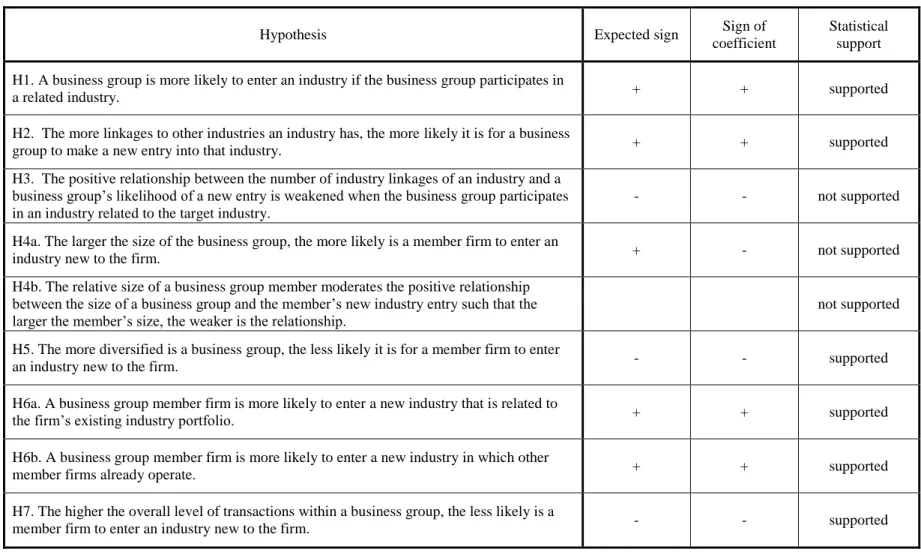
Table 9. Summary of empirical test results ... 134
1
CHAPTER I INTRODUCTION
“My father and I started a cosmetic cream factory in the late 1940s. At the time, no company could supply us with plastic caps of adequate quality for cream jars, so we had to start a plastics business. Plastic caps alone were not sufficient to run the plastic molding plant, so we added combs, toothbrushes, and soap boxes. This plastics business also led us to manufacture electric fan blades and
telephone cases, which in turn led us to manufacture electrical and electronic products and telecommunication equipment. The plastics business also took us into oil refining, which needed a tanker shipping company. The oil refining company alone was paying an insurance premium amounting to more than half the total revenue of the then largest insurance company in Korea. Thus, an insurance company was started. This natural step-by-step evolution through related businesses resulted in the Lucky-Goldstar group as we see it today.” (Koo Cha-Kyung, former chairman of the LG Group, as quoted in Milgrom & Roberts, 1992:542-543)
Business Group as a Paradox
Business groups – collections of legally independent firms that are owned or controlled by the same person or persons (Cainelli & Iacobucci, 2011) who are usually family members (Chang & Hong, 2000; La Porta, Lopez-de-Silanes, & shleifer, 1999; Morck, Wolfenzon, & Yeung, 2005; Morck & Yeung, 2003) – seem to defy some of the major tenets of strategic management. Scholars mostly agree that unrelated
diversification is harmful (Palich, Cardinal, & Miller, 2000; Wan, Hoskisson, Short, & Yiu, 2011), but business groups are typically diversified widely to unrelated industries (Khanna & Rivkin, 2001; Kock & Guillén, 2001). Moreover, the presence of the controlling shareholders presiding over a wide variety of listed and unlisted member firms is believed to be a threat to the ideal of strong corporate governance because the
2
controlling shareholders may destroy value by pursuing their own interest at the expense of minority shareholders (Bae, Kang, & Kim, 2002; Bertrand, Mehta, & Mullainathan, 2002; Chang, 2003). Indeed, many studies on business groups focus on their dark side: how they can only exist and prosper in environments characterized by poor institutions (Khanna & Palepu, 2000a, b; Leff, 1978) or foreign trade and investment asymmetries (Guillén, 2000; Kock & Guillén, 2001); and how controlling shareholders of business groups may “tunnel” resources from one member firm to another (Bertrand et al., 2002; Chang, 2003; Johnson, La Porta, Lopez-de-Silanes, & Shleifer, 2000) or divert resources to prop up weaker, inefficient member firms (Friedman, Johnson, & Mitton, 2003; Jia, Shi, & Wang, 2013) to pursue their own benefits.1
Given these negative accounts for business groups, their ongoing persistence and prevalence around the world even as national economies mature under the strong
influence of globalization may be called paradoxical (Manikandan & Ramachandran, 2014). Despite the prediction that diversified business groups in emerging markets will increasingly undertake corporate refocusing (Hoskisson, Johnson, Tihanyi, & White, 2005), evidence suggests otherwise. For example, business groups in India, one of the major emerging markets, became larger and more diversified instead of smaller and more focused as the Indian economy liberalized between 1989 and 2008 (Siegel & Choudhury, 2012).
1 Johnson et al. (2000:1) define tunneling in the abstract as “the transfer of assets and profits out of firms
for the benefit of their controlling shareholders”. Friedman et al. (2003: 735) describe propping as “negative tunneling”.
3
Moreover, even though academic research on business groups tends to focus on those in emerging markets, business groups are an important part of many developed economies as well (La Porta et al., 1999; Langlois, 2010; Morck et al., 2005).
According to Morck et al. (2005), a single business group accounts for half the market capitalization in Sweden and the largest ten business groups constitute 40% of the market capitalization in Canada, while the assets of the largest fifteen business groups amount to over 80% of Hong Kong’s gross domestic product (GDP). The United States and the United Kingdom, countries where business groups are not prominent – large firms there are mostly held widely and do not control other listed firms due to legal constraints and prohibitions2 – are rare exceptions rather than the norm (Granovetter, 1995; Kandel, Kosenko, Morck, & Yafeh, 2013; Langlois, 2010; Morck et al., 2005).
Purpose and Approach of the Dissertation
If business groups are prone to exclusively benefit controlling shareholders at the expense of minority shareholders, why are outside investors still interested in business group member firms and why do business groups keep expanding? If business groups are organized to exploit weak institutions, why do business groups continue to be relevant in improved and advanced institutional environments?
This dissertation explores potential reasons for the resilience and success of business groups by revisiting their nature as a “hybrid” organizational form (Williamson,
2 For example, in the U.S. the Glass-Steagall Act (1933) prohibits banks from owning stock of industrial
companies and the Investment Company Act (1940) makes it impossible for a company to manage another company without actually own it. In the U.K., in 1968, the London Stock Exchange started to require that anyone acquiring 30 percent of a publicly traded firm should acquire 100 percent of the firm.
4
1991). Because a business group is a collection of firms, a business group has two different boundaries. Each business group member firm has its own boundary, and the member firm is also placed inside another, larger boundary, that of the business group. Figure 1 shows a stylized graphical example. The business group boundary is depicted as a dashed line to convey the idea that the business group is rarely a legal entity. For a member firm, the business group represents a special market-like environment in which it enjoys relationships and transactions based on trust and shared values (Das & Teng, 1998; Keister, 1998; Manikandan & Ramachandran, 2014). Therefore, business groups have characteristics of firms as well as those of markets.
This hybrid nature of business groups has not been fully examined because prior studies have made approximations in an effort to apply existing theories about the firm – such as transaction cost theory, agency theory, and resource-based theory – to the
business group. First, most studies of business groups have focused on the level of business group member firms by comparing them with stand-alone firms (e.g., Ferris, Kim, & Kitsabunnarat, 2002; Khanna & Palepu, 2000a; Khanna & Palepu, 2000b; Khanna & Rivkin, 2001). Even though this approach provides us with a way to
understand the economic impact of business groups, the approach reduces the complex phenomenon of business groups just to a matter of membership. On the other hand, some scholars consider the hierarchy to exist at the group level and regard business group member firms as divisions of a conglomerate (e.g., Chang & Choi, 1988; Chang & Hong, 2000; Guillén, 2000). However, this second approach has the danger of ignoring or downplaying (1) the autonomy of legally independent group member firms, (2) the
5
ties and transactional relationships among member firms, and (3) the business group’s market-like characteristics.
The basic premise this dissertation puts forth is that the controlling shareholders of a business group may not want, and may not have, to exercise blanket control over all the member firms. Indeed, with cognitive and physical limitations, it may not be
realistic to expect the controlling shareholders to manage a large business group as tightly as some prior research works have assumed (e.g., Chang & Choi, 1988; Chang & Hong, 2000; Hoskisson et al., 2005). I propose that by designing and controlling the overall group structure, the controlling shareholders may be able to help define linkages among member firms and give each member firm unique economic incentives to play an appropriate role within the business group structure. The implication is that member firms will try to choose and pursue strategies in order to reap the maximum possible benefits of group membership. In turn, if the group is structured in a desirable way, the controlling shareholders will benefit without having to get involved in every detail of every business. A recent finding that structures of business groups are formed more as the result of sequential delegation of authority than as the consequence of control-magnifying intention (Belenzon, Patacconi, & Zelner, 2012b) is consistent with this view. Moreover, given the inherent incompleteness of strategic factor markets, building an appropriate market-like environment within the boundary of the business group may contribute positively to the growth potential of the group’s member firms (Manikandan & Ramachandran, 2014).
6
This dissertation specifically focuses on the diversification3 of business groups and their member firms (Hitt, Hoskisson, & Ireland, 1994). Because a business group is formed when a specific type of diversification – setting up a separate legal entity instead of diversifying the existing firm further – is pursued, the most crucial group-level characteristics have to do with the diversification pattern of the business group. Business groups are often characterized in the literature as a quintessential example of unrelated diversification (Hoskisson et al., 2005; Khanna & Rivkin, 2001; Kock & Guillén, 2001), but in reality, degrees of diversification in business groups do vary and how they approach diversification may be different as well. This dissertation examines business group diversification at two different levels: the business group level and the member firm level.
On the business group level, I propose that diversification at this level should not be examined solely based on the relatedness criterion (Palich et al., 2000; Rumelt, 1974; Wan et al., 2011) given the market-like nature of the business group. Typical business groups are widely diversified into unrelated industries, which scholars have explained as a consequence of institutional weaknesses (Khanna & Rivkin, 2001; Kock & Guillén, 2001). However, I suggest the possibility that this seemingly non-strategic and inefficient diversification pattern may actually be a way for a business group to take advantage of the linkages among different industries to provide its member firms with
3 Diversification can refer to both product diversification, “expansion into product markets new to the
firm” and international diversification, “expanding across country boarders into geographic locations (e.g., markets) that are new to the firm” (Hitt et al., 1994: 298). However, in this dissertation, diversification only means product diversification unless otherwise noted.
7
critical resources to spur the member firms’ growth. Relying on insights from Leontief’s (1986) input-output model, I propose that business groups are more likely to enter
industries that have linkages to multiple other industries than to follow the relatedness criterion. I argue that, given the business group’s market-like nature, the business group’s purpose of diversification (provision of critical resources to member firms) should differ from the purpose of the firm (creation of synergies from operating in related industries).
On the member firm level, I propose that various characteristics of the business group affect a member firm’s diversification choices. The logic is that group-level characteristics imply that each member firm has a unique set of roles and characteristics within the business group, and that each member firm will pursue strategic options that will maximize the benefits of its membership to the business group. Therefore, I argue that member firms’ diversification patterns will differ depending upon the characteristics and diversification pattern of the business group to which the firms belong.
Additionally, I suggest that for business group member firms, whether they are diversifying into an unrelated industry should be determined more carefully than for stand-alone firms because business group member firms may be able to realize synergies even when they seem to enter an unrelated industry if there is another member firm of the same business group in the industry thanks to the special market environment characterized by trust and shared values (Manikandan & Ramachandran, 2014).
8
Empirical Test of the Ideas
I test the ideas in this dissertation using a sample of 30 major South Korean business groups and their listed non-financial member firms from 1999 to 2008. South Korea is an ideal testing ground for the ideas because business groups dominate the country’s economy. Moreover, since the 1997-1998 Asian financial crisis, the
institutional environment of the country has improved immensely. However, business groups have continued to flourish, strengthening their competitive advantage rather than withering away from inefficiency.
Table 1 shows that the top 30 business groups in South Korea collectively account for a substantial portion of the country’s gross domestic product (GDP). In 2008, the total assets and the total sales of the 30 largest business groups amounted to approximately 84 percent and 85 percent of the country’s GDP, respectively. Even though there are changes in the composition of business groups and yearly fluctuations in financial details over the decade from 1999 to 2008, the table indicates that major business groups continue to take up a significant portion of South Korea’s national economy. Furthermore, as the financial impacts of the Asian financial crisis wear off, major South Korean business groups appear to be growing even faster and expanding their influence even further.
Contributions
This dissertation makes several contributions to the business group literature and the diversification literature.
9
To the literature on business groups
This dissertation makes several major contributions to the business group
literature. First, the dissertation looks inside each business group rather than treating all business groups as homogeneous. Most prior studies of business groups focus primarily on the economic efficiency of business group membership, through comparisons of group member firms’ performance with that of stand-alone firms (Khanna & Palepu, 2000a, b; Khanna & Rivkin, 2001; Siegel & Choudhury, 2012). Such an approach assumes that business groups are homogeneous and that firms benefit or lose from membership universally. I challenge these assumptions by sorting out different diversification characteristics of business groups and focusing on each member firm’s incentives to take advantage of the business group characteristics, which collectively define the special market-like environment in which the member firm operates.
Second, I provide a new way of thinking about the nature of business group diversification by differentiating it from that of firm-level diversification. Prior studies have examined business groups either at the firm level (e.g., Guillén, 2000; Khanna & Palepu, 2000b; Kim, Hoskisson, Tihanyi, & Hong, 2004) or at the group level (e.g., Chung & Luo, 2008; Luo & Chung, 2005; Mahmood, Chung, & Mitchell, 2013; Mahmood & Lee, 2004; Mahmood & Mitchell, 2004; Yiu, Bruton, & Lu, 2005)
assuming that hierarchy exists at just one level. I argue that group-level diversification should be examined as a separate and different (but related) phenomenon from that of firm-level diversification because the purpose of the former is different from that of the latter.
10
Third, I further suggest there is a linkage between the two forms of
diversification: a business group’s diversification characteristics may affect its member firms’ diversification strategies. This opens the door for the possibility that setting up a certain business group structure may lead to desirable strategic outcomes for member firms. I propose that the business group form may generate economic incentives for member firms (both carrots and sticks) by posing structural constraints on member firms’ diversification while providing resources on which member firms can draw.
Prior studies, even when they examine the internal mechanisms of business groups, tend to focus simply on how business group member firms can benefit from resources available within the group structure (Chang & Hong, 2000; Mahmood, Zhu, & Zajac, 2011). I counterbalance this by considering the fact that incentives for the
business group member firm arise from structural constraints as well as resource
endowments. By highlighting economic incentives within the business group, I suggest that the business group as an organizational form should be seen as an organizational innovation set up to satisfy the diverse and often conflicting needs of the controlling shareholders and other shareholders (Manikandan & Ramachandran, 2014). Thus, I argue that the business group should be seen through a positive lens rather than the “dark side” perspective that regards the business group as an organizational form that can only keep its relevance and advantage by bridging institutional deficiencies and exclusively benefits the controlling shareholders at the expense of minority shareholders.
11
To the literature on diversification
Additionally, this dissertation also makes contributions to the diversification literature. First, prior research on diversification has mostly focused on the relationship between the degree of diversification and financial performance. Because the focus has been primarily on how diversified a firm is, the pattern of its diversification - the portfolio of industries in which the firm operates and the choices it makes over time to build up the portfolio – has not been highlighted (Lemelin, 1982). However, from the perspective of managers and stakeholders of a firm, it may be more helpful to know what industries to enter and how to build an appropriate portfolio of activities than to know whether the firm is at the optimum level of diversification. The relatedness criterion may provide managers with enough insight on how to deal with issues surrounding diversification. However, a more complete picture may emerge when industry characteristics and interrelationships among different industries are considered together with firm characteristics. This dissertation suggests a way to combine these considerations to understand diversification in a different light.
Second, this dissertation suggests that firms and business groups may have different purposes for diversification. I develop a theory of business group
diversification based on inter-industry linkages rather than rely on the firm-level theories of diversification based on relatedness in order to consider the market-like nature of the business groups. The concept of inter-industry linkages has been emphasized in
development economics, especially in the theory of unbalanced growth (Hirschman, 1958; Jones, 1976), but has rarely been used or considered in strategic management
12
research regarding diversification (c.f., Lemelin, 1982; Zhou, 2011). Combining insights that arise from the understanding of industrial linkages with knowledge that have been accumulated with the notion of relatedness may form a stronger foundation for future diversification research, especially regarding business groups.
Organization of the Dissertation
This chapter has provided a brief introduction to the remainder of the
dissertation. Chapter II presents a critical review of studies and theories that are relevant for this dissertation. Chapter III examines diversification at the business group level and argues that group-level diversification should not be viewed in the same perspective that has been used in studies of firm diversification. This idea is tested empirically based on 30 South Korean major business groups’ industry portfolio data from 1999 to 2008. Chapter IV focuses on business group member firms’ diversification patterns to examine how business group characteristics may affect member firms’ diversification choices. I extend the ideas developed in Chapter III to the member firm level to argue that business group member firms have incentives to pursue certain directions in their diversification choices under the influence of their respective business groups, which have distinct characteristics. I combine the data used in Chapter III with firm-level diversification and industry entry data to test the general idea. Chapter V discusses the overall implication of the findings, suggests future research directions, and concludes the dissertation.
13
CHAPTER II LITERATURE REVIEW
Definition of Business Groups
No single definition exists for the business group. Many different forms of business groups exist and operate in different countries and institutional contexts (Morck, 2010; Yiu, Lu, Bruton, & Hoskisson, 2007).
Leff (1978: 663) proposes probably the earliest definition of a business group: “a multicompany firm which transacts in different markets but which does so under
common entrepreneurial and financial control”. Leff’s definition treats a business group like one single integrated firm even though the group member firms are legally
independent. Other definitions that downplay the independence of member firms of a business group largely follow his perspective on business groups (Chang & Hong, 2000; Mahmood & Mitchell, 2004).4
One of the most widely used academic definitions of business groups is Granovetter’s (1995:95): “collections of firms bound together in some formal and/or informal ways, characterized by an ‘intermediate’ level of binding”. Granovetter’s definition explicitly recognizes that even though there may be some degree of
integration among the member firms of a business group, they are basically separate.
4 Chang and Hong (2000: 429) define a business group as “a gathering of formally independent firms
under the single common administrative and financial control of one family”. Mahmood and Mitchell (2004: 1348) define business groups as “conglomerations of nominally independent firms that operate under common administrative and financial management and often are controlled by families”. Their definitions largely focus on the role of the business group as a hierarchy, downplaying the legally independent nature of business group member firms as simply titular or nominal.
14
Khanna and Yafeh (2007) offer a similar definition, but further clarify the characteristics of member firms: “legally independent firms, operating in multiple (often unrelated) industries, which are bound together by persistent formal (e.g., equity) and informal (e.g., family) ties”. Additionally, Kock and Guillén (2001:78) define business groups as “loose constellations of firms spanning a wide variety of manufacturing and service industries held together by common ownership or informal control ties.”
In these definitions that focus on ties among business group member firms rather than the hierarchical administrative control, the existence of an entity that controls and guides all the member firms is not evident. To account for that, Colpan and Hikino (2010) distinguish network-type business groups, in which no single dominant entity exists, from hierarchy-type business groups, where a single entity is supposed to dominate strategic decision-making. Morck (2010) and Guillén (2010) suggest the existence of an entity that controls all the member firms as one of the main features of diversified business groups. Indeed, even though Japanese keiretsu may fall into the category of network-type business groups, this category has the potential danger of encompassing too wide a variety of economic relationships such as regional clusters and strategic alliances (Langlois, 2010).
Among hierarchy-type business groups, family-controlled ones are by far the most common and influential across countries (Langlois, 2010; Morck et al., 2005). Even though political considerations often support the formation and growth of business groups (Schneider, 2009), it is rare to see business groups directly controlled by a national government outside of China, where the government has fostered the formation
15
of business groups (Keister, 1998) and used them to control strategic industries vital to the national economy (Yiu et al., 2005). This dissertation focuses on hierarchy-type business groups and acknowledges the existence of controlling shareholders, who are usually family members.
Some scholars include even Western-style conglomerates within the conceptual boundary of business groups (Altomonte & Rungi, 2012). However, what really characterizes the business group is not control per se but rather the non-financial nature of control, which is based on the social solidarity often arising from kinship
(Granovetter, 1995; Jones, Hesterly, & Borgatti, 1997; Smångs, 2006). Including Western-style conglomerates in the definition may dilute the importance of this unique characteristic. This dissertation is based on the view that business groups are different from conglomerates.
There are numerous empirical studies of business groups as indicated by the number of published and unpublished studies on which a recent meta-analysis on business groups was based (Carney, Gedajlovic, Heugens, Van Essen, & van
Oosterhout, 2011). However, given the definition of business groups, it appears that too much attention has been paid to the member firm level rather than the group itself. Most empirical studies of business groups have been done at the member firm level; this is despite the complexity and heterogeneity of business groups arising from the fact that they are collections of firms, each of which is already a complex economic and social phenomenon.
16
The economic implications of business groups have mostly been examined based solely on membership (Carney et al., 2011). A majority of prior studies of business groups examine the performance implications of business group membership at the firm level, trying to determine whether business group member firms outperform
non-member firms (e.g., Chang & Choi, 1988; Ferris et al., 2002; Khanna, 2000; Khanna & Palepu, 2000a, b). Scholars have also employed this approach in multi-country studies to determine whether weak institutions promote the economic success of business groups (e.g., Khanna & Rivkin, 2001).
However, these research questions make the unlikely assumption that
membership in any business group has a universal impact irrespective of each business group’s unique characteristics and circumstances. Additionally, this approach ignores the possibility that business group member firms may develop characteristics and strategies that are different from those of non-member firms, which would make the comparison between the two groups difficult, if not impossible (Siegel & Choudhury, 2012). Even though it is worthwhile to examine whether business group membership in general is positive or negative in terms of member firm performance, it may be arguably more important to see how different group-level characteristics may affect different member firms’ characteristics and strategies.
Theoretical Approaches to Business Groups
Scholars have taken diverse theoretical approaches to study business groups (Yiu et al., 2007). Major theories employed include transaction cost theory (Khanna & Rivkin, 2001), agency theory (Bertrand et al., 2002; Morck & Yeung, 2003),
resource-17
based theory (Kock & Guillén, 2001; Tan & Meyer, 2007), and network theory (Mahmood et al., 2013; Mahmood et al., 2011).
However, we still do not fully understand why business groups exist and how they function, evolve, and thrive to adapt to the ever changing external environment. Yiu et al. (2007) comment aptly that diverse theoretical perspectives may hinder, rather than contribute to, the further understanding of business groups. I argue that the
underlying reason the applications of diverse theories have not led us to a better understanding of the business group is that these theories were developed for the firm rather than the business group and that scholars have not fully accounted for the differences between the two when trying to apply their theories.
A business group is made up of legally independent firms (Khanna & Yafeh, 2007). Each of the member firms develops its own organizational structure and has a different mix of shareholders (Manikandan & Ramachandran, 2014). From the perspective of minority shareholders, what counts is the performance and value of the member firm in which they hold the shares. Therefore, each member firm has an
incentive to maximize its shareholder value in order to satisfy its shareholders unless the member firm is owned entirely by the controlling shareholder. Empirical studies on business groups that use the business group member firm as the unit of analysis implicitly make this assumption of profit maximization.
However, each member firm of a business group is also influenced by its
controlling shareholders and the overall business group structure. In other words, firms that have their own boundaries are placed within yet another boundary and the business
18
group to which they belong forms a special operating environment for the member firms. This is where confusion about business groups starts because some approximation has to be made in order for existing theories about the firm to be applied to the business group.
In the following subsections, I introduce some of the major theoretical
perspectives that have been employed to explain business groups. What I argue is that it may not be appropriate to directly apply these perspectives to business groups because the perspectives have been developed for firm-level analysis and do not consider the market-like characteristics of the business group.
Transaction cost theory
Transaction cost theory was developed to explain the existence and scope of the firm (Coase, 1937). According to transaction cost theory, if the market were completely efficient, there would be no need for firms to coordinate and control economic activities within their boundaries. However, since certain activities incur more transaction costs than other activities, firms arise to handle such activities internally. It is argued that firms will continue to include or exclude activities within their boundaries, which will ultimately determine the scope of firms (Williamson, 1979).
Because transaction costs determine the scope of a business according to transaction cost theory, scholars trying to explain business groups based on the theory have emphasized differences in overall level of transaction costs across countries caused by ‘institutional voids’, that is, weak or missing institutions (Khanna & Palepu, 2000b). According to this approach, the business group is a mechanism to cope with market failures that increase overall transaction costs of an economy in various areas such as
19
product markets, capital markets, and labor markets (Khanna & Palepu, 1997; Leff, 1978).
With this approach, the main empirical question becomes whether the organizational form of business group is economically efficient in a particular institutional environment. Scholars have approached the question by comparing the economic performance of business group member firms with that of independent firms, in countries with varying degrees of institutional deficiency (Khanna & Palepu, 2000a; Khanna & Rivkin, 2001). As transaction cost theory has been the most popular
perspective on business groups (Yiu et al., 2007), most of previous empirical studies on business groups have been based on this approach.
However, despite the popularity of the perspective, transaction cost theory cannot directly account for the existence of business groups. According to the theory, if the overall level of transaction costs is high in an economy, more economic activities are supposed to be cheaper to carry out within the firm boundary than through the external market (Coase, 1937; Williamson, 1979, 1981). However, the ultimate consequence of high overall level of transaction costs in a country should be the potentially expanded scope of firms, not the birth and growth of business groups. Therefore, transaction cost theory does not directly explain why diversified business groups should be more
prevalent than multidivisional enterprises in emerging markets where transaction costs are assumed to be higher than in advanced economies. Transaction cost theory does not consider the business group as an alternative option to the diversified firm. In other words, transaction cost theory may be able to answer the question, “Why do firms
20
exist?”, but it may not be able to answer Granovetter’s (1995) question, “Why do business groups exist?”
Influenced by Leff’s (1978) definition of the business group as a multi-company firm, some studies have explicitly regarded the business group as a single multidivisional firm to account for the existence of the controlling shareholders as the “control tower” (Chang & Choi, 1988; Chang & Hong, 2000). In fact, when scholars state that a business group is diversified, they implicitly assume that the hierarchy lies at the
business group level rather than at the firm level. However, this approach overlooks the fact that each individual member firm is a legally independent firm with a different ownership structure and enjoys a substantial degree of autonomy (Kock & Guillén, 2001). On the other hand, if transaction cost logic is applied to the firm level, it would be each individual member firm that chooses its own boundary, perhaps with some influence from and consideration for the overall business group structure. However, in this case, because the hierarchy is assumed to be at the level of each member firm, the business group’s decision to add or maintain a legally independent member firm cannot be explained.
The direct application of transaction cost theory to the business group also results in confusion and inconsistencies in empirical studies of business groups. Previous studies have tested whether business group member firms are economically more efficient than stand-alone firms (Belenzon & Berkovitz, 2010; Carney et al., 2011; Chakrabarti, Singh, & Mahmood, 2007; Chang, 2006; Khanna, 2000; Khanna & Rivkin, 2001).
21
However, if the direct application of transaction cost theory to the level of business group is to be strictly followed, the comparison should be made between business groups and stand-alone firms, not between business group member firms and stand-alone firms. When business group member firms and stand-alone firms are compared, the only difference between the two types of firms becomes business group membership, which basically assumes that business groups are homogeneous in nature and a membership to any business group has an identical effect.
Given the structural complexity of business groups, it would be difficult for this assumption to hold. Even though the business group may not have a legal status, it has many characteristics that may potentially affect the way its member firms operate. This type of empirical test also goes against transaction cost theory in that business group member firms are assumed to autonomously and independently pursue their own financial goals, rather than being partially under the hierarchy and authority of their business groups where they may be tasked to achieve group-level goals.
Another issue with the transaction cost approach to business groups based on the concept of institutional voids is the ubiquity of business groups even in countries with advanced institutions (Belenzon & Berkovitz, 2010; Belenzon, Patacconi, & Zelner, 2012a; Langlois, 2010; Morck, Strangeland, & Yeung, 1998). This fact makes it
difficult to claim that the business group is only a coping mechanism for market failures arising from institutional voids. Outside of a few common-law countries such as the United States and the United Kingdom, business groups, especially family-controlled ones, are very common even in advanced economies (Belenzon et al., 2012a; La Porta et
22
al., 1999; Morck et al., 1998). Therefore, linking the existence of the business group automatically to institutional voids and to the issue of transaction costs may not provide a universal theoretical explanation.
Agency theory
Agency theory (Jensen & Meckling, 1976) has been used to account for problems that can arise from the separation of ownership from control in modern firms (Berle & Means, 1932). However, the focus of scholars taking this approach to business groups is not on the classic agency issue between owners and managers, but rather on the
possibility that controlling shareholders may pursue their own benefits through
expropriation of the wealth of minority shareholders (Dharwadkar, George, & Brandes, 2000; Khanna & Rivkin, 2001; Yiu et al., 2007). In the case of family-controlled business groups, it is argued that managers of a member firm may strive to work for the controlling family rather than for shareholders in general (Morck & Yeung, 2003). Scholars argue that expropriation is more likely when the controlling owner uses “pyramiding” 5 to maximizing the owner’s control while minimizing actual financial contributions (Bertrand et al., 2002; Claessens, Djankov, Fan, & Lang, 2002; Claessens, Djankov, & Lang, 2000).
As with transaction cost theory, agency theory was developed with an
independent, autonomous firm in mind (Jensen & Meckling, 1976). Because a business group is made up of multiple legally independent firms, scholars using agency theory
5 Pyramiding means “owning a majority of the stock of one corporation which in turn holds a majority of
23
conceptually view the business group as a collection of agency relationships (Yiu et al., 2007). In empirical tests, however, most studies simply focus on each member firm and determine whether there is evidence of expropriation at the member firm level based on its ownership structure (e.g., Bae et al., 2002; Bertrand et al., 2002; Chang & Hong, 2000; Claessens et al., 2002); this approach may not be able to capture how the complex structural characteristics of business groups and multiple ties among member firms affect each firm’s business strategies.
For example, Bertrand et al. (2002) concluded that tunneling was widespread among Indian business groups after finding out that business group member firms profited less from positive industry shocks than stand-alone firms. However, as Siegel and Choudhury (2012) point out, what Bertrand et al. (2002) found that seemingly appears to be the consequence of tunneling may arise because business group member firms pursue more complex and costly recombinative activities than stand-alone firms. Siegel and Choudhury (2012) only consider mere membership to business groups, but their finding insinuates that the business group structure and relationships within it may lead its member firms to pursue strategies that are different from those of stand-alone firms (Manikandan & Ramachandran, 2014).
Another point to consider about potential expropriation by the controlling shareholders is that expropriation may incur costs for them. Minority shareholders of a business group member firm, fully anticipating that there will be expropriation, may simply stop investing in the firm (Colpan & Hikino, 2010; Masulis, Pham, & Zein, 2011). If minority shareholders do not stop investing, it may be an indication that
24
investing in the firm gives them benefits that at least compensate for the expropriation potential.6 One such benefit may come from the reputation that the business group has not mistreated minority shareholders (Gomes, 2000), which is actually consistent with the notion that business groups can compensate for missing or underdeveloped
institutions (Khanna & Palepu, 2000a). Another benefit, on which this dissertation focuses, may come from the firm’s linkages with other member firms within the business group and value creation potential arising from those linkages. Investors may appreciate the fact that the business group member firm in which they invest benefits from the special market-like environment provided by the business group structure.
Resource-based theory
The central idea of resource-based theory is that firms are bundles of resources and capabilities (Penrose, 1959) and rare, valuable, inimitable, and non-substitutable resources and capabilities lead to a firm’s competitive advantage (Barney, 1991; Wernerfelt, 1984). Scholars approaching business groups with resource-based theory tend to focus on group-level resources rather than resources at the member firm level.
Resource-based advantages of business groups have been discussed often in close connection with institutional voids (e.g., Guillén, 2000; Yiu et al., 2005). Ghemawat and Khanna (1998), for example, argue that institutional voids foster the formation of business groups by making “generalized” resources and capabilities
6 Another possibility is that investors may simply not be able to find a better alternative in which to invest.
However, the fact that business groups are flourishing in many developed countries and they are not losing relevance in countries that are experiencing improvements in terms of institutional environments indicates that this possibility cannot explain continued investor interest in business group member firms
25
valuable. Project-execution capabilities (Amsden & Hikino, 1994), the capability for repeated industry entry (Guillén, 2000), and the capability to leverage contacts (Kock & Guillén, 2001) may be examples of such resources. Guillén (2000) also argues that such generic capabilities may lose value over time as institutions improve and foreign trade and investment asymmetries between the emerging country and developed countries disappear.
However, trying to locate resource advantages solely at the level of the business group may obscure the role of each member firm, and overlook the question of how member firms obtain and develop their own resources and capabilities within the business group boundary (Mahmood et al., 2011). Like transaction cost theory and agency theory, resource-based theory was originally developed for independent and autonomous firms (Heugens & Zyglidopoulos, 2008). Focusing only on group-level resources may miss the presence of firm-level resources and the potential that member firms may build resources and capabilities either by themselves or in concert with other member firms to improve their firm-level competitiveness.
Chang and Hong (2000) overcome some of these limitations by studying the firm-level performance implications of within-group resource sharing and business transactions, but they still do not provide an answer to the question of how business group member firms may collectively engage in the formation and integration of resources and capabilities. To reach a more complete understanding of the business group, I argue that we need to examine resources and capabilities on both business group level and firm level, rather than focusing on either level. To do that, we have to realize
26
that the each of the two levels – business group level and member firm level – has distinct characteristics.
Social network theory
As Granovetter’s (1995) influential definition of business groups indicates, business groups are rich in formal and informal linkages among member firms.
Therefore, some recent studies employ social network theory to study business groups. Viewing business groups as networks and member firms as nodes, the studies use network-theoretic concepts such as centrality and tie density to explain firm-level or business group-level outcomes (Mahmood et al., 2013; Mahmood et al., 2011; Smångs, 2006).
Mahmood et al. (2011) regard a business group as an external source of R&D capability acquisition for its member firms. They argue and find that a member firm’s centrality in the intragroup buyer-supplier network contributes to the firm’s R&D capability. They further show that characteristics of other types of network ties, such as intragroup director and equity ties, either strengthen or weaken the main hypothesized relationship. This study, focusing on the level of member firms, regards the business group simply as existing outside the boundary of each member firm. On the other hand, Mahmood et al. (2013) use the business group as the unit of analysis to argue and find that the density of intragroup buyer-supplier ties has an inverted-U shaped relationship with group innovativeness.
The network theoretic approach can capture the overall structure of the business group and the position of each member firm nicely. However, it is the controlling
27
shareholders that initially design member firms’ embeddedness in the business group network. Treating a business group as a network and assuming that each node (member firm) is completely independent overlooks the fact that the controlling shareholders can design and structure the overall business group linkages.
Diversification and Relatedness
Why do firms diversify? It is one of the fundamental questions in the strategic management field (Rumelt, Schendel, & Teece, 1991). Under the assumptions of neoclassical economics, the firm is simply a production function that specializes on a single type of product. When the market is perfect and so there are no frictional costs of transacting through the market, diversification may not be justifiable. Therefore, the widespread existence of firm diversification indicates that there is some degree of imperfection in the market (Hoskisson & Hitt, 1990; Klein & Lien, 2009). Indeed, if the assumption of competitive equilibrium held perfectly and managerial actions did not affect firm performance, the whole purpose of strategic management would be moot because the field seeks answers on how to gain sustainable competitive advantages through managerial actions. Therefore, any type of diversification – be it related or unrelated – may be thought of as an action to take advantage of or respond to market imperfections.
One of the most important factors that contribute to market imperfections, and thus to diversification, are firm resources (Barney, 1986, 1991; Chatterjee & Wernerfelt, 1991; Penrose, 1959; Teece, 1982). Certain resources are difficult to trade on the market because of their indivisibility (Penrose, 1959) and social complexity (Coff, 1999;
28
Jonsson & Regnér, 2009). These problems may lead managers to take advantage of their excess resources in another, related business where the slack resources can be used either as substitutes or complements (Klein & Lien, 2009). In this line of logic,
operating in related businesses may yield synergies for the firm, causing performance to improve (Montgomery & Wernerfelt, 1988; Palich et al., 2000; Rumelt, 1974).
Another important factor that causes market imperfection and thus diversification are transaction costs (Williamson, 1979). When the costs of organizing activities within the boundary of the firm are lower than the costs of transacting with external parties, it becomes more efficient for the firm to diversify into those activities. Because the level of transaction costs is substantially dependent upon the nature of resources and
capabilities behind the business activities, it may be said that the two factors – resources and transaction costs – are intricately tied with each other in determining the scope of the firm (Argyres, 2011; Jacobides, 2008; Jacobides & Winter, 2005).
Therefore, even though there are other potential antecedents of diversification such as government policy (Ravenscraft & Scherer, 1987; Scherer, 1980), low
performance (Fiegenbaum & Thomas, 1988; Rumelt, 1974; Sanders & Hambrick, 2007), and cash flow uncertainty (Hoskisson & Hitt, 1988), resources and transaction costs may be considered as the two main drivers that determine the economic efficiency of
diversification.
The implication of the combination of these two factors is that a diversification strategy based on the relatedness criterion may create value by conferring synergistic benefits on the firm (Chatterjee & Wernerfelt, 1991; Montgomery & Wernerfelt, 1988).
29
Moreover, these benefits should continue until the costs of managing activities internally go over those of transacting with outside parties.
Unrelated diversification obviously violates the relatedness criterion. Therefore, it has been viewed negatively even though unrelated diversification has the potential for financial synergies (Amit & Wernerfelt, 1990; Chatterjee, 1986) and there are some prominently successful conglomerates such as General Electric or Siemens. Unrelated diversification has often been regarded as a sign of top managers’ self-interest seeking behavior (Amihud & Lev, 1981; Jensen, 1986; Jensen & Meckling, 1976).
Because it is hard to justify unrelated diversification based on pure efficiency considerations, scholars tend to link it to market failures and resulting high transaction costs that characterize underdeveloped countries (Khanna & Palepu, 1997; Khanna & Rivkin, 2001). In underdeveloped and emerging economies, unrelated diversification tends to take the form of the business group. This is the reason that business groups have often been regarded as prime examples of unrelated diversification even though they are fundamentally different from conglomerates.
In this dissertation, I argue that business group diversification is different from ordinary firm diversification in terms of its purpose. To show that it is the case, I emphasize the fact that industries have linkages with one another and some industries have more linkages than others. Business groups, as collections of firms, have a unique advantage in exploiting this inter-industry linkages compared with stand-alone firms. I argue that unlike stand-alone firms, business groups diversify to bridge such linkages than to obtain synergies from operating in related industries.
30
CHAPTER III
GROUP-LEVEL DIVERSIFICATION AND INTER-INDUSTRY LINKAGES
Introduction
Business group level diversification represents the span of industries in which all the member firms of a business group engage. It is fundamentally related to the initial formation of business groups because the first decision of the controlling shareholders to diversify by starting a new firm instead of diversifying within the existing firm’s
boundary initiates a business group. Why would the controlling shareholders set up another firm to diversify rather than diversify within the existing firm?
For a stand-alone firm, an excessively high level of diversification is generally known to be negative for performance (Ansoff, 1987; Markides & Williamson, 1996; Palich et al., 2000). Diversification makes it possible for the firm to utilize excess firm-specific assets (Markides, 1992; Penrose, 1959), gain economies of scope through sharing resources and activities (Markides & Williamson, 1994), and use superior internal information to allocate resources among different lines of business more efficiently than the market (Markides, 1992). However, as the degree of relatedness goes down among different lines of business, such positive effects may deteriorate and various costs of management may begin to increase (Grant, Jammine, & Thomas, 1988; Markides, 1992). As activities within a firm become too disparate, the purpose of the firm may become less coherent (Teece, Rumelt, Dosi, & Winter, 1994) and social
31
comparison costs among its employees may increase (Nickerson & Zenger, 2008), eventually causing the firm’s performance to deteriorate.
This line of logic has been directly applied to business groups even though business groups are not firms but collections of firms. The business group is often referred to as the quintessential form of unrelated diversification (Hoskisson et al., 2005; Khanna & Rivkin, 2001; Kock & Guillén, 2001), where each member firm is commonly assumed to represent a different line of business or strategic business unit (Chang & Choi, 1988; Chang & Hong, 2000; Ferris et al., 2002; Leff, 1978). The logic based on the relatedness criterion has been commonly used to discredit the business group as an inefficient organizational form that can only work in poor quality institutional
environments. Scholars argue that business groups are diversified widely to compensate for and take advantage of institutional weaknesses (Khanna & Palepu, 2000a, b). Some scholars propose that business groups will lose their purpose and increasingly refocus their business portfolios as institutional environments improve (Hoskisson et al., 2005).
In this chapter, I argue that group-level diversification should not be evaluated based on the same criteria that apply to firm-level corporate diversification because business groups, as “hybrid” organizations (Granovetter, 1995; Williamson, 1991), are not equivalent to firms. Within the boundary of a business group, thanks to formal and/or informal ties, its member firms as independent legal entities can transact with one another without getting exposed to various exchange hazards (Granovetter, 1995; Luo & Chung, 2005). Given this market-like function of the business group, the purpose of diversification pursued by the business group may be more to provide its member firms
32
with strategic resources (by setting up a well-functioning market within its boundary) than to pursue synergies from operating in related industries as in the case of the firm.
To explore this possibility, I focus on the strategic importance of inter-industry linkages (Burt, Guilarte, Raider, & Yasuda, 2002; Chenery & Watanabe, 1958;
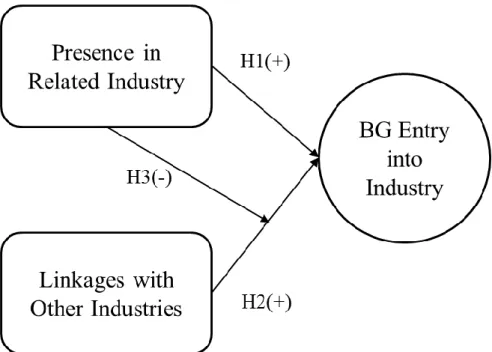
Hirschman, 1958; Lemelin, 1982; Rasmussen, 1956) for business groups. I argue that a business group is likely to enter an industry that is related to many other industries. Entering an industry that has an impact on multiple other industries may provide the group’s member firms with rich and crucial linkages with the rest of the economy. The implication is that a business group may encourage its member firms to pursue related diversification by pursuing unrelated, but still strategic, diversification at the group level. Figure 2 graphically presents the three hypotheses that are presented in this chapter.
To empirically test these hypotheses, I analyze the diversification patterns of 30 major South Korean business groups from 1999 to 2008 using categorizations and data available in South Korean input-output tables prepared by the Bank of Korea. Input-output flows among 77 industries are used to determine the impact an industry has on the rest of the economy (Burt et al., 2002).
Prior research on diversification has mainly focused on the degree of diversification starting from a firm’s primary industry based on the concept of relatedness (Hoskisson & Hitt, 1990; Rumelt, 1974). This chapter extends the diversification literature by turning attention to the inherent linkages among various industries and the importance of multiple impacts an industry may have for other industries (Chang, 1999; Hirschman, 1958). Previous research on business groups tend
33
to depict them as an organizational form that cannot function efficiently in the environment with strong and advanced institutions (Guillén, 2000; Hoskisson et al., 2005; Kock & Guillén, 2001). Examining business groups’ diversification patterns through the lens of inter-industry linkages may reveal that business groups are highly strategic in their diversification choices. Theoretically, it may indicate that business groups are less of an outcome of institutional voids, but more of a consequence of pursuits for critical resources and growth opportunities (Lamin, 2013; Manikandan & Ramachandran, 2014). If it is the case, business groups will certainly not lose their relevance even after institutional environments in emerging markets and developing countries reach a similar level of quality to that of developed countries.
Theory and Hypotheses Nature of the business group
The business group is characterized by an “‘intermediate’ level of binding” (Granovetter, 1995:95). Even though there may be some degree of integration among the member firms of a business group with the presence of the controlling shareholders (Guillén, 2010; Morck, 2010), the member firms are legally independent (Khanna & Yafeh, 2007) and typically enjoy a substantial degree of autonomy (Kock & Guillén, 2001; Smångs, 2006). While some studies have treated business groups as if they were single multidivisional firms (Chang & Choi, 1988; Chang & Hong, 2000; Leff, 1978), business groups themselves are typically not legal entities. It is each member firm that is a legal entity.
34
Business group member firms, with their own unique ownership and
organizational structures, have their own corporate-level strategies. Each member firm has its own top management team and is overseen by its own board of directors, which may assess market opportunities independently from the controlling shareholders. Unlike a division in a multidivisional firm, an individual business group member firm has the autonomy to make its own decisions to pursue growth opportunities and directly face consequences of the decisions in the market (Manikandan & Ramachandran, 2014).7 Indeed, some business group member firms are widely diversified themselves (Carney et al., 2011).
On the other hand, business group member firms are inevitably affected by the business group structure. When member firms transact with one another within the boundary of the business group, they may face few exchange hazards, if any, thanks to trust arising from formal and/or informal ties among them (Manikandan &
Ramachandran, 2014). However, when member firms transact with parties outside the business group, they may face the same degree of exchange hazards as stand-alone firms do. Therefore, business group member firms have strong economic incentives to take full advantage of their business group membership by transacting within the boundary of the business group.
7 This will definitely be the case for publicly listed business group member firms. However, even if they
are not publicly listed, business group member firms are different from a multidivisional firm’s divisions, whose managers lack not only market-based incentives but also ultimate decision rights to pursue growth opportunities (Manikandan & Ramachandran, 2014).
35
In summary, the business group is a “hybrid” organization (Granovetter, 1995; Williamson, 1991). It is close to a firm in that the controlling shareholders form a hierarchy, while it is like a market in that member firms within the business group boundary enjoy transactional relationships that may be more efficient and flexible than those available outside the boundary. Therefore, treating the business group as if it were equivalent to the firm may discount this market-like role of the business group.
Unrelated diversification and business groups
It is generally agreed upon in the field of strategic management that related diversification leads to superior firm performance while unrelated diversification is harmful for firm performance (Palich et al., 2000; Rumelt, 1974; Wan et al., 2011). Extended to business groups, this consensus has been commonly used to discredit the business group as an inefficient organizational form that can only work in poor
institutional environments because business groups are typically diversified widely into unrelated industries (Hoskisson et al., 2005; Khanna & Rivkin, 2001; Kock & Guillén, 2001).
Considering the market-like nature of the business group, however, opens up a new possibility. Given such market-like nature, the purpose of diversification that a business group pursues may be fundamentally different from that of a firm which
represents a pure hierarchy. The controlling shareholders of a business group may focus on establishing a relevant and well-functioning group-wide market from which the group’s member firms can benefit rather than try to control every aspect of the group-wide business portfolios. In turn, member firms’ top managers may have a greater sense