I N T E R N A T I O N A L J O U R N A L O F C O M P U T E R S & T E C H N O L O G Y
F-MEEP: Fuzzy Logic Based Multihop Energy Efficient Routing Protocol for
HWSN
Muhammad Rizwan
1, Muhammad S. Nisar,
2Hongbo Jiang
3 13Department of Electronics and Information Engineering, HUST, Wuhan, 430074, China
[email protected];
[email protected]
2
Wuhan National Laboratory for Optoelectronics, HUST, Wuhan 430074, China
[email protected]
ABSTRACT
Energy preservation is one of the most important research challenges in Wireless Senor Networks (WSNs). In recent research, topologies and architectures have investigated that allow energy efficiency in WSNs. Clustering is one of the most famous energy efficient techniques. In clustering, the selection of cluster head (CH) and short distance multi-hop energy efficient communication between CH and base station (BS) plays a vital role in order to achieve the desired energy efficiency in the sensor network. In this energy saving solution, we purpose and combine the idea of fuzzy logic based CH selection and multihop short distance communication between CH and base station in order to prolong the stable period and life span of network. Our proposed routing protocol, Fuzzy Logic based Multihop Energy Efficient Routing Protocol (FMEEP) for Heterogeneous WSN, which uses fuzzy logic inference system (FIS) in order to select a qualified CH in the cluster formation process and minimizes the overall energy dissipation in the sensor network. The simulation results have shown that purposed routing scheme outperforms in terms of stability period and network lifetime as compared to previous routing protocols.
Keywords
Heterogeneous Wireless Sensor Network (HWSN), Fuzzy Logic, Clustering, LEACH, SEP, Stability Period, Network Lifetime.
Academic Discipline And Sub-Disciplines
Computer Science, Computer Networks, Hetrogeneous Wireless Sensor Network, Clustering;
SUBJECT CLASSIFICATION
Energy Efficient Clustering Based Routing Protocols, Aritificial Intellegnece
TYPE (METHOD/APPROACH)
Novel Routing Approach For Hetrogeneous Wireless Sensor Network.
1. INTRODUCTION
Recent advances in microelectronics and wireless communication, the Wireless Sensor Networks (WSNs) have attained more attention worldwide. Recent advances in Micro-Electro-Mechanical Systems (MEMS) technology results the development and advancement of smart sensors. A WSN is collection of smart sensor nodes, which are deployed to monitor the environmental or physical conditions, such as sound, motion, weather, temperature, vibration, pressure or pollutants. The sensor nodes have the capability to sense, gather and measure the information and also able to communicate with each other. The sensed data is forwarded to sink via possible multihop communication. In the sensing field the nodes can be stationary or mobile. WSNs are used in many industrial application areas, including healthcare application, home automation, industrial process control, industrial process monitoring, tracking vehicle, environment monitoring, power monitoring health monitoring, and habitat monitoring [1][2]. Heterogeneous wireless sensor networks have become more popular because of the advantages of using HWSN with different resources in order to meet the demands of various applications which have been studied in the recent literature [3][4].
The important challenges in the organization of wireless sensor network are energy efficiency, stability and improvement in network life time because the sensor nodes are limited in energy, storage capacity and computational power. The battery of the sensor nodes cannot be changed or recharged due to their dense deployment in the harsh environment. Because sensor nodes have limited energy, so it is important to introduce the energy techniques in order to extend the lifetime of WSNs [5].
Clustering is an efficient technique to address the challenges related to energy consumption and scalability. Due to this, it has been exploited in various sensor applications. The clustering is very useful strategy in order to achieve many goals such as uniform energy consumption, energy efficient operations of WSN, enhancement of network life time of WSN and minimizing the number of sensor nodes that communicate with BS. Optimal cluster formation is necessary in order to achieve energy efficient operation and to ensure the balanced energy dissipation in the network. Cluster based routing techniques are very helpful in solving the sensor nodes energy constraints by reducing the cost of data aggregation and transmission of sensed data before transmitting to sink or base station [6]. In clustering, the sensing region is divided in a hierarchical way to create the clusters and communications between clusters are controlled by elected cluster heads.
I N T E R N A T I O N A L J O U R N A L O F C O M P U T E R S & T E C H N O L O G Y
Cluster heads can be selected randomly or by an election among the nodes using a probability schemes. Centralized controlled method can also be used to select the cluster heads. By this energy load can be balanced in sensor network. In sensor networks, the energy can be saved by using heterogeneity without sacrificing the performance. The clustering approach can be divided into two layers. The first layer is used for selecting the cluster and second layer for routing in WSN. Heterogeneity in sensor nodes can be divided into three types: energy heterogeneity, computational heterogeneity and link heterogeneity [7]. Clustering is widely used by various researchers in the various types of routing such as evolutionary [8], grid [9] and geometric [10] based routing in both homogenous [11] and heterogeneous [12] wireless sensor networks.
In recent research, topologies and architectures have investigated that allow energy efficiency in WSNs. Clustering is one of the most famous energy efficient techniques. In clustering, the selection of cluster head (CH) and short distance multi-hop energy efficient communication between CH and base station (BS) plays a vital role in order to achieve the desired energy efficiency in the sensor network. In this work, we present the fuzzy logic technique to the election of cluster heads and combine with short distance multi-hop energy efficient communication approach from CHs to BS in order to achieve the desired energy efficiency in the sensor network. In this paper, we propose and examine a novel routing protocol which is called Fuzzy Logic based Energy Multihop Efficient Routing Protocol (FMEEP) for Heterogeneous WSN. FMEEP uses fuzzy logic inference system (FIS) in order to select a qualified CH in the cluster formation process and minimizes the overall energy consumption in the sensor network. The node’s qualification for being a CH is examined through its physical parameters such as its residual energy; its distance from CH and its proximity to base station. Based on these physical parameters, each node applies fuzzy rules in order to determine whether to become a CH in each round. The nodes with high residual energy, normalize distance from CH and closer to base station have more chances to become a CH in each round. So, we consider three inputs descriptors in the fuzzy system such as residual energy (RE), distance between sensor node and CH (node-CH) and distance between CH and base station (CH-BS). Finally, for data transmission, FMEEP uses short distance multi-hop energy efficient communication approach from CHs to BS in order to achieve the desired energy efficiency in the sensor network. The simulation results have shown that purposed routing scheme outperforms in terms of stability period and network lifetime as compared to previous routing protocols. Rest of the paper is organized as follows. In section 2, we will discuss the related work to former cluster based routing protocols. In section 3 we present the system model and section 4 describes the proposed routing protocol. The simulation performance parameters are discussed in section 5. In section 6, we present simulation setup and result discussion. In Section 7, we conclude the paper with our final remarks.
2. RELATED WORK
Recent advances in microelectronics and wireless communication, the Wireless Sensor Networks (WSNs) have attained more attention worldwide. Recent advances in Micro-Electro-Mechanical Systems (MEMS) technology results the development and advancement of smart sensors. Clustering schemes are divided into two types: one approach is homogenous network and other one is heterogeneous network. All nodes are of the same type in homogenous network while in heterogeneous network it is not the case. In recent research, a lot of cluster based routing algorithms have been proposed for sensor network. LEACH (Low Energy Adaptive Clustering Hierarchy) [11] is one of the first classical homogenous cluster based routing protocol which uses an adaptive approach for the cluster head selection and formation. LEACH is cluster head single-hop routing protocol. SEP (Stable Election Protocol) [12] is a heterogeneous routing protocol which improves the network stability period and longevity of the network. SEP deals with two types of nodes such as normal and advance nodes. These nodes have their own election probability. MREEP [13] uses a multihop short distance communication between CH and BS in order to achieve the energy efficiency in sensor network. TMEEP [14] is reactive protocol. TMEEP combines the idea of threshold sensitive based data collection and short distance multihop communication for achieving the best performance in terms of energy consumption and network lifetime. ZEEP [15] reduces the inter cluster and intra cluster distance and efficient utilization of total coverage area in order to enhance the network lifetime. DEEC [16] is a distributed energy efficient clustering protocol for HWSN. In DEEC the selection of CHs depends upon the residual energy of sensor nodes and average energy of sensor network. While, EDEEC [17] uses three types of sensor nodes and selection of the CHs depends upon the residual and average energy of the sensor network in a round. EEHC [18] is an energy efficient heterogeneous clustered routing scheme for heterogeneous networks. EEHC uses powerful node setting and increased the network life by 10% compared to LEACH protocol. EEHC is a SEP-based routing scheme and a stable probability based election has been conducted among the sensor nodes for selection of CH. MCR [19] is an improved version of EEHC protocol MCR builds the multihop path to reduce the energy consumption in a sensor network. DBCP [20] is an energy efficient routing protocol for HWSNs. In this routing scheme the selection of CH is based upon the residual energy and average distance. The Gupta Fuzzy Logic Protocol [21] is based on fuzzy logic approach in order to select the cluster heads. In this protocol, three descriptors are used as input parameters into Fuzzy Inference System (FIS) designer such as: energy level, concentration and centrality, each divided into three levels and one output which is called chance, which is divided into seven levels. This protocol is mainly based on LEACH protocol and the main difference between these two protocols lies in the setup phase, where the BS need to collects energy level and location information for each node. CHEF (Cluster Head Election mechanism using Fuzzy Logic in WSNs) [22] is based on fuzzy logic technique in order to enhance the life span of sensor network. The protocol is similar to GUPTA protocol but in this approach BS does not needs to collect the information from all sensor nodes. CHEF uses fuzzy logic approach in the election of CH instead of localized CH election mechanism. LEACH-FL [23] (Improving on LEACH Protocol of Wireless Sensor Networks Using Fuzzy Logic) is based on Fuzzy Logic Approach to improve the LEACH protocol, by considering three different descriptors: energy level, node density and distance between the CH and BS. The proposed model is same as the Gupta protocol but the main difference between these two protocols lies in the setup phase, where it considers
I N T E R N A T I O N A L J O U R N A L O F C O M P U T E R S & T E C H N O L O G Y
different parameters to apply in the designed FIS to obtain the fuzzy output for each node. In FSEP-E [24] (Enhanced Stable Election Protocol based on Fuzzy logic), the author improved the existing SEP-E [25] by using fuzzy logic approach in order to enhance the energy efficiency in the sensor network.
3. SYSTEM MODEL AND ASSUMPTIONS
This section presents the system model of the proposed routing scheme. Let n be the number of senor nodes randomly deployed in 100 x100 square meter sensing area. There are two types of sensor nodes used i.e. normal and advance nodes. Advance nodes are equipped with more initial energy than normal nodes. Let E0 is the initial energy of the normal nodes and E0 x (1+ α) be the initial energy of m fraction of the advance nodes, where α means that advance nodes contain α times more initial energy than normal nodes (1-m)n [12]. Total Initial energy of HWSN model is given by:
( ) ( )
( ) ( )
.
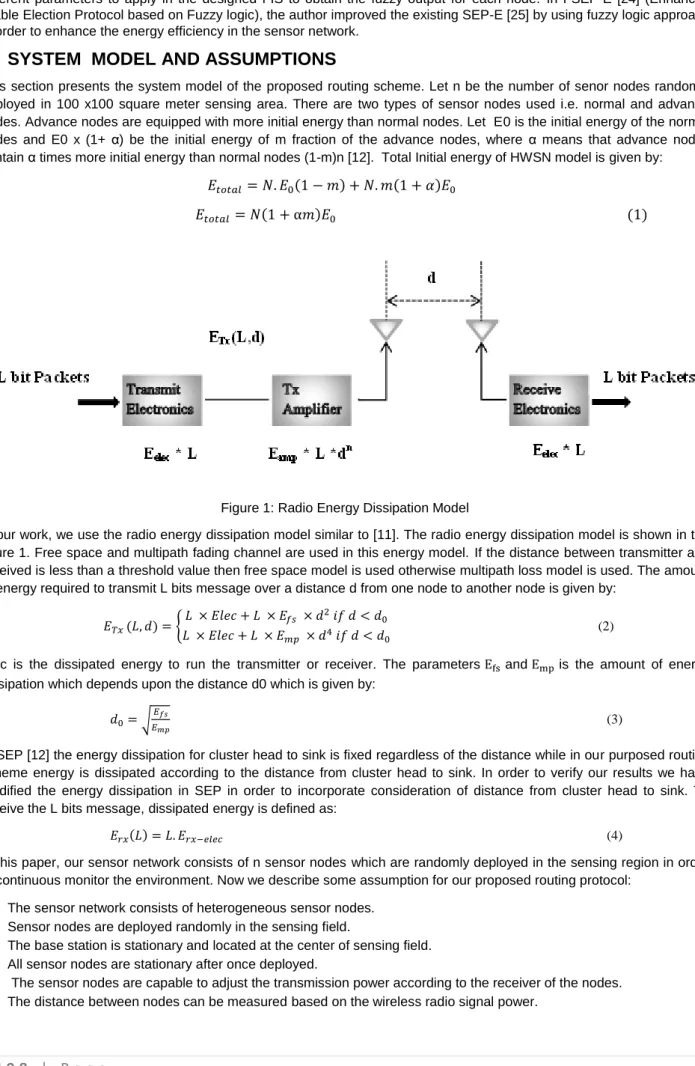
Figure 1: Radio Energy Dissipation Model
In our work, we use the radio energy dissipation model similar to [11]. The radio energy dissipation model is shown in the figure 1. Free space and multipath fading channel are used in this energy model. If the distance between transmitter and received is less than a threshold value then free space model is used otherwise multipath loss model is used. The amount of energy required to transmit L bits message over a distance d from one node to another node is given by:
( ) {
(2)
Elec is the dissipated energy to run the transmitter or receiver. The parameters and is the amount of energy dissipation which depends upon the distance d0 which is given by:
√
(3)
In SEP [12] the energy dissipation for cluster head to sink is fixed regardless of the distance while in our purposed routing scheme energy is dissipated according to the distance from cluster head to sink. In order to verify our results we have modified the energy dissipation in SEP in order to incorporate consideration of distance from cluster head to sink. To receive the L bits message, dissipated energy is defined as:
( ) (4)
In this paper, our sensor network consists of n sensor nodes which are randomly deployed in the sensing region in order to continuous monitor the environment. Now we describe some assumption for our proposed routing protocol:
The sensor network consists of heterogeneous sensor nodes. Sensor nodes are deployed randomly in the sensing field.
The base station is stationary and located at the center of sensing field. All sensor nodes are stationary after once deployed.
The sensor nodes are capable to adjust the transmission power according to the receiver of the nodes. The distance between nodes can be measured based on the wireless radio signal power.
I N T E R N A T I O N A L J O U R N A L O F C O M P U T E R S & T E C H N O L O G Y
4. PROPOSED FMEEP: FUZZY LOGIC BASED MULTIHOP ENERGY EFFICIENT
ROUTING PROTOCOL
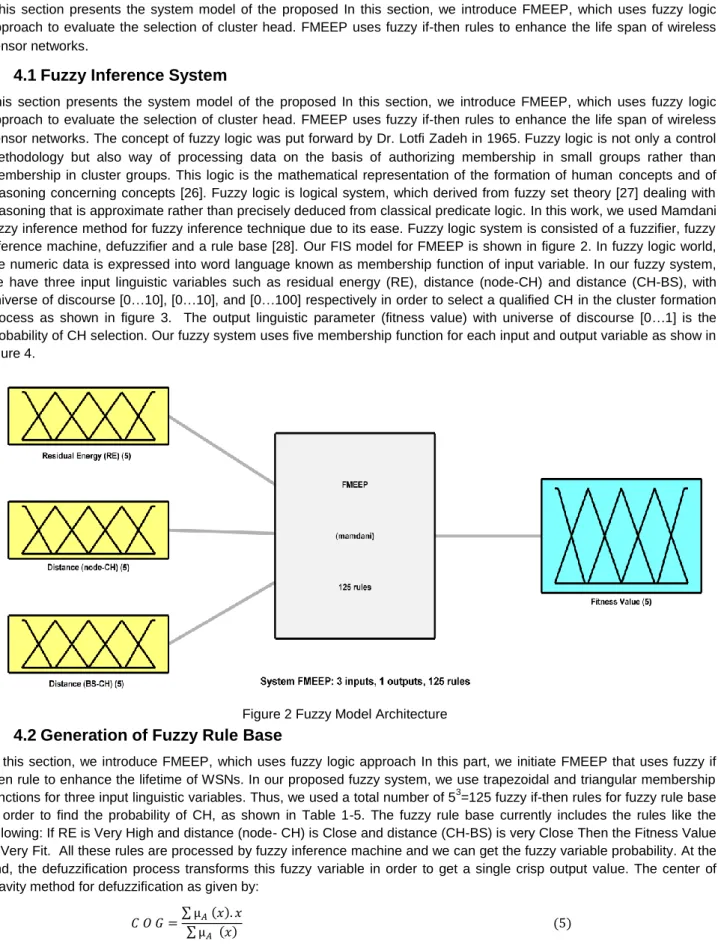
This section presents the system model of the proposed In this section, we introduce FMEEP, which uses fuzzy logic approach to evaluate the selection of cluster head. FMEEP uses fuzzy if-then rules to enhance the life span of wireless sensor networks.
4.1 Fuzzy Inference System
This section presents the system model of the proposed In this section, we introduce FMEEP, which uses fuzzy logic approach to evaluate the selection of cluster head. FMEEP uses fuzzy if-then rules to enhance the life span of wireless sensor networks. The concept of fuzzy logic was put forward by Dr. Lotfi Zadeh in 1965. Fuzzy logic is not only a control methodology but also way of processing data on the basis of authorizing membership in small groups rather than membership in cluster groups. This logic is the mathematical representation of the formation of human concepts and of reasoning concerning concepts [26]. Fuzzy logic is logical system, which derived from fuzzy set theory [27] dealing with reasoning that is approximate rather than precisely deduced from classical predicate logic. In this work, we used Mamdani fuzzy inference method for fuzzy inference technique due to its ease. Fuzzy logic system is consisted of a fuzzifier, fuzzy inference machine, defuzzifier and a rule base [28]. Our FIS model for FMEEP is shown in figure 2. In fuzzy logic world, the numeric data is expressed into word language known as membership function of input variable. In our fuzzy system, we have three input linguistic variables such as residual energy (RE), distance (node-CH) and distance (CH-BS), with universe of discourse [0…10], [0…10], and [0…100] respectively in order to select a qualified CH in the cluster formation process as shown in figure 3. The output linguistic parameter (fitness value) with universe of discourse [0…1] is the probability of CH selection. Our fuzzy system uses five membership function for each input and output variable as show in figure 4.
4.2 Generation of Fuzzy Rule Base
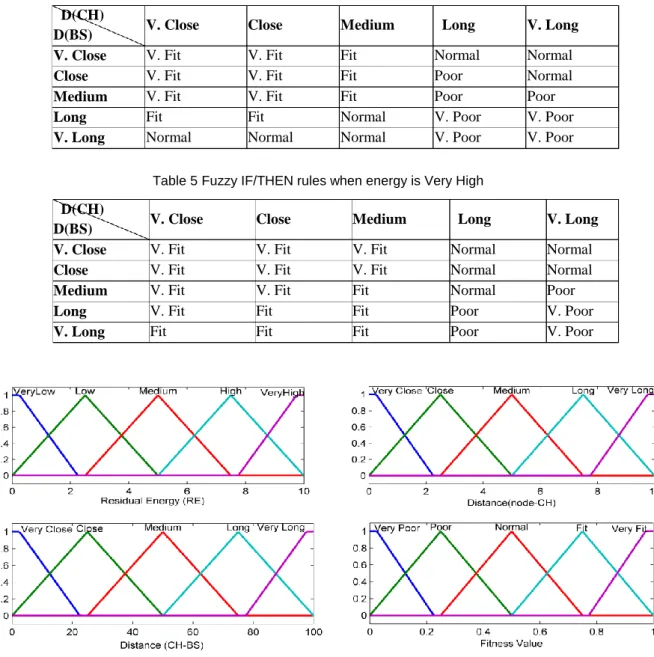
In this section, we introduce FMEEP, which uses fuzzy logic approach In this part, we initiate FMEEP that uses fuzzy if then rule to enhance the lifetime of WSNs. In our proposed fuzzy system, we use trapezoidal and triangular membership functions for three input linguistic variables. Thus, we used a total number of 53=125 fuzzy if-then rules for fuzzy rule base in order to find the probability of CH, as shown in Table 1-5. The fuzzy rule base currently includes the rules like the following: If RE is Very High and distance (node- CH) is Close and distance (CH-BS) is very Close Then the Fitness Value is Very Fit. All these rules are processed by fuzzy inference machine and we can get the fuzzy variable probability. At the end, the defuzzification process transforms this fuzzy variable in order to get a single crisp output value. The center of gravity method for defuzzification as given by:
∑ ( ) ∑
( ) ( )
Where, µA(x) is membership function of fuzzy set A.
I N T E R N A T I O N A L J O U R N A L O F C O M P U T E R S & T E C H N O L O G Y
4.3 Multihop Routing Approach
Finally, for data transmission, FMEEP uses short distance multi-hop energy efficient communication approach from cluster heads to base station in order to achieve the desired energy efficiency in the sensor network. The multi-hop approach is used for cluster heads that exceed the communication threshold, d > d0, to base station. In this multihop strategy, each cluster head uses greedy forward approach and forward packets towards the BS.
Figure 3 Proposed FIS model for FMEEP
D(CH)
D(BS) V. Close Close Medium Long V. Long
V. Close Normal Poor Poor V. Poor V. Poor
Close Normal Poor V. Poor V. Poor V. Poor
Medium Poor V. Poor V. Poor V. Poor V. Poor
Long Poor V. Poor V. Poor V. Poor V. Poor
V. Long V. Poor V. Poor V. Poor V. Poor V. Poor
D(CH)
D(BS) V. Close Close Medium Long V. Long
V. Close Normal Normal Poor V. Poor V. Poor
Close Normal Poor V. Poor V. Poor V. Poor
Medium Normal Poor V. Poor V. Poor V. Poor
Long Poor V. Poor V. Poor V. Poor V. Poor
V. Long V. Poor V. Poor V. Poor V. Poor V. Poor
Table 1 Fuzzy IF/THEN rules when energy is Very Low
Table 2 Fuzzy IF/THEN rules when energy is Low
Table 3 Fuzzy IF/THEN rules when energy is Medium
D(CH)
D(BS) V. Close Close Medium Long V. Long
V. Close Fit Fit Fit Normal Normal
Close Fit Fit Normal Normal Poor
Medium Fit Fit Normal Poor Poor
Long Normal Normal Normal Poor V. Poor
I N T E R N A T I O N A L J O U R N A L O F C O M P U T E R S & T E C H N O L O G Y
5. SIMULATION PERFORMANCE PARAMETERS
In this work, the following performance measurement parameters are used to evaluate the performance of proposed routing algorithm. Detail of these parameters is as follow:
1) Stability period: Stability Period can be defined as the time interval from when the network operation starts until death of first node.
2) Instability period: Instability Period can be defined as the time interval starting from the death of first node till death of last node.
3) Network lifetime: Network lifetime can be defined as the time interval between the network operation start until the death of last node.
4) Network Remaining Energy: It will measure the total remaining total energy of the network.
5) Throughput: Throughput will measure the total number of packets which are sent to BS. Table 4 Fuzzy IF/THEN rules when energy is High
D(CH)
D(BS) V. Close Close Medium Long V. Long
V. Close V. Fit V. Fit Fit Normal Normal
Close V. Fit V. Fit Fit Poor Normal
Medium V. Fit V. Fit Fit Poor Poor
Long Fit Fit Normal V. Poor V. Poor
V. Long Normal Normal Normal V. Poor V. Poor
Table 5 Fuzzy IF/THEN rules when energy is Very High
D(CH)
D(BS) V. Close Close Medium Long V. Long
V. Close V. Fit V. Fit V. Fit Normal Normal
Close V. Fit V. Fit V. Fit Normal Normal
Medium V. Fit V. Fit Fit Normal Poor
Long V. Fit Fit Fit Poor V. Poor
V. Long Fit Fit Fit Poor V. Poor
Figure 4 Membership graph for three inputs variables (Residual Energy (RE), Distance (node-CH), Distance (CH-BS)) and one output variable (Fitness Value)
I N T E R N A T I O N A L J O U R N A L O F C O M P U T E R S & T E C H N O L O G Y
6. SIMULATION PERFORMANCE PARAMETERS
In this section, we evaluate the performance of purposed routing scheme by introducing various parameters of heterogeneity. We use 100 x 100 square meter sensing region of 100 sensor nodes. Sink is located in the middle of sensing field. We compare it with LEACH and SEP in the same heterogeneous setting, where extra initial energy of advance nodes is uniformly distributed over the sensor field. The other key parameters used in simulation are given below in the Table 6.
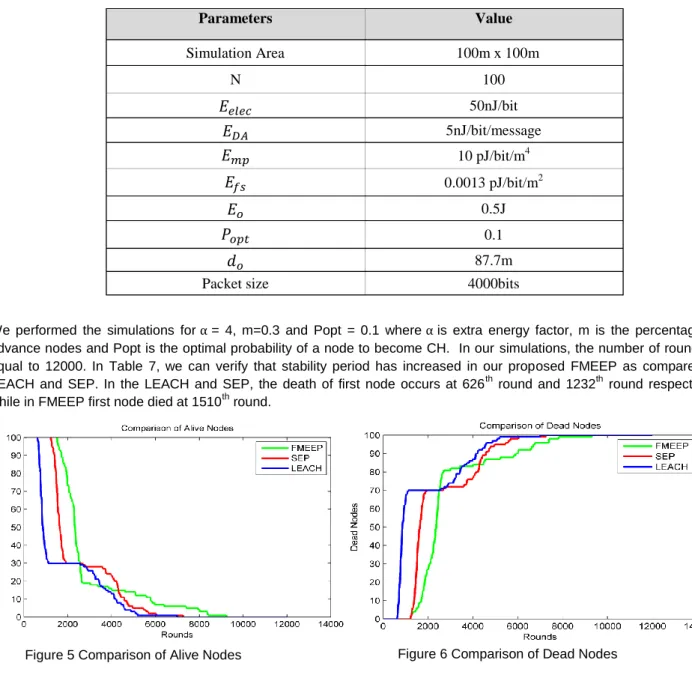
We performed the simulations for = 4, m=0.3 and Popt = 0.1 where is extra energy factor, m is the percentage of advance nodes and Popt is the optimal probability of a node to become CH. In our simulations, the number of rounds is equal to 12000. In Table 7, we can verify that stability period has increased in our proposed FMEEP as compared to LEACH and SEP. In the LEACH and SEP, the death of first node occurs at 626th round and 1232th round respectively while in FMEEP first node died at 1510th round.
We can verify that the stability period of network has enhanced in the case of FMEEP as compare to LEACH and SEP because FMEEP uses fuzzy logic based mechanism in order to select the most qualified CH and more balanced energy efficient operations in the sensor network. Figure 5 shows the number of alive nodes and it is clearly shown that FMEEP outperforms in terms of stability period as compared to LEACH and SEP. In Table 7, we can observe that FMEEP has significantly enhanced the instability period of the network as compared to LEACH and SEP. In LEACH and SEP all nodes died at 6990th round and 7279th round respectively while in FMEEP all nodes died at 9245th round. It is thus clear that the instability period of network has improved in the case of FMEEP as compare to LEACH and SEP as shown in Figure 6. The results show that FMEEP improves total network lifetime by 33 % compared to LEACH and 27 % as compared to SEP. Parameters Value Simulation Area 100m x 100m N 100
𝐸
𝑒𝑙𝑒𝑐 50nJ/bit𝐸
𝐷𝐴 5nJ/bit/message𝐸
𝑚𝑝 10 pJ/bit/m4𝐸
𝑓𝑠 0.0013 pJ/bit/m2𝐸
𝑜 0.5J𝑃
𝑜𝑝𝑡 0.1𝑑
𝑜 87.7mPacket size 4000bits
Table 6 Simulation Parameters
I N T E R N A T I O N A L J O U R N A L O F C O M P U T E R S & T E C H N O L O G Y
Figure 7 shows the comparison of total remaining energy of network in each round and we can observe that total remaining energy in joules is more in FMEEP as compared to LEACH and SEP.
In Figure 8, we can see that FMEEP has enhanced the throughput of the network as compared to LEACH and SEP. The results show that the total number of packets sent from CHs to sink is higher in the case of FMEEP as compared to LEACH and SEP. Our simulation results prove that the throughput of FMEEP is higher than LEACH and SEP.
Figure 9 depicts the surface plot among the two input variables residual energy (RE) and distance (CH-BS) and output variable Fitness Value. We can see that input variable parameters of the nodes have different effect on the output variable. As the residual energy increased and the distance to BS decreased, the node is more probable to become a CH. Figure 10 shows that as residual energy is increases and the distance to CH decreases the probability of node to become a CH also increased. Hence, the simulation results clearly show that FMEEP provides best performance characteristics as compared to LEACH and SEP in terms of network lifetime, stability and throughput.
Rounds Nodes LEACH SEP FMEEP
12000
1st Dead 626 1232 1510
Last Dead 6990 7249 9245
Table 7 Comparison of Results
Figure 7 Comparison of Total Remaining Energy
Figure 9 Surface plot of Distance (CH-BS) and Residual Energy (RE)
Figure 8 Comparison of Throghput
Figure 10 Surface plot of Distance (node-CH) and Residual Energy (RE)
I N T E R N A T I O N A L J O U R N A L O F C O M P U T E R S & T E C H N O L O G Y
7. CONCLUSION
In this paper, we proposed a novel fuzzy logic based cluster head election mechanism with energy-optimized multihop routing in order to achieve the energy efficiency in HWSN called FMEEP. The simulation results proved that the purposed routing protocol, FMEEP, significantly increased the stability period, network lifetime and throughput of the sensor network as compared to SEP and LEACH in heterogeneous environment. This is because each node determines its fitness value based on residual energy, distance (node-CH) and distance (CH-BS) in order to elect a qualified CH. The simulation results indicate that FMEEP can balance the overall energy consumption of the entire sensor network and extend the network lifetime. Moreover, in future work, we can improve this study in order to find the optimal fuzzy set and to compare the enhanced version of FMEEP with other clustering protocols.
REFERENCES
1. I.F. Akyildiz, W.Su, Y. Sankarasubmmaiam, E.Cayirci, “A Survey on Sensor Networks,” IEEE Comm. Magazine, pp.102-114, Aug 2002.
2. Jennifer Yick, Biswanath Mukherjee, Dipak Ghosal. Computer Networks,The International Journal of Computer and Telecommunications Networking, Volume 2 Issue 12, August, 2008.
3. R Kumar, V. Tsiatsis, M.B. Srivastava, Computation Hierarchy for In-Network Processing, Proceedings of 2nd ACM International Workshop on Wireless Networks and Applications, San Diego, CA, 68-77, 2003.
4. D. Kumar, T. C. Aseri, R.B. Patel, HCEE: Hierarchical clustered energy efficient protocol for heterogeneous wireless sensor networks, International Journal of Electronics Engineering, 1(1):123-126, 2009.
5. Kemal Akkaya and Mohamed Younis, “A Survey on Routing Protocols for Wireless Sensor Networks,” Ad Hoc Networks, Vol. 3, No. 3, pp. 325-349, May 2005.
6. J. Al-Karaki, and A. Kamal, “Routing Techniques in Wireless Sensor Networks: A Survey,” IEEE Communications Magazine, Vol. 11, no. 6, Dec. 2004, pp. 6 -28.
7. M. Yarvis, N. Kushalnagar, H. Singh “Exploiting heterogeneity in sensor networks,” IEEE INFOCOM, 2005. 8. E. A. Khalil and B. A. Attea, “Energy-aware evolutionary routing protocol for dynamic clustering of wireless
sensor networks,” Swarm and Evolutionary Computation, vol. 1, no. 4, pp. 195–203, 2011.
9. E. Kranakis, H. Singh, and J. Urrutia,“Compass Routing on Geometric Networks” Proc 11th Canadian Conference on Computational Geometry, Vancouver, Canada, August 1999, pp. 51-55.
10. Y. Huang , L. Yang , and J. Lin, “An efficient energy data gathering based on grid-chain for wireless sensor networks,” Proc. 2012 4th International Conference on Awareness Science and Technology, August 2012, pp.78-82, DOI: 10.1109/iCAwST.2012.6469593.
11. W. R. Heinzelman, A. Chandrakasan,and H.Balakrishnan,”Energy- Efficient Communication Protocol for Wireless Microsensor Networks,” IEEE Proc. Hawaii Int’,l. Conf. Sys. Sci., pp. 1-10, 2000.
12. G. Smaragdakis, I. Matta, A. Bestavros, “SEP: A Stable Election Protocol For Clustered Heterogeneous Wireless Sensor Networks,” in proceedings of 2nd International Workshop on Sensor and Actor Network Protocols and Applications (SANPA’04), Boston, MA, 2004, pp. 660 -670.
13. Muhammad Rizwan , Muhammad S.Nisar, and Hongbo Jiang, MREEP: Multihop Residual Energy based Energy Efficient Routing Protocol for HWSN, 6th International Conference MMEBC, 2016.
14. Muhammad Rizwan , Muhammad S.Nisar, and Hongbo Jiang, TMEEP: Threshold-sensitive based Multihop Energy Efficient Protocol for HWSN, 6th International Conference MMEBC, 2016.
15. Muhammad Rizwan , Muhammad S.Nisar, and Hongbo Jiang, ZEEP: Zonal based Energy Efficient Routing Protocol for HWSN, 6th International Conference MMEBC, 2016.
16. Qing, Li, Qingxin Zhu, and Mingwen Wang. "Design of a distributed energy-efficient clustering algorithm for heterogeneous wireless sensor networks." Computer Communications 29, no. 12, pp. 2230-2237, 2006.
17. H. Saini, Parul, and Ajay K. Sharma. "E-DEEC-enhanced distributed energy efficient clustering scheme for heterogeneous WSN." In Parallel Distributed and Grid Computing (PDGC), 2010 1st International Conference on, IEEE, 2010, pp. 205-210. 2010.
18. D. Kumar, T. C. Aseri, and R. B. Patel, “EEHC: energy efficient heterogeneous clustered scheme for wireless sensor networks,” Computer Communications, vol. 32, no. 4, pp. 662–667, 2009.
19. D. Kumar, T. C. Aseri, and R. B. Patel, “Multi-hop communication routing (MCR) protocol for heterogeneous wireless sensor networks,” International Journal of Information Technology, Communications and Convergence, vol. 1, no. 2, pp. 130–145,2011.
20. S.Kumar, M. Prateek, B. Bhushan,”Distance based cluster protocol for heterogeneous wireless sensor network,” IJCA, vol. 76, No. 9, pp. 42-47, August 2013.
21. I.Gupta, D Riordan and S.Sampalli, “Cluster-head Election using Fuzzy Logic for Wireless Sensor Networks,” Communication Networks and Services Research Conference, pp. 255-260, 2005.
22. J. M.Kim, S.H.Park, Y. J.Han, and T.M. Chung, “CHEF: Cluster Head Election mechanism using Fuzzy logic in Wireless Sensor Networks,” Advanced Communication Technology, ICACT 2008, Vol. 1, pp. 654 –659 2008.
I N T E R N A T I O N A L J O U R N A L O F C O M P U T E R S & T E C H N O L O G Y
23. Ran, H. Z., "Improving on LEACH Protocol of Wireless Sensor Networks Using Fuzzy Logic," Journal of Information & Computational Science, 2010.
24. Pal, R., Sharma, A.K.: FSEP-E: enhanced stable election protocol based on fuzzy logic for cluster head selection in WSNs.In: Sixth International Conference on Contemporary Computing, pp. 427–432, Aug 2013.
25. Femi A. Aderohunmu, Jeremiah D. Deng, “ An Enhanced Stabel Election Protocol (SEP) for Clustered Heterogeneous WSN”, Discussion Paper Series, No. 2009/07, October 2009, ISSN: 1177-455X, Department of Information Science, University of Ontago, (2010).
26. Z. Daliri et al., “Railway security through the use of wireless sensor networks based on fuzzy logic”, International Journal of the Physical Sciences Vol. 6(3), pp. 448-458, 2011.
27. S. Robert Lowen, Fuzzy Set Theory: Basic Concepts, Techniques, and Bibliography, Springer, 1996.
28. S. Swapna Kumar, M. Nanda Kumar, V. S. Sheeba, K. R. Kashwan, “Cluster Based Routing Algorithm Using Dual Staged Fuzzy Logic in Wireless Sensor Networks”, Journal of Information & Computational Science 9: 5 1281–1297,2012