ISSN 1744-1986
T e c h n i c a l R e p o r t N
o2 0 0 6 / 0 7
Problem transformations in solving the Package Router
Control problem
Dr Lucia Rapanotti
Dr Jon Hall
Michael Jackson
5
thJuly 2006
Department of Computing
Faculty of Mathematics and Computing
The Open University
Walton Hall,
Milton Keynes
MK7 6AA
United Kingdom
Problem transformations in solving
the Package Router Control problem
Lucia Rapanotti
Jon G. Hall
Michael A. Jackson
Centre for Research in Computing
The Open University
{
L.Rapanotti, J.G.Hall
}
@open.ac.uk, [email protected]
July 4, 2006
Abstract
The paper describes a problem analysis, from early requirements through to design, to devise a controller for a package router. The analysis is based on the representation and systematic transformation of the problem and its parts. The intent of the paper is to provide an example of detailed and systematic analysis by using a problem-oriented approach that brings together ideas from the original problem frames approach with subsequent elaboration and extensions by the authors.
1
Introduction
Problem-oriented approaches to Requirements Engineering (RE) are gaining interest as a way of developing the re-quirements for software intensive systems. The foundations of problem-oriented RE have been laid over a number of years [16, 17, 18], problem frames [18] being the most complete presentation. Problem-oriented RE encourages the developer to focus on developing their understanding of a problem first, avoiding premature software design and implementation. In this view, a problem is seen as a requirement in a real-world context for which a soft-ware solution is sought. The process of requirements analysis is then seen as a problem solving process, leading ultimately, in hope, to a software specification which can be argued to satisfy the requirement in its context.
The approach is gaining popularity (see [7] for an overview of recent research and practice) and complements other approaches in RE such as goal-oriented [38, 37] and scenario-based [33, 1, 6] ones. Most current research into problem-oriented RE is based on problem frames.
Problem-oriented RE has many advantages. It has a principled basis [39, 10, 13], which allows for adequacy argumentation and rich traceability [14] from requirements to specifications. It embodies a discipline of descrip-tions [19] for the capture of the relevant properties of the real-world context, while being sufficiently flexible to allow for informality [12]. It supports reuse of expertise through the identification of recurrent problem classes [18]. However, it suffers from being difficult to combine with models of software system development that iterate between problem and solution domains. For instance, Bass, Clement and Kazman observe that early trade-offs between qualities need to be made if a system architecture is to be chosen, with that choice of architecture being
a driver in the way in which the system’s requirements can be further determined. Other authors [22, 35, 29, 13] make similar observations.
In previous work of the authors, explicit consideration has been given to problem and solution spaces as ‘equal partners’ in software engineering [12, 4, 31, 11]. This view raises the issue of which is the most appropriate way to relate them and has lead us to the developments of a conceptual framework for problem-oriented Software Engineering (SE) [12]. The framework is a reflection of the fact that SE includes the identification and clarification of system requirements, the understanding and structuring of the problem world, the structuring and specification of a hardware/software machine that can ensure satisfaction of the requirements in the problem world, and the construction of adequacy arguments, convincing both to developers and to customers, users and other interested parties, that the system will provide what is needed.
Note that these activities are much concerned with non-formal domains of reasoning: the physical and human world, requirements expressed in natural language, the capabilities of human users and operators, and the identifi-cation and resolution of apparent and real conflicts between different needs. In a software-intensive system these informal domains interact with the essentially formal hardware/software machine: an effective approach to system development must therefore deal adequately with the informal, the formal, and the relationships between them.
As Turski has pointed out [36]:
There are two fundamental difficulties involved in dealing with non-formal domains (also known as the real world):
1. Properties they enjoy are not necessarily expressible in any single linguistic system. 2. The notion of mathematical (logical) proof does not apply to them.
These difficulties, which are well known in the established branches of engineering, have sometimes led to a harmful dichotomy in approaches to software development: some approaches address only the formal concerns, usually in a single formal language; others address only the informal concerns, using several, often incommensu-rable, languages. The aim of the framework proposed in [12] is to bring both non-formal and formal aspects of software development together in a single framework. The framework is intended to provide a structure within which the results of different development activities can be combined and reconciled. Essentially the structure is the structure of the progressive solution of a system development problem; it is also the structure of the adequacy argument that must eventually justify the developed system. The framework does not prescribe any particular development process, but rather identifies discrete steps of development and their connections, which may be accommodated within the chosen development process.
In this paper we provide an example of a detailed and systematic development of a problem based on the proposed framework. The problem is drawn from the literature, but the analysis presented here is new. The notation adopted for problem representation is largely that of problem frames rather than the formal notation of [12], and we assume that the reader is familiar with this notation.
2
The Problem-oriented framework
The framework of [12] can be regarded as the definition of a Gentzen-style sequent calculus [21] for manipulating software problems, with sequents representing problems rather than the traditional logical statements. The basis of a Genzten-style sequent calculus is a sequent. A sequent is, simply, some well-formed formula which in the framework defines a problem. The point of a sequent is to have it transformed into another sequent that is, in some sense, easier to work with, or will lead to something that is easier to work with. The point of the Genzten system is to provide (always sensible) manipulations of sequents; many useful logical systems – such as the propositional calculus, natural deduction, predicate calculus – have Gentzen-style sequent encodings with useful properties, such as being amenable to computer supported transformation (for instance, [3, 8, 2, 5]). In the framework the sequents represent problems, and that is what we manipulate. Hence, the aim of the framework is to allow the description of problems as sequents and to characterise the sensible manipulations of problems. In the remainder of this section we recall the main elements of the framework.
2.1
Software problems
A (software) problem is regarded as a requirement in a real-world context. A context is a set of (possibly) inter-acting domains (D1, . . . ,Dn) described in terms of their indicative properties; each domain encapsulates a part of
the real-world which is of interest in the problem; a requirement (R) is a statement of what we would like to be true of the context given a solution to the problem, i.e., an optative statement. A solution (S) is simply a domain, representing a machine whose behaviour is constrained by a developed program, and that solves the problem by interacting with other domains. Interactions between domains is through shared phenomena, which are either con-trolled or observed by each domain. Thus, a software problem challenges us to find the solution that, in the given context, guarantees satisfaction of the requirement.
Within a problem representation, a domain description indicates the possible values and/or states that a domain can occupy, how their values change over time, and which events may occur and when. Such a description is in terms of the domain’s private phenomena and those it shares with other domains. Given a domainD, its sets of phenomena are indicated asD(p)c
o, wheredis the set of its private phenomena,c, the set of phenomenaDcontrols
and shared with other domains, andothe set of phenomena thatDobserves, but are controlled by other domains. A phenomenon is controlled exactly by one domain; a decoration is omitted when the corresponding set is empty. A requirement description indicates the values or states that that a domainshouldoccupy, how their valuesshould
change over time, which eventsshouldoccur and when. Such a description is also in terms of phenomena, which the requirement description either referred to or constrains. In formal notation, we writeRcons
ref to indicate that consis the set of phenomena constrained byRandref the set of phenomena referred to byR. Again, decorations are omitted when corresponding sets are empty.
Hence a problem is represented in the framework as the sequent:
D1(p1)c1
o1, . . . ,Dn(pn)oncn,SoScs `Rrefcons
left-hand side of`.
Conceptually, this view of a problem is shared by problem frames, and in this paper we will adopt the problem frames notation of context and problem diagrams for the representation of problems, rather than the formal notation of [12] just described. For instance, given the following problem, its corresponding problem diagram is given in Figure 1:
Operatoron,off,Device(Stopped,Working)
a on,a off,Controller
a on,a off
on,off `Obey command
Stopped,Working on,off
There are slight differences between the two notations. In problem frames, the ‘!’ sign indicates control: in Figure 1, O!{on,off} indicates that the operator (shortened toO) controls (in this case issues) commands on andoff. We abuse the notation slightly by using the same sign to identify phenomena constrained by the requirement: in the figure,!{Stopped,Working}indicates that the (private) states of the device are constrained byObey command. In problem frames notation, the sharing of phenomena between two domains is indicated by a line which links the (boxes representing the) domains, annotated by the phenomena which are shared, with an indication of which domain controls them. In the formal notation, this is achieved by stating explicitly both sets of controlled and observed phenomena for each domain. Also, private phenomena are not represented explicitly in problem frames notation, unless they are referred to or constrained by the requirement, while they are always stated in the formal framework as part of the decoration of a domain.
O!{on, off} C!{a_on, a_off} Obey command {on, off} !{Stopped, Working} Device Operator Controller
Figure 1: Example of problem frames notation
The language in which a domain or requirement description is written is not prescribed: all is asked is that meaning1can be assigned to statements in the language. Indeed, it would be typical for different stake-holders to have different languages for expressing their understanding of domain descriptions and requirements. Also, there is no assumption of precision or lack of ambiguity in any description; a floor manager’s description of a press that appears in a manufacturing plant might simply be:
The press was installed three years ago.
Through descriptions, understanding of a domain and/or requirement is transferred between customer and de-veloper; for instance, a developer working on the design of a press controller might interpret the floor manager’s statement as identifying the press as thePVert model. The mechanisms of interpretation are complex, ranging from “guessing” to “knowing,” and may be influenced by other factors, such as experience or direct inspection of the press. Interpretation is more or less precise too, and is often in need of validation through, for instance, contin-ued interaction between the stake-holders as development proceeds. The mechanisms by which such interaction
is conducted are important, but not part of the framework, which makes use only of theoutcomesof it, when they serve as justification of the steps taken towards solution.
2.2
Solutions and adequacy arguments
A software solution is simply a domain that solves a problem. Its description can take many forms, including specifications relating inputs to outputs, or detailed program code in some programming language.
In parallel with, or perhaps following somewhat behind, the search for a solution is the construction of an argu-ment that justifies the fitness-for-purpose of a found solution with respect to the problem. Actually, the arguargu-ment the developer will have to construct expresses the adequacy of the solution with respect to a number of criteria including those of fitness-for-purpose as a customer might see it, design rationale, traceability and trade-offs. The construction of the adequacy argument is step-wise, and follows the application of problem transformations. We will illustrate how an adequacy argument is built in the development of the case study.
2.3
Problem Transformations
Problem transformations capture discrete steps in the solution process. Many classes of transformations are recog-nised in the framework, reflecting a variety of practices reported in the literature or observed elsewhere.
For instance, one type of transformation, calledproblem reduction, captures the idea of transforming problems which appears in [18, Page 103]. There, a transformation of requirements keeps a problem’s solution invariant while domains are removed from the problem. More recently, Hall and Rapanottiet al.[12, 32], Liet al.[27, 28], and Seateret al. [34] have explored what the detail of such transformations would look like. Indeed transformations of requirements to derive specifications are not limited to problem-oriented approaches: in goal-based approaches, for instance [38, 37], high-level goals, which may be regarded as requirements deep in the world, are successively decomposed and refined until technical requirements are specified for a machine to satisfy. Similarly, in scenario-based approaches [33, 1, 6] refinement is often required in the move from from high-level scenarios, often capturing business processes within an organisation, through to low-level scenarios expressing the direct interaction between a software system and its actors.
Another source of problem transformations is the consideration of solution architectures during the analysis process. As already mentioned, in problem frames, with their focus on the problem domain, the choices available to the developer are those that exist in the problem domain, and so useful solution notions, such as architecture, are only implicit. Hallet al.add a notion of architectural service [11] and Rapanottiet al.[31] a notion of architectural decomposition into problem frames to allow solution options to be explored. The framework simultaneously gen-eralises and simplifies these earlier approaches through the definition of a basic rule, calledarchitectural expansion
that allows the solution space structure to influence the problem space.
Problem transformations transform descriptions and their interrelations as problems in a way that respects solution adequacy. This does not mean that in the framework transformations are sound in any formal sense — the informality of the subject matter precludes fully formal treatment of some transformations. The meaning of ‘sound’ here is not necessarily ‘formal’, or ‘formalisable’, although it could be the case that formality is appropriate; instead soundness is fitness-for-purpose of a solution. AJustification of sound application obligation(shortly,justification)
is therefore attached to each problem transformation. An adequacy argument is then a by-product of the sequence (linearization of a tree) of problem transformations that are the designer’s path to solution.
In [12],Problem transformation schematadefine classes of problem transformation. They all conform to the following general form of problem transformation:
That a problem transformation transforms a single problemP to a set of problemsPi,i = 1, ...,n, with justificationJ, means that under the transformation,S is a solution ofPwith adequacy argument
(A1 ∧ ... ∧ An) ∧ J whenever S1, ...,S n are solutions ofP1, ...,Pn, with adequacy arguments A1, ...,An, respectively.
Note that, in general,J will express and justify the relation between the parts ofPand those of ofP1, ...,Pn. As a result, through the linearization of the tree, we also obtained a structuring of S. Of course, such relations could be arbitrarily complex, so that there is no general form forS.
3
The Case Study
We consider the following problem from [18] (in turn, adapted from [35]):
A package router is a large machine used by delivery companies to sort packages into bins according to bar-coded destination labels affixed to the packages. Each bin corresponds to a regional area. Packages slide by gravity through a tree of pipes and binary switches. The bins are at the leaves of this tree.
The problem is to control the operation of the package router so that packages are routed to their appropriate bins, obeying the operators commands to start and stop the conveyor, and reporting any misrouted packages. A schematic of the package router is given in Figure 2; the details of the pipes and switches appear in Figure 3.
control computer (which we must build) misrouting display conveyor on/off buttons conveyor motor operator computer is connected to display, buttons, motor, reading station, sensors & switches
Figure 2: Schematic of the problem (based on [18])
3.1
The initial problem context
In order to provide a problem-oriented representation of the problem, the elements of the schematic must be con-sidered and modelled as domains and phenomena. One possible approach is to map each element of the schematic
conveyor
label reading station package sensors pipe (for sliding down) switch (not to be flipped
unless empty) bin (corresponding to one
or more destinations)
Figure 3: Pipes and switches (based on [18])
to a domain in the model and hard-wired connections to some sets of shared phenomena between corresponding domains. This raises a number of issues.
We should ask whether this level of granularity of the domains is appropriate for our analysis. Do we need to consider the conveyor belt and motor as separate or could we represent them as a single domain? Similarly, should we separate pipes, switches and sensors? In the case of the conveyor, the controller has no separate interaction with the belt, and the relation between motor and belt is well understood, therefore, we could simplify the representation by considering them as a single combined domain.
In modelling the context, we always have a choice between aggregating or separating the descriptions of relevant parts of the world. What we seek is a choice which is fruitful for problem analysis. In general, we want to aggregate, and model as a single domain, identified parts of the world with pertinent behaviours. For instance, let us consider again the topology of Figure 3. The behaviours we may be interested in this problem have to do with: a package label being read by the reading station; a package leaving the reading station; a package entering or leaving a switch; the switch setting at any particular time; and a package being dropped into a bin. A possible aggregation which may help us analyse these behaviours is suggested in Figure 4. For instance, each switch has an incoming pipe and sensor, and two outgoing pipes and sensors, corresponding to the two routes a package can take, while a bin has an incoming pipe and sensor, which is activated just before a package drops into the bin.
Switch
Bin Reading Station
Hard-wired phenomena, such as the connections shown in Figure 2, are certainly a good starting point to look for shared phenomena. For instance, we know that sensor information is sent to the control computer as well as readings from the reading station. However, other shared phenomena arise from transient interactions between domains. This is the case, for instance, of the operator pushing the on/off conveyor buttons or using the display to read information about misrouting.
For bins, switches and packages an identity concern [18] arises: we need to be able to identify the individual switches through which a particular package is routed, and the particular bin in which it falls. Notationally, this is indicated in a context diagram by indexing the corresponding domains and phenomena.
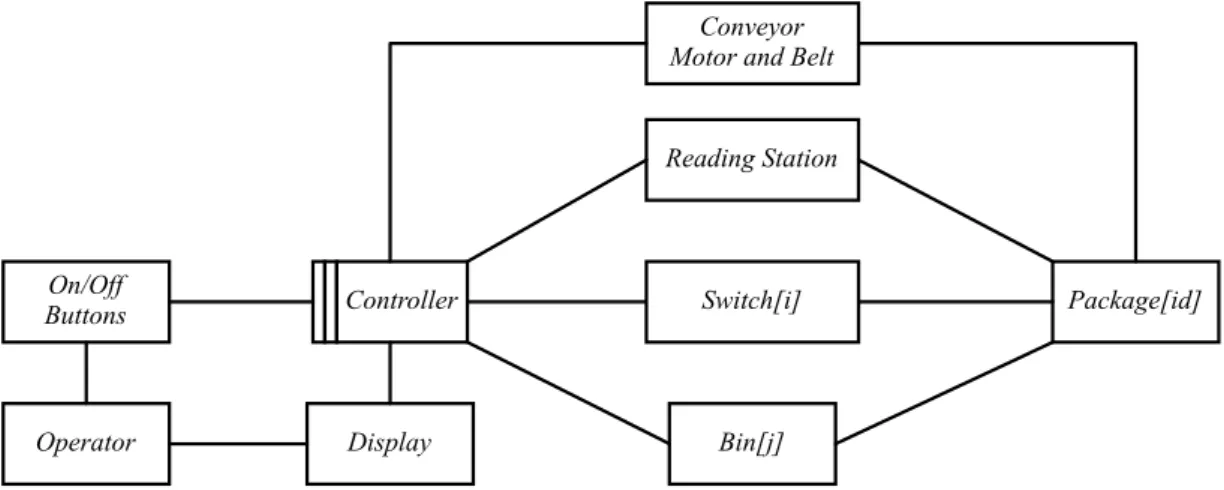
By taking the above considerations into account, a possible context diagram is illustrated in Figure 5: the shared phenomena annotations are not yet included in the figure, as further analysis is still required. Note that, as is always the case in modelling, the suitability of a proposed context diagram as a starting point for analysis is open to debate, and something that would have to be validated with the customer in a real development. This is because the choices we make in defining a context diagram have profound implications on subsequent analysis: we can only reason about facts which can be explicitly captured within the bounds of the model; therefore leaving out certain aspects of the real world means we assume they have no bearing on the problem under study. Making sure that our assumptions are justifiable is necessary to the soundness of our analysis.
Controller Switch[i] Bin[j] Reading Station On/Off Buttons Operator Display Package[id] Conveyor
Motor and Belt
Figure 5: Context diagram of the initial problem (P0), without shared phenomena annotations
3.1.1 Summary of step
This initial step of analysis can be considered as ending with an initial problem statement, P0, in which the context diagram of Figure 5 provides an initial vocabulary of given and machine domains. The diagram also indicates where phenomena are shared by including links between domains; however, at this point, we do not know exactly which phenomena are they. The initial requirement is a generic need for a router controller whose parts are represented in the context diagram; its exact statement has yet to be determined. At this point, little is known of the given domains, other than they interact somehow based on the topology in the diagram. The justification for this first step,J0, is in terms of validating that we have made some acceptable initial assumptions on the world, its parts and their interrelations.P0is the root of our ‘analysis tree’ of problems: each child problem is derived through a problem transformation from its parent, with appropriate justification provided. An initial justification leads to a first problem formulation as illustrated in Figure 6.
P0 J0
P0 Initial problem whose context diagram has no domain descriptions or phenomena annotations (Figure 5)
Figure 6: Tree view of the analysis
There are many possible analysis steps that may be taken from here - many will become apparent as we develop the case study. We choose to start by filling in some of the detail about given domain behaviours and phenomena.
3.2
Behaviour and phenomena
In this section, we analyse in some detail behavioural characteristics of the given domains. In doing so, we analyse relevant states and events, and define appropriate behavioural descriptions. We use state machines [30] as a description language.
Let us start with theConveyor Motor and Belt. On receivingonandoff commands from the controller the conveyor motor will activate or deactivate the belt accordingly. A plausible description of its behaviour is given in Figure 7, whereonandoff are commands issued by the controller and shared betweenControllerandConveyor Motor and Belt.
Running
do / dropPkg[id] Stationary off
on
on off
Figure 7:Conveyor Motor and Beltbehaviour
We assume that this descriptions captures the essential behaviour of the conveyor motor and belt. As an assumption, it is something we rely on in the subsequent analysis, and, hence, needs validation in the real-world, either through the customer or direct empirical testing. The risk of not validating our assumptions is that the resulting analysis may be unsound. The same observation applies to all behavioural descriptions in this section.
The operator (see Figure 5) uses the on/off buttons to control the conveyor through the controller. The on/off buttons act as a connection domain [18] between operator and machine.
Next we are interested in the behaviour of the reading station. When a package arrives, the reading station reads the label on the package and then releases it down into the pipe leaving the station. Figure 8 gives a pos-sible representation of this behaviour. arrivedPkg[id]represents the arrival of a package with identityid at the reading station. The arrival causes the reading station to start reading the package (Reading state with action readPkg(id,dst)). After a short period of time, the package is read and the reading station releases it (transition to Releasingtriggered by the passage of time, with actionreleasePkg[id]). Releasing is complete when the package enters the exit pipe, which triggers a signaloutfrom the reading station sensor to the controller. arrivedPkg[id]
is a phenomenon controlled byPackageand shared withReading Station, whilereleasePkg[id]andout are both controlled byReading Stationand shared withPackageandController, respectively.
Reading do / readPkg(id,dst) arrivedPkg[id] after (n seconds) / releasePkg[id] Ready Releasing out
Figure 8:Reading Stationbehaviour
corresponds to a switch and its incoming and outgoing pipes and sensors. When a package passes in front of a sensor, then the sensor issues a signal to the controller. For example, event in[i][id] represents a package with identityid passing in front of the incoming sensor of switchi; this event triggers the signalin[i]from the sensor to the controller. Similarly, pairsoutLeft[i][id]/outLeft[i]andoutRight[i][id]/outRight[i]correspond to the package passing in front of the left and right exit sensors, respectively, and the corresponding signals triggered. The switch itself can assume one of two positions, left or right, which determines the way a package will be routed at the switch. It is important to know whether a package is currently in the switch as we can only set its position, through activatorsleft[i]andright[i], when the switch is empty. This raises a breakage concern [18]. A breakage concern requires the developer to ensure that the machine (in our example the controller) does not cause a problem domain (in our case one of the switches) to enter an unknown state. The model in Figure 9 does not take into consideration possible delays in state transition when a switch position is set, due to the fact that the switch is a mechanical device. Such delays will require careful consideration in order to fine tune the controller so that a switch position is set in time for an incoming package to be routed correctly. In our example, we disregard such delays.
Switch[i]controls, and shares with theController, phenomena andin[i],outLeft[i]andoutRight[i]. It also shares phenomenain[i][id],outLeft[i][id]andoutRight[i][id]withPackage, which controls them.
Empty &
Left [i] Left [i]Full & in[i][id] / in[i] ? right[i] Empty & Right [i] Full & Right [i] outLeft[i][id] / outLeft[i] in[i][id] / in[i] outRight[i][id] / outRight[i] left[i] left[i] left[i] left[i] right[i] right[i] right[i]
Figure 9:Switch[i]behaviour
Let us now look atBin[j]. This is representative of a bin together with its incoming pipe and sensor. The sensor will issue a signal (bin[j]) whenever it senses a package passing (eventbin[j][id]).
The behaviour of a package is also of interest. This is represented in Figure 10, which reflects as states the positions of a package in its journey from the conveyor, through the router and to its destination bin. For simplicity, we have abstracted the router pipes away in our model, and, with some abuse of notation, we use
event sequences (with separator a ’;’) to annotate transitions. For instance, the transition of a package from being in the reading station (InRS[id]) to the first switch (InSwitch[i][id], withi equal to 1) is annotated by the sequencereleasePkg[id]; in[1][id], representing the event of the package being released at the reading station (releasePkg[id]) immediately followed by the package entering the switch (in[1][id]).
OnBelt[id] InRS[id] dropPkg[id];arrivedPkg[id] InBin[j][id] InSwitch[i][id] releasePkg[id];in[1][id] outLeft[i][id];in[2i][id] [i>2^treeHeight-1] outLeft[i](id);bin[2i](id) outRight[i][id];in[2i+1][id] [i>2^treeHeight-1] outRight[i][id];bin[2i+1][id]
Figure 10:Package[id]behaviour
This behavioural model is a reflection of the binary tree nature of the package router, which will only allow packages to follow specific routes from the reading station to the bins. In terms of sensor signals, the journey of a package from the reading station to a bin - assuming the package does not get stuck on its way - can be characterised by a sequence of events adhering to the following rules (refer also to Figure 11), which characterise a perfectly balanced binary tree:
• releasePkg[id]is followed byin[1][id];
• in[i][id]is followed by eitheroutLeft[i][id]oroutRight[i][id];
• for a tree of heightn >0and for2n−1≤i≤2n−1, eachoutLeft[i][id]oroutRight[i][id]is followed by
abin[j][id], for1≤j ≤2n.
1
2 3
4 5 6 7
1 2 3 4 5 6 7 8
Figure 11: Binary tree of heightn = 3, withm = 2n = 8leaves (the bins) andm−1 = 2n−1 = 7internal
nodes (the switches)
Finally, the controller is to use the display to show information about package misrouting to the operator. The detail of what is to be displayed is yet to be determined. Therefore we use a more abstract phenomenon, display(id,dst,k), to signpost the fact that some information (about the package identity and destination, and the bin number it actually arrived at) will be shared between those domains, the details of which will be decided later on in the analysis.
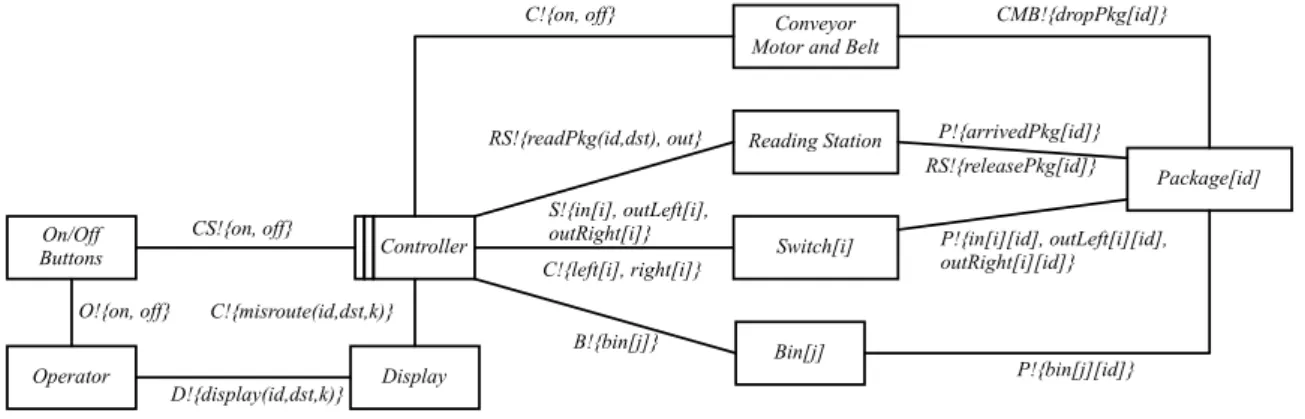
The context diagram with the identified shared phenomena is given in Figure 12.
Controller
Conveyor Motor and Belt
Switch[i] Bin[j] Reading Station On/Off Buttons Operator Display O!{on, off} CMB!{dropPkg[id]} RS!{readPkg(id,dst), out} S!{in[i], outLeft[i], outRight[i]} C!{left[i], right[i]} B!{bin[j]} Package[id] P!{arrivedPkg[id]} P!{bin[j][id]} C!{on, off} CS!{on, off} C!{misroute(id,dst,k)} D!{display(id,dst,k)} RS!{releasePkg[id]} P!{in[i][id], outLeft[i][id], outRight[i][id]}
Figure 12: Context diagram with shared phenomena annotations (for transformed problemP1)
3.2.1 Summary of step
This step transforms problem P0 to a problem P1 (see Figure 13), where behavioural descriptions have been provided for the given domains, together with their relevant phenomena, while the remaining parts ofP0remain unchanged. The justificationJ1required for this transformation is that the given descriptions are approximately true, an assumption which should be validated in the real world.
P0
P1 J1 J0
P0 Initial problem whose context diagram has no domain descriptions or phenomena annotations (Figure 5) P1 Initial problem whose context diagram includes domains descriptions and phenomena annotations (Figure 12)
Figure 13: Tree view of the analysis
Having made an initial exploration of the context of the problem, we move to analysing the requirements for the problem.
3.3
Requirements
As stated earlier, the problem is to control the operation of the package router so that packages are routed to their appropriate bins, obeying the operators commands to start and stop the conveyor and reporting any misrouted packages. This is a rather complex problem which we are going to tackle, in the spirit of problem orientation, by trying to separate various aspects, which may be addressed as separate sub-problems.
Ultimately, of course, to solve this problem we would need to produce code that controls, through some ap-propriate physical device, the switches of the package router. Code and physical device together are the controller machine we are seeking. In our analysis we go some way towards this goal by actually developing (part of) the specification of the code.
The way the machine can control the router is by reading a package destination on the package label via the reading station, then setting the various switches to the appropriate position so that the package is routed to the desired bin. A properly configured controller will know the identity of each switch and the position of each bin. However, as many packages will be on route at any one time, the controller will have to be able to track the route each package is following in order to change the appropriate switches at the appropriate time. Note that this information is not contained in the sensors inputs: a sensor reports that a package has crossed the sensor, but not the package identity. This gives rise to an information deficit concern [20, 15] as the controller cannot determine the current position of a package directly from sensory inputs. We will deal with this problem later on in Section 3.6, when we discuss a standard solution to this concern.
Related to routing is the report of any misrouted package. A package is considered as misrouted if it doesn’t reach the bin appropriate to the package’s destination. Once again, we have an information deficit: in order to decide whether a package has been misrouted, the controller must know its route and current position. This deficit will also be addressed in Section 3.6.
Another part of the problem is to allow the operator to control the package conveyor by using the conveyor on/off buttons.
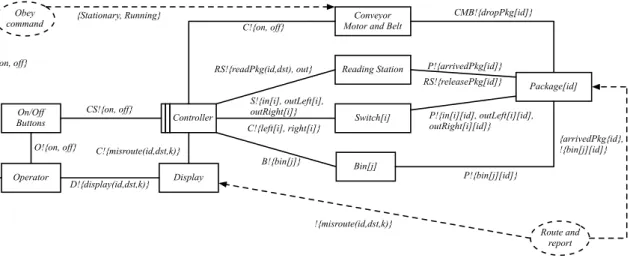
Let us express these aspects of the problem as the following two separate parts of the requirement, which leads to the problem diagram of Figure 142.
Obey command Anon command from the operator should result in the conveyor belt state Running; an off command from the operator should result in the conveyor belt stateStationary.
and
Route and report A package with identityid and destinationdst arriving at the reading station (arrivePkg[id]) should reach the bin corresponding to its destination (bin[id][j], whereBin[j]corresponds todst); otherwise misroute informationmisroute(id,dst,k)should be reported, whereBin[k]is the bin erroneously reached by the misrouted package.
Controller
Conveyor Motor and Belt
Switch[i] Bin[j] Reading Station On/Off Buttons Operator Display O!{on, off} S!{in[i], outLeft[i], outRight[i]} C!{left[i], right[i]} B!{bin[j]} Package[id] C!{on, off} CS!{on, off} Obey command {on, off} {Stationary, Running} Route and report {arrivedPkg{id}, !{bin[j][id]} !{misroute(id,dst,k)} CMB!{dropPkg[id]} P!{arrivedPkg[id]} P!{bin[j][id]} RS!{releasePkg[id]} P!{in[i][id], outLeft[i][id], outRight[i][id]} RS!{readPkg(id,dst), out} C!{misroute(id,dst,k)} D!{display(id,dst,k)}
Figure 14: Problem diagram with requirement statement in two separate parts (problemP2)
3.3.1 Summary of step
This step of analysis transformsP1to problemP2(of Figure 14), where the requirement is restated as the con-junction ofObey command andRoute and report. The justificationJ2for this transformation should be an argument that this interpretation of the requirement corresponds to what the customer desires. The analysis so far is summarised in Figure 15. P0 P1 P2 J1 J2 J0
P0 Initial problem whose context diagram has no domain descriptions or phenomena annotations (Figure 5) P1 Initial problem whose context diagram includes domains descriptions and phenomena annotations (Figure 12) P2 Problem diagram with statement of requirement (Figure 14)
Figure 15: Tree view of the analysis
In the next step we look at dealing with the stated parts of the requirement as separate sub-problems.
3.4
Architectures and sub-problems
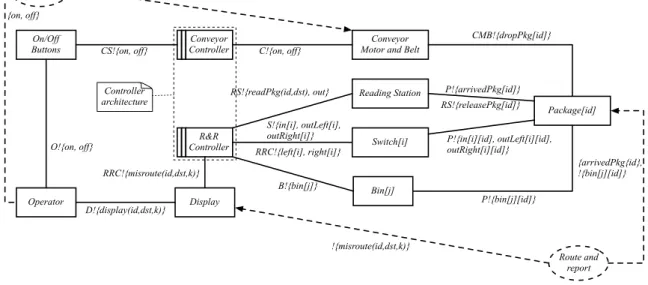
In separating the two parts of requirement, it is our intention to deal with them as separate sub-problems. The transformation that produces this separation, called architectural expansion in the framework, regards the solution of each sub-problem as a separate machine, as indicated in Figure 16. Here, the logical architecture of the con-troller includes an independent component to deal with each sub-problem: theConveyor Controllerand theR&R Controller.
In separating sub-problems some concerns arise when recomposition of their solution is required later on. A number of composition concerns are identified in [18] which relate to issue of synchronisation, consistency of description across sub-problems, interference and precedence. Unless the architectural expansion deals with some of them through decomposition of a standard architecture (as we will see later on in this document), these concerns are usually deferred and dealt with later once sub-problem solutions are found.
In considering the sub-problems separately, we need to identify which parts of the problem context are relevant to each of them (and which to both). First, we consider theObey commandsub-problem. Its requirement states a relation which we would like to be true between operator commands and conveyor belt states. In particular, belt states are constrained by the requirement based on operator commands. For such a relation to be established, we can exploit causal relations existing between phenomena ofOperator,On/Off Buttons,Conveyor Controllerand
Conveyor Motor and Belt, identifiable from their domain properties, hence these parts of the context are all to be considered in the sub-problem analysis.
R&R Controller
Conveyor Motor and Belt
Switch[i] Bin[j] Reading Station On/Off Buttons Operator Display O!{on, off} S!{in[i], outLeft[i], outRight[i]} RRC!{left[i], right[i]} B!{bin[j]} Package[id] C!{on, off} CS!{on, off} Obey command {on, off} {Stationary, Running} Route and report Conveyor Controller Controller architecture {arrivedPkg{id}, !{bin[j][id]} CMB!{dropPkg[id]} P!{arrivedPkg[id]} P!{bin[j][id]} RS!{releasePkg[id]} P!{in[i][id], outLeft[i][id], outRight[i][id]} RS!{readPkg(id,dst), out} RRC!{misroute(id,dst,k)} D!{display(id,dst,k)} !{misroute(id,dst,k)}
Figure 16: Architectural expansion into independent components (P3)
remainder of the problem context, and which may influence the state of the belt, hence the satisfaction of the requirement. From the problem diagram and behaviour descriptions,Conveyor Motor and Beltonly shares phe-nomenondropPkg[id]withPackage[id], which is controlled by the conveyor and appears no to have any effect on the belt state, hence we can disregard it. We can therefore ignore the remainder of the context in the analysis of the sub-problem as indicated in Figure 17.
R&R Controller Switch[i] Bin[j] Reading Station Conveyor Switch Display O!{on, off} RS!{readPkg(id,dst), out} S!{in[i], outLeft[i], outRight[i]} RRC!{left[i], right[i]} B!{bin[j]} Package[id] C!{on, off} CS!{on, off} RRC!{misroute(id,dst,k)} D!{display(id,dst,k)} Obey command {on, off} {Stationary, Running} Conveyor
Controller Motor and BeltConveyor
Operator CMB!{dropPck[id]} P!{arrivedPkg[id]} P!{in[i][id], outLeft[i][id], outRight[i][id]} P!{bin[j][id]} RS!{releasePkg[id]}
Figure 17:Obey commandsub-problem (P6)
A similar analysis of theRoute and reportsub-problem leads to the problem diagram in Figure 18.
3.4.1 Summary of step
This step of analysis is a combination of a number of tranformations and is summarised in Figure 19. Firstly,P2
(of Figure 14) is transformed to problemP3(of Figure 16) by interpreting the solution description to include two separate machines. The justificationJ3for this transformation includes the architectural considerations which led to Figure 16. Then two sub-problems,P4andP5, are generated, corresponding to the problems of specifying the
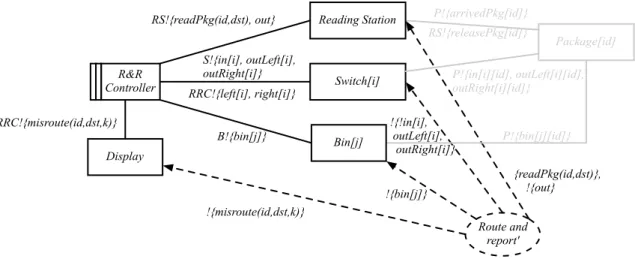
Conveyor Controllerand theR & R Controller, respectively. Finally, problem reduction (which we explain next) is used twice to derive problemsP6(highlighted part of Figure 17) andP7(highlighted part of Figure 18). The
R&R Controller
Conveyor Motor and Belt
Switch[i] Bin[j] Reading Station On/Off Buttons Operator Display O!{on, off} S!{in[i], outLeft[i], outRight[i]} RRC!{left[i], right[i]} B!{bin[j]} Package[id] C!{on, off} CS!{on, off} D!{display(id.dst.k)} Route and report Conveyor Controller {arrivedPkg{id}, !{bin[j][id]} P!{arrivedPkg[id]} P!{bin[j][id]} RS!{releasePkg[id]} P!{in[i][id], outLeft[i][id], outRight[i][id]} CMB!{dropPck[id]} RS!{readPkg(id,dst), out} RRC!{misroute(id,dst,k)} !{misroute(id,dst,k)}
Figure 18:Route and reportsub-problem (P7)
justificationsJ4andJ5of these transformations justify the narrowing of the problem context in each sub-problem.
3.5
Problem reduction
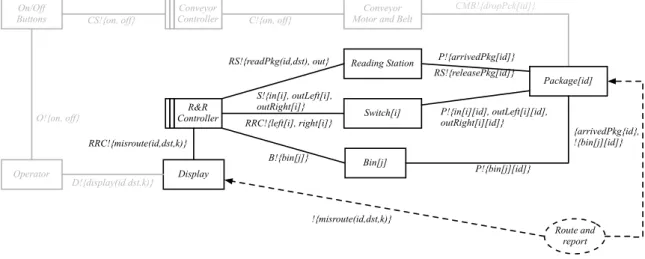
The aim of our problem analysis is to derive a specification from which a solution to the problem can be imple-mented. In the context of problem frames, a specification is a machine description which is expressed entirely in terms of phenomena that the machine shares directly with its context (so called ‘specification phenomena’). Prob-lem reduction [12, 32] is a transformation which, in the context of a probProb-lem, aims at deriving a specification from the requirement in a systematic and solution-preserving way. For instance, in theRoute and reportsub-problem of Figure 18, a specification derived through reduction would be expressed entirely in terms of the phenomena theR& R Controllershares with its context, as opposed to the current requirement constrainingPackage[id]phenomena, which are not accessible by the machine.
As shown in the narrowing of the problem context of a sub-problem, encountered in the previous section, reduction relies on causal relations between phenomena. The result of the transformation is illustrated in Figure 20: it has the combined effect of re-expressing the requirement in terms of specification phenomena and narrowing down the problem context by ‘removing’ Package[id]. The intent is that a solution to the reduced problem in Figure 20 will also be a solution to the problem in Figure 18: the justification for the transformation must, of course, be adequate to ensure this.
Here is the justification for the transformation. Assume areadPkg(id,dst)has occurred at the reading sta-tion, indicating the presence of a package with identityid and destinationdst. For the package to reach the bin corresponding to its destination (bin[j][id], it must follow a particular route through the router leading to that bin. Given the topology of the router and the effect of gravity, the package can only follow one particular route. For instance, a route sequence may have the form (see also Figure 11):
releasePkg[id]; in[1][id]; outLeft[1][id]; in[2][id]; outLeft[2][id]; . . . . . .; in[2n−1][id]; outRight[2n−1][id]; bin[2][id]
P0 P1 P3 P4 P5 J1 J2 J0 P2 J3 P6 J4 P7 J5
P0 Initial problem whose context diagram has no domain descriptions or phenomena annotations (Figure 5) P1 Initial problem whose context diagram includes domains descriptions and phenomena annotations (Figure 12) P2 Problem diagram with statement of requirement (Figure 14)
P3 Controller domain expanded into two architectural components (Figure 16)
P4 Conveyor Controllersub-problem
P5 R & R Controllersub-problem
P6 Conveyor Controllersub-problem with reduced context (Figure 17) P7 R & R Controllersub-problem with reduced context (Figure 18)
Figure 19: Tree view of the analysis
R&R Controller Switch[i] Display S!{in[i], outLeft[i], outRight[i]} RRC!{left[i], right[i]} B!{bin[j]} Route and report' !{bin[j]} {readPkg(id,dst)}, !{out} !{!in[i], outLeft[i], outRight[i]} Package[id] Bin[j]
Reading Station P!{arrivedPkg[id]}
P!{bin[j][id]} RS!{releasePkg[id]} P!{in[i][id], outLeft[i][id], outRight[i][id]} RS!{readPkg(id,dst), out} RRC!{misroute(id,dst,k)} !{misroute(id,dst,k)}
sequence of switches, and ends with the package enteringBin[2]in this case.
Assuming all sensors behaves reliably, each of these package events triggers a sensor signal to the controller (see also the behaviour of reading station and switches in Figures 8 and 9), hence from a sequence of package events we can derive a corresponding sequence of sensor signals. For instance from the route sequence above we can derive the signal sequence:
out; in[1]; outLeft[1]; in[2]; outLeft[2]; . . .; in[2n−1]; outRight[2n−1]; bin[2]
Letroute(id,dst)denote the sequence of signals which can be derived from the route taken by a package with identityid and destinationdst. Similarly, letroute(j)denote the sensor sequence corresponding to the route a package should take to reachBin[j]. Note that this is fixed for each bin, and based on the topology of the binary tree (see Figure 11); for instance,route(1)always follows the left branch of each sub-tree, that is:
out; in[1]; outLeft[1]; in[2]; outLeft[2]; . . .; in[2n−1]; outLeft[2n−1]; bin[1]
Hence, assuming the given topology, only ifroute(id,dst)is the same asroute(j), with Bin[j]corresponding todst, the package will have reached the correct destination. From this observation, we can abstract away the
Package[id]domain, and re-express the requirement in terms of sensor signals as follows:
Route and report0 Assuming a given router topology, areadPkg(id,dst)at the reading station should result in route(id,dst)being the same asroute(j), withBin[j]corresponding todst. Otherwise misroute informa-tionmisroute(id,dst,k)should be reported, wherebin[k]is the last element ofroute(id,dst).
3.5.1 Summary of step
This step of analysis transformsP7(highlighted part of Figure 18) to problemP8(highlighted part of Figure 20). The justification J6for this transformation is in terms of the causal relationships between phenomena and as-sumptions which can be made of parts of the context that are abstracted away, which are captured in the restated requirement. Figure 21 summarises the analysis so far.
3.6
Further architectural expansion
Let us consider the Route and report0 sub-problem further. As noted in Section 3.3, as many packages will be on route at any one time, the controller will have to track the route each package is following in order to set the correct switch directions at appropriate times. Also, as the controller cannot determine the current position of a package directly from the sensor’s inputs, we have an information deficit to deal with. A standard solution is that of building a model [18]: this will allow the controller to track dynamically information about bins, switches and their states, and packages and their routes.
Note how the recognition of an information deficit leads to an architectural decision: that the controller needs to include a model component. This is an example of intertwining of problem and solution [29, 31]: the identification of a problem leads to the search for a standard solution, which can then be used to further problem analysis.
In this sub-problem we can take architectural considerations even further. The problem is a control problem in which inputs and outputs are mediated by a model. A solution architecture which is known to address this
P0 P1 P3 P4 P5 J1 J2 J0 P2 J3 P6 J4 P7 J5 P8 J6
P0 Initial problem whose context diagram has no domain descriptions or phenomena annotations (Figure 5) P1 Initial problem whose context diagram includes domains descriptions and phenomena annotations (Figure 12) P2 Problem diagram with statement of requirement (Figure 14)
P3 Controller domain expanded into two architectural components (Figure 16)
P4 Conveyor Controllersub-problem
P5 R & R Controllersub-problem
P6 Conveyor Controllersub-problem with reduced context (Figure 17) P7 R & R Controllersub-problem with reduced context (Figure 18)
P8 Further reduction ofR & R Controllersub-problem (removal ofPackage[id], Figure 20)
type of problem is a variant of the Model View Controller (MVC) architecture. Originally introduced for software applications with graphical user interfaces [23], an MVC architecture includes controller (C) components which receive user inputs and update a model (M) component accordingly; changes in M are communicated to its dependents, called view (V) components, which interpret them and generate user outputs appropriately. Variants of this MVC architecture have been adopted in control applications, such as avionics [26]. Here, instead of user inputs, environmental sensor information is received by the controller and used to update the model, while the view generates outputs based on changes in the model’s state. Outputs are either user outputs to a display (as in the traditional MVC) or actuator signals through which the controller influences the environment. It is this variant of the MVC which is discussed here.
Figure 22 illustrates an MVC architecture with a single controller and view, presented in problem frames notation. Note that this architectural expansion leads to three sub-problems, which are co-dependent: those of specifying each architectural component. In order to solve the Model sub-problem we would need a complete description of the controller and view. Similarly, in order to solve the Controller (or View) sub-problem we would need a complete description of the model. We ‘co-design’ in the presence of co-dependent sub-problems, A way to resolve co-design is to establish which part of the architecture should be specified first, and which parts should follow. In an MVC architecture, both controller and view are dependent on the model, which is also the component which presents the highest level of complexity, hence the highest development risk. Because of risk and complexity, it is therefore sensible to deal with the model component first [24, 25].
C!{commands to set model state}
M!{model state} S!{in[i], outLeft[i], outRight[i]} V!{left[i], right[i]} B!{bin[j]} C V M RS!{readPkg(id,dst), out} V!{misroute(id, dst, k)}
Figure 22: MVC architecture in problem frames notation
When applied to our problem, the result is that of Figure 23. The architecture of the machine is made explicit and expanded into the three distinct components. This de-coupling of model, view and controller components allows us not only to identify further sub-problems, but also to determine how they fit together, based on standard architectural properties of the MVC.
3.6.1 Summary of step
This step of analysis (summarised in Figure 24) transformsP8toP9(of Figure 23) by re-interpreting the machine domain as the combination of the three architectural components. For justificationJ7of this transformation we appeal to the arguments we have made that the MVC is a suitable solution architecture to deal with the information deficit in our problem. FromP9, the three sub-problems corresponding to finding each of the components are
Switch[i] Bin[j] Reading Station Display S!{in[i], outLeft[i], outRight[i]} V!{left[i], right[i]} B!{bin[j]} C V R&R Controller architecture Route and report' M !{bin[j]} {readPkg(id,dst)}, !{out} !{!in[i], outLeft[i], outRight[i]} RS!{readPkg(id,dst), out} V!{misroute(id,dst,k)} !{misroute(id,dst,k)} Figure 23: MVC expansion (P9)
derived that is: the Model sub-problem (P10); the View sub-problem (P11); and the Controller sub-problem (P12).
Our next step is to specify the model, the more risky and complex part of the architecture.
3.7
Specifying the model
M
We need to define an analogic model [18] of the package router, which will allow theR & R Controllerdynamically to track information about bins, switches and their states, and packages and their routes. In particular, the analogic model will have to provide during operation a faithful representation of the package router state.
Building an analogic model is a design activity, which involves making decisions about the machine’s data structures and their behaviour, rather than capturing new given properties of the world. Such design decisions are dependent on which questions the model is built to answer – in our example, the identity and position of each package in the router, the switch states, etc. Figure 25 gives an illustration of a possible abstraction, proposed in [18], on which the model data structure can be based. Packages travelling in the router can be seen as joining and leaving queues at various points of the router: at the reading station, inside switches and in the pipes that connect reading station, switches and bins. This abstraction based on queues is sensible only if packages cannot overtake each other while travelling through the router. Hence, such a design choice needs to be validated in the real world, for instance, through reasoning based on the physical properties of the mechanical devices and packages, or established knowledge and experience with routers and queues, or even by empirical testing, and considering if any reliability issues with the package router may be uncovered by this abstraction.
Based on this abstraction, and by taking an object-oriented design view, a possible structural description ofM is given by the class diagram [30] of Figure 26. The description is based on well-established object-oriented design heuristics: that classes should be defined to represent relevant parts of the real world, and that an ‘orchestrating class’ (OC) should be added, whose only instance has the responsibility to initialise and orchestrate the behaviour of the model [25]. Class associations reflect the static topological relations between the various parts of the router: for instance, the binary tree topology is reflected in the fact the each switch is associated with exactly three package queues, one incoming and two outgoing. The dynamic relationship between packages and queues is also captured
P9 J7 P10 P11 P12 P0 P1 P3 P4 P5 J1 J2 J0 P2 J3 P6 J4 P7 J5 P8 J6
P0 Initial problem whose context diagram has no domain descriptions or phenomena annotations (Figure 5) P1 Initial problem whose context diagram includes domains descriptions and phenomena annotations (Figure 12) P2 Problem diagram with statement of requirement (Figure 14)
P3 Controller domain expanded into two architectural components (Figure 16)
P4 Conveyor Controllersub-problem
P5 R & R Controllersub-problem
P6 Conveyor Controllersub-problem with reduced context (Figure 17)
P7 R & R Controllersub-problem with reduced context (Figure 18)
P8 Further reduction ofR & R Controllersub-problem (removal ofPackage[id],Figure 20) P9 R & R Controllerdomain expanded into three architectural components (Figure 23) P10 M sub-problem
P11 V sub-problem P12 C sub-problem
Figure 24: Tree view of the analysis
Which Package Is Now At Sensor[s]?
!
No overtaking: packages queue in pipes and switches
!
Each queue associated with its entry point
e
"
{sensor}
#
RS
• Each package first enters the Reading Station queue
• Packages queue in switches: only one exit active at once
!
The machine can maintain a dynamic model of these queues
• Queued elements pi are pairs (Id, Destination)
• p(ID,Destination) represents the package in the model
SWa SWb
Reading Station
Reading
St’n Queue QueuePipe SwitchQueue QueuePipe SwitchQueue QueuePipe
BinB pk
Id Dst
queued packages pi... pj Id Dst pi Id Dst
Figure 25: Using queues as an abstraction
by an association: each package can be at most in one queue at any one time. SwitchQueue in(); outLeft(); outRight(); Package id: Identity; dst: Destination; RSQueue out(); Bin no: Number; bin(); Queue add(Package); remove(): Package; ReadingStation read(Identity, Destination); Switch no: Number; state: SwitchState left(); right(); 1 1 0..1 0..1 1 3 0..1 1 currentQueue 0..1 * 1 1 PipeQueue OC init();
<< signal >> read(Identity, Destination); <<signal>> out((); <<signal>> in_i(); <<signal>> outLeft_i(); <<signal>> outRight_i(); <<signal>> bin_j(); 1 1 1 * * 1 <<enumeration>> SwitchState Left; Right; value {ordered}
Figure 26: Structural description ofM
The behaviour ofM should be devised in a way which addresses the model-world correspondence concern [18], that is making sure that during operation the state of the model is a faithful representation of the world state. An example of a behavioural specification is given by the sequence diagram [30] of Figure 27, which illustrates what happens when the input sensor of switchiis triggered: the orchestrating instance invokes the in() operation on the switch queue object, which retrieves the package from the incoming pipe queue and adds it to the switch own queue. Similar descriptions should be provided for all other incoming signals.
in_i()
remove() package
sq_i: SwitchQueue in_i: PipeQueue
add(package) : OC
in()
Figure 27: Behavioural description ofM on receiving signalin[i]
The current state of a switch in the router is not directly observable by the machine, as there are no sensors to this effect. However, it can be inferred from theoutLeft[i], outRight[i]signals: whenoutLeft[i]is triggered, the
Switch[i]state can only beLeft (ignoring failure); similarly forRight. Based on this observation, we can make sure the a switch state is properly represented in the model every timeoutLeft[i], outRight[i]signals are received by the machine. This is exemplified in the behavioural description in Figure 28 of operation outLeft i(): note how the last operation invocation set the switch state in the model.
The initialisation ofM will have to reflect the actual topology of the router (i.e., which particular switches are connected to each other, etc.), setting the initial state of each switch and the content of each queue (i.e. which packages are in the router and their position. Operation init() in the model will have to be specified to this effect.
outLeft_i()
add(package)
sq_i: SwitchQueue outL_i: PipeQueue
remove() : OC outLeft() package swL_i: Switch left()
Figure 28: Behavioural description ofM on receiving signaloutLeft[i]
phenomena withC andV. In the case ofC, they are all the operation invocations on the orchestrating instance. In the case ofV, it is the model state, that is the instantiation of the structural model of Figure 26. This is illustrated in Figure 29 whenM is now represented as a given domain – plain rectangle – rather than a machine domain – striped rectangle.
C!{init(), out(), in_1(), ..., bin_1(), ...}
M!{model state} C
V M
Figure 29: Shared phenomena between MVC components
Note that during detailed design or implementation, a decision has to be made as to how changes in the model are propagated to the view. There are two standard ways in which this is achieved in practice [9]. The pull approach is predicated onM notifyingV that a change has occurred and V accessing the model state to find out which relevant parts of the model have changed. Thepush approach is predicated onM sendingV specific information of what has changed. Efficiency considerations often determine which of the two approaches should be chosen for a particular development problem based on the complexity of the model and the number of views. The availability of either mechanism at the programming level is another determining factor. Although important, these considerations are outside the scope of this document, which only deals with problem analysis up to early design. In any case, once a decision is made it would be possible within the framework to base further design on it.
3.7.1 Summary of step
This step of analysis includes two transformations. The first transformation, fromP10toP13, is the interpretation which provides the description ofM. Its justificationJ8must support the claim that the specification ofM is an appropriate analogic model of the package router, a claim which requires validation with respect to the real world. The necessary validation is two fold: first with respect to the modelled parts of the problem world; and second,
with respect to the internal consistency of theM domain. The second transformation solvesP13by providing the adequacy argumentJ9of the specification with respect to the requirement. Figure 30 summarises the analysis: the black dot connected toP13indicates this problem has been solved.
P9 J7 P10 P11 P12 P0 P1 P3 P4 P5 J1 J2 J0 P2 J3 P6 J4 P7 J5 P8 J6 P13 J8 J9
P0 Initial problem whose context diagram has no domain descriptions or phenomena annotations (Figure 5) P1 Initial problem whose context diagram includes domains descriptions and phenomena annotations (Figure 12) P2 Problem diagram with statement of requirement (Figure 14)
P3 Controller domain expanded into two architectural components (Figure 16)
P4 Conveyor Controllersub-problem
P5 R & R Controllersub-problem
P6 Conveyor Controllersub-problem with reduced context (Figure 17)
P7 R & R Controllersub-problem with reduced context (Figure 18)
P8 Further reduction ofR & R Controllersub-problem (removal ofPackage[id],Figure 20) P9 R & R Controllerdomain expanded into three architectural components (Figure 23) P10 M sub-problem
P11 V sub-problem P12 C sub-problem
P13 M sub-problem interpreted with a description ofM and then solved
Figure 30: Tree view of the analysis
3.8
Specifying the controller
C
We can now consider the sub-problems of specifyingC andV, under the assumption thatM is as specified in the previous section. Of course, proceeding in this way may lead to the realisation thatM is an inadequate model, hence lead to iteration – which, of course, we would be prepared to do if necessary.
By assumingM, the specification ofC becomes simple:Cis entirely decoupled fromV and only responsible for translating inputs from the environment into operation invocations on the only instance of the orchestrating classOCofM. The correspondence between its inputs and outputs is rather trivial: by following our naming con-vention, on receiving signalin[i],C will invoke operation in i(); on receiving,outLeft[i],C will invoke operation outLeft i(); etc.
3.8.1 Summary of step
This analysis step produces a solution forP8, the sub-problem of specifying theCcomponent of the architecture. As for M, solving a problem is regarded as a problem transformation whose justificationJ10is the adequacy argument that the specification ofC satisfies the requirement of a controller which modifies the model’s state consistently with inputs from the environment. The solution assumes as given the specification of M of the previous section.
3.9
Specifying the view
V
In comparison with that ofC, the problem of specifyingV is more complex and we will analyse it in more detail. The corresponding problem diagram is given in Figure 31, where descriptions ofM andC are now assumed as given (hence both represented as given domains instead of machine domains).
Switch[i] Bin[j] Reading Station Display S!{in[i], outLeft[i], outRight[i]} V!{left[i], right[i]} B!{bin[j]} C M V Route and report' C!{init, out, in_1, ...,
bin_1, ...} M!{model state} !{bin[j]} {readPkg(id,dst)}, !{out} !{!in[i], outLeft[i], outRight[i]} RS!{readPkg(id,dst), out} !{misroute(id,dst,k)} V!{misroute(id,dst,k)}
Figure 31: The sub-problem of specifyingV (P11)
Let us recall from Section 3.5 the requirement for this problem:
Route and report0 Assuming a given router topology, areadPkg(id,dst)at the reading station should result in
route(id,dst)being the same asroute(j), withBin[j]corresponding todst. Otherwise misroute informa-tionmisroute(id,dst,k)should be reported, wherebin[k]is the last element ofroute(id,dst).
First, we want to simplify the problem as much as possible by applying reduction techniques as we did in Section 3.5. These should have the effect of narrowing down the problem context and re-expressing the requirement in terms of specification phenomena.
Because of the specification ofC, we know that inputs from the environment are translated into operation invocations on the modelM. We can therefore restate a package route in terms of operation invocations instead of
sensor signals (see Section 3.5) and re-express the requirement accordingly. For instance, route out; in[1]; outLeft[1]; in[2]; outLeft[2]; . . .; in[2n−1]; outRight[2n−1]; bin[2] can be restated as
out(); in 1(); outLeft 1(); in 2(); outLeft 2(); . . .; in 2n−1(); outRight 2n−1(); bin 2()
Because we have a description ofM, we know the effect of operation invocations on the model state which is shared withV. For instance, the execution of operation outLeft i() will result in switch i having state Left. Therefore, the route above can also be restated in terms of switch states as follows, whereLeft i indicates state Left of switch i (similarly forRight i):
Left 1; Left 2; . . .; Right 2n−1
Letroute0(id,dst)denote the route of a package when restated in terms of switch states (similarly, for the route to a bin). By assuming the available descriptions of all physical domains, and ofC andM, we can rewrite the requirement as follows, which leads to the reduced problem of Figure 32, where the package and bin routes are expressed in terms of switch states:
Route and report00 Assuming a given router topology, and assuming the given behaviours ofReading Stationand
Bin[j], areadPkg(id,dst)at the reading station should result inroute0(id,dst)being the same asroute0(j), withBin[j]corresponding todst. Otherwise misroute informationmisroute(id,dst,k)should be reported, wherebink()is the last element ofroute0(id,dst).
Switch[i] Bin[j] Reading Station Display RS!{readPkg(id,dst), out} S!{in[i], outLeft[i], outRight[i]} V!{left[i], right[i]} B!{bin[j]} C
C!{init, out, in_1, ..., bin_1, ...}
M!{model state}
Route and report'' {read(id,dst)},
!{out(), in_i(), outLeft_i(), outRight_i(), bin_j()} V
M
!{misroute(id,dst,k)} V!{misroute(id,dst,k)}
Figure 32: Problem reduction (to problemP15)
Note that the assumption of the already described given behaviours in the restated requirement is what makes the transformation sound: it allows us to argue that a solution of the reduced sub-problem is also a solution of the original sub-problem. For instance, from the behavioural description ofSwitch[i], we know that on receiving a
left[i]commands the switch position will be set to the left, leading to anoutLeft[i]signal as soon as a package leaves the switch and goes through the sensor. This signal is related to C, which invokes the corresponding operation outLeft i, which in turn causes the state of the switch in the model to be set to Left (see Figure 28).
ForV to be a solution to the reduced sub-problem, it needs to be able to determine which route each package should follow and set switch states accordingly. We make the design decision to represent route information inM through the addition of a class SQueue as shown in Figure 33. This class represents an ordered sequence of switch states and is used for three different purposes:
Package id: Identity; dst: Destination; Bin no: Number; bin(); SQueue value: SwitchState[*]; {ordered} add(SwitchState); remove(): SwitchState; <<enumeration>> SwitchState Left; Right; 0..1 0..1 1 0..1 route route Switch no: Number; state: SwitchState left(); right(); 0..1 1 settings
Figure 33: Route class
For each bin, an instance of this class represents the route from the reading station to the bin, which is statically determined based on the router topology and set in the model at initialisation;
For each package, an instance of this class represents the route a package still has to travel in order to reach its destination. This is initially set when the package destination is read at the reading station (through invocation of operation read in the model) and decreases in length as a package goes through each switch on its route.
For each switch, an instance of this class represents the sequence of settings of the switch which allows the incom-ing packages (i.e., packages in the in queue of the switch) to be routed correctly. This changes dynamically as packages enters the switch incoming and outgoing queues.
L LLRR L RRLR LRR L LR RLR LRR L R RLR LRR L package routes switch settings switch state a) b) c) d)
Figure 34: Routing behaviour
Figure 34 illustrates the expected behaviour. Initially (part a) of the figure) the switch state is Left, and all its queues are empty; a package with route Left; Left; Right; Right is about to enter its incoming pipe. The package enters the incoming pipe (from a) to b) of the figure): the head of the queue representing its route is removed, so that the content of the queue now represents its remaining route to destination; the switch settings queue records the
![Figure 2: Schematic of the problem (based on [18])](https://thumb-us.123doks.com/thumbv2/123dok_us/1697265.2735207/7.892.212.663.725.1004/figure-schematic-problem-based.webp)
![Figure 3: Pipes and switches (based on [18])](https://thumb-us.123doks.com/thumbv2/123dok_us/1697265.2735207/8.892.206.671.56.329/figure-pipes-and-switches-based-on.webp)
![Figure 9: Switch[i ] behaviour](https://thumb-us.123doks.com/thumbv2/123dok_us/1697265.2735207/11.892.264.625.758.978/figure-switch-i-behaviour.webp)
![Figure 10: Package[id] behaviour](https://thumb-us.123doks.com/thumbv2/123dok_us/1697265.2735207/12.892.200.682.165.347/figure-package-id-behaviour.webp)