Theory and Application of a Tool for Value-Based
Sustainability Management
Frank Figge, Tobias Hahn, Stefan Schaltegger & Marcus Wagner
1Center for Sustainability Management, University of Lueneburg, Scharnhorststr. 1, D-21335 Lüneburg, Germany
Paper presented at the Greening of Industry Network Conference 2002, Gothenburg “Corporate Social Responsibility – Governance for Sustainability”
Abstract
Kaplan and Norton’s Balanced Scorecard is a management tool that supports the successful implementation of corporate strategies. It has been discussed and considered widely both in practice and research. By linking operational and non-financial corporate activities with causal chains to the firm’s long-term strategy the Balanced Scorecard supports the alignment and management of all corporate activities according to their strategic relevance. The Balanced Scorecard makes it possible to take into account non-monetary strategic success factors which significantly impact the economic success of a business. It is thus a promising starting-point to also incorporate environmental and social aspects into the main management system of a firm. This paper proposes for value-oriented corporate sustainability management with the
Sustainability Balanced Scorecard. This helps to overcome the shortcomings of conventional approaches to environmental and social management systems by integrating the three pillars of sustainability into a single and overarching management tool. A Sustainability Balanced
Scorecard shows the causal relation between the economic, environmental, and social performance of firms. On the one side this paper discusses the different possible forms of a Sustainability Balanced Scorecard from a conceptual point of view. On the other side it shows the process and steps of formulating a Sustainability Balanced Scorecard for a fictitious
company in practice based on the experience of a major joint research project in Germany and Switzerland.
1
1 Introduction
In the market system economic scarcities are reflected by market prices. Environmental and social scarcities are, however, only partially reflected in economic transactions, although they have become increasingly important for business. Management reacts to perceived scarcities with the use of management instruments. To the degree that environmental and social issues are reflected in market transactions and with the growing importance of environmental and social issues many companies have implemented specific environmental or social management systems during the last decade. These systems have, however, rarely been integrated with the general management system of a firm. As a consequence, environmental and social manage-ment is often not consequently oriented towards the economic success of the firm and the economic contribution of environmental and social management remains unclear. The decisive role of companies in achieving sustainability has been stressed and discussed both on the strategic (e.g. Hart 1995; Hart 1997; Roome 1998; Dyllick & Hockerts 2002) as well as on the instrumental level (e.g. Schaltegger & Burritt 2000; Bennett & James 1999). If firms are to achieve simultaneous improvements of the economic, environmental, and social performance of businesses (strong contributions to sustainability; Figge et al. 2001b; Figge & Hahn 2002) this lack of integration turns out to be a major obstacle. Studies concerning the relation between the environmental and social performance of the firm with its economic performance are mainly based on empirical tests which refer to the correlation but not to the causality between envi-ronmental and social measures and the economic success of firms (e.g. Wagner 2001; Pava & Krausz 1996; Griffin & Mahon 1997). To date there is rather little literature on the relation between environmental and social measures and the achievement of long-term economic goals (for some exceptions Burke & Logsdon 1996; Figge 2001; Schaltegger & Figge 1997; Schaltegger & Synnestvedt 2002). The Balanced Scorecard as a strategic management tool serves to identify the major strategically relevant issues of a business. It describes and depicts the causal contribu-tion of those issues that contribute to a successful achievement of a firm’s strategy (Kaplan & Norton 1997). Thus, it appears promising to use the Balanced Scorecard methodology as a star-ting point to integrate environmental and social management with the general management of a firm. Given this potential, a range of authors have dealt with the topic of a Sustainability Balan-ced Scorecard (e.g. Radcliffe 1999; Bieker et al. 2001a; Bieker et al. 2001b; Bieker et al. 2001c; Dyllick & Schaltegger 2001; Epstein & Wisner 2001; Epstein & Roy 2001; Orssatto et al. 2001). However, only recently the basic approaches and methodology of a value-oriented sustainabi-lity management with the Balanced Scorecard have been discussed in detail (Figge et al. 2001a; Figge et al. 2001b; Figge et al. 2001c and Figge et al. 2002; Hahn & Wagner 2001). A
value-orien-ted corporate sustainability management with the Balanced Scorecard helps to integrate the three pillars of sustainability into a single and overarching management tool.
This paper presents the Sustainability Balanced Scorecard (SBSC) as a tool for value-based sustainability management. First, we briefly discuss the different possible forms of a SBSC. Subsequently, the paper concentrates on the process and steps of formulating a Sustainability Balanced Scorecard. This process is illustrated by using the fictitious example of Textiles Ltd. Before doing so, the Balanced Scorecard approach and its suitability for a value-oriented sustainability management will be outlined in brief in the following section.
2 Balanced Scorecard and value-based sustainability management
2.1 The Balanced Scorecard approachThe concept of the Balanced Scorecard (synonymous: BSC) was developed in the early 90’s as a new approach to performance measurement due to problems of short-termism and past orien-tation in management accounting (Kaplan & Norton 1992). The concept of the BSC is based on the assumption that the efficient use of investment capital is no longer the sole determinant for competitive advantages, but increasingly soft factors such as intellectual capital, knowledge cre-ation or excellent customer orientcre-ation become more important. As a reaction Kaplan and Nor-ton suggested a new performance measurement approach that focuses on corporate strategy in four perspectives (Kaplan & Norton 1992; ibid. 1997; ibid. 2001). This BSC aims to make the contribution and the transformation of soft factors and intangible assets into long-termed financial success explicit and thus controllable. The BSC’s four perspectives can be characterized briefly as follows (Weber & Schäffer 2000, pp 3; Kaplan & Norton 1997, pp 24; ibid. 2001, pp 23, 76):
The financial perspective indicates, if the transformation of a strategy leads to improved economic success. Thus, the financial measures assume a double role: On the one hand, they define the financial performance a strategy is expected to achieve. On the other hand, they are the endpoint of cause and effect relationships referring to the other BSC perspectives.
The customer perspective defines the customer/market segments, in which the business competes. By means of appropriate strategic objectives, measure, targets and initiatives the customer value proposition is represented in the customer perspective, through which the firm/business unit wants to achieve a competitive advantage in the envisaged market segments.
The internal process perspective identifies those internal business processes, which enable the firm to meet the expectations of customers in the target markets and those of the shareholders.
Finally, the learning and growth perspective describes the infrastructure which is neces-sary for the achievement of the objectives of the other three perspectives. In this case, the most important areas are qualification, motivation and goal orientation of employ-ees, and information systems.
The purpose of a BSC is to formulate a hierarchic system of strategic objectives in the four perspectives, derived from the business strategy and aligned towards the financial perspective. Based on such a causal system of objectives, corresponding measures are formulated in all four perspectives. Kaplan and Norton basically distinguish between lagging and leading indicators (Kaplan & Norton 1997, pp 28).
Lagging indicators and long-termed strategic objectives are formulated for the strategic core issues of each perspective which are derived from the strategy of the business unit. Lagging indicators thus indicate whether the strategic objectives in each perspective were achieved. In contrast to the lagging indicators, the leading indicators are very firm-specific. They express the specific competitive advantages of the firm and represent how the results – reflected by the lagging indicators – should be achieved. Based on the specific strategy of the business unit, the key performance drivers that have the greatest influence on the achievement of the core strate-gic objectives (measured by lagging indicators) are identified for every perspective.
The integration of the indicators in the four perspectives is achieved by defining goals and appropriate lagging and leading indicators (Kaplan & Norton 1997, pp 28, 142) for a specific business strategy. By doing so, a BSC translates strategy in terms of objectives, measures and targets in the four perspectives. Rather than representing strategy as a loose collection of indica-tors and measures, these are linked by cause and effect relationships. By formulating and defi-ning the goals and measures based on the strategy top down from the financial perspective through the other perspectives, it becomes clear which influence factors impact the lagging indi-cators most and thus ultimately the achievement of the objectives. These strategy specific influ-ence patterns are reflected through cause-and-effect-chains which directly or indirectly link all the goals, indicators, and measures of the BSC perspectives hierarchically towards the financial perspective with its long-term financial goals. It is noteworthy that the causal linking of leading and lagging indicators not only occurs within the individual perspectives, but also by construc-ting effect chains through the four perspectives of the BSC. This means that lagging indicators of a lower-level Balanced Scorecard perspective are acting as leading indicators/performance
dri-vers for an indicator in a higher-level perspective. Proceeding in this way results in a situation where the lagging (financial) indicators are combined with the leading indicators/performance drivers through the four perspectives leading to a hierarchical cause-effect network which re-flects the fundamental assumptions for successful translation of the strategy (Kaplan & Norton 1997, pp 8, 28). This strategy-focused hierarchical approach ensures the identification of the major strategic issues of a business and assigns them their particular strategic relevance – as strategic core issues or performance drivers. This enables an orientation of all business resour-ces and activities towards the conversion of the strategy and a better communication of the strategy.
The BSC as an instrument for performance measurement was further developed beyond its original conception into a strategic management concept. Here, the BSC is used to communicate and coordinate the translation of the business strategy (Kaplan & Norton 1997, pp 24, 34): The gap between strategic and operative planning can be bridged and the long-termed achievement of the strategic objectives guaranteed by means of a consistent application and formulation of a previously defined business strategy in the four perspectives of the BSC (Kaplan & Norton 2001, pp 65). In particular, Kaplan and Norton subdivide the strategic management system of the BSC into four partial processes. The central question for the theme of this paper about the structure of a BSC is mainly related to the first of the four critical management processes de-scribed by Kaplan and Norton (Radcliffe 1999, p 8): Clarification and translation of vision and strategy.
The BSC is directed top-down, both in its contents and in its development as a management system. Therefore, to be able to clarify and translate the strategy top-management must agree on the strategy. The goal is to create a common and comprehensible strategic basis in the form of a formulated BSC (Kaplan and Norton 1997, pp 11, 186). Because of this, the verbally formu-lated strategy should be transformu-lated and causally linked in terms of objectives and measures as described above.
2.2 Suitability of the Balanced Scorecard as a tool for value-based sustainability management Conceptually, value-based sustainability management seeks to address the problem of corpo-rate contributions to sustainability in an integrative way. It posits that for companies to contri-bute to sustainable development, it is desirable corporate performance improves in all three dimensions of sustainability – economic, environmental, and social – simultaneously (see Figge et al. 2001a). In contrast to approaches which try to measure corporate sustainable performance (e.g. Huizing & Decker 1992; Atkinson 2000) value-based sustainability management takes a
more procedural approach: While there might be conflicts between the three performance cate-gories, from the viewpoint of value-based sustainability management one should first identify and realize opportunities for simultaneous improvements in all three dimensions in order to achieve strong corporate contributions to sustainability.
In a BSC all aspects relevant for achieving a permanent competitive advantage should be inclu-ded. The creation and preservation of competitive advantages serves to permanently secure a firm’s economic success. In the four perspectives of the BSC, therefore, the key activities for value creation are included and causes are linked to effects. In the formulation of a BSC the ob-jectives and measures in all perspectives are deduced from the long-termed strategic financial goals in a top-down process. This hierarchical structure of the BSC guarantees a value orienta-tion of all business activities.
This characteristic of the BSC can also be used for the management of environmental and social aspects. The ability of the BSC to integrate the three dimensions of sustainability offers the pos-sibility of a value-based approach to the management of environmental and social aspects. A value-based approach to sustainability management aims at a simultaneous achievement of ecological, social and economic goals (Figge et al. 2001a and 2001b; Schaltegger & Burritt 2000). Therefore, the relation between environmental and social measures and the economic success of the firm is at the very heart of value-based sustainability management. The three pillars of sustainability need to be integrated by a value-oriented approach for three reasons (Figge 2001; Figge et al. 2001a and 2001b):
1. Sustainability management that reduces the business value is endangered because it is carried out by firms only as long as the company is successful and can afford this “luxury”. If firms find themselves under financial distress, those costs are cut down first which do not contribute to the financial bottom line. Sustainability management which does not create business value will thus be practiced only as long as firms are successful.
2. Non-value-oriented sustainability management is an inappropriate role model for other businesses. As firms which want to promote or reinforce their environmental and social management often orientate themselves towards competitors, it is improbable that they adopt sustainability management which creates losses rather than benefits.
3. Non-value-oriented sustainability management is by definition not sustainable. Accor-ding to the 3-pillar-concept sustainability involves economic, ecological and social as-pects. Usually, it is implicitly assumed that these aspects bear a complementary relation
reached simultaneously. Only a business which improves with regard to all the three dimensions of sustainability demonstrates clearly a sustainable performance.
The BSC assists the identification and the management of those environmental and social as-pects, which contribute to financial business goals. Therefore, a Sustainability Balanced Score-card fulfils the central requirement of the sustainability concept for a permanent improvement of the business’ performance in economic, ecological and social terms. The BSC is particularly suitable for value-based sustainability management because of two reasons:
First, it ensures the integration of all three sustainability dimensions because it allows to consider soft factors which cannot be monetarized. Environmental and social aspects often show precisely these characteristics (Senn 1986).
Second, conceptually the BSC approach is open to implementing different kinds of stra-tegies (see also Kaplan & Norton 1996, who apply BSC to both profit and non-profit organizations). As a consequence the Sustainability Balanced Scorecard is open not only to niche players with an explicit sustainability strategy but also to many mainstream firms whose strategy it is to move gradually towards more sustainability by integrating environmental and social key success factors. .
In the following section the fundamental possibilities of an integration of environmental and social aspects into the BSC are briefly described.
3 Different possible approaches of integrating environmental and social aspects
Basically, environmental and social aspects can be integrated in the BSC in three ways. Firstly, environmental and social aspects can be integrated in the existing four standard perspectives. Secondly, an additional perspective can be added to take environmental and social aspects into account. Thirdly, a specific environmental and/or social scorecard can be formulated (Deegen 2001, pp 50; Epstein 1996, pp 73; Figge et al. 2001a and 2002; Sturm 2000, pp 374).3.1 Integration of environmental and social aspects in the four standard perspectives
Environmental and social aspects can be subsumed under the four existing BSC perspectives like all other potential strategically relevant aspects (Deegen 2001; Epstein 1996, 73; Figge et al. 2001a and 2002). This means that environmental and social aspects are integrated in the four perspectives through respective strategic core elements or performance drivers for which lag-ging and leading indicators as well as targets and measures are formulated (Kaplan and Norton
2001, pp 90). As a result of this top-down approach those environmental and social aspects are identified which are strategically relevant within the framework of the four standard perspec-tives of the BSC. Environmental/social aspects consequently become an integral part of the conventional Scorecard and are automatically integrated in its cause-effect links and hierarchi-cally orientated towards the financial perspective and a successful conversion of a business’ strategy.
The BSC as proposed by Kaplan and Norton with its four standard perspectives remains almost exclusively in the economic sphere. As a consequence, exchange processes and resource flows outside the market mechanism are hardly considered. Therefore, environmental and social as-pects, that are strategically relevant should be subsumed under the four standard perspectives when they are already integrated in the market system. For instance, for a firm that aims at an environmental customer segment the core measure “market share” in the customer perspective would have an environmentally oriented dimension. Also, the leading indicator “product fea-tures” would have an environmental dimension. However, due to the characteristics of many environmental and social aspects already mentioned above, it might be necessary to extent the logic and structure of the standard BSC.
3.2 Introduction of an additional non-market perspective into the Balanced Scorecard
As already noted above, environmental and social aspects and scarcities are not (yet) fully inte-grated in the market exchange processes through assigned market prices. The reason for this is that, fundamentally, environmental and social aspects originate from non-market systems as social constructs which act via other social mechanisms than the market (e.g. Prakesh 2001). Thus, from a single company’s point of view many environmental and social aspects are still not integrated into the market coordination mechanism and often represent externalities. How-ever, the model of the socio-economic rationality according to Hill shows that firms do not operate exclusively in the commercial-economic sphere. As quasi-public institutions they rather interact with other spheres, too, like for instance the socio-cultural or the legal sphere (Hill 1985). Environmental and social aspects as social constructs can emerge in all spheres and can become strategically relevant for firms through other mechanisms than the market exchange process.
Given these particular characteristics of environmental and social aspects it becomes clear that for the integration of strategically relevant environmental and social aspects from outside the market system the standard BSC structure – which reflects the market system only – might have to be extended by an additional perspective. Figge et al. (2001b and 2002) propose the
introduction of an additional, so called non-market perspective in order to integrate strategical-ly relevant environmental and social aspects which are not integrated in the market mechanism. Kaplan and Norton, too, point out that the firm-specific formulation of a BSC may involve a renaming or adding of perspectives (Kaplan and Norton 1997, 33). In order to justify an intro-duction of an additional non-market perspective environmental and social aspects from outside the market system must explicitly represent strategic core aspects for the successful execution of the strategy of the company considered. Thus, the necessity for an additional non-market per-spective arises when environmental or social aspects significantly influence the firm’s success from outside the market system which at the same time cannot be reflected according to their strategic relevance within the four standard BSC perspectives.
Strategically relevant environmental/social aspects from outside the market system can impact a firms performance in all four perspectives of the conventional Scorecard. This means, that they can be relevant both directly (with regard to the financial perspective) and indirectly (with re-gard to the other perspectives). Thus, factors from an additional non-market perspective can affect all four conventional perspectives. The formulation of a non-market perspective is ana-logous to the process of formulating a conventional scorecard: The strategic core aspects and leading indicators of the non-market perspective must be identified and reproduced through respective measures. These measures are then linked towards the financial perspective by means of hierarchical cause-and-effect chains. Consequently, value-oriented and strategy-linked ma-nagement is guaranteed for the strategically relevant non-market aspects, too. As will be shown later on (see 3.4), the decision whether an additional non-market perspective is necessary to formulate a Sustainability Balanced Scorecard for a specific business strategy cannot be taken beforehand but only within the process of formulation.
3.3 Deduction of a derived environmental and social scorecard
The third approach to integrating environmental and social aspects into the BSC lies in the deduction of an environmental and/or social scorecard. At this point, it is very important to note that due to the value-orientation pursued in this paper such a scorecard cannot be deve-loped parallel to the conventional scorecard. Instead, a derived environmental/social scorecard is not an independent alternative for integration, but only an extension of the two variants dis-cussed in the previous sections. A derived scorecard as disdis-cussed in this section builds its contents upon an existing BSC system and is thus predominantly used in order to coordinate, organize and further differentiate the environmental and social aspects, once their strategic relevance and position in the cause-and-effect chains have been identified by the two
approa-ches presented above. Deriving such a scorecard can serve to clarify the relationship of an internal service unit with the strategic business units and their scorecards (Kaplan and Norton 2001, 48). Thus, this additional variant of a derived environmental/social scorecard allows coordinated control of all strategically relevant environmental/social aspects which are spread and integrated in the whole overarching BSC system. This possibility of a derived scorecard is of particular interest for environmental and/or social management departments which are mainly concerned with cross-sectional and coordinative management tasks.
3.4 Relationship of the three approaches to build a Sustainability Balanced Scorecard
As already pointed out in the previous paragraph, there is a fundamental difference between the three approaches to build a SBSC. One the one hand, the first two variants (subsumption and addition) refer to the structure of the core scorecard for a business unit. On the other hand, the derived environmental/social scorecard is deduced from the core scorecard. Consequently, a derived environmental or social scorecard can only be formulated after at least one of the two first variants has been realized for the core scorecard system. The contents of a derived scorecard is based on the objectives found in the higher-level BSC of the strategic business unit. Concerning the process of building up a SBSC, formulating a derived environmental/social scorecard represents thus only a possible second step. The first step always needs to be an inte-gration of the strategically relevant environmental and social aspects into the core BSC with the help of the two variants discussed in 3.1 and 3.2.
After having delineated the first two approaches from the subsequent possibility of a derived environmental or social scorecard, it is important to take a look at the relation between the two approaches and the structure of a business unit’s core scorecard. It is important to note that some environmental or social aspects can be subsumed under the four conventional BSC-per-spectives while at the same time the introduction of a specific perspective for other strategically relevant environmental or social aspects is appropriate. In other words, the first two alternatives of structuring a SBSC are not mutually exclusive. If one takes a closer look at the characteristics of the two alternatives as outlined in 3.1 and 3.2 it becomes clear, that the appropriateness of the two approaches depends mainly on the characteristics of the strategically relevant environ-mental and social aspects. Strategically relevant environenviron-mental or social aspects which are al-ready integrated in the market system (e.g. environmental costs should be integrated by means of appropriate leading or lagging indicators into one of the four conventional perspectives. In contrast, if environmental and social aspects exert their strategically relevant influence via me-chanisms acting in the firm’s non-market environment (e.g. complaints of neighbor groups), an
additional, non-market perspective is necessary. There might well exist situations where strate-gically relevant environmental or social aspects which are already incorporated in the market system occur alongside with those influencing the business unit via non-market mechanisms. Thus, it is not necessary, nor desirable to make a final decision for or against one of the two variants of integration. Most of the authors who have dealt with different approaches to inte-grate environmental and social aspects in the BSC so far have neither considered explicitly the relationship between the different approaches nor discussed the preconditions of their respec-tive appropriateness (Epstein 1996, pp 73; Radcliffe 1999; Sturm 2000, pp 374; Fahrbach et al. 2000; Czymmeck and Faßbender-Wynands 2001). We propose two fundamental conditions for the introduction of an additional non-market perspective: In order to justify the addition of a non-market perspective (i) environmental and social aspects have to be strategically relevant, i.e. they are either strategic core aspects or performance drivers and (ii) it is not possible to include these aspects appropriately, i.e. according to their strategic relevance into the four conventional perspectives of the BSC (Figge et al. 2001a; 2001b and 2002).
Regarding the process of formulating a SBSC these findings lead to the conclusion that the decision which structure is appropriate for a specific business unit can not be taken without further consideration. Rather it depends on the nature of the strategically relevant environmen-tal and social aspects that are identified during the process of formulating a SBSC. The choice of how environmental and social aspects are integrated is therefore taken during this process, rather than at its beginning. The process of constructing a SBSC is described in the following chapter. For the sake of ease and understandability we illustrate this process by using the ficti-tious example of Textiles Ltd.
4 The process of formulating a Sustainability Balanced Scorecard
Based on our reasoning in the previous sections the process of formulating a SBSC has to meet a number of basic requirements (Figge et al. 2001a and 2002):
First, the process must lead to a value-based management of environmental and social aspects (see 2.2).
Second, in order to ensure their value-based management environmental and social aspects must be integrated with the general management system of the firm.
A SBSC which meets exactly the specific characteristics and requirements of the strategy and the environmental and social aspects of a business unit must not be generic. The process therefore has to ensure, third, that the SBSC formulated is business unit-specific.
Forth, environmental and social aspects of a business unit must be integrated according to their strategic relevance. This includes the question whether the introduction of an additional non-market perspective is necessary.
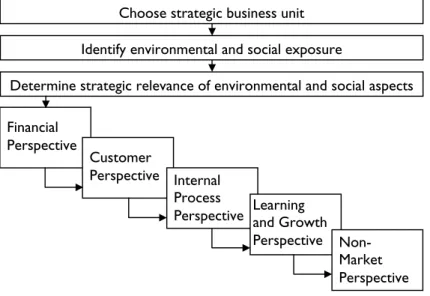
Figure 1. Process of formulating a SBSC (Figge et al. 2002).
On the basis of these requirements the process of formulating a SBSC can be divided into three major steps. First, the strategic business unit has to be chosen. This step presupposes that a stra-tegy of the business unit exists. Second, the environmental and social aspects of concern have to be identified. And third, the relevance of those aspects for the specific business unit’s strategy has to be determined. Figure 1 gives an overview over the full process. The process described for formulating a SBSC shall in the following be applied to the fictitious example of a Textiles manufacturer, Textiles Ltd. (see Hahn & Wagner 2001). This shall make the rather abstract pro-cess described above better understandable and more tangible.
4.1 Choice of strategic business-unit: The case of Textiles Ltd
The BSC as developed by Kaplan and Norton originally has been designed for strategic management at the business unit level (Kaplan & Norton 1997, pp 161). Thus, as a first step, the business unit for which a SBSC shall be formulated has to be chosen. For small and medium sized enterprises the business unit level may be identical with the corporate level, while in large companies or groups there are often several business units which aim at different customer segments often organized as independent profit centers.
The strategic business unit used in our example is the Textiles Ltd. For simplicity we assume that Textiles Ltd. is only active in one area of business, hence company level and business unit
Choose strategic business unit Identify environmental and social exposure
Determine strategic relevance of environmental and social aspects Financial
Perspective
Customer
Perspective Internal Process
Perspective Learning and Growth Perspective
Non-Market Perspective
The choice of the business unit presupposes that a strategy exists for this business unit. It is important to note that the BSC is not a tool for the formulation of strategies. Rather, the BSC serves to describe and translate an existing strategy consistently in order to enhance the suc-cessful execution of the strategy (Kaplan and Norton 1997, 36; ibid. 2001, p 104). The formu-lation of a Balanced Scorecard is thus not an independent process but is part of a wider frame-work of competitive positioning and strategy formulation (Kaplan and Norton 2001, p 40). This is also the case for the formulation of a SBSC: Before a SBSC can be formulated top manage-ment has to arrive at a common agreemanage-ment on what the strategy is, no matter if it explicitly mentions sustainability issues or not. As a consequence, the SBSC is an open tool to all kinds of business strategies.
In the following we will outline the initial situation and the strategy of Textiles Ltd. as the basis for formulating a SBSC. Textiles Ltd. produces garments. Part of its production takes place in a structurally disadvantaged region in Germany. Parts of their products are supplied as interme-diate goods from South-East Asia. The company sees itself as a manufacturer of quality pro-ducts in the medium price segment. So far, environmental and social aspects did not have a prominent role in Textiles Ltd’s business strategy.
Top management is unhappy with the current return on capital employed (ROCE) of 6% which it wants to increase to 8% within the next four years. Overall, the market for textile products is declining slightly and manufacturers are exposed to considerable pressure on their margins. Because of this, management expects that it will be necessary to increase sales by 20% in order to achieve the desired ROCE. Currently, Textiles Ltd. has a market share of approximately 15% in its core market segment. However, to achieve its strategic target of a 20% increase in sales, it is necessary to achieve a market share of 20% within the next four years. Alongside with this, management wishes to increase Textiles Ltd’s return on sales of currently 4% by half a percent to 4.5%.
A market survey commissioned by Textiles Ltd. revealed that in the medium price segment the market demands higher quality garments. This particularly concerns durability and health aspects. However, additional willingness to pay for increased quality on the side of customers is very limited. Therefore, the strategy of Textiles Ltd. is geared towards increasing the observable quality of its products. At the same time, prices shall be kept at the current level, as far as possible.
The new vision and top-level strategy of Textiles Ltd. which shall ensure the company’s economic success can be summarized as follows:
“Textiles Ltd. produces and markets high-quality and durable garments for the health conscious consumer at a competitive price. For our owners and shareholders, we continuously improve our economic business performance.”
The top-level strategy is the basis and starting point for developing Textiles Ltd’s SBSC.
4.2 Identification of the environmental and social exposure of the business unit
In order to ensure that the SBSC is tailored to the specific needs of the business unit chosen, the environmental and social aspects that affect the business unit must be identified in a second step. The result is a profile of the environmental and social exposure of the business unit. The purpose of this step is to identify all the pertinent environmental and social aspects in order to obtain a comprehensive list of all possibly strategically relevant environmental and social aspects. For the identification of the environmental and social exposure of a business unit two generic frameworks can be used.
Environmental exposure of Textiles Ltd
Emissions
Waste water polluted by chemical substances (e.g. dyeing agents, dyeing salts, pesticides…)
VOC emissions
Waste Residues of dyes and dyeing salts
Material input and intensity
Water consumption of washing and dyeing processes Use of chlorine based dyeing agents
Use of heavy metal based dyeing salts Use of VOC based solvents
Pesticide pollution of pre-products
Energy intensity Energy consumption of drying and steaming processes Noise and vibrations
Waste heat Radiation Land use
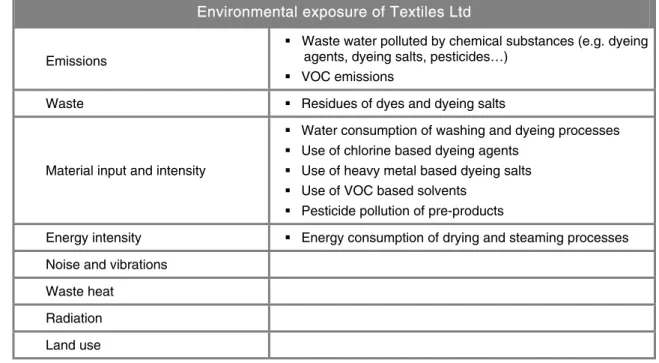
Table 1. Environmental exposure of Textiles Ltd.
The first framework (see Table 1) serves to identify the environmental exposure of a business unit. The idea behind this framework is to identify all environmental interventions which origi-nate from a business unit’s operations and products. These interventions are eventually respon-sible for the environmental impacts a business unit causes, because all environmental problems can finally be traced back to physical and/or chemical interventions (Heijungs et al. 1992). In
order to obtain the business unit specific environmental exposure all activities and products of the business unit must be checked against the categories of the framework as shown in Table 1. It is important to consider all pertinent environmental interventions in order to come up with a comprehensive and business unit specific profile of the environmental exposure.
For our example company, Textiles Ltd, the first step after clarifying its top-level strategy is therefore to identify those environmental aspects, which are of importance (see Figge et al. 2001a, pp. 43). Initially, this will be done independently of their strategic relevance. The objec-tive of this step is instead to achieve a complete overview of those environmental aspects and impacts, that are relevant for Textiles Ltd. This will also form the basis of the next step which will be integrating the strategically relevant environmental aspects in the SBSC of Textiles Ltd. In order to identify the environmental exposure of the company, possible environmental inter-ventions are checked with regard to their relevance to Textiles Ltd’s operations. For each of the environmental impact categories, the strategic business unit (in this case the company’s top management) has to decide, which impacts emanate from its operations and to which environ-mental problems it is contributing because of this (for a more detailed discussion of this proce-dure, see Figge et al. 2001a, pp. 34). The specific environmental impacts of Textiles Ltd. result in the profile of environmental exposure summarized in Table 1 below. As can be seen, the profile is dominated by the various dyeing, washing and finishing processes and the various chemical substances which come to use in these processes.
Social aspects that are strategically relevant can be identified analogous to the environmental aspects. However, due to the great variety and diversity of social aspects and the lack of a com-mon foundation in natural sciences as found for environmental aspects it is very difficult to achieve a comprehensive classification of social aspects (Clarkson 1995, p 102). Rather, social aspects heavily depend on the preferences and values of the different actors involved (Zadek 1999, pp 7). It is therefore advisable to classify social aspects not according to their contents but according to the actors involved. The stakeholder approach (Freeman 1984) provides a useful framework to classify the actors which are concerned with different social claims (Clarkson 1995). The social issues concerning a business unit can thus be identified by systematically fol-lowing a comprehensive framework of potentially relevant stakeholder groups (Liebl 1996). Table 2 provides such a framework. Potentially relevant stakeholder groups for a business unit can be distinguished into internal stakeholders, stakeholders along the value chain, stakeholders in the local community and societal stakeholders. As a further, cross-sectional classification di-rect stakeholders can be distinguished from indidi-rect stakeholders (Rowley 1997). Didi-rect stake-holders are those groups which are related to the firm by direct material resource exchange flows while with indirect stakeholders no such direct material exchange flows are established. In
a first step, all pertinent stakeholder groups for a business unit have to be identified (these are shown with a gray shading in Table 2). In a second step the precise social claims and issues brought up by these groups against Textiles Ltd. have to be identified. By specifying the frame-work shown in Table 2, a specific profile of the social exposure of the business unit can be obtained for Textiles Ltd.
Social exposure of Textiles Ltd.
Direct Stakeholders Indirect Stakeholders
internal along the value chain
com-munity societal internal
along the value chain com-munity societal Employees of Textiles Ltd Job security Working conditions Payment Suppliers in South-East Asia Successful and lasting business relations Customers High product quality Low prices Employees of the suppliers Job security Working conditions Payment Consumer associations Product quality NGOs (Human Rights Watch etc.)
Child labor in South-East Asia
Government
Unemployment Regional development
Table 2. Social exposure of Textiles Ltd.
Together with the top-level strategy of Textiles Ltd. and the economic success factors included there, the individual environmental and social exposure of the company forms the basis for developing a SBSC for Textiles Ltd.
4.3 Determination of the strategic relevance of environmental and social aspects
For both the conventional Balanced Scorecard as well as the SBSC identification and alignment of the strategically relevant aspects are the core steps. The purpose of this step is to translate the verbally formulated strategy of a business unit into causally linked objectives and indicators. As already mentioned above (see 2.1) the Balanced Scorecard is a tool to identify the 15 to 25 stra-tegically most relevant aspects and to link them causally and hierarchically towards the long-term success measured by the financial perspective. For the formulation of a Balanced Score-card Kaplan and Norton (1997) propose a top-down process to identify the strategically rele-vant aspects in all the perspectives. In principle, this approach can also be used for the formu-lation of a SBSC. The only difference is that in addition to “conventional” aspects environmental and social aspects have to be considered, too. By going through the perspectives in a cascade-like process starting from the financial perspective as indicated in Figure 1 the hierarchical and
causal linkage of the strategically relevant aspects is guaranteed. This serves to align all strategi-cally relevant aspects of a business unit towards the successful conversion of the strategy and thus towards long-term economic success.
Like all other business issues we can distinguish between three stages of strategic relevance of environmental and social aspects:
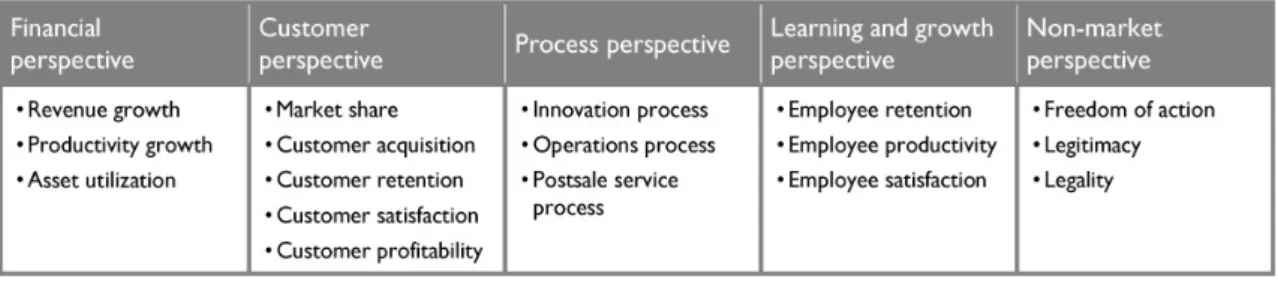
Environmental or social aspects can represent strategic core issues for which lagging in-dicators have to be defined. Those lagging inin-dicators measure whether the strategic core requirements in the perspective have been achieved. Kaplan and Norton (1997, p 4) have proposed generic categories for the formulation of lagging indicators in each per-spective (see Table 3).
Table 3. Generic categories for the formulation of lagging indicators (Figge et al. 2002, based on Kaplan and Norton 1996).
Performance drivers as represented by leading indicators show how the results in each perspectives, reflected by the lagging indicators, are to be achieved. Performance drivers are highly business specific but there are once again categories to support identification (see Table 4). Leading indicators will reflect environmental or social issues whenever en-vironmental and social aspects act as performance drivers.
Table 4. Generic categories for the formulation of leading indicators (Figge et al. 2002, based on Kaplan and Norton 1996).
Finally, environmental or social issues can also represent hygienic factors, reflected by diagnostic indicators. Hygienic factors (Herzberg et al. 1999) are issues which have to be managed sufficiently in order to guarantee successful business operations, however, addressing these factors does not lead to any competitive advantage (Kaplan and
Norton 1997, pp 156). In other words, hygienic factors represent necessary but not suf-ficient conditions for a successful execution of a firm’s strategy. Therefore, those factors are not part of the Balanced Scorecard.
To formulate a SBSC one can use matrices with the financial perspective as a starting point, that put potential environmental and social aspects opposite strategic core aspects and performance drivers of each perspective. These matrices allow to determine which environmental and social aspects are strategically relevant, their strategic importance and the reason for this strategic im-portance and how they link to the attainment of the strategic objectives (cf. Figge et al. 2001a, pp. 40; Figge et al. 2002, for a similar method SustainAbility 2001). It is of fundamental impor-tance to determine how the objectives and measures of the upper perspectives can be attained when working ones way top-down through the perspectives and from perspective to perspec-tive (cf. cascade in Figure 1). This way it can be ensured, that hierarchical cause and effect chains both within and between the perspectives are identified, that link up to the financial per-spective. In the following chapters this top-down methodology is explained for all perspectives using Textiles Ltd. as a case.
Financial perspective
The financial perspective assumes a double role in a SBSC: On the one hand, it defines the financial performance a strategy is expected to achieve. On the other hand, it is the endpoint of cause and effect chains referring to the other BSC perspectives (cf. Kaplan & Norton 1997, 46). The financial perspective consists mainly of financial lagging indicators, which reflect, if the desired economic goals of the business unit are achieved. How these goals are achieved is indi-cated by the other perspectives. In addition to a top financial measure (e.g. Shareholder Value, EVA or return on capital) sales, cost or asset utilization are usually considered to be the most important categories of the financial perspective (cf. Kaplan & Norton 1997, pp. 49). Specific environmental or social measures will therefore usually not be found in the financial perspec-tive.
On the basis of the situation and strategy of Textiles Ltd. as presented above the following measures and lagging indicators result for the financial perspective:
An increase of return on capital from 6% to 8% within the next four years as top financial measure.
This is to be attained by a 20% increase of turnover on the one hand and and increase of return on sales from 4% to 4.5% on the other hand.
Customer perspective
In the customer perspective is put down which client segment is targeted to achieve the desired economic result. It is furthermore laid out how, i.e. with which value proposition, the company plans to be successful in the market. Kaplan and Norton (1997, pp. 71) propose the categories product attributes, customer relations and image in this context. It has to be apparent how all measures and objectives link to the attainment of the objectives of the financial perspective. For Textiles Ltd. two strategic core elements have been identified in the customer perspective that are considered as lagging indicators market share and customer satisfaction (cf. Figure 2). Textiles Ltd. plans to achieve the increase in sales of 20% (see financial perspective) by raising market share from 15% to 20% in the target customer segment. Management is convinced that customer satisfaction is the key to success in this context. As figure 2 shows, meeting customer’s expectations regarding quality is of strategic relevance in this context. This is taken into account by including the lagging indicator client satisfaction.
Figure 2. Customer perspective of Textiles Ltd.
The leading indicators of the customer perspective show how Textiles Ltd. plans to be successful in the market. Market analysis has shown that durability and toxin free products are the most important aspects in the customer segment Textiles Ltd. aims at. Heavy metal based dyeing salts and the pesticide content of the products are therefore integrated into the perfor-mance driver toxin-free products Pressure exercised by consumer protection agencies and
NGOs are also considered to be strategically relevant and the management of these claims to be part of a sound environmental and social image. They are therefore considered in a correspon-ding performance driver.
Internal process perspective
In the internal process perspective, those processes are identified, which are crucial for achiev-ing the targets in the customer and financial perspectives. For this purpose it has to be defined how the targets in these two higher-level perspectives will be achieved. In doing so, the causal links from the internal process perspective to the two higher-level perspectives will be ensured. The lagging indicators and performance drivers (leading indicators) in the internal process per-spective can be broadly categorized into the three partial processes innovation, operations/ production and customer services. Typically, indicators in these three categories can be subdivi-ded into cost-related, time-related and quality related measures (see. Kaplan & Norton 1997, pp. 92).
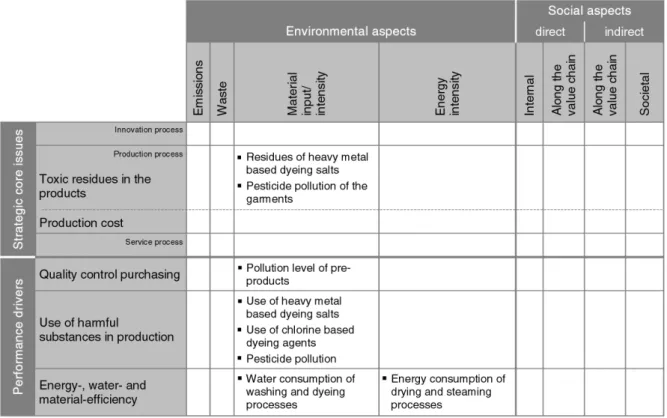
Figure 3 shows the internal process perspective of Textiles Ltd. Two strategic core aspects result out of the higher-level targets in the financial and customer perspectives. These (the toxic resi-dues in the products and the production costs) are represented in the internal process perspec-tive through lagging indicators. The lagging indicator “toxic residues in the products” refers to the healthiness of the products offered. As can be seen in the matrix in Figure 3, this lagging in-dicator aggregates several product-related environmental aspects (mainly the pesticide pollution of the garments and the residues of heavy metal based dyeing salts). These environmental aspects therefore have a central strategic relevance for Textiles Ltd. (since they are captured by a lagging indicator) and are integrated in the SBSC through specific environmental lagging indica-tors. The other lagging indicator in the process perspective are the production costs. This strate-gic core aspects influences directly the targeted increase of the return on sales in the financial perspective. This lagging indicator has no environmental or social specification and hence is represented by a conventional financial ratio indicator. The central performance drivers in Tex-tiles Ltd’s internal process perspective are the quality control of the purchasing activities, the use of harmful substances in production (both of which affect the lagging indicator “toxic resi-dues in the products” of the internal process perspective) and the energy-, water- and material-efficiency of the production processes (all of which influence the lagging indicator “production costs” of the internal process perspective). As can be seen in Figure 3, especially the performance drivers (leading indicators) “use of harmful substances in production” and “energy-, water- and material-efficiency” have a very strong environmental stance (i.e. they reflect and represent
stra-tegically relevant environmental aspects). Opposed to this, environmental aspects play only a very minor role for the performance driver/leading indicator “quality control purchasing”.
Figure 3. Internal process perspective of Textiles Ltd.
Learning and growth perspective
The learning and growth perspective describes the infrastructure which is necessary for the achievement of the objectives of the other perspectives. Here the most important areas are qua-lification, motivation and goal orientation of employees, as well as information systems and organization. As shown in Table 3, it has been proposed to use employee retention, employee productivity, and employee satisfaction as the main categories for the formulation of lagging indicators in this perspective. Generic categories for deriving leading indicators for the learning and growth perspective comprise areas such as employee potentials, the technical infrastructure as well as the work climate (Kaplan & Norton 1996) (see also Table 4). Like in all other perspec-tives the objecperspec-tives and indicators are linked causally to the upper level perspecperspec-tives in order to show how the strategically relevant aspects of the learning and growth perspective contribute to the successful implementation of the strategy.
Highly motivated and satisfied employees are a key prerequisite to successfully implementing an ambitious strategy. Therefore employee satisfaction turns out as the most important strategic core issue in the learning and growth perspective for Textiles Ltd. Consequently, the learning
and growth perspective of Textiles Ltd’s scorecard displays a social lagging indicator (see matrix in Figure 4).
The management of Textiles Ltd. believes, that a positive work climate in its production sites is crucial to achieve high employee satisfaction. In this context work place pollution in the pro-duction sites of Textiles Ltd. plays an important role. Thus, work place air quality has been de-fined as a leading indicator in the learning and growth perspective. As shown in the matrix in Figure 4 due to the specific technology used by Textiles Ltd. volatile organic compounds (VOCs) are the most important pollutants workers of Textiles Ltd. are exposed to.
Figure 4. Learning and growth perspective of Textiles Ltd.
Non-market perspective
Finally, it has to be checked, whether strategically relevant environmental or social aspects exist which significantly influence the success of Textiles Ltd’s strategy via other mechanisms than the market system. In such a case it is appropriate to introduce an additional non-market per-spective (see 3.2). A non-market perper-spective acts as a societal frame or background in which the market activities are embedded. Eventually, it depends on the characteristics of the strategically relevant environmental and social aspects of Textiles Ltd. whether a non-market perspective should be introduced. This decision can be made by answering the following questions (see Figge et al. 2001a; Figge et al. 2002):
Are there any environmental or social aspects which influence the success of Textiles Ltd. via non-market mechanisms?
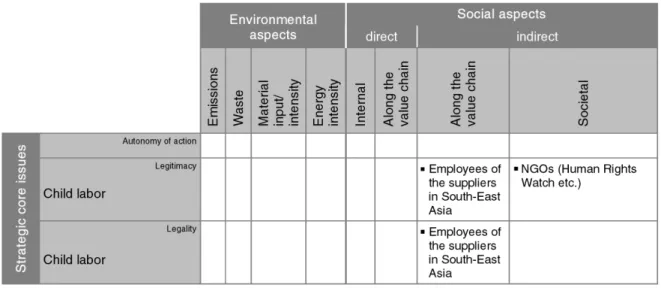
Again, this question can be answered by using a matrix. In such a matrix the relevant environmental and social aspects of Textiles Ltd. are cross checked against three
catego-ries of potential strategic core aspects of the non-market perspective (Figge et al. 2001a, pp.55). The first category is legality, which means prospective compliance with environ-mental and social regulation and legal requirements (Hahn 2001). Second there is orga-nizational legitimacy (Dowling & Pfeffer 1975; Dyllick 1989; Schaltegger & Sturm 1992; Göbel 1995; Oliver 1996 and 1997). Together, these two aspects serve to secure and widen the scope and autonomy for strategic decision making (autonomy of action) (Schaltegger 1999).
Do these environmental or social aspects represent strategic core issues at which Textiles Ltd. has to excel in order to successfully execute its strategy?
Introducing a non-market perspective is only necessary, if the non-market aspects represent strategic core issues and not just hygienic factors. Two considerations are used to answer this question: Taking up an opportunity perspective serves to find out how severe the consequences for the strategic success of Textiles Ltd. would be if the non-market requirements were not fulfilled. The stronger and more serious these consequen-ces turn out, the higher is the importance of the respective environmental and social non-market aspects. In a second step Textiles Ltd. has to distinguish strategic core issues from hygienic factors. As long as it is sufficient to merely satisfy a claim from the non-market environment, i.e. to fulfill a certain threshold, this aspect can be considered as a hygienic factor. However, if it turns out that for the strategic success of Textiles Ltd. it is necessary to excel at meeting certain non-market requirements, e.g. by taking up a pro-active and prospective approach, a non-market perspective has to be introduced in order to take these strategic core issues from the non-market environment into account. What is the substantial contribution of the strategic non-market aspects to the achievement of Textiles Ltd’s strategy?
In order to make explicit the causal contribution of the strategic non-market aspects to the overarching strategic objectives, the strategic core aspects of the non-market per-spectives have to be linked to the other perper-spectives through cause and effect chains: The lagging indicators of the non-market perspective can serve as performance drivers of any other SBSC perspective. Thus the non-market perspective is linked directly or indirectly to the financial perspective. Likewise, the performance drivers for the results of the non-market perspective can be found in the other perspectives of the SBSC (see also Table 4) (Figge et al. 2001b).
The matrix in Figure 5 shows, that the social aspect of child labor represents the core non-mar-ket success factor of Textiles Ltd’s strategy. This is mainly due to the situation at Textiles Ltd’s
suppliers in South-East Asia. NGOs like human rights organizations (e.g. Human Rights Watch) build up public pressure to ban child labor. Textiles Ltd. has identified a socially responsible image as a core strategic issue in the customer perspective. This strategic objective will only be reached, if Textiles Ltd. can prove that no child labor occurs with its suppliers and subcontrac-tors. A strong public outcry would destroy the competitive advantage of a socially responsible image. However, if Textiles Ltd. succeeds to position itself as a credible marketer of products “free of child labor“, this will lead to a sustained competitive advantage. The lagging indicator child labor in the non-market perspective is thus causally linked to the customer perspective. On the other hand, the most important performance driver of avoiding child labor can be found in the process perspective, as Textiles Ltd. has introduced a special routine in its quality control activities in the purchasing department.
Figure 5. Non-market perspective of Textiles Ltd.
5 The Strategy Map of Textiles Ltd’s Sustainability Balanced Scorecard
When going through the perspectives in the described cascade-like manner it is important to remember that the causal relationships between the strategically relevant aspects identified not only exist between lagging and leading indicators within one perspective. Rather, all the aspects and indicators have to be directly or indirectly linked towards the financial perspective. The strategic core aspects and value drivers of the lower level perspectives in the cascade shown in Figure 1 serve to achieve the objectives set by the indicators in the upper level perspectives. Therefore, every time one moves from an upper level perspective to the next lower level per-spective in the cascade is has to be ensured that and shown explicitly how the lower level stra-tegic core aspects and performance drivers contribute to the achievement of the objectives in the higher level perspective(s). This serves to establish the hierarchic cause-and-effect chains
which link all strategically relevant aspects towards the successful execution of the strategy. As a result of this process, all strategically relevant aspects reflected by appropriate lagging or lea-ding indicators are part of a cause-and-effect network which visualizes and translates the stra-tegy of the business unit. By systematically going through the perspectives in a top down direc-tion the strategic relevance of the pertinent environmental and social aspects is determined like for all other “conventional” aspects. This ensures the full and value-oriented integration of envi-ronmental and social aspects in the general management system.
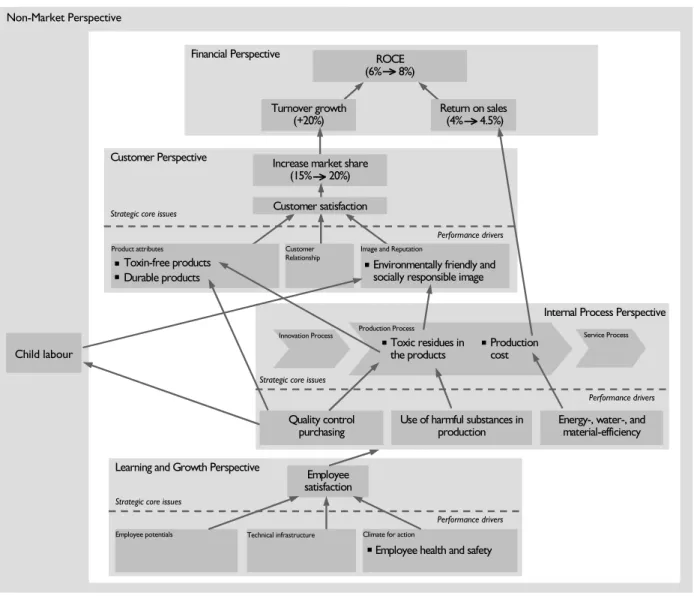
The result of the process of formulating a SBSC can be shown graphically by using a strategy map (Kaplan & Norton 2001). In such a strategy map, all economic, environmental, and social aspects which have been identified as strategically relevant are represented in the hierarchical network of cause-and-effect chains. Once the identification and alignment of the strategically relevant aspects has been done, the next step is to define indicators, targets and measures in order to control and steer corporate performance towards long term success and the achieve-ment of strong corporate contributions to sustainability.
Figure 6. Strategy map of Textiles Ltd. (Figge et al. 2002).
Non-Market Perspective Child labour Financial Perspective Turnover growth (+20%) Return on sales (4% 4.5%) ROCE (6% 8%)
Internal Process Perspective Innovation Process
Production Process
Service Process
Strategic core issues
Toxic residues in the products
Production cost
Performance drivers
Energy-, water-, and material-efficiency Use of harmful substances in
production Quality control
purchasing Learning and Growth Perspective
Employee potentials Technical infrastructure
Employee satisfaction
Climate for action
Employee health and safety
Strategic core issues
Performance drivers
Customer Perspective
Customer Relationship
Increase market share (15% 20%)
Strategic core issues
Performance drivers
Product attributes
Toxin-free products Durable products
Image and Reputation
Environmentally friendly and socially responsible image Customer satisfaction
Figure 6 shows the strategy map of Textiles Ltd. In order to achieve an improved return on capital employed of 8 % Textiles Ltd. wants to boost its turnover by 20 % by increasing its market share from 15 to 20 %. These ambitious objectives shall be reached by orienting the products more towards customer demand. Therefore as the core of its market strategy Textiles Ltd’s focuses on durable, toxin-free products and aims at building up a environmentally friend-ly and socialfriend-ly responsible image. Consequentfriend-ly, the reduction of the toxic residues in the pro-ducts is one central objective of the process perspective. This shall be reached through buying less harmful raw material as well as using less toxic substances in production. In addition to ensuring less harmful raw material the purchasing department also has to control that there is no child labor involved in the supplier chain. At the same time, for reaching its financial objec-tive Textiles Ltd. also wants increase its sales margin from 4% to 4.5 %. This objecobjec-tive shall be reached through a more efficient use of energy, water and material. Fundamentally, Textiles Ltd. is convinced that for the successful implementation of its strategy it is crucial to have highly motivated and satisfied employees.
The strategy map of Textiles Ltd. as shown in Figure 6 shows that the strategically relevant environmental and social aspects are integrated in the SBSC just as “conventional” success fac-tors. As a result environmental and social aspects both from within the market system as well as non-market issues are integrated into the mainstream management system. The environmen-tal and social aspects of Textiles Ltd. are integrated according to their strategic relevance. Those environmental and social aspects that have not been included in the SBSC represent hygienic factors. This does, however, not mean that these aspects are irrelevant. They have to be managed conscientiously, to keep operations going. For this purpose, a deduced scorecard for the environmental and social management department as a shared service unit can be formu-lated.
6 Discussion and conclusion
In this paper we describe the methodology and application of the Sustainability Balanced Scorecard concept as a new tool for a value-oriented sustainability management. The funda-mental approach and logic behind the SBSC as well as the different possibilities to formulate a
SBSC are explained in the first part of the paper. The second part explains how a SBSC is for-mulated using the fictitious example of Textiles Ltd. It is shown how environmental and social issues can be integrated with the general management of a business unit. The process of SBSC formulation is designed in such a way, that it can be applied no matter whether environmental and social aspects are integrated in an existing or a newly created Balanced Scorecard. As a fur-ther advantage, the SBSC concept is an open concept. This means, that it can use both “conven-tional” corporate strategies as well as explicit corporate sustainability strategies as a starting point. This was also seen in the example of Textiles Ltd. It is obvious that in the case of compa-nies which have adopted explicit sustainability strategies (e.g. Hart 1997) environmental and social aspects will play a more prominent role in the SBSC. However, the openness of the approach to also include conventional firms widens the applicability of the SBSC from sustain-able niche players to the far wider range of mainstream companies and helps them to move to-wards a more sustainable performance. It is obvious that the SBSC does not dictate which kind of strategy should be chosen. Here again, it becomes clear that a SBSC is embedded in the wider context of strategic management.
The embeddedness of environmental and social issues and corporate strategy holds also true when it comes the relation of the SBSC with other tools of sustainability and environmental management. As the SBSC is used to translate a verbally formulated strategy into operational terms it can be seen as a tool for strategic control. Thus, it has a very tight link to other corpo-rate information management tools. On the other hand, the formulation of a SBSC depends on information generated by tools for strategic planning. Furthermore, through each of its perspec-tives the SBSC establishes links to the realms of finance, marketing, operations, human resour-ces, and issues management, for all of which dedicated environmental literature can be found. Insofar, the approach proposed in this paper can help to chose the most pertinent tools for vironmental and social management for a specific business considered. Eventually, this will en-hance both, effective and efficient environmental and social management and sustained econo-mic success. Such a situation translates into the simultaneous achievement of econoecono-mic, social, and environmental goals, i.e. into strong corporate contributions to sustainability. This will not only help to make corporate performance more sustainable but also to show the business value and good business sense of value-oriented environmental and social management.
Overall the SBSC provides a strong tool for an integrated and value-based sustainability ma-nagement. It helps significantly to overcome the shortcomings of the often parallel approaches of environmental, social and economic management systems implemented in the past.
Acknowledgements
The authors would like to acknowledge the German Federal Ministry of Education and Research (BMBF) for funding this research project under grant number 01RU0001.
Literature
Atkinson, G. (2000): “Measuring Corporate Sustainability”, Journal of Environmental Planning and Management, 43(2), 235-252.
Bennett, M. & James, P. (1999): Sustainable measures: evaluation and reporting of environ-mental and social performance. Sheffield: Greenleaf Publishing.
Bieker, T.; Dyllick, T.; Gminder, C.-U. & Hockerts, K. (2001a): Towards a Sustainability Balanced Scorecard - Linking Environmental and Social Sustainability to Business Strategy. Conference Proceedings of Business Strategy and the Environment 2001 in Leeds, UK. ERP Environment, 22-31.
Bieker, T.; Dyllick, T.; Gminder, C.-U. & Hockerts, K. (2001b): Management unternehmerischer Nachhaltigkeit mit einer Sustainability Balanced Scorecard – Forschungsmethodische Grundlagen und erste Konzepte. IWÖ-Diskussionsbeitrag Nr. 94. St.Gallen: Institut für Wirtschaft und Ökologie.
Bieker, T.; Gminder, C.-U.; Hahn, T. & Wagner, M. (2001c): „Unternehmerische Nachhaltigkeit umsetzen: Welchen Beitrag kann die Balanced Scorecard dazu leisten?“, Ökologisches Wirtschaften, (5), 28-30.
Burke, L. & Logsdon, J. (1996) : “How Corporate Social Responsibility Pays Off”, Long Range Planning, 29(4), 495-502.
Clarkson, M. (1995): “A Stakeholder Framework for Analyzing and Evaluating Corporate Social Performance”, Academy of Management Review, 20(1), 92-117.
Czymmeck, F. & Faßbender-Wynands, E. (2001): Die Bedeutung der Balanced Scorecard im Rahmen eines auf Kennzahlen basierenden Umwelt-Controlling. Arbeitsbericht Nr. 6. Universität Köln: Köln.
Deegen, T. (2001): Ansatzpunkte zur Integration von Umweltaspekten in die „Balanced Score-card“. Lüneburg: Center for Sustainability Management.
Dowling, J. & Pfeffer, J. (1975): "Organizational Legitimacy: Social Values and Organizational Behavior", Pacific Sociological Review, 18(1), 122-136.
Dyllick, T. & Hockerts, K. (2002): "Beyond the Business Case for Corporate Sustainability", Business Strategy and the Environment, (forthcoming).
Dyllick, T. & Schaltegger, S. (2001): „Nachhaltigkeitsmanagement mit einer Sustainability Balanced Scorecard", UmweltWirtschaftsForum, 9(4), 68-73.
Epstein, M. (1996): Measuring corporate environmental performance: best practices for costing and managing an effective environmental strategy. Chicago: Irwin Professional Publ.
Epstein, M. J. & Roy, M.-J. (2001): "Sustainability in Action: Identifying and Measuring the Key Performance Drivers", Long Range Planning, 34(5), 585-604.
Epstein, M. J. & Wisner, P. (2001): "Good Neighbors: Implementing Social and Environmental Strategies with the BSC", Balanced Scorecard Report, 3(3), 8-11.
Fahrbach, M.; Heinrich, V. & Pfitzner, R. (2000): „Strategische Umweltcontrolling mit Hilfe der Balanced Scorecard“, UmweltWirtschaftsForum, 8(2), 41-44.
Figge, F. (2001): Wertschaffendes Umweltmanagement. Keine Nachhaltigkeit ohne ökonomischen Erfolg. Kein ökonomischer Erfolg ohne Nachhaltigkeit. Frankfurt: Center for Sustainability Management e.V. (CSM) in Zusammenarbeit mit PriceWaterhouseCoopers Global Risk Management Solutions.
Figge, F. & Hahn, T. (2002): Sustainable Value Added – Measuring Corporate Contributions to Sustainability Beyond Eco-Efficiency. 2nd edition. Lüneburg: Center for Sustainability Management.
Figge, F.; Hahn, T.; Schaltegger, S. & Wagner, M. (2001a): Sustainability Balanced Scorecard. Wertorientiertes Nachhaltigkeitsmanagement mit der Balanced Scorecard. Lüneburg: Center for Sustainability Management..
Figge, F.; Hahn, T.; Schaltegger, S. & Wagner, M. (2001b): The Sustainability Balanced Scorecard – A Tool for Value-Oriented Sustainability Management in Strategy-Focused Organisations. Conference Proceedings of the 2001 Eco-Management and Auditing Conference. ERP Environment: Shipley: 83-90.
Figge, F.; Hahn, T.; Schaltegger, S. & Wagner, M. (2001c): The Sustainability Balanced Scorecard - Translating Strategy into Value-Based Sustainability Management. Conference Proceedings of Business Strategy and the Environment 2001 in Leeds, UK. ERP Environment, 93-102.
Figge, F.; Hahn, T.; Schaltegger, S. & Wagner, M. (2002): "The Sustainability Balanced Scorecard - Linking Sustainability Management to Business Strategy", Business Strategy and the Environment, (forthcoming).