Bill Francis – Iftekhar Hasan – Qiang Wu
The impact of CFO gender
on bank loan contracting
Bank of Finland Research
Discussion Papers
Suomen Pankki Bank of Finland PO Box 160 FI-00101 HELSINKI Finland +358 10 8311 http://www.suomenpankki.fi/en E-mail: [email protected]
Bank of Finland Research
Discussion Papers
18
•
2011
Bill Francis* – Iftekhar Hasan**
−
Qiang Wu***
The impact of CFO gender
on bank loan contracting
The views expressed in this paper are those of the author and do not necessarily reflect the views of the Bank of Finland. * Lally School of Management, Rensselaer Polytechnic
Institute, Troy, NY, 12180, USA.
** Lally School of Management, Rensselaer Polytechnic Institute, Troy, NY, 12180, USA and Bank of Finland, FI 00101, Helsinki, Finland. Corresponding author.
*** Lally School of Management, Rensselaer Polytechnic Institute, Troy, NY, 12180, USA.
http://www.suomenpankki.fi/en
ISBN 978-952-462-774-0 ISSN 1456-6184
(online) Helsinki 2011
3
The impact of CFO gender on bank loan contracting
Bank of Finland Research
Discussion Papers 18/2011
Bill Francis – Iftekhar Hasan − Qiang Wu Monetary Policy and Research DepartmentAbstract
Motivated by recent studies that show female CFOs are more risk averse than male CFOs when making various corporate decisions, we examine whether banks take into consideration the gender of CFOs when pricing bank loans. We find that in our sample, firms under the control of female CFOs on average enjoy about 11% lower bank loan price than firms under the control of male CFOs. In addition, loans given to female CFO-led companies have longer maturities and are less likely to be required to provide collateral than loans given to male CFO led companies. Our results are robust to a series of robustness tests, such as a firm and year-fixed effect regression, a Heckman two-stage self selection model, a propensity score match method and a differences-in-differences approach. Overall, our results suggest that banks tend to recognize the role of female CFOs in providing more reliable accounting information ex ante and reducing default risk ex post, and grant firms with female CFOs lower loan price and more favourable contract terms.
Keywords: CFOs, gender, accounting information, bank loans JEL classification numbers: M41, G21, J16
4
Vaikuttaako yrityksen rahoitusjohtajan sukupuoli
pankkiluottojen ehtoihin?
Suomen Pankin keskustelualoitteita 18/2011
Bill Francis – Iftekhar Hasan − Qiang WuRahapolitiikka- ja tutkimusosasto
Tiivistelmä
Tuoreiden tutkimusten mukaan naispuoliset yritysten rahoitusjohtajat kaihtavat päätöksenteossaan riskejä enemmän kuin miespuoliset rahoitusjohtajat. Tässä tut-kimuksessa otetaan nämä tulokset lähtökohdaksi ja haetaan empiiristä näyttöä ole-tukselle, että pankkilainaa hakevan yrityksen rahoitusjohtajan sukupuoli vaikuttaa pankkilainan ehtoihin, erityisesti lainan hintaan. Tutkimuksessa käytetystä otok-sesta saatujen estimointitulosten mukaan yritys, jonka rahoitusjohtaja on nainen, saa pankilta lainaa keskimäärin 11 % halvemmalla kuin yritys, jonka rahoitus-päätöksistä vastaa mies. Pankkien myöntämien yrityslainojen maturiteetti lisäksi pitenee ja lainoille vaaditaan todennäköisesti vähemmän vakuuksia, kun yrityksen rahoitusjohtaja on nainen. Estimointitulosten murtumispisteitä etsitään vaihto-ehtoisilla tilastollisilla testeillä ja estimointimenetelmillä. Estimoituun malliin ote-taan yhtäältä mukaan yritys- ja vuositason kiinteät vaikutukset. Toisaalta työssä testataan Heckmanin kaksivaiheisen menetelmän avulla valikointiharhan merki-tystä estimointitulosten kannalta. Lisäksi malli estimoidaan myös kahdella muulla menetelmällä: ”prospensity scrore matching” sekä ”difference-in-difference”. Tut-kimustuloksia voidaan kaiken kaikkiaan tulkita niin, että pankit luottavat enem-män naispuolisten rahoitusjohtajien antamaan etukäteistietoon yrityksen tulokses-ta ja uskovat naisjohtulokses-tajan pienentävän luottojen tulokses-takaisinmaksuun liittyviä riskejä. Pankit ovat näin ollen valmiita myöntämään luottoa edullisemmin ehdoin niille yrityksille, joiden rahoitusjohtaja on nainen.
Avainsanat: rahoitusjohtaja, sukupuoli, kirjanpitoinformaatio, pankkiluotot JEL-luokittelu: M41, G21, J16
5
Contents
Abstract ... 3
Tiivistelmä (abstract in Finnish) ... 4
1 Introduction ... 7
2 Related literature and hypothesis development ... 11
3 Data ... 14
3.1 Sample selection ... 14
3.2 Descriptive statistics ... 15
3.3 Univariate comparisons ... 17
4 Results of multivariate tests ... 18
4.1 Female CFOs and bank loan price ... 18
4.2 Female CFOs, loan maturity and loan collateral ... 23
4.3 Robustness checks ... 25
4.4 The impact of female CFOs on major firm characteristics... 29
5 Conclusion ... 32
References ... 35
Tables 1–9 ... 38
7
1. Introduction
Over the past decade, the num ber of fe male CFOs has increased dram atically. For example, the total number of female CFOs in S&P 1,500 companies was only 4 in 1994,
and it was 104 in 2006. 1 This significant in crease of female CFOs has attrac ted
considerable attention from academics. An em erging stream of lite rature begins to investigate the systematic differences between male and female CFOs in term s of their accounting, financing and invest ment decision-making. For instance, prior studies find that firms with female CFOs adopt more c onservative accounting policies (Francis et al.
(2010)), report higher quality earnings (P eni (2008)), are less likely to m anipulate
earnings (Wei and Xie (2009) and Chava and Purnanandam (2010)), and are less likely to make significant acquisitions and m ore likely to reduce leve rage level than f irms with male CFOs (Huang and Kisgen (2010)). In this paper, we extend this line of research by examining whether the gender of CFOs affects the cost of debt capital in the con text of bank loans.
We focus on bank loans for two prim ary reasons. First, bank loans are a m ajor source of corporate financing, even for larg e public companies. E ach year, the sheer
volume of bank loan financing is much larger than equity and bond financing.2 Given the
economic significance of bank loans in allocatin g capital to corporations as well as the growing number of female CFOs, it is very important to understand whether the gender of CFOs affects the cost of bank loans.
1 Data source: ExecuComp.
2 For example, according to the Loan Pricing Association and Federal Reserve System, in 2005 the total
amount of equity issua nce was about 115 billion U.S. dollars and the t otal amount of corporate bond issuance was about 700 billion, while the total amount of bank loan issuance was 1,500 billion U.S. dollars.
8
Second, accounting inform ation is a persiste nt standard that banks rely on to assess borrowers’ credit risk (e .g., Anderson et al. (2004) a nd Armstrong et al. (2010)). Prior studies find that when banks initiate pr ivate debt, they are very sensitive to various attributes of accounting information, such as operating accrual (Bharath et al. (2008)) and conservatism (Sunder et al. (2009) and Zhang (2008)). Assuming female CFOs are more likely to report high quality and conservative earnings than male CFOs as documented in prior studies, as inside lenders with in-dep th knowledge of thei r clients (e.g., Diamond (1984) and Fama (1985)), banks should realize the benefits of female CFOs in providing
more reliable and conservative accounting information to lenders. In addition, the
incentives of female CFOs to reduce f irms’ leverage level and m ake less risky investments also indicate lower def ault risk of the firms (Strahan (1999)). Collectively, we conjecture that banks should consider th e gender effect and reward borrowers with female CFOs with lower bank loan price a nd more favorable non-price loan terms when designing bank loan contracts.
However, there is a long existing literature shows that fem ales are discriminated in the credit m arket. The discrimination hypothesis simply implies that bank s charge higher loan price and require tighter non-price term s when lending to fe male led companies because they are biased against women. Empirically, most studies focus on small business firms and their results are m ixed (e.g., Blanchflower et al. (2003), Storey (2004) and Alesina et al. (2008)).
We empirically examine this question. Using a sample of S&P 1,500 com panies from 1994-2006, we estim ate how loan spread, lo an maturity and loan collateral are
9
affected by the gender of CFOs. Following previous studies, we control for firm
characteristics and loan characteristics that are likely to shape loan contract terms.
We find that gender of CFOs do affect ba nk loan contracts. Specifically, we find that in our sample, firms with f emale CFOs, on average, enjoy about 14 basis points lower bank loan price than firms with male CFOs. In addition, loans given to female CFO led companies have 9% (3.8 months) longer maturities and are about 8% less likely to be required to provide collateral than loans given to m ale CFO led com panies. The results support the hypothesis that banks tend to recognize the role of female CFOs in reducing information risk ex an te and def ault risk ex post, and reward firms with f emale CFOs more favorable loan contract terms.
We also test whether fem ale CEOs and other female top executives affect bank loan price. However, we do not find that th e presence of female CEOs and other fem ale top executives affect both price and non-price loan terms considered in our paper. The results suggest that banks view CFOs, but not CEOs or ot her executives, as the primary executives who determ ine the qu ality of accounting information and the financing decisions of the firm s, and in tu rns, affect their lending decisions. The results are also consistent with recent studies that find a st rong relation between CFOs and the quality of accounting information and the leverage level of the firms (e.g., Geiger and North (2006), Matsunaga and Yeung (2007), Peni (2008), Huang and Kisgen (2010), Chava and Purnanandam (2010) and Jiang et al. (2010)).
Endogeneity is a big concern in the study of gender issue. For instance, Fe male CFOs may not be random ly assigned to firms. Firms having more favorable credit term s may be m ore likely to hire fem ale CFOs. In addition, unobservable tim e-variant or
10
invariant factors may be correlated with bank loans. Further, the causality problem makes our results hard to in terpret. To address the issue of potential endogeneity, we em ploy a series of econometric analysis. First, we use a firm and year fixed effect regression to rule out the impact of potential unobservable time-invariant firm specific effects. Second, we use a Heckm an two-stage m odel to contro l for self-section bias. Third, we apply a matching sample approach based on propensity score match method to control for sample selection bias. Finally, sim ilar to Francis et al. (2010), we trace firm s who change their CFOs from male to female (treated group) and from male to male (control group) and apply a differences-in-differences approach to mitigate unobservable time variant factors which could affect the estim ated influence of fem ale CFOs. Our results are all rob ust, regardless of the econometric methods that we apply. The results of the differences-in-differences approach also indicate that fe male CFOs bring about, and not m erely reflect, a reduced bank loan price and more favorable non-price loan terms.
Our research is rela ted to the lite rature on the rela tion between ac counting information and bank loan contracting. For ex ample, recent studies fin d that bank loan contract terms are affe cted by accrual qual ity (Bharath et al. (2008)), conservatism (Sunder et al. (2009 )), debt-contracting v alue of accounting inform ation (Ball et al. (2008)), internal control weakness (Schneider and Church (2008), financial restatements (Graham et al. (2008)) and earni ngs predictability (Park and Wu (2010)). In this paper, rather than focus on firm -level factors, we firstly relate bank lendi ng decisions to the gender of top executives of borrowers and provide evidence that gender of CFOs also has a significant impact on bank loan contracting, thereby furthering our understanding of its determinants.
11
Our paper also contributes to the gender literature. Despite the proliferation of studies, there is still much debate as to the systematic differences between m en and women with regard to their risk attitudes (e.g., Atkinson et al. (2003) and Dwyer et al. (2002)). In this paper, by exam ining how informed private lenders, who are supposed to be very sensitive to the risk attitudes of top executives, react to the gender of CFOs when designing bank loan contracts, w e can gain new insig ht into wh ether there exits systematic differences between m ale and fe male CFOs from sophisticated investors’ perspective. In additio n, in our research des ign, we comprehensively use different econometric methods to mitigate the potential endogeneity concern.
The rest of the paper is struc tured as follows. Section 2 reviews related literature and develops our hypotheses. Section 3 presents sample selection, summary statistics and univariate comparisons. The results of multivariate tests are in Sec tion 4. The f inal section provides conclusions.
2. Related literature and hypothesis development
Gender differences in attitudes towards risk and in risk related behavior have long
been studied in the sociology, psychology and econom ics literatures.3 In general, m ost
studies support the notion that wo men are m ore risk averse than m en. Because o f the dramatic increase of fem ale executives on top m anagement teams over the past decade, more and more studies begin to investigate whether the gender of top executiv es affects various corporate decisions. For exam ple, Huang and Kingen (2010) investigate how gender of CFOs a ffects corporate financia l decisions. They find that firm s under the control of female CFOs are less likely to make significant acquisitions and are less likely
12
to issue long term debt. Furthermore, female CFOs are m ore likely to reduce leverage level than m ale CFOs. They also test m arket reactions to acquisitio ns and find that acquisitions made by fem ale CFOs exhibit higher annou ncement returns com pared to those made by firms with male CFOs. Their results provide so me supportive evidence that female CFOs are more risk- averse than male CFOs when m aking their f inancial decisions.
Francis et al. (2010) exam ine the im pact of gender of CFOs on accounting decision-making. By focusing on accounting cons ervatism, they find that fe male CFOs tend to report m ore conservative accounting numbers than their counterparts. They also examine the linkage b etween risk aversion of female CFOs and corporate decisio n making. They find that female CFOs make less risky financing and investment decisions compared to their counterparts. Peni (2008) test the relation between earnings quality and the gender of top executives. She finds that the gender of CFOs, but not CEOs or other executives affect earnings quality. Using a sa mple of listed Chinese firms, Wei and Xie (2009) find that female CFOs are less likely to manipulate earnings than male CFOs.
In the bank loan literature, the default risk is the primary determinant of bank loan price, and banks always rely on accounting inform ation to assess the default risk of their borrowers, as accounting inform ation is the prim ary resource for banks to evaluate and predict riskiness of borrowers. Prior studies find a negative relation between bank loan price and earnings quality (Bharath et al. (2008)) and conservatism (Zhang (2008)). In addition, the capital structure decisions and ac quisition decisions directly related to the default risk of the firms. Prior studies find firms with higher leverage level and firms with higher takeover vulnerability have higher bank loan price (e.g., Strahan (1999) and Chava
13
et al. (2009)). Assuming fe male CFOs tend to report higher quality and more conservative earnings than m ale CFOs, as in side lenders and delegated m onitors who concern about earnings quality and default risk of their borrowers (e.g., Diamond (1984) and Fama (1985)), banks should recognize the gender differences of CFOs with regard to their accounting and financing decision-m aking, and reward firm s with fe male CFOs with lower bank loan price than firms with male CFOs.
H1: All else being equal, firms under the control of female CFOs have lower bank loan price than firms under the control of male CFOs
Bank loan contracts hav e multiple terms and they cannot b e treated s eparately (Melnik and Plaut (1986)). In addition, while interest rates are an effective way to “price”
the risk of bank loans, they have advers e effects on th e moral hazard prob lem of
borrowers (Stiglitz and Weiss (1981)). In reality, banks are m ore likely to set up customized contracts not only on price, but also on non-price loan term s to price risk, facilitate monitoring and limit potential losses. Therefore, it is important to focus on both price and non-price terms when studying bank loan contracts (Qian and Strahan (2007)).
Among different loan contract terms, loan maturity and collateral are important non-price terms which are widely used by banks to limit downside risk of lenders. For example, Barclay and Sm ith (1995) and Ra jan and W inton (1995) argue that shorter maturities is a useful way to solv e information problems because th ey can force more frequent information disclosure and tim ely renegotiation of contract term s. Berger and Udell (1990) and Jimenez et al (2006) show th at lenders are more likely to use collateral
14
when borrowers have higher information ri sk. Rajan and Winton (1995) discuss how the use of collateral affects banks’ incentives to monitor borrowers. As we expect that female CFOs affect both information risk ex ante and default risk ex post, we expect that firm s with female CFOs should enjoy longer m aturities and are less likely to be required to provide collateral in bank loan contracts.
H2: All else being equal, firms under the control of female CFOs have longer loan maturities in bank loan contracts than firms under the control of male CFOs
H3: All else being equal, firms under the control of female CFOs are less likely to be required to provide collateral in bank loan contracts than firms under the control of male CFOs
3. Data
3.1 Sample selection
The gender inform ation is from ExecuComp database which covers most S&P 1,500 public com panies. S&P 1,500 include s S&P 500, S&P Midcap 400, and S&P
SmallCap 600.4 The bank loan inform ation is fr om the LPC Dealscan database, which
contains historical bank loan data that ar e compiled from the SEC filings, self-reporting by banks and its staff reporters. The basic unit of loans is facility, which is the
fundamental security that de signates a loan in the loan market. The LPC Dealscan database includes detailed deal terms and conditions of loans, such as the interest rate,
15
loan size, m aturity and collateral. Beyond th ese loan contract te rms, Dealscan also includes information on the types of loans and the purposes of loans.
The accounting information is f rom the Compustat database. Follow ing prior studies, we exclude financial and utility co mpanies. After merging the vario us data sources, the final sam ple contains 9,680 f acility/year observations obtained by 1,296
firms from 1994 to 2006. 5
3.2 Descriptive statistics
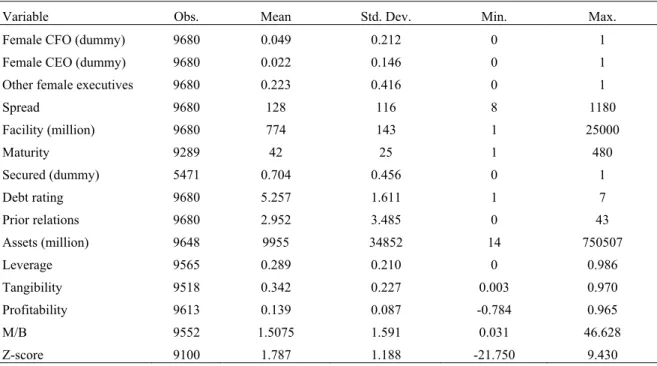
Table 1 provides descriptive statistics of the key variables in our study. W e find that the m ean values o f female CFOs, fe male CEOs and other fem ale executives are 0.049, 0.022 and 0.223, respectively. These number s show that the number of fem ale CFOs is more than twice as the number of fe male CEOs. Although the total number of female executives counts for over one fifth of top executive members, the proportions of female CEOs and female CFOs are still relatively low.
[Insert Table 1 here]
With regard to bank loa n characteristics, we find that the average lo an spread is 128 basis points, ranging from 8 basis points to 1,180 basis points. In our sam ple, the average loan amount is 774 m illion with the mean maturity of 42 months. The loan amount and maturity vary considerably across our sample. We also find that about 70%
5 Year 1992 and year 1993 are dropped because there is no female CFO in these two years in ExecuComp
16
of loans use collateral (security) in our sam ple. The resu lts of loan va riables are very similar to those of Chava et al. (2009) and Francis et al. (2009).
Table 1 also shows that the average value of assets for our sam ple borrowers is 9,955 million, ranging from a minimum of 14 million to a maximum of 750,507 million. The average market leverage ratio is 0.289, the average tangibility is 0.342, the average profitability is 0.139 and the average Z-score is 1.787. All of these firm variables also vary across our sample.
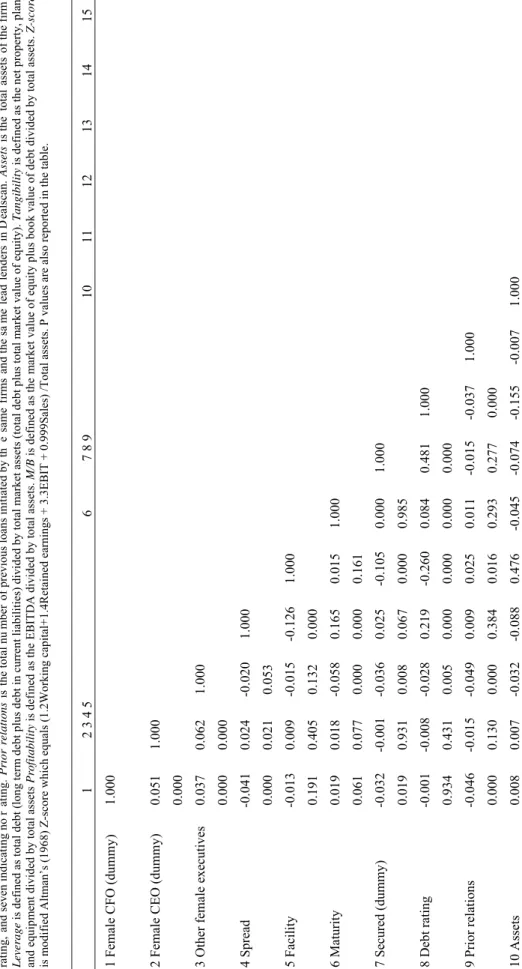
Table 2 provides the Spearm an pair-wise co rrelations among the key variables. We find that female CFOs are sign ificantly negatively correlated with bank loan spread and security, and are signif icantly positively correlated with bank loa n maturity. The results provide some preliminary evidence about the effect of female CFOs on bank loan contracts. However, because those loan terms are also significantly correlated with many other loan and firm variable s, it suggests that we need to analyze the relation in a multivariate environment.
[Insert Table 2 here]
Table 2 also shows that fe male CEOs, female CFOs and other female executives are all significantly positively correlated, sugge sting firms with female CEOs are more
likely to hire fe male executives on the top m anagement teams. The result seem s
consistent with the sim ilarity attraction principle (Westphal and Zajac (1995)), which
says that the appointment as a company ex ecutive is influenced by the individuals’
17
3.3 Univariate Comparisons
Table 3 provides univariate com parisons of price and non price loan term s
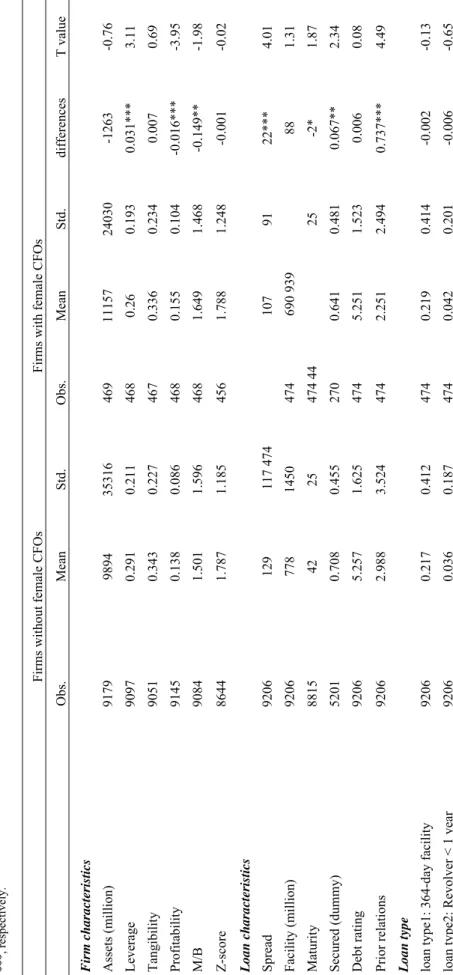
between firms with fe male CFOs and firm s without female CFOs. Consistent with our hypothesis, we find that the mean of bank loan spread for firms with female CFOs is 107 basis points, while it is 129 basis points for f irms without fem ale CFOs. The m ean difference of 22 basis points is significant at the 1% level. We also find that the means of loan maturity and loan security are both significantly different between firms with female CFOs and firm s without fem ale CFOs. On av erage, loans for borrowers with female CFOs are less likely to be s ecured and have longer m aturities than loans for borrowers with male CFOs.
[Insert Table 3 here]
While the univariate tests provide som e evidence to support our hypotheses, the results do not take into consideration poten tially fundamental differences in borrower characteristics and other lo an characteristics between these two gr oups. Therefore, we also compare the borrower characteristics, loan types and loan purposes between these two samples. We find that on average, firms with female CFOs have higher profitability, higher market to book ratio, but lower leverage ratio than fir ms with male CFOs. The results are consistent with prior findings, such as Huang and Kisgen (2010) and Francis et al. (2010).
18
In terms of loan types, we do not find significant differences between these two sample firms. For loan purposes, w e find that loans for firm s without female CFOs are more likely to be used for debt repay, recapit alization and takeover, and are less likely to be used for general corporate purpose compare to firms with female CFOs.
In sum, the results of univariate tests s uggest that banks provide m ore favorable loan terms to borrowers with female CFOs. The results also show that some key borrower characteristics and loan characteristics that may affect bank loan s are s ignificantly different across sub-samples, which suggest th e need of controlling for those key firm and loan characteristics in the multivariate analysis.
4. Results of multivariate tests
In our multivariate regression tests, we begin by testing how female CFOs affect bank loan price. Next, we examine how female CFOs affect non-price loan terms. Further, we conduct a series of robus t checks by using different st atistical methods, including a Heckman two-stage approach, a propensity score match approach, a differences-in-differences approach and a fir m level analysis. Finally, we explore through which channels female CFOs affect bank loan contracting by exam ining how fe male CFOs affect major firm characteristics.
4.1 Female CFOs and bank loan price
We first test how the presence of female CFOs impact bank loan price. The m ain empirical model follows:
19
Log (Loan spread) = f (Female CFOs, Firm characteristics, Loan characteristics, Industry effects, Year effects) (1)
In the regression, the basi c unit of observation is the loan facility, and the
dependent variable is the natural logarithm of the Loan spread. To capture the effect of
gender of CFOs, we defines a dum my variable, Female CFOs, which is equal to o ne if
the loan is initiated to a firm with female CFOs, and zero otherwise.
Following prior studies, such as those by Qian and Strahan (2007), Bharath et al. (2008), Graham et al. (2008) and Francis et al. (2009), we control for several firm
characteristics that may affect the loan price in the regressions. Those factors include Log
(assets), which is the n atural logarithm of a firm’s total assets; Leverage, which is the
total debt (long term debt plus debt in current liabilities) divided by the total market
assets (total debt plus to tal market value of equity); Profitability, which is the EBITDA
divided by the total assets; Tangibility, which is the net property, plant and equipm ent
divided by the total assets; M/B, which is the market value of equity plus the book value
of debt divided by the total assets; and Z-score, which is the modified Altman’s Z-score.6
Further, we employ one-digit SIC dummies to control for the potential differences in loan
pricing across industries.7
We further control for loan characteristics that may affect loan contracting in the
regressions. We include Log (facility), the natural logarithm of the a mount of a loan
facility, to m easure loan size. Sharpe (1990) and Rajan (1992) em phasize lock-up
6 Following Graham et al. (2008), we use a modified Z-score, which does not include the ratio of the
market value of equity to the book value of the total debt, because a si milar term, market-to-book, is included in the regressions.
20
problems associated with the existing lendi ng relationship that subsequently increase borrowing costs. To control for previous lend ing relationships, we construct a variable
Prior relations, which is the tota l number of previous loans established by the sam e
borrower and the same lead lender in the Dealscan database. Following Qian and Strahan (2007), we construct a loan rating score ba sed on Moody’s rating unless it is m issing, in
which case we use the S&P rating. Debt rating is a score that ranges from one to seven,
with one indicating an Aaa rating, two indicating an Aa rating, three indicating an A rating, four indicating a Bbb ra ting, five indicating a Bb ra ting, six indicating a B rating or worse, and seven indicting no or missing debt rating. We also control for both the loan type effect and the loan purpose effect in our analysis. Following Francis et al. (2009), we separate loan types into six catego ries: 364-day facility, Revolver less than one year, Revolver more than one year, Revolver/Term loan, Term loan and others. For loan purposes, we separate loans into eleven groups: Acquisition lines, CP backup, Corporate purpose, Debt rep ay, LBO/MBO, Recapitalization, Spinoff, Stock bu yback, Takeover, Working capital and Others.
As the number of fem ale CFOs has increased dramatically since 1994, one concern is that our s ample of female CFOs is heavily we ighted to the latte r part of the sample. For example, there are 330 fe male CFO observations in the 2002 to 2006 period while there are 144 female CFO observations in the 1994 to 2001 period. In addition, the average treasury rate is significantly di fferent between the 1994 to 2001 period and the 2002 to 2006 period, suggesting dif ferent macro-level borrowing environments between these two periods. To m itigate this concern, we first add year dumm y to control for year effect. Second, we add a dummy for the 2002 to 2006 period. Third, we construct a
21
dummy variable called High treasury rate, which equals one if a loan is created on a day
when the one year treasury rate is above the median rate for the entire sample period, and
zero otherwise. 8
[Insert Table 4 here]
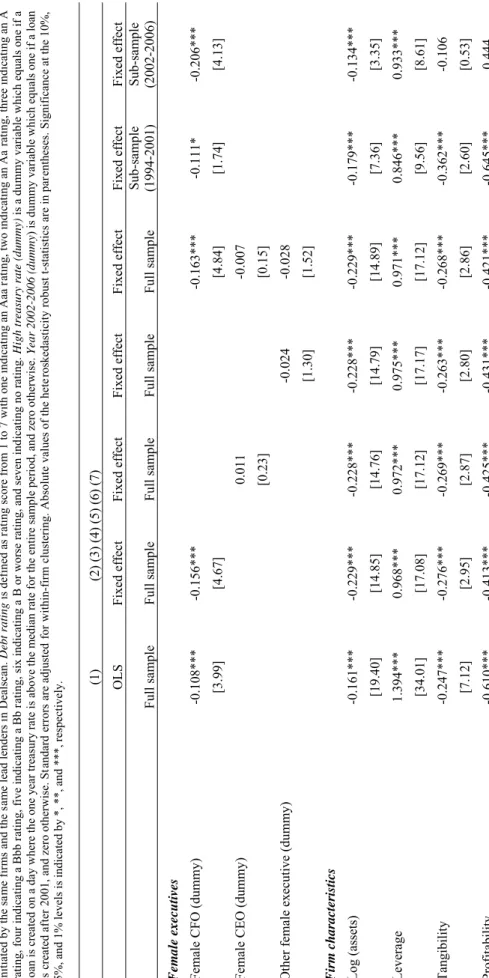
In Column 1 of Table 4, we first test how the presence of fem ale CFOs affects
bank loan price by using an OLS regr ession. The estimated coefficient of Female CFOs
equals -0.108 and is significan t at the 1% level, indicati ng firms with female CFOs, on average, have about 11% (abou t 14 basis points) lower bank loan price than firm s with male CFOs. Therefore, the effect of female CFOs on bank loan price is economically and statistically significant.
In terms of control variables, our results are consistent with prior studies such as Qian and Strahan (2007), Bharath et al. (2008) , Graham et al. (2008) and Francis et al.
(2009). Specifically, we find that Log (assets), Tangibility, Profitability, M/B and Z-score
are all signif icantly negatively related to the lo an spread, while Leverage is positively
related to the loan spread, suggesting firms with higher information asymmetries and
default risk have higher loan price. We also find that Log (facility) is negatively, while
Prior relations and Debt rating are positively related to the loan spread.
In previous OLS regression, although we control for various observable firm and loan characteristics which are wid ely used in prior s tudies, it is still poss ible that unobservable time-invariant factors could aff ect bank lo an price. In addition, it is common that a firm have several loan facilities each year, and those facilities may not be
22
independent. Treating those correlated loans in dependently may overstate the statistical significance and lead to biased results. To d eal with these two issues, we perform a firm and year fixed regression with standard erro rs adjusted for heteroscedasticity and within-firm clustering. The results are in Column 2 of Table 4. We find after controlling for within-firm
and year fixed effects, the Female CFOs effect on bank loan price increases to 0.156
from 0.108 (in Column 1), and it remains economically and statistically significant. As CEOs have the overall responsibilities of corporate decision-making, and prior studies find that CEOs’ individual styles affects firm policies and firm performance (e.g., Levi et al. (2008), Bertrand a nd Schoar (2003) and Bennedsen et al. (2006)), gender of CEOs may also affect lender’s p erceptions in their lending decisions. In Colum n 3 of Table 4, we further tes t whether the presence of female CEOs affects bank loan price. The results show that there is no significant relation between these two, indicating banks do not take consideratio n of the gender of CEOs when pricing bank loans. The result is consistent with prior studies, such as Peni (2008) and Jiang et al. (2010), which show that CFOs have more impacts on earnings quality and earnings management than CEOs.
We further test whether the pres ence of other fem ale top executives affects bank loan price. The results in Colum n 4 of Table 4 show that other female top executives are not related to bank loan pri ce significantly. In Colum n 5 of Table 4, we specify three
testing variables, Female CFOs, Female CEOs and Female other top executives, in one
regression simultaneously. The resu lts further confirm that only Female CFOs is
significantly negatively related to bank loan price, and both Female CEOs and Female
other top executives have no impacts on bank loan price.9
9We test whether multicollinearity problems exist for all the regressions presented in this section. We find
23
As we said before, the num ber of female CFO observations in the 2002 to 2006 period is larger than that in the 1994 to 2001 period, and the borrowing environments are different between these two periods. Theref ore, we further exam ine whether the CFO gender effect on bank loan price holds for bot h sample periods. We separate our sample into two subsamples bases on the tim e periods, and then rerun firm and year fixed effect regressions for these tw o sub samples separately. The results are re ported in Column 6 and Column 7 of Table 4. W e find that CFO gender effect on bank loan price holds for both subsamples, although the m agnitudes of the coefficient for the 2002 to 2006 period
sample is higher than that for the 1994 to 2001 period sample. 10
In sum, the results in Table 4 support th e hypothesis that banks tend to recognize benefits of female CFOs in providing m ore reliable accounting inform ation ex ante and reducing default risk ex post, and grant firm s with female CFOs lower bank loan price. The results also suggest that banks only concern the gender of CFOs, but not CE Os or other top executives when making their lending decisions.
4.2 Female CFOs, loan maturity and loan collateral
If female CFOs convey inform ation about disclosure quality and default risk of the firms, lenders might consider this factor not only on loan pric e, but also on other contract terms. Similar to Bharath et al. ( 2008), in this section, we focus on how fe male CFOs impact two m ajor non-price loan cont ract features: loan m aturity and loan collateral.
variance inflation factor (VIF) for model 1 of Table 4 is 3.01 (log assets), and the VIF for female CFOs is only 1.03. So it seems that multicollinearity is not a big issue in our multivariate analysis.
24
[Insert Table 5 here]
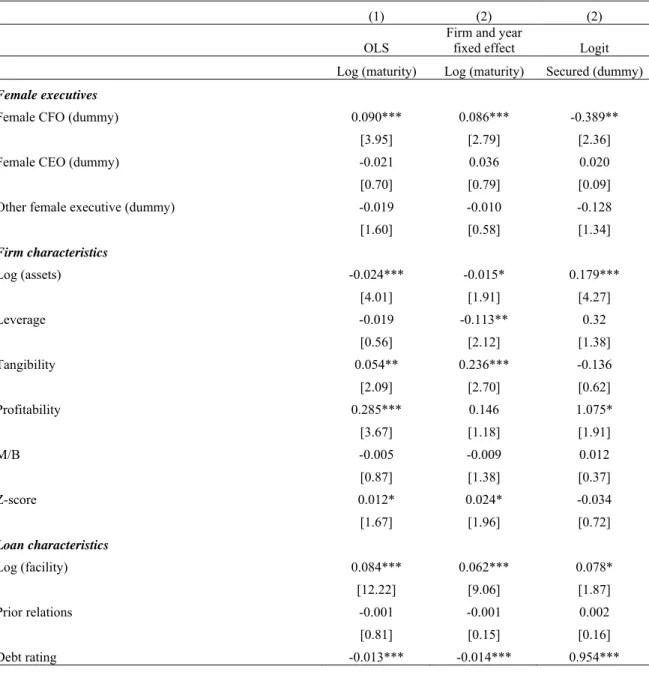
Column 1 of Table 5 reports the results on the impact of female CFOs on loan
maturity. The dependent variable is the natural loga rithm of the Loan maturity.
Consistent with our Hypothesis 2, we find that the estimated coefficient of Female CFOs
is 0.090 and is significant at the 1% level, indicating that loans given to firms with female CFOs have about 9% (3.8 m onths) longer maturities than loans given to fir ms with male
CFOs. We also find that Female CEOs and Other female executives have no im pact on
loan maturity. In Column 2, we run firm and year fixed effect regression. Again we find that the estimated coefficient of female CFOs is still e conomically and statistic ally significant.
We further test the im pact of fe male CFOs on the likelihood of a loan being secured. We estimate a logit m odel where the dependent variable is one if a loa n is
secured and zero otherwise.11 The results are in Column 3 of Table 5. The marginal effect
of Female CFOs implies that the p robability of a loan being secured is about 8% lower
for firms with female CFOs than for firms with male CFOs. 12 This is consistent with our
hypothesis that because of the in formation risk and default ri sk is lower in fem ale CFO led firms than in m ale CFO led f irms, banks are less likely to require collateral in loan contracts when lending to fe male CFO led fi rms. In addition, we s till do no t find
significant impacts of Female CEOs and Other female executives on the likelihood of a
loan being secured.
11 Because there are many missing observations about loan secured in Dealscan, the sample size for l oan
secured is smaller than other loan variables.
25
In sum, the results in Table 5 indicate that the firms with female CFOs enjoy more favorable non-price loan terms than firms with male CFOs, which is co nsistent with the literature that shows banks al ways simultaneously use both pr ice and non-price terms to compensate for higher risk, facilitate monitoring and limit potential losses (e.g., Qian and Strahan (2007), Bharath et al. (2008), Graham et al. (2008) and Francis et al. (2009)). The results on the gender of CEOs and other t op executives also confirm that banks only consider the gender of CFOs, but not CEOs or other top executives, when designing bank loan contracts.
4.3 Robustness checks
So far, we fi nd that firms with female CFOs enjoy more favorable loan contract terms. However, endogeneity is a big concern in the study of gender issue. In this section, we perform robustness checks using different econometric analysis.
The first issue is the self selection bias. Female CFOs may not be random ly assigned to firms. Firms having more favorable credit terms may be more likely to hire female CFOs. Therefore, a proper evaluation of the effect of fe male CFOs on bank loan contracts should take into account the endogeneity of the choice of female CFOs. To deal with this issue, we first use a Heckman’s two-stage self-selection model to control for the self-selection bias induced in firms’ choices of female CFOs.
In the first stage, we run a probit regression. T he dependent variable is Female
CFOs. Similar to Huang and Kisgen (2010) and Francis et al. (2010), we include fir m
size, leverage, profitability, ta ngibility, market to book ratio in the regression. W e also control for industry and year effects. In the second stage, we run OL S regression and
26
logit regressions as Model 1 of Table 4 and Table 5 but include inverse Mills ratio, which is obtained from the first stage probit regre ssion, to control for the endogeneity of the
choice of female CFOs. Table 6 reports the results. We test Log (spread), Log (maturity)
and Secured (dummy) as dependent variables in Colu mns 1, 2 and 3, respectively. W e
find that th e estimated coefficients of three Female CFOs in Column 1, 2 and 3 are
-0.1210, 0.089 and -0.4105 and are significant at the 1%, 1% and 5% levels, respectively, suggesting our results hold after considering the endogeneity of the choice of fem ale CFOs.
[Insert Table 6 here]
In our sample, only around 5% firm s have female CFOs. In order to fairly compare between two group firm s (male and fem ale CFO led firm s), we construct a matched male CFO firm s by applying a pr opensity score m atching approach. The matching begins with a logistic regressi on of the fem ale CFO dummy variable on industry, year, firm size and leverage. Then we use the prop ensity scores obtained f rom logistic estimation and perform a one to one nearest neighbor match with replacement. This procedure ensures that each female CFO firm is paired with a male CFO firm. Then we obtain a new pooled sam ple which includes 356 observati ons with female CFOs and 356 matched observations with male CFOs.
27
The results are reported in Table 7. Similar to Table 6, we test Log (spread), Log
(maturity) and Secured (dummy) as dependent variable s in Columns 1, 2 and 3,
respectively. We find that the estimated coefficients of three Female CFOs in Column 1,
2 and 3 are -0.117, 0.098 and -0.589 and are significant at different levels. The propensity score matching approach results also confirm our prior findings and further mitigate the sample selection bias concern.
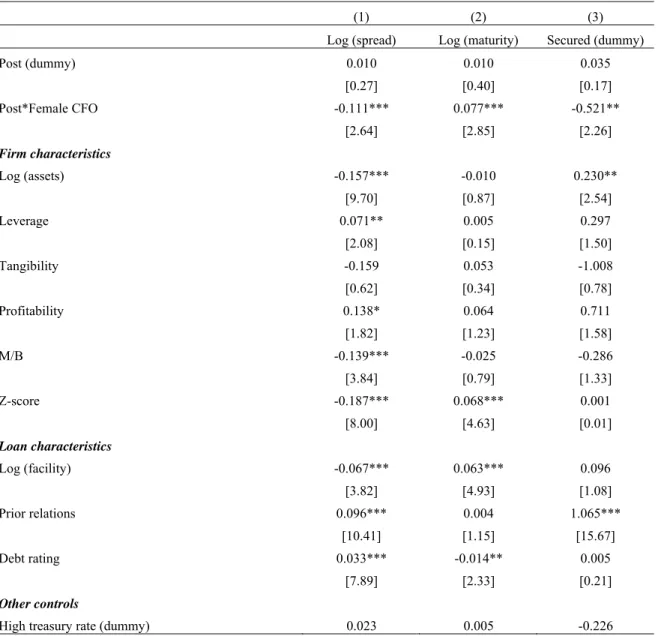
As we use panel data in our studies, unobservable time-variant factors m ay be correlated with bank loan terms, which would make our results spurious. To remove the effect of contemporaneous changes, we employ a differences-in-differences methodology. Similar to Francis et al. (2010), we first trac e firms who change their CFOs from m ale to female (treated sample) and from male to m ale (control sample). We require each CFO should be in the offices for at least three consecutive years excluding the transition year. We focus on how m ale to fem ale CFO change s affect bank loan term s, using m ale to
male CFO change firms as control group. Post is a dummy variable which equals one if a
year is after CFO transition year an d zero if a year is b efore CFO transition y ear. The results are in Table 8.
[Insert Table 8 here]
The first column shows the test with Log (spread) as the dependent variable. W e
find that the estimated coefficient of Post, which captures the effect of male to male CFO
transition on Log (spread), is insignificant, indicating that there is no significant
28
period for the control group. The estim ated coefficient of the inter action term between
Post and Female CFOs, which captures the incremental effect of male to female CFO
transition on Log (spread), is -0.111 and is significant at the 1% level. Hence, compared
to male CFOs, female CFOs reduce bank loan spread significantly after CFO transitions.
Consistent results are also found in Colum n 2 and 3 when we use Log (maturity) and
Secured (dummy) as de pendent variables. The result s of the differences-in-differences
approach demonstrates that our findings about the impact of female CFOs on bank loan contracts hold after considering time-variant omitted variable bias. The results also suggest that female CFOs bring about, and not merely reflect, a reduced bank loan price
and more favorable non-price loan terms.13
[Insert Table 9 here]
In our earlier analysis, the unit of observa tion is individual loan. However, a
borrower can obtain several loans in the sam e year and those loans m ay not be
independent. Treating these loans independently may overstate statistical significance. To deal with this issue, we use a reduce d sample in which we only keep one larges t loan for each firm each year. We rerun our main analysis using this firm level sample. The results are reported in Table 9. Although the sample size is reduced from 8986 to 5480, the main results are qualitatively unchanged.
13 We also consider the self selection issue in the di fference-in-difference analysis by control for inverse
Mills ratio generated from Heckman’s two-stage self-selection model. The results are qualitatively unchanged.
29
In sum, Table 6, 7, 8 and 9 further confirm our m ain finding that f irms with female CFOs enjoy more favorable price and non-price loan terms, and the robust checks mitigate the potential endogeneity concern in the study.
4.4 The impact of female CFOs on major firm characteristics
In this paper, we establish our hypotheses based on recent studies which show that female CFOs m ake more conservative corpor ate decisions, and consequently lead to more favorable bank loan contracts. In Table 3 univariate test, we find that firm s with female CFOs are m ore profitable, have highe r market to book rati o and lower leverage level than firms without female CFOs. However, we could not make the conclusion from Table 3 that female CFOs affect those firm characteristics, and subsequently affect bank loan contract terms, as we do not show a causal link between female CFOs and those firm
factors.14
Although to examine the impact of gender of CFOs on various corporate decision-making is not the focus of this paper, in this sub section, we try to provide som e evidence to mitigate this causality concern. Similar to the robustness check in Table 8, we trace firms who change their CFOs from male to female and from male to male. Then we plot the main firm characteristics from three years before CFO transitions till three years after CFO transitions. In this way, we could gain a visual sense of how firm characteristics are affected by CFO gender change. For com parison, we also plot the changes of the same variables for the male to male CFO transition sample.
30
[Insert Figure 1 here]
Figure 1-1 shows leverage level three years before and three years after the CFO
transition. We see m ale to female CFO transition-firms have higher leverage level than
male to m ale CFO tran sition-firms in gene ral. However, f or male to f emale transition
firms, we see a significa nt and continuous drop of leverage after female CFOs are hired.
For male to male transition firms, leverage remains relatively stable after new male CFOs
are hired. The finding shows that fem ale CFOs tend to redu ce firm leverage level after they are hired, and it is consistent with the finding by Huang and Kisgen (2010). Prior studies show that leverage is an important indicator of firm risk, and firm s with higher leverage level pay m ore when they borro w (e.g., Strahan (1999) and Graham et al. (2008)). Here we provide a possible channe l through which fe male CFOs affect bank loan contracting.
Figure 1-2 plots how m arket to book ra tio change following CFOs transitions. The trends of m arket to book ratio for the firms belonging to the two different samples are opposite. For m ale to fe male transition-firms, it keeps increasing following the transition from male to female CFOs, while for male to male CFO transition-firms there is a slight decline. The im pact of fe male CFOs on m arket to book ratio also has implications for bank loan contracting. Fr om accounting perspective, market to book ratio is a proxy for conservatism , with hi gher market to book ratio indicating more conservative accounting. Prior studies find that firms with more conservative accounting
enjoy more favorable bank loan terms (Sunder et al. (2009)). 15
15 From finance perspective, market to book ratio could implies either growth opportunity or opaqueness of
31
Figure 1-3 shows th e change of profitability following CFO tr ansitions. Consistent with the f inding in Table 3, we f ind that in gen eral male to female transition firms have higher profitability than male to male transition firms. However, the trends of profitability for two samples are very sim ilar. For both m ale to male firms and male to female firms, profitability keeps decreasing before CFO transitions. After CFO changes, profitability increases slowly but not significantly. From this figure, we do not find obvious differences between m ale and female CFOs about their impact on profitability. However, we should notice that we could not make the conclusion that fe male CFOs do not affect firm performance, as we do not provide a strong statistical analysis here.
In Figure 1 -4, we plot how tangibility changes following CFO transitions. W e find that before CFO t ransitions, male to male firms seem to have higher level of tangibility than male to female firms. However, after new CFOs are hire d, female CFOs increase the tangibility level con tinuously, while male CFOs tend to reduce tangib ility level gradually. This f igure indicates that f emale CFOs are m ore likely to inves t in tangible assets than male CFOs. Tangibility also has a ve ry important implication for
bank loan contracting, as tangible assets are critical for lende rs to recove r when
borrowers default. Prior studies find a st rong negative relation between tangibility and cost of bank loans (e.g., Strahan (1999), Bharat h et al. (2008) and Graham et al. (2008)). Here we provide another possible channel th rough which female CFOs affect bank loan contracting.
In general, Figure 1 shows that firm s under the control of fem ale CFOs are more likely to invest in tangible assets, decrease leverage level and incr ease market to book
32
ratio. These finding could som ehow help expl ain through which cha nnels that fem ale CFOs affect bank loan contracting.
5. Conclusion
In this pap er, we exam ine whether the gend er of CFOs affects bank loan contracting. Based on recent em pirical work which shows that female CFOs report more conservative and high-q uality accounting numbers and are m ore likely to reduce ris k level of the fir ms, we hypothesize that as inside lenders, banks should recognize the benefits of female CFOs in reducing information risk ex ante and default risk ex post, and reward borrowers with female CFOs with more favorable loan contract terms.
Our empirical results support our hypothese s. We find that, in our sam ple, firms with female CFOs, on average, enjoy about 14 basis points lower ba nk loan price than firms with male CFOs. In add ition, loans given to female CFO led companies have 3.8 months longer maturities and are 8% less likely to be required to provide collateral than loans given to male CFO led companies. In addition, we do not find that the presence of female CEOs and other female executives affect bank loan contract terms, suggesting that banks view CFOs, but not CEOs or other executives, as the prim ary executives who determine the quality of accounting infor mation, and in turns, affect their len ding decisions.
We further com prehensively examine the potential endogeneity concern in our study. We perform a firm and year fixed e ffect model, a Heckm an two-stage self selection model, a propensity score m atch method, a differences-in-differences approach and a firm level analysis to test potential issues such as un observable time variant and
33
invariant omitted variable bias, self-section bias, causality problem and interdependence among individual loans. Our results hold to all these robustness checks.
To the best of our knowledge, this paper is the first one that links gender of CFOs and other top executives with banks’ lendi ng decision-making. The results further our understanding on the determinants of the cost of capital in general, and the cost of bank loan in particular. In addition, our paper tests the gender e ffect from the informed and sophisticated private lenders perspective, and provides some evidence on the debate as to the systematic differences between men and women with regard to their risk attitudes.
However, we acknowledge that the results of our paper should be considered in the context of its inherent limitations. First, although we find supportive evidence for our “risk-averse” hypothesis, we still cannot rule out the “discrimination” hypothesis in the literature. Due to the data lim itations, our study only focuses on larg e loans (at least one million dollars) granted to public com panies. Discrimination effect m ay be less prominent in such kind of lending decisions . Therefore, it is hard to gene ralize our findings to sm all business loans and persona l loans. Furtherm ore, to exam ine gender discrimination in the cr edit market, it is very important to focus not only on the interest rates and other loan terms, but also on the av ailability of private debt financing, such as the denial rates of bank loans, as denial rates are the firs t-stage evidence to test whether women are discrim inated in the credit m arket. This m ay be another drawback in our study due to the data limitations.
Second, in our studies, as we do not have the detailed inform ation about
individual lenders who are in charge of the lending decision-m aking, we only consider the gender effect of the borrowers, but not th e gender effect of the lenders. If the “risk
34
averse” does exist betw een men and women, it is highly possible that m ale and female lending officers have different judgm ents on their lending decision-making. Therefore, a more accurate research design sho uld simultaneously take into consideration of the gender of both borrowers and lenders.
Third, based on prior studies, we propose two possible explanations on why banks may care about the gend er of CFOs in our paper. One is the accounting information risk explanation and another is the default risk explanation. However, we do not know exactly which factor drives the observed gender effect. In addition, as the research in the gender of top executive s is s till in its e arly stage, there m ay be som e other alternative explanations for the observed e ffect of CFO gender that we do not consider in our paper but are considered by lenders when m aking their decisions. For exam ple, the gender of CFOs may not only affect disc ount rate, but also im pact firms’ performance, which is also a primary factor that determines the cost of capital. Further research could examine the relation between female CFOs and f irm performance and whether the public m arket recognizes the gender differences between m ale and female CFOs as well as other top executives with regard to their risk attitudes.
35
References
• Alesina, Alberto F., Francesca Lotti, and Paolo Emilio Mistrulli, 2008, Do women
pay more for credit? Evidence from Italy, Unpublished working paper, NBER.
• Anderson, Ronald C., Sattar A. Mansi, and David M. Reeb, 2004, Boar d
characteristics, accounting report integrit y, and the cost of debt, Journal of Accounting and Economics 37, 315-342.
• Armstrong, Chris, W ayne R. Guay, a nd Joseph W eber, 2010, The role of
information and financial reporting in co rporate governance and debt contracting Journal of Accounting and Economics 50, 179-234.
• Atkinson, Stanley M., Sa mantha Boyce Baird, and Melissa B. Frye, 2003, Do
female mutual fund managers m anage differently?, The Jour nal of Financial Research 26, 1-18.
• Ball, Ryan T, Robert M. Bushman, a nd Florin P. Vasvari, 2008, The debt
contracting value of accounting inform ation and loan syndicate structure, Journal of Accounting Research 46, 247-287.
• Barclay, Michael J., and Clifford W. Smith, 1995, The m aturity structure of
corporate debt, Journal of Finance 50, 609-631.
• Bennedsen, Morten, Francisco Pérez-González, and Daniel Wolfenzon, 2006, Do
CEOs matter?, Unpublished working paper, Copenhagen Business School.
• Berger, Allen N., and Gregory F. U dell, 1990, Collateral, loan quality, and bank
risk, Journal of Monetary Economics 25, 21-42.
• Bertrand, Marianne, and Antoinette Sc hoar, 2003, Managing with style: The
effect of managers on firm policies, Quarterly Journal of Econom ics 118, 1169– 1208.
• Bharath, Sreedhar T., Jayanthi Sunder , and Shyam V. Sunder, 2008, Accounting
quality and debt contracting, Accounting Review 83, 1-28.
• Blanchflower, David G., Phillip B. Levine, and David J. Zimmer man, 2003,
Discrimination in the sm all-business credit market, Review of Economics and Statistics 85, 930-943.
• Chava, Sudheer, Dm itry Livdan, and Am iyatosh K Purnanandam , 2009, Do
shareholder rights affect the cost of ba nk loans?, Review of Financial Studies 22, 2973-3004
• Chava, Sudheer, and Am iyatosh Purnanandam, 2010, CEOs versus CFOs:
Incentives and Corporate Policies, Journal of Financial Economics 97, 263-278.
• Diamond, Douglas W., 1984, Financial intermediation and delegated monitoring,
The Review of Economic Studies 51, 393-414
• Dwyer, Peggy D., and Jam es H. Gilkeson, 1999, Gender differences in revealed
risk taking: Evidence from mutual fund investors, Economics Letters 76, 151-158.
• Fama, Eugene F., 1985, W hat’s different about banks? , Journal of Monetary
Economics 15, 29-39.
• Francis, Bill, Iftekhar Hasan, Michael Koetter, and Qiang Wu, 2009, Corporate
boards and bank loan contracting, Unpub lished working paper, R ensselaer
36
• Francis, Bill, Iftekhar Hasan, Jong C hool Park, and Qiang W u, 2010, Gender
differences in financial reporting d ecision-making: Evidence from accounting conservatism, Working paper, Rensselaer Polytechnic Institute.
• Francis, Jennifer, Ryan LaFond, Per M. Olsson, and Katherine Schipper, 2004,
Costs of equity and earnings attributes, Accounting Review 79, 967-1010.
• Geiger, Marshall A., and David S. Nort h, 2006, Does hiring a new CF O change
things? An investigation of changes in discretionary accruals, Accounting Review 81, 781–809.
• Graham, John R., Si Li, and Jiaping Qi u, 2008, Corporate misreporting and bank
loan contracting, Journal of Financial Economics 88, 44-61.
• Huang, Jiekun, and Darren J. Kisgen, 2010, Gender and copoarte finance, Journal
of Finance Forthcoming.
• Jiang, John (Xuefeng), Kathy R. Petr oni, and Isabel Yanyan W ang, 2010, CFOs
and CEOs: Who has the m ost influence on earnings m anagement?, Journal of Financial Economics Forthcoming.
• Jimenez, Gabriel, Vicente Salas, and Jesus Saurina, 2006, Determ inants of
collateral, Journal of Financial Economics 81, 255-281.
• Matsunaga, Steven, and Eric Yeung, 2007, Evidence on the im pact of a CEO's
financial experience on the qual ity of the firm's financial reports and disclosures, Unpublished Working paper, University of Oregon.
• Melnik, Arie, and Steven Plaut, 1986, Lo an commitment contracts, term s of
lending, and credit allocation, The Journal of Finance 41, 425-435.
• Park, Jong Chool, and Qiang Wu, 2010, Does earnings predictability matter in the
private debt contracts?, Working Paper, Rensselaer Polytechnic Institute.
• Peni, Emilia, 2008, Do female directors affect earnings quality?, Unpublished
working paper, University of Vaasa.
• Qian, Jun, and Philip E. Strahan, 2007, How law and institutions shape financial
contracts: the case of bank loans, The Journal of Finance 62, 2803 - 2834.
• Rajan, Raghuram G., 1992, Insiders and out siders: the choice between Infor med
and arm's-length debt, The Journal of Finance 47, 1367-1400.
• Rajan, Raghuram G., and Andrew W inton, 1995, Covenants and collateral as
incentives to monitor, The Journal of Finance 50, 1113-1146.
• Schneider, Arnold, and Bryan K. Church, 2008, The effect of auditors’ internal
control opinions on loan decisions, Journa l of Accounting and Public P olicy 27, 1-18.
• Sharpe, Steven A., 1990, Asymmetric in formation, bank lending and im plicit
contracts: a stylized m odel of customer relationship, The Journal of Finance 45, 1069–1087.
• Stiglitz, Joseph E., and Andrew Weiss, 1981, Credit rationing in m arkets with
imperfect information, The American Economic Review 71, 393-410.
• Storey, D. J., 2004, Racial and gender di scrimination in the m icro firms credit
market?: Evidence from trinidad and tobago, S mall Business Economics 23, 401-422.
• Strahan, Philip E., 1999, Borrower risk a nd the price and non-price terms of bank
37
• Sunder, Jayanthi, Shyam V. Sunder, and Jingjing Zhang, 2009, Balance sheet
conservatism and debt contracting, U npublished working paper, Northwestern University.
• Wei, Zuobao, and Feixue Xie, 2009, CFO gender and earnings m anagement,
Unpublished working paper, University of Texas at El Paso.
• Westphal, James D., and Edward J. Za jac, 1995, Who shall govern? CEO board
power, demographic sim ilarity, and ne w director selection, Administrative Science Quarterly 40, 60–83.
• Zhang, Jieying, 2008, The contracting bene fits of accoun ting conservatism to
38
Table 1 Summary statistics
This table presents descriptive statistics for the sa mple. Female CFO is a dummy variable which equals one if a CFO is fe male and
zero otherwise. Female CEO is a dummy variable which equals one if a CEO is female and zero otherwise. Other female executives is
a dummy variable which equals one if at least one member of top management team (excluding CEO and CFO) is female and zero otherwise. Spread is the all-in spread drawn which is defined as the amount the borrower pays in basis points over LIBOR or LIBOR
equivalent for each dollar drawn down. Facility is the total amount of loan facility. Maturity is the loan maturity time. Secured is a
dummy variable which equals one if a loan is secured by collateral, and zero otherwise. Debt rating is defined as rating score from 1
to 7 with one indicating an Aaa r ating, two indicating an Aa r ating, three indicating an A rating, four indicating a Bbb r ating, five indicating a Bb r ating, six indicating a B or worse rating, and seve n indicating no r ating. Prior relations is the total number of
previous loans initiated by the same firms and the same lead lenders in Dealscan. Assets is the total assets of the firm. Leverage is
defined as total debt (long term debt plus debt in current liabilities) divided by total market assets (total debt plus total market value of equity). Tangibility is defined as the net pr operty, plant and equipment divided by total assets Profitability is defined as the E BITDA
divided by total assets. M/B is defined as the market value of equity p lus book value of debt di vided by total assets. Z-score is
modified Altman’s (1968) Z-score which equals (1.2Working capital+1.4Retained earnings + 3.3EBIT + 0.999Sales) /Total assets. Number of observations (Obs.), mean, standard deviation (Std. Dev.), minimum (Min.) and maximum (Max.) are reported in the table.
Variable Obs. Mean Std. Dev. Min. Max. Female CFO (dummy) 9680 0.049 0.212 0 1 Female CEO (dummy) 9680 0.022 0.146 0 1 Other female executives 9680 0.223 0.416 0 1 Spread 9680 128 116 8 1180 Facility (million) 9680 774 143 1 25000 Maturity 9289 42 25 1 480 Secured (dummy) 5471 0.704 0.456 0 1 Debt rating 9680 5.257 1.611 1 7 Prior relations 9680 2.952 3.485 0 43 Assets (million) 9648 9955 34852 14 750507 Leverage 9565 0.289 0.210 0 0.986 Tangibility 9518 0.342 0.227 0.003 0.970 Profitability 9613 0.139 0.087 -0.784 0.965 M/B 9552 1.5075 1.591 0.031 46.628 Z-score 9100 1.787 1.188 -21.750 9.430
39
Table 2 Correlation tab
le Th is table pr ovides spearm an cor relations of m ain var iables em ployed in our analy sis . Fem a le CFO is a du m m y var iable which equals one if a C FO is fe m ale and zer o other w ise. Fe ma le CEO is a du m m y var iable
which equals one if
a CE O is fem ale and zer o other w ise. Other female exec utives is a du mmy variable which equ als one if at leas t one m em ber of top m anage m ent tea m (e xcluding CE O and CFO) is fem ale and zer o other w ise. Spread is the all-in spr ead dr awn which is defined a s the am ount the bor ro wer pay s in basis points o ver L IB O R or L IB O R equivalent for
each dollar drawn down
. Facility is the total a m ount of loan fa cility . Maturity is t he loan m aturit y tim e. Secured is a d um m y var iable wh ich equals one i f a loan is secur ed by collater al, and zer o other w ise. Debt r a ting is define d as ra ting sc or e fr om 1 to 7 with one indi cating an Aaa rating, two indi cati ng an Aa rating, three i ndicating an A r ating, four indicating a Bbb rating, five indicating a Bb ra ting, six indicating a B or wor se ra ting,
and seven indicating no r
ating. Prior relations is the total nu m be r
of previous loans initiated by th
e sa m e firm s and the sa m e le ad lende rs in D ealscan. As sets is the total as sets of the firm . Leverage
is defined as total debt (
lon
g
ter
m
debt plus debt in cur
re nt liabili ties) divided by total m arket assets (total
debt plus tot
al m arket value of eq uity). Tangibility is defined as the net pr oper ty, plant and equip m ent div ided by total assets Profitability is def ined as the EBI TDA divided by total assets. M/ B is defined as the m ar ket value of equity pl us book value of de bt divided by total assets. Z-sc or e is m odified Altm an’ s ( 1968) Z -scor e which equals (1 .2 W or king capital+1. 4Retained ear nings + 3. 3E BIT + 0. 999Sales) /T otal ass ets . P values ar e also r epor ted in the table. 1 2 3 4 5 6 7 8 9 10 11 12 13 14 15 1
Female CFO (dummy
) 1.000 2 Female CEO ( dummy ) 0.051 1.000 0.000 3 Other female executi ves 0.037 0.062 1.000 0.000 0.000 4 Spread -0.041 0.024 -0.020 1.000 0.000 0.021 0.053 5 Facility -0.013 0.009 -0.015 -0.126 1.000 0.191 0.405 0.132 0.000 6 Maturity 0.019 0.018 -0.058 0.165 0.015 1.000 0.061 0.077 0.000 0.000 0.161 7 Secured (dummy ) -0.032 -0.001 -0.036 0.025 -0.105 0.000 1.000 0.019 0.931 0.008 0.067 0.000 0.985 8 Debt r ating -0.001 -0.008 -0. 028 0.219 -0.260 0.084 0.481 1.000 0.934 0.431 0.005 0.000 0.000 0.000 0.000 9 Prior relations -0.046 -0.015 -0.049 0.009 0.025 0.011 -0.015 -0.037 1.000 0.000 0.130 0.000 0.384 0.016 0.293 0.277 0.000 10 Assets 0.008 0.007 -0.032 -0.088 0.476 -0.045 -0.074 -0.155 -0.007 1.000
40 0.444 0.500 0.002 0.000 0.000 0.000 0.000 0.000 0.471 11 Lev erag e -0.032 0.009 0.001 0.309 0.086 0.008 -0.036 -0.104 0.067 0.131 1.000 0.002 0.358 0.921 0.000 0.000 0.461 0.009 0.000 0.000 0.000 12 Tang ibility -0.007 -0.050 0.007 -0.063 -0.009 -0.028 -0.017 -0.085 0.015 -0.006 0.255 1.000 0.490 0.000 0.496 0.000 0.385 0.007 0.202 0.000 0.132 0.546 0.000 13 Profitab ility 0.040 0.001 0.037 -0.218 -0.032 0. 034 0.015 -0.010 0.005 -0.078 -0.416 0.032 1.000 0.000 0.888 0.000 0.000 0.002 0.001 0.271 0.344 0.598 0.000 0.000 0.002 14 M/B 0.020 0.015 0.026 -0.055 -0. 052 -0.004 0.025 0.062 -0.006 -0 .055 -0.422 -0.163 0.376 1.000 0.048 0.133 0.010 0.000 0.000 0.692 0.064 0.000 0.587 0.000 0.000 0.000 0.000 15 Z-score 0.000 -0.001 0.013 -0.221 -0.123 0.010 0.027 0.070 0.016 -0.174 -0.443 -0.257 0.515 0.186 1.000 0.984 0.955 0.222 0.000 0.000 0.342 0.054 0.000 0.139 0.000 0.000 0.000 0.000 0.000
41
Table 3 Univariate comparison
This
table pr
esents
univar
iate
tests on the dif
fer ences between firm s with fem ale CFOs a nd firm s without fem ale CFOs. Assets a re
total assets of the firm
. Leverage is defined as total debt (long term debt plus debt in c urrent liabilities) d ivi ded by total m arket assets (total debt plus total m ark et value of equity). Tangibility
is defined as the net pr
oper ty , plant and equip m ent divided by total assets Profitability is defi ned as the E BI TDA divided by total assets. M/B is defined as the m ar ket value of e quity plu s boo k value o f debt divided by total assets. Z-score is m odified Altm an ’s (1968) Z -scor e which equals ( 1. 2W or king capital+1 .4Retained ear nings + 3. 3E BIT + 0. 999Sales) /T otal assets. Spread is the all-in spr ead dr awn which is defined as the a m ount the bor ro wer pay s in basis points over LIBOR or LIBOR equivalent fo r
each dollar drawn down.
Facility is the total a m ount of loan facility . Maturity is the loan m aturity tim e. Secured is a du m m y var iable
which equals one if a loan is
secur ed by collateral, and zer o other w ise. Debt rating is defined as r ating scor e fr om 1 to 7 w ith one indicatin g an Aaa r ating, two indica ting an Aa ra ting, thr ee in dicating an A r ating, four indicatin g a Bbb ra ting, five indicating a Bb ra ting, six indicating a B or wor se ra ting, and seven i ndicating no r ating. Prior relations is the total nu m ber of previous loan s initiated by the sa m e firm s and the sa me lead lenders in De alscan. The m eans of th e diff erences
between the variab
les fo r two subsam ples and t-statistics ar e also re por ted. Significance at the 10%, 5%, and 1% levels ar e indicated by *, **, an d ***, re spectively . Firms
without female CFOs
Firms
with female CFOs
Obs . M ean St d. Obs . M ean St d. differen ces T va lue Firm c h arac te ristic s Assets (m illion) 9179 9894 35316 469 11157 24030 -1263 -0.76 Lever age 9097 0.291 0.211 468 0.26 0.193 0.031*** 3.11 Tangibility 9051 0.343 0.227 467 0.336 0.234 0.007 0.69 Profitability 9145 0.138 0.086 468 0.155 0.104 -0.016*** -3.95 M/B 9084 1.501 1.596 468 1.649 1.468 -0.149** -1.98 Z-score 8644 1.787 1.185 456 1.788 1.248 -0.001 -0.02
Loan characteristics Spread
9206 129 117 474 107 91 22*** 4.01 Facility (million ) 9206 778 1450 474 690 939 88 1.31 Maturity 8815 42 25 474 44 25 -2* 1.87 Secured (dummy ) 5201 0.708 0.455 270 0.641 0.481 0.067** 2.34 Debt rating 9206 5.257 1.625 474 5.251 1.523 0.006 0.08 Prior relations 9206 2.988 3.524 474 2.251 2.494 0.737*** 4.49 Loan typ e loan ty pe1: 364-day facility 9206 0.217 0.412 474 0.219 0.414 -0.002 -0.13 loan ty pe2: Rev olver < 1 ye ar 9206 0.036 0.187 474 0.042 0.201 -0.006 -0.65