University of Nebraska - Lincoln
DigitalCommons@University of Nebraska - Lincoln
CSE Journal Articles
Computer Science and Engineering, Department of
1-1-2006
A Survey of Security Issues In Wireless Sensor
Networks
Yong Wang
University of Nebraska - Lincoln
Garhan Attebury
University of Nebraska - Lincoln
, [email protected]
Byrav Ramamurthy
University of Nebraska - Lincoln
, [email protected]
Follow this and additional works at:
http://digitalcommons.unl.edu/csearticles
Part of the
Computer Sciences Commons
This Article is brought to you for free and open access by the Computer Science and Engineering, Department of at DigitalCommons@University of Nebraska - Lincoln. It has been accepted for inclusion in CSE Journal Articles by an authorized administrator of DigitalCommons@University of Nebraska - Lincoln.
Wang, Yong; Attebury, Garhan; and Ramamurthy, Byrav, "A Survey of Security Issues In Wireless Sensor Networks" (2006).CSE Journal Articles.Paper 84.
dvances in wireless communication and electronics have enabled the development of cost, low-power, multifunctional sensor nodes. These tiny sen-sor nodes, consisting of sensing, data processing, and communication components, make it possible to deploy Wire-less Sensor Networks (WSNs), which represent a significant improvement over traditional wired sensor networks. WSNs can greatly simplify system design and operation, as the envi-ronment being monitored does not require the communica-tion or energy infrastructure associated with wired networks [1].
WSNs are expected to be solutions to many applications, such as detecting and tracking the passage of troops and tanks on a battlefield, monitoring environmental pollutants, measur-ing traffic flows on roads, and trackmeasur-ing the location of person-nel in a building. Many sensor networks have mission-critical tasks and thus require that security be considered [2, 3]. Improper use of information or using forged information may cause unwanted information leakage and provide inaccurate results.
While some aspects of WSNs are similar to traditional wireless ad hoc networks, important distinctions exist which greatly affect how security is achieved. The differences
between sensor networks and ad hoc networks are [4]: • The number of sensor nodes in a sensor network can be
several orders of magnitude higher than the nodes in an ad hoc network.
• Sensor nodes are densely deployed.
• Sensor nodes are prone to failures due to harsh environ-ments and energy constraints.
• The topology of a sensor network changes very frequently due to failures or mobility.
• Sensor nodes are limited in computation, memory, and power resources.
• Sensor nodes may not have global identification.
These differences greatly affect how secure data-transfer schemes are implemented in WSNs. For example, the use of radio transmission, along with the constraints of small size, low cost, and limited energy, make WSNs more susceptible to denial-of-service attacks [5]. Advanced anti-jamming tech-niques such as frequency-hopping spread spectrum and physi-cal tamper-proofing of nodes are generally impossible in a sensor network due to the requirements of greater design complexity and higher energy consumption [5]. Furthermore, the limited energy and processing power of nodes makes the use of public key cryptography nearly impossible. While the
A
Y
ONGW
ANG, G
ARHANA
TTEBURY,
ANDB
YRAVR
AMAMURTHYU
NIVERSITY OFN
EBRASKA-L
INCOLNA
BSTRACTWireless Sensor Networks (WSNs) are used in many applications in mil-itary, ecological, and health-related areas. These applications often include the monitoring of sensitive information such as enemy movement on the battlefield or the location of personnel in a building. Security is therefore important in WSNs. However, WSNs suffer from many constraints, includ-ing low computation capability, small memory, limited energy resources, susceptibility to physical capture, and the use of insecure wireless communi-cation channels. These constraints make security in WSNs a challenge. In this article we present a survey of security issues in WSNs. First we outline the constraints, security requirements, and attacks with their corresponding countermeasures in WSNs. We then present a holistic view of security issues. These issues are classified into five categories: cryptography, key management, secure routing, secure data aggregation, and intrusion detec-tion. Along the way we highlight the advantages and disadvantages of vari-ous WSN security protocols and further compare and evaluate these protocols based on each of these five categories. We also point out the open research issues in each subarea and conclude with possible future research directions on security in WSNs.
A S
URVEY OF
S
ECURITY
I
SSUES IN
W
IRELESS
S
ENSOR
N
ETWORKS
2
NDQ
UARTER2006, V
OLUME8, N
O. 2
www.comsoc.org/pubs/surveys
results from recent studies show that public key cryptography might be feasible in sensor net-works [6, 7], it remains for the most part infeasi-ble in WSNs. Instead, most security schemes make use of symmetric key cryptography. One thing required in either case is the use of keys for secure communication. Managing key distribution is not unique to WSNs, but again constraints such as small memory capacity make centralized key-ing techniques impossible. Straight pairwise key sharing between every two nodes in a network does not scale to large networks with tens of thousands of nodes, as the storage requirements are too high. A security scheme in WSNs must provide efficient key distribution while maintain-ing the ability for communication between all rel-evant nodes.
In addition to key distribution, secure routing protocols must be considered. These protocols are concerned with how a node sends messages to other nodes or a base station. A key challenge is that of authenticated broadcast. Existing authenticated broadcast methods often rely on
public key cryptography and include high computational over-head making them infeasible in WSNs. Secure routing proto-cols proposed for use in WSNs, such as SPINS [8], must consider these factors. Additionally, the constraint on energy in WSNs leads to the desire for data aggregation. This aggre-gation of sensor data needs to be secure in order to ensure information integrity and confidentiality [9, 10]. While this is achievable through cryptography, an aggregation scheme must take into account the constraints in WSNs and the unique characteristics of the cryptography and routing schemes. It is also desirable for secure data aggregation protocols to be flex-ible, allowing lower levels of security for less important data, thus saving energy, and allowing higher levels of security for more sensitive data, thus consuming more energy.
As with any network, awareness of compromised nodes and attacks is desirable. Many security schemes provide assur-ance that data remain intact and communication unaffected as long as fewer than tnodes are compromised [11]. The ability of a node or base station to detect when other nodes are com-promised enables them to take action, either ignoring the compromised data or reconfiguring the network to eliminate the threat.
The remainder of this article discusses the above areas in more detail and considers how they are all required to form a complete WSN security scheme. A few existing surveys on security issues in ad hoc networks can be found in [12–14]; however, only small sections of these surveys focus on WSNs. A recent survey article on security issues in mobile ad hoc networks also included an overview of security issues in WSNs [15]. However, the article did not discuss cryptography and intrusion detection issues. Further, it included only a small portion of the available literature on security in WSNs.
The rest of this article is organized as follows. Background information on WSNs is presented, followed by a discussion of attacks in the different network layers of sensor networks. Then we focus on the selection of cryptography in WSNs, key management, secure routing schemes, secure data aggrega-tion, and intrusion detection systems. We discuss future research directions on security in WSNs and then conclude the article.
B
ACKGROUND
C
OMMUNICATIONA
RCHITECTUREA WSN is usually composed of hundreds or thousands of sensor nodes. These sensor nodes are often densely deployed in a sensor field and have the capability to collect data and route data back to a base station (BS). A sensor consists of four basic parts: a sensing unit, a processing unit, a transceiver unit, and a power unit [4]. It may also have additional applica-tion-dependent components such as a location finding system, power generator, and mobilizer (Fig. 1). Sensing units are usually composed of two subunits: sensors and analog-to-digi-tal converters (ADCs). The ADCs convert the analog signals produced by the sensors to digital signals based on the observed phenomenon. The processing unit, which is generally associated with a small storage unit, manages the procedures that make the sensor node collaborate with the other nodes. A transceiver unit connects the node to the network. One of the most important units is the power unit. A power unit may be finite (e.g., a single battery) or may be supported by power scavenging devices (e.g., solar cells). Most of the sensor net-work routing techniques and sensing tasks require knowledge of location, which is provided by a location finding system. Finally, a mobilizer may sometimes be needed to move the sensor node, depending on the application.
The protocol stack used in sensor nodes contains physical, data link, network, transport, and application layers defined as follows [4]:
• Physical layer: responsible for frequency selection, carrier frequency generation, signal deflection, modulation, and data encryption
• Data link layer: responsible for the multiplexing of data streams, data frame detection, medium access, and error control; as well as ensuring reliable point-to-point and point-to-multipoint connections
• Network layer: responsible for specifying the assignment of addresses and how packets are forwarded
• Transport layer: responsible for specifying how the reli-able transport of packets will take place
• Application layer: responsible for specifying how the data are requested and provided for both individual sensor nodes and interactions with the end user
nFigure 1.The components of a sensor node (Source: [4]).
Power generator Sensing unit Sensor Processing unit Processor Storage Transmission unit Transceiver ADC Power unit
Position finding system Mobilizer Internet
User
BS
Sensor node
C
ONSTRAINTS INWSN
SIndividual sensor nodes in a WSN are inherently resource constrained. They have limited processing capability, storage capacity, and communication bandwidth. Each of these limita-tions is due in part to the two greatest constraints — limited energy and physical size. Table 1 shows several currently avail-able sensor node platforms. The design of security services in WSNs must consider the hardware constraints of the sensor nodes:
•Energy: energy consumption in sensor nodes can be cate-gorized into three parts:
–Energy for the sensor transducer
–Energy for communication among sensor nodes –Energy for microprocessor computation
The study in [20, 21] found that each bit transmitted in WSNs consumes about as much power as executing 800–1000 instructions. Thus, communication is more costly than compu-tation in WSNs. Any message expansion caused by security mechanisms comes at a significant cost. Further, higher secu-rity levels in WSNs usually correspond to more energy con-sumption for cryptographic functions. Thus, WSNs can be divided into different security levels, depending on energy cost [22, 23].
•Computation: the embedded processors in sensor nodes are generally not as powerful as those in nodes of a wired or ad hoc network. As such, complex cryptographic algorithms cannot be used in WSNs.
•Memory: memory in a sensor node usually includes flash memory and RAM. Flash memory is used for storing downloaded application code and RAM is used for stor-ing application programs, sensor data, and intermediate computations. There is usually not enough space to run complicated algorithms after loading OS and application code. In the SmartDust project, for example, TinyOS consumes about 3500 bytes of instruction memory, leav-ing only 4500 bytes for security and applications [20, 21]. This makes it impractical to use the majority of current security algorithms [8]. With an Intel Mote, the situation is slightly improved, but still far from meeting the requirements of many algorithms.
•Transmission range: the communication range of sensor nodes is limited both technically and by the need to con-serve energy. The actual range achieved from a given transmission signal strength is dependent on various environmental factors such as weather and terrain.
S
ECURITYR
EQUIREMENTSThe goal of security services in WSNs is to protect the infor-mation and resources from attacks and misbehavior. The security requirements in WSNs include:
• Availability, which ensures that the desired network ser-vices are available even in the presence of denial-of-ser-vice attacks
• Authorization, which ensures that only authorized sensors can be involved in providing information to network ser-vices
• Authentication, which ensures that the communication from one node to another node is genuine, that is, a malicious node cannot masquerade as a trusted network node
• Confidentiality, which ensures that a given message can-not be understood by anyone other than the desired recipients
• Integrity, which ensures that a message sent from one node to another is not modified by malicious intermedi-ate nodes
• Nonrepudiation, which denotes that a node cannot deny sending a message it has previously sent
• Freshness, which implies that the data is recent and ensures that no adversary can replay old messages
Moreover, as new sensors are deployed and old sensors fail, we suggest that forward and backward secrecy should also be considered:
• Forward secrecy: a sensor should not be able to read any future messages after it leaves the network.
• Backward secrecy: a joining sensor should not be able to read any previously transmitted message.
The security services in WSNs are usually centered around cryptography. However, due to the constraints in WSNs, many already existing secure algorithms are not practical for use. We discuss this problem in the section “Cryptography in WSNs” below.
T
HREATM
ODELIn WSNs, it is usually assumed that an attacker may know the security mechanisms that are deployed in a sensor network; they may be able to compromise a node or even physically capture a node. Due to the high cost of deploying tamper-resistant sensor nodes, most WSN nodes are viewed as non-tamper-resistant. Further, once a node is compromised, the attacker is capable of stealing the key materials contained within that node.
nTable 1. Variety of real-life sensor nodes.
Berkeley mote [16]
EYES [17] Medusa MK-2 [18] Imote[19]
WeC rene2 rene2 dot mica
Month/Year 09/99 10/00 06/01 08/01 02/02 03/02 09/02 01/03
CPU AT90LS8535 ATmega163 ATmega1031 MSP 430F149 40MHz ARM THUMB ARM core 12MHz
Prog. memory 8KB 16KB 128KB 60KB 1MB 512KB
RAM 0.5KB 1KB 4KB 2KB 136KB 64KB
Radio RFM TR1000 916MHz RFM TR1001 868.35MHz RFM TR1000 916MHz BT 2.4 GHz
Rate 10 kb/s 10/40 kb/s 115 kb/s 115 kb/s 100kb/s
Base stations in WSNs are usually regarded as trustworthy. Most research studies focus on secure routing between sen-sors and the base station. Deng et al.considered strategies against threats which can lead to the failure of the base sta-tion [24].
Attacks in sensor networks can be classified into the fol-lowing categories:
• Outsider versus insider attacks: outside attacks are defined as attacks from nodes which do not belong to a WSN; insider attacks occur when legitimate nodes of a WSN behave in unintended or unauthorized ways. • Passive versus active attacks: passive attacks include
eavesdropping on or monitoring packets exchanged with-in a WSN; active attacks with-involve some modifications of the data steam or the creation of a false stream.
• Mote-class versus laptop-class attacks: in mote-class attacks, an adversary attacks a WSN by using a few nodes with similar capabilities to the network nodes; in laptop-class attacks, an adversary can use more powerful devices (e.g., a laptop) to attack a WSN. These devices have greater transmission range, processing power, and energy reserves than the network nodes.
E
VALUATIONWe suggest using the following metrics to evaluate whether a security scheme is appropriate in WSNs.
• Security: a security scheme has to meet the requirements discussed above.
• Resiliency: in case a few nodes are compromised, a secu-rity scheme should still protect against the attacks. • Energy efficiency: a security scheme must be energy
effi-cient so as to maximize node and network lifetime. • Flexibility: key management needs to be flexible so as to
allow for different network deployment methods, such as random node scattering and predetermined node place-ment.
• Scalability: a security scheme should be able to scale without compromising the security requirements.
• Fault-tolerance: a security scheme should continue to provide security services in the presence of faults such as failed nodes.
• Self-healing: sensors may fail or run out of energy. The remaining sensors may need to be reorganized to main-tain a set level of security.
• Assurance: assurance is the ability to disseminate differ-ent information at differdiffer-ent levels to end-users [25]. A security scheme should offer choices with regard to desired reliability, latency, and so on.
A
TTACKS IN
S
ENSOR
N
ETWORKS
WSNs are vulnerable to various types of attacks. According to the security requirements in WSNs, these attacks can be cate-gorized as [3]:
• Attacks on secrecy and authentication: standard crypto-graphic techniques can protect the secrecy and authentic-ity of communication channels from outsider attacks such as eavesdropping, packet replay attacks, and modifi-cation or spoofing of packets.
• Attacks on network availability: attacks on availability are often referred to as denial-of-service (DoS) attacks. DoS attacks may target any layer of a sensor network.
• Stealthy attacks against service integrity: in a stealthy attack, the goal of the attacker is to make the network accept a false data value. For example, an attacker
com-promises a sensor node and injects a false data value through that sensor node.
In these attacks, keeping the sensor network available for its intended use is essential. DoS attacks against WSNs may permit real-world damage to the health and safety of people [5]. In this section, we focus only on DoS attacks and their countermeasures in sensor networks. We discuss attacks on secrecy and authentication in the section “Secure Routing Protocols,” and discuss stealthy attacks and countermeasures in the section “Intrusion Detection” below.
The DoS attack usually refers to an adversary’s attempt to disrupt, subvert, or destroy a network. However, a DoS attack can be any event that diminishes or eliminates a network’s capacity to perform its expected function [5]. Sensor networks are usually divided into layers, and this layered architecture makes WSNs vulnerable to DoS attacks, as DoS attacks may occur in any layer of a sensor network.
Previous discussions on DoS attacks in WSNs can be found in [3, 5, 26, 27]. The remainder of this section summarizes the possible DoS attacks and countermeasures in each layer of a sensor network.
P
HYSICALL
AYERThe physical layer is responsible for frequency selection, carri-er frequency gencarri-eration, signal detection, modulation, and data encryption [4]. As with any radio-based medium, there exists the possibility of jamming in WSNs. In addition, nodes in WSNs may be deployed in hostile or insecure environments where an attacker has easy physical access. These two vulnera-bilities are explored in this subsection.
Jamming— Jamming is a type of attack which interferes with
the radio frequencies that a network’s nodes are using [3, 5]. A jamming source may either be powerful enough to disrupt the entire network or less powerful and only able to disrupt a smaller portion of the network. Even with lesser-powered jamming sources, such as a small compromised subset of the network’s sensor nodes, an adversary has the potential to dis-rupt the entire network provided the jamming sources are randomly distributed in the network.
Typical defenses against jamming involve variations of spread-spectrum communication such as frequency hopping and code spreading [5]. Frequency-hopping spread spectrum (FHSS) is a method of transmitting signals by rapidly switch-ing a carrier among many frequency channels usswitch-ing a pseudo random sequence known to both transmitter and receiver. Without being able to follow the frequency selection sequence, an attacker is unable to jam the frequency being used at a given moment in time. However, as the range of possible fre-quencies is limited, an attacker may instead jam a wide sec-tion of the frequency band.
Code spreading is another technique used to defend against jamming attacks and is common in mobile networks. However, this technique requires greater design complexity and energy, thus restricting its use in WSNs. In general, to maintain low cost and low power requirements, sensor devices are limited to single-frequency use and are therefore highly susceptible to jamming attacks.
Tampering— Another physical layer attack is tampering [5].
Given physical access to a node, an attacker can extract sensi-tive information such as cryptographic keys or other data on the node. The node may also be altered or replaced to create a compromised node which the attacker controls. One defense to this attack involves tamper-proofing the node’s physical package [5]. However, it is usually assumed that the sensor
nodes are not tamper-proofed in WSNs due to the additional cost. This indicates that a security scheme must consider the situation in which sensor nodes are compromised.
L
INKL
AYERThe data link layer is responsible for the multiplexing of data streams, data frame detection, medium access, and error con-trol [4]. It ensures reliable point-to-point and point-to-multi-point connections in a communication network. Attacks at the link layer include purposely introduced collisions, resource exhaustion, and unfairness. This subsection looks at each of these three link-layer attack categories [5].
Collisions— A collision occurs when two nodes attempt to
transmit on the same frequency simultaneously [5]. When packets collide, a change will likely occur in the data portion, causing a checksum mismatch at the receiving end. The pack-et will then be discarded as invalid. An adversary may strategi-cally cause collisions in specific packets such as ACK control messages. A possible result of such collisions is the costly exponential back-off in certain media access control (MAC) protocols.
A typical defense against collisions is the use of error-cor-recting codes [5]. Most codes work best with low levels of col-lisions, such as those caused by environmental or probabilistic errors. However, these codes also add additional processing and communication overhead. It is reasonable to assume that an attacker will always be able to corrupt more than what can be corrected. While it is possible to detect these malicious col-lisions, no complete defenses against them are known at this time.
Exhaustion— Repeated collisions can also be used by an
attacker to cause resource exhaustion [5]. For example, a naive link-layer implementation may continuously attempt to retransmit the corrupted packets. Unless these hopeless retransmissions are discovered or prevented, the energy reserves of the transmitting node and those surrounding it will be quickly depleted.
A possible solution is to apply rate limits to the MAC admission control such that the network can ignore excessive requests, thus preventing the energy drain caused by repeated transmissions [5]. A second technique is to use time-division multiplexing where each node is allotted a time slot in which it can transmit [5]. This eliminates the need of arbitration for each frame and can solve the indefinite postponement prob-lem in a back-off algorithm. However, it is still susceptible to collisions.
Unfairness— Unfairness can be considered a weak form of
a DoS attack [5]. An attacker may cause unfairness in a net-work by intermittently using the above link-layer attacks. Instead of preventing access to a service outright, an attacker can degrade it in order to gain an advantage such as causing other nodes in a real-time MAC protocol to miss their trans-mission deadline. The use of small frames lessens the effect of such attacks by reducing the amount of time an attacker can capture the communication channel. However, this technique often reduces efficiency and is susceptible to further unfair-ness, for example, when an attacker is trying to retransmit quickly instead of randomly delaying.
N
ETWORK ANDR
OUTINGL
AYERThe network and routing layer of sensor networks is usual-ly designed according to the following principles [4]:
• Power efficiency is an important consideration. • Sensor networks are mostly data-centric.
• An ideal sensor network has attribute-based addressing and location awareness.
The attacks in the network and the routing layer include the following.
Spoofed, Altered, or Replayed Routing Information—
The most direct attack against a routing protocol in any net-work is to target the routing information itself while it is being exchanged between nodes. An attacker may spoof, alter, or replay routing information in order to disrupt traffic in the network [26]. These disruptions include the creation of rout-ing loops, attractrout-ing or repellrout-ing network traffic from select nodes, extending and shortening source routes, generating fake error messages, partitioning the network, and increasing end-to-end latency.
A countermeasure against spoofing and alteration is to append a message authentication code (MAC) after the mes-sage. By adding a MAC to the message, the receivers can veri-fy whether the messages have been spoofed or altered. To defend against replayed information, counters or timestamps can be included in the messages [8].
Selective Forwarding— A significant assumption made in
multihop networks is that all nodes in the network will accu-rately forward received messages. An attacker may create malicious nodes which selectively forward only certain mes-sages and simply drop others [26]. A specific form of this attack is the black hole attack in which a node drops all mes-sages it receives. One defense against selective forwarding attacks is using multiple paths to send data [26]. A second defense is to detect the malicious node or assume it has failed and seek an alternative route.
Sinkhole— In a sinkhole attack, an attacker makes a
com-promised node look more attractive to surrounding nodes by forging routing information [5, 26]. The end result is that sur-rounding nodes will choose the compromised node as the next node to route their data through. This type of attack makes selective forwarding very simple, as all traffic from a large area in the network will flow through the adversary’s node.
Sybil— The Sybil attack is a case where one node presents
more than one identity to the network [3, 26, 27]. Protocols and algorithms which are easily affected include fault-tolerant schemes, distributed storage, and network-topology mainte-nance. For example, a distributed storage scheme may rely on there being three replicas of the same data to achieve a given level of redundancy. If a compromised node pretends to be two of the three nodes, the algorithms used may conclude that redundancy has been achieved while in reality it has not.
Wormholes— A wormhole is a low-latency link between two
portions of the network over which an attacker replays net-work messages [26]. This link may be established either by a single node forwarding messages between two adjacent but otherwise non-neighboring nodes or by a pair of nodes in dif-ferent parts of the network communicating with each other. The latter case is closely related to the sinkhole attack, as an attacking node near the base station can provide a one-hop link to that base station via the other attacking node in a dis-tant part of the network. Hu et al.presented a novel and gen-eral mechanism called packet leashes for detecting and defending against wormhole attacks [28]. Two types of leashes were introduced: geographic leashes and temporal leashes. The proposed mechanisms can also be used in WSNs.
Hello Flood Attacks— Many protocols which use HELLO packets make the naive assumption that receiving such a packet means the sender is within radio range and is therefore a neighbor. An attacker may use a high-powered transmitter to trick a large area of nodes into believing they are neighbors of that transmitting node [26]. If the attacker falsely broad-casts a superior route to the base station, all of these nodes will attempt transmission to the attacking node, despite many being out of radio range in reality.
Acknowledgment Spoofing— Routing algorithms used in
sensor networks sometimes require Acknowledgments to be used. An attacking node can spoof the Acknowledgments of overheard packets destined for neighboring nodes in order to provide false information to those neighboring nodes [26]. An example of such false information is claiming that a node is alive when in fact it is dead.
T
RANSPORTL
AYERThe transport layer is responsible for managing end-to-end connections [4]. Two possible attacks in this layer, flooding and desynchronization, are discussed in this subsection.
Flooding— Whenever a protocol is required to maintain
state at either end of a connection it becomes vulnerable to memory exhaustion through flooding [5]. An attacker may repeatedly make new connection requests until the resources required by each connection are exhausted or reach a maxi-mum limit. In either case, further legitimate requests will be ignored. One proposed solution to this problem is to require that each connecting client demonstrate its commitment to the connection by solving a puzzle [5]. The idea is that a con-necting client will not needlessly waste its resources creating unnecessary connections. Given that an attacker does not like-ly have infinite resources, it will be impossible for him/her to create new connections fast enough to cause resource starva-tion on the serving node. While these puzzles do include pro-cessing overhead, this technique is more desirable than excessive communication.
Desynchronization— Desynchronization refers to the
dis-ruption of an existing connection [5]. An attacker may, for example, repeatedly spoof messages to an end host, causing
that host to request the retransmission of missed frames. If timed correctly, an attacker may degrade or even prevent the ability of the end hosts to successfully exchange data, thus causing them to instead waste energy by attempting to recover from errors which never really existed.
A possible solution to this type of attack is to require authentication of all packets communicated between hosts [5]. Provided that the authentication method is itself secure, an attacker will be unable to send the spoofed messages to the end hosts.
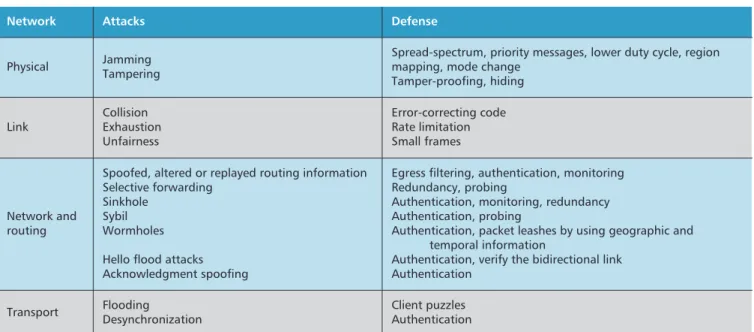
Table 2 shows the possible DoS attacks and countermea-sures in WSNs.
In the following sections we discuss cryptography, key man-agement protocols, secure routing protocols, secure data aggregation, and intrusion detection for WSNs. For the remainder of this article, we use the following notation: •A, Bare principals such as communicating nodes. •IDAdenotes the sensor identifier of node A.
•NAis a nonce generated by A (a nonce is an
unpre-dictable bit string, usually used to achieve freshness). •KABdenotes the secret pairwise key shared between A
and B.
•MKis the encryption of message Mwith key K
•MAC(K,M) denotes the computation of the message authentication code of message Mwith key K
•A→Bdenotes Aunicasts a message to B
•A→* denotes Abroadcasts a message to its neighbors
C
RYPTOGRAPHY IN
WSNS
Selecting the most appropriate cryptographic method is vital in WSNs because all security services are ensured by cryptog-raphy. Cryptographic methods used in WSNs should meet the constraints of sensor nodes and be evaluated by code size, data size, processing time, and power consumption. In this section, we focus on the selection of cryptography in WSNs. Public key cryptography, discussed first, is followed by sym-metric key cryptography.
P
UBLICK
EYC
RYPTOGRAPHY INWSN
SMany researchers believe that the code size, data size, pro-cessing time, and power consumption make it undesirable for public key algorithm techniques, such as the Diffie–Hellman key agreement protocol [29] or RSA signatures [30], to be
nTable 2. Sensor network layers and denial-of-service defenses.
Network Attacks Defense
Physical Jamming Tampering
Spread-spectrum, priority messages, lower duty cycle, region mapping, mode change
Tamper-proofing, hiding Link Collision Exhaustion Unfairness Error-correcting code Rate limitation Small frames Network and routing
Spoofed, altered or replayed routing information Selective forwarding
Sinkhole Sybil Wormholes Hello flood attacks Acknowledgment spoofing
Egress filtering, authentication, monitoring Redundancy, probing
Authentication, monitoring, redundancy Authentication, probing
Authentication, packet leashes by using geographic and temporal information
Authentication, verify the bidirectional link Authentication
Transport Flooding
Desynchronization
Client puzzles Authentication
employed in WSNs.
Public key algorithms such as RSA are computationally intensive and usually execute thousands or even millions of multiplication instructions to perform a single security opera-tion. Further, a microprocessor’s public key algorithm effi-ciency is primarily determined by the number of clock cycles required to perform a multiply instruction [31]. Brown et al.
found that public key algorithms such as RSA usually require on the order of tens of seconds and up to minutes to perform encryption and decryption operations in constrained wireless devices which exposes a vulnerability to DoS attacks [32]. On the other hand, Carman et al.found that it usually takes a microprocessor thousands of nano-joules to do a simple multi-ply function with a 128 bit result [31]. In contrast, symmetric key cryptography algorithms and hash functions consume much less computational energy than public key algorithms. For example, the encryption of a 1024-bit block consumes approximately 42 mJ on the MC68328 DragonBall processor using RSA, while the estimated energy consumption for a 128 bit AES block is a much lower at 0.104 mJ [31].
Recent studies have shown that it is feasible to apply pub-lic key cryptography to sensor networks by using the right selection of algorithms and associated parameters, optimiza-tion, and low-power techniques [6, 7, 33]. The investigated public key algorithms include Rabin’s Scheme [34], NtruEn-crypt [35], RSA [30], and Elliptic Curve Cryptography (ECC) [36, 37]. Most studies in literature focus on RSA and ECC algorithms. The attraction of ECC is that it appears to offer equal security for a far smaller key size, thereby reducing pro-cessing and communication overhead. For example, RSA with 1024 bit keys (RSA-1024) provides a currently
accepted level of security for many applications and is equivalent in strength to ECC with 160 bit keys (ECC-160) [38]. To protect data beyond the year 2010, RSA Security recommends RSA-2048 as the new minimum key size which is equivalent to ECC with 224 bit keys (ECC-224) [39]. Table 3 summarizes the execution time of ECC and RSA implementations on an Atmel ATmega128 processor (used by Mica2 mote) [6]. The execu-tion time is measured on average for a point mul-tiplication in ECC and a modular exponential operation in RSA. ECC secp160r1 and secp224r1 are two standardized elliptic curves defined in [40]. As shown in Table 3, by using the small integer e= 216+ 1 as the public key, RSA public
key operation is slightly faster than ECC point
multiplication. However, ECC point multiplication outper-forms RSA private key operation by an order of magnitude. The RSA private key operation, which is too slow, limits its use in a sensor node. ECC has no such issues since both the public key operation and private key operation use the same point multiplication operations.
Wander et al.investigated the energy cost of authentication and key exchange based on RSA and ECC cryptography on an Atmel ATmega128 processor [7]. The result is shown in Table 4. The ECC-based signature is generated and verified using the Elliptic Curve Digital Signature Algorithm (ECDSA) [41]. The key exchange protocol is a simplified version of the SSL handshake, which involves two parties: a client initiating the communication and a server responding to the initiation [42]. The WSN is assumed to be administered by a central point with each sensor having a certificate signed by the cen-tral point’s private key using a RSA or ECC signature. In the handshake process, the two parties verify each other’s certifi-cate and negotiate the session key to be used in the communi-cation. As Table 4 shows, in comparison with RSA cryptography at the same security level, ECDSA signatures are significantly cheaper than RSA signatures and ECDSA verifications are within reasonable range of RSA verifications. Further, the ECC-based key exchange protocol outperforms the RSA-based key exchange protocol at the server side, and there is almost no difference in the energy cost for these two key exchange protocols at the client side. In addition, the rela-tive performance advantage of ECC over RSA increases as the key size increases in terms of the execution time and ener-gy cost. Tables 3 and 4 indicate that ECC is more appropriate than RSA for use in sensor networks.
The implementation of RSA and ECC cryptography on Mica2 motes further proved that a public key based protocol is viable for WSNs. Two modules, TinyPK [43], based on RSA, and TinyECC [44], based on ECC, have been designed and implemented on Mica2 motes using the TinyOS develop-ment environdevelop-ment. Similar work was also conducted by Malan
et al.on ECC cryptography using a Mica2 mote [45]. In their work, ECC was used to distribute a single symmetric key for the link-layer encryption provided by the TinySec module [46].
While public key cryptography may be possible in sensor nodes, the public key operations are still expensive. The assumptions in [33, 45] may not be satisfied in some applica-tions. For example, the work in [33, 45] concentrated on the public key operations only, assuming the private key opera-tions will be performed by a base station or a third party. By selecting appropriate parameters, for example, using the small integer e= 216+ 1 as the public key, the public key operation
time can be extremely fast while the private key operation time does not change. The limitation of private key operation
nTable 3. Public key cryptography: average ECC and RSA execution times (Source: [6]).
Algorithm Operation
time (s) ECC secp160r1 0.81s ECC secp224r1 2.19s RSA-1024 public-key e= 216+ 1 0.43s RSA-1024 private key w. CRT1 10.99 RSA-2048 public-key e= 216+ 1 1.94s RSA-2048 private-key w. CRT1 83.26
1Chinese Remainder Theory
nTable 4. Public key cryptography: average energy costs of digital signature and key exchange computations [mJ]. (Source: [7]).
Algorithm Signature Key Exchange
Sign Verify Client Server
RSA-1024 304 11.9 15.4 304
ECDSA-160 22.82 45.09 22.3 22.3 RSA-2048 2302.7 53.7 57.2 2302.7 ECDSA-224 61.54 121.98 60.4 60.4
occurring only at a base station makes many security services using public key algorithms not available under these schemes. Such services include peer-to-peer authentication and secure data aggregation.
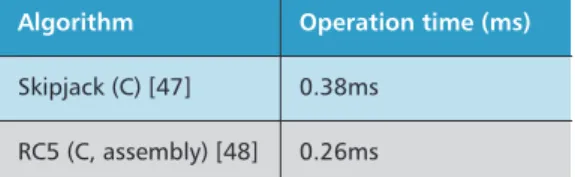
In contrast, Tables 5 and 6 show the execution time and energy cost of two symmetric cryptography protocols on an Atmel ATmega128 processor. In Table 5, the execution time was measured on a 64 bit block using a 80 bit key. From the table we can see that symmetric key cryptography is faster and consumes less energy as compared to public key cryptography. In the next section we focus on symmetric key cryptography.
S
YMMETRICK
EYC
RYPTOGRAPHY INWSN
SThe constraints on computation and power consumption in sensor nodes limit the application of public key cryptography in WSNs. Thus, most research studies focus on symmetric key cryptography in sensor networks.
Five popular encryption schemes, RC4 [51], RC5 [48], IDEA [51], SHA-1 [49], and MD5 [51, 52], were evaluated on six different microprocessors ranging in word size from 8 bit (Atmel AVR) to 16 bit (Mitsubishi M16C) to 32 bit widths (StrongARM, XScale) in [53]. The execution time and code memory size were measured for each algorithm and platform. The experiments indicated uniform cryptographic cost for each encryption class and each architecture class. The impact of caches was negligible while Instruction Set Architecture (ISA) support was limited to specific effects on certain algo-rithms. Moreover, hashing algorithms (MD5 and SHA-11) incurred almost an order of a magnitude higher overhead than encryption algorithms (RC4, RC5, and IDEA).
In [54], Law et al. evaluated two symmetric key algorithms: RC5 and TEA [55]. They further evaluated six block ciphers, including RC5 and RC6 [56], Rijndael [50], MISTY1 [57], KASUMI [58], and Camellia [59] on IAR Systems’ MSP430F149 in [60]. The benchmark parameters were code, data memory, and CPU cycles. The evaluation results showed that Rijndael is suitable for high-security and energy-efficiency requirements while MISTY1 is suitable for good storage and energy efficiency. The evaluation results in [60] disagreed with the work in [8] in which RC5 was selected as the encryption/decryption scheme, and with the work in [22] in which RC6 was selected. The work in [60] provides a good resource for deciding which symmetric algorithm should be adopted in sensor networks.
The performance of symmetric key cryptography is mainly decided by the following factors:
• Embedded data bus width: many encryption algorithms prefer 32 bit word arithmetic, but most embedded pro-cessors usually use 8 or 16 bit wide data bus.
• Instruction set: the Instruction Set Architecture (ISA) has specific effects on certain algorithms. For example, most embedded processors do not support the variable-bit rotation instruction like ROL (rotate variable-bits left) of the Intel architecture, which greatly improves the perfor-mance of RC5.
Due to the constraints in sensor nodes, symmetric key cryptography is preferred in a WSN.
O
PENR
ESEARCHI
SSUESSelecting the appropriate cryptography method for sensor nodes is fundamental to providing security services in WSNs. However, the decision depends on the computation and com-munication capability of the sensor nodes. Open research issues range from cryptography algorithms to hardware design as described below:
• Recent studies on public key cryptography have demon-strated that public key operations may be practical in sensor networks. However, private key operations are still too expensive in terms of computation and energy cost to accomplish in a sensor node. The application of private key operations to sensor nodes needs to be stud-ied further.
• Symmetric key cryptography is superior to public key cryptography in terms of speed and low energy cost. However, the key distribution schemes based on symmet-ric key cryptography are not perfect. Efficient and flexi-ble key distribution schemes need to be designed. • It is also likely that more powerful motes will need to be
designed in order to support the increasing requirements for computation and communication in sensor nodes.
K
EY
M
ANAGEMENT
P
ROTOCOLS
Key management is a core mechanism to ensure the security of network services and applications in WSNs. The goal of key management is to establish required keys between sensor nodes which must exchange data. Further, a key management scheme should also support node addition and revocation while working in undefined deployment environments. Due to the constraints on sensor nodes, key management schemes in WSNs have many differences with the schemes in ad hoc net-works.
As shown above, public key cryptography suffers from limi-tations in WSNs. Thus, most proposed key management schemes are based on symmetric key cryptography. Further, a straight pairwise private key sharing scheme between every pair of nodes is also impractical in WSNs. A pairwise private key sharing scheme requires predistribution and storage of n– 1 keys in each node, where nis the number of nodes in a sen-sor network. Due to the large amount of memory required, pairwise schemes are not viable when the network size is large. Moreover, most key pairs would be unusable since direct communication is possible only among neighboring nodes. This scheme is also not flexible for node addition and revocation. In this section, we discuss key management proto-cols in WSNs. Another investigation of key management mechanisms for WSNs can be found in [61].
Figure 2 shows a taxonomy of key management protocols in WSNs. According to the network structure, the protocols
nTable 5. Symmetric key cryptography: average RC5 and skipjack execution times (Source: [46]).
Algorithm Operation time (ms)
Skipjack (C) [47] 0.38ms RC5 (C, assembly) [48] 0.26ms
nTable 6. Symmetric key cryptography: average energy numbers for AES and SHA-1. (Source: [7]).
Algorithm Energy
SHA-1 (C) [49] 5.9 mJ/byte AES-128 Enc/Dec (assembly)
can be divided into centralized key schemes and distributed key schemes. According to the probability of key sharing between a pair of sensor nodes, the protocols can be divided into probabilistic key schemes and deterministic key schemes. In this section, we present a detailed overview of the main key management protocols in WSNs. We start with key manage-ment protocols based on network structure.
N
ETWORKS
TRUCTUREB
ASEDK
EYM
ANAGEMENTP
ROTOCOLSThe underlying network structure plays a significant role in the operation of key management protocols. According to the structure, the protocols can be divided into two categories: centralized key schemes and distributed key schemes.
Centralized Key Management Schemes— In a centralized
key scheme, there is only one entity, often called a key distri-bution center (KDC), that controls the generation, regenera-tion, and distribution of keys. The only proposed centralized key management scheme for WSNs in the current literature is the LKHW scheme, which is based on the Logical Key Hier-archy (LKH) [62]. In this scheme, the base station is treated as a KDC and all keys are logically distributed in a tree root-ed at the base station.
The central controller does not have to rely on any auxil-iary entity to perform access control and key distribution. However, with only one managing entity, the central server is a single point of failure. The entire network and its security will be affected if there is a problem with the controller. Dur-ing the time when the controller is not workDur-ing, the network becomes vulnerable as keys are not generated, regenerated, and distributed. Furthermore, the network may become too large to be managed by a single entity, thus affecting scalabili-ty.
Distributed Key Management Schemes — In the
distribut-ed key management approaches, different controllers are usdistribut-ed to manage key generation, regeneration, and distribution, thus minimizing the risk of failure and allowing for better scalabili-ty. In this approach, more entities are allowed to fail before the whole network is affected.
Most proposed key management schemes are distributed schemes. These schemes also fall into deterministic and prob-abilistic categories, which are discussed in detail in the follow-ing subsection.
K
EYM
ANAGEMENTP
ROTOCOLSB
ASED ON THEP
ROBABILITY OFK
EYS
HARINGIn the remainder of this section, we present the key management protocols based on the proba-bility of key sharing between a pair of sensor nodes. We first discuss deterministic approaches and then discuss probabilistic approaches.
Deterministic Approaches— Zhu et al.have
proposed a key management protocol, Localized Encryption and Authentication Protocol (LEAP), for sensor networks in [63]. LEAP sup-ports the establishment of four types of keys for each sensor node:
• An individual key shared with the base station (predistributed)
• A group key that is shared by all the nodes in the network (predistributed) • Pairwise keys shared with immediate
neighboring nodes
• A cluster key shared with multiple neighboring nodes The pairwise keys shared with immediate neighboring nodes are used to protect peer-to-peer communication while the cluster key is used for local broadcast. The pairwise keys can be set up as follows: in the key predistribution stage, each sensor node is loaded with an initial key KIand each node A
generates a master key KA= fKI(A), where fis a
pseudoran-dom function. Then, in the neighbor discovery stage, A broad-casts a HELLO message and expects an Acknowledgment from neighboring nodes, e.g., node B:
A→*: A
B→A: B, MAC(KB, A|B)
Node Acomputes its pairwise key with B, KAB= fKB(A). Node
Bknows A, KBand can also compute KABin the same way.
Then, KABserves as their pairwise key.
Cluster key establishment follows the pairwise key estab-lishment phase. Suppose node Awants to establish a cluster key with all its immediate neighbors B1, B2, …, Bm. Node A
first generates a random key KcA, then encrypts this key with
the pairwise key shared with each neighbor, and finally trans-mits the encrypted key to each neighbor Biwhere 1 ≤m:
A→Bi: (KcA)KABi
LEAP uses unicast for key exchange. Notice that most of the proposed security protocols were based on point-to-point handshaking procedures to negotiate session keys. Lai et al.
have proposed a BROadcast Session Key (BROSK) negotia-tion protocol [64]. BROSK assumes a master key is shared by all nodes in the network. To establish a session key Kwith its neighbors, such as node B, a sensor node Abroadcasts a key negotiation message:
A→*: IDA|NA,MAC(K, IDA|NA)
B→* : IDB|NB,MAC(K, IDB|NB)
Aand Bwill receive the broadcast message. They can verify the message using the master key Kand both Aand Bcan cal-culate the shared session key:
KAB= MAC(K,NA|NB)
BROSK therefore establishes pairwise session keys between every two neighboring nodes. It is both scalable and energy efficient.
nFigure 2.Key management protocols in WSNs: a taxonomy.
Deterministic key scheme Probabilistic key scheme Distributed key scheme LKHW [62] LEAP [63], BROSK [64] CDTKeying [65], IOS/DMBS [66], random key schemes [67 68, 69, 70, 71, 72, 73, 74]
Random key schemes [67, 68, 69, 70, 71, 72, 73, 74] LKHW [62], LEAP [63], BROSK [64], CDTKeying [65], IOS/DMBS [66] Centralized key scheme
Network structure Probability of key sharing
Key management protocols in WSNs
Camtepe and Yener have proposed a deterministic key dis-tribution schemes for WSNs using Combinatorial Design The-ory [65]. The combinatorial design theThe-ory based pairwise key predistribution (CDTKeying) scheme is based on block design techniques in combinatorial design theory. It employs sym-metric and generalized quadrangle design techniques. The scheme uses a finite projective plane of order n(for prime power n) to generate a symmetric design with parameters n2
+ n+ 1, n+ 1, 1. The design supports n2+ n+ 1 nodes,
and uses a key-pool of size n2+ n+ 1. It generates n2+ n+
1 key chains of size n+ 1 where every pair of key chains has exactly one key in common, and every key appears in exactly n
+ 1 key chains. After the deployment, every pair of nodes finds exactly one common key. Thus, the probability of key sharing among a pair of sensor nodes is 1. The disadvantage of this solution is that the parameter nhas to be a prime power, thus indicating that not all network sizes can be sup-ported for a fixed key-chain size.
Lee and Stinson have proposed two combinatorial design theory based deterministic schemes: the ID-based one-way function scheme (IOS) and the deterministic multiple space Blom’s scheme (DMBS) [66]. They further discussed the use of combinatorial set systems in the design of deterministic key predistribution schemes for WSNs in [67].
Probabilistic Approaches— Most proposed key
manage-ment schemes in WSNs are probabilistic and distributed schemes.
Eschenauer and Gligor introduced a key predistribution scheme for sensor networks which relies on probabilistic key sharing among the nodes of a random graph in [68]. This scheme consists of three phases: key predistribution, shared-key discovery, and path shared-key establishment. In the shared-key predis-tribution phase, each sensor is equipped with a key ring held in the memory. The key ring consists of kkeys which are ran-domly drawn from a large pool of Pkeys. The association information of the key identifiers in the key ring and sensor identifier is also stored at the base station. Further, the authors assumed that each sensor shares a pairwise key with the base station. In the shared key discovery phase, each sen-sor discovers its neighbors within the wireless communication range with which it shares keys. Two methods to accomplish this are suggested in [68]. The simplest method is for each node to broadcast a list of identifiers of the keys in their key ring in plain text, thus allowing neighboring nodes to check whether they share a key. However, an adversary may observe the key-sharing patterns among sensors in this way. The sec-ond method uses the challenge–response technique to hide key-sharing patterns among nodes from an adversary. For every Kion a key ring, each node could broadcast a list α, EKi
(α), i= 1, …, kwhere αis a challenge. The decryption of
EKi(α) with the proper key by a recipient would reveal the challenge and establish a shared key with the broadcasting node. This method requires that the challenge αbe well known in the sensor network, thus allowing the recipient with the proper key to discover the challenge.
Finally, in the path-key establishment phase, a path-key is assigned for those sensor nodes within wireless communica-tion range and not sharing a key, but connected by two or more links at the end of the second phase. If a node is com-promised, the base station can send a message to all other sensors to revoke the compromised node’s key ring. Rekeying follows the same procedure as revocation. The messages from the base station are signed by the pairwise key shared by the base station and sensor nodes, and thus it is ensured that no adversary can forge a base station. If a node is compromised, the attacker has a probability of approximately k/Pto be able
to successfully attack any link. Because k<< P, it only affects a small number of sensor nodes.
Inspired by the work in [68], which we call the basic ran-dom key scheme in the following section, additional ranran-dom key predistribution schemes have been proposed in [69–74].
In the basic random key scheme, any two neighboring nodes need to find a single common key from their key rings in order to establish a secure link in the key setup phase. However, Chan et al.observed that increasing the amount of key overlap in the key ring can increase the resilience of the network against node capture [69]. Thus, they proposed a q -composite keying scheme, in which it is required that at least
qcommon keys be shared in the key setup phase in order to build a secure link between any two neighboring nodes. Fur-ther, a key update phase was introduced to enhance the basic random key scheme. Suppose Ahas a secure link to Bafter the key setup phase and the secure key kis from the key pool
P. Because kmay be residing in the key-ring memory of some other nodes in the network, the security of the link between A
and Bis jeopardized if any of those nodes are captured. Thus, it is better to update the communication key between Aand B
instead of using a key in the key pool. To address this prob-lem, they presented a multipath key reinforcement for the key update. Assume there are jdisjoint paths between Aand B. A
generates jrandom values v1, v2, …, vjand then routes each
random value along a different path to B. When B has received all jkeys, the new link key can be computed by both
Aand Bas follows:
k′= k⊕v1⊕v2⊕… ⊕vj
The adversary has to eavesdrop on all jpaths if he/she wants to reconstruct the communication key. This security enhancement comes at the cost of more communication over-head needed to find multiple disjoint paths. Further, Chan et al.also developed a random-pairwise keys scheme for node-to-node authentication.
Blundo et al.presented a polynomial-based key predistri-bution protocol for group key predistripredistri-bution [75] which can also be adapted to sensor networks. The key setup server ran-domly generates a bivariate t-degree polynomial f(x, y) =
Σit,
j=0aijxiyjover a finite field Fqwhere qis a prime number
that is large enough to accommodate a cryptographic key such that it has the property of f(x, y) = f(y, x). For each sensor i, the setup server computes a polynomial share of f(x, y), that is, f(i, y). For any two sensor nodes iand j, node ican com-pute the common key f(i, j) by evaluating f(i, y) at point j, and node jcan compute the same key f(j, i) = f(i, j) by evaluating
f(j, y) at point i. In this approach, each sensor node ineeds to store a t-degree polynomial f(i, x), which occupies (t+ 1) log
qstorage space. This scheme is unconditionally secure and t -collusion resistant. However, the storage cost for a polynomial share is exponential in terms of the group size, making it pro-hibitive in sensor networks.
Inspired by the work of [68, 69, 75], Liu and Ning pro-posed a polynomial pool-based key predistribution scheme in [70], which also includes three phases: setup, direct key estab-lishment, and path key establishment. In the setup phase, the setup server randomly generates a set Fof bivariate t-degree polynomials over the finite field Fq. For each sensor node, the
setup server picks a subset of polynomials Fi⊆Fand assigns
the polynomial shares of these polynomials to node i. In the direct key establishment stage, the sensor nodes find a shared polynomial with other sensor nodes and then establish a pair-wise key using the polynomial-based key predistribution scheme discussed in [75]. The path key establishment phase is similar to that in the basic random key scheme. Further, the
proposed framework allows for the study of multiple instantia-tions of possible pairwise key establishment schemes. Two of the possible instantiations, the key predistribution scheme based on random subset assignment and the grid-based key predistribution scheme, are also presented and analyzed in the article.
Similar to [70], Du et al.presented another pairwise key predistribution scheme in [72] which uses Blom’s method [76]. The key difference between [70] and [72] is that the scheme in [70] is based on a set of bivariate t-degree polynomials while Du’s scheme is based on Blom’s method. The proposed scheme allows any pair of nodes in a network to be able to find a pairwise secret key. As long as no more than λnodes are compromised, the network is perfectly secure (which is called the λ-secure property). To use Blom’s method, during the predeployment phase, the base station first constructs a (λ
+ 1) ×Nmatrix Gover a finite field GF(q) where Nis the size of the network and Gis considered to be public informa-tion. Then the base station creates a random (λ+ 1) ×(λ+ 1) symmetric matrix Dover GF(q), and computes a N×(λ+ 1) matrix A= (D⋅G)Twhere (D⋅G)Tis the transpose of D⋅
G. Matrix Dneeds to be kept secret, and should not be dis-closed to adversaries. It is easy to verify that A⋅Gis a sym-metric matrix.
A ⋅G= (D⋅G)T⋅G= GT⋅DT⋅G= GT⋅D⋅G= (A⋅G)T
Thus, we know that Kij= Kji. The idea is to use Kij(or Kji) as
the pairwise key between nodes iand j. To carry out the above computation, in the predistribution phase, for any sen-sor k= 1, …, N:
• Store the kthrow of matrix Aat node k
• Store the kthcolumn of matrix Gat node k
Therefore, when nodes iand jneed to find the pairwise key between them, they first exchange their columns of G, and then respectively compute Kijand Kjiusing their private rows
of A.
In the proposed scheme in [72], each sensor node is loaded with Gand τdistinct Dmatrices drawn from a large pool of ω
symmetric matrices D1, …, Dωof size (λ+ 1) ×(λ+ 1). For
each Di, calculate the matrix Ai= (Di⋅G)Tand store the jth
row of Aiat this node. After deployment, each node needs to
discover whether it shares any space with neighbors. If they find out that they have a common space, the nodes can follow Blom’s method to build a pairwise key. The scheme in [72] is scalable and flexible. Moreover, it is substantially more resilient against node capture as compared to [70].
Hwang et al.extended the basic random key scheme and proposed a cluster key grouping scheme [74]. They further analyzed the tradeoffs involved between energy, memory, and security robustness.
Notice that location information helps to avoid unneces-sary key assignments and thus improve the performance of sensor networks, for example, connectivity, memory usage, and network resilience against node capture. Taking this into account, two random key predistribution schemes were pro-posed in [73, 77]. Although the presented schemes show improved performance, the deployment information (e.g., location) is required when sensors are deployed.
The abovementioned schemes are classified and compared in Table 7.
nTable 7. Classification and comparison of key management protocols in WSNs.
Protocol Ref. Theory Master
key Pairwise key Path key Cluster key Scala-bility Resili ency Process. load Comm. load Storage load I
All pairwise — n/a n/a Yes No No Low Low Low Low High
LEAP [63] n/a Yes Yes Yes Yes Good Low Low Low Low
BROSK [64] n/a Yes Yes No No Good Low Low Low Low
LKHW [62] LKH Yes Yes No Yes Limited Low Low Low Low
CDTKeying [65] Combinatorial n/a Yes No No Good Good Medium Medium High IOS & DMBS [66] Combinatorial n/a Yes No No Good Good Medium Medium High
II
Basic random key [68] Random graph n/a Yes Yes No Good Good Medium Medium High q-composite [69] Random graph n/a Yes Yes No Good Good Medium Medium High
Polynomial based [70]
t-degree polynomial & random graph
n/a Yes Yes No Good Good Medium Medium High
Blom based [72]
Blom's method & random graph
n/a Yes Yes No Good Good Medium Medium High
Deployment
knowledge based [73] Random graph n/a Yes Yes No Good Good Medium Medium Medium Cluster key
grouping [74] Random graph n/a Yes Yes No Good Good Medium Medium High Location based [77] Random graph n/a Yes Yes No Good Good Medium Medium Medium Note: Category I denotes deterministic approaches and category II denotes probabilistic approaches. Master key is the key shared by all the nodes in the network. Pairwise key is the key shared between two neighboring nodes. Path key denotes the key shared between any two nodes which need exchange data but does not share a pairwise key. Cluster key denotes the common key shared by all cluster members.