EN
EN
EUROPEAN COMMISSION Brussels, XXX SWD(2014) 232 PART 1/2COMMISSION STAFF WORKING DOCUMENT IMPACT ASSESSMENT
Accompanying the document
Commission Recommendation
on common principles for the protection of consumers and players of online gambling services and for the prevention of minors from gambling online
{C(2014) 4630} {SWD(2014) 233}
1 TABLE OF CONTENTS
1. Introduction ... 5
2. Procedural Issues and Consultation of Interested Parties ... 6
2.1. Procedural issues ... 6
2.2. Consultation and expertise ... 6
2.2.1. Public consultation ... 7
2.2.2. Workshops, expert group meetings: gambling regulatory authorities ... 7
2.2.3. Workshops: industry ... 7
2.2.4. The consultation and debates ... 8
2.2.5. Behavioural study ... 8
3. Policy Context ... 8
3.1. Definition of the market ... 8
3.2. Size of the market ... 9
3.3. The regulatory framework ... 11
4. Identification and Definition of the problem ... 13
4.1. Problem driver 1: Accessibility of online gambling by consumers and minors ... 15
4.2. Problem driver 2: Widespread gambling advertising and marketing ... 17
4.3. Problem Driver 3: Poor transparency and information for players and minors ... 19
4.4. Problem driver 4: Low monitoring of player behaviour ... 21
4.5. Problem drivers 5 and 6: Deficiency of regulatory measures for protecting consumers and for responsible commercial communications ... 23
4.6. Problem driver 7: Across the Member States there are uneven levels and measures for protecting consumers and for responsible commercial communications ... 25
4.7. Problems and consequences ... 27
4.8. How will the current situation likely develop without EU action? ... 33
5. Does the EU have a right to act? ... 34
6. What are the policy objectives? ... 34
7. Policy options: The nature of possible EU action ... 35
7.1. Option 1: No change ... 35
7.2. Option 2: Content and identification requirements ... 36
7.3. Option 3: Electronic player registration systems ... 37
7.4. Option 4: Player protection requirements ... 38
7.4.1. Option 4a: EU-wide player self-exclusion ... 38
2
8. Analysis of impacts ... 39
8.1. Analysis of option 1: no policy change ... 39
8.2. Analysis of option 2: Content and identification requirements ... 39
8.3. Analysis of option 3: Electronic player registration systems ... 40
8.4. Analysis of option 4: Player protection requirements ... 41
8.5. Analysis of option 4a: EU wide player self-exclusion ... 41
8.6. Analysis of option 5: Strengthening regulatory supervision through real time monitoring systems ... 42
8.7. Impact on EU budget ... 42
8.8. Overview of impacts ... 43
9. Comparing the options ... 43
9.1. The preferred option ... 44
10. Instrument options ... 45
10.1. EU legislation (Directive)... 45
10.2. Industry self-regulation ... 45
10.3. In-depth information exchange between regulatory authorities ... 45
10.4. Commission Recommendation ... 46
11. Monitoring and Evaluation ... 46
3
Executive Summary Sheet
Impact assessment on Commission Recommendation on common principles for the protection of consumers and players of online gambling services and the prevention of minors from gambling online
A. Need for action
Why? What is the problem being addressed? Maximum 11 lines
In Europe online gambling services are widely offered, advertised, and used. With nearly 7 million EU consumers, annual revenue in 2012 was €10.54 bn. It is accessible wherever internet connection is available
(computers, mobile phones and smart phones, tablets and digital TV). Whilst there are several EU established operators holding licences in one or more Member State, there is also a significant presence of unregulated gambling sites.In addition there is a lack of measures in the Member States for social responsibility regarding commercial practices, which also impacts on minors, and for the protection of online gambling consumers. At EU level there is no sector-specific legislation regulating gambling services. At the same time a majority of Member States has been undertaking regulatory reforms in particular to take account of new forms of gambling services that are primarily taking place online. National rules and policies in this area are developing largely in isolation and the degree to which Member States address the identified issues varies from one Member State to another. What is this initiative expected to achieve? Maximum 8 lines
By means of a common set of principles, this initiative is expected to contribute to the protection of consumers, and citizens in order to safeguard their health and to also minimise eventual economic harm resulting from compulsive or excessive gambling with a view to:
ensure transparent and understandable information, dedicated support and monitoring of gambling behaviour
reinforce that gambling commercial communications are to be socially responsible, and to ensure awareness of the inherent risks regarding health associated with gambling
have more effective measures to ensure that minors are prevented from gambling and reduce as much as possible the exposure of minors to gambling
keep users of online gambling within an EU regulated context What is the value added of action at the EU level? Maximum 7 lines
Individual EU countries are unable to provide citizens with effective protection owing to the very nature of the online environment and the cross-border dimension of online gambling. Existing EU secondary legislation is applicable only for some of the issues. Without EU intervention the probability is that the prevailing issues would not be adequately addressed. EU citizens will continue to be faced with diverse approaches and measures which, however, do not afford them sufficient or equal protection, whether within respective Member States or across the EU. As for operators, a large number of these are likely to continue to face a fragmented situation and some markets may be left without adequate regulation to protect consumers. Action at EU level should provide for a common level of protection across the Member States. Member States remain responsible for the method of implementation.
B. Solutions
What legislative and non-legislative policy options have been considered? Is there a preferred choice or not? Why? Maximum 14 lines
An EU Directive would be best placed to achieve the objectives. At this stage a legislative solution is not feasible, mainly because of the lack of support by a majority of Member States and the EP. In-depth information exchange between regulatory authorities is discarded. It would address common challenges but it may not sufficiently achieve the objectives. General information exchange can continue to be facilitated amongst gambling regulators in the context of the Commission expert group. Industry self-regulation was also considered. This would mean substantial reliance on voluntary measures alone. This is not to say that the existing self-initiatives cannot be helpful. These can complement regulatory requirements. From a political perspective, there is currently distrust from Member States regarding industry -led -initiatives as a self-standing
4
solution. On the other hand a Recommendation addressed to the Member States can provide an enabling framework to achieve the objectives. It can set out principles commonly applicable in the Member States to protect users of online gambling services and to protect citizens more broadly including minors. Industry will be required to have measures in place and be monitored for compliance. A review clause would allow for an assessment of the effectiveness of the measures proposed therein. In terms of acceptability, a Commission recommendation responds to the repeated calls for action to protect citizens, minors and consumers as regards gambling, namely by Member States and by the EP, including their strong reservations on a legislative solution.. Who supports which option? Maximum 7 lines
A policy option of soft-law EU intervention rather than legislation or industry self-initiatives alone is largely supported by the European Parliament, the Member States, the Economic and Social Committee and industry. Consumer associations have not been very vocal in the process (including the Green paper public consultation).
C. Impacts of the preferred option
What are the benefits of the preferred option (if any, otherwise main ones)? Maximum 12 lines For the benefits to be fully realised the recommendation should be followed by the Member States. To counter
the non-binding nature, the implementation of the recommendation will be evaluated by the Commission. The recommendation will provide an enabling framework, and greater clarity, with the objective of ensuring a sufficient and even level of protection of citizens across the EU, improving the social responsibility of operators and improved supervision. Regulators and industry should benefit from greater clarity regarding oversight, which in turn in is to the benefit of EU citizens
What are the costs of the preferred option (if any, otherwise main ones)? Maximum 12 lines From an economic standpoint, it will entail marginal compliance costs on a majority of operators but at the same
time provides for a more streamlined approach, which can help address their compliance concerns as regards the multijurisdictional licensing mainly. It should have a positive impact on businesses because it provides a basic set of common requirements, and it will have stronger spill-over effect on providers of commercial communications. From a social perspective the combination of options should significantly improve the protection of citizens, consumers and minors, as well as enhancing consumer’s rights when playing online on the
regulated sites. It will be effective in helping to improve the social responsibility obligations of operators, to the benefit of citizens. Administratively there should be minimal impacts. It may entail changes to regulations or licence requirements, and it may entail changes to gambling regulatory authorities. The combined approach can help reduce unnecessary administrative burdens both for regulators and for operators. Lack of consistent and comparable data across the Member States does not allow for a costing of impacts. There may be low- medium range expenses depending on whether the Member States follow the Commission Recommendation.
How will businesses, SMEs and micro-enterprises be affected? Maximum 8 lines
Businesses, including small online gambling operators will not be negatively impacted, on the other hand the recommendation is intended to yield greater clarity and to reduce unnecessary administrative burden. It will have stronger spill-over effect on providers of commercial communications.
Will there be significant impactson national budgets and administrations? Maximum 4 lines No significant impacts on national budgets and administrations are anticipated.
Will there be other significant impacts? Max 6 lines
No other significant impacts are envisaged. Fundamental rights of individuals are respected, the competitiveness
of industry in the EU will not be negatively impacted, nor should there be impacts of significance to the EU’s
external competitiveness. It also does not impact significantly on simplification of legislation because the method of implementation of the recommendation is up to the Member States.
D. Follow up When will the policy be reviewed? Maximum 4 lines
The Recommendation foresees that an evaluation of the implementation could be carried out within [24 months] from the date of adoption by the Commission.
5 Introduction
In Europe online gambling1 services are widely offered, advertised, and used. The online gambling market2 is a growing service sector, with annual revenues in 2012 amounting to €10.54 billion, in comparison to €6.16 billion in 2008.3 The supply and demand of online gambling relates to the fast pace development of online technologies and to the increase of internet access of individuals (fast broadband connections, reduced costs).4 The number of consumers5 which represent the EU’s online gambling market share is estimated to be around 6.84 million. Besides operators6 regulated in the EU Member States there is a significant prevalence of gambling sites in Europe operating outside any form of EU control.7
In view of the growth of online gambling a majority of Member States has engaged in a review of their gambling legislation, in particular to take account of new forms of gambling services that are primarily taking place online, and mainly through the introduction of licensing systems but also the reorganisation of national exclusive right systems. Generally, Member States are seeking to direct people’s interest to gamble into safe conduits and to limit potential societal harms. At the same time, the regulations differ significantly from one Member State to another. Similarly, when it comes to commercial communications there are variations in the national rules.
With national related measures alone, individual EU countries are unable to provide individuals with effective protection owing to the very nature of the online environment and, in many instances, the cross-border dimension of online gambling. In addition, the fragmented piecemeal regulatory approach across the EU is not yielding measures which are sufficiently effective as regards commercial communications which are socially responsible and the protection of users of online gambling, to safeguard health including protection against economic consequences that may result from excessive or compulsive gambling.
The Commission has drawn on the responses to the public consultation held in 2011 which identified the protection of citizens, including minors, and consumers regarding online
gambling as a priority area.8 Furthermore, since 2008 Member States, the European
Parliament (EP), the European Economic and Social Committee (EESC) and industry stakeholders have repeatedly called on the Commission to engage in the protection of citizens
1 See Annex II for the definition
2 H2 Gambling Capital (H2). See section 3.2 for further data 3 H2
4 The use of internet in the EU has increased to 73%: Eurostat 50/2012
5“Consumers” and “users”, as used in this document is intended to refer to individuals above the permitted gambling age in the Member States who search for gambling opportunities. “Citizens” is intended to include all EU persons. “Players” is
intended to refer to the individuals participating in online gambling. “Minors” as used in this document includes “children”. In line with the UN Convention on the Rights of the Child a “child” means any person below 18 years of age. n
6“Operators” as used in this document refers to entities offering online gambling services, which can be both commercial and
public operators
7“Unregulated” for the purpose of this document is intended to refer to gambling sites and offers operating outside any form
of EU control. The availability in the EU of sites without a licence in one or more EU Member State is elaborated on in section 3.4; there are sites which do not hold a licence from a non-EU jurisdiction, or hold a licence but they are not subject to regulatory scrutiny. Some non-EU jurisdictions issue gambling licences and monitor their licensees but these are not established in the EU and do not hold a license in one or more EU Member State.
6 and consumers in the area of gambling.9 In line with the action plan published in 201210 this initiative is a step towards the development of a transparent, safe and responsible European framework for online gambling for the benefit of citizens, businesses and ultimately also for gambling regulatory authorities. It is an approach that brings together the EU, Member States and industry to address the public policy issues.
In connection with the online focus of the above-mentioned consultation, the initiatives will focus on online gambling services that are offered by commercial operators and by State-owned or State-controlled operators. Nonetheless, a number of the principles therein are also pertinent to the offline environment because as with any form of gambling the risks include underage gambling, the loss of funds put into the game and addiction and the health-related consequences.
This document does not pre-judge the final form of any decision to be taken by the European Commission.
1. Procedural Issues and Consultation of Interested Parties
1.1. Procedural issues
An Inter-service Impact Assessment Steer Group, led by Directorate General Internal Market and Services, was set up in February 2013. The preparation of this impact assessment was carried out in cooperation with DG Health and Consumers, DG Education and Culture, DG Enterprise and Industry, DG Justice, DG Home Affairs, DG Communications Networks, Content and Technology, DG Competition, DG Communication, DG Employment and Social Affairs, the Secretariat-General and the Legal Service.
The group met on 20 February 2013, 25 October 2013 and 3 December 2013. Information was also exchanged outside of these meetings.
The draft impact assessment was submitted to the Impact Assessment Board on 17 December 2013. The Board, which met on 22 January 2014, gave a positive opinion and provided its recommendations for improvement, namely to improve the problem description, the added value of EU action, the policy options explored and the analysis of their impacts, the effectiveness of the retained options and the presentation of stakeholders’ views.
1.2. Consultation and expertise
The impact assessment draws on a range of sources. It builds on a broad consultation and meetings with a range of stakeholders and Member States since 2011. The protection of citizens in the context of the action plan has also been debated extensively in the EP and EESC, in formal committees and in organised public hearings/conferences in which the
9 Council Presidency Progress reports on the framework for gambling and betting in the EU Member States (2008-2011) and
3057th Competitiveness Council conclusions, EP: 2008/2215 (INI), 2011/2084(INI), 2012/2322(INI), EESC:
1581/2011-INT/579, 2514/2012-INT/671
7 Commission has participated. Member States and the European Parliament have expressed their political support for addressing the protection of citizens at EU level.11
1.2.1. Public consultation
A public consultation on online gambling was held between March and July 2011.12 It solicited close to 260 responses by Member States, commercial and owned or state-controlled online and offline gambling operators, gambling associations, intermediary services, treatment associations, beneficiaries of gambling services and sport entities.13 The consultation encompassed detailed questions dedicated to issues concerning player support, protection of minors and advertising. As part of the consultation, a series of workshops with a range of stakeholders and with Member States’ gambling regulatory authorities were also organised so as to have in-depth discussions on select issues with experts in the field.14 The public consultation and the workshops below yielded minimal interest from individual consumers and consumer organisations. Feedback was received from entities and individual experts dedicated to treatment of problem gambling.
1.2.2. Workshops, expert group meetings: gambling regulatory authorities
During 2012 three full day workshops were held with national gambling regulators. The objective was to focus the debate, building on the issues identified in the responses to the public consultation. A specific questionnaire was sent out to Member States addressing consumer protection measures and on commercial communications. The feedback was discussed during these meetings.
During 2013, a series of full-day meetings were held with Member States, in the context of the newly created group of experts on gambling services. During these meetings discussions focused in detail on challenges Member States face as regards protection of consumers playing online and of commercial communications through diverse channels. Discussions were used to test ideas with the experts.15
1.2.3. Workshops: industry
Two full day workshops with industry were organised in 2013 which included commercial and state-owned or state-controlled online and offline operators, as well as intermediary service providers, on the basis of detailed questions to guide the debate sent to participants in advance. The in-depth discussions focused on the issues concerning the protection of consumers and citizens. These were discussed at length. Discussions were used to test ideas with stakeholder experts across EU jurisdictions.16
11 See footnote 9 12COM(2011)128 final
13The summary of responses was published with the action plan (see footnote 10)
14 For the conclusions: http://ec.europa.eu/internal_market/gambling/green-paper/index_en.htm 15 For the minutes: http://ec.europa.eu/internal_market/gambling/expert-group/index_en.htm 16 For the minutes: http://ec.europa.eu/internal_market/gambling/initiatives/index_en.htm
8 Consultation with industry, in particular with the online gambling operators, shows that both commercial and state-owned or state-controlled operators, as an objective, seek to protect consumers of gambling services. A number of self-regulatory approaches by industry are in place.
1.2.4. The consultation and debates
The consultations and debates show broad convergence on the importance of protecting citizens across the EU and the measures that should be available across the EU for the adequate protection of citizens. As for the regulatory framework, Member States frame gambling services in different ways, to the extent that EU law affords them a margin of discretion: as a leisure activity, falling under the aegis of the Ministry responsible for the economy or for finance, or as an at-risk social/health activity, falling under the aegis of the Ministry responsible for the interior or for justice. However, there is convergence on the principles to be proposed so as to provide for a common denominator to protect citizens throughout the EU, leaving the choice of applying a higher level of protection and the method of implementation to the Member States. Results of the consultations and debates show that the vast majority of Member States and the European Parliament do not support a legislative instrument in the area of gambling, at this stage at least. At the same time, there is an almost unanimous call for policy action at EU level in order to ensure coherent and comparable solutions by Member States and for gambling operators, media and others to follow.
1.2.5. Behavioural study17
A study on behavioural responses carried out to test a set of consumer protection measures related to online gambling has been a source, in part, for this impact assessment. Behavioural considerations help to inform the regulatory process. The study tested the relative effectiveness of different measures and individuals’ reactions. It was carried out to lend support to principles that could be proposed at EU level to adequately protect consumers of online gambling services. In particular, the study is pertinent to the problem drivers in sub-sections 4.3 and 4.4 below.
2. Policy Context
2.1. Definition of the market
Games of chance are games which involve a sum of money and are generally defined as a game the outcome of which is uncertain or predominantly dependent on coincidence or an unknown future rather than skill or influenced by the player. At national level legal definitions vary or do not exist.18
17Study on online gambling and adequate measures for the protection of consumers of gambling services:
http://ec.europa.eu/internal_market/gambling
9 In terms of market development and transmission channels, these include the computers, mobile phones and smart phones, tablets and digital TV.19 Online gambling is accessible through the devices wherever internet connection is available. Gambling, depending on the nature of the game/bet, can be anonymous or involve interaction with other players, including social through chat functions and message boards for instance. Upstream actors also have an interest in, or are affected, by the provision or promotion of online gambling services, such as ISP (internet service providers) and suppliers of software (game) product providers. Other actors concern suppliers of data storage, gambling platform providers and payment service providers.
On-line service providers use commercial communications to promote their services, related products and image to final citizens and/or distributors. The following commercial communications are the most frequently used: TV advertising, printed press advertising, on-line commercial communications, sales promotions, direct marketing (which includes direct mail, primarily by e-mails and sms to registered customers, for example personal follow-up contacts), and sponsorship agreements.
2.2. Size of the market20
Economically and technologically online gambling is growing at a fast pace. This is facilitated by increased access to the internet and faster bandwidth internet connections. Online gambling in the EU represents around 45% of the global online gambling market. Globally the online market is around 15% of the whole gambling market. The global gambling market generated €296 billion (GGR) in 2012, around 29% of which represents the European market share. In the EU, online gambling services represents more than 12% of the gambling market share (ie €10.54 billion (GGR21) in 2012), in a market which is estimated to be €81.7 billion. The market size differs from one Member State to another (Figure 1 shows GGR per Member State, see Annex I for further data). The variations in the national levels of demand are due to diverse factors, including the size of the e-commerce market.22
19 Globally mobile betting, gaming and lottery is estimated to generate €19 billion gross win in 2018, accounting for 44% of total remote gambling gross win. In 2012 it was €4.5 billion, representing 18%.
20 Source of market data: H2 (unless otherwise indicated)
21 Gross Gaming Revenue: calculated as stakes less prizes but including bonuses 22 COM(2011)128 final, page 8
10 Figure 1: GGR online gambling per Member State,
2012
Globally, the number of gambling sites that are regulated is around 3,000.23 A number of these operators are established in the EU and hold licences in one or more Member State.24 A significant number of gambling sites offering services in Europe operate outside any regulation within the EU.25
No comprehensive data exists for the overall advertising expenditure of the gambling sector in the EU. Data from individual Member States however suggests that the advertising and sponsoring expenditure of gambling operators is significant.
Table 1: Advertising and sponsorship spend Advertising
UK: In 2012total marketing expenditure of the gambling sector was €248m.26
FR: On‐line gaming and betting operators spent €255m in marketing in 2012, €314m in 2011.27
FI: Advertising costs by the horse-racing operator in 2010 was €1.6m. The Finnish lottery spent €14.7m on product advertising in 2010.
SE: During 2012, the gaming industry increased its advertising spend by about SEK 503m to some SEK 2,1bn (€240m).28 IT: Advertising expenditure for gambling services is estimated to be €78m in 2011.
AT: Industry estimates that gambling operators spent around €41m on advertising in the first 8 months of 2013
The gambling advertising expenditure on the major media types (Television, Newspapers, Magazines, Outdoor, Radio, Cinema and Display internet) in 2012 (% total advertising market): ES 4.0, UK 2.2, IE 1.5, BE 1.5, HR 1.0, NL 0.8, IT 0.5,
DE 0.4.29
Sponsorship
The gambling sector has in recent years become a significant source of sponsorship in Europe:
the number of gambling operators becoming leading shirt sponsors in the 5 biggest markets in Europe (DE, ES, FR, IT, UK) grew from 1 in 2002/3 to 26 in 2010/1130; in 2012/2013 all first division football clubs in Germany cooperate with a
gambling operator31;
Industry estimates that over €150m are spent on sponsorship investments by betting companies in the 5 biggest markets;
23 Casino City, 2011: www.onlinecasinocity.com. Note: different sites can belong to a single operator The American study Online Gambling Five Years after UIGEA, 2011, cites that these sites are owned by around 665 companies
24 This is dependent on the licensing system in the Member States. Licenses may be required per gambling service in some
Member States
25 A study dating to 2006 estimated that around 85% of 14,823 gambling sites in Europe operated without any licence in any
EU Member State. www.lexsi.com/telecharger/gambling_cybercrime_2006.pdf
26 Nielsen 27 ARJEL
28 Annual report Svenska Spel 2012
29Nielsen
30 Sport + Markt 'Sport, Gambling & Sponsorship: The Financial Relationship' presentation, September 2010 31 Goldmedia, SPONSORs
11
gambling sponsors were ranked joint 7th of all business sectors for worldwide reported deals in 2011, with 73 gambling sponsorship deals reported in 2011 compared to 21 in 2007, 350% growth in five years32.
Data indicating the number of consumers participating in online gambling is scarce. It is estimated that there are close to 7 million users of online gambling services in the EU, compared to 4.32 million users in Asia and the Middle East. At a global level, the estimated national participation rate of gambling is up to 82%, and up to 6.5% of the adult population gamble online.33 73% of individuals in the EU use the internet and nearly 60% of 16-24 year olds use internet on the move, which is part of the convenience and accessibility of gambling.34 Table 2 illustrates the market in some Member States.
Table 2: Online gambling participation in the Member States (% adult population), and gambling spend EE: 123,000 (12%)35
DK: 1.7 million player accounts (a player may have more than 1 account)36
FI: 1.5 million (34%), with one operator37
FR: 2.1 million (3.7%), 7.1% also through tablets38
IT: over 5 million player accounts opened, over 2 million active player accounts39 NO: 480,00040
NL: 500,000(2-3%)41
ES: 1.42 million player accounts (a player may have more than 1 account) 42 UK: 4.9 million (14%),43 372,000 use sports betting apps on their iPhones44
HU, EE, PT,DK: More than 1.9% of internet users playing poker online in each of these countries. In DE it is around 0.9% of internet users45
Gambling Spend
FI: Total spend on gambling across the population (aged 15-74) per month is approximately €143 million - 2.2 % of net income (of respondents)46
FR: Total deposits by players in 2012 was €988 million, and €435 withdrawn. On average€73 per month, per player account on average.47
IT: €960 million player deposits, €714 million player withdrawals48
2.3.The regulatory framework
At EU level there is no sector-specific legislation regulating gambling services. However, gambling services are services in the meaning of Article 56 of the Treaty on the Functioning of the EU (TFEU) and subject to legislation which aims to protect consumers, namely the
32 The World Sponsorship Monitor, 2011
33Recommendations for international gambling harm-minimisation guidelines: comparison with effective public health policy, Journal of Gambling Studies, DOI 10.1007/310899-013-9389-2, and Responsible gambling strategies for internet gambling : the theoretical and empirical base of using pop-up messages to encourage self-awareness, Computers in Human Behaviour 25(2009)
34 Eurostat, 50/2012: 76% of households have access to internet, though this share varies among Member States. Internet
access penetration has increasing in the EU-27, from 50% of households with internet access in 2006 to 70% of households in 2011. Furthermore, broadband access which was about 30% in 2006 has reached about 65% in 2011.
35 Gambling Prevalence in Estonia, 2012Error! Hyperlink reference not valid.
36Danish Gambling Regulator, 2014
37 Veikkaus, 2013
38 Observatoire des jeux, June 2013
39 Italian gambling regulatory authority, Q3 2013
40 Norwegian Gaming Board, Lotteritilsynet, figures for 2013
41The nature and scale of illegal gaming in the Netherlands, Ministry of Justice, November 2009 42 El Mercado de juego online en Espana, April-June 2013
43 British Gambling Prevalence Survey, 2010
44comScore, December 2012, http://www.theguardian.com/technology/appsblog/2013/jun/19/uk-iphone-gambling-apps 45Online poker in the EU, Gambling law Review, July 2011
46 2011 survey of gambling in Finland commissioned by the Finnish Ministry of Social Affairs and Health 47http://www.arjel.fr/IMG/pdf/bilan-2012.pdf
12 Unfair Commercial Practices Directive (‘UCP Directive’) and the Unfair Contract Terms Directive.49 The Directive on Consumer Rights, which aims at striking the right balance
between a high level of consumer protection and the competitiveness of enterprises does not apply to gambling services.50 As regards commercial communications, the misleading and comparative advertising Directive is not concerned with business-to-consumers transactions.51
Nonetheless, applicable EU secondary legislation is only pertinent for some of the problems. As for the UCP Directive, this concerns consumers’ economic interests in relation to measures aiming to or resulting in the classification of a commercial practice as unfair, to the exclusion of other interests such as health and safety.52
At national level, requirements differ significantly among Member States as does the role and competence of gambling regulators in terms of competence and scope. Generally, Member States are regulating online gambling in order to channel people’s interest to gamble and to limit potential social harms. Few Member States prohibit the offer of online gambling, for certain types of gambling. Monopolistic regimes have been established in some European jurisdictions. It may be unlawful to facilitate participation in foreign games of chance in a Member State, whilst in another it may be unlawful to deliberately participate in a game of chance offered by an operator not licensed by the national authority of the Member State where the participant resides. A growing number of Member States are establishing licensing systems requiring an operator of online gambling offering services on their territories to obtain a licence within the jurisdiction. Whether or not the operator holds a licence from one or more EU Member States may be but is not always taken into consideration.
Annex II provides an overview of the regulatory frameworks in the Member States for online gambling, as well as further information about relevant EU secondary legislation.
As regards consumer protection rules, the range and detail of the requirements placed on online gambling operators vary from one Member State to another. Where available, the rules are generally provided for in the gambling law, in subsidiary regulations or in administrative decrees, and they may also be laid out in the operator’s licence requirements. Member States generally monitor operators for compliance in real time or quasi, or through reporting schemes. In some Member States these are complemented with codes of practice or service Charters (eg the UK, Italy). An underlying objective of consumer protection rules in the area of gambling activities in the Member States is typically to ensure that gambling remains a source of entertainment or leisure activity, that users of online gambling are adequately protected, including on the conditions they sign up to with an operator, and do not develop a type of gambling disorder53, and that minors are prevented from gambling online.
Similarly, national rules for commercial communications of online gambling services differ significantly. The regulatory approach ranges from prohibiting advertising of online
49 Directive 2005/29/EC and Council Directive 93/13/EEC 50 Directive 2011/83/EU
51 Directive 2006/114/EC
52 See Report about Directive 2005/29/EC: http://ec.europa.eu/justice/consumer-marketing/files/ucpd_report_en.pdf 53 see footnote 96
13 gambling services (e.g. Latvia) to restricting the advertising of online gambling services to operators authorised in the Member State where the advertising is placed (e.g. Slovakia) to allowing advertising of online gambling services by those operators authorised in any EU Member State or even third countries (so called while-listed jurisdictions). Member States permitting the advertising of online gambling services often combine the application of general consumer protection and competition law provisions, such as on comparative publicity, misleading information and unsolicited direct communications, with specific online gambling provisions. These rules can be found either in the general gambling law, in specific gambling advertising acts, codes of conduct or guidelines, in the gambling operator’s authorisation or in self-regulatory frameworks. Compliance with national advertising rules is often ensured by authorisation schemes and a set of supervision and enforcement measures. Authorisation schemes work either ex-ante – authorisation of advertising concepts or specific campaigns prior to the placing of the advertising or ex-post – detailed rules in conjunction with regular audits or on the basis of complaints. In many cases the responsibility for the ex-post monitoring of gambling advertising does not lie with the gambling regulator but with media regulators or consumer protection authorities. In general regulators do not engage in regular screening exercises but act upon complaints or notices.
Annexes III and IV provide an overview of the requirements regarding consumer protection and commercial communications across the Member States.
Self-regulatory initiatives have been developed. The European Committee for
Standardisation (CEN) workshop agreement developed a set of control measures designed to ensure the adequate protection of customers and the responsible behaviour of gambling operators, software providers and associated service providers.54 The CEN workshop agreement incorporates guidelines for responsible marketing. There are other industry initiatives such as Euromat’s Statement on Responsible Gambling55 and the European Lotteries’ Gaming Standards and Certification Process56. International organisations such as the European Advertising Standards Alliance (EASA) or the International Chamber of Commerce (ICC) have drawn up best practice models and standards respectively for self-regulatory advertising with a view to protecting citizens. These concern advertising in general but principles that advertising should be honest are applicable to gambling-related advertising. There are also international self-regulatory initiatives such as the IAGR eGambling Guidelines drawn up by regulators.57
3. Identification and Definition of the problem
In the area of online gambling services, the adequate and efficient protection of consumers and citizens, including minors is affected by four main problems determined by seven problem drivers. The problem drivers originate from the current market situation (problem
54European Committee for Standardisation Workshop Agreement (known as ‘CWA 16259: 2011’) 55
http://www.euromat.org/uploads/documents/EUROMAT_brochure_1_web.pdf?PHPSESSID=03f4dc708a0295528176fe3095 576d84
56 https://www.european-lotteries.org/european-gaming-standards 57 http://iagr.org/iagr-egambling-guidelines-september-2008/
14 drivers 1 and 2), the provision of the online gambling offer (problem drivers 3 and 4) and the regulation of the offer (problem drivers 5, 6 and 7). Figure 2 shows the problem drivers and the problems they lead to, as well as their consequences. This section first discusses the problem drivers and then presents the resulting problems and consequences.
15 Figure 2: Problem Tree
DRIVERS PROBLEMS
3.1. Problem driver 1: Accessibility of online gambling by consumers and minors
A major driver behind the identified problems is the accessibility of online gambling, which concerns not only consumers but also minors. This concerns both online gambling services which are regulated in Member States and those which are outside any form of EU control (unregulated).58 First, online gambling services are broadly offered and used (see section 3.1.2). Furthermore, the growth of online gambling is also linked to the development of
58 See COM(2012)596 final: this does not imply that they are authorised in other recipient Member States Weak enforcement against illegal gambling offers
Regulatory deficiency in the Member States
Fragmented situation in the EU
2. Widespread gambling commercial communications
Use of misleading or aggressive practices
- practices
1. Accessibility of online gambling by consumers and minors
- on the authorised sites
- on the prevalent unregulated sites
7. Uneven levels and measures to protect citizens across the Member States
5. Lack of efficient measures to protect consumers (safeguards, support, rights) in Member States
3. Poor transparency and information for players and minors
4. Low monitoring of player behaviour - limited player support
- insufficient regulatory oversight
Player detriments Misinformed choices Loss of perception of time and/or money while playing Development of a gambling problem
Inadequate assistance provided
Societal detriments, including minors
Low awareness about unregulated sites, and the risks of playing on these sites No protection against types of fraud (identity data, credit card details, no payments), Minors are exposed to gambling
Minors play online
Structural detriments (legal offer)
Licensed operators choose to remain out of one or more Member States where they could apply for a licence Reduced choice of offer for players
Lack of attractive legal offer drawing consumers to illegal markets
6. Low or no measures for socially responsible commercial communications in Member States
Outside of scope
Co-existence of the national regulatory frameworks for online gambling services Ov e ral l C o n seq u e n ce : U n sat is fact o ry p ro tection o f citiz en s, co n su m er s a n d min o rs
16 technologies (mobile phones and smart phones, tablets and digital TV), which are accessible wherever internet connection is available, and to the increase of internet access, and convenience of mobile applications, of individuals (fast broadband connections, reduced costs).59 For instance in France 28% of poker players connect via mobile devices (7% via tablets) and 25% of sports bets are made via mobile devices (21% via smartphones, 4% via digital tablets), whilst a UK survey shows 3.4% of online gambling is via mobile and 0.9% via interactive/digital TV.60 In Finland, gaming through digital channels increased by €10.6
million over a one year period.61
Second, in an online environment a cross-border unregulated offer is also accessible, regulated and unregulated operators are both only a mouse-click away. Available figures show that, significantly, there are up to 15,000 gambling sites prevalent in Europe operating outside EU control.62 The public consultation responses did not provide other data in this regard. For instance, a study carried out ahead of the 2005 UK Gambling Act estimated over 2000 gambling websites were available, with approximately 0.9 million users in the UK alone.63 Around 15% of operators on the European market are licensed in one or more
Member State. Nonetheless, users of online gambling services because of a lack of supply, perceived unattractive offers or because they seek to maximise returns on stakes search for competing gambling opportunities.64 Table 3 below provides an indication. A survey in Estonia found that players sought unlicensed environments because of looser registration rules, bonuses offered upon registration, bigger jackpots or chances of winning and larger number of players in poker rooms.65 The risks that consumers can face when going on
unregulated sites are technological, financial and social; because the consumer is outside an environment where the operator is supervised by gambling regulatory authorities and, for example, its gambling equipment has been tested and certified (by accredited bodies). Italy opened its online market, in a gradual manner widening the products offered, and it reduced the market share it considered illegal from 37% in 2010 to 22% in 2012. The Commission recognises the diverse risks and is also addressing these issues through other initiatives it is working on with Member States in this area, for instance on better administrative cooperation between national gambling authorities.
Table 3: Availability of online gambling66
DE: 10% of online poker players worldwide are from Germany, where this is banned67
FI: The size of the market considered illegal is estimated to be around €100-150million 21% respondents of a survey participated in online gambling in 2011, 16% visited international sites68
59 The growth of such technologies and of types gambling services was reflected in a study commissioned by the
Commission in 2006. See part II of the study: http://ec.europa.eu/internal_market/gambling/docs/study4_en.pdf
60 FR: ARJEL, 2nd Quarter 2013, UK: Gambling Commission survey data on gambling participation, January 2012.
According to Eurobarometer 1 in 3 EU citizens has access to the internet through their mobile phones, Special Report 381
61 One operator reports annual revenues of more than €60 million from digital channels: http://www2.ray.fi/ray/current 62 Response to the Green Paper public consultation by the World Lottery Association:studies from various jurisdictions
worldwide indicate it is not possible to definitively establish the size of the illegal market. CERT-LEXSI (footnote 9), cites 14,826 sites. Incidences des site illegaux sur le marche françaisdes jeux en lignes, F. Merlin, cites 10,000-15,000 sites
63Scoping study for UK Gambling Act, 2005 Impact Assessment Framework, June 2007
64There are websites providing a comparison of operators’ payouts, promotions and customer service
65Centre for Gambling Addiction, 2012
66 Data available to the Commission for the Member States is not limited to sites which are outside any form of EU control 67 Gambling Law Review and Economics, Volume 16 Number 12, 2012
17 FR: The market deemed to be illegal in France is estimated to be around 57% of the French online market.69 11% of players
play on international sites, 25.5% play on French (.fr) and international sites70
IT: The GGR of non-Italian (.com) online casinos in 2011 was estimated to be €232 million, whilst 10% of online poker sites
and 45% sports betting sites in Italy are deemed to be international sites71
NO: 12% of the adult population play online, an increase of 89,000 from 2012, 16% of the people surveyed played only on non-Norwegian sites,72
The risk of identity theft online was highlighted by several types of stakeholders in their responses to the public consultation. The Bank of Italy has found that reports of fraudulent activity in the Italian gambling sector have increased, and that in the online segment identity theft remains present (mainly through credit cards).73 The majority of transactions as regards customer accounts are deemed to be effected via credit cards (around 64-65%), followed by e-wallets, bank transfers and pre-paid cards.74 The Commission has recognised this risk as part
of a growing challenge of cybercriminality and online provision of services in general and is addressing the issues in the context of its policy on cybercriminality.75
As for minors 18 is the age below which online gambling is not permitted in the majority of Member States, though the situation can differ from one gambling service to another. 75% of under-17 year olds have access to the internet in the EU76, and research shows that adolescents in particular are attracted to the internet because of their developmental characteristics.77 92% of 14-17 year olds are members of at least one social networking site78. And online gambling is accessible to minors. A study shows that 5.9% of 14-17 year olds gamble online in the EU.79 One in twelve of 12-15 year olds have played a lottery game on the internet over a year.80
3.2. Problem driver 2: Widespread gambling advertising and marketing
The wide spread of gambling commercial practices81 and the aggressive or misleading manner in which this is repeatedly done drives the problem of lack of social responsibility in this area, resulting in consumers making misinformed choices and minors being attracted to gambling.82 A wide range of media contribute to gambling commercial communication exposure, including cross-border. These include print media (both display advertising and classified 68The Gambling Market in Finland, 2012, Centre for collaborative research, Turku school of economics
69Jeux en ligne in the French market, Key features, strengths and weaknesses of the French legal gambling offer, MAG
study, February 2011
70 Observatoire des Jeux, June 2013
71Casinos and slots online in Italy 2011/2012Error! Hyperlink reference not valid.. % for online poker and sports
betting are based on estimates of the national gambling regulator
72 Norwegian Gaming Board, Lotteritilisynet
73www.bancaditalita.it/homepage/notizie/uif/Rapporti_UIF_annot_2012.pdf 74 Response to Green Paper consultation by an operator.
75 COM(2012)140 final 76 COM(2012) 196 final
77Research on Internet Addictive Behaviours among European Adolescents, funded under Safer Internet plus 78 idem
79 10.36% gambled in an offline environment. idem
80Adolescent gambling on the internet, a review (2010), using a sample of 8,017 school children. Griffiths & Wood (2007) 81 "Business-to-consumer commercial practices" (hereinafter also referred to as commercial practices) means any act,
omission, course of conduct or representation, commercial communication including advertising and marketing, by a trader, directly connected with the promotion, sale or supply of a product to consumers.
82 These concerns were highlighted in discussions with Member States and with industry. See footnotes 15 and 16 for the
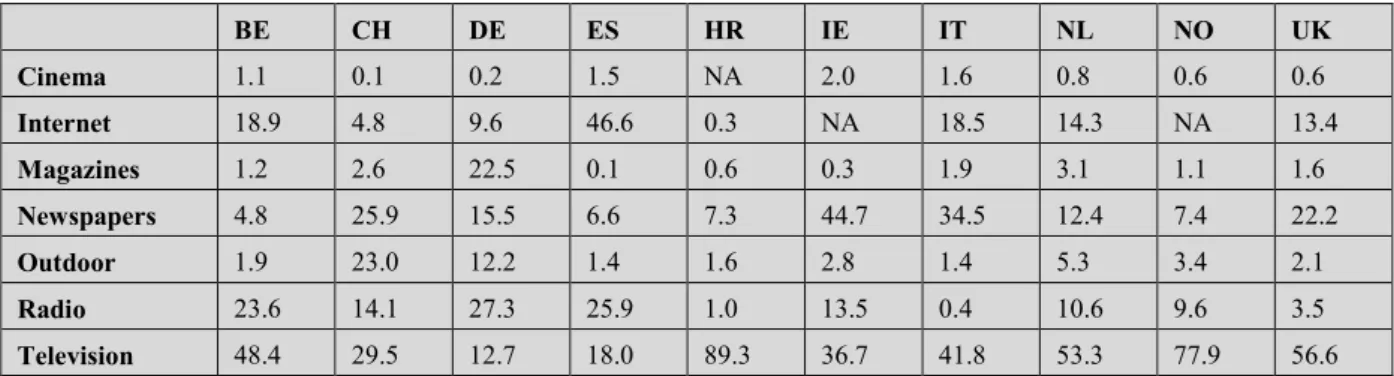
18 adverts), direct mail, audio-visual media such as radio, television and cinemas, as well as online media, outdoor advertising and sponsoring. In one week during the 2010 football World Cup a survey in the UK counted 471 ads in printed press, 276 internet banner ads, 17 TV and 6 radio ads and 20 direct mailings; 796 ads in total.83 Table 4 provides a comparative overview for a number of European countries. Gambling operators – commercial and state-owned - spend significant amounts of money for commercial communication purposes, primarily for advertising services on television, printed press and through the internet. Operators use direct mail, banner ads and pop-ups to promote themselves and to recruit new players.84 Gambling services are finally commonly advertised through other far reaching means such as shirt sponsoring and perimeter advertising in sports arenas.
Table 4: Spread of gambling commercial practices (% total advertising activity in category “lottery and gambling”)85
BE CH DE ES HR IE IT NL NO UK Cinema 1.1 0.1 0.2 1.5 NA 2.0 1.6 0.8 0.6 0.6 Internet 18.9 4.8 9.6 46.6 0.3 NA 18.5 14.3 NA 13.4 Magazines 1.2 2.6 22.5 0.1 0.6 0.3 1.9 3.1 1.1 1.6 Newspapers 4.8 25.9 15.5 6.6 7.3 44.7 34.5 12.4 7.4 22.2 Outdoor 1.9 23.0 12.2 1.4 1.6 2.8 1.4 5.3 3.4 2.1 Radio 23.6 14.1 27.3 25.9 1.0 13.5 0.4 10.6 9.6 3.5 Television 48.4 29.5 12.7 18.0 89.3 36.7 41.8 53.3 77.9 56.6
Minors are frequently exposed to gambling commercial communication as they use media that display gambling advertising, watch or attend sports competitions with gambling sponsoring or advertising.
Table 5: Minors’ exposure to gambling commercial practices
UK: 9% of the ads on websites favoured by children are for online gambling and 4% for dating services (Fielder et al., 2007, p. 11).86
NO: A majority of adolescents reported having seen advertising for gambling in the past.87
While commercial practices should ensure that citizens and players are sufficiently informed on the choices there are repeatedly instances where gambling advertising was found to be misleading or aggressive, deceiving the consumer in its behaviour or impairing the consumer's choice. It raises concerns in terms of timing, location, nature or persistence. Gambling is also portrayed as a solution to financial concerns or linked to personal success or enhanced attractiveness. Adverts were also found to lead to social harm and to exploit inexperience or lack of knowledge. For example advertisements were found irresponsible or misleading when they
offered a solution to redundancy, debt or financing of children’s education (UK);
promised free games without revealing in a clear manner that withdrawing winnings would be subject to a wager of a disproportionate high amount (UK).
83Compliance Report - Gambling Advertising Survey 2010, ASA.
84Internet Gambling: Strategies to Recruit and Retain Gamblers, Wiebe, Ontario Problem Gambling Research Centre, 2008.
85Nielsen, 2012
86 British National Consumer Council (now Consumer Focus) and Childnet International 87 NOVA 2010, report nr. 18/10, page 211.
19 In France revision of commercial communication requirements have been proposed because it is considered that social responsibility in commercial communications needs to be improved, both as regards the messages contained therein as well as regards limitations inter alia on television and internet. The proposed improvements are aimed at preventing problem gambling.88
Table 6: Misleading or aggressive commercial practices
UK: In 2012 873 complaints were made to the Advertising Standards Authority; 37 adverts responsible for more than 600 complaints in 2012.89.
Europe: In 2012, advertising self-regulatory organisations received 2,005 complaints about advertisements for gambling and lotteries (4.08% of the total amount of complaints received on products and services). The majority of these complaints related to taste and decency issues (52.13%). A further 18.44% concerned allegedly misleading advertising while 11.40% concerned social irresponsible ads.90
3.3. Problem Driver 3: Poor transparency and information for players and minors
The problem of consumers making misinformed choices is driven in part by the lack of clear upfront customer-friendly information and by information that, despite the provisions of the Unfair Contract Term Directive, is often buried under lengthy or legalistic text on the gambling website. This poor transparency can concern a plethora of information, for instance: how to gamble responsibly, how to access help or counselling, game-specific information, operator financial limits or timeframes regarding payouts of winnings, collection and further processing of personal data, protection of player funds against insolvency, and sign-up bonus policies, as well as where to direct queries and complaints. Improvements to the requirements as to the content, and accessibility, of information on the operator’s website about responsible gambling are considered necessary in France.91 In a number of Member States there is no obligation on operators to provide warning signs or helplines (e.g. Bulgaria, Germany), whilst in others such information may be required but it could be anywhere on the website (e.g. Estonia Slovakia, Slovenia) which can hinder its immediate accessibility by consumers. If information is not transparent or clear consumers may not be able to properly assess sites, or to seek assistance. Solely by way of comparison, four out of five online consumers in the EU used a (price) comparison website in 2010.92 In France around 16% of players think the player
funds are not guaranteed.93 This is a sub-optimal level of consumer protection because individuals will be unable to make choices based on informed decisions. In the workshops mentioned earlier expert representatives of treatment centres stressed the importance of clearly available helpline numbers, for those players feeling the need for immediate assistance. A typical casino player visits over six casinos over a short time span,94 and should
88Lutter contre le jeu excessif ou pathologique, ARJEL
89UK Gambling Ad Complaints Rocket – But Not Always Because of Gambling, GamblingCompliance, 28 Feb 2013. 90 European Advertising Standards Alliance 2012
91 See footnote 88
92Staff working paper SEC(2011) 1640 final ‘Bringing e-commerce benefits to consumers’ 93 Observatoire des jeux, June 2013
94 Response to the public consultation quoted study sample of 10,000 internet casino and poker players which found that the
20 also be empowered with clear information. Table 7 below provides examples of information awareness in some Member States.
Several operators, as well as a number of Member States, responded in the public consultation, that in a borderless online environment information should be accessible and understandable in different EU jurisdictions so that the average consumer may be able to compare – where this is possible under the applicable law – the offer of online gambling services whilst in another Member State with that of his/her home jurisdiction. The customer registration process is relevant in this respect (see below problem driver 7). In the context of the workshops operators explained that they assume (self)responsibility to implement policies and procedures aimed at protecting players. It follows that this may be either to protect players in a responsible manner or to keep players on their site. Invariably there is a responsibility on national authorities regulating gambling and licensing operators to monitor gambling activities.
The behavioural study carried out on behalf of the Commission found that the information provided to the consumer on the landing page (or home page) of a gambling website serves to inform the consumer for instance about the potential risks associated with gambling, about the operator and the regulating authority. It found that such measures do not directly serve the purpose of safeguarding the player against the possible development of a gambling disorder (see problem driver 4 below).
Table 7: Consumer awareness in Member States
EE: 67% of players did not notice information on the sites on responsible gambling, and 75% did not notice options for counselling for prevention of gambling addiction. 46% of problem gamblers noticed information on responsible gambling and 32% on the counselling information95
FR: 24.9% of players are not aware about French sites96
UK: 92% of 100 sites of popular operators in the UK were found not to provide a knowledge base to enable users to easily search and access information online. The questions looked at timing responsiveness, channels available, accurateness of responses and personalisation97
As for player funds, information about how funds are protected may not be readily available on the site or there may be no such obligations (e.g. Greece, Hungary, UK). Only a few Member States require a segregation of player funds from those of the operator’s company finances and the paying of winnings into the same deposit account (see Annex III).
The general lack of awareness and education initiatives in order to provide minors with a realistic view about gambling, including parental responsibility about filtering software possibilities, is driving the problem of minors gambling online. In Romania, Lithuania and Portugal approximately six out of ten homes do not have filtering or monitoring software on the home computer, whilst in Bulgaria, Slovakia, the Czech Republic and Malta more than a fifth of parents do not know if such software was installed on the home computer.98 In
95 Centre for Gambling Addiction, 2012 96 Observatoire des Jeux, June 2013
97 Independent audit, 2006 – 2008. At the same time it found that the sites audited increased their average score from 54% in
2006 to 61% in 2007, outperforming other UK market sectors including online retailers (51%) and broadband providers (54%). http://www.moxiesoft.com/press/gambling-websites-on-roll-with-customer-service
21 comparison, in the UK, BigDeal.org.uk is designed to educate young people about gambling and how to get help99, whilst in Italy an education and awareness raising project in schools has been launched, targeting adolescents.100 Furthermore, an OECD report identified the misuse of parents’ credit cards or other payment methods by children.101 Credit cards as stated earlier are one of the most used payment method102,. Not all online payment possibilities may have inbuilt identification possibilities. Typically operators require deposits into player accounts before playing and any winnings to be transferred into the same payment method from which the stake was made, although as regards some payment methods this may not be permitted. Having said this, payment means used in online services are subject to EU legislation, and are not subject of this impact assessment.103
Annex III provides more information about the requirements in the Member States.
3.4. Problem driver 4: Low monitoring of player behaviour
The loss of perception of time and/or money while playing and the inadequate assistance provided – which might then lead to the development of a gambling problem - is driven in part by limited player monitoring and support. Several of the public consultation responses (Member States, industry, treatment experts) indicated that the efficacy of support measures is more pronounced where several measures are in place, and where self-check possibilities are constantly available. In this respect some systems use risk-assessment mechanisms to assess player behaviour and test the risk level of gambling products.104
As regards player support, broadly, users of gambling services fall into these categories: social, regular, problem gambler105, gambling disorder106. Whilst the preventive measures that a social/regular gambler (the overall majority of players), and a problem gambler require will differ, insufficient measures can affect every type of gambler. Measures like ‘forcing’ a temporary break during play, for example through in-built periodic alerts on responsible gambling or play duration can capture any players’ attention/time disorientation but are not systematically provided. Systems may not be effective on the ground in monitoring fluctuating patterns in player behaviour, and therefore they may also not be effective in detecting changes, and to prevent the development and perpetuation of problem gambling.107
99 It is the brand name for the GamCare youth services campaign. It links to the GamCare, as site use by many gambling
operators site, for immediate access to the services, including the Freephone helpline
100“Gioco online: rischi e pericoli”, launched in 2012
101The protection of children online: risks faced by children online and policies to protect them, OECD Digital Economy
Papers No 179
102 COM(2011) 128 final, page 17 103 Directive 2007/64/EC
104 For example: www.gamcard.com, www.forschung-gluecksspiel.de/pdf/AsTERiG.pdf, www.playscn.com
105 A frequently used generic term. It covers early signs of gambling-related problems. Definitions on problem gambling
vary.
106 The International Statistical Classification of Diseases and Related Health Problems (ICD), which classifies diseases and
medical conditions and is published by the World Health Organisation (WHO). It lists pathological gambling as a mental and
behavioural disorder, consisting of frequent, repeated episodes of gambling that dominate the patient’s life to the detriment of social, occupational, material, and family values and commitments. The Diagnostic and Statistical Manual of Mental Disorders (DSM) has reclassified the disorder in the updated DSM-5, under the heading addiction and Related Disorders,
renaming it ‘Gambling Disorder’. It identifies nine diagnostic criteria. Persistent and recurrent problematic gambling behaviour is indicated by four or more of these in a twelve-month period. www.dsm5.org.