76
International Journal of Academic Research and DevelopmentISSN: 2455-4197, Impact Factor: RJIF 5.22 www.academicsjournal.com
Volume 2; Issue 1; January 2017; Page No. 76-80
An intelligent tutoring system for cloud computing
1 Hasan Abdulla Abu Hasanein, 2 Samy S Abu Naser
1 Department of Information Technology, Israa University, Gaza, Palestine 2 Department of Information Technology, Al-Azhar University, Gaza, Palestine
Abstract
Intelligent tutoring system (ITS) is a computer system which aims to provide immediate and customized or reactions to learners, usually without the intervention of human teacher's instructions. Secretariats professional to have the common goal of learning a meaningful and effective manner through the use of a variety of computing technologies enabled. There are many examples of professional Secretariats used in both formal education and in professional settings that have proven their capabilities. There is a close relationship between private lessons intelligent, cognitive learning and design theories; and there are ongoing to improve the effectiveness of ITS research. And it aims to find a solution to the problem of over-reliance on students' teachers for quality education. The program aims to provide access to high-quality education to every student, and therefore the reform of the education system as a whole.
In this paper, we will use Intelligent Tutoring System Builder (ITSB) to build an education system on cloud computing in terms of the concept of cloud computing and components and how to take advantage of cloud computing in the field.
Keywords: intelligent tutoring system, intelligent tutoring system builder, cloud computing
1. Introduction
It is no secret one of the great technological development in which we live in the present, bringing to the use of computers and the Internet of the elements of daily life such as water and electricity, and in the light of this great development was necessary to take advantage of it in the field of education. Intelligent tutoring system (ITS) is one of the areas which have emerged recently and aimed to take advantage as much as possible of evolution in which we live. Intelligent tutoring system (ITS) is software which aims to provide immediate instructions and customized or reactions to learners usually without the intervention of human teacher. The goal of building
intelligent Privacy lessons cloud computing system is to teach students the general concepts and components of mathematical computing and its importance in our dail y lives and how to use them in the field of education [5, 6]. 2. Literature Review
There are many intelligent tutoring systems in various fields [4-34]. Since the launch of these systems, programmers racing to develop intelligent tutoring systems to help learners overcome the difficulties they face. A lot of previous research papers were read about the subject of intelligent tutoring but no research paper was found related to cloud computing.
3. ITS Architecture
77
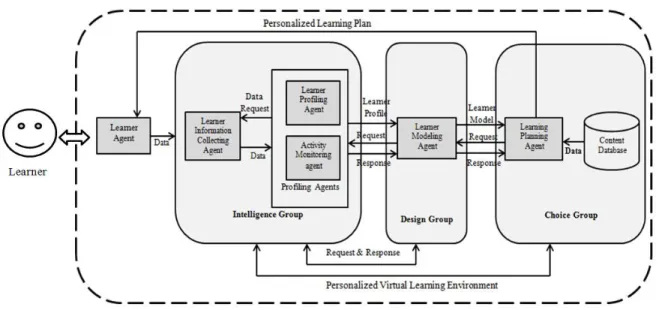
You may need the design and selection of stages of intelligence information. Learner information collection agent enables a system to collect personal information, previous educational experiences and results of pre -agent learner. Also record activities such as mouse movements and learning time period and exam scores. Learner profiling agent and agent activity monitoring are two types of profiling the factors that apply to the making and improving the situation. The profiling agent learner resides partial information from different learner and determines the level of intelligence, and learning and former preference learning of learners. Agent activity monitoring assessment of learning time of each session, the results of the exam and the exam has spent time and in this way determine the path of learning and knowledge level of the learner [4]. In the next step, when the agent modeling personal learner receives information of learners in the design stage, and begins to learn or improve modeling. After this step model auto matically sent to the learning and planning agent in the selection phase. Undersecretary of analyzes based tutorial on model and then update it. And finally sent a personal learning plan learner agent. The Under educational materials such as personal contents, exams, feedback is vital for leaners.
3.1 Domain Model Architecture
This domain of a set of chapters consists all of them many lessons, information becomes more difficult when you move from each chapter to another, came the chapters and lessons are organized within them as follows [1, 2, 3]:
Introduction to Cloud Computing
What cloud computing
The history of the emergence of cloud computing
What is the basic idea of cloud computing?
Cloud Computing Component
Software as a Service
Platform as a service
Infrastructure as a service.
The benefits and obstacles to cloud computing
The benefits of cloud computing
Obstacles and threats to use cloud computing
Cloud Computing Service Providers
What is the role of cloud computing service provider?
What are the main leading companies in the cloud computing service?
Security in cloud computing
Use of cloud computing
Cloud computing in trade
Cloud Computing in Education
Cloud computing in companies
3.2 Student Model Architecture
Each student when using the system for the first time the rules of the art is by default set up a special file the student and give him a user name and password, then the student Login to your account through a dedicated student user interface and then provide the student to
choose the part you want presided, and the system in turn offer lessons within this segment so that the student can study them.
There in the system a set of questions for each lesson and each of these lessons have a certain level of difficulty through the student answers to these questions, the system determining the level of the student. If it exceeds the student questions the degree of success, the collection system is considered to be a student of this part has been successfully completed, and thus the system moves the student to the next part and so on.
3.3 Pedagogical Module Architecture
The teacher enters the main parts of the material and then enters each part of the lessons. The teacher then enter the questions and you're adding each question according to the levels they want, and can also determine the degree of success for each lesson and that if a student got on top of them, the sign system is transferred to the next level. This section also contains an interface through which the teacher to follow up the students who use the system, so that it can see the levels at which they arrived, and it can monitor the performance of students and the extent of their understanding of the lessons.
3.4 User Interface Model
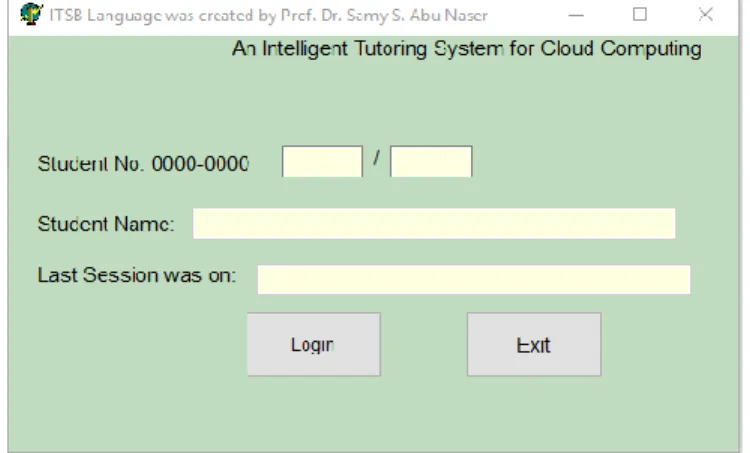
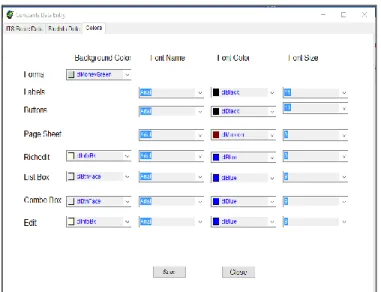
This ITSB tool used to build our current ITS supports two classes of users: students and teachers. When the teacher logs in the system, the teacher can add/modify/delete lessons, exercises, answers of exercises, initial ITS basic information, initial information about students, configure/adjust the color, font name, and size of all combo boxes, buttons, and menus.. A screenshot of the teacher interface is shown in Fig 2,Fig 3,Fig 4,andFig 5. However, when the student logs into the system, he/she can study the lessons, examples and questions.
When the student clicks on Exercises button then "new problem" button is enabled and the student can click on it to be given a new problem to solve. The student should click on the "check" button to check his/her answer is correct or not. When the student wants to see his/her performance he/she should click on "stats" button. See Fig 6 and Fig 7.
78
Fig 3: Add basic ITS data
Fig 4: Add Student initial data
Fig 5: choose the font, color, sizes for other screens
Fig 6: Lessons and examples area
Fig 7: Exercises area
4. Evaluation
We have evaluated the intelligent tutoring system teaching cloud computing by presenting it to a group of teachers who specializes in cloud computing and another group of students. Both groups were asked to evaluate system. Then we asked them to fill questionnaire about it. The questionnaire consisted of questions regarding advantages of ITS, completeness of the material, quality of the ITS design. The results of the evaluation by both groups were very acceptable.
5. Conclusion
In this paper, we have designed an Intelligent Tutoring System teaching cloud computing by using ITSB authoring tool. The ITS system was designed to ease the study of cloud computing lessons by the students and overcome the difficulties they face. The ITS for cloud computing architecture and requirements of each part of
79
the ITS system have been explained. We conducted an evaluation of the ITS two groups of teachers and students and the results were very acceptable.
References
1. Rafaels RJ. Cloud Computing: From Beginning to End, 2015.
2. Arshdeep B, Vijay M. Cloud Computing: A Hands-On Approach, 2013.
3. Thomas E. Cloud Computing: Concepts, Technology & Architecture and Cloud Computing Design Patterns, 2015.
4. Abu Naser S. JEE-Tutor: An Intelligent Tutoring System for Java Expression Evaluation. Information Technology Journal, Scialert. 2008; 7(3):528 -532. 5. Abu Eloun NN, Abu Naser SS. Mathematics
Intelligent Tutoring System. International Journal of Advanced Scientific Research, 2017; 2(1).
6. Abu-Naser S, Ahmed A, Al-Masri N, Deeb A, Moshtaha E, Abu Lamdy M. An Intelligent Tutoring System for Learning Java Objects. International Journal of Artificial Intelligence and Applications (IJAIA). 2011; 2(2).
7. Abu-Naser S, Al-Masri A, Sultan YA, Zaqout I. A prototype decision support system for optimizing the effectiveness of elearning in educational institutions. International Journal of Data Mining & Knowledge Management Process (IJDKP), 2011; 1:1-13.
8. Akkila AN, Abu Naser SS. Teaching the Right Letter Pronunciation in Reciting the Holy Quran Using Intelligent Tutoring System. International Journal of Advanced Research and Development. 2017; 2(1). 9. Al-Bastami BH, Abu Naser SS. Design and
Development of an Intelligent Tutoring System for C# Language, European Academic Research. 2017; 4(10).
10. Al-Bayed1 MH, Abu Naser SS. An Intelligent Tutoring System for Health Problems Related To Addiction of Video Game Playing. International Journal of Advanced Scientific Research. 2017; 2(1). 11. Aldahdooh R, Abu Naser SS. Development and Evaluation of the Oracle Intelligent Tutoring System (OITS). European Academic Research. 2017; 4(10). 12. Alhabbash MI, Mahdi AO, Abu Naser SS. An
Intelligent Tutoring System for Teaching Grammar English Tenses. European Advanced Research, 2016; 4(9):7743-7757.
13. Al-Hanjori MM, Shaath MZ, Abu Naser SS. Learning Computer Networks Using Intelligent Tutoring System. International Journal of Advanced Research and Development. 2017; 2(1).
14. Almurshidi SH, Abu Naser SS. Stomach Disease Intelligent Tutoring System. International Journal of Advanced Research and Development, 2017; 2(1). 15. Almurshidi SH, Naser SSA. Design and Development
of Diabetes Intelligent Tutoring System. European Academic Research. 2017; 4(9):8117-8128.
16. Al-Nakhal MA, Abu Naser SS. An Intelligent Tutoring System for learning Computer Theory. European Academic Research. 2017; 4(10).
17. El Haddad IA, Abu Naser SS. ADO-Tutor: Intelligent Tutoring System for leaning ADO.NET. European Academic Research. 2017; 4(10).
18. Elnajjar AA, Abu Naser SS. DSE-Tutor: An Intelligent Tutoring System for Teaching DES Information Security Algorithm. International Journal of Advanced Research and Development. 2017; 2(1).
19. Hilles MM, Abu Naser SS. Knowledge-based Intelligent Tutoring System for Teaching Mongo Database. European Academic Research, 2017; 4(10).
20. Mahdi AO, Alhabbash MI, Abu Naser SS. An intelligent tutoring system for teaching advanced topics in information security. World Wide Journal of Multidisciplinary Research and Development, 2016; 2(12):1-9.
21. Mahmoud AY, Barakat MS, Ajjour MJ. Design and Development of ELearning University System (Journal of Multidisciplinary Engineering Science Studies (JMESS), 2016; 2(5):498-504.
22. Naser S, Evaluating the effectiveness of the CPP -Tutor an intelligent tutoring system for students learning to program in C++. Journal of Applied
Sciences Research;
www.aensiweb.com/JASR/, 2009; 5(1):109-114. 23. Naser SA. A comparative study between Animated
Intelligent Tutoring Systems (AITS) and Video -based Intelligent Tutoring Systems (VITS). Al-Aqsa University Journal, 2001; 5(1):1.
24. Naser SA. An Agent Based Intelligent Tutoring System For Parameter Passing In Java Programming. Journal of Theoretical & Applied Information Technology, 2008; 4(7).
25. Naser SA, Ahmed A, Al-Masri N, Sultan YA. Human Computer Interaction Design of the LP-ITS: Linear
Programming Intelligent Tutoring
Systems. International Journal of Artificial Intelligence & Applications (IJAIA), 2011; 2(3):60-70.
26. Naser SSA. Intelligent tutoring system for teaching database to sophomore students in Gaza and its effect on their performance. Information Technology Journal; Scialert. 2006; 5(5):916-922.
27. Naser SSA. Developing an intelligent tutoring system for students learning to program in C++. Information Technology Journal; Scialert, 2008; 7(7):1055-1060. 28. Naser SSA. A Qualitative Study of LP-ITS: Linear
Programming Intelligent Tutoring
System. International Journal of Computer Science & Information Technology, 2012; 4(1):209-220. 29. Naser SSA. Predicting learners performance using
artificial neural networks in linear programming intelligent tutoring system. International Journal of Artificial Intelligence & Applications, 2012; 3(2):65-73.
30. Naser SSA. ITSB: An Intelligent Tutoring System Authoring Tool. Journal of Scientific and Engineering Research, 2016; 3(5):63-71.
31. Naser SSA, Sulisel O. The effect of using computer aided instruction on performance of 10th grade
80
biology in Gaza. Journal of the College of Education. 2000; 4:9-37.
32. Naser SSA. Developing visualization tool for teaching AI searching algorithms, Information Technology Journal, Scialert, 2008; 7(2):350-355. 33. Shaath MZ, Al-hanjouri M, Abu Naser SS,
ALdahdooh R. Photoshop (CS6) Intelligent Tutoring System. International Journal of Academic Research and Development 2017; 2(1).
34. Alawar MW, Abu Naser SS. CSS-Tutor: An Intelligent Tutoring System for CSS and HTML. International Journal of Academic Research and Development 2017; 2(1).