Static Detection of Asymptotic Performance
Bugs in Collection Traversals
Oswaldo Olivo
University of Texas at AustinIsil Dillig
University of Texas at AustinCalvin Lin
University of Texas at AustinAbstract
This paper identifies and formalizes a prevalent class of asymptotic performance bugs calledredundant traversal bugsand presents a novel static analysis for automatically detecting them. We evalu-ate our technique by implementing it in a tool called CLARITYand applying it to widely-used software packages such as the Google Core Collections Library, the Apache Common Collections, and the Apache Ant build tool. Across 1.6M lines of Java code, CLAR-ITYfinds 92 instances of redundant traversal bugs, including 72 that have never been previously reported, with just 5 false positives. To evaluate the performance impact of these bugs, we manually repair these programs and find that for an input size of 50,000, all repaired programs are at least 2.45×faster than their original code. Categories and Subject Descriptors D.2.4 [Software Engineer-ing]: Software/Program Verification; C.4 [Performance of Sys-tems]: Analysis
General Terms Program analysis, Performance Bugs, Experi-mentation
1.
Introduction
Afunctionality bugoccurs when a piece of software crashes or pro-duces an incorrect result. Fortunately, research in program anal-ysis has produced significant advances in the automated detec-tion of such bugs [1, 4–6, 22]. By contrast, aperformance bug
arises when a program produces the correct result but a simple functionality-preserving change can provide a substantial perfor-mance improvement [25]. Perforperfor-mance bugs are significant be-cause they can render a program unusable; they can also be ex-ploited by malicious users to create denial-of-service attacks. Un-fortunately, performance bugs are more difficult to detect than func-tionality bugs for several reasons:
•First, it is difficult to know whether a program’s performance can be expected to improve, since it depends on user inputs, on the many details of the program’s execution environment, and on some notion of how a “good” solution should perform.
Permission to make digital or hard copies of part or all of this work for personal or classroom use is granted without fee provided that copies are not made or distributed for profit or commercial advantage and that copies bear this notice and the full citation on the first page. Copyrights for components of this work owned by others than ACM must be honored. Abstracting with credit is permitted. To copy otherwise, to republish, to post on servers, or to redistribute to lists, contact the Owner/Author. Request permissions from [email protected] or Publications Dept., ACM, Inc., fax +1 (212) 869-0481. Copyright 2015 held by Owner/Author. Publication Rights Licensed to ACM.
PLDI’15 , June 13–17, 2015, Portland, OR, USA Copyright c2015 ACM 978-1-4503-3468-6/15/06. . . $15.00 DOI: http://dx.doi.org/10.1145/(to come)
1. public boolean render(Graphics2D g2, Rectangle2D
2. dataArea, int index, ...) {
3. ...
4. XYDataset dataset = getDataset(index); 5. XYItemRenderer renderer = getRenderer(index); 6. ...
7. int sCount = dataset.getSeriesCount(); 8. int series;
9. for (series=sCount-1; series >= 0; series--) { 10. int first = 0;
11. int last = dataset.getItemCount(series) - 1; 12. ...
13. for (item=first; item <= last; item++) { 14. renderer.drawItem(dataset, series, item,...);
15. }
16. ... 17. } 18. ... 19. }
20. public void drawItem(XYDataSet dataset,
21. int series, int item, ...) {
22. ...
23. OHLCDataset highLowData = (OHLCDataset)dataset; 24. itemCount = highLowData.getItemCount(series); 25. double xxWidth = dataArea.getWidth();
26. for(int i=0; i< itemCount; i++) { 27. ... 28. if(last != -1) { 29. xxWidth=Math.min(xxWidth,Math.abs(pos-last)); 30. } 31. } 32. }
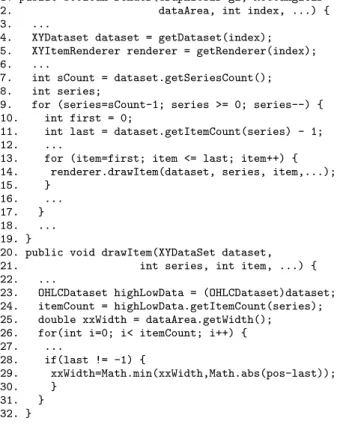
Figure 1. A previously unknown performance bug in the JFreeChart application that was identified by CLARITY.
• Second, while functionality bugs can be tested using assertions or various automated testing tools [6, 18, 33], the detection of performance bugs typically requires a human to monitor the program and make a judgment call on its performance. • Third, performance bugs often manifest themselves only with
large inputs, so thesmall input hypothesis[29], which forms the basis of most software testing methodologies, does not hold. For these reasons, performance bugs remain a nebulous and evasive problem, and most existing tools for detecting performance prob-lems either rely on rule-based pattern matching of syntactic pro-gram constructs or on some degree of runtime analysis and human intervention.
This paper presents a new static analysis—and its implemen-tation in a tool called CLARITY—for automatically detecting an important class of asymptotic performance bugs. We say that a
code snippet has anasymptotic performance bugif its computa-tional complexity isO(f(n))but the same functionality can be implemented by code with complexityO(g(n))such thatg(n)is
O(f(n))butf(n)is notO(g(n)). Although the detection of ar-bitrary asymptotic performance bugs is beyond the scope of pro-gram analysis1, we have identified a restricted but prevalent class of asymptotic performance bugs that we callredundant traversal bugs. A redundant traversal bug arises if a program fragment re-peatedly iterates over a data structure, such as an array or list, that has not been modified between successive traversals of the data structure. Since such computation can be memoized and re-used across loop iterations, redundant traversal bugs typically result in at least anO(n)performance degradation, wherenis the size of the data structure. Furthermore, such performance bugs are typi-cally easy to fix and often only require the addition of a parameter to a method, the addition of a field to an object, or the use of a slightly different data structure.
Motivating Example. As an example of a redundant traversal bug, consider the program snippet shown in Figure 1. This code is taken from version 1.0.17 of the JFreeChart software and exhibits a previously unknown performance bug uncovered by CLARITY. In particular, therendermethod (lines 1–19) plots a series of data items in the form(x, y)and invokes thedrawItemmethod on line 14 to draw a single point within a given series. Here, the method invocation on line 14 is a virtual call with many possible targets, one of which is thedrawItemmethod ofCandlestickRenderer
(lines 20–32).
The performance problem in this example arises because the
drawItemmethod iterates overall pointswithin the series in order to draw asingledata point. In particular, the code traverses all data points to compute a value calledxxWidth, which corresponds to the minimum gap between adjacent x-coordinates in the series. However, since the data set is not modified between successive calls to drawItem, the recomputation of xxWidth in each call to drawItem is redundant and needlessly traverses a potentially large list of data items many times. Hence, this code fragment exhibits a serious performance bug that can be fixed either by passingxxWidthas an argument todrawItemor by storing it as a field. Not only does such a fix result in a theoretical asymptotic performance improvement ofO(n), but it produces an order of magnitude performance improvement in practice.2
While it may seem surprising that such a blatant performance bug exists in a mature software project like JFreeChart, there are several reasons why this bug could be missed during development and testing. First, the impact of this performance bug is propor-tional to the size of the data series and requires data points to be drawn in the shape of candlesticks. Hence, test cases that either use small data series or render objects in a different shape, such as a square, will not reveal the performance bug. Second, the heavy-use of object oriented abstractions obscures the performance bug, mak-ing it difficult to spot the problem durmak-ing manual code inspection. In particular, observe that thedrawItem()method is virtual, and the performance bug only occurs in theCandlestickRenderer
implementation. Similarly, the collection that is traversed is hidden behind an interface, so to identify the exact data structure, another virtual method call must be resolved. Finally, there is a function call depth of three between the loop that traverses the data structure and the access of the actual item in the data structure.
1Observe that identifying arbitrary asymptotic performance bugs requires
knowing a “best” algorithm for implementing a given functionality.
2For example, using the existing test harnesses from SourceForge, we
ob-serve speedups of 8×to 11×when we fix this performance bug and modify the test harness to render each data item in the shape of a candlestick.
boolean containsAny1(HashSet<Foo> mySet, ArrayList<Foo> myList) { for(Foo f: mySet) if(myList.contains(f)) return true; return false; }
Figure 2. Check ifmyListcontains an element frommySet
Contributions. This paper makes the following contributions: • We introduce and formalize the notion ofredundant traversal
bugs, which result in serious performance problems even in mature and well-tested software.
• We show that the detection of redundant traversal bugs is a non-trivial static analysis problem, and we present a novel and sound static analysis for automatically detecting this class of performance bugs.
• We implement the proposed analysis in a tool called CLARITY and experimentally demonstrate its effectiveness on nine open source Java code bases. Our tool is able to find 92 redundant traversal bugs, 72 of which were previously unknown. We also show that these performance bugs have significant impact in terms of program performance. For example, for an input size of 50,000, the repaired versions of these programs are at least 2.45×faster than the original code.
Organization. The remainder of this paper is organized as fol-lows. Section 2 formally defines redundant traversal bugs and presents the core ideas for detecting such problems. After describ-ing our algorithm for statically detectdescrib-ing redundant traversal bugs in Section 3, we briefly describe our implementation in Section 4 and present our empirical evaluation in Section 5. Before conclud-ing, we compare our approach to previous work in Section 6.
2.
Conceptual Foundations
This section defines the notion of redundant traversal bugs and explains the core ideas underlying our static analysis.
2.1 Defining Redundant Traversal Bugs
DEFINITION1.(Traversal)We say that a code snippetStraverses
a data structureδ if it performs a computation whose average-case complexity is at leastΩ(n), wherendenotes the number of elements inδ.
For instance, consider thecontainsmethods provided by var-ious data structures in the Java Collections Framework. Accord-ing to Definition 1, thecontainsmethod ofArrayListperforms a traversal of the data structure, as its average-case complexity is
O(n). On the other hand, whileHashSet’scontainsmethod has worst-case complexityO(n), it is not considered a traversal be-cause its average-case complexity isO(1).
DEFINITION2.(Traversal Footprint) The traversal footprint of a code snippet S, written TraversalFP(S), is the set of data structures traversed byS.
DEFINITION3.(Write Footprint)Thewrite footprintof codeS, writtenWriteFP(S), is the set of data structures thatSmodifies.
DEFINITION4.(Redundant Traversal Bug)A loopLexhibits a
redundant traversal bugif there exists a data structureδsuch that: 1.δ∈TraversalFP(L)andδ6∈WriteFP(L)
boolean containsAny2(HashSet<Foo> mySet, ArrayList<Foo> myList) { for(int i=0; i < myList.size(); i++) {
Foo elem = myList.get(i); if(mySet.contains(elem))
return true; }
return false; }
Figure 3. Different implementation of code in Figure 2.
2.δis traversedΩ(m)times inL, wheremis the number of times thatLexecutes
In other words, a redundant traversal bug arises if a loop-invariant data structure is traversed a linear number of times within the loop. We believe that this definition captures the intuitive notion of redundancy, as the computation that is performed by traversing the data structure can be done once and re-used across all loop iterations.
EXAMPLE1.Figures 2 and 3 show the implementation of two methods called containsAny1 and containsAny2 that deter-mine if the intersection ofmyListandmySetis non-empty. While containsAny1and containsAny2are functionally equivalent, containsAny1has a performance bug according to Definition 4 whilecontainsAny2does not. In particular, since thecontains method ofArrayListtraverses the data structure,myListis part of the traversal footprint of the loop. By contrast, thecontains method ofHashSetdoes not perform a traversal; so, the traversal footprint of the loop from Figure 3 is empty. Thus,containsAny1 contains an asymptotic performance bug because its average-case complexity isO(n·m), whereas the average-case complexity of containsAny2isO(n)for a list of sizenand set of sizem.
The need for the second condition of Definition 4 is illustrated by the following example.
EXAMPLE2.Consider the following code snippet, where the computeAvgmethod traverses its input:
int calculate(ArrayList<ArrayList<int>> a) { int avgSum = 0;
for(int i=0; i < a.size(); i++) avgSum += computeAvg(a.get(i)); return avgSum;
}
Here, condition (1) of Definition 4 is satisfied because each element of ais part of the traversal footprint but not the write footprint of the loop. However, this code does not have a performance bug because adifferentelement ofais traversed in each loop iteration. Hence, condition (2) is violated.
2.2 Core Ideas for Detecting Redundant Traversals
This section explains the key challenges underlying the static detec-tion of redundant traversal bugs and outlines the core ideas behind our static analysis.
First, based on condition (1) of Definition 4, we see that a sound static analysis for detecting redundant data structure traversals must be able to perform the following task:
Given code snippetS, overapproximate the emptiness of the setθ≡TraversalFP(S)−WriteFP(S)
Since θ is defined to be the difference of TraversalFP(S)
andWriteFP(S), a sound static analysis for detecting redundant
traversal bugs mustoverapproximatethe traversal footprint but un-derapproximatethe write footprint. Furthermore, since our analysis will track data structures in terms of program expressions, we need over- and under-approximating preconditions of program expres-sions with respect to a given program fragment. For this purpose, we define the following notions ofnecessaryandsufficient precon-ditions:
DEFINITION5.(Necessary precondition) A set of expressions {e1, . . . , en}is called anecessary preconditionof an expression
ewith respect to a code snippetS, writtenpre+(e, S), if, for any constantc, the following Hoare triple is valid:
{e16=c∧. . .∧en6=c}S{e6=c}
In other words, foreto have valuecafterS, it is necessary that some element inpre+(e, S)has valuecbeforeS; hence, we refer to the set{e1, . . . , en}as a necessary precondition ofewith respect toS. Now, we also define a dual notion ofsufficient preconditions: DEFINITION6.(Sufficient precondition)A set of expressionsE
is called asufficient preconditionof expressionewith respect to codeS, writtenpre−(e, S), if, for all constantscand alle0 ∈E, the following Hoare triple is valid:
{e0=c}S{e=c}
In other words, foreto have valuecafterS, it is sufficient that elements inpre−(e, S)have valuecbeforeS. Thus, sufficient con-ditions underapproximate the weakest precondition of an expres-sionewith respect to codeS.
EXAMPLE3. Consider the following code snippetS: if(*) x := y else x := z;
Here, we havepre+(x, S) = {y, z} andpre−(x, S) = ∅. In particular, forx to be equal to a certain value c after S, it is necessary that eitheryorzhave valuecbeforeS. However, the sufficient precondition forxis∅because neithery=cnorz =c
beforeSguarantees thatx=cafterS.
Now, given a statementS and a sub-statementπnested inside
S, we will use the notationS−[π]to denote the code that comes beforeπinS. For instance, ifSis the code:
x:=y; if(x>10) x++; y--; else x := 0
andπis the statementy--, thenS−[π]is:
x:=y; assume(x>10); x++;
The following theorem explains why necessary and sufficient preconditions are useful for checking condition (1) of Definition 4. THEOREM1.LetSbe a code snippet containing two sets of state-mentsΠ1andΠ2such that:
1. Each statementπi∈Π1traverses a data structure referred to
by program expressionei
2. Eachπ0j∈Π2modifies a data structure referred to bye0j Then,TraversalFP(S)−WriteFP(S) =∅if:
( [ πi∈Π1 pre+(ei, S − [πi])− [ π0 j∈Π2 pre−(e0j, S − [π0j]) ) =∅ (∗)
PROOF1. Suppose TraversalFP(S) −WriteFP(S) 6= ∅ but (∗)holds. Then there must be some statementπthat traverses a data structureδ that is referred to by expressione andδ is not
modified inS. Letpre+(e, S−[π]) = {e1, . . . , en}. By definition of necessary precondition, this implies thate1 =δ∨. . .∨ek=δ beforeS. Now, since condition(∗)holds, every ei is in the set
pre−(e0j, S −
[π0j])for some statementπ 0
jmodifying data structure referred to by expressione0j. By definition of sufficient precondition, this means that{ei=δ}S−[πj0]{e
0
j=δ}. But this implies thatδ must also be modified, i.e., a contradiction.
Theorem 1 is useful because it provides a method for statically checking condition (1) of Definition 4. In particular, to determine whetherTraversalFP(S)−WriteFP(S)maybe empty, we com-pute necessary preconditionsEof all program expressions that are traversed and sufficient preconditionsE0of all expressions that are modified. IfE−E0is empty, then Theorem 4 implies that all ex-pressions that are traversed are also modified; hence, we can rule out a potential redundant traversal bug. This is a key insight under-lying our static analysis, and we will compute necessary tions of data structures that are traversed and sufficient precondi-tions for expressions that are modified in Section 3.
We now turn to the problem of statically checking condition (2) from Definition 4. That is, given a loop-invariant data structure
δthat is traversed within the loop, isδtraversed at least a linear number of times? In our analysis, we will check this linearity requirement by over-approximating the following slightly stronger condition:
Given a loopLand a data structureδ, isδtraversed in all iterations ofL?
The above criterion is stronger than checking whetherδis tra-versedΩ(m)times in the loop. However, since our static analysis is path-insensitive, soundly answering the above question overap-proximates condition (2) of Definition 4 for all practical purposes. EXAMPLE4.Consider the following code snippet, wheren is a positive integer andtraverseperforms list traversal:
for(i=0; i<n; i++) {if(i%2 == 0) traverse(myList);}
Here,myListis not traversed in all iterations, but it is traversed Ω(n)times. However, a sound static analysis that treats the testi%2 == 0as a non-deterministic choice will conclude thatmyListmay be traversed in all iterations.
The following theorem is useful in determining whether a data structureδmay be traversed in all loop iterations:
THEOREM2.Letebe a program expression, and letEbe a nec-essary precondition ofewith respect to code snippetS. Then, the following Hoare triple is valid for any constantc:
{e=c ∧ ^ ei∈E
e6=ei}S{e6=c} PROOF2.First, note that the following implication is valid:
e=c∧ ( ^ ei∈E e6=ei)⇒( ^ ei∈E ei6=c) Now, by definition of necessary precondition, we have:
{(^
ei∈E
ei6=c)}S{e6=c} Hence, the theorem holds by precondition strengthening.
Simply put, this theorem states that the value of an expression
ehas different values before and after executingS provided that
eis distinct from everyei ∈pre+(e, S). To see the relevance of this theorem, suppose thateis a program expression that may be traversed in the loop. Now, if the value ofechanges between any
ProgramP := τ1v1;. . . τnvn; S
Typeτ := Int|Collectionhτ1, τ2i
StatementS := skip|v:=e|v.traverse()
|v1:=v2.get(v3)|v1.putρ(v2, v3)
|S1;S2|if(?) thenS1elseS2
|while(?) doρS
Expressione := int|v|e1⊕e2 (⊕ ∈ {+,−,×}) Figure 4. Language used for formal development.
two consecutive loop iterations, then two different data structures
δandδ0are traversed; hence,δis not traversed in all loop itera-tions. Thus, the key question to answer is whether the value ofe
can change between different loop iterations. Fortunately, we can answer this question using Theorem 2. Specifically, letE be the necessary precondition ofewith respect to the loop bodyS. Based on Theorem 2, if we can prove thateis distinct from everyei∈E, then we know that the same data structure is not traversed in all loop iterations.
EXAMPLE5. Consider again the code from Example 2, where computeAvgtraverses the input array. Here, the loop traverses program expressiona[i], but the necessary precondition ofa[i] with respect to the loop body is{a[i+1]}. Thus, assuminga[i] anda[i+1]do not alias, we can determine that condition (2) of Definition 4 is violated.
3.
Static Analysis
We now use the ideas introduced in Section 2 to describe our static analysis for detecting performance bugs.
3.1 Language
To formally describe our analysis, we use the small imperative language shown in Figure 4. This language contains two types of variables, namely, scalars of type Int and references of type Collection. We model collections as key-value stores that support insertion and retrieval of values associated with a given key. Hence, a variable of type Collectionhτ1, τ2i models a key-value store where keys are of typeτ1and values are of typesτ2. Observe that both keys and values may be of type Collection; hence, it is possible to nest an arbitrary number of data structures within another one.
In the language shown in Figure 4, statements include skip, assignments of the formv:=e, and the following three collection-manipulating operations:
• A statementv.traverse()traverses collectionv, where traversal encompasses any operation that is consistent with Definition 1. • A statementv1 :=v2.get(v3)retrieves the valuev1of keyv3
in the data structure pointed to by variablev2.
• A statementv1.putρ(v2, v3), whereρdenotes a program point, associates valuev3with keyv2in the data structure referenced by variablev1.
In addition, statements also include sequencesS1;S2, if state-ments, and while loops. Since our analysis does not interpret con-ditionals (i.e., is path-insensitive), we model concon-ditionals using non-deterministic choices indicated as?in Figure 4. Furthermore, we assume that while loops are annotated with a program pointρ
which denotes the program location right before the first instruction in the loop body.
To simplify the formalization of our analysis, we omit function calls from this language and assume that the only way to traverse a data structure is by callingv.traverse(). In Section 4, we explain
Symbolic expπ := c|v|π1hπ2i
Read footprint Φ := 2π
Write footprint Ψ := 2π
Alias environmentE := ρ×π→(2π,2π) Figure 5. Summary of notation used in formalization
the inference of methods that traverse data structures as well as our interprocedural analysis.
3.2 Computing Traversal and Write Footprints
We now describe our static analysis for over- and under-approximating each statement’s traversal and write footprints. Our analysis is a backwards dataflow analysis and is presented in Figure 6 using judgments of the form:
E,Φ,Ψ`S: Φ0,Ψ0
This judgment means that under the aliasing relations given by en-vironmentE, ifΦandΨdenote the traversal and write footprints after statementS, thenΦ0andΨ0over- and under-approximate the traversal and write footprints beforeSrespectively. That is, assum-ing the correctness ofE,ΦandΨ, the setΦ0 over-approximates all collections that are traversed in or afterSin terms of program expressionsbeforeS. Similarly, the setΦ0under-approximates all collections that must be modified in terms of program expressions beforeS.
As summarized in Figure 5, our analysis tracks traversal and write footprints using sets of symbolic expressionsπ. Symbolic expressionsπcan be constantsc, variablesv, or expressions of the formπ1hπ2i, which represents the value associated with keyπ2in a data structure represented by expressionπ1. For example, if the traversal footprintΦof some statementS includes an expression
vh3i, then the data structure stored at index3 of the collection referenced by variablevmay be traversed by statementS.
Since variables of type Collection are references in our lan-guage, our analysis must take possible aliasing relations into ac-count if it is to soundly compute traversal and write footprints. Thus, our analysis rules utilize analiasing environmentE which maps each expression to its set of aliases. However, since our goal is to under-approximate write footprints, we needmust aliasfacts as well asmay aliasinformation, so the aliasing environmentEhas signatureρ×π → (2π,2π), which maps each expressionπand program pointρtoπ’s may- and must-aliases at program pointρ. In what follows, we will assume that such an aliasing environment Ehas been computed by performing may- and must-alias analyses prior to our footprint computation.
Let us now consider the analysis rules shown in Figure 6. In particular, rule (2) describes the analysis of assignments of the form v := e. Here, we replace any variable v used in Φ and
Ψby expression e becausee is both a necessary and sufficient precondition forvwith respect to statementS. For instance, for a statementv1 :=v2, traversal footprintΦ = {v1, y}and write footprintΨ ={xhv1i}, our analysis computesΦ0 ={v2, y}and
Ψ0={xhv2i}.
Rule (3) describes the analysis of traversals of the formv.traverse. In this case, we simply add variablevto the traversal footprintΦ; the write footprintΨremains unchanged.
Rule (4) describes the analysis of retrieval (i.e., load) operations of the formv1 :=v2.get(v3). Similar to the assignment rule, we replace variablev1 in the traversal and write footprints with the expression v2hv3i, which denotes the value associated with key
v3in the collection referenced byv2. Observe thatv2hv3iis both a necessary and sufficient precondition forv1 with respect to the statementv1 :=v2.get(v3): In particular, the value ofv1is equal
(1) E,Φ,Ψ`skip : Φ,Ψ (2) Φ 0 = Φ[e/v] Ψ0= Ψ[e/v] E,Φ,Ψ`v:=e: Φ0,Ψ0 (3) Φ 0 = Φ∪ {v} E,Φ,Ψ`v.traverse() : Φ0,Ψ (4) Φ0= Φ[v2hv3i/v1] Ψ0= Ψ[v2hv3i/v1] E,Φ,Ψ`v1:=v2.get(v3) : Φ0,Ψ0 (5) E(ρ, v1) = (A+ 1,A − 1) E(ρ, v2) = (A + 2,A − 2) Φ0= Φ[v3/A+ 1hA + 2i]∪(Φ A − 1hA − 2i) Ψ0= Ψ[v3/A−1hA − 2i]∪(Φ A + 1hA + 2i) E,Φ,Ψ`v1.putρ(v2, v3) : Φ0,Ψ0∪ {v1} (6) E,Φ,Ψ`S2: Φ0,Ψ0 E,Φ0,Ψ0`S1: Φ00,Ψ00 E,Φ,Ψ`S1;S2: Φ00,Ψ00 (7) E,Φ,Ψ`S1: Φ1,Ψ1 E,Φ,Ψ`S2: Φ2,Ψ2
E,Φ,Ψ`if(?) thenS1elseS2: Φ1∪Φ2,Ψ1∩Ψ2
(8) Φ0⊇Φ Ψ⊇Ψ0 E,Φ0,Ψ0`Se: Φ 0 ,Ψ0 E,Φ,Ψ`while(?) doS: Φ0,Ψ0
Figure 6. Analysis rules for computing traversal and write foot-prints. The notationsA1hA2i andΦ[v/A]are defined in
Equa-tions 1 and 2, and operator is defined in Equation 3.
to constantcafter this statement if and only ifv2hv3i=cbefore executingv1 :=v2.get(v3).
The most involved part of the analysis is Rule (5) for ana-lyzing insertion (i.e., store) operations. To build intuition, let us first consider the statementS=v1.put(v2, v3)and an expression
xhyi ∈ Φ. There are two cases to consider:
• Ifxmust aliasv1andymust alias3v2, then the necessary
pre-condition forxhyiis just{v3}since, for any valuec, condition
v36=cbeforeSguaranteesxhyi 6=cafterS.
• On the other hand, if x may alias v1 and y may alias v2
(but either may-alias relation is not also a must-alias relation), then the necessary precondition forxhyiis the set{xhyi, v3}. Observe that neither conditionxhyi 6=cnorv3 6=cbeforeS
on its own guaranteesxhyi 6= cafterS, as the value ofxhyi may—but does not have to– be affected byS. However, if we knowxhyi 6= c∧v3 6= c beforeS, we can guarantee that
xhyi 6=cafterS.
Now, let us also consider the analogous case wherexhyi ∈Ψ. Again, there are two cases to consider:
• Ifxmust aliasv1andymust aliasv2, then the sufficient pre-condition forxhyiis just{v3}since, for any valuec, condition
v3=cbeforeSguaranteesxhyi=cafterS.
3Here, sinceyandv
2may be scalars, we overload the term “alias” to also
•Otherwise, if xmay alias v1 and y may alias v2, then the sufficient precondition forxhyiis the empty set, as there is no program expression whose value beforeS is guaranteed to be the same as the value ofxhyiafterS.
As this example illustrates, the computation of traversal and write footprints for store operations requires aliasing information for pointers (and equality information for scalars). With this intu-ition in mind, we now explain Rule (5) from Figure 6. As expected, we first need to look up the set of may- and must-aliases (A+
1,A − 1) ofv1 as well as those ofv2 (A+ 2,A −
2). Now, any expression of
the formxhyimay be affected by the statementv1.put(v2, v3)if
xis an alias ofv1andyis an alias ofv2. Given set of symbolic expressionsAandA0, we use the notationAhA0ito represent:
JAhA 0 iK= [ π∈A [ π0∈A0 πhπ0i (1) Hence, in Rule (5),A+ 1hA +
2iyields the set of expressions that
maybe affected by the update, whileA−
1hA
−
2irepresents
expres-sions thatmustbe overwritten.
Now, let us focus on the computation of the traversal footprint
Φ0in the second line of Rule (5). Here, for a setA={π1, . . . , πn}, we use the notationΦ[v/A]as shorthand for:
Φ[v/{π1, . . . , πn}] = Φ[v/π1, . . . , v/πn] (2) Hence, the setΦ[v3/A+
1hA +
2i]is the same as Φexcept that
every (sub-) expression that may correspond tov1hv2ihas been replaced with v3. However, since we want to over-approximate the footprint,Φ0must also contain any expressionπsuch that (i)
π ∈ Φand (ii) no prefix of π is in the set A−1hA
−
2i, because
such an expressionπis not guaranteed to be killed by the store operation. To capture all expressions inΦthat are preserved by the statementv1.put(v2, v3), we define an operation on expression sets as follows: π∈(A1 A2)⇔π∈ A1∧ ∀π 0 ∈ A2.(π 0 6 = prefix(π)) (3) In other words,A1 A2 preserves exactly those expressions πin A1 whereπ is not an extension of some expression inA2.
Hence, the overall effect is two-fold:
•Φ0containsv3ifΦcontains some expressionxhyiwherexand
ymay aliasv1andv2respectively
•Φ0contains any expressionπ∈Φsuch thatπis not guaranteed to be modified by the statementv1.put(v2, v3)
We now explain the computation of the write footprint Ψ0, which is described in the third line of Rule (5). First, observe that
Ψ0containsv3iff there exists somexhyi ∈ Ψsuch thatxandy
must aliasv1andv2. Furthermore, we kill all expressions inΨof the formx0hy0iwherex0andy0may aliasv1andv2, respectively. Finally, since the statementv1.put(v2, v3)modifies collectionv1, the write footprint before this statement includes variablev1. EXAMPLE6.Consider the following code snippet wherexandy
are variables of typeCollectionhInt,CollectionhIntiiandz, w
are variables of typeCollectionhInt,Inti:
1. y.put(0, w); Φ1={xh0i, w} Ψ1={y, w}
2. z:=x.get(0); Φ2={xh0i} Ψ2={w}
3. w.put(2,5); Φ3={z} Ψ3={w}
4. z.traverse(); Φ4={z} Ψ4=∅
The annotationsΦiandΨishow the traversal and write footprints right before statementSiunder the assumption thatxandymay alias (but are not guaranteed to).
We now consider the last two rules in Figure 6. When analyzing if statements in Rule (7), we take the union of the traversal foot-printsΦ1 and Φ2 obtained from the two branches. On the other
hand, since we need to underapproximate the write footprint, we take the intersection ofΨ1andΨ2. rather than their union.
The final rule (8) describes the analysis of while loops4. In this rule, we use the notationSeto denote the resulting statement when
all traversal statements inSare replaced by skip. In particular, to avoid reporting the same warning for both inner and outer loops, our analysis ignores traversals in nested loops when computing the traversal footprint associated with an outer loop.
Now, continuing with rule (8), the traversal and write footprints
Φ0andΨ0must satisfy the following properties:
• Φ0must be a superset ofΦsince any expression that is traversed after the loop may also be traversed before the loop (observe that the loop may execute zero times).
• Ψ0must be a subset ofΨsince only those expressions that are modified after the loop are guaranteed to be modified before the loop.
• Φ0andΨ0must be inductive with respect to loop bodySe.
EXAMPLE7. Consider the following code snippet:
1. while(?) doi=i+ 1; if(?) thena=belseb=a; 2. a.traverse(); b.put(2,5);
Right before line 2, we have the traversal and write footprints Φ2={a},Ψ2 ={b}. On the other hand, the traversal and write
footprints before line 1 areΦ1={a, b}andΨ1=∅.
3.3 Detecting Redundant Traversal Bugs
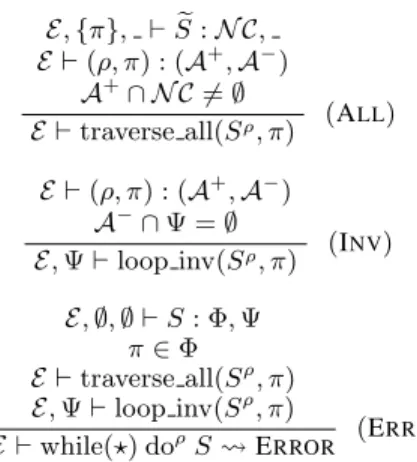
We now explain how the computed traversal and write footprints are used to detect redundant traversal bugs. Figure 7 summarizes our performance bug detection algorithm using the judgments from Figure 6. As expected, our analysis only reports warnings when analyzing loops. Specifically, as shown on the first line of the ERRrule, we first compute the traversal and write footprintsΦ,Ψ
associated with the loop body. Now recall from Section 2 that the loop contains a redundant traversal bug if there exists aπ ∈ Φ
such that (i)πis traversed in all loop iterations, and (ii)πis loop invariant (i.e., is not modified within the loop).
To determine if condition (i) holds, we use Theorem 2 from Section 2 to check whetherπis distinct from every expressionπ0∈
pre+(π, S). More specifically, in the ALLrule,N Ccorresponds to
pre+(π, S), and the checkA+∩ N C
=∅stipulates thatπdoes not alias any expression inpre+(π, S). Hence, by Theorem 2, if the predicatetraversal all(Sρ, π)evaluates to true, thenπmay be traversed in all loop iterations.
Now, we still need to check thatπis not modified within the loop. For this purpose, we use the INVrule, which checks if some must-alias ofπis in the write footprintΨ. If not (i.e.,A+∩
Ψ =∅), this implies thatπmay be loop invariant, so our analysis reports a potential performance bug.
EXAMPLE8. Consider the following code snippet: while(?) do t:=a.get(i); t.traverse();i:=i+ 1; Here, the traversal footprintΦfor the loop body is{ahii}, and the write footprintΨis∅. Since the necessary precondition ofahiiis Φ0={ahi+ 1i}, theALLrule fails (assumingahiiandahi+ 1i do not alias), so our analysis does not report a performance bug.
4This rule is only needed when detecting performance bugs in loops that
E,{π}, `Se:N C, E `(ρ, π) : (A+ ,A− ) A+∩ N C 6 =∅
E `traverse all(Sρ, π) (ALL) E `(ρ, π) : (A+,A− ) A−∩ Ψ =∅ E,Ψ`loop inv(Sρ, π) (INV) E,∅,∅ `S: Φ,Ψ π∈Φ E `traverse all(Sρ, π) E,Ψ`loop inv(Sρ, π)
E `while(?) doρS ERROR (ERR)
Figure 7. Summary of performance bug detection. As before,Se
denotes traverse statements inSreplaced by skip.
EXAMPLE9.Consider the following code snippet: 1. if(?) thenb:=a; else skip;
2. while(?) do a.traverse(); b.put(2,4);
Here, we haveΦ = {a}andΨ = {b}. The necessary precondi-tion ofawith respect to the loop body is{a}, so using theALL
rule, we determine thatamay be traversed in all loop iterations. Furthermore, sinceaandbare not guaranteed to alias, theINV
rule succeeds, so our analysis reports a redundant traversal bug. However, if we changed line1tob:=a, then our analysis would not report a performance bug, sinceaandbare now guaranteed to alias.
4.
Implementation
We have implemented our proposed analysis in a tool called CLAR-ITY, which is written in Java and consists of approximately 8,000 lines of code. CLARITYis implemented in the Soot compiler frame-work [39] and uses the Jimple intermediate representation. CLAR-ITYrelies on Soot for CFG and callgraph construction and issues a warning if any possible target of a virtual method call contains a performance bug. We have also implemented our own summary-based pointer analysis for computing may and must aliases by adapting the ideas described by Dillig et al. [14].
In this section, we focus on two important aspects of the imple-mentation: (1) the identification of data structure traversals and (2) interprocedural analysis.
Identifying Data Structure Traversals. Our implementation uses a combination of automatic inference and a small amount of man-ual annotations to identify data structure traversals. In particular, we manually annotate 28 methods that (a) are implemented by the Java collections library and (b) have average-case complexity that is at least linear in the size of the data structure.5For instance, as we saw in Section 2, thecontainsmethod ofArrayListis annotated as a traversal, whileHashSet’scontainsmethod is not.
In addition to such manual annotations, CLARITYperforms au-tomated inference to identify code snippets that traverse data struc-tures through iterators or loops. However, our current implementa-tion does not detect data structure traversals in recursive funcimplementa-tions. Hence, CLARITYis not able to detect performance bugs involving recursive data structures.
To detect data structures that are traversed in loops, our static analysis also maintains a so-calledread footprint. In particular, a
5The annotated methods represent a tiny fraction of the analyzed methods.
data structureδis added to the read footprint for code snippetSif
Smay accessδ. For instance, using the notation from Section 3, if a code snippet accesses an element of arraya, we simply add
ato the read footprintRand computeR’s necessary precondition during our backwards analysis. When we encounter a loop, we then check whether an elementa∈ Ris accessed multiple times using Theorem 2. This analysis is similar to the check that tests whether a data structure is traversed multiple times (see the ALL rule in Figure 7). If a given data structure may be accessed in multiple loop iterations, we then add it to the traversal footprintΦ. The following example illustrates this analysis:
EXAMPLE10. Consider the following code snippet:
while(?) dot:=l.get(i); sum := sum +t;i:=i+ 1; While analyzing the loop body, we add variableltoR. Then, when analyzing the while loop, we check whetherlmay be accessed in all loop iterations by testing whether the necessary precondition forl
includes itself. Since it does in this case,lis added to the traversal footprintΦof the while loop.
Interprocedural Analysis. Since the key idea underlying our technique is to compute traversal and write footprints, our analysis is amenable to modular reasoning. In particular, our interprocedu-ral analysis computes aprocedure summaryfor each method that tracks its read, traversal, and write footprints as well as transfer functions that give the necessary and sufficient preconditions for each data structure used in that method.
When we encounter a call to methodm, we simply retrievem’s summary andinstantiateits read, write, and traversal footprints by applying the appropriate formal-to-actual mapping. The instanti-ated callee footprints are then added to the corresponding footprints of the caller. In addition, the summary for each procedure also contains transfer functions that describe side effects of the callee. These transfer functions correspond to necessary and sufficient pre-conditions of program expressions with respect to the callee’s body. Hence, for each expressionein the caller’s read, write, and traver-sal footprints, we apply the appropriate transfer function to obtain the new footprints before the method call.
5.
Experimental Evaluation
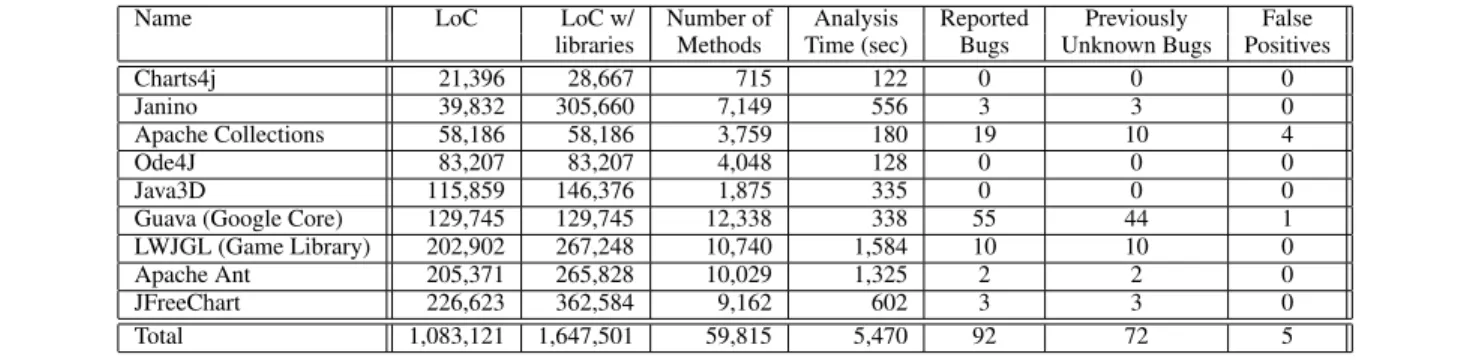
We evaluate CLARITYby applying it to nine mature and widely-used open source code bases (see Table 1). We conduct our exper-iments on an x86 64 Ubuntu 12.04 desktop machine with 8 GB of RAM and a dual-core 3 GHz processor. We evaluate our approach using the following metrics: (1) the number of performance bugs detected by CLARITY, (2) the number of false positives reported, and (3) the impact of fixing these bugs.
Table 1 summarizes the results of our experimental evaluation, with the benchmarks listed in order of increasing code size. Our benchmarks range from 21,396 to 226,623 lines of Java source code and contain between 715 and 12,338 methods (including external library calls). Since CLARITYalso analyzes the external libraries called by each application, the actual number of lines of code analyzed by the tool can be much larger (see third column of Table 1). We see that even though CLARITYperforms a non-trivial interprocedural static analysis, the running time of the tool is quite reasonable, with LWJGL taking the longest at 26.4 minutes. These times include the time to perform pointer analysis, as well as the time required to analyze the libraries for which the benchmarks depend on.
Most significantly, we see that CLARITYreports a total of 92 performance bugs, with only five of these being false positives. Furthermore, among the 92 true positives, 72 are previously unre-ported according to the SourceForge development logs. The num-bers in this table include only unique performance bugs; that is,
Name LoC LoC w/ Number of Analysis Reported Previously False libraries Methods Time (sec) Bugs Unknown Bugs Positives Charts4j 21,396 28,667 715 122 0 0 0 Janino 39,832 305,660 7,149 556 3 3 0 Apache Collections 58,186 58,186 3,759 180 19 10 4 Ode4J 83,207 83,207 4,048 128 0 0 0 Java3D 115,859 146,376 1,875 335 0 0 0 Guava (Google Core) 129,745 129,745 12,338 338 55 44 1 LWJGL (Game Library) 202,902 267,248 10,740 1,584 10 10 0 Apache Ant 205,371 265,828 10,029 1,325 2 2 0 JFreeChart 226,623 362,584 9,162 602 3 3 0 Total 1,083,121 1,647,501 59,815 5,470 92 72 5
Table 1. Experimental results: Performance Bugs Detected.
performance bugs that are inherited by a sub-class are not counted multiple times.
Finally, to evaluate CLARITY’s performance impact, we repair each of the identified performance bugs, for example, by adding additional fields to classes, passing extra parameters to methods, or transforming data structures (e.g., lists into sets). We then com-pare the execution time of the original and repaired programs on input sizes ranging from a few thousand to a few hundred thou-sand elements. In this evaluation, we observe speedups in the range 2.5-548.2×on inputs sizes of 50,000 and speedups between 6.6-3,350×on input sizes of 100,000. This empirical comparison be-tween the original and modified programs confirms that the redun-dant traversals identified by CLARITYindeed correspond to asymp-totic performance problems.
5.1 Discussion
We now explain the most commonly reported performance bugs and share some observations about the nature of the performance bugs detected by CLARITY.
RetainAll Performance Bug. TheRetainAllbug occurs in code that removes all elements in a collectionAthat are not also present in another collectionB(often passed as a parameter). The ineffi-ciency occurs whenB has a slow containment checking method that is invoked a linear number of times. This bug can typically be fixed by converting the parameter collectionB to a set, either within the algorithm or at its call site, or by more complicated means such as keeping an iterator on the parameter collection and advancing it accordingly to avoid redundant checks. In addition to appearing in doubly-nested loops, this bug can also appear in other ways, such as the pruning of multi-maps, removal of data points from a plot, and intersection of build resources while compiling a Java application. In fact, we observe some variant of theRetainAll
bug in four code bases, namely, Apache Ant, Guava, JFreeChart, and Apache Collections.
ContainsAll Performance Bug. TheContainsAllbug is similar toRetainAlland occurs in code that checks whether a collection contains all the elements in some other collection, which is often a method parameter. As in the RetainAll bug, we see that the flexibility of generic types for collection parameters can lead to severe performance degradation. We found several instances of this performance bug in Guava and Apache Collections.
FilterPredicate Bug. This bug occurs when a containment predi-catePis attached to a collectionC, and elements can only be added toCif they satisfyP. Typically, the root cause of the performance problem is an inefficient data structure used in the implementation of the predicate. We see several instances of this bug in the Guava libraries.
TransformPredicate Bug. This type of performance bug is simi-lar to theFilterPredicatebug. It appears when an inefficient pred-icate is used to identify elements that should be removed from a collection. Again, we find several occurrences of this type of per-formance bug in the Guava libraries.
ExtremeVal Bug. TheExtremeValperformance bug occurs when the maximum or minimum value of a list of elements is computed multiple times, even though the list does not change. An instance of this type of bug is the JFreeChart example from Figure 1. PatternMatching Bug. This bug occurs when checking a set of elements against a set of patterns. The redundant traversals could be avoided by combining the set of patterns into one pattern, sim-plifying it, and then checking the elements against this pattern. An instance of this bug arises in Apache Ant when testing if files in a directory satisfy a regular expression describing an include-path. False Positives. Four of the false positives in our experiment arise from imprecise virtual method call resolution. For example, in some cases, CLARITYbelieves that the target of a virtual method call may beLinkedList::containseven though it can only be
HashMap::contains. The fifth false positive arises when CLAR-ITYbelieves that a data structure is traversed multiple times in a loop that can be traversed only once. In this case, the code has a non-trivial loop invariant that CLARITYcannot reason about. Nature of Performance Bugs. We conclude this section with some observations about the nature of performance bugs uncovered by CLARITY.
First, while the majority of the bugs detected by CLARITYare
conceptuallyquite simple, they are not easily identifiable through either manual code review or simple static analysis. Due to the heavy use of abstraction in Java, the collection that is traversed is often hidden behind an interface, so identifying data structures that are accessed requires virtual method call resolution. Furthermore, the loop where the performance bug arises is typically defined in a different class or method from the code that actually traverses the data structure. Hence, the detection of such bugs requires fairly sophisticated interprocedural static analysis.
Second, even though there are conceptual similarities be-tween the performance bugs identified by CLARITY, different code snippets exhibiting conceptually similar bugs can be syn-tacticallyvery different. For example, a performance bug that is classified in the RetainAll category appears in a method called
createConsolidatedPieDataset, which tries to create a new dataset with keys above a certain threshold. Meanwhile, another instance of theRetainAllbug appears in the Apache collections in a method calledretainAlland looks very different from the JFreeChart instance of theRetainAllbug. Thus, despite conceptual similarities among various performance bugs detected by
CLAR-ITY, these bugs cannot be detected by performing syntactic pattern matching on program constructs.
Finally, our empirical evaluation sheds light on the difficulty of detecting these performance bugs during testing. First, several performance bugs identified by CLARITYarise in rarely executed program paths. For instance, recall the performance bug from Fig-ure 1, which is triggered when the user renders items in the shape of a candlestick. Since this shape is unlikely to be a popular choice, it is unlikely to be triggered during testing. Second, as observed in our empirical performance comparison between the original and repaired programs, the true cost of a performance bug may not be apparent unless tested with large inputs. Since most test suites are designed with thesmall input hypothesisin mind, they are unlikely to reveal these performance problems.
6.
Related Work
Automated Performance Bug Detection. Several recent projects use program analysis to automatically detect performance bugs. Some of these detect wasteful use of temporary objects [16, 35, 43, 44], others focus on inefficient or incorrect usage of collection data structures [34, 41, 42], and some use dynamic profiling to identify expensive computation that can be memoized [31].
The Toddler tool [32] uses dynamic instrumentation to iden-tify “likely redundant” computation by monitoring repetitive and partially-similar memory access patterns. Like Toddler, our work builds on the observation that repetitive traversal of collections likely constitutes a performance bug. Unlike Toddler, our method is purely static, so it incurs no run-time overhead and does not require that the programmer provide representative performance tests.
The PerfChecker tool [28] statically analyzes Android applica-tions to identify common performance bugs. Unlike CLARITY, Per-fChecker detects performance bugs related to GUI lagging, energy leaks, and memory bloat.
The X-ray tool [3] helps users diagnose performance problems related to configuration settings. X-ray uses a technique called per-formance summarization, which couples performance costs with dynamic information flow analysis. Unlike CLARITY, X-ray per-forms dynamic analysis and focuses on performance problems caused by user rather than developer error.
Trace analysisis a technique for identifying root causes of per-formance anomalies [15, 45]. For example, the TraceAnalyzer tool [15] constructs performance traces that capture the time-varying performance of program runs. Another approach [45] per-forms impact and causality analysis on traces to discover patterns that are correlated with performance problems. These techniques can shed light on a wide variety of performance anomalies, but they are not fully automated.
Classification and Impact of Performance Bugs. Jin et al. present a comprehensive study of performance bugs and propose a variety of rules to detect and repair likely performance bugs [25]. These rules, which are inspired from existing patches, perform pattern-matching over syntactic program constructs and require domain-specific knowledge about the classes of performance bugs that exist in a given application. A pattern-matching technique is also proposed in the context of databases [8].
Song and Lu use five open-source applications to study the use of statistical debugging for finding performance bugs [36]. They find that two kinds of statistical models involving branch predicates can help pinpoint root causes of performance problems. The idea is to use existing bug reports to gather similar efficient and inefficient computations and compute statistically significant predicates. While quite general, this approach relies on existing bug reports and on user-provided test parameters.
Zaman et al. find that, for Mozilla Firefox and Google Chrome, developers typically spend more time fixing performance bugs than functionality bugs [46].
Loop-Invariant Code Motion. The removal of redundant traver-sal bugs bears some similarity to loop invariant code motion (LICM), but the problems are quite different. LICM is typically applied to individual assignment statements, and it uses a low-level notion of loop-invariance that is based on reaching definitions. Thus, LICM is not capable of identifying redundant data structure traversals that are detected by our analysis. Of course, LICM also performs the actual optimization, rather than simply detecting the inefficiency.
Techniques for Estimating Computational Complexity. Recent work uses sophisticated static analyses to automatically esti-mate worst-case resource usage—such as running time—of pro-grams [20, 21, 23, 26], and the TrendProfiler tool uses profiling and dynamic analysis to estimateempirical computational com-plexity[19]. While these approaches can help programmers debug and understand performance problems, they do not automatically pinpoint them.
Necessary and Sufficient Preconditions. To detect redundant traversal bugs, our algorithm constructs dual over- and under-approximations of the program. Other static analyses that involve negation (or set complement) also make simultaneous use of neces-sary and sufficient conditions. In particular, the interplay between over- and under-approximations has been explored in path-sensitive static analysis [11], in precise reasoning for unbounded data struc-tures [12, 13], in the construction of method summaries [9], for analysis of confidentiality properties [7], and in typestate analy-sis [17].
May and Must Alias Analysis. May aliasanalysis [10, 27, 37, 38, 40] underlies almost any compiler optimization, bug detection, and verification technique. While not quite as common as may-alias analysis, must-alias analysis is also considered in several papers [2, 24, 30]. Our work simply utilizes may- and must-alias information and does not make contributions in this area.
7.
Conclusions
Modern software is written in languages such as Java and C# and makes heavy use of abstractions that allow difficult-to-detect performance bugs to creep into mature code bases. While modern compilers perform many types of sophisticated optimizations, they are ill-equipped to deal with performance bugs that cross many procedure and abstraction boundaries.
In this paper, we have introduced CLARITY, a purely static tool that effectively detects redundant traversal bugs. Our application of CLARITYto nine open source Java code bases identifies a large number of previously unknown performance bugs with a small number of false alarms. Once CLARITY identifies a redundant traversal bug, the repair is typically straightforward. Furthermore, as confirmed by our empirical evaluation, the repaired programs enjoy a significant performance benefit over the original programs. Although CLARITY targets a restricted class of performance problems, it is nonetheless a significant step towards automated static detection of performance bugs. In future work, we plan to expand the class of performance bugs that can be automatically detected. We also plan to explore techniques for automatically repairing the performance bugs identified by CLARITY.
Acknowledgments. We thank Thomas Dillig and Jia Chen for their valuable comments on early versions of this paper. This work was supported by NSF grants CNS-1138506 and DRL-1441009, and Air Force Research Laboratory under agreement number FA8750-12-2-0020
References
[1] A. Aiken, S. Bugrara, I. Dillig, T. Dillig, B. Hackett, and P. Hawkins. An overview of the Saturn Project. InPASTE, pages 43–48, 2007. [2] R. Z. Altucher and W. Landi. An extended form of must alias analysis
for dynamic allocation. InPLDI, pages 74–84. ACM, 1995. [3] M. Attariyan, M. Chow, and J. Flinn. X-ray: Automating root-cause
diagnosis of performance anomalies in production software. InOSDI, pages 307–320, 2012.
[4] T. Ball and S. Rajamani. The SLAM project: debugging system software via static analysis. InPOPL, pages 1–3, 2002.
[5] W. Bush, J. Pincus, and D. Sielaff. A static analyzer for finding dynamic programming errors.Software: Practice and Experience, 30 (7):775–802, 2000.
[6] C. Cadar, D. Dunbar, and D. R. Engler. Klee: Unassisted and au-tomatic generation of high-coverage tests for complex systems pro-grams. InOSDI, volume 8, pages 209–224, 2008.
[7] P. ˇCern`y and R. Alur. Automated analysis of Java methods for confi-dentiality. InCAV, pages 173–187. Springer, 2009.
[8] T. Chen, W. Shang, Z. Jiang, A. Hassan, M. Nasser, and P. Flora. Detecting performance anti-patterns for applications developed using object-relational mapping. InICSE, pages 1013–1024. ACM, 2014. [9] P. Cousot, R. Cousot, M. F¨ahndrich, and F. Logozzo. Automatic
inference of necessary preconditions. InVerification, Model Checking, and Abstract Interpretation, pages 128–148. Springer, 2013. [10] A. Deutsch. Interprocedural may-alias analysis for pointers: Beyond
k-limiting. InPLDI, pages 230–241. ACM, 1994.
[11] I. Dillig, T. Dillig, and A. Aiken. Sound, complete and scalable path-sensitive analysis. InPLDI, volume 43, pages 270–280, 2008. [12] I. Dillig, T. Dillig, and A. Aiken. Fluid updates: Beyond strong vs.
weak updates. InESOP, pages 246–266. 2010.
[13] I. Dillig, T. Dillig, and A. Aiken. Precise reasoning for programs using containers. InACM SIGPLAN Notices, volume 46, pages 187–200. ACM, 2011.
[14] I. Dillig, T. Dillig, A. Aiken, and M. Sagiv. Precise and compact modular procedure summaries for heap manipulating programs. In
PLDI, pages 567–577. ACM, 2011.
[15] A. Diwan, M. Hauswirth, T. Mytkowicz, and P. F. Sweeney. Traceana-lyzer: a system for processing performance traces.Software: Practice and Experience, 41(3):267–282, 2011.
[16] B. Dufour, B. G. Ryder, and G. Sevitsky. A scalable technique for characterizing the usage of temporaries in framework-intensive Java applications. InFSE, pages 59–70, 2008.
[17] S. J. Fink, E. Yahav, N. Dor, G. Ramalingam, and E. Geay. Effective typestate verification in the presence of aliasing. ACM Transactions on Software Engineering and Methodology (TOSEM), 17(2):9, 2008. [18] P. Godefroid, N. Klarlund, and K. Sen. DART: directed automated
random testing. InACM SIGPLAN Notices, volume 40, pages 213– 223. ACM, 2005.
[19] S. F. Goldsmith, A. S. Aiken, and D. S. Wilkerson. Measuring empir-ical computational complexity. InFSE, pages 395–404, 2007. [20] S. Gulwani. Speed: Symbolic complexity bound analysis. In
Com-puter Aided Verification, pages 51–62. Springer, 2009.
[21] S. Gulwani, K. K. Mehra, and T. Chilimbi. Speed: precise and effi-cient static estimation of program computational complexity. InACM SIGPLAN Notices, volume 44, pages 127–139. ACM, 2009. [22] T. A. Henzinger, R. Jhala, R. Majumdar, and G. Sutre. Software
verification with BLAST. InModel Checking Software, pages 235– 239. Springer, 2003.
[23] J. Hoffmann, K. Aehlig, and M. Hofmann. Multivariate amortized resource analysis. InACM SIGPLAN Notices, volume 46, pages 357– 370. ACM, 2011.
[24] S. Jagannathan, P. Thiemann, S. Weeks, and A. Wright. Single and loving it: Must-alias analysis for higher-order languages. InPLDI, pages 329–341. ACM, 1998.
[25] G. Jin, L. Song, X. Shi, J. Scherpelz, and S. Lu. Understanding and detecting real-world performance bugs. ACM SIGPLAN Notices, 47 (6):77–88, 2012.
[26] J. Knoop, L. Kov´acs, and J. Zwirchmayr. Symbolic loop bound com-putation for WCET analysis. InPerspectives of Systems Informatics, pages 227–242. Springer, 2012.
[27] W. Landi and B. G. Ryder. A safe approximate algorithm for interpro-cedural aliasing.ACM SIGPLAN Notices, 27(7):235–248, 1992. [28] Y. Liu, C. Xu, and S. Cheung. Characterizing and detecting
perfor-mance bugs for smartphone applications. InICSE, pages 1013–1024, 2014.
[29] D. Marinov and S. Khurshid. TestEra: a novel framework for auto-mated testing of Java programs. In16thIEEE Conference on Auto-mated Software Engineering, page 22, 2001.
[30] M. Naik and A. Aiken. Conditional must not aliasing for static race detection.ACM SIGPLAN Notices, 42(1):327–338, 2007.
[31] K. Nguyen and G. Xu. Cachetor: Detecting cacheable data to remove bloat. InProceedings of the 2013 9th Joint Meeting on Foundations of Software Engineering, pages 268–278. ACM, 2013.
[32] A. Nistor, L. Song, D. Marinov, and S. Lu. Toddler: Detecting perfor-mance problems via similar memory-access patterns. InICSE, pages 562–571. IEEE, 2013.
[33] K. Sen, D. Marinov, and G. Agha. CUTE: a concolic unit testing en-gine for c. InProceedings of the 10th European Software Engineering Conference, pages 263–272, 2005.
[34] O. Shacham, M. Vechev, and E. Yahav. Chameleon: adaptive selection of collections. InACM SIGPLAN Notices, volume 44, pages 408–418. ACM, 2009.
[35] A. Shankar, M. Arnold, and R. Bodik. Jolt: lightweight dynamic analysis and removal of object churn. InACM SIGPLAN Notices, volume 43, pages 127–142. ACM, 2008.
[36] L. Song and S. Lu. Statistical debugging for real-world performance problems. InOOPSLA, NY, USA, 2014. ACM.
[37] M. Sridharan and R. Bod´ık. Refinement-based context-sensitive points-to analysis for Java. ACM SIGPLAN Notices, 41(6):387–400, 2006.
[38] B. Steensgaard. Points-to analysis in almost linear time. InPLDI, pages 32–41. ACM, 1996.
[39] R. Vall´ee-Rai, P. Co, E. Gagnon, L. Hendren, P. Lam, and V. Sundare-san. Soot-a Java bytecode optimization framework. InProceedings of the 1999 Conference of the Centre for Advanced Studies on Collabo-rative research, page 13. IBM Press, 1999.
[40] R. P. Wilson and M. S. Lam. Efficient context-sensitive pointer analysis for c programs.ACM SIGPLAN Notices, 30(6):1–12, 1995. [41] G. Xu. CoCo: sound and adaptive replacement of Java collections. In
ECOOP 2013–Object-Oriented Programming, pages 1–26. Springer, 2013.
[42] G. Xu and A. Rountev. Detecting inefficiently-used containers to avoid bloat.ACM SIGPLAN Notices, 45(6):160–173, 2010.
[43] G. Xu, M. Arnold, N. Mitchell, A. Rountev, and G. Sevitsky. Go with the flow: profiling copies to find runtime bloat. InACM SIGPLAN Notices, volume 44, pages 419–430. ACM, 2009.
[44] G. Xu, M. Arnold, A. Rountev, and G. Sevitsky. Finding low utility data structures. InPLDI, pages 174–186. ACM, 2010.
[45] X. Yu, S. Han, D. Zhang, and T. Xie. Comprehending performance from real-world execution traces: A device-driver case. InASPLOS, pages 193–206. ACM, 2014.
[46] S. Zaman, B. Adams, and A. E. Hassan. A qualitative study on performance bugs. InMining Software Repositories. ACM, 2012.
![Figure 6. Analysis rules for computing traversal and write foot- foot-prints. The notations A 1 hA 2 i and Φ[v/A] are defined in Equa-tions 1 and 2, and operator is defined in Equation 3.](https://thumb-us.123doks.com/thumbv2/123dok_us/9780456.2469780/5.918.486.824.111.576/figure-analysis-computing-traversal-notations-defined-operator-equation.webp)