MONETARY POLICY IN NAMIBIA, 1993-2011
BY
JOHANNES PEYAVALI SHEEFENI SHEEFENI
Submitted in fulfilment of the requirements for the degree of Doctor Philosophiae Commercii in the Faculty of Business and Economic Sciences at the Nelson
Mandela Metropolitan University
March 2013
DECLARATION
I, Johannes Peyavali Sheefeni Sheefeni, 209932082, hereby declare that the thesis for Doctor Philosophiae is my own work and that it has not previously been submitted for assessment or completion of any postgraduate qualification to another University or for another qualification.
Johannes Peyavali Sheefeni Sheefeni
Official use:
In accordance with Rule G4.6.3,
4.6.3 A treatise/dissertation/thesis must be accompanied by a written declaration on the part of the candidate to the effect that it is his/her own work and that it has not previously been submitted for assessment to another University or for another qualification. However, material from publications by the candidate may be embodied in a treatise/dissertation/thesis.
i
ACKNOWLEDGEMENT I would like to extend my special thanks and appreciation to:
** The Almighty God for giving me this opportunity to pursue my studies and particularly for this project.
** My supervisor, Prof. M.K. Ocran, for the advice and support he provided to me during my studies at Nelson Mandela Metropolitan University and, particularly for his constructive criticism in the course of writing this report.
** My grandmother, Elizabeth Nashilongo Mushelenga, for her continuous support and motivation during the writing of this report.
** The following institutions for financial support: Namibian Government Scholarship and Training Program (NGSTP) as well as National Council of Higher Education (NCHE). ** Last, but not least, to all my family members and friends, for their continuous moral and financial support.
JOHANNES PEYAVALI SHEEFENI SHEEFENI March 2013
ii
TABLE OF CONTENTS
Abstract...viii
Abbreviations...ix
CHAPTER ONE: INTRODUCTION...1
1.1 Background and Problem Statement...1
1.2. Research Objectives...4
1.3 Relevance of the Study...4
1.4. Structure of the Study...7
CHAPTER TWO: MONETARY POLICY: AN OVERVIEW OF NAMIBIA’S MONETARY POLICY...10
2.1 Introduction...10
2.2 Definitions...10
2.3 Monetary Policy Frameworks...11
2.3.1 Exchange rate targeting...13
2.3.2 Monetary targeting...20
2.3.3 Interest-rate targeting………...………...25
2.3.4 Discretionary monetary policy………...……….28
2.3.5 Nominal Gross Domestic Product Level Targeting...30
2.3.6 Inflation targeting...32
2.3.7 Monetary Policy Rule...40
2.3.8 Unconventional (Heterodox) Monetary Policy...43
2.4 Monetary policy in small open economies...48
2.5 Evolution of Monetary Policy in Namibia...52
2.5.1 The History of Monetisation in Namibia...52
2.5.2 The Evolution of Central Banking in Namibia...54
2.5.3 Institutional Arrangements...55
2.5.4 Monetary Policy Formulation...56
2.5.5 Institutional framework...57
2.5.6 Important mandates in relation to monetary policy...57
iii
2.5.8 Monitoring economic and financial trends...57
2.6 Monetary Policy Tools...58
2.6.1 Seven-day repurchase transaction………...………..……..59
2.6.2 Call Account………..60
2.6.3 Bank of Namibia bills………60
2.6.4 Other operational tools………...……….60
2.7 Monetary Policy Communication...60
2.8 Independence of Bank of Namibia...60
2.9 An Evaluation of Monetary Policy in Terms of Macroeconomic Indicators…………63
2.9.1 Inflation……...………..………....……….63
2.9.2 Interest Rates………...………..………..65
2.9.3 Money Supply……….………....…..66
2.9.4 Size of Bank Credit to GDP………...……….67
2.9.5 GDP growth…………...………...………...……….68
2.10 Conclusion...69
CHAPTER THREE: LITERATURE REVIEW...71
3.1 Introduction...71
3.2 Monetary Policy Transmission Mechanisms...71
3.2.1 Interest rate channel...72
3.2.2 The credit channel...78
3.2.3 Exchange rate channel...84
3.2.4 Asset price channel...90
3.2.5 Exchange rate pass-through...93
3.2.6 A Currency Board Framework of Monetary Transmission……….97
3.3 Conclusion...101
CHAPTER FOUR: METHODOLOGY...102
4.1 Introduction...102
4.2 Theoretical Framework...102
4.3 Empirical Models ………...………...…105
4.3.1 The Generic Model………..………..……106
iv
4.3.3 The Credit Channel………...……….107
4.3.4 Exchange Rate Channel………...………108
4.3.5 The Money Effect Model………...………108
4.3.6 Exchange Rate Pass-Through Model………...…..109
4.4 Analytical Framework...110
4.5 Data, Data Sources and Data Measurements...124
CHAPTER FIVE: EMPIRICAL ESTIMATIONS AND ANALYSIS...126
5.1 Introduction...126
5.2 Detailed Estimation...126
5.2.1 The Generic Model...132
5.2.2 The Interest Rate Channel...139
5.2.3 The Credit Channel...145
5.2.4 The Exchange Rate Channel...151
5.2.5 The Money Effect Model...156
5.2.6 The Exchange Rate Pass-Through...162
5.3 Conclusion...172
CHAPTER SIX: SUMMARY, CONCLUSIONS AND POLICY RECOMMENDATIONS...173
6.1 Introduction...173
6.2 Summary...173
6.3 Issues for Future Research...178
References...180
APPENDIX………...………..……….. 210
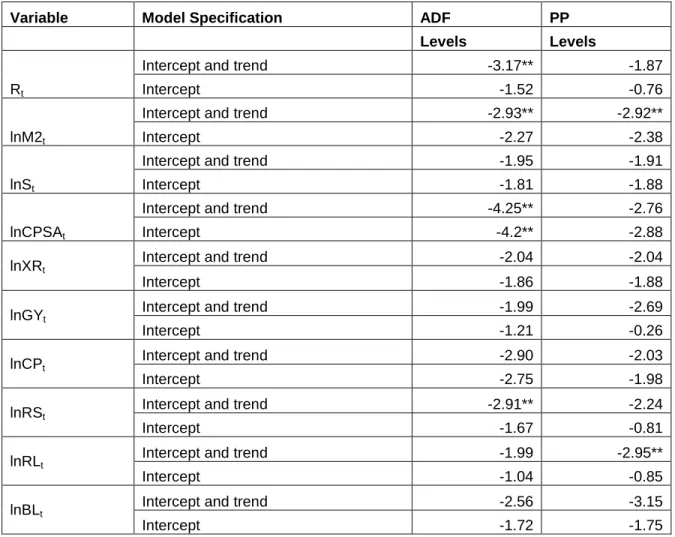
List of tables Chapter 5 Table 5.1: Unit Root Tests: Augmented Dickey-Fuller (ADF) and Phillips Perron (PP) in levels...127
v
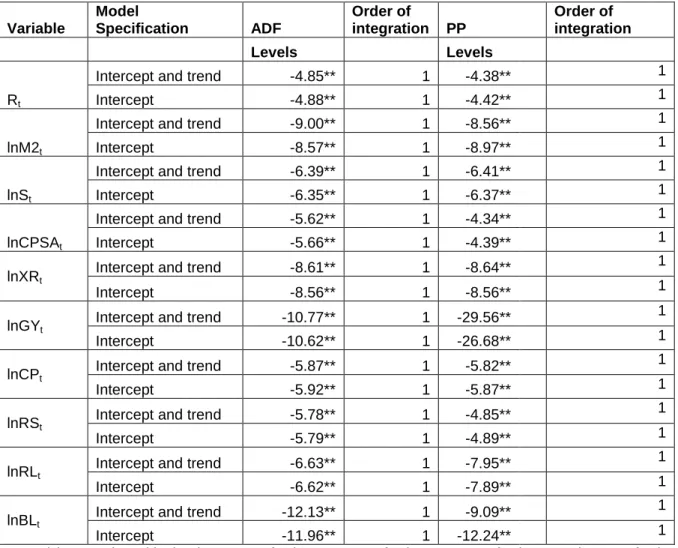
Table 5.2: Unit Root Tests: Augmented Dickey-Fuller (ADF) and Phillips Perron (PP) in differences...128 Table 5.3: Unit Root Tests: (KPSS) in levels and differences...130 Table 5.4: Johansen Co-integration Test: The Generic Model...132 Table 5.5: Granger-Causality Tests: The General Model...133 Table 5.6: Variance Decomposition for the Generic Model...138 Table 5.8: Johansen Co-integration Test: The Interest Rate Channel...139 Table 5.9: Granger-Causality Tests: The Interest Rate Channel...140 Table 5.10: Variance Decomposition for the Interest Rate Channel...144 Table 5.11: Johansen Co-integration Test: The Credit Channel...145 Table 5.12: Granger-Causality Tests for the Credit Channel...146 Table 5.13: Variance Decomposition for the Credit Channel...150 Table 5.14: Johansen Co-integration Test: The Exchange Rate Channel...151 Table 5.15: Granger-Causality Tests for the Exchange Rate Channel...151 Table 5.16: Variance Decomposition for the Exchange Rate Channel...153 Table 5.17: Johansen Co-integration Test: The Money Effect Model...156 Table 5.18: Granger-Causality Tests for the Money Effect Model...157 Table 5.19: Variance Decomposition for the Money Effect Model...161 Table 5.20: Johansen Co-integration Test: The Exchange Rate Pass-Through Model...162 Table 5.21: Granger-Causality Tests for Exchange Rate Pass-Through...163 Table 5.22: Variance Decomposition for the Exchange Rate Pass-Through………….165 Table 5.23: Johansen Co-integration Test: The Exchange Rate Pass-Through Error Correction Model...166 Table 5.24: Error Correction Model (ECM) Estimation...167
vi
List of Graphs Chapter 2
Figure 2.1: Impossible Trinity...50
Figure 2.2: Repo rates for Namibia and South Africa: 1993 – 2011………..63
Figure 2.3: CPI Inflation in Namibia and South Africa: 1993 – 2011………..64
Figure 2.4: Interest rates in Namibia: 1993 – 2011………...65
Figure 2.5: Growth of Money Stock in Namibia: 1993 – 2011……….66
Figure 2.6: Size of Bank Credit/GDP: 1993 – 2011……….….68
Figure 2.7: Gross Domestic Product for Namibia: 1993 – 2011….………...………….…69
Chapter 5 Figure 5.1: Impulse Responses of Repo Rate: The Generic Model………..…..…135
Figure 5.2: Impulse Responses of Output and Consumer Prices: The Generic Model……….….136
Figure 5.3: Impulse Responses of Short-term Interest Rate: The Interest Rate Channel………..………...141
Figure 5.4: Impulse Responses of Output and Consumer Prices: The Interest Rate Channel……….………...……….143
Figure 5.5: Impulse Responses to Credit Shocks: The Credit Channel………..147
Figure 5.6: Impulse Responses of Output, Consumer Prices and Bank Loans: The Credit Channel...148
Figure 5.7: Impulse Responses to Exchange Rate Shocks: The Exchange Rate Channel………..………...153
Figure 5.8: Responses of Output, Consumer Prices and Exchange Rate: The Exchange Rate Channel………….………...………154
Figure 5.9: Impulse Responses to Money Supply Shocks: The Money Effect Model………...………...158
Figure 5.10: Responses of Output, Consumer Prices and Money Supply: The Money Effect Model...159
vii
Figure 5.11: Impulse Responses to Exchange Rate Shocks: Exchange Rate Pass-Through Model...164
viii ABSTRACT
This thesis investigated the role of monetary policy in Namibia for the period 1993 to 2011. It aims at achieving six objectives. First, it reviews the evolution of monetary policy in Namibia for the period 1980 to 2011. Second, it investigates the interest rate channel of the monetary policy transmission mechanism in Namibia. Third, it analyses the credit channel of the monetary policy transmission mechanism in Namibia. Fourth, it evaluates the exchange rate channel of the monetary policy transmission mechanism in Namibia. Fifth, it studies the money effect model in the context of the monetary policy transmission mechanism in Namibia. Sixth, it examines the exchange rate pass– through (ERPT) to domestic prices in Namibia.
In order to achieve the objectives of the relative importance of the different channels of monetary policy transmission, a structural vector autoregressive model of the Namibian economy is constructed. Specifically the responses of the output and prices to monetary policy shocks for Namibia over the quarterly period 1993:Q1 to 2011:Q4 are investigated using impulse response functions and forecast variance error decompositions obtained from a structural vector autoregressive model (SVAR). The thesis also examined the exchange rate pass-through from exchange rate to domestic prices using both SVAR and the single equation error correction model (ECM). Estimation results on the different channels of monetary policy transmission mechanism showed that the interest rate channel and the credit channel are effective in transmitting monetary policy actions. The exchange rate channel is also operative but not effective. The money effect model confirms that inflation in Namibia is not a monetary phenomenon. The results of the pass-through relationship showed that there is an incomplete but high exchange rate pass-through from exchange rate to domestic prices.
Keywords: Monetary policy, exchange rate, inflation, nominal anchor, structural vector autoregressive, South African rand, Namibian dollar, interest rate, credit
ix
ABBREVIATIONS ADB – African Development Bank
ADF – Augmented Dickey-Fuller BON – Bank of Namibia
CMA – Common Monetary Area CPI – Consumer Price Index ECM – Error Correction Model EMS – European Monetary System ERPT – Exchange Rate Pass-Through ERM - Exchange Rate Mechanism GDP – Gross Domestic Product
GIRF - Generalized Impulse Response Function IMF – International Monetary Fund
LOOP - Law of One Price
MPC – Monetary Policy Committee
MPTM - Monetary Policy Transmission Mechanism NEER – Nominal Effective Exchange Rate
OLS – Ordinary Least Square
REER – Real Effective Exchange Rate SA – South Africa
SARB - South African Reserve Bank SVAR – Structural Vector Autoregressive SWA – South West Africa
USA – United States of America VAR – Vector Autoregressive
1
CHAPTER ONE 1. INTRODUCTION 1.1 Background and Problem Statement
Before independence Namibia was known as South West Africa and was assigned to South Africa by the League of Nations after World War I in 1920. This led to the merging of Namibia into the South African monetary system. In fact, the South African Reserve Bank (SARB) has maintained a branch in Windhoek since 1961 (Bank of Namibia [BON], 2002:41-42). Among its roles were the distribution of currency (notes and coins), administration of exchange controls, provision of clearing facilities to commercial banks and being a banker to commercial banks (Kalenga, 2001:3). Furthermore, major South African banking institutions were established, primarily aimed at financing commerce and trade.
After independence, monetary policy conduct in Namibia incorporated the practice of fixed exchange rate regimes where the exchange rate was the main policy instrument used to control inflation in order to maintain financial stability (BON, 2008). This has been the practice since 1990, at the time of independence, when Namibia was confronted with a situation of choosing between monetary policy options and exchange rate regimes. The two options that were available to Namibia were (1) to leave the Common Monetary Area (CMA1) to pursue an independent monetary policy, such as the use of interest rate by the central bank on money supply to influence the economy, or (2) to remain in the CMA. The country chose the second option. In the process the country‘s exchange rate was pegged to that of South Africa, leading to the assertion that monetary policy had been abandoned.
1
The CMA was formerly known as the Rand Monetary Area, which consisted of Botswana, Lesotho, Swaziland and South Africa. Botswana moved out in 1976 and Namibia joined in 1990 after attaining independence. The CMA is now comprised of the following members: Lesotho, Swaziland, Namibia and South Africa.
2
Subsequent to joining the CMA, a separate bilateral agreement between Namibia and South Africa on features of the peg was concluded in 1992 (Kalenga, 2001:3). The 1992 bilateral agreement was in anticipation of the peg, which was formally instituted in 1993, after the introduction of the Namibian currency, the Namibian dollar. The Namibian dollar was then pegged to the South African rand on a one-to-one basis in line with the requirement to satisfy the backing rules (Kalenga, 2001:3). Even after the introduction of the Namibian dollar, the rand remained legal tender in Namibia.
As a member of a CMA, Namibia does not engage in any active discretionary monetary policy. This is primarily subordinated to South Africa‘s conduct of monetary policy. The fixing of the Namibian dollar to the South African rand was done to attain the ultimate objective of price stability, which is the aim of Namibia‘s monetary policy. That is why maintenance of the peg appear as an intermediate target that ensures the ultimate goal of price stability by importing stable inflation from the anchor country, in this case South Africa. According to Kalenga (2001:4), the experience of countries with a fixed exchange rate has generally demonstrated that, provided the exchange rate is fixed to a low inflation rate and a stable currency, the attainment of exchange rate stability (implied by pegging the Namibian dollar to the rand) will help to ensure that domestic prices approximate prices in South Africa. Therefore, under this monetary arrangement, economic agents‘ expectations are heavily dependent on the movements of the nominal exchange rate. The influence of nominal exchange rates in the formation of expectations creates an indexation mechanism in the price-setting process (Baþçý, Özel & Sarýkaya, 2008:475). Therefore efficient conduct of monetary policy is the pre-requisite for it to exert a systematic influence on the economy in a forward-looking manner.
Exchange rate pegging also suggests that developments of the South African rand have both a direct and an indirect impact on the Namibian dollar. This occurs by implication through imported goods, especially since South Africa is Namibia‘s main trading partner. Records show that about 80 per cent of Namibia‘s trade is with South Africa (ADB, 2009:2). It is expected that imports from South Africa will play a significant role in
3
determining inflation in Namibia. Moreover, Namibia‘s monetary policy is by default determined by South Africa because of the country‘s membership of the CMA. It poses difficulties in examining the monetary policy transmission mechanisms. Therefore there is a need to examine what these developments mean for the transmission mechanisms of monetary policy in Namibia.
Although the specific classification of transmission mechanisms varies at times, the following four channels of monetary policy transmission are generally distinguished in literature: (1) interest rate channel; (2) credit channel; (3) exchange rate channel and (4) asset price channel.
The transmission of monetary policy depends on the openness of the capital account and the exchange rate regime (Saxena, 2008:82). Namibia is a small open economy and there has been a steady increase in trade with the rest of the world. However, a number of implications arise, given the current monetary policy arrangement in place. The starting point is the famous trilemma from the Mundell-Fleming model that states that countries cannot simultaneously fix their exchange rate, have an open capital account and pursue an independent monetary policy. If the capital account is open, then domestic monetary policy will be determined by the exchange rate regime and the degree of substitutability between domestic and foreign financial assets. On the other hand, the pro-fixed exchange rate outlook has influenced the formulation and conduct of monetary policy in Namibia. There are instances where the BON has sometimes opted for tight monetary policy for the sake of defending the exchange rate in the absence of inflationary pressures or in the absence of serious heated economic activities. Against this background, questions are raised about what the monetary policy transmission channels in Namibia are and which of these channels is most effective. In order to answer these questions, a number of research objectives have been identified.
4 1.2. Research Objectives
The main objective is to study monetary policy in Namibia. Although monetary policy has implications and interacts with macroeconomic variables, the scope of this thesis is limited to the following specific objectives:
(1) To review the evolution of monetary policy in Namibia for the period 1980 to 2011.
(2) To investigate the interest rate channel of the monetary policy transmission mechanism in Namibia.
(3) To analyse the credit channel of the monetary policy transmission mechanism in Namibia.
(4) To evaluate the exchange rate channel of the monetary policy transmission mechanism in Namibia.
(5) To study the money effect model in the context of the monetary policy transmission mechanism in Namibia.
(6) To examine the exchange rate pass–through (ERPT) to domestic prices in Namibia.
1.3 Relevance of the Study
This study is particularly relevant for a small open economy such as that of Namibia. For a long time Namibia‘s monetary authorities have considered exchange rate stability as the primary goal of the monetary policy. The transmission of monetary policy depends on the openness of the capital account and the exchange rate regime. Namibia is a small open economy and there has been a steady increase in trade with the rest of the world. However, a number of implications arise, given the current monetary policy arrangement in place.
5
First and foremost, monetary policy can affect economic variables through different mechanisms. It is inevitable that in order to conduct monetary policy successfully, monetary authorities need to segregate the relevant transmission mechanisms in the economy. The different transmission mechanisms have different implications on how monetary policy can stabilise output and inflation. Moreover, different channels of monetary policy transmission raise a variety of empirical and policy questions about the modalities of monetary theory and policy that need to be empirically tested. The key question is how do macroeconomic variables (especially output and the price level) respond to changes in the interest rate (monetary policy instrument)?
Secondly, the obvious implication for Namibia is that a country cannot simultaneously fix its exchange rate, have an open capital account and pursue an independent monetary policy. This is often used as justification for the fact that the exchange rate channel under a fixed exchange rate is inactive. For example, according to Uanguta and Ikhide (2002), the exchange rate channel of monetary transmission is not active in Namibia because the country is pursuing a fixed exchange rate. This is because domestic interest rates adjust in such a way that they leave the exchange rate unchanged. However, even if a nominal exchange rate is fixed, monetary policy may be able to affect the real exchange rate by acting on the price level. In this way monetary policy retains its ability to affect net exports, though to a much more limited extent and with much longer lags (Afandi, 2005:49). Therefore, it is worth examining this channel empirically to make pronouncements in terms of policy-making.
Thirdly, in studying monetary transmission mechanism it is very difficult to find truly exogenous variables because practically every variable in the monetary/financial sector is to some extent endogenously determined given well established financial markets and rational expectations. Therefore, employing a general (unrestricted) vector autoregressive (VAR) modeling framework may impose limitations. The study by Uanguta and Ikhide (2002) utilized this approach on the premises of the argument of Bernake and Mihov (1998:873) that‖… the fact that tracing the dynamic response of the economy to a monetary policy innovation provides a means of observing the effects of
6
policy changes under minimal identifying assumptions justifies the emphasis of the VAR-based approach on monetary policy shocks‖. This may have led to a deficiency in modelling the effects of monetary policy shocks in the sense that in an unrestricted approach the structural innovations have a fundamentally different role. That is, these errors simply represent the aggregate effects of a large number of individually unimportant variables, and hence lack economic significance. In response to these difficulties a structural vector autoregressive framework is commended which allows to impose plausible restrictions that will allow for careful modelling of the impulse response to monetary policy. SVAR models first decompose all variables into their expected and unexpected parts. The identifying restrictions are then imposed only on the unexpected part, where plausible identifying restrictions are easier to find (Gottschalk, 2001:18-25). With respect to monetary policy, the SVAR approach recognizes that the policy instrument is for the most part endogenously determined, which precludes treating this variable as exogenous. Hence, this exercise is crucial in monetary policy analysis and this study will therefore address the issue.
Fourthly, in their analysis of monetary policy transmission in Namibia, Uaguta and Ikhide (2002) used the Cholesky decomposition; however, this approach imposes a restriction on the ordering of the variables in the VAR. To avoid the impact of the ordering restriction, there is a particular way of dealing with it. Some researchers introduced the generalised impulse response function (GIRF) as an alternate tool to the traditional Cholesky impulse response and variance decomposition (Koop et al, 1996; Pesaran & Shin, 1998). The main advantage of the suggested generalised approach is that it is not affected by the ordering of the variables used in the VAR model. This also motivates the researcher to address this issue.
Fifthly, the study by Uanguta and Ikhide (2002) did not estimate the money effect model in the context of monetary policy transmission separately. This is critical for Namibia, since the major concern in an exchange rate pegging arrangement involves an obligation by the central bank (BON) to limit money creation to levels comparable to those of the country (South Africa) to which its domestic currency is pegged, because
7
money creation is associated with domestic inflation pressures. As an alternative channel of monetary transmission from the viewpoint of the monetarist, this channel downplays the role of interest rates and liquid asset adjustment in the transmission mechanism, reducing the process to a direct link between changes in aggregate money supply and absorption (Bolnick, 1991). According to this view, prices and output respond to monetary impulses because households and businesses fail to anticipate or perceive correctly all the future implications of past and current actions (Meltzer, 1995). This is also a motivation to address this deficiency in this study, in order to determine whether the Namibian authorities applied corrective measures by maintaining the peg through the control of monetary growth. If so, this would imply that the BON actively pursued monetary policies that ensured that effectiveness.
Finally, Uanguta and Ikhide‘s (2002) work is the most recent study exclusively on monetary policy in Namibia. That means that for nine years no new data have been gathered, even though the situation is likely to have changed in respect of the channels they investigated, namely the interest rate and credit channels. The same is true of other channels that they did not investigate, particularly the exchange rate channel. This is another motivation for this study: to address time-gap deficiency regarding monetary policy in Namibia.
1.4. Structure of the Study
The rest of the thesis is organized into five chapters, as follows: Chapter two presents an overview of Namibia‘s monetary policy, particularly an analysis of the various monetary policy frameworks that are discussed, by comparing their advantages and disadvantages. The discussion extends to monetary policy rule. This is done with the aim of enhancing understanding of how the central bank alters nominal interest rates in response to development in inflation and macroeconomic activities. The chapter also looks at the alternative or unconventional monetary policy to understand how the central bank responds in the wake of a financial crisis. The discussion also touches on the situation of small open economies, of which Namibia is one, by taking an interest in the
8
problem trilema (having free capital flows, a fixed exchange rate and independent monetary policy). Finally, the chapter discusses the evolution of monetary policy in Namibia. Thereafter, an evaluation of monetary policy in terms of macroeconomic indicators is also conducted.
Chapter three presents a survey of a literature review for each channel of the monetary policy. The aim of this discussion is to find gaps in the literature that may be filled in for the purpose of this study. The discussion is divided into two parts, namely theoretical literature and empirical literature. The theoretical section presents various theoretical arguments on how monetary policy impulses are transmitted to the real sector. The discussion is extended to look at how changes in the exchange rate alter relative prices, better known as exchange rate pass-through (ERPT). The empirical literature reviews the empirical modelling of monetary policy shocks. Subsequently, empirical evidence on the channels of monetary policy transmission, both locally and internationally, are discussed.
Chapter four presents the methodology employed in conducting empirical analysis. In doing so the chapter reviews the VAR framework, its critics and a formal exposition of the VAR model. The chapter extends the discussion to the identification strategies. It also presents the construction of an SVAR model for Namibia. This model is estimated to assess the relative strength of channels of monetary policy transmission in Namibia. A brief discussion on the various steps of analysis is also presented. Finally, the chapter presents the data, data sources and data measurements.
Chapter five presents the empirical estimation of the six specifications of the SVAR model and that of the price-generating process (ERPT) of the Namibian economy. These results are used in examining the extent to which these specifications are able to identify the effects of monetary policy shocks in Namibia. In doing so the chapter analyses the impulse response function of each variable to a monetary policy tightening shock based on individual model specification. The specifications, together with their
9
identification assumptions, are assessed by comparing the implied dynamic responses to monetary policy disturbances with the predictions derived from the theory.
Chapter six concludes the thesis. It briefly highlights the major empirical findings and makes some policy recommendations. The chapter also extends the discussion on the shortcomings of this study and makes suggestions for future research.
10
CHAPTER TWO
2. AN OVERVIEW OF NAMIBIA’S MONETARY POLICY 2.1 Introduction
This chapter presents a historical overview and background of Namibia‘s monetary policy. The chapter is divided into eight sections. In section 2.2 a brief discussion on the definition of monetary policy is presented. This is done with the aim of understanding the meaning of monetary policy. An overview of different monetary policy frameworks is presented in section 2.3. Section 2.4 discusses monetary policy in small open economies to contextualise the operations of monetary policy in Namibia. The evolution of monetary policy in Namibia is presented in section 2.5. The monetary policy tools used in Namibia are discussed in section 2.6. Section 2.7 gives a brief description of monetary policy communication in terms of how monetary policy decision information is conveyed to the economic agents. A discussion on the independence of the Central Bank of Namibia is presented in section 2.8. After having discussed the general aspect of monetary policy, a specific case for monetary policy evaluation in terms of macroeconomic indicators in Namibia is presented in section 2.9. Section 2.10 concludes the chapter.
2.2 Definitions
Monetary policy can be defined in two ways, namely the narrow and broader definition. In its narrow concept monetary policy can be defined as the measures aimed at controlling money supply (CBK, 1988:4). Kalenga (2001:4) defines monetary policy as the action of the central bank to influence the short-term interest rates, supply of money and credit to achieve certain objectives. This is often referred to as discretionary monetary policy where decisions are usually taken on the basis of the prevailing economic conditions. However, other researchers have deemed it appropriate to define the concept of monetary policy in harmony with monetary policy goals and as one of the central bank‘s functions. Patnaik and Shah (2007:3) define monetary policy as the
11
management of money supply and interest rate by central banks to influence prices and employment. Therefore monetary policy is defined as ―the set of procedures and measures taken by monetary authorities to manage money supply, interest and exchange rates and to influence credit conditions to achieve certain economic objectives‖. The common view of this definition is that it appears to be more consistent with the practical applications of monetary policy in the real world. It is practical in the sense that monetary policy objectives vary among countries, hence the link between the instruments of monetary policy and their ultimate goals (Caprio & Honohan, 1990:3).
A monetary policy instrument is defined as a tool that central banks use to reach their operational targets. Various measures can be employed by the central bank to meet such targets (BON, 2008:9). An operational target is further defined as an economic variable that the central bank wants to influence, largely on a day-to-day basis, through its monetary policy instruments (BON, 2008:8).
2.3 Monetary Policy Frameworks
Conducting monetary policy requires the central bank to choose the appropriate monetary-policy framework. A monetary-policy framework serves as a means to achieve monetary policy objectives. In its most basic form, a monetary-policy framework comprises two methods, namely monetary policy based on rules, and monetary policy based on discretion (Bordo & Schwartz 1997; Tuma 2000). However, Bordo and Schwartz (1997) define monetary-policy framework as a set of monetary arrangements and institutions accompanied by a set of expectations by the public with respect to policy-makers‘ action and expectations by policy-makers about public‘s reaction to their actions.
There is a tendency of change in the monetary-policy frameworks that is they are constantly evolving in response to new developments in economic and financial markets. Maumela (2010:87) highlighted that a certain theoretical framework may be a trend for central banks around the world in one era, and out of favour in the next. In the
12
1970s, monetary targeting was a popular monetary-policy framework adopted by several countries such as the United States, Canada and the United Kingdom. However, this framework was not successful in controlling inflation in these countries. By the early 1980s, it was very clear that the relationship between monetary aggregates, and inflation and nominal income had broken down and all three countries formally abandoned monetary targeting. Hence, this is a good example of this was the highs and lows of monetarisms in the 1980s.
The traditional rule for central banks‘ objectives involves price stability and economic growth. A number of prominent central banks, including the European Central Bank, Bank of England and Bank of Japan, have adopted price stability as the single objective of monetary policy. The Federal Reserve of the USA continues to pursue multiple objectives of monetary policy, including a) maximum employment, b) stable prices, and c) moderate long-term interest rates. On the other hand, central banks in a number of developing countries have exchange rate management as an objective. The transmission mechanism involves the process through which changes in the monetary policy are transmitted to the ultimate objectives, hence the name ―monetary policy transmission mechanism‖ (Reddy, 2002:3). In general, operating procedures refer to the day-to-day implementation of monetary policy by central banks through various instruments (classified into two broad categories, namely direct and indirect instruments). However, there are factors that influence the choice of a monetary policy strategy that the monetary authorities follow, including: (i) the form of the government system, (ii) economic and legal systems, (iii) the level of expertise in monetary policy matters that exists both inside and outside the central bank, (iv) the policy history of a country, (v) the analytical capacities of a central bank and (vi) institutional arrangements and the structure of the financial sector (Mishkin, 1999).
Neupauerova and Vravec (2007:220) discuss three main monetary policy frameworks, namely monetary targeting, exchange rate targeting and inflation targeting. However, the following basic monetary-policy frameworks are found in the literature: exchange
13
rate targeting, monetary targeting, interest rate targeting, discretionary monetary policy, nominal income targeting and inflation targeting.
Each of these issues is dealt with in this discussion; the Namibian experience is touched upon briefly in a later section.
2.3.1 Exchange rate targeting
Historically, exchange rate targeting is the earliest monetary policy strategy used by central banks. In the literature exchange rate targeting is better known as ―rule-directed policy-making‖ (Kahveci and Sayilgan, 2006), meaning that monetary policy conduct is based on the exchange rate as a nominal anchor, better known as exchange rate targeting.
The exchange rate targeting regime is defined as a monetary-policy regime whose primary focal point is the level of the exchange rate (Calvo et al., 1995). Under this regime the control is on the level of and movements in the level of the exchange rate in determining the stance of the monetary policy. This implies that the exchange rate is the epic of macroeconomic policy. In fact, countries practise monetary policy based on the exchange rate as a nominal anchor. In particular, this practice involves the use of the nominal exchange rate as a nominal anchor that can help in controlling domestic inflation (Mishkin, 1998:82). Chow and Kim (2003:333) articulate that using a nominal anchor serves as a stabilisation policy for domestic prices in the economy. They argue that a nominal anchor would serve the purpose of price stabilisation, irrespective of economic status. It is usually practised in small, yet relatively open economies following the stabilisation of inflation when credibility is rather low (Wagner, 2000). Ghosh et al (1996:6) also support this argument by indicating that countries with low credibility can use an exchange rate target as an anti-inflationary policy. This is because a pegged exchange rate is often meant to import credibility into countries with a high inflation rate to achieve a lower inflation rate effectively (Mishkin, 1998:82).
14
Wessels (2007:708) further highlights that the exchange rate target can be set at different levels because there are different levels of inflexibility. These include conventional fixed pegs, crawling pegs, horizontal bands, crawling bands or a hard (fixed) peg exchange rate, such as currency board and dollarisation (El-Mefleh, 2004:50; Fischer, 2001:3). Calvo (2001) and Macfarlane (1999) highlight different types or arrangements of exchange-rate targeting regimes classified as follows:
(i) Fixed arrangements such as currency unions, currency boards and a fixed exchange rate
(ii) Intermediate arrangements such as an adjustable peg, a crawling peg, and a basket peg
(iii) Target-zone or band and floats arrangements, such as managed and free floats.
In recent years, exchange-rate targeting policy has implied the fixing or linking or pegging of the exchange rate of one country to another currency or basket of currencies. In most cases the peg country is a neighbour or major trading partner of the pegging country and the pegging country in turn imports low inflation, provided that its currency is relatively stable (Wagner 2000). Therefore, any country that follows an exchange-rate targeting policy or regime will implicitly be following a policy of the peg country. Moreover, exchange-rate targeting is said to enhance the importation of credibility of the anchored country, that is, if the exchange-rate target is credible. Velasco (2003:3) argues that the commitment by authorities to a pegged exchange rate arrangement conveys credible signals about predictions of expected inflation. It follows that under a pegged exchange rate arrangement, the prediction of inflation is so simple and clear that it is easily understood by the public (Giucci & Trebesch, 2004:3). Latter (2001:36) supports this argument by arguing that when economic agents understand the system, it enhances the credibility of the peg. That is why a currency peg as nominal anchor facilitates the convergence of policy targets in the domestic economy to the levels prevailing in the country of anchor, ie low inflation (Krueger, 1997:2). Moreover, exchange-rate targets have a disciplinary effect on both monetary and fiscal policy; for
15
example, governments‘ budgetary pressures are often associated with expansionary monetary policies (Keller and Richardson, 2003:13-14; and Hoffmann, 2007:425).
Exchange rate targeting has its pros and cons. Mishkin (1999), Bernanke et al (1999), Houben (2000) and Nell (2004) pin-point some advantages of an exchange-rate targeting framework.
First, the exchange-rate target as a nominal anchor directly links the inflation rate to internationally traded goods; hence it contributes directly to keeping inflation under control by containing the imported inflation of an open economy. That is why the exchange-rate targeting regime is advocated for controlling inflation in open economies that are largely dependent on imports of goods.
Second, under the exchange-rate targeting regime inflation expectations are anchored to the inflation rate of the country to which the currency is pegged. However, in the presence of restrictions on capital movements, an exchange rate target suggests that the monetary policy of the pegged country is subordinated by the peg country, meaning the country adopts monetary policy for the anchor country.
Third, the central bank uses an automatic mechanism; this involves depreciating factors that bring about monetary policy restriction or alternatively, appreciating factors that bring about monetary policy relaxation. This helps in mitigating the time-inconsistency problem where policymakers are enticed to exploit the short-run trade-off between employment and inflation. In this case, policymakers might, for example, pursue short-run employment objectives using an expansionary monetary policy.
Fourth, an exchange-rate target has the advantages of simplicity and clarity that make it easily understood by the public. For instance, exchange rate targeting is a good signal for the creation of private sector expectations; this in turn increases the strength of the currency.
16
Fifth, an exchange-rate target is also advocated because of its role in helping to shape and advance economic and political integration. A good example is that of the exchange rate mechanism (ERM), which was in place in the European Monetary Union (EMU) states prior to the introduction of the euro.
Sixth, the exchange-rate targeting regime enhances the harmonisation of both fiscal and monetary policy, ie, co-operation between the government and the central bank. This inclusiveness forces government to share responsibility for the achievement of the target jointly and it cannot implement policies that are in contrast with its objective. Therefore, exchange-rate targets have a disciplinary effect on both monetary and fiscal policy, because governments‘ budgetary pressures are often associated with expansionary monetary policies.
Seventh, exchange-rate targeting eases foreign financing by reducing or eliminating the exchange-rate risk.
Eighth, the exchange rate has been used as an anti-inflationary policy, especially in an open economy, because it ties the pegging country to commit to low inflation. This strategy is used as a price stabiliser and credibility enhancer in fighting inflation.
Even though a number of advantages have been highlighted above, exchange rate targeting has its disadvantages. There have been bad experiences emanating from this framework. Obstfeld and Rogoff (1995), Mishkin (1999), Houben (2000) and Nell (2004) share some of the disadvantages of the exchange-rate targeting regime that are discussed below.
First, exchange rate targeting leads to loss of monetary policy independence. This is because economic agents hardly follow domestic interest rates, since these are determined from outside by the subordinating country. Furthermore, exchange-rate targeting binds the domestic currency to the currency of an anchor country; the domestic country has to do what the partner country does, restricting the ability of the
17
central bank to respond to both domestic and external shocks. Thus, monetary policy does not respond to domestic economic conditions and this raises questions regarding the effects of these on output growth and employment.
Second, exchange-rate targeting is only, if not mainly, appropriate for small, open economies where the exchange rate plays a major role in determining domestic price developments. Therefore, the exchange rate is relatively good as a nominal anchor in the presence of capital flow regulation. This is because a reduction in capital flow decreases the risk of exchange-rate speculation and allows alternative schemes of exchange autonomous monetary-policy regulation to be applied.
Third, by default, the exchange-rate target forces the central bank to use monetary policy to keep the exchange rate on target or within the target range. This implies that it becomes a primary goal, while domestic economic considerations will be secondary when implementing monetary policy.
Fourth, under an exchange-rate targeting regime, signalling by the foreign-exchange market regarding the monetary policy stance becomes unidentifiable. This impedes the central bank in adapting to changing financial markets. This in itself is regarded as weakening of the accountability of the central bank.
Fifth, an exchange-rate targeting regime is fragile by nature, because it lays a country open to speculative attacks on the capital account, suggesting to economic agents that the central bank will not be able to buy or sell sufficient quantities of foreign exchange to defend the peg. Therefore, exchange-rate targeting could bring about financial fragility and possibly a full-fledged financial crisis. Calvo and Mishkin (2003) acknowledge a number of financial crises that are said to have been caused by the unsustainability of an exchange-rate targeting framework. A number of the crises associated with exchange-rate targeting framework are discussed below.
18
The ERM crisis of 1992
The European ERM is a system introduced by the European Community in March 1979, as part of the European Monetary System (EMS), with the following aims:
(i) To reduce exchange-rate variability
(ii) To achieve monetary stability in Europe
(iii) To prepare for joining the Economic and Monetary Union
(iv) To advocate the introduction of a single currency, the euro. This took place on 1 January 1999.
In the United Kingdom, after joining the EMS in October 1990, there were too many speculative compressions on the external value of the pound sterling in September 1992. On 16 September 1992 (also known as Black Wednesday) the Bank of England stopped intervening in the foreign-exchange market owing to foreign-exchange losses and abandoned the exchange-rate target. Black Wednesday refers to the date, 16 September 1992, when the UK was forced out of the ERM (Calvo & Mishkin, 2003; Maumela, 2010).
The “Tequila Crisis” of 1994 and 1995
This refers to the economic crisis in Mexico in 1994, widely known as the ―Mexican peso crisis‖; the situation became an effective crisis with the sudden devaluation of the Mexican peso in December 1994. This crisis also spread to other countries in the region, such as Brazil and Argentina. This event created fears that other emerging-market economies might be prone to similar problems. Chile and Uruguay were also affected by this crisis (Calvo & Mishkin, 2003; Maumela, 2010).
The Asian financial crisis in 1997
The Asian financial crisis affected the larger part of Asia at the start of July 1997. This started in Thailand with the financial collapse of the Thai baht that was caused by the
19
decision of the Thai government to float the baht, cutting its peg to the US dollar. At the time, Thailand had acquired a liability of foreign debt that led to bankruptcy even prior to the collapse of the baht. Countries such as Japan and others in Southeast Asia were also affected, resulting in phenomena such as slumping currencies, devalued stock markets and other asset prices, and a quick rise in private debt (Calvo & Mishkin, 2003; Maumela, 2010).
The Russian financial crisis in 1998
The Russian financial crisis (also called "ruble crisis") hit Russia on 17 August 1998. This crisis occurred as a result of the Asian financial crisis, which started in July 1997. The Russian financial crisis was primarily a result of non-payment of taxes by the energy and manufacturing industries (Calvo & Mishkin, 2003; Maumela, 2010).
The Turkish crises of 2000 and 2001
Turkey experienced a crisis in February 2001, which resulted from failure of the public sector to maintain strict targets and implement the free-market rationale of globalisation fully. Pressures emanating from the process of integration with global capital markets worsened the financial crisis (Calvo & Mishkin, 2003; Maumela, 2010).
The crises of 2001 and 2002 in Argentina
The economic crisis in Argentina was a financial situation that affected its economy during the early 2000s. Argentina adopted the currency board system from 1 April 1991 to 6 January 2002. The adoption of the currency board was aimed at ending the cycle of inflationary surges. Under this arrangement, the peso/dollar was fixed at one to one. However, in 1998, Argentina entered a recession phase, resulting in banking crises and the default of government debt. However, monetary policy under the Currency Board could not be used by the central bank to stimulate the economy as a way of curbing the recession. Moreover, the Currency Board did not allow the central bank to fulfill its
20
function as the lender of last resort; it was constrained by the Convertibility Law of 1 April 1991. Speculative attack against the Argentine Currency Board quickly turned into a major banking crisis. As a result of these developments, the currency depreciated by more than 70 per cent, which led to a full-scale financial crisis in 2002 (Calvo & Mishkin, 2003; Maumela, 2010).
Based on the experiences discussed above, the authors suggest that unsustainable exchange-rate regimes are inherently crisis-prone. This has led to the advocacy of an alternative nominal anchor, namely monetary aggregate targeting, especially with the increasing liberalisation of capital flows and the globalisation of financial markets. In fact, various countries shifted to monetary targeting, abandoning exchange-rate targeting.
2.3.2 Monetary targeting
In the wake of set-backs concerning exchange rate targeting, monetary economists considered monetary-aggregate targeting as an alternative monetary policy framework that could remedy problems associated with exchange-rate targeting (Campbell & Dougan, 1988). Monetary targeting is defined as a strategy that a central bank uses by observing and targeting monetary aggregates (Meltzer, 1998). This may vary from country to country but it includes monetary base, M1, M2 or M3 aggregate (Cagan, 1982). Hence, monetary policy under such a regime focuses on ensuring an appropriate growth rate of the chosen monetary aggregate (Croce & Khan 2000). According to Neupauerova and Vravec (2007:220) monetary targeting is based on three main elements:
(i) The central bank should rely on the information signalled by monetary aggregate evolution.
(ii) The central bank should announce the targeted level of monetary aggregate to economic players.
21
(iii) The central bank should have a controllable mechanism that would permit the elimination of big and systematic gaps from assigned monetary objectives.
The German Bundesbank was the first central bank to practise money-supply targeting in 1975 (Bernanke & Mihov, 1997). This framework requires that the growth of money supply be controlled over time; this in turn results in stable prices (Moore, 1988). McCallum (1985) also mentions various countries that used monetary-aggregate targeting. According to Goodfriend (2007), this principle is based on the following arguments:
(i) The remedy for inflation is monetary-based.
(ii) In the long run, price growth is affected by money-supply growth.
(iii) The central bank is in a position to control the money supply sufficiently in order to control inflation because it has a monopoly on currency and bank reserves.
(iv) There should be a stable relationship between nominal expenditure and the quantity of money.
Monetary-policy targeting strategy is based on the quantity theory of money, where MV = PQ, with M = nation‘s money supply, V = velocity of circulation of money, P = general price index, and Q = physical output or quantity (Salvatore, 2011:575). The quantity theory of money is the theory that money supply has a direct, positive relationship with the price level. Moreover, the quantity theory of money states that changes in money supply-growth are followed by an equal change in the rate of inflation through nominal interest. This theory proves that the quantity of money available in an economy determines the value of money. If V remains stable in this equation, any change in M will have an impact on nominal PQ, which is GDP. This suggests that control over the rate of growth will also ensure control over a nominal GDP, where GDP = PQ and control price changes.
22
As in the case of the exchange rate targeting framework, monetary-aggregate targeting also has its advantages and disadvantages. The advantages of monetary targeting are discussed by Mishkin (1999), Houben (2000), Mishkin and Savastano (2001) and Neupauerova and Vravec (2007), who mention the following:
First, under monetary targeting the central banks can adjust monetary policy to respond and be in the position to cope with domestic economic conditions. That is why it is argued that monetary targeting takes into account that monetary policy decisions are inclusive of individuals with different preferences.
Second, under this framework, central banks have a large degree of independence in the conduct of monetary policy. This implies that the central bank has greater independence, hence it is in a position to conduct monetary policy in response to domestic economic shocks. Furthermore, a country can have its goal but can also accommodate other monetary policy goals.
Third, a monetary-targeting framework exhibits the characteristics of control, which can be exercised when necessary to prevent the monetisation of government debt. This is advocated particularly when the central bank is targeting a narrow monetary aggregate.
Fourth, an announced monetary-aggregate target is a self-imposed commitment. It is used as a benchmark for evaluation as to whether the central bank is progressing or not by all the economic agents.
Fifth, it is transparent; the computation of target ranges becomes a public exercise. Furthermore, the intentions of policy-makers to control inflation become clear to both the public and the markets.
Sixth, there is accountability to the monetary authorities to keep inflation low and prevent time-inconsistency problems.
23
Seventh, monetary targeting provides a nominal anchor that is fairly easily understood and communicated to the public.
The disadvantages of the monetary-aggregate targeting framework have been highlighted by various authors including Bryant (1982), McCallum (1985), Cagan and Dewald (1985), Taylor (1995), Wagner (2000), Dalziel (2002), Fontana and Palacio-Vera (2004), Söderström (2005) and Neupauerova and Vravec (2007). These disadvantages include the following:
First, there is a limitation on control over money supply. This results in inaccurate measurement and target miss, which may consequently require frequent adjustments of the policy instrument.
Second, monetary-aggregate targets are largely dependent on a stable money-inflation relationship. This relationship produces poor outcomes. It is even more challenging in an environment of financial innovation, improvements in transaction technology, market computation and globalisation. This relationship started deteriorating in the 1980s as money-demand equations were off track, resulting in the limited role of money in the modern approach to monetary policy. In this light this strategy was abandoned by the majority of monetary targeters in the 1980s.
Third, the relationship between the monetary aggregates and goal variables is weak, undermining the transparency and accountability of the central bank to economic agents. Furthermore, it undermines monetary targeting‘s ability to serve as a communication device. Hence, the credibility of the central bank is questioned.
Fourth, the monetary-targeting framework is not proactive because it only reacts to overshooting of the target, with delays between monetary aggregates and nominal income.
24
Fifth, there is confusion between the intermediate target, ultimate goal and a directly controllable instrument. This can lead to the actual goal not being achieved or policy mistakes.
Sixth, this framework subordinates other macroeconomic goals to monetary-aggregate targeting. Therefore, little is achieved if the central bank successfully meets its monetary target but inflation and output growth are not close to their desired rates.
Seventh, the extent to which the government views an explicit monetary target as the central bank target might be problematic. This might encourage the government unknowingly to pursue policies that are not supportive of target achievement.
There are some experiences with monetary-aggregate targeting that are worth discussing briefly. For example, the People‘s Bank of China has been applying this strategy since late 1980. This has occurred in phases, with the last phase being in effect since 1998. In this phase credit ceilings were eliminated and money supply, in particular M2, became the single intermediate objective. The experience has been that China has observed instability between monetary aggregates and the inflation rate.
Peru‘s central bank also applies monetary targeting in a very dangerous and risky way, as highlighted by Mishkin and Savastano (2001:15). The central bank does not publicly announce its monetary targeting. Given the history of high instability of the relationship between money and inflation in Latin America, this can be harmful to the economy.
Mexico had adopted monetary targeting as its strategy but gradually replaced it by inflation targeting during the last decade and the first positive results are already obvious (Mishkin & Savastano, 2001:14).
The German Bundesbank is another central bank that engaged in monetary targeting, resulting in a favourable impact on the economy. Despite its success, there were problems with the money-inflation relationship. This led to the establishment of a
two-25
pillar strategy, namely monetary aggregate growth but also a forecast inflation rate. This yielded some positive results for the Bundesbank, because of its high credibility, flexibility and transparency.
The European Central Bank has also applied monetary targeting but it has a relatively low level of transparency and credibility because of its short history.
Slovenia has practised monetary targeting from 1991 to 1995, with M1 as an intermediate target. This strategy yielded positive results for the inflation level and other macroeconomic indicators (Caprirolo & Lavrač, 2003:8).
There is evidence of failure of this monetary policy strategy. The disadvantages indicated are the reasons for abandoning this monetary-policy strategy in favour of interest rate targeting. In fact economists proposed that central banks target the interest-rate level, ie switch from monetary-aggregate targeting to interest-rate targeting (Parkin, 1998).
2.3.3 Interest-rate targeting
Monetary authorities, in particular central bankers and even several economists, advocate interest rate targeting as a means to control inflation. Interest-rate targeting is simply a monetary-policy strategy that targets a given level of interest rate through which the central bank seeks to influence short-term interest rates (Maumela, 2010:105). This strategy relates to nominal interest rates because it is in the realm of the systematic control of the central bank. Furthermore, this monetary policy strategy is associated with the ―Ricardian‖ regime or ―money-dominant‖. This is a regime of the fiscal analogue to interest-rate targets or accommodative money supply rules that can leave the price level indeterminate in the quantity theory (Cochrane 1999:335). In fact, a long time ago, Poole (1970) argued that when the major source of instability in the economy is the money-demand function, central banks should rather concentrate on the interest-rate target.
26
Barro (1989) used the term interest-rate targeting to indicate both (1) the choice of an interest rate as a short-run policy instrument of monetary-policy control and (2) as an objective of a central bank that involves the smoothing of interest rates. This implies that interest-rate targeting was then used as an operational objective and as an intermediate objective. The use of interest rate targeting is based on the argument that the central bank has power to control the interest rate as a means of conducting monetary policy. This policy regime assumes that all other interest rates move in line with the interest rate target set. For example, a nominal interest rate is targeted to influence aggregate demand and consequently inflation. Ideally, a central bank chooses to keep the policy rate at a prescribed level to achieve its objective of price stability or change the target range when economic or market conditions require it. However, experience shows that the market rate deviates from the target at times, hence transitory liquidity shocks.
In view of the above, interest-rate targeting is considered to have advantages and disadvantages. Among others, Carlstrom and Fuerst (1996), Quiggin (1997:179 -180), Houben (2000:87) and Teruyoshi (2004) highlight the following advantages:
First, this monetary policy strategy has the advantage of offsetting real shocks, for example cutting interest rates in trying or difficult times.
Second, it eliminates distortions caused by sluggish portfolios; for instance, it allows labour, and thus output and consumption, to respond optimally to economic shocks.
Third, it is simple, easy to understand and observed by the public. Hence, the central bank can be held accountable.
Fourth, it has the ability to deal with the time-inconsistency problem.
Fifth, it allows for minimal interventions by the central banks, which confines the scope of uncertain preferences of the central bank to affect the economy.
27
Sixth, it enhances communication policy intention; for example, the public can be informed that the rates will be kept at a predetermined margin above the rate of inflation.
Seventh, variations in the inflation rate translate directly into variations in the interest rate. Hence, stabilising real interest rates translates into eliminating unanticipated inflation.
Eighth, obedience to interest-rate targets increases the building-up of credibility of the monetary authority because it precedes the policy outcomes in terms of inflation and output.
Ninth, interest rate changes are highly visible and tightly controllable, thus strengthening transparency and accountability for monetary policy-making.
Tenth, it ensures interest-rate stability if successfully targeted, in particular once the public accepts the credibility of such a policy.
As in all other monetary policy frameworks, interest-rate targeting has attracted criticism included in various texts in literature, such as the work of Barro (1989), Quiggin (1997:180), Balduzzi et al. (1998), Houben (2000:88) and Maumela (2010).
First, interest rates must rise significantly beyond the inflation level to alleviate inflation, irrespective of the circumstances or prevailing economic condition. This is detrimental to economic growth and it does not address inflation per se.
Second, it is immune to the fiscal temptation of inflating the interest rate in an attempt to boost the economy.
Third, the use of an interest-rate targeting framework makes the economy lose its nominal anchor and in turn the rate of monetary growth passively accommodates
28
inflation. This is because in the long run the nominal anchor value for inflation is non-existent.
Fourth, there is limited scope for predicting the short-term rates because inflation does not remain fixed or constant over time. In fact, changes in in the inflation rate directly translate into changes in the nominal interest rate.
Fifth, because of the problem of changes in inflation and inflation expectations, interest-rate targeting requires complementary mechanisms to pin down the levels of nominal variables.
Sixth, in the absence of an equilibrium level of interest rates, interest rate targeting does not provide a nominal anchor for the price level. Hence, there is no fixed relationship between the interest rate level and the end objective of monetary policy, namely, inflation and output.
Seventh, a rise in indirect taxes results in a rise in nominal interest rates, to protect the predetermined real interest rate margin.
Eighth, the interest rate targeting framework makes monetary policy more susceptible to outside pressures. This is because there is no objective measure of whether a specific interest-rate target is inflationary or deflationary; alternatively, whether monetary policy is loose or tight.
Argument in literature points out that government can regard an interest-rate target as the target of the central bank alone, because the interest rate is not collectively set by the fiscal and monetary authorities.
2.3.4 Discretionary monetary policy
A discretionary (combined) monetary-policy regime is also described in literature as the ―just trust us‖ or ―just do it‖ approach to monetary policy, with an implicit but no explicit nominal anchor (Bernanke et al, 1999). It is referred to as a regime with an implicit nominal anchor and targets certain nominal variables not announced explicitly but
29
adopted only internally within the central bank without a specific parameter. Consequently no specific objectives for monetary policy are put forward. It targets multiple variables such as inflation, unemployment and economic growth, and identifies sources of monetary disturbances instead of simply one indicator to guide monetary policy (Maumela, 2010).
A discretionary monetary-policy strategy has the following advantages, as cited in Mishkin (1999), Houben (2003) and Maumela (2010):
First, this strategy has the potential to solve the problem of time inconsistency by adopting ―forward-looking behaviour‖.
Second, having multiple targets minimises loss of credibility as a result of missing a specific target.
Third, having multiple targets also serves as a diversification device and helps to spread the risks ensuing from an unstable relationship between an individual intermediate target and the final objective.
Fourth, discretionary monetary policy enriches the autonomy of the central bank, particularly when target variables are fully within the dominion of the central bank. This strategy was successfully used in the past in the USA, where the rate of inflation was reduced from double-digit levels to a level of 3,0 per cent by the early 1990s. Since then, the rate of inflation has been stable at this level or below it. Despite the abovementioned advantages, this monetary policy strategy also has some disadvantages, as highlighted by Mishkin (1999), Houben (2000) and Maumela (2010): First, in the absence of an explicit nominal anchor, it becomes difficult to assess the performance of the central bank. Furthermore, this may lead to a rise in inflation expectations due to failure to understand the reasons for the interest rate hike.