Financial Risks in Supply Chain Management:
Causes and Consequences
Obsatar Sinaga
#1, Wahdiaman
#2, Fitrah Rumaisa
#3, Zalina Zainudin
4*
1, 2, 3Widyatama University
4*
Universiti Kuala Lumpur Business School
*corresponding author: [email protected]
Abstract— The principal purpose of the currentstudy is to explore the nexus between supply chain financial risk, supply chain operational performance and supply chain management. To achieve the objective of the current study we have proposed two direct and one indirect hypothesis. To achieve the objective of the current study, we have employed the structural equation modeling and used the statistical package of smart PLS-3. The data by mean of an adapted survey instrument in the form of questionnaire is collected from the operation and finance managers of manufacturing firms. The results of the current study are providing support to the hypothesized results as supply chain financial risk appear in significant relationship with firm supply performance. Meanwhile the supply chain operational risk is in significant relationship with supply chain management and also significantly moderate the relationship between supply chain financial risk and supply chain management. The current study which in author knowledge is among few pioneering studies on this issue, will be helpful for financial experts, operation managers, academicians, researchers and other policy makers in formulating policies.
Keywords: Supply chain financial risk, supply chain operational risk, supply chain management
1.0 Introduction
The management can utilize the functions of SCM to plan, coordinate, and control logistics knowledge flow, capital flow, and information flow of the business. It enables firms to improved response speed and reduced uncertainty of the supply chain [1]. In contemporary, the characteristic of competition increasing to global business environments [2]. Therefore, it is vital that textile and apparel organizations to cooperate to attain common goals such as minimizing delivery cost, stock holding cost, increase punctuality [3], enhance quality, improved flexibility, and quick respond [3] to ensure profitability and customer satisfaction [1],[2],[3]. Otherwise, the company will lose competence in extreme varied and fast change market.
In Asia, technology is a real concern to develop an
efficient supply chain. There is a feeble accessibility of technology application in numerous developing Asia countries. Bringing down the operation cost has been common in Asia. However, this is also the weakness of Asia to develop an efficient logistics and distribution to diminish the cost. Basheer et al. [3] states that the used of technological functions can aid extraordinarily in this respect. Besides, joint effort is a range of opportunity in Asia. Presently, a huge number of the collaborative efforts are informal [3]. As a more formal form of collaboration creates, particularly at the industry level, extraordinarily efficiency and cost savings can be realized. Basheer et al. [3] further stated that the used of technological functions into their daily operations can aid extraordinarily in this respect too. From the above discussion, the effective SCM should be able to apply technology functions. It is the keys competitive factors, if adopted the right technology in the right firm and on the right time [4].
As Wang et al. [4] noted, most of the enterprises in Malaysia's textile and apparel industry are SMEs. According to Basheer et al. [3] approximately 75% of Malaysia textile and apparel companies are small and medium sizes. It is the similar situation faced in Hong Kong textile and apparel supply chain [3]. The development of SMEs is an important growth engines and backbone of economic [5]. Specifically, Malaysia textile and apparel SMEs offered utilization of resources, employment opportunities, foreign-currency accumulation, and ultimately enhance national economic development. Wae et al. [5] reveals that the large companies in Malaysia are appreciated the benefits of SCM, but SMEs have insufficient knowledge and lagging behind in realizing the potential benefits of SCM.
According to Ojha et al. [6], the adoption of modern supply chain technology is essential to determine the structure of process flows in the supply chains. As the objective of supply chain during year 1975 until 1985 stated, it is aims to educate all related employees to used supply chain systems [3], [6]. In business globalization, an appropriate supply chain technology able to strengthen cooperation relationships between internal and external supply chain members to enhance supply chain performance [7]. However, ______________________________________________________________
International Journal of Supply Chain Management
IJSCM, ISSN: 2050-7399 (Online), 2051-3771 (Print)
the interdependence between each supply chain members has been greater than before and thus, failure of any supply chain members affects the entire supply chain performance [3]. For instance, technology is the main tool used to increase revenues and reduce costs of US textile industry [6]. Besides, Lin (2008) noted that organizational culture also had the ability to influence the technological innovation and thus, it is crucial to avoid failure in the supply chains. Information technology (IT) capability has been strong moderating effect upon the relationship between service innovation and supply chain performance [7]. Furthermore, prominent role of IT personnel for the reengineering project is crucial to avoid the efforts being failure [8]. For instance, IT personnel provide new technology application training for employees at the right time to avoid shortage of trained personnel that can affect supply chain performance.
The good relationship with customer is crucial to achieve their requirements and expectations. Besides, IT applications are popular, and it has been proven that able to cut cost, improved services, enhanced supply chain partnership [9], allow direct link to suppliers or customers [9], reduced production cost, shorter lead time, and minimized inventory level [10]. In the boundless business environment, businesses are faced an increasing customers pressure in product customization, quality enhancement, and demand responsiveness more than ever [10].
2.0. Literature Review
Supply chain management (SCM) has recently become popular among practitioners and academicians [11]. Business competition was strengthened in the 1990s and 2000s in global markets and supply chain management practices have been chartered to deliver the right products, to the right place, at the right time, in the right quantity, quality and condition to the growers at the lowest possible cost[3], [10],[11],[12] It has been suggested by Basheer et al. [13] that the recent business environment has been driven by constant changes, market unpredictability, as from banking sector to production sector the business environment is constantly changing [14],[13],[17], rapid technology changes and shorter product life cycle [15]. This has resulted in a range of products and inconsistent global demand [16]. According to Basheer et al [3] successful organizations remain competitive through various supply chain channel collaborations while adapting to changing market place conditions [18] [19].
The focus in SCM is on the efficient, effective, and timely delivery of goods from raw materials and
supplies through manufacturing to the ultimate customer or user. It is required the flow of information in both forward and rearward directions in the suppIy chain. Without effective information flow, the goals of supply chains cannot be achieved. In addition, the successful implementation of an effective SCM and effective inter-organizational system requires the cooperation of a large number of external partners [33], [46-49]. In short, relational capability can be defined as the property of two or more data files that can be shared or exchange for view, edit, or transform to become useful information within or between two or more supply chain members .This implies that the SCM is engaged in the management of the movement of products, information and finance up and down the supply chain. Over time, businesses having highly developed SCM capabilities will benefit the most from radical improvements in grower responsiveness, advanced grower services and satisfaction, better adaptability to changes in market conditions, enhanced retention of growers and more effective marketing [20]. For Saeidi et al. [20], SCM is an idea, “whose primary objective is to integrate and manage the sourcing, flow, and control of materials using a total systems perspective across multiple functions and multiple tiers of suppliers”. The common objective of almost every function in the chain is “Supply” and it is especially important strategically because of its impact on costs, profits and market share on the whole. A different perspective of the SCM is needed when it comes to the usage of inventories as a final, not first, option as a balancing mechanism. In this case, a more advanced approach is necessary, one that calls for integration instead of interfacing inventory management within a supply chain. This concept was then extended to cover the whole supply chain [15]
In textile and apparel industry, suppliers can be categorized as few types, which include farmers, chemical manufacturers, dye houses, ginning facilities, fabric mills, finishing plants, sewing factories, trim vendors, trucking companies and shipping brokers [17]. Building a good partnership with those suppliers of textile and apparel enables the organization to receive more quality materials, optimal inventory levels, and timely delivery [18]. Hence, only well manage the suppliers linkage can well sustain in the supply chain [24] [45-52]. As the twenty-first century begins, SCM has turned into a significant strategic instrument for firms to reduce costs, but also enable firms struggling to enhance quality, improve customer service, and increase competitiveness [23],[24]. Supply chain and SCM have played an important role in firm efficiency and have attracted scholars' attention in recent years [23]. The real contribution of SCM not
only attracted scholars' attention, but also received attention from practitioners.
The supply chain is centrally integrated with the financial performance [24]. The financial performance is a key for the success of the organization [25]. The financial decisions are central to performance of any department of the organization [26] [27][28]. The cooperation are being controlled by the effective cods of the corporate governance [29].In the twenty first century, SCM has been considered as the most effective operations tools to improved organizational competitiveness. Both agile manufacturing and SCM seem to vary in philosophical emphasis, but the goals of each complements are the same which is to improved competitiveness. Agile manufacturing is emphasized more on partnerships to achieve speed and flexibility in producing goods. While, SCM is emphasis on all aspects which includes quality, speed, flexibility, cost, and asset management. In SCM, the integration of suppliers and customers are crucial to achieve great values [3]. In short, SCM becomes a popular management tool in helping organizations to improve their performance through the ultimate goal of SCM which waste elimination and increased efficiency is.
Supply chain is an organizations network that associated corporate activities and coordination within and between organization to create value for customer [3], [14], [17]. An effective SCM enables firms to make informed decisions in supply chain function, which start from procurement of materials for manufacture to become products and then distribute the products to final customer [29]. SCM grows within and across organizations by the information flow to truly support the real time communication [14]. IT applications such as internet, intranet, and extranet based tools are becoming essential for firms to optimize the materials flow and information flow in the entire supply chain [3], [30]. The extended supply chain network moves beyond the individual firm to inter-organization functions, including suppliers, customers, trading partners, service providers, retailers, manufacturers, and transporters.
SCM is a critically significant strategy for today's highly competitive, turbulent, unpredictability, and dynamic business environments [3]. Organizations are now extremely exploring the potential of SCM concept to get their products to market in minimum time and lower total cost, meanwhile enhanced total quality, increased customer service, and greater profit [30]. It enables coordinating and controlling of material flow and information flows throughout the business process from sources to customers wherein gets the correct product to the right place at the minimum cost with minimum
inventory while offers greater customer service and shortens lead times [31]. Thus, in twenty-first century, SCM is a crucial and significant strategy to success in the global markets.
In nature of resource-based view (RBV), performance can be divided into three categories, which are environmental, operational, and financial performance [32]. This study focused on supply chain operational performance, since its characterized as having the huge impact for the performance [5]. Therefore, supply chain environmental and financial performance would not be emphasized on this study, since supply chain operational performance would give positive impact to environmental and financial performance [12],[14],[17]. Supply chain operations often involve activities and processes associated with transforming raw materials or intermediate components into finished goods.
The complementary resources that positive associates with the development of long-term customer relationships are including technology resources, business resources, and human resources. These resources have a positive interactive effect on customer connectivity. In business and technology disciplines, CRM system is an application that helps firms obtain and retain gainful customers [31]. The challenges are to communicate with customer by using the right way and at the right time discussed the right topic. . Since this study is focused on supply chain operational performance, thus reliability, responsiveness, flexibility, and cost would become the dimensions in measuring the performance. However, asset management in the definitions of SCOR model is more to return on investment and operational performance is focused on non-financial performance. Therefore, asset management is excluded in the measurement list of supply chain operational performance variables. Whereas, performance measurement system can be defined as "a set of matrices used to quantify the efficiency and effectiveness of actions"[33] . It is also acting as a key to detecting any potential problems and gaps for improvement in a supply chain. These systems enable users to realize the status of the performance in the supply chain such as strengths, weaknesses, and the levels of current performance in order to allow companies to make informed decisions towards the opportunities and threats. So that organization able to take appropriate actions on the right time to effectively improve their performance.
Efficiency in financial management is a vital area of corporate finance strategies. Corporate finance traditionally focuses on long-term capital structure and capital budgeting; however, in recent times,
many firms from different industries have focused their attention on working capital management efficiency to increase profitability and growth [39]. Efficient working capital management means keeping the components of working capital, accounts receivable, inventory and accounts payable at optimal level and efficient utilization of cash for the day-to-day operations.
According to Speier et al., [13] the tightly and loosed and supply chain both have cost and benefits. Earlier the emphasis was being placed on the tightly coupled supply chain. However, later because of risks such as disruptions, and process slack, there is a paradigm shift, and new definition of integrations are under discussions. Thus, according to Blome and Schoenherr, [14] the integrated approach of risk identification and analysis with the underlying objectives of mitigation or acceptance of uncertainty assorted with supply chain operations is known as supply chain risk
The twenty-first century because of technologically advance production, globally spread mass media, and well aware customers have witnessed an intense competition. In response to intense competitive pressure in the business world, organizations are facing numerous challenges to attain sustainable competitive advantages. The ultimate goal of all kinds’ types and size of organizations is to provide a high-quality product with shortened lead time and high responsiveness to its consumer [17]. Therefore production flexibility with improved agility level has become an important subject in an ever-changing market; many companies found outsourcing by decentralizing their production as a solution to this problem and focus is to create virtual enterprises. This shows how information technology is changing market determinants and management styles. But to meet customer need and come up with the same quality from all outsourced, information sharing among all partners is of great importance
Firm must be able to establish a performance measurement system that consistent with the goals in their SCM [33], since it is considered as the cornerstones of business excellence. The selection of supply chain performance measures became more difficult and challenging to measure effectively, if the complexity of the supply chain kept increasing. This might cause the results of performance measures to become uncompleted and thus, produced inaccurate analyses to firm The old adage, "you cannot improve what you are not measuring7? is certainly true for a firm and supply chains as well. Therefore, the selection of an appropriate performance measurement tool is absolutely vital, indispensable, and a critical step,
as it contributes to firm to make the informed decision.
Supply chain costs can be defined as the costs related with operating the business functions in the supply chain, including procurement, manufacturing, and distribution [24]. However, costs related with overhead functions, sales and promotion, and marketing are not reflected in supply chain costs. Nevertheless, the lead times for manufacturing goods are widely affected the operating costs such as overtime and delivery costs [14] For the practical example reported by Basheer et al. [3], the firm required to operate overtime and sends the goods to customer by fly instead of boat at their own cost if the firm missed a deadline given by the customer. However, shared planning and forecasting information to well matched demand and supply quantity able to reduce overall supply chain costs [34], [35] . Generally, some of the organizations view their supply chain performance in the aspect of environmental, operational, and financial perspective [36]. In addition, the performance also can be viewed from two categories which are financial and non-financial performance measures [35]). However, the SCOR model is employed in this study [36]
The supply chain finance has significant impact on supply chain management [36]. The operational risk has significant impact on supply chain management [3] [14], [17],. This study is among very few pioneering studies which is investigating the moderating role of supply chain risk in the relationship between supply chain financial risk and supply chain management.
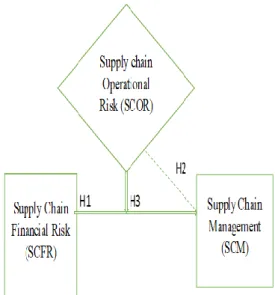
H1: Supply Chain finical risk has significant impact on the supply chain management.
H2: Supply Chain operational risk has significant impact on firm supply chain management.
H3: Supply chain operational risk moderates the relationship between supply chain financial risk and the supply chain management.
Figure 1 depicts the theoretical framework of this study. The resource-based theory and agency theory are used to conceptualize the framework shown in figure 1.
Figure 1: Conceptual framework
3.0. Methodology
The current study is carried out to explore the moderating role of operational risk, in the relationship between supply chain risk and firm supply chain management. The currents have employed survey-based method using an adapted questionnaire. The operational managers, and finance managers working in the manufacturing industry are chosen as a final sample of the currents study. the 435 questionnaires were sent to mangers of manufacturing firms. The required number was sent to the departments for dispersion. Respondents were stiff-necked. They returned the questionnaire within the period. This procedure took four weeks to gather every one of the questionnaires from the respondents. In this study, researchers have used the questionnaire method for collecting data. This questionnaire is divided into four sections which the entire question was conducted in English. Section A in this questionnaire asked about the respondent background. Gender, ethnicity, educational level, age, marital status, length of services, job category and income (per monthly) were asked. Meanwhile, the question from Part B, C and D are the part of the instrument that tested for this study. The measurement scale for all the section is based on the Likert Scale of 1 to 5, where 1 = strongly disagreed, 2= disagreed, 3 = neutral, 4 = agreed and 5 = strongly agreed. 520 respondents were selected to distribute questionnaires. Three hundred thirtee -nine questionnaires were received out of 297; the response rate was 69 per cent and hence accepted for further evaluation. Respondents’ average age was 47 years, and around 63 percent of them were working in operation departments from last 15 plus years. The greater part of the respondents was held highest
degrees; the response rate is above the threshold of 45-50 percent [11]. Male respondents were 233 and the female was 64. The average working experience was 11 years.
4.0. Research Analysis and Discussion
To achieve the objective of the current study we have employed the PLS-SEM. The PLS-SEM, according to Hair et al., [37], the PLS-SEM is second generation is structural equation modelling, which not only new but also a robust as it integrates all the model into a structure of the equation and produces results with a simultaneous operation by producing a relationship with all direct and intervening phenomena. According to Hair et al., [37], Hameed et al. [38] and Basheer et al. [3] PLS-SEM is one of the robust and most reliable statistical technique. Therefore, this study adopted PLS SEM to analyses the data. Before testing the hypothesis, data reliability and validity was scrutinized. These steps were taken through PLS 3. It is revealed in Table 1 which shows that factor loading is more than 0.5, average variance extracted (AVE) is more than 0.5 and composite reliability is also more than 0.7. Therefore, it is revealed that the current study attained convergent validity.Table 1. Convergent and Discriminant Validity Indicators Loadings CR AVE SCFR SCFR1 SCFR2 SCFR4 SCFR5 .843 .855 .802 .925 0.895 0.772 SCOR SCOR1 SCOR3 SCOR4 .884 .955 .903 0.932 0.617 SCM SCM1 SCM2 SCM3 SCM4 SCM5 .822 .855 .722 .825 .841 0.910 0.671 SCM6 SCM7 SCM8 SCM9 SCM10 SCM13 SCM15 SCM16 SCM17 SCM18 .800 .880 .881 .826 .821 .882 .928 .840 .921 .882
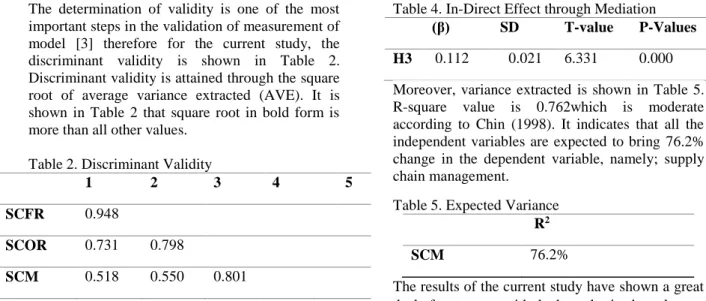
The determination of validity is one of the most important steps in the validation of measurement of model [3] therefore for the current study, the discriminant validity is shown in Table 2. Discriminant validity is attained through the square root of average variance extracted (AVE). It is shown in Table 2 that square root in bold form is more than all other values.
Table 2. Discriminant Validity
1 2 3 4 5
SCFR 0.948
SCOR 0.731 0.798
SCM 0.518 0.550 0.801
The next step to the confirmation of reliability and validity is the development and estimation of structural model therefore after confirmation of reliability and validity, the SEM was used to analyze the hypothesis. The direct and indirect effect was examined. Indirect effect was examined to check the mediation. In this process, the p-value was considered. While analyzing the data, 0.05 minimum level of p-value was considered to test the hypothesis. According to the direct results, it is shown that all hypothesis has a p-value less than 0.05. Thus, the hypothesis 1 related to supply chain financial risk and supply chain management is significant, and results of the second hypothesis sis also in consistent with the proposed hypothesis as the supply chain operational performance is in significant positive relationship with supply chain performance. The direct results of the current study are shown in table 3
Table 3. Direct Effect
(β) SD T-value P-Values
H1 0.111 0.035 3.161 0.002
H2 0.467 0.132 3.978 0.007
Along with the direct relationship between supply chain operational performance and supply chain management, the current study is also interested in investigating the moderating role of supply chain operational performance in the relationship between supply chain financial risk and supply chain management. The results of the moderating effect of corporate cash holdings is shown in the table 4 . These results of moderation show that for both mediation hypothesis, the t-value is above 1.96 and p-value is below 0.05 which accept H3.
Table 4. In-Direct Effect through Mediation (β) SD T-value P-Values
H3 0.112 0.021 6.331 0.000
Moreover, variance extracted is shown in Table 5. R-square value is 0.762which is moderate according to Chin (1998). It indicates that all the independent variables are expected to bring 76.2% change in the dependent variable, namely; supply chain management.
Table 5. Expected Variance
R2
SCM 76.2%
The results of the current study have shown a great deal of agreement with the hypothesized results.
5.0. Conclusion
The prime objective of the current study is to explore the nexus between supply chain financial risk, supply chain operational performance and supply chain management. To achieve the objective of the current study we have proposed two direct (H1 & H2) and one indirect hypothesis (H3). Following the prior findings on the issues of supply chain and research methodology [3], [37],[38],[39] the current study, we have employed the structural equation modeling and used the statistical package of smart PLS-3. The data by mean of an adapted survey instrument in the form of questionnaire is collected from the operation and finance managers of manufacturing firms. The results of the current study are offering support to the p[reposition of agency theory [40], [41], [42] and resource based view theory [3] , [23]. The results indicate the fact that SCM is a critically significant strategy for today's highly competitive, turbulent, unpredictability, and dynamic business environments. Organizations are now extremely exploring the potential of SCM concept to get their products to market in minimum time and lower total cost, meanwhile enhanced total quality, increased customer service, and greater profit. It enables coordinating and controlling of material flow and information flows throughout the business process from sources to customers wherein gets the correct product to the right place at the minimum cost with minimum inventory while offers greater customer service and shortens lead times. Thus, in twenty-first century, SCM is a crucial and significant strategy to success in the global markets. The findings of the current study have revealed the fact that the majority if the respondent
has shown a great deal of agreement with our proposed hypothesizes. The current study which in author knowledge is among few pioneering studies on this issue, will be helpful for financial experts, operation managers, academicians, researchers and other policy makers in formulating policies [43, 44]
References
[1] Zandieh, M., Janatyan, N., Alem-Tabriz, A., & Rabieh, M. (2018). Designing Sustainable Distribution Network in Pharmaceutical Supply Chain: A Case Study. International Journal of Supply and Operations Management, 5(2), 122-133.
[2] Nawi, M. N. M., Songappenm, M., Nadarajan, S., Ibrahim, S. H., & Mustapha, R. (2017). Procurement Performance and Supplier Management Measurement Issues: A Case of Malaysian Private Company. Int. J Sup. Chain. Mgt Vol, 6(1), 246.
[3] Basheer, M., Siam, M., Awn, A & Hassan, S. (2019). Exploring the role of TQM and supply chain practices for firm supply performance in the presence of information technology capabilities and supply chain technology adoption: A case of textile firms in Pakistan. Uncertain Supply Chain Management, 7(2), 275-288.
[4] BANNOUR, S., SFAR, E., & MTAR, K. (2017). The Effects of FDI on the Moroccan Economy: An Empirical Estimate from a Structural Model. Asian Journal of Economic Modelling, 5(3), 266-273.
[5] Wee, S. Y., Jamal, N. M., & Thoo, A. C. (2018). The Strategic Roles of Market Orientation on Supply Chain Collaboration for Small and Medium-Sized Manufacturers. Advanced Science Letters, 24(6), 3854-3857. [6] Ojha, D., Acharya, C., & Cooper, D. (2018).
Transformational leadership and supply chain ambidexterity: Mediating role of supply chain organizational learning and moderating role of uncertainty. International Journal of Production Economics, 197, 215-231.
[7] Halldórsson, Á., Hsuan, J., & Kotzab, H. (2015). Complementary theories to supply chain management revisited–from borrowing theories to theorizing. Supply Chain Management: An International Journal, 20(6), 574-586.
[8] Lambert, D. M., & Enz, M. G. (2017). Issues in supply chain management: Progress and potential. Industrial Marketing Management, 62, 1-16.
[9] Formentini, M., & Romano, P. (2016). Towards supply chain collaboration in B2B pricing: A critical literature review and research agenda.
International Journal of Operations & Production Management, 36(7), 734-756. [10] Fayezi, S., Zutshi, A., & O'Loughlin, A.
(2017). Understanding and development of supply chain agility and flexibility: A structured literature review. International Journal of Management Reviews, 19(4), 379-407.
[11] Li, G., Fan, H., Lee, P. K., & Cheng, T. C. E. (2015). Joint supply chain risk management: An agency and collaboration perspective. International Journal of Production Economics, 164, 83-94.
[12] Jonsson, P., & Holmström, J. (2016). Future of supply chain planning: closing the gaps between practice and promise. International journal of physical distribution & logistics management, 46(1), 62-81.
[13] Basheer, M. F., KhorramI, A. A. A., & Hassan, S. G. (2018). PATRONAGE
FACTORS OF ISLAMIC BANKING
SYSTEM IN PAKISTAN. Academy of Accounting and Financial Studies Journal, 22, 1-9.
[14] Prajogo, D., Oke, A., & Olhager, J. (2016). Supply chain processes: Linking supply logistics integration, supply performance, lean processes and competitive performance. International Journal of Operations & Production Management, 36(2), 220-238. [15] Ralston, P. M., Blackhurst, J., Cantor, D. E.,
& Crum, M. R. (2015). A structure–conduct– performance perspective of how strategic supply chain integration affects firm performance. Journal of Supply Chain Management, 51(2), 47-64.
[16] Chan, A. T., Ngai, E. W., & Moon, K. K. (2017). The effects of strategic and manufacturing flexibilities and supply chain agility on firm performance in the fashion industry. European Journal of Operational Research, 259(2), 486-499.
[17] Javed, M. A., & Basheer, M. F. (2017). Impact of external factors on bank profitability. EPRA International Journal of Research and Development, 2(5), 1-11. [18] Gligor, D. M., Esmark, C. L., & Holcomb, M.
C. (2015). Performance outcomes of supply chain agility: when should you be agile?. Journal of Operations Management, 33, 71-82.
[19] Asif, M., Asghar, F., Younis, A., Mahmood, A., & Wang, L. Z. (2018). The Role of Social Entrepreneurship in Pakistan and its Impact on Economy. International Journal of Business, Economics and Management, 5(5), 117-127.
[20] Saeidi, S. P., Sofian, S., Saeidi, P., Saeidi, S. P., & Saaeidi, S. A. (2015). How does corporate social responsibility contribute to
firm financial performance? The mediating role of competitive advantage, reputation, and customer satisfaction. Journal of business research, 68(2), 341-350.
[21] Mahmood, A., Hussan, S. G., Sarfraz, M., Abdullah, M. I., & Basheer, M. F. (2016). Rewards Satisfaction, Perception about Social Status and Commitment of Nurses in Pakistan. European Online Journal of Natural and Social Sciences, 5(4), pp-1049.
[22] Siddhartha, & Sachan, A. (2016). Review of agile supply chain implementation frameworks. International Journal of Business Performance and Supply Chain Modelling, 8(1), 27-45.
[23] Kanda, M. K., & Iravo, M. A. (2015). Access Factors Affecting Supply Chain Efficiency of Medical Supplies in public Health Centres in kenya: A Case Study of Public Health Centres in Elgeyo Marakwet Count. Int J Acad Res Accounting Financ Manag Sci, 5, 2.
[24] Ellram, L., Bals, L., & Tate, W. (Eds.). (2018). Supply Chain Finance: Risk Management, Resilience and Supplier Management. Kogan Page Publishers. [25] Basheer, M., Ahmad, A., & Hassan, S.
(2019). Impact of economic and financial factors on tax revenue: Evidence from the Middle East countries. Accounting, 5(2), 53-60.
[26] Wuttke, D. A., Blome, C., Heese, H. S., & Protopappa-Sieke, M. (2016). Supply chain finance: Optimal introduction and adoption decisions. International Journal of Production Economics, 178, 72-81.
[27] Basheer, M. F., Ahmad, A. A., & Hassan, S. G. (2018). How managerial view the dividend policy: A case of UAE. Opción, 34(16), 630-645.
[28] Lekkakos, S. D., & Serrano, A. (2016). Supply chain finance for small and medium sized enterprises: the case of reverse factoring. International Journal of Physical Distribution & Logistics Management, 46(4), 367-392.
[29] Bals, C. (2018). Toward a supply chain finance (SCF) ecosystem–Proposing a framework and agenda for future research. Journal of Purchasing and Supply Management.
[30] Qazi, A., Dickson, A., Quigley, J., & Gaudenzi, B. (2018). Supply chain risk network management: A Bayesian belief network and expected utility based approach for managing supply chain risks. International Journal of Production Economics, 196, 24-42. [31] Rostamzadeh, R., Ghorabaee, M. K., Govindan, K., Esmaeili, A., & Nobar, H. B. K. (2018). Evaluation of sustainable supply chain risk management using an integrated
fuzzy TOPSIS-CRITIC approach. Journal of Cleaner Production, 175, 651-669.
[32] Artha, I. W. B., & Mulyana, B. (2018). The Effect of Internal and External Factors of Companies on Profitability and its Implications on Stock Price Index of State-Owned Banks. The Economics and Finance Letters, 5(2), 58-71..
[33] Ul-Hameed, W., Shabbir, M., Imran, M., Raza, A., & Salman, R. (2019). Remedies of low performance among Pakistani e-logistic companies: The role of firm’s IT capability and information communication technology (ICT). Uncertain Supply Chain Management, 7(2), 369-380.
[34] Templar, S., Findlay, C., & Hofmann, E. (2016). Financing the end-to-end supply chain: A reference guide to supply chain finance. Kogan Page Publishers.
[35] Martin, J., & Hofmann, E. (2018). Towards a framework for supply chain finance for the supply side. Journal of Purchasing and Supply Management.
[36] Moretto, A., Grassi, L., Caniato, F., Giorgino, M., & Ronchi, S. (2018). Supply chain finance: From traditional to supply chain credit rating. Journal of Purchasing and Supply Management.
[37] F. Hair Jr, J., Sarstedt, M., Hopkins, L., & G. Kuppelwieser, V. (2014). Partial least squares structural equation modeling (PLS-SEM) An emerging tool in business research. European Business Review, 26(2), 106-121.
[38] Hameed, W. U., Basheer, M. F., Iqbal, J., Anwar, A., & Ahmad, H. K. (2018). Determinants of Firm’s open innovation performance and the role of R & D department: an empirical evidence from Malaysian SME’s. Journal of Global Entrepreneurship Research, 8(1), 29.
[39] Jabarullah, N.H. and Hussain, H.I. (2019) The Effectiveness of Problem-Based Learning in Technical and Vocational Education in Malaysia, Education + Training, https://doi.org/10.1108/ET-06-2018-0129. [40] Basheer, M. F. (2014). Impact of Corporate
Governance on Corporate Cash Holdings: An empirical study of firms in manufacturing industry of Pakistan. International Journal of Innovation and Applied Studies, 7(4), 1371. [41] Hussain, H.I., Abidin, I.S.Z., Ali., A. &
Kamarudin, F. (2018) Debt Maturity and Family Related Directors: Evidence from a Developing Market, Polish Journal of Management Studies, 18 (2), 118 – 134. [42] Hussain, H.I., Abidin, I.S.Z., Kamarulzaman,
R., Shawtari, F.A. (2018) The Impact of State Affiliated Directors on the Capital Structure Speed of Adjustment in an Emerging Market,
Polish Journal of Management Studies, 18 (1), 133-148.
[43] Abdullah, N., Safiah, N., Ghani, A. A., Maamor, S., Wahab, N. A., Razimi, A., ... & Elias, N. H. (2018). Examining Level of Spirituality among Malaysian Youth. Indian Journal of Public Health Research & Development, 9(11).
[44] Taib, C. A., Ashraf, M. S., & Razimi, M. S. B. A. (2018). Productivity Change in The Efficiency of The Insurance and Takaful Industry of Pakistan. Academy of Accounting and Financial Studies Journal.
[45] Alharbi, J. M., & Aldaba, A. M. (2018). Exploration of English Teachers Understandings and Practices of Communicative Language Teaching (CLT) at Pre-University Level of Islamic Tertiary Educational Organization. International Journal of Asian Social Science, 8(7), 320-331.
[46] Ali, A., & Haseeb, M. (2019). Radio frequency identification (RFID) technology as a strategic tool towards higher performance of supply chain operations in textile and apparel industry of Malaysia. Uncertain Supply Chain Management, 7(2), 215-226. [47] Suryanto, T., Haseeb, M., & Hartani, N. H.
(2018). The Correlates of Developing Green Supply Chain Management Practices: Firms Level Analysis in Malaysia. International Journal of Supply Chain Management, 7(5), 316.
[48] Haseeb, M., Abidin, I. S. Z., Hye, Q. M. A., & Hartani, N. H. (2018). The Impact of Renewable Energy on Economic Well-Being of Malaysia: Fresh Evidence from Auto Regressive Distributed Lag Bound Testing Approach. International Journal of Energy Economics and Policy, 9(1), 269-275. [49] Haseeb., H. Z., G. Hartani., N.H., Pahi., M.H.
Nadeem., H. . (2019). Environmental Analysis of the Effect of Population Growth Rate on Supply Chain Performance and Economic Growth of Indonesia. Ekoloji, 28(107).
[50] Salimon, M., Mokthar, S., Yusr, M., Yusoff, R., Kareem, O., & Bamgbade, J. (2018). Do risk and fun matter in the adoption of mobile
commerce in Nigeria? A PLS-SEM
approach. Management Science Letters, 8(6),
507-518.
[51] Al-Hussaini, A. (2019). A study on exchange rate risk through lagged predictors, market
risk and financial sector indicators: Time
series analysis from Kuwait. Management
Science Letters, 9(2), 325-338.
[52] Kumar, A., Garg, R., & Garg, D. (2019). An empirical study to identify and develop constructive model of e-supply chain risks based on Indian mechanical manufacturing
industries. Management Science Letters, 9(2),