APPLICATION OF COMPUTER PROGRAMMING IN OPTIMIZATION
OF TECHNOLOGICAL OBJECTIVES OF COLD ROLLING
Abdrakhman Naizabekov
1, Vitaly Talmazan
2, Sergey Lezhnev
2,
Zhuman Amanzholov
2, Аlmas Erzhanov
21 Rudny Industrial Institute, Rudny, Kazakhstan
E-mail: [email protected]
2 Karaganda State Industrial University,
Temirtau, Kazakhstan
Republic avenue 30, 101400, Temirtau, Kazakhstan E-mail: [email protected]
ABSTRACT
This article is devoted of optimization of force and power parameters of cold rolling process. Anoptimization of cold rolling with the use of computer programming to reduce defects ofcold rolled metalwas carried out. For this purpose a computer program for calculations of optimal modes of rolling of strip with surface defect was devel-oped. It allows one to calculate power parameters for a given mode of rolling, the degree of use of the resource of plasticity of metal strips with defect and determination of optimal rolling modes. In the result were obtained graphs of curves with optimized values of rolling force, power and also degree of using of plasticity resource in compare with workshop mode.
Keywords: computer programming, optimization, cold rolling, surface defects.
Received 19 February 2015 Accepted 30 July 2015
INTRODUCTION
Rolling process consists of a series of connected unit operations, each of which represents a conversion into a finished workpiece profile. It is necessary to rationally design process chain, thus, during operation to man -age to get the highest possible quality of the finished products. Continuous rolling process has a number of features which complicate and impede the development of optimal processes. One of the difficulties is that the resulting optimization problem requires consideration of many factors related to each other. In this mode, continu -ous rolling largely determines the quality of rolled metal. During rolling of the strip it is very important to find the optimal regimes of rolling to produce quality steel [1].
The essence of optimization from a mathematical point of view is the following: it is required to find such process control functions to implement under given constraints extremum of so-called objective function. The essence of optimization from a technological point
of view is the following: it is required to find a mode of rolling process that for given technological constraints to achieve the best results. By optimizing we understand some common problem with a common goal, and also assume the formulation of the objective function and the study of solutions providing the extremum of the objective function. There are many methods for optimal control of technological processes. Optimization prob -lem is solved by methods of rolling process of linear and nonlinear programming, as well as by means of dynamic programming. The most universal method for optimal control in relation to production problems is the method of dynamic programming [2].
Dynamic programming is a mathematical tool that allows implementing the optimal scheduling of multi -stage control processes and the processes that depend on time. When solving complex optimization problems it is often useful to make a decision immediately, but gradually, step by step, so that the decision is divided into several stages. The fundamental basis of dynamic
programming is the principle of optimality, which con -sists in finding the conditional optimal controls from each state at this stage in the final state. Using the prin -ciple of optimality is to guarantee that the solution that combines the best decisions at certain stages would be the best when considering the whole process [3].
Dynamic programming method is characterized by the following: 1) step or gradual movement (complex problem is reduced to the successive solution of the set of simpler problems);2) to apply dynamic programming method it is necessary to obtain a recurrence relation so that a new state at the end of phase uniquely calculated on the basis of the state in the early stage and manage -ment at this stage, regardless of how solution is found; 3) the selected optimality criterion must have the property of additivity, i.e., for the entire process, it must consist of values obtained at various stages (this condition greatly restricts the possibility of using dynamic programming or can lead to considerable complication of the problem when trying it for additivity).
When used correctly, the method of dynamic pro -gramming allows viewing all the necessary control channels and finding the true optimal solution. The method features with a specific targeted search, rejecting unwanted control path, which saves computation time compared to blind search. However, the complexity of
the dynamic programming method is to obtain recur
-rence relations, which would satisfy the conditions of the problem and lead to the desired result.
The optimization problem is solved under certain constraints defined by the design parameters of the roll -ing mill and roll-ing technology. These are valid values of force and moment of rolling, the limit values of rolling power and other limits of the passages at the relative compression, the ratio of specific tension to the yield stress of the material, the coefficient of friction and other.
Deformation zone during rolling is characterized by the presence of forward slip and backward slip zones. For backward slip zones in the deformation zone is character -ized as follows: the vector of linear speed of the roll is greater than the velocity vector of the strip; so in backward slip zones stress friction facing forward in the course of rolling. In the forward slip zone stress friction is directed against a course of rolling. In this regard, the forward slip zone of the deformation zone can be a process of defect formation due to friction force directed against rolling stroke caused by the velocity increase of the metal relative
to the speed of rolling rolls. This phenomenon is particu -larly important during rolling in the last rolling stands, in which the final formation of the strip surface occurs [4].
EXPERIMENTAL
To reduce the defect formation for the optimization parameter we adopted the total length of the forward slip zone for the whole rolling cycle. The whole rolling cycle is divided into five stages (similar to continuous five stand cold rolling mill 1700 at JSC “ArcelorMit -tal Temirtau”). The program is structured so that the endpoints of each of the previous stand are the initial parameters of each subsequent.
Surface defects are a kind of stress concentrators in the places of which occurrence, during rolling an open tearcan be formed, and, as a consequence, this can lead to the strip break, as well as the integrity of the working surface of rolls barrel. Control of the degree of use of the resource of plasticity of metal in the zone of surface defects will increase their rolling out, reduce strip burst during rolling, and as a consequence, improve the quality of steel products.
As objective function during optimization of rolling total length of the forward slip zone for all the passages of deformation under the existing restrictionscan be considered :
( )
{
}
2 2 2 min 1min
...
n i n il
l
l
==
+ +
∑
(1) An important condition is considered to be preven -tion of excess of plasticity resource using degree 1.0 [5]. In view of this system major limitations look as follows (considering [6, 7]):[ ]
[ ]
0 0.2 1 0.2 min max 1 0.2 , , , 0,02 0,15, 0,2 0,5 , , 0, 0,1 , 1,0. Ci i i i i i i i i i i i i n n i P P N N R q R h h h W q R a µ µ ψ∑ ≤ < < ≤ ≤ ≤ ≤ ≤ ≤ > ≤ < (2) where:αС- capture angle, rad;
[P], [N] - maximum allowable value of force and power during rolling correspondingly, kN, kW;
μ - friction coefficient;
q1 - forward specific tension, MPa; R0.2 - yield strength of the metal, MPa; h - strip thickness, mm;
Wi - plasticity resource stocks; i - passage number;
n - quantity of passages.
In general, the main functions can be written as follows:
(
)
(
)
(
)
0.2 0 1,
, ,
, , , , ,
, , ,
, ,
, ,
i avei i i dCi i i i i i i i i i i iP
p
R
l
q q
R
N
M
R
W
h I
δµ
ε
µ
µ
υ
µ λ ψ δ
=
=
=
(3) where: P- rolling force, kN; N - rolling power, kW; M-rolling moment, kN·m;pave- average specific pressure, MPa; ε - relative reduction, %;
R - radius of the rolls, mm; υ - rolling speed, ms-1; λi - draw;
ψi- plasticity resource utilization degree; δi/hi - relative depth of the surface defect; Iδ - intensity of rolling out of surface defect. With the use of [8-9] we developed a computer program for calculating the optimal regimes of rolling strip with surface defects. The program is written in the programming language «Delphi». The program allows performing the following tasks: calculation of power parameters for a given rolling mode; calculation of the degree of use of the resource of plasticity of metal strips with defect; determination of optimal rolling modes, providing improved surface finish and increase rolling out of strip surface defects, and consequently decrease burst of strips during rolling.
Problems are solved under certain constraints: de -sign parameters of the rolling mill and rolling technol -ogy requirements. These are valid values of forces and power of rolling, capture angle relations of front and rear specific tensions to the yield point of the material, based on the conditions for the efficient construction of the mill. Also limits on the values of the coefficient of friction, the front and rear specific tensions, relative reduction per passareset.
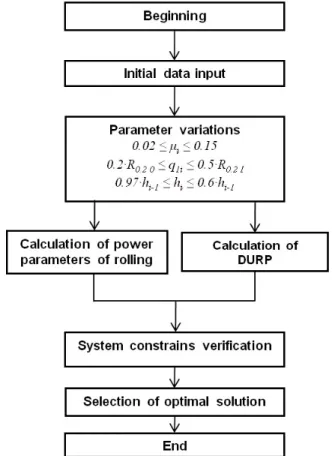
The program has three control parameters, with whose help there is a focused sorting of different process states. Control parameters are compression, friction and front resistivity tension. After input of initialdata there occurs avariation ofcontrol parameterswithsimultaneous calculation of DURPandpower parameters ofrolling. As
the three control parameters are accepted:μi – friction coefficient; q1i – front tension (MPa); hi – strip thickness (mm). Before the start of variation process define the boundaries of variation of selected parameters control.
Variation boundaries are defined on the basis of the normal conditions of the rolling process and constitute: 1) 0.02 ≤ μi ≤ 0.15 with iterationstep 0.01; 2) 0.2·R0.20 ≤ q1i ≤ 0.5·R0.2i with iteration step 1; 3) 0.97·hi-1 ≤ hi ≤ 0.6·hi-1with iteration step 0.01.
A simplified block diagram of the program is shown in Fig. 1.
The variation consists of the following: 1) at the beginning control parameters are assigned to the initial boundaries of variation and calculation occurs; 2) further the value of one of the control parameters is changed to the iteration step, the values of the other two control parameters are not changed (control parameter changing occurs until it reaches a final value limit); 3) after the entire boundary has been calculated, there is a change of the next control parameter values on the step itera -tion (this happens as long asall the borders of all control settings calculated).
Fig. 1. A simplified block diagram of the rolling opti
In the forward slip zone of the deformation zone could occur a process of defect formation due to friction forces directed against the rolling stroke and caused by an increase of the speed of the metal relative to the speed of rolls. The system of constraints is necessary to ensure the normal rolling process and represents a limitation of the capture ability, limitationson strength, power of the motor, and a limit on the degree of use of the resource of plasticity. It is important that the total degree ofthe use of the resource of plasticity of metal does not exceed unity. Limitations system eliminates options that exceed the permissible requirements. Next, when the entire set of solutions obtained, the program selects a mode of rolling, which provides the smallest total length of the forward slip zone in the deformation zone in the last stand for the entire rolling period.
With the results of regression analysis of the data we obtained a relationship equation of compression, tension and friction coefficient (at R2 = 0.99):
1 0 1 2 0 i i i
q
a a
a
q
ε
= +
+
µ
, (4) where:a0, a1, a2- constants depending on the rolled metal and shapes;
q0- specific back tension, MPa; q1- specific front tension, MPa; μi- contact friction coefficient; i-stand number.
Appointment of rolling mode according to equation (4) provides a rolling process without exceeding the al -lowable values of energy-power parameters and degree of use of the resource of metal plasticity, and also reduces probability of defect formation in the deformation zone.
RESULTS AND DISCUSSION
In conditions of JSC “ArcelorMittal Temirtau” most often surface defects occur on a thin profile with a thickness of 0.7 mm. Using developed program has completed the calculation of compression optimization modes at mill 1700 of JSC “ArcelorMittal Temirtau” of profile 0.7×1000 mm made of steel AISI 1008. The results obtained by computing are optimized versions of compression and tension modes, providing specified profile rolling and satisfy given constraints. Optimization of rolling is calculated considering the minimization of
forward slip zone length to the final stand, it is because in this stand the final formation of the strip surfaceoccurs.
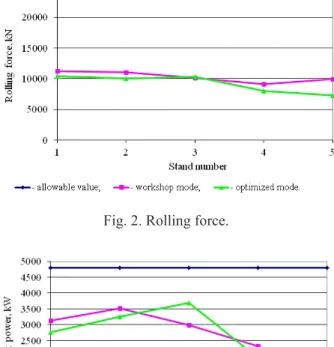
Power parameters of rolling optimized mode do not exceed the maximum permissible values. Comparison of workshop and optimized modes is shown in Figs. 2-5.
Tension during rolling on workshop mode is in the range of 0.2·R0.2, increasing the tension to 0,275·R0.2 causes a slight lowering of the rolling force (Fig. 2).
Fig. 2. Rolling force.
Fig. 3. Rolling power.
Fig. 4. Summary of the degree of use of the resource of plasticity.
Redistribution of compression in stands leads to some increase of the rolling power in the third stand (Fig. 3). Optimized rolling mode characterizing by more inten -sive use of the resource of plasticity, while there is no complete exhaustion of it (Fig. 4). More intensive use of plasticity resource, on the one hand positively affects rolling out of surface defects, on the other hand there is the danger of the plasticity resource exhaustion, which can lead to the destruction of the strip in the deformation.
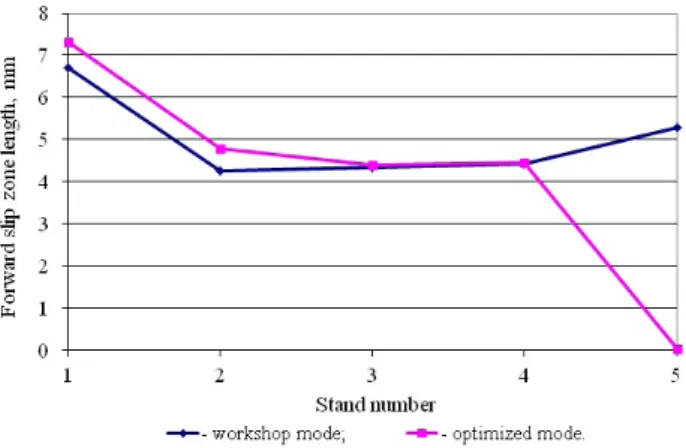
At last stand the final formation of the strip surface occurs, hence, reducing the length of forward slip zone has a positive impact on reducing the defect formation during rolling (Fig. 5).
CONCLUSIONS
After optimization of criterion selecting, determin -ing the technological and mathematical formulation of the optimization problem and the formulation of restrictions we proposed an optimization program of cold rolling.
An equation of the relationship of compression, tension and friction coefficient was obtained. From the resulting equation it is implied that an increase in the
total relative reduction
ε
∑
friction coefficient andfront specific tension q1current relative depth of defect
/
i hi
δ
is reducing, i.е. defect if rolling out. Reverse ef-fect onδ
i/hi providing back tension q0. The increase of the initial relative depth of the defectδ
0/h0 naturallyincreases
δ
i/hi , thus the risk of defect development on tear rises. The purpose of the rolling mode according to the obtained equation provides the rolling process with-out exceeding the allowable values of the powerparam-Fig. 5. Forward slip zone length.
eters and the degree of use of the resource of plasticity. An optimization of modes of cold rolling mill 1700 was conducted. Optimization of the rolling mode was calculated by minimizing the length of the forward slip zone of the last stand, this is due to the fact that in this stand the final formation of the strip surface occurs. Comparison of workshop and optimized modes showed that the power parameters of the rolling do not exceed the maximum permissible values. Reducing the length of the forward slip zone of the last stand has a positive effect on reducing the defects formation, because during final formation of the strip surface in this zone stress of friction is directed against the course of rolling, so the removal from the deformation zone of the products of decomposition and deterioration is difficult.
The results of the optimization calculations showed that increasing the front tension and relative compres -sion significantly reduce rolling force and rolling power, except for stand No. 3.It should be noted that DURP increases. In the fourth and fifth stands and workshop and optimized modes DURP do not reach the critical value of 1.0. With regard to the target function, according to optimized mode the length of the forward slip zone l2 in the first two stands is higher than the workshop variant (for the first stand:
shop
l
2 = 6.7 mm andl
2opt = 7.37 mm; for the secondstand:
l
2shop = 4.37 mm andl
2opt = 4.79 mm), in thesubsequent third and fourth stands close by value (4.4 mm and 4.5 mm).
The most important point in the optimization of the rolling mode is considered a sharp decrease of the length of the forward slip zone in the fifth stand up to the value of 0.098 mm (at workshop mode the value of the forward slip zone in the fifth stand is 5.29 mm).
Thus, it is possible to consider that optimization of the rolling mode is to reduce the defect formation during rolling appropriate.
REFERENCES
1. А.N. Skorohodov, P.I. Poluhin, B.M. Ilyukovich, B.Е.Haykin, N.Е. Skorohodov, Optimization of roll -ing production, Metallurgy, 1983, p. 432, (in Russian). 2. G.L. Himich, М.B.Tsalyuk, Optimization of modes of
cold rolling on a digital computer, Metallurgy, 1973, p. 256, (in Russian).
3. S. Roberts, Dynamic programming in the processes of chemical technology and management methods, Mir, 1965, p. 488, (in Russian).
4. E.А. Garber, E.N. Shebanits, Е.V. Diligensky, О.А. Pobegailo, N.P. Medvedev, Optimization of the struc -ture of the deformation zone on the mill 1700, Steel, 2007, 1, 48-50, (in Russian).
5. А.А. Bogatov,The mechanical properties and fracture models of metals, SEIHPEUSТU-UPI, 2002, p. 329, (in Russian).
6. А.P. Grudev, Theory of rolling, Intermet engineering, 2001, p. 280, (in Russian).
7. А.А. Korolev, Design and calculation of the rolling mills machinery, Metallurgy, 1985, p. 376, (in Rus -sian).
8. Yu.N. Kuznetsov, V.I. Kuzubov, А.B. Voloschenko, Mathematical programming, Highschool, 1980, p. 300, (in Russian).
9. I.L. Akulich, Mathematical programming in examples and problems, Highschool, 1986, p. 319, (in Russian).