Designated Attribute-Based Proofs for RFID
Applications
Gergely Alp´ar1,2
, Lejla Batina1,3
, and Wouter Lueks1,2 1 Radboud University Nijmegen, ICIS/Digital Security group
Heyendaalseweg 135, 6525 AJ Nijmegen, The Netherlands {gergely, lejla, w.lueks}@cs.ru.nl
2 TNO Information and Communication Technology, The Netherlands 3 K.U.Leuven ESAT/SCD-COSIC and IBBT
Kasteelpark Arenberg 10, B-3001 Leuven-Heverlee, Belgium
Abstract. Recent research has shown that using public-key cryptogra-phy for RFID tags is not only necessary in order to meet privacy require-ments, but also now practically feasible. This has led to the development of new protocols like the Randomized Schnorr [6] identification. This protocol ensures that the identity of a tag only becomes known to the intended reader, and not to any eavesdropping party.
In this paper we generalize that protocol by introducing an attribute-based identification scheme. The proposed scheme preserves the desig-nation of verification (i.e., only a legitimate reader is able to learn the identity of a tag) while it allows tags to prove any subset of their at-tributes to eligible readers. The proposed scheme is proven to be secure and narrow-strong private.
Keywords: RFID, identification, authentication, elliptic curve cryptography, security, privacy, attribute-based credential
1
Introduction
We rely on the security of embedded systems in our daily lives when using e.g. public transportation, mobile phones, e-banking applications, pay TV systems, etc. Typical devices include smart cards and Radio Frequency IDentification (RFID) tags that are extremely limited in resources such as area, memory and battery time. This fact results in the security and privacy requirements of these systems being considered as one of the most challenging issues in RFID appli-cations.
Recently, with privacy-sensitive RFID services, such as proving the owner-ships of certain credentials, the attention of the research community has yet again returned to Public-Key Cryptography (PKC) for RFID systems. The main rea-son is in maintaining the privacy of a user, but other properties such as scalability and anti-counterfeiting are also very important. Although critics still consider
public-key systems too expensive for passive tags, a number of companies and academic groups have pursued their efforts on designing PKC-based chips for RFID protocols [5, 10, 11]. While the first performance results are promising, to get viable solutions, the design of new PKC-based protocols is necessary. Namely, standard solutions for authentication, e.g., signatures require typically a hash function as well, which adds additional burden in terms of gates and power consumption.
In particular, Elliptic Curve Cryptography (ECC) has been preferred choice so far, and numerous protocols were designed aiming at security and privacy of RFID systems based (exclusively) on the Elliptic Curve (EC) point multi-plication [6, 15]. Starting from an authentication of a single tag, a number of more complex protocols emerged such as grouping proofs [13] and hierarchical proofs [1], each of which was motivated by yet another application of RFID security. It has become obvious that this trend will continue as lightweight cryp-tography is turning into the main component of modern communication networks and new applications are ever emerging.
While showing attribute-based credentials1
(ABC) does not require more exponentiations on the tag’s side than some other protocols demonstrated to be computationally feasible on RFID chips [1, 3], attributes with selective disclosure provide great flexibility. To extend the variety of RFID applications, we show how ABCs can be converted to RFID systems in which a tag can prove all or a subset of its secret attributes to designated verifier readers. Our protocols are proved to be secure against impersonation attacks and narrow-strong private.
1.1 Related works
The discrete logarithm (DL) problem is considered to be hard2
, that is, finding the exponent a of a random point A = aP with respect to a publicly-known base pointP is computationally infeasible [14]. A similarly hard problem can be stated with respect to more base points: In the discrete logarithm representation (DL-REP) problem, introduced by Brands [4] and employed in Microsoft’s U-Prove technology [16], given a random pointA and base points P0, . . . , Pl one has to find exponentsa0, . . . , alsuch thatA=Pl0aiPi. While in a DL problem the exponentais uniquely determined, in a DL-REP problem there are several tuples of (a′
0, . . . , a′l) for which A= Pl
0a′iPi.
Zero-knowledge proofs of knowledge are cryptographic techniques to prove the knowledge of a secret value without revealing any information about the secret itself. Schnorr [18] proposes an interactive protocol that enables a prover to show the knowledge of a DL value to a verifier, that is, a secret scalar cor-responding to a public point. A similar method by Brands [4] can be applied 1 Attribute-based credential: (aka. anonymous credentials) An ABC is a composite commitment that carries multiple values, so-called attributes, and signed by a trusted authority; in this paper the signing is ignored as the initialization of RFID tags are out of scope of this study.
2 Although in this paper we discuss schemes in an ECC setting, they work in any groups in which the discrete logarithm problem is hard.
to prove the knowledge of a DL-REP of a point with respect to a tuple of base points. A prover can also show the knowledge of a subset of scalars in a DL-REP without releasing others; this procedure is calledselective disclosurewhich is one of the most relevant functionalities in relation to ABCs [7].
While the techniques above provide a high-degree of security for the prover by not necessarily revealing secret pieces of data, any party interacting with the prover can learn selectively disclosed information. In some scenarios, prior verifier authentication is not possible (i.e., a secure channel cannot be assumed between the prover and the intended verifier) and therefore, this may not be de-sirable. In particular, in the context of RFID systems, possibly malicious readers can interrogate RFID tags. Designated verifier proofs are proofs of knowledge that only a designated verifier can obtain identity information. Bringer et al. [6] present a scheme to designate a Schnorr proof. Since the designation random-izes the messages for a party that does not know the secret key, they call it a “Randomized Schnorr” scheme.
Undeniable signatures have been introduced by Chaum and Antwerpen [9] and enhanced to zero-knowledge proofs of ownership by Chaum [8]. An unde-niable signature cannot be verified without interacting with its signer. Further-more, during the proving protocol no external parties learn anything about the validity or invalidity of the signature. Jacobsson et al. [12] propose a more gen-eral notion, the designation of verification that a statement is true. The idea is that the prover generates a zero-knowledge proof that can only be produced by him and the verifier. Since the verifier knows that she was not the one who created the proof, she becomes convinced about the validity of the statement; however, she cannot convince any third party that the proof was produced by the prover and not by herself.
Saeednia et al. [17] improve the notion of designated verifier signatures, in which not only the verifier but anybody can simulate transcripts of valid proof conversations. They also propose an efficient designated verifier signature using Fiat–Shamir heuristic.
1.2 Our contribution
By encoding several attributes as exponents ai’s in a point A = Pl
0aiPi, the number and variety of applications increase considerably. As Lee et al. [15] have shown that multiple point multiplications are feasible on a passive RFID tag, DL-REP related protocols also become realizable in such limited environments. In this paper we propose designated verifier proofs of knowledge of DL-REPs. Furthermore, by applying a new proof technique, a subset of exponents can also be shown to a designated verifier.
Unlike in Brands’ selective disclosure schemes, a prover here cannot send the revealed exponents in advance or during a protocol run in clear; however, those exponents have to be computable for an eligible verifier. Table 1 shows a summary of these zero-knowledge proofs. Although a trivial solution to reveal certain attributes would be to send them encrypted to the verifier, this causes significant overhead.
Table 1. Designated proofs of knowledge of discrete logarithm values; highlighted protocols are presented in this paper for the first time.
Problem ZK proof Designated ZK proof DL Schnorr [18] Randomized Schnorr [6] DL-REP U-Prove showing [4] Designated DL-REP proof DL-REP U-Prove selective disclosure [4] Designated partial DL-REP proof
We prove that the proposed designated verifier schemes are zero-knowledge, secure against impersonation, and narrow-strong private. Moreover, we show how these general building blocks can be employed to design secure RFID ap-plications.
The remainder of the paper is organized as follows. First we describe the cryptographic background and relevant protocols in Section 2. Second we in-troduce the new Designated Verifier DL-REP and Designated Verifier Partial DL-REP proofs in Section 3. Then we describe some possible RFID applications of the introduced protocols in Section 4.2. Finally, we conclude the paper in Section 5.
2
Cryptographic Background
An identification scheme is an interactive protocol in which a prover, i.e., a tag in this setting, convinces a verifier that it stores secret values corresponding to some identifier on a list in the verifier’s system. Before we introduce our proposal for a designated attribute-based proof system in Section 3, we describe cryptographic requirements and prior relevant protocols.
2.1 Basic set-up
Throughout this paper let E be an elliptic curve defined over a finite fieldFqk, where q = 2 or a large prime (in this casek = 1). Let G be a cyclic group of prime order p of points on the curveE, generated by a point P. The fields of characteristic 2, i.e., whenq= 2, are more suitable for hardware implementations and hence for RFID tags, but ECC protocols conceptually apply for arbitrary fields.
We use capital letters, likeA and P to denote points on the elliptic curve. Scalars are written using lower case letters. We writekP, withk∈Zp, to denote the point P added k times to itself. Finally, we denote by x∈R Zp that x is chosen uniformly at random from the setZp.
We use a number of hardness assumptions to prove the security and privacy of our systems. We assume that the following problems are hard3
. 3 We state these assumptions in the ECC setting.
Definition 1 (Discrete Logarithm (DL) problem).Given a generatorP ∈
Gand a multiple A=aP ofP, wherea∈RZp, determinea.
Definition 2 (Decisional Diffie-Hellman (DDH) problem). Given a gen-erator P, and the points A = aP, B = bP and C = cP, where a, b ∈R Zp, determine whether c=ab.
2.2 Security and Privacy model
The protocols we consider are typical authentication protocols. This means that the tag and the reader engage in a protocol, at the end of which the reader will either be convinced about the identity of the tag (and in our case also the validity of the attributes) or it will report failure. In this paper we show that our two new protocols satisfy two different requirements: security and privacy. The former roughly means that it is difficult for an adversary to pretend to be a valid tag, while the latter means that an adversary cannot distinguish legitimate tags from simulated tags.
Just as Bringer et al. [6], we follow the security model proposed by Vaude-nay [19]. In his model, VaudeVaude-nay describes how adversaries can interact with a set of tags. Besides offering methods for communicating with and choosing from the tags as well as communicating with the reader, the model also exposes two additional oracle calls. The level of access to these two additional oracles defines the type of the adversary.
The first additional oracle is the result-oracle. As is typical in identification protocols, at the end of the protocol the reader draws one of the following two conclusions. It either concludes that the tag it communicated with has been successfully identified as the tag with identity I, or it will report failure. The result-oracle will return only the success/failure status of the reader. In our pro-tocols we do not allow this type of queries, hence resulting in anarrow adversary (as opposed to awide one that is allowed to make such queries).
The second additional oracle is the corruption oracle. This allows the adver-sary to corrupt a tag, and hence learn all its secrets. We consider only strong attackers, i.e., attackers that can obtain the secrets of any tags they choose. Further attacks on the privacy of these tags are still allowed afterwards (note that they are explicitly prohibited in the security game).
Given this model we can now give games to define the security model.
Definition 3 (Security game). Assume that there exists a system of t tags that can be interrogated via the identification protocol, then the game consists of two phases:
1. In the first phase, the adversary is allowed to interrogate any tag multiple times. Furthermore, it is allowed to corrupt any tags of its choosing. 2. In the second phase, the adversary communicates with the verifier to
An RFID scheme is secure if no adversary can win the Security game above with non-negligible probability.
Intuitively, our notion of privacy for these types of protocols usually means that it is not possible to link two different executions of the protocol. In the Vaudenay model it is captured as follows. Even though the adversary is given the identifiers of the tags it talked to at the end of the game, it cannot distin-guish between the setting in which it communicates with actual tags and the setting in which it communicates with simulated tags. Note that in the latter case the simulator didn’t know the identifiers. Hence, any information leak on the identifiers can be used by the adversary to gain an advantage. A system has narrow-strong privacy if no adversary can win the following game with non-negligible probability.
Definition 4 (Narrow-Strong Privacy Game). Assume that there exists a system of t tags that can be interrogated via the identification protocol. First, the challenger generates a bit b∈R {0,1} and depending on b, it runs different experiments:
– Ifb= 0, the adversary is allowed to directly talk to any tag of its choice.
– If b = 1, the adversary is not allowed to interrogate tags directly but the challenger, without interacting with the actual tags, simulates them. Then in the corruption phase, the adversary can receive all the tag’s private information by corrupting it. At the end of the game, the adversary must guess the value of bit b.
Note that since we are in a strong setting, the challenger can obtain the tags identifiers using the corruption query; therefore, this is not mentioned separately in the game.
2.3 Randomized Schnorr scheme
Bringer et al.’s Randomized Schnorr [6] scheme is secure and narrow-strong private by the definitions above. Each prover (tag) has a secret key x and an identifier I = xP, while each verifier has a secret key v and a corresponding (designation) public keyV =vP. Verifiers store a list of valid tag identifiers.
During a protocol run (see Fig. 1), not only does a tag prove the knowledge of its secret key, but it also hides its identifier from any external party. Using its secret keyv, the verifier can compute the tag’s identifier. Therefore, the prover’s secret key and its identifier are protected: First, as this scheme is a modified Schnorr identification, no adversary can learn anything about the tag’s secret keyx. Second, without the knowledge ofv, no adversary can computeI.
2.4 Discrete logarithm representation (DL-REP)
Discrete logarithm representations [4] have been introduced by Brands4 . Given a set of l+ 1 generators (base points, in case of ECC) P0, . . . , Pl in a group, 4 We will often refer to schemes by Brands as U-Prove since basically, they are the
Prover Verifier x, I=xP P, V =vP v α, β∈RZp A1:=αP A2:=βV A1,A2 −−−−−−−−→ c ←−−−−−−−− c∈RZ∗p r:=c·x+α+β (modp) −−−−−−−−→r Verification: I=c−1(rP−A1−v−1A2) check whetherI is a valid identifier
Fig. 1.Randomized Schnorr [6] identification, i.e., Designated Verifier Schnorr identi-fication. (There are 2 point multiplications on the Prover’s side.)
participants can commit tol (attribute) valuesx1, . . . , xl. We say that the DL-REP ofI is (x0, . . . , xl) with respect to (P0, . . . , Pl) if I=Pl0xiPi.
While the identifierI (as a cryptographic commitment) hides the attributes (x1, . . . , xl) because of the extra scalar x0 unconditionally, it binds the prover only computationally. However, this computation is infeasible as an oracle that, after changing some exponents, can compute a new DL-REP x′
0, . . . , x′l with respect to the same base points P0, . . . , Pl can be used to break the discrete logarithm problem.
In [4] Brands builds an anonymous credential system on commitments in which a credential is a commitment, likeIabove, (blindly) signed by a credential authority. Using such a credential and zero-knowledge proof techniques, a prover is able to demonstrate to a verifier that she knows the secret values in the commitment without actually showing them. Moreover, a prover can selectively disclose values corresponding to a disclosure index setD ⊆ {1, . . . , l}(see Fig. 2). Having these values (xi)i∈D, the verifier can compute a partial commitment
com−P
i∈DxiPi and the prover can prove the knowledge of all other secret values. Note that in case of D =∅, this scheme is a proof of knowledge of all exponents – we will refer to this protocol asU-Prove showing protocol.
3
Designated Verifier DL-REP Proofs
A designated verifier DL-REP proof is an interactive identification protocol in which a prover reveals his unique identifier and at the same time proves knowl-edge of the identifier’s DL-REP with respect to pointsP0, . . . , Pl in a way that only the verifier can verify the proof and compute the identifierI. Finally, the verifier checksI in her database that stores all valid tag identifiers. Note that, unlike in a Schnorr proof or a U-Prove showing protocol in which the identifier is a common input value and it is confirmed by the verification equation, only the verifier learns the identifier in this scheme.
Prover Verifier x0, . . . , xl P0, . . . , Pl,D I=Pl0xiPi αi∈RZp∀i /∈ D A:=Pi /∈DαiPi −−−−−−−−−−→A c ←−−−−−−−−−− c∈RZ∗p ∀i /∈ D: ri:=c·xi+αi (modp) (ri)i /∈D,(xi)i∈D −−−−−−−−−−−→Verification: A=? Pi /∈DriPi −c(I−Pi∈DxiPi)
Fig. 2.Selective disclosure protocol in [4] where attributes (committed values) in D are disclosed, while for all the others only a proof of knowledge is given. Herel is the number of attributes;d is the size of the disclosure setD, andI is the commitment following the identification notation. (There arel−d+ 1 point multiplications on the Prover’s side.)
Firstly, we show that the Randomized Schnorr scheme can be generalized in a natural way resulting in a secure and narrow-strong designated verifier DL-REP proof. Secondly, we introduce the designated selective disclosure, i.e., a protocol that allows for a Designated Verifier Partial DL-REP proof.
3.1 Designated Verifier DL-REP Proof Setup
– SetupSystem(1k)−→paroutputs parametersparwith the group description and the base pointsP0, . . . , Pl.
– SetupVerifier(par)−→(v, V) generates a private/public key pair for the Ver-ifier, where the public keyV =v·Pl
0Pi. If the key pair has already been generated in the system, the algorithm outputs that.
– SetupTag(par)−→ ((x0, . . . , xl), I) generates attributes (x0, . . . , xl) and an identifierI for a tag, where the identifierI=Pl
0xiPi.
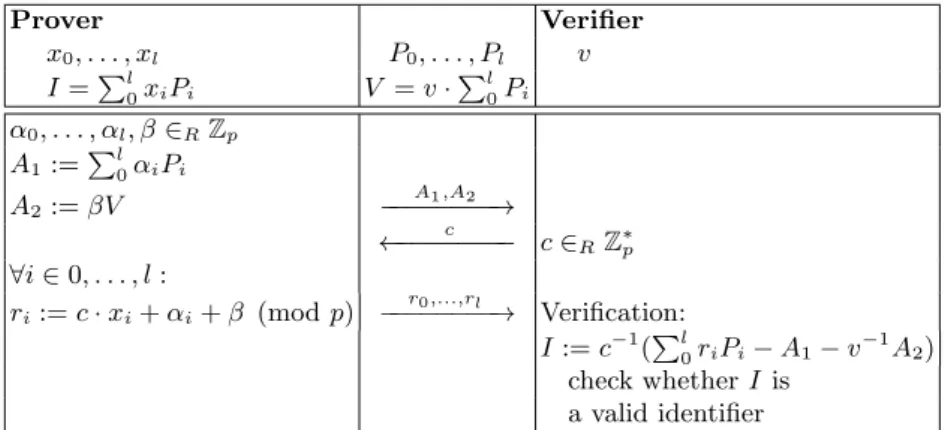
Protocol The Designated Verifier DL-REP proof in Figure 3 is clearly correct as the value computed by the verifier in the last step will be always equal to the prover’s identifier I. Furthermore, the proof is zero-knowledge since, given
I, the verifier herself could generate a valid transcript by selectingr0, . . . , rland
c uniformly at random from Zp and A2 point from G. Then A1 :=Pl0riPi−
cI−v−1
A2will be distributed uniformly inG.
To use the full potential of DL-REPs, we want to make selective disclosure proofs, that is, a scheme in which a prover should be able to prove the knowledge of any subset of attributes. In U-Prove, the revealed attributes are either common input, or they are sent through a private channel to the verifier. While the former
Prover Verifier x0, . . . , xl P0, . . . , Pl v I=Pl0xiPi V =v·Pl0Pi α0, . . . , αl, β∈RZp A1:=Pl0αiPi A2:=βV A1,A2 −−−−−−−−→ c ←−−−−−−−− c∈RZ∗p ∀i∈0, . . . , l: ri:=c·xi+αi+β (modp) r0,...,rl −−−−−−−−→ Verification: I:=c−1(Pl0riPi−A1−v−1A2) check whetherIis a valid identifier
Fig. 3.Designated verifier DL-REP proof; i.e., proof of knowledge of a DLREP of I
w.r.t.P0, . . . , Pl(There arel+ 2 point multiplications on the Prover’s side.)
releases information to an external party, the latter presumes some encryption with the verifier’s key. Since neither of these solutions is suitable in an RFID set-up, we should extend designated verification also to selective disclosure.
A naive approach is for the prover to prove the knowledge of a reduced set of attributes (e.g., without attributex2) which would enable the verifier to compute a partial identifier. Adding to it possible attribute points (e.g., x2P2) by trial and error, the verifier can find the real identifierI of the prover tag. However, this solution does clearly not scale up for several attributes with a lot of possible values.
In the next section we extend the current scheme to a designated selective disclosure scheme that does not have the drawback mentioned above. The secu-rity and narrow-strong privacy for this designated DL-REP scheme will follow from the corresponding results for the scheme in the next section.
3.2 Designated Selective Disclosure
In the previous section we introduced a designated zero-knowledge proof of knowledge of a DL-REP. Accordingly, the prover tag does not reveal its at-tributes, only the fact that it actually knows them. To make the construction more practical, we propose another scheme, the Designated Verifier Partial DL-REP scheme, or simply designated selective disclosure.
A verifier can compute and check the identifier of a tag; furthermore, he can compute those attribute points5
that the prover disclosed and the verifier is entitled to see according to the entitlement setE. Note that even if the verifier
5 Unlike in traditional selective disclosure, not the actual attributesx
jbut the
corre-sponding pointsxjPj are disclosed. However, note that the proof includes the fact
does not have all designated attribute private keys vi, she can compute I and those attributes she is entitled to determine byD ∩ E.
Setup The algorithmSetupVerifierin the Setup is slightly modified because of the designated attribute verification.
– SetupVerifier(par,E)−→(v, V,(vi, Vi)E) generates a private/public key pair
and a set of pairs for the Verifier, where the latter set depends on the enti-tlement index setE. If the identification key and the entitlement keys have already been generated in the system, the algorithm outputs those.
Protocol Assume that a tag is interrogated to reveal a set of attributes corre-sponding to the disclosure index setD(see Figure 4). Then it has to perform an identification in which the designated verifier, who is entitled to read attributes in E, can compute the following values:
– identifierI of the prover tag;
– disclosed attribute points Ci = xiPi for which the verifier has the corre-sponding attribute verifier keyvi.
After generating random values for all attributes and for the designation, the prover can compute the commitment pointsA1, A2for the DL-REP and (Bi)i∈D for the designated selective disclosure. Following the challenge–response phase, the verifier can first compute identifierI like in the normal Designated Verifier DL-REP scheme, that is, without the use of the entitlement setE. Second, the verifier can reconstruct attribute points Cj =xjPj in case j ∈ D ∩ E, that is, both the prover included Bj in the proof and the verifier is entitled to see the attribute point of index j.
Security against impersonation We show that it is not possible for an adver-sary to impersonate any valid tag, even though it was allowed to communicate with valid tags before.
Theorem 1. Assuming the original Selective Disclosure U-Prove scheme is se-cure against active impersonation attacks the Designated Verifier Partial DL-REP proof is also secure against active impersonation attacks.
Proof (Sketch.).We show how an adversary against the Designated Verifier Par-tial DL-REP system can be used to break the security of the U-Prove Selective Disclosure scheme. To do so, we build an adversary B that essentially trans-lates between these two systems. For the disclosed attributes we can easily ‘un-disclose’ them to mimic the Designated Verifier Partial DL-REP scheme. To go back we simply remember which attribute value corresponds to which public value. The other direction is the same as in Bringer et al. [6].
Prover Verifier x0, . . . , xl P0, . . . , Pl v,(vi)i∈E ∀i∈ D: Vi=viPi I=Pl0xiPi V =v·Pl0Pi α0, . . . , αl, β∈RZ∗q A1:=Pl0αiPi A2:=βV Bi= (αi+β)Vi ∀i∈ D A1,A2,(Bi)i∈D −−−−−−−−−−→ c ←−−−−−−−−−− c∈RZ∗q ∀i∈0, . . . , l: ri:=c·xi+αi+β (modp) r0...rl
−−−−−−−−−→ First verify that the identifier is correct:
I=c−1(Pl0riPi−A1−v−1A2) Then for eachj∈ D ∩ Eand attributeCj:
Cj=I−c−1(Pi6=jriPi−A1−v−1A2+vj−1Bj)
Fig. 4.Designated verifier DL-REP proof in which attributes inDare disclosed. (There arel+ 2 +dpoint multiplications on the Prover’s side.)
Narrow-strong privacy This proof uses a somewhat similar approach as the privacy proof of the Randomized Schnorr scheme [6]. There the authors show that the game in Definition 4 can be reduced to the following. If an adversary breaks the narrow-strong privacy of their Randomized Schnorr scheme, then it has to be able to distinguish tuples of the form (A1=αP, A2=βP, r =α+β), where α and β are random from tuples of the form (A1 = αP, A2 = βP, r), where alsoris random. Furthermore, they show that any adversary that can do so can be used to break DDH.
Theorem 2. Assuming the hardness of the DDH-problem the Designated Veri-fier Partial DL-REP scheme is narrow-strong private.
Proof (Sketch.). We extend traces for the Randomized Schnorr scheme to full traces for the Designated verifier DL-REP scheme. We do this in such a way that the new responses are random if and only if the response of the original instance was random. Hence any adversary against the Designated Verifier DL-REP scheme can be converted into a Randomized Schnorr adversary. However, the latter is secure under the DDH-assumption. The result follows.
4
Feasibility and Applications
4.1 Feasibility of our proposal
To show the feasibility of the proposed protocols for RFID tags, we consider an ECC-based architecture, for example, the one presented in [2]. The EC processor described is very compact and the performance of 1 point multiplication, even when frequency is lowered enough to keep the total power low, is still acceptable.
More precisely, the ECC-based grouping proofs as in [2] require two or three point multiplications and, even in the latter case, running time to complete the proof should stay below 300ms. In addition, considering hierarchical proofs [1] in which the performance depends on the number of levels in the hierarchy, our selective disclosure protocol achieves similar performance.
Similar remarks are valid for the memory requirements of a single tag. As-sumingl attributes, a tag has to store l+ 1 values where each is 160 bits long as the group keys in the hierarchical proof protocols. Having, for instance, 4 attributes to store, a tag requires 800 bits memory (assuming a curve over a 160-bit field). This is completely acceptable even for passive tags as attributes could be stored in the ROM memory, which is considered (unlike registers) very cheap, in the same way as the ECC parameters.
4.2 Envisioned RFID Applications
As mentioned above, new RFID security applications requiring a strong level of privacy are emerging constantly. Examples from previous works include yok-ing (or groupyok-ing) proofs and hierarchical proofs. Hence, an immediate need for designated attribute-based proofs is clear.
Considering the example of hierarchical proofs, our solution could be de-ployed meeting exactly the same requirements as envisioned by the tree struc-ture of the hierarchical proofs [1]. To obtain the same functionality, one could sort the attributes according to their order of importance. More precisely, choose
x1to be less important i.e. less privacy/security critical and therefore, the first secret verification keyv1can be stored on a lot of readers, whilev3, for example, only at a very limited set of verifiers, etc. This infrastructure is easily incorpo-rated in the designated attribute-based proofs as introduced above. In this way, we achieve not just a more fine-grained access control for tags, but also more fine-grained permissions for readers.
Typical real-life scenarios include applications involving users with medical conditions carrying around medicines that could be scanned (and sometimes should) by legitimate authorities, e.g., customs officers while maintaining some privacy for the user. In this case, the highest level of verification, i.e., the lowest index is left for medical staff providing first aid in accidents or other emergency cases.
5
Conclusions
Applying the most recent designs of RFID chips that allows for the use of elliptic curve cryptography, we propose a new scheme, the Designated Verifier (Partial) DL-REP proof: A tag, storing a DL-REP of its unique identifier, can reveal an arbitrary subset of its attributes to a designated verifier. While any authentic verifier can check the tag’s validity, it can only compute those attribute points that she is entitled to. On the one hand, a tag can bear multiple attributes of
different semantics, a reader, on the other hand, can gain access only certain attributes on the tags.
We showed in Section 4.2 that the scheme enables swift development of new protocols for specific applications. Nevertheless, in the context of RFID systems further study could investigate the potential provided by attribute-based proofs, such as proving predicates and linear dependencies among attributes, or verifying more tags at the same time.
We proved that the protocol is secure and narrow-strong private in the Vau-denay model. Therefore, the scheme is a powerful and reliable construction that enables further architectural developments in which tags and verifiers can have fine-grained permissions.
6
Acknowledgement
This work was supported in part by the European Commission under contract number ICT-2007-216676 ECRYPT NoE phase II and by the research program Sentinels as projectMobile IDM (10522) and projectRevocable Privacy (10532). Sentinels is being financed by Technology Foundation STW, the Netherlands Or-ganization for Scientific Research (NWO), and the Dutch Ministry of Economic Affairs.
References
1. Lejla Batina, Yong Lee, Stefaan Seys, Dave Singel´ee, and Ingrid Verbauwhede. Privacy-Preserving ECC-Based Grouping Proofs for RFID. In Mike Burmester, Gene Tsudik, Spyros Magliveras, and Ivana Ilic, editors, Information Security, volume 6531 ofLNCS, pages 159–165. Springer Berlin / Heidelberg, 2011. 2. Lejla Batina, Yong Ki Lee, Stefaan Seys, Dave Singel´ee, and Ingrid Verbauwhede.
Extending ECC-based RFID authentication protocols to privacy-preserving multi-party grouping proofs. Personal and Ubiquitous Computing, 16(3):323–335, 2012. 3. Lejla Batina, Stefaan Seys, Dave Singel´ee, and Ingrid Verbauwhede. Hierarchical ECC-Based RFID Authentication Protocol. In Ari Juels and Christof Paar, editors,
RFID. Security and Privacy, volume 7055 ofLNCS, pages 183–201. Springer Berlin / Heidelberg, 2012.
4. Stefan A. Brands. Rethinking Public Key Infrastructures and Digital Certificates: Building in Privacy. MIT Press, Cambridge, MA, USA, 2000.
5. Michael Braun, Erwin Hess, and Bernd Meyer. Using Elliptic Curves on RFID Tags. IJCSNS International Journal of Computer Science and Network Security, 8(2):1–9, 2008.
6. Julien Bringer, Herv´e Chabanne, and Thomas Icart. Cryptanalysis of EC-RAC, a RFID Identification Protocol. In Matthew Franklin, Lucas Hui, and Duncan Wong, editors,Cryptology and Network Security, volume 5339 ofLNCS, pages 149–161. Springer Berlin / Heidelberg, 2008.
7. Jan Camenisch, Ioannis Krontiris, Anja Lehmann, Gregory Neven, Christian Paquin, Kai Rannenberg, and Zwingelberg Harald. D2.1 Architecture for Attribute-based Credential Technologies. Deliverable, ABC4Trust EU Project, December 2011.
8. David Chaum. Zero-Knowledge Undeniable Signatures (extended abstract). In Ivan Damg˚ard, editor,Advances in Cryptology - EUROCRYPT ’90, volume 473 of
LNCS, pages 458–464. Springer Berlin / Heidelberg, 2006.
9. David Chaum and Hans van Antwerpen. Undeniable Signatures. In Gilles Brassard, editor,Advances in Cryptology — CRYPTO’ 89 Proceedings, volume 435 ofLNCS, pages 212–216. Springer Berlin / Heidelberg, 1990.
10. Junfeng Fan, Miroslav Knezevic, Dusko Karaklajic, Roel Maes, Vladimir Rozic, Lejla Batina, and Ingrid Verbauwhede. FPGA-based testing strategy for crypto-graphic chips: A case study on Elliptic Curve Processor for RFID tags. In 15th IEEE International On-Line Testing Symposium (IOLTS 2009), 24-26 June 2009, Sesimbra-Lisbon, Portugal, pages 189–191. IEEE, 2009.
11. Daniel M. Hein, Johannes Wolkerstorfer, and Norbert Felber. ECC Is Ready for RFID - a proof in silicon. In Roberto Maria Avanzi, Liam Keliher, and Francesco Sica, editors,Selected Areas in Cryptography, 15th International Workshop, SAC 2008, Sackville, New Brunswick, Canada, August 14-15, Revised Selected Papers, volume 5381 ofLNCS, pages 401–413. Springer, 2009.
12. Markus Jakobsson, Kazue Sako, and Russell Impagliazzo. Designated Verifier Proofs and Their Applications. In Ueli Maurer, editor, Advances in Cryptology — EUROCRYPT ’96, volume 1070 of LNCS, pages 143–154. Springer Berlin / Heidelberg, 1996.
13. A. Juels. “Yoking-Proofs” for RFID Tags. InProceedings of the Second IEEE An-nual Conference on Pervasive Computing and Communications Workshops (PER-COMW ’04), pages 138–143. IEEE Computer Society, 2004.
14. Neil Koblitz. Elliptic curve cryptosystems. Mathematics of Computation, 48:203– 209, 1987.
15. Yong Ki Lee, Lejla Batina, Dave Singel´ee, and Ingrid Verbauwhede. Low-Cost Untraceable Authentication Protocols for RFID. InProceedings of the third ACM conference on Wireless network security, WiSec ’10, pages 55–64, New York, NY, USA, 2010. ACM.
16. Christian Paquin. U-Prove Cryptographic Specification V1.1. Technical report, Microsoft, 2011.
17. Shahrokh Saeednia, Steve Kremer, and Olivier Markowitch. An Efficient Strong Designated Verifier Signature Scheme. In Jong-In Lim and Dong-Hoon Lee, editors,
Information Security and Cryptology - ICISC 2003, volume 2971 ofLNCS, pages 40–54. Springer Berlin / Heidelberg, 2004.
18. C. Schnorr. Efficient Identification and Signatures for Smart Cards. In Gilles Brassard, editor, Advances in Cryptology — CRYPTO’ 89 Proceedings, volume 435 ofLNCS, pages 239–252. Springer Berlin / Heidelberg, 1990.
19. Serge Vaudenay. On Privacy Models for RFID. In Kaoru Kurosawa, editor,
ASIACRYPT, volume 4833 ofLecture Notes in Computer Science, pages 68–87. Springer, 2007.
A
Security and Privacy Proofs
A.1 Proof of Theorem 1
Proof. (Theorem 1.) Suppose we are given an adversaryAthat wins the active impersonation game for the Designated Verifier DL-REP proof, we show how to construct an adversary B that wins the active impersonation game for the
U-Prove selective disclosure scheme. We need to show how Banswers the iden-tification requests fromAusing only the U-Prove oracle. Furthermore, we show how the impersonated identification protocol, run byAagainst the Designated Verifier DL-REP scheme, is converted by B into an identification protocol for the U-Prove selective disclosure scheme.
Initially, adversaryB generates a random private keyv and sets the public keyV to V =vPPi. Furthermore, for any disclosed attributei∈ Dadversary
Bgeneratesviat random and setsVi=viPi, and sends theseVi’s together with
V to adversaryA.
During the first phaseB answers interrogation queries for a tag as follows. First, it queries its own oracle, who sends a commitmentA. AdversaryB gener-atesαi ∈RZp fori∈ Dandβ∈RZp and sends toAthe values
A1=A+ X i∈D αiPi A2=βV Bi= (αi+β)Vi i∈ D.
Subsequently,B receivescfrom Awhich it passes along to its oracle. In return it receivesr′
i fori /∈ Dandxifori∈ D. It then sends toAthe responses
ri=
r′
i fori6∈ D
cxi+αi+β (modp) fori∈ D.
For future referenceBwill store the tuples (xi, xiPi) for every disclosed attribute. Clearly, this construction is a perfect simulation of the designated verification protocol.
In the second phase adversaryAwill impersonate a tag. The goal of adversary
B is to transform this communication such that it in turn impersonates a valid tag for the U-Prove selective disclosure protocol. First, A will generate two commitmentsA1 andA2, which are converted byBintoA=A1+v−1A2before sending it to the original U-Prove verifier. The verifier responds with a challenge
c, which B relays unchanged to A. Finally, A replies with the ri values. For
i /∈ D, B forwards these values to the challenger. Note that they should equal
ri=cxi+αi+β and are therefore appropriate responses to the commitmentA. For the disclosed attributes (i∈ D),B can calculate
xiPi=I−c− 1 (X j6=i rjPj−A1−v− 1 A2+v− 1 i Bi).
Using its stored tuples,Bcan then recover the valuesxi before forwarding them to the challenger according to the U-Prove protocol (see Figure 2). This com-pletes the proof.
A.2 Proof of Theorem 2
Proof. (Theorem 2.) A transcript in our designated verifier partial DL-REP proof has the form A1 = PαiPi, A2 = βV,(Bi)i∈D, c,(ri =cxi +αi+β)li=0.
We would like to show that the adversary cannot distinguish between properly constructedri’s and randomly chosen ones. Following the argument in Bringer et al. [6], we can take out the attribute values xi. Hence, the adversary has to distinguish instances from the actual distribution
DAl ={(AS1 = l X i=0 αiPi, AS2 =βV,(Bi)i∈D,(ri=αi+β)) : αi, β∈RZp,0≤i≤l} from instances from the simulated distribution
DSl ={(AS1 = l X
i=0
αiPi, AS2 =βV,(Bi)i∈D,(ri)) : αi, β, ri∈RZp,0≤i≤l} where theri’s are random.
Suppose we have an oracle for distinguishing between these two distributions, we will use this to decide between the corresponding instances for the Random-ized Schnorr scheme, which are in fact instances fromD0
AorD 0
S. The main idea is that we use the instance (A1:=αP, A2:=βV, r) we obtain as a challenge, to construct a full instance. This instance can then be solved using our oracle. We construct the other attributes in such a way thatα0=αandαi=α+γi where
γi is random.
Start by settingP0 =P andPi =piP,with pi random. Then we construct
AD 1 as AD1 =A1+ l X i=1 (piA1+γiPi) =αP0+ l X i=1 [(α+γi)Pi]. Similarly, we setV =Pl
i=0Pi,withvi random and construct
AD2 =A2+ l X i=1 piA2=β l X i=0 Pi.
For any disclosed attributei∈ D choosevi∈R Zp and setVi =viPi. Then the valuesBi are constructed as
Bi=vi(piA1+γiPi) = (α+γi)Vi. Finally, we setr0=rand
ri=r+γi.
If r = α+β, then clearly all other ri’s are correct as well, and we are in the normal situation. However, ifris random, then all the other values are random as well.6
This construction yields a valid input to our Designated Partial DL-REP oracle, and can hence be used to break the privacy of the Randomized Schnorr scheme.
6 While it may appear that theγ
i’s are fixed by the construction ofAD1,this is actually not the case: Nothing binds the value ofαitself anymore, and hence,AD
1 is actually a commitment to theγi’s that hides information theoretically.

![Fig. 1. Randomized Schnorr [6] identification, i.e., Designated Verifier Schnorr identi- identi-fication](https://thumb-us.123doks.com/thumbv2/123dok_us/9708846.2460577/7.892.254.669.172.351/randomized-schnorr-identification-designated-verifier-schnorr-identi-fication.webp)