EFFECTS OF HUMAN RESOURCE PRACTICES ON ORGANIZATIONAL PERFOMANCE.A CASE OF VETA IN DAR ES SALAAM AND
MOROGORO REGIONS
FELIX ELLIAH STAKI
A DISSERTATION SUBMITTED IN PARTIAL FULFILMENT FOR THE REQUIREMENTS OF THE DEGREE OF MASTER OF HUMAN RESOURCE MANAGEMENT OF THE OPEN UNIVERSITY OF
TANZANIA 2018
The undersigned certifies that, she has read and hereby recommends for acceptance by the Open University of Tanzania a dissertation titled: “Effects of Human Resource Practices on Organizational Performance. A Case of VETA in Dar es salaam and Morogoro Regions” in partial fulfillment of the requirements for the Degree of Master of Human Resource Management (MHRM) of the Open University of Tanzania. ……….………. Dr. Janeth N. Isanzu Supervisor ……… Date
No part of this dissertation may be reproduced, stored in any retrieval system, or transmitted in any form by any means, electronically, photocopying, recording or otherwise without prior permission of the author or The Open University of Tanzania in that behalf.
I, Felix Elliah Staki, do hereby declare that this dissertation is my own original work and that it has not been presented and will not be presented to any other university for a similar or any other degree award.
………..…… Signature
……….……… Date
This work is dedicated to my almighty God, the compassionate, the beneficent, the dispenser of grace, the most merciful, for being my shepherd, leading me to the path of righteousness, and for many blessings that He has made part of my life.
First and foremost, I would like to thank the Almighty God for giving me the strength and wisdom to carry out this study. I thank my supervisor Dr.Janeth N.Isanzu for her support and for her dedicated guidance during the entire period of writing this dissertation. Her suggestions, constructive critics and comments were vital to shape this study. I also express my appreciation to MHRM 2016/2017 classmates for their willingness to be my discussants during the research proposal.
My mother and other family members deserve special attention for their moral support and encouragement during the whole process of writing this study. I honorably thank my wife and children for their support willingness and tolerance during my study. I appreciate support from all of you.
This study entitled “The Effects of Human Resource Practice on Organizational performance: A case of Vocational Education Training Authority (VETA)” intended to assess effects of human resource practices such as Human Resource Planning (HR), training and career development and compensation policy and management on organizational performance in Tanzania public institutions. An exploratory research design was adopted as an appropriate study design. A sample of 100 employees was selected using purposive sampling and simple random sampling. An interview and self-administered questionnaire composed of closed and open-ended, and likert scale questions and documentary review instruments were used to collect data. Data were analyzed using descriptive statistics using excel for quantitative data. The findings indicated that the human resource practices such as HR planning, training and development, compensation policy, have a positive relationship with VETA institutions’ performance. The performance of both employees and the institutions depends on how managers use best practice on employees’ management. It was concluded that selected human resource practices work well if there is effective policies to assist managers when motivating staff to raise their working morale. It was recommended that the public sector institutions Governing Boards, should be competent so that they can supervise managements and sign performance contracts with managers and later appraise.
TABLE OF CONTENTS CERTIFICATION ... ii COPYRIGHT ... iii DECLARATION ... iv DEDICATION ... v ACKNOWLEDGEMENTS ... vi ABSTRACT ... vii
TABLE OF CONTENTS ... viii
LIST OF TABLES ... xiii
LIST OF FIGURES ... xiv
LIST OF ABBREVIATIONS ... xv
CHAPTER ONE ... 1
INTRODUCTION ... 1
1.1 Background to the Study ... 1
1.2 Statement of the Research Problem ... 4
1.3 Research Objectives ... 6
1.3.1 General Objective ... 6
1.3.2 Specific Objectives ... 6
1.4 Research Questions ... 6
1.5 Significance of the Study ... 7
1.6 Scope of the Study ... 7
CHAPTER TWO ... 9
LITERATURE REVIEW ... 9
2.1 Overview ... 9
2.2 Conceptual Definitions ... 9
2.2.1 Human Resource Management Practices ... 9
2.2.2 Human Resource Planning (HRP)... 10
2.2.3 Training and Development ... 10
2.2.4 Compensation Management... 10
2.2.5 Organizational Performance ... 11
2.2.6 Employees Performance ... 11
2.3 Effects of Human Resource Management Practices on Organizational Performance ... 12
2.3.1 Effects of Human Resource Planning (HRP) on Organizational Performance ... 12
2.3.2 Effects of Training and Development on Organizational Performance ... 12
2.3.3 Effects of Compensation on Organizational Performance ... 13
2.4 Theoretical Analysis ... 14
2.4.1 Abraham Maslow’s Needs Theory ... 14
2.5 Empirical Literature Review ... 15
2.5.1 Studies done Worldwide ... 15
2.5.2 Studies done in African Countries... 16
2.5.3 Empirical Studies in Tanzania ... 17
2.5.4 Human Resources Planning Policies and Practice ... 17
2.7 Conceptual Framework ... 20
2.8 Chapter Summary ... 20
CHAPTER THREE ... 21
RESEARCH METHODOLOGY ... 21
3.1 Overview ... 21
3.2 Research Design and Strategies ... 21
3.3 Area of the Study... 21
3.4 Target Population ... 22
3.5 Sample and Sampling Procedures ... 22
3.5.1 Sample Size ... 22
3.5.2 Sampling Techniques ... 23
3.6 Methods of Data Collection ... 24
3.6.1 Primary Data ... 24 3.6.2 Secondary Data ... 24 3.7 Research Instruments... 25 3.7.1 Interview ... 25 3.7.2 Questionnaire ... 25 3.7.3 Documentation ... 25
3.8 Variables and Measurement Procedures ... 26
3.9 Validity and Reliability of Research Instruments ... 26
3.9.1 Validity of the Instruments ... 26
3.9.2 Reliability of the Instruments ... 27
3.10 Data Processing and Analysis ... 27
CHAPTER FOUR ... 29
FINDINGS AND DISCUSSION... 29
4.1 Overview ... 29
4.2 Results of test of Validity and Reliability... 29
4.3 Profiles of Respondents ... 30
4.4 Descriptive Statistics ... 33
4.4.1 Assessment of Effects of Human Resource planning on Organizational Performance ... 33
4.4.2 Assessment of effects of Training and Development on Organizational performance... 34
4.4.3 Assessment of Effects of Compensation Management on Organizational Performance ... 35
4.5 Analysis of Findings Concerning HR Practices at VETA ... 36
4.5.1 Effects of HR Planning on Organizational Performance ... 36
4.5.2 Effects of Training and Development of Employees on Organizational Performance ... 36
4.5.3 The Effects of Compensation Policy on Organizational Performance ... 37
4.6 Results from Interview ... 38
4.7 Discussion of Findings ... 41
CHAPTER FIVE ... 44
SUMMARY OF MAIN FINDINGS, CONCLUSIONS AND RECOMMENDATIONS ... 44
5.1 Overview ... 44
5.3 Implication of the Findings ... 44
5.3.1 Implications to the HR Practitioners ... 44
5.3.2 Implications to the Employees ... 45
5.4 Conclusion ... 45
5.5 Recommendations ... 45
5.6 Limitations of the Study ... 46
5.7 Delimitation of the Findings ... 46
5.8 Suggestion for Areas for Further Studies ... 47
REFERENCES ... 48
LIST OF TABLES
Table 3.1: Composition of Sample ... 23
Table 4.1: Reliability Analysis ... 29
Table 4.2: Respondent’s Biographical data ... 31
Table 4.3: Human Resources Planning Attribute ... 33
Table 4.4: Training and Development Attributes ... 34
Table 4.5: Compensation Management Attributes ... 35
Table 4.6: Descriptive Statistics (Overall) ... 35
Table 4.7: Effects of Human resource planning on organizational Performance (N=94)... 36
Table 4.8: Effects of Training and Career Development of Employees on Organizational Performance (N=94) ... 37
LIST OF FIGURES
LIST OF ABBREVIATIONS FBM Faculty of Business Management
GPRA Government Performance or Result Act
HR Human Resources
HRM Human Resource Management HRP Human Resources Planning
MHRM Master of Human Resource Management NIT National Institute of Transportation OUT Open University of Tanzania
SPSS Statistical Package for Social Sciences VETA Vocational Education and Training Authority URT United Republic of Tanzania
CHAPTER ONE INTRODUCTION 1.1 Background to the Study
Organizations nowadays are looking forward to have a competitive advantage against the threats present in globalization. Due to the high competency requirements, most organization aim to generate the kind of performance that can bring more profit. In order to do that, the employees are required to perform well and improve their performance (Osman, 2013).
To comply with this, the organization needs to align organizational performance with human resource management practices, which would be shown by organizational output of financial variables (sales growth, goal achievement, good services, productivity) (Chand and Katou, 2015; ) and non-financial variables (management quality, long-term orientation, continuous improvement, workforce quality) (De Waal and Frijns, 2011; Dimba, 2010) and also other outcomes as commitment, quality and flexibility (Guest,2013). Once a business entity has analyzed its mission, identified all its stakeholders, and defined its goals, it needs a way to measure progress toward those goals (Kaplan and Norton,2015).
Since the 1980s, human resource management (HRM) strategy has become an important topic for the management area.HRM strategy has achieved its prominence because it provides competitiveness and promotes managerial efficiency in the business area. The rise of human resource management in the 1980s brought managerial scholars to the link between the management of people and performance. A number of attempts were made to put empirical facts with the theoretical bones of
the knowledge based firms and the specific HRM views concerning how the systems on Human Resource practices, which can make an increment on the organizational performance. The approach that focuses on individual Human Resource practices and the link with the performance continued since early 1990s (Hendry and Pettigrew, 2012).
In a global context, human resource practices are such as recruitment, selection, and appraisal; it directs partially constrain development of specific practices; and overarching philosophies, which specify the values that inform an organization's policies and practices (Gilley et.al., 2012). According to Bulla and Scott (1994), human resource planning is the process of ensuring that human resource requirements of an organization are identified and plans are made for satisfying those requirements. This view suggests several specific, interrelated activities that together constitute Human Resources planning which includes personnel inventory, human resource process, action plan, control and evaluation. An organization needs to adopt specific HR policies and practices for different strategies. Thus, it can elicit employee behaviors that are consistent with an organization’s strategy (Rose and Kumar, 2014).
Human Resource management practices should be an important part of the strategy of any large corporation (Gilley et.al., 2012).Yet researchers basing their views on a behavioral psychology perspective have argued that human resource management practices could contribute to competitive advantage as long as they reinforce the skills, attitudes and behaviors that result in lowering costs and enhancing product differentiation. Therefore, the important role of human resources practices in
contributing to a firm’s competitive advantage overlaps with the concept of efficiency as a human resources strategy for effective performance (Ozcelik and Ferman, 2016).
Human resource planning is surrounded by three basic level practices which can increase the organizational performance: To increase the knowledge, skills and abilities among employees, to enhance their empowerment like giving them employment security and organize some participation programs for employees and to give them motivation through both incentive means like giving them compensation and benefits, and also through internal promotion like promoting them with their job status. (Yongme et al., 2015).
Organizational performance can be measured through financial stability and productivity, but when we have to relate human resource planning with the organizational performance, then we consider some of other variables like efficiency and effectiveness, employee motivation, job satisfaction, trust on employees (Cho et al., 2015). To comply with this, the organization needs to align organizational performance with human resource management practices, which would be shown by organizational output of financial variables (sales growth, goal achievement, good services, productivity) (Osman et al., 2013; Chand and Katou, 2015;) and non-financial variables (management quality, long-term orientation, continuous improvement, workforce quality) .
The Vocational Education and Training Authority (VETA) was established by the Act of Parliament Act No. 1 of 1994. VETA is charged with broad tasks of
coordinating, regulating, financing, promoting and providing vocational education and training in Tanzania. VETA promotes a balancing of supply and demand for skilled labour force in both wage employment and for skills needed.
VETA coordinates more than 860 Vocational Training Centres which provide training in more than 90 different long courses and various tailor-made short courses to equip young men and women with basic skills before they join organizations in various sectors of the national economy (VETA, 2016). To that juncture, it is the work of this study to assess the impacts of Human Resources Planning on the organizational performance in VETA in order to come up with findings which will help for improvement of the head office, zonal offices and training Centres working performance.
1.2 Statement of the Research Problem
The way in which Human Resource Management (HRM) practices can influence the commitment of an individual employee to the aims and objectives of an organization has been the focus of much researches (Meyer and Amp, 2014; Allen, 2015). Some researchers have found that high involvement of HRM practices, such as regular appraisals, Human Resource Planning, bonus and compensation schemes, training and development opportunities, and regular constructive feedback, can significantly enhance the organizational commitment of employees and organizational knowledge and performance in developed nations (Smith, 2014).
Many studies in human resource practices focused on the impact of such practices on job satisfaction (Yousef, 2010; Eslami et al., 2012), on productivity (Osa et al.,
2014), other focused on linkage between HR practices with employee commitments and innovation (Mathieus and Zajac, 2012), Corporate social responsibility (Ali et al, 2010) and Transformation leadership, (Srithongrung, 2011). Despite a wealth of empirical works on the subject, still effects of human resources practices on organizational performance remain one of the greatest challenges that many organization faces. This has been the case of the Vocational Education Training Authority (VETA) in Tanzania.
Nevertheless, at most all studies have been done beyond Tanzania boundaries creating a geographical and cultural gap this study sought to fill.The vocational education and training system in Tanzania focuses on providing skills to the labour force in order to enable it to enter, re-enter skills training retrain with a view of acquiring and maintaining decent employment and employability.The history of forming VETA in Tanzania dates back to 1940 when the Apprenticeship Ordinance was enacted to guide training in the industry. VETA is charged with responsibilities of coordinating, regulating, financing, promoting and providing vocational education and training in Tanzania (Moshi, 2014). As said earlier,good human resources management practices are organization’s greatest assets, therefore identifying good human resource practices at VETA staff is important.
Moreover, when the organization implement good management practices staff will not quit, organization will have a good performance and implications for the learning institutions. This has motivated the researcher to study the effects of human resources management practices among VETA staff and establish whether has related to organizational performance. Has HRM practices positively affects VETA
performance? Or is HRM practices at VETA negatively influenced performance? It is from this puzzle the researcher proposed to conduct research because according to his knowledge, no similar study has been conducted in Dar es salaam and Morogoro regions in Tanzania.
1.3 Research Objectives 1.3.1 General Objective
To examine the effects of human resources practices on organizational performance of VETA in Dar es Salaam and Morogoro regions.
1.3.2 Specific Objectives
i. To examine the effects of human resource planning on organizational performance
ii. To examine the effects of training and development on organizational performance
iii. To examine the influence of compensation management on organization performance
1.4 Research Questions
i. What are the effects of human resource planning on organizational performance?
ii. What are the effects of training and development on organizational performance?
iii. What are the influences of compensation management on organization performance?
1.5 Significance of the Study
The study will enable the researcher to integrate both theories and empirical literature with the real work situation. It will broaden the knowledge of the researcher and if properly and strategically applied, human resource planning will help the organization to achieve its objective in more efficient and effective manner. The findings of the study will be used to refine the human resource management practices used by VETA management. Results will help organizations to prepare human resource planning and other practices and to assess whether these practices are implemented effectively or not.
The study will also assist Director Generals, management members as well as managers to assess the impacts of Human resources management practices on organizational performance of VETA particularly in Dare es Salaam and Morogoro regions. The VETA employees will be aware of the relationship between human resource planning and organizational performance. The study will be beneficial to other researcher as the source of reference Furthermore; this study will fulfill the requirement for Master of Human Resources Management of the Open University of Tanzania. Moreover, the findings will assist future researchers on the same topic.
1.6 Scope of the Study
The study examined the effects of human resource practices on organizational performance at VETA.This research investigated the VETA employees and management team working in VETA centres in Dar es salaam and Morogoro regions in Tanzania. The study was carried out within a period of six month starting from February 2018
1.7 Organization of the Study
Chapter one of this study introduced the background of the study, statement of problem, the objectives of the study, research question and the significance of the study. Chapter two presents a review of literature and relevant researches associated with the problem addressed in this study. The study is supported by literatures from different researchers from different areas within and outside the country. Chapter three presents the methodology that will be used in this study and which comprises the research design, area of the study, population of the study, sample size and sampling design, sources of data, data collection tools, reliability and validity of data, data analysis and presentation and the expected results. Chapter four presents research findings and discussion. This is followed by chapter five which covers the summary of the main findings, conclusion, recommendations and areas for future studies.
CHAPTER TWO LITERATURE REVIEW 2.1 Overview
This chapter presents the literature review related to the topic under study. The purpose of this chapter is to review different studies and views from other researchers and authors, their theories and problems they face, with the objective of adding knowledge and familiarize the researcher about the problem to be studied. Some specific books, research articles, dissertations, theses and journals were reviewed. The chapter consists of conceptual definitions, theories governing the study, empirical literature review, research gap and conceptual framework.
2.2 Conceptual Definitions
This section starts by looking at some definitions about several terms as they are used in this study.
2.2.1 Human Resource Management Practices
In a study conducted by Katou and Bedhwar (2015) in Greece, the influencing factors of Human Resource Management (HRM) practices include activities like staffing, training and development. Human Resource Planning, compensation management, recruitment, involvement of employees, incentives, and safety and health which have positive relationship with firms’ performance. Also, a study by Sang (2013) from Taiwan and Cambodia, the respondents which called managers concluded that workforce planning; staffing; compensation, and incentives; teamwork; training, and employee security had a positive and significant influence on non-financial and financial dimensions of organizational performance.
2.2.2 Human Resource Planning (HRP)
Human Resource planning is a process of guiding activities related to the human resources management (Mursi, 2013). It generally, refers to how the management makes decisions on how the human resources needs in an organization can be staffed minimum costs.
2.2.3 Training and Development
Training is defined as the organized activity aimed at imparting information or instructions to get better the staff performance or attain a required level of skill or knowledge to help him or her (Saed and Asgher, 2012). Development is defined as those activities that lead to the attainment of fresh skills or knowledge for the sole aim of personal growth. (Peteraf, 2013).
2.2.4 Compensation Management
According to Nhema (2015) employee receive compensation in the form of rewards, pay, benefit it is basically the output that management uses to increase the performance of organization. Half of the cash flow is equal to the compensation of the organization but more than half in the service sector (Ivanceikh and Glueck, 2014 ). For the purpose to increase performance of organization the key factor is to motivate employees and attract the employees.
Compensation can be in the form of multiple pay plans and can be in the form of individually, merit pay to performance long incentives, bonus, and merit pay in the form of rewards. These are the different qualities and components of compensation that are in the form of individual performance and multiple pay
plan performance, this research was conducted by Millvier and Newman (2013). In order to increase the performance of organization pay plan is commonly used Chani. The most common appraisal of employee is pay plan by Heneman and warner (2011).
2.2.5 Organizational Performance
Organization performance refers to an analysis of a company’s performance as compared to goals and objectives of the company. Within the corporate organizations, there are three primary outcomes analyzed, financial performance, market performance and shareholder value performance (Johnson, 2009). However, VETA is not a corporate company; it is not for profit but Vocational Skills service provider. Considering the vision and mission statement of VETA, the major objective is to provide quality vocational skills trainings for young Tanzanians leading to improved work force. In this regard therefore, the study will measure VETA performance on its capability to provide quality vocational skills trainings.
2.2.6 Employees Performance
Performance refers to behaviors that are relevant to organizational goals and that are under control of individual employee. Other scholars for example, Campbell (1999), defines employee performance as a behavior which consists of directly observable actions of a worker and also mental actions or products such as answers or decisions, which result in organizational outcomes in the form of attainment of set goals. Moreover, Motowidlo (2013) argues that job performance is “the total expected value to the organization of discrete behavioral episodes that an individual carries out over a standard period of time”. According to Sturo (2007), employee
performance is the extent of completion of the tasks that make up an individual’s job.
2.3 Effects of Human Resource Management Practices on Organizational Performance
The following are the effects of some of the human resource management practices on organizational performance
2.3.1 Effects of Human Resource Planning (HRP) on Organizational Performance
According to Mursi (2013), there is significant and positive relationship between Human Resource (HR) planning and organizational performance. Study by Hiti (2010) indicated that HR planning have a positive relationship with organizational performance. In another study by Arsad (2012) manpower planning effect on organizational performance and have a positive relationship between manpower planning an organizational performance. Hand and Katou (2015) study the effects of planning in the Indian hotel industry and found out that manpower planning have strong relationship to productivity, and productivity impact on organizational performance.
2.3.2 Effects of Training and Development on Organizational Performance Training and development is a main important element of human resource management (HRM) (Vlachos, 2014). Training is defined as the organized activity aimed at imparting information or instructions to get better the staff performance or attain a required level of skill or knowledge to help him or her (Saed and Asgher,
2012). Development is defined as those activities that lead to the attainment of fresh skills or knowledge for the sole aim of personal growth. (Peteraf, 1993).
Study by Apospori et al (2008) suggested that there is a significant impact of training and development on organizational performance. Subramaniam et al. (2011) mentioned that training and development could influence organizational performance because employees’ skills, knowledge and abilities can be enhanced and up to date. In another study by Dimba, (2010) it was found that there is the influence and relationship between training and development on organizational performance.
2.3.3 Effects of Compensation on Organizational Performance
An organization's compensation policies and practices are integral to its success (Gomez-Mejia, Berrone, and Franco-Santos, 2010; Huselid, 1995; Lawler, 2003). Compensation plays a number of key roles in organizations including signaling employee worth, attracting potential job incumbents, and retaining existing employees (Gerhart and Rynes, 2003). Furthermore, while intrinsic motivators are important, extrinsic motivators such as pay continue to represent a central role in explaining why individuals are productive in the workplace (Dulebohn and Werling, 2007).
In sum, compensation systems represent a critical influence and driver of employee attitudes and behaviors (Rynes, Gerhart and Minette, 2004; Sweins and Kalmi, 2008). The effectiveness of a compensation system, however, depends, to a large degree on how it is designed, among other factors. considerable portion of employee
pay to be based on levels of employee productivity (Chien, et al., 2010). When HRM systems, such as compensation, are used to differentially affect employee performance through increased expectations (Batt and Colvin, 2011), these are referred to as performance-enhancing (or expectation-enhancing) practices (Shaw et al., 2009).
2.4 Theoretical Analysis
The following theories guided this study
2.4.1 Abraham Maslow’s Needs Theory
Maslow’s Hierarchy of Needs theory postulates that humans have specific needs that must be met. His proposition about motivation is that people want beings, they always want more, and what they want depends on what they already have (Mullin, 2002). He postulated that human needs are arranged in a hierarchy of importance in five steps.
According to Maslow, human beings have needs that are organized into a hierarchy like a pyramid. Those basic needs at the bottom of the pyramid, such as food and shelter, must be met first. Once these basic needs are accomplished, employees seek to feel safe (such as job security), be loved (friendships and relationships), have a sense of accomplishment (such as through recognition or a job well done) and finally, for self-actualization (work that is personally fulfilling). Needs must be met at each level before employees can move higher along the triangle. Therefore, an employee who fears for his job can't focus on high-performance goals (Colquitt et al., 2013).
2.5 Empirical Literature Review 2.5.1 Studies done Worldwide
Rawashdeh et al. (2012) conducted a study to analyse whether there is any relationship between Human Resource Planning (HRP) and organizational performance. He took a sample of 140 employees of selected manufacturing firms in Guatemala. His findings indicated that there is a relationship between HRP and organizational performance. He recommended that. when we prepare our planning programme, practitioners should bear in mind that their staff members have their objective they need to achieve. This is the reason why employees seek employment. Neglecting these needs would result in poor motivation that may lead to unnecessary poor performance and even Industrial actions.
Klein (2014) contended that there is a positive relationship between human resource management practices and organizational performance. He recommended that in order to stimulate organizational performance, management is required to develop skilled and talented employees who are capable of performing their jobs successfully (Achieving better organizational performance requires successful, effective and efficient exploit of organization resources and competencies in order to create and sustain competitive position locally and globally.
Ahmad and Schroeder (2013) conducted a study in Pakistan to examine the relationship between human resource management activities and organizational performance. They found that there is existence of positive relationship between human resource management practices (information sharing, extensive training, selective hiring, compensation and incentives, status differences, employment
security, and decentralization and use of teams) and organizational performance including quality of work, cost reduction, flexibility, quality deliverability and commitment.
Sang (2015),in his study conducted in Japan found a positive influence of human resource management practices (namely, human resource planning, staffing, incentives, appraisal, training, team work, employee participation, status difference, and employment security) on organisation performance. He recommended that in order the organization to perform better, HRM should be given its rightful place of relevance in any organization and not left in the hands of line managers who neither have the expertise nor the time and space to carry out the enormous functions of a human resource manager.
2.5.2 Studies done in African Countries
Chand and Katou (2015) conducted a study in Accra Ghana to examine the effects of human resource practices on organizational performance. They used a sample of 200 employees working at educational institutions in Accra. The analyzed several human resource management practices, measured by organizational output of financial variables (sales growth, goal achievement, good services, productivity) (Osman, Ho & and non-financial variables (management quality, long-term orientation, continuous improvement, workforce quality) and also other outcomes as commitment, quality and flexibility (Guest, 1997). The found a positive relationship between HRM practices and organizational performance. They recommended that once a business entity has analyzed its mission, identified all its stakeholders, and defined its goals, it needs a way to measure progress toward those goals.
2.5.3 Empirical Studies in Tanzania
Husna (2013) conducted a study in Mbeya Tanzania to assess the impact of human resource planning on organization performance. She found that Human Resource Planning is one of the key elements that have to be considered, if National Institute of Transportation (NIT) has to get the best out the employees, the Planning for them should be top priority in enabling the institution to realize its set goals and 52 objectives. Basically, planning for human resources involves setting the required objectives, analyzing the environment, carrying out an audit of Human Resources, making a forecast, reconciling the demand and supply of Human Resources and evaluating the implementation.
Furthermore, the Tanzanian government can mandate the use of HRP and systematic performance assessment tools as means to improve accountability measures over the Public Sector. For example, the government can develop and pass either the Government Performance or results Act (GPRA) of 1993 (Blackmon, 2008; Franklin, 2011) or performance based budgeting system to the ministry of social affairs as an effective governance tool. Following this could allow Public Sector to justify how effective are they in offering valuable public services. The findings revealed that human resource planning plays a critical role on performance of the organization specifically in NIT as the case study.
2.5.4 Human Resources Planning Policies and Practice
An organization needs to adopt specific Human Resource (HR) policies and practices for different strategies. Thus, to be effective, an organization’s HR policies must be consistent with other aspects of the organization. By having appropriate HR
policies and practices in place, organizations can elicit employee behaviors that are consistent with an organization’s strategy (Kumar & Rose, 2006).
It is obvious that HR management practices should be an important part of the strategy of any large corporation. Yet researchers basing their views on a behavioral psychology perspective have argued that human resource management practices could contribute to competitive advantage as long as they reinforce the skills, attitudes and behaviors that result in lowering costs and enhancing product differentiation.
Therefore, the important role of human resources practices in contributing to a firm’s competitive advantage overlaps with the concept of efficiency as a human resources strategy for effective performance (Ozcelik & Ferman, 2016). The human resource planning is the strategic planning process at the level of the senior management. The human resources planning is a process of guiding activities related to the human resources management (Mursi 2013). Human resources planning involves two steps proposed by Durah and Al-Sabag (1986).
Fist part is analysis of the organization's objectives; this step involves the studying and understanding the objectives of the organization. It is integral part of the organizations strategic planning and to meet the strategic goals of the organization. The external and internal environment for the organization should be considered and evaluated. The second part is Monitoring and evaluation: The monitoring and evaluation is an assessment to diagnose of the strength and the weaknesses.
2.6 Research Gap Identified
By considering the above reviewed empirical literature it is evident that a good number of similar research have been done, but there are a number of gaps left ranging from geographical to time as well as nature of the organization studied. Khan et al (2010), conducted a research on the impact of human resource planning on organizational performance on public and private sector of oil and gas in Pakistan.
Despite the study relevance the research was conducted in Pakistan where geographical attributes, political and socio culture values differ from Tanzania. Katou and Bedhwar (2013) studied the relationship of human resource practices on organizational performance. The study left a gap in time. Sang (2015) studied the relationship between compensation and job attitude in the tourism industry and its effect on organizational performance. The study conducted in Taiwan and Cambodia where most of the organization operates in an advanced working environment compared to those found in Tanzania. Therefore, their findings cannot be in favor of the Tanzania environment.
Despite the fact that a number of research have been done to explore the effect of human resource management practices in relation to organizational performance, most of them were carried in other countries particularly Asian countries. Few studies have been done in African countries including Tanzania. This study will fill the existing gap left by previous literature specifically the effects of human resource management practices on organizational performance in Tanzania organizations.
2.7 Conceptual Framework
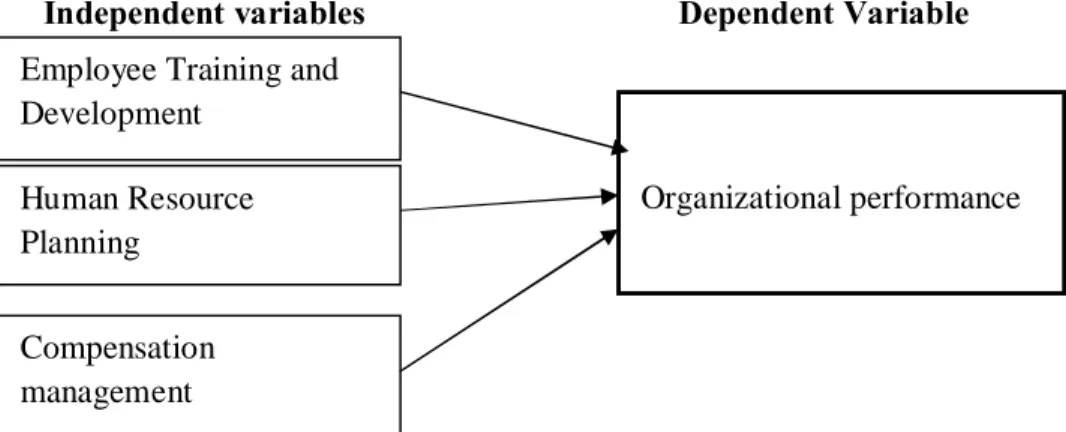
A conceptual framework can be defined as a set of broad ideas and principles taken from different relevant fields of enquiry and used to structure subsequent presentation (Kombo and Tromp, 2006).In this chapter, on the basis of specific objectives, research hypotheses and literature review, conceptual framework is developed. This framework is constructed to direct and organize data collection.
Independent variables Dependent Variable
Figure 2.1: Conceptual Framework Source: Researcher, 2018
2.8 Chapter Summary
This chapter focuses on different studies, which attempt to explain the relationship and impact of human resource practices on organizational performance in VETA. It can be said that human resource practices is a critical area with human resource manager keen to differentiate their strategies by enhancing voice performance, training, and team work. In addition, this chapter discussed the variable in conceptual framework, which used to examine the impacts of human resource practices on organizational performance in VETA.
Human Resource Planning
Compensation management
Employee Training and Development
CHAPTER THREE RESEARCH METHODOLOGY 3.1 Overview
This chapter presents the methodology used in the study. It describes the research paradigm, research design, the population of the study, sampling techniques, sampling procedures, sample size, data collection methods, data collection procedures data analysis and reliability and validity.
3.2 Research Design and Strategies
Research design simply means an overall plan for conducting a research.It is the way a researcher has chosen and planned ways of investigating the social reality or the planned arrangement of how to address the research problem and is organized in such a manner as to optimize on research outcomes (Omari 2011).Research design in this study is exploratory design. It adopted quantitative approaches supported partly by qualitative data.
3.3 Area of the Study
The study was conducted in Dar es Salaam and Morogoro regions. The study was restricted to Dar es Salaam and Morogoro region where VETA operates because these two regions are the centre of Tanzania’s economy and almost all the head quarter of the public sectors are located in this regions. Second, the selection was based on the researcher’s accessibility to the data required. Moreover, Dar es Salaam and Morogoro regions were chosen for this study due to limited time and fund, which restricted the researcher to collect data countrywide in order to achieve the study objective with convenience and cost justification.
3.4 Target Population
A population is the totality of any group of units which have one or more characteristics in common that are of interest to the research (Omari, 2011). Total number of target population contained 1000 staffs of VETA in different centres at Dar es Salaam and Morogoro region.
3.5 Sample and Sampling Procedures
Sampling is referred to as the process of selecting units from a population of interest so that by studying the sample a researcher may fairly generalize his results back to the population from which they were chosen (Kothari,2006).Churchill and Iaccobucci,2002) has defined sampling as a selection of a subset of elements from a large group of objects.
3.5.1 Sample Size
According to Kothari (2006) sample is a collection of some parts of the population on the basis of which judgment is made, small enough for convenient data collection and large enough to be a true representative of the population from which it has been selected. Sample size refers to a number of items to be selected from the universe to constitute a sample. Due to time and financial constraints, the sample size consisted one hundred (100) respondents selected among 1000 VETA staffs at Dar es salaam and Morogoro Centres including management members, center principals and staff members. According to Kothari (2006), depending the nature of the study, in order for the sample to be a true representative of the population, it must be at least ten percent (10%) of the population. In this study the sample size was about ten percent (10%) percent of the population, hence the sample was a true representative of the
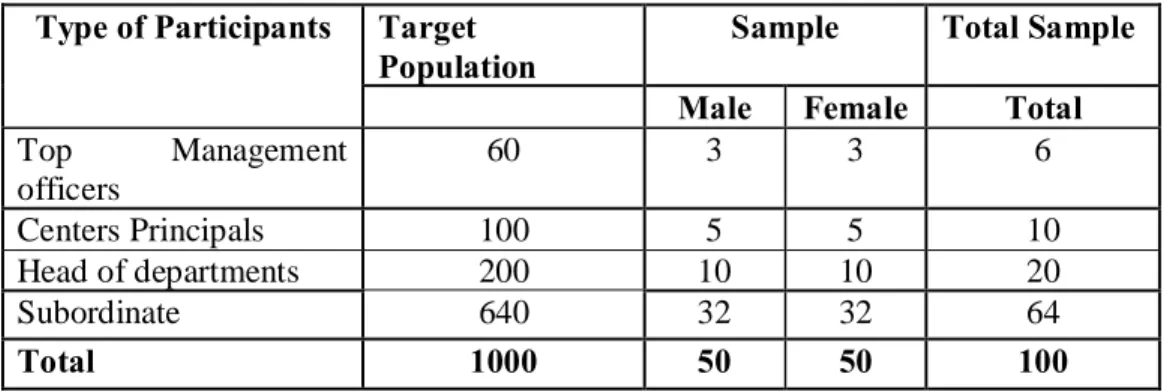
population. The sample size proposed for this study is shown in Table 3.1
Table 3.1: Composition of Sample Type of Participants Target
Population
Sample Total Sample
Male Female Total
Top Management officers 60 3 3 6 Centers Principals 100 5 5 10 Head of departments 200 10 10 20 Subordinate 640 32 32 64 Total 1000 50 50 100 Source: Researcher, 2018 3.5.2 Sampling Techniques
Sampling is done due to constraints of time, money and accessibility of data to the entire population (Cohen, et al., 2007). This study employed both probability and non-probability sampling. Probability sampling involved simple random sampling. Simple random sampling was used to select center principals, head of departments and subordinate members from VETA centres at Dar es salaam and Morogoro regions. The aim of using simple random sampling was to make sure that each staff has equal chance of been chosen.
Furthermore the researcher employed purposive sampling. Purposive sampling was used to select six (6) top management officers from six VETA centres at Dar es Salaam and Morogoro regions. This technique was used for this special group of people who are among the top management for the aim of getting reliable information about effects of human recourse practices. These respondents were selected purposively because they hold specific positions in the organization and as
such could have reliable information on effects of hr practices (Tan and Nasurdin,2011)
3.6 Methods of Data Collection
Data collection refers to systematic focused and orderly collection of data for the purpose of obtaining information to solve research problems (Kumar, 2011). Both primary and secondary data collection methods were used in this study in order to counterbalance shortcomings from each technique (Saunders et al., 2006).The decision to use multiple methods in collecting data (triangulation) ensured validity of data as one method complement each other (Saunders et al., 2006).
3.6.1 Primary Data
According to Saunders (2006), this is the original source of data, in which the researcher collects the data for the first time, and as such, the data collected are known as primary data. According to Mugenda (1999), primary sources of data constitute the “information a researcher obtains from the field that is data collected from the subjects in the sample.
3.6.2 Secondary Data
According to Kothari (2006), secondary sources of data refer to already available data, which was collected and analysed by someone else. In this study, secondary sources of data involved the use of published and unpublished documents obtained from libraries, offices and the Internet. Such documentary materials include published books, journal articles, research reports, theses and dissertations. The secondary data provides the researcher with more insights on the problem being
studied by cross-validating and augmenting evidence obtained from interviews, questionnaires and focus group discussion.In this study researcher collected secondary data from files, VETA reports (2016 and 2017), books and journals. Additional information was obtained from the World Wide Web (www)-internet.
3.7 Research Instruments 3.7.1 Interview
According to (Kothari, 2006), an interview is a set of questions administered through oral or verbal communication between the researcher and the interviewee. In this study, semi structured interview was employed to collect data from the six (6) VETA top management executives. Interview schedule was prepared and questions were asked to each participant. Through this method six (6) respondents from the sample i.e. VETA management personnel were interviewed.
3.7.2 Questionnaire
Questionnaire is a set of questions, which are usually sent to selected respondents to answer at their own convenient time and return back the filled questionnaire to the researcher (Kothari, 2006).Semi structured Questionnaires were distributed to ninety four (94) respondents including principals, head of departments and subordinates who filled them under the administration of the researcher. This study employed semi structured questionnaire with open ended questions, close ended questions and five point likert scale questions.
3.7.3 Documentation
and information by going through various documents such as; books and journals on the topic in question. The researcher also studied reports, booklets and brochures issued by VETA. The reason for using documentary research in this study was that documents would have enabled the researcher to track various types of information from documents, records, and publications within a short time and with less cost. According to Saunders (2006) one of the advantages of using secondary data is the enormous saving of resources, and particularly time and money.
3.8 Variables and Measurement Procedures
In the course of the study, the researcher collected quantitative data, supported partly by qualitative data using both secondary and primary sources of data. Quantitative data was collected especially on social demographic characteristic of respondents including gender, age, education level, and other quantitative information. Qualitative data was obtained from the respondents though interview whereby quantitative data was obtained through self-administered questionnaires. On the other hand, secondary information was obtained through reviewing of published materials on the subject of the subject of the study. Documents including staff’s attendance record, published reports on VETA, academic and newspaper articles on the subject of the study were explored for secondary data collection.
3.9 Validity and Reliability of Research Instruments 3.9.1 Validity of the Instruments
Validity aimed at whether the tools are truly measuring what they intended to measure (Kothari, 2007). Pilot study was done to test whether the tools truly
measure what they intended to measure (Kothari 2007). Validity of the tool was made by piloting the questionnaires before a comprehensive exercise of data collection to see if the tool can measure what it is supposed to measure from different respondents.
3.9.2 Reliability of the Instruments
Reliability is the extent to which a test or procedure of data collection yields similar results under constant conditions on all occasions (Kothari, 2007). That is, if we repeated to assess the effects of HRs practices on the organizational performance normally a person gets the same answer each time? According to Crobanch (1951) there are several devices for checking reliability in scales and tests such as Test and re- test, alternative forms methods or split half method. The reliability of this study’s instruments was ascertained by using Cronbach’s Alpha test.
3.10 Data Processing and Analysis
Data analysis refers to the process of examining what has been collected in survey or experience and making deduction (Komba et al., 2006). In this study we analyzed quantitative data by using descriptive analysis, tabular form, frequencies and percentages. The researcher used Statistical Packages for Social Scientists (SPSS) version 23 for the analysis of Quantitative data. Data were sorted, coded and entered into the SPSS software. After data entry, the researcher was able to present that in descriptive statistics including frequencies, mean, and percentages and making cross tabulations of variables to check the relationships. Quantitative data was presented in Tables.
3.11 Ethical Issues Considered
The ethical consideration was observed in getting informed consent from the impacts of HRs practices on the organizational performance in Dar es Salaam and Morogoro regions. The researcher consulted supervisor on ethical issues in the university, the researcher abides with confidentialities from the people who needed information; there were no exposing or leaking of information without consent of the person who provided information. Also, it was humbled to cultural and belief of respondents. There were no bias, exposing leaking, hyperbolizing and understatement of the information from the respondents.
CHAPTER FOUR FINDINGS AND DISCUSSION 4.1 Overview
This chapter comprises of presentation and analysis of findings. Mainly it focuses on presenting and analyzing data using descriptive statistics, regression analysis and correlation between variables. Results were presented and analyzed as tested according to the specific objectives which were as follows: - To examine the effects of human resource planning on organizational performance, to examine the effects of training and development on organizational performance, to examine the influence of compensation management on organization performance and to suggest ways in which human resources management practice policies affect public learning institutions.
4.2 Results of test of Validity and Reliability Table 4.1: Reliability Analysis
Source: Field Data, 2017
To test the reliability of data collection instruments Cronbach’s Alpha was used to measure the internal consistency by the use of SPSS. Cronbach alpha ranges between 0 and 1 (Grayson, 2004), the closer the Cronbach’s alpha coefficient is to 1.0 the greater the internal consistency of the items in the scale (Grayson, 2004).
S/N Question Number of respondent Number of items Cronbach’s alpha
1 Human resource planning 94 5 0.811
2 Training and Development 94 7 0.942
3 Compensation Management 94 4 0.765
4
Ways in which human resources management practice policies affect VETA
Table 4.1 shows the results of reliability test using Cronbach’s alpha approach. According to Nunnaly & Bernstein (1994) and Grayson (2004) reliability coefficient of 0.7 or higher is considered acceptable in most social science research situations. George and Mallery (2003) established the rule of thumb indicating that a Cronbach’s alpha greater that 0.9 means excellent consistency, greater that 0.8 means good consistence, 0.7 means acceptable, 0.6 means questionable, greater than 0.5 means poor and less that 0.5 is unacceptable.
The analysis presented in Table 4.1 indicates the reliability coefficients of human resource planning and training and development are excellence while the reliability coefficient of Compensation Management and the ways in which human resources management practice policies affect VETA is good which implies that probably few items could be improved. Therefore both variables indicate a strong internal consistency of instruments used in data collection. However, a high value for alpha does not imply the measure is undimensional. If in addition to measuring internal consistency, you wish to provide evidence that the scale in question is undimensional, Explanatory Factor Analysis is one of methods of checking dimensionality. Cronbach’s alpha is a coefficient of reliability or consistency
4.3 Profiles of Respondents
This part presents the main characteristics of respondents categorized as gender, age, level of education, period undertaking by VETA staffs, effects of planning to the organization, effects of training and development on performance ,effects of compensation management and ways in which policies influence performance of VETA.
Descriptive statistics was used to provide simple summaries about the sample and about the observations that have been made. Such summaries may be either quantitative that’s summary statistics or visual, that’s simple-to-understand graphs. These summaries may form the basis of the initial description of the data as part of a more extensive statistical analysis, or they are sufficient in and of themselves for this research work. The use of descriptive and summary statistics has an extensive history and, indeed, the simple tabulation of populations and of economic data was the first way the topic of statistic appeared.
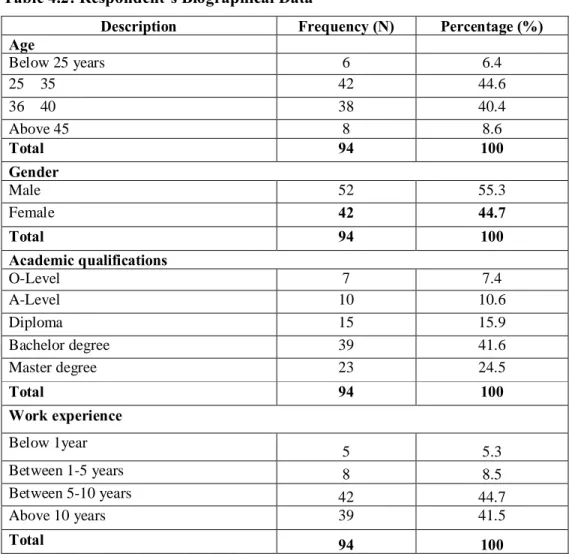
Table 4.2: Respondent’s Biographical Data
Description Frequency (N) Percentage (%)
Age Below 25 years 6 6.4 25 – 35 42 44.6 36 – 40 38 40.4 Above 45 8 8.6 Total 94 100 Gender Male 52 55.3 Female 42 44.7 Total 94 100 Academic qualifications O-Level 7 7.4 A-Level 10 10.6 Diploma 15 15.9 Bachelor degree 39 41.6 Master degree 23 24.5 Total 94 100 Work experience Below 1year 5 5.3 Between 1-5 years 8 8.5 Between 5-10 years 42 44.7 Above 10 years 39 41.5 Total 94 100
This study adopted a five-point Likert scale to answer the items in the questionnaire, with 5 denoting “always” and 1 denoting “never.” The following is the descriptive statistics of the finding of the study. Table 4.2 shows the summary of the descriptive percentage of the respondent's demographic factors including (age, gender, academic qualifications and working experience). Table 4.2 shows the summary of the descriptive statistics of the respondent's demographic factors including (age, gender, academic qualifications and working experience). From the table, it can be seen that males differ from females by marginal percentage.This shows that there are no gender balance considerations in recruiting staffs at VETA. This might be due to the technical subjects which creates career for job requirement that needs more males assuming that they are masculine as compared to female when it comes to practical matters. Furthermore, the study was interested to use age because age has influence on the ability to work.The age was measured in years ranging from below 25 years,25 - 35, 36 - 40 and above 45 years.
According to the findings the majority of respondents (staffs of VETA) were aged between 25 to 40 years which reflect that they are matured enough to provide relevant required information. It is an indication that VETA recruits young people within the active age and energetic so as to enhance high learning. Concerning the education of respondents, the level of education was measured with the kind of education attained. The findings from table 4.2 show that the majority of staffs at VETA had bachelor degree followed by those having master degrees. This implies that the majority of staffs at VETA have reliable education to perform their duties. Regarding the work experience, the findings indicated that majority of staffs at
VETA have a long working experience (above 5 years of age) giving them experience of dealing with matters related with human resource management practices.
4.4 Descriptive Statistics
This part presents the descriptive statistics of respondents categorized as age, marital status, level of education, period undertaking by respondents.
4.4.1 Assessment of effects of Human Resource planning on Organizational Performance
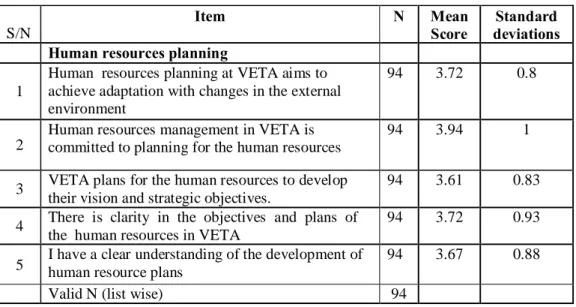
Table 4.3: Human Resources Planning Attribute
S/N
Item N Mean
Score
Standard deviations
Human resources planning
1
Human resources planning at VETA aims to achieve adaptation with changes in the external environment
94 3.72 0.8
2
Human resources management in VETA is committed to planning for the human resources
94 3.94 1
3 VETA plans for the human resources to develop their vision and strategic objectives.
94 3.61 0.83 4 There is clarity in the objectives and plans of
the human resources in VETA
94 3.72 0.93 5 I have a clear understanding of the development of human resource plans 94 3.67 0.88
Valid N (list wise) 94
Source: Field data
Item serial number 2 obtained the highest mean score (3.94) for the first variable, HR planning (see Table 4.3). This result suggested that the planning processes within VETA are well established, and HR staff members are well versed in the rules and procedures, and have experience and competence in the employee planning process.
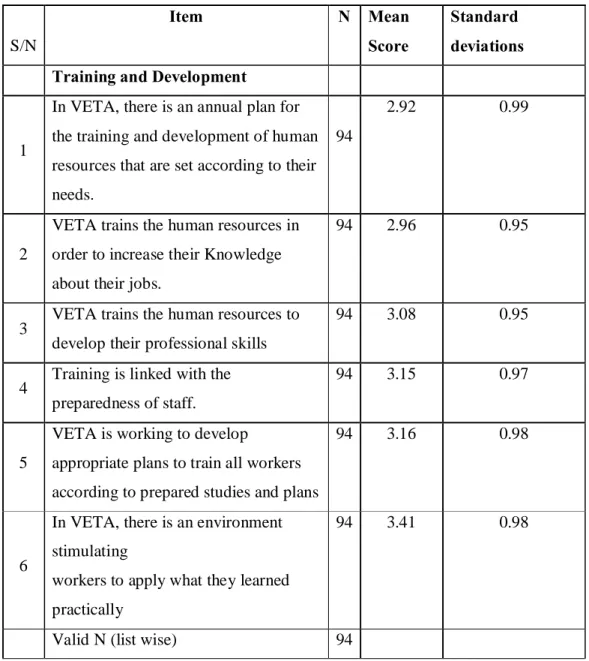
4.4.2 Assessment of effects of Training and Development on Organizational performance
Table 4.4: Training and Development Attributes
S/N
Item N Mean
Score
Standard deviations Training and Development
1
In VETA, there is an annual plan for the training and development of human resources that are set according to their needs.
94
2.92 0.99
2
VETA trains the human resources in order to increase their Knowledge about their jobs.
94 2.96 0.95
3 VETA trains the human resources to develop their professional skills
94 3.08 0.95
4 Training is linked with the preparedness of staff.
94 3.15 0.97
5
VETA is working to develop
appropriate plans to train all workers according to prepared studies and plans
94 3.16 0.98
6
In VETA, there is an environment stimulating
workers to apply what they learned practically
94 3.41 0.98
Valid N (list wise) 94
Source: Field Data, 2018
Item serial number 6 (Table 4.4) obtained the highest mean score for the second variable, training and development. This result implied that the training or course content is relevant and applicable to the day-to-day responsibilities of HR staff.
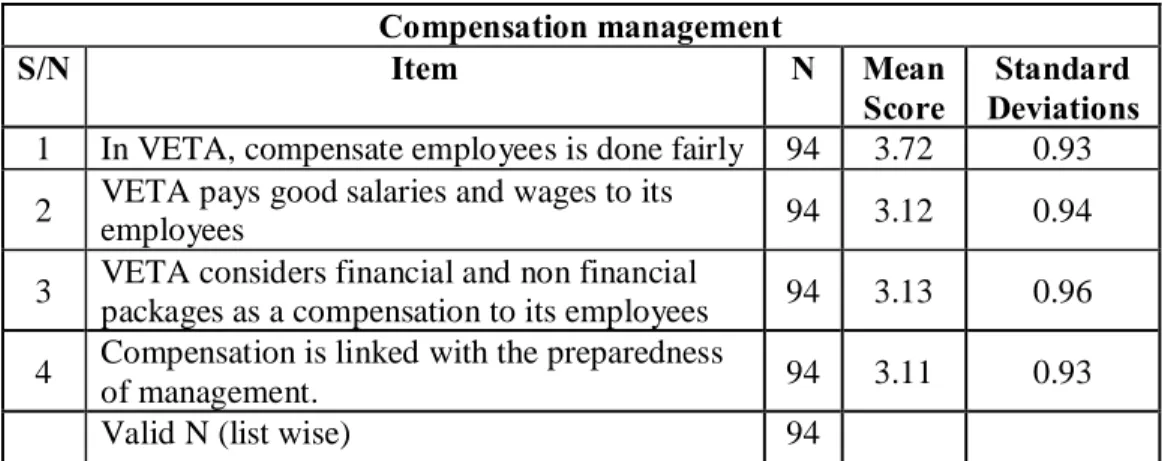
4.4.3 Assessment of Effects of Compensation Management on Organizational Performance
Table 4.5: Compensation Management Attributes Compensation management
S/N Item N Mean
Score
Standard Deviations 1 In VETA, compensate employees is done fairly 94 3.72 0.93 2 VETA pays good salaries and wages to its
employees 94 3.12 0.94
3 VETA considers financial and non financial
packages as a compensation to its employees 94 3.13 0.96 4 Compensation is linked with the preparedness
of management. 94 3.11 0.93
Valid N (list wise) 94
Source: Field Data, 2018
According to the findings in table 4.5, mean scores less than 3.12 were considered weak, mean scores between 3.12 and 3.13 were considered moderate, and mean scores of more than 3.50 were considered high. Item serial 1 (Table 4.5) obtained the highest mean score (3.72) for the third variable, compensation management. This result implied that compensation management at VETA works effectively and its content is relevant and applicable to the day-to-day responsibilities of HR staff. Table 4.6: Descriptive Statistics
Organizational Performance Human Resource Planning Employee Training and Development Compensation Management N Valid 94 94 94 94 Missing 0 0 0 0 Mean 9 10.06 10.61 10 Median 6 8 12 7 Std. Deviation 2.76 3.21 4.16 2.65 Range 12 13 14 12 Minimum 4 5 6 4 Maximum 16 18 20 16
4.5 Analysis of Findings Concerning HR Practices at VETA 4.5.1 Effects of HR Planning on Organizational Performance
Research objective one sought to find out whether HR planning has effects on organizational performance. In answering to the research question the researcher asked respondents whether there are any effects. Table 4.7 shows the respondent’s feedback.
Table 4.7: Effects of Human Resource Planning on Organizational Performance (N=94)
Respondent Frequency (N) Percentage (%)
No effects 27 28.7
Positive effects 63 67.0
Don’t know 4 4.3
Total 94 100.0
Source: Field Data, 2018
Table 4.7 shows the distribution of VETA staffs according to their opinion on the effects of human resource planning on the organizational performance. A total of 94 respondents were asked to show their opinions on effects of human resource planning on organizational performance. Sixty three respondents argued that there is a positive relationship between HR planning and organizational performance, while twenty seven respondents said that there is no effect, and four respondents did not know the idea. Since majority of respondents said there are positive effects, and then we conclude that HR planning have positive effects on organizational performance.
4.5.2 Effects of Training and Development of Employees on organizational Performance
of employees as HR practices have effects on organizational performance. To fulfill this objective, the question was asked that required the respondents to indicate whether they support the idea that training and career development of employees as one of HR practices have effects on organizational performance. The results from table 4.8 show the response from respondents.
Table 4.8: Effects of Training and Career Development of Employees on Organizational Performance (N=94)
Respondent Frequency (N) Percentage (%)
No effects 21 22.3
Positive effects 67 71.3
Don’t know 6 6.4
Total 94 100.0
Source: Field Data
Table 4.8 shows the distribution of VETA staffs according to their opinion on the effects of training and career development of employees on the organizational performance. A total of 94 respondents were asked to show their opinions on effects of employee training and career development on organizational performance. Sixty seven respondents (71.3%) argued that there is a positive relationship between training and career development on organizational performance, while twenty one (21) (22.3%) respondents said that there is no effect, and 6 respondents (6.4%) said they don’t know the idea. Since majority of respondents said there are positive effects, then we conclude that training and career development have positive effects on employee performance and ultimately impacts organizational performance.
4.5.3 The Effects of Compensation Policy on Organizational Performance The third objective of the study was to assess the effects of compensation policies on