Eastern Michigan University
DigitalCommons@EMU
Master's Theses and Doctoral Dissertations Master's Theses, and Doctoral Dissertations, and Graduate Capstone Projects
11-16-2015
Users' perspective on the relationship between
internal controls and key constructs
Santosh Mutnuru
Follow this and additional works at:http://commons.emich.edu/theses Part of theScience and Technology Studies Commons
This Open Access Thesis is brought to you for free and open access by the Master's Theses, and Doctoral Dissertations, and Graduate Capstone Projects at DigitalCommons@EMU. It has been accepted for inclusion in Master's Theses and Doctoral Dissertations by an authorized administrator of DigitalCommons@EMU. For more information, please [email protected].
Recommended Citation
Mutnuru, Santosh, "Users' perspective on the relationship between internal controls and key constructs" (2015).Master's Theses and Doctoral Dissertations. 646.
Users’ Perspective on the Relationship between Internal Controls and Key Constructs by
Santosh Mutnuru
Dissertation
Submitted to the College of Technology Eastern Michigan University
In partial fulfillment of the requirements for the degree of
DOCTOR OF PHILOSOPHY IN TECHNOLOGY Concentration in Technology Management
Dissertation Committee: John Dugger, Ph.D., Chair Sean Xiangdong Che, Ph.D.
Ali Eydgahi, Ph.D. Huei Lee, Ph.D
November 16, 2015 Ypsilanti, Michigan
ii Abstract
This study sought to understand a user’s perspective on the level of influence that internal controls had on the levels of trust, employee engagement, employee performance, and
organization performance. The relationship between the level of implementation of internal controls with the level of trust that employees have for their employer, employee engagement, employee performance, and organization performance has not been adequately explored. The study was conducted on users who worked in organizations that implemented Committee of Sponsoring Organizations of the Treadway Commission (COSO) internal controls, and these organizations strictly maintain all of their information in digital format. About nine hundred users were targeted from COSO implemented small intensive information-technology
organizations in southeastern Michigan. The influence that COSO Internal Controls have on the levels of trust, organization performance, employee performance, and employee engagement was explored.
The findings revealed that a significant positive relationship existed between the degree of implementation of internal controls and participant-reported organization performance. It was also found that there was a significant positive relationship between the level of implementation of internal controls and the level of trust an employee has for his/her employer. Further, it was found that the level of implementation of internal controls has a significant positive relationship with both employee engagement and employee self-reported performance. This study also determined that there was a significant positive relationship between the level of trust an employee has towards the employer and employee engagement in small businesses. One implication of this study is that private-information technology-intensive organizations should consider implementing a system of internal controls such as the COSO system.
iii
It is recommended that future research efforts focus on understanding internal controls interrelated components such as control environment, risk assessment, control activities, information and communication, and monitoring to determine which component has more influence on the level of trust that an employee has regarding his/her employer, employee engagement, employee performance, and organization performance.
iv Dedication
I dedicate this work to my mom Lakshmi; and to my wife Bhagyasree. I dedicate this work to Achanta family; to my brother-in-law Kishore and my sister Parimala; and to all my cousins. I also dedicate this work to my friends Surekha and Sushma.
v Acknowledgements
I would like to extend my sincere thanks to my dissertation chair Dr. John Dugger for being the best mentor and guide I could ask for on the journey to becoming a PhD. I genuinely appreciate the guidance and support he had given me through this process. Working under Dr. Dugger has been a real learning experience. I would also like to extend my thanks to Billy Whisnant for being there for me. I would also like to thank Dr. Ali Eydgahi for being a part of my committee and for the suggestions and guidance that I received from him. I would also like to thank Dr. Sean Xiangdong Che and Dr. Huei Lee for being in my committee and for providing valuable suggestions and guidance throughout. I would like to thank Prof. John Boyless, and Tracy RushBuyers. I am extremely grateful to the institution, faculty, and staff at Eastern Michigan University for the support and guidance. I am also thankful to my fellow Eastern Michigan University graduate students for their friendship over the years.
vi Table of Contents Abstract ... i Dedications ... iv Acknowledgements ... v List of Tables ... ix List of Figures ... ix Chapter 1: Introduction ... 1
Statement of the Problem ... 3
Nature and Significance of the Problem ... 4
Objective of the Research ... 6
Research Questions ... 7
Null Hypotheses ... 8
Limitations and Delimitations ... 8
Assumptions ... 9
Definitions of Terms ... 9
Summary ... 9
Chapter 2: Literature Review ...11
The Concept of Internal Controls as a Solution ...11
Vulnerability to External and Internal Employee Attacks ...11
Vulnerability to Fraud ... 13
Threats to Digital Storage ... 15
vii
Defining Internal Control Elements ... 18
Important Factors When Considering Internal Controls ... 19
The Role of Employee Engagement... 20
The Role of Employee Performance ... 23
The Role of Employee Trust ... 24
Organization Performance ... 27
Summary ... 28
Chapter 3: Methodology ... 30
Research Design ... 30
Population... 30
Sample and Sampling Techniques ... 30
Instrument Design ... 30
External Validity ... 37
Human Subjects Approval ... 37
Pilot Test ... 38 Data Collection ... 39 Data Analysis... 39 Reliability Analysis ... 39 Outliers ... 40 Summary ... 40
Chapter 4: Data Analysis ... 41
Reliability Analysis ... 41
viii
Descriptive Analysis of Scales ... 44
Factor Analysis ... 57
Results ... 60
Summary ... 67
Chapter 5: Discussion, Conclusions, and Implications ... 68
Overview of the Study... 68
Discussion ... 68 Research Implications ... 70 Limitations ... 71 Future Research ... 72 Research Summary ... 74 References ... 75
ix
List of Figures
Figure 1: Model of Proposed Study ... 6
List of Tables Table 1: Constructs and Items ... 34
Table 2: Reliability Analysis ... 40
Table 3: Reliability Analysis ... 44
Table 4: Demographic Characteristics of the Sample ... 46
Table 5: Descriptive Analysis on the Items in Trust ... 48
Table 6: Descriptive Analysis on the Items in COSO Internal Controls ... 48
Table 7: Descriptive Analysis on the Items in Organization Performance ... 50
Table 8: Descriptive Analysis on the Items in Employee Engagement ... 50
Table 9: Descriptive Analysis on the Items in Employee Performance ... 51
Table 10: Crosstab between Employee Engagement and Employee Education ... 52
Table 11: Crosstab between Employee Engagement and Employee Age ... 53
Table 12: Crosstab between Employee Engagement and Employee Gender ... 54
Table 13: Crosstab between Employee Engagement and Employee Experience ... 54
Table 14: Crosstab between Employee Performance and Employee Education ... 55
Table 15: Crosstab between Employee Performance and Employee Age ... 56
Table 16: Crosstab between Employee Performance and Employee Gender ... 56
Table 17: Crosstab between Employee Performance and Employee Experience ... 57
x
Table 19: Crosstab between Trust and Employee Age ... 58
Table 20: Crosstab between Trust and Employee Gender ... 59
Table 21: Crosstab between Trust and Employee Experience ... 59
Table 22: Factor Loading for Factor 1 ... 61
Table 23: Factor Loading for Factor 2 ... 62
Table 24: Factor Loading for Factor 3 ... 62
Table 25: Factor Loading for Factor 4 ... 63
Table 26: Summary of Linear Regression Analysis for Predicting the Level of Trust that an Employee Has with his/her Employer by COSO Internal Controls..……… 64
Table 27: Summary of Linear Regression Analysis for Predicting the Organization Performance by COSO Internal Controls……… 64
Table 28: Summary of Linear Regression Analysis for Predicting the Employee Performance by COSO Internal Controls……… 65
Table 29: Summary of Linear Regression Analysis for Predicting the Employee Engagement by COSO Internal Controls………..66
Table 30: Summary of Linear Regression Analysis for Predicting the Level of Trust that the Employee Has for the Employer by Organization Performance……… 66
Table 31: Summary of Linear Regression Analysis for Predicting the Level of Employee Engagement by Organization Performance……….……… 67
Table 32: Summary of Linear Regression Analysis for Predicting the Level of Employee Performance by Organization Performance……….……… 68
Table 33: Summary of Linear Regression Analysis for Predicting the Level of Trust that an Employee Has with his/her Employer by Employee Engagement……… 68
Table 34: Summary of Linear Regression Analysis for Predicting the Level of Trust that an Employee has in his/her Employer by Employee Performance……… 69
Table 35: Summary of Linear Regression Analysis for Predicting the Level of Employee Performance by Organization Performance……… 70
Chapter 1: Introduction
In order to ensure efficiency, effectiveness, safety of information, reliability of financial reporting, and compliance with the applicable laws in small organizations, most small businesses and organizations rely heavily on a system of internal controls (COSO, 1994). According to the Committee of Sponsoring Organizations of the Treadway Commission (1994), internal control is defined as a process effected by an entity’s board of directors, management, and other personnel, which is designed to provide reasonable assurance regarding the achievement of objectives in the following categories: effectiveness and efficiency of operations, reliability of financial reporting, and compliance with applicable laws and regulations.
Pressly (2009) wrote that the Committee of Sponsoring Organizations of the Treadway Commission (COSO) was originally formed in 1985 by major groups of financial and accounting associations. As part of its agenda, “the Committee has advocated strong internal controls as a deterrent to financial fraud” (Pressly, 2009, p. 49). The five components that were identified by the commission are control environment, risk assessment, control activities, information and communication, and monitoring. The use of internal controls is especially important as the use of electronic business transactions continues to expand.
Pressly (2009) indicated that robust financial internal controls promote reliable processes and a positive business image that lead to long-term relationships with customers. Small
organizations that rely on internal controls such as the COSO framework may boost
performance, achieve profitability targets, and prevent loss of resources. COSO (1994) declared that its five interrelated components can help an organization reduce risks and ensure reliability in financial statements. So with the increasing number of failures and frauds that affect small organizations such as those that result from internal employee attacks, network intrusions, and
2
fraud in financial reporting, more emphasis is being placed on internal control systems (Pressly, 2009).
Based on the analysis of the Ohlson (1995) model, the negative impact of weak internal controls on a firm’s value may arise from three factors: higher cost of capital, lower precision of accounting information, and lower effectiveness and efficiency of business operations. Firms can achieve competitive advantage and also can achieve effectiveness and efficiency of business operations through the resources they have (Barney, 1991). Barney (1991) states that an organization’s resources can take many forms, including assets, as well as the employees’ performance, capabilities, employee engagement, trust, and knowledge.
According to Pathak (2003), in addition to COSO, another framework is available from the Information Systems Audit and Control Association (ISACA): Control Objectives for Information and Related Technology (COBIT). First released in 1996, this framework is narrower than the COSO framework and addresses the need for management and control of information and Information Technology (IT) processes. The primary objective of the Systems Audit and Control (eSAC) approach is to focus on how organizational risks can be dealt with by management and auditors in the discussion and the implementation phases (Pathak, 2003). The eSAC approach is primarily designed for managers and auditors.
Small organizations need internal controls to provide higher levels of assurance that they will achieve their operating, financial reporting, and compliance objectives, precisely to help the organization succeed in its mission. Internal control helps ensure that the policies, directions, procedures, and practices designed and approved by management and the board are put in place and are functioning as per the need. The more elaborate the organization, the more the need for
3
internal control to counteract any loss of effectiveness sustained when more employees and processes are involved in the business (COSO, 1994).
The COSO model has broader applicability as it focusses on the complete life cycle of a business and can be implemented by any business type. Possible variables that might be affected by the utilization of internal controls include: the level of trust that an employee has for an employer who implements the COSO internal controls framework, the level of employee engagement with work, and the employee’s individual performance. Additionally, the overall performance of the organization may also be influenced by the utilization of a system of internal controls.
Statement of the Problem
There is a paucity of evidence to suggest that the use of internal controls such as those identified by the COSO framework had any significant influence on the level of trust perceived by an employee regarding the employer, the level of employee engagement, individual employee performance, and overall performance within small organizations. Based on this gap, this
research sought to determine whether a relationship existed between the level of use of COSO internal controls, level of trust felt by employees, the level of employee performance, the level of employee engagement, and the performance of the organization in which the employee worked.
Nature and Significance of the Problem
Over the past few years, our society has witnessed several large-scale corporate scams. In many of these cases, the top executives formed elaborate schemes to commit massive fraud over multiple years (Ashbaugh et al, 2006). One of the notorious scams was the internal control failure of consulting and IT services provided in India.
4
Satyam is the consulting and IT services provider in India whose chairman and chief financial officer have confessed to overstating profits and creating a fictitious cash balance of more than $1 billion. The company counts roughly one-third of the Fortune 500 among its customers. Satyam's auditor, Price Waterhouse, a regional arm of PricewaterhouseCoopers, says the company’s financial statements from 2000 to 2008 should no longer be considered reliable. (Whitehouse, 2009, p. 1)
Ashbaugh et al. (2006) stated that firms that exist with weak internal control have more chances of increased exposure to accounting and fraudulent risks. Therefore, it is critical that an organization have strong internal controls in order to achieve accuracy and reliability of financial reporting, along with compliance with applicable laws and regulations. At the same time,
organizations should protect employees’ trust in their managers and in the organization. Hewitt Associates LLC indicated that based on employees’ efforts, a significant relationship exists between employee engagement and the performance of an organization (Hewitt Associates LLC, 2005). This firm wrote that they “have established a conclusive, compelling relationship between engagement and profitability through higher performance, sales, customer satisfaction, and employee retention” (Hewitt Associates LLC, 2005, p. 1). Erickson (2005, p. 14) wrote that employee engagement is above and beyond simple satisfaction with the employment arrangement or basic loyalty to the employer that most organizations have measured for many years. Engagement, in contrast, is about passion and commitment to invest oneself and have one’s own discretionary efforts to help the employer succeed. One dimension of this research examined Erickson’s view and determined whether an employee would work with the same passion and commitment and help the employer succeed even if the employer implements internal controls in the organization.
5
Cook and Wall (1980) concluded that trust among the individuals and a team in an organization is very important and significant for both short-term and long-term stability of an organization. Cohen and Prusak (2001) believe that trust is an essential fluid for all social activities, allowing people in an organization to work together, without creating unnecessary stresses and conflicts during negotiations or carrying out natural business processes.
According to Burton (2011), performance is a versatile measure used at both individual and company levels to determine how much work gets done. On the individual level, people strive to be more productive in their jobs. Companies analyze costs per employee and are often concerned with employee morale as a means of maintaining or increasing performance. This research attempted to determine whether employee engagement and the level of an employee’s trust in his/her employer had any significant relationship with performance in a small
organization. Also, this research analyzed whether COSO internal controls had any significant relationship with the performance of the individual or the small organization in which he/she was working.
Cascio (1992) stated that performance is an employee’s accomplishment of an assigned task. He stated further that predetermined standards are set, against which actual performance can be measured. In other words, managers can claim an employee is underperforming or over-performing only when there are some performance expectations. The objective of an employee performance analysis exercise is to review employee performance against set standards and identify strengths and weaknesses of employees both in terms of personal characteristics and work skills (Goss, 1994). It then becomes a question of whether employee performance has anything to do with the performance of the organization in which he/she works.
6
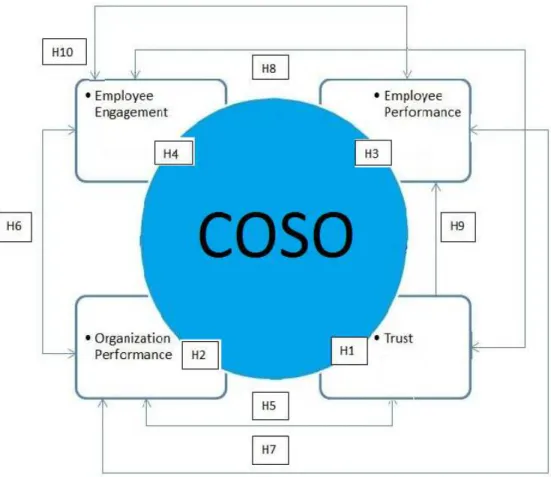
Of particular interest is how the existence of COSO internal controls affect the important constructs mentioned above. Determining whether these relationships exist will help guide future organizations as they attempt to enjoy the many benefits of a system of internal controls. Figure one provides the theoretical framework tested for the purposes of this study.
Figure 1. Model of Proposed Study
The COSO small-business document provides principles and attributes, aligned with COSO’s internal-controls framework, that allow small organizations to understand the necessary elements to ensure a robust system of internal control reflecting size, structure, and degree of complexity (COSO, 1992).This study attempted to broaden the scope; instead of focusing on an HR consulting firm, this effort captured the nature of small privately held organizations that have
7
more than 50 but fewer than 250 employees, that maintain all information in a digital format, that store customer-related information, and that use internal controls. This study determined whether there was a relationship between employee engagement and performance in all categories of small firms such as finance, sales, HR, IT, manufacturing, and engineering.
Objective of the Research
The purpose of this study was to determine whether a relationship exists based on a user’s perspective between the level of implementation of an internal-control framework (COSO) in a small privately held organization and the dimensions of level of trust, level of employee engagement, level of employee performance, and performance of the organization.
Research Questions
The following research questions were used to frame the study.
1. Does the level of implementation of the COSO control framework have any relationship with the level of trust that an employee has in his/her employer as perceived by users?
2. Does the level of implementation of the COSO control framework have any relationship with the performance of an organization as perceived by users? 3. Does the level of implementation of the COSO control framework have any
relationship with the performance of an employee in an organization as perceived by users?
4. Does the level of implementation of the COSO control framework have any
relationship with the engagement of an employee in an organization as perceived by users?
8
5. Does the level of trust that the employee has in the employer have any relationship with the performance of an organization as perceived by users?
6. Does the level of employee engagement have any relationship with the performance of an organization as perceived by users?
7. Does the level of performance of an employee have any relationship with the performance of an organization as perceived by users?
8. Does the level of trust that the employee has in the employer have any relationship with employee engagement as perceived by users?
9. Does the level of trust that the employee has in the employer have any relationship with the employee performance as perceived by users?
10.Does the level of employee engagement have any relationship with the employee performance as perceived by users?
Null Hypotheses
According to the theoretical framework and proposed research model this study tests the hypothesis listed below.
H1.There is no significant relationship between the level of implementation of a COSO framework and the level of trust that employees have in their employer.
H2.There is no significant relationship between the level of implementation of a COSO framework and the performance of a small organization.
H3.There is no significant relationship between the level of implementation of a COSO framework and the level of employee performance in a small organization.
H4.There is no significant relationship between the level of implementation of a COSO framework and the level of employee engagement in a small organization.
9
H5.There is no significant relationship between level of trust in the employer reported by employees in a small organizations and the performance of a small organization. H6.There is no significant relationship between the level of employee engagement and
performance of a small organization.
H7.There is no significant relationship between the level of trust in the employer reported by employees and the performance of a small organization.
H8.There is no significant relationship between level of trust in the employer reported by employees and employee engagement in a small organization.
H9.There is no significant relationship between the level of trust with the employer reported by employees and employee performance in a small organization.
H10. There is no significant relationship between the level of employee engagement and employee performance in a small organization.
Limitations and Delimitations
The following delimitations helped define this study.
1. This research focused on the employees who work in small privately held information-technology intensive organizations.
2. Focused on SE Michigan small organizations.
3. This research was delimited to organizations that used the COSO framework. The following limitations influenced this study.
1. The limitations found with electronic survey research apply to this study. 2. The number of participants responding from an individual organization was
10 Assumptions
The following assumptions form the basis for this study.
1. Participants reported honestly and were able to understand the instrumentation. 2. It was assumed that the COSO internal control items, when combined would form a
latent variable that can be used to measure the level of implementation of COSO internal controls.
3. The level of performance of an organization may be determined by summing perceptions from employees regarding the selected organizational performance variables.
4. The level of employee trust regarding their employer may be determined by summing perceptions from employees regarding the selected employee trust variables.
5. The level of performance of an employee may be determined by summing perceptions
from employees regarding the selected employee performance variables.
6. The level of engagement of an employee may be determined by summing perceptions
from employees regarding the selected employee engagement variables.
7. It was assumed that at least a few employees from each of the surveyed organizations participated in the survey.
8. It was assumed that the respondents were representative of the population regardless of which organization they belonged to.
Definitions of Terms
Internal Controls: “Internal control is broadly defined as a process, affected by an entity's board of directors, management and other personnel, designed to provide reasonable assurance
11
regarding the achievement of objectives in the following categories: Effectiveness and Efficiency of operations, Reliability of financial reporting, Compliance with applicable laws and
regulations” (COSO, 1994).
Control Environment: “Control environment factors include the integrity, ethical values, and competence of the entity's people; management's philosophy and operating style; the way management assigns authority and responsibility, and organizes and develops its people; and the attention and direction provided by the board of directors” (COSO, 1994).
Risk Assessment: “Risk assessment is the identification and analysis of relevant risks to achievement of the objectives, forming a basis for determining how the risks should be
12 Summary
The chapter provides an introduction to the study, including a statement of the problem, the purpose and significance of the study, the research scope, and the research objectives. This chapter also presents the research questions and hypotheses. In the following chapter literature pertaining to this chapter is reviewed.
13 Chapter 2: Literature Review
This study seeks to answer questions regarding the use of internal controls and its influence on organizational performance. These questions have been developed regarding relationships among trust, employee engagement, and employee performance in small organizations. This chapter is structured with the following headings: the concept of internal controls as a solution for threats to digital storage, vulnerability to fraud, and vulnerability to external and internal employee attacks, the role of employee engagement, summary of relevant findings, and measuring employee engagement. This chapter follows a similar structure for other constructs such as trust, employee performance, and employee trust.
The Concept of Internal Controls as a Solution
Fraudulent activities take place in an organization because of the lack of internal control, which detects and prevents fraudulent acts; insufficient inspection; inadequacy in determining the quality of the work being done; lack of access to information; failure in punishing the criminals of fraud; neglect; and lack of capacity (Piskin, 2004). Vulnerability to fraud is one of the important factors to be considered by small organizations, and the use of internal controls will be a good bet to overcome them.
Vulnerability to Fraud. A number of categories of attacks exist such as Distributed Denial of Service attacks, internal employee attacks, network intrusions, database attacks, phishing, and Advanced Evasion Techniques. Each may cause serious deterioration as discussed above. Organizations face one more threat that has emerged over the past few decades: fraud. According to the Association of Certified Fraud Examiners (ACFE; 2010, p. 42), “Fraud is the use of one’s occupation for personal enrichment through the deliberate misuse or misapplication of the employed organization’s resources or assets.” This kind of fraud can be committed by
14
anyone in an organization. It doesn’t have to do with the role of an employee in an organization; even a chief executive officer can commit fraud. Fraud can be as simple as misappropriation of funds or as complex as cheating on financial tables. In the report, based on the results of a research study carried out in 2009 on 146 companies regarding the inspection of misconduct, the types of fraud were determined as follows: theft of company assets; bribing public institutions; forgery of documents; non-fulfillment of legal obligations; financial table tricks; bribes given by sellers; theft of non-material goods, such as secrets of the company; financial misconduct
committed by executives; non-compliance with the rules of conduct of the company; obtaining income or goods by fraudulent acts; consumer frauds; theft of credentials and creditcard fraud; E-trade and risks of misconduct related to information systems; and money laundering (KPMG Turkey Department of Prevention and Investigation of Misappropriations, 2009). In another study done on fraudulent acts, six different fraud categories were formed: employee, seller, customer, management, investment frauds, and other (Albrecht, Albrecht, & Albrecht, 2009). It is possible to increase the number of examples. In general, according to ACFE (2010), which considered how fraudulent acts were performed, the acts of fraud in businesses were divided into three groups: misconduct of goods, corruption, and fraudulent financial tabulation. In this scope, ACFE (2010) stated that the type of fraud that lasted the longest was fraudulent financial
tabulation, while the shortest one was theft of cash. According to the American Institute of Certified Public Accountants (AICPA; 2002, p. 34), “Fraud is also a comprehensive legal concept that can be separated from ‘error’ depending on its detection as an intentional or unintentional act.” In conclusion, fraud was the intentional misuse or abuse of resources and assets of a business or the obtaining of illegal advantage by acquiring them (Bozkurt, 2009).
15
The elements inferred from the definition of fraud were secrecy, intention, and the benefit that caused damage to the victim of the fraud (Çitak, 2007). When trustworthy employees find themselves in a financial crisis that they cannot share, they often breach the trust given to them. They tend to solve their problems discreetly by misusing their trusted position in the company (Akdemir, 2010).
In order to overcome such fraud, organizations should provide an honest and transparent working environment and should create a support line that helps the company fight against fraud, employ the right people for the job, create a positive working environment, determine the code of conduct in an organization, and eliminate fraud opportunities. All of these factors point to the existence of an internal control system (Bozkurt, 2009).
Vulnerability to External and Internal Employee Attacks. Vulnerability to internal and external employee attacks is also an important factor organizations should deal with. Use of internal controls might overcome that risk. From an organization perspective, digital security attacks, which include outsider attacks and insider employee attacks, affect every entity from small organizations to large organizations, from private businesses to not-for-profit
organizations. To generalize, digital security attacks can happen to any organization that uses digital information. Outsider attack varies from illegal access to information and/or monetary gain. However, insider employee threats are also seen as a major issue for all organizations, sometimes even more severe than damage from outsiders, as seen in the WikiLeaks and NSA surveillance incidents (Silowash et al., 2012). The Verizon breach report (Verizon, 2013) also looks at some of the characteristics of the current digital security incidents. The Verizon report indicated that 75% of the digital security compromises were considered opportunistic attacks, and nearly two-thirds took months to discover; these were actually discovered by external parties
16
and not by the companies themselves. The report lists 14% of data breaches as insider employee attacks and claims that most of these were deliberate or malicious in nature and arose from financial incentives. Some were deliberate attempts to steal proprietary information as people were terminated or on the way out the door. Some, however, were accidental, such as taking work home via personal email accounts, sending sensitive materials to the wrong recipients, and errors made by the IT staff themselves (Verizon, 2013).
Insider employee attacks are real and substantial. The 2011 Cybersecurity Watch Survey, conducted by the U.S. Secret Service, the CERT Insider Threat Center, CSO Magazine, and Deloitte, found that in cases where respondents could identify the perpetrator of an electronic crime, 21% were committed by insiders. In addition, 43% of respondents had experienced at least one malicious, deliberate insider incident in the previous year. The survey also revealed that 46% of the respondents thought that damage caused by insider attacks was more severe than damage from outsider attacks (Software Engineering Institute, 2011). Symantec’s 2013 Internet Security Threat Report states that small organizations are the path of least resistance for many external attackers (Symantec, 2013). The Symantec report reveals that in 2012, half of the targeted attacks were aimed at organizations with fewer than 2,500 employees. These companies are often less careful in their cyber defenses and so make themselves low-difficulty intrusion targets, particularly for criminals. The use of COSO internal controls elements such as control activities, risk assessment, control environment, information communication, and monitoring would provide an extra eye on employees’ activities and thereby would definitely reduce the risk of internal and external employee attacks.
Threats to Digital Storage. Up until a few decades ago, almost all information was stored in a physical format that consisted of images on a substrate. By the early 1980s, the
17
personal computer revolution began to expand. Computer use started to increase exponentially all around the world. Companies began to rely more on computers to store and retrieve digital information. Currently, with the prices for computation capability at an all-time low, the growing menu of applications available as solutions to traditional storage problems is forcing businesses of every size to rely more on digital storage, making the physical format for information storage all but extinct. The ever-increasing volume of digital data that needs to be reliably retained for long periods of time and the decreasing costs of disk storage, memory, and processing have motivated organizations to use low-cost, high-efficiency disk-based storage systems (Lawrence et al., 2011). Also, most companies have started using digital data, which prompted the digital data to grow exponentially (Lyman et al., 2003). With the increase of data storage, a company tends to store and archive all of its data. Archival storage systems typically use the following process for memory-storage hierarchy: primary storage in the form of random-access main memory, secondary storage in the form of random-access magnetic disk, and, finally, tertiary storage in the form of magnetic tape or optical disk. Hierarchical storage management spans these systems by automatically migrating files through the hierarchy (Gibson, 1998). When storing the archival data, most companies use the following data-compression implementations, which include the following popular programs: zip, compress, gzip (Free Software Foundation 2000, based on Lempel–Ziv compression [Ziv and Lempel, 1977]), and bzip2 (Seward 2002, based on Burrows–Wheeler compression [Burrows and Wheeler, 1994]). Due to the ease of backup and access, along with low cost, most organizations have chosen to use digital data storage.
With the proliferation of digital information management and storage, new risks have emerged. Major concerns for organizations include managing data protection within the
18
organization’s budgetary constraints, meeting the changing legal and regulatory requirements, storing and managing an increasing amount of personally identifiable information, avoiding external attacks, such as becoming hijacked by a botnet with the subsequent risk to reputation, ensuring the confidentiality of intellectual property from insider and outsider threats, meeting the increasing threat of cybercrime from inside and outside the organization, and understanding the impact of state-sponsored cyber-attacks such as the ones by the Syrian Electronic Army that compromised the New York Times and Twitter (Kerner, 2013). According to one of the major cyber-incident reports, the 2013 Verizon Data Breach Identification Report confirms that 37 percent of incidents involved the exposure of business information affecting financial
organizations, 24 percent of data breaches occurred in retail environments, and some 20 percent of network intrusions were linked to the manufacturing, transportation, and utility industries (Verizon, 2013). “Well-known examples include the February, 2000, spate of denial of service attacks on popular sites such as CNN and E-Bay” (Slatalla, 2004). This form of behavior is commonly known as hacking. “Price Waterhouse Coopers, in a multi-industry study of 897 companies from 19 Asian countries, revealed that 63% of respondents suffered a security breach or attack over the previous 12 months” (PriceWaterhouseCoopers, 2003, p. 14). Even personal computers are coming under increased attention from hackers; Furnell (2004, p. 410) reports that it is not uncommon for home computers to suffer 50 attempted hacks or port scans a day.
Symantec (2011) says that 20% of small businesses lost at least $100,000 due to cyber-attacks last year, while 20% of larger enterprises reported cyber-attack damages amounting to $271,000 or more. While larger businesses are bigger targets, small businesses are more vulnerable to hacking. Insider employee attacks are a prime example of a vulnerability to small organizations as they may lack the financial resources to build comprehensive automated techniques that could
19
overcome such attacks. As per the Internet Security Threat Report, “The top industry that has been attacked in 2012 was the Manufacturing Industry” (Internet Security Threat Report, April, 2013, p. 15). According to Fossi et al. (2009), the United States was the top country for overall malicious activity in 2008, and the average cost per incident of a data breach just in the United States was $6.7 million. “In 26,000 targeted attacks that were documented by Symantec last year, half were on businesses with fewer than 2,500 employees and 18% on businesses with fewer than 250 employees” (September 17, 2012, Information Week). According to the Internet Security Threat Report, the “average number of identities exposed per breach in 2012 is 604,826” (Internet Security Threat Report, April, 2013, p. 10).
One of the COSO internal-controls elements, the control-activities element, is used to minimize the risks of digital storage. At this stage, information security office/internal auditors involved in the development of the organization digital-storage system can help ensure that controls are built into the system and the business processes associated with the system. The important categories of control activities are
* Separation of duties. * Physical controls.
* Information-processing controls. * Performance reviews.
These categories can be used in order to mitigate the risks involved with the storage of digital information.
Defining Internal Controls. According to the AICPA (2009, p. 65), “Internal control comprises the plan of organization and all of the coordinated methods and measures adapted within a business to safeguard its assets, check the accuracy and reliability of its accounting data,
20
promote operational efficiency, and encourage adherence to prescribed management policies.” In general, control refers to the whole body of policy and regulations that help an organization achieve its objectives soundly (Ataman, Rustemoglu, & Bozkurt, 2001).
Committee of Sponsoring Organizations (COSO) of Treadway Commission defined an internal control system as a process, effected by an entity’s board of directors, management, and other personnel, designed to provide reasonable assurance regarding the achievement of
objectives in the following categories: effectiveness and efficiency of operations; reliability of financial reporting; and compliance with laws and regulations (Yılancı, 2006).
Defining Internal Controls Elements. In COSO’s reports, an internal control system consists of five components: control environment, risk assessment, control activities, information and communication, and monitoring (Pickett & Pickett, 2010). Organizations related to the control environment compose the basis of internal-control systems and provide the necessary environment for the organization to achieve its objectives. Risk evaluation is the stage where definitions regarding the objectives of an organization are made and where risks are determined and analyzed. Control activities aim to lower the risks to a reasonable level and consist of policies and procedures that assist the application of executive decisions. Some of the control activities carried out are approval mechanisms, authorizations, validations, review of
performance, protection of assets, and segregation of duties. The information and communication element refers to the production and sharing of information that relevant business parties need to manage and also control their decisions. Monitoring is a process designed to ensure that internal control procedures are operating effectively, and all operations are meeting the standards. The consistency of monitoring and internal-control performance with the procedures must be constantly examined (Pickett & Pickett, 2010).
21
Important Factors when Considering Internal Controls. Ashbaugh et al. (2006) stated
that firms that report weak internal control have more complex operations, have experienced recent changes in organizational structure, are at increased exposure to accounting and fraudulent risks, and have fewer resources to invest in internal control. The majority of the studies involving internal controls are focused on investigating the characteristics of organizations that disclose material weaknesses in internal controls. Adding to that, Doyle et al. (2005) indicated that firms with material weaknesses have a lower earnings quality than those that do not report material weaknesses. Weili Ge and Sarah McVay (2005) found that companies with material weaknesses are more complex, smaller, and less profitable than firms that do not disclose material
weaknesses. Doyle et al. (2007b) confirmed Ge and McVay’s results and also show that firms disclosing material weaknesses are younger, growing rapidly, or undergoing restructuring.
Based on the analysis of Ohlson (1995) model, the negative impact of the disclosures of weak internal controls on firm value may arise from three factors: higher cost of capital, lower precision of accounting information, and lower effectiveness and efficiency of business
operations. This indicates that organizations with weak internal controls have lower efficiency and effectiveness regarding its business operations. The researcher will try to identify how much influence internal controls have on the performance of an organization.
Also, this research seeks to answer questions regarding the COSO internal controls on employee trust, employee engagement, employee performance, and performance of small organizations. The questions will be developed regarding relationships with COSO internal controls, job satisfaction, employee engagement, and employees’ performance, and an
organization’s performance using the standards of performance during employees’ work and the influence that multiple variables have on this relationship.
22 The role of Employee Engagement
Employee Engagement, as defined by Kahn, is “the harnessing of organization members’ selves to their work roles” (Kahn, 1990, p. 694). An engaged employee is someone who is well compensated and whose interests are aligned with the organization (Gill, 2012). Kahn (1990, 1992) stated that employee engagement is dependent on three psychological conditions in the workplace: meaningfulness, psychological safety, and availability. Meaningfulness refers to the value an employee attaches to his/her performance in the work role. It is influenced by the tasks employees perform and the roles they fill (May et al., 2004). Safety refers to the sense of whether an employee perceives the freedom to be authentic in the work role that he or she was assigned. Finally, availability involves employees’ beliefs regarding whether they possess the physical, cognitive, and emotional resources needed to invest themselves fully in their work roles. It is determined largely by individuals’ perceptions of the quantity and quality of available resources and the extent of involvement in activities outside of work (May et al., 2004; Schaufeli & Bakker, 2004). Collectively, these three conditions determine whether employees are more engaged or disengaged (Kahn, 1990).
Harter, Schmidt, and Hayes (2002) define employee engagement as “the individual's involvement and satisfaction with as well as enthusiasm for work” (p. 269). Leiter and Maslach (1998) define employee engagement as “an energetic experience of involvement with personally fulfilling activities that enhance a staff member's sense of professional efficacy” (p. 351).
More recently, Macey et al. (2009) distinguished engagement in terms of employee engagement feelings consisting of urgency, intensity, focus, and enthusiasm from employee-engagement behaviors consisting of persistence, role expansion, proactivity, and adaptability.
23
Measuring Employee Engagement. Researchers have engaged with a wide variety of
constructs to describe employee engagement in an organization. Sanchez-Burks (2005) used the socio-religious construct of Protestant Relational Ideology to describe organizational behavior in American firms. Markos and Sridevi (2010) discussed the complexity and diversity associated with adequately describing employee engagement. Meduna (2009) identified multiple themes associated with employees, which could be instrumental to organizational success. Salanova et al. (2005) showed that higher levels of employee engagement corresponded to a more hospitable service climate. Likewise, Harter et al. (2002) conducted a meta-analysis, finding that employee engagement related positively to customer satisfaction, performance, and profit, and negatively to employee turnover. More recent meta-analytic evidence also indicated significant negative relationships with absenteeism and shrinkage or unaccounted for, lost merchandise (Harter, Schmidt, Killham, & Asplund, 2006). According to a survey of 656 chief executive officers hailing from different countries all around the world, employee engagement is the fourth most important management challenge, behind creating customer loyalty, managing mergers and alliances, and reducing costs (Wah, 1999). It is really essential for organizations to make sure that high employee-engagement is maintained. Also, these organizations should make sure that employee disengagement is as minimal as possible.
Summary of Relevant Findings. Existing studies have uncovered positive links between different facets of employee engagement and business outcomes. Mathew, Ogbonna, and Harris (2011) demonstrated that satisfaction and performance at work lead to profitability and growth in software companies, while the quality of work contributes to organizational innovation. The Gallup Organization recently found that nearly 20 percent of U.S. employees were disengaged, and an additional 54 percent were effectively neutral about their work (Fleming et al., 2005).
24
Also, Gallup Inc. (2010) proposed that a high ratio between the number of engaged employees and the number of disengaged employees ensures superior financial performance in an
organization. It was claimed that world-class organizations have an employee engagement ratio of 9.57. Despite this evidence of the importance of engagement, very few empirical studies have investigated its antecedents (cf. Bakker, van Emmerik, & Euwema, 2006). Harter, Schmidt, Killham. and Agrawal (2009) and Buckingham and Coffman (1999) demonstrated that employee engagement and business outcomes share a directly proportional relationship. So, it is proven that employee engagement has a relationship with the organization’s performance. The researcher will try to identify how much influence employee engagement has on an
organization’s performance. Extending the findings of these few exceptions, the researcher believes that COSO internal controls could affect employee engagement.
The Role of Employee Trust
Trust in general is conceptualized in a variety of ways, and several follow. Luhmann’s (1979) conceptualization is that trust represents the level of confidence that one individual has in another to act in a fair, ethical, and predictable manner. Griffin (1967) defines trust as “the reliance upon the characteristics of an object, or the occurrence of an event, or the behavior of a person in order to achieve a desired but uncertain objective in a risky situation” (p. 105).
Carnevale and Wechsler (1992) state that trust “involves faith or confidence in the intentions or actions of a person or a group, the expectation of ethical, fair, and non-threatening behavior, and concerns for the rights of others” (p. 473). Culbert and McDonough (1986) contend that “trust pertains to whether or not one individual is able to value what another is up to and demonstrate respect for him or her particularly when the individual’s need and those of the person taking the action momentarily compete” (p. 175).
25 Measuring Employee Trust. Argyris (1964) states that trust will be positively associated with openness, experimentation with new behaviors, and nonthreatening feedback on
performance. This statement is very apt when it comes to employees’ trust in other employees. Zand (1972) and Boss (1978) state that high levels of trust are the key factor in effective
problem-solving; this can even be related to problem-solving as a team in an organization. Trust is a “positive force from which cooperation is derived” (Scott, 1980, p. 158). Savage (1982) states that the performance methods have trust as a basis. She believes that merely creating an atmosphere of trust can positively affect performance without new programs or expense. Matthai (1989) says “trust is defined as the employees’ feelings of confidence that, when faced with an uncertain or risky situation, the organization’s words and behaviors are consistent, and are meant to be helpful” (p. 29).
Culbert and McDonough (1986) state that “when an individual perceives that an organizational system is not trustworthy—that the system will not recognize and reward contributions the individual seeks to make—the individual seeks to reduce his or her
vulnerability by emphasizing only those performance areas that can be objectively tabulated and defended” (p. 179).
Luhmann (1979) states that a system’s trust stands beyond the experiences that influence personal trust on a daily basis (p. 58). This dichotomization assumes that an employee’s degree of trust in his or her supervisor varies when compared to the organization as a whole.
Employees’ trust in an organization varies based on the decisions and actions of the executive group. These images of an organization as an entity are separate from those that are formed based on the immediate contact the employee has on a daily basis with his or her supervisor. The
26
supervisor controls the flow of information in most organizations, and access to information is a key manifestation of the level of trust in an organization (Creed & Miles, 1996).
Winning employees’ trust is an important element for an organization’s success. Trust has long been recognized as being fundamental to cooperative relationships (Blau, 1964). In particular, employee trust is an important part of the relationship between individuals and organizations. However, the main issue has previously been “trust in whom?” (Perry & Mankin, 2004). Hunt and Aldrich (1998) suggest that direct supervisors have a stronger influence than company CEOs. In turn, trust in leaders has been tied to desirable outcomes such as job satisfaction, commitment, and OCB (Dirks & Ferrin, 2002). Morrison and Robinson (1997) stated that employees who trust their supervisors are obliged to tell them the truth about the company, and, if they do not, the employees feel that they are treated unfairly, which then decreases their work engagement.
Cook and Wall (1980) concluded that trust among the individuals and a team in an organization is very important and significant for both short-term and long-term stability of an organization. Cohen and Prusak (2001) believe that trust is an essential fluid for all social activities, allowing people in an organization to work together, without creating unnecessary stresses and conflicts during negotiations. Thus, the influential elements that develop employees’ trust in their supervisors are integrity, goodwill, and professional competency; these are
necessary components that determine whether supervisors can be trusted (Colquitt, Scott, & LePine, 2007).
Summary of relevant findings. Iacono and Weisband (1997) found that trust resulted in greater efficiency in moving through project processes. Not all research is in agreement,
27
trust was not needed for a team to deliver a high quality product. Aryee, Budhwar, and Chen (2002) found that trust in the organization completely moderated the relationship between work attitudes of job satisfaction, turnover intentions, and organizational commitment.
Kanawattanachi and Yoo’s (2002) research concerning trust examined it as being both
cognitively and affectively-based. Their study hypothesized correctly that cognitive-based trust would be slightly higher than affective-based trust in a team’s project in an organization. Furthermore, their study determined that high-performing teams would have higher levels of both cognitive and affective-based trust than lower performing teams, and that low performance was related to affective-based trust. These findings clearly suggest that workers will trust because they want it to be in their best interests because of an emotional reaction.
The Role of Employee Performance
Employee is a key element of the organization. The success or failure of an organization depends on employee performance. Hence, organizations are investing huge amounts of money on employee development. This research proposal analyzes the impacts on employee
performance when the organizations have strict internal controls. This proposal will also try to determine whether employee performance has any impact on an organization’s performance.
Defining Employee Performance. Employee performance is defined as “What an
employee does or does not do” (Mathis & Jackson, 2003, p. 339). Employee performance is common to most jobs and includes timeliness of output, presence at work, cooperativeness, and job-specific criteria. Employees in small organizations are rated on their achievement of
established goals with formal evaluations. These evaluations are the basis for identifying areas of improvement needed by the employee to enhance his or her performance, which contributes to the success of the company (Bourguignon, 2004). In an organization, employee performance
28
evaluations are necessary to ensure that each employee understands his or her role within the organization and is working in accordance with the organization's overall strategies and
objectives (Woodford & Maes, 2002). Employees perform better when the efforts of their work connect to the vision of the company and when there is a belief that the contributions of the employee are making a difference in an organization (Heathfield, 2007).
Measuring Employee Performance. Employee characteristics like cognitive ability or goal-orientation have been found to influence the work performance in an organization
(Ackerman, 1989). Kane proposes that employee performance be evaluated in terms of the percentage of time that an employee performs a task at varying levels of performance. Kane also mentioned that evaluating employee performance levels, as a percentage of time, may be
stronger and more accurate than more subjective formats (Kane, 2000).Sacket, Zedeck, and Fogli’s (1988) findings also set up the following additional issues. First, while it clearly demonstrates that employees tend to vary the level at which they perform a task, it does not consider the true opposite of maximum performance (i.e., minimum performance) and its implications for work performance as a criterion. Also, it may be important to consider the impact of minimum to maximum performance variation, in and of itself, on higher levels of performance. So we can assume that an employee’s performance level might vary with the level at which internal controls are being implemented in small organizations.
Summary of Relevant Findings. De Avila (2007) said that Mercer’s findings supported
information from a study distributed about the same time in 2007 by WorldatWork
(www.worldatwork.org), a human-resource association located in Scottsdale, Arizona, that found employers rewarded, with bonuses and pay raises, employees who significantly exceeded their performance and business objectives. The WorldatWork study uncovered that employers offered
29
telecommuting, flextime, and compressed workweeks as incentives, in addition to linking pay to performance in an attempt to retain and continually motivate top-tiered employees. So in order to maintain an employee’s productive performance, it is important that organizations provide the attributes that employees would rely on and that would increase employee performance. “In the United States, just 29% of employees are energized and committed at work, according to Gallup Poll data. Perhaps more distressing is that 54% are effectively neutral—they show up and do what is expected, but little more. The remaining employees, almost two out of ten, are
disengaged” (Thibodeau, 2006, p. 16). An employee’s performance varies greatly due to various factors; this research will try to identify whether there is a relationship between stringent internal controls and an employee’s performance.
Organization Performance
It is critical for any organization to continue to perform better in order to remain competitive and, ultimately, to continue to exist. Organizations should analyze the factors that impact their overall performance. Richard, Devinney, Yip, and Johnson (2009) suggest that “measuring [organizational performance] is essential in allowing researchers and managers to evaluate the specific actions of firms and managers, where firms stand vis-à-vis their rivals, and how firms evolve and perform over time” (p. 719). Barney (1991) states that an organization’s resources can take many forms, including assets, as well as an employee’s performance,
capabilities, and knowledge. The resource-based view of an organization suggests that firms can achieve competitive advantage through the resources they have. However, in order for
competitive advantage to be realized, such resources must be very valuable, rare, not imitable, highly immobile, and heterogeneously distributed across firms (Barney, 1991). Jarvenpaa and Leidner (1999) suggest that the resource-based perspective is predominantly used in information
30
systems research to understand competitive advantage in firms. Managerial resources (the skills and abilities of managers) are important contributors to the success of an organization (Castanias & Helfat, 2001). As per Lumpkin and Dess, innovative techniques can be employed by small businesses to improve the performance of their organization. Innovativeness is an indicator of a firm’s tendency to engage in and support new ideas, processes, and creative methods from its employees. This type of activity may result in new processes, services, or technologies being produced (Lumpkin & Dess, 1996). Innovation could be applied in management processes, promotion, human resources, IT services, Information Security, visual merchandising, and other aspects of running a small business. These are all areas where a firm or small businesses could employ innovative techniques to improve the performance of their businesses. Innovation is an important aspect of EO as it reflects the means by which firms might pursue new opportunities (Lumpkin & Dess, 1996).
Lumpkin and Dess (1996) suggest that innovativeness occurs on a continuum. This can include employees’ willingness to try a new product line or commit fully to a new technology. An often-used method for assessing innovation is the number of new products or services a small organization introduces, or the frequency of product/service line changes (Miller & Friesen, 1982: Covin & Slevin, 1989). So earlier studies suggest that innovativeness is directly related to overall organizational performance. This research tries to extend the previous literature and see whether internal controls have any impact on an organization’s performance. One way to analyze this is to see if internal controls curb the innovativeness of an organization’s employees.
Miller (1993) suggests that organizations will engage in competitive tactics to improve relative organization performance. Such tactics include the struggle for market share through price cuts and advertising campaigns (Vilcassim, Kadiyali, & Pradeep, 1999), new product
31
development (Banbury & Mitchell, 1995), new market entry (Ferrier, Smith, & Grimm, 1999; Makadok, 1998), and competitive differentiation (Caves & Ghemawat, 1992). Organizations may engage in competitive actions that have proven successful or develop new competitive actions when past actions become ineffective (Miller, 1990) or were found to be flawed (Kirzner, 1997). A competitive action may disrupt a market or steal market share from a competitor. An action may fragment a previous market sector, leading customers and employees to switch to a new organization.
Cushing (1974) mathematically shows that internal controls facilitate effective operations by enhancing the reliability of the system, which increases the firm’s profit. Cushing’s research proves that there is a relationship between internal controls and a firm’s performance. But the research can be extended to see the performance of an organization when there is a deficiency in internal-controls implementation. Also the research can be extended if the internal controls have been implemented very strictly, which means constant monitoring of employee activities.
Summary of Organization’s Performance. An organization’s performance has a direct
correlation with an employee’s performance, capability, and knowledge. When an employee in an organization is unique which means if an employee in an organization cannot be imitated then an organization can see good performance. Also when employees in an organization have fresh ideas, this can include employees’ willingness to try a new product line or commit fully to a new technology, then it results in good organization performance.
32 Summary
This chapter provided relevant information about the key constructs being studied. These include: the level of trust of an employee in his/her employer, the level of implementation of COSO internal controls, the level of implementation of employee engagement, the level of implementation of employee performance, and the level of implementation of organization performance. In chapter three, this study will provide more information about research methodologies used to answer the research questions that have been generated based on the introduced research model.
33 Chapter 3: Methodology
A descriptive approach was deemed most appropriate as this study sought to understand the influence that COSO Internal Control factors have on the levels of trust, organizational performance, employee performance, and worker engagement in a small organization. This chapter is structured by headings that reflect the key methodological steps.
Research Design
This research used descriptive methodology to determine the effect of the COSO framework on the level of employee trust, employee engagement, employee performance, and performance of the small organization. According to Leedy (2010), the descriptive methodology can be used to find relationships between several variables.
Population
The target population of the research consisted of users in small organizations in Michigan that satisfied the following criteria:
a. Users belong to an Organization that has more than fifty employees and fewer than two hundred and fifty employees.
b. Users belong to an Organization that maintained all of its information in a digital format, including customer-related information.
c. Users belong to an Organization with COSO-implemented internal controls.
Sample and Sampling Technique
The minimum sample size required for a study may appear to be subjective; however, it has been recognized that a sample size between 100 and 160 employees is satisfactory for valid statistical analysis (Dell, R., Holleran, S., & Ramakrishnan, R., 2002). While a sampling of data with 100 respondents is considered statistically adequate and reliable, a larger sample (n = 136)
34
was used for this investigation. The return rate of the sample was approximately seventeen percent. Vaske (2008) stated that “email surveys can have low response rates because using the delete key makes disposing of the questionnaire easy” (p. 167). Witmer stated that it is common to have a 20 percent or lower response rate when a survey was distributed through email
(Witmer, et al., 1999).
Purposive sampling was used for selecting the companies. Purposive sampling techniques engage the researcher’s decision to identify the exact characteristics of the population and sub-populations under investigation. The latitude provided by this technique allows for the
comparison of the outcome that may not be otherwise attainable with common probability sampling (Leedy & Ormrod, 2010, pp. 210-213). The users who responded to the survey were completely random.
Instrument Design
This research utilized an online survey questionnaire to examine the research hypotheses and predictive research model formulated from the in-depth review of corresponding literature reported in Chapter 2. The questionnaire in this survey consisted of items designed to measure constructs such as internal-control structure, employees’ evaluation of internal-control
effectiveness, employee engagement, employee performance, and the level of employee trust in the employer. The questionnaire also included a demographics section, which includes gender, time on the job, education, and the category of industry.
The first draft was developed by the researcher based on relevant literature. This draft was presented to panel of experts, consisting of three faculty members at Eastern Michigan University. The panel confirmed that the survey had good content validity. Each construct was measured through the use of multiple items where each item utilized a seven-point likert-type
35
scale from 1, “very strongly disagree” to 7, “very strongly agree.” As illustrated in Table 1, the items have been adapted from constructs existing from previous literature.
36
Table 1
Constructs and Items
Construct Items Demographic Gender Age Education Experience Industry Trust
Adapted from Ronald C. Nhyan and Herbert A. Marlowe (1997).
TR1. My organization is treating me fairly.
TR2. The level of trust between supervisors and workers in this organizations is very high.
TR3. The level of trust among the people I work with on regular basis is very high.
TR4. The level of trust that I have in the organization is very high. TR5. The degree to which we can depend on each other in this organization is very high.
37
COSO
Adapted from Jokipii (2010).
COSO1. The personnel understand the content and responsibilities of their tasks.
COSO2. The personnel have demonstrated commitment to honesty and the ethical values of the company through their conduct. COSO3. Management actively evaluated both internal and external risks likely to prevent the achievement of goals.
COSO4. Those in managerial functions were aware of the risks of their areas of responsibility and knew how risk management was implemented.
COSO4. In my opinion the company’s risk analysis and means of protection could have been more efficient.
COSO5. In my opinion the internal control measures should have been stepped up still further.
COSO6. There were functioning controls in the company’s processes which gave warning whenever something exceptional occurred. COSO7. Our company’s information and communications system was not quite up to date with respect to functions.
COSO8. The work was efficiently coordinated within the function and also with other functions.
COSO9. Line managers take excellent care of day-to-day control. COSO10. We conducted analyses based (customer satisfaction, job satisfaction, efficiency) changes during the last year.