JAMILLAH H. MAGANGA
A DISSERTATION SUBMMITED IN PARTIAL FULFILMENT FOR THE REQUIREMENTS OF THE MASTER DEGREE IN EDUCATION ADMINISTARATION, PLANNING AND POLICY STUDIES OF THE OPEN
UNIVERSITY OF TANZANIA 2016
CERTIFICATION
The undersigned certifies that he has read and hereby recommends for acceptance by the Open University of Tanzania a dissertation titled: Factors Affecting Students’ Academic Performance: A case of Public Secondary Schools in Ilala District, Dar – es – Salaam. ………. Dr. Zacharia R. Rwejuna (Supervisor) ……….. Date
COPYRIGHT
No part of this dissertation may be reproduced, stored in any retrieved system or transmitted in any form by any means, electronic, mechanical, photocopying or otherwise without prior written permission of the author or The Open University of Tanzania on behalf.
DECLARATION
I, Jamillah Maganga, do hereby declare that, this dissertation is my own work and it has not been submitted for any academic award in any other university for a similar or any other degree award.
……… Signature
……… Date
DEDICATION
I dedicate this dissertation to my beloved late parents Ms. Mwajuma Mrisho Matwili (mother) and Mr. Haroun Mzee Maganga (father) who encouraged me wholeheartedly in my studies from primary school up to the master’s degree level. This work is also dedicated to lovely sons Haroun Massa, Harith Massa and AbdurRahim Massa
ACKNOWLEDGEMENT
I am especially grateful and thank Almighty God for His gracious love and endless blessings, without Him the entire dream of completing this dissertation would not have been possible. This work is a product of collective efforts, dedication and support from various individuals. I convey special gratitude to my Jamhuri Secondary School fellow Staff for their cooperation. I wish to express my heartfelt thanks to all of them for helping me to achieve my goal. Moreover, I would like to express my sincere gratitude to my supervisor, Dr. Zacharia R. Rwejuna who generously and tirelessly extended his expertise, guidance, aspirations and contribution to shape the quality of this work. He made constructive criticisms, suggestions and comments that made this dissertation in its present form. Again, I would like to extend my special thanks to my family especially my beloved husband Ahmad Massa, my son Abdallah Massa, my daughters Zainab Massa, Zuhra Massa, and Fatma Massa who were patient during my studies, their encouragement, advice moral and materials support were very important source of motivation to complete my studies. Also I would like to thank my brothers Mzee Maganga, Mrisho Maganga and Karim Maganga as well as my sisters Saadah Maganga, and Safina Maganga for their prayers and encouragement during undertaking of this study. Generally, my sincere gratitude is directed to anyone who, in way or another, assisted to make this study a reality.
ABSTRACT
The study focused on the factors that affect the academic performance in secondary schools in Ilala district. The study was guided by the following research objectives: to relate how English capacity among the students affects the student academic performance, to relate the how the teaching and learning facilities such as (text books, chemicals facilities) and the students’ academic performance in secondary schools in Ilala District, and to establish how guidance and counseling affect academic performance of students in secondary schools. The study employed qualitative research design. Interview, focused group discussion and documentary were employed in data collection. The findings revealed that many learners could not master the English as (LOI), and they had very poor knowledge of vocabularies used in various subjects, they had weak English capacity to the extent of failing to make good and logical sentence in English. Altogether poor capability in English limited their ability to understand concepts in various discipline like Geography, Physics and Chemistry. Further, the results showed that with exception of arts textbooks, Science textbooks were not enough in Ilala Secondary Schools. This limited effective learning of various discipline like Physics. The funding further indicated that the schools were experiencing problems of science on one side and interaction during learning of the other side. Schools were observed to skip formative evaluation because of high costs of stationeries. Lastly, the results showed that many schools had no counselors to counsel teens. The finding further indicated that even if teens were pretending learning, they lost in between many hours for non academic activities like charting on email, smart phones and they had poor concentration in their studies. Recommendations to improve the academic performance are attached.
TABLE OF CONTENTS CERTIFICATION ... ii COPYRIGHT ... iii DECLARATION ... iv DEDICATION ... v ACKNOWLEDGEMENT ... vi ABSTRACT ... vii TABLE ... xiii FIGURE ... xiv LIST OF ABBRREVIATIONS ... xv CHAPTER ONE ... 1 1.0 INTRODUCTION ... 1 1.1 Introduction... 1
1.1.1 Background of the study ... 1
1.2 Statement of the Problem... 3
1.3 Purpose of the Study ... 3
1.3.1 Objectives of the Study ... 4
1.4 Research Questions ... 4
1.5 Significance of the Study ... 4
1.7 Operational Definition of Terms ... 5
1.8 Conceptual frame work... 7
CHAPTER TWO ... 9
2.0 LITERATURE REVIEW ... 9
2.1 Introduction... 9
2.2 The Concept of Ordinary Secondary Education ... 9
2.3 Curriculum ... 10
2.4 Aims and Objectives of Secondary Education ... 10
2.5 Importance of having Ordinary Secondary Schools ... 11
2.6 Theoretical Literature Review ... 11
2.6.1 The Role of English Command/Capacity in Influencing Students’ Academic Performance in Secondary School ... 12
2.6.2 Effects of Teaching/Learning Facilities on School Performance ... 16
2.6.3 School Guidance and Counseling and Students Academic Achievement ... 16
2.6.4 Summary ... 19 CHAPTER THREE ... 20 3.0 RESEARCH METHODOLOGY ... 20 3.1 Introduction... 20 3.2 Research Design ... 20 3.3 Limitations of Qualitative ... 22
3.4 Location of the Study... 23
3.5 Target Population... 23
3.6 Data Collection Methods ... 25
3.6.1 Interview ... 25
3.6.2 Focus Group Discussion (FGD) ... 25
3.6.3 Documentary Review ... 26
3.6.4 Justification of Interview Method ... 26
3.6.5 Validity and Reliability... 27
3.7 Data Analysis Techniques ... 28
3.8 Ethical Consideration... 29
3.9 Summary of the Chapter ... 29
CHAPTER FOUR ... 30
4.0 DATA PRESENTATION AND ANALYSIS... 30
4.1 Introduction... 30
4.1.1 English Ability among Students and Academic Performance in Ilala Secondary Schools ... 30
4.2 Effects of the Teaching and Learning Resource on the Academic Achievement ... 32
4.2.1 Text Books and Academic Performance in Ilala Secondary Schools... 32
4.2.2 Science Laboratories and the Academic Performance in Ilala Secondary Schools ... 33
4.2.3 Classrooms Congestions and the Student Learning In Ilala Secondary
Schools ... 34
4.2.4 Stationeries and Academic Performance in Ilala Secondary Schools ... 35
4.3 Effects of Counseling Practice on the Students’ Academic Performance ... 36
CHAPTER FIVE ... 38
5.0 DISCUSSION OF THE FINDINGS ... 38
5.1 Introduction... 38
5.2 The English Capacity among Students and Academic Achievement/Performance ... 38
5.3 The Effects of Teaching and Learning Resources on the Academic Performance ... 40
5.3.1 Textbooks and Academic Performance ... 40
5.3.2 Science Laboratories and Academic Performances ... 41
5.3.3 Classroom Congestion and Academic Performance... 42
5.3.4 Stationeries and Academic Performance in Ilala Secondary Schools ... 43
5.3.5 The Effects of Guidance and Counseling Practice on the Student Academic Achievement in Ilala District ... 43
CHAPTER SIX ... 46
6.0 SUMMARY, CONCLUSION AND RECOMMENDATIONS ... 46
6.1 Summary ... 46
6.3 Implications of the Findings ... 47
6.4 Conclusion ... 48
6.5 Recommendations... 49
6.6 Areas for Further Research ... 50
REFERENCES ... 51
TABLE
Table: 1.1: Poor Academic Performances of Four Secondary Schools 2013-Ilala District ... 3
FIGURE
Figure 1.1: Conceptual Framework for Studying Factors Affecting Students’ Academic Performances in Secondary Schools ... 8
LIST OF ABBRREVIATIONS BAKITA Baraza la Kiswahili Tanzania
CSEE Certificate of Secondary Education FGD Focus Group Discussion
LoI Language of Instruction
NECTA National Examination Council of Tanzania SEDP Secondary Education Development Plan
CHAPTER ONE 1.0 INTRODUCTION
1.1 Introduction
Schools, colleges and universities have no worth without students. Students are most essential asset for any educational institute. The social and economic development of the country is directly linked with students’ performance. The students’ performance (academic achievement) plays an important role in producing the best quality graduates who will become great leader and manpower for the country thus responsible for the country’s economic and social development (Ali et al, 2009). Academic achievement is an apparent phenomenon in many developing countries like Tanzania since is measured in final examination (Form Four National Examination), whereby success is measured by academic performance or how well students meet standards set out by the National Examination Council (NECTA) and the institute itself. Students’ performance at the level of secondary has the strong impact on other levels of higher and tertiary education. The chapter includes an explanation on why this topic will be important, research problem, the purpose and significance and the specific research questions along with the delimitations of the study.
1.1.1 Background of the Study
Mosha, (2014) said that, students’ performance was affected by shortage of English teachers and absence of teaching and learning materials. However, her findings showed that, the presence of untrained, under-qualified and trained teachers who are
incompetent resulted to skip teaching some difficult topics in the syllabus and students’ infrequent use of English language at school and home, large class size, teachers’ responsibilities, poor conducive teaching and learning environment in the classrooms, limited home support environment and poverty are among the factors that affecting students’ academic performance in English Language. Students’ effort, previous schooling (Siegfried &Fels, 1976; Anderson & Benjamin, 1994), parents’ education, family income (Devadoss& Foltz, 1996), self motivation, age of student, learning preferences (Aripin, Mahmood, Rohaizad, Yeop, & Anuar, 2008), class attendance (Romer, 1993), and entry qualifications as factors that have a significant effect on the students’ academic performance in various settings. Ali Shoukat at el, said that the factors affecting academic performance are gender, age, schooling, father/guardian social economic status, residential area, medium of schooling, tuition trend, daily study hours and accommodation trend are the factors affecting academic performance.
Graetz (1995) conducted a study on study on socio- economic status of the parents of students and concluded that the socio economic background has a great impact on student’s academic performance. Pedrosa et. al (2006) in their study on social and educational background pointed out those students who mostly come from deprived socio-economic and educational background performed relatively better than others coming from higher social-economic and educational area. Eamon (2005) “Those students usually come out from low socio-economic status or area show low performance in studies and obtained low scores as compared to the other students or their counter parts”.
1.2 Statement of the Problem
Performance in public schools is something which everyone expects to be of higher quality because of the roles the sector plays to provide service to the community, on the other hand those who failed to perform better cannot contribute well to the human resources because they don’t have skill needed. Despite of its importance, this has not been implemented effectively thus, many public schools still lack improved performance. See table 1.1 that for the four schools the students who sat for the form four examinations in 2013, more than 81.3% scored poor grades (division four and zero). This is alarming and it indicates that school performance in schools is poor. The poor achievements in examinations among public secondary students in Tanzania reflect superficial and temporary knowledge. In last decade achievements in examinations in public secondary schools in Tanzania, Ilala district inclusive have been poor. The low achievements are related to the challenges listed.
Table: 1.1 Poor Academic Performances of Four Secondary Schools 2013-Ilala District
Div 1 Div 2 Div 3 Div 4 Fail
2013 Juhudi sec 4 18 37 130 161
2013 Mnazi Mmoja sec 1 7 28 82 78
2013 Jamhuri 3 15 35 93 88
2013 Pugu 2 7 29 87 92
10 47 129 392 419
1% 4.7% 12.9% 39.3% 42.0%
Source: National Examination Council of Tanzania CSEE results (NECTA) 2013
1.3 Purpose of the Study
The general purpose of the study was to assess the factors affecting students’ academic performance in Ilala district.
1.3.1 Objectives of the Study
The study intended to achieve the following specific objectives:
i) To access how LoI affect the student’s academic performance in Ilala district secondary schools
ii) To examine if teaching and learning facilities such as (text books, laboratory equipments) affect students’ academic performance in secondary schools in Ilala district, and
iii) To establish how guidance and counseling affect academic performance of students in secondary schools in Ilala district.
1.4 Research Questions
The study is guided by the following research questions:
i) What is the influence of LoI on students’ academic performance in selected secondary schools in Ilala district?
ii) How status of learning and learning farcicalities affect students’ academic performance in Ilala secondary schools?
iii) Is there any relationship between guidance and counseling services and students’ academic performance in Ilala district secondary schools?
1.5 Significance of the Study
The study intends to investigate on the factors cause poor academic performance such as students’ low ability to use English in communication in the lessons. This is very useful feedback to curriculum planners to review the proper use of language in teaching in secondary schools. The study may provide feedback on the status of
teaching and learning facilities such as, chemicals, textbooks, chalks, laboratory equipments. The feedback may guide the Ministry to improve its resources allocation in secondary schools aiming at improving the quality of education in schools. The study may provide feedback on the status of guidance and counseling as a component needed to support students growth through effective use of time, decision making and hence good performance among secondary schools students. The study expects to bring useful insights on which to build, modify or improve the ways of teaching/learning in Tanzania context.
On other hand, the study is important for educational stakeholders including :- Researchers, Politicians, Heads of Schools , Teachers, Parents of the Students as well as, Educational Planners in planning for improving the quality of education in secondary schools.
1.6 Scope and Delimitations of the Study
The study was confined to public secondary schools in Ilala District. The private schools were not included because they would not be free to share confidential information. However, every effort was made to ensure that sampling used was adequate to collect information required for drawing conclusions. Head of schools, Teachers, and form four students preferred by the researcher as the main respondents because they were the direct consumers of the researcher’s concern.
1.7 Operational Definition of Terms
Students’ academic performance: The outcomes of the teaching and learning process in terms of knowledge and skills in students acquires from schools as measures by scores obtained in Certificate for Secondary Examinations (CSEE).
Academic performance: Refers to achievement in standardized tests or examinations shown by a student. According to Niebuhr (1995) Academic performance of students is typically assessed by the use of teacher’s ratings, tests, and examinations.
Counseling: This refers to a process that uses the safety of a special relationship between the counselor and the counselee together explore the thoughts, feelings and counselor attitudes of the counselee with the objective of tapping the resources within the counselee to effect healing and change.
Guidance: Refers to all activities rendered by educational institutions, which are primarily concerned with assisting individual students understand themselves, thus their needs, interest abilities and potentials.
Teaching and learning materials: In this study teaching and learning materials mean all materials that facilitate the teaching and learning in secondary schools. They include laboratories with its chemical and equipment, text books used for teaching by the teachers and those used by the students for reference. Other materials are projectors, classrooms, desks, libraries as well as syllabus. Big charts, wall maps, photographs are also teaching and learning materials (Mbunda, 2006).
Performance: To perform is to take a complex series of actions that integrate skills and knowledge to produce a valuable result.
Secondary school: Is a school which provides secondary education after primary school education.
Language of instruction: This refers to the language of instruction which is used to implement the school curriculum in schools mainly the language of instruction is English.
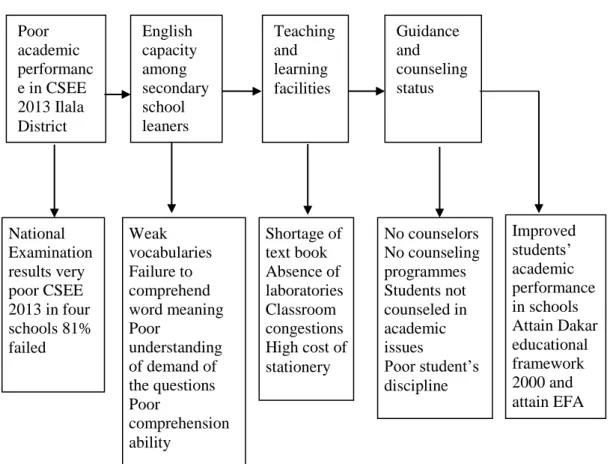
1.8 Conceptual frame work
The study literature has indicated that students in secondary schools are not perfuming well due to various reasons. This study further takes steps to investigate on some problem with focus to Ilala District Secondary Schools. The variables to be investigated are English among learners, teaching and learning materials in schools, and status of guidance and counseling in those schools. This variables have being identified because the researcher hopes that by analyzing this variables the deep insides on the factor for student poor performance can be revealed, thus guide towards improvement of secondary school performance in terms of academic in those schools.
Figure 1.1: Conceptual Framework for Studying Factors Affecting Students’ Academic Performances in Secondary Schools
Poor academic performanc e in CSEE 2013 Ilala District English capacity among secondary school leaners Teaching and learning facilities Guidance and counseling status National Examination results very poor CSEE 2013 in four schools 81% failed Weak vocabularies Failure to comprehend word meaning Poor understanding of demand of the questions Poor comprehension ability Shortage of text book Absence of laboratories Classroom congestions High cost of stationery No counselors No counseling programmes Students not counseled in academic issues Poor student’s discipline Improved students’ academic performance in schools Attain Dakar educational framework 2000 and attain EFA
CHAPTER TWO 2.0LITERATURE REVIEW
2.1 Introduction
A number of studies have been carried out to identify and analyse the numerous factors that affect students’ academic performance in various centres of learning. Their findings identify students’ effort, previous schooling (Siegfried &Fels, 1979; Anderson & Benjamin, 1994), parents’ education, family income (Devadoss& Foltz, 1996), self motivation, age of student, learning preferences (Aripin, Mahmood, Rohaizad, Yeop, &Anuar, 2008), class attendance (Romer, 1993), and entry qualifications as factors that have a significant effect on the students’ academic performance in various settings.
Parent involvement is another factor that has been consistently related to a child’s increased academic performance (Hara& Burke, 1998; Hill & Craft, 2003; Marcon, 1999; Stevenson & Baker, 1987). While this relation between Parent involvement and a student’s academic performance is well established. This chapter covered the literature on the factors affecting students’ academic performance. Therefore, the chapter covers how communication skill affect students academic performance, how status of teaching/learning facilities affect students academic performance and how guidance and counseling services affect students’ academic performance.
2.2 The Concept of Ordinary Secondary Education
This is the third level education in which the students are enrolled after successful completion of seven of Primary Education. Students shall spend four years of studies
in Ordinary Secondary Education. In Tanzania Ordinary Secondary Education is provided by both the public sector and private sector.
2.3 Curriculum
The curriculum of secondary education consists of optional subjects plus core and compulsory subjects. All schools offer core and compulsory subjects in Form One and Two, subjects include: Mathematics, English, Kiswahili, Civics, History, Geography, Physics, Chemistry, Biology and religion. The optional subjects in Form One and Two include: Home Economics, Information and Computer studies, additional Mathematics, Music, Fine arts, French, Arabic, other Foreign Languages, Islamic studies, Bible knowledge, and Physical education.
2.4 Aims and Objectives of Secondary Education
Ministry of Education and Vocational Training (2007) outlined seven objectives of secondary education in Tanzania as follow: to consolidate and broaden the scope f baseline ideas, knowledge, skills and principles acquired and developed at the primary level; to enhance further development and appreciation of national unity, identity and ethic, personal integrity, respect for and readiness to work, human rights, cultural and moral values, customs, traditions and civic responsibilities and obligations; to promote the development of competency in linguistics ability and effective use of communication skills in Kiswahili and in at least one foreign language; to provide opportunities for the acquisition of knowledge, skills, attitudes and understanding in prescribed or selected fields of study; to prepare students for tertiary and higher education, vocational, technical and professional training; to
inculcate a sense and ability for self –study, self-confidence and self advancement in new frontiers of science and technology, academic and occupational knowledge and skills; and to prepare students to join the world of work.
2.5 Importance of having Ordinary Secondary Schools
The Government of Tanzania saw the importance of developing secondary schools as an entry point to producing citizens who can compete in free market economy. In spite of the effort made by the Government through PEDP and SEDP there is a increase rate from primary schools to secondary schools, still there is a problem in quality of education provided to the students. The evidence is shown by the decline in the students’ academic performance. According to Galabawa et al (2008) there is deterioration of secondary education in community schools in Tanzania since there is poor system of controlling supply of text books used in schools, poor method of instruction that fosters rote learning, lack or absence of libraries and laboratories in schools. Therefore, analysis of secondary school learning environment may help to identify specific issues related to learning environment to students that need to be addressed to improve academic performance of students in ordinary certificate examinations.
2.6 Theoretical Literature Review
A review of prior, relevant literature is an essential feature of any academic project, An effective review creates a firm foundation for advancing knowledge. It facilitates theory development, closes areas where a plethora of research exists, and uncovers areas where research is needed (Webner& Watson, 2002).
2.6.1 The Role of English Command/Capacity in Influencing Students’ Academic Performance in Secondary School
Many researchers have been done discussing the different factors that affect the students’ academic performance. There are two types of factors that affect the students’ academic performance which show that internal and external classroom factors are strongly affecting the students’ performance.
Internal classroom factors include students’ competence in English, class schedules, class size, English text books, class test results, learning facilities, homework, environment of the class, complexity of the course material, teachers’ role in the class, technology used in the class and examinations system.
External classroom factors include extracurricular activities, family problems, work and financial, social and other problems. Research studies show that students’ performance depends on many factors such as learning facilities, age and gender differences and many other factors that can affect student performance.
One of the first studies in the area of language in education in Tanzania was established by Mvungi (1974). The study demonstrated the importance of language in the cognitive and emotional development of a child. She pointed out that language should be taken into account as an important factor in the total structure of education because it involves the total mental capacity of the child. In another study (Mvungi, 1982) showed the relationship between proficiency in the language of instruction, on the other hand, and educational performance, on the other hand.
Mlama and Matteru (1977) conducted research from 1976 to1977 that was commissioned by BAKITA to find out the actual situation in the schools in relation to the language of instruction. They gave a detailed account of the extent to which secondary school students’ knowledge of English had deteriorated. This is one of the very first studies that provided documentary evidence of the language situation which complaints had been raised. It confirmed the alarm that had been raised about the existence of a serious language of instruction problem in secondary schools. (Hansen, Joe B., 2000). Harb and El-Shaarawi (2006) found that the most important factor which positively support effect on students’ performance is student’s competence in English. Hussein (2006) said that, “ if the students have strong communication skills an have strong grip on English, it increase the performance of teacher also affects the student performance. The guidance from the parents and the teachers indirectly affect the performance of the students”.
Halima Mwinsheikhe, who has worked as a biology teacher in Tanzania secondary schools for many years, admits:
“I personally was compelled to switch to Kiswahili by a sense of helplessness born of inability to make students understand the subject matter by using English. (Mwinsheikhe, 2001).
Study done by Mwinsheikhe (2003) find out whether the participation and performance of secondary school students in science would be improved when Kiswahili is used in the teaching/learning process. Students performed better when taught in Kiswahili than in English. Mwinsheikhe points out that, the findings of her
study are in favour of Kiswahili as Language of Instruction. Her findings show that Kiswahili would improve participation and performance of secondary school students studying science subjects. Galabawa (2004) recommends that a study should be conducted to find out the direct and indirect benefits of adopting Kiswahili as the Language of Instruction. He points out that Kiswahili as Language of Instruction (LoI) is likely to lead more people acquiring secondary education that more effectively enhances the creative and innovative capabilities of learners through greater ease of using participative and interactive pedagogical approaches.
In the following passage the science teacher changes languages completely as he sees that his students do not understand ( taken from Rubagumya; Jones; Mwansoko 1999) His own English is not easy to understand. He expresses himself much clearer and better in Kiswahili. For him the important thing is to get the subject matter across.
T: When you go home put some water in a jar, leave it direct on the sun rays and observe the decrease of amount of water, have you undesrstood?
Ss: (silence).
T: Nasema, chukua chombo, uweke maji na kiache kwenye jua, maji yatakuaje? (I
say take a container with water and leave it out in the sun, what will happen to the water?)
Ss: Yatapungua (it will decrease)
T: Kwa nini? (why?)
The example above, after the teacher initial try in English and followed by silence, switches completely to Kiswahili.
Malekela’s study (2004) compares students’ performance in Kiswahili and English in Certificate of Secondary Education Examination. He finds that performance in both languages is not good, over 80% of students performed at level of D and below. Other factors which influence students’ academic performance is effective and efficient utilization of time. The amount time the learners are learning that take place in the classroom and how efficient the teachers perform in schools (Ekwesili, 2006). The performance of the student is also affected by communication skills; it is possible to see communication as variable which may be positively related to performance of the student in learning.
No child in England, Wales, Scotland or Northern Ireland has to leran a modern foreign language before they start secondary. And since 2004 when it became optional to take a modern language exam at GCSE, it’s only compulsory to carry till age 14.
Most pupils beginning secondary school from September are required to take a GCSE in modern language under Government proposals for the English Baccalaureate (EBacc) to be taken by at least 90% of pupils.
The majority of schools teach one or more of French, German and Spanis, but the Government does not promote the teaching of particular languages.
“Many language teachers in secondary schools are heartily sick of the formulaic format of GCSE exams which all too easily has the effect of stifling the motivation of students with the greatest potential for advanced language learning, says Crawshaw.
2.6.2 Effects of Teaching/Learning Facilities on School Performance
Karemera (2003) found that students’ performance is significantly correlated with satisfaction with academic environment and the facilities of library, computer lab and other important facilities in the institution. With regard to background variables, he found a positive effect of high school performance and school achievement; he found no statistical evidence of significant association between family income level and academic performance of the student. Robert et al (2011), found that the member of educational board will be educated and their impact on school is positive, for professional development it is essential for student learning. A study effort from student and the proper use of the facilities provided by the institution to the student, a good match between students’ learning style positively affect the student’s performance (Norhidayah Ali, et. al, 2009). Young (1999), in Pakistan held the view that the student performances are linked with the use of library and the level of their parental education. The use of library positively affects the student performance. The academic environment is the effective variable for students and has positive relationship with fathers’ education and grade level (Kirman &Siddiquah, 2008).
2.6.3 School Guidance and Counseling and Students Academic Achievement According to Ministry of Education and Vocation Training (2007:37-38) explained
guidance and counseling as follow, “ Effective social and moral education appropriate to the age level of learners shall be ensured in order to address the whole range of problems/challenges of youths such as drug abuse, HIV and other sexually transmitted infections, teenage pregnancies, induced abortions and unemployment. These and other adverse emerging issues in the society shall be addressed across the curriculum and through extra-curricular activities.
Guidance and Counseling services shall be established in schools to help students to face the life challenges and become responsible and committed members of the community. Learners need guidance in selecting appropriate carriers upon completion of their studies. They also need counseling services that will help them to cope with the prevailing situations in the community and addressing various problems and challenges. Guidance and counseling skills provided in schools shall help learners to develop abilities such as negotiation, assertiveness, communication, decision making, coping with peer pressure and development of attitudes such as compassion, self-esteem, tolerance and role-modelling.
There shall be school counselors/Guardians who are well abreast with the current life challenges and capable of designing appropriate programme to address such challenges. Issues of HIV/AIDS, gender relations, sexual and reproductive health and related problems need to be addressed strategically depending on the needs of the community.
In addition, there should be strengthened peer education programme in the school where there shall be two peer educators elected in each stream basing on gender in
co-education schools. Peer educators will be guided by school counselors/guardians in their day-to-day activities. Relevant documents shall be consulted to support the establishment of effective guidance and couselling services in schools such as MOEVT strategic plan for HIV/AIDS and Guidelines for implementing HIV/AIDS and Life-Skills Education Programme in Schools, (2004).
Qorro and Sumra (2013) argued that many of the learners in Secondary school are not capable of using English language yet the Ministry of Education and Vocational Training in Tanzania has resisted on this fact by directing schools to use English as medium of instruction. The problem of English language is manifested itself in the high failure rate among the form four leavers.
Bashire (2015) conducted a study in Morogoro on the evaluation of school guidance counseling. The findings revealed that many schools were not having counseling programmes. This practice was associated with failure of students in their CSEE in 2010. The findings further showed that the schools had not trained counselors to help students in academic matters such as study skills and time management.
Evodia (2014) did a study in the evaluation of guidance and counseling services in Moshi District secondary schools. The findings above are related to the Bashire’s findings where many schools had not established counseling programmes at schools. So the students discipline was low, hence, low academic performance.
In Malawi the need for guidance and counseling is recognized when a survey was done of 20 school counselors in southern and central regions and the main problems
examined. It was proven that, there is a great need for a clear rationale for Guidance and Counselling programmes, Taylor and Francis (1998).
Allis and Kamme (1999) conducted a cross-section survey on indiscipline among 2170 preparatory and secondary school students enrolled in the mainstream governmental schools in Alexandria in Egypt. Indiscipline cases were related to family background whereas the majority was related to the children themselves. Schools are social systems which have several objectives to achieve and the role of guidance and counseling is vital in shaping the discipline of the students.
2.6.4 Summary
When guidance and counseling is introduced to students, chances of having problems with behaviors management diminish as more of the students have the goals of learning are actualized through guidance, being the reference point and also making sure that is intellectual development and growth of the child ( Zins & Elias, 2006). The organization of guidance and counseling in the secondary schools is a basic element in ensuring good discipline hence better academic performance. It is the role of Heads of schools to plan, organize, coordinate and control the activities of guidance and counseling services.
CHAPTER THREE
3.0RESEARCH METHODOLOGY
3.1 Introduction
This chapter focused on the methodology that was used in the study. It dealt with research design, location of the study, target population, sampling techniques and sample size, research instruments, validity instruments, reliability of instruments, data collection procedures and ethical considerations.
3.2 Research Design
Trochim (2006) holds that “the research design refers to all the overall strategy that researcher chooses to integrate the different components of the study in a coherent and logical way, thereby, ensuring you will effectively address the research problem; it constitutes the blueprint for the collection, measurement, and analysis of data. Note that your research problem determines the type of design you should use, not the other way round!”
There are about three research designs; qualitative research design the one that generates words as data for analysis (Creswell,1998; Patton, 2009), quantitative research design is the one that generates numbers as data for analysis (Patton and Cochran, 2002), and mixed-method design comprises both qualitative and quantitative research designs.
The study intended to assess factors affecting students’ academic performance at Ilala district. The researcher find out the experience in-depth the causative factors of
students’ poor performance from participants themselves (students) as to what extent are they comfortable with teaching/learning environment at school. Thus, qualitative approach was deemed necessary as (Omari, 2010) postulates that, “qualitative approach expects to conduct and work with more descriptive data which seek deep and vivid descriptions of the context and events.”
A qualitative approach was adopted purposely to allow the flexibility in the study. Qualitative research design allowed researcher to change according to the conditions of the respondents and ask open ended questions during interviews (Kombo et al; 2006). Some respondents mixed questions during the interview and focused group discussion, the researchers twisted the questions so as to get the required information basing on the objective of the study in assessing how English Language command/capacity, effect of teaching/learning materials and the status of guidance/counselling affected students’ academic performance, and the ways to improve it.
Qualitative design develops in-depth knowledge. Laws, Harper and Marcus (2003) pointed out that if the researcher needs to develop in-depth knowledge about a certain phenomenon, the use of qualitative method is recommended especially interviews method and focused group discussions.
The researcher managed to receive views and experiences of the respondents based on the study objectives. For instance, respondents provided their experiences on how English Language capacity/command affected academic performance.
Also, qualitative design allowed researcher to make description of data. In qualitative research design, the researcher is allowed to put explanation on the data collection from the field (Patton et al., 2000). The researcher used qualitative design because the research design allowed her to make description on how English Language capacity/command, Teaching/Learning materials and the status of Guidance/Counseling affected students’ academic performance. Also, the researcher explained recommended strategies in the study according to the response of the respondents to what they have said and not said by looking their feelings during the interviews.
3.3 Limitations of Qualitative
Qualitative research finding are not representative (Laws et al, 2002 and Patton et al 2003). Knowledge produced might not generalize to other people or other findings (i.e, findings might be unique to the relatively few people included in the research study). Hence, findings about the factors that affecting ordinary secondary schools, particularly communication skills, teaching/learning materials and guidance/counseling services affect students’ academic performance might not generalize to other areas, the study found strategies to realize good academic performance of students that are applicable in Ilala district especially in selected schools.
By qualitative research is difficult to test hypotheses and theories with large participant pools. By qualitative research generally takes more time to collect data also, data analysis is often time consuming. The results are more easily influenced by
the researcher’s personal biases. In connection to that, sometimes researcher decided to take note on some issues of own interests and leave other issues in relation to the way communication skills, teaching/learning facilities, guidance/counseling affected students’ academic performance. Therefore, the nature of the researcher’s perspective might influence the value of inquiry, findings and interpretations. To clear his doubt, the researcher reminded ideas of (Bogdan & Biklen, 1992) in their argument that, there is no form of research which is free from human bias, all research, whether qualitative or quantitative has some forms of subjectivity. Madrigal et al (2012) say, “ Both qualitative and quantitative methods of user research play important roles in product development”. However, the researcher struggle to the maximum to be as fair as she could avoid biasness in the study.
3.4 Location of the Study
The study was conducted at Ilala district in Dar es Salaam city. In Ilala district the study involved six ordinary secondary schools namely; Jamhuri, Mnazi Mmoja, Juhudi and Pugu Station. Other schools were Yusuph Makamba sec and Zawadi sec school located in Tabata.
3.5 Target Population
Target population also known as universe population is a group of elements such individuals, objects or items from sample are taken for measurement. A population refers to the group of individuals from which sample are taken for measurement. A population should have at least one thing in common (Kombo etal, 2006) .However, a sample is a subset of people, items, or events from a larger population that you
collect and analyze to make inferences. This study used the experience of 4 ward education officers 4 Heads of secondary schools, 6 teachers, 9 parents, and 10 students that made a total of 33 respondents. This number of respondents was enough because in qualitative research even a single respondent is enough for a researcher to generate findings (Patton et al., 2002). It is from this population that sample of study was drawn from deep investigation on the communication skill factor, teaching/learning material and guidance/counselling factors affected students’ academic performance among ordinary secondary schools in Ilala district.
As one can observe that the sample of 33 respondents were selected on the basis of the that fact that the current researcher sough that they would provide experience on the factors that hinder the academic performance in Ilala ordinary secondary schools; then were selected with purpose, hence, the sampling techniques applied in this study was purposeful sampling technique.
3.5.1 Study Sample and Sampling Procedure
Sampling is the act, process or technique of selecting a suitable smaller size of population of a representative part of a population for the purpose of determining parameters or characteristics of the whole population, a list of all public secondary schools in the District will be obtained from the D.E O, Ilala District. All the 4 ward education officers, 4 Heads of secondary schools, 56 teachers, 20 parents and 100 students were selected using purposive sampling. The researcher used simple random sampling for the categories to determine the respondents among the students. Gay (1996), states that for a descriptive research a sample of 10-20% of population is
sufficient for reliable findings. The researcher used 100 students ( %) of the….students participated in the study. Using simple random sampling 60 form four girls students and 40 form four boys students was used in the study respectively.
3.6 Data Collection Methods 3.6.1 Interview
Bogdan and Bicklen (1998) hold that the interview uses oral method to collect data between the interviewers and the interviewees. The interview can be open or structured. The interview usually has power to use the probes to allow the interviewer to get more depth information than any other method like questionnaire.
The interview can inform other information the current researcher may have not planned to investigate but they are useful in the study as the respondent is seen how he feels about the issues; unlike the questionnaire where the information is filled by the distinct respondent. The current researcher prepared the interview questions by using the guideline of the research objective. So, three questions (appendix 1) with sub questions were developed to guide the investigation of this study.
3.6.2 Focus Group Discussion (FGD)
The study employed the focused group discussion (FGD).The focused group discussion is another nature of the interview that is used in collecting data for the investigations by involving around eight people who come to discuss a topic under the investigation. The questions themes composed for interview were used for the focused group discussion. The advantage of this method is that it allows those who
cannot initiate discussion to contribute after observing the contribution of their fellows in the group. The method again can generate a lot of data in a shorter time than other method like interview and questionnaire. FGD if not well controlled, can result to a chaos and lost direction in the discussion, thus, the researcher used assistant to help recording the discussion when the discussion was going on. The current researcher therefore played a role of the mediator to control the discussion as recommended by (Patton, 2009).
3.6.3 Documentary Review
The study used the school documents obtained at the office of the headmaster, ward education officers and the school meeting minutes to observe the students’ academic preferences of CSEE for 2013.These documents were appropriately selected and used as they could inform on what was investigated as they matched with the studied objectives.
3.6.4 Justification of Interview Method
The study adopted the qualitative design. Qualitative design is a design which seeks to find the experience of the individual on the issue under the investigation (Bogdan and Bicklen (1998). In this study the experience sought was those associated with the factors that people know that affect the academic performance of student in selected schools in Ilala district. The best methods that can seek and collect the thick description on the phenomena is the interview; as it has power to elicit the response by using the probe questions (Patton, 2004). Hence, the study used the interview method to collect the data.
3.6.5 Validity and Reliability
Validity is the accuracy and meaningfulness of inference which were based on research results (Mugenda and Mugenda 1999) .In this study, the validity of the research results was increased by applying more than one method. This involved employing the interviews, Focused group discussion (FGD) and the documents. The results obtained from the interview were therefore cross checked with FGD method and then the documents. Example, poor examination results claimed to prevail in Juhudi after being said in the interviews was cross checked in the document that contained examination results.
Another method used was of more than one site; where the current researcher used to collect data using more than one research site (Pugu, secondary school, Mnazi mmoja secondary school and Jamhuri secondary school). Sites improve the reliability of data than if the study had relied on the single source for data collection. Lastly, the approach employed varied sample where the students, the parents and the teachers were involved to inform the study on the factors that affect academic performance of the students in selected secondary schools in Ilala district.
According to Mulusa (1990), reliability is a measure of accuracy of the findings and suggests the truthfulness of the collected data whereas validity is the measure of acceptability that outcomes are likely to be adopted for similar cases or areas covering same domains.The researcher used questionnaires method to enhance instrument reliability. The same instrument was given to another group of people. The reliability was the correlation between the scores of the two instruments. If the
results was consistent over time the scores would be similar. The judgment was to ascertain the items in the instruments to prove reliability level to make a judgment about the instrument reliability.
3.7 Data Analysis Techniques
Mhehe (2002), quoting from (Glesne & Peskiri, 1992), explained that data analysis involves organizing what we have observed, heard and read, to make sense of the acquired knowledge. They maintain that, as one does so he/she categories, synthesizes, search for patterns and interprets the data collected. Bogdan & Biklen (1992) quoted from Athanas (2004) defined data analysis as a systematic process involving working with data, organizing and breaking them into manageable units. It is also concerned with synthesizing data, searching patterns, discovering what is important, what is to be learned and deciding what to tell others.
In this study, data analysis continued throughout the data collection phase. Data analysis in this study took Kvale’s (1992) approach which contends that, data analysis in interview needs to follow five steps, which are, categorization of meaning, condensation of meaning, structuring of meaning through narratives, interpretation of meaning, and ad hoc methods for generating meanings. In the data analysis of interviews and focused group discussions the information was first read by the researcher. Secondly, the data was placed in sub topics of the study. For instance, all data that explained on the effects of English command on the students’ academic performance was categorized under the same theme. Third step was to reread the common patterns in each category, and decide which to take and which to
leave out. Fourth, was to write narrates in each category using quotes from interviewees. The fifth step was to interpret narrates from respondents to gain meaning out of it. All categories of data were led by the research questions.
3.8 Ethical Consideration
Gray (2009) insists on the need of the researcher to observe the principle of ethics when conducting research. This is because there could be some danger the respondents may experience or harm if their views are known to their superiors. Furthermore, it is not recommended to violet the right of individuals for the reason of searching knowledge. So the researcher in the first place needs to establish an informed consent to ask the respondents to respond willingly and without being forced. Then, since it is not possible to estimate the danger the respondents may experience the researcher has to change the name by giving them codes and protect them for any harm or embarrassment from those superiors. In this study the respondents’ names were hidden and the respondents were asked to participate willingly and anyone who was not interested was allowed to with draw at any time during research processes. Further, the current researcher obtained a research clearance letter from the Directorate of Research and Postgraduate Studies, which allowed accessing various schools in data collection in Ilala district.
3.9 Summary of the Chapter
This chapter shows the analysis of results of each item. The researcher used questionnaire, FGD, interview and documentary review as they could inform on what was investigated.
CHAPTER FOUR
4.0DATA PRESENTATION AND ANALYSIS
4.1 Introduction
The data are presented in three themes. The first them was the effect of English ability among students on their academic performance, second was the effects of the teaching and learning resource on the academic achievement of students and last the effects of counseling practice on the students’ academic performance.
4.1.1 English Ability among Students and Academic Performance in Ilala Secondary Schools
The interview held in the schools of Mnazi mmoja secondary school and Pugu secondary school indicated that the school teachers were using English as language of instruction (LOI) but in many case the students were not comfortable in the vocabularies used and there they were not mastering the language. This made them miss many concepts in the lesson. One Chemistry teacher remarked during the interview that he is getting problem to encourage students to take science because they fear the chemistry terminologies used in the lesson. This so makes them perform poorly in the internal examination as well as national exterminations. The students were of the same opinion with the observation of the teacher on the challenge of LOI. The students said that they chemistry is getting tough, one needs to know many topic eg soil, soil texture, soil structure, soil leaching and many terminologies used in chemistry eg gases, interpret the results using the practical manuals. Given low level of English the students do not perform well in their final examinations. One teacher
who once marked the examination at CSEE showed this example as evidence of the problem of LOI. The question was asked to the student. Make a sentence using a word: Book. Many students could not construct and write a logical sentence on the use of a book. An object used for reading in the classroom. One of the students wrote: Mother gives me a book to buy chips. Here, the word book was conceived by a student as money.
The parent who seemed to be educated had this to say relation to the English as LOI: The schools are in confusion. They insist to use English in their teaching but a majority of the students are not capable of using English in their learning so there is no learning. It shows that the students can do better if they are taught in their mother tongue but the ministry is till neglecting this fact.
The teacher who teaches English as subject said that many students are not capable to speak English despite of some effort the school use. They cannot use tenses correctly they cannot make good and logical sentences. But mind that in all subjects they are asked questions in English. What would you expect the performance of those students to be, it is a failure; because they cannot write good and correct English. If they cannot write the tenses correctly it is doubt if they are also able to understand well the demand of the questions.
Another history teacher said that to pass history one has to know how to put down some factors and discuss the question depending on what exactly one was asked. But because the students are not capable of the English language they fail to comprehend
even the demand of the questions. For example, a question can be asked to state the effects of the scramble and partition of Africa, then, one fails and states the reasons for the scramble and partition of Africa. The effects and reasons are two different terminologies in history.
One student who was involved in the focused group discussion explained this with regard to the English as LOI.
The subject like Geography requires one to read and understand the geography terminologies. Example the volcanic features, the land formation feature and the atmospheric features and the regional geography feature like agriculture and population. Given our low English it becomes difficult to follow the textbook and finally you are not motivated to go on reading the text because you don’t comprehend what is presented in the text.
The teacher at Juhudi secondary school explained that the school put down some rules to ensure that the students are developing the needed skills in using English. So the students are encouraged to speak English when they need services from the teachers. We have however not succeeded because even some teachers are breaking the rules by allowing the use of Kiswahili in the classrooms and when servicing the students. This limits the students’ understanding as there is mixing of languages.
4.2 Effects of the Teaching and Learning Resource on the Academic Achievement
4.2.1 Text Books and Academic Performance in Ilala Secondary Schools
The interview results held at Mnazi mmoja secondary school indicated that the school had some recourse for teaching like textbooks. The teacher said that the school infact has many arts textbooks like those of teaching civic, geography.
However the teacher remarked that the textbooks for teaching science subjects like Physics and Chemistry and computer science are not enough.
The teacher further explained on the problem of textbooks at the school:
Under SEDP we usually received some funds for the school development. Nowadays the funds are not coming regularly. The schools are in serious shortage of funds and the schools cannot purchase the textbooks for the students to use in their learning, either the parents do not understand if we order the students to buy the textbooks using their own funds.
The parents living in Tabata when asked to give his opinion on the challenge of the school resource and how they affect the academic performance had this to say: The way I observe the students taking the private study without textbooks gives me worry if they are serious learning and getting the concepts of the subject. What I see they do is to use notes written by their fellow students whom also may have not passed the examination because of the same poor system of learning.
The student who was about to take final form four examination at Yusuf Makamba secondary school in 2015 remarked by saying that their school is struggling to assist the students to do better in their examination. However, the school has the library room but the books are not their so it is used as the study room instead a resource room.
4.2.2 Science Laboratories and the Academic Performance in Ilala Secondary Schools
Many of the schools in Ilala are not having laboratories for doing science practicals. This corresponds to the national movement engendered by the President Jakaya
Mrisho Kikwete that every school must have the science laboratory to assist the students to learn science effectively. Despite of this move the progress of the science laboratories was not promising as the a school like Zawadi secondary school in Tabata despite that fact that the school had completed a part of the structure; the laboratory was seen as a big hall and not in any way used by the students to conduct practicals.
One student at Zawadi secondary school lamented that: the students who opted for science subject are forced to choose the alternative practical subject. To us this is not a good opportunity to learn science by seeing, observing the specimen and recording the results; as this is in hypothetical model.
The headmaster at Yusuph Makamba secondary school remarked that the schools are using both the allocated funds and the community contribution to make sure that the science laboratories are completed. We are not yet their but we are trying. As we are waiting; the science students are affected because they cannot do the practical in the laboratories and the chance for them to interact with the chemicals, use equipment and specimen as part of the science drills is limited. This has a grater impact in the way the students’ perform the science subject at our school.
4.2.3 Classrooms Congestions and the Student Learning In Ilala Secondary Schools
In a course of doing interview with the teachers at the Zawadi secondary school the researcher was given chance to observe the classroom teachings. The status of the
classrooms was not able to accommodate a big number of the students. This problem was observed and it was noted in all classrooms from form one to form four. The teacher said that when the ere lager number of students, it is not easy for the teacher to manage the classroom and follow up the stages of teaching effectively, as there is not chance and time to attend to all students in the classroom. There is no learning here the teacher ended her remarks.
The student at Pugu secondary school showed the dissatisfaction with the number of the students in their classroom. He said that:
We are studying in difficult situation, the classroom are not having enough spaces. The big number forces the school to have congested classroom. During learning the teacher cannot attend all questions asked by students when they need clarification abut a certain issue or concepts in academic. This is not good to us. My parents are planning to transfer me to another school.
4.2.4 Stationeries and Academic Performance in Ilala Secondary Schools
The focus group discussion held at Juhudi secondary school generated that the data on the issues of stationeries and its effects on the academic performance. The discussion revealed that many currently the schools stationeries are very expensive. For example one realm costs 15,000 tsh. To prepare weekly tests which are typed and printed (need of toners) in a computer you need more than twenty realms and several toners. Since many of the schools are not having those funds they skip the weekly tests. But mind you this is serious omission of the need formative evaluation to the students and builds strength in their subject to be able to answer well the questions in the final examinations.
4.3 Effects of Counseling Practice on the Students’ Academic Performance The documents reviewed in the schools of Juhudi, Mnazi mmoja, Pugu Yusufu Makamba and Zawadi showed that the school had not put much emphasis on the schools guidance and counseling. The schools had not trained counselors to counsel the students on various social and academic matters. For the few a schools that had
the Malezi teacher the activity of counseling was less frequently done and there were
no proper documentation on what exactly was done about counseling at those schools.
One headmaster at Yusufu Makamba secondary school explained that the school had no well trained counselors to counsel the students. For those who volunteered to counsel students were doing the task partially as they had other actual duties that were charged with, other than the extra duty of counseling students.
The interview further revealed that the school time table showed to have other subjects and other extra funicular activities but the counseling time was not indicated. This indicated that the school has no time and plan to counsel students on the academic matters.
One student during interview explained that:
Our schools are not like the private or mission schools where the students are given time and counseled on how to write question; how to tackle the question and the strategies of using time during the examination. So when we enter the examination we are trembling even if we know the answers. Our fellow students in seminarians are given counseling to be confident to accept own challenge and to be confident in the issue they know so they do very well in their examinations.
The parent living in Tabata area expressed his dissatisfaction with the examination performance of the form four examinations in current years (2010-2013). He further said that the school are nowadays loose they don’t have the plan to teach students skill in summarization of notes, the students take many hours reading but they lack the study skills of making notes and summarization and answer questions according to the need of the questions. The students are using many hours listening to the music with their smart phones; but they don’t take time to review what has been discussed in the classrooms what can one expect from this type of students in term of the academic performance?
The focused group discussion held at Juhudi secondary school revealed that counseling is good approach as it helps the students both girls and boys to control their feeling on the relationship issue and thus concentrate with studies first. The schools that put emphasis on the counseling their students are doing well; example the religious schools and the private schools. The discussion further revealed that many students are losing time emailing the love massages and they forget to use that time for learning as this affect the academic performance of our students in their examinations