Statistics Conference Proceedings, Presentations
and Posters Statistics
2013
A Structural Equation Model Correlating Success
in Engineering with Academic Variables for
Community College Transfer Students
Marcia R. LaugermanUniversity of Iowa Mack C. Shelley
Iowa State University, [email protected]
Follow this and additional works at:http://lib.dr.iastate.edu/stat_las_conf
Part of theEngineering Education Commons,Higher Education Commons,Science and Mathematics Education Commons, and theStatistical Models Commons
This Conference Proceeding is brought to you for free and open access by the Statistics at Iowa State University Digital Repository. It has been accepted for inclusion in Statistics Conference Proceedings, Presentations and Posters by an authorized administrator of Iowa State University Digital Repository. For more information, please [email protected].
Recommended Citation
Laugerman, Marcia R. and Shelley, Mack C., "A Structural Equation Model Correlating Success in Engineering with Academic Variables for Community College Transfer Students" (2013).Statistics Conference Proceedings, Presentations and Posters. 4.
A Structural Equation Model Correlating Success in Engineering with
Academic Variables for Community College Transfer Students
Abstract
Student Enrollment and Engagement through Connections is a collaboration between a large Midwestern university and in-state community colleges (CCs) to increase success of transfers into engineering. This study explores predictors of completing a BS in engineering for CC transfers through a structural equation model. The model was estimated using academic variables from both institutions. The dataset includes 472 in-state CC transfer students admitted to the College of Engineering between 2002 and 2005. The model fits the data well (χ2=74.254, df=30, p<0.0001; RMSE=0.056, Comparative Fit Index=0.984, chi-square/df ratio=2.475). First spring University GPA and credit hours, CC transfer credits toward core engineering courses, first fall credit hours after transfer, first fall University GPA, and University core course GPA are significantly related to graduation in engineering. This research may help increase the success of CC transfers to engineering,
emphasizing the importance of core engineering courses.
Disciplines
Engineering Education | Higher Education | Science and Mathematics Education | Statistical Models
Comments
This is a conference proceeding fromProceedings of the 2013 American Society for Engineering Education Annual Conference & Exposition(2013): 1. Posted with permission.
Paper ID #6699
A structural equation model correlating success in engineering with academic
variables for community college transfer students
Dr. Marcia R Laugerman P.E., University of Iowa
Dr. Laugerman is a PE in Industrial Engineering with over 20 years of University teaching experience. She is currently working as a research fellow in the Department of Teaching and Learning at the University of Iowa on an Institute for Education Sciences project to increase critical thinking skills in science through an inquiry-based instructional method. Her teaching and research interests are in STEM.
Prof. Mack Shelley, Iowa State University
Mack Shelley is a full professor at Iowa State University, where he holds the titled rank of University Professor. He currently holds a joint appointment in the Department of Statistics and the Department of Political Science. His research, grants and contracts, consulting, and teaching focus on applications of multivariate statistical methods to problems in education, the social sciences, engineering, and other areas. From 1999 to 2003 he was coordinator of research, and from 2003-2007 was director of the Research Institute for Studies in Education at Iowa State.
c
A STRUCTURAL EQUATION MODEL CORRELATING SUCCESS IN ENGINEERING WITH ACADEMIC VARIABLES FOR COMMUNITY COLLEGE TRANSFER
STUDENTS Abstract
Student Enrollment and Engagement through Connections is a collaboration between a large Midwestern university and in-state community colleges (CCs) to increase success of transfers into engineering. This study explores predictors of completing a BS in engineering for CC
transfers through a structural equation model. The model was estimated using academic variables from both institutions. The dataset includes 472 in-state CC transfer students admitted to the
College of Engineering between 2002 and 2005. The model fits the data well (χ2=74.254, df=30,
p<0.0001; RMSE=0.056, Comparative Fit Index=0.984, chi-square/df ratio=2.475). First spring
University GPA and credit hours, CC transfer credits toward core engineering courses, first fall credit hours after transfer, first fall University GPA, and University core course GPA are
significantly related to graduation in engineering. This research may help increase the success of CC transfers to engineering, emphasizing the importance of core engineering courses.
Introduction
This is an exploratory study to determine the strength of the relationships between core engineering coursework and graduation in engineering for community college (CC) transfer students. The longitudinal study accounts for the coursework taken at the CC prior to transfer as well as coursework taken at the University after transfer. The objective of the study is to create a structural equation model (SEM) to estimate the covariance structure based on hypothesized relationships between the academic variables and the outcome of graduation in engineering. The model provides a simultaneous analysis of relationships among the academic variables. The results of this study may be instructive to the CC administration, to academic advisors, and to students who are considering or already are pursuing a degree in engineering. . The purpose of this study, taken along with other informative qualitative studies, is to increase the success of CC transfers to engineering. This research could further increase both the number and diversity of engineering graduates and contribute to workforce development and national economic strength. The model is developed based on academic and background variables for in-state CC transfer students who entered the College of Engineering at a large Midwestern State University (SU) during the fall semesters of 2002 through 2005. It follows CC transfer students longitudinally over a six-year period, allowing sufficient time for graduation. For these cohorts of students, 49% graduated in engineering. It is important to note that transfer students are defined by the institution they attended immediately following high school graduation and prior to transfer, and not by the number of credits transferred.
One problem in creating these models is obtaining data from both the sending and receiving institution. Unique in this study is the use of academic variables from both institutions. Other
models based on academic integration variables have not included CC characteristics1. Nor have
together, these strategies provide a roadmap for success that proved to be influential for this sample of CC students.
Key variables in determining graduation are based on performance in core courses in engineering and first-year performance after transfer. These core courses are offered at both the sending and receiving institution. In this study the core courses are identified as the Basic Program (BP) in engineering. All students must successfully complete the BP with a minimum C average (2.0 on a 4.0 scale) to graduate in engineering. This program consists of two semesters of calculus, one semester of chemistry, one semester of physics, two semesters of English, and one semester of engineering fundamentals with computer programming. These courses represent the most
substantial barrier to achieving an engineering degree1,2,3.
Background
Recognizing the importance of increasing graduates in STEM fields, the National Science Foundation (NSF) has funded the Science Technology Engineering and Mathematics (STEM) Talent Expansion Program (STEP). One initiative of the STEP program is the Student
Enrollment and Engagement through Connections (SEEC) project. SEEC is a collaborative, connection-based alliance between the SU and one of the in-state CCs. The purpose is to increase the success of CC transfers to engineering.
There has been a recent trend of students turning to CCs for educational and professional
advancement4,5,6. According to the American Association of Community Colleges (AACC), CCs
provide a local, affordable, and low-risk path to development and expansion of marketable
skills7. The trend is especially strong for traditionally underrepresented populations: women,
minorities, rural students, veterans, and older Americans4. These groups are becoming
increasingly central to the United States’ mission to graduate more scientists and engineers8. However, many of these potential scientists and engineers leave this pathway before completing a four-year degree9.
Understanding and addressing persistence at the CC level is a multi-faceted task that takes into
account fluctuating state funds and a diverse student population10. In addition, the enrollment
patterns of CC students are complex and may involve multiple transfers across several
institutions11. However, the academic requirements in engineering that are universal for all CC
students can provide a basis for analysis.
Previous research suggests that models based on core-course academic variables are a key aspect
in determining retention and graduation in engineering1,2,3. In addition, the first year of study in
an engineering program has been shown to be critical to success. Levin and Wyckoff3 developed
a freshman-year model that identified the best predictors of retention as grades in Physics I, Calculus I, and Chemistry I.
Most students who leave engineering do so before they have successfully completed these
difficult courses3. Previous studies have shown that students must acquire proficiency in these
35,000 pre-engineering students at Purdue, 84% of those who left engineering did so before they
completed their pre-professional program2.
LeBold and Ward12 also found that the freshman year is critical to retention and that the best
predictors of retention were the first- and second-semester grades and cumulative GPA. They found that students’ perceptions of their problem-solving abilities in mathematics and science
were also indicative of retention. Budny et al.2 found a strong correlation between first-semester
GPA and graduation rates in engineering. Whalen and Shelley13 also found that the most
important variable indicative of retention in STEM fields is grade point average. They found a dramatic increase in six-year retention and graduation rates for as little as a 0.10 increase in GPA
for STEM majors. Earlier research by Strenta, Elliot, Adair, Matier, and Scott14 found that low
grades were the most common predictor for all students leaving science and engineering courses. Pre-college characteristics account for a relatively small but meaningful percentage of variation
in retention rates15. However, research shows that pre-engineering success measures are weaker
predictors of retention in engineering than are grades in core engineering courses2,3. Further, the
combination of all first-year course grades, measured as end-of-second-semester cumulative grade point average, is a stronger predictor of success than is the grade in any single course. Multiple data analysis methods have been applied to predict retention and graduation rates by using academic and demographic variables. Conventional predictive models have used logistic regression. Other data analysis methods existing in the literature are summarized by Li,
Swaminathan, and Tang16:
Stepwise/Hierarchical Multiple Regression
Longitudinal Data Analysis
Covariate Adjustment
Two-Step Design
Exploratory Factor Analysis
Discriminant Analysis
Classification Tree
A strength of SEM over some other statistical techniques is that it is able to account for and remove the effects of two types or error: measurement error and residual error. Measurement error is created whenever data are gathered by means of a measuring instrument or process that has less than perfect reliability. Residual error is the amount of unexplained variation in the dependent or endogenous variables left after the independent or exogenous variables have accounted for as much variability as possible. Another strength of this SEM model is its ability to incorporate collinear variables yet provide significant effects in the expected direction, after accounting for collinearity present in the model.
Research Questions
What are the strengths of the relationships as determined by a SEM model, between academic variables in core engineering coursework and graduation in engineering for CC transfer students?
How can these findings increase the success of CC transfers to engineering and inform workforce development strategies?
Design/Method
The SEM employed in this analysis was created with Analysis of Moments Structures (AMOS) software combined with SPSS statistical software using academic variables from both the sending and the receiving institutions. The academic variables consist of a student’s combined transcript-level data for course requirements in engineering. These include academic data that occur during the first year after transfer through completion of the BP in engineering. The model provides a simultaneous analysis of relationships among the academic variables and provides strength of relationship indicators. The dataset for this study includes 472 in-state CC transfer students who were admitted to the College of Engineering during the fall semesters of the academic years 2002 through 2005. Model worthiness is determined by root mean square error approximation (RMSEA), comparative fit index (CFI), and the ratio of the chi-squared fit statistic to the model degrees of freedom.
In addition to the BP GPA at the sending and receiving institutions, the model uses the number of credits toward BP courses at both institutions as well as the number of credits and GPA for the first fall, first spring, and first year after transfer. These academic variables are hypothesized to correlate with graduation in engineering. The model identifies which academic variables are mediated through the BP GPA at the university and discovers which other academic variables are correlated directly with graduation in engineering. Other non-significant academic and
demographic variables were dropped from the model; including the total number of transfer credits, the overall transfer GPA, gender, and the number of learning communities in which a student participated at the University. Note that a student may have transfer credit from other colleges when the institution she or he attended immediately before transfer was an in-state CC, and the number of credits and the GPA in core engineering courses are from the in-state CC only. This may help explain why the overall number of transfer credits and the overall transfer GPA were not significant predictors.
The observed, endogenous variables in the model are:
Number of BP transfer credits from the sending institution (Tr BP Cr)
GPA in core-engineering courses from the sending institution (Tr BP GPA)
Number of first fall credit hours (after transfer) at the receiving institution (first fall Cr)
First fall GPA at the receiving institution (first fall GPA)
Number of first spring credit hours at the receiving institution (first spring Cr)
First spring GPA at the receiving institution (first spring GPA)
Number of first-year credit hours at the receiving institution (first year Cr)
First-year GPA at the receiving institution (first year GPA)
Number of core engineering course credits taken at the receiving institution (BP Cr)
GPA in core engineering courses taken at the receiving institution (BP GPA)
Graduation in engineering (EngGrad)
ACT Composite score (act cmpst)
ACT English score (act engl)
ACT Math score (act math)
Since the data analyzed in this study were collected on in-state community college transfer students in a Midwestern state where nearly all high school students take ACT rather than SAT for college admissions, the vast majority of students in our dataset transferred ACT scores as opposed to SAT scores. Missing data values for variables included in the model were imputed using a Bayesian multiple imputation method incorporated in SPSS. The unobserved, exogenous variables include error terms for each endogenous variable in the model. They represent the residual error that is left after the exogenous variables have accounted for as much of the variability as possible.
Assumptions in the Design
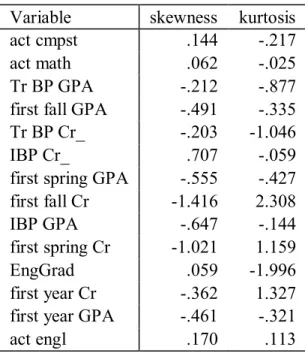
The estimation method used is this model is maximum likelihood (ML). ML assumes that the observations must be independent with multivariate normality for all continuous endogenous variables. This means we treat the 472 CC students in the study as being picked independently and representative of the population of CC transfer students. Although parameter estimates are relatively robust against non-normality, normality checks were performed on all endogenous variables using skewness and kurtosis values. Using a skewness value>|3| and/or kurtosis value
>|10| to indicate non-normality17 all endogenous variables were sufficiently normally distributed
to utilize ML estimation (see Table 1). Table 1 Assessment of normality
Variable skewness kurtosis
act cmpst .144 -.217
act math .062 -.025
Tr BP GPA -.212 -.877
first fall GPA -.491 -.335
Tr BP Cr_ -.203 -1.046
IBP Cr_ .707 -.059
first spring GPA -.555 -.427
first fall Cr -1.416 2.308
IBP GPA -.647 -.144
first spring Cr -1.021 1.159
EngGrad .059 -1.996
first year Cr -.362 1.327
first year GPA -.461 -.321
Results
The model, estimated by ML, demonstrates a reasonably good fit with the data (chi square
=74.254, df=30, p<0.0001) and very good index metrics (RMSEA=0.056, Comparative Fit
Index=0.991, chi-squared ratio=2.475).
Although the chi-square test for goodness of fit is rejected, this does not undermine the value of the estimated covariance structure of the model, which is consistent with the sample covariance structure of the data. Whether this specific model is actually correct is not known, however, the estimated path coefficients are statistically significant (p<.05) and the directions of the
relationships are as hypothesized. Prior research about the value of these variables in predicting success in engineering confirms the validity of the relationships estimated by the model.
The model index metrics demonstrate a very good fit. In this model the RMSEA=0.056.
According to Brown and Cudeck18 an RMSEA < 0.08 may indicate a good fit in relation to
degrees of freedom and indicate a reasonable error of approximation. For the comparative fit
index (CFI=0.991), Bentler19suggests that CFI values close to 1 indicate a very good fit. The
chi-square ratio (chi square/df=2.475) is consistent with the minimum discrepancy that several
writers have suggested as a measure of fit. Carmines and McIver20suggest that ratios in the range
of 2 to 1 or 3 to 1 are indicative of an acceptable fit between the hypothetical model and the sample data.
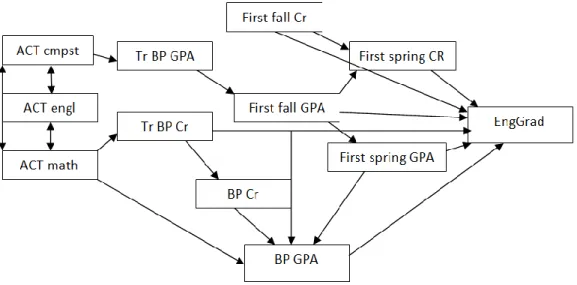
Figure 1 shows the recursive path model for graduating in engineering (EngGrad). A recursive model means that no variable in the model has an effect on itself. That is, in the path diagram of the model, it is not possible to start at any variable and, by following a path of single-headed arrows, return to the same variable.
Figure 1 shows six variables with significant or very nearly significant positive direct effects on graduation in engineering. They are:
Number of first spring credit hours (p=0.055)
Number of first fall credit hours (p<0.001)
First fall GPA (p=0.029)
Number of transfer credits toward BP (p<0.001)
First spring GPA (p<0.001)
Overall university BP GPA (p=0.062)
Overall university BP GPA is included in the model since it also has a significant mediating effect on graduation. All of the variables correlated with graduation in engineering occur after transfer to the university, with the exception of the number of transfer credits toward BP courses. Figure 1 also shows four variables with significant positive direct effects on the overall
university BP GPA, which becomes a mediating variable for graduation in engineering. They are:
Number of BP credits taken at the university (p<0.001)
First fall GPA (p=0.003)
First spring GPA (p<0.001)
This is one of only three times a pre-college variable occurs in the model. The other times are ACT math correlating with the number of transfer BP credits, and the ACT composite score correlating with the transfer BP GPA. As expected, the ACT scores all vary with each other, as shown by the connecting arrows on the model diagram (see Figure 1).
Figure 1 SEM Model
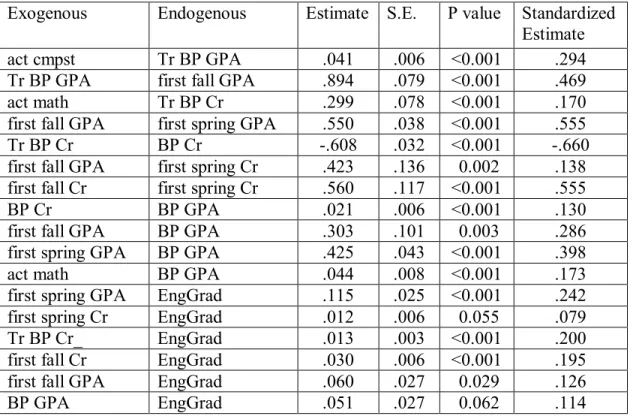
Table 2 gives the regression weights for each statistically significant relationship. These unstandardized estimates are given in terms of the original metric of measurement for each variable. This estimate also can be thought of as the unstandardized effect size. It is followed by
the standard error (S.E.), the p-value, and the standardized estimate that gives the magnitude and
direction of effects measured in unitless standard deviations.
For example, when the ACT mathematics score goes up by 1 point, the BP GPA goes up on average by an estimated 0.044 unit of GPA, holding constant all the other variables in the model.
The p-value is determined by dividing the parameter estimate by its standard error. The p-value
means that the regression weight for ACT mathematics in the prediction of BP GPA is
significantly different from zero at the 0.001 level (using a two-tailed hypothesis test).The
standardized estimate is 0.173, which means that when the ACT mathematics score increases by 1 of its standard deviation units, BP GPA increases by 0.173 of its standard deviation unit. Table 2 also shows that the variables with the highest unstandardized effect sizes for determining the BP GPA are first spring GPA (0.425) and first fall GPA (0.303). These results measure the estimated increases in BP GPA that correspond with a one-point increase in first fall or first spring GPA, holding all other variables constant. The variable with the highest unstandardized effect size in determining graduation in engineering is the first spring GPA, with estimated unstandardized regression coefficient of 0.115. For a one-point increase in first spring GPA, the
engineering graduation rate increases on average by 0.115 percentage points, holding all else constant. The highest overall unstandardized effect size is 0.894, which correlates the transfer BP GPA with the first fall GPA.
Table 2 Regression Weights (Effect Sizes)
Exogenous Endogenous Estimate S.E. P value Standardized
Estimate
act cmpst Tr BP GPA .041 .006 <0.001 .294
Tr BP GPA first fall GPA .894 .079 <0.001 .469
act math Tr BP Cr .299 .078 <0.001 .170
first fall GPA first spring GPA .550 .038 <0.001 .555
Tr BP Cr BP Cr -.608 .032 <0.001 -.660
first fall GPA first spring Cr .423 .136 0.002 .138
first fall Cr first spring Cr .560 .117 <0.001 .555
BP Cr BP GPA .021 .006 <0.001 .130
first fall GPA BP GPA .303 .101 0.003 .286
first spring GPA BP GPA .425 .043 <0.001 .398
act math BP GPA .044 .008 <0.001 .173
first spring GPA EngGrad .115 .025 <0.001 .242
first spring Cr EngGrad .012 .006 0.055 .079
Tr BP Cr_ EngGrad .013 .003 <0.001 .200
first fall Cr EngGrad .030 .006 <0.001 .195
first fall GPA EngGrad .060 .027 0.029 .126
BP GPA EngGrad .051 .027 0.062 .114
Table 3 gives the squared multiple correlations for each endogenous variable. This measures the proportion of variation for each endogenous variable attributable to its set of exogenous
variables. For example, it is estimated that the predictors of BP GPA explain 57.4 percent of its variance, which is the highest amount of explained variance among the endogenous variables. Also, the predictors of graduation in engineering explain 34.8 percent of the variance in that outcome.
Table 3 Squared Multiple Correlations
Variable Estimate
Tr BP GPA .087
first fall GPA .218
Tr BP Cr .029
BP Cr .420
first spring GPA .401
BP GPA .574
first spring Cr .138
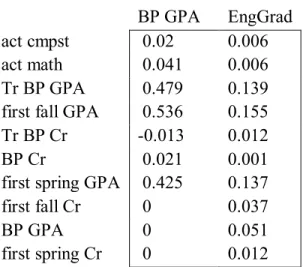
Table 4 shows the unstandardized total effect (which is a combination of direct and indirect effects) of each row (exogenous) variable on each column (endogenous) variable. For example, the total (direct and indirect) effect of transfer BP GPA on graduation in engineering is 0.139, due to both direct (unmediated) and indirect (mediated) effects of transfer BP GPA on graduation in engineering. The top five unstandardized total effects on graduation in engineering (in terms of percentage point increases) are:
when Tr BP GPA goes up by 1 unit, EngGrad goes up by 0.139 on average
when first fall GPA goes up by 1 unit, EngGrad goes up by 0.155 on average
when first spring GPA goes up by 1 unit, EngGrad goes up by 0.137 on average
when first fall Cr goes up by 1 unit, EngGrad goes up by 0.037 on average
when BP GPA goes up by 1 unit, EngGrad goes up by 0.051 on average
Table 4 Unstandardized Total Effects
BP GPA EngGrad
act cmpst 0.02 0.006
act math 0.041 0.006
Tr BP GPA 0.479 0.139
first fall GPA 0.536 0.155
Tr BP Cr -0.013 0.012
BP Cr 0.021 0.001
first spring GPA 0.425 0.137
first fall Cr 0 0.037
BP GPA 0 0.051
first spring Cr 0 0.012
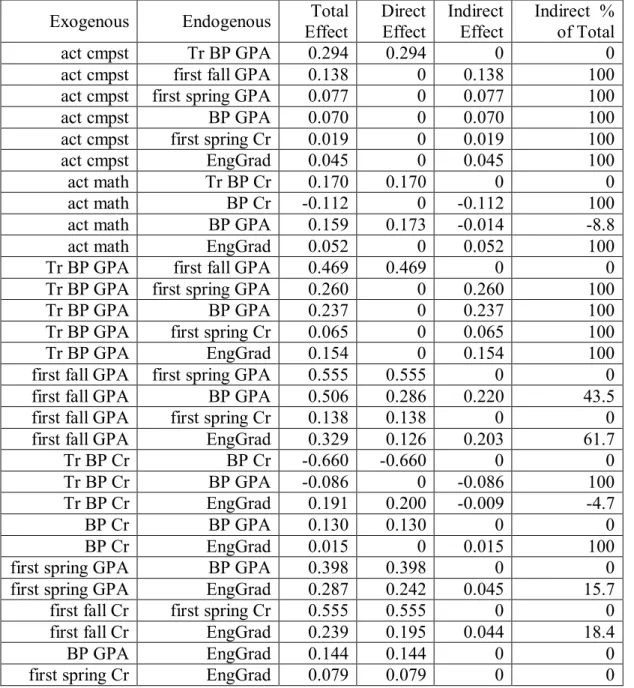
Table 5 shows the standardized total effect of each exogenous variable on the endogenous variables in terms of standard deviation units. This illustrates the portion of the effect that is due to the exogenous variable and the portion of the effect that is due to indirect effects mediated through other variables. For example, the standardized total (direct and indirect) effect of first fall GPA on graduation in engineering is 0.329. The total direct effect of first fall GPA on graduation in engineering is 0.126, which represents 61.7 percent of the total effect.
Modification indices were employed in preliminary models to indicate whether new parameters should be included. The resulting model has no remaining modification indices that exceed the specified threshold in chi-square units.
Table 5 Standardized Total Effects
Exogenous Endogenous Effect Total Direct Effect Indirect Effect Indirect % of Total
act cmpst Tr BP GPA 0.294 0.294 0 0
act cmpst first fall GPA 0.138 0 0.138 100
act cmpst first spring GPA 0.077 0 0.077 100
act cmpst BP GPA 0.070 0 0.070 100
act cmpst first spring Cr 0.019 0 0.019 100
act cmpst EngGrad 0.045 0 0.045 100
act math Tr BP Cr 0.170 0.170 0 0
act math BP Cr -0.112 0 -0.112 100
act math BP GPA 0.159 0.173 -0.014 -8.8
act math EngGrad 0.052 0 0.052 100
Tr BP GPA first fall GPA 0.469 0.469 0 0
Tr BP GPA first spring GPA 0.260 0 0.260 100
Tr BP GPA BP GPA 0.237 0 0.237 100
Tr BP GPA first spring Cr 0.065 0 0.065 100
Tr BP GPA EngGrad 0.154 0 0.154 100
first fall GPA first spring GPA 0.555 0.555 0 0
first fall GPA BP GPA 0.506 0.286 0.220 43.5
first fall GPA first spring Cr 0.138 0.138 0 0
first fall GPA EngGrad 0.329 0.126 0.203 61.7
Tr BP Cr BP Cr -0.660 -0.660 0 0
Tr BP Cr BP GPA -0.086 0 -0.086 100
Tr BP Cr EngGrad 0.191 0.200 -0.009 -4.7
BP Cr BP GPA 0.130 0.130 0 0
BP Cr EngGrad 0.015 0 0.015 100
first spring GPA BP GPA 0.398 0.398 0 0
first spring GPA EngGrad 0.287 0.242 0.045 15.7
first fall Cr first spring Cr 0.555 0.555 0 0
first fall Cr EngGrad 0.239 0.195 0.044 18.4
BP GPA EngGrad 0.144 0.144 0 0
first spring Cr EngGrad 0.079 0.079 0 0
Discussion
The objective of this study was to explore SEM statistical models of the academic variables that influence the completion of a BS degree in engineering for CC transfer students. The SEM approach estimates the covariance structure based on hypothesized relationships between the academic variables and the outcome of graduation. Unique in this study is the use of continuous academic variables from both the sending (CC) and the receiving (SU) institution. An
understanding of these relationships may promote success for CC transfers to engineering, which
The first research question was to determine the strengths of the relationships, as determined by a SEM model, between academic variables in core engineering coursework and graduation in engineering for CC transfer students Two important relationships to academic outcomes were explored: variables that correlated with completion of the core engineering requirements (the BP GPA) and variables that correlated with graduation in engineering including the mediating effect of BP GPA. The predictors with significant positive direct effects on BP GPA were: the ACT mathematics score, the first fall GPA (after transfer), the first spring GPA (after transfer), and the total number of BP credits taken at SU. The variables with the highest effect sizes for
determining BP GPA are first spring GPA (0.425) and first fall GPA (0.303).
In addition to BP GPA, the other predictors that had positive direct effects on graduation in engineering were: the number of transfer credits counting toward BP courses, the number of first fall credit hours, first fall GPA, the number of first spring credit hours, and first spring GPA. The variable with the largest effect size in determining graduation in engineering is first spring GPA, with an effect size of 0.115. These findings suggest that reasonable advice to students and their advisors is to focus on coursework that applies to the BP in engineering at the transfer institution. In terms of the unstandardized total effects on graduation in engineering, the following increases in academic variables correspond to increases in the engineering graduation rate and illustrate a possible scenario for the magnitude of increases that have significant effects on graduation rates in engineering:
when Tr BP GPA goes up by 1 unit, EngGrad goes up by 0.139 on average
when first fall GPA goes up by 1 unit, EngGrad goes up by 0.155 on average
when first spring GPA goes up by 1 unit, EngGrad goes up by 0.137 on average
when first fall Cr goes up by 1 unit, EngGrad goes up by 0.037 on average
when BP GPA goes up by 1 unit, EngGrad goes up by 0.051 on average
The results of this study emphasize the importance of early success in core courses (the BP in engineering) for attainment of an engineering degree. These findings reinforce the results of
previous research conducted by Whalen and Shelley,13 who found that the most important
predictor of retention in STEM fields is grade point average. They found a dramatic increase in six-year retention and graduation rates for as little as a 0.10 increase in GPA for STEM majors. Schools have found that success strategies such as tutoring, supplemental instruction, and
counseling are effective in helping students complete these high-risk courses with better grades2.
After controlling for student’s pre-entry characteristics, Shelley and Hensen21 found that
supplemental instruction participants in engineering mathematics and physics courses earned significantly higher percentages of A and B grades, significantly lower percentages of D and F grades and withdrawals, and significantly higher mean final course grades than did non-SI participants.
Collaborative learning strategies are a well-documented way to increase grades in difficult
courses22, 23. Many men and women who form study groups report that they both enjoy their
work more and feel they learn more because of the academic discussions in these groups. “Collaborative learning strategies solve two of the most vexing pedagogical programs: large
Placement in pre-calculus has validity in increasing success rates. Purdue University found that students placed in pre-calculus who successfully mastered the material (defined by earning an A in the course) were enabled to have similar retention rates as those with mathematics SAT score
advantages of up to one hundred points2.
Academic variables occurring after transfer generally correlate higher with graduating in engineering than do the pre-collegiate or other transfer variables employed in this study. This finding emphasizes the need for transfer students to be prepared for the academic rigor after transfer. Enrollment partnership programs have been shown to create a smoother transfer
process, which in turn may lead to improved grades25. The National Academy of Sciences
recently published a report indicating that students often begin their two- or four-year study with too little preparation. Preparation in mathematics, reasoning, and critical thinking are necessary
for students to succeed in STEM careers26. This will aid students with early success in variables
shown to correlate with graduation in engineering Acknowledgements
This research was made possible through grant # 420-20-03 from the National Science Foundation. Any opinions, findings, and conclusions or recommendations expressed in this material are those of the author(s) and do not necessarily reflect the views of the National Science Foundation.
References
1. Tyson, W. (2011). Modeling engineering degree attainment using high school and college physics and calculus coursetaking and achievement. Journal of Engineering Education, 100(4), 1-18.
2. Budny, D., LeBold, W., & Bjedov, G. (1998). Assessment of the impact of freshman engineering courses. Journal of Engineering Education, 87(4), 405–411.
3. Levin, J., & Wyckoff, J. (1990). Identification of student characteristics that predict persistence and success in an engineering college at the end of the sophomore year: Informing the practice of academic advising. Division of Undergraduate Studies Report No. 1990. 1, Pennsylvania State University.
4. American Association of Community Colleges. (2011). July 2011 report: Improving student transfer from community colleges to four-year institutions. Retrieved from
http://advocacy.collegeboard.org/sites/default/files/11b3193transpartweb110712.pdf
5. Baime, D. (2011, September 23). Obama's best bet: $5 billion for community colleges. The Chronicle of Higher Education, 58(3), A30.
6. Mullin, C. (2011). The road ahead: A look at trends in the educational attainment of community college students. (Policy Brief 2011-04PBL). Washington, DC: American Association of Community Colleges. 7. American Association of Community Colleges. (2009). AACC statement on trends in college pricing and aid
2009. Retrieved from http://www.aacc.nche.edu/newsevents/News/articles/Pages/102020091.aspx.
8. National Science Board. (2010). National science board science and engineering indicators. (Appendix Table 2-35). Washington, DC: National Science Board. Retrieved from
http://www.nsf.gov/statistics/seind10/append/c2/at02-35.pdf.
9. National Research Council. (2005). Enhancing the community college pathway to engineering careers. Washington, DC: The National Academies Press.
10. Bailey, T., & Alfonso, M. (2005). Paths to persistence: An analysis of research on program effectiveness at community colleges. Indianapolis IN: Lumina Foundation for Education.
11. McCormick, A. (2003). Swirling and double-dipping: New patterns of student attendance and their implications for higher education. New Directions for Higher Education, 121, 13-24.
12. LeBold, W., & Ward, S. (1998). Engineering retention: National and institutional perspectives. Proceedings, 1988 ASEE Annual Conference. ASEE, 1988, 843-851.
13. Whalen, D., & Shelley, M. (2010). Academic success for STEM and non-STEM majors. Journal of STEM Education, 11(1 & 2), 45-60.
14. Strenta, C., Elliot, R., Adair, R., Matier, M., & Scott, J. (1994). Choosing and leaving science in highly selective institutions. Research in Higher Education, 35(5), 513-547.
15. Zhang, G., Anderson, T., Ohland, M., Carter, R., & Thorndyke, B. (2004). Identifying factors influencing engineering student graduation and retention: A longitudinal and cross institutional study. Journal of Engineering Education, 93(4), 313–320.
16. Li, Q., Swaminathan, H., & Tang, J. (2009). Development of a classification system for engineering student characteristics affecting college enrollment and retention. Journal of Engineering Education, 98(4), 361-376. 17. Kline, R. (2011). Principles and practice of structural equation modeling (3rd ed.). New York, NY: Guilford
Press.
18. Browne, M., & Cudeck, R. (1993). Alternative ways of assessing model fit. In K. Bollen & J. Long. (Eds.) Testing structural equation models (pp. 136-162). Newbury, Park, CA: Sage.
19. Bentler, P. (1990). Comparative fit indexes in structural models. Psychological Bulletin, 170, 238-246. 20. Carmines, E., & McIver, J. (1981). Analyzing models with unobserved variables. In G. Bohrnstedt, & E.
Borgatta (Eds.). Social measurement: Current issues (pp. 65-115). Beverly Hills: Sage.
21. Shelley, M., & Hensen, K. (2003). The impact of supplemental instruction: Results from a large, public, midwestern university. Journal of College Student Development, 44(2), 250-259.
22. Laugerman, M., Rover, D., Bruning, M., Laanan, F., Mickelson, S., & Shelley, M. (2011). Learning communities and retention in engineering, NSF SEEC Study Data Brief. Retrieved from
http://www.eng.iastate.edu/seec/index.shtml.
23. Martin, D., Arendale, D., and Associates. (1993). Supplemental instruction: Improving first-year student success in high-risk courses (2nd ed., Monograph series No.7). Columbia, SC: University of South Carolina, National Resource Center for the Freshman Year Experience.
24. Light, R. (1990). The Harvard assessment seminars: Explorations with students and faculty about teaching, learning and student life. Cambridge, MA: Harvard University. Lumina Foundation, Retrieved from http://www.luminafoundation.org/
25. Laugerman, M., Shelley, M., Mickelson, S., Rover, D. (2013). An initial evaluation of a STEP initiative: The Engineering Admissions Partnership Program designed to increase success of community college transfer students, International Journal of Engineering Education (Accepted with final review).
26. National Academy of Sciences. (2012). Community colleges in the evolving STEM education landscape: Summary of a summit, http://www.nap.edu/catalog.php?record_id=13399