ARTICLE
The future of specialised alcohol
treatment services: a matter of
policy?
†
Harish Rao & Jason Luty
SUMMARY
Around 7.1 million people in England drink hazard ously or harmfully and a further 1.1 million are dependent on alcohol. Motivational interviewing is widely used to treat people with alcohol problems and is probably the best described example of a brief intervention. However, some recent trials have been disappointing. Specialised alcohol treatment services have also suffered from weakness in the evidence base. Investment in treating alcohol misuse has fallen far behind that for drug misuse. The Department of Health’s Alcohol Harm Reduction Strategy for England embraces policies that are highprofile and cheap but are ineffective and ignore many effective measures. It recommends stepped care for alcohol treatment, but unlike the equivalent for drugs treatment, it sets no targets and leaves the small (7%) increase in funding to the discretion of local purchasers. UK spending on specialised treatment for drug misuse is estimated to be around £600 million for 2007 – around three times the estimated cost of treatment for alcohol misuse.
DECLARATION OF INTEREST None.
Worldwide, around 2000 million people consume alcoholic drinks. The World Health Organization estimates that, at any one time, 76 million people have an alcohol use disorder (World Health Organ ization 2004). It reports that alcohol causes 3.2% (1.8 million) of all deaths worldwide each year, 4% of all ill health, and contributes to 58 million premature deaths. Alcohol is also responsible for an enormous burden of social, mental and economic problems, including crime, accidents and domestic violence (Babor 2003). There are enormous regional variations in alcohol dependence. Just over a decade ago, Gossop (1995) reported prevalence rates ranging from 11–12% in Brazil and Poland to 0.2% in Egypt and many Islamic states. Global average alcohol consumption was equivalent to 5.8 litres of pure alcohol per head, although consumption in
Europe was higher (12 litres alcohol per head). The highest consumption occurred in former communist countries of the Eastern Bloc, at almost 14 litres per head. Alcohol causes 6% of all deaths in Europe, half of which are related to accidents (Rehm 2006).
In Great Britain, around 90% of adults (aged 16– 64) consume alcohol and most do not experience problems. The UK General Household Survey (Office for National Statistics 2001) found that more than 75% of adults in England were either nondrinkers (4.7 million people) or drank within safe limits (26.3 million people). The Alcohol Needs Assessment Project (Department of Health 2005) found that 23% of adults (about 7.1 million people) in England drank at hazardous or harmful levels and estimated that a further 1.1 million were dependent on alcohol.
Clearly, effective treatments for alcohol use disorders (for a review in Advances see Luty 2006) would have great health and economic benefit.
Evidence base for alcohol misuse
interventions
Brief interventions
There has been a worldwide movement away from expensive residential treatment services in favour of communitybased brief interventions. Primary care can deliver brief interventions inexpensively. They involve up to four sessions using counselling techniques such as motivational interviewing (Moyer 2002), and target moderate and nondependent drinkers, who account for the greater proportion of alcohol problems and related ill health. In contrast, specialised services tend to focus on a smaller number of severely alcoholdependent people.
Motivational interviewinghas been the corner stone of psychological treatment of substance misuse problems for some time. It is probably the best described example of a brief intervention†
(Bien 1993; Moyer 2002). The client, rather than the therapist, gives the reasons for abstinence and provides a list of problems caused by their drinking. Motivational interviewing can be delivered in a
Harish Rao is a specialist registrar and honorary consultant at the South Essex Partnership NHS Foundation Trust. He works as a higher specialist trainee in addictions in East London. He has published research on stigma and additive disorders.
Jason Luty is a consultant psychiatrist in addictions at the South Essex Partnership NHS Foundation Trust. He has an honorary contract with the Cambridgeshire and Peterborough Mental Health Partnership NHS Trust. His research is based on the effects of adult attention-deficit hyperactivity disorder and stigma in people with substance-use disorders.
Correspondence Dr Jason Luty, The Taylor Centre, Queensway House, Essex Street, Southend-on-Sea, Essex SS1 4RB, UK. Email: [email protected]
†For a commentary on this article
see pp. 260–262, this issue.
†Related articles in Advances:
Treasure J (2004) Motivational interviewing. 10: 331–7. Boland, B, Drummond C, Kaner E (2008) Brief alcohol interventions – everybody’s business. 14: 469–76. Ed.
small number of sessions (the Matching Alcohol Treatments to Client Heterogeneity trial, or Project MATCH, used four sessions: see below) and can easily be adapted to primary care settings (Miller 2002). Brief interventions seem modestly effective in opportunistic samples of people who did not realise they were drinking too much (Moyer 2002). Moyer and colleagues reported effect sizes of 0.14–0.67 over control conditions, equivalent to a 10–20% increase in the number of people achieving a favourable response. Of 33 brief intervention studies reviewed in the metaanalysis by Bien et al (1993), there was an overall improvement in drinking outcomes with an effect size of 0.7–0.8 over the followup period for all groups (control and intervention groups). The brief interventions themselves produce a 0.38 effect size over the control condition in 19 trials, whereas extended treatment produced no significant advantage over brief interventions (effect size 0.06) in 14 other trials. Much research has shown that brief interventions, delivered in a variety of settings, are effective in reducing alcohol consumption among people who drink to a hazardous or harmful level. However, there is no evidence that opportunistic brief interventions are effective among people with more severe alcohol problems and levels of dependence – that is, who are moderately or severely dependent. Such individuals should be encouraged to attend specialised treatment services.
More research is needed into the longevity of the effects of brief interventions and their efficacy in reducing alcoholrelated mortality.
Intensive treatment and specialised treatment
services
In the era of evidencebased medicine, specialised alcohol treatment services have also suffered from a weak evidence base (Tucker 2006). The diminishing funding for research into treatment for alcohol use disorders is a major problem for policy development (Drummond 1997). Similarly, economic analyses of alcohol treatment are uncommon and notoriously poor, rarely being based on randomised trials and often with no control group (McCollister 2003).
Cynicism about the effectiveness of specialised alcohol treatment has been expressed for some time. In Britain, Edwards’ classic randomised controlled trial of a brief intervention (a 3hour assessment session) compared with a comprehensive package of treat ment showed no difference even after 10 years of followup (Edwards 1983). In New Zealand, a randomised controlled trial involving 113 alcoholdependent people confirmed the results of the British study (Chapman 1988). A 6month pros pective study reported that supervised
administration of disulfiram decreased drinking significantly (Chick 2000), but subsequent reviews of disulfiram treatment (Hughes 1997) concluded that unsupervised administration of the drug is of limited utility and associated with poor outcome.
Acamprosate and naltrexone
However, in recent times a few studies have spurred a new wave of optimism. Although the two largest trials of acamprosate and naltrexone showed no sign i fi cant benefits (Chick 2000; Krystal 2001), a metaanalysis of studies (Bouza 2004) has demonstrated a beneficial therapeutic effect.
The metaanalysis included 13 acamprosate studies (n = 4000) and 19 naltrexone studies (n = 3205). Except for four studies involving nal trexone, all participants were detoxified before treatment. These studies typically lasted between 3 months and 2 years. Acamprosate was found to increase the continuous abstinence rate with a calculated number needed to treat of 10 (95% CI 7–15). The cumulative abstinence (total periods of abstinence regardless of relapses) is significantly increased both in treatment and during the followup period. Acamprosate may thus be more useful in therapeutic approaches that target alcohol abstinence. The evidence for naltrexone is less convincing because of small sample sizes and short term studies. Comparisons between acamprosate and naltrexone are often difficult as many trials of acamprosate report total periods of abstinence, whereas trials of naltrexone report relapse rates. It is also unclear how the type of psychosocial therapy used along with the medication, patient characteristics and the duration of therapy might affect the outcome measures.
Bouza and colleagues concluded that both acamprosate and naltrexone work (although differently) in treating alcohol dependence and that they have a place in such treatment. There are unconfirmed suggestions that the two may act differently and may therefore act additively if combined.
The COMBINE study: acamprosate, naltrexone and cognitive–behavioural intervention
The influential COMBINE study in the USA reported on a 16week randomised controlled trial involving 1383 recently abstinent alcohol dependent volunteers (Anton 2006). The parti cipants were randomised into nine groups to receive naltrexone, or acamprosate, or naltrexone plus acamprosate or placebo (all with or without a ‘combined behavioural intervention’ based on cognitive–behavioural therapy), or the behavioural intervention alone. Participants were followed for
up to 1 year after treatment. All groups showed substantial improvements. However, acamprosate showed no evidence of efficacy above placebo, with or without the behavioural intervention. Naltrexone plus the behavioural intervention produced the best efficacy. Placebo pills and a meeting with a healthcare professional had a more positive effect than the behavioural intervention alone. Note that because of safety concerns, naltrexone is not licensed in the UK to treat alcohol dependence syndrome.
Project MATCH: motivational enhancement, twelve step facilitation and cognitive–behavioural therapy
Project MATCH was an older multicentre US trial involving two groups of patients with alcohol dependence (Project MATCH Research Group 1997). The aftercare group comprised 774 patients, who were followed after inpatient treatment. The outpatientonly group involved 952 participants who entered outpatient treatment. The trial randomised the participants in each group to three forms of manualised psychotherapy: 4 sessions of motivational enhancement therapy, 12 sessions of twelvestep facilitation or 12 sessions of cognitive– behavioural therapy (CBT); there was no control group.
At 1 year, 35% of aftercare participants (who had undergone detoxification) remained completely abstinent compared with 20% of the outpatient participants, regardless of which treatment they received. Motivational enhancement therapy over four sessions was generally as clinically effective as the two more intensive treatments – twelvestep facilitation and CBT delivered over 12 sessions. This equivalence in effectiveness applied across both aftercare and outpatient arms of the trial and in a population of people with relatively severe levels of alcohol dependence and problems.
UKATT
Project MATCH took place in the USA, which has a different healthcare system from that of the UK. In the UK, where an abstinencebased philosophy prevails over moderation, the UKATT study enrolled 742 people seeking treatment for alcoholism at seven sites around the UK (United Kingdom Alcohol Treatment Trial Research Team 2005). The trial randomised participants to social behaviour network therapy or motivational enhancement therapy.
The mean number of days that participants abstained from alcohol increased from 30% at base line to 46% at 1 year, and average alcohol consumption on a drinking day fell from 27 units to 19. Both social behaviour network therapy
and motivational enhancement therapy produced statistically significant improvements in alcohol consumption, alcohol dependence, alcoholrelated problems and aspects of general functioning. The trial therefore confirmed the effectiveness of motivational enhancement therapy and found that the novel treatment, social behaviour network therapy, is as effective.
Analysis of effectiveness
A review of the effectiveness of treatments for people with alcohol problems that evaluated Project MATCH, among other research, concluded that even people with severe dependence should be offered motivational enhancement therapy as the first stage in a stepped programme of care in specialist services, provided there are no sound reasons for immediately offering a more intensive treatment (Raistrick 2006).
The review also mentions results from the Mesa Grande project (Miller 2003), a large systematic review of treatment outcomes research before 2001, which summarised 381 randomised controlled trials of different types or intensities of treatment. A cumulative evidence score was calculated, with higher scores indicating large amounts of evidence in favour of each trial and lower scores indicating unfavourable evidence. Although the Mesa Grande project has had many criticisms, brief interventions and motivational enhancement therapy received ranks of one and two respectively.
Cost-effectiveness of alcohol treatments
Studies have demonstrated both shortterm and longerterm cost savings. The UKATT looked at the shortterm public sector resource savings in healthcare, other alcohol treatments, social care and the criminal justice system. Comparing the use of resources 6 months before the start of treatment with 6 months before the 1year followup inter view, the conclusion was that for every £1 spent on treatment, the public sector saved £5 (United Kingdom Alcohol Treatment Trial Research Team 2005). When this result is extrapolated to just 10% of alcoholdependent people in the UK, it is thought that it will reduce annual public sector resource costs by between £109 million and £156 million (National Treatment Agency for Substance Misuse 2006a).Specialised alcohol services are also useful for advice regarding harm reduction (for example, in dealing with episodes of alcohol withdrawal), cognitive impairment, treating suicidal crises and other complications of alcohol misuse. Many specialists would point out that specialised alcohol services should also be judged in respect of these
outcomes and not just by reduction in alcohol consumption, although analyses of effectiveness often neglect these other activities.
MoCAM and the stepped-care treatment model
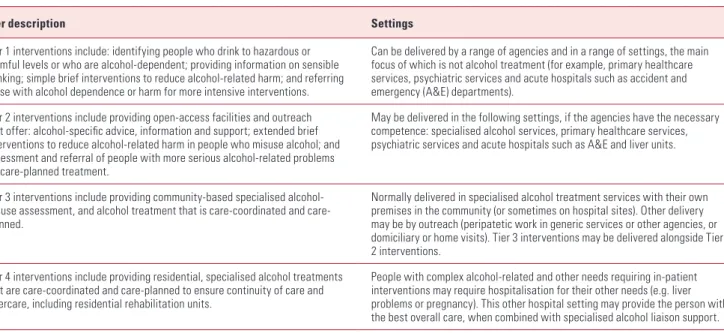
Models of Care for Alcohol Misusers (MoCAM; National Treatment Agency for Substance Misuse 2006b) is a UK government publication designed to assist health service managers to commission local alcohol treatment services. It advocates a stepped model of care (Table 1) and identifies four main categories of people who misuse alcohol: hazardous drinkers (who drink over medically recommended limits or binge drink but show no obvious alcohol related problems); harmful drinkers (who are experiencing alcoholrelated damage to health but are not clinically dependent); moderately dependent drinkers; and severely dependent drinkers. Individuals who misuse alcohol may move in and out of different categories over the course of a lifetime. The MoCAM model envisages two main components: brief interventions for people who drink excessively but do not require treatment for physical dependence, and specialised treatment for people with moderate or severe dependence. In stepped care, people new to such treatment should be assessed and should initially receive the least intensive or least prolonged intervention suitable for their level of need. If the person’s response to such a limited initial intervention is inadequate, a more intensive or prolonged package of care may be needed. Someone who is moderately dependent and has other complex needs might require the more intensive interventions from the outset.
Alcohol policy and treatment in England
The UK spends around £13 billion on buying alcohol each year and, on average, each UK adult consumes the equivalent of 9.1 litres of alcohol (Raistrick 2005). The recommended safe limits are 21 units a week for men and 14 for women, but 27% of men and 17% of women drink more than this. In addition, 7% of men and 3% of women drink over the danger limit (50 and 35 units a week respectively). There are at least a million alcohol dependent people in the UK (Department of Health 2005). Alcohol misuse in England costs the National Health Service (NHS) £1.7 billion each year and chronic alcoholrelated diseases cause 11 000– 18 000 deaths (Prime Minister’s Strategy Unit 2004). Alcohol costs the UK £7.3 billion through crime and public disorder and up to £6.4 billion through lost productivity. However, investment in treatment for people with alcohol problems has fallen far behind that for drug problems (Raistrick 2005), presumably because the British government ‘is determined to be toothless with respect to alcohol policy’ (Room 2004).Many national alcohol policies also emphasise demandreduction techniques such as restriction on advertising, age limits on purchasing alcohol, stringent drinkdriving levels, random driver breath testing and taxation on alcohol. Although the effectiveness of these methods is proven, their application and enforcement vary considerably (Gossop 1995; Plant 2004; Room 2004; Hall 2005). Demandreduction techniques are relatively inexpensive and flexible (they can be changed or abolished easily by government edicts). They also TAbLE 1 The model of treatment delivery envisaged by Models of Care for Alcohol Misusers
Tier description Settings
Tier 1 interventions include: identifying people who drink to hazardous or harmful levels or who are alcohol-dependent; providing information on sensible drinking; simple brief interventions to reduce alcohol-related harm; and referring those with alcohol dependence or harm for more intensive interventions.
Can be delivered by a range of agencies and in a range of settings, the main focus of which is not alcohol treatment (for example, primary healthcare services, psychiatric services and acute hospitals such as accident and emergency (A&E) departments).
Tier 2 interventions include providing open-access facilities and outreach that offer: alcohol-specific advice, information and support; extended brief interventions to reduce alcohol-related harm in people who misuse alcohol; and assessment and referral of people with more serious alcohol-related problems for care-planned treatment.
May be delivered in the following settings, if the agencies have the necessary competence: specialised alcohol services, primary healthcare services, psychiatric services and acute hospitals such as A&E and liver units.
Tier 3 interventions include providing community-based specialised alcohol-misuse assessment, and alcohol treatment that is coordinated and care-planned.
Normally delivered in specialised alcohol treatment services with their own premises in the community (or sometimes on hospital sites). Other delivery may be by outreach (peripatetic work in generic services or other agencies, or domiciliary or home visits). Tier 3 interventions may be delivered alongside Tier 2 interventions.
Tier 4 interventions include providing residential, specialised alcohol treatments that are care-coordinated and care-planned to ensure continuity of care and aftercare, including residential rehabilitation units.
People with complex alcohol-related and other needs requiring in-patient interventions may require hospitalisation for their other needs (e.g. liver problems or pregnancy). This other hospital setting may provide the person with the best overall care, when combined with specialised alcohol liaison support.
do not require the significant, longterm investment in health infrastructure that is required with specialised alcohol treatment services.
The Alcohol Harm Reduction Strategy and the Licensing Act 2003
The Alcohol Harm Reduction Strategy for England is a spectacular example of how the drinks industry can subvert alcohol policy (Plant 2004; Prime Minister’s Strategy Unit 2004). In summary, the strategy embraces all the policies that are highprofile, cheap and ineffective, such as school education and voluntary advertising codes. However, the strategy dismisses virtually all the policies that are known to be effective in reducing alcohol consumption (reduced licensing hours, increased excise duty, reducing the drink driving limit). Changes to the English Licensing Act 2003 (which regulates sales of alcohol) are similarly emasculated (Room 2004). Drummond (2006) describes MoCAM as ‘a light touch’. Unlike its equivalent for treating drug misuse, there are no targets and a derisory 7% increase in funding. The decisions to implement the recommendations (or not) are left to the discretion of local purchasers. Specialised treatment services are hardly mentioned in the commissioning sections, which focus almost entirely on screening and brief interventions in primary care (National Treatment Agency for Substance Misuse 2006b).
Shifting agendas: from healthcare to public order
The NHS currently spends about £217 million a year on specialised alcohol treatment services (Prime Minister’s Strategy Unit 2004; Department of Health 2005). These are provided by around 300 advice and counselling services, 100 day programmes and nearly 200 residential programmes. There has been a striking move away from residential treatment towards communitybased facilities following an influential government report and the increasing popularity of home detoxification and brief interventions in primary care (Edwards 1967, 1977; Centre for Reviews and Dissemination 1993). Hence, healthcare commissioners in the UK have progressively withdrawn funding from estab lished treatment centres and diverted it into screening programmes and brief interventions in primary care.
Recent government policy documents mean that the dissolution of specialised alcohol services in England is likely to continue. It is clear that the healthcare agenda now takes second place to the public order agenda in guiding investment in treatment for substance misuse problems in England (Raistrick 2005). Consequently, the total
spending on specialised treatment for drug misuse is estimated at around £600 million for 2007 (National Treatment Agency for Substance Misuse 2006b), which is three times the estimate for alcohol treatment. This is made worse by the fact that the NHS has directed its spending on substance misuse towards treatment for illicit drug use.
A European alcohol strategy
The situation in England is remarkably similar to that in Germany, where political apathy in the presence of a heavydrinking culture has produced relatively ineffective attempts to face up to the nation’s alcohol problems (Buhringer 2006). Just over 20% of German adults screen positive for alcohol use disorders. Alcohol policy has only recently been devised in Germany and tends to be limited to demand reduction. Regulations concerning sale of alcohol to minors are rarely enforced. For most of the 20th century the German approach to treating people with alcohol problems was longterm residential treatment in specialised centres. This is now financed by public pension insurance schemes and there has been a dramatic reduction in the availability and duration of residential alcohol treatment over the past two decades. Although Germans have a legal right to treatment without cost, there has been a huge increase in people seeking outpatient treatment for alcohol problems but little extra investment to meet these needs.
A European alcohol strategy is currently being developed (McKee 2006). Unfortunately, so far this appears to be full of bland platitudes regard ing ‘under lining’, ‘stressing’ and ‘endorsing’ various aspects of the alcohol strategies of the member states. The strategy contains no concrete recom mend ations regarding targets for treatment or prevention of alcoholrelated problems, nor any specific measures (such as taxation) to reduce alcoholrelated harm. However, some mention is made of irresponsible advertising, preventing alcoholrelated accidents and preventing alcohol misuse in young people. The strategy reiterates the view that alcohol policies should ensure balanced representation for the various stakeholders, including the alcoholic beverage industry. There appears to be little so far in the European alcohol strategy that has not already been adopted by the more affluent member states.
Conclusions
Specialised alcohol treatment services are an endangered species. The crime agenda means that there is great political enthusiasm in high income countries for treating people with drug
problems. In countries where alcohol is seen as part of the overall substance misuse problem, such as Spain and Australia, alcohol services have been enhanced. However, in countries such as England, where alcohol problems are of secondary political importance, drug treatment services may even starve resources from alcohol services. National alcohol policies, where these are emasculated by the political influence of the drinks industry, concentrate on demandreduction regulations rather than treating alcohol problems. Evidence for treating people with alcohol problems has also moved away from specialised, residential facilities towards screening and brief interventions in primary care. Although there is emerging evidence in favour of specialised treatment, there are limitations in the evidence base for treatment of people with severe alcohol problems and more research is needed. The future for specialised alcohol services in England looks bleak.
References
Anton RF, O’Malley SS, Ciraulo DA, et al (2006) Combined pharmaco-therapies and behavioural interventions for alcohol dependence. The COMBINE study. A randomized controlled trial. JAMA; 295: 2003–17. Babor TF, Caetano R, Casswell S, et al (2003) Alcohol: No Ordinary Commodity. Research and Public Policy, Oxford University Press. Bien TH, Miller WR, Tonigan JS (1993) Brief interventions for alcohol problems. A Review. Addiction; 88: 315–36.
Bouza C, Magro A, Muñoz A, et al (2004) Efficacy and safety of nal-trexone and acamprosate in the treatment of alcohol dependence. A systematic review. Addiction; 99: 811–28.
Buhringer G (2006) Germany, alcohol and alcohol policy. Oscillating between contemplation, action and relapse. Addiction; 101: 477–80. Centre for Reviews and Dissemination (1993) Brief interventions and alcohol use. Effective Health Care;bulletin 7.
Chapman PLH, Huygens I (1988) An evaluation of three treatment programmes for alcoholism. An experimental study with 6- and 18-month follow-ups. British Journal of Addiction; 83: 67–81. Chick J, Howlett H, Morgan MY, et al (2000) United Kingdom Multi-centre Acamprosate Study (UKMAS). A 6-month prospective study of acamprosate versus placebo in preventing relapse after with drawal from alcohol. Alcohol and Alcoholism; 35: 176–87.
Department of Health (2005) Alcohol Needs Assessment Research Project (ANARP). The 2004 National Alcohol Needs Assessment for England. TSO (The Stationery Office).
Drummond DC (1997) Alcohol interventions: do the best things come in small packages? Addiction; 92: 375–9.
Drummond C (2006) Alcohol. Two steps forward, one step back. SCANbites; 8: 1–3 (http://www.scan.uk.net/docstore/SCANbites_8_ FINAL.pdf).
Edwards G, Guthrie S (1967) A controlled trial of inpatient and outpatient treatment of alcohol dependency. Lancet; 1: 555–9.
Edwards G, Orford J, Egert S, et al (1977) Alcoholism. A controlled trial of ‘treatment’ and ‘advice’. Journal of Studies on Alcohol; 38: 1004–31.
Edwards G, Duckitt A, Oppenheimer E, et al (1983) What happens to alcoholics. Lancet; 2: 269–71.
Gossop M (1995) The treatment mapping survey. A descriptive study of drug and alcohol treatment responses in 23 countries. Drug and Alcohol Dependence; 39: 7–14.
Hall W (2005) British drinking. A suitable case for treatment? BMJ;
331: 527–8.
Hughes JC, Cook CCH (1997) The efficacy of disulfiram. A review of outcome studies. Addiction; 92: 381–95.
Krystal JH, Kramer JA, Krol WF, et al (2001) Naltrexone in the treatment of alcohol dependence. New England Journal of Medicine;
345: 1734–9.
Luty J (2006) What works in alcohol use disorders? Advances in Psychiatric Treatment; 12: 13–22.
McCollister KE, French MT (2003) The relative contribution of outcome domains in the total economic benefit of addiction interventions. A review of first findings. Addiction; 98: 1647–59.
McKee M (2006) A European alcohol strategy – will the opportunity be missed? BMJ; 333: 871–2.
Miller WR, Rollnick S (2002) Motivational Interviewing: Preparing People for Change (2nd edn). Guilford Press.
Miller WR, Wilbourne PD, Hetema JE (2003) What works? A summary of alcohol treatment outcome research. In Handbook of Alcoholism Treatment Approaches: Effective Alternatives (eds RK Hester, WR Miller): 13–63. Allyn and Bacon.
Moyer A, Finney JW, Swearingen CE, et al (2002) Brief interventions for alcohol problems. A meta-analytic review of controlled investigations in treatment-seeking and non-treatment-seeking populations. Addiction;
97: 279–92.
National Treatment Agency for Substance Misuse (2006a) Review of the Effectiveness of Treatment for Alcohol Problems. Department of Health.
National Treatment Agency for Substance Misuse (2006b) Models of Care for Alcohol Misusers. Department of Health.
Office for National Statistics (2001) Results from the 2000 General Household Survey. TSO (The Stationery Office).
Plant M (2004) The alcohol harm reduction strategy for England. BMJ;
328: 905–6.
Prime Minister’s Strategy Unit (2004) Alcohol Harm Reduction Strategy for England. Cabinet Office.
Project MATCH Research Group (1997) Matching alcohol treatments to client heterogeneity. Project MATCH posttreatment drinking outcomes. Journal of Studies on Alcoholism; 58: 7–29.
Raistrick D (2005) The United Kingdom: alcohol today. Addiction; 100: 1212–4.
Raistrick D, Heather N, Godfrey C (2006) Review of the Effectiveness of Treatment for Alcohol Problems. National Treatment Agency for Substance Misuse.
Rehm J, Patra J, Popova S (2006) Alcohol-attributable mortality and potential years of life lost in Canada 2001: implications for prevention and policy. Addiction; 101: 373–84.
Room R (2004) Disabling the public interest. Alcohol strategies and policies for England. Addiction; 99: 1083–9.
Tucker JA, Roth DL (2006) Extending the evidence hierarchy to enhance evidence-based practice for substance use disorders. Addiction; 101: 918–32.
United Kingdom Alcohol Treatment Trial Research Team (2005) Effectiveness of treatment for alcohol problems. Findings of the randomised UK Alcohol Treatment Trial (UKATT). BMJ; 331: 541. World Health Organization (2004) Global Status Report. Alcohol Policy. WHO. MCQ answers 1 2 3 4 5 a f a f a f a t a f b f b f b t b f b t c f c f c f c f c f d t d t d f d f d f
MCQs
It is estimated that: 1
7 million people throughout the world have an
a
alcohol use disorder at any one time
the highest per capita consumption of alcohol is
b
in North America
in the UK 2% of the population (aged 16–64)
c
drink hazardously or harmfully around 1.1 million people in England are
d
dependent on alcohol.
As regards interventions for alcohol misuse: 2
there has been a world-wide move away from
a
community-based brief interventions towards expensive residential treatment
brief interventions are designed to target
b
severely dependent drinkers
recent trials favour brief interventions
c
specialised alcohol treatment services suffer
d
from weakness in the evidence base.
The UK Alcohol Harm Reduction 3
Strategy:
embraces cheap, effective strategies
a
embraces cheap, ineffective strategies
b
sets targets
c
proposes funding increases similar to those for
d
treatment of drug misuse proposes a stepped-care approach.
e
Models of Care for Alcohol Misusers: 4
proposes a stepped-care approach
a
offers all new patients intensive prolonged
b
treatment from the start
proposes new ways of commissioning care
c
is published by the alcohol drinks industry.
d
In England: 5
the NHS spends about £1 billion a year on
a
treatment for alcohol misuse
government policy emphasises
demand-b
reduction techniques such as restriction on advertising, age limits on purchasing alcohol and stringent drink-driving levels
the NHS currently spends more on specialised
c
alcohol treatment services than on drug treatment services.
purchasers have progressively increased
d
funding on specialised alcohol treatment services rather than on treatment in primary care.