Estimation Using MCMC
Xibin Zhang Maxwell L. King Rob J. Hyndman
Department of Econometrics and Business Statistics Monash University, Clayton, Victoria, 3800, Australia
Correspondence to: [email protected]
July 2004
Abstract: Kernel density estimation for multivariate data is an important technique that has
a wide range of applications in econometrics and finance. However, it has received signifi-cantly less attention than its univariate counterpart. The lower level of interest in multivariate kernel density estimation is mainly due to the increased difficulty in deriving an optimal data-driven bandwidth as the dimension of data increases. We provide Markov chain Monte Carlo (MCMC) algorithms for estimating optimal bandwidth matrices for multivariate kernel den-sity estimation. Our approach is based on treating the elements of the bandwidth matrix as parameters whose posterior density can be obtained through the likelihood cross-validation criterion. Numerical studies for bivariate data show that the MCMC algorithm generally per-forms better than the plug-in algorithm under the Kullback-Leibler information criterion, and is as good as the plug-in algorithm under the mean integrated squared errors (MISE) crite-rion. Numerical studies for five dimensional data show that our algorithm is superior to the normal reference rule. Our MCMC algorithm is the first data-driven bandwidth selector for kernel density estimation with more than two variables, and the sampling algorithm involves no increased difficulty as the dimension of data increases.
Key Words: Bandwidth matrices; Cross-validation; Kullback-Leibler information; Mean
1 Introduction
Multivariate kernel density estimation is an important technique in multivariate data analysis and has a wide range of applications (see, for example, Scott 1992; A¨ıt-Sahalia 1996; Donald 1997; Stanton 1997; A¨ıt-Sahalia and Lo 1998). However, its widespread usefulness has been limited by the difficulty in computing an optimal data-driven bandwidth. We remedy this deficiency in this paper.
LetX = (X1,X2, . . . ,Xd)0denote ad-dimensional random vector with density f(x)defined on
Rd, and let{x1,x2, . . . ,xn}be an independent random sample drawn from f(x). The general
form of the kernel estimator of f(x)is (Wand and Jones 1993):
ˆ fH(x) = 1 n n
∑
i=1 KH(x−xi),whereKH(x) =|H|−1/2K(H−1/2x), K(·)is a multivariate kernel function, andHis a
symmet-ric positive definited×dmatrix known as the bandwidth matrix.
The bandwidth matrix can be restricted to a class of positive definite diagonal matrices, and then the corresponding kernel function is known as a product kernel. However, there is much to be gained by choosing a full bandwidth matrix, where the corresponding kernel smoothing is equivalent to pre-rotating the data by an optimal amount and then using a diagonal bandwidth matrix. It has been widely recognized that the performance of a kernel density estimator is primarily determined by the choice of bandwidth, and only in a minor way by the choice of kernel function (see, for example, Izenman 1991; Scott 1992; Simonoff 1996).
A large body of literature exists on bandwidth selection for univariate kernel density estima-tion (see, for example, Marron 1987; Jones, Marron and Sheather 1996 for surveys). However, the literature on bandwidth selection for multivariate data is very limited. Sain, Baggerly and Scott (1994) discussed the performance of bootstrap and cross-validation methods for band-width selection in multivariate density estimation and found that the complexity of finding an optimal bandwidth grows prohibitively as the dimension of data increases. Wand and Jones (1994) presented a less variable cross-validation algorithm using the plug-in method, which
re-quires auxiliary smoothing parameters. The technology for choosing these auxiliary smoothing parameters is not well developed. Duong and Hazelton (2003) showed that the full bandwidth matrix selectors suggested by Wand and Jones (1994) fail to produce plug-in bandwidths for some data sets. In response to this problem, Duong and Hazelton (2003) presented an alter-native plug-in algorithm for bandwidth selection for bivariate data. This plug-in method has the advantage that it always produces a finite bandwidth matrix and requires computation of fewer pilot bandwidths. However, it cannot be directly extended to the general multivariate setting.
When data are observed from the multivariate normal density and the diagonal bandwidth
matrix, denoted by H = diagonal(h1,h2,· · ·,hd), is employed, the optimal bandwidth that
minimizes MISE can be approximated by (Scott 1992; Bowman and Azzalini 1997)
hi =σi ½ 4 (d+2)n ¾1/(d+4) ,
fori =1, 2, . . . ,d, whereσi is the standard deviation of theith variate and can be replaced by
its sample estimator in practical implementations. We call this the “normal reference rule”. This method is often used in practice, in the absence of any other practical bandwidth selection schemes, despite the fact that most interesting data are non-Gaussian.
In theory, the cross-validation criterion can be employed for estimating the optimal bandwidth for multivariate data. However, it usually involves a numerical optimization, which becomes increasingly difficult as the dimension of data increases. The MCMC approach avoids this problem.
To our knowledge, the only previous paper employing an MCMC approach to bandwidth se-lection for kernel density estimation is Brewer (2000). He derived adaptive bandwidths for univariate kernel density estimation, treating the bandwidths as parameters and estimating them via MCMC simulations. Brewer (2000) showed that the proposed Bayesian approach is superior to methods of Abramson (1982) and Sain and Scott (1996).
Schuster and Gregory (1981) demonstrated that in some circumstances, the likelihood cross-validation produces inconsistent estimates for univariate kernel density estimation. However,
Brewer (2000) argued that the MCMC approach to adaptive bandwidth selection may avoid the inconsistency problem by choosing an appropriate prior and using a kernel with infinite support. The same argument applies to the case considered here.
To estimate the optimal bandwidth matrix for multivariate data, we treat the bandwidth matrix
Has a parameter matrix. The posterior density of Hcan be obtained through the likelihood
function derived via the likelihood cross-validation criterion. MCMC algorithms can be
de-veloped to sample H from its posterior, and the ergodic average or the posterior mean acts
as an estimator of the optimal bandwidth matrix. One important advantage of the MCMC approach to bandwidth matrix selection is that it is applicable to data of any dimension, not only to bivariate data. Moreover, the sampling algorithm involves no increased difficulty as the dimension of data increases.
In this paper, we present MCMC algorithms for estimating optimal bandwidth matrix for mul-tivariate kernel density estimation through the likelihood cross-validation criterion, and sam-pling algorithms are developed for both diagonal and full bandwidth matrices. The rest of this paper is organized as follows. Section 2 briefly discusses the likelihood cross-validation criterion and presents MCMC algorithms for both diagonal and full bandwidth matrices. In Section 3, we examine the performance of MCMC algorithms with data generated from known bivariate densities. We find that the MCMC algorithm generally performs better than either the plug-in algorithm or the normal reference rule in the bivariate setting. Section 4 applies the MCMC bandwidth selectors to data generated from known multivariate densities, and we find that the MCMC algorithm performs much better than the normal reference rule. Section 5 illustrates the use of the MCMC algorithm for bandwidth selection with an application to some earthquake data. We provide conclusions in Section 6.
2 MCMC for optimal bandwidth selection
2.1 Likelihood cross-validation
The Kullback-Leibler information is a measure of distance between two densities. Our interest
is in choosing the approximate density ˆfH(x) to minimize its distance from the true density
f(x). In this case, the Kullback-Leibler information is defined as
dKL(f, ˆfH) = Z log µ f(x) ˆ fH(x) ¶ f(x)dx= Z log[f(x)]f(x)dx− Z log[fˆH(x)]f(x)dx, (1)
which is nonnegative. We want to find an optimal bandwidth that minimizesdKL(f, ˆfH), or,
equivalently, maximizes E log[fˆH(x)] =
R
log[fˆH(x)]f(x)dx, in which the logarithmic
pseudo-likelihood function can be approximated by (see, for example, H¨ardle 1991)
L(x1,x2, . . . ,xn| H) =
n
∑
i=1log ˆfH,i(xi), (2)
where ˆfH,iis the leave-one-out estimator
ˆ fH,i(xi) = n−1 1 n
∑
j=1 j6=i |H|−1/2K ³ H−1/2(xi−xj) ´ .The likelihood cross-validation criterion is to selectHby maximizing the average logarithmic
likelihood functionn−1L(· | H).
2.2 Sampling a diagonal bandwidth matrix
WhenHis diagonal, the kernel density estimator of f(x)is
ˆ fh(x) = 1n n
∑
j=1 1 h1h2· · ·hd K µ x1−xj,1 h1 , x2−xj,2 h2 ,· · ·, xd−xj,d hd ¶ ,whereh = (h1,h2,· · ·,hd)0 is a vector of bandwidths with positive values. The leave-one-out estimator is ˆ fh,i(xi) = 1 n−1 n
∑
j=1 j6=i 1 h1h2· · ·hd K µ xi,1−xj,1 h1 ,xi,2−xj,2 h2 ,· · ·,xi,d−xj,d hd ¶ .We treat the bandwidthhas a vector of parameters, given which, the likelihood function of
{x1,x2,· · ·,xn}is L(x1,x2,· · ·,xn|h) = n
∑
i=1 log ˆfh,i(xi).We assume that the prior density of each component ofhis (up to a normalizing constant)
π(hi|λ) ∝ 1
1+λh2
i
, (3)
for i = 1, 2,· · ·,d, where λ is a hyperparameter controlling the shape of the prior density.
Uniform priors of bandwidths are generally unsuitable, because the update of eachhi has a
negligible effect whenhi is already very large. However, the prior ofhi defined in (3) can
pre-vent the update ofhifrom getting too large. In a different context, Bauwens and Lubrano (1998)
used a similar prior for the degree-of-freedom parameter of thet-distribution. The purpose of
such priors is to put a low prior probability on the “problematic” region in the parameter space,
where the likelihood function is flat. The joint prior ofh, denoted byπ(h|λ), is the product of
marginal priors defined in (3). According to Bayes theorem, the logarithmic posterior ofhis
(up to an additive constant)
π(h|λ,x1,x2,· · ·,xn)∝logπ(h|λ) + n
∑
i=1log ˆfh,i(xi), (4)
from which we can samplehusing the Metropolis-Hastings algorithm. The ergodic average or
the posterior mean ofhacts as an estimator of optimal bandwidth.
2.3 Sampling a full bandwidth matrix
As the bandwidth matrix is symmetric positive definite, we can obtain its Cholesky
Then the kernel estimator of f(x)is ˆ fB(x) = 1 n |B| n
∑
i=1 K¡B(x−xi) ¢ ,and the leave-one-out estimator of f(x)is
ˆ fB,i(xi) = 1 n−1|B| n
∑
j=1 j6=i K¡B(xi−xj)¢.We treat non-zero elements of the bandwidth matrix as parameters, whose posterior density can be obtained based on the likelihood function given in (2). We assume that the prior density
of each non-zero component ofBis (up to a normalizing constant)
π(bij |λ) ∝ 1
1+λb2
ij
(5)
forj≤iandi=1, 2, . . . ,d. The joint prior of all elements ofBis the product of marginal priors
defined in (5). Using Bayes theorem, we can obtain the logarithmic posterior ofB (up to an
additive constant) π(B|λ,x)∝ d
∑
i=1 i∑
j=1 logπ(bij |λ) + n∑
i=1 log ˆfB,i(xi), (6)from which we sample all elements ofBusing the Metropolis-Hastings algorithm. The ergodic
average or the posterior mean ofBacts as an estimator of optimal bandwidth.
2.4 Transformation of data
The plug-in algorithm for bandwidth selection developed by Duong and Hazelton (2003) uses a simple form for the pilot bandwidths, which is inappropriate when the dispersion of the data differs markedly between the two variates. Hence Duong and Hazelton (2003) suggested that the data be pre-scaled before the plug-in algorithm is implemented.
Given a set of bivariate data denoted by {x1,x2, . . . ,xn}, let S denote the sample
variance-covariance matrix with diagonal components s2
the sphering and scaling transformations, respectively, by
x∗i =S−1/2xi, and x∗i =S−d1/2xi,
fori= 1, 2, . . . ,n, whereSd = diagonal(s2
1,s22). When the optimal bandwidth matrix, denoted
by ˆH∗, for the transformed data is obtained, the optimal bandwidth matrix for the original data
can be calculated through the reverse transformation, ˆH=S1/2Hˆ∗(S1/2)0or ˆH =S1/2
d Hˆ∗S1/2d .
In contrast, the MCMC algorithm does not require such pre-transformations of data. How-ever, if we choose to make a sphering transformation of data and use the diagonal bandwidth matrix, the resulting bandwidth estimator for the original data is a full matrix. When the vari-ates are correlated and the diagonal bandwidth matrix is used, the bandwidth matrix estimator obtained through the sphering transformation of original data might produce a better perfor-mance than that obtained directly from the original data, because the sphering transformation is equivalent to pre-rotating data (see, for example, Wand and Jones 1993).
3 Numerical studies with bivariate densities
This section examines the performance of the proposed MCMC methods for bandwidth selec-tion via several sets of bivariate data, generated from known densities. As the true density is known in each case, the performance of the bandwidth can be measured by the accuracy of the corresponding kernel density estimator via Kullback-Leibler information.
The Kullback-Leibler information defined in (1) is the mean of log(f(x)/ ˆfH(x))under density
f(x), and so it measures the discrepancy of the estimated density from the true density. If a
large number of random vectors, denoted by {x1,x2, . . . ,xN}, can be drawn from f(x), the
Kullback-Leibler information can be estimated by ˆ dKL(f, ˆfH) = N1 N
∑
i=1 log(f(xi)/ ˆfH(xi)). (7)3.1 True densities
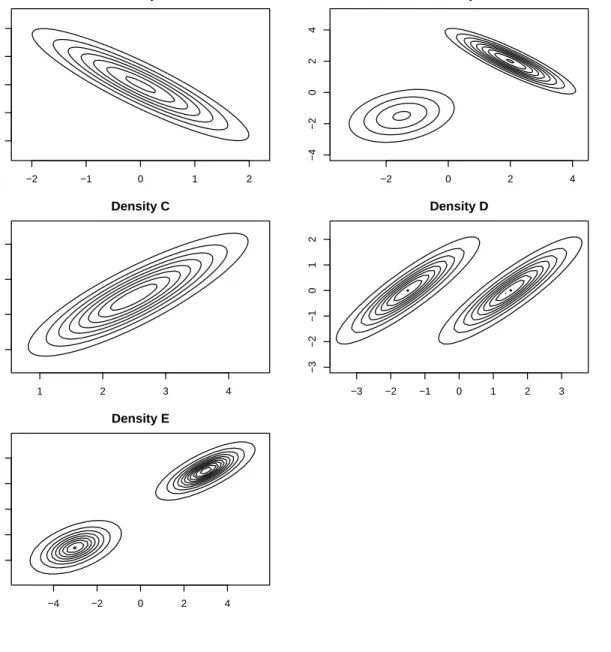
We consider five target densities labelled A, B, C, D and E. Contour plots of these densities are shown in Figure 1.
Density Ais bivariate normal with high correlation between two variates:
fA(x|µ,Σ) = (2π)−d/2|Σ|−1/2exp
³
−1
2(x−µ)
0Σ−1(x−µ)´,
with meanµand variance-covariance matrixΣgiven by
µ= 0 0 , Σ= 1 −0.9 −0.9 1 .
Density Bis a mixture of two bivariate normal densities, with high correlation and bimodality:
fB(x|µ1,Σ1,µ2,Σ2) = 12fA(x|µ1,Σ1) + 1 2fA(x|µ2,Σ2), where µ1 = 2 2 , Σ1= 1 −0.9 −0.9 1 , µ2 = −1.5 −1.5 , Σ2= 1 0.3 0.3 1 .
Density Cis a bivariate skew-normal density with high correlation:
fC(x|µ,Σ,α) =2φ(x|µ,Σ)Φ(α0W−1/2(x−µ)),
whereφ(· | µ,Σ)is the bivariate normal density with meanµand variance-covariance matrix
Σ, Φ(·) is the cumulative density function of a standard bivariate normal distribution, andW
is a diagonal matrix with diagonal elements the same as those of Σ. This distribution has
recently been studied by Azzalini and Dalla Valle (1996), Azzalini and Capitanio (1999, 2003),
Jones (2001) and Jones and Faddy (2003) among many others. Hereαis the shape parameter
normal density. For the purpose of generating a set of data, we use the following parameters, µ= 2 2 , Σ= 1 0.9 0.9 1 , α= 0.5 0.5 .
Density Dis a mixture of two bivariate Studenttdensities
fD(x|µ1,µ2,Σ,ν) = 12td(x|µ1,Σ,ν) + 1 2td(x|µ2,Σ,ν), where td(x|µ,Σ,ν) = Γ((ν+d)/2) (νπ)d/2Γ(ν/2)|Σ|1/2 · 1+1 ν(x−µ) 0Σ−1(x−µ) ¸−(d+ν)/2 , (8)
has location parameterµ, dispersion matrixΣand degrees of freedomν, and with parameters
set to µ1 = −1.5 0 , µ2 = 1.5 0 , Σ= 1 0.9 0.9 1 ,
andν=5. Density D exhibits heavy tail behaviour, high correlation and bimodality.
Density Eis a mixture of two bivariate Studenttdensities, but has thicker tails than density D:
fE(x|µ1,µ2,Σ,ν) = 12td(x|µ1,Σ1,ν) +12td(x|µ2,Σ2,ν), whereν=3, µ1 = 3 3 , Σ1 = 1 0.75 0.75 1 , µ2 = −3 −3 , and Σ2= 1 0.5 0.5 1 .
3.2 Bandwidth matrix selectors
From each of the proposed bivariate densities, we generate data sets of size n = 200, 500
and 1000, respectively. For each data set, we calculate the bivariate kernel density estimator using the bivariate Gaussian kernel function and bandwidth matrix selected through each of
the following selectors.
M1: MCMC algorithm for full bandwidth matrix without pre-transformation of data;
M2: MCMC algorithm for full bandwidth matrix with scaling transformation of data;
M3: MCMC algorithm for full bandwidth matrix with sphering transformation of data;
M4: MCMC algorithm for diagonal bandwidth matrix without pre-transformation of data;
M5: MCMC algorithm for diagonal bandwidth matrix with scaling transformation of data;
M6: MCMC algorithm for diagonal bandwidth matrix with sphering transformation of data;
P1: Plug-in selector of full bandwidth matrix with scaling transformation of data;
P2: Plug-in selector of full bandwidth matrix with sphering transformation of data;
P3: Plug-in selector of diagonal bandwidth matrix with scaling transformation of data;
P4: Plug-in selector of diagonal bandwidth matrix with sphering transformation of data;
A1: The normal reference rule approach for a diagonal bandwidth.
The plug-in bandwidth selector refers to the algorithm developed by Duong and Hazelton (2003). We have not included the plug-in algorithms of Wand and Jones (1993), because their algorithm for full bandwidth matrix selection sometimes fails to produce finite bandwidths for some data sets. When their algorithm works, its performance is similar to the plug-in algorithm developed by Duong and Hazelton (2003). See Duong and Hazelton (2003) for a discussion on the advantages of their plug-in algorithm.
3.3 MCMC outputs and sensitivity analysis
The hyperparameter of prior densities defined in (5) is initially set toλ=1 which represents a
very flat prior. Given a data set generated from a bivariate density, we sample the diagonal and full bandwidth matrices from their corresponding posterior densities defined in (6) using the random-walk Metropolis-Hastings algorithm, in which the proposal density is the multivariate standard normal density, and the tuning parameter is chosen so that the acceptance rate is between 0.2 and 0.3.
The burn-in period is set at 5,000 iterations, and the number of total recorded iterations is
Bfor each data set, we calculate the ergodic average (or posterior mean) and the batch-mean standard error (see, for example, Roberts 1996), where the number of batches is 50 and there are 500 draws in each batch. The ergodic average acts as an estimator of optimal bandwidth. We use the batch-mean standard error and the simulation inefficiency factor (SIF) to check the mixing performance of the sampling algorithm (see, for example, Kim, Shephard and Chib
1998; Tse, Zhang and Yu 2004). We use fE(·)as an example to illustrate the mixing performance
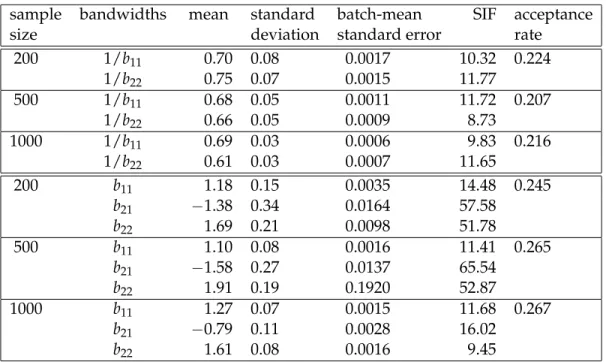
of the sampling algorithm. Table 1 presents a summary of MCMC outputs obtained throughM1
andM6. Both SIF and the batch-mean standard error show that all the simulated chains have
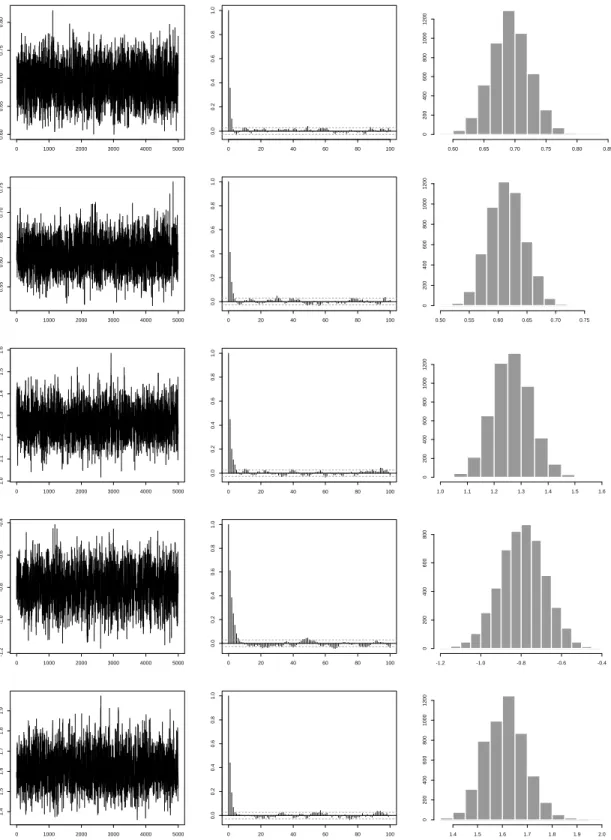
mixed very well. To demonstrate the mixing performance of these samplers graphically, we plot the sampled paths, their associated autocorrelation functions and histograms in Figure 2, which also reveals that these simulated chains have mixed very well. We found similar mixing performance for the other sampling algorithms, and for the other data sets.
We examined the robustness of the results to prior choices by trying values of λ = 0.1 and
λ = 5, as well as λ = 1. The mixing performance and posterior mean of each sampler was
similar in all cases.
3.4 Accuracy of MCMC bandwidth selectors
In order to estimate the Kullback-Leibler information, we generateN =100,000 bivariate
ran-dom vectors from the true density and calculate the estimated Kullback-Leibler information defined by (7), which is employed to measure the distance between the bivariate kernel density estimator and the corresponding true density. Table 2 presents the estimated Kullback-Leibler information for each density and each bandwidth selector. The simulation study reveals the following evidence.
• For data sets generated from fD and fE, the MCMC bandwidth selector performs better
than the corresponding plug-in bandwidth selector; for data sets generated from fB, both
selectors have a similar performance; for data sets generated from fAand fC, the MCMC
bandwidth selector performs better than the plug-in bandwidth selector except when using a sphering transformation for a full bandwidth matrix.
• For each data set generated, the MCMC bandwidth selector performs better than the normal reference rule.
• The scaling transformation adds nothing to the performance of MCMC algorithms for
sampling both diagonal and full bandwidth matrices.
• The sphering transformation of data is only helpful to the MCMC algorithm for sampling
a diagonal bandwidth matrix when two variates are correlated, such as for densities A, C and E. For uncorrelated data, and for sampling a full bandwidth matrix, sphering can degrade performance. This is also supported by Wand and Jones (1993).
• The MCMC algorithm for a diagonal bandwidth matrix applied after sphering does not
perform quite as well as the full bandwidth approach. However, the simplicity of using a diagonal bandwidth matrix makes this an attractive approach, especially with high dimensional data.
We also employ the MISE criterion to examine the performance of optimal bandwidths ob-tained through the MCMC algorithm, the bivariate plug-in algorithm and the normal reference
rule. We compute numerical MISEs for algorithmsM6,P4andA1through 50 data sets of sample
sizes 200, 500 and 1000, each of which was generated from fE(·). Results are given in Table 3,
which shows that M6performs slightly better thanP4 for sample size 200, and slightly poorer
thanP4 for sample sizes 500 and 1000. We also compute the average difference between
inte-grated squared errors (ISE) of any two bandwidth selectors. The difference of ISEs betweenM6
andP4is insignificant, but the difference of ISEs between M6and A1, as well as that between
P4andA1, are significant. BothM6andP4perform significantly better than A1.
4 Numerical studies with multivariate densities
In this section, we examine the accuracy of the MCMC approach in the general multivariate
4.1 True densities and bandwidth selectors
We consider five target densities labelled F, G, H, I and J, respectively.
Density Fis a multivariate normal density with location parameterµand variance-covariance
matrix defined as Σ= 1 1−ρ2 1 ρ ρ2 · · · ρd−1 ρ 1 ρ · · · ρd−2 ρ2 ρ 1 · · · ρd−3 · · · · · · ρd−1 ρd−2 ρd−3 · · · 1 , (9) whereρ=0.9 andµ= (2, 2, 2, 2, 2)0.
Density Gis a mixture of two multivariate normal densities,
fG(x|µ1,µ2,Σ) = 12fA(x|µ1,Σ) +
1
2fA(x|µ2,Σ),
whereµ1 = (2, 2, 2, 2, 2)0,µ2 = (−1.5,−1.5,−1.5,−1.5,−1.5)0andΣis the identity matrix.
Density His a mixture of two multivariate Studenttdensities,
fH(x|µ1,µ2,Σ,ν) = 12td(x|µ1,Σ,ν) +
1
2td(x|µ2,Σ,ν),
withtd(·)defined in (8),µ1= (2, 2, 2, 2, 2)0,µ2= (−1.5,−1.5,−1.5,−1.5,−1.5)0,Σis the identity
matrix, andν=3.
Density Iis the multivariate skew normal density,
fI(x|µ,Σ,α) =2φ(x|µ,Σ)Φ(α0W−1/2(x−µ)),
whereφ(· | µ,Σ) is the multivariate normal density with location parameterµand
variance-covariance matrixΣ,Φ(·)is the cumulative density function of a standard multivariate normal
distribution, andWis a diagonal matrix with diagonal elements the same as those ofΣ. To
Σdefined in (9) withρ=0.9, and skewness parameterα= (−0.5,−0.5,−0.5,−0.5,−0.5)0.
Density Jis the multivariate skewtdensity,
fJ(x|µ,Σ,ν,α) =2td(x|µ,Σ,ν)Td(x˜ |ν+d)
wheretd(·)is the multivariatet density defined in (8),Td(· | ν+d) is the cumulative density
function of a multivariatet distribution with mean0, identity dispersion matrix and degrees
of freedomν+d, and ˜ x=α0W−1/2(x−µ) µ ν+d (x−µ)0Σ−1(x−µ) +ν ¶1/2 ,
withW the diagonal matrix with diagonal elements the same as those ofΣ.
From each of the proposed multivariate densities, we generate data sets of sizes 500, 1000 and 1500. Then we apply the proposed MCMC algorithms to each data set to estimate the optimal bandwidth, where the multivariate standard Gaussian kernel is used. As the normal reference rule discussed in Scott (1992) and Bowman and Azzalini (1997) is the only viable alternative,
we shall compare the performance of MCMC bandwidth selectors M1 to M6 with that of the
alternative bandwidth selectorA1. The MCMC algorithm and parameter settings are the same
as in bivariate examples.
4.2 MCMC outputs and sensitivity analysis
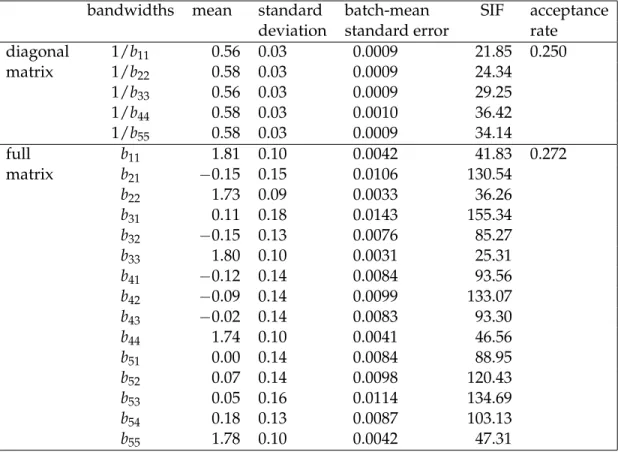
Table 4 shows MCMC output obtained from fF(·)with size 1500 to illustrate the mixing
per-formance of the sampling algorithm. Both the batch-mean standard error and SIF show that all
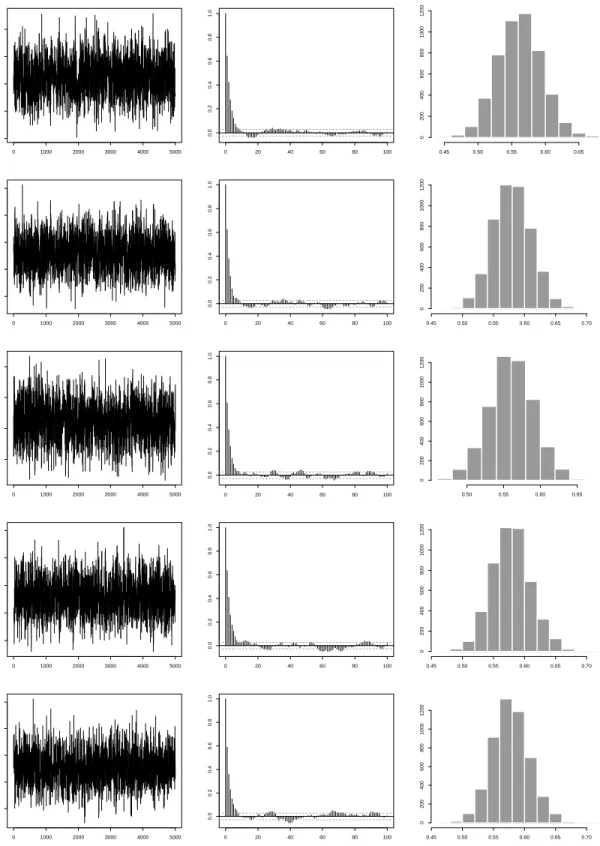
the sampled chains have mixed very well. Using the output obtained throughM1, we plot the
sampled paths, their associated autocorrelation functions and histograms in Figure 3, which shows that the simulated chains via this algorithm have mixed well.
The numerical study shows that all algorithms for a diagonal bandwidth matrix have a similar mixing performance, and that all algorithms for a full bandwidth matrix have a similar mixing performance. However, the algorithm for a diagonal bandwidth matrix usually has a better
mixing performance than that for a full bandwidth matrix. Similar results were found with the
other data sets. Again, we found that MCMC results are insensitive to changes inλ.
4.3 Accuracy of MCMC bandwidth selectors
To estimate the Kullback-Leibler information, we generate N =100,000 random vectors from
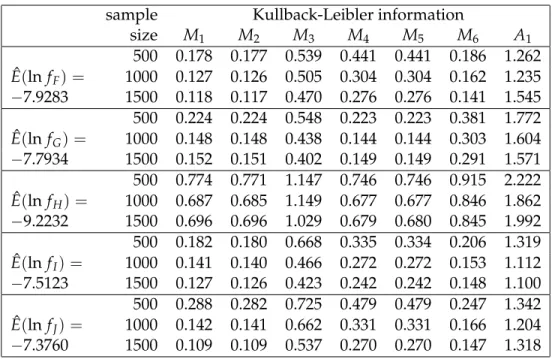
the true density and calculate the estimated Kullback-Leibler information defined by (7). Ta-ble 5 presents these results for each density and each bandwidth selector.
The simulation study reveals the following evidence. First, all MCMC bandwidth selectors perform much better than the normal reference rule. Second, the scaling transformation adds nothing to the performance of MCMC algorithms for either the diagonal or full matrices. Third, the sphering transformation of data is only useful for the diagonal bandwidth matrix when variables are correlated (such as with densities F, I and J). When there is no correlation, or with the full bandwidth matrix, sphering degrades performance.
As we did in the bivariate case, we employ the MISE criterion to compare the performance of optimal bandwidths obtained through the MCMC algorithm and the normal reference rule. We
computed numerical MISEs for algorithmsM6andA1through 50 data sets of sample size 500,
1000 and 1500, each of which was generated from fI(·). The ISE obtained through M6 is less
than that obtained throughA1 for every data set. a summary of numerical ISEs is given in
Ta-ble 6, which shows that the average difference between ISEs ofM6andA1is highly significant.
5 Application to earthquake data
We now apply the methodology to a trivariate data set discussed in Scott (1992). These data represent the epicenters of 510 earthquake tremors that occurred beneath the Mt St Helens vol-cano in the two months leading up to its eruption in March 1982. The three variables represent latitude, longitude and log-depth below the surface. Scott (1992, plate 8) gives several contours of a kernel density estimate of these data, where the bandwidths appear to have been chosen subjectively. We repeat this plot, but using our optimal bandwidth methodology.
We use the MCMC algorithmsM1and M5to obtain optimal bandwidths, where the
hyperpa-rameterλ=1, the burn-in period consists of 5,000 iterations, and the recorded period contains
25,000 iterations. Table 7 tabulates a summary of results. Both the batch-mean standard error and SIF show that all sampled chains have mixed very well.
Using the estimated diagonal bandwidth matrix, we compute a kernel density estimator. (The estimate using the full bandwidth matrix was almost identical in this case.) The 98% highest density region (Hyndman 1996) is plotted in Figure 4. The surface was computed using the algorithm of Amenta, Bern and Kamvysselis (1998). Note that the detached shells represent outliers in the data; the large central shell represents the bulk of the epicenters. The figure clearly shows clustering of the epicenters, revealing structure that was not discovered by Scott (1992) using a subjective bandwidth. It would be interesting to identify the clusters with geo-logical features, although this information is not available to us.
6 Conclusion
This paper presents MCMC algorithms to estimate the optimal bandwidth for multivariate kernel density estimation via the likelihood cross-validation criterion. This represents the first data-driven bandwidth selection method for density estimation with more than two variables. Our numerical studies show that the sampling algorithms have a very good performance in achieving convergence of the simulated Markov chains, and are insensitive to prior choices. Under the Kullback-Leibler information criterion, we have found that the MCMC algorithm generally performs better than the bivariate plug-in algorithm of Duong and Hazelton (2003) and the normal reference rule discussed in Scott (1992) and Bowman and Azzalini (1997). Un-der the MISE criterion, the MCMC algorithm works as well as Duong and Hazelton’s (2003) plug-in algorithm, and both algorithms are superior to the normal reference rule. Under both criteria, our sampling algorithm is superior to the normal reference rule for higher dimensional data. Apart from the superior performance, the other great advantage of our sampling algo-rithm is that it is applicable to higher dimensional data with no increase in the complexity, although the computing time required does increase.
Acknowledgements
We extend our sincere thanks to Faming Liang for sharing his coding skills and resources, David Scott for providing the earthquake data, and Tarn Duong and Martin Hazelton for pro-viding their R library to compute bivariate plug-in bandwidths. We thank Martin Hazelton and Gael Martin for helpful comments.
References
Abramson, I. (1982), “On Bandwidth Variation in Kernel Estimates – A Square Root Law,”The
Annals of Statistics, 10, 1217-1223.
A¨ıt-Sahalia, Y. (1996), “Testing Continuous-Time Models of the Spot Interest Rate,”Review of
Financial Studies, 9, 385-426.
A¨ıt-Sahalia, Y., and Lo, A.W. (1998), “Nonparametric Estimation of State-Price Densities
Im-plicit in Financial Asset Prices,”The Journal of Finance, 53, 499-547.
Amenta, N., Bern, M., and Kamvysselis, M. (1998) “A New Voronoi-based Surface
Reconstruc-tion Algorithm”,Proceedings of the 25th Annual Conference on Computer Graphics and
Interac-tive Techniques, 415–421.
Azzalini, A., and Capitanio, A. (1999), “Statistical Applications of the Multivariate Skew
Nor-mal Distribution,”Journal of the Royal Statistical Society, Series B, 61, 579-602.
Azzalini, A., and Capitanio, A. (2003), “Distributions Generated by Perturbation of Symmetry
with Emphasis on a Multivariate Skewt-distribution,”Journal of the Royal Statistical Society,
Series B, 66, 367-389.
Azzalini, A., and Dalla Valle, A. (1996), “The Multivariate Skew Normal Distribution,”
Biometrika, 83, 715-726.
Bauwens, L., and Lubrano, M. (1998), “Bayesian Inference on GARCH Models Using the Gibbs
Sampler,”Econometrics Journal, 1, C23-C26.
Bowman, A.W., and Azzalini, A. (1997),Applied Smoothing Techniques for Data Analysis, London:
Brewer, M.J. (2000), “A Bayesian Model for Local Smoothing in Kernel Density Estimation,”
Statistics and Computing, 10, 299-309.
Donald, S.G. (1997), “Inference Concerning the Number of Factors in a Multivariate
Nonpara-metric Relationship,”Econometrica, 65, 103-131.
Duong, T., and Hazelton, M.L. (2003), “Plug-in Bandwidth Selectors for Bivariate Kernel
Den-sity Estimation,”Journal of Nonparametric Statistics, 15, 17-30.
H¨ardle, W. (1991),Smoothing Techniques with Implementation in S, New York: Springer-Verlag.
Hyndman, R.J. (1996), “Computing and Graphing Highest Density Regions,”American
Statisti-cian, 50, 120-126.
Izenman, A.J. (1991), “Recent Developments in Nonparametric Density Estimation,”Journal of
the American Statistical Association, 86, 205-224.
Jones, M.C. (2001), “A SkewtDistribution,” inProbability and Statistical Models with Applications:
A Volume in Honor of Theophilos Cacoullos,” eds. C.A. Charalambides, M.V. Koutras, and N. Balakrishnan, London: Chapman & Hall, pp. 269-278.
Jones, M.C., and Faddy, M.J. (2003), “A Skew Extension of the t-distribution, with
Applica-tions,”Journal of the Royal Statistical Society, Series B, 66, 159-174.
Jones, M.C., Marron, J.S., and Sheather, S.J. (1996), “A Brief Survey of Bandwidth Selection for
Density Estimation,”Journal of the American Statistical Association, 91, 401-407.
Kim, S., Shephard, N., and Chib, S. (1998), “Stochastic Volatility: Likelihood Inference and
Comparison with ARCH Models,”Review of Economic Studies, 65, 361-393.
Marron, J.S. (1987), “A Comparison of Cross-Validation Techniques in Density Estimation,”
Annals of Statistics, 15, 152-162.
Roberts, G.O. (1996), “Markov Chain Concepts Related to Sampling Algorithms,” in Markov
Chain Monte Carlo in Practice, eds. W.R. Gilks, S. Richardson, and D.J. Spiegelhalter, London: Chapman & Hall, pp. 45-57.
Sain, S.R., Baggerly, K.A., and Scott, D.W. (1994), “Cross-Validation of Multivariate Densities,”
Journal of the American Statistical Association, 89, 807-817.
Sain, S.R., and Scott, D.W. (1996), “On Locally Adaptive Density Estimation,” Journal of the
Schuster, E.F., and Gregory C.G. (1981), “On the Nonconsistency of Maximum Likelihood
Non-parametric Density Estimators,” in Computer Science and Statistics: Proceedings of the 13th
Symposium on the Interface, eds. W.F. Eddy, New York: Springer-Verlag, pp.295-298.
Scott, D.W. (1992),Multivariate Density Estimation: Theory, Practice, and Visualization, New York:
John Wiley.
Simonoff, J.S. (1996),Smoothing Methods in Statistics, New York: Springer-Verlag.
Stanton, R. (1997), “A Nonparametric Model of Term Structure Dynamics and the Market Price
of Interest Rate Risk,”The Journal of Finance, 52, 1973-2002.
Tse, Y.K., Zhang, X., and Yu, J. (2004), “Estimation of Hyperbolic Diffusion with Markov Chain
Monte Carlo Simulation,”Quantitative Finance, 4, 158-169.
Wand, M.P., and Jones, M.C. (1993), “Comparison of Smoothing Parameterizations in Bivariate
Kernel Density Estimation,”Journal of the American Statistical Association, 88, 520-528.
Wand, M.P., and Jones, M.C. (1994), “Multivariate Plug-in Bandwidth Selection,”Computational
Statistics, 9, 97-116.
Table 1:MCMC results for data generated from fE(·). The first panel is obtained through the algorithm
for a diagonal bandwidth matrix(M6), while the second panel is obtained through the algorithm for a full bandwidth matrix (M1).
sample bandwidths mean standard batch-mean SIF acceptance
size deviation standard error rate
200 1/b11 0.70 0.08 0.0017 10.32 0.224 1/b22 0.75 0.07 0.0015 11.77 500 1/b11 0.68 0.05 0.0011 11.72 0.207 1/b22 0.66 0.05 0.0009 8.73 1000 1/b11 0.69 0.03 0.0006 9.83 0.216 1/b22 0.61 0.03 0.0007 11.65 200 b11 1.18 0.15 0.0035 14.48 0.245 b21 −1.38 0.34 0.0164 57.58 b22 1.69 0.21 0.0098 51.78 500 b11 1.10 0.08 0.0016 11.41 0.265 b21 −1.58 0.27 0.0137 65.54 b22 1.91 0.19 0.1920 52.87 1000 b11 1.27 0.07 0.0015 11.68 0.267 b21 −0.79 0.11 0.0028 16.02 b22 1.61 0.08 0.0016 9.45
Table 2:Estimated Kullback-Leibler information for bivariate densities.
sample Kullback-Leibler information
size M1 M2 M3 M4 M5 M6 P1 P2 P3 P4 A1 200 0.046 0.046 0.066 0.101 0.101 0.045 0.117 0.044 0.120 0.203 0.205 ˆ E(lnfA) = 500 0.025 0.024 0.041 0.051 0.051 0.026 0.054 0.030 0.057 0.132 0.134 −2.003 1000 0.017 0.017 0.018 0.038 0.038 0.020 0.043 0.019 0.047 0.094 0.096 200 0.131 0.129 0.158 0.154 0.154 0.228 0.129 0.213 0.153 0.192 0.375 ˆ E(lnfB) = 500 0.074 0.075 0.091 0.094 0.094 0.150 0.075 0.124 0.093 0.112 0.284 −3.099 1000 0.042 0.042 0.054 0.058 0.058 0.095 0.040 0.067 0.056 0.067 0.235 200 0.032 0.032 0.053 0.089 0.089 0.037 0.100 0.050 0.119 0.105 0.114 ˆ E(lnfC) = 500 0.021 0.021 0.037 0.048 0.047 0.022 0.047 0.023 0.055 0.089 0.085 −1.822 1000 0.018 0.018 0.040 0.040 0.040 0.021 0.038 0.021 0.043 0.065 0.071 200 0.299 0.296 0.247 0.394 0.392 0.361 0.357 0.345 0.391 0.325 0.410 ˆ E(lnfD) = 500 0.121 0.121 0.129 0.226 0.226 0.220 0.223 0.197 0.263 0.230 0.327 −3.072 1000 0.084 0.084 0.101 0.161 0.161 0.140 0.144 0.135 0.187 0.163 0.255 200 0.256 0.254 0.281 0.260 0.260 0.258 0.487 0.417 0.488 0.268 0.461 ˆ E(lnfE) = 500 0.219 0.221 0.249 0.240 0.240 0.217 0.333 0.298 0.345 0.240 0.385 −3.850 1000 0.149 0.149 0.150 0.178 0.178 0.149 0.260 0.222 0.274 0.173 0.299
Table 3: Numerical MISEs for the bivariate density fE(·). “PI” refers to the plug-in method, and
“NRR” the normal reference rule. Values in parentheses are the corresponding standard deviations.
sample MISE difference between ISEs
size MCMC PI NRR MCMC & PI MCMC & NRR PI & NRR 200 0.0077 0.0092 0.0176 -0.00152 -0.00998 -0.00847 (0.00177) (0.00151) (0.00085) 500 0.0065 0.0060 0.0149 0.00047 -0.00842 -0.00889 (0.00155) (0.00147) (0.00058) 1000 0.0049 0.0041 0.0128 0.00081 -0.00789 -0.00870 (0.00107) (0.00099) (0.00032)
Table 4:MCMC results for data generated from fF(·). The sample size is 1500.
bandwidths mean standard batch-mean SIF acceptance
deviation standard error rate
diagonal 1/b11 0.56 0.03 0.0009 21.85 0.250 matrix 1/b22 0.58 0.03 0.0009 24.34 1/b33 0.56 0.03 0.0009 29.25 1/b44 0.58 0.03 0.0010 36.42 1/b55 0.58 0.03 0.0009 34.14 full b11 1.81 0.10 0.0042 41.83 0.272 matrix b21 −0.15 0.15 0.0106 130.54 b22 1.73 0.09 0.0033 36.26 b31 0.11 0.18 0.0143 155.34 b32 −0.15 0.13 0.0076 85.27 b33 1.80 0.10 0.0031 25.31 b41 −0.12 0.14 0.0084 93.56 b42 −0.09 0.14 0.0099 133.07 b43 −0.02 0.14 0.0083 93.30 b44 1.74 0.10 0.0041 46.56 b51 0.00 0.14 0.0084 88.95 b52 0.07 0.14 0.0098 120.43 b53 0.05 0.16 0.0114 134.69 b54 0.18 0.13 0.0087 103.13 b55 1.78 0.10 0.0042 47.31
Table 5:Estimated Kullback-Leibler information for multivariate densities.
sample Kullback-Leibler information
size M1 M2 M3 M4 M5 M6 A1 500 0.178 0.177 0.539 0.441 0.441 0.186 1.262 ˆ E(ln fF) = 1000 0.127 0.126 0.505 0.304 0.304 0.162 1.235 −7.9283 1500 0.118 0.117 0.470 0.276 0.276 0.141 1.545 500 0.224 0.224 0.548 0.223 0.223 0.381 1.772 ˆ E(ln fG) = 1000 0.148 0.148 0.438 0.144 0.144 0.303 1.604 −7.7934 1500 0.152 0.151 0.402 0.149 0.149 0.291 1.571 500 0.774 0.771 1.147 0.746 0.746 0.915 2.222 ˆ E(ln fH) = 1000 0.687 0.685 1.149 0.677 0.677 0.846 1.862 −9.2232 1500 0.696 0.696 1.029 0.679 0.680 0.845 1.992 500 0.182 0.180 0.668 0.335 0.334 0.206 1.319 ˆ E(ln fI) = 1000 0.141 0.140 0.466 0.272 0.272 0.153 1.112 −7.5123 1500 0.127 0.126 0.423 0.242 0.242 0.148 1.100 500 0.288 0.282 0.725 0.479 0.479 0.247 1.342 ˆ E(ln fJ) = 1000 0.142 0.141 0.662 0.331 0.331 0.166 1.204 −7.3760 1500 0.109 0.109 0.537 0.270 0.270 0.147 1.318
Table 6: Numerical MISEs for the 5-dimension density fE(·).
sample MISE difference between ISEs size MCMC NRR MCMC & NRR standard deviation
500 0.000195 0.000499 -0.000304 0.000023 1000 0.000144 0.000421 -0.000278 0.000015 1500 0.000125 0.000391 -0.000265 0.000008
Table 7:MCMC results obtained from the Earthquake data.
bandwidths mean standard batch-mean SIF acceptance
deviation standard error rate
diagonal 1/b11 0.003 0.0001 0.000003 9.07 0.254 matrix 1/b22 0.003 0.0001 0.000003 12.60 1/b33 0.715 0.0383 0.000873 12.96 full b11 311.65 0.07 0.002 15.80 0.246 matrix b21 101.53 0.10 0.005 62.21 b22 388.57 0.10 0.003 15.84 b31 147.45 0.13 0.008 89.38 b32 97.21 0.16 0.011 118.86 b33 1.65 0.27 0.012 47.54
Figure 1:Contour graphs of the proposed bivariate densities. Density A −2 −1 0 1 2 −2 −1 0 1 2 Density B −2 0 2 4 −4 −2 0 2 4 Density C 1 2 3 4 1 2 3 4 Density D −3 −2 −1 0 1 2 3 −3 −2 −1 0 1 2 Density E −4 −2 0 2 4 −4 −2 0 2 4
Figure 2:MCMC results for the simulated bivariate data. Columns (from left to right) show the sampled paths, their associated autocorrelation functions and histograms. The first two rows represent nonzero elements of H1/2, while the rest three rows represent elements of B.
0 1000 2000 3000 4000 5000 0.60 0.65 0.70 0.75 0.80 0 20 40 60 80 100 0.0 0.2 0.4 0.6 0.8 1.0 0.60 0.65 0.70 0.75 0.80 0.85 0 200 400 600 800 1000 1200 0 1000 2000 3000 4000 5000 0.55 0.60 0.65 0.70 0.75 0 20 40 60 80 100 0.0 0.2 0.4 0.6 0.8 1.0 0.50 0.55 0.60 0.65 0.70 0.75 0 200 400 600 800 1000 1200 0 1000 2000 3000 4000 5000 1.0 1.1 1.2 1.3 1.4 1.5 1.6 0 20 40 60 80 100 0.0 0.2 0.4 0.6 0.8 1.0 1.0 1.1 1.2 1.3 1.4 1.5 1.6 0 200 400 600 800 1000 1200 0 1000 2000 3000 4000 5000 -1.2 -1.0 -0.8 -0.6 -0.4 0 20 40 60 80 100 0.0 0.2 0.4 0.6 0.8 1.0 -1.2 -1.0 -0.8 -0.6 -0.4 0 200 400 600 800 0 1000 2000 3000 4000 5000 1.4 1.5 1.6 1.7 1.8 1.9 0 20 40 60 80 100 0.0 0.2 0.4 0.6 0.8 1.0 1.4 1.5 1.6 1.7 1.8 1.9 2.0 0 200 400 600 800 1000 1200
Figure 3: MCMC results for the simulated multivariate data. Columns (from left to right) represent the sampled paths, their associated autocorrelation functions and histograms. Rows represent nonzero elements of H1/2. 0 1000 2000 3000 4000 5000 0.45 0.50 0.55 0.60 0.65 0 20 40 60 80 100 0.0 0.2 0.4 0.6 0.8 1.0 0.45 0.50 0.55 0.60 0.65 0 200 400 600 800 1000 1200 0 1000 2000 3000 4000 5000 0.50 0.55 0.60 0.65 0.70 0 20 40 60 80 100 0.0 0.2 0.4 0.6 0.8 1.0 0.45 0.50 0.55 0.60 0.65 0.70 0 200 400 600 800 1000 1200 0 1000 2000 3000 4000 5000 0.50 0.55 0.60 0.65 0 20 40 60 80 100 0.0 0.2 0.4 0.6 0.8 1.0 0.50 0.55 0.60 0.65 0 200 400 600 800 1000 1200 0 1000 2000 3000 4000 5000 0.50 0.55 0.60 0.65 0.70 0 20 40 60 80 100 0.0 0.2 0.4 0.6 0.8 1.0 0.45 0.50 0.55 0.60 0.65 0.70 0 200 400 600 800 1000 1200 0 1000 2000 3000 4000 5000 0.50 0.55 0.60 0.65 0.70 0 20 40 60 80 100 0.0 0.2 0.4 0.6 0.8 1.0 0.45 0.50 0.55 0.60 0.65 0.70 0 200 400 600 800 1000 1200
Figure 4: The 98% highest density region for the earthquake data showing four views looking from north, east, south and west. Negative log-depth is on the vertical axis, and various combinations of latitude and longitude are on the horizontal axes.
N E