EDUCATION PROGRAMMES IN TANZANIA
AMINA ABUBAKARI MSUYA
A DISSERTATION SUBMITTED IN PARTIAL FULFILMENT OF THE REQUIREMENTS FOR THE DEGREE OF MASTER OF EDUCATION IN
ADMINISTRATION, PLANNING AND POLICY STUDIES OF THE OPEN UNIVERSITY OF TANZANIA
CERTIFICATION
The undersigned, certifies that, she has read and hereby recommends for acceptance by the Open University of Tanzania a dissertation entitled: Facilitators and Learners’ Perceptions on the Implementation of Competence-Based Curricula in Adult Education Programmes in Tanzania in fulfillment of the requirements for the Degree of Master of Education Administration, Planning and Policy Studies of the Open University of Tanzania.
...
Prof. Honoratha M. K. Mushi
(Supervisor)
………..
COPYRIGHT
This dissertation is copyright material protected under the Berne Convention, the copyright Act 1999 and other international and national enactments, in that behalf, on intellectual property. No part of this dissertation may be reproduced, stored in any retrieval system, or transmitted in any form by any means, electronic or mechanical for research or private study, critical scholarly review or discourse without written permission of the Directorate of Postgraduate Studies on behalf of both the author and the Open University of Tanzania.
DECLARATION
I, Amina Abubakari Msuya, declare that this dissertation is my own work and it has not been presented, and will not be presented to any other University or Institution for a similar or any other degree award.
………..
Signature
………..
DEDICATION
I dedicate this work to my family and my beloved parents who formed the base on which I developed the habit of eagerness to aspire for educational perfection.
ACKNOWLEDGEMENT
Many people have contributed to the success of this dissertation. I wish to acknowledge all of them for their contributions. Although it is not possible to mention all of them by names, I would like to express my sincere thanks to some of them on behalf of all. I extend my thanks to the Director of the Institute of Adult Education Dr. Fidelice Mafumiko for securing a scholarship for me to pursue this programme.
I also wish to convey my sincere gratitude to my supervisor Prof. Honoratha M. K. Mushi for her invaluable guidance throughout the writing of this dissertation, such that she made this work possible and successful. Further, I extend my appreciation for advice and encouragements from Mr. Aristaricke Lekule, the Head of Adult and Continuing Education Studies (ACES) Department of the Institute of Adult Education. My sincere appreciation to my fellow MED-APPS students at the Open University of Tanzania and all staff of the Institute of Adult Education (IAE) for their contribution and cooperation, which enabled me to accomplish this work. I could not have done much without the contribution of respondents of this study, thus I acknowledge their participation with heartfelt gratitude.
My beloved husband Mr Yassin B. Kilavo and children Halima, Shaila and Bashiri were always beside me; to them I am indebted for their love and patience during the years of my studies. Last but not least my thanks to all those who are not mention but provided me with direct or indirect contribution along my study’s journey. Notwithstanding I remain solely responsible for any shortcomings of this study.
ABSTRACT
This study investigated facilitators and learners’ perceptions on the implementation of Competence-Based Education and Training (CBET) approaches in adult education programmes in Tanzania. The Institute Adult Education (IAE) was the case for this study which examined the extent to which IAE implemented competence based curricula. It also intended to identify challenges faced in implementing competence based curricula. The study employed a case study design under qualitative research approach. Some elements of quantitative research techniques were involved. The sample comprised fifty eight (58) respondents including 15 facilitators, 3 IAE senior officials and 40 students. Facilitators and students were obtained through simple random sampling while IAE senior officers were sampled through purposive sampling. Data collection methods included interview, observation, documentary review and focus group discussion. Qualitative data were analyzed through content analysis employing simple calculations, tables, and percentages for quantitative data. Findings revealed that to some extent the IAE was successful to implement CBET curricula. It was revealed that the effective implementation of CBET curricula was hampered by insufficient teaching and learning resources including inadequate library space. It was concluded that there were changes in teaching and learning from knowledge based to CBET approaches. It was recommended that for the smooth CBET curricula implementation the IAE should ensure availability of teaching and learning resources and staff training; Collaboration with other stakeholders; and conduct further studies regarding CBET curriculum implementation.
TABLE OF CONTENTS CERTIFICATION ... ii COPYRIGHT ... iii DECLARATION ...iv DEDICATION ... v ACKNOWLEDGEMENT...vi ABSTRACT ... vii
TABLE OF CONTENTS ... viii
LIST OF TABLES ... xii
LIST OF FIGURES... xiii
LIST OF APPENDICES ... xiv
LIST OF ABBREVIATIONS ... xv
CHAPTER ONE ... 1
INTRODUCTION ... 1
1.1 Background to the Study ... 1
1.1.1 Competence –based Curriculum ... 4
1.2 Statement of the Problem ... 11
1.3 Main objective of the Study ... 12
1.4 Specific Objectives ... 12
1.5 Research Questions ... 13
1.6 Significance of the Study ... 13
1.7 Limitations of the Study ... 14
1.8 Delimitations of the Study ... 14
1.9 Conceptual Framework ... 15
CHAPTER TWO... 19
LITERATURE REVIEW ... 19
2.1 Introduction ... 19
2.2 Conceptualization of Major Terms ... 19
2.2.1 Competence ... 19
2.3 Overview of competency Based Education and Training (CBET) ... 20
2.4 The Experience of CBET in the Worldwide Context ... 22
2.5 Implementation of CBET Curriculum ... 25
2.5.1 Teaching and Learning Approaches in CBET ... 26
2.5.2 Competence Based Assessment ... 28
2.6 Challenges Facing Implementation of Competence Based Curriculum ... 30
2.7 Empirical Studies ... 33 2.8 Literature Gap ... 34 CHAPTER THREE ... 35 RESEARCH METHODOLOGY... 35 3.1 Introduction ... 35 3.2 Study Area ... 35
3.3 Research Design and Approach ... 35
3.4 The Target Population ... 37
3.5 Sample and Sampling Techniques ... 37
3.5.1 Sample of the Study ... 37
3.5.2 Sampling Techniques ... 39
3.5.2.1 Purposive Sampling ... 39
3.5.2.2 Simple Random Sampling ... 40
3.6.1 Documentary Review ... 41
3.6.2 Observation... 41
3.6.3 Interview... 42
3.6.4 Focus Group Discussion ... 42
3.7 Validation of the Study instruments ... 43
3.8 Data Analysis Plan ... 44
3.9 Ethical Consideration ... 44
CHAPTER FOUR ... 45
DATA PRESENTATION, ANALYSIS AND DISCUSSION ... 45
4.1 Introduction ... 45
4.2 Facilitators’ and learners’ Perceptions on the Concept of CBET ... 45
4.2.1 Facilitators’ Perceptions on the Concept of CBET ... 46
4.2.2 Learners’ Perceptions on their Knowledge of the Concept of CBET ... 47
4.3 Facilitators’ and Learners’ Perceptions on the Implementation of CBET Curricula in the Classroom at IAE ... 50
4.3.1 Teaching and Learning Resources Available for the Implementation of Competence- Based Curriculum at IAE ... 50
4.3.1.1 Availability of Library Services and Stock of Books at IAE ... 51
4.3.1.2 Availability of Lecture Theatres (halls) and Seminar Rooms ... 56
4.3.2 Perceptions of Facilitators and Learners on Programmes Delivery System at IAE ... 58
4.3.3 Perceptions on facilitators’ Assessment Methods at IAE in the Implementation of CBET ... 61
4.3.4 Professional Development ... 64
4.4 Perceptions of Facilitators and Learners on the Challenges that IAE Encounters in Implementing CBET Curricula ... 66
4.4.1 Large Class Sizes ... 67
4.4.2 Shortage of Time for Curriculum Implementation ... 71
4.4.3 Shortage of Teaching and Learning Materials and Facilities ... 73
4.4.4 Lack of Professional Development ... 75
4.4.5 Measures Taken by IAE to Address the Identified Challenges ... 76
4.4.5.1Measures Taken by IAE Management to Address the Identified Challenges ... 76
4.5 Opportunities that IAE can Harness to Improve the Implementation of the CBET Curricula at the Institute ... 78
CHAPTER FIVE ... 80
SUMMARY, CONCLUSIONS AND RECOMMENDATIONS ... 80
5.1 Introduction ... 80
5.2 Summary of the Study ... 80
5.3 Conclusions ... 83
5.4 Recommendations ... 85
5.4.1 Recommendations for Tanzania Government ... 85
5.4.2 Recommendations for students at IAE... 85
5.4.3 Recommendations for the Institute of Adult Education... 86
5.4.4 Recommendations for further studies ... 87
REFERENCES ... 88
LIST OF TABLES
Table 3.1: Composition of the Sample ... 38 Table 4.1: Total Number of Students at IAE Headquarters During the 2014/2015
LIST OF FIGURES
Figure 1.1: Conceptual framework for analysis of the implementation of CBET
curriculum ... 18
Figure 4.1: A Section of IAE Library... 55
Figure 4.2: Ordinary Diploma Students during lecture session in Elimu Hall ... 69
LIST OF APPENDICES
Appendix 1 : Interview Schedule for Senior IAE Officers and Head of Department ... 97
Appendix 2 : Focus Group Discussion Schedule for Certificate, Diploma and Bachelor Degree Students in Adult and Continuing Education... 99
Appendix 3 : Observation Checklist ... 101
Appendix 4 : Documentary Review Guide ... 102
LIST OF ABBREVIATIONS AAPA American Academy of Physician Assistants ACES Adult and Continuing Education and Studies BI Basement One
B II Basement Two
CBE College of Business Education
CBET Competence Based Education and Training CBC Competence Based Curriculum
DIT Dar es Salaam Institute of Technology EH Elimu Hall
ENP Elimu kwa Njia ya Posta IAE Institute of Adult Education
ICT Information and Communication Technology IFM Institute of Finance Management
IPPE Integrated Post- Primary Education KBET Knowledge Based Education and Training LHs Lecture Halls
LH I Lecture Hall One LH IV Lecture Hall Four LH III Lecture Hall Three
MoEVT Ministry of Education and Vocational Training NACTE National Council for Technical Education NTA National Technical Awards
NVQs National Vocational Qualifications OBE Outcome Based Education
OUT Open University of Tanzania PDPs Personal Development Plans TAFE Technical And Further Education TIA Tanzania Institute of Accountancy
SCANS Secretary’s Commission on Achieving Necessary Skills SR Seminar Room
SR I Seminar Room One SR II Seminar Room Two SR III Seminar Room Three
SSAFs Student Self Assessment Forms
UNESCO United Nations Education, Science and Cultural Organization URT United Republic of Tanzania
CHAPTER ONE INTRODUCTION 1.1 Background to the Study
Competence - based education and training (CBET) is a currently emerging concept in Tanzania education system. It was introduced in the early 2000’s as reaction of the public to the concern that school curricula are not focusing on enabling learners to cope with the world of employment and general life (Meena, 2009). As with any new concept there is no one acceptable definition of this term under operation. The most important thing in CBET is for the learner to be engaged actively in all aspects of knowledge acquisition, skills development and professional behaviours that need to be demonstrated and practiced in a specific discipline.
Sudsomboon, Anmanatarkul and Hemwat (2007) describe competence-based education as the education that enables an individual to perform anything practically and measurably using a set of knowledge and skills acquired through effective training. Competence Based Education and Training (CBET) can be referred as the education approach that produces professionals who have the required competences to be successful in their jobs. It is an approach which focuses on outcomes of learning. Competence is described in terms of skills, knowledge and aptitude or understanding as well as the typical context and level that a person who possesses such a competence could work successfully (Mulder, 2001). Competences describe the ability of the students to apply basic and other high level skills in situations that are commonly encountered in everyday life. Competence addresses what the learners are expected to do after learning rather than on what they are expected to learn.
Furthermore, competence - based education has been described by Mrowicki (1986) as quoted by (Kafyulilo, Rugambuka and Moses, 2012) as a component of essential skills,
knowledge, attitudes, and behaviors required for effective performance of a real-world task or activity. Arguelles and Gonczi (2000) further define competence-based education as education based on outcomes and pre- determined standards, on what students can do.
In this study, Competence - Based Education and Training (CBET) is defined as a perspective on how to prepare competent graduates with knowledge of how to meet the needs of an ever-changing work situation. From this perspective, knowledge, skills and attitudes which make up the essentials of an occupation are not transmitted as separate learning activities or subjects. These competences are acquired in an integrated way through assignments and activities that come as close as possible to the actual context of the occupation. Competence-Based Education uses teaching and learning strategies that facilitate the development and demonstration of competences.
The introduction of competence – based education and training in an education setting leads to competence- based curriculum. In competence – based curriculum (CBC), the focus is to enable learners to master the knowledge, skills and attitudes needed for the world of employment and general life. The curriculum is activity –oriented with respect to the required competencies. It is normally prepared in such a way that it requires learners to perform various tasks as a means of equipping them with knowledge and skills related to their real life situations. In CBC, a teacher is supposed to switch from the role of an expert who transfers knowledge to a coaching role of facilitating and guiding learning process (Biemans, Nieuwenhuis, Poell, Mulder & Wesselink, 2004). The teacher is required to be active in supporting the learning process rather than be active in transferring content. He/she should use didactical approach that is based on the facilitation of active learning including group work, presentations and self study.
The advocacy of Competence Based Curriculum has been witnessed in recent years in various levels of education system in the world. The main reason for this advocacy is to provide quality education in all levels from pre- primary education to the university level. Competence Based Curriculum is the leading paradigm for innovation, both at the system level and at the level of the learning environment (Biemans et al., 2004).
Competence Based Curriculum therefore requires adult learners to take more responsibilities for their own learning process, which is initiated by the competence learning tasks along the continuum of curriculum implementation. This calls for the review of teaching and learning methods as well as assessing learners. Essentially, it leaves behind the traditional instruction and assessment approaches (Kafyulilo et al, 2012).
A competence–based curriculum basically seeks to develop in learners the ability to know, to learn and learn how to learn. CBC also enables a learner to do things competently, to live confidently and work with other people harmoniously (Jallow, 2011). In this context, the introduction and implementation of competence - based curriculum in the education system in Tanzania shifts the orientation of the content largely, away from the rote memorisation of factual knowledge to competency based learning which is largely instrumental. This focuses much more on the understanding of concepts, and the acquisition of skills and competencies, which in turn calls for changes in teaching, learning and assessment approaches (Woods, 2008; World Bank, 2011; Wangeleja, 2010) as quoted by Kafyulilo et al (2012).
The implementation of Competence- Based Curriculum (CBC) leads to new paradigm on the goals, learning process and approach, roles of teachers, learning environment, and assessment in education. CBET curriculum is aimed at reaching the professional practice as it is based on the future occupational practice of the graduate. The curriculum, therefore, has
an integral arrangement in which the profession is essential (Boyatzis et al., 1996). The CBET curriculum advocates the learner-centred approach in which the learning process is central. Field and Drysdale (1991) point out some of the aspects of a learner-centred approach such aspects as the use of individualized materials, flexible learning time and continued feedback. In this regard, the implementation of CBC should ensure that all aspects of a learner- centered approach are included in the learning process. The Learning environment in the CBET curriculum is therefore directed towards the development of competencies at the end the study program (Kirschner et al, 1997).
1.1.1 Competence –based Curriculum
The Tanzania’s Institute of Adult Education (IAE) is a public institution which is legally responsible for adult education programmes. It started operating before independence, 1961 as a section under the department of extra-mural studies of Makerere University College, in Kampala, Uganda. Makerere University was by then the only university serving the East Africa countries. The IAE catered mainly for people aspiring to join University College through mature age entrance scheme. In 1963, it became part of department of the University College of Dar es Salaam which was established in 1961 as an affiliate College University of London. IAE became an autonomous institution under the parliamentary Act No. 12 of 1975. Currently, it is fully registered and accredited by the National Council for Technical Education (NACTE). The institute’s mission is to become efficient and effective in designing, developing and implementing high quality adult non-formal and continuing education programmes that will equip people with enabling knowledge, skills and attitudes to ensure achievement of sustainable development in both urban and rural areas. The implementation of competence-based education and training curricula in Tanzania is one of the major strategies of meeting this mission.
The implementation of Competence-based education and training approach seems to be appropriate to IAE training programmes since it recognizes the characteristics of adult learners. For example, among other things, adult learners come to higher education with a knowledge background which they use to build up new knowledge. In doing so, they need support from their instructors/ facilitators as they examine prior and new experiences. Knowles, Holton and Swanson (1998:26) stated that ‘adult learners bring to the classroom a diversified range of individual differences related to their experiences, interests, backgrounds, goals and learning styles. The best way to manage the differences between adult learners is by creating activities that tap into the adults’ experience using group discussions, problem-solving activities and simulations’ (UNESCO, 2005).
Since this study deals with investigating the implementation of adult education programmes, it is important to conceptualize the term adult education. The term adult education or adult education programmes has been defined by UNESCO (2006) as a multidisciplinary process oriented to favour life long education for all, as well as efficient learning throughout life. UNESCO (2006) also defines adult education as the entire body of ongoing learning processes whereby people regarded as adults by the society to which they belong develop their abilities, enrich their knowledge and improve their technical or professional qualifications or turn them in a new direction to meet their own needs and those of their society.
Mushi (2010) pointed out that the term adult education is used in two ways: as field of operations (practice) and as a field of study and research. According to him, as field of practice, adult education describes a process of adult learning; that is a process by which men and women seek to improve themselves or their community by increasing their knowledge and skills. As a field of study, adult education can be considered as specialized
body of knowledge arising from study, research, interpretation and reflection (Mushi, 2010). In this study, adult education is defined as a field of study which aims at equipping adults with new competencies which can enable them to fit into the changing world of work.
In Tanzanian context, adult education is concerned with the provision of basic and functional literacy skills which are reading, writing and doing simple arithmetic (3Rs). It also includes efforts to consolidate and sustain the acquired basic skills through post literacy and literacy supporting programmes such as rural libraries, rural newspapers and radio programmes. However, adult education is not just about literacy (3Rs) i.e. training adults to read, write and do arithmetic; it is broader than the 3Rs. It encompasses all experiences of mature men and women by which they acquire new knowledge, skills and values for their own self and community development (Mushi, 2010).
According to Mushi (ibid) there are three modes of adult education. Firstly, it is education for adults outside the formal education system not leading to qualification. This includes literacy training, film education, newspapers, home craft seminars and workshops. Second, it is education for adults outside the formal system leading to qualification. Such education includes evening school classes and correspondence education for higher qualifications. Third, education provided to adults within the formal education system for specific purposes. It includes adult education programmes organized by tertiary institutions, universities and other institutions of higher learning. (Mushi, 2010). In this context and depends on the nature of the study, this study will focus only on the last mode of adult education.
The implementation of competence- based education and training is not only practiced by African countries particularly Tanzania but also in other countries in worldwide as proved
by Arguelles and Gonczi (2000). Arguelles and his colleagues examined the implementation of competence-based education and training in a number of countries. They provided case studies of the application of competence-based education and training to Vocational Education and Training systems in countries including Mexico, Australia, Costa Rica, France and New Zealand. These case studies provide insight into the implementation of competence-based education into various cultural and educational systems and show the importance of having the various stakeholders (particularly government, industrial bodies, the education profession and enterprises) working together with a common purpose (Miller, 2001).
In Tanzanian, the implementation of competence- based education and training curriculum is influenced by the Development Vision 2025 which envision Tanzania to be a nation with high level educated citizens at all levels and which produces the quantity and quality of educated people sufficiently equipped with the requisite knowledge and skills to meet the challenges of development and attain competitiveness at regional and global levels (URT, 1991). The intention was that by implementing the CBET system, the institutions will be able to produce people who are competent in their workplaces and who can transform the country to attain its desired vision. It is in this regard that the Institute of Adult Education (IAE) as among the institutions which provides education and training programmes in Tanzania has adopted the CBET curricula since 2009 at the level of certificate, diploma and bachelor degree.
Many studies about the implementation of competency - based education and training curriculum have been conducted particularly at the government primary and secondary schools as well as to the pre- service teacher’s training colleges. Most of the findings reveal that the implementation of competence based curriculum in Tanzania is not yet achieved.
Despite the majority of the teachers/facilitators having high level of awareness about based teaching approaches to be used in the implementation of competence-based curriculum they are unable to adopt or practice learner-centred teaching methods. They are implementing the curriculum using the conventional teacher-centred methods (Paulo, 2014; Kyafulilo, Rugambuka & Mosses, 2012). It is thus, likely that teachers’ knowledge of competence teaching methods is theoretical and superficial (Paulo, 2014).
Similarly, Mosha, (2012) declare that entire primary school curricula are changed from the traditional content –based curricula to competency –based curricula to make it more relevant and market oriented. However, in classroom situations most teachers implement CBC by using the traditional methods to deliver the content. They implement the curriculum from planning the lesson and instruction to assessing the students. Teachers are unable to select experiences that are student-centered and that are appropriate to specific lesson objectives, and the mental ability or/and age of the learners.
Paulo (2014) points out that majority of the facilitators relay on traditional paper-pencil assessment methods despite changes in curriculum which demands the adoption of authentic and performance-based assessment methods. Hakielimu (2012) reported that portfolios, project work, practical tasks, and written reports though envisaged in the competence based curriculum as among the most important assessment methods are the least used methods by teachers. In the classroom situation, teachers ask verbal questioning to assess what students remember about the previously learned material. They combine their lectures with verbal questioning which call forth memory of facts learned. Innovative modes of assessment require teachers to move from the routine limited factual questions to more open-ended questions and problem solving tasks which evoke broad ranging discussions and thinking in classroom (Black, Harrison, Lee, Marshall & William, 2005).
Kafyulilo et al (2012) also reveal that to a large extent, teachers continue teaching by using the traditional instructional approaches and assessments. Students also continue learning through memorization rather than creating and inventing new ideas through inquiry learning approaches. In this situation, implementation of competence based curriculum using traditional teacher centred methods is against both the demands of the current competence-based curriculum which are competence-based on current perspectives on teaching and learning. In the current perspectives on teaching and learning, learner-centred methods are deemed best practice in situations where curriculum aims to build student’s independent study skills, working collaboratively with others and application of academic knowledge and skills in real life situations (Westwood, 2008).
Generally, findings from the recent studies on teachers’ classroom practices in implementing the revised competence-based curriculum in secondary schools in Tanzania (Paulo, 2014) shows that majority of secondary school teachers are not implementing the revised competence-based curriculum as directed in the formal policy documents such as syllabus and curriculum frameworks. This is because teachers have narrow understanding of competence-based curriculum and its repercussion on classroom practices. Thus, they have continued to teach and assess using the traditional teaching and assessment methods (Paulo 2014).
Generally, it can be realized that the introduction of competence-based curriculum in Tanzanian education system particularly at the Institute of Adult Education calls for comprehensive change in instructional approach in terms of teaching, learning and assessment processes. Consequently, this necessitates changes in education and training programmes to equip facilitators with competencies that will enable them to effectively handle challenges associated with the implementation of competence-based curriculum in
higher learning institutions (Woods, 2008; Kitta &Tilya, 2010). Where competency based curriculum is not effectively being implemented there is often the danger of sliding back into traditional teaching methods if there is not enough follow-up and training for the facilitators. Similarly, if the competencies and accompanying rubrics are not carefully chosen and planned to ensure successful implementation, the curriculum will not be strong enough to support a true competency-based learning experience.
The Institute of Adult Education as higher learning institution has taken a significant part in implementing Competence Based –Education and Training Curricula to its training programmes offered since 2009, but to what extent has been fully implemented is still unclear. However, the fundamental question which needs to be answered six years since competence-based curricula for IAE programmes were introduced is whether this curriculum innovation is being implemented as intended by policy makers. The question is of great concern because the implementation of competence-based curricula elsewhere in Sub-Saharan region has faced many of challenges (Paulo, 2014). It is therefore the aim of this study to find out the facilitators’ and learners’ perceptions towards an effective implementation of competence- based curricula at the Institute of Adult Education programmes. The researcher is interested to examine perspectives of facilitators and learners on the teaching and learning strategies, teaching and learning resources as well as the methods of assessment of learning employed by the IAE in implementing competence – based curricula.
This study used a case study design. The researcher adopted a qualitative research approach although elements of quantitative research were also used so as to validate data from qualitative instruments and argumentation. Documentary review, observation, interview schedules and focus group discussion were used as data collection instruments.
1.2 Statement of the Problem
Despite the fact that implementation of competence – based curricula at IAE is about six (6) years now, there is no research based evidence of such implementation. Rweyemamu (2012 -cited in Kafyulilo et al, 2012) points out that competency –based curriculum for secondary schools has been poorly implemented because the majority of stakeholders did not aptly understand the requirements of the CBET educational guidelines (Kafyulilo et al, 2012). Kafyulilo and his associates (2012) declare that the competency- based teaching approaches have not been well implemented in schools because teachers continue to use the traditional teacher –centered methods even after having been trained about the CBET approaches. It is in this context that, this study was intended to investigate the extent to which IAE implements the CBET innovation in its education and training programmes.
The introduction of competence –based curricula to IAE’s programmes has raised a question on the capacity which the institute has to manage the implementation of CBET curricula. The institute still faces challenges such as inadequate library services, shortages of teaching and learning resources such as text and references books, insufficient learning infrastructure including classrooms, computer laboratory and internet connectivity which are very essential for implementing the competence- based curricula. The notion of changing facilitators’ mind sets from teacher-centered approach to learner-centered approach as well as employing competence- based assessment in the learning processes has also become among the challenges at the Institute. This situation has triggered the IAE to consider appropriate ways of implementing its competence –based programmes in order to produce graduates who are competent in their workplaces.
The available studies at IAE suggest that no one has conducted investigation to specifically focus on the extent to which the Institute implements the CBET curricula. The studies that
have been conducted on the IAE have dealt on issues such as the experience of the IAE to implement the Integrated Post Primary Education curriculum/programme as an innovation in Tanzania (Chuachua and Mafumiko, 2013); establishing competences and curriculum for Integrated Post Primary Education (IPPE) (Meena, 2009).
CBET is now used as an important strategy in most Tanzanian educational and training programmes to promote the quality of the programmes and ensures their sustainability in today’s dynamically complex learning and working environment. An appropriate implementation of CBET curricula in IAE programmes is very crucial for labour market competition since the institute does not operate in an isolation from the contemporary global world. This study intended to find out the facilitators’ and learners’ perceptions towards an effective implementation of competence- based curricula at the Institute of Adult Education programmes. The study was an attempt to guide the effective implementation of CBET curricula through appropriately adopted teaching and learning strategies employed at the institute.
1.3 Main objective of the Study
The main objective of this study was to investigate the perceptions of facilitators and learners on the implementation of CBET curricula for the programmes offered at IAE.
1.4 Specific Objectives
The following list consists of the specific objectives for this study:
1. To find out facilitators’ and learners’ perceptions on the concept of CBET
2. To find out facilitators’ and learners’ perceptions on the extent to which the CBET curricula are implemented at the IAE programmes.
3. Determine the perceptions of facilitators and learners on the challenges that IAE encounters in implementing CBET curricula.
4. Find out whether there are opportunities that IAE can harness to improve the implementation of the CBET curricula at the institution.
1.5 Research Questions
The following are the research questions for this study:
1. What are the perceptions of IAE facilitators and learners on the concept of CBET? 2. What are the perceptions of the facilitators and learners about the implementation of
CBET curricula at IAE?
3. What are the challenges facing facilitators and learners in implementing the CBET curricula?
4. What are the opportunities that IAE can harness to improve the implementation of the CBET curricula at the institution?
1.6 Significance of the Study
The study will be useful to researchers so as to be aware of the way CBET is organized and implemented at the Institute of Adult Education (IAE). The study will also sensitize IAE’s lecturers on the effective selection of teaching and learning strategies and assessment tools in facilitating CBET. Further, the study will be useful to IAE management and its community as a whole. This is due to the fact that no study has been carried out at IAE about CBET implementation since the programme was initiated. The management will get feedback about the effectiveness of the programmes implementation from facilitators and learners. The feedback might trigger creation of a conducive facilitation and learning environment that enhances and supports smooth implementation of CBET. The study will
also be useful to the government and other education stakeholders as they will be informed on the importance of shifting from knowledge based education to competence based education.
1.7 Limitations of the Study
The researcher encountered some problems during fieldwork. Some of the challenges included difficulties in obtaining students for the focus group discussion sessions. This was because during the study the students were not stationed at the college; most of them were dispersed for academic fieldwork and others were on vacations. The researcher had to reschedule her time table for data collection task. She made new arrangements for focus group discussions during supplementary examinations sessions and when vacations were over. This prolonged the fieldwork period and caused inconveniences for the researcher. Poor cooperation from IAE respondents (facilitators) during data collection also limited the study since most of them were busy in their field work assessment and administrative duties. The researcher sometimes had to wait until they completed their duties and arrange for alternative interview time. This adversely affected the time frame of the study although the information gathered remained valid and useful.
1.8 Delimitations of the Study
This study was confined to the Institute of Adult Education’s (IAE), headquarters in Dar es Salaam Region only. The study was confined to facilitators’ and learners’ perceptions on the implementation of competence-based curricula in adult education programmes in Tanzania particularly at IAE. Hence, the findings from this study might not be equally valid to other settings where CBET programmes are being implemented.
1.9 Conceptual Framework
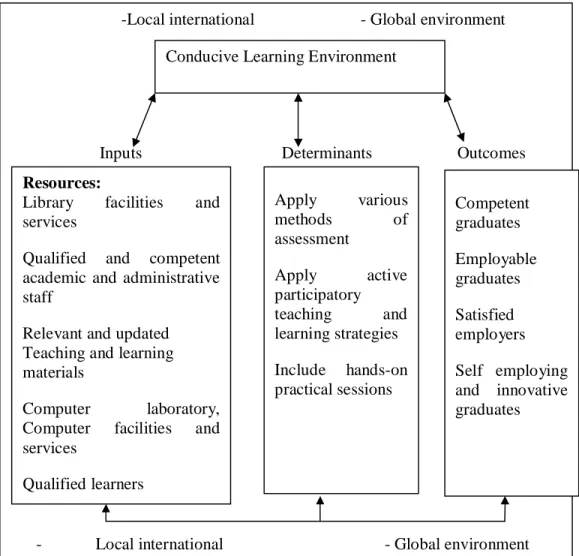
A conceptual framework is a set of broad ideas and principles taken from the relevant fields of enquiry and used to structure a subsequent presentation (Reichel and Ramey, 1987). It is a research tool intended to assist a researcher to develop awareness and understanding of the situation under scrutiny and to clearly communicate it to others. When clearly articulated, a conceptual framework has potential use as a tool to assist a researcher make meaning of subsequent findings. It forms part of the agenda for negotiation to be scrutinized and tested, reviewed and reformed as a result of an investigation ( Guba and Lincoln, 1989). According to Smyth, (2004) a conceptual framework should assist a researcher to organize his/her thinking and complete an investigation successfully. It must explain the relationship among interlinked concepts. It explains the possible connection between the variables and answers. Mertens (1998) argues that in qualitative research, a conceptual framework is used to focus the research and give its boundaries. It is viewed as a conceptual template with, which to compare and contrast results. The conceptual framework in this study comprised three components namely: inputs, determinants and outcomes which were interrelated and interdependent. This made all the variables to be easily investigated, organized and discussed in a holistic manner as one variable cannot be studied in isolation.
The first component was inputs. Inputs in this study referred to resources that were considered necessary in ensuring the smooth implementation of the competence –based education and training curriculum. These included; availability of library services with relevant up-to-date textbooks, references related to the programmes, and availability of a conducive learning environment. Other resources were such as availability of qualified facilitators, availability of teaching and learning materials and availability of computer laboratory with ICT facilities such as computers and internet connectivity. These variables were interdependent and interacted with each other.
In examining this complex relationship between these variables, it was possible for the researcher to understand the effectiveness implementation of competence based education and training programmes. For example, an institution needs to examine and find out whether or not there are adequate numbers of qualified facilitators and the extent to which standards are maintained and monitored. The same applies to the library services which are also important variable in teaching and learning processes. Since competence based approach promotes learner- centeredness, the availability of library and its services was assessed to find out whether they were available, adequate and relevant to the courses offered.
Availability of the computer laboratory with well furnished ICT facilities like computers and internet connectivity formed very crucial variables in implementing competence based approach. This is due to the fact that in competence based approach, learners get actively involved in learning by searching their own materials/ information related to their courses from different internet sources. They also conduct their individual and group assignments and they also communicate with their facilitators through e- mails and other online social media such as facebook and twitter.
The second components were ‘determining factors’. The implementation of competence based education and training was determined by a number of factors that might take place during teaching and learning processes. The first such variable was the application of various methods of assessment of learning. This variable was considered important in teaching and learning process as far as competence based approach was concerned. This is because assessment is an integral part of the learning process in the development of competences. Therefore, examining the methods of assessment helped to determine its effectiveness in the implementation of the CBET curriculum.
The second variable was application of actively participatory teaching and learning strategies during teaching and learning processes. This determining factor was crucial during the implementation of the competence based approach. To integrate knowledge, skills and attitudes in teaching and learning processes requires students to be actively involved in learning process. To examine to what extent the learners are generally actively involved in teaching and learning processes either through individual or group work. This helped to determine the effectiveness of the implementation of competence based phase. The last component was outcomes; these were the expected results from the well utilized inputs and implementation of constructivist teaching and learning strategies as well as constructivist assessment models during teaching and learning processes. A well implemented competence based education and training curriculum was expected to result into competent graduate professionals who would compete with others in the labour market on equal basis.
1.10 Organization of the Study
This dissertation is organized into five chapters. Chapter one presents Background information; Statement of the Problem; Objectives of the Study; Significance of the study; Limitations of the study; Delimitations of the study; and Conceptual Framework. Chapter two is about Literature Review, while Chapter Three presents Research Methodology. Chapter Four presents Results and Discussion of the Findings while Chapter Five shows the Summary of the Study, Conclusion and Recommendations.
Figure 1.1: Conceptual framework for analysis of the implementation of CBET curriculum
Source: A model adapted from Koontz and O’Donnell (1986).
-Local international - Global environment
Inputs Determinants Outcomes
- Local international - Global environment Resources:
Library facilities and services
Qualified and competent academic and administrative staff
Relevant and updated Teaching and learning materials
Computer laboratory, Computer facilities and services Qualified learners Apply various methods of assessment Apply active participatory teaching and learning strategies Include hands-on practical sessions Competent graduates Employable graduates Satisfied employers Self employing and innovative graduates Conducive Learning Environment
CHAPTER TWO
LITERATURE REVIEW 2.1 Introduction
This chapter presents a review of literature and studies related to the study in order to see what others have done concerned with the study and see the rationale of implementing competence based education programmes offered at the Institute of Adult Education and challenges facing its effectiveness.
2.2 Conceptualization of Major Terms 2.2.1 Competence
There is no single standard definition for a competence. Garavan & McGuire (2001) acknowledges that the term competence has no generally accepted operational definition. According to them, competence is “an action, behavior or outcome which a person should be able to demonstrate”. This definition constitutes a description of what a person can do (output).
Many literatures have been consulted regarding the definitions of competence. Some of them view competence as output, input and outcome. For example, Field $ Drysdale (1991) defines competence as ability to perform work roles or jobs to the standard required in employment. They view competence as the ability to perform at a desired level or according to a certain standard. This definition view competence as output. Competence might also be viewed from the possession of certain attributes such as knowledge, skills and attitudes or competence as input. Kirschner et al. (1997) view competence as the ability to choose and use the attitudes (knowledge, skills, and attitudes) that are needed for a performance at a desired level. They argue that “a competent person is within a certain context (situation) is
able/capable to choose a set of available behaviours and to execute suitable behaviours in order to reach a certain goal”.
Kouwenhoven (2003) defines competency as “the capability to choose and use (apply) an integrated combination of knowledge, skills and attitudes with the intention to realize a task in a certain context while personal characteristics such as motivation, self-confidence and willpower are part of that context”. He views competence as the capacity to realize ‘up to standard’ the key occupational tasks that characterize a profession. From the above definitions, we learn that when implementing competence based education and training programmes in our institutions three aspects which are knowledge, skills and attitudes have to be integrated together in all learning activities. These learning activities are usually related to competencies required in workplace. In this study, competence is viewed as the integration of knowledge, skills and attitudes with the intention to realize a task in a certain context.
2.3 Overview of competency Based Education and Training (CBET)
Competence-based education was introduced in America towards the end of 1960s when the public reacted that the students are not taught the skills they require in life after school. The National Vocational Qualifications (NVQs) was introduced as the qualifications relevant to employment and it was intended to facilitate entry into or progression in employment, further education or training (Burke, 1989). The same dilemma of graduates not equipped with skills to enter the job market can be seen among Malaysian graduates. This was explained in the study conducted by Hansad (2000) which was mentioned in IPPTN report that unemployed graduate is a major phenomenon in Malaysia. The reasons why graduates were not employable include: some of them lacked communication skills, computer skills and self-confidence.
In Malaysia, the Educational Master Plan 2006-2010 is quoted as emphasizing the mastery of the English language as a tool to widen one’s horizon in terms of knowledge. English language is seen as a catalyst that may help to develop competence, as students would be able to access many more different genres of knowledge to make them able to ‘do’ things rather than just to ‘know’ them. (Tranter & Warn, 2003).
The Mayer Committee (1992) cited in Tranter and Warn (2003) defines ‘competence’ more broadly since it recognizes that competence depends on both skill-and knowledge-based understand, and that competence includes the capacity to transfer knowledge and skills to new tasks and situations. The Mayer committee perceived the necessity for a strong knowledge base to underline any ongoing application of skills, thus regarding ‘competence’ as the fusion of knowledge and skills. This is because when employers interview prospective employees, they expect to see a combination of knowledge and skills being portrayed. (Tranter and Warn, 2003). In addition, potential employees need to show integrity, accountability towards work, readiness to work with others and reliability in managing difficult situations. Those skills are not explicitly taught in a school situation. These competency skills need to be developed over time and should not be rushed upon in students when they were still in school.
Spady (1993) in his report emphasized that ‘outcome-based education focuses and organizes a school’s entire programs and instructional efforts around the clearly defined outcome we want all students to demonstrate when they leave school. He further adds that CBE is ‘about preparing students for life, not simply getting them ready for university, or employment. An education system such as the one in Malaysia highlights the value of academic excellence from its graduates. It has well-defined syllabuses and objectives that educators use to ensure that students achieve the minimum required standard when they complete school. However,
little was prepared for them about survival skills after school especially in the workplace. Even if there is such a program, it will be an entirely separate program that students attend when they have already exited the school system. (Tranter and Warn, 2003).
CBET addresses what the learners are expected to do rather than on what they are expected to learn about. (Berdrow & Evers, 2010). They argue that there are four bases of competence that students need to master in order to achieve high performance in the workplace. Those bases are; managing self, communicating, and managing people and tasks and mobilizing innovation and change. These critical skills are often lacking in graduates to make them sustain in the work environment. These skills should be developed from the school environment when students are involved in societies, club and associations. However, extremely limited number of students is holding posts where these skills could be applied. Many are just ordinary members and they did not get the change to practice these skills.
2.4 The Experience of CBET in the Worldwide Context
Competence Based Education Training (CBET) or Outcome Based Education (OBE) has been significantly adopted by a number of countries in their education system in worldwide. Countries such as the United State of America, Mexico, Australia, New Zealand, Costa Rica, France, Hong Kong and a number of European countries are some of the few who have implemented CBET in their education system. Each country specifies or adapts its own learning outcomes and its own methods of measuring students’ achievement to suit with the nation’s needs. (Higher Education Institution, Penang, 2002).
In countries like United States of America, the Secretary’s Commission on Achieving Necessary Skills (SCANS) is used as guidelines to match the skills and knowledge required
by the job sectors from their prospective employees. SCANS were circulated by the United States Department of Labor as a Blueprint for schools and any educational institutions to follow. SCANS were written in a form of easy-to follow manual for all educational institutions to refer to when deciding on the necessary skills to teach in their institutions. This is to ensure a smooth transition from the educational institutions to workplaces. (Higher Educational Institute, Penang, 2002).
Similarly, in Australia the Mayer Key Competencies Standard was introduced to give guidelines to schools and colleges about the skills and competency standard that is required by the country from the workforce. The intention is to make sure that colleges such as Technical And Further Education (TAFE) prepare their graduates with the skills needed for them to get jobs when they have completed their studies. (Tranter & Warn, 2003). In Africa, many countries have adopted CBET system. These include; Ghana, Kenya, Uganda, Malawi, South Africa, Botswana, Namibia and Tanzania.
The experiences from Australia and United States indicate that at national wise, there should be a national qualification framework that will be acted as a quality control to those institutions that adopt competence based approaches. The national qualification framework will be used by all adopted institutions during implementation of the competence based education and training programmes.
In case of Tanzania, these experiences are somehow similar whereby in higher learning institutions particularly technical institutions there is a statutory body known as National Accreditation Council for Technical Education (NACTE) which controls the quality of education and training programmes delivery to those technical institutions. Among these institutions include: Institute of Adult Education (IAE), Dar es Salaam Institute of
Technology (DIT), College of Bussiness Education (CBE), Tanzania Institute of Accountant (TIA) and Institute of Finance Management (IFM). These institutions and others are implementing competence based approaches in the delivery of their programmes. But to what extent the implementation is effective. In other words, do these institutions implement well principles of competence based approach? These questions and others have made the researcher to be interested to find out the views of facilitators and learners on the effective implementation of competence based education and training curricula at the IAE programmes.
The National Council for Technical Educational (NACTE) established by Act of parliament No. 9 of 1997 is charged with the task to ensure that education offered by technical institutions is of high quality and responds to the changing needs as well as technological innovations in the world. The council performs its role by using the established national qualification system that is used by all technical institutions in implementing CBET curriculum.
Ensuring the relevance of technical education and training to the labour market, the NACTE has defined and established a range of national technical awards (NTA) to be conferred in various fields of technical education and training, covered by its five subject boards. These awards are competence based and are designed to testify that the holders can function on a level in accordance with the qualification standards. This means that holders of the awards possess the knowledge, skills and attitudes (competence) that are required in the relevant occupational sectors (NACTE, 2008).
2.5 Implementation of CBET Curriculum
Currently, the movement from knowledge based to competence based approach in delivery of education and training programmmes is much more emphasized worldwide. The most important difference between competence based learning and traditional knowledge based is that knowledge, skills and attitudes are acquired integrally. The learning process is beginning from the practical challenges and then integration of the knowledge, skills and attitudes. This implies a shift in the didactical approach from teaching and instructing to facilitating and coaching. In competence based teaching and learning, the didactical approach is based on the facilitation of active learning whereby group work, presentations, self study and work related projects are among the learning activities that facilitate the development of the competencies. These learning activities involve integration of knowledge, skills and attitudes together. Kouwenhoven (2003) suggests that the knowledge, skills and attitudes should be used in an integrated manner although they might be used in varying degrees, depending on the task to be performed.
Integration of knowledge, skills and attitudes during teaching and learning process might lead to the development of competencies. Competencies can be developed by the student himself with the support of the teacher as facilitator of the learning process (NACTE, 2008). In this regard, the role of the teacher is changing from a subject expert to facilitator and coach. The teacher is active in supporting learning process rather than active in transferring content. In order to facilitate learning process which is learner- centered, various teaching and learning strategies are employed to both teachers and learners. The question to be asked here is how teaching and learning strategies are effective regarding CBET.
2.5.1 Teaching and Learning Approaches in CBET
Competence based education and training requires teachers and learners to change their conceptions of teaching and learning practices. A wide range of teaching and learning techniques is used in delivery of competence programmes. In CBET, constructivist teaching and learning is emphasized. Constructivist teaching and learning is based on the belief that learning occurs as learners are actively involved in a process of meaning and knowledge construction as opposed to passively receiving information. This approach fosters critical thinking and creates motivated and independent learning. In constructivist teaching, the teacher’s role is to prompt and facilitate discussion. Thus, the teacher’s main focus should be on guiding students by asking questions that will lead them to develop their own conclusion on the subject.
Experience in many institutions of Tanzania suggests that the traditional teaching and learning methods are still used by teachers to deliver the contents despite Tanzania’s declaration that it has now shifted to competence based approach. This is supported by Mosha (2012) who declared that teachers implementing the curriculum from planning the lesson and instruction to assessing students had not changed at all. This is also supported by Kafyulilo et al (2012) on their study where they concluded that competence based teaching approaches are not well implemented in schools and to a large extent teachers have continued teaching by using the traditional approaches and assessment. They also noted that students have also continued learning through memorization rather than creating and inventing new ideas through inquiry learning approaches. Nevertheless teachers have declared to implement competence based curricula but what they really practice in the classroom setting in terms of the teaching and learning methods, roles of teachers and assessment of learning do not reflect the competence based approach (Kafyulilo et al, 2012).
Competency based education and training demands a different approach to teaching and even assessment and certification (Anane, 2013). This is because conceptually CBET is different from the traditional system. It is based on defined competency standards which are industry oriented. The education and training is more learner-centred (more emphasis is placed on the learner’s role in the learning process) than teacher-centred. Anane (2013) highlighted the facilitation methods that are employed for the CBET programmes:
Direct Instruction Method: It is effective when you have to introduce learners to a new study area or define new concepts and show how they are interrelated or for teaching factual information.
Discussion Method: Allows learners to share knowledge and ideas thereby motivating them to achieve more particularly when others respect their contribution. It also helps the teacher to determine whether the learner understands the content of the lesson.
Small Group Method: Pairing is done in such a way that learners help each other to learn faster than the teacher would have been able to do with the whole class. There may however be difficulties with the physical arrangement of the classroom and individual assessment using group work is difficult.
Problem Solving Method: Provides a challenge to learners; gives them a sense of satisfaction and increases their confidence when they are able to solve new problems and thus gain new knowledge. It also allows the learner to develop critical thinking skills and the ability to adapt to new learning situations. It is however time consuming and because learners sometimes work individually, they may not learn all the things that they are expected to learn.
Research Method: It is used for workshops and laboratory tasks, field experiments, case studies. It encourages learners to investigate and find answers for themselves and to
critically evaluate information. It however requires a lot of time and careful planning of research projects for the learner.
2.5.2 Competence Based Assessment
Competence – based assessment is a process where an assessor works with a trainee to collect evidence of competence, using the benchmarks provided by the unit standards that comprise national qualifications (Biggs, 1996). The shift from knowledge based to competence based approaches does not only influence the change in teaching and learning methods but also the change in the methods of assessment. This is because when learning outcomes change from the acquisition of knowledge to the acquisition of skills, then the manner of assessment will also change (NACTE, 2008). In CBET there must be sufficient evidence to ensure that a candidate meets the competence specified by the current standard. There is no single approach to competence based assessment. Evidence can be collected using different methods at different times under a variety of conditions (Biggs, 1996).
In this regard, the learning environment should be designed in such way that it focuses on the development of competencies rather than transfer of knowledge. The learning environment should encourage and motivate self –learning and self assessment. This is supported with the availability of the resources that support and encourage learner-centred. These resources include: teaching and learning resources, computer laboratory, library and classrooms which allow interaction of the learners during teaching and learning process. In CBET, assessment is carried out not only by the teachers but also by the students themselves (student- self assessment) as well as by those representing the labour market (the outsiders). Students play a role of assessing themselves and reflecting upon their actual achievements. They reflect their own learning process through reflective essays, logbooks, Student Self Assessment Forms (SSAFs) and Personal Development Plans (PDPs). In this
context, the collection of evidence to demonstrate that a learner can perform or behave according to specific standards is carried out by both the teachers, students themselves and the labour market representative by using various methods include: tests, examinations, observation, field reports, portfolio, projects, and assignments (NACTE, 2008).
In CBET, assessment is the process of collecting evidence of a learner’s performance, upon which an assessor judges whether or not, or the extent to which a learner has met the performance requirements of the learning outcome laid in a particular course and then making a decision, based on these judgments as to whether a learner has achieved the learning outcome as a whole or not (Anane, 2013). In other words, it is the process of measuring learner’s skills, knowledge and understanding against the standards (occupational standards) laid down for a particular course. If a learner can show, by generating sufficient evidence of their competence, that they meet the standards, they qualify for that course.
Therefore CBET assessment measures whether a learner is competent or not competent. Only two possible outcomes can be the result of the assessment process, i.e. they are competent (i.e. they can perform what is stated in the standard) or they are not yet competent (they cannot perform yet what is stated in the standard). The assessment is not designed to measure a learner who is 30% or 50% or 80%, etc. competent. If they do not meet the standards they develop their skills and knowledge further, after which they are assessed again.
Authentic assessment methods are more useful for competence-based curriculum than other forms of assessment because they provide opportunity for students to demonstrate the competencies they have mastered in real life or related situation. In competence based assessment, teachers are required to change from norm referenced to criterion referenced
judgment of learners’ capabilities or competencies as supported by Kouwenhoven (2003) who argued that in competence-based education, performance assessment is carried out by giving the learner a clearly defined task and a list of explicit criteria for assessing the performance or product. Criteria are often given in the form of rubrics that can be either analytic (specification of parts) or holistic (looking at overall performance). Finally, teachers are supposed to provide continuous, timely and constructive feedback to inform student about the strength and weakness of their performance.
2.6 Challenges Facing Implementation of Competence Based Curriculum
Aschcraft (1994) reveals that the sources of challenges comprise assessment and classroom management. CBET is learner-centered, hence small class sizes are preferred to enable effective use of CBET facilitation techniques. The ideal CBET class size is between 40 - 50 learners. Currently in most of the institutions in Tanzania, the average class size is hundred students and above. With this number, it is difficult for facilitators to handle class size of hundred and above students. Aschcraft (1994) said that if the number of students is 30 and above it is often difficult to manage the class. This is because the teachers have to pay individualized attention to students, have to motivate and give stimulus to them. In addition, he said that it is very difficult for every teacher to develop soft skills to a large number of students.
Challenges of implementing CBET curriculum is also observed on the aspect of Readiness. The readiness applies for both teachers and students in order that they can undergo successful teaching and learning process. The ideal condition of CBC is that both facilitators and students should be ready to undergo the teaching and learning process in class, but in reality, the opposite condition happens (Hatmanto, 2011). According to him, there are some students and teachers who are not ready to learn and teach respectively. If the students are