Deliverable Coordinator: Adam Cooper, Tore Hoel Coordinating Institution: Cetis
Date due: 31.05.15 -‐ Submission: 31 May 2015
Keywords: learning analytics, data sharing, interoperability, ethics and privacy, transparency
Abstract: Data sharing is in this report understood as the release of data for use by others for the purpose of learning analytics. The issues for data sharing identified through case studies and other means are analysed from a technical, semantic, organisational, and legal perspective, following the structure of the European Interoperability Framework. The issues are also assessed as to whether they could easily be addressed or would appear as a blocker of progress. Even if the research community is rather optimistic of the possibility to “scale up” learning analytics to create big impact using big data, this report shows the need for more research and community exchange to frame, sort and prioritise the issues of data sharing.
Requirements an
d
Roadmap
Executive summary
Data sharing is in this report understood as the release of data for use by others for the purpose of learning analytics (LA). We are not exploring sharing of data between software under control of a single legal entity, but data sharing between persons or organisations.
Data sharing is a precondition for realising the potential of learning analytics. Even so, it is a finding in this report that the ramifications of data sharing have not been worked out, and that there is work to be done to characterise the problem-‐space, as well as the solution-‐space.
Through exchange with the learning analytics research community and collection of case reports from a number of stakeholders in schools, universities and industry, we have gathered requirements for data sharing in order to explore the feasibility of actions within a number of perspectives.
The variety of data that is relevant to learning analytics is very great, and in exploring aims for data sharing it is useful to discern between data sharing benefitting analytical and research processes, and data sharing supporting and enhancing the organisational and pedagogical processes
contributing to the learning outcome. Eight aims were identified and assessed towards the current interest of the LA stakeholder communities.
• More useful analysis through the combination of data from different sources • Sufficient scale of data to determine relevance and quality of educational resources • A critical mass of data for learning science research
• Reproducibility and transparency in learning analytics research • Cross-‐institutional strategy comparison
• Research on the effect of education policy • Social learning in informal settings
• Learner data as a teaching and learning resource
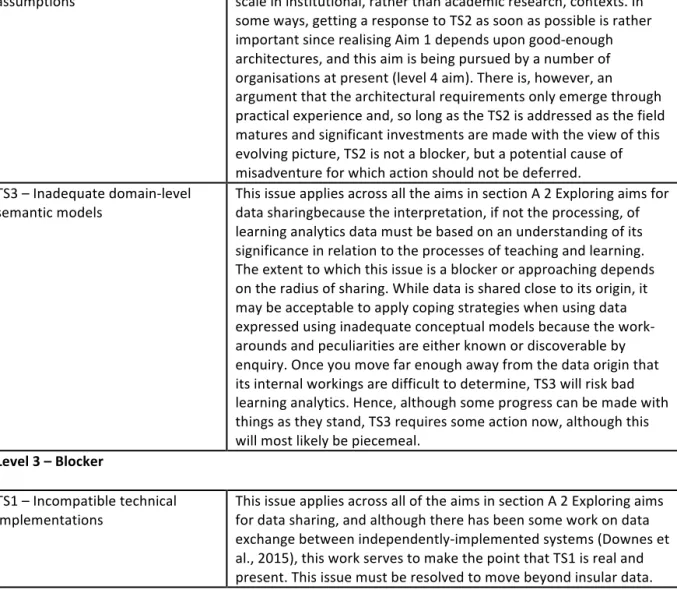
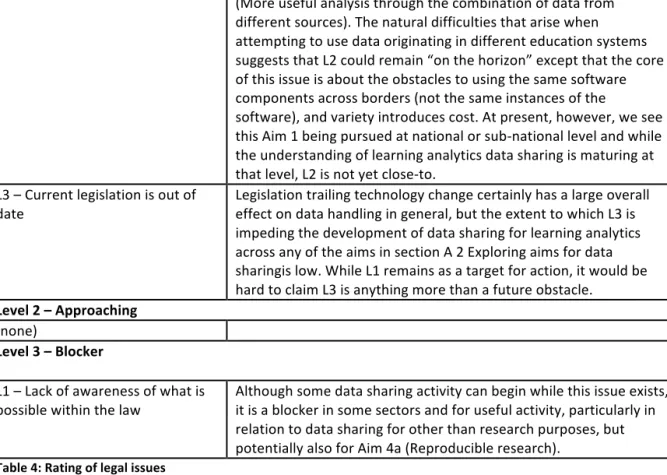
The issues for data sharing identified through case studies and other means are analysed from a technical, semantic, organisational, and legal perspective, following the structure of the European Interoperability Framework. The issues are also assessed as to whether they could easily be addressed or would appear as a blocker of progress. The following issues are identified within each category:
Technical and semantic issues
• Incompatible technical implementations • Inappropriate architectural assumptions • Inadequate domain-‐level semantic models • Lack of adoption of existing specifications Organisational issues
• Privacy
• Inadequate decision-‐maker knowledge Legal issues
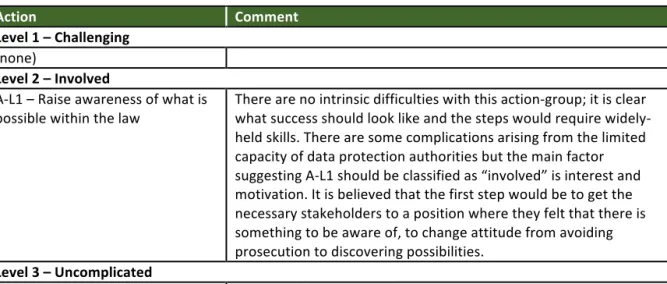
• Lack of awareness of what is possible within the law • National differences
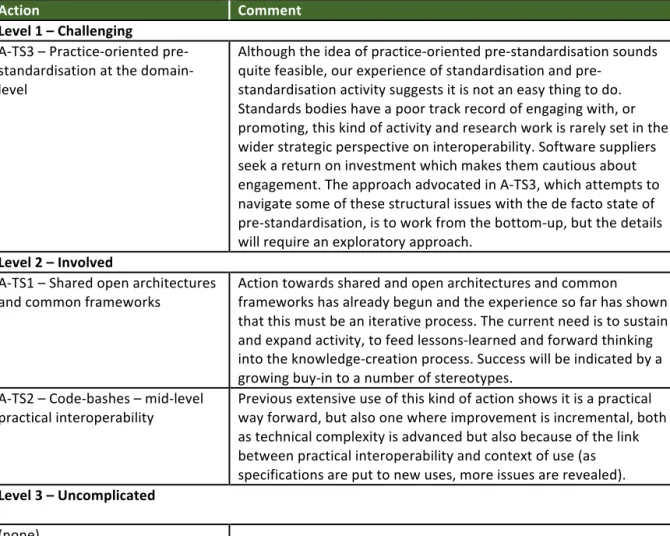
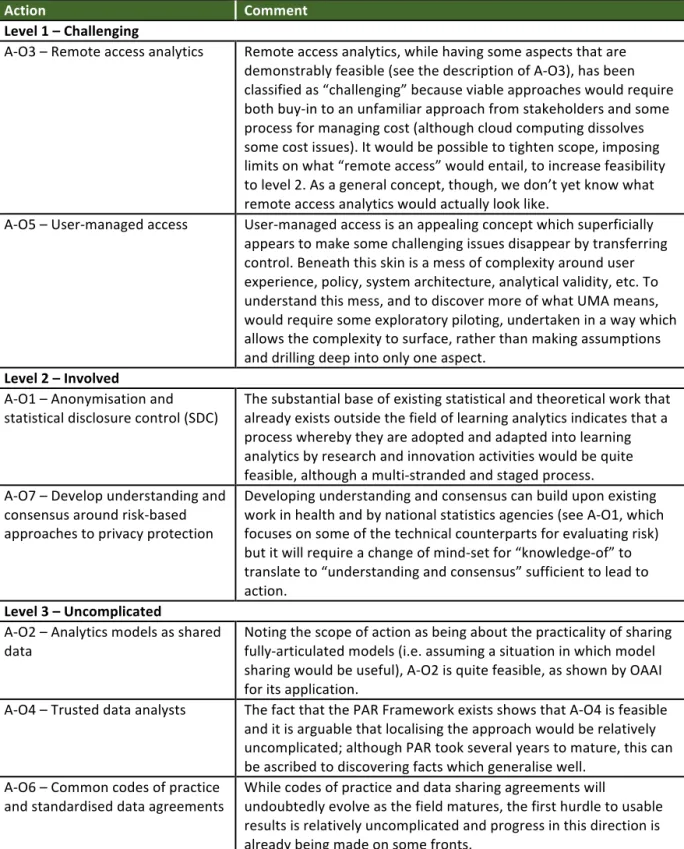
The report also discusses how the identified issues could be addressed and how feasible their solutions are. Again the European Interoperability Framework is used as a scaffold. These are the activities that could be undertaken, and that are classified as being either challenging, requiring concerted efforts, or are seen as uncomplicated:
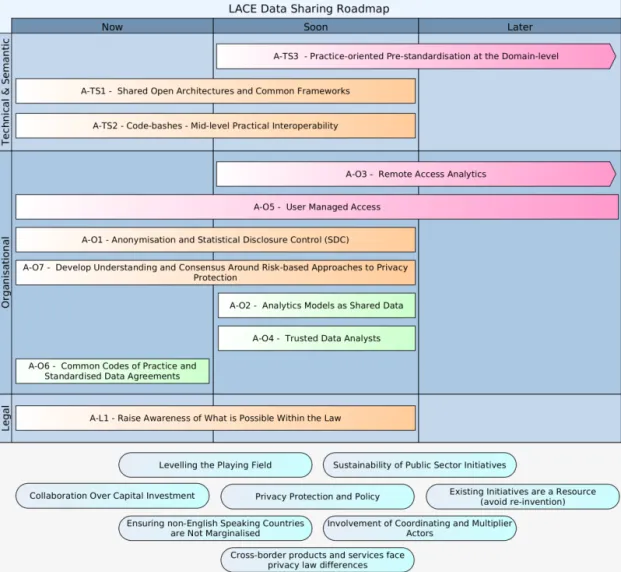
Technical and semantic issues
• Shared open architectures and common frameworks
• Code-‐bashes (plugfests) -‐ addressing mid-‐level practical interoperability • Practice-‐oriented pre-‐standardisation at the domain-‐level
Organisational issues
• Anonymisation and statistical disclosure control • Analytics models as shared data
• Remote access analytics • Trusted data analysts • User-‐managed access
• Common codes of practice and standardised data agreements
• Develop understanding and consensus around risk-‐based approaches to privacy protection Legal Issues
• Raise awareness of what is possible within the law
Even if the research community is rather optimistic of the possibility to “scale up” learning analytics to create big impact using big data, this report shows the need for more research and community exchange to frame, sort and prioritise the issues of data sharing. Moving towards a LACE Data Sharing Roadmap this report organises 11 issues on a time scale of action, and groups them according to type of issue. There are a number of issues that can be addressed right now. Other issues need more time for stakeholders to take action, while many contextual issues need to be further explored to understand how they could be addressed.
This report is based on desk research by the LACE Work Package on Interoperability and Data Sharing and case studies with contributions from stakeholders and other EU projects. The case studies are included in Part B of this report.
Contents
Guide to this document ... 1
1 Introduction to data sharing for learning analytics ... 4
1.1 Big data or small data ... 4
1.2 Data and people – the wider social and technological landscape ... 5
1.3 Definition of scope ... 6
2 Exploring aims for data sharing ... 8
2.1 Eight aims for learning analytics data sharing ... 8
2.2 Rating of aims ... 11
3 Issues for data sharing ... 13
3.1 Technical and semantic issues ... 14
Summary technical and semantic issues ... 16
3.2 Organisational issues ... 17
Summary organisational issues ... 21
3.3 Legal issues ... 21
Summary legal issues ... 22
4 Addressing issues ... 24
4.1 Addressing technical and semantic issues ... 24
Feasibility of actions ... 26
4.2 Addressing organisational issues ... 26
Feasibility of actions ... 31
4.3 Addressing legal issues ... 31
Feasibility of actions ... 32
5 Roadmap ... 33
5.1 Business and political context ... 33
5.2 Concerning actors ... 35
5.3 Suggested steps to take ... 37
6 Conclusion ... 39
PART B 1 LACE Workshop on Privacy and Ethics ... 41
PART B 2 European Project Case Studies ... 44
2.1 Designing a national learning analytics system – the case of Estonia ... 44
2.2 PELARS – a European project investigating practice-‐based learning ... 48
2.3 LEA’S BOX – a European project creating a Learning Analytics Toolbox ... 50
2.5 Building a cross-‐sector service platform – the case of Connect, Norway ... 53
2.6 Requiring an open architecture for learning analytics – the case of JISC plans for the UK ... 55
2.7 A Norwegian learning analytics vendor’s perspective on data sharing and interoperability .... 59
2.8 A Norwegian publisher with adaptive learning product cooperating with a US company ... 61
2.9 School owners’ concerns – what is allowed according to the Privacy Protection Act? The case of giving advice to Norwegian schools ... 63
Part B 3 Existing examples of data sharing for learning analytics ... 65
3.1 Pittsburgh Science of Learning (PSLC) DataShop ... 65
3.2 Predictive Analytics Reporting Framework (PAR) ... 67
3.3 Open Academic Analytics Initiative (OAAI) ... 68
3.4 Multimodal contextualised Learner Corpus Exchange (MULCE) ... 69
3.5 Stanford Data Portal for Research (VPOL) ... 71
3.6 xMOOC platforms ... 72
3.7 Open data initiatives ... 73
3.8 A counter-‐example: InBloom ... 74
Glossary of abbreviations and specialist terms ... 76
References ... 77
About ... 79
Guide to this document
This report is the LACE Project’s contribution to developing an appreciation of data sharing -‐ the release of data for use by others -‐ as an umbrella idea that covers a range of possibilities, within the field of learning analytics. We consider both data sharing for learning analytics in practical teaching and learning situations and for learning science research, but rather than focus on one motivation for data sharing, we try to capture variety within the field.
Part A of this report is concerned with the scope of data sharing for learning analytics, the motivations for doing so, and with the issues involved and ways in which these issues may be overcome or navigated-‐around. Part B presents a number of case studies and examples which complement the desk research used to create Part A. Forward references are made from Part A to Part B to make links to evidence rather than to direct the reader to an elaboration of the point; Part B is a supplement.
Part A is structured as follows:
• Section 1 provides some of the contextual background to data sharing for learning analytics and outlines the scope we have adopted for this report.
• Section 2 presents a number of aims for data sharing, covering both research and
operational use of learning analytics. The section concludes with a rating of aims according to our assessment of learning analytics community interest.
• Section 3 explores the issues arising from data sharing, obstacles to realising the aims. Issues of diverse character are considered: technical, organisational, legal, etc. The section
concludes with a mapping of the significance of each issue to the aims identified in subsection 2 in order to arrive at a rating of the extent to which the issue is an obstacle to the progress of learning analytics in general, i.e. how important the issue is.
• Section 4 discusses a variety of ways in which the issues identified in subsection 3 might be addressed. Some actions that would be required to make progress are advanced and classified according to broadly-‐defined levels of feasibility.
• Section 5 concludes Part I with a look at the intersection of importance of issues and the feasibility of ideas to address the issues. This leads to an outline roadmap, which is
supplemented by a discussion of the potential roles of change-‐agents in the field of learning analytics.
Whereas Part A of this report is concerned with the scope of data sharing for learning analytics, the motivations for doing so, and with the issues involved and ways in which these issues may be overcome or navigated-‐around, Part B provides background material which we have combined with desk research to create Part A. This evidence is largely presented in this document and is organised into three subsections:
• Section 1 presents the views of participants in a series of LACE workshops on privacy and ethics.
• Section 2 comprises a set of case studies of a selection of European learning analytics initiatives in the public and private sectors. These have been obtained from, or in collaboration with, third parties. We have added a boxed summary of our observations which draw out from each unit the significant points relevant to this report.
• Section 3 presents a summary of operational learning analytics data sharing initiatives. This is an extended excerpt from a component -‐ “Learning Analytics Data Sharing -‐ Current Examples 2014” -‐ of D7.1 (Cooper & Hoel, 2014).
In addition to this evidence, Part A has drawn on the Learning Analytics Specifications and Standards Quick Reference Guide, which was included as a snapshot in D7.1 and which is not duplicated here.
Part A
1 Introduction to data sharing for learning analytics
1.1 Big data or small data
Learning analytics processes necessarily involve data, and once you start talking about data, the Big Data meme pops up and brings images of gigantic amounts of digital data controlled by companies, authorities and large organisations, subject to extensive analysis based on the use of advanced algorithms.
To create a feeling of urgency and change when talking about big data and analytics one is often presented with the fact that over 90 percent of the world’s data was produced just in the past two years (Gudivada et al., 2015). Data related to learning is just a tiny fraction of the stream of data emanating from nearly all aspects of our daily life. The claims for the promise of Big Data are far reaching, driving “more accurate descriptive and predictive models that inform decision making on every level, whether identifying the next big security threat or making the best diagnosis and treatment choice for a given patient”, observes (Schadt, 2012). The influence of Big Data is considerable for a wide range of life spheres and these experiences will collectively shape the way we are willing to share our personal data in general. As a politician said during a LACE policy brief, if Big Data has revolutionised advertising, it can certainly help us improve education! But is the archetypal corporation with Petabytes of data a suitable prototype for learning analytics? The situation for educational institutions is more characterised by Small Data than Big Data and there are certainly differences between selling soap and grafting knowledge, including many subtle aspects and contested notions about purpose, methods, and values. It is often said in workshops on learning analytics: currently it is not so much about Big Data, – you can easily fit your data in a spreadsheet on your laptop computer! While a spreadsheet may be inadequate for captured activity data, it remains true that for most of the potential applications of learning analytics in education and training practice, the useful data will be of a scale well below that of Big Data.
Many applications of learning analytics are found to require data sharing to realise their potential. For example, large scale data is often a prerequisite for educational data mining techniques or multi-‐ variate statistics. Although the data from an institutional learning platform or a MOOC may be considered large and varied, the scale and coverage of such datasets may be insufficient to allow the potential of learning analytics to be fully realised because of the great variety of learner and
contextual attributes. For example, Verbert et al. (2011) demonstrated that the activity of learners on a single course is likely to be so diverse that a learning resource recommender system would be practically useless if only based on data at this scale. Thus, this challenge applies to both learning science research and to potential products and services built around data generated during learning activities. It is also usually the case that the data required to undertake learning analytics resides in different software systems. Increasing use of Cloud Computing models of service and IT provision, where expertise or technology is provided by a separate organisation to the education provider, has increased the extent to which data is not only distributed between different IT systems, but is also distributed among legal entities. The combined effect of the need for data at scale and for
combination of different data sources motivates the idea that data sharing between organisations -‐ potentially including public and private sector bodies -‐ is an important enabler for effective learning analytics.
A distinctive difference between the archetypal Big Data corporation and educational
establishments is, therefore, the requirement for data sharing. During the preparation of this report, the authors have been struck by the extent to which the characterisation and ramifications of data sharing have not been worked on. Although we have found a number of examples of data sharing, we have also discovered that conversations about data sharing with various stakeholders have often raised questions and sometimes exposed un-‐asked questions that should be addressed. There is, it seems, some work to do to properly characterise the problem-‐space, as well as the solution-‐space. Whatever we would like to do in relation to data sharing for learning analytics will be moulded by the impact of trends outside of education. While the education community is likely to place barriers to prevent data from the outside world from being used in learning analytics (The Open University 2014a, 2014b), we also know that that private space is already being invaded by sensors and data hungry applications, with personal information frequently shared to interests pursuing less noble aims than promoting the individual’s knowledge and skills. In only a few years, we have moved to the point where GPS, accelerometers, and heart rate sensors are common-‐place, in which location data is leaking out through mobile apps, and technologies such as iBeacon1 are being launched which tighten the connection between location and retailing in non-‐transparent ways (Scoble & Israel, 2014).
The boundaries between the worlds of formal and informal learning have always been somewhat permeable and ill-‐defined; and in world in which numerous digital devices can capture and render any activity or utterance into data it would hardly be practical to isolate education for the “outside”. It will be difficult to raise higher standards for personal protection within education than in other domains. Before focussing on the learning analytics context, therefore, it may be useful to step back and to consider the wider social and technology landscape and to give some definition to our scope of “data sharing”.
1.2 Data and people – the wider social and technological landscape
In the book “Age of Context: Mobile, Sensors, Data and the Future of Privacy” (2014) the technology journalists Robert Scoble and Shel Israel examine five forces creating a storm of change: mobile devices, social media, big data, sensors and location-‐based services. Learning analytics is an important, but only a small part of this storm. When controversies build around learning analytics specific issues like access to social media data, learner control of information, parents’ rights to follow each step of the educational process, etc. it is important to realise that learning analytics shares challenges with other sectors and that more and more of our society nowadays is driven by data. The solutions found by the learning analytics community will be impacted by the development in the society as a whole. Just reflect on the trends that underlie future development in the
standards community, captured by these headlines from a recent technology trend2:
• Computing Everywhere;
• Advanced, Pervasive and Invisible Analytics;
• Social Business with a special focus on Social Network Analysis, Social Content, and Social Commerce;
1 http://en.wikipedia.org/wiki/IBeacon
• Risk-‐Based Security and Self-‐Protection; • Wearables electronics and services; and
• Privacy Management with a special focus on Privacy Management Tools. These trends will also impact learning, education and training.
When analysing data sharing for learning analytics, the subject of this report, we need to identify the specifics of learning analytics while making sure that we understand the dynamics of a field that is entangled in a more complex system where solutions to challenges and barriers may be sought in knowledge domains not usually visited by the educational profession, like health informatics or cyber security (section A 4.2 Addressing organisational issues).
1.3 Definition of scope
1.3.1 Interpretation of “data sharing”
Data sharing can be defined as the release of data for use by others. For the purpose of this report, we constrain the term to refer to data sharing between legal entities (an organisation or person), and not just sharing between software under control of a single legal entity. This outlook on data sharing requires careful consideration of factors which do not apply to the single-‐operator system-‐ integration scenario. It is these factors, rather than the details of the system-‐integration problem, which are the focus of this report.
The interpretation of data sharing is at present somewhat confused by common conceptions of ownership and related factors, under-‐developed thinking about the topic, and sometimes a failure to consider it. The increasing use of software hosted in “the cloud” -‐ i.e. Software as a Service (SaaS) -‐ has amplified this situation, but we have also inherited a confusion from the days when most software used in education was running on-‐site. This confusion relates to ownership and control, and the extent to which the educational establishment has absolute authority or acts as a custodian on behalf of the learner. While it is clear that there is some data which the educational
establishment is required to keep, and some of which the learner has no right to change, there has generally been little attention to the details of ownership, control, and custodianship. The rise of SaaS has introduced the third party service providers into the picture, and many of these provide at-‐ best limited access to the data created through the use of their software. The rise of interest in learning analytics is starting to make the situation better known, but procurement specifications and service level agreements continue to lack clarity on the distinctions that can be made in ownership and control, and tend to presume absolute power resides in the service provider. In many cases, this situation makes for vagueness when considering who would release data and to whom. A
consequence of this situation, which constitutes a background issue for making progress with learning analytics data sharing, is that this report will discuss “data sharing” with some generalised assumptions about who has control, and who will use the data.
When sharing research data a systematic approach for deposit, sharing, reuse, curation and
preservation of data is required (van den Eynden & Bishop, 2014). All these processes are definitely present also in a learning analytics data sharing scenario; however, the requirements may differ. For instance, preservation of data may be a more pressing need for sharing of research data than for learning analytics data. Learning is after all a more transitional activity, where even the right not to have one’s learning trajectory stored may be in the interest of the learner.
1.3.2 Types of data
The variety of data that is relevant to learning analytics is potentially very great indeed. For the purpose of this report, our interest is primarily in data about people or their activity in a learning-‐ related situation. We are not concerned, for example, with national or international classification schemes for subject matter of courses or learning resources. These are not our focus of attention for two reasons: sharing such reference data lacks many of the complications of person-‐related data; the sharing of this kind of impersonal data of utility for learning analytics is often undertaken as an Open Data initiative and recent projects, such as Linked-‐Up3 have produced thorough accounts of
that topic. Consequently, we pay little attention to Open Data in Part A, although a short section in Part B is devoted to the topic (see B 3.7 Open data initiatives). In short: a focus on person-‐related data gives us more clarity of purpose because this relationship influences so many critical decision-‐ points.
2 Exploring aims for data sharing
This section is written not as a definitive guide to, nor survey of, the aims and motivations for data sharing for learning analytics but as an exploration of the range of possibilities. Some of these are drawn from the examples and case studies which appear in Part B, while others have been stimulated by workshop sessions and informal conversations at, for example, LAK 2015 (including the Open Dashboard Hackathon), EC-‐TEL 2014, the Open Learning Analytics Summits, the EP4LA workshops, the Jisc co-‐design workshop on effective learner analytics, etc. These have involved researchers, HE managers, and IT specialists.
In respect of aims, we wish to be clear that we do not understand “learning analytics data sharing” to represent a single idea. Similarly, even within our chosen scope of person-‐related data, questions about privacy, feasibility, sustainability, etc. vary greatly depending on whether the data in question is about records of education achievement and history, public social media activity, LMS/VLE activity, etc. Consequently, it is clear that there cannot be a single idealised technology platform, workflow, policies, etc.
In exploring aims for data sharing we have considered both: the affordance of data sharing to the analytical and research processes; and the benefits to learning outcomes from enhancement of organisational and pedagogical processes, where data sharing is a precursor to informed process change. In crude terms, some aims are related to research and others to practice, but this does not imply we see a separation of research and practice as being necessary or desirable. Indeed, it is arguable that a better connection between research and practice is desirable, and this is attested to by the activities of SoLAR4 in seeking to engage more practitioners. It is conceivable, for example,
that a data sharing platform intended to primarily serve the enhancement of outcomes would be a valuable research resource, and that concurrent use for academic research and organisational and pedagogical processes would catalyse cross-‐over and synergetic projects.
2.1 Eight aims for learning analytics data sharing
Data sharing aims to support learning analytics on different levels, from contributing to new knowledge and research through bringing more data for research and development; improving organisational analysis through aggregations of educational data to improve retention strategies and learning design; to active learning support through synchronous adaptation of the learning context and content. The following eight aims capture some, but certainly not all, of these complex
requirements for data sharing:
Aim 1: More useful analysis through the combination of data from different sources
It is the norm, rather than the exception, for learners to engage in activities in many different pieces of software. In this case, the value that can be gained by treating each data-‐set independently is quite low, and many important questions can only be addressed with a more complete picture (we recognise that many questions remain unanswerable from captured data alone). This aim is relevant to all outcome categories. Were all of these software systems to be operated by a single educational establishment, the challenge would be largely one of system integration. This scenario is, however, rare, even for large universities with access to skilled developers and infrastructure engineers. Aim 1 encompasses scenarios where software is operated by third parties on behalf of an educational
establishment and scenarios in which learners engage in learning-‐related tasks using their personal social web services. It will be important to tease-‐apart these scenarios when considering the issues raised by data sharing. Whereas Aim 1 is concerned with variety of data, Aims 2 and 3 are concerned with its scale.
Aim 2: Sufficient scale of data to determine relevance and quality of educational resources This aim would be shared by the creators of resource recommender systems, or for more open ended analysis of learner behaviour in an institutional context (e.g. to for learning design, learning support, or resource planning). Publishers may also wish to use this data for improving their products. In practice, there is likely to be a strong link to Aim 1: data on usage within the nominal resource -‐ e.g. down to page or lower level in a text -‐ or on actions such as annotation, when joined with other learner data offers substantially greater benefits than anonymous usage would.
Aim 3: A critical mass of data for learning science research
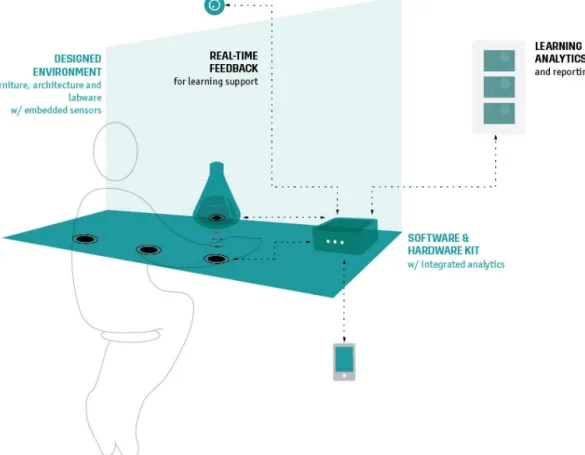
This aim is a counterpart to Aim 2, tuned to research process rather than education/training outcomes. Within Aim 3, two aspects are combined: the need for large scale data, and fact that the effort/cost of acquiring high quality data is a limit to the pace of research. This aim fundamentally relates to increasing the quality, or decreasing the cost, of pure research outcomes. The examples in sections B 2.2 PELARS – a European project investigating practice-‐based learning, B 3.1 Pittsburgh Science of Learning (PSLC) DataShop, B 3.4 Multimodal contextualised Learner Corpus Exchange (MULCE), and B 3.5 Stanford Data Portal for Research (VPOL) illustrate this aim.
Data at scale may be used to overcome challenges that have been levelled at conventional forms of educational/psychological research, in which reduction of the problems to a form that is amenable to small-‐data research introduces mis-‐specification into the research question (Winne, 2006). In brief, since educational outcomes, and related aspects of interest to various stakeholders, such as employability, depend on a large number of parameters, a large volume of data is required to address many research questions in education. This is likely to mean both data from a large number of individuals as well as a substantial quantity of data from each. There is, therefore, a limit on what can be achieved using data from a single cohort or educational establishment. The same benefits also apply to the development of educational technologies.
The desirability of sharing for data re-‐use, to increase the ratio of data use over data gathering, is taken as not requiring explanation.
Aim 4: Reproducibility and transparency in learning analytics research
Both the process and outcomes perspective stand to benefit from wider access to the data used in research work, whether this is overtly academic research or overtly institutional research5. This could include two related activities: reproducible research, and the re-‐interpretation of findings. [Aim 4a] Reproducible research refers to research in which data and computer code (etc.) are made available in addition to published papers, such that other researchers can reproduce, rather than attempt to recreate, the procedure that led to the paper. This is a research process aim. Interest in
5 The term “institutional research” is borrowed from North American usage. It should be understood, in this
document, to indicate research activities that are undertaken with the intention of improving organisational or pedagogical processes rather than for the pursuit of knowledge per se. It is being used to identify a subset of learning analytics and should not be interpreted as meaning institutional research other than of a learning analytics character; we are not introducing ostensibly management interests.
reproducible research has grown from a desire to: deal with issues of efficiency in a research community, where effort to verify or adapt research, including the conduct of meta-‐analysis and comparative studies, is currently often substantial; to increase the extent to which research is a public good, for example through Open Access publication. FOAS, the Foundation for Open Access Statistics, for example, has a mission to “promote free software, open access publishing, and
reproducible research in statistics”. The Journal of Learning Analytics (JLA) is already an Open Access journal and a number of participants in the Open Learning Analytics Summit (Indianapolis, March 2014) advocated support for reproducible research as being something JLA should move towards. [Aim 4b] The re-‐interpretation of findings kind of activity might fall short of full reproducibility but would allow claims for efficacy to be subject to inspection and counter-‐interpretation. This may be more relevant for institutional research or to determine the effectiveness of learning analytics products, where there is a wider community interested in verifying and generalising what works in one institution to other institutions with similar contextual factors and student profile. The need to do this is becoming more widely felt as the practical difficulties in demonstrating “what works”, and the contextual prerequisites for it, are being repeatedly demonstrated. Education and educational processes are complex and frequently wicked6. The challenges raised against Purdue University over
its published claims of efficacy of Course Signals, and the controversy that followed7, illustrates a
scenario which this aim could avoid.
Aim 5: Cross-‐institutional strategy comparison
There is considerable interest, both in educational establishments and in public-‐sector agencies in understanding how well different strategies for teaching and learning, and the support of teaching and learning, perform and the extent to which these represent sharable “good practice” in similar educational and cultural settings. These would include “intervention strategies” to reduce drop-‐out or under-‐achievement, for example, but assessment strategies and investigation of strategies such as “flipped classroom” fall under the same category. The core of this aim is the comparison of the effects of strategy, but this is unlikely to be a meaningful comparison if summative “benchmark” statistics are shared, although sharing a wider range of aggregated outcomes than at present would achieve some benefits. More meaning, and understanding of what it is about a strategy that makes it work and in which contexts, is likely to require sharing of more detailed data. There may be both organisation-‐level and person-‐level concerns about who can access this data. The PAR Framework (section B 3.2 Predictive Analytics Reporting Framework (PAR)) illustrates this aim.
Aim 6: Research on the effect of education policy
Education ministries, and local authorities, have used data for this purpose for decades, but the data they have used has often been quite crude and there have usually been long time lags. This state of affairs reflects a heritage of labour-‐intensive reporting processes, which Civil Servants and Ministers are now challenging and beginning to express an interest in data that is more detailed and closer to
6 “wicked” is used in the sense of “wicked problem”, which Wikipedia summarises as: “a wicked problem is a
problem that is difficult or impossible to solve because of incomplete, contradictory, and changing requirements that are often difficult to recognize.” (http://en.wikipedia.org/wiki/Wicked_problem)
7 Mike Caulfield challenged the Purdue interpretation of their statistics -‐ http://hapgood.us/2013/09/26/why-‐
the-‐course-‐signals-‐math-‐does-‐not-‐add-‐up/ -‐ after which a number of commentators noted issues of credibility arising from lack of access to the data for others to inspect, for example Michael Feldstein -‐
http://mfeldstein.com/purdues-‐non-‐answer-‐course-‐signals/ -‐ and Doug Clow -‐ http://dougclow.org/2013/11/13/looking-‐harder-‐at-‐course-‐signals/
“live data” (Plant, 2013). This aim is a close relation to Aim 5, but separated because of the different locus of control. In reality, both the policy environment in which educational establishments
operate, and their locally-‐selected (or developed) strategies are entangled. The case study in B 2.1 Designing a national learning analytics system – the case of Estonia illustrates this aim.
Aim 7: Social learning in informal settings
This aim is unique among all that we outline in that it is concerned with autonomous sharing of learning-‐related data by learners with self-‐selected peers. We have included it not as a claim that this is a well-‐established aim for data sharing, but to draw attention to a possibility that has been largely neglected in the learning analytics discourse so far, although some initiatives are interested in the idea of personal data stores (e.g. see the Estonian case study, section B 2.1 Designing a national learning analytics system – the case of Estonia). The essential idea is that sharing and comparing data with a peer has the potential to significantly expand on the benefits to metacognition and self-‐ efficacy, etc., relative to isolated introspection of a “quantified learner”.
Aim 8: Learner data as a teaching and learning resource
Analysis of learner data is likely to become a growing component of undergraduate and masters-‐ level teaching in education, psychology, and machine learning courses. This assertion is evidenced by the announcement from the Society for Learning Analytics Research that it intends to collaborate with the International Educational Data Mining Society8 on an initiative to create an open masters
program to be licenced for use and re-‐use by academic institutions, the Learning Analytics Masters Program. Authentic data with known data quality and suitable for teaching specific principles and processes would be a valuable asset, and the potential levels of use could be many orders of magnitude greater than for Aim 4.
2.2 Rating of aims
In order to guide the identification of issues, which are discussed in section A 3 Issues for data sharing, to be estimated, we will organise the aims according to our assessment of learning analytics community interest using a four level ranking (see Table 1).
1. Speculative
2. Plausible mid-‐term or minority interest 3. Near-‐term and broad interest
4. Here now
The assessment of interest is our subjective combination of intelligence from: the case studies and examples in Part B, academic and non-‐academic conferences and workshops, grey literature, standardisation project teams, etc. The rating numbers indicate ordering; we do not imply proportional weighting.
Aim Comment Level 1 – Speculative
Aims which may be identified only by a few people in the wider learning analytics community and which may well remain that way
Aim 7: Social learning in informal settings
While social and informal learning is widely appreciated in general, the idea of peer-‐to-‐peer data sharing for learning analytics is
marginal interest. Level 2 – Plausible mid-‐term or minority interest
Aims which would be identified only by some groups within the learning analytics community but which may plausibly become of wider appeal in the mid-‐term
Aim 4a: Reproducible Research While reproducible research has a number of purposeful
proponents, and could have a dramatic effect on scholarship, it is an idea which would require explanation to most learning analytics stakeholders.
Aim 8: Learner data as a teaching
and learning resource The inevitable rise in courses with an overt learning analytics component, or of data handling in general, will surely lead to keen interest in suitable data.
Level 3 – Near-‐term and broad interest
Aims which are likely to be identified by large sections of the learning analytics community, and for which the benefits are appreciated
Aim 2: Sufficient scale of data to determine relevance and quality of educational resources
While educational publishers, and some content brokers, are doing this now, the extent to which data sharing is occurring (and having benefits) is limited.
Aim 4: Transparency in the success of learning analytics products and initiatives
As more institutions move to adopt learning analytics products and processes, we can expect greater scrutiny of what works, and the contextual factors which influence efficacy.
Aim 5: Cross-‐institutional strategy
comparison The PAR Framework (section B 3.2 Predictive Analytics Reporting Framework (PAR)) includes this now, but the idea of institutions using analytics to compare each other’s student support strategies is yet to spread.
Aim 6: Research on the effect of
education policy The use of more fine-‐grained educational data than has conventionally gathered as government statistics seems to be a widely appreciated idea, but one which is taking time to translate to practice.
Level 4 – Here now
Aims that are being pursued by a number of organisations at present Aim 1: More useful analysis
through the combination of data from different sources
This aim is evident in the many projects seeking to capture data from multiple sources into some form of data warehouse using technologies such as IMS LTI and ADL xAPI.
Aim 3: A critical mass of data for
learning science research As indicated in the outline of Aim 3, and in section Part B 3 Existing examples of data sharing for learning analytics, there are several examples of initiatives focussed on learning science research. Table 1: Rating of the aims
3 Issues for data sharing
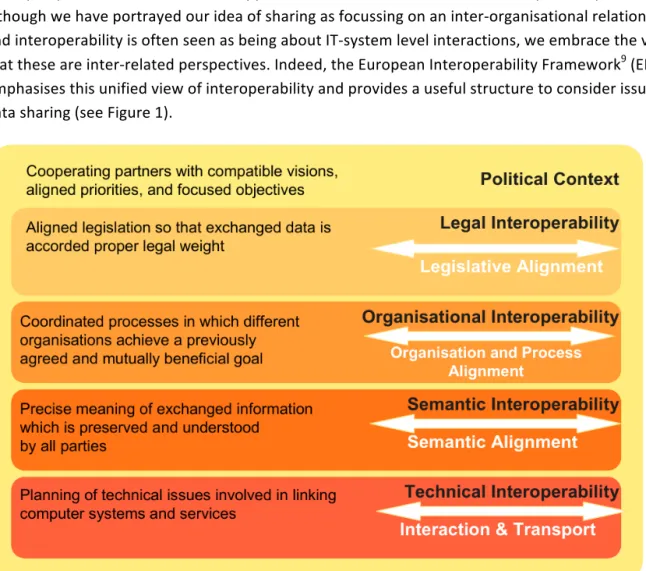
Issues for data sharing may be looked at from a range of perspectives, and different stakeholders tend to instinctively adopt one of them. In this section, we seek to draw attention to issues in a multi-‐perspective manner. A similar approach has been used to consider interoperability and, although we have portrayed our idea of sharing as focussing on an inter-‐organisational relationship, and interoperability is often seen as being about IT-‐system level interactions, we embrace the view that these are inter-‐related perspectives. Indeed, the European Interoperability Framework9 (EIF)
emphasises this unified view of interoperability and provides a useful structure to consider issues for data sharing (see Figure 1).
Figure 1: Four Levels of Interoperability (from EIF v2, Figure 4-‐1)
The following discussion of issues broadly follows the EIF, working from the bottom up, while aspects of the Political Context are touched-‐upon in section A 5 Roadmap.
At the end of each section of the discussion, a few synoptic problem statements are presented to capture the main points and to give an assessment of the proximity of the problem. The proximity of the problem is graded a follows, with numerical levels given to show rank order as for the aims.
1. Horizon: the issue will have impact but it could reasonably be addressed with low-‐level effort at present.
9 This is formally known as “Annex 2 to the Communication from the Commission to the European Parliament,
the Council, the European Economic and Social Committee and the Committee of Regions 'Towards interoperability for European public services’”, or informally as EIF v2. It is available from
2. Approaching: the issue will have impact in the mid-‐term and neglecting it could make matters worse in the future, for example by flawed technologies or practices coming into use. The issue deserves early attention.
3. Blocker: the issue is a blocker to meaningful progress.
3.1 Technical and semantic issues
The Description of Work of the LACE project identifies four core issues related to data sharing and interoperability. The first of these is the stimulus for this report on data sharing, while the remaining three issues emphasise aspects spanning the technical and semantic interoperability levels:
• Learning analytics and educational data mining research could make more progress in developing and testing algorithms and models if datasets could be more easily merged (both increased in scale and diversity of data).
• At present, analysts have to independently map between different data models. It would be more efficient for them if this work was done once and used many times.
• The absence of (data) interoperability means that there is wasted time and money spent to create and maintain computer code for multiple data exchanges. This makes it hard for suppliers to service localised or niche markets and hard for innovative products to become established. Few, if any, analytics-‐based applications will be viable – commercial or Open Source – except those provided by already-‐dominant suppliers of learning platform software.
• Existing specifications and standards have been neither motivated by, or designed for, learning analytics.
These are foundational issues for the data-‐sharing aims set out above, as well as system integration scenarios which do not fall within our scope for this report (Cooper, 2014a). From the point of view of practical application, the technical/semantic distinction is often not made by system developers, who usually deal with data structures and APIs as manifest entities. From the point of view of understanding the issues, however, and the possible actions to enable realisation of the aims we have outlined, it is useful to draw some distinctions. It is apparent, however that the
technical/semantic distinction is somewhat arbitrary and that there are really various conceptual models from the technical representation of data at one end to facets of pedagogy at the other end. We draw the following coarse distinctions: low level semantics deal with basic representations, while domain-‐specific semantics would be appreciated by a teaching and learning practitioner, and in between these is the space of generalised meaning. These three levels are expanded on below, and comments made about the issues for learning analytics data sharing. The interoperability specifications referred to are further described in (Cooper, 2014b). It is also appropriate to consider the technical architecture here; it is not simply the representation and intended meaning of data elements which are necessary for practical interoperability.
3.2.1 Low Level
Low level semantics give meaning to the components of XML, CSV, JSON, relational database, etc structures. These are well defined and at a surface level pose no challenge to data sharing for learning analytics. Each, however, has its own form of expression, which colours the representation of data and so presents some practical difficulty.