(IJSBAR)
ISSN 2307-4531
(Print & Online)
http://gssrr.org/index.php?journal=JournalOfBasicAndApplied
---
26
Improving Students' Mathematical Reasoning Ability
through Problem Posing Approaches at SMPN 19 Banda
Aceh
Ainal Mardiah
a*, M. Ikhsan
b, Marwan
ca,b,cUniversitas Syiah Kuala, Jl. Teungku Chik Pante Kulu No. 5, Banda Aceh 23111,Indonesia a Email: [email protected] b Email: [email protected] c Email: [email protected] Abstract
One tendency that causes students to fail to solve every mathematical problem that demands analysis is caused by students not using good reasoning in solving problems given. The application of the problem posing approach to junior high school students is one solution to overcome this problem. This research was conducted as an effort to improve mathematical reasoning abilities, activities, and student responses to learning using the problem posing approach. This research is a Classroom Action Research which was conducted for four meetings and consisted of two cycles with the research subject being seventh grade students of SMP Negeri 19 Banda Aceh. Data collection was carried out using a test of mathematical reasoning ability, student activity observation sheet, and questionnaire. Data were analyzed using descriptive statistics. The results showed that students' mathematical reasoning abilities could be improved through a problem posing approach. This is shown by the students' mathematical reasoning ability which has increased, namely in the 50% I-cycle, complete and become 95.83% in the second cycle. The expected student activity in learning using the problem posing approach is also active and students' responses to learning using the problem posing approach in class VII of SMPN 19 Banda Aceh are very positive.
Keywords: Problem Posing Approach; Student Activities; Mathematical Reasoning Ability; Student Response.
--- * Corresponding author.
27
1.Introduction
Mathematics education in schools aims to make students have good reasoning power especially when solving problems in mathematics. The purpose of mathematics learning can be achieved by applying a scientific (scientific) approach, namely observing, asking, trying, reasoning, presenting, and creating so that learning becomes more meaningful [1]. The 2013 curriculum also states that the scientific (scientific) approach will train students to have reasoning abilities that are very useful in the learning process and solve problems in everyday life [2]. One of the general goals in mathematics learning that must be considered by teachers is the ability of reasoning [3]. Besides that, the government always makes improvements, reforms and pays attention to the development of education in Indonesia, especially mathematics, so that the 2013 curriculum have tried to develop it in accordance with the demands of the times and international competitions such as TIMSS, PISA, PIRLS and others.
The results of the test of mathematical reasoning ability are also evidenced by the low values obtained by students from the results of the test, the problem of which requires mathematical reasoning abilities that researchers (teachers) have given. The results of student answers to the questions given are still far from the expected indicators, students have not been able to use relationship patterns to analyze the situation or make analogies and generalizations and draw logical conclusions. This is caused by the ability to reason and analyze the problems given are still lacking. As for one of the students' answers to the number one question as presented in the following picture 1.1.
Figure 1: Results of student answers to questions number 1
Based on the students' answers above, identify that students are not able to analyze and reason well with the intent of the two discounts referred to from the question, even though students have been able to understand well the concept of discount as explained in the answers of the students above. As a result of inappropriate analysis, the conclusions concluded by students are also illogical. So that the indicators of mathematical reasoning ability, namely estimatin the answers and process solutions and drawing logical conclusions have not been reached.
The same thing also happened to the results of the students' answers to questions number two, where students also could not use good reason in solving the problems given. This can be seen from the description of student answers as presented in the following figure 1.3.
28
Figure 2: Results of student answers to questions number 2.
Based on the answers of the students above also illustrates that students 'mathematical reasoning ability is still lacking, even though the ability of students' understanding of the concept of single interest and final savings can be understood well. As a result, students do not reason perfectly and determine the amount of administrative costs for one year, then the conclusions obtained from solving the problem are also illogical. Even though the two banks offered to Garli did not benefit him if he saved for one year with interest rates and administrative fees offered by the two banks.
The fact the problem above identifies that students are still lacking in mathematical reasoning skills when solving mathematical problems. This is because students are not accustomed to solving problems in daily life independently, what happens when the learning process in class is if the teacher has given a story-shaped problem and requires students to reason, usually students are quiet and less able to pour each problem given into the language of mathematics. Even though mathematical reasoning is one of the main goals in learning mathematics.
With regard to mathematical reasoning abilities, the teacher has a very important role in developing mathematical reasoning abilities in students both with the learning method used, and the type of evaluation used. Improving students' mathematical reasoning skills also needs to be supported by the right learning approach so that learning objectives can be achieved. One important aspect of planning rests on the teacher's ability to anticipate needs and materials or models that can help students to achieve expected learning goals[4]. In this case, Teachers must have a method in learning as a strategy that can facilitate students to master the knowledge provided [5]. One of the predictable and possible learning approaches to improve students' mathematical reasoning abilities is learning through problem posing approach.
The results of previous studies have also shown the positive effects of applying the problem posing approach in overcoming students' problems in learning mathematics. The problem posing approach gave a significant value to the improvement of students' mathematical problem solving abilities [6]. Straight-line equation learning that contains problem posing can make students more responsible for learning and facilitate students in understanding the lessons that lead to increased mastery, even though mastery still varies based on academic
29
ability [7].
2. Theoretical Review
2.1 Problem Posing Approach
The questions asked are questions that are asked by students who ask their own questions or questions that are simpler questions. It is expected that learning by learning posing problems can increase students' motivation to learn requires learning to be created, students will not be bored and will be more responsive. Thus it will improve students' punishment abilities to be better. The types of learning by discussing posing problems can be applied in three forms of cognitive cognitive activity as follows [8]:
1. Posing before problem solving, namely students make questions or solve problems from the
information provided before solving problems;
2. In the solution to pose (submitting a problem when the solution), namely students formulate the
problem again when solving problems; and
3. Posting posing solutions (submitting a problem after the solution) that is modifying the goal or problem problem that was resolved to create a new problem.
2.2 Mathematical Reasoning Capabilities
Mathematical reasoning ability is one of the abilities expected by every student to learn mathematics. Reasoning is an integral part of doing mathematics [3]. The indicators of mathematical reasoning abilities that have been formulated are; 1) Submitting allegations; 2) Perform mathematical manipulation; 3) Draw conclusions, compile evidence, and give reasons for the truth of the solution; 4) Draw conclusions from a statement; 5) Check the validity of an argument; and 6) Find patterns or characteristics of mathematical symptoms to make generalizations [3]. Indicators of mathematical reasoning ability are; 1) Draw logical conclusions; 2) Give explanations using pictures, facts, characteristics, existing relationships; 3) Estimating the answers and process solutions; 4) Using relationship patterns to analyze, make analogies, generalize and compile and test conjectures; 5) Propose opponents to examples; 6) Propose rules of inference, check the validity of arguments and arrange valid arguments; and 7) Arrange direct evidence, indirect evidence and proof by mathematical induction [9].
The indicators that become a benchmark for knowing the mathematical reasoning abilities of students in this study are; 1) Estimating the answers and process solutions; 2) Draw logical conclusions; 3) Provide explanations with models, facts, characteristics, and relationships; 4) Using relationship patterns to analyze situations or make analogies and generalizations; and 5) Arrange valid arguments.
3. Methods
The type of research used is Classroom Action Research (CAR) with models Kemmis and Taggart as described with the following flowchart.
30
Figure 3: Flow of Implementation of PTK Model Kemmis and Taggart [10]
The subjects in this study were seventh grade students of SMPN 19 Banda Aceh in the 2018/2019 academic year, totaling 24 students. The research instruments used in the study were tests of mathematical reasoning abilities, student activity observation sheets, and questionnaire sheets. The data collection techniques consisted of tests, observations, and student response questionnaires which were then analyzed using descriptive statistics.
4. Results
The results of the implementation of the actions in the first cycle until the second cycle showed an increase in students' mathematical reasoning abilities, student activities in learning and student responses to learning had also been very positive. This shows that there is an increase in students' mathematical reasoning abilities through the application of problem posing learning approaches in class VII of the SMP Negeri 19 Banda Aceh. The observations of student activities during learning carried out by one observer during the first cycle until the second cycle continued to show effectiveness, so that in the second cycle all student activities during the problem posing learning approach were effective in accordance with the percentage of ideal time set in each aspect observation of student activity within the tolerance limit of 5%. The recapitulation of the effectiveness of student activities during learning can be seen in the following table 1.1.
Table 1: Recapitulation of Student Activities from Cycle-I to Cycle-II
No Observation Category Ideal Time-Based Effectiveness
Cycle-I Cycle-II
1 Pay attention to the explanation of the teacher and
friend Ineffective Ineffective
2 Read and understand the problems contained in the
LKPD Effective Effective
3 Provide a response to the problems found in the
LKPD Ineffective Effective
4 Express ideas in solving each problem Effective Effective
5 Discuss answers in groups Effective Effective
6 Complete the task of designing questions and
completing them in groups Ineffective Effective
7 Give answers and responses in class discussions Ineffective Ineffective
8 Make conclusions about a concept and procedure Effective Effective
31
The recapitulation of the results of tests of students' mathematical reasoning abilities for two cycles can be seen in table 1.2 below.
Table 2: Results of Final Test of Mathematical Reasoning Ability of Students in Cycles I and II
No Student Initials Cycle-I Score Cycle-II Score No Student Initials Cycle-I Score Cycle-II Score 1 S1 88 100 13 S13 89 98 2 S2 77 95 14 S14 58 78 3 S3 60 100 15 S15 56 82 4 S4 67 88 16 S16 63 80 5 S5 75 80 17 S17 83 100 6 S6 69 87 18 S18 66 78 7 S7 65 78 19 S19 59 75 8 S8 86 100 20 S20 65 88 9 S9 87 100 21 S21 75 90 10 S10 75 95 22 S22 79 95 11 S11 90 90 23 S23 82 100 12 S12 63 75 24 S24 50 74
Based on the Minimum Completion Criteria (KKM) in SMP Negeri 19 Banda Aceh, it has been determined that students are said to complete learning if they have at least 75 absorptive capacity, while classical mastery learning is achieved when at least 85%. In the first cycle, the achievement of completeness of students' mathematical reasoning abilities only reached 50% has been completed and by 50% is not complete.
In the second cycle after adding new activities for consideration to activate students, namely the presence of activities contained in the talking stick learning model, the results of students' mathematical reasoning ability increased by 95.83% and 4.17% did not complete. Based on classical completeness, the mathematical reasoning abilities of students in cycle II have achieved classical completeness.
Increased mathematical reasoning abilities of students who have achieved complete mastery classically are strongly influenced by an increase in students' likes and likes for problem posing learning.
This is evident from the results of the questionnaire responses of students who have been very positive about the learning that has been carried out. The results obtained as presented in table 1.3 follow.
32
Table 3
5. Discussions
In the first cycle of the first meeting students' activities in the problem posing learning approach were 44.44% effective, consequently the expected student activities had not been achieved as expected. At the second meeting in the first cycle the researchers more conditioned the more effective discussion group preparation, so that there were group members exchanged. The hope is that student activities that are still less effective can be effective. The results of student activities at the second meeting in the first cycle have shown an increase so that 66.67%
No Responded Aspect Cycle-I Student Respon se Cycle-II Student Response
1 I can easily understand social arithmetic material that is taught by the
problem posing approach and the talking stick learning model
Very
positive Very positive
2 I did not feel the difference between learning through the problem posing
approach and the talking stick learning model with learning as usual. Positive Very positive
3 I am interested in participating in learning activities using the problem posing approach and the talking stick learning model on other material .
Very
positive Very positive
4 For me, the problem posing approach and the talking stick learning model are
suitable for other mathematical material.
Very
positive Very positive
5
I did not feel the atmosphere that was active in learning social arithmetic material using the problem posing approach and the talking stick learning model even though the composition of group members was as good as possible
Very
positive Very positive
6
I cannot understand clearly how the group discussions used in the problem posing learning approach and the talking stick learning model even though the composition of group members is as good as possible
Positive Very positive
7 I feel very happy about the learning atmosphere in the classroom when a
problem posing approach is applied and the talking stick learning model
Very
positive Very positive
8
My reasoning power and thinking ability are more developed during learning
using the problem posing approach and the talking stick learning model Positive Positive
9 I cannot understand clearly the language used in the LKPD Very
positive Very positive
10 For me, learning using the problem posing approach and the talking stick
learning model is an approach to learning new mathematics .
Very
positive Very positive
11 If allowed, I am inclined not to follow the problem posing learning approach
33
of students' activities in the learning process are problem posing effective. This is caused by the condition of the discussion group that has been well rearranged and is more responsible for the tasks given in the problem posing learning approach. Students have appeared bolder because of the motivation and direction given by the teacher and not rigid in developing their mindset, especially in designing questions and completing them according to the interests and abilities of each in the group, so that all students in the group are required to think to solve problems in the worksheet of students with full responsibility. This is in line with the opinion of Japa & Suarjana which states that the learning process is designed to create an atmosphere that allows students to carry out mathematics learning activities [11]. Activities in groups can also provide opportunities for students to hold discussions, so that student interactions can be established and the sharing of opinions occurs.
The results of student activities in learning in the second cycle are good in the first meeting and the second is in accordance with the expected indicators, where 100% of student activities are effective. This is caused by the addition of activities contained in the talking stick learning model, namely the activity of giving sticks to students to explain the results of discussions in groups. With this activity, students must really master everything discussed in the group, especially the questions designed and resolved, because the stick can be left to anyone in unpredictable times. After discussion activities in the group, all students must understand all the concepts learned in the group, because the teacher will give the stick freely to all the students desired by the teacher. So students really are required to be active in learning. Active students are active students with limbs, making things, playing or working, not just sitting and listening [12].
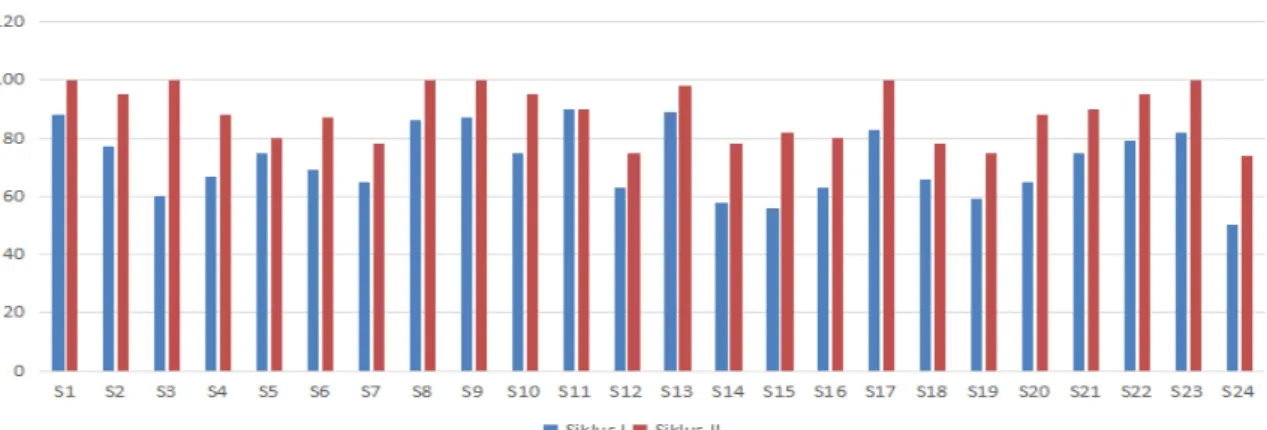
As a result of the activities of students in active learning based on the expected indicators, it has an impact on improving students' mathematical reasoning abilities which 95.83% complete in cycle-II. The improvement of students' mathematical reasoning abilities during the first cycle to the second cycle can be seen from the following bar chart presentation.
Figure 4: Final Test Results of Student Mathematical Reasoning Ability in Cycles to Cycle-II
Based on Figure 1.4 above, it can be seen that the improvement of students 'mathematical reasoning abilities from each cycle can be seen clearly, so that in the second cycle the completeness of students' mathematical reasoning abilities has reached classical completeness. This happens because every cycle of the teacher always
34
gives actions that can help students' mathematical reasoning abilities get better, so that it is clearly seen to be directly proportional between mathematical reasoning abilities and student activities in each cycle. The results of evaluations are often used as a measure to find out how far someone has mastered the material that has been taught[13].
The success of this action is also inseparable from classroom management and teacher guidance in each cycle is improved and the problem posing approach is used. The general objective of class management is to provide class facilities for various learning and teaching activities in order to achieve good results [14]. Whereas the specific purpose is to develop students' ability to use learning tools, provide conditions that allow students to work and study and help students obtain the expected results.
The results of this study are also relevant to the results of research conducted by Novitasari, Hanurawan, and Soetjipto,which concluded that the application of the problem posing approach could improve the skills of fourth grade students in asking about social studies at Tunjungsekar 5 Elementary School Malang [15]. The research results of Vionita and Purboningsih also concluded that learning by applying the problem posing approach in class VIII-A of SMP 3 Kalasan in the academic year 2016/2017 was able to improve the learning process and students' attitudes towards mathematics learning after applying the problem posing approach in several cycle [16].
The results of student questionnaire response data analysis, obtained that students are very interested in learning with a problem posing approach, not only on social arithmetic material but also on other material. This is in accordance with the statement of students towards problem posing learning in positive and very positive categories.
The statement of students in the positive and very positive categories in each cycle is inseparable from the students' pleasure in learning that is carried out. This means that the problem posing learning approach generates satisfaction for students, because this learning is a new learning for them such as subject matter, LKPD, tests of mathematical reasoning skills, the atmosphere of learning in the classroom and the way teachers teach. Students' pleasure is also caused by the activity of designing their own questions and answering themselves by students in each cycle in learning with problem posing learning approaches.
6. Conclusions
From the results of the learning activities that have been conducted for four meetings with two cycles and based on the results of the analysis and discussion that have been described, it can be concluded; (1) Students' mathematical reasoning abilities can be improved through the application of a problem posing approach in class VII of the SMPN 19 Banda Aceh. This is shown from the results of tests of mathematical reasoning abilities of students in the first cycle of 50%, which increased to 95.83% in the second cycle. This success is inseparable from several teacher actions that are continually improved in learning in the second cycle, among others, encouraging all students to be actively involved and have a sense of full responsibility for the tasks provided with the talking stick activity at the end of learning, giving tips that encourage students' reasoning power is
35
better, especially in solving each given problem, designing questions and completing them, and encouraging students to diligently read and practice solving problems that require analysis or reasoning at home to improve their mathematical reasoning abilities. (2) Student activities expected in learning using the problem posing approach in class VII of the SMPN 19 Banda Aceh is active. (3) Students' responses to learning using the problem posing approach in class VII of SMPN 19 Banda Aceh were very positive.
References
[1] Kemendikbud. (2013). Materi Pelatihan Guru Implementasi Kurikulum 2013 SMP/MTs Matematika. Jakarta: Kemendikbud.
[2] Hosnan, M. (2014). Pendekatan Saintifik dan Konstekstual dalam Pembelajaran Abad 21. Bogor: Ghalia Indonesia
[3] NCTM. (2000). Principles and Standards for School Mathematics. Reston: National Council of Teachers of Mathematics.
[4] Wahyudin. (2008). Pembelajaran dan Model-Model Pembelajaran. Bandung: Universitas Pendidikan Matematika.
[5] Sagala, S. (2011). Konsep dan Makna Pembelajaran. Bandung: Alfabeta.
[6] Xia, X., Lu, C., & Wang. B. (2008). Reasearch on Mathematics Instruction Experiment Based Problem Posing. Journal of Mathematics Education, (1), 153-163.
[7] Yuhasriati. (2002). Pembelajaran Persamaan Garis Lurus yang Memuat Problem Posing di SLTP Laboratorium Universitas Negeri Malang. Jurnal Penelitian Kependidikan, 12 (1), 61-74.
[8] Silver, E. A. & Cai, J. (1996). An Analysis of Arithmetic Problem Posing by Middle School Student. Journal for Research in Mathematics Education, 27 (5), 521-529
[9] Sumarmo, U., & Johar, R. (2012). Evaluasi Pembelajaran Matematika. Banda Aceh: Universitas Syiah Kuala.
[10] Arikunto, S. (2010). Prosedur penelitian suatu pendekatan praktik. Jakarta: Rineka Cipta.
[11] Japa, I Gusti Ngurah & Suarjana, M. (2012). Pembelajaran matematika SD. Singaraja: Universitas Pendidikan Ganesha
[12] Rohani, A. (2004). Pengelolaan pengajaran. Jakarta: Rineka Cipta.
[13] Irwan. (2011). Pengaruh Pendekatan Problem Posing Model Search, Solve, Create and Share (SSCS) dalam Upaya Meningkatkan Kemampuan Penalaran Matematis Mahasiswa
36
Matematika. Jurnal Penelitian Pendidikan, 12 (1), 1-13
[14] Purwanto, N. (1994). Prinsip-prinsip dan teknik evaluasi pengajaran pendidikan. Bandung: Remaja Rosdakarya
[15] Usman, M. U. (2005). Menjadi Guru Profesional, Cet. XVII. Bandung: Remaja Rosdakarya.
[16] Novitasari, N. I., Hanurawan, F., & Soetjipto, B. E. (2016). The Implementation of Prblem Posing Medel Assisted by Smard Card to Improve Students’ Questioning Skill on Social Studies for the Fourth Grade Students. IOSR Journal of Humanities and Social Science (IOSR-JHSS), 21 (3), 105-110.
[17] Vionita, A and Purboningsih, D. (2017) Improving Attitudes Toward Mathematics Learning with Problem Posing in Class VIII. AIP Conference Proceeding, 1868, 050007-1–050007-8, 1-8


![Figure 3: Flow of Implementation of PTK Model Kemmis and Taggart [10]](https://thumb-us.123doks.com/thumbv2/123dok_us/1225908.2665162/5.892.269.629.116.284/figure-flow-implementation-ptk-model-kemmis-taggart.webp)