Volume 7 Number 3 2010 www.wwwords.co.uk/ELEA
Technologies in Literacy Learning: a case study
ANNE CLOONAN
Faculty of Arts and Education,
Deakin University, Melbourne, Australia
ABSTRACT This article draws on outcomes of a study which explored changes in teachers’ literacy pedagogies as a result of their participation in a collaborative teacher professional learning project. The educational usability of schemas drawn from multiliteracies and Learning by Design theory is
illustrated through a case study of a teacher’s work on website exploration and design with 8- to 11-year-olds. The teacher sought to develop pedagogical responses which were cognisant of multimodal shifts resulting from an increasingly digitised, networked communications environment. Engagement with the schemas influenced the teacher’s print-based literacy pedagogies to incorporate multimodal literacy practices.
Breakthroughs in New Literacy Teaching and Learning
Despite the now commonplace claims of the unprecedented opportunities presented to literacy education by the new information and communications technologies (ICTs) of the twenty-first century, the implementation of technology itself does not act as a panacea for underachievement in literacy and disengagement from learning (Cuban, 2001; Andrews et al, 2005). Foremost in enhancing learning and teaching are the teacher’s pedagogies in the use of ICTs (Miller & Olson, 1994; Snyder, 2008).
Learning by Design and its complementary multiliteracies theory present conceptual schemas for influencing an expanded repertoire of literacy practices, as a response to opportunities presented by technological advancement (New London Group, 1996; Cope & Kalantzis, 2000; Kalantzis & Cope, 2005). The following explores a case study of a collaborative application of multiliteracies and Learning by Design schemas which sought to investigate their educative useability.
A Collaborative Study in Teacher Learning: developing students’ multiliterate capacities
Multiliteracies theory offers frameworks or schemas for multimodal meaning making and pedagogical repertoires that address learner engagement, diversity and transformation within an increasingly technologically driven knowledge society. The schemas used in the study that underpins this article are derived from the New London Group’s arguments and recommendations for (1) multimodal representations rather than written linguistic forms of text to be the agenda of contemporary literacy education; and (2) four major traditions of pedagogy which can be drawn upon as a means for designing contemporary literacy teaching and learning.
The two key schemas emanating from multiliteracies theory that were deployed in the broad study of which the case study discussed in this article is a part include, first, a ‘multimodal schema’ which frames becoming ‘multiliterate’ as students develop proficiency in six meaning-making modes: linguistic representation, visual representation, audio representation, gestural representation, spatial representation and multimodal representation, i.e. a combination of the
other modes (New London Group, 1996, 2000). Second, the study used a schema based on a pedagogy of multiliteracies which identified four major dimensions of pedagogy that were originally called situated practice, overt instruction, critical framing and transformed practice (New London Group, 1996, 2000). The teachers in the study under discussion informed the more recent articulation of these dimensions of pedagogy as ‘pedagogical knowledge processes’ of experiencing, conceptualising, analysing and applying (Kalantzis & Cope, 2005). This I am calling a ‘pedagogical knowledge processes schema’, which teachers can use to map their pedagogical choices and to determine how these align with the multimodal means they deploy.
The study took place in the context of an Australian public education sector in 2003 and involved teachers of students aged 5-11 (Cloonan, 2010). The teachers were drawn from government schools – one in an inner-urban suburb of a capital city, the other from a semi-rural town. Both schools had a high proportion of students from low socio-economic backgrounds. The teachers’ classroom experience ranged between 8 and 25 years.
The teachers engaged in participatory action research (Carr & Kemmis, 1986; Kemmis & McTaggart, 2005), forming a community of practice (Wenger, 1999) which sought to develop classroom responses that were cognisant of multimodal shifts in contemporary communication. The teachers agreed to undertake sustained and reflective engagement with the two schemas over an eight-month period. Implementation was specific to their individual teaching contexts. During this time, each teacher undertook two sequences of teaching with 62 lessons analysed.
Characteristics of effective professional learning and teacher research (Cochran-Smith & Lytle, 1993; Darling-Hammond, 1997; Elmore, 2002) were incorporated within a participatory action research design. Professional learning strategies were deployed recursively, in differing combinations, to support both teacher professional learning and collection of data. These interventions included theoretical input via schemas derived from multiliteracies theory; workshopping through distributed collegiate mentoring; reflective planning for classroom applications; staged filming of classroom applications; staged filming of teacher interviews; collaborative viewing of film artefacts (classroom applications and teacher reflection on classroom applications); collaborative reflection on observed film artefacts; and collaborative reflection on data and findings. The teachers participated in three cycles of participatory action research.
As the case study teachers moved to introduce multimodal teaching into their classroom programs, they documented their intended practices, were filmed and observed in their teaching, and reflected on their efforts in recorded interviews. The sequences of teaching developed as a result of teacher participation were specific to the teachers’ individual teaching contexts. For example, during one teaching sequence, a teacher of school entrants (five-year-olds) taught her students about narratives represented in different modes of meaning; and in their first teaching sequence, two teachers of six- and seven-year-olds focused their team teaching on the elements and structures on greetings cards within a study of multicultural celebrations and festivals.
Using the prism of the multimodal and pedagogical knowledge processes schemas referred to above, this study sought to investigate teacher learning as a means to influence print-based literacy pedagogies to incorporate multimodal literacy practices. The case study discussed in this article illustrates the impact of one teacher’s engagement with multimodal and pedagogical knowledge processes schemas on literacy pedagogy. The teacher’s name is Pip (a pseudonym).
In her first teaching sequence, Pip – a teacher of 8- to 11-year-olds – focused on developing personal profiles and interest-based projects (or ‘passion projects’) as a way of creating content for a class website. In her second teaching sequence, Pip extended this work to include an exploration of online and print newspapers as part of her development of an online class newspaper. The sources of data documenting Pip’s efforts have been drawn upon in the discussion below to categorise and analyse her practices moving from literacy teaching focused on print to literacy teaching focused on multiple modes of meaning. The following discussion uses the pedagogical knowledge processes schema and the multimodal schema to track the relationships between pedagogical choices made by Pip and the modes of representation which were the foci of her literacy program.
Deploying Pedagogical Designs for Exploring Multimodal Representations
A preschool and primary educator with over 20 years’ experience at the time of the research, Pip had recently returned to a semi-rural school after a three-year placement in an ICT/literacy consultancy position at a regional education office. The school is situated 200 kilometres east of the state capital city and has a population of approximately 240 students, many from families experiencing socio-economic disadvantage. The main forms of industry open to the community are agricultural or agriculture-related (sales, agistment, haulage), with a well-represented ‘trucking community’.
Pip’s ICT and literacy expertise had been deployed by the region in the conduct of initiatives to encourage the use of ICT across the curriculum. Pip was also a regional literacy trainer responsible for training school-based coordinators. She was very confident with and eager to incorporate technology into literacy learning. Her school-based responsibilities included teaching a Year 3 and 4 class (students aged 8-11) and school literacy and numeracy coordination, which involved Pip in supporting the professional learning of other teachers at her school.
Despite expertise and access to professional learning in the regional position, Pip admitted to a superficial understanding of multiliteracies. Early in the project, Pip described her perceptions of multiliteracies as
a term that’s been around a long time and I guess I’d heard about it ... my initial understanding was probably the changing nature of literacy, particularly now with email, mobile phones and SMS messages, how that’s changed ... I really didn’t know anything about, or hadn’t considered the multimodal nature of the learning.
While Pip was aware of the connection between multiliteracies and technology, prior to involvement in the project these connections did not extend to multimodality or the pedagogical knowledge processes. Pip’s first sequence of 14 lessons involved the investigation of personal ‘passions’ and web-page creation (see Table I, lessons 1-14). These are described in detail below. Her second sequence of 8 lessons focused on the exploration of print and online newspapers (see Table I, lessons 15-22). Data from both these sequences will be drawn on in the discussion of analysis and results later in this article.
Lesson Multimodal representation addressed Pedagogical knowledge process deployed Teaching Sequence 1
1 Linguistic and visual
Concept map showing knowledge of websites
experiencing the known 2 Linguistic
Personal details
experiencing the known 3 Linguistic and visual
Listening and responding to stories on website
experiencing the new 4 Linguistic and visual
Navigating websites conceptualising by naming 5 Visual Website features conceptualising by naming 6 Visual
Structure and layout of website
conceptualising by theorising 7 Visual and linguistic
Features of a search engine
analysing functionally 8 Linguistic
Writing about a ‘passion’
analysing functionally 9 Linguistic
Researching for information on websites
analysing functionally 10 Visual and linguistic
Critiquing features on websites
analysing critically 11 Linguistic and visual
Critiquing features on websites
analysing critically 12 Linguistic and visual
Comparing websites and books
applying appropriately 13 Visual and linguistic (and audio) applying creatively
Publishing profiles
14 Linguistic and visual (and audio)
Publishing and presenting passion projects
applying creatively Teaching Sequence 2
15 Linguistic and visual
Exploration of print newspapers
experiencing the known 16 Visual and linguistic (and audio)
Exploration of online newspapers
experiencing the new 17 Linguistic and visual (and audio)
Naming features of a newspaper
conceptualising by naming 18 Visual and linguistic (and audio)
Realisation of features in different newspapers
conceptualising by theorising 19 Linguistic and visual (and audio)
Functions of features – print and online
analysing functionally 20 Linguistic
Consideration of audience preferences
analysing critically 21 Linguistic and visual
Creation of class newspaper
applying appropriately 22 Visual and linguistic
Creation of class newspaper
applying creatively
Table I. Pip’s addressing of multimodal representation and deployment of pedagogical knowledge processes (predominant mode of focus is shown in italics).
Pip’s pedagogical starting point was an amalgam of her professional interests and a situating engagement for a diverse group of learners – where 19 out of 28 students were boys. In her words:
We’ve got a wide range of children in the room. So as a way of connecting to them and making their learning more meaningful to them and engaging them and motivating them, technology and computers was a fantastic link, but linking it to what they already knew ... I just felt it [technology] was a way of engaging particularly all those boys and it just hooked in so well with the multimodal ... I’ve felt it [technology] is a tool that engages all children and particularly boys because it’s so hands-on.
Developing knowledge of the multimodal schema, consideration of students’ disengagement with writing, and professional interest and expertise influenced Pip’s decision to explore and create web pages. Pip began her first teaching sequence by engaging her students in the pedagogical knowledge process of experiencing, firstly by making a concept map of their knowledge of websites and listing their personal details (experiencing the known); and since the majority of the students did not have home access to computers, she introduced them to an author’s website (experiencing the new).
Researcher: The video shows you looked at the elements of web pages.
Pip: We started off reading them [the web pages] and as we were reading them we discovered that some were easier to read, some of the links were easier to use. They [the students] looked at background colours, font size, font colours, images. Some were really slow loading. They loved the animated ones.
Researcher: So, reading is very complex, the way you’re approaching it.
Pip: Exactly. Also making the connection between what’s written and the actual use of the background or perhaps the use of the graphics ... Kids are quite critical whether the actual graphics were appropriate to what was written in terms of the content. They like the content to be matching fairly closely.
The pedagogical knowledge processes schema prompted Pip to focus on experiencing the known (students’ current knowledge of websites and their own personal details in lessons 1 and 2) and then moved to experiencing the new (an author’s website in lesson 3). In lessons 1 and 3, the predominant mode of focus is on the linguistic mode of representation, with a lesser focus on the visual, as indicated in Table I. Pip engaged the students in the use of conceptual visuals in the form of concept maps to develop classificational taxonomies, however the major focus here was on the
words describing students’ prior knowledge with websites. Lesson 2 only engaged students with the linguistic mode – a lesson involving students in writing their personal details (name, address, interests, friends, etc.).
Following the students’ involvement in the pedagogical knowledge process of experiencing, Pip focused learners’ attention on the navigation of websites with attention given to website features such as hyperlinks and navigation icons, as well as the structure and layout of various sites. Pip addressed the pedagogical knowledge process of conceptualising by naming and theorising (lessons 4-6), identifying and emphasising specialised multimodal metalanguage with students, as evidenced in the following interview excerpt:
Researcher: The video shows you’ve worked up a vocabulary. There are some quite complex technical terms you’ve been using.
Pip: The children are getting very skilled at using the appropriate language ... there’s been lots of planning for that concept naming and being able to understand that this is a ‘hyperlink’, or this is a ‘font’ ... identifying these features and concepts that they need to be able to use and need to be able to name ... being able to articulate what the concept is and then learn what does this do ... So we are developing a class glossary.
Researcher: I suppose you’d be continually adding to that?
Pip: We’ve already made two A3 pages of our glossary words, but certainly each time we find a new word we’re working out what it means and adding to the glossary, so it’s going to be ongoing. I imagine it will continue with what we’re doing with the web pages, leading on to developing our own class newspaper or newsletter, which will link to the web page.
She firstly drew attention to linguistic concepts and then to visual concepts, actually foregrounding visual representations as meaning-making resources as part of her literacy teaching. Whether the concept naming was planned, incidental or emergent from the classroom acts, Pip emphasised the language of the Internet through isolating terms and building a class glossary.
The pedagogical knowledge process of analysing was deployed in five of Pip’s lessons in her first teaching sequence (lessons 7-11). These lessons incorporated and extended the use of the conceptualising introduced in lessons 4-6, applying an analytical lens to the use of visual and linguistic elements. Analysis focused on the functions of features of a search engine, writing about a ‘passion’, and researching for information on websites; as well as analysing critically features on websites. Incorporating multimodal texts required Pip to reflect on and reframe the analytical strategies she had habitually used in print-based teaching practices and apply these to teaching multimodal representations. An example of this was the use of a PMI (plus, minus, interesting) thinking tool to generate analysis:
Pip: They’re [the students] used to using PMI, which is the plus, minus and interesting way of looking at texts. We’ve done it with books and with book characters. It was very easy to transfer that to a web page.
Researcher: Have you got an example?
Pip: One of the sites we looked at was a Grade 3/4 site and they’d been to an athletics day. They had a little graphic of an animated character ... and while they loved that, they said, ‘Well, that’s not really appropriate for a report about an athletics day.’ I said, ‘What could we have used instead?’, and one child said, ‘They should have just taken a digital photo and downloaded it [sic] onto the computer.’
Researcher: So a lot of analysis of the multimodal…
Pip: Exactly, and looking at the way the visual relationships work too, the way the text is
presented on the page. Sometimes there’s quite a large section of writing with nothing to break it up, which, when you are looking at a screen and having to scroll down the page, makes it a bit laborious. They liked sites where there was small amount of text but with some kind of a horizontal line or something to break up each section ... We looked at the links, how when you click on a link it is similar to turning a page. We used that analogy.
In Teaching Sequence 1, the pedagogical knowledge process of applying was deployed in three of Pip’s lessons (lessons 12-14), firstly through comparing websites and non-fiction texts, which gave
students opportunities for ‘applying appropriately’. Pip involved students in navigating visual and linguistic structures of print and online designs, particularly contents pages, navigation bars, chapters or sections, glossaries, key words, photographs, captions, diagrams and maps. In designing web pages and creating and presenting a digital presentation, students applied knowledge creatively, hyperlinking their word-processed personal profiles to passion projects developed in PowerPoint. Enactments of the pedagogical knowledge process of ‘applying creatively’ involved students making oral presentations of projects, supported by written summaries of key points and incorporation of complementary artefacts. Their presentations were videoed and snippets incorporated into digital portfolios.
Hyperlinking was explicitly taught, following which students worked independently to link their personal profile to their passion project. In reflecting on her work with students applying their growing knowledge, Pip described a small-group teaching session focused on hyperlinking. When asked, ‘What teaching approach did you use to teach the small group about hyperlinking?’, Pip replied with a self-reflective question: ‘Would that be shared reading or shared writing?’
The shift of the context of literacy teaching from the page to the online environment prompted reflection on the nature of reading and writing, a consideration of what hyperlinking involves, and how it might be compared with the practices of print-based reading and writing. This self-reflection was followed by a description of lesson 14:
We introduced the hyperlinking with a small group and we had a shared writing session around my laptop computer. We were looking at linking our personal profile to our passion projects. For some children it was quite easy. They went through their personal profile and found the particular bit of text that was going to match their passion project. For example, one boy had written about mythological creatures, so he straightaway worked out that he needed to hyperlink from the word ‘mythological’.
In relation to the modes of representation being addressed in the teaching of literacy, Pip’s teaching expanded to include the visual, particularly the organisational dimension of meaning (Cope & Kalantzis, 2000), in teaching associated with the linguistic and visual modes. Her teaching drew attention to the navigational aspects of Web-based multimodal designs, examples of ‘conceptual’ – rather than narrative – visual representations (Kress & Leeuwen, 1996). Pip maintained a strong emphasis on the organisational dimension of meaning of linguistic representations.
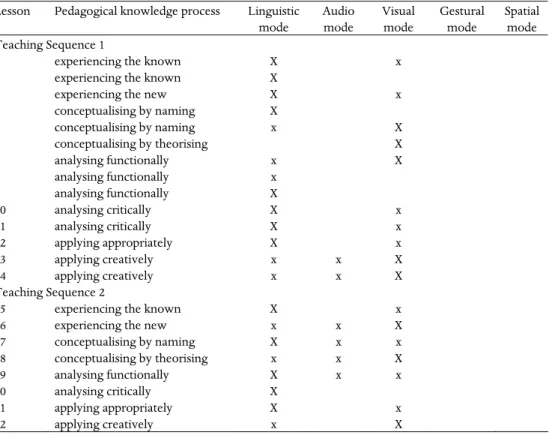
Pip’s deployment of pedagogical knowledge processes in teaching multimodal representations both in Teaching Sequence 1 (described above) and in a subsequent, second, teaching sequence, which focused on print and online newspapers, is shown in Table II. Engagement with the ‘multimodal schema’ influenced Pip to attend to teaching the linguistic and visual modes of meaning, and their multimodal relationships – an expansion of the literacy teaching repertoire from print-focused literacies. Cursory attention was given to the audio mode. The gestural and spatial modes of representation were not focused on in either teaching sequence. Pip addressed modes of meaning made ubiquitous by technology – particularly the visual mode of representation which has in recent times been more fully articulated as a meaning-making resource (Kress & Leeuwen, 1996).
Comparison of data from the two teaching sequences in Table II shows that in Teaching Sequence 1, the impact of the ‘multimodal schema’ on Pip’s documented classroom practices was limited to expanding oral and written linguistic literacy teaching to include visual meaning representations. Pip’s relatively confident and purposeful teaching of modes through deployment of pedagogies was fine-tuned in Teaching Sequence 2 – a study of print and online newspapers (see Table III). Pip emphasised the pedagogical knowledge process of analysis in Teaching Sequence 1, reflecting the usefulness of this pedagogy in exploring the ‘newness’ of the visual as a meaning-making resource. In both teaching sequences, Pip deployed all of the pedagogical knowledge processes in teaching addressed to either the linguistic and/or the visual mode. Teaching Sequence 2, which saw a greater focus on the visual as a meaning-making mode in its own right, as well as in a secondary capacity in teaching the linguistic, also saw each of the pedagogical knowledge processes deployed in the teaching of each mode.
For example, Pip’s deployment of the pedagogical knowledge process of experiencing, used in Teaching Sequence 1 to address the linguistic mode, was expanded in Teaching Sequence 2 to address the teaching of linguistic and visual modes and, to a lesser extent, the audio in print and
online newspapers (lessons 15 and 16). Deployment of the pedagogical knowledge process of conceptualising, used mainly in Teaching Sequence 1 to name and theorise about the linguistic mode in website features, was, in Teaching Sequence 2, deployed in naming and theorising about the multimodal realisation of online and print newspapers, specifically the linguistic and visual modes (lessons 17 and 18). As discussed earlier, multimodal metalanguage was emphasised in an ongoing way through development of a class glossary. The pedagogical knowledge process of analysis, predominantly deployed in Teaching Sequence 1 to address the linguistic mode but with a lesser emphasis on the visual, was similarly deployed in Teaching Sequence 2 to focus on functions of linguistic and, to a lesser extent, the visual and audio modes (lesson 19), as well as audience preferences through the linguistic mode (lesson 20).
Lesson Pedagogical knowledge process Linguistic mode Audio mode Visual mode Gestural mode Spatial mode Teaching Sequence 1
1 experiencing the known X x
2 experiencing the known X
3 experiencing the new X x
4 conceptualising by naming X 5 conceptualising by naming x X 6 conceptualising by theorising X 7 analysing functionally x X 8 analysing functionally x 9 analysing functionally X 10 analysing critically X x 11 analysing critically X x 12 applying appropriately X x 13 applying creatively x x X 14 applying creatively x x X Teaching Sequence 2
15 experiencing the known X x
16 experiencing the new x x X
17 conceptualising by naming X x x 18 conceptualising by theorising x x X 19 analysing functionally X x x 20 analysing critically X 21 applying appropriately X x 22 applying creatively x X
Table II. Pip’s deployment of pedagogical knowledge processes in teaching multimodal representations (predominant mode of focus is shown in upper case)).
Experiencing % Conceptualising % Analysing % Applying % Teaching Sequence 1 21 21 37 21 Teaching Sequence 2 25 25 25 25
Table III. Deployment of pedagogical knowledge processes in the two teaching sequences.
The pedagogical knowledge process of applying, deployed in Teaching Sequence 1 to emphasise the linguistic but with a lesser emphasis on the visual in the publication and presentation of personal profiles and passion projects on a class web page, was deployed in Teaching Sequence 2 in addressing both the linguistic and visual modes in creating a newspaper (lessons 21 and 22). Teaching Sequence 2 showed a fine-tuning of emphasis between the teaching of the linguistic and visual. Teaching in both teaching sequences was tightly focused on students’ literacy development, encouraging traditional literacies of reading and writing in the online environment enabled by technology, with the visual increasingly treated as a mode of meaning in its own right.
Pip stated that engagement with the two multiliteracies/Learning by Design schemas had developed her awareness of ‘the range of learning needs and styles [and] actually looking at the
way the children bring meaning. I’ve had to reflect on that a lot more. It’s taking my understanding to a deeper level’. The pedagogical knowledge processes became a naturalised way of describing her classroom practice, as the following interview extract shows:
Researcher: So what would you say is important for contemporary literacy teachers?
Pip: It’s knowing your children really well and being able to identify with them as people, so you’re in touch with them, with where they need to go, with their learning, but also what they’re bringing into the classroom, their prior knowledge and their life experiences. It’s also taking them beyond what they know already by conceptualising and being more critical and analysing their world and things around them learn and they move on and apply their knowledge. (My
emphasis)
Pip noted connections between teacher learning and student learning, displaying a great respect for students as learners. Increasingly, Pip shared classroom power with students, with students identifying themselves as ‘experts within the room’ in aspects of technology.
Teaching through and Teaching about Multimodal Representations
Engagement with the multimodal schema persuaded Pip of the importance of developing student understanding that literacy involved more than linguistic meanings, and that texts are multimodal. Analysis addressed the deliberate, conscious attempts made by Pip to focus teaching on modes of representation including, but not confined to, the linguistic. In other words, the teaching data was analysed to see how Pip drew students’ attention to ‘the integration/composition of the various modes ... both in production/making and in consumption/reading ... [which] presupposes adequate understandings of the semiotic characteristics which are brought together in multimodal compositions’ (Kress, 2000, p. 153); or as the New London Group (2000, p. 25) suggests, the ‘patterns of interconnections among the other modes’.
It became evident that Pip’s engagement with the multimodal schema resulted in classroom efforts focused on teaching through multimodality and mode, and teaching about multimodality and mode (Cloonan, 2010). This resonates in some ways with Halliday’s (1980) triptych: ‘learning language, learning through language and learning about language’.
By teaching through multimodality and mode, I refer to teaching in which individual modes and/or multimodality are deployed not necessarily as the point of teaching, but in the service of other teaching foci. The focus, when teaching through mode and multimodality, could be related to substantive content, such as an Internet search when the topic of interest is ‘dancing’ or ‘football’ and students search for words, images, sounds and gestures which explain aspects of the topic. Teaching through multimodality and mode can be exemplified by the teacher’s efforts to incorporate a range of texts including, but not limited to, print texts, and the use of representations including illustrated books, still and moving digital images, animations, songs, podcasts, web pages and gestures as a means of exploring some other substantive content.
Teaching about multimodality and mode in the context of the designs of meaning articulated by the New London Group (linguistic, visual, gestural, audio, spatial and multimodal) requires language for describing and comparing how meaning is constructed by isolated and combined modes – a metalanguage which relates to the functions of various modes of meaning within different contexts. Kress directs us to a broader task, arguing that:
we need to understand how meanings are made as signs in distinct ways in specific modes, as the result of the interest of the maker of the sign, and we have to find ways of understanding and describing the integration of such meaning across modes, into coherent wholes. (Kress, 2003, p. 37)
At times, it was evident in Pip’s pedagogical design that a mode within a multimodal text was isolated for teachingabout (for example, the visual design of navigation buttons or the selection of an animation on a website) and the meanings contributed by each mode explored. Pedagogical knowledge processes of conceptualising and analysing were used to bring these aspects to the students’ attention.
Individually and in combination in Teaching Sequence 1, Pip addressed the linguistic and visual modes within the context of a study of web design incorporating passion projects. A strong
focus on teachingabout the linguistic was apparent (writing concept maps, writing personal profiles, writing about a ‘passion’, reading an author’s website and writing an author profile in lessons 1-3 and 8), as well as through the linguistic, such as researching for information on the Internet in lessons 4 and 9.
Pip’s early deployment of the visual mode was to teachthrough the visual – for example, to use the visual incidentally to show knowledge of websites in the lesson focused on writing concept maps (lesson 1), and to use the visual features of a web page as a means to listen to an author read stories (lesson 3). Pip’s teaching about the visual indicated recognition of the visual as a mode of meaning making (lessons 5 and 6), an influence of the multimodal schema. Later in the sequence, Pip addressed the meaning-making affordances of both the linguistic and the visual, teaching through and about them (lessons 9-14), incidentally incorporating the audio for presenting information but not teaching about it (lessons 13 and 14). The addressing of the audio mode was limited. The gestural and spatial modes of representation were not explicitly addressed or taught about.
In Teaching Sequence 2 – an exploration of print and online newspapers – Pip continued to emphasise teachingabout both the linguistic and visual within the contexts of newspapers. Teaching addressed prior linguistic and visual knowledge of newspapers (lessons 15 and 16); the linguistic, visual and audio features of newspapers, including concepts such as mastheads, datelines, bylines, captions and photographs (lessons 17 and 18); comparisons of print and online newspapers, including design structure and its relation to purposes and audiences (lessons 19 and 20); and the creation of a class newspaper, involving design of mastheads, logos, barcodes, prices, interviewing, genre selection and reporting (lesson 21). While teaching of the audio mode was increasingly incorporated, it was not taughtabout. Again, the gestural and spatial modes of representation were not explicitly addressed or taught about.
Conclusion
The two multiliteracies/Learning by Design schemas that were used to both inform and track teachers’ instructional choices had the effect of influencing the teaching and learning experiences of the participants in this study (including Pip). Through engagement in this research project, habitual pedagogical practices and instructional oversights became apparent and were tempered. The participating teachers acknowledged that through collaborative engagement with their peers and researchers, and documentation of their practices, they reviewed, refined and reframed their practices.
Engagement with the pedagogical knowledge processes schema influenced teachers (including Pip) to be explicit about their selection and deployment of pedagogy. The pedagogical knowledge processes schema acted as a scaffold for teaching of mode and multimodality, although its broader application also allowed other teaching foci. The multimodal schema offered teachers a way of considering six modes of representation as literacy resources. The linguistic and visual modes and the interplay between them were the main foci of teachers’ expanded literacy teaching repertoires. Audio, gestural and spatial representations were not the focus of sustained teaching.
Interestingly, teachers’ conscious attempts to incorporate texts more reflective of those used in the contemporary communications environment were realised by teaching through mode and multimodality and teaching about mode and multimodality. Having decided on the value of teaching multimodality and mode as part of literacy programs, teachers tended to initially teach through multimodality and mode and then teach about multimodality and mode.
The multiliteracies/Learning by Design pedagogical knowledge processes schema has been shown to influence more purposeful teacher deployment of pedagogy. The multimodal schema has been shown to influence teachers to consider a broader range of representations as literacy resources. Collaborative teacher learning focused on these schemas has resulted in transformed classroom applications. Use of these two schemas in interplay and the impact of classroom applications on student learning outcomes are agendas for future research.
References
Andrews, R., Dan, H., Freeman, A., McGuinn, N., Robinson, A. & Zhu, D. (2005) The Effectiveness of Different ICTs in the Teaching and Learning of English (Written Composition), 5-16. London: EPPI-Centre, Social Science Research Unit, Institute of Education, University of London.
Carr, W. & Kemmis, S. (1986) Becoming Critical: education, knowledge and action research, 3rd edn. London: Falmer Press.
Cloonan, A. (2010) Multiliteracies, Multimodality and Teacher Professional Learning. Altona, Victoria: Common Ground.
Cochran-Smith, M. & Lytle, S. (1993) Inside/Outside: teacher research and knowledge. New York: Teachers College Press.
Cope, B. & Kalantzis, M. (Eds) (2000) Multiliteracies: literacy learning and the design of social futures. London: Routledge.
Cuban, L. (2001) Oversold and Underused: computers in the classroom. Cambridge, MA: Harvard University Press.
Darling-Hammond, L. (1997) Doing What Matters Most: investing in quality teaching. New York: National Commission on Teaching and America’s Future.
Elmore, R. (2002) Bridging the Gap between Standards and Achievement: report on the imperative for professional development in education. Washington, DC: Albert Shanker Institute.
Halliday, M.A.K. (1980) Three Aspects of Children’s Language Development: learning language, learning through language and learning about language, in J. Webster (Ed.) The Language of Early Childhood, 308-326. London: Continuum.
Kalantzis, M. & Cope, B. (2005) Designs for Learning, E-Learning, 1(1), 38-93.
Kemmis, S. & McTaggart, R. (2005) Participatory Action Research, in N. Denzin & Y. Lincoln (Eds) The Sage Handbook of Qualitative Research, 3rd edn, 559-603. London: Sage.
Kress, G. (2000) Multimodality, in B. Cope & M. Kalantzis (Eds) Multiliteracies: literacy learning and the design of social futures. South Yarra, Victoria: Macmillan.
Kress, G. (2003) Literacy in the New Media Age. London: Routledge.
Kress, G. & Leeuwen, T. van (1996) Reading Images: the grammar of visual design. New York: Routledge. Miller, L. & Olson, J. (1994) Putting the Computer in Its Place: a study of teaching with technology, Journal of
Curriculum Studies, 26(2), 121-141. http://dx.doi.org/10.1080/0022027940260201
New London Group (1996) A Pedagogy of Multiliteracies: designing social futures, Harvard Educational Review, 66(1), 60-92.
New London Group (2000) A Pedagogy of Multiliteracies: designing social futures, in B. Cope & M. Kalantzis (Eds) Multiliteracies: literacy learning and the design of socialfutures,9-38. South Yarra, Victoria: Macmillan. Snyder, I. (2008) Love Them or Loathe Them: navigating the literacy landscape in digital times, English in
AOTEAROA, 6, 12-22.
Wenger, E. (1999) Communities of Practice: learning, meaning and identity. Cambridge: Cambridge University Press.
ANNE CLOONAN’s research and teaching interests focus on practice-based scholarly activity that examines the impact of digital culture and multimodality on English and literacy teachers and students. Correspondence: Dr Anne Cloonan, Deakin University, Burwood, Victoria 3125, Australia ([email protected]).