Face Recognition in
Challenging Situations
Eilidh Clare Noyes
Doctor of Philosophy
University of York
Psychology
2
Abstract
A great deal of previous research has demonstrated that face recognition is unreliable for unfamiliar faces and reliable for familiar faces. However, such findings typically came from tasks that used ‘cooperative’ images, where there was no deliberate attempt to alter apparent identity. In applied settings, images are often far more challenging in nature. For example multiple images of the same identity may appear to be different identities, due to either incidental changes in appearance (such as age or style related change, or differences in images capture) or deliberate changes (evading own identity through disguise). At the same time, images of different identities may look like the same person,due to either incidental changes(natural similarities in appearance), or deliberate
changes(attempts to impersonate someone else, such as in the case of identity fraud). Thus, past studies may have underestimated the applied problem. In this thesis I examine face recognition performance for these challenging image scenarios and test whether the familiarity advantage extends to these situations. I found that face recognition was indeed even poorer for challenging images than previously found using cooperative images. Familiar viewers were still better than unfamiliar viewers, yet familiarity did not bring performance to ceiling level for challenging images as it had done in the cooperative tasks in the past. I investigated several ways of improving performance, including image manipulations, exploiting perceptual constancy, crowd analysis of identity judgments, and viewing by super-recognisers. This thesis provides interesting insights into theory regarding what it is that familiar viewers are learning when they are becoming familiar with a face. It also has important practical implications; both for improving performance in challenging situations and for understanding deliberate disguise.
3
Table of Contents
Abstract ... 2
Table of Contents ... 3
List of Tables ... 6
List of Figures ... 7
Acknowledgements ... 15
Declaration ... 16
Chapter 1 – General Introduction ... 17
1.1 Introduction: Why Face Recognition is Important ... 17
1.2 Familiarity & Face-Matching ... 21
1.3 What Information is used to Recognise a Face? ... 30
1.4 Learning Variability ... 36
1.5 Face Recognition in Challenging Situations ... 40
1.6 Overview of Current Work ... 44
Chapter 2 –
Familiarity & Challenging Faces
... 48
2.1 Chapter Summary ... 48
2.2 Introduction ... 48
2.3 Celebrity Faces & Celebrity Lookalikes ... 54
2.4 Experiment 1: Lookalike Task ... 55
4
2.6 Experiment 3: Coarse Pixelation ... 74
2.7 Between Experiments Analysis ... 81
2.8 General Discussion ... 82
Chapter 3 – Improving Performance ... 86
3.1 Chapter Summary ... 86
3.2 Introduction ... 86
3.3 Experiment 4: Blurring Pixelated Images ... 91
3.4 Experiment 5: Crowd Analysis ... 97
3.5 Experiment 6: Observer Factors ... 107
3.6 General Discussion ... 117
Chapter 4 – Changing Camera-to-Subject Distance 120
4.1 Chapter Summary ... 1204.2 Introduction ... 120
4.3 Experiment 7: Facial Configuration Measurements ... 124
4.4 Experiment 8: Face-Matching & Camera-to-Subject Distance ... 127
4.5 Experiment 9 - Perceptual Constancy for Face Shape ... 134
4.6 General Discussion ... 140
Chapter 5 – Matching Disguised Faces ... 144
5.1 Chapter Summary ... 144
5.2 Introduction ... 144
5.3 Existing Disguise Face Databases ... 152
5.4 FAÇADE Database ... 156
5.5 Experiment 10: Unfamiliar Viewers ... 166
5
5.7 Experiment 12: Familiar Viewers ... 176
5.8 General Discussion ... 184
Chapter 6 – Understanding Disguise ... 191
6.1 Chapter Summary ... 191
6.2 Introduction ... 192
6.3 How do People Disguise Themselves? ... 199
6.4 Can Viewers Predict by Eye which Disguises will be Effective? ... 205
6.5 What do Viewers Believe Makes for an Effective Disguise? ... 208
6.6 Experiment 13 - Do Social Inferences Change for Disguise? ... 213
6.7 General Discussion ... 221
Chapter 7 – General Discussion ... 224
7.1 Overview of Findings ... 224
7.2 Relation to Previous Research ... 228
7.3 Theoretical Implications ... 231
7.4 Practical Implications ... 235
7.5 Future Directions ... 237
6
List of Tables
Table 3.1 Crowd analysis results broken down by trial types (same identity, different identity)……….……….104 Table 3.2 Crowd analysis results broken down by trial types (same identity, different identity)……….….…106 Table 3.3 Performance accuracy broken down by viewer group and trial type………..115 Table 3.4 Crowd analysis results broken down by trial types (same identity, different identity) for the mid pixelation (control) Experiment 2………116 Table 3.5 Crowd analysis results broken down by trial types (same identity, different identity) for the SRs.……….……….116 Table 4.1 Table showing mean measurements for each photograph condition. EN stands for ear to nose measurement, and NM represents nose to mouth. The letters following denote the side of the image which the measurement was taken for, L = left, R = right & C = centre. Average measurements are calculated for week 1 (Avg1) and week 2 (Avg2) at both near (AvgN) and far (AvgF) distances……….………..127
Table 6.1 Social inference comparisons for impersonation similar images………219 Table 6.2. Impersonation random disguises, means and median results for each
7
List of Figures
Figure 1.1 Image showing the face of the real suspect, Hussain Oman on the left and the face of Jean Charles de Menezes on the right………18 Figure 1.2 Face-matching performance of passport officers in the study by White et al. (2014). Some officers perform with very high performance regardless of their employment duration..………..24 Figure 1.3 Example of line stimuli taken from Bruce et al. (1999) line up task. The correct match of the target face is face number 3.………..25 Figure 1.4 Examples of face pairs taken from the GFMT (Burton et al., 2010). Top row show different identity pairs, bottom row are same identity pairs………27 Figure 1.5 Examples of face pairs in the matching task involving poor quality CCTV footage in the experiments conducted by Burton et al. (1999). Familiar viewers performed with high accuracy when matching the face pairs...………..……28 Figure 1.6 Examples of full-face image on the left was to be matched with either of the internal face images on the right. Familiarity aided matching accuracy on this task……….29 Figure 1.7 Example of test stimuli used by Tanaka & Farah (1993), which shows examples of isolated features, intact faces and scrambled faces……….32 Figure 1.8 Example images of one identity with features changed in configuration across the different images taken from the study by Haig (1984). Features themselves remain intact, although the exact distances between features are changes……….33 Figure 1.9 Example stimuli from Hole et al. (2002) showing original image, vertical stretch of 150% and 200%...………..………..………34 Figure 1.10 Example stimuli from Collishaw & Hole (2000). Top row, from left to right images show the following image conditions: intact, inverted, scrambled. Bottom row images show: blurred, blurred and scrambled, blurred and inverted.……….……35
8
Figure 1.11 Example of the card-sorting scenario. Figure shows 20 images of two different identities. Familiar viewers find this task easy whereas unfamiliar viewers generally believe that there are more than two identities present. ………..….……38 Figure 1.12 Example stimuli in the Dhamecha et al. (2014) face-matching task………44 Figure 2.1 Example of full face and internal feature stimuli (left) and full face and external features (right) viewed as part of Clutterbuck & Johnston’s (2002) face-matching task….53 Figure 2.2 Face-matching task image examples. The pairs on the left (A) show different identities (with the imposter face on the right), the pairs on the left (B) show same identity pairs………..……57 Figure 2.3 Photograph of one participant’s use of the familiarity scale taken immediately after completion in the experimental setting. The far left side of the scale indicates that the face was completely unfamiliar, and the far right depicts extreme familiarity with the face………59 Figure 2.4 Percentage of correct responses in face-matching task (using fine quality 200x300 pixel images) for each familiarity quintile; 1 (0-19), 2 (20-39), 3 (40-59), 4 (60-79), 5 (80-100). With Band 1 being completely unfamiliar and Band 5 being extremely familiar. Error bars show standard error of the mean………..60 Figure 2.5 Pairwise comparisons showing which familiarity levels performance was significantly better than the other familiarity levels..………61 Figure 2.6 Graph showing pattern for Same identity pairs correct response and Different
(lookalike) identity pairs correct responses. Error bars show standard error of the mean.………..………62 Figure 2.7 Example of actual image issued by the police to the public to assist with identification of a man caught on CCTV (Howarth, 2016). This image takes a pixelated appearance.……….………..65 Figure 2.8 Example of stimuli used in the face-matching task created by Bindemann et al. (2013)..……….……… 67
9
Figure 2.9 Example of the image appearance for Experiment 2 (top pair) compared with the fine version of the same image as used in Experiment 1 (bottom) pair. These are different image pairs of Al Gore with the lookalike appearing on the right..………. 69 Figure 2.10 Graph showing the graded effect of familiarity for participants’ face-matching task performance. Error bars show standard error of the mean………..71 Figure 2.11 Face-matching performance broken down into correct Same and Different
identity trials. Error bars show standard error of the mean……….………72 Figure 2.12 Example of coarsely pixelated image stimuli used in Experiment 3………….…..76 Figure 2.13 Percentage of correct responses for each of the three levels of familiarity in the 20x30 pixel condition. Error bars show standard error of the mean………77 Figure 2.14 Percentage of correct responses in face-matching task (using poor quality 20x30 pixel images) by familiarity broken down into same (dotted line) and different (dashed line) correct trials. Error bars show standard error of the mean………..……78 Figure 3.1 Face shape classification examples provided by Towler et al. (2014)………. 87 Figure 3.2 Graph from White et al. (2014) passport officer paper showing the officers’ performance accuracy on the GFMT alongside their employment duration. Some police officers performed very highly on the GFMT, these high scores can be found at both ends of the employment duration axis………90 Figure 3.3 Identical images of Al Gore (left) and Gary Barlow (right) shown as they were presented in each experimental condition. The image on the left for each identity, shows the coarsely pixelated image as presented in Experiment 3. The images on the right, show the image on the left of it, after undergoing blurring, and as presented in Experiment 4.93 Figure 3.4 Graph showing performance accuracy on the blurred pixelated task split by same and different person trials. Error bars show standard error of the mean……….94 Figure 3.5 Percentage of correct responses in face-matching task for each familiarity band (low familiarity, mid familiarity, high familiarity), for Experiments 3 (black line) & 4 (blue
10
line). Error bars show standard error of the mean. Error bars show standard error of the mean………95 Figure 3.6 Mean performance on items of the GFMT performance according to different crowd sizes (White et al. 2013). Graph shows performance accuracy broken down by trial type, with results analysed for crowd sizes of 1, 2, 4, 8, 16, 32 and 64..……….…100 Figure 3.7 Graph showing the mean accuracy score for crowd sizes of 1, 3, 5 and 15 for the coarsely pixelated lookalike task, Experiment 3. Error bars show standard error of the mean……….103 Figure 3.8 Graph showing the mean accuracy score for crowd sizes of 1, 3, 5 and 15 for blurred version of coarsely pixelated lookalike task (blue line) and the coarsely pixelated lookalike task (black line).………..…………106 Figure 3.9 Example trials from the PLT. Images on the left show different identities (with the imposter face on the right). Images on the right show the same identity...……112 Figure 3.10 Performance of police super-recognisers and comparison viewers. Performance of super- recognisers (SR1–4; black) and comparison viewers (white) on three different tests of face recognition—the GFMT (left column), the MFMT (middle column), and the PLT (right column). Vertical lines indicate the range of scores for comparison groups, the deleted portion of the line shows the standard deviation, and the horizontal notch shows the mean. In all three tasks, chance performance is 50%..………113 Figure 4.1 Changes in face shape resulting in differing weight judgments as photographs were taken from far distance (left) to near distance (right), example taken from Harper & Latto (2001)………. ………..121 Figure 4.2 Example of measurement figure taken from Burton et al. (2015). Images are standardised so that interocular distance is the same. Metric distances are expressed as proportions of standardised interocular distance……….….….…122 Figure 4.3 Example of the measurements taken for two of the photos of one model. Measurements taken were the distances between: left eye to nose, right eye to nose, left nose to mouth corner, right nose to mouth corner and centre of nose to mouth…..….…126
11
Figure 4.4 Example of one identity with each of their four image identity pairings shown. The first column shows image pairs of the same identity and the second column shows different identity pairs. The first row shows same camera-to-subject distance pairs and the bottom row shows pairs where the images are of different camera-to-subject distance.……….………129
Figure 4.5 Effect of changing camera-to-subject distance on performance accuracy in the face-matching task for familiar (F) and unfamiliar viewers (U), for same and different identity trials, at both same and different distances. Error bars show standard error of the mean……….…132 Figure 4.6 Example of congruent and Incongruent face image pairs (with distance cues) for same and different identities.………….……….……….….……….……..….….…137 Figure 4.7 Graph showing the percentage of correct responses for both congruent and incongruent image pairs broken down by same and different identity trials. Error bars show standard error of the mean………...138
Figure 5.1 Images from the IDV1 database. Props include glasses, fake beards and moustaches, medical maskes and hats turbans..… ……….…148 Figure 5.2 Images from the AR datatbase. Disguise manipulations are limited to a change of expression or the addition of sunglasses or a scarf..……….… ……….153
Figure 5.3 A sample of images from the National Geographic Database (Ramathan, et al., 2004) ………154 Figure 5.4 Example images taken from the TarrLab face database. ………..155 Figure 5.5 Examples from the synthetic face disguise database (Singh et al. 2009).……..156
Figure 5.6 Sample of props used to create the disguise face database……….159 Figure 5.7 Image taken during stimuli selection process……….161
12
Figure 5.8 Example pairs for each condition. Top row shows same identity pairs, the lower two rows show different identity pairs. Pairs in the first column are in no disguise. Pairs in the second column are in disguise. All 26 models were photographed in each of the conditions………162 Figure 5.9 Selection of images taken from the disguise base database to create a wheel of disguise. Images with the same colour frame show the same identity. Images with different colour frames are of different identities……….…………..….….…163 Figure 5.10 Performance accuracy for unfamiliar viewers for evasion, impersonation similar and impersonation random pairs when the images consisted of no disguise or disguise pairs. Error bars show standard error of the mean……….169 Figure 5.11 Performance accuracy of unfamiliar viewers who were aware of the disguise component of the face-matching task. Error bars show standard error of the mean…….174 Figure 5.12 Performance accuracy in the face-matching task for viewers who were familiar with the models whose images featured in the task. Error bars show standard error of the mean………180 Figure 5.13 Graph showing performance accuracy for Disguise face pairs for each of the 3 Experiments: U informed (Experiment 10), U uninformed (Experiment 11), Familiar (Experiment 12) ………181 Figure 6.1 Figure demonstrates two different disguise images for the same identity. The image on the left occludes top part of the face, and the image of the right occludes the bottom part of the face………198 Figure 6.2 Word cloud showing the most frequently stated words for creating an Evasion disguise………201 Figure 6.3 Word cloud showing the most frequently stated words for creating an Impersonation Similar disguise. All words represent similarities with the target face except where specified as differences….……….…202
13
Figure 6.4 The model (shown right in this image pair) shaved his beard to better match the appearance of his target (right)……….…..…203 Figure 6.5 The model (right) has copied the eyebrows of the target (left) using makeup to alter eyebrow shape………..……….………..………..…203 Figure 6.6 Word cloud showing the most frequently stated words for creating an Impersonation Random disguise. All words represent similarities with the target face except where specified as differences.…….………204 Figure 6.7 Graph showing correlation between effectiveness rating and percentage of errors made for each Evasion disguise item. Data points are spread horizontally if they would otherwise overlap………...204 Figure 6.8 Graph showing correlation between effectiveness rating and percentage of errors made for each Impersonation Similar disguise Item. Data points are spread horizontally if they would otherwise overlap………..……207 Figure 6.9 Graph showing correlation between effectiveness rating and percentage of errors made for each Impersonation Random disguise item. Data points are spread horizontally if they would otherwise overlap………..………207 Figure 6.10 Bar graph showing the most frequent forms of disguise for Evasion (blue), Impersonation Similar (red) and Impersonation Random (grey). Evasion changes capture differences in appearance with the reference photograph whereas Impersonation changes represent similarities..……….…210 Figure 6.11 Image example where social inferences were reported to differ between the reference model image (left) and the model in evasion disguise (right)..………..211 Figure 6.12 The model (left) copied the distinguishing feature (mole [on the left side of the image under the mouth]) of the target (right) by using make up……….212 Figure 6.13 Example illustration of the distance calculations made for the Evasion disguise condition. Distance moved for incidental change was compared with distance moved for
14
disguise change for each of the 3 disguise conditions (Evasion, Impersonation Similar, Impersonation Random)……….………...218 Figure 7.1 Schematic representations of the disguise manipulations with regards to face space. Each bubble represents one individual’s face space.………..………….….232
15
Acknowledgements
First I would like to express my sincere gratitude to my supervisor Dr Rob Jenkins, for his continued guidance and support, as well as for his enthusiasm for each and every project throughout my PhD.
I would also like to thank the members of the University of York FaceLab as well as my friends and family for all of their encouragement and helpful advice.
Finally, thank you to my disguise models – so much of this thesis would not have been possible without the phenomenal effort and dedication you put into creating your disguises. For that I am incredibly grateful. Your involvement helped make this PhD so enjoyable.
16
Declaration
I declare that this thesis is my own work carried out under normal terms of supervision. This work has not been previously been presented for an award at this, or any other University. All quotations in this thesis have been distinguished by quotation marks and they have been attributed to the original source. All sources are acknowledged as References.
17
Chapter 1 – General Introduction
1.1
Introduction: Why Face Recognition is Important
Face recognition refers to the ability to correctly verify the identity of a specific individual, often by comparing a ‘target’ face against other face images. Accurate facial identification is important because facial image comparison is the basis of many security infrastructures, such as passport control. Successful face recognition is often critical in the identification of criminal suspects, and avoiding miscarriage of justice.
The Applied Problem
The need for face recognition research became apparent following several high profile cases of mistaken identity. In England in the 1890s Adolf Beck was convicted of fraud and imprisoned as a result of erroneous face recognition. Beck was first imprisoned in 1896, after being repeatedly picked out in a police line up of face photographs as being the man responsible for defrauding over 20 women in different attacks. All women had reported that their attacker was a grey haired man who had a moustache. Beck’s face was the only face in the line up to have both of these features. After serving his sentence Beck was released, but soon imprisoned after again being identified (based on eyewitness testimonies and line up scenarios) for more attacks similar in nature to those prior to his prison sentence. It was only when these similar attacks continued during Beck’s second prison sentence that the real culprit ‘Smith’ whose real name was Meyer, was finally caught. Three of the five women who identified Beck as the culprit at the hearing prior to his second imprisonment were called in to view photographs of Meyer. All women admitted their mistake in their previous recognition of Beck and agreed that Meyer was the true attacker. Meyer had been following the original Beck case and had moved away to America until Beck served his sentence, returning to the UK and to his previous fraudulent activity following Beck’s release but was unaware that Beck had been convicted a second time (Coats, 1999).
18
Similar high profile situations of mistaken identity still exist in the United Kingdom. On the 22nd July 2005, a case of mistaken identity cost Jean Charles de Menezes his life. The metropolitan police mistook Jean Charles de Menezes, a Brazilian electrician, for Hussain Osman who was a suspect involved in failed bomb attacks, which had been carried out in London the previous day. Several incidents led to the police shooting Jean Charles de Menezes eight times, believing that they were faced with Hussain Osman at the time of shooting. One of the contributors was erroneous face-matching - police had been given a photograph of Osman, and mistook Jean Charles de Menezes to be him (see Figure 1 for example images of the suspect and mistaken suspect) (BBC News, 2005; Cowan, 2005). This tragedy echoed the message that when face recognition goes wrong, very serious consequences can occur.
Figure 1.1 Image showing the face of the real suspect, Hussain Oman on the left and the face of Jean Charles de Menezes on the right.
In addition to these famous cases, several studies highlight the weight that eyewitness face recognition can hold on a jury verdict. Wells et al. (1998) found that out of the first 40 cases where later DNA evidence excluded wrongfully convicted suspects as the culprit of a crime, 90% of these wrongful convictions had been strongly based on evidence from erroneous eyewitness testimonies. Additionally, Huff (1987) found that mistaken eyewitness identification of a convicted culprit occurred in 500 wrongful convictions that were later investigated.
19
Loftus & Doyle (1992) tested the weight given to eyewitness testimonies experimentally by creating a mock trial situation. Two separate sets of jurors took part, each set were presented with the same evidence, however one of the sets of jurors were also given evidence from an eyewitness testimony whereas the other set of jurors received no eyewitness testimony. When no eyewitness testimony was presented, 18% of jurors gave a guilty verdict. This jumped to a guilty verdict of 72% for those who received the eyewitness testimony. Further still, even when the eyewitness testimony was said to be inaccurate, 68% of jurors delivered a guilty verdict. Jurors tend to overestimate the accuracy of eyewitness testimonies (Brigham & Bothwell, 1983). It is important to understand whether these cases of mistaken identity are unfortunate anomalies in face recognition or whether they are indicative of a very serious problem – people may not be as good as they think they are at recognising faces. A great deal of research has been done on this, which will be discussed later in this chapter.
Solutions to the Face Recognition Problem
The examples and studies discussed above clearly demonstrate that there are situations where face recognition has been inaccurate in the past. Several procedures and technologies exist to aid identification. For example, passports, driving licences and university student cards feature an image of the holders face. This is intended to allow a viewer to make an identity judgment by comparing the image of the physically present cardholder with the image on the card that they are holding. If the images are considered a match, then the holder will be granted the access or purchase that they wish to acquire. If the images are not considered to match this would imply that the holder is using fraudulent identification, and the carrier would not be granted their access or purchase request.
Additionally, police line-up situations exist to try and reduce the number of erroneous face identifications in an investigation. In a line-up situation, witnesses of a crime view
20
the faces of several people, often of a similar appearance, one of whom is the suspect in a criminal case. The witness is tasked with picking out the suspect from the line-up array of faces. Line-up situation errors existed in several of the cases discussed above, demonstrating that this method of facial identification does not always render accurate results.
Closed circuit television (CCTV) cameras have become more prevalent in recent years meaning that more facial images are stored now than ever before. CCTV camera footage is used in many forensic investigations as the images can both capture the image of a suspect and track the suspect’s movement. CCTV camera footage is however not always of good quality, and images available for comparison may come from multiple cameras, with breaks in the footage where CCTV is not in operation.
Demands Experienced by Human Viewers
Although there are several methods in place, which aim to ensure accurate identification of an individual occurs, each of the methods places demand on the human viewer who is required to make the identity judgment from the visual information available. Document holder to card image identity comparisons and CCTV camera footage evaluation require a viewer to make an identity judgment by comparing the images presented before them to determine whether the identities are the same person or different people across the multiple images. Line-up scenarios include a memory component – a witness has to compare the previously seen image of a face, which they have stored in memory, with the images seen before them. This memory component to the task may affect face recognition accuracy. Human ability to meet each of these demands is assessed below.
Human Face Memory Ability
The famous cases of mistaken identity discussed earlier involved aspects of erroneous face memory. To test face memory performance experimentally, Bruce (1982)
21
investigated human face memory performance for identical images, images changed in either pose or expression and images changed in both pose and expression. Participants in the study viewed images of 24 people, and were told to try and remember the face of the person in each of the images viewed as they would be asked to identify the images in a later recognition task, in which the identity may be shown in a changed image. Recognition accuracy was highest for the unchanged images (90% rate), followed by the images changed in pose or expression (76% hit rate) and finally images changed in both pose and expression (60.5% hit rate). It is important to note that in real world face recognition tasks the images for comparison are always changed between learning and viewing the face at a later stage. This study provides experimental evidence for poor face memory performance for changed face images. Alongside the example of famous cases of mistaken identity discussed above, it is clear that face recognition involving face memory is problematic.
Perceptual Matching
Initially, memory was thought to be the whole problem of face recognition. However, in recent years, identification by face-matching has become important. In face-matching the task is to compare two images—both of which are physically present – in order to make identity judgments. This is the scenario used in passport control, other identity checks involving photographic identification, and also by police to piece together an incident through comparison of multiple CCTV images. There is no memory component in this task as all of the information needed to make a decision is available in the images presented. However, it soon became clear that the problems of face recognition surpassed erroneous memory.
1.2
Familiarity & Face-Matching
Face-matching accuracy differs greatly for faces that a viewer is familiar with compared to performance for faces that are unfamiliar to the viewer (e.g Burton, Wilson, Cowan & Bruce, 1999). This section will examine face-matching performance for both unfamiliar
22
viewers and familiar viewers in turn and then explore the idea that familiarity is more than a binary variable; investigating research which treats familiarity as a graded concept (Clutterbuck & Johnston, 2002,2004,2005).
Unfamiliar Face-Matching
People are extremely accurate at matching two identical images of a face (Bruce, 1982). Face recognition, as required by the security and forensic situations outlined above, relies on the ability to match or identify a mismatch between different images of faces. The literature covers several unfamiliar face-matching scenarios including person to photograph matching (Kemp, Towell & Pike, 1997; White, Kemp, Jenkins, Matheson & Burton, 2014), police line up scenarios (Burton, Wilson, Cowan, & Bruce, 1999) and paired image comparisons (Megreya & Burton, 2006, 2007; Burton, 2010).
Unfamiliar Live Face-Matching
The comparison of a face photograph to a physically present face is the method of identity verification that matches that of passport control, building access, shop sales and many other security situations. There is no memory component in such a task as both the physically present cardholder and the identification card are available for direct comparison. Kemp et al. (1997) tested performance accuracy for matching an ID card holder (physically present) to a photo on the ID card. The experiment took part in a large supermarket in the outskirts of London where participants in the study were experienced supermarket cashiers. The cashiers’ task was to determine whether the photograph on the identification cards portrayed the holders. Each cashier judged physical appearance against the identity cards for an average of 44 shoppers with whom they interacted at the checkout (interaction was as in a normal shopping scenario). Identification performance was poor - the cashiers performed with 67% accuracy. More than half of fraudulent cards were accepted as the holder’s true identity. In this experiment identification card photographs were taken just six weeks before the experiment. In the UK, passport photographs are valid for up to ten years before the photograph needs updating. This
23
means that the cashier task could be even easier than real life situations of cardholder to image identity matching as a face may look even more different over longer periods of time.
While performance was poor for the supermarket cashiers, one might expect trained personnel who work in security to excel at a live person to image matching task. White, Kemp, Jenkins, Matheson & Burton (2014) recently tested passport officers face recognition ability in a task similar to Kemp and colleagues (1997) study. Passport officers were tested on their ability to match live subjects to a passport style photograph that was either of the same identity or showed an image of a different identity. Just 16 female, and 16 male student volunteers took part as the photo holders and identities for this experiment. Different person trials were created though pairing together the most similar images from the images provided by the volunteers. As the volunteer pool was small, this greatly limited the ability to provide an extremely convincing foil. Additionally, all photographs were taken just two weeks before the experiment was carried out. These conditions may make the experiment easier than a real life situation would be, as in real situations of identity fraud people may have a large sample of available different person passports to chose from, and additionally for same person trials, people may look more different in their real passport photograph than they did in the image used in this task as less time had passed since the time of photograph, leaving less time for natural changes as a result of aging. Nevertheless, performance in the matching task was poor. On average, passport officers made errors in 10% of cases, with 14% of different identity pairs being mistakenly accepted as same people. Years of experience and training in matching faces made no difference to performance. Despite overall levels of poor performance, there were some individuals who performed very well on the task (see Figure 1.2). A photo-to-photo matching test was then conducted to compare passport officer performance with that of undergraduate student participants. Student’s performance was indistinguishable from that of the passport officers. This study highlights the difficulties of live-person to image matching, and also demonstrates that passport officers, a highly trained group, are no better than undergraduates at face-matching.
24
Figure 1.2 Face-matching performance of passport officers in the study by White et al. (2014). Some officers perform with very high performance regardless of their employment duration.
Line-ups
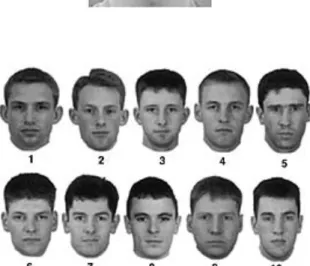
In addition to live person to image matching, poor face-matching performance has also been reported in experiments that replicate the police line up scenario. Bruce, Henderson, Greenwood & Hancock (1999) created a face-matching task based on a police line up situation. Participants had to match a given photograph of a face to one of the face images from a line up of 10 face images presented in an array below the target face (see Figure 1.3). Participants were told that the target face may or may not be present in the array line-up, as would be the case in a real criminal line-up situation. Notably, unlike a real line-up situation, no memory component was involved for the viewer of the faces. All face photographs were taken on the same day, in the same lighting, and in the same pose. The only deliberate modification between images was that the target photograph was taken with a different camera to the array photographs. Despite the consistencies between the target photograph and the correct match in the array line-up, performance
25
was poor. For both the target-present and target-absent array scenarios, accuracy was 70%. Performance accuracy for correctly matching a target to the same identity present in the array remained poor even when participants knew that the target face was present in the array (Bruce et al. 1999; Bruce, Henderson, Newman & Burton, 2001).
Figure 1.3 Example of line stimuli taken from Bruce et al. (1999) line up task. The correct match of the target face is face number 3.
Paired Face-Matching
More recently, work on face-matching ability has focused on paired matching paradigms, in which viewers make identity judgments (same or different) for two faces presented simultaneously. The viewer’s task is to say whether the two faces in the pair presented depict the same person or different people. Face-matching by image is a good model of real world tasks and has important practical applications. For example, police investigations often require accurate matching of an image taken from CCTV footage to another image of the suspect, such as a mug shot. Alternatively, two different face images taken from different CCTV footage may be compared in order to track a person’s
26
movement. As in the experiments described above, the face-matching paradigm involves no memory component – both images are viewed simultaneously and the viewer’s task is to say whether the faces presented are of the same person’s face or are faces of two different people.
To provide a standardised measure of face-matching ability, Burton, White & McNeil (2010) designed a task known as the Glasgow Face-Matching Test (GFMT). The images used to construct this test were taken at a constant viewing distance and same camera angle, under constant lighting conditions, and the expression of the face was unchanged across photographs of the same identity (see Figure 1.4 for examples). Photographs of the same individual were taken only minutes apart, with no deliberate attempt to change the model’s appearance in any way between photographs. Thus, images should have been of optimal condition to allow accurate comparison. Different person trials were created by pairing the faces with the most similar other person’s face image out of those available. Two versions of the GFMT were created – the full version (160 items), and a short version consisting of the 40 most difficult items from the full version. Participants made over 10% of errors in the full version. This performance is considered low, especially considering the controls taken to make the images as similar to each other as possible and given that participants experienced no time limit while completing the task. The short version of the task rendered poorer results, with participants making nearly 20% errors.
27
Figure 1.4 Examples of face pairs taken from the GFMT (Burton, et al. 2010) Top row show different identity pairs, bottom row are same identity pairs.
In summary, these studies successfully and repeatedly demonstrated the real world problem of poor face-matching in a lab environment. However, these findings go against most people’s intuition. People tend to believe that they are good at face recognition (Jenkins & Burton, 2011). It is important to remember the vast majority of face-matching that people are faced with on a daily basis involves familiar faces. People experience regular and repeated success in recognising family members and friends, and do so with very little difficulty.
Familiar Face Matching
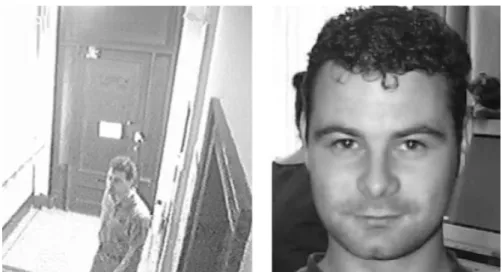
People are extremely good at matching familiar faces, even when image quality is poor. To test this, Burton, Wilson, Cowan & Bruce (1999) designed a face-matching task using poor quality CCTV footage (see Figure 1.5). This matching task was presented to people who were familiar with the faces in the CCTV footage, and also to a group of unfamiliar viewers. Familiar viewers could match the faces in the task with almost perfect levels of accuracy, whereas unfamiliar viewers performed at chance level or highly inaccurately on the exact same task (Bruce, Henderson, Newman & Burton, (2001); Burton, Wilson, Cowan & Bruce (1999).
28
Figure 1.5 Examples of face pairs in the matching task involving poor quality CCTV footage in the experiments conducted by Burton et al. (1999). Familiar viewers performed with high accuracy when matching the face pairs.
This familiarity advantage can be achieved quickly. Megreya and Burton (2006) familiarised participants with faces by showing participants 30 second long video clips of the 40 identities that the participants were told to try and learn as they would see the faces again in a subsequent face-matching task. Even after this brief familiarisation with a target face, participants performed better in the task in trials involving familiarised faces over novel faces. However this advantage only existed for upright faces. When the familiarised face images were inverted, participants performed better on the unfamiliar upright faces than the inverted versions of the familiarised face images. This is likely due to the range of experience that a viewer has with a face and is a topic which will be addressed later in this chapter. Megreya & Burton (2006) concluded that unfamiliar faces are “processed for identity in a qualitatively different way than are familiar faces”. The authors suggested that unfamiliar faces are processed in a similar way to other objects whereas we have a special ability for faces when they become familiar, which relies on a different processing system.
29 Familiarity as a Graded Concept
Many past studies have classified faces as either familiar or unfamiliar. Recently, experiments have demonstrated a graded nature to familiarity, with familiarity with a face increasing as exposure to that face increases. To test for a graded nature of familiarity, Clutterbuck & Johnston (2002) divided the familiarity of faces viewed in their study into 3 levels, rather than treating familiarity as a binary variable. Faces in Clutterbuck & Johnston’s (2002) study were described as being highly familiar, of medium familiarity and unfamiliar. Familiarity distinctions for these celebrity face images were made by a group of eight independent raters. The high and medium familiarity group were created based on the mean familiarity ratings for each face. Unfamiliar faces were faces that were not famous and were not known by the participants. The results demonstrated that participants were fastest at accurately matching full faces to internal features of a face for the faces for the highly familiar faces in the study (Figure 1.6). Speed of correct response decreased as familiarity level decreased across each of the three familiarity groups. All of the faces used for the familiar and medium familiarity groups belonged to celebrities. By breaking familiarity into 3 levels this study begins to separate the level of familiarity of these celebrities which begins to address the issue that not all celebrities are equally well known. However, this method fails to address that different participants in the study may be more or less familiar with different faces to each other.
Figure 1.6 Examples of full-face image on the left was to be matched with either of the internal face images on the right. Familiarity aided matching accuracy on this task.
30
Clutterbuck & Johnston (2004) also demonstrate a graded familiarity advantage for accuracy in a gender judgment task. The authors again distinguished between three levels of familiarity but constructed the familiarity groups in a different way to their previous (Clutterbuck & Johnston, 2002) study. Faces in the gender judgment tasks were either previously familiar (know to the participant before the experiment), of acquired familiarity, or unfamiliar (never seen before the testing phase of the experiment). Participants achieved acquired familiarity by viewing sets of previously unfamiliar images for two second periods, with each face image viewed a total of ten times. The results of the study were that participants were best at the identity judgment task for faces which they were previously familiar with (familiarity was measured by eight independent raters as in Clutterbuck & Johnston, 2002), and gender judgement performance was of higher accuracy for acquired familiarity faces than for the unfamiliar faces. This acquired familiarity method gave a similar pattern of results for face-matching speed (Clutterbuck & Johnston, 2005). Participants were fastest at correctly rejecting mismatch faces when they were previously familiar with them, followed by those for which they had learnt as part of the experiment, and slowest for faces which were unfamiliar at test. The three experiments conducted by Clutterbuck & Johnston (2002, 2004, 2005) suggest that face recognition is influenced not only by whether a face is familiar or not, but by the level of the viewer’s familiarity with the face.
1.3
What Information is used to Recognise a Face?
The literature has shown that people get better at recognising faces when they learn the faces in question, but it is unclear what information from an image viewers actually use to make identity judgments of faces.
There has been much debate in the face recognition literature over which information from a face allows the face to be recognised. The main lines of debate over the information used within a face to aid identification, focus on a featural versus configural
31
nose, mouth), and then using the information from the detail of these features to decide whether the face is known. Configural processing on the other hand, argues that the spatial layout between features is what is important for successful face recognition. According to the holistic processing theory, faces are identified ‘as a whole entity’, with both a match in configural and featural information being important for recognition (Sergent, 1984; Bruce, Hellawell & Hay, 1987). Studies have generally taken the approach that if a manipulation applied to a face image slows down and/or impairs face recognition, then whatever was changed about the face was important for the face recognition process (Donders, 1868/1969).
Featural Accounts
Bradshaw & Wallace (1971) provided one of the first studies to suggest that face recognition is based primarily on the recognition of facial features. Their experiment comprised of images of identikit faces - faces made up of face elements [individual features], which can be combined to make a face. This method is used by police to create an image of a suspect based on a witnesses’ description of the suspect’s face. Participants in Bradshaw and Wallace’s (1971) study viewed pairs of identikit faces and judged whether the image pairs presented showed the same face or different faces. Different parings differed in the number of shared features in the two images. For different person trials, accurate identity judgments were made more quickly as the number of differences in features between the faces increased. On the basis of this result it seemed that participants scanned the face images until they found a mismatch of features across the image pairs. Thus, it was concluded that the results were best explained through a featural account of face recognition. An earlier experiment by Smith & Neilsen (1970) supported this result. They reported that as the number of featural differences between pairs of faces was increased, there was a decrease in the time needed to tell the two faces apart. This suggests that participants were using a feature comparison technique to aid their identity judgment of the face images. These studies looked only at performance for unfamiliar faces, therefore they do not provide information on what is learnt during the familiarisation process with a face.
32
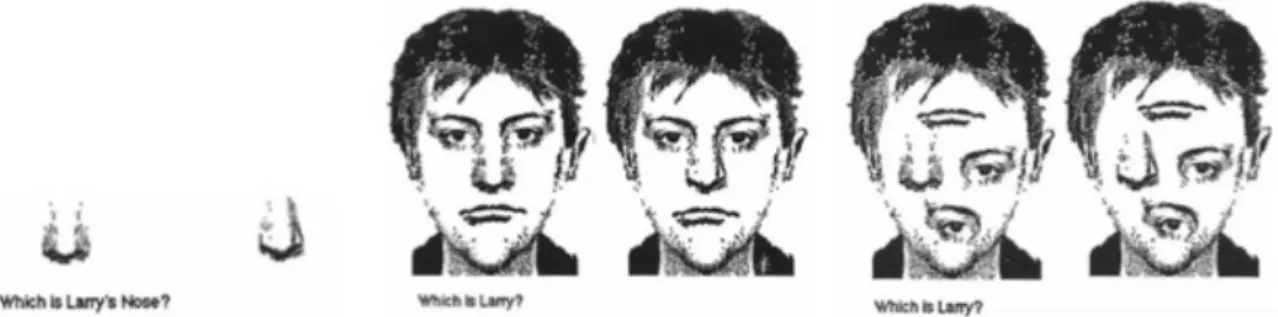
Figure 1.7 Example of test stimuli used by Tanaka & Farah (1993), which shows examples of isolated features, intact faces and scrambled faces.
Further evidence for a featural processing account comes from studies involving scrambled faces. Scrambled face images contain all the featural information as in an intact face image, however the features appear in a jumbled order. Tanaka & Farah (1993) tested whether participants were able to recognise learned identities from scrambled face images, or even from viewing a feature from a face in isolation of the whole face. They reported that participants made identity judgments with moderate accuracy in the context of a scrambled face and also when features belonging to a previously seen identity were viewed in isolation of the rest of the face (see Figure 1.7). This suggests that features, regardless of their configuration or even the presence of the rest of the face, provide information which aids face recognition (Bruyer & Coget, 1987; Tanaka & Farah, 1993).
Configural Processing
In addition to the research that argues for the importance of featural information in face recognition, there is a wealth of research that configural processing is important. Theories of configural processing suggest that the layout of features within a face (1st order configural processing), specifically the metric distances between features in a face (2nd order configural processing) are learnt and used in face recognition. For example, Haig (1984) tested the effect of digitally editing the distance between features of a face, without editing the features themselves in any way, on face recognition performance. Haig (1984) found that even when featural information was present in a highly accessible
33
form (see Figure 1.8 for example stimuli), recognition for unfamiliar faces was severely dampened when subtle changes were applied to the relationship of the layout of the facial features. This supports theories of configural processing.
Figure 1.8 Example images of one identity with features changed in configuration across the different images taken from the study by Haig (1984). Features themselves remain intact, although the exact distances between features are changes.
Many studies on this topic are based on a similar logic; any manipulation that is seen to reduce recognition accuracy or speed is thought to be important for the recognition process. It is believed that configural information is harder to access in an upside down image than in the upright form that people have everyday experience with (Yin, 1969). Familiar orientation had been found to be important for past studies involving object and letter recognition (Henle, 1942; Ghent, 1960), and it is argued that the familiarity factor for upright orientation also exists for face recognition (Yin, 1969). Therefore, if configural information is important for face recognition, performance accuracy would drop in an inverted face memory task, as configural information is more accessible in an inverted than upright face image. Yin (1969) found exactly that result. In general, people show a bias for remembering upright objects, with various upside-down objects proving more difficult to remember (Goldstein, 1965; Hochberg & Galper, 1967), however, faces were
34
disproportionally affected by inversion, with poorer results for remembering faces than objects in the inverted image memory task (Maurer, Grand & Mondloch, 2002; Rossion, 2009). Poorer recognition performance for inverted than upright faces suggests a role for configural information in face recognition. Again, this finding was for unfamiliar faces.
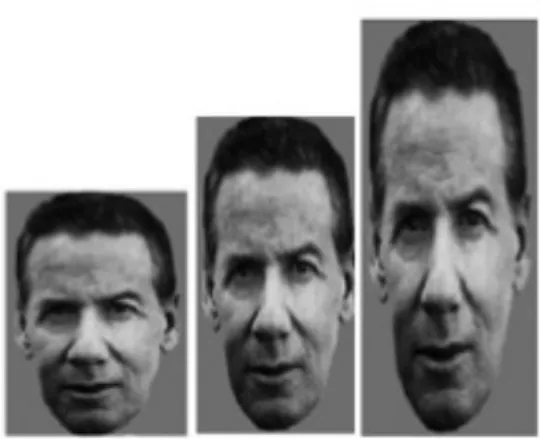
Despite the arguments for configural processing provided by the studies discussed, the usefulness of the content has been queried. Several studies show that configural information in a face can be changed, and faces still successfully recognised. Hole, George, Eaves & Rasek (2002) investigated whether familiar face recognition was affected by drastic changes in the featural layout of the face. They reported that faces could undergo vertical stretching of twice their original height, with no change in face recognition performance for these face images (see Figure 1.9 for example of image stretching). Bindemann, Burton, Leuthold & Schweinberger (2008) added to this finding, as they demonstrated that the N250r ERP response to faces is unaffected by stretching of the face. These findings suggests that neural processes involved in face recognition, and also behavioural face recognition, are unaffected by the configural changes caused by stretching, suggesting that consistent configural information is not important for these processes.
Figure 1.9 Example stimuli from Hole et al. (2002) showing original image, vertical stretch of 150% and 200%.
The configural account has also rendered failure in practical application. Configural processing has failed to provide adequate facial identification results in both early
35
automated face recognition systems (Kelly, 1970; Kanade, 1973), and more recently Kleinberg, Vanezis, & Burton, (2007) presented evidence that anthropometry methods fail to identify targets in forensic investigations.
Are Both Important?
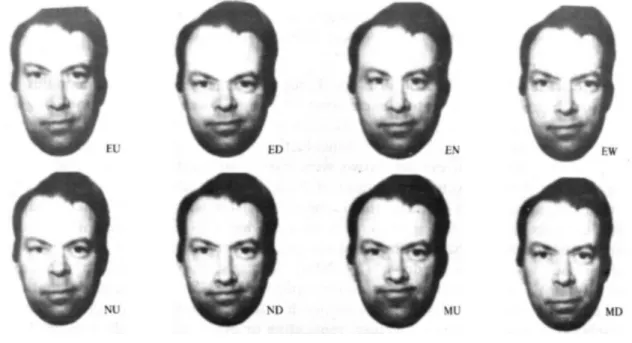
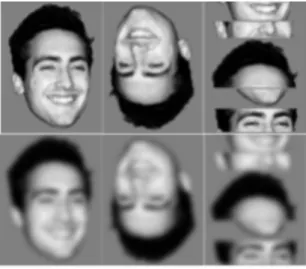
Collishaw & Hole (2000) investigated the effect of a range of face image manipulations on face recognition performance for both familiar and unfamiliar faces (Figure 1.10). Two of these manipulations – scrambled and inverted (upside down) faces – disrupted the configural information in an image, but kept the features themselves intact. Another – blurring – made it very difficult to access the featural information in a face. It was found that the identities in the image, regardless of the viewers familiarity with the identity, could be recognised ‘much of the time’ in all of these situations. Thus, suggesting that as long as one of these processing methods is available, face recognition can take place. Further image conditions – blurred and scrambled, blurred and inverted – were recognised at levels of around chance. This finding reaffirms the need for one of these routes of recognition to be present for successful recognition to occur.
Figure 1.10 Example stimuli from Collishaw & Hole (2000). Top row, from left to right images show the following image conditions: intact, inverted, scrambled. Bottom row images show: blurred, blurred and scrambled, blurred and inverted.
36
In summary, evidence points to neither featural or configural accounts providing a full answer to the face recognition problem for both unfamiliar and familiar face recognition. Images can be difficult to recognise when featural information is present but configuration is changed, and recognition performance can also be poor when configural information is intact, such as in photo-negatives and sketch drawings (Galper, 1970; Davies, Ellis & Shepherd, 1978; Rhodes, Brennan & Carey, 1987; Bruce, 1992; Kemp, 1996). It is also possible that recognition relies somewhat on texture information – something ignored by the configural and featural accounts (Kemp, 1996; Bruce, 1992).
1.4
Learning Variability
It is possible that what is being learnt when becoming familiar with a face, is not in fact a specific factor such as the exact details of features themselves or of facial configuration, but instead an accepted range of appearances for any given face. People are very good at recognising face images for people they are familiar with, providing any new image is similar to those previously experienced, but are poor at recognising people in situations beyond this experience (Bruce, 1994). People vary in appearance naturally across multiple images. This can be a result of changes in expression, pose, hairstyle, skin complexion, clothing and many other variables. Bruce (1982) demonstrated changes in pose or expression between items learned and presented at a later recognition test, lowered recognition accuracy for unfamiliar viewers. Unfamiliar viewers could rely only on the information from their one previous exposure with the face image, and could not generalise this exposure to changes of expression and viewpoint. Familiar viewers performed accurately on the task despite these image changes, as they could call on a large number of previous encounters of the face under different conditions to aid their identity judgments (Bruce, 1982; Burton et al. 1999). Familiar viewers cannot however generalise past experience with a face to aid recognition in the case of novel face transformations. For example, familiar viewers have been found to perform poorly in recognition tasks of photo negative faces and images changed in pigmentation (Bruce & Langton, 1994) – these changes fell outwith the previous range of experience acquired for the familiar faces.
37
Further evidence to suggest that familiar viewers store an accepted range of experiences from a face come from studies on facial configuration. Bruce, Doyle, Dench & Burton (1991) presented participants with a series of face images which were generated using facial image software Mac-a-Mug. Different versions of the same face image were created to provide various configurations of the same face (e.g. the features could be moved up, down, further apart or closer together). Participants were later presented with a series of test image pairs, and asked to identify which image from each of the pairs was identical to an image that they had seen earlier. Accuracy was at ceiling levels for recognition of an identical face. Faces where configurations lay outwith that in the previously seen face images were not recognised at test. However, the central image of those previously viewed (although never itself presented), was also rated as highly familiar, demonstrating that familiar viewers would accept face images which fell inside the range of face images they had experienced for a face, but reject any faces which fell outside this experienced range (Bruce et al., 1991). More recently, Sandford and Burton (2014) asked participants to resize an altered image of a face to make the face ‘look right’. Familiar viewers were no more accurate than non-familiar viewers at this task. If configuration does not remain constant for faces across various images, then it makes sense that there would not be just one accurate configuration, but a range of accepted configurations that could be stored.
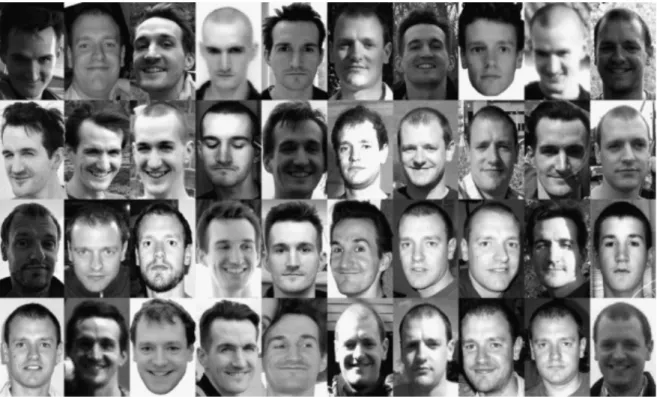
The effect that learning variability has on face-matching accuracy is demonstrated in a study by Jenkins White, Montfort & Burton (2011). First they highlighted the difficulty that variability between photographs of the same face causes in unfamiliar face-matching. Jenkins and colleagues (2011) challenged participants to separate images of cards into piles according to identity. Images of the same identity were to be placed in the same pile. There were in fact only 2 identities - 20 images of each. The 2 identities were Dutch celebrities who were well known in the Netherlands but unfamiliar faces for British viewers. Unfamiliar (British) participants averaged rating of the number of identities present among the cards was 7.5. Familiar viewers (Dutch participants) were then asked to do the exact same task, and easily and accurately separated the faces into the two identities present. This study highlights the range of variation that familiar viewers have
38
stored for an identity and the advantage this holds in identity matching. Figure (1.11) demonstrates some of the many ways that the same faces can vary across images.
Figure 1.11 Example of the card-sorting scenario. Figure shows 20 images of two different identities. Familiar viewers find this task easy whereas unfamiliar viewers generally believe that there are more than two identities present.
Face Space Theory
One influential concept for understanding face recognition by variation is the theory of face space. It is possible that when a new face is encountered, or a previously viewed face takes on an appearance different to the way it looked before, the mental representation for that face image is then stored in that person’s ‘face space’. Valentine (1991) was first to propose the face space model for faces. Valentine argued for a single, although multidimensional, face space, in which faces for all identities are stored. Faces could be stored as a single averaged image for each identity, or individual face images could all be stored within this face space. Valentine believed that faces were organised within this space by dimensions specific to faces. Specifically, faces were proposed to cluster within face space in ways which explain phenomena of face recognition including the own race bias, and typicality effects (Valentine, 1991). There are however shortcomings of this proposal, for example Burton & Vokey (1998) argue that most of the faces within
39
Valentine’s proposed face space are located away from the centre of face space, therefore there are very few ‘typical’ faces.
An alternative formulation of face space would be that instead of one face space encapsulating all faces, in order to account for variation within each individual face, each face may have its own face space. Each face space could be thought of as a multidimensional ‘bubble’ that encapsulates all the ways and range of ways that one face is accepted to look. Any new image would then be compared against the representation held in face space, for that face, and against all other stored identities’ face spaces, in order to make an identity judgment. Expertise would be acquired one face at a time, not for all faces as a class of stimuli.
This formulation is in line with the familiarity advantage, as familiar viewers have had more encounters with a face or been exposed to the face across more varied viewing conditions than an unfamiliar viewer. Thus, when a person is becoming familiar with a face they are learning the different appearances that the specific face can take, and this refines the face space held for that individual. If, as I suggest, identity judgments are made by comparing a new image with the representation of a face stored in that person’s face space, then identification accuracy should increase in alignment with refinement of face space, i.e. familiar viewers will be more accurate as they have a more refined face space than unfamiliar viewers. This means that false match (different identity) items are more likely to fall outwith the range of accepted faces for the target face for familiar than unfamiliar viewers, and true (same identity) images of target will be more likely to be accepted to fall within the accepted range for the target face. It appears that exposure to greater variation with a face increases the likelihood of later correct identity judgments being made (Menon, White & Kemp, 2015).
Within person variability is a strong component of this face space model, as an identity specific face space would encompass the idea that people’s appearance naturally changes
40
across images. Sometimes people can look unlike themselves, or similar to another person, just by chance. This incidental variation between faces is very different to deliberate change in appearance. Whilst people can look incidentally unlike themselves, or like another person they can also make a deliberate attempt to look unlike themselves (evasion disguise) or like another person (impersonation disguise). These appearance changes, both incidental and deliberate (disguise) will be a key theme of challenging images explored in this thesis.
1.5
Face Recognition in Challenging Situations
Past research has demonstrated that people are very good at matching two identical images of a face and that problems instead arise when dealing with matching multiple images of the same face (Bruce, 1982). When the target faces are unfamiliar to viewers, performance on such tasks is very poor (Kemp et al. 1997; Burton et al. 1999; Megreya & Burton, 2006,2007; White et al. 2014). However familiarity with the target faces aids face recognition accuracy in a range of situations (Burton et al. 1999, Bruce et al. 2001, Megreya & Burton, 2006, Jenkins & Burton, 2011). The studies discussed up until this point have tested face recognition where the people who are photographed to provide images for identity comparisons cooperate with the identity effort, i.e. for same person trials the models made no deliberate attempt to change appearance across the different images taken. Furthermore, different person trials were created by selecting the most similar face images from a small number of available images, therefore the different identity images may not look all that similar to each other. Face-matching performance could be even worse for more challenging identity matching scenarios.
As demonstrated above, people can look very different to themselves across different images (Jenkins, 2011). There are also situations where people naturally look very similar in appearance to another person. In addition to incidental change, in real world scenarios people may have strong incentives to create deliberate changes to their appearance - either to evade their own identity (evasion) or to impersonate someone else (impersonation). There may be reasons for a person to hide their identity (evasion) for example if they had been banned from a place but wanted to gain access. Impersonation
41
disguise is also a serious issue. Criminal activities including illegal immigration, the smuggling of drugs, weapons or stolen goods, human trafficking and terrorist activity may involve the use of stolen identity documentation in order to cross borders as someone else. People might choose a passport based on natural similarities with the face. It is also possible that the new document holder will make an effort to look like the photographed face on the document in order to reduce suspicion and successfully pass borders using the stolen identity. Such attempts are made quite frequently, for example, in 2010, 359 people were found guilty in the UK for possessing false or improperly obtained ID. Under the 2006 Fraud Act an additional 7,319 were charged for dishonestly making a false representation to make gain for oneself or another (Home Office, 2012). There have been some attempts to investigate the effect that i) natural/incidental image manipulations; and ii) deliberate disguise manipulations, have on face recognition performance. These will be discussed below.
Natural Image Manipulations
It is likely that there are certain image manipulations that increase the likelihood of these challenging image situations arising. Manipulations including changes in pose and expression have already been found to make identity judgments more difficult across images (Bruce et al. 1982).
It is possible that another simple image manipulation, changing camera-to-subject distance between comparison images, could make same person identity judgments more difficult than comparing images taken at the same distance. Harper & Latto (2007) showed that changing camera-to-subject distance changed perceived weight judgments of a face. This manipulation has not yet been experimentally explored with reference to face recognition ability, however the results suggest that images changed in camera-to-subject distance would be more difficult to ‘tell together’ as perceptions of the face changed as a result of camera-to-subject distance change.