University of Toronto
Department of Economics
May 14, 2008 By Diego Restuccia
The Latin American Development Problem
Working Paper 318The Latin American Development Problem
†Diego Restuccia
University of Toronto
March 2008
Abstract
By international standards, gross domestic product (GDP) per capita in Latin America is low – around one fifth of that of the United States. Moreover, in the last five decades, Latin America has failed to catch-up in wealth to the level of the United States while other countries at similar or even lower stages of development have been successful. The failure to attain higher levels of relative income represents what I call the development problem of Latin America. Using a variety of data, I find that the bulk of the difference in GDP per capita between Latin America and the United States is explained by low GDP per worker and, in particular, low total factor productivity (TFP) in Latin America. I calculate that to explain the difference in GDP per worker, TFP in Latin America must be around 60 percent of the level in the United States. I consider a model with heterogeneous production units where institutions and policy distortions lead to a 60 percent productivity ratio between Latin America and the United States. Removing the barriers to productivity can increase long-run relative GDP per worker in Latin America by a factor of 4. This increase is equivalent to 70-years worth of U.S. post WW-II development.
Keywords: labor productivity, capital, schooling, plant heterogeneity, policy distortions.
JEL Classification: O1.
†This paper was prepared for the workshop “Economic Growth in Latin America” organized by the
United Nations’ Economic Commission for Latin America and the Caribbean (ECLAC), Santiago de Chile, June 2007. I thank workshop participants – specially my discussants Andr´es Solimano and Raimundo Soto for useful comments. All remaining errors are my own. Contact Information: Department of Economics, University of Toronto, 150 St. George Street, Toronto, Ontario, M5S 3G7, Canada. E-mail: [email protected].
1
Introduction
The economic growth experience of Latin America in the last five decades constitutes one of the most interesting episodes in modern development economics. In 1950, GDP per capita in Latin America relative to the United States was 34 percent. By 2005 this statistic had fallen to 22 percent. Not only income is low in Latin American countries, but also it has fallen relative to the industrial leader. This poor economic performance contrasts sharply with other regions and countries at similar or lower stages of economic development in 1950.1
While many countries in Latin America contribute to this relatively poor performance, some countries stand out such as Argentina, Bolivia, Peru, and Venezuela. Broadly speaking, the facts of low and declining relative income motivate what I call the Latin American development problem. What explains this poor economic performance in Latin America?
Using data for 10 Latin American countries, I report the following facts about the devel-opment problem in Latin America.2 First, between 1950 and 2005 Latin America features
low (about 1/5) and declining GDP per capita relative to the United States. Second, in decomposing GDP per capita I find that none of the difference is explained by differences in the amount of work hours, while only 20 percent of the difference is explained by a lower employment to population ratio in Latin America. The bulk of wealth difference steams from
1Duarte and Restuccia (2006) report that in 1960 the average Latin American country represented 34
percent of the GDP per worker in the United States. It also represented more than 2.4 times the GDP per worker of the average country in Asia and about half the GDP per worker of Western Europe. By 2000, the same Latin American countries represented about 25 percent of the GDP per worker in the United States. Whereas Latin American countries lost some ground in productivity relative to that of the United States, Asia overtook Latin America’s labor productivity (Latin America being 73 percent of Asia) and Western Europe increased its advantage to more than 3 times the level of productivity in Latin America.
2The countries are Argentina, Bolivia, Brazil, Chile, Colombia, Ecuador, Mexico, Peru, Uruguay, and
low (about 1/4) GDP per worker in Latin America relative to the United States. Third, in decomposing GDP per worker using an aggregate production function that includes physical and human capital as inputs, I show that almost none of the difference is explained by sys-tematic differences in the physical capital to output ratio, that some difference is explained by differences in the quality and quantity of human capital but that all the difference steams from differences in TFP. This emphasis on the role of TFP in explaining the economic per-formance of Latin America is consistent with the earlier analysis of Elias (1992), Solimano and Soto (2006), among others. I argue that in the context of a model with physical and human capital accumulation TFP in Latin America relative to the United States need only be about 60 percent. Fourth, I report labor productivity in agriculture, industry, and ser-vices to argue that aggregate productivity differences between Latin America and the United States are not the result of sector specific distortions. Therefore, I seek for an economy-wide explanation for low productivity in Latin America.
Given these facts, I then consider a model where institutions and policy distortions in Latin America cause relative measured TFP to be 60 percent of the United States. The model follows Restuccia and Rogerson (2007) in extending the neoclassical growth model to allow for plant heterogeneity. This framework has been extensively used in empirical applications of productivity differences across countries (see for instance Hsieh and Klenow, 2007; Bartelsman, Haltiwanger, and Scarpetta, 2006; Alfaro, Charlton, and Kanczuk, 2007; among others). A related framework has been used for more specific applications of the development problem such as size-dependent policies (Guner, Ventura, and Xi, 2007), finan-cial frictions (Greenwood et al. 2007), restrictions to foreign direct investment (Burstein
and Monge, 2007), among others. In the model plants differ on their factor productivity and reallocation of capital and labor across plants leads to measured TFP differences. In addition, upon entering plants invest in the likelihood of higher productivity. As a result, institutions and policy distortions not only misallocate resources across plants, but also can shift the distribution of plants to lower productivity levels. The class of institutions and policy distortions that I consider is broad and abstract. I quantify the impact of institutions that cause an increase in the cost of entry for plants. There are many examples of these costs (see for instance De Soto, 1986 and Djankov et al. 2002). I also quantify the impact of idiosyncratic distortions that cause a reallocation of resources from the most productive plants to the less productive plants. The type of policies that would effectively cause such a reallocation is also very large including public enterprises, trade and labor restrictions, taxation, competition barriers and excessive regulations, among others. In the calibrated model, I find that these institutions and policy distortions lead to a TFP ratio between the distorted and undistorted economies in the range of 60 to 70 percent. As a result, remov-ing the productivity barriers in Latin America can lead to an increase in relative long-run labor productivity of a factor of 4. Under one metric, this increase in labor productivity is equivalent to 70 years worth of U.S. post-WWII development.
There is an extensive literature analyzing different aspects of the development experience in Latin America. This literature is too vast to cite here but see for instance Solimano and Soto (2006) and the references therein. There is also a recent literature studying country-specific experiences using quantitative models (see for instance Bergoeing et al., 2002; Kyd-land and Zarazaga, 2002; Cole, Ohanian, Riascos, and Schmitz, 2005; among others). Cole
et al. (2005) emphasize the importance of competition barriers in explaining the low pro-ductivity levels in Latin America. Many Latin American experiences have been studied in the context of depression episodes such as Mexico and Chile in the 80’s (see for instance Bergoeing et al., 2002, Bergoeing et al., 2004). While similar forces may lead to TFP to be below trend, the emphasis in this paper is in explaining the low productivity levels in Latin America.
The paper is organized as follows. In the next section I document the basic facts about the development problem in Latin America. I decompose GDP per capita to show that low labor productivity (and in particular low TFP) is at the core of the development problem in Latin America. Section 3 describes a model of TFP and calibrates it to data for the United States. In section 4 I perform a quantitative analysis of institutions and policy distortions in Latin America with a discussion of policy implications. I conclude in section 5.
2
Some Facts
In this section, I document a set of facts about gross domestic product (GDP) per capita and related factors in order to establish what I call the development problem in Latin America. The analysis will serve to guide the search for an explanation of the development problem in Latin America. The period of analysis covers 1950 to 2005 at an annual frequency. I will focus on long-run trends, therefore, the data are trended using the Hodrick-Prescott filter with a smoothing parameter λ= 100. For a detailed description of the data and sources see
2.1
GDP per Capita
The total amount of goods and services produced in a country within a specified period of time provides a summary measure of wealth in a nation. Between 1950 and 2005, GDP per capita has grown for all Latin American countries. But the growth in GDP per capita has not allowed Latin American countries to catch up to the level of more developed economies. I take the United States, which has observed a high level and stable growth rate of GDP per capita for most of the 20th century, as the benchmark against which to compare the economic performance in Latin America. Relative to the United States, GDP per capita in Latin American countries is low and has been declining. Table 1 summarizes these facts. In 1950 Latin America was 34 percent of the GDP per capita of the United States. By 2005 this statistic has declined to 22 percent. This relative decline is highly influenced by the negative economic performances of Venezuela, Uruguay, and Argentina. Figure 1 reports the evolution of GDP per capita in Latin American countries relative to the United States between 1950 and 2005. Relative GDP per capita has been stagnant or declining for Latin American countries during this period. With the exception of Chile in recent years, no other Latin American country has grown at rates substantially above the ones in the United States. This occurs despite Latin American countries observing levels of GDP per capita about one third the level in the United States in 1950. Even though there is substantial room for catch-up in income to the United States, this process has not occurred for Latin American countries. This performance contrasts sharply with the evolution of GDP per capita in other countries at a similar stage of development in 1950. For instance, Italy, Spain, Hong Kong, and Singapore were in 1950 at relative levels similar or below the average of Latin America
(with 37, 23, 23, and 22 percent of GDP per capita of the United States respectively) and were able to catch up substantially to the United States (to 64, 55, 81, and 91 percent in 2005).
Table 1: GDP per Capita in Latin America Relative GDP Annualized Growth
per capita GDP per capita
Country 1950 2005 1950-2005 (%) Argentina 0.49 0.27 0.97 Bolivia 0.20 0.09 0.59 Brazil 0.17 0.19 2.28 Chile 0.38 0.38 2.08 Colombia 0.22 0.18 1.73 Ecuador 0.19 0.15 1.62 Mexico 0.24 0.25 2.14 Peru 0.24 0.14 1.03 Uruguay 0.50 0.25 0.79 Venezuela 0.77 0.27 0.12 Latin America 0.34 0.22 – USA 1.0 1.0 2.08
2.2
Decomposing GDP per Capita
What is the source of the poor economic performance of Latin American economies? We can look beyond the aggregate evolution of GDP per capita and decompose it into three factors as follows. At each date, GDP per capita can be written as:
Y P = Y nE × E P ×n,
where Y /P is GDP per capita, E/P is the employment to population ratio, n is hours per
worker, andY /nE is labor productivity (GDP per labor hour). Hence, the ratio of GDP per
capita between any two countries iand j is given by:
(Y /P)i (Y /P)j = (Y /nE)i (Y /nE)j × (E/P)i (E/P)j × ni nj .
In words, relative GDP per capita between countriesiandjis the product of the ratio of labor
productivity, the ratio of employment to population, and the ratio of hours worked. Hence, a low relative GDP per capita can be the result of low labor productivity, low employment rates, low hours or any combination of these factors. The evidence from Figure 1 indicates that the factor difference in GDP per capita between Latin America and the United States is roughly 1 to 5 (or 20 percent). Which variables in the above decomposition explain a factor of 5 times difference between GDP per capita in the United States and Latin America? I describe these differences in turn.
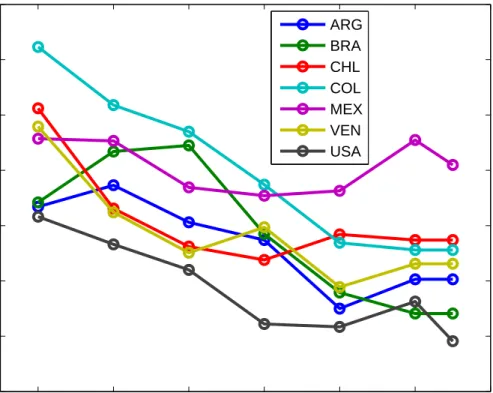
Hours I first examine whether hours of work can account for the low relative levels of GDP per capita in Latin America. There are important limitations in collecting and comparing hours of work across a wide range of countries. Nevertheless the available data suggest that hours of work cannot explain the low relative levels of GDP per capita in Latin America. I use data on annual hours per worker collected by the Conference Board and Groningen Growth and Development Centre (2007) from a number of sources. Figure 2 documents the available time series data for a number of Latin American economies and the United States. As the figure shows, Latin American countries systematically work more hours than the
United States (about 8 percent more in average). Over time, with the exception of Mexico, hours of work have declined for all countries but hours of work remain in about 8 percent higher for Latin American countries relative to the United States. As a result, not only aggregate hours contributes to a small difference between Latin America and the United States, but also hours of work contributes negatively to explaining low relative GDP per capita in Latin America. I conclude then that an explanation of low and declining relative GDP per capita in Latin America cannot be based on differences in hours of work.
Employment to Population Ratio I next examine whether differences in the employ-ment to population ratio can explain the low relative GDP per capita in Latin America. Figure 3 documents the time series for the employment to population ratio across Latin American countries and the United States. While there are some patterns over time that relate to the increasing participation of women in the labor market for all countries (most noticeably for the United States) and while the employment ratio is higher for the United States than most Latin American countries, the difference in the employment ratio can only explain less than 20 percent of the difference in GDP per capita across Latin America and the United States. To see this, notice that the ratio of the employment to population be-tween Latin America and the United States is 0.75 while the ratio of GDP per capita is 0.20, therefore the employment ratio explains less than 20 percent of the difference in GDP per capita (log(0.75)/log(0.20)).
Labor Productivity The previous analysis leaves us with one factor explaining the bulk differences in GDP per capita. That factor is labor productivity or GDP per labor hour.
Since I already established that hours differences are small and stable then the bulk of difference in GDP per capita is explained by differences in GDP per worker between Latin American countries and the United States. Figure 4 reports GDP per worker for Latin America relative to the United States. A simple inspection of Figure 4 together with Figure 1 suggests that indeed the level differences and time path of GDP per capita are well captured by the behavior of GDP per worker. As a summary measure, the average ratio of GDP per worker between Latin America and the United States is 0.25, this explains 86 percent of the difference in GDP per capita (log(0.25)/log(0.20)).
To summarize, the average difference in GDP per capita between Latin America and the United States is accounted for by
(Y /P)LA (Y /P)U S | {z } 1/5 = (Y /nE)LA (Y /nE)U S | {z } 1/4 ×(E/P)LA (E/P)U S | {z } 3/4 × nLA nU S |{z} 1.08/1 .
Hence, the contribution to the difference in GDP per capita between Latin America and the United States is: labor productivity 87 percent, employment ratio 18 percent, and hours -5 percent.
2.3
Decomposing GDP per Worker
To investigate the sources of differences in GDP per worker the standard procedure is to write down an aggregate production function that explicitly states the relevant factors of production. For this purpose, I consider a standard Cobb-Douglas aggregate production
function augmented to include human capital,
Y =AKαH1−α, (1)
whereY is output,K andH are the inputs of physical and human capital services, and Ais
total factor productivity (TFP). Since ultimately I am interested in broadly separating the importance of factor accumulation (human and physical capital) and TFP, I follow Klenow and Rodriguez-Clare (1997) in writing the production function above in intensive form. To do this, first I write aggregate human capital (H) as the product of human capital per worker
(h) and the number of workers (E), i.e., H = Eh. Using this substitution in equation (1),
dividing by Y on both sides, taking Y /E to the left hand side, and rearranging terms I
obtain: Y E =A 1 1−α K Y 1−αα h. (2)
Using equation (2), the ratio of GDP per worker (Y /E) between countries i and j is given
by: (Y /E)i (Y /E)j = Ai Aj 1−1α × (K/Y)i (K/Y)j 1−αα × hi hj . (3)
In words, GDP per worker differences can be the result of three factors: differences in TFP, differences in physical capital to output, and differences in human capital per worker. The goal is to investigate the factors on the right hand side of equation (3) that can account for differences in GDP per worker of 1 to 4 between Latin America and the United States.
Physical Capital I first investigate the importance of physical capital accumulation. I focus on institutions and policies that lead to capital to output ratio differences across countries. Notice that differences in TFP could also cause capital accumulation to differ across countries. But in a broad class of models, FP differences imply no differences in the capital to output ratio. This implication is what leads to the decomposition in equation (2) to be useful in separating the forces directly related to capital accumulation from TFP differences. So the next step is to look for measures of physical capital across countries. Typically the physical capital stock is measured in domestic prices. Cole et al. (2005) and others have used this measure from Nehru and Dhareshwar (1993) in their analysis. In these units the physical capital stock relative to GDP is not systematically different across Latin American countries and the United States (see Figure 5). However, measuring the capital stock at domestic prices may give a biased view of capital accumulation since the price of capital goods is systematically higher in poor relative to rich countries (see for instance Restuccia and Urrutia, 2001). Alternatively, a measure of the capital stock at common international prices can be constructed using investment rates from the Penn World Table. I follow this approach in constructing the capital to output ratio for Latin American countries and the United States (see the Appendix for details). I report these estimates in Figure 6 and Table 2, and the time series of the investment rates from PWT6.1 in Figure 7. The main conclusion I draw from these figures is that capital accumulation as measured by the capital to output ratio is not systematically different between Latin America and the United States. In fact, in 1960 the average capital to output ratio in Latin America was 20 percent above the level in the United States, whereas in 2000 the capital to output ratio was 80 percent of
the level in the United States. Nevertheless, these level differences are too small to account for any substantial portion of the difference in GDP per worker across these countries. For instance, with a capital share of 1/3 (α= 1/3 in equation (3), a 30 percent higher capital to
output ratio translates into a 14 percent higher GDP per worker. I conclude that although there are some relevant country differences in the capital to output ratio, these differences are not systematic and quantitatively substantial to explain differences in GDP per worker of a factor of 4 between Latin American countries and the United States.
Table 2: Physical Capital to GDP Ratio in International Prices
K/Y Country 1960 2000 Argentina 1.42 1.76 Bolivia 1.20 1.09 Brazil 1.95 1.86 Chile 2.71 1.71 Colombia 1.32 1.25 Ecuador 2.65 2.07 Mexico 1.51 1.88 Peru 3.61 2.13 Uruguay 1.77 1.50 Venezuela 2.78 1.82 Latin America 2.09 1.71 USA 1.69 2.14
Human Capital A serious limitation of development accounting studies is the fact that there are no good measures of human capital across countries. In addition, even if these measures were available, it would be difficult to disentangle the role of TFP and other factors in explaining those differences. For this reason, recent studies have used quantitative theory to get at the importance of human capital in development – see for instance Manuelli
and Seshadri (2006) and Erosa, Koreshkova, and Restuccia (2007). There is some available evidence on the quantity of schooling indicating important differences across countries (see Figure 8) but a theory is needed to assess the importance of those differences in human capital and output across countries. How do productivity differences translate into human capital differences across countries? Standard models of human capital accumulation imply a log linear relationship between human capital and income when economies differ on TFP, i.e.,
logh=ch+γlog(Y /E),
where h is human capital per worker, Y /E is output per worker, and ch is a constant.
Substituting this expression for h in equation (2) and ignoring differences in the physical
capital to output ratio, GDP per worker (Y /E) can be expressed as a function of TFP only,
as follows:
Y
E =cyA
1
(1−α)(1−γ), (4)
where cy is a constant. Using equation (4), GDP per worker between countries i and j is
just a function of the ratio of TFP’s raised to some power, i.e.,
(Y /E)i (Y /E)j = Ai Aj (1−α)(11 −γ) . (5)
Differences in TFP across countries lead to differences in physical capital accumulation and human capital accumulation (both in the form of quantity of schooling – years – and on the quality of schooling). These factors can lead to a substantial amplification of TFP differences
across countries. To see how important this mechanism can be, first suppose in equation (5) that γ = 0 and α= 1/3 consistent with the standard one-sector growth model. Then in
order to generate a factor of 4 difference in GDP per worker between the United States and Latin America, a TFP ratio of 2.5 is needed – TFP in the United States would need to be 2.5 times that of Latin America. This number is perhaps too large to be justified empirically. But if instead γ = 1/2, equation (5) would require a TFP ratio of 1.6 in order to achieve
a factor of 4 difference in output per worker. The key question is then how important this amplification mechanism is quantitatively. Or to put it differently, what is a reasonable value for the elasticity parameter summarized by γ?
Total Factor Productivity The relationship implied by equation (5) can be used to establish the difference in TFP between Latin America and the United States that is needed in order to explain a difference in GDP per worker of 1 to 4. Using cross-section heterogeneity across people in the United States, Erosa, et al. (2007) estimate that γ is around 0.46.3
Given this estimated value for γ, equation (5) implies that in order to generate a factor of 4
differences in GDP per worker between the United States and Latin America, TFP must be 60 percent higher in the United States. In the next section I consider a theory of TFP that can potentially explain a productivity difference of this magnitude between Latin America and the United States.
3Roughly speaking, the parameters of the human capital production function that generate an elasticity
of TFP on income across countries also generate an elasticity of heterogeneity across people and their earnings. So section heterogeneity within a country gives some information on the relevant cross-country elasticity.
2.4
Sectoral Labor Productivity
Before I move on to the theory, one last point about the data. An argument could be made about Latin America affecting productivity in specific sectors or distorting activity that af-fects some sectors of the economy more than others. This view of the development problem in Latin America is not consistent with the facts. The evidence from three broad sectors –agriculture, industry, and services– shows that low labor productivity growth relative to the United States is prevalent in all the sectors of the economy. For a summary of these facts see Figures 9, 10, and 11. See also Duarte and Restuccia (2007b) for a more detailed documentation of the data sources and modeling assumptions related to these figures. I con-clude that low labor productivity in Latin America is not the result of sector specific policies or distortions, instead it is an economy-wide phenomenon. All countries go through a pro-cess of structural transformation whereby the agricultural sector is replaced in importance by the industrial sector and later by the service sector. While labor productivity improve-ments in agriculture and specially industry have proven essential in explaining episodes of substantial catch-up in aggregate productivity between new industrialized countries and the United States such as Korea, Japan, Singapore, and many European countries, sectoral labor productivity in Latin America has failed to catch up in all sectors.4
3
A Theory of TFP
I present an extension of a theory of measured total factor productivity developed by Restuc-cia and Rogerson (2007). The theory builds from the industry equilibrium framework of Hopenhayn (1992) embedded into a standard neoclassical growth model. The basic ingredi-ent of the theory is the heterogeneity in total factor productivity across establishmingredi-ents. In the context of this model, the allocation of factors of production across plants leads to a role of policy distortions on aggregate measured TFP differences across countries. I now go onto the details of the model.
3.1
Economic Environment
There is an infinitely-lived representative household with preferences over streams of con-sumption goods at each date described by the utility function,
∞
X
t=0
βtu(Ct),
where Ct is consumption at date t and 0 < β < 1 is the discount factor. Households are
endowed with one unit of productive time in each period and K0 > 0 units of the capital
stock at date 0.
Differently than in the standard neoclassical growth model, the unit of production is the plant. Each plant is described by a decreasing returns-to-scale production function
with capital services k and labor services n as factor inputs. The technology parameter s
varies across plants. I assume that s can take on a discrete and finite number of values,
s ∈ S ≡ {s1, ..., sns}. As in Restuccia and Rogerson (2007), I abstract from variation in s
over time. All plants face an exogenous and constant probability of deathλ. Exogenous exit
realizations are iid across plants and across time.
New plants pay a set-up cost of ce measured in terms of output. After paying this cost a
realization of the plant-level productivity parameter s is drawn but plants can invest in the
likelihood of higher realizations of productivity levels. In particular, incurring the cost c(q)
in units of output, with probabilityq productivity is drawn from the higher productivity set
SH ≡ {snˆs+1, ..., sns} according to a pdf hH(s), while with probability 1−q productivity is
drawn from the lower set SL ≡ {s1, ..., snsˆ} according to pdf hL(s), where nsˆ ∈ {1, ..., ns}.
Draws areiid across entrants and there is a continuum of potential entrants. I denote by Nt
the mass of entry in period t. I parameterize the cost function as
c(q) = Bqφ, B, φ >0.
Feasibility in this model requires:
Ct+Xt+ceNt+c(qt)Nt≤Yt,
where Ct is aggregate consumption, Xt is aggregate investment in physical capital, c(qt) is
the standard neoclassical growth model, the aggregate law of motion for capital is given by:
Kt+1 = (1−δ)Kt+Xt.
I focus on institutions and policies that create idiosyncratic distortions to plant-level decisions as emphasized in Restuccia and Rogerson (2007). The empirical counterpart of these policies will be discussed later. Broadly speaking these policies will be represented by a tax on output of operating plants τ. As in Restuccia and Rogerson (2007), I assume that
τ can take on three values: a positive value reflecting that a plant is being taxed, a negative
value reflecting that the plant is being subsidized, and zero reflecting no distortion for the plant. Different specifications of policy are denoted by P(s, τ) representing the probability
that a plant with productivitys faces policy τ and it is possible that the value of the
plant-level tax rate be correlated with the draw of the plant-plant-level productivity parameter. From the point of view of the plant what matters is the joint probability distribution over s and
τ and I denote this by gH(s, τ) and gL(s, τ) for productivity in the high and low sets. Not
all policy configurations will lead to a balanced budget for the government so I assume that the government imposes a lump-sum tax (or transfer) T to consumers in order to balance
the budget.
3.2
Equilibrium
The analysis focuses exclusively on the steady-state competitive equilibrium of the model. In a steady-state equilibrium the rental prices for labor and capital services are constant as
well as all aggregates in the economy including the invariant distribution of plants in the economy. The consumer’s side of the model is entirely standard so I will skip the details. The important aspect to keep in mind from the consumer’s problem is that the real interest rate in the economy is pinned down by preference parameters and the depreciation rate of the capital stock, i.e., in steady state the real interest rate, denoted by R, is given by
R =r−δ= 1
β −1.
Incumbent Plant’s Problem The decision problem of a plant to hire capital and labor services is static. The per-period profit functionπ(s, τ) satisfies:
π(s, τ) = max
n,k≥0{(1−τ)sk
αnγ−wn−rk}.
It is simple to derive the optimal factor demands from this problem which I denote ¯k and ¯n.
Because both the plant-level productivity and tax rate are constant over time, the discounted present value of an incumbent plant is given by,
W(s, τ) = π(s, τ) 1−ρ ,
where ρ = 1+1−Rλ is the discount rate for the plant, R is the (steady-state) real interest rate,
Entering Plant’s Problem Conditional upon entering, a plant invests c(q) in plant
pro-ductivity. This investment leads to a probability q of drawing plant productivity from the
setSH. I denote the optimal investment decision by ¯q. Potential entering plants make their
entry decision knowing that they face a distribution over potential draws for the pair (s, τ).
The expected value of entering plants is given by,
We = max q ( q X τ,s∈SH W(s, τ)gH(s, τ) + (1−q) X τ,s∈SL W(s, τ)gL(s, τ)−c(q) ) −ce.
Whether a potential entering plant decides to enter or not depends on the expected value of entering We being greater than zero. In an equilibrium with entry, We must be equal to
zero since otherwise additional plants would enter. This condition is typically referred to as the free-entry condition.
Definition of Equilibrium A steady-state competitive equilibrium with entry is a wage rate w, a rental rate r, a lump-sum tax T, an aggregate distribution of plants µ(s, τ), a
mass of entry N, value functions W(s, τ),π(s, τ), We, policy functions ¯k(s, τ), ¯n(s, τ), ¯q for
individual plants, and aggregate levels of consumption (C) and capital (K) such that:
(i) (Consumer optimization) r = 1/β−(1−δ),
(ii) (Plant optimization) Given prices (w, r), the functionsπ,W, andWesolve incumbent
and entering plant’s problems and ¯k, ¯n, ¯q are optimal policy functions,
(iv) (Market clearing) 1 = X s,τ ¯ n(s, τ)µ(s, τ), K = X s,τ ¯ k(s, τ)µ(s, τ), C+δK +ceN+c(¯q)N = X s,τ f(s,¯k,n¯)µ(s, τ),
(v) (Government budget balance)
T +X s,τ τ f(s,k,¯ n¯)µ(s, τ) = 0, (vi) (µis an invariant distribution) µ(s, τ) = N λqg¯ H(s, τ), ∀s ∈SH,∀τ, N λ(1−q¯)gL(s, τ), ∀s∈SL,∀τ.
3.3
Calibration
I calibrate the model to data for the United States assuming that this is an economy with no distortions. The general strategy follows Cooley and Prescott (1995) in calibrating the neoclassical growth model. A period in the model corresponds to one year in the data. The discount factor is selected to match a real rate of return of 4 percent, implyingβ = 0.96. The
parameter controlling decreasing returns to scale at the plant is quantitatively important. I assume α+γ = 0.85. Recent related studies have argued for values around this level, in
calibration procedures and emprical strategies have arrived to similar values (see for instance Veracierto, 2001; Basu and Fernald, 1997; and Atkeson, Khan, and Ohanian, 1996). For more discussion on the implications of this choice see Restuccia and Rogerson (2007). Given this value, I separate α and γ according to the income share of capital and labor (1/3 and 2/3),
henceα= 0.28 andγ = 0.57. The depreciation rate of capitalδ is chosen so that the capital
to output ratio is equal to 2, implying δ= 0.10. The exit rate λis assumed to be 10 percent
consistent with the evidence of job destruction rates in Davis, Haltiwanger, and Schuh (1996) and exit rates of plants in Tybout (2000).
In the economy with no distortions there is a simple mapping between plant-level pro-ductivity and employment. So I choose the range of propro-ductivity to match the range of employment levels in the data. With the lowest plant productivity normalized to one, this calibration implies that the highest productivity is 3.78. I use a log-spaced grid of plant productivity with 100 points, i.e., ns = 100. The next step is to restrict the probability
distributions. I choose nˆs to be 20 percent of ns. With the calibrated distributions this
implies that plants in the set SL represent close to 40 percent of all plants. The mapping
of productivity to employment implies that I can choose values of [qhH(s),(1−q)hL(s)] to
match the distribution of plants across employment sizes. This puts a restriction on the values of q and hH(s) and hL(s). For the cost function c(q), I set φ = 2 and then choose B
so that the equilibrium ¯q = 0.615 which is the value implied by the U.S. plant data. I use
statistics from the U.S. Department of Commerce (1997), Census of Manufactures in order to restrict these distribution. An important property of the U.S. plant data is that there is a large number of plants with a small number of workers and therefore these plants account
Table 3: Distribution of Plants and Employment Share of (%)
Establishments Employment
Workers Data Model Data Model
Less than 10 51.4 51.4 4.0 3.8
Between 10 and 50 31.2 31.2 15.2 13.6
Between 50 and 500 16.0 16.0 48.3 43.8
More than 500 1.4 1.4 32.5 38.8
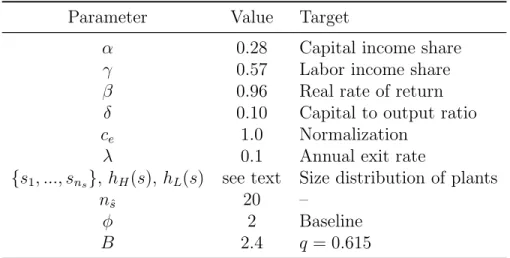
for a small share of the employment in the economy. About 50 percent of the plants have less than 10 workers and these plants account for only 4 percent of the employment, while only half of a percent of plants have more than 2,500 workers and represent 30 percent of the employment. Table 3 reports these statistics from the data and the calibrated economy. As the table shows, the calibrated economy matches the distribution statistics very well. Table 4 summarizes the parameter values and targets for the calibrated economy.
Table 4: Calibration
Parameter Value Target
α 0.28 Capital income share
γ 0.57 Labor income share
β 0.96 Real rate of return
δ 0.10 Capital to output ratio
ce 1.0 Normalization
λ 0.1 Annual exit rate
{s1, ..., sns}, hH(s), hL(s) see text Size distribution of plants
nsˆ 20 –
φ 2 Baseline
4
Quantitative Analysis
I study three types of experiments in the model. First, I consider a modification of the benchmark economy to allow for an increase in the cost of entry of plants ce. This higher
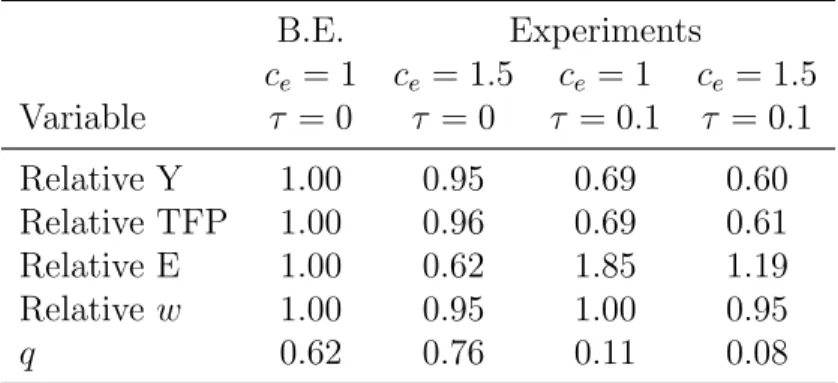
cost of entry is motivated by a variety of evidence for Latin American economies. Second, I consider policies that distort the prices faced by different producers, what Restuccia and Rogerson (2007) call idiosyncratic distortions. In particular, I evaluate a policy configuration where the output of the 50 percent most productive plants gets taxed at the rate of 10 percent and the remaining 50 percent of plants get subsidized. I choose the subsidy rate to maintain capital accumulation as in the benchmark economy. Third, I compute equilibrium for an economy that features the previous two scenarios – a higher entry cost and policy distortions. Tables 5 and 6 summarize the results of these experiments. All statistics (except distributional statistics) are reported relative to the benchmark economy without distortions and with the normalized entry cost of 1.
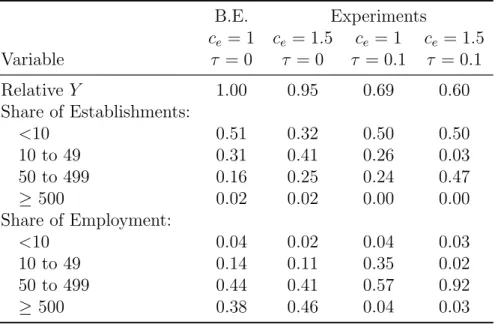
Entry Costs Higher entry costs discourage plants entering the market (see column 2 in Table 5). This reduces productivity compared to the benchmark economy because plant sizes are distorted. With the higher entry cost the average plant has more workers than in the benchmark economy. The aggregate effect of the higher entry cost is not large, it reduces output per worker in about 5 percent compared to the benchmark economy. The effect of the higher entry cost on average establishment size is somewhat mitigated by the fact that the lower wage rate encourages more investment in plant productivity, so q in this economy
Table 5: Aggregate Implications B.E. Experiments ce= 1 ce = 1.5 ce= 1 ce= 1.5 Variable τ = 0 τ = 0 τ = 0.1 τ = 0.1 Relative Y 1.00 0.95 0.69 0.60 Relative TFP 1.00 0.96 0.69 0.61 Relative E 1.00 0.62 1.85 1.19 Relative w 1.00 0.95 1.00 0.95 q 0.62 0.76 0.11 0.08
Idiosyncratic Distortions I now implement a set of policies that create differences in the output prices of different producers. Many policies take effectively this form and Restuccia and Rogerson (2007) study a general configuration of these policies. I set the tax rate to 10 percent and then compute the subsidy rate that leaves capital accumulation the same. Holding capital accumulation constant is motivated by the observations discussed above that capital accumulation is not a fundamental factor in explaining low relative GDP per worker in Latin America. The effect on output per worker is larger for this policy (see Table 5 column 3). Output falls by more than 30 percent. This is mainly the result of a systematic distortion on plants – productive plants become small because of the tax on output while unproductive plants become larger because of the subsidy. This distortion entails a misallocation of resources across plants with different productivity. In addition, the policy leads to decrease in investment in plant productivity soqfalls to 11 percent compared to 61.5
percent in the benchmark economy. This shifts the distribution of plants by employment size to the left, reducing the average establishment size in more than 40 percent. This effect on the average establishment size is consistent with the evidence in Tybout (2000) that production
Table 6: Distributional Implications B.E. Experiments ce = 1 ce= 1.5 ce = 1 ce = 1.5 Variable τ = 0 τ = 0 τ = 0.1 τ = 0.1 RelativeY 1.00 0.95 0.69 0.60 Share of Establishments: <10 0.51 0.32 0.50 0.50 10 to 49 0.31 0.41 0.26 0.03 50 to 499 0.16 0.25 0.24 0.47 ≥ 500 0.02 0.02 0.00 0.00 Share of Employment: <10 0.04 0.02 0.04 0.03 10 to 49 0.14 0.11 0.35 0.02 50 to 499 0.44 0.41 0.57 0.92 ≥ 500 0.38 0.46 0.04 0.03
in developing countries takes place in smaller units (see Table 6). When combined with higher entry costs, policy distortions create a fall in output per worker and productivity of almost 40 percent (see Table 5 column 4). This is the magnitude in productivity that is needed to generate an output per worker difference between Latin America and the United States when capital accumulation is augmented to include human capital.
Discussion While the policy experiments considered above are simplified and abstract, they capture the essence of the empirical evidence on the cost of doing business in Latin America relative to developed countries and the systematic bias against large and productive establishments. I briefly discuss some of this evidence. There is abundant evidence on the higher cost of doing business in Latin America. The most well-known empirical cases are De Soto (1986) and Djankov, La Porta, Lopez-de-Silanes, Shleifer (2002). For instance, according to the data on barriers to entry in Djankov et al. (2002), Latin American countries
Table 7: Barriers to Entry in Latin America Country Cost USA 2 Chile 24 Argentina, Colombia ≈ 35 Brazil 45
Peru, Uruguay, Venezuela ≈ 53
Mexico 83
Ecuador 91
Bolivia 300
have a cost of entry for firms – a measure of cost of entry (time and goods) relative to per capita GDP – that ranges between 20 to 300 percent. These costs represent less than 2 percent in developed economies. (See some of these figures in Table 7.) More recently, the World Bank has collected systematic data for a large number of countries ranking them in categories such as starting a business, dealing with licences, protecting investors, enforcing contracts, trade and other restrictions. The data is reported every year, the most recent being Doing Business 2008 (see World Bank, 2008). Not surprisingly, Latin American economies rank at the bottom on most of these measures. (See also Fantoni, 2007). Broader measures of regulation and their effect on economic performance have been constructed and analyzed by Loayza, Oviedo, and Serven (2007). Again these indices indicate that Latin America has an overly regulated economy, many of these restriction impose higher costs of operating a business but many of them become a de facto tax on large and productive firms. For instance, Galindo, Schiantarelli, and Weiss (2007) document the empirical evidence from developing countries that financial reforms affect the allocation of investment, leading to higher productivity.
5
Conclusions
In this paper I make two main points. First, I show that low and declining GDP per capita in Latin America relative to the United States (what I call the development problem of Latin America) is due to low and declining relative total factor productivity. In other words, the development problem of Latin America is a productivity problem. I calculate that in order to explain a factor of 1 to 4 difference in GDP per worker between Latin America and the United States only a 1 to 1.6 difference in TFP would be needed. The larger difference in GDP per worker arises as an amplification of productivity through physical and human capital accumulation. Second, I consider a framework where institutions and policy distortions create a misallocation of factors across heterogeneous producers that explains the low relative productivity in Latin America. Barriers to formal market entry, regulation and barriers to competition, trade barriers and employment protection, among others may be at the core of productivity differences between Latin America and the United States. Removing these barriers can lead to an increase in long-run relative GDP per worker in Latin America of a factor of 4. This increase in income amounts to 70 years worth of U.S. post-WWII development.
References
[1] Alfaro, L., Charlton, A., and Kanczuk, F. (2007) “Firm-Size Distribution and Cross-Country Income Differences,” manuscript, Harvard Business School.
[2] Atkeson, A. and Kehoe, P. (2005) “Modelling and Measuring Organizational Capital,”
Journal of Political Economy, 113, pp. 1026-53.
[3] Atkeson, A., Khan, A., and Ohanian, L. (1996) “Are Data on Industry Evolution and Gross Job Turnover Relevant for Macroeconomics?”Carnegie-Rochester Conference Se-ries on Public Policy, 44, pp. 215-39.
[4] Barro, R. and Lee, J. (2000) “International Data on Educational Attainment: Updates and Implications,” CID Working Paper No. 042, April.
[5] Basu, S. and Fernald, J. (1997) “Returns to Scale in U.S. Production: Estimates and Implications,” Journal of Political Economy, 105(2), pp. 249-83.
[6] Bartelsman, E., Haltiwanger, J., and Scarpetta, S. (2006) “Cross-Country Differences in Productivity: The Role of Allocative Efficiency,” manuscript, University of Maryland. [7] Bergoeing, R., Kehoe, P., Kehoe, T., and Soto, R. (2002) “A Decade Lost and Found:
Mexico and Chile in the 80s,” Review of Economic Dynamics, 5(1): pp. 166-205. [8] Bergoeing, R., Loayza, N., and Repetto, A. (2004) “Slow Recoveries,” Journal of
De-velopment Economics 75: pp. 473-506.
[9] Burstein, A. and Monge, A. (2007) “Foreign Know-How, Firm Control, and the Income of Developing Countries,” National Bureau of Economic Research Working Paper 13073. [10] Cohen, D. and Soto, M. (2007) “Growth and Human Capital: Good data, Good
Re-sults,” Journal of Economic Growth12: pp. 5176 (DOI 10.1007/s10887-007-9011-5). [11] Cole, H., Ohanian, L., Riascos, A., and Schmitz, J. (2005) “Latin America in the
Rearview Mirror,” Journal of Monetary Economics, 52: pp. 69-107.
[12] Conference Board and Groningen Growth and Development Centre (2007). Total Econ-omy Database. January.
[13] Cooley, T. and Prescott, E. C. (1995) “Economic Growth and Business Cycles,” in
Frontiers of Business Cycle Research,ed. T. Cooley. New Jersey: Princeton University Press.
[14] Davis, S., Haltiwanger, J., and Schuh, S. (1996) Job Creation and Destruction, The MIT Press: Cambridge, Massachusetts.
[15] De Soto, H. (1986) El Otro Sendero. Editorial Sudamericana.
[16] Djankov, S., La Porta, R., Lopez-de-Silanes, F., and Shleifer, A.( 2002) “The Regulation of Entry,” Quarterly Journal of Economics, 67(1): 1-37.
[17] Duarte, M. and Restuccia, D. (2006) “The Productivity of Nations,” Federal Reserve Bank of Richmond Economic Quaterly 92 (3) Summer, pp. 195-224.
[18] Duarte, M. and Restuccia, D. (2007a) “The Structural Transformation and Aggregate Productivity in Portugal,” Portuguese Economic Journal 6, pp. 23-46.
[19] Duarte, M. and Restuccia, D. (2007b) “The Role of the Structural Transformation in Aggregate Productivity,” manuscript, University of Toronto.
[20] Elias, V. (1992) Sources of Growth: A Study of Seven Latin American Economies. San Francisco; ICS Press.
[21] Erosa, A., Koreshkova, T., and Restuccia, D. (2007) “How Important is Human Capital? A Quantitative Theory Assessment of World Income Inequality,” Working Paper 280, University of Toronto.
[22] Fantoni, R. (2007) “Checking Latin America’s Vital Signs,” The McKinsey Quarterly,
special edition.
[23] Galindo, A., Schiantarelli, F., and Weiss, A. (2007) “Does Financial Liberalization Improve the Allocation of Investment? Micro-evidence from Developing Countries,”
Journal of Development Economics, 83: pp. 562-87.
[24] Greenwood, J., Sanchez, J., and Wang, C. (2007) “Fianncing Development: The Role of Information Costs,” National Bureau of Economic Research Working Paper.
[25] Guner, N., Ventura, G. and Xu, Y. (2007) “Macroeconomic Implications of Size-Dependent Policies,” Review of Economic Dynamics, forthcoming.
[26] Heston, A., Summers, R., and Atten, B. (2002) Penn World Table Version 6.1, Center for International Comparisons at the University of Pennsylvania (CICUP),
<http://pwt.econ.upenn.edu>.
[27] Kydland, F. and Zarazaga, C. (2002) “Argentina’s Lost Decade,” Review of Economic Dynamics 5(1): pp 152-65.
[28] Hopenhayn, H. (1992) “Entry, Exit, and Firm Dynamics in Long Run Equilibrium,”
Econometrica 60: 1127-50.
[29] Hsieh, C. and Klenow, P., 2007, “Missallocation and Manufacturing TFP in China and India,” manuscript , Stanford University.
[30] Klenow, P. and A. Rodriguez-Clare, 1997, “The Neoclassical Revival in Growth Eco-nomics: Has it Gone Too Far?,” NBER Macroeconomics Annual. University of Chicago Press.
[31] Loayza, N., Oviedo, A., and Serven, L. (2007) “Regulation and Macroeconomic Perfor-mance,” manuscript, the World Bank.
[32] Manuelli, R. and Seshadri, A. (2006) “Human Capital and the Wealth of Nations,” manuscript, University of Wisconsin.
[33] Nehru, V. and Dhareshwar, A. (1993) “A New Database on Physical Capital Stock: Sources, Methodology, and Results. Revista de Analisis Economico8(1): pp. 37-59. [34] Restuccia, D. and Rogerson, R. (2007) “Policy Distortions and Aggregate Productivity
with Heterogeneous Plants,” National Bureau of Economic Research Working Paper No 13018.
[35] Restuccia, D. and Urrutia, C. (2001) “Relative Prices and Investment Rates,” Journal of Monetary Economics, 47(1): pp. 93-121.
[36] Solimano, A. and Soto, R., (2006) “Economic Growth in Latin America in the Late Twentieth Century: Evidence and Interpretation,” in Vanishing Growth in Latin Amer-ica, The Late Twentieth Century Experience, A. Solimano Ed., Edward Elgar Publish-ing: Massachusetts.
[37] Tybout, J. (2000) “Manufacturing Firms in Developing Countries: How Well Do They Do, and Why?” Journal of Economic Literature, 38(1): 11-44.
[38] U.S. Department of Commerce (1997), Census of Manufactures.
[39] Veracierto, M. (2001) “Employment Flows, Capital Mobility, and Policy Analysis,”
International Economic Review 42(3): 571-95.
A
Data Sources and Definitions
The data covers 10 Latin American countries. These are Argentina, Bolivia, Brazil, Chile, Colombia, Ecuador, Mexico, Peru, Uruguay, and Venezuela. For most countries the time series include data from 1950 to 2005. The main source of data is the Conference Board and Groningen Growth Centre (2007).
I use data from Penn World Tables version 6.1. (see Heston, Summers, and Aten, 2002) to construct annual time series of PPP-adjusted investment to GDP ratio. This series cover the period 1950 to 2003 for all countries. I use the investment rates at international prices to obtain a measure of physical capital to output ratio (K/Y)at international prices. I proceed as follows: (1) Estimate K/Y in 1954 using the average I/Y from PWT 1950-54 and the steady-state relationship implied by a standard Solow model, i.e.,K/Y = (n+gI/Y+δ+ng) where n is the growth rate of population, g is the growth rate of productivity, and δ is the depreciation rate of capital. I assume δ2 ≡n+g+ng+δ = 0.10. (2) Use I/Y to compute
K/Y over time using the standard capital accumulation equation Kt+1 = (1−δ)Kt+It.
This implies, Kt+1 Yt+1 = ˆgt× h (1−δ)Kt Yt + It Yt i
where ˆg is the gross growth rate of output (growth in output per capita times population growth).
The physical capital stock in domestic prices is from Nehru and Dhareshwar (1993). The sectoral data is from Duarte and Restuccia (2006) for details see the appendix. Data on years of schooling is from Cohen and Soto (2007) (see also Barro and Lee, 2000). All series are trended using the Hodrick-Prescott filter with a smoothing parameter λ= 100 before any ratios are computed.
Figure 1: GDP per Capita relative to the United States 1960 1980 2000 0 0.2 0.4 0.6 0.8 1 ARG BOL BRA 1960 1980 2000 0 0.2 0.4 0.6 0.8 1 CHL COL ECU 1960 1980 2000 0 0.2 0.4 0.6 0.8 1 MEX PER 1960 1980 2000 0 0.2 0.4 0.6 0.8 1 URY VEN
Figure 2: Annual Hours per Worker 1950 1960 1970 1980 1990 2000 2010 1700 1800 1900 2000 2100 2200 2300 2400 ARG BRA CHL COL MEX VEN USA
Figure 3: Employment to Population Ratio 1950 1960 1970 1980 1990 2000 0.2 0.25 0.3 0.35 0.4 0.45 0.5 ARG BOL BRA CHL COL ECU MEX PER URY VEN USA
Figure 4: GDP per Worker relative to the United States 1960 1980 2000 0 0.2 0.4 0.6 0.8 1 ARG BOL BRA 1960 1980 2000 0 0.2 0.4 0.6 0.8 1 CHL COL ECU 1960 1980 2000 0 0.2 0.4 0.6 0.8 1 MEX PER 1960 1980 2000 0 0.2 0.4 0.6 0.8 1 URY VEN
Figure 5: Physical Capital to GDP Ratio (Domestic Prices) 19501 1960 1970 1980 1990 1.5 2 2.5 3 3.5 4 4.5 ARG BOL BRA CHL COL ECU MEX PER URY VEN USA
Figure 6: Physical Capital to GDP Ratio (International Prices) 1960 1970 1980 1990 2000 0.5 1 1.5 2 2.5 3 3.5 4 ARG BOL BRA CHL COL ECU MEX PER URY VEN USA
Figure 7: Investment to GDP Ratio 19505 1960 1970 1980 1990 2000 10 15 20 25 30 35 40 45 ARG BOL BRA CHL COL ECU MEX PER URY VEN USA
Figure 8: Average Years of Schooling 19502 1960 1970 1980 1990 2000 2010 4 6 8 10 12 14 ARG BOL BRA CHL COL ECU MEX PER URY VEN USA
Figure 9: Value Added per Worker – Agriculture 19500 1960 1970 1980 1990 2000 0.05 0.1 0.15 0.2 0.25 0.3 0.35 0.4 0.45 ARG BOL BRA CHL COL MEX PER VEN
Figure 10: Value Added per Worker – Industry 19550 1960 1965 1970 1975 1980 1985 1990 1995 2000 0.2 0.4 0.6 0.8 1 1.2 1.4 1.6 1.8 ARG BOL BRA CHL COL MEX PER VEN
Figure 11: Value Added per Worker – Services 19550 1960 1965 1970 1975 1980 1985 1990 1995 2000 0.1 0.2 0.3 0.4 0.5 0.6 0.7 0.8 0.9 1 ARG BOL BRA CHL COL MEX PER VEN